

Meta expands automated audience targeting options in latest AI push
Written on January 25, 2024 at 2:20 pm, by admin
Meta’s Advantage detailed targeting is now available on all campaign objectives and optimizations.
The decision to expand access to this automated audience targeting feature comes just weeks after the tech giant announced plans to sunset detailed manual ad targeting categories for sensitive topics.
Why we care. Leveraging AI in advertising can enhance campaign performance for advertisers. However, there is a growing concern among some that the potential lack of control may lead to the opposite outcome, causing inefficient allocation of ad budgets that becomes challenging to oversee and manage.
What is Advantage detailed targeting? Advantage detailed targeting, a product available within Meta’s Advantage product suite, leverages AI and machine learning technology to identify a broader range of high-valuable customers for your campaign than the initial specified audience group.
Affected campaigns. Meta’s Advantage detailed targeting is now available for:
- Campaigns that are optimized for Impressions, Video views, Reach, Engagement or ad recall lift.
- Campaigns that are optimized for Leads.
- Campaigns that are optimized for Link clicks or Landing page views.
Next steps. To launch this update, you will need to ask your site developer to make changes to the code in Meta’s Marketing API. Developers have until April 22 to complete the implementation of these code changes.
Deep dive. Read Meta’s announcement in full for more information.
Courtesy of Search Engine Land: News & Info About SEO, PPC, SEM, Search Engines & Search Marketing
Category seo news | Tags:
Social Networks : Technorati, Stumble it!, Digg, de.licio.us, Yahoo, reddit, Blogmarks, Google, Magnolia.
YouTube advertising: The ultimate guide
Written on January 25, 2024 at 2:20 pm, by admin
With billions of users worldwide, one of the lowest advertising costs and the growing preference for video, YouTube has some serious marketing potential.
Aside from the well-known organic side of YouTube, it also offers highly lucrative marketing tools: retargeting video and display ads.
Combined with other marketing channels, you can become a strong contender for driving brand awareness and generating leads and sales.
But first, you have to make sure your target audience doesn’t just skip your ads.
Learn how to create an effective YouTube advertising strategy with this comprehensive guide.
Is YouTube a good way to advertise?
YouTube has 2.1 billion users worldwide, bringing in over $29 billion in ad revenues annually. This success is likely because 59% of viewers find YouTube’s ads more relevant than those on TV or other streaming services. Over time, more relevant ads lead to higher conversion rates and stronger brand loyalty.
You have a unique opportunity to adapt video ads into various ad formats. For example, one emerging trend is the rise in vertical videos. Vertical videos allow users to watch a video in full screen without having to rotate their phone.
Recently, Google found that in some cases, just by adding a vertical video asset to a video action campaign, you can reach 10 to 20% more conversions compared to only offering horizontal videos for YouTube Shorts.
Despite being a highly popular organic search engine with clear benefits, YouTube is underutilized by many companies. When combined with other channels, YouTube ads become a key retargeting touchpoint crucial for driving conversions and achieving business success.
How much does YouTube advertising cost?
Generally speaking, YouTube ad costs start at $10 per day. There’s no minimum spend, so your ad expenses depend on the allocated daily budget. Factors that influence cost include:
- Advertising goals: Are you looking to increase brand awareness, drive website traffic, or generate leads? Your goals influence the type of ads you run and the budget required.
- Target audience: If your audience is active on YouTube and you want to reach a large number of viewers, you might need a higher budget. But you’ll also need to filter the audience targeting settings to show your ad only to relevant users, which then helps optimize costs.
- Ad format: YouTube offers various ad formats and each format has different pricing structures, so your budget should align with the chosen format.
- Competition: If there is a high demand for ads targeting your audience, it might be necessary to allocate a larger budget to stand out. But you can also combat this by developing a stronger niche and filtering audience targeting to reduce costs.
- Ad placement: Where your ads appear on YouTube (e.g., in-stream, in-display, or homepage) affects costs. Keep in mind that premium placements may require a higher budget. So, when deciding where ads go, consider where your target audience is most likely to benefit from seeing them.
- Cost-per-click (CPC) or Cost-per-thousand-impressions (CPM): Decide whether you want to pay for clicks (CPC) or impressions (CPM), as the pricing model you choose will impact your budget strategy. If you want the user to view more of your video ad, you might consider focusing on CPM, but if you want users to come to a landing page, you might consider focusing on CPC.
Types of YouTube ads
YouTube comes with various ad formats, so you can deeply hone in on what your target audience engages with the most. YouTube ad formats include:
Display ads
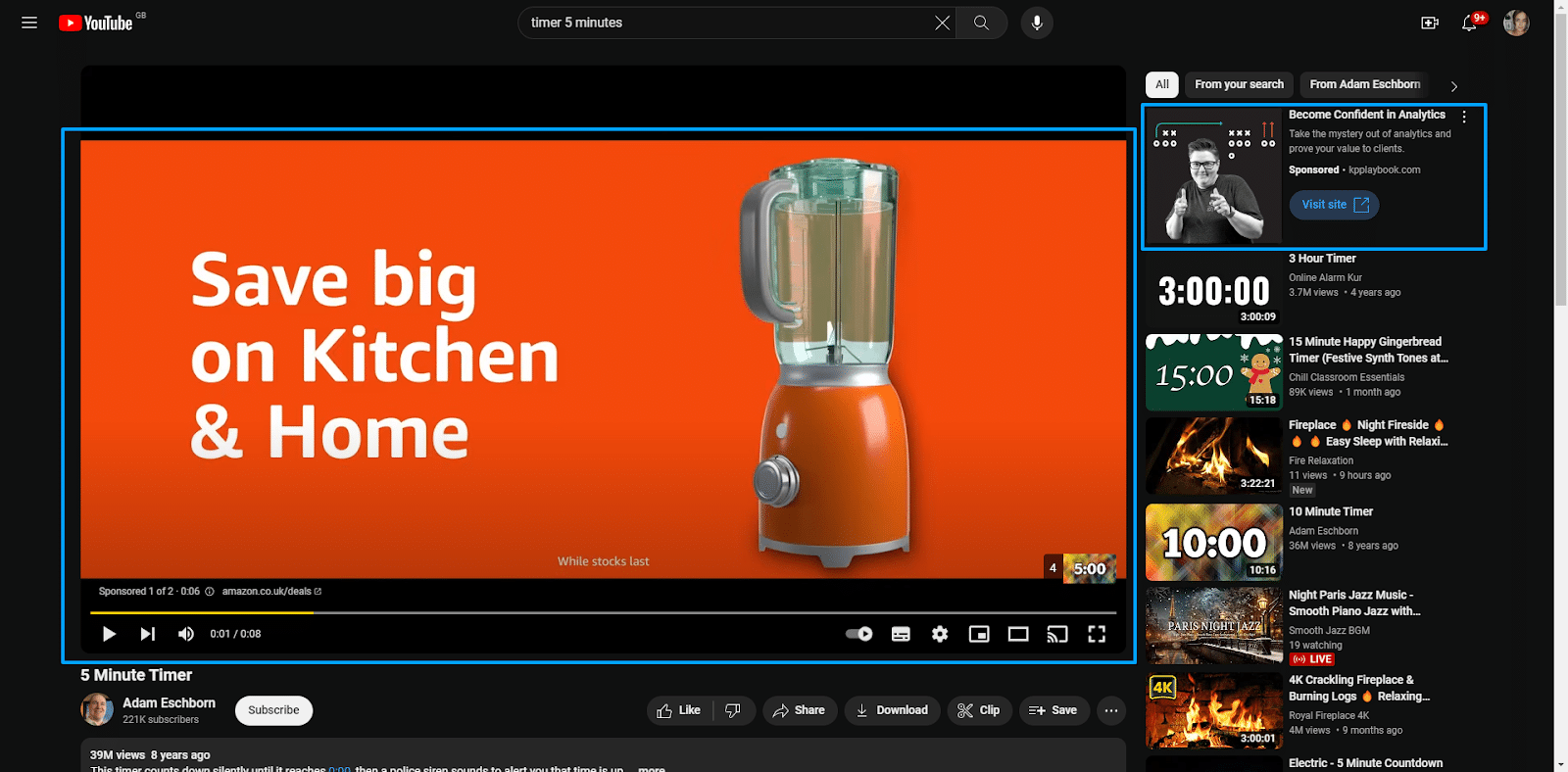
- These ads are positioned above the video suggestions on the sidebar when YouTube isn’t in full-screen view and appear next to the feature video.
TrueView ads
- When a user searches for specific content, then the ads are displayed on the same screen within the search results.
- TrueView Ads come in a few different formats:
- In-stream ads: Video ads that can be skipped after 5 seconds that appear before, during, or after the main video content.
- Non-skippable ads: Limited to 15 seconds, these short ads must be watched in full before users can view the main video content.
- Long, non-skippable ads: Limited to 30 seconds, these longer ads must be watched in full before users can view the main video content.
- To give you an idea of the visual placement, here’s an example of a TrueView skippable ads and Display ads.
Overlay ads
- These are semi-transparent ads that overlay the primary video content, though they can be clicked to close. They usually occupy 20% of the space below your video.
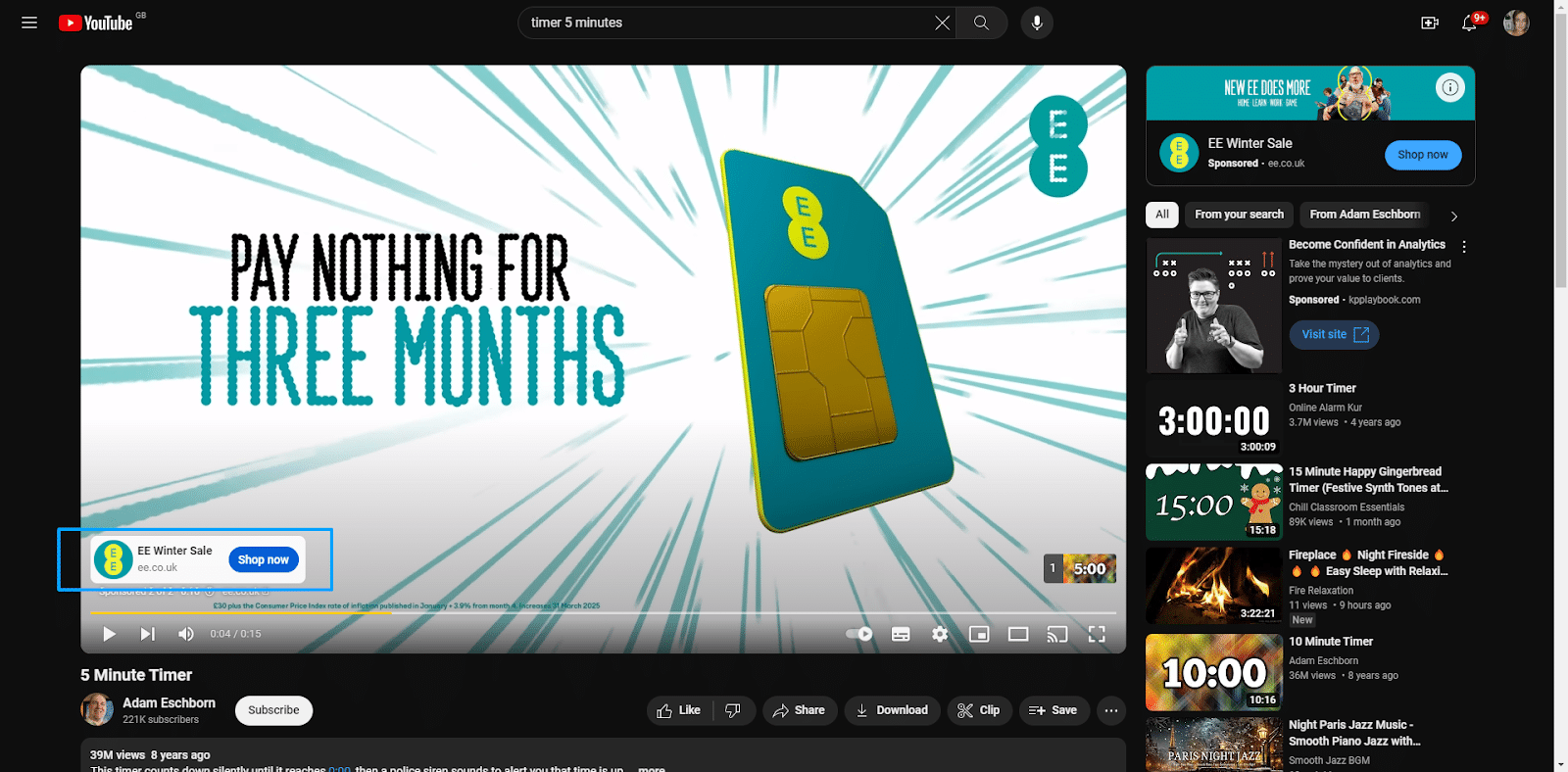
Sponsored cards
- These ads have cards with relevant content, allowing you to run ads featuring upcoming products within videos without interrupting the content.
- They are typically displayed for a few seconds, then disappear. To give you a visual idea of sponsored cards, take a look at the image below:
Video discovery ads
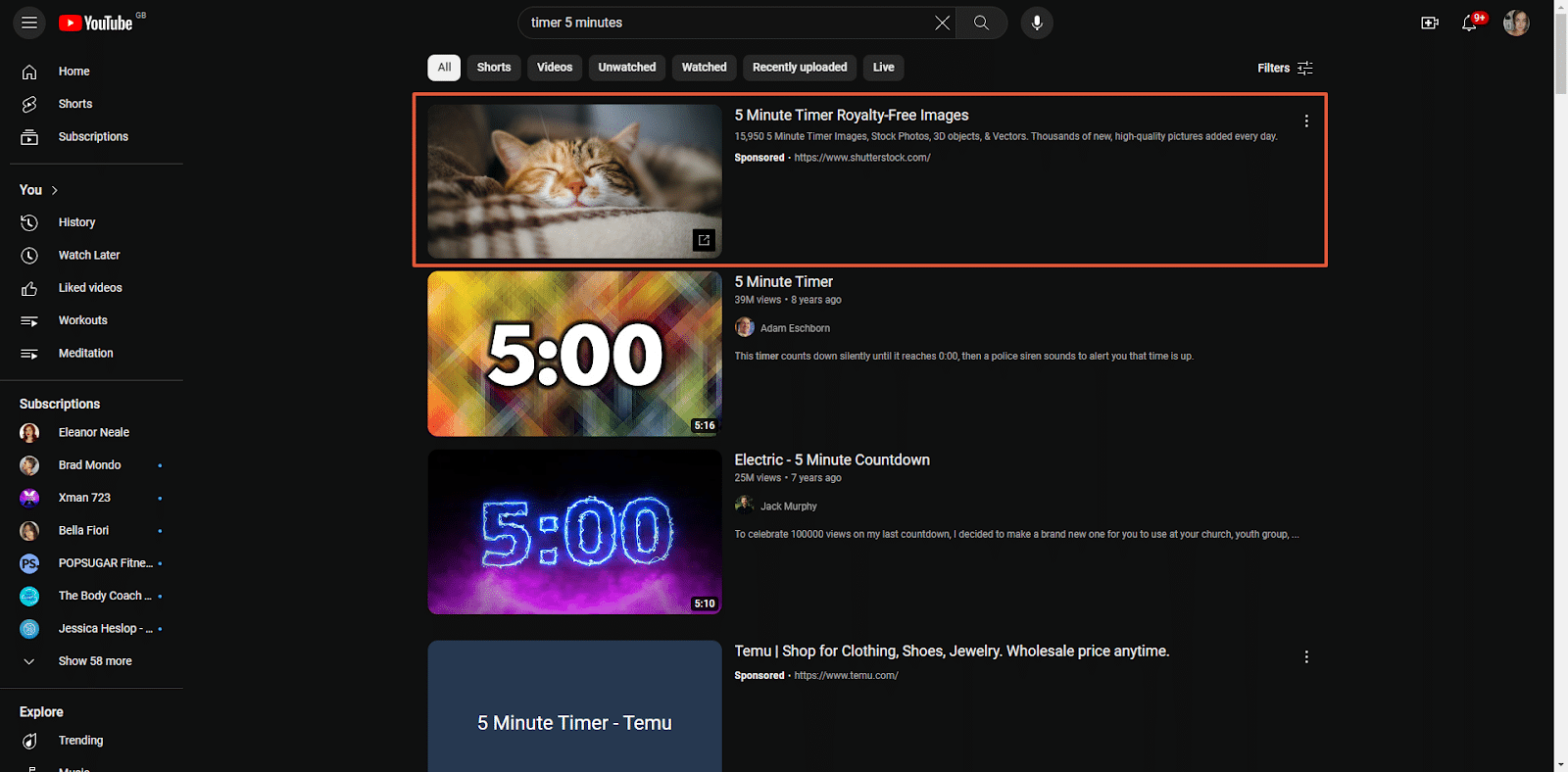
- Similar to Google SERPs, these ads appear in the YouTube search results and alongside related videos on the watch page.
- The search results list the promo videos at the top, then the organic results. Users can also hover over the thumbnails to see a video preview.
- To give you an idea of what this looks like, check out the image below:
Dig deeper: 3 key trends reshaping YouTube marketing today
How to advertise on YouTube in 7 steps
Like any marketing strategy, advertising on YouTube requires plenty of research, crafting a strategic approach, and analyzing your success. To help, I’ve broken the process down into seven actionable steps:
- Identify your target audience
- Choose your ad types
- Create your bid and targeting strategies
- Establish campaign structure based on intent stage (BoFu, MoFu, ToFu)
- Prepare your videos
- Set up and monitor GA4 conversion tracking
Now let’s take a look at these steps in detail.
Step 1: Identify your target audience
Before getting too deep into your YouTube ad content creation, you must understand your target audience and how to engage them. You can then enter this into YouTube to help you get in front of the right people.
Thanks to a recent update to YouTube’s audience insight tools, you can precisely define your target audience within each ad group and choose where your ads should appear.
There are several different targeting options in this update, allowing for customization across several categories:
Demographics
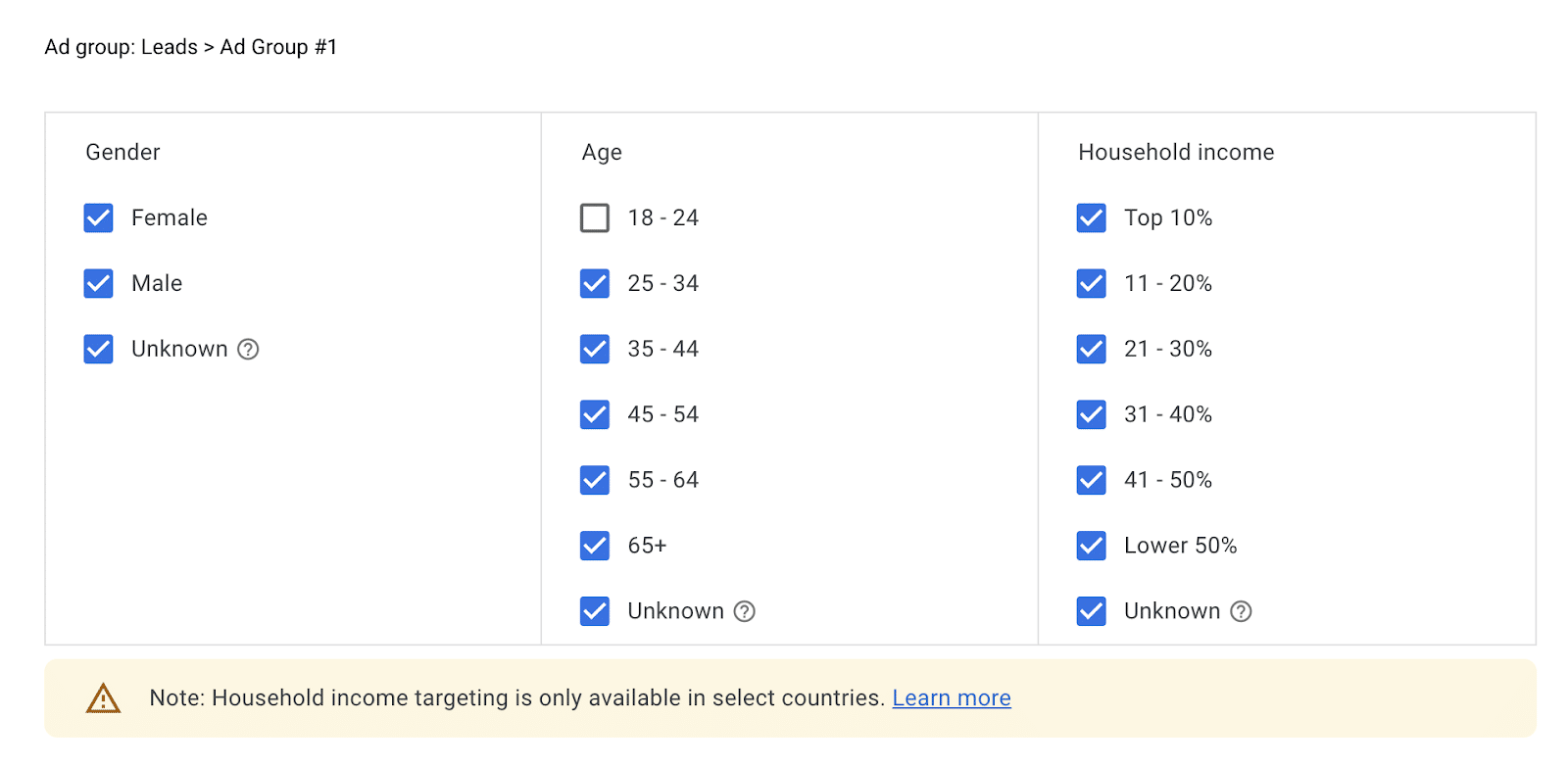
With this broad targeting option, you can clearly define the specifics of your audience. This allows you to reach your audience based on gender, age, and household income.
While it’s a great tool, remember that using demographics alone could result in lower returns and engagement, as a one-size-fits-all message might not resonate with such a diverse audience.
Audience segments
This lets you strategically target people with specific demographics, interests, and behaviors.
Essentially, these create a subgroup within your general target audience to help explore more specific groups based on the identified parameters.
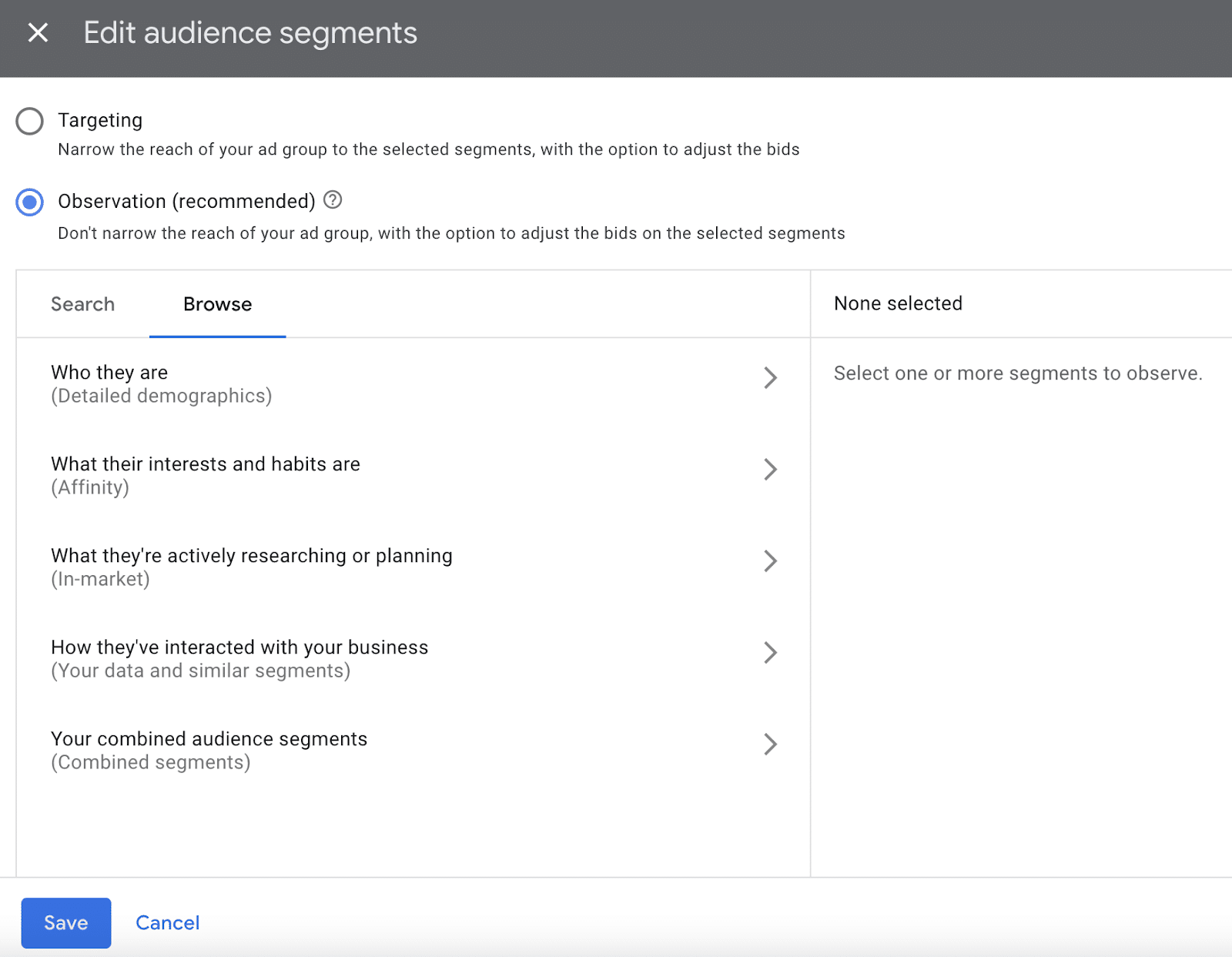
To refine your targeting, segments can include:
- Detailed demographics.
- Affinities.
- In-market.
- Your data and similar or combined segments.
Detailed demographics
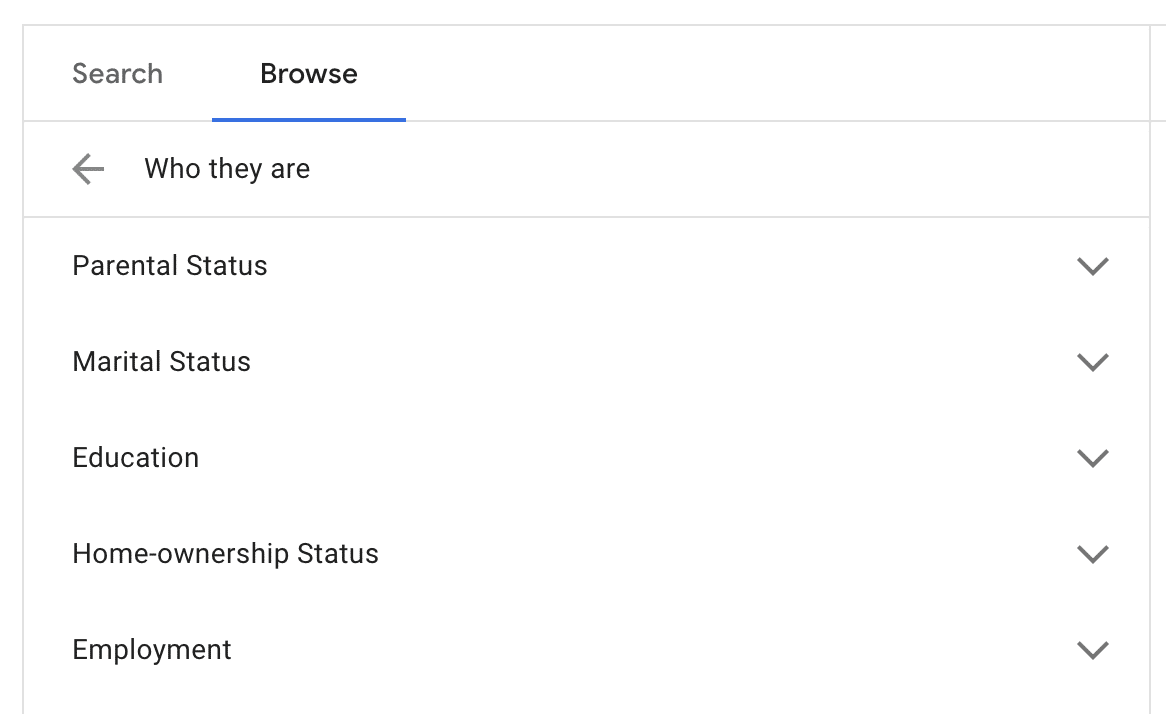
This helps refine your audience by targeting more specific information, including:
- Parental status.
- Marital status.
- Education status.
- Home ownership status.
- Employment status.
You can tailor ads to appeal to specific groups, such as those in construction, education, real estate, finance, etc.
Affinity audiences
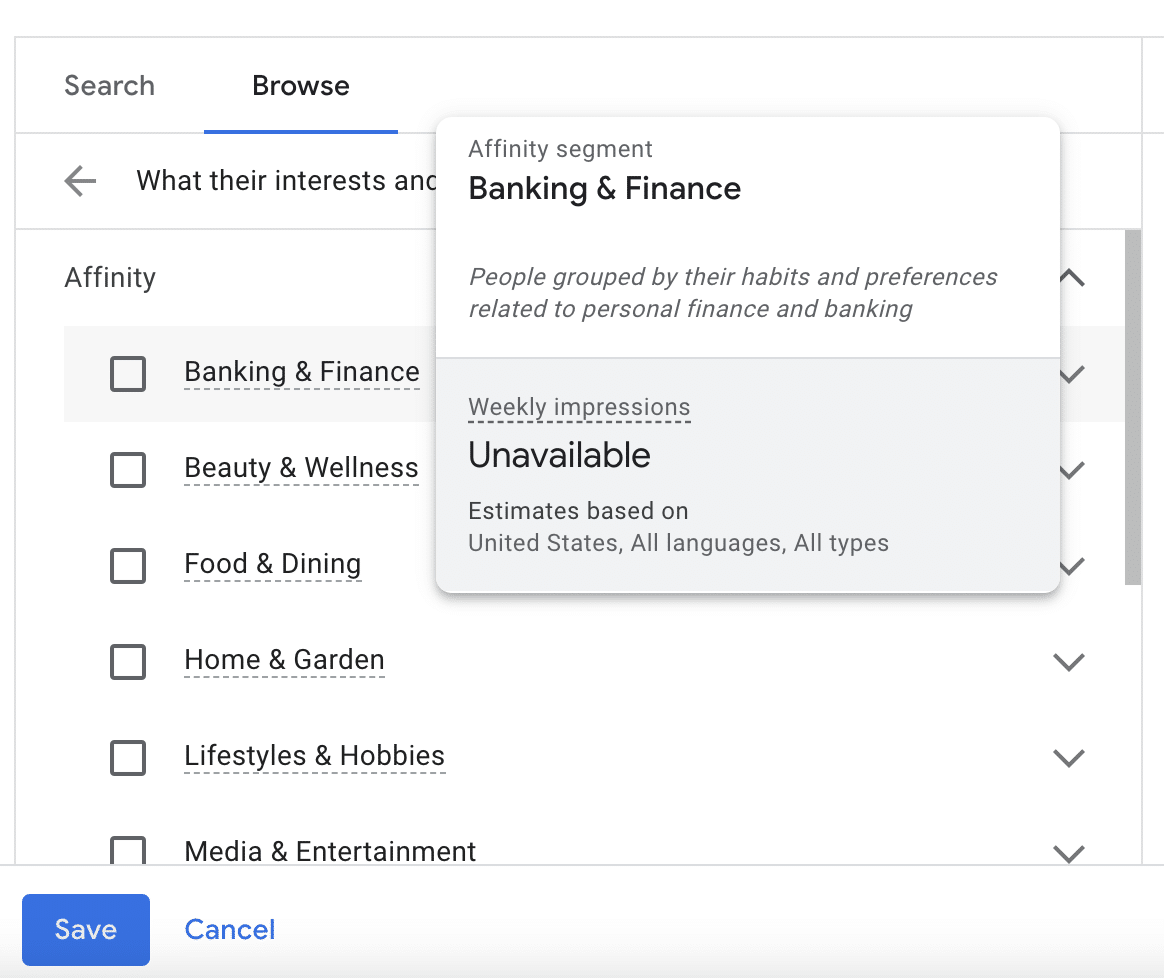
This segmentation allows you to reach audiences with specific interests and habits.
For example, you can target people interested in categories like banking and finance, beauty and wellness, food and dining, home and garden, lifestyles and hobbies, etc.
In-market audiences
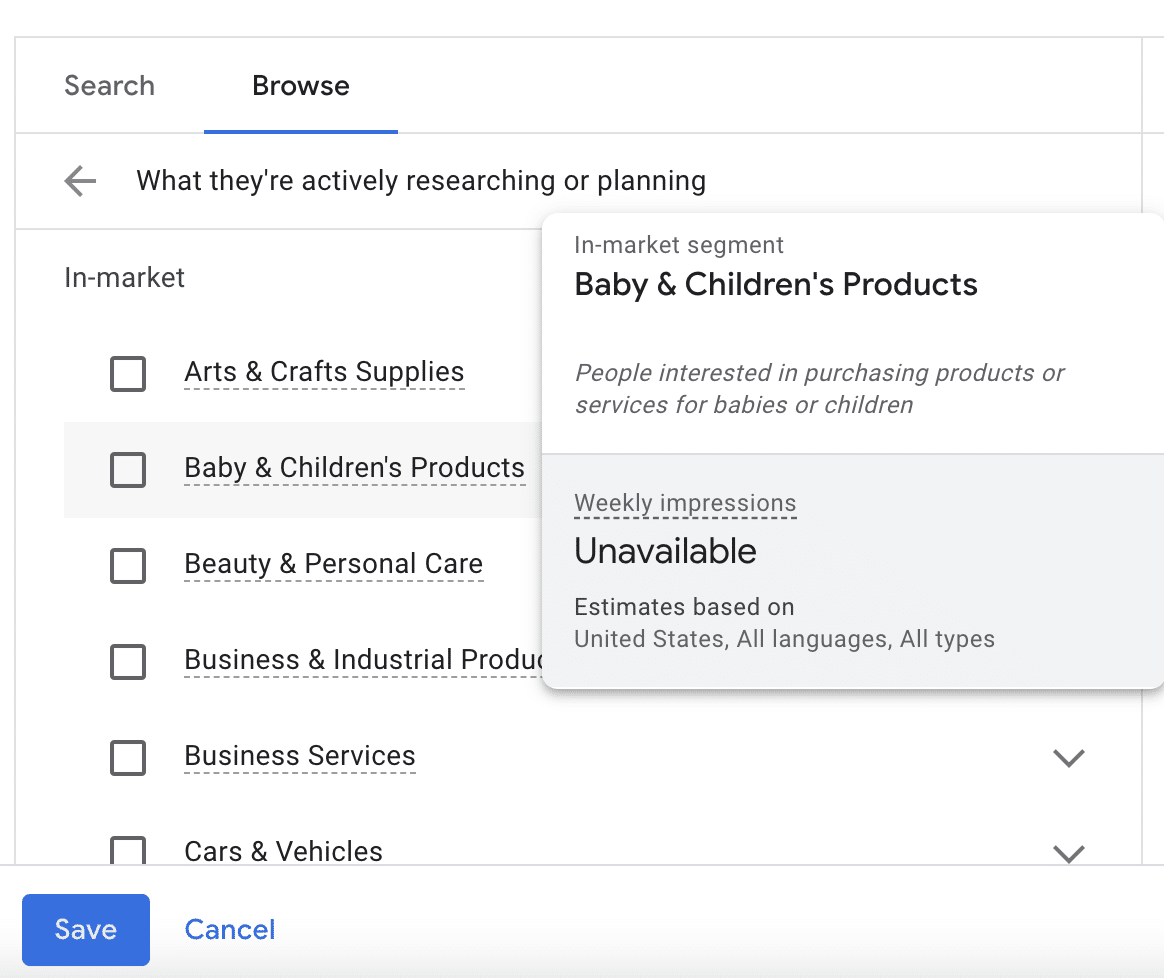
A lot of people use YouTube as a resource when researching a topic or planning to purchase specific products or services.
Segmenting by in-market audiences allows you to get in front of people actively searching for similar products or services.
This segment is ideal for conversion-focused campaigns, driving engagement, and facilitating purchases.
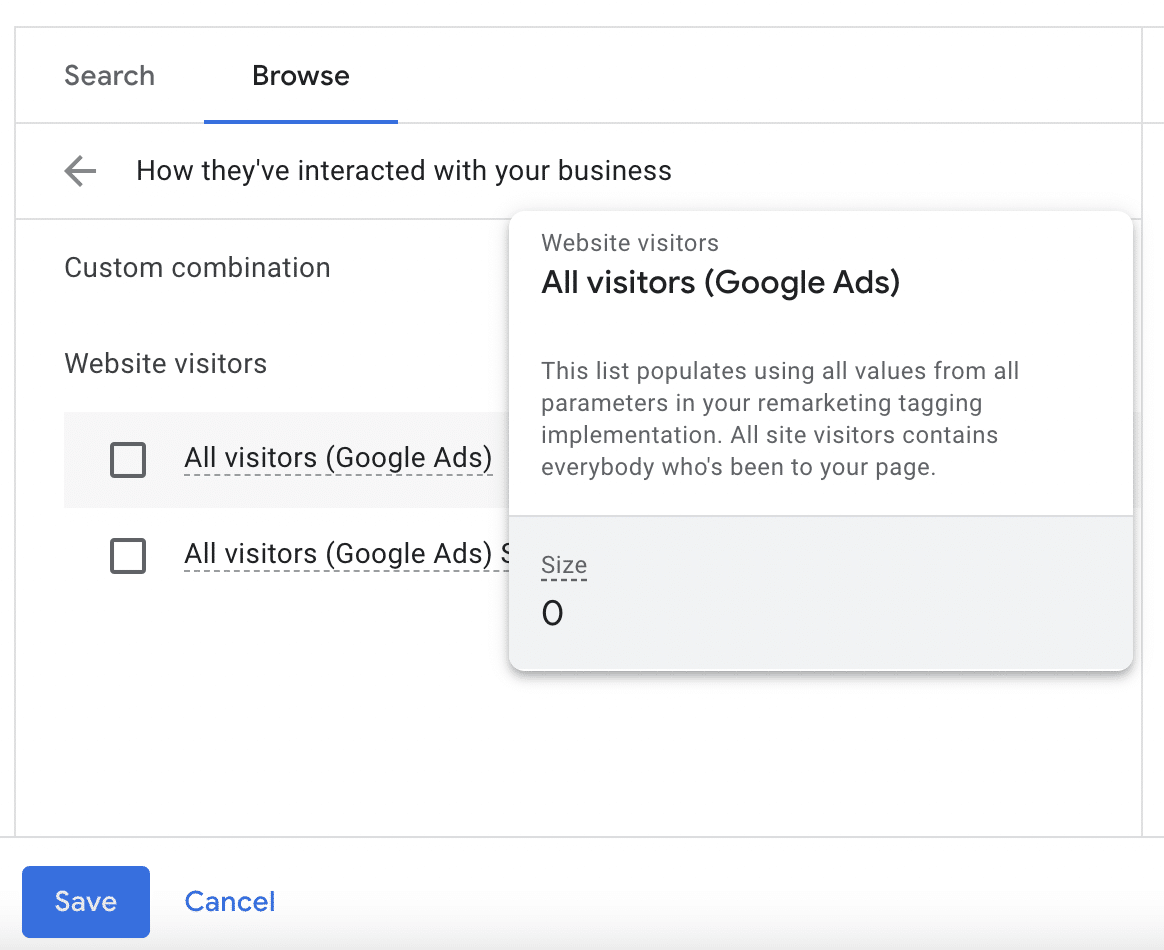
Your data and similar segments
Using this segment, you can remarket to users who have visited your website but haven’t converted.
Getting in front of them again can increase brand recognition and help influence conversions. You can utilize similar audience segments for effective retargeting.
Combined segments
You can combine two or more segments from this list, which helps you define your ideal audience with precision and increase the effectiveness of your YouTube ads.
Keywords
In addition to segmentation, you’ll also want to contextually target your audience using keywords.
For example, if you target “localized marketing,” your ad will appear on videos and channels related to that topic.
This is a good tactic for awareness campaigns, but a keyword-only approach typically isn’t as effective for conversion-focused campaigns.
Topics
Another option is to select specific topics to help ensure that your ad is shown on related videos and channels.
However, there are benefits and drawbacks similar to a keyword-focused approach and are more effective in awareness campaigns.
Step 2: Choose your ad types
Diversifying your YouTube ad formats is essential to cater to various audience preferences and achieve specific campaign goals.
Here’s a detailed exploration of different ad formats on YouTube, each offering unique advantages, and how to align them with your campaign objectives:
TrueView ads
As mentioned, these ads are displayed on the same “screen” as the video content a user searched for. There are two primary types: skippable and non-skippable.
Skippable TrueView ads
- Format: Viewers can skip the ad after 5 seconds.
- Advantages: Ideal for longer content, as you only pay if viewers watch beyond the first 5 seconds, which gives you more space for storytelling and detailed messaging.
- Best for: Brand awareness, engagement, and conveying complex messages.
Non-skippable TrueView ads
- Format: Viewers can’t skip the ad.
- Advantages: Captures immediate attention, ensuring your message is seen in its entirety.
- Best for: Short, impactful messages, and when immediate engagement is crucial.
Bumper ads
These are like miniature ads. They’re short, sweet, and to the point.
- Format: Short, non-skippable ads (typically 6 seconds).
- Advantages: Concise and memorable, great for delivering quick messages.
- Best for: Increasing brand recall, complementing broader campaigns, and conveying a brief but impactful message.
Display ads
Overlay ads
- Format: Semi-transparent overlay on the lower part of the video.
- Advantages: Allows for interactive elements without disrupting the viewing experience.
- Best for: Calls to action, promoting additional content, and maintaining engagement.
Overlay image ads
- Format: Static image overlays on the lower part of the video.
- Advantages: Non-intrusive yet visually impactful.
- Best for: Branding, displaying products, and providing additional information.
Step 3: Create your bid and targeting strategies
To determine your budget, use the following steps:
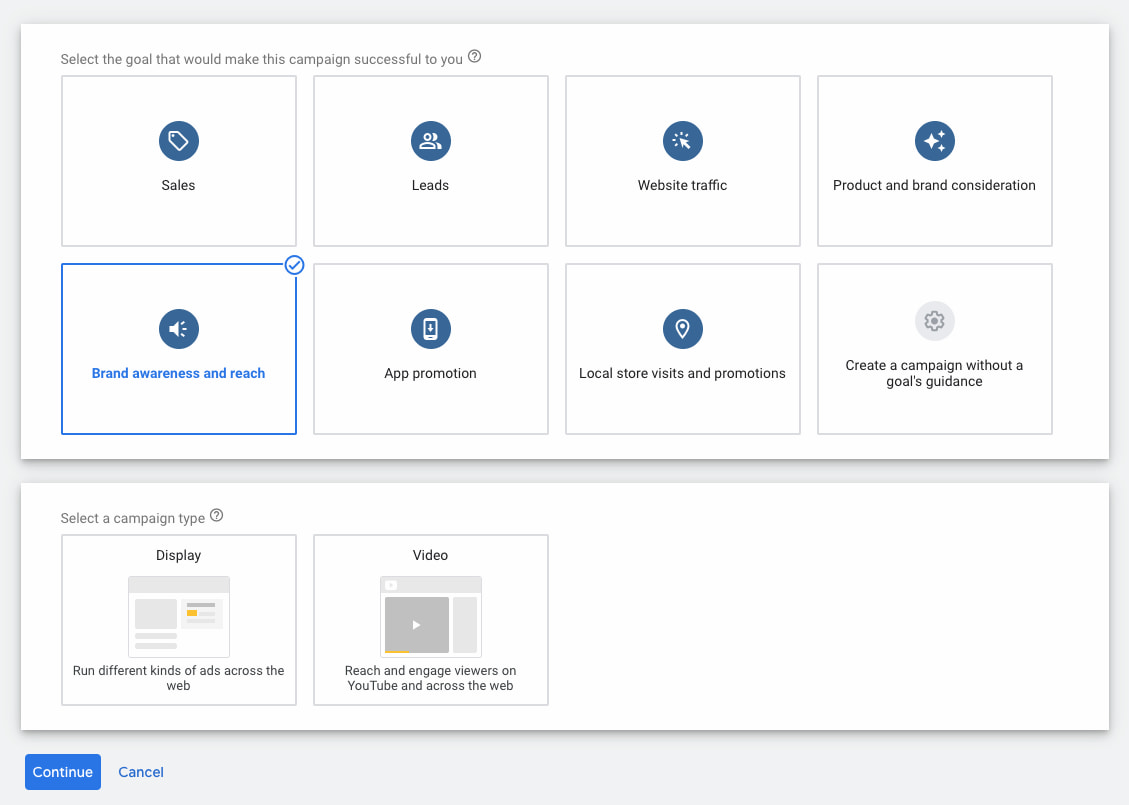
Define your campaign goal
Decide whether you want to focus on brand awareness, lead generation, or sales and align your budget with the specific outcomes you aim to achieve.
Each part of the sales funnel requires different content and ad development types, which can result in varying ROIs.
When you’re setting up an ad, you can set the campaign goal here:
Dig deeper: Setting PPC goals: How to tailor KPIs and metrics for each funnel stage
Establish your campaign duration
How long will your YouTube ads run? What’s the timeframe for your campaign?
Short-term campaigns will likely have different budget considerations than long-term ones, as they may reach a smaller audience.
Researching industry benchmarks can help you understand the average costs and set realistic expectations for your budget.
Choose your bid strategy
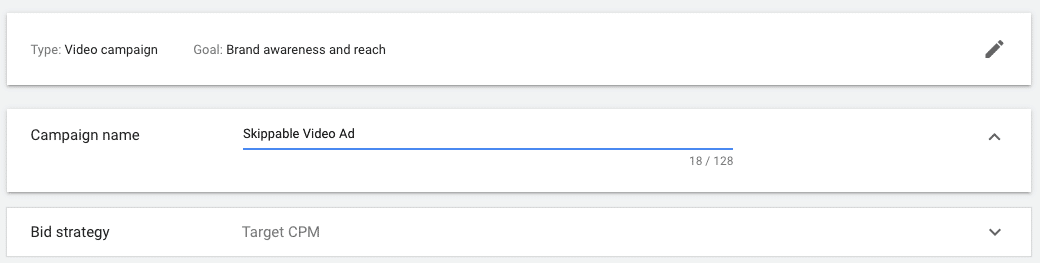
A bidding strategy is where you’ll set an average amount you’re willing to pay for impressions, actions, or clicks.
This is established when you choose your ad format type and then select the bid strategy for that campaign, as shown in the image below:
There are a few different types of bidding strategies you can experiment with, so try a few and see which option works best for your goals:
- A cost-per-view (CPV) strategy charges advertisers whenever a viewer watches at least 30 seconds of the ad or engages with it in some way. This is a great option for campaigns focusing more on brand awareness and video views.
- With cost-per-action (CPA), you set a target cost for specific actions such as clicks or conversions and then pay based on your audience’s engagement. This is suitable for performance-oriented campaigns where specific actions, such as lead generation or sales, are critical.
- Enhanced cost-per-click (eCPC) allows manual bidding while letting Google adjust bids for clicks. This is often regarded as the bidding strategy most likely to lead to conversions, as it offers a balance between manual control and algorithmic optimization.
- Automated bidding is another option you have to allow YouTube’s algorithm (via Google) to automatically adjust your bids to get the most conversions within your specific budget. This is ideal for campaigns where the primary goal is to maximize the number of desired actions. Just make sure you’re willing to spend whatever budget you enter, as Google may adjust your bids to the maximum amount.
Outline production costs vs. ad format
YouTube is filled with experienced content creative and engaging videos.
If you want your ad to spark some interest, you’ll also need to put aside a budget for creative production costs, including ad creatives.
Remember, high-quality content often requires an investment but can significantly impact campaign performance.
Calculate management costs
In addition to video production, you’ll also need to make sure you allocate the resources to regularly manage and assess your campaign performance.
Give yourself some flexibility and be prepared to adjust your budget based on real-time data. This ensures the optimal allocation of resources and maximum effectiveness of your YouTube ad campaigns.
Step 4: Establish campaign structure based on intent stage (BoFu, MoFu, ToFu)
Defining and understanding the marketing funnel stages is crucial for creating a targeted and effective YouTube advertising strategy.
Tailoring your ad content and messaging to align with each stage allows you to address users’ varying needs as they progress through the funnel, from initial awareness to conversion.
Top of funnel (ToFu)
At the ToFu stage, the primary goal is to create brand awareness and capture the attention of a broad audience. This sets the stage for targeted messaging and a pathway to conversions.
During the ToFu stage, you need to create compelling, attention-grabbing content that introduces your brand, product, or service to a wide audience.
Try to focus on storytelling, highlighting your unique value proposition and the broader benefits you offer. Pair this with engaging visuals, captivating narratives, and brand messaging to help create a memorable first impression.
The best ad formats for ToFu campaigns are Skippable TrueView Ads and Bumper Ads, as they allow for concise, yet impactful messaging. Use a CTA that encourages users to explore more about your brand or product without putting too much pressure on them to take immediate action.
Middle of funnel (MoFu)
In the MoFu stage, the goal is to help nurture your audience and guide them toward considering your products or services. This part of the funnel targets users already aware of your brand and may be considering converting.
During the MoFu stage, developing content that provides more in-depth information about your products or services is important. Try to showcase specific features, benefits, and any unique selling points to differentiate your offering from competitors.
You can also include social proof such as testimonials, case studies, or educational content to help build trust and credibility.
The best ad formats for MoFu campaigns are longer-form, skippable TrueView ads, allowing a more detailed presentation of your products or services.
Use a CTA that encourages users to explore specific product features, download resources, or sign up for newsletters to deepen engagement.
Bottom of funnel (BoFu)
In the BoFu stage, the primary focus is converting potential customers into actual ones. This part of the funnel targets users who are already familiar with your brand and ready to decide.
During the BoFu stage, drive action by developing content that emphasizes conversion-driven elements, such as limited-time offers, discounts, or exclusive deals. Always provide clear information on how users can make a purchase or take a desired action and use strong, compelling CTAs that create a sense of urgency.
The best ad formats for BoFu campaigns will combine skippable TrueView ads, display ads, and overlay ads to reinforce your conversion-oriented messaging.
Create a CTA that directly prompts users to make a purchase, sign up for a trial, or take the specific action that aligns with your conversion goals.
Dig deeper: How to use always-on marketing in paid search
Step 5: Prep your videos
Creating impactful video content is fundamental to a successful YouTube advertising campaign. The components of successful videos for YouTube include:
Compelling and engaging video content
- Try to tell a story about your business and/or product or service in a way that connects to users emotionally while simultaneously highlighting your brand’s values.
- Within the narrative, highlight unique selling points (USPs) so it’s easy to see what sets your product or service apart from competitors.
- Be clear and try to emphasize key features and benefits without being overly salesy or pushy. Essentially, you want to create a video that clearly shows viewers why they should choose your offering.
Optimization for mobile viewing
- Videos need to be responsive and optimized for smaller screens.
- You also need a quick hook that captures their attention within the first few seconds, as mobile users can be more prone to quick browsing.
- Try experimenting with vertical or square video formats, reducing users’ need to turn their devices. This mirrors Instagram Reels and TikToks, leading to increased performance on mobile devices without sacrificing screen coverage.
Clear CTAs
- To generate good conversion rates, you need to be strategic about CTA wording and placement.
- This might mean placing CTAs at the beginning of your video to encourage immediate engagement or adding them to the end to prompt a specific action.
- If the goal is to drive traffic to a specific webpage, include clickable links in your video descriptions or use YouTube’s in-video programming features to add external links.
Uploading to YouTube channel or Google Ads asset library
- When your ads are finalized, upload your videos directly to your YouTube channel. This ensures that your content is easily discoverable and shareable, contributing to the growth of your channel over time.
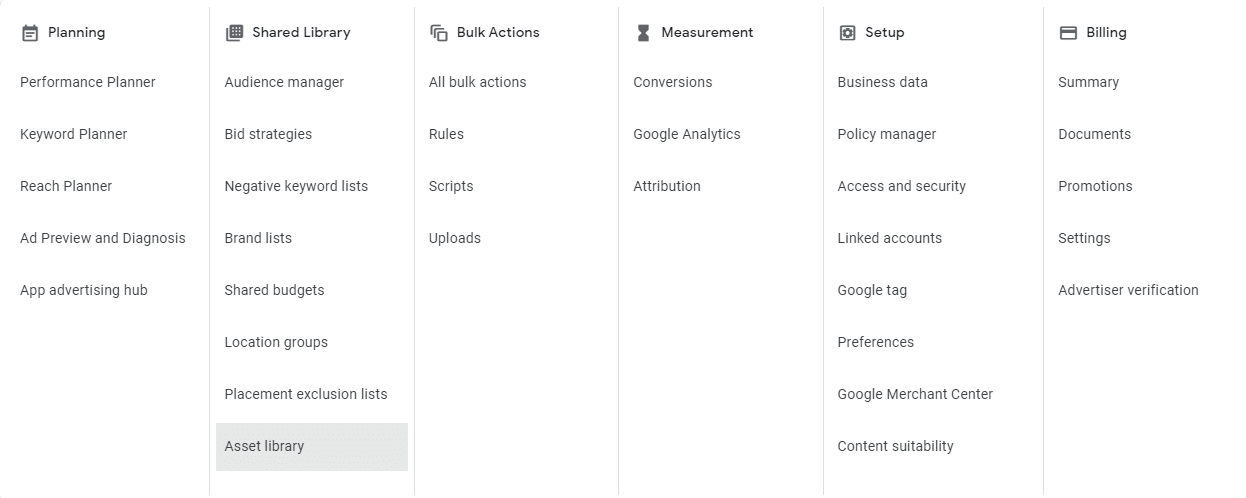
- If you’re managing campaigns within Google Ads, add your videos to the Google Ad Asset Library. This centralized storage allows for the efficient reuse of assets across different campaigns.
Optimize metadata
- Similar to any type of content creation online, you need to optimize the metadata for your YouTube ads.
- Optimize video titles, descriptions, and tags for relevant keywords.
Appealing thumbnails
- Within your YouTube channel, choose thumbnails that make people want to click them.
- Creating visually appealing thumbnails that accurately represent the video content can be crucial in CTR.
- At the same time, try to avoid spammy clickbait thumbnails that will frustrate your audience or inaccurately represent the content.
Align campaigns with relevant landing pages
- If your campaign goal is to generate clicks for a specific landing page, ensure you have a landing page that directly relates to the particular campaign, including audience buyer intent levels and a high-quality UI/UX.
Step 6: Set up and monitor GA4 conversion tracking
To track YouTube Ad performance with GA4, you must clearly outline your conversion goals for each video and the landing pages connected to the videos.
Whether it’s encouraging sign-ups, driving purchases, or achieving specific actions, defining these goals will allow for more precise tracking throughout the campaign.
Next, link Google Ads to GA4 and your YouTube channel to create a connection between the two. This will help facilitate the seamless sharing of data between the two platforms, which is essential for accurately tracking YouTube ad campaign success.
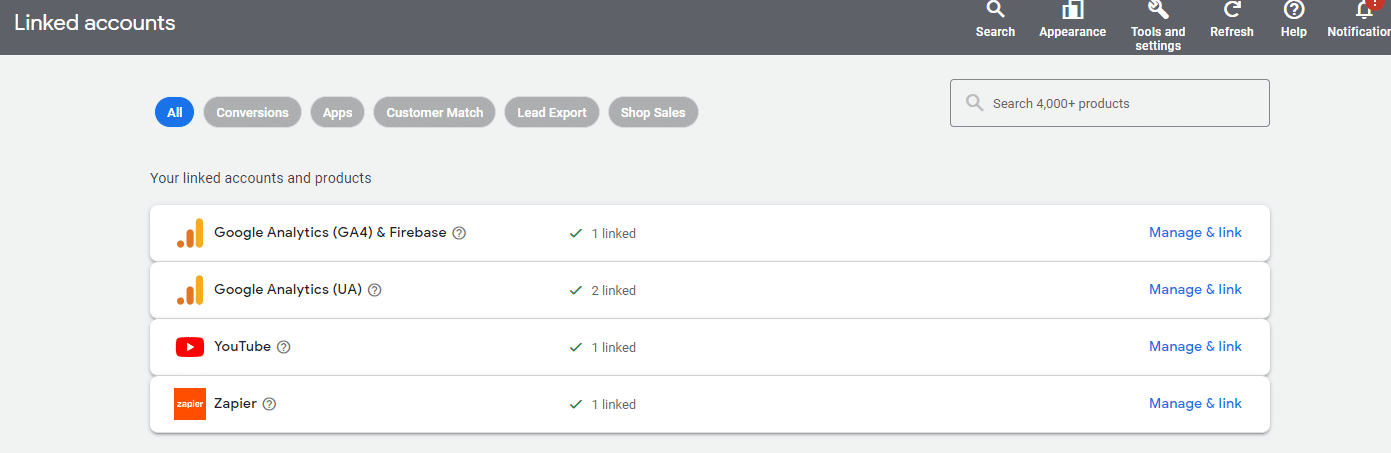
Once the channels are connected, import your conversion goals into Google Ads. This allows Google Ads to attribute conversions directly to your YouTube ad campaigns, which provides you with detailed insights into your ongoing campaign performance.
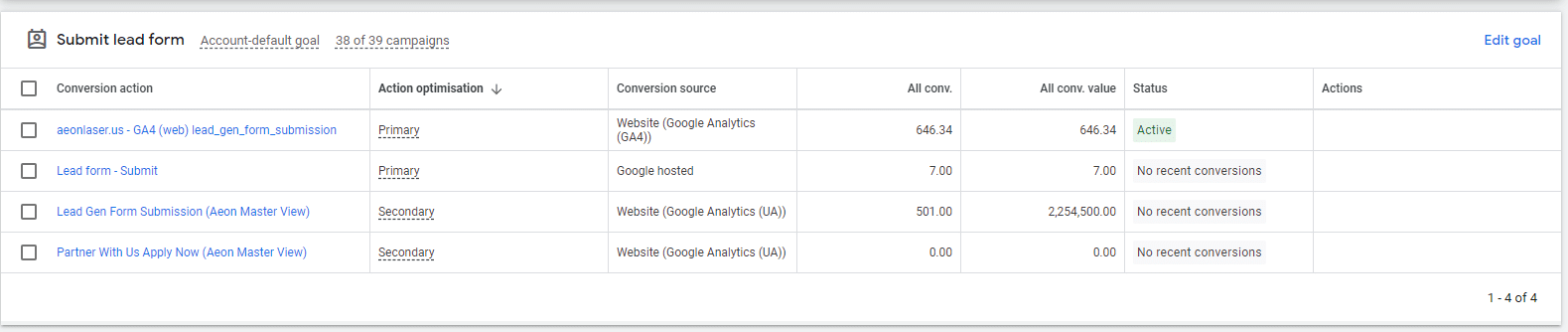
GA4 also formulates Audience Reports to help you better understand the characteristics and behaviors of users engaging with your site.
Regularly check these reports to gain insight into audience segments that respond well to your YouTube Ads, which allows you to tailor future campaigns accordingly.
Harness the power of YouTube ads with the right strategy
Although YouTube has long been known as a highly effective organic strategy, YouTube ads can be just as effective for growing brand awareness and generating leads and sales.
As users move faster and faster toward video-first campaigns, YouTube is one of the best platforms to grow an audience on, especially as it’s underutilized by most brands.
Because it’s not fully saturated and the user base continues to grow, this channel is one of the best new media opportunities to capitalize on today.
Courtesy of Search Engine Land: News & Info About SEO, PPC, SEM, Search Engines & Search Marketing
Category seo news | Tags:
Social Networks : Technorati, Stumble it!, Digg, de.licio.us, Yahoo, reddit, Blogmarks, Google, Magnolia.
TikTok pilots 30-minute video uploads for select users
Written on January 24, 2024 at 10:19 am, by admin
TikTok is trialing 30-minute long video uploads for some users in the beta version of its app.
Why we care. Longer videos may provide more opportunities to place ads in the middle of clips, known as mid-roll ads. These mid-roll ads often lead to higher completion and engagement rates.
First look. The new upload option was first spotted by social media consultant, Matt Navarra. He shared a screenshot of the TikTok pop-up notification on his Threads account:

Why now? TikTok’s choice to allow longer video uploads follows Douyin’s move, the Chinese version of TikTok, which extended its upload limit to 30 minutes per clip in 2022 and received a positive response.
Time line. TikTok has regularly increased the maximum duration allowed for each post over the years:
- 15 seconds per clips in 2018.
- 60 seconds per clip in 2019.
- 3 minutes per clip in 2020.
- 5 minutes per clips in 2021.
- 10 minutes per clips in 2022.
- 15 minutes per clip in 2023.
Deep dive. Read our report on how non-skippable video ads may harm engagement for more information.
Courtesy of Search Engine Land: News & Info About SEO, PPC, SEM, Search Engines & Search Marketing
Category seo news | Tags:
Social Networks : Technorati, Stumble it!, Digg, de.licio.us, Yahoo, reddit, Blogmarks, Google, Magnolia.
Generate image alt text at scale with AI: A 7-step guide for SEOs
Written on January 24, 2024 at 10:19 am, by admin
Image alt text is important for accessibility and beneficial for SEO. But if you have lots of images on your website, manually writing alt text for all of them will be time-consuming. This article is a step-by-step guide for using AI to generate alt text automatically at scale.
- We will use Screaming Frog to identify images with missing alt text across a website.
- Then, we’ll leverage an image captioning AI called BLIP to create text descriptions of images automatically.
- To refine the AI-generated captions, we’ll use ChatGPT.
- Finally, we’ll hand off the alt text to a developer to link the alt text with the appropriate images.
Generating image alt text matters for accessibility and SEO
Alt text is the text that loads when an image fails to load. Alt text also is what screen readers use to produce audio descriptions of images for visually impaired users.
You might be asking, “Alt text for SEO has minimal impact, so why bother?” Minimal impact is better than none. And using AI makes the task efficient and cost-effective. The initial setup may take some time, but the ongoing effort is minimized.
Here are the seven steps for using AI to generate image alt text at scale:
- Step 1: Find images with blank alt text to optimize.
- Step 2: Download the images ready for BLIP.
- Step 3: Install the image-to-text interpreter (BLIP).
- Step 4: Create text captions (via BLIP) for your downloaded images.
- Step 5: Organize and make sense of the output.
- Step 6: Filter the generated captions via ChatGPT.
- Step 7: Communicate with your web developer.
Step 1: Find images with blank alt text to optimize
This step is fairly simple. We will crawl a site and extract all the image embeds that do not have alt text. In this case, we’re going to look at the Classic British Hotels website.
This site was chosen for the demo because it’s not too large and is based on WordPress, a platform familiar to most SEOs. Additionally, this site displays images well, even with JavaScript disabled, enhancing accessibility for our purposes.
Some images lack alt text, but they seem straightforward to describe in context, which is important when working with AI that may not recognize specific niche products.
Crawl the site with Screaming Frog to isolate images with missing alt text. Screaming Frog has an official guide on isolating missing alt text, which we’ll follow for the most part.
Let’s launch the crawler:
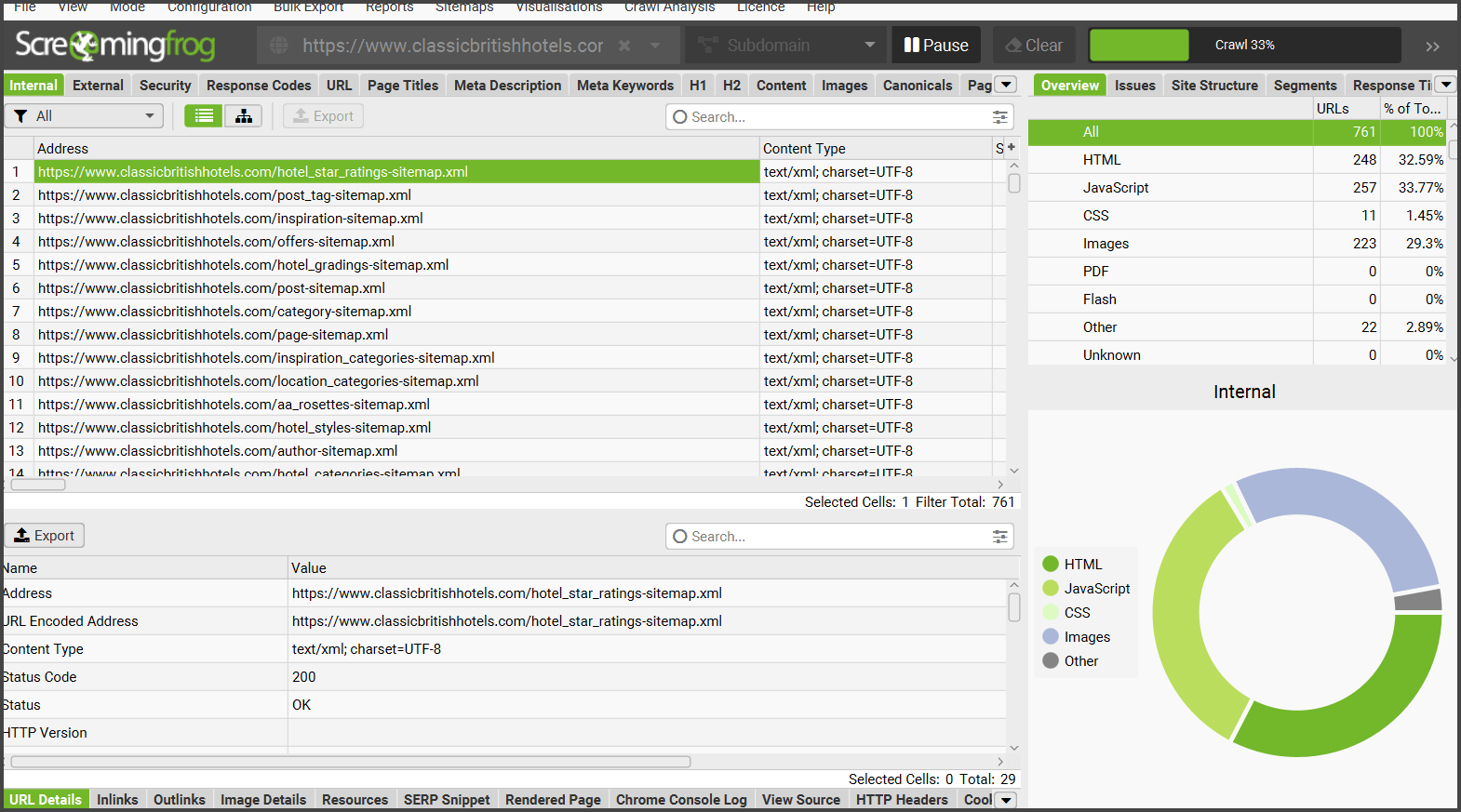
Once the crawl is complete, export the addresses of images that are missing alt text:
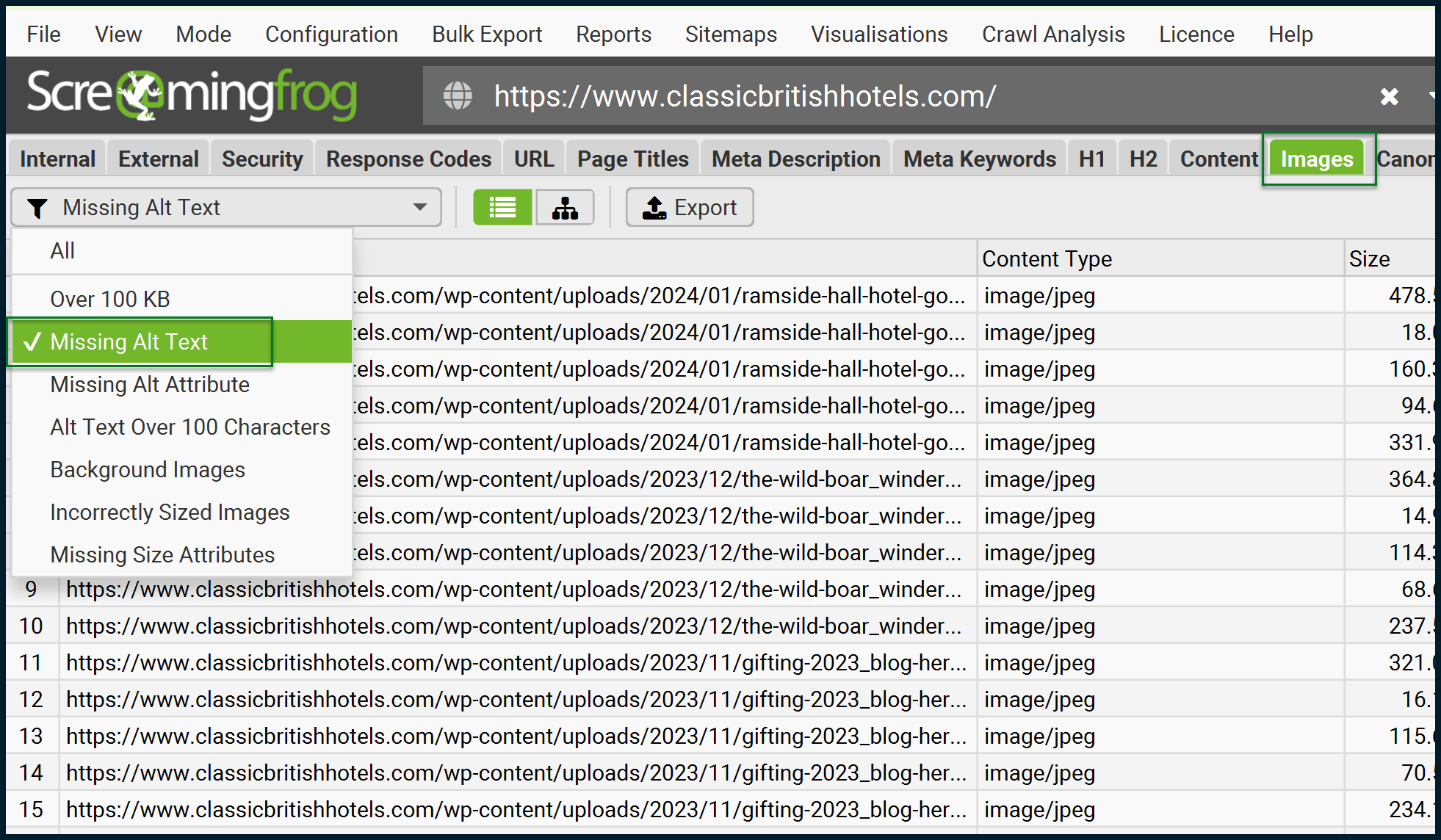
Be sure to click the Export button to have a local record (CSV / Excel) of all the images missing alt text.
We now have the addresses of all images missing their alt text. To run them through a locally installed AI (BLIP), which will interpret these images, we need to download them all. In this case, there are just over 230 images.
Step 2: Download the images ready for BLIP
You’ll need to copy all the image URLs from your “images_missing_alt_text” file (Column A). paste them into a Notepad (.txt) file, and then save.
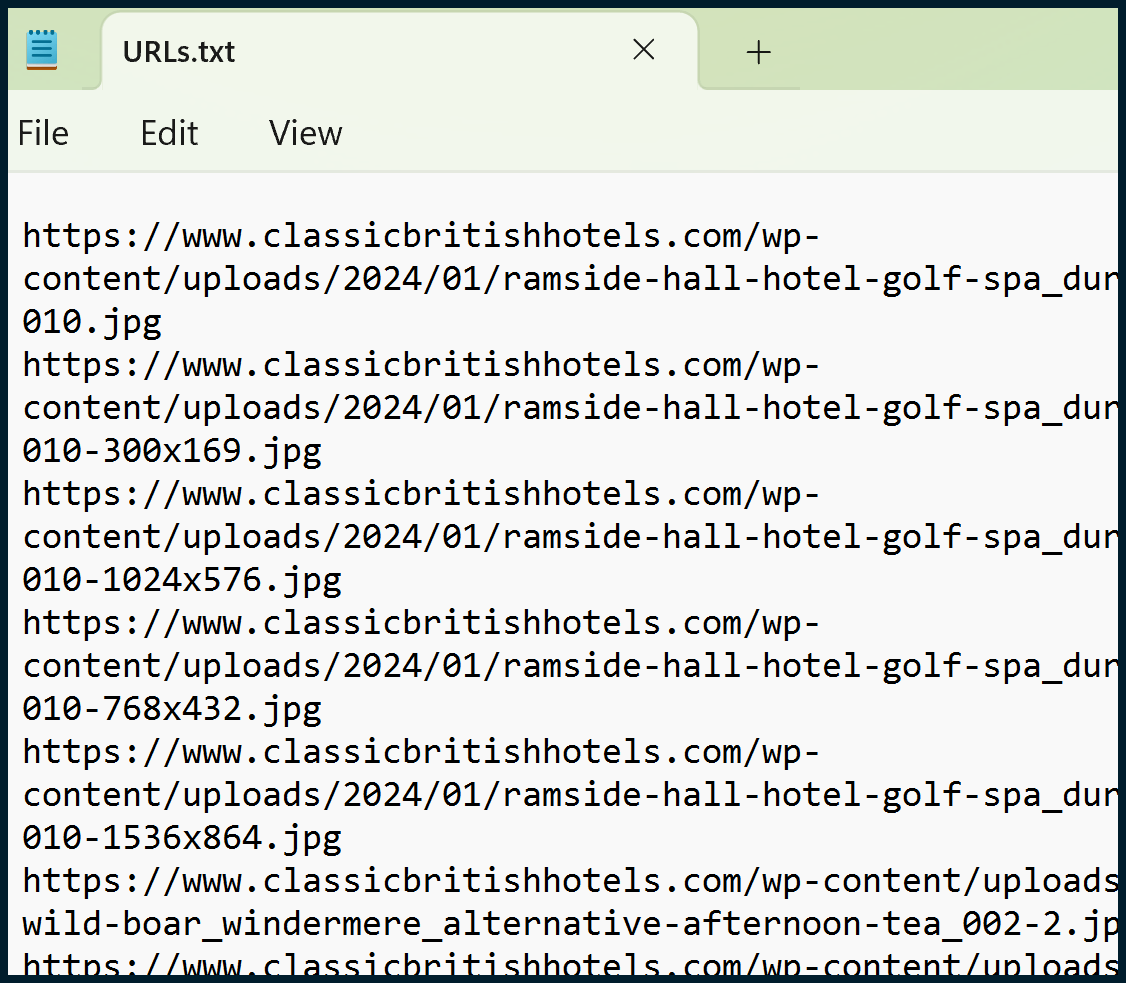
For the next part, I like using the Firefox add-on called DownThemAll!, which is also available for Chrome. Once the browser plugin is installed, open your browser. Right-click to open the context menu, then run the DownThemAll manager:
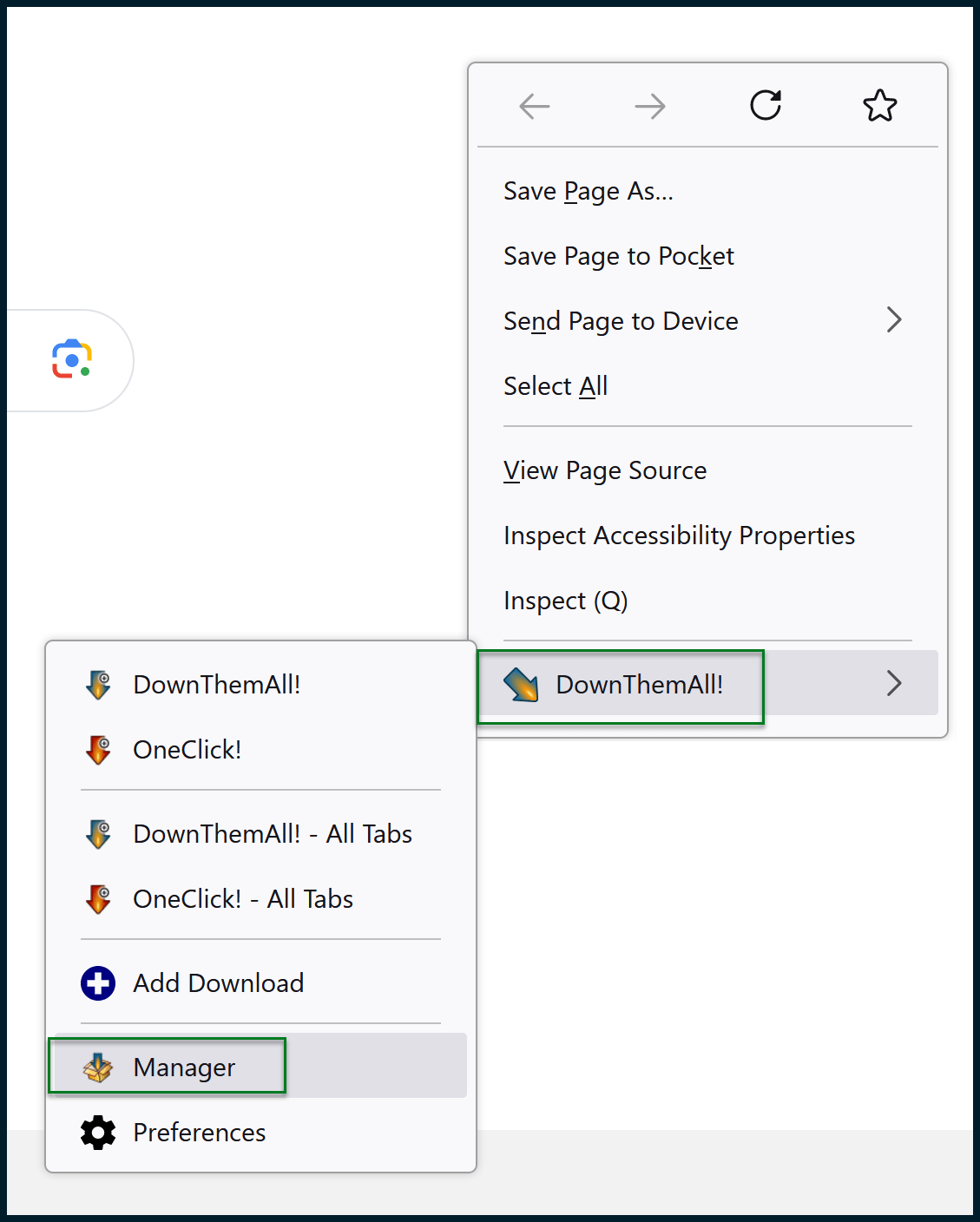
Right-click on the manager’s background and choose Import from file.
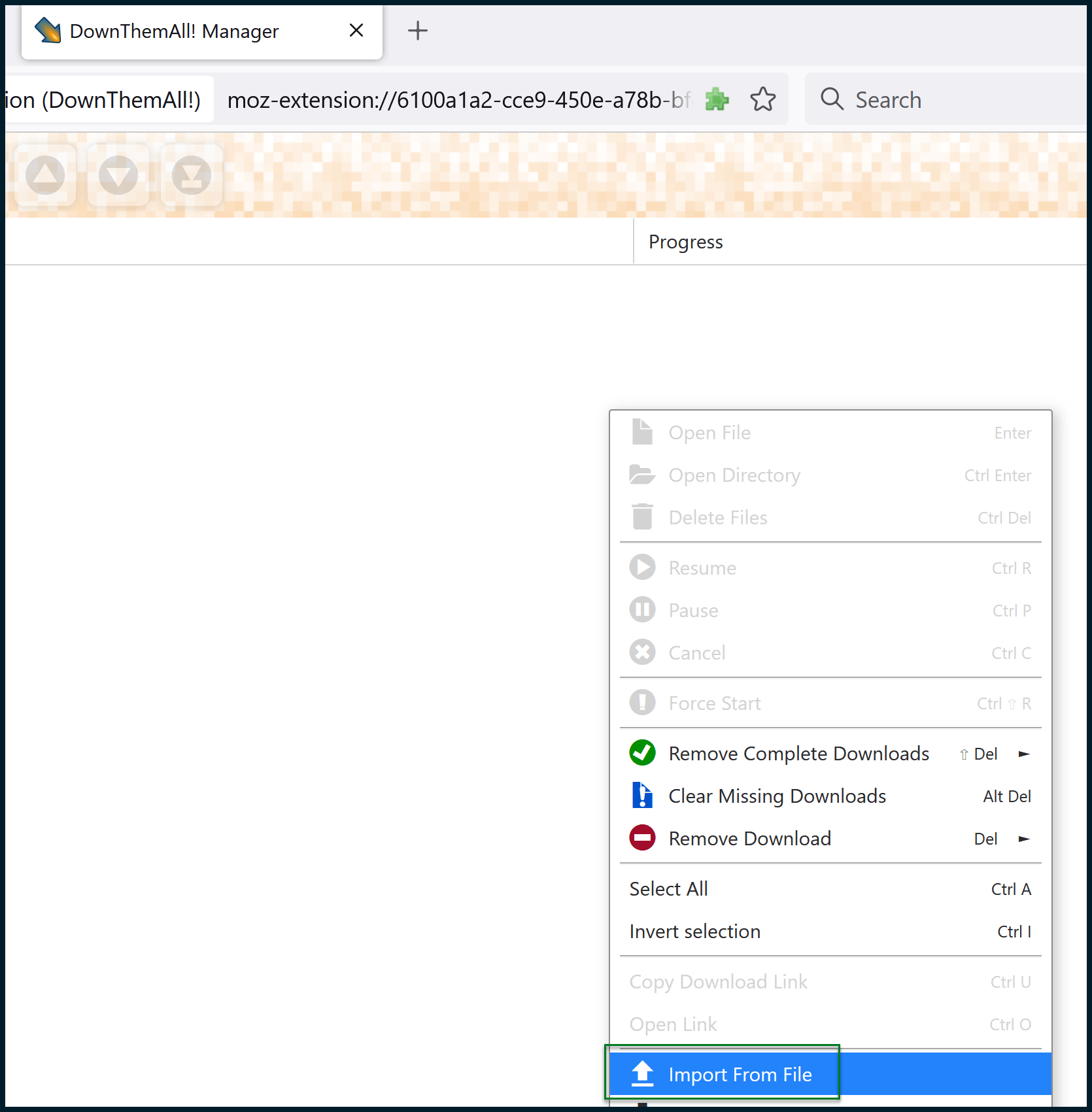
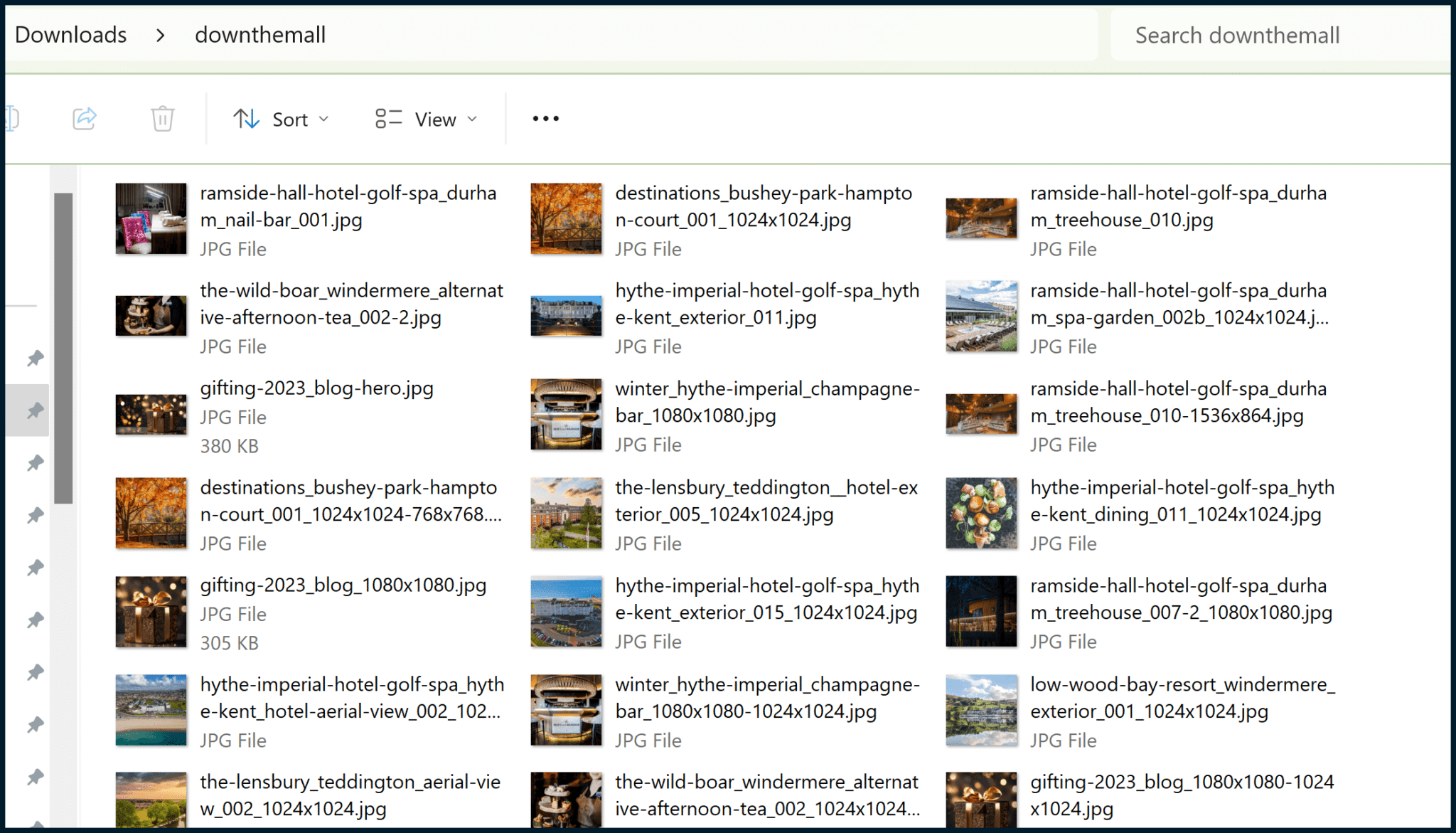
Select the text file that you created earlier. Once you do that, you can then finalize some settings before initiating the batch download:

I like to specify a subfolder so that the downloaded images are grouped together.
DownThemAll! will create this subfolder within your Downloads folder, then place all the images inside. Click the Download button.
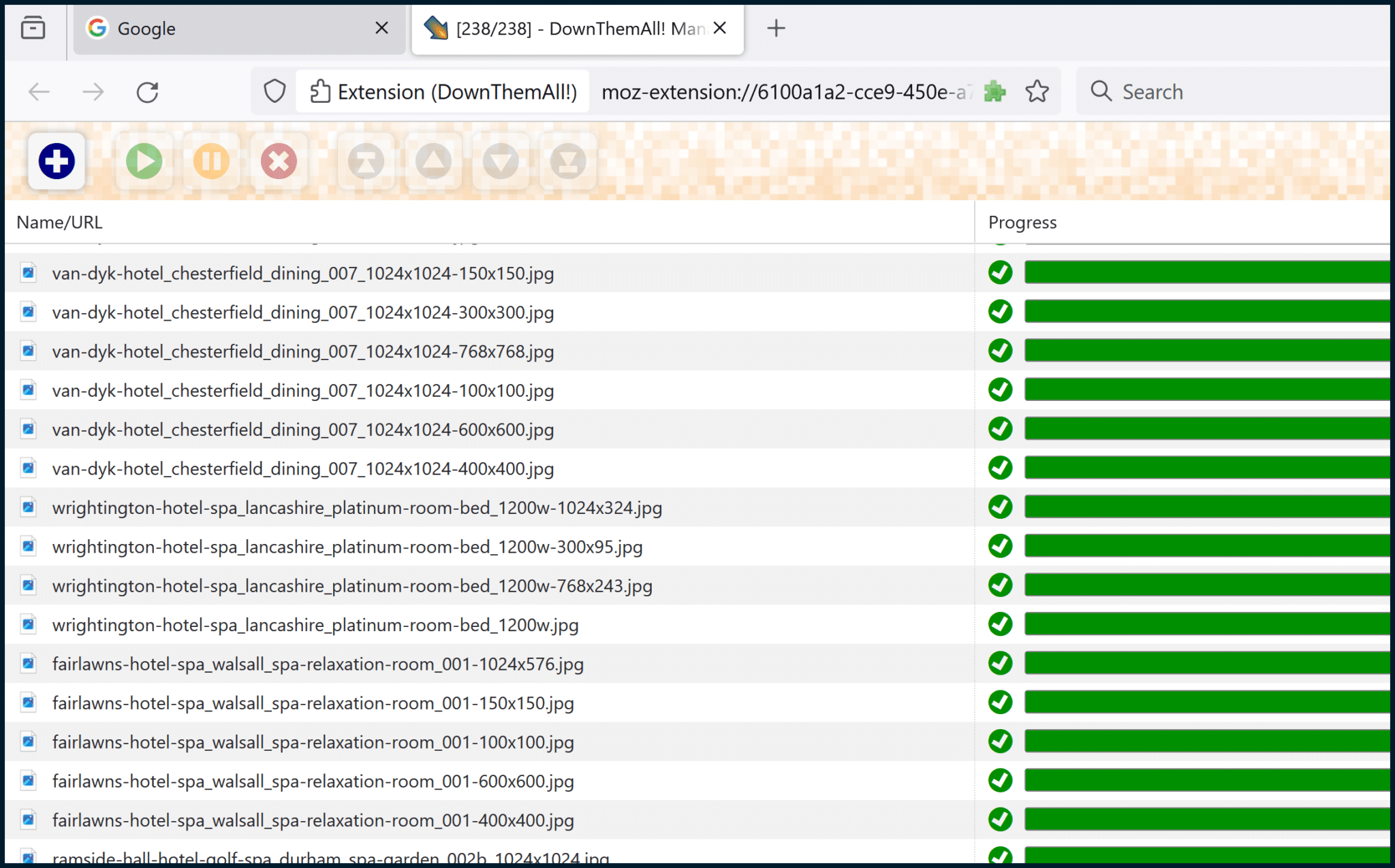
All of the images should now be downloaded.
Step 3: Install the image-to-text interpreter (BLIP)
Now that we have a folder full of images that don’t have alt text, we need a way to transmute the images into short snippets of text, for descriptive image captions.
I’ve explored using ChatGPT for on-page product descriptions before, but it’s not suitable for our needs. OpenAI, the creators of ChatGPT, focus on text-to-text AI, while we require image-to-text AI. For this purpose, we can use BLIP.
Since BLIP is simply a proposed model, we need a publicly accessible project that someone has produced using BLIP, something suitable for our purposes.
Using Git, we can clone the following project created by Cobanov: https://github.com/cobanov/image-captioning.
To do this, you will first have to install Git (documentation here) and then run a couple of commands (using the installed Git CMD) similar to:
cd c:\git
git clone https://github.com/cobanov/image-captioning.git
Please note that the above assumes that you have created a folder named “git” in your C: drive (Windows). Once executed, the project will be cloned to c:\git\image-captioning.
You should also visit Cobanov’s project page here, then scroll down and read the README section, including the Usage sub-section.
Note that this project relies upon Python and also requires you to install some Python modules that are not shipped with Python’s (Windows) installer by default. I used Python version 3.10.9 for this demo.
After connecting Windows Command Prompt to my Python install by amending the Windows PATH variable (I believe Python also has options to do this as you install it), I needed to run some additional CMD commands to get everything working as I would like:
python -m pip install --upgrade tqdm
python -m pip install --upgrade torch
python -m pip install torch==2.1.0 torchvision==0.16.0 torchaudio==2.1.0 --index-url https://download.pytorch.org/whl/cu118
python -m pip install timm==0.4.12 transformers==4.17.0 fairscale==0.4.4 pycocoevalcap pillow
If you run one or two of the above commands and receive some errors, try not to worry too much. The referenced commands represent the sequence of module installations, which proved successful for me.
Since I use Python quite a lot, there may be other dependencies that are already satisfied by my Python install.
Later, if you run the project (we haven’t reached that stage yet, in this article) and see errors relating to Modules not existing, or not being found, you should additionally install such modules.
Step 4: Create text captions (via BLIP) for your downloaded images
Your project folder should look similar to this one:

My project folder has a couple of extra folders.
Since documentation for such projects is rarely perfect, I created my own notes in a #Notes folder.
Since the images folder contains proof of concept images to run against the AI (demo images) provided by the project author, I also created my own folder to place new images in, named inputs.
I suggest you also create your own inputs folder so you don’t get muddled up with the demo images.
Also note that checkpoints may not exist until you run the project for the first time, which should trigger the download of a specified checkpoint/data model.
Once you have done all that, copy all of the images that you downloaded earlier (via DownThemAll) to the inputs folder:

Now it’s time to execute our project. Open Windows Command Prompt and execute a couple of commands like this:
cd C:\git\image-captioning
python inference.py -i C:\git\image-captioning\inputs -b 238
Note that you may need to amend the above commands to point to the correct Git project install and image inputs folder if you have created your Git project with a location or structure different from mine.
The “-b 238” part of the command is very important. The project and script need to be told how large the batch is.
I have 238 images to caption in this instance, so the correct “-b” (batch) number is 238. You can ask the script to execute your images via numerous smaller batches.
For instance, if I wanted the script to save captions when it was halfway through and then again at the end, I could use “-b 119” since 119 is half of 238.
Note that you need to be careful here. If you input a number that is not a factor of (i.e., cannot be evenly divided into) the total number of images, the script will crash. You have been warned!
Let’s attempt an execution:
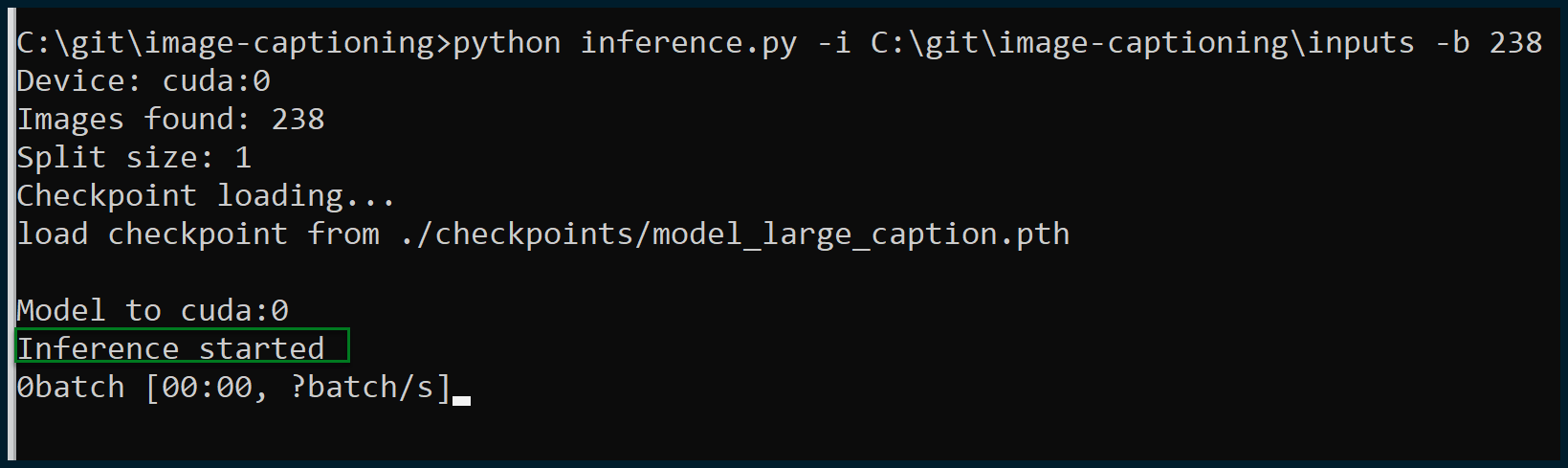
Excellent, execution has been successful, and inference has commenced. All the images were found; this is exactly what we wanted to see.
If the script crashes and the number of images found is different from the total number of images within your inputs folder, then something is wrong with the format of your images.
By experimenting with this project and its associated scripts, I have found that only JPG and PNG images are accepted.
- You can use WebP images by simply changing their file extensions to “.png.” JPEG images will also be accepted if the file extensions are altered to “.jpg” (without the “e”). There’s no need to make any actual changes to the images themselves.
- SVG images seem to be fundamentally incompatible and will not be accepted. (This AI is probably only capable of working with rasterized rather than vector-based images.)
Once the script is running successfully, note that your own GPU (graphics card) and local machine are doing the work. You’re not accessing an API to generate text from images, it’s all happening on your workstation.
As such, a more powerful, more graphically capable PC is advised. I’m running this on a machine with a 30-series NVIDIA graphics card (and a Ryzen 7 5800X). The results didn’t take long to come in (a minute or two), but the more images you have to analyze, the more it will take longer.
Now that we have run the script, it’s time to make sense of the output.
Step 5: Organize and make sense of the output
You should now have a generated text file like this one:
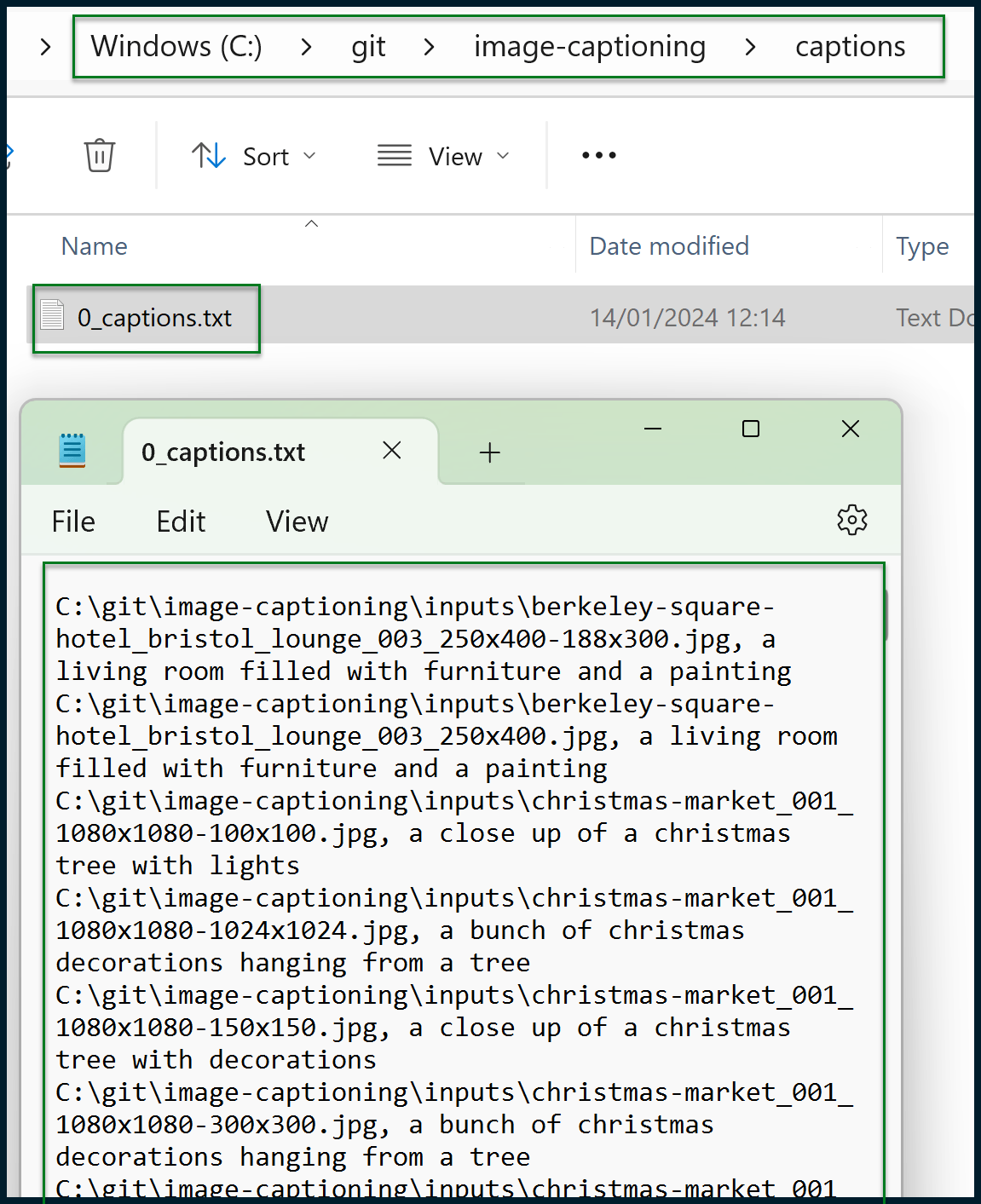
The output may look intimidating, but it’s simply a comma-separated list that can be easily handled in Microsoft Excel (or similar). Start by copying the entire contents of the notepad file and then pasting them as values into a fresh Excel sheet:
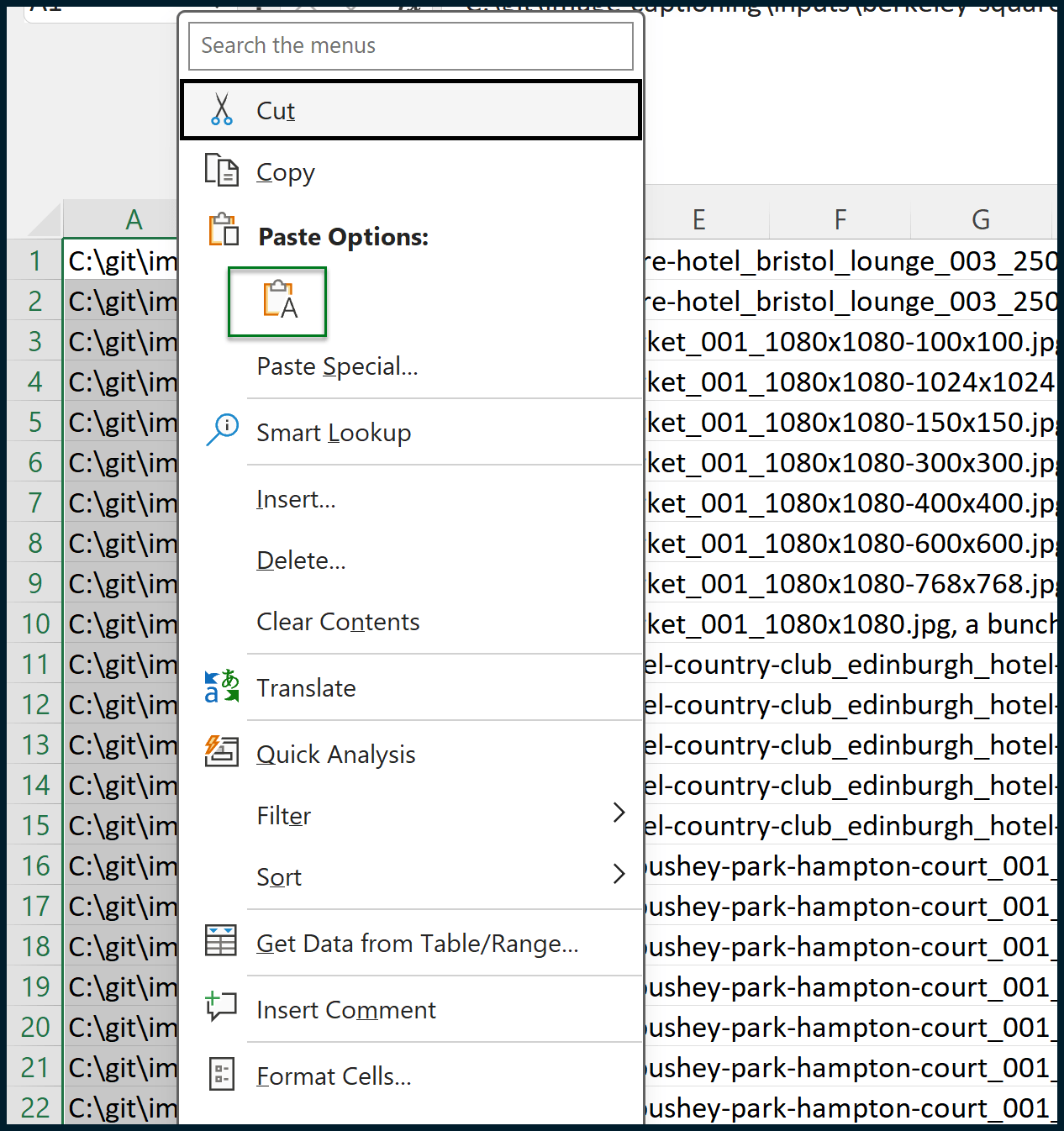
We need to separate the image file paths (local) from the image captions. To do this, we must create a couple of formulas in columns B and C.
There’s also a way to do this using the Text to Columns entry in the Data tab. However, this data is split by “, ” (comma space) rather than a single character, so for our purposes, formulas will work better. (This also evades potential complications where image captions contain commas.)
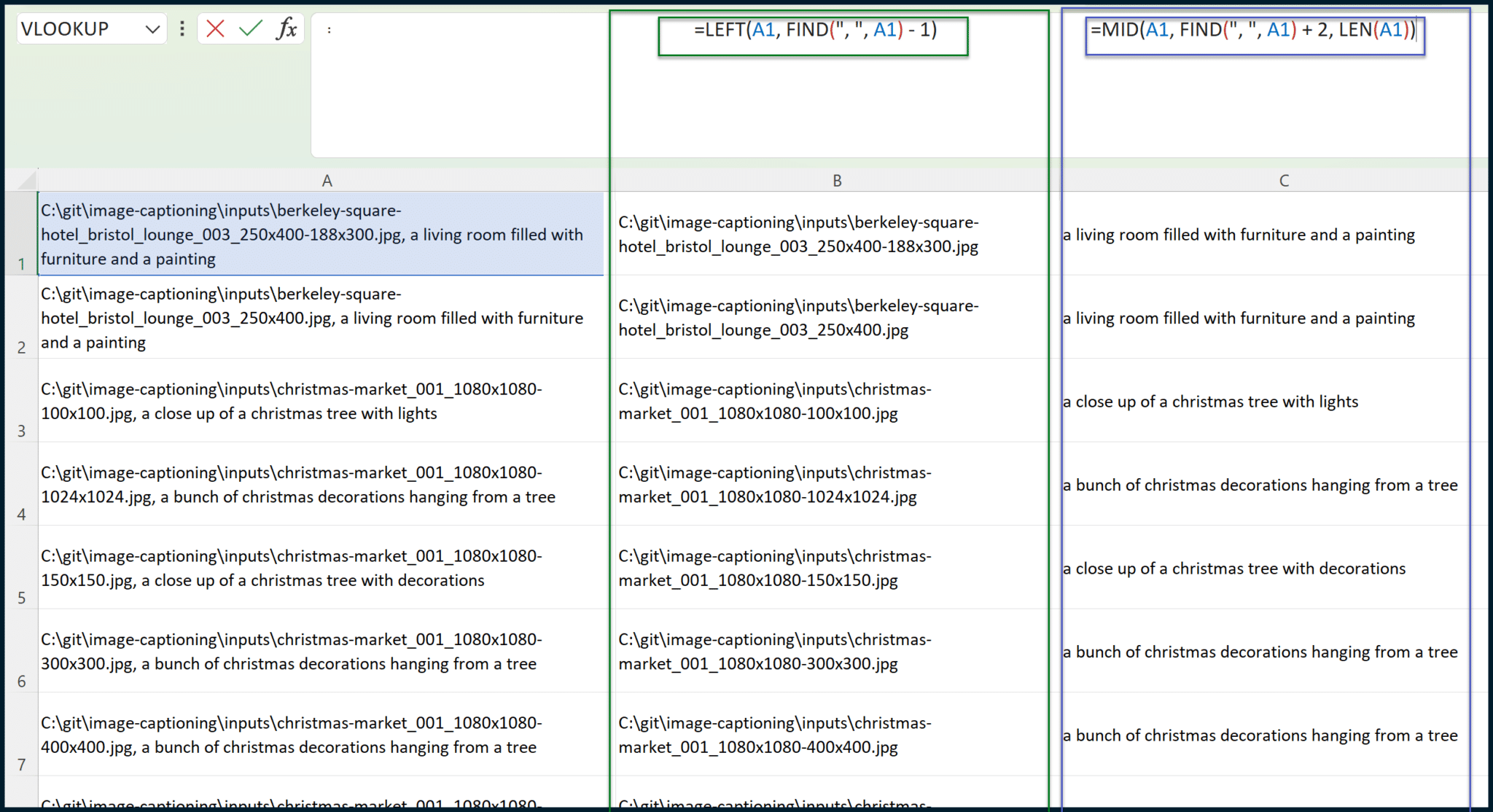
Assuming the pasted data resides in Column A, opening from cell A1, the formula that you need for cell B1 is:
=LEFT(A1, FIND(", ", A1) - 1)
The formula which you need for cell C1 is:
=MID(A1, FIND(", ", A1) + 2, LEN(A1))
Each formula can be copied down its column (B or C) until the total data population is achieved. Once this is done, we should correct the casing of the generated image captions.
To emulate sentence casing, we should capitalize the first letter of each text string contained within column C:
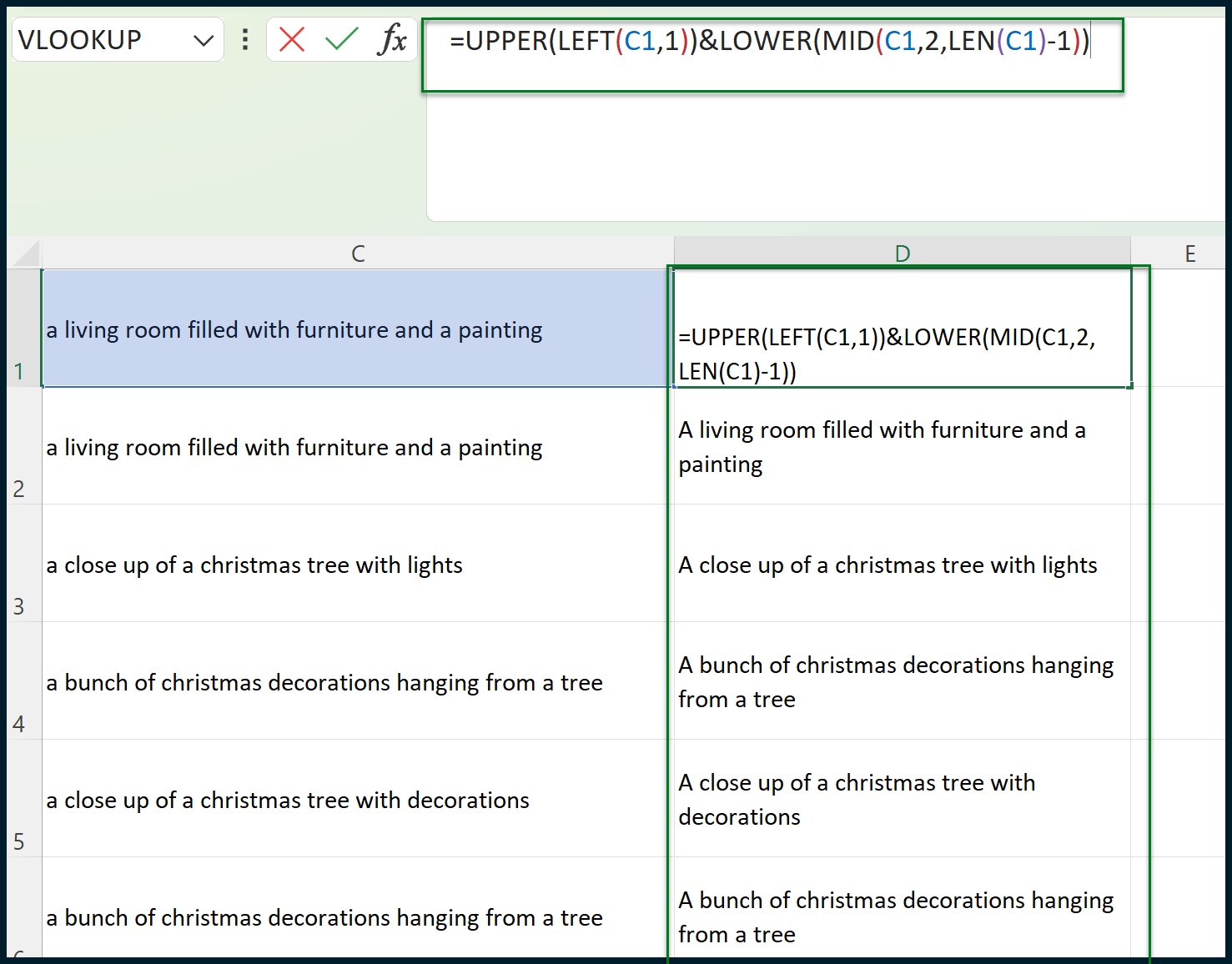
The formula for cell D1 is:
=UPPER(LEFT(C2,1))&LOWER(MID(C2,2,LEN(C2)-1))
Now, we can begin to format the data. We can add a new row for column titles.
You can also take this opportunity to apply column filters or (preferred) format the table as an actual table. Adding some frozen panes may also help:
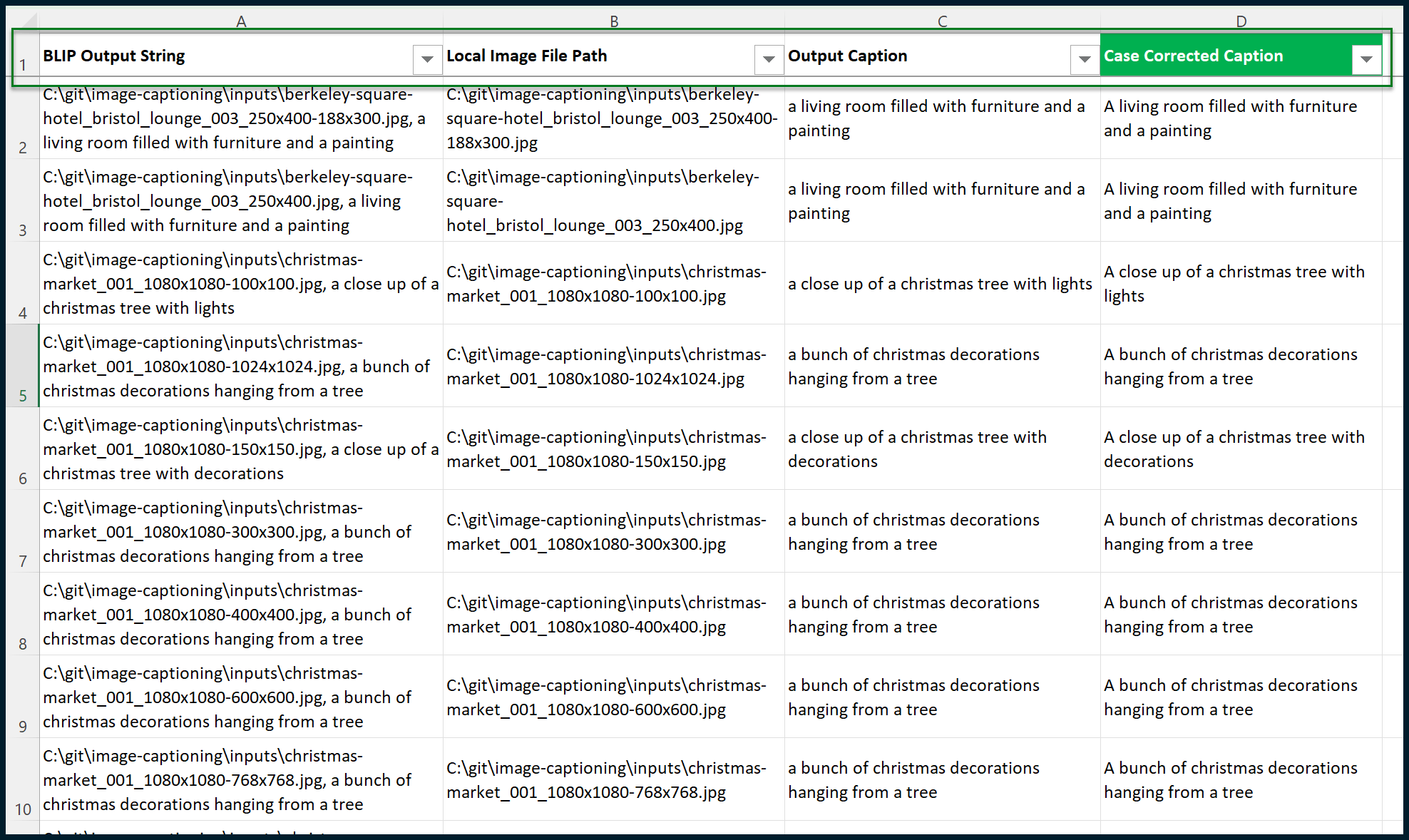
This is great, but we don’t know which image captions relate to which specific images on the website. We only have local image file paths rather than the original image URLs (as they appear online, on the website).
We need to isolate each image’s individual file name, separate from the total file path. If we do this, we can snap the data back together with VLOOKUP.
Create a new column in between columns B and C (so, a new column C) and apply the following formula:
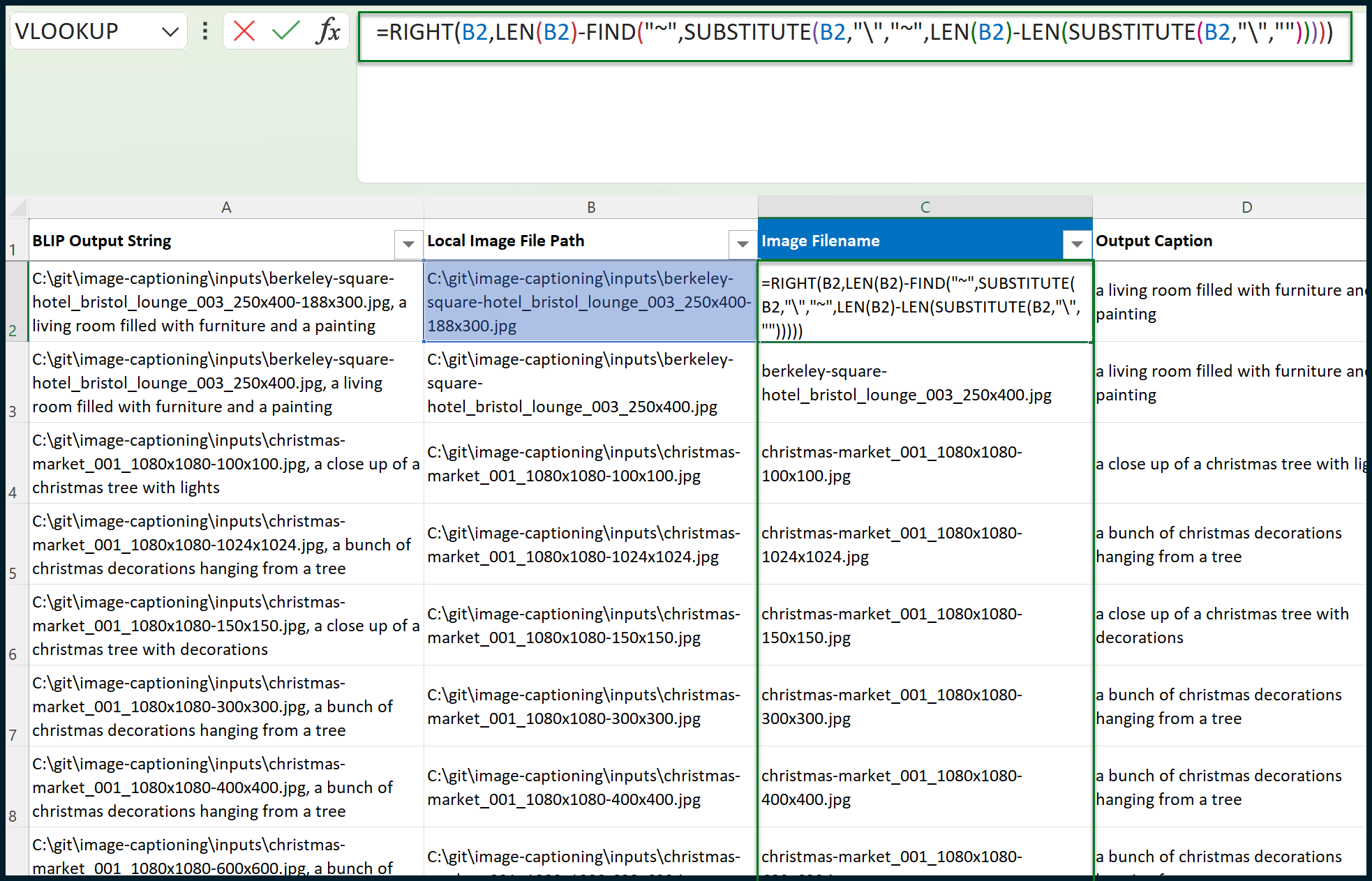
The formula which you need for the new cell (C1) is:
=RIGHT(B2,LEN(B2)-FIND("~",SUBSTITUTE(B2,"\","~",LEN(B2)-LEN(SUBSTITUTE(B2,"\","")))))
We now need to open “images_missing_alt_text.xlsx” which we exported previously from Screaming Frog. Don’t close the sheet that you have been building so far; have both open.
Inside of “images_missing_alt_text.xlsx”, create a new column between columns A and B (so, a new column B):
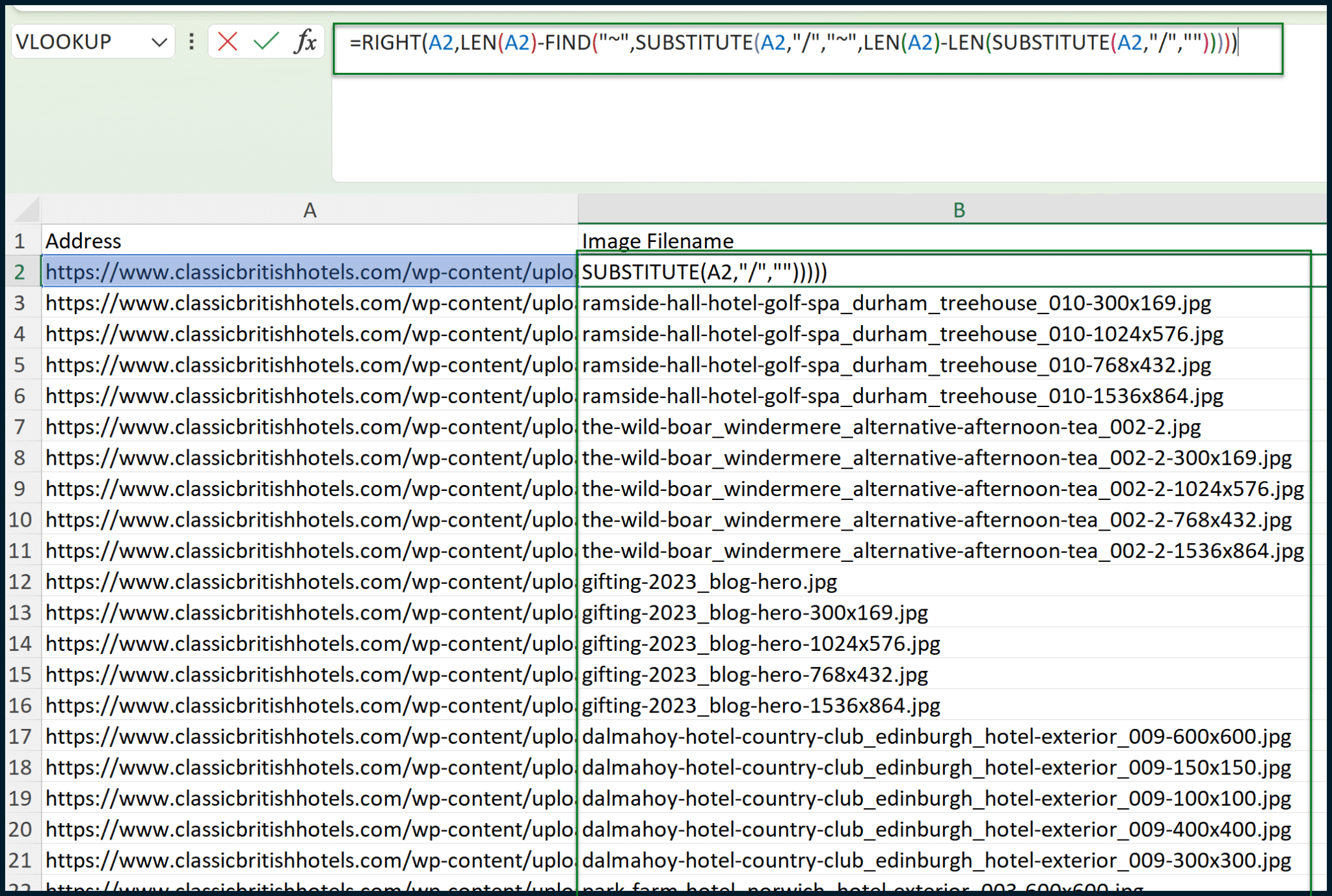
The formula which you need for Cell B2 is:
=RIGHT(A2,LEN(A2)-FIND("~",SUBSTITUTE(A2,"/","~",LEN(A2)-LEN(SUBSTITUTE(A2,"/","")))))
We can snap the data together now that we have two sheets containing an identical Image Filename.
(Sidenote: In the “images_missing_alt_text.xlsx” sheet, the data we want comes before the Image Filename. This won’t work for VLOOKUP since it can only ascertain data to the right of the match criteria. As a result, utilizing INDEX and MATCH might have been a better solution. However, VLOOKUP is simpler and more accessible for marketers. So, we’re opting for a basic VLOOKUP approach since the entire process is already complex.)
We need to copy the values within column B and paste them as values within the same position:
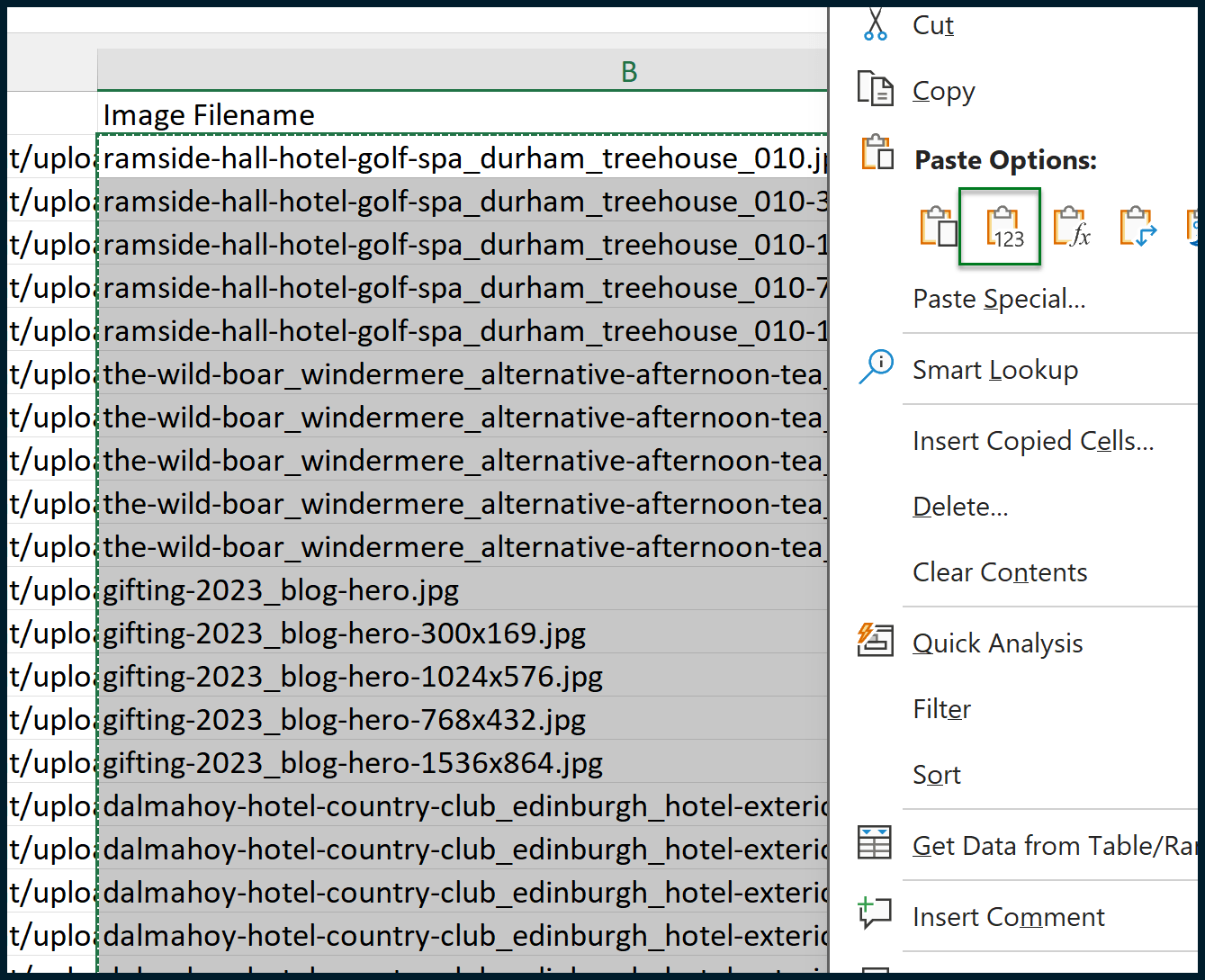
Once this is done, we can move the values within Column A to a new column – between columns B and C. We can then erase column A, resulting in the following output:
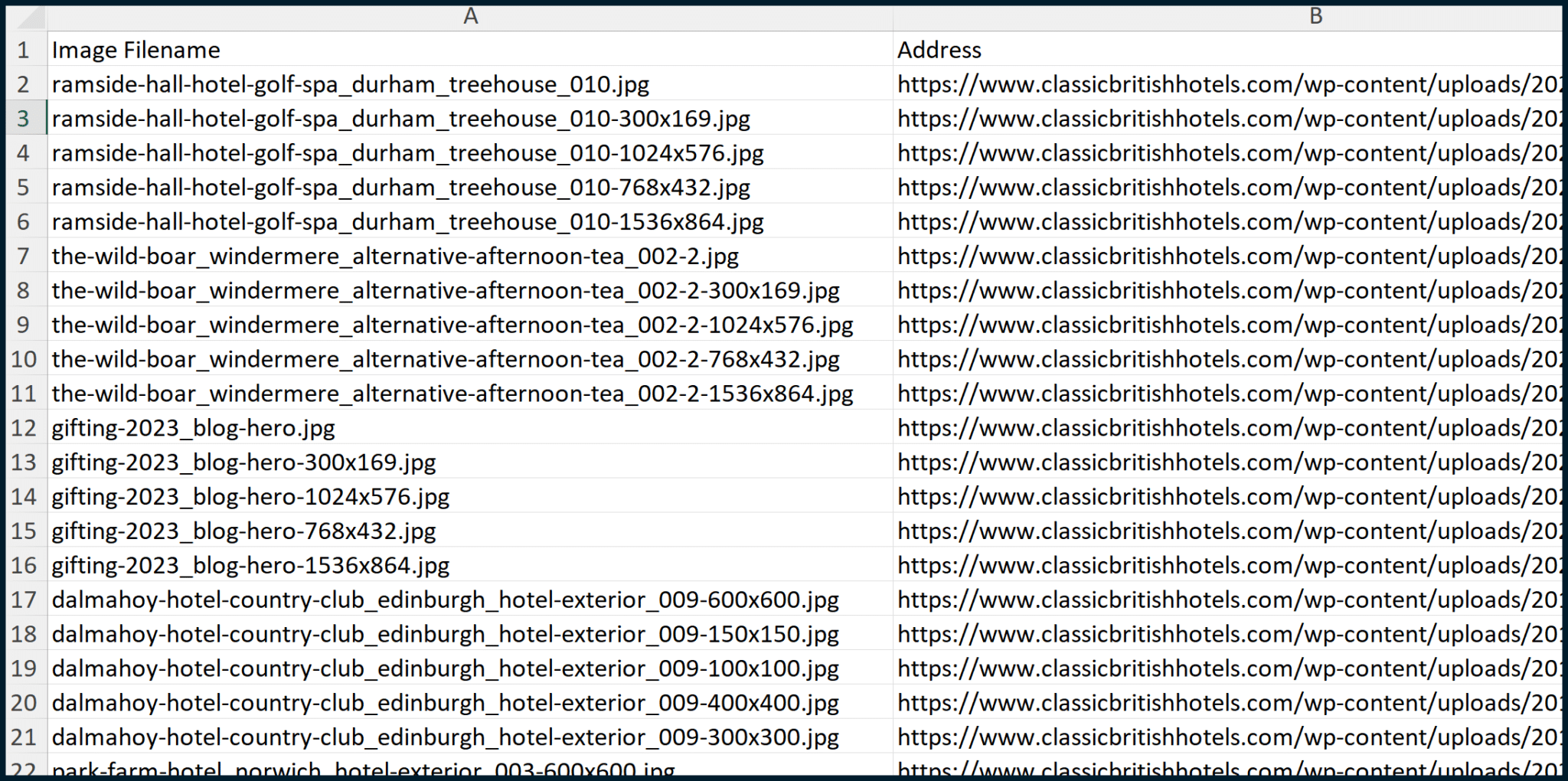
We want the Image Filename on the left and the Address on the right.
Finally, we can go back to the sheet that we were previously creating and perform a VLOOKUP to pull in the Address as Image URL.
To do this, we will need to create a new column between columns C and D (so, a new column D):

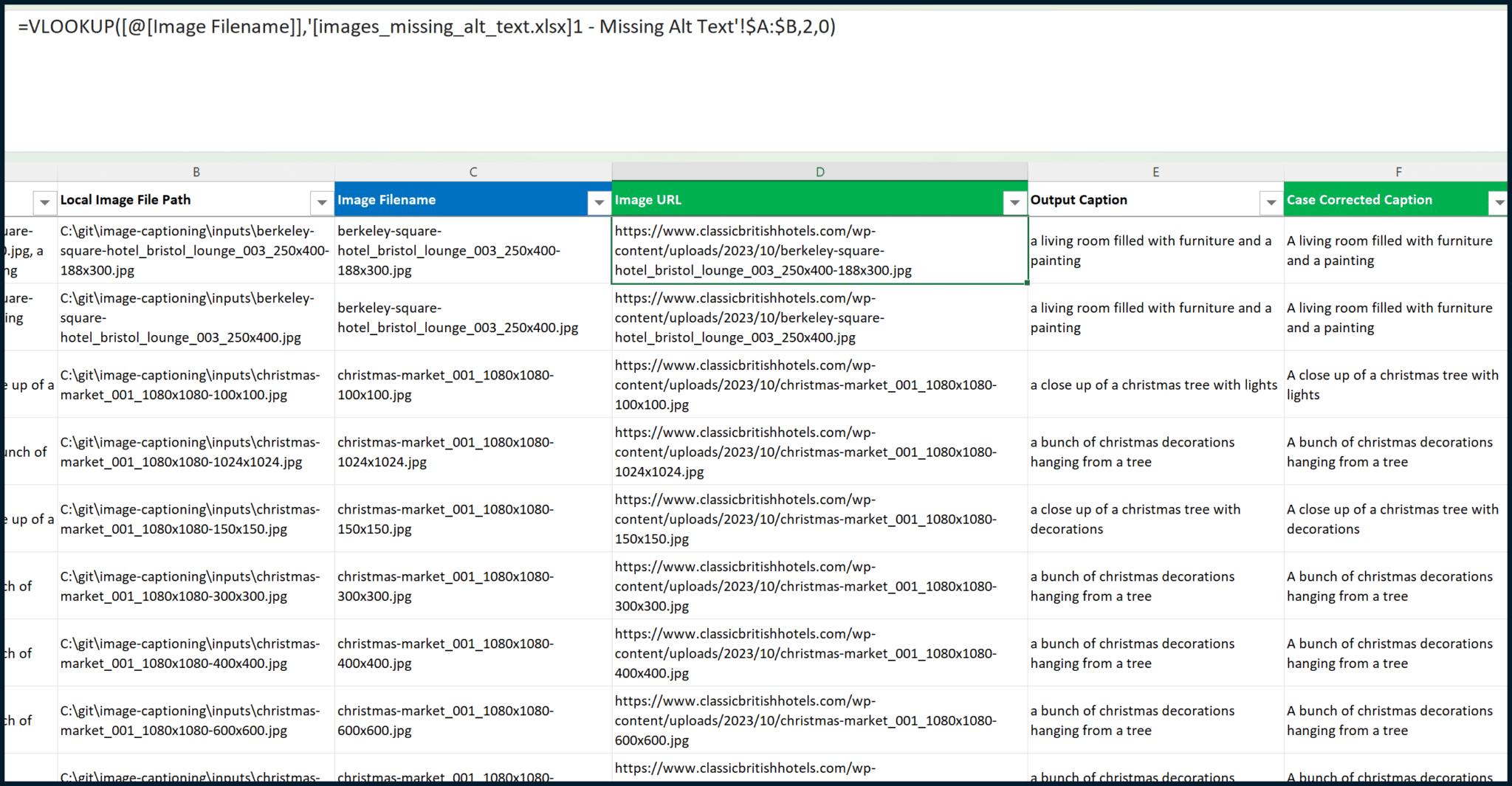
We can then copy and paste values for the entire table, making the data static (i.e., not reliant on formulas) to ensure a proper snapshot of data:
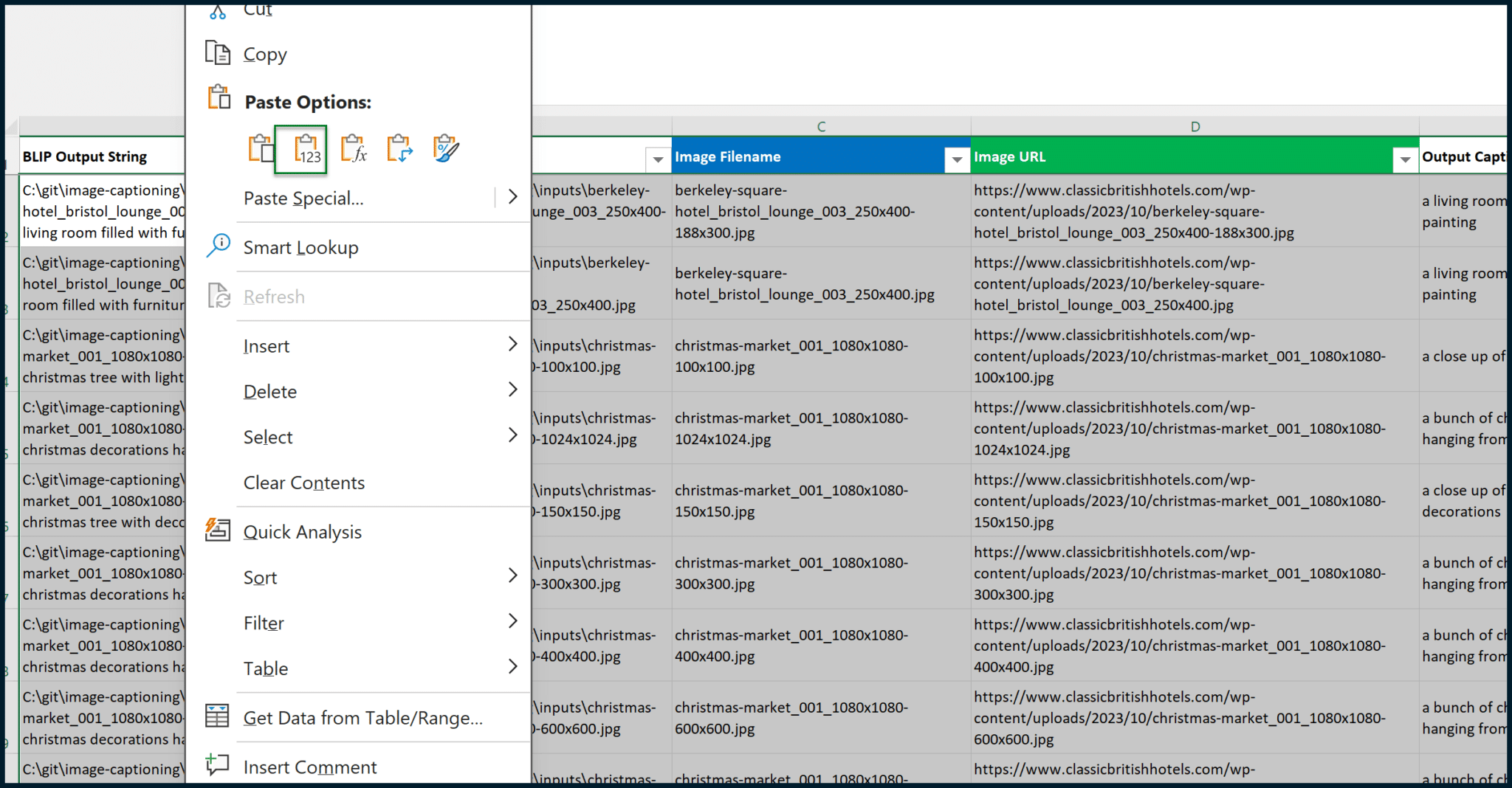
Finally, we can hide columns A, B, C and E to get the output that we want:
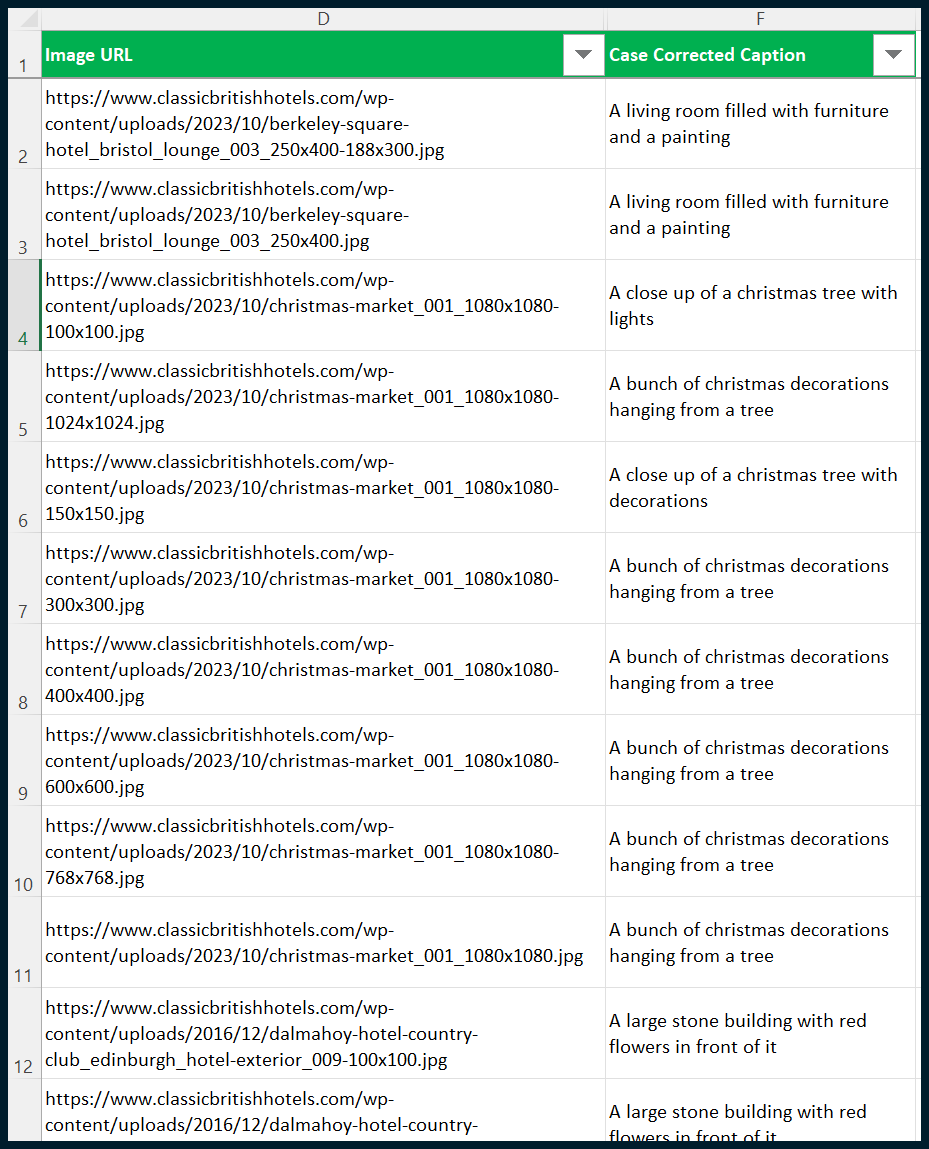
You’ll notice in the example above that there are duplicates in captions. This happened because the website stores various revisions of each image with different dimensions.
The images are stored at full resolution and in various dimensions, as is required by the engine generating thumbnails of each image. It is acceptable for identical or similar captions to apply to the same images, even at different resolutions.
Step 6: Filter the generated captions via ChatGPT
BLIP is great for generating short captions of text from images. (If you want longer captions, try a separate model known as CLIP.) However, its command of the English language is not as strong as OpenAI’s ChatGPT.
We can fire the generated BLIP image captions through ChatGPT to clean them up. We’re moving away from locally installed AI to cloud AI, which comes with API costs.
I won’t go over the details here as I recently covered accessing ChatGPT’s AI capabilities in a previous article. (Go and read it if you haven’t yet.) Afterward, the next steps should appear straightforward, and I’ll outline the basics here.
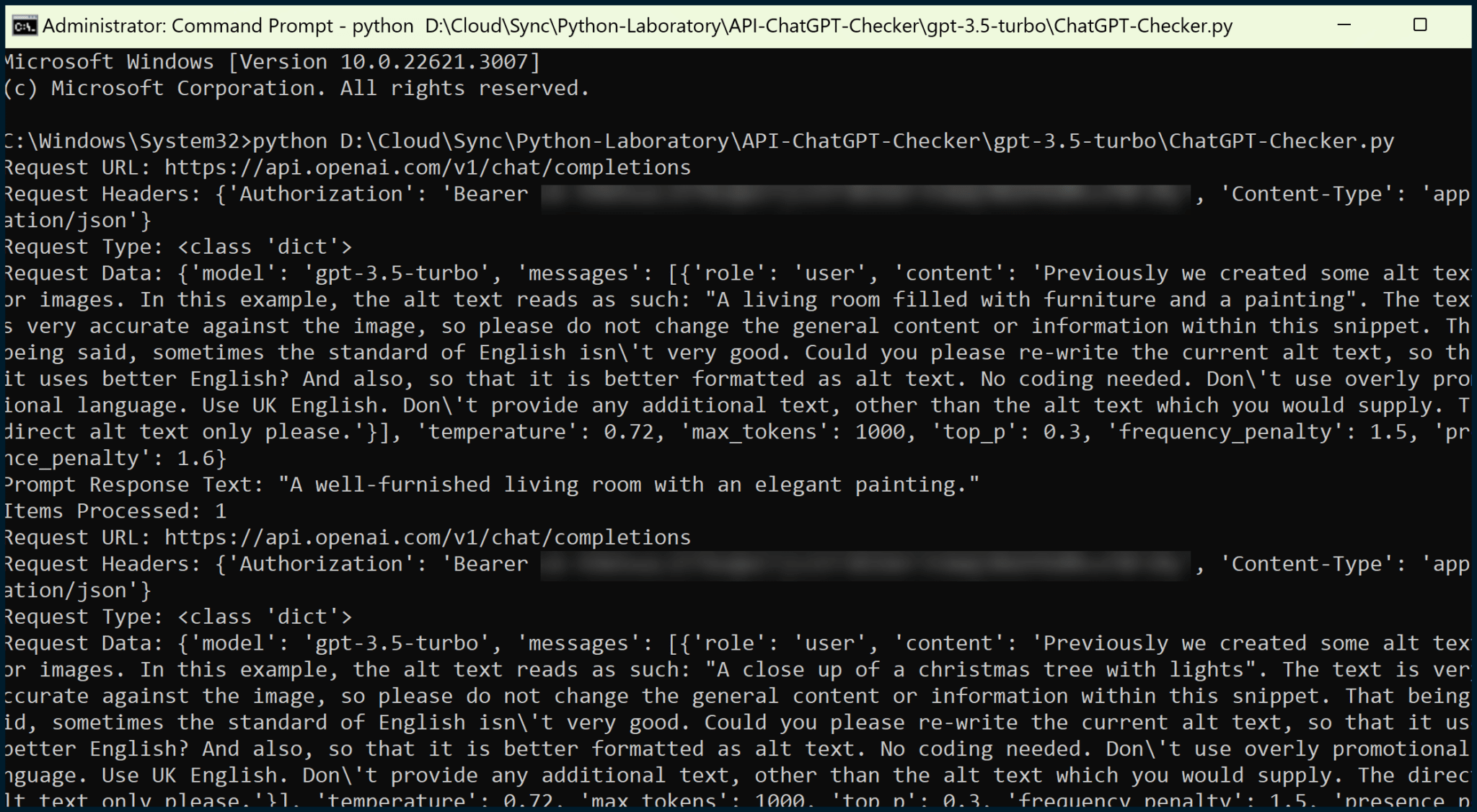
In essence, we want to send the captions off to ChatGPT, along with a prompt that will help increase each caption’s general standard. Utilizing my own Python / Excel project and formulas (to translate each BLIP caption into a ChatGPT prompt), I can produce something like this:

For example, the BLIP caption of “A living room filled with furniture and a painting” results in the formula-generated prompt of:
“Previously, we created some alt text for images. In this example, the alt text reads as such: “A living room filled with furniture and a painting.” The text is very accurate against the image, so please do not change the general content or information within this snippet. That being said, sometimes the standard of English isn’t very good. Could you please re-write the current alt text, so that it uses better English? And also, so that it is better formatted as alt text. No coding needed. Don’t use overly promotional language. Use UK English. Don’t provide any additional text, other than the alt text which you would supply. The direct alt text only please.”
This prompt is detailed for a reason. The more specifics you give ChatGPT (tone, language style, technical requirements), the better. Most details can be combined easily, with the only exception being the BLIP caption.
Now, I can utilize my own Python script (which interacts with Microsoft Excel documents) to fire this off to OpenAI via their API:
Once I have the output, I can use VLOOKUP to pull this data through to the sheet that I created earlier:

ChatGPT has now enhanced the output from BLIP.
Again, if you want to read more about how to interact with ChatGPT / OpenAI in terms of text-to-text-based output (specifically for SEO), read my previous article. There’s a lot of detail within this article which will bring you from proof of concept to full and commercially viable completion.
Step 7: Communicate with your web developer
You now have a list of image URLs without alt text, a list of BLIP-generated captions, and a list of ChatGPT refined alt text outputs.
This is where your experience as a marketer (even a highly technical one) ends. You must now share this three-column sheet to an accomplished web developer, who will create a script that appends your alt texts to images.
This must be a back-end script. A front-end script that injects the alt texts would not be suitable, as Google would need to execute those injections to apply them.
Whatever changes are made, they must be applied to the database(s) in the back end so that Google has a better (non-generated) fix on the front-end output.
Leverage AI to efficiently create alt text at scale
We’ve deployed image-to-text (BLIP, local) and text-to-text (ChatGPT, external) AIs with a shared goal. Endless possibilities arise from combining these technologies. This showcases how AI can enhance efficiency in SEO workflows.
Setup may take a couple of days initially, but tasks can be done in hours once you get the hang of it. As this cutting-edge technology integrates into mainstream SEO tools in the near future, you’ll see the value in staying ahead of the competition – producing what they cannot in a fraction of the time.
Special thanks to:
- Cobanov for creating the essential Git project that made this demonstration possible.
- My friend, Mike Worswick, for his decade-long friendship and valuable contributions. Collaborating with Mike allowed me to discover image-to-text AI applications relevant to SEO. Thank you, Mike!
Courtesy of Search Engine Land: News & Info About SEO, PPC, SEM, Search Engines & Search Marketing
Category seo news | Tags:
Social Networks : Technorati, Stumble it!, Digg, de.licio.us, Yahoo, reddit, Blogmarks, Google, Magnolia.
Meta rolls out new and updated tools to improve brand safety controls
Written on January 24, 2024 at 10:19 am, by admin
Meta introduced new tools and features to existing tools that enable brands to monitor their reputation across its platforms. They include:
- Brand Rights Protection (updated).
- Rights Manager (updated).
- Intellectual property reporting center (new).
These tools make it easier for businesses to monitor brand impersonation, prevent scams, report intellectual property infringement, and block infringing content across Facebook and Instagram.
Why we care. Safeguarding reputation is table stakes for brands. Brands associated with inappropriate or controversial content risk alienating customers and prospects. Tools that make it easier for brands to protect their reputations are welcome additions.
Brand Rights Protection. Meta is updating this tool to make it easier for brands to protect their intellectual property across its platforms using machine learning. The new version simplifies the process of reporting infringement and business impersonation, helping brands identify and address misuse of their intellectual property. Updates include:
- Improved matching: Find matches based on your past use of Brand Rights Protection.
- Cross-surface searching: Search across Ads, Commerce, Accounts, and Posts simultaneously without re-entering search terms each time.
- Saved search: Frequently used search terms and filters are now stored, so they don’t need to be reentered. Each user with access to a business account can monitor a unique list of terms.
- Reference library expansion: The reference now enables brands to monitor 200 images, up from 50 images previously.
Intellectual Property Reporting Center. If you regularly use Meta’s IP Reporting Forms, the new reporting center could save you time. New functionality stores your account information and reporting history. Multiple users logged into the same Business Manager account can access the reporting history for the entire business, making it easier for different departments to share information.
Updates to Rights Manager. Meta is adding three new features to help brands manage and protect their copyrighted content at scale. The new features include:
- Automatic blocking: Automatically block matching images.
- Image attribution: Add attribution links to matching content on Facebook (and soon on Instagram), sharing ownership details about the matched image. Rights holders can also include a call to action, allowing viewers to Follow, Email, or Message their page directly.
- Bulk actions: Perform actions on multiple image reference files at once, making it more efficient to manage your reference library.
Meta For Business Web Resources. The Meta for Business website has a new guide to assist businesses in creating a brand protection strategy and reducing the effects of brand misuse. The guide is structured into three segments – Protect, Monitor, and Resolve – offering businesses Meta’s recommended practices and product solutions for brand management.
Deep dive. Visit the Meta Help Center for more information on Brand Rights Protection and Rights Manager.
Courtesy of Search Engine Land: News & Info About SEO, PPC, SEM, Search Engines & Search Marketing
Category seo news | Tags:
Social Networks : Technorati, Stumble it!, Digg, de.licio.us, Yahoo, reddit, Blogmarks, Google, Magnolia.
How product scoring can boost your Shopping campaigns
Written on January 24, 2024 at 10:19 am, by admin
PPC advertisers running Google Shopping ads typically choose a brand, margin, or category-based structure for their campaigns. These approaches are effective for broader advertising across a large inventory. Managing tens or hundreds of thousands of SKUs poses a challenge for advertisers, making it hard to focus on individual products.
Still, delving into SKU-level details is crucial to uncover hidden potential, address wasted budget, or identify specific products affecting overall category performance. To deal with product data at scale, consider implementing product scoring.
What is product scoring?
Product scoring involves assigning numerical values to products based on various performance indicators. This rating reflects a product’s potential or current market success.
Using product scoring, you can systematically choose which products to emphasize in your marketing and sales efforts, focusing on those with the strongest potential for advertising success.
For an effective product scoring system, several metrics play pivotal roles:
Sales velocity
- This parameter gauges the speed at which a product is purchased over a set duration. Products selling swiftly typically earn higher scores, signaling market appeal.
Customer insights
- Valuable insights gathered from customer reviews and ratings are indispensable.
- Products receiving positive feedback score higher, indicating their appeal to prospective buyers.
Profit margins
- Product scoring places significant emphasis on products with lucrative profit margins because they contribute more to the advertiser’s bottom line.
Conversion rates
- Measure how effectively customer interest is transformed into sales. High-scoring products are often those that achieve robust conversion rates.
Aligning with market trends and demand
- Advertisers who align their product offerings with market trends and consumer demands are likely to achieve higher product scores.
Inventory turnover
- This measures a product’s sales and restocking cycle. Products that are consistently in demand and quickly restocked tend to score higher, indicating sustained market desire.
In addition, any product scoring model can be extended with numerous metrics, such as:
- Add to cart.
- Pricing info like average price or price competitiveness
- Bookmarked products.
- Preorder ratio.
This additional information might help in fine-tuning the scoring model.
Dig deeper: Margin-based tracking: 3 advanced strategies for Google Shopping profitability
Integrating product scoring into your marketing strategy: A step-by-step guide
Incorporating product scoring into your marketing strategy is a step toward more precise and effective Shopping campaigns.
Below are the essential steps and considerations to add product scoring into your marketing activities.
Step 1: Establish your product scoring criteria
Identify key metrics
- Identify the metrics from the list above that matter most for your products and market. Consider sales velocity, customer ratings, profit margins, conversion rates, market trends, and inventory turnover.
Create a scoring model
- Construct a method to assign scores to your products based on these identified metrics. This model can range from a straightforward numerical scale to a more nuanced weighted algorithm.
- A basic model could be a scoring system from 1-5; a product’s score is determined by adding the score of each metric for the product. You can implement a basic scoring system quickly, but it lacks the sophistication that can be achieved with a more advanced model.
- A more advanced model could be based on this formula:
Product Score = sales volume (share) x price competitiveness x demand x profit margins

- Advertisers should test models. Some models might lead to more accurate decision-making results depending on the data quality.
There are almost no limits to the composition of metrics that contribute to the score. The most significant challenge may be aggregating data from multiple sources so that it can be analyzed. That leads to Step 2.
Step 2: Integrate data analytics
Use diverse data sources
- Tap into varied data sources, including sales records, customer feedback, market research, and digital footprints from online interactions.
Implement analytics tools
- Deploy sophisticated analytics tools capable of processing and interpreting this data to yield precise product scores. Opt for solutions that manage a lot of data and offer real-time analysis for adaptive scoring.
- On a small scale, information could be stored in a spreadsheet, which can be developed into an enterprise resource planning (ERP) based analytics database.
- Larger enterprises may start with a cloud-based data warehouse to aggregate all its product scoring data.
- Make sure to develop the necessary connectors or have an existing setup. For example analytics or ads data can easily be integrated. In contrast, Google Trends or ERP data might need an automated process to ensure timely and accurate data.
Step 3: Apply product scoring in marketing campaigns
Prioritize top-scoring products
- Allocate your marketing investments to products with the highest scores. This might mean increased advertising budgets, strategic placement in promotional materials, or special offers.
- Create automations to remove lower-scoring products or bring products without a score into a test cycle.
Step 4: Maintain and refine product scoring
Dynamic scoring updates
- Keep your product scores fluid, allowing them to evolve with shifting market trends, consumer preferences, and incoming data.
Ongoing scoring optimization
- Continually assess and fine-tune your scoring criteria and methods to ensure they stay pertinent and yield the most beneficial outcomes.
- Also, make sure to refine your scoring model and the metrics you use.
Step 5: Monitor results and glean insights
Track campaign efficacy
- Diligently monitor the performance of campaigns that feature high-scoring products, comparing their effectiveness against other campaigns.
Extract insights for future strategies
- Use the insights gleaned from these campaigns to inform and shape your future marketing strategies and product development decisions.
Challenges in implementing product scoring
Implementing product scoring involves navigating various challenges and adhering to best practices for maximum effectiveness.
The biggest challenge is likely data collection and management. As data accumulates, new tools and additional storage may be required.
Selecting the product scoring metrics you capture and store should be well thought out. Adding a new data source to the model means you’ll be losing historical context.
The product scoring must be aligned and updated frequently and reliably to supply quality data for marketing. This approach can only work if the data is correct.
Leverage product scoring for more effective campaigns
While developing and integrating a scoring system takes concerted effort, the rewards make it worthwhile. Product scoring provides a compass to guide your marketing dollars, advertising campaigns, and product development.
Balancing the focus between high and low scorers is important. While it’s essential to prioritize high-scoring products, lower-scoring products should not be completely overlooked, as targeted efforts can sometimes turn these products around.
Leveraging technology and automation for data processing and scoring reduces human error and increases efficiency.
Dig deeper: Google Merchant Center: Using product data to boost your retail efforts
Courtesy of Search Engine Land: News & Info About SEO, PPC, SEM, Search Engines & Search Marketing
Category seo news | Tags:
Social Networks : Technorati, Stumble it!, Digg, de.licio.us, Yahoo, reddit, Blogmarks, Google, Magnolia.
How to make PPC work for SMBs
Written on January 23, 2024 at 6:18 am, by admin
PPC offers great opportunities for companies of all sizes to reach new customers. However, enterprises and small to medium-sized businesses (SMBs) face very different challenges when it comes to developing and optimizing campaigns.
Smaller budgets, limited data and an emphasis on quick ROI mean that SMBs can’t simply replicate the strategies of big brands. Instead, they need a tailored approach to make every dollar count.
This article outlines the key differences between enterprises and SMBs when it comes to PPC and specific optimization tactics for maximizing ad spend.
Enterprises vs. SMBs: Differences in PPC strategy
Budget
One of the biggest differences between SMBs and larger organizations is the amount of money/budget available to them.
Smaller companies could have an ad spend budget of $5,000 per month, while larger companies in the same space might be able to spend $5,000 per day.
This significantly impacts marketing strategy. To deal with lower budgets, targeting should have a narrower focus to prioritize the most important audiences. Some strategies to tighten up coverage include:
Phrase and exact match keywords
Broad match keyword performance may have improved in recent years (for some advertisers), but they still tend to struggle in smaller accounts because of limited budgets, data and how many searches they can match.
While phrase and exact match keywords are still eligible for close variant matching, you retain much more control over the queries they match to compared to broad match.
Localized geo-targeting
Start by targeting your core service areas or a specific region. You can then test expanding your footprint more intentionally once those campaigns run efficiently or if more budget opens up.
- For example, you’re working with a local ice cream store that can ship anywhere in the U.S. Targeting the entire country would likely eat up the budget without significantly impacting their sales.
- Instead, I’d recommend targeting a 25-mile radius around the store so that they saturate the search engine results page for any searches related to ice cream in their area. From there, they can expand into neighboring counties and work their way up to the rest of the state, region, etc.
Local and/or long-tail keywords
Longer, more specific keywords will help eliminate some of the extra noise that comes with query matching. Combine this with phrase or exact match types and tighter geo-targeting, and you get a nicely refined audience that maximizes your budget.
- For example, targeting “ice cream” is very open-ended and would likely result in wasted spend. However, [ice cream store near me] makes it much clearer what the user’s intent is and would be highly relevant to a local shop.
Small to medium-sized B2B companies are another important segment to highlight. These businesses often deal with search terms that overlap with a larger, unrelated audience, and they can benefit greatly from longer-tail keywords.
- For example, an ingredient supplier that wants to sell their products to corporations like Coca-Cola, not an individual consumer. Targeting something like “bulk sweetener” may result in traffic from people looking to buy for their own kitchen or office. Instead, I’d recommend targeting more specific terms like “wholesale stevia supplier” and “commercial grade sweetener distributors”.
Dig deeper: 2024 PPC budgeting: How to plan and secure your ideal budget
Volume
Another difference is that many SMBs deal with lower volume than large companies. This could be due to various factors, such as lower budgets, smaller service areas, longer sales cycles, or offering more niche products/services.
One major problem with having low volume is that it makes it more difficult for automation to work in the account’s favor. At the very least, it will take more time for data to be collected and the systems to learn, but not every business is willing or able to wait for something that might eventually work for them.
- For example, a construction company with a limited budget and long sales cycle gets an average of 5 leads per month from Google Ads campaigns. However, the more data you collect, the faster the ad platform’s algorithm will learn and the better your campaigns will perform. Because this company doesn’t receive much data each month, they may struggle to see results if they start with a Maximize Conversions bidding strategy.
- Another example is Target CPA bidding. Historically, Google Ads has recommended testing this strategy with a daily budget 10x higher than your CPA. SMBs with a tCPA of $50 likely aren’t able to set one campaign to spend $500/day.
Manual bidding strategies are a great starting point to combat lower volume. This allows you to retain more control while data is collected instead of handing over the reins to companies incentivized to spend your money.
That’s not to say that automation can’t help smaller accounts – it’s just important to know what the system needs to be successful. Feeding higher-quality data will allow the algorithms to learn best, such as offline conversions and CRM imports.
Emphasis on ROI
Lastly, SMBs want to see a return on their investment quickly and can’t afford to wait a long time to start seeing leads, sales, etc. As a result, focus on capturing existing demand first.
Search and Remarketing will likely be most impactful to start, as these users have much higher intent to convert than those who would be targeted in a top-funnel awareness campaign.
You should also make sure that all conversion tracking is reliable and accurate to clearly determine what is or isn’t successful.
Dig deeper: Setting PPC goals: How to tailor KPIs and metrics for each funnel stage
PPC optimization tactics for SMBs
When you’re dealing with lower budgets and volume with an emphasis on ROI, I recommend prioritizing refinements before expansion.
We all want to grow and scale our accounts, but it’s important to first make the most of the existing budget. This ensures you’re reaching the most relevant audience possible, setting up any future expansion efforts for success.
Below are optimization tactics focused on refining spend and improving audience/traffic quality:
Review the Search terms and Placement reports regularly
- Do this at least once a month to identify and prevent irrelevant traffic.
- Adding negative keywords is crucial for any Search campaign, especially for SMBs.
- If the account runs on Display or Video Networks, consider excluding mobile apps, children’s YouTube channels and other spammy sites/channels/etc.
Avoid unnecessary networks to ensure ads appear where you want them
- For Search campaigns, opt out of the Google Display Network and consider opting out of Google Search Partners.
- While Microsoft Advertising no longer allows advertisers to opt out of the Audience Network for Search campaigns, you can still exclude websites at the campaign and account level.
- For social campaigns, consider opting out of the platforms’ external networks, such as the LinkedIn Audience Network for LinkedIn campaigns.
Test bid modifications, ad schedules and exclusions based on performance analyses
- For example, you reviewed your Google Ads day and device data and found that 12 a.m. to 4 a.m. on weekends, and tablet devices all have a CPA at least 5x higher than the account average. From there, you can test a -25% bid modification from 12 a.m. to 4 a.m., -10% bid modification for tablets, and only run campaigns on weekdays.
- You then conducted location and audience analyses and found that current college students and people in Montana never converted. To limit spend on these non-converting segments, you can exclude current college students and test a -50% bid modification in Montana.
- On LinkedIn, you compared the Demographics Report to your actual campaign targeting and found that 80% of your impressions came from people with a job function in Sales (even though this is outside your target audience). You can then exclude the Sales function from all campaigns.
Make sure the website is optimized for conversions
- Lastly, if you’re running campaigns for an SMB, the website must be ready for traffic to come through.
- If you direct people to a page that has minimal information, no conversion tracking, poor speed and/or design, etc., your PPC campaigns will not be set up for success.
- The strategies and refinement tactics above will matter significantly less if landing pages are not optimized.
Dig deeper: 5 tips for effective PPC bidding on a budget
Making every PPC dollar count for SMBs
Small and medium-sized businesses face different problems compared to companies that have 1,000+ employees and significantly more revenue. PPC is no exception, with many SMBs facing the reality of having a limited budget, less data and greater pressure for results.
Paid media can also be intimidating for smaller organizations when they see big brand names competing in the same space. However, it can quickly become a key component of the marketing mix by implementing tighter targeting, maximizing control over ad spend, implementing robust and accurate conversion tracking, and testing ongoing refinements.
Courtesy of Search Engine Land: News & Info About SEO, PPC, SEM, Search Engines & Search Marketing
Category seo news | Tags:
Social Networks : Technorati, Stumble it!, Digg, de.licio.us, Yahoo, reddit, Blogmarks, Google, Magnolia.
Google performance reports updates how it counts clicks and impressions for job listing and detail pages
Written on January 23, 2024 at 6:18 am, by admin
Google changed how it counts clicks and impressions for job listing and detail pages within the Search Console performance reports. You may notice an increase in clicks and impressions when filtering by job listings and detail pages, but that is only because Google evaluates these data points differently than it did in the past. The change in reporting started on January 9, 2024.
No changes to Google Search. Google did not changed how or where job listings and detail pages show within Google Search. Instead this was just a reporting change in Google Search Console.
What Google said. Google posted about this update here, saying:
Search Console has changed the way it evaluates and counts impressions and clicks for job listing and detail pages. As a result, you may see an increase in clicks and impressions for your job pages. This increase doesn’t reflect actual growth, but rather that Search Console is more accurately reporting the number of impressions and clicks across the various job experiences in Search.
How these metrics work. Google posted more details on this within its help documentation. You can read them over here.
Why we care. If you notice an increase in impression and click data for job listing and detail pages, this is why. Record the date of this reporting change. Nothing you or Google Search may have done was responsible for the fluctuations in impressions or clicks.
Courtesy of Search Engine Land: News & Info About SEO, PPC, SEM, Search Engines & Search Marketing
Category seo news | Tags:
Social Networks : Technorati, Stumble it!, Digg, de.licio.us, Yahoo, reddit, Blogmarks, Google, Magnolia.
Google confirms a search ranking bug where sites disappear from search results over the weekend
Written on January 23, 2024 at 6:18 am, by admin
Google confirmed a search ranking bug, a “very narrow issue,” as Google called it, that affected a “small number of websites” where those rankings would drop out of the Google Search results over the weekend and then reappear during the weekdays.
Google’s statement. A Google spokesperson told Search Engine Land this issue has already been resolved and that it only impacted a “small number of websites.” Google wrote:
We’re aware of a very narrow issue that caused temporary fluctuations in search results for a small number of websites. The issue has since been resolved, and the sites should no longer be seeing its effects.
The issue. The issue seemed to have impacted sites that were on exotic vanity top-level domains (TLDs). Affected TLDs ended in .club, .consulting, .life and other non-standard TLDs. Some sites noticed that they completely stopped ranking over the weekends. Initially, I thought it was either a quality issue, being on the edge of quality, or a bug with Google Search. But it turned out it was a bug with Google Search.
The first person I saw cover this was Tomasz Rudzki at ZipTie. In short, he wrote, “On weekends, something strange kept happening – the website would completely lose rankings and traffic. People couldn’t even find it when they searched for it by its name.”
What was interesting is that those ranking issues coincided with several unconfirmed Google updates that happened over the weekend. He said, “9 out of 9 examples were non-standard TLDs, such as, .consultancy (example.consultancy), .care (example.care), .club, .info, .energy.” The dates he shared coincided with the algorithm updates I reported on. He said these were the dates:
- 25th November (my story)
- 9th December (my story)
- 15th December (my story)
- 22-24th December (my story)
- 29-30th December (my story)
- 4-6th January (my story)
Sample ranking chart. Here is one example of a ranking chart showing the weekend drop in performance from organic Google Search:

Why we care. This issue seems to have been going on since November 2023. Nearly three months later, after these reports, Google resolved the issue.
If you noticed weird ranking issues over the weekends and you are on one of these non-standard TLDs, then maybe this impacted you. I did notice these Google weekend search ranking updates stopped over the past week or so.
Hopefully, you won’t see this going forward.
Courtesy of Search Engine Land: News & Info About SEO, PPC, SEM, Search Engines & Search Marketing
Category seo news | Tags:
Social Networks : Technorati, Stumble it!, Digg, de.licio.us, Yahoo, reddit, Blogmarks, Google, Magnolia.
Google tests new Nearby Events and Deals feature in SERPS for local businesses
Written on January 23, 2024 at 6:18 am, by admin
Google is trialing a new local search box called Nearby Events and Deals.
The new SERP feature, which is only visible for local searches on mobile devices, displays Google Business Profile (GBP) posts promoting deals and events from nearby businesses.
Why we care. This feature offers a chance for local businesses to boost conversions. To make the most of it, you should regularly post and optimize content on your Google My Business (GMB) profile to increase the likelihood of your brand’s events and deals ranking higher.
How it works. The Nearby Events and Deals feature was first spotted by Saad Alikhan who shared a preview on X:

The feature displays four tiles, complete with the company name, a promotional photo and a review rating.
If you select one of the tiles, Google will take you to a full-screen view of the offer in more detail. Here, you’ll find the name of the business, where it is situated on a map, an image of the promotion and some text. However, the feature has not yet been spotted on Google maps.
Competitive. Notably, the four pack does not appear to have a “show more” option, meaning that visibility via this feature is very limited.
Placement. Observers noted that the new Nearby Events and Deals feature is typically located further down the SERP, under the local pack, organic results, “People also ask” and “People also search for” sections.
Deep dive. Read our How to follow Google Business Profile guidelines deep dive for more information on optimizing your account.
Courtesy of Search Engine Land: News & Info About SEO, PPC, SEM, Search Engines & Search Marketing
Category seo news | Tags:
Social Networks : Technorati, Stumble it!, Digg, de.licio.us, Yahoo, reddit, Blogmarks, Google, Magnolia.