

GPT-4 vs. Google Cloud: Performance comparison on 9 SEO tasks
OpenAI’s APIs, especially the large language model (LLM) GPT-4 and its chatbot ChatGPT, have gained significant popularity in the past year.
Despite the availability of marketing APIs from long-established providers like Google Cloud, Microsoft Azure, and AWS for over a decade, many search marketers prefer generative AI models for their SEO-related tasks.
This article compares the performance of GPT-4 and Google Cloud’s machine learning APIs on common SEO tasks where automation can be implemented, including semantic analysis, classification, translation, and image understanding.
While there are undoubtedly many other applications of these technologies for SEO and digital marketing, my aim with this analysis is to:
- Inspire you to think creatively about available machine learning APIs and how you use them daily.
- Help you understand the different areas where ML-based automation can help boost efficiency and improve outcomes for digital marketers.
- Illustrate the importance of choosing your automation allies carefully depending on the task instead of relying on one solution (like ChatGPT) for all your automation tasks.
Methodology
To test the models’ performance, I’ve put them against one another on the same data (i.e., same text, video/audio, or image, depending on the task).
I’ve repeated the process on three different data points for each task to allow me to draw better conclusions for the “Comparative Analysis” below.
Summary
Here’s a table quickly summarizing the performance analysis:

Legend:
 – Can do it, with limitations
 – Can’t do it
 – Excels at this task
Let’s dive into each category below.
Understanding text
Named entity recognition (NER) is an area in computer science and natural language processing (NLP) that focuses on detecting and categorizing specific entities within a text, like people’s names, organizations and places.
The main objective of entity analysis is to efficiently extract these details from unstructured text data (or otherwise – from free-form text).
You can also analyze unstructured text through syntax analysis. This area deals with understanding and analyzing the structure of sentences in a language, assisting machines to extract meaning from text.
The key aspects of syntax analysis include:
Parsing sentence structure
- Syntax analysis involves breaking down a sentence into constituent elements like nouns, verbs, adjectives, etc., and understanding how these elements form grammatically correct sentences.
Dependency parsing
- Understanding how different words in a sentence depend on each other – identifying main verbs, subjects, objects, etc.
Parts of speech tagging
- This involves identifying parts of speech for each word in a sentence, such as whether a word is a noun, verb, adjective, etc. This is crucial for understanding the role each word plays in a sentence.
Phrase chunking
- This step groups words into phrases that naturally belong together, which is helpful for further syntactic and semantic analysis.
Syntax trees
- Many syntax analysis tools create a tree diagram (syntax tree) to represent the hierarchical structure of a sentence, showing the relationships between different parts of the sentence.
So, what type of projects can these two approaches be used in SEO for?
Entity recognition in SEO
In SEO, you can use entity recognition in the following projects:
SERP analysis
- In this case, you can use your keyword universe as a starting point and collect SERP data in bulk via a tool like dataforSEO.
- Using a Sheets template like this one, you can extract entities of titles, URLs, or meta descriptions of top-ranking pages and use the insights from the analysis to inform your topical maps and content direction.
Keyword research
- Begin with your keyword data and validate which keywords include entities.
- Develop content maps based on closely linked entities and create lists of both positive and negative secondary entities for your content writers.
- Additionally, assess which keywords feature entities in the knowledge graph.
Internal linking audits
- Start with your internal linking anchor text data. Validate which anchors include entities and further analyze anchor text for entities, particularly those in the knowledge graph.
- Utilizing your website content (scraped via crawling) in combination with internal links, identify pages mentioning entities and link them together.
Competitor content analysis
- Extract entities from your competitors’ website content, including text, titles, and meta descriptions. If an entity appears prominently, include it in your content map.
- Analyze how many articles with prominent entities feature them in titles/meta descriptions and what the relationship between this practice and traffic.
Social comments analysis
- Scrape customer-generated comments from platforms like YouTube, TikTok, X and Facebook. Analyze these entities and map the findings against your site content for enhanced insights.
- As an additional step, check the entity sentiment associated to uncover insights into how users feel toward important entities, especially if those relate to the brand or its products or services (e.g., the price).
Syntax analysis in SEO
In SEO, text analysis methods can be used if you want to:
Analyze content at scale
- Employ text analysis methods in SEO to comprehensively analyze and understand content from SERPs or competitor websites.
Identify n-grams
- Discover n-grams within titles, meta descriptions, content, and anchor text to gain insights into content composition and relevance.
Determine successful title structures
- Identify effective title structures for your target keywords by analyzing patterns and structures in existing content.
Enhance entity analysis
- Detect the most common words associated with target entities and attributes to enhance content relevance and SEO performance.
Facilitate structured data automation
- Recognize repeated use of specific terms and term combinations to trigger automated structured data JSON completion.
- For instance, if a page frequently mentions “FAQ” or “Frequently asked questions,” initiate FAQPage structured data extraction.
- Similarly, if a page mentions “recipe” more than three times, trigger the completion of Recipe schema, and so on.
Comparative analysis of GPT-4 vs. Google Cloud Natural Language API on entity extraction and text analysis

Grouping text
In the following section, I will review two machine learning approaches for grouping text – clustering and classification. Both are extremely important for SEO analysis and executing different tasks at scale.
- Clustering is an unsupervised machine learning approach that involves partitioning an unlabeled dataset (splitting into groups of similar data objects).
- Classification is a supervised machine learning approach that involves sorting data objects into pre-defined categories using the provided labels.
It’s best to illustrate the difference between the two with a simple example from the SEO industry. Imagine working with a list of pages (a website’s URLs) that you want to label with appropriate category tags based on the pages’ content. In this case:
- If you have a list of categories (e.g., that your client is sure that the content will align with in one way or another), you can implement a classification machine learning algorithm to parse the content and label it accordingly, based on the provided category list
- Suppose you don’t have a list of categories (e.g., nobody on the team knows what the content is about). In that case, you can implement a clustering machine learning algorithm to parse the content, understand its key terms and provide the most appropriate topic label for it, organizing each content piece into topics and giving an approximation of how closely to this topic each piece is aligned.
Here are some examples of how these approaches can be applied in SEO and why they are important.

Classification in SEO
Review the following scenarios and how classification can help improve your SEO strategy completion or speed up some processes.
You have a large website that you want to quickly understand the content of
- Utilize classification to quickly determine the range of topics covered by a site’s content.
You are conducting a content gap analysis or competitor research and trying to categorize multiple competitors’ content
- Use classification to verify if the competitor sites’ content aligns with the desired business direction.
Clustering in SEO
Consider these practical applications of clustering in SEO and how it can enhance your strategy and efficiency:
You are trying to group together keywords in a big Keyword Universe
- Clustering here enables categorizing and understanding various topics within your keyword set.
You are trying to understand a website’s content without having any idea what the content is about
- Topic clusters work on the semantic or keyword extraction method, so some models can help identify prominent topics and cluster content together based on sub-topic similarity.
Comparative analysis of GPT-4 vs. Google Cloud Natural Language API on clustering and classification
The table below shows the benefits and limitations of using either of the models analyzed.

Image SEO
There are a few tasks in the image category where machine learning algorithms can assist you, like captioning images and image generation.
Currently, image generation can be done only by OpenAI’s DALL-E model; Google Cloud does not yet have a comparable alternative.
Image captioning, needless to say, is highly important for SEO for many reasons, including:
- Site accessibility.
- Improved image search rankings and site visibility.
- Better content comprehension of your site by crawlers.
Comparative analysis of GPT-4V vs. Google Cloud Vision AI on captioning images
The table below compares the captioning capabilities of Google Cloud’s Vision AI and Vertex AI versus the recent introduction of GPT-4 with vision (or GPT-4V) vision capabilities, accessed via ChatGPT.
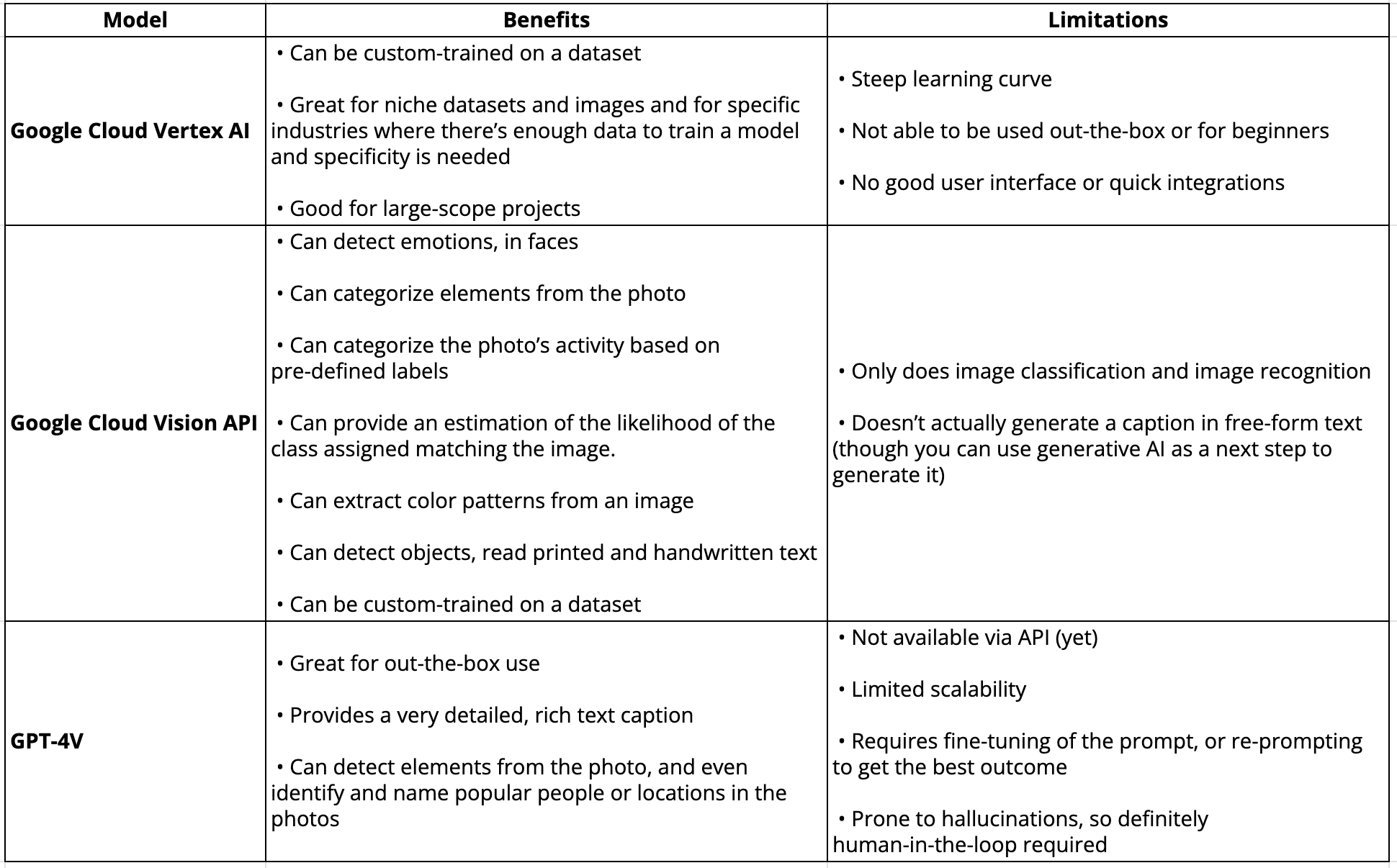
The only notable difference that can sway you to use one versus the other would be that you can easily integrate Google Cloud’s Vertex AI algorithm into a project and run it to caption hundreds, if not thousands, of images.
This can be extremely useful for image captioning for enterprise-level or large websites failing at this accessibility requirement. Despite the many conversions that this capability will soon be introduced with the GPT-4 API endpoint, this has not (yet) come to fruition, though it might soon.
Content transformation
Content transformation refers to transforming the content to a different format, style, or length. It is important for SEO because of two factors: omnipresence and accessibility.
Omnipresence encapsulates the need for your brand or content to exist in different forms and platforms. This requirement is influenced by:
- Customers’ desires to be able to consume the content in different formats.
- The ever-changing preferences Google provides in the SERP for different content types.
It’s important to know that Google won’t automatically treat it as duplicate content if you have the same content in both written (like a blog) and video formats (such as a long YouTube video or in shorter clips on Shorts/TikTok).
In short, the same content in different formats is not considered duplicate, as it benefits both the user (able to consume the content in whatever format they choose) and search engines (able to serve the content in different formats and satisfy the user’s search intent regardless of their preference).
Accessibility means offering diverse ways for people to consume your content, helping you reach a broader and more inclusive audience.
Think of different platforms (YouTube, TikTok, Spotify, Instagram, Pinterest, Medium) and content formats (text, image, video, audio).
Transforming your textual content into audio format, for instance, makes it accessible to people with visual impairments or those who prefer listening over reading.
Text-to-text transformation in SEO
You can use text-to-text content transformation to improve your organic reach in the following scenarios:
You have a high-performing blog or resource section but no presence on platforms like LinkedIn, X or Facebook Groups
- In this case, you can benefit from growing an audience and brand reach and potentially improve lead gen.
- To do this, transform the content into the format required to gain maximum visibility (which is different for each site) and start regularly publishing insightful and helpful posts.
Your email newsletters have substantial content but limited engagement
- Repurpose this content into bite-sized, visually appealing posts for social media or as blog posts.
- Use interactive elements to attract more readers and encourage shares, increasing visibility and subscriber numbers.
Your in-depth research or whitepapers are underutilized
- Break down these extensive texts into a series of smaller, digestible articles or blog posts, each focusing on a specific aspect or finding.
You have comprehensive guides or reports in PDF format that are only accessible through gated content
- You can extract key insights, summaries, or actionable tips from these documents and repurpose them into blog posts, LinkedIn articles, or X threads.
- Offer a teaser of the value in the full PDF and drive traffic back to your gated content.
Text-to-audio transformation in SEO
You can use text-to-audio content transformation to improve your organic reach in cases where:
You have a high-performing blog or resource section but no presence on YouTube
- In this case, you can easily transform the content to audio format,
- Take it a step further and incorporate the audio with visual elements, creating videos for social media like YouTube, or Shorts and TikTok (for short-form content).
You have data to support the hypothesis that your audience prefers audio content over reading
- For instance, people often listen to audio content while driving, exercising, working, or performing other tasks.
- You can increase engagement by converting your blog posts, articles, or newsletters into podcast episodes or audiobooks compared to having only one static format.
Video or audio transcription in SEO
Here is how you can use audio-to-text or video-to-text content transformation to improve your organic reach:
You have a library of high-performing videos on YouTube but no blog
- In this case you can scale the launch of your blog quickly via audio transcription.
You have a series of successful webinars or online workshops
- Transcribe these sessions and convert them into a multi-part blog series or an ebook.
- This approach gives your content a longer shelf life and reaches an audience that prefers reading over watching videos or attending live events.
You have a running podcast or interview series
- Transcribe these and publish them as text on landing pages on your site, with the appropriate structured data and links to the audio or video resource.
- Incorporate key insights or additional contributions.
Comparative analysis of GPT-4 vs. Google Cloud on content transformation
The table below compares three of Google Cloud’s models (depending on the task) versus GPT-4’s model. (You will notice that the latter does not have text-to-audio or video transcription out-of-the-box. However, this can be incorporated with custom agents.)

Content localization
Remember that regardless of the development of machine learning models, translation does not replace localization, at least not yet.
This means that when it comes to SEO or user-facing content, you should use a content localization specialist as your last edit, ideally, also someone who can align the last draft of content with SEO research for that target market.
That said, automated translation can make a difference for medium and large websites or those working on a bit more constrained budget, as it is much quicker, cheaper, and scalable to implement than traditional translation.
Content translation in SEO
When would you require content translation to improve your organic search performance? Consider the following as some potential examples:
You are expanding your business research into international markets
- In this case, translating existing content before handing it off to a localization expert can significantly reduce costs.
You are trying to attract searches from other locales
- Translating content into the local language can significantly improve visibility in local search results, as search engines prioritize content that matches the user’s language and location.
You are building a content and keyword strategy for a website in another language
- While not common, this scenario happens in big organizations or agencies, where you’d rely on a translation tool to better understand competitor content, SERP analysis, or keywords from the language you don’t speak.
Comparative analysis of GPT-4 vs. Google Cloud Translation AI for content translation
The following table summarizes the insights from the analysis conducted by Dmitrii Lukianov.

Key takeaway
Don’t just use a blanket model for all your tasks. You might be missing out on useful tools from Google Cloud because you’re focusing a lot on GPT-4.
I’ve pointed out the various tasks where you can use these APIs and how they can help your strategy, make tasks faster, and improve your organic visibility. Using APIs for specific tasks can also:
- Speed up the process of turning data into insights.
- Improve the quality of your work when dealing with enterprise-level websites.
- Help you evolve in your career and skills as an SEO consultant.
As noted, each model will have benefits and limitations for specific tasks, so it’s important to research what each model you use has been trained for and its ideal use before you start.
Courtesy of Search Engine Land: News & Info About SEO, PPC, SEM, Search Engines & Search Marketing
Category seo news | Tags:
Social Networks : Technorati, Stumble it!, Digg, de.licio.us, Yahoo, reddit, Blogmarks, Google, Magnolia.
You can follow any responses to this entry through the RSS 2.0 feed.