

How to get better leads and conversions with Google’s AI
Written on May 10, 2022 at 10:55 am, by admin

If you’re looking for ways to modernize your PPC optimization, you’ve probably come across value-based bidding (VBB). This technique revolves around teaching AI systems at Google and Microsoft what types of conversions you value most. Together with automated bidding and ad formats like responsive search ads (RSAs), the ad platforms can then prioritize getting you more of the best conversions and significantly improve the results from your ad budget.
VBB can make successful advertisers better, and it can even be a solution for advertisers who’ve tried and failed at PPC because they were unhappy with the quality of the conversions when leads were low quality or buyers made too many returns.
In this article, you will learn how to deploy VBB for three different types of advertisers: pure-play e-commerce, hybrid retail and lead gen.
The principle behind VBB
The idea of value-based bidding is that automated bids should be based on the value the resulting clicks and conversions add to your business. That’s not so different from the idea of bid management in general. But rather than achieving this goal through the manipulation of CPCs or targets like tROAS or tCPA, it’s achieved by teaching the machine the true value of conversions.
The reason VBB is so important in PPC in 2022 is that automation is now the standard way new campaigns operate and when you give automation bad or incomplete goals, you risk creating a vicious cycle that leads to poor results in those campaigns.
One problematic scenario is when advertisers give the ad engines an incomplete picture of what their goals are. Is the conversion they’re reporting to Google truly the conversion the CFO of the company cares about, or is it just some intermediate goal that happened to be easier to set up?
It’s similar to a problem you may face with people. When you hire someone for your PPC team, you can only expect them to drive great results if you tell them what results you’re after. If you tell your new teammate to get as many leads on the landing page as possible, don’t be surprised if those leads aren’t all of the most reputable origins.
If, on the other hand, you tell your coworker that the leads on the landing page will go to the sales team and they expect those leads to be well qualified, they will likely change how they go about generating leads and the quality will go up. If you tell them they will be judged not just on the volume of leads but also how many turn into paying customers, results are likely to get even better.
And so it goes with machine learning too. The machine will only do a great job if you teach it what you’re really after!
So let’s look at how you can teach the machines what a conversion really is and which type of conversions are the kind you’d like to get more of.
Optimizing PPC with better conversion data
There are two levels of sophistication when it comes to teaching the machine about the value of your conversions. Let’s start with the more sophisticated and precise method first. For every click or order, we will teach the machine what happened in the weeks after the original conversion event.
For lead gen advertisers:
The most sophisticated method of teaching the ad engines what you value relies on offline conversion imports (OCI), a method that depends on capturing the gclid or msclkid, passing it through your CRM and then feeding it back to the ad engines within 90 days as the value of the ‘conversion’ becomes more clear.
Recently Google introduced Enhanced Conversions for Leads, a simpler method with many of the same benefits but without the need for storing the click id in your own system.
For retailers:
E-commerce advertisers don’t need to grab the engine’s click ID but can instead send their own unique order ID with the conversion. As the true value of the sale becomes clear, advertisers can restate values to the ad engine within 55 days. Look up conversion value adjustments to learn how this works.
If you haven’t implemented one of the three methods above, it’s probably not because you weren’t aware of them, but rather because there is a technical limitation within your team that’s made it hard to implement. So let’s look at a new, simpler alternative to optimizing PPC with your conversion data.
It’s called Conversion Value Rules and lets you tell Google more about how to value different conversions based on a common attribute, like location, device or audience. While not as precise as the other methods, it’s a much easier way to teach the machine so it can start to prioritize the types of conversions that matter more to you.
Questions to help determine the true value of conversions
With Conversion Value Rules, advertisers create rules to adjust conversion values based on attributes like location, device, and audience.
When setting Conversion Value Rules, advertisers should focus on elements of a conversion that Google may not be able to observe like lifetime value, average deal size, lead-to-sale conversion rate, returns, etc. Google already knows about conversion rate differences between different locations, but what they may not know is what happens to conversions from different locations after they start to engage with your business.
Let’s look at some example questions to guide yourself to an initial set of Conversion Value Rules.
Conversion Value Rule questions for lead gen advertisers:
- If you generate leads for HVAC installers, do prospects in certain zip codes have bigger houses and spend more on a typical installation?
- If you generate leads for education, do prospects in cities that are closer to campus tend to stay in the program longer?
- If you generate leads for plastic surgery, do prospects who read your article about rhinoplasty tend to become repeat customers and have higher lifetime value?
Conversion Value Rule questions for pure-play e-commerce advertisers:
- Do purchases made in a hurry on mobile devices lead to more items being returned for refunds?
- Do purchases from people who read your blog with tips for runners tend to be more frequent repeat buyers of running shoes from your brand?
- Do purchases from those who engage with your social media platforms tend to lead to a bigger brand impact when they share their own images of their purchase with their friends?
Additional Conversion Value Rule questions for hybrid retailers:
Hybrid retailers can ask the same questions as pure-play e-commerce retailers but refine their Conversion Value Rules further with additional questions like these.
- Are customers in California worth more because it’s the only state with physical stores?
- Are customers who shared their email address when they shopped in-store worth more because they make fewer returns?
Now that you have an idea of what types of questions to ask to get an idea of conversion signals Google may not be able to detect on its own, it’s time to create rules for your most important traffic segments.
Which segments to score for Conversion Value Rules
The sample questions above can get you thinking about Conversion Value Rules to create, but you may quickly get stuck on deciding for which locations or audiences to answer these questions. That’s where a good PPC management tool like Optmyzr can help.
Optmyzr’s new tool for Optimizing Conversion Value Rules starts by asking advertisers to rank the typical value for each of the highest volume locations and other segments detected for a site.
The tool also helps solve the challenge of deciding a good value for each rule. It helps with a question like: if a customer from California is worth more than average, exactly how much more valuable are they? The good news is that VBB will work even if your answers are not precise. Just creating a Conversion Value Rule that says a conversion from California is a bit more valuable than typical will help steer the engine’s AI automations in the right direction. It’s like giving it a nudge that says if all else were equal, it should try to get more conversions from California.
To make this scoring process easier, Optmyzr asks advertisers to rank every segment on a scale of 1 to 5. It can be a bit jarring as a data-driven marketer to be asked for a gut-based judgment call, but like Google’s mantra of “don’t let perfect get in the way of good enough,” the beauty is that this type of optimization works well as an iterative process rather than a quest for instant perfection.
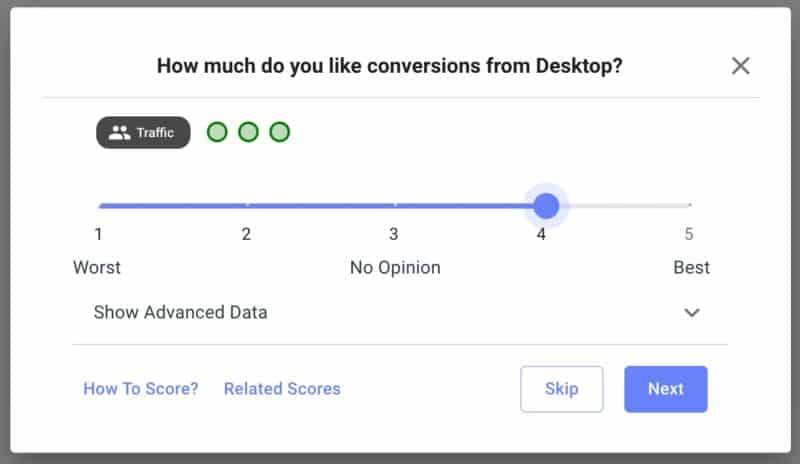 Rate which attributes correspond to better or worse than average conversions to help build Conversion Value Rules.
 Screenshot from Optmyzr.com.
After ranking around 30 segments, the tool will have enough data to create an initial batch of Conversion Value Rules which will teach Google’s AI how to get better conversions for your company.
Determining the right Conversion Value Rules
After you’ve thought about the relative value of different conversions for a business, the next step is to translate those insights into rules. Remember Conversion Value Rules can be for a single attribute, like just location, or for combinations of segments, like location + audience, or location + device.
These combinations can be complex to figure out and cumbersome to maintain but Optmyzr’s tools can help with this too. Using the principle of the wisdom of the crowds, it uses scores from you and your team to come up with a sensible set of Conversion Value Rules. For example, an advertiser who values conversions from California a lot and who also sees more value from mobile conversions may see a value adjustment of +20% for that combination.
By setting Conversion Value Rules like this in Google, Smart Bidding strategies like Maximize Conversion Value with an optional tROAS can go to work to find more of the highest quality conversions.
Conclusion
In modern PPC, where bids, ads, and so much more are automated, advertisers can still get an edge over their competitors. This requires taking true-and-tried principles like solid bid management and knowing the new ways to optimize these levers. Value-based bidding is the modern way to improve bidding. And thanks to innovations from Google and Optmyzr that make optimizing Conversion Value Rules easier than ever, better-performing campaigns are now well within any advertiser’s reach. If you’re interested, you can try Optmyzr free for two weeks.
The post How to get better leads and conversions with Google’s AI appeared first on Search Engine Land.
Courtesy of Search Engine Land: News & Info About SEO, PPC, SEM, Search Engines & Search Marketing
Category seo news | Tags:
Social Networks : Technorati, Stumble it!, Digg, de.licio.us, Yahoo, reddit, Blogmarks, Google, Magnolia.
Google now allows virtual food brands to have Google Business Profiles
Written on May 9, 2022 at 7:53 am, by admin
Google has updated its Google Business profile guidelines page under the “guidelines for chains, departments & individual practitioners” to allow virtual food brands to be listed with “conditions.”
One of the more popular virtual food brands is MrBeast Burgers, a popular YouTube creator has deals with local burger shops to sell his own branded burgers but MrBeast does not have any official burger shop or workers. You buy virtual branded food items made by the local shop. Joy Hawkins said with these updated guidelines “Mr. Beast would be allowed listings and should set them up as service area listings (without an address).”
Updated guidelines. The updated guidelines now say “virtual food brands are permitted with conditions.” It goes on to write out those conditions:
Co-located food brands offering pick-up
- Food brands that are co-located each must have permanent separate signage. They should display their address only if they offer pick-up to all customers.
- Delivery-only brands (no-pick up option) out of shared kitchens must hide their address and add service areas to that specific brand to avoid confusing their customers.
Delivery-only food brands
- Delivery-only brands (i.e. those operating out of virtual kitchens) are permitted if they have distinct branded packaging and a distinct website.
- Multiple virtual brands operating out of one location are permitted, but are subject to additional verification steps.
- Delivery-only brands must add their service areas and hide the address on their business profile to avoid confusing their customers.
- If there is a partnership where a food brand has authorized the virtual kitchen as a verified provider of the food, the virtual kitchen may manage each authorized brand’s business profile once the authorization is confirmed.
- The facility that houses the delivery-only brands, i.e. Doordash Kitchens, is permitted to have its own separate business profile. Only someone affiliated with the facility can claim and verify this profile.
Virtual food brands in local search. Yes, MrBeast Burgers, a virtual food brand, does indeed show up in Google local search results:
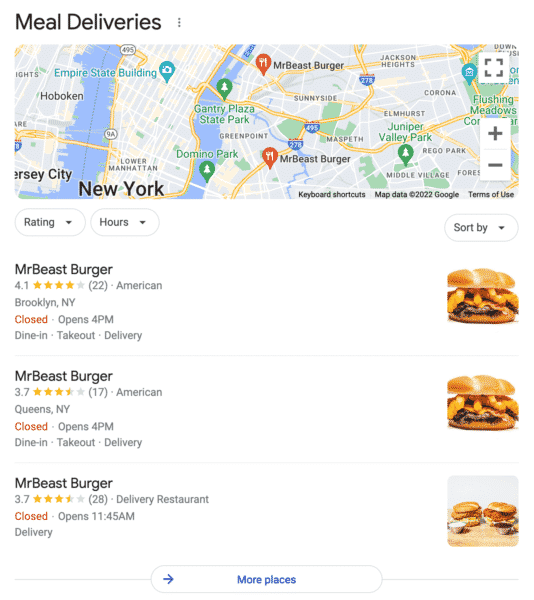
Why we care. So now Google is allowing virtual food brands to have listings in Google Business Profiles and thus Google Maps and local search results. If you have any clients that offer virtual food brands or you run your own, you can now technically show up in the local search results in Google Search and Google Maps. This is even when the address is technically not listed and there is no physical presence of that business outside of another business slapping on a new label on the product.
The post Google now allows virtual food brands to have Google Business Profiles appeared first on Search Engine Land.
Courtesy of Search Engine Land: News & Info About SEO, PPC, SEM, Search Engines & Search Marketing
Category seo news | Tags:
Social Networks : Technorati, Stumble it!, Digg, de.licio.us, Yahoo, reddit, Blogmarks, Google, Magnolia.
Why SEO is a great investment, not just a cost
Written on May 9, 2022 at 7:53 am, by admin
Companies make investments all the time. The intention of any investment is to fund something now that will deliver a return later.
So why is the investment not there for an acquisition channel like SEO?
My theory:
Investments in SEO are compounding in nature. It can be difficult to “see” the results of increases in traffic and revenue because the growth is much more visible when measured over time, often up to a year later.
But who wants to return to leadership 12 months later saying, “Hey, look, we did it!”
Alas, that’s the nature of organic results. They take a while to produce.
This article will discuss some of the main inputs that drive organic growth, as well as the kinds of outputs to expect. Specifically, how SEO needs investments in:
- People: Building teams to develop and oversee the SEO strategy that drives business results.
- Content: Creating and optimizing content that’s supported by a strong, technical foundation that drives the consumer’s journey and decision to trust and transact with your business over another.
- Tools: For SEO and content practitioners alike. In the same way a sports team needs a ball and equipment to play, tools are needed to find the many micro-optimizations that drive the macro impact.
A huge misconception: SEO is “free”
There’s no such thing as “free traffic.”
Earning consistent, quality web traffic is not free. It never has been.
It doesn’t matter whether you’re a startup, enterprise brand or a company of some other type or size.
What matters is getting the best possible ROI.
That requires investing in the components that contribute to traffic growth.
Another huge misconception: SEO ‘just happens’
At its core, SEO is a long-term strategy. SEO requires an ongoing investment.
Results are realized over time as the amount of improvements compounds.
Just having a website full of content or products to sell won’t make organic traffic magically materialize.
The reality: any traffic acquisition strategy, especially one involving growing organic traffic, requires funding.
- People are needed to manage the strategy and daily operations.
- Writers are needed to create and optimize content.
- Engineers are needed to code and release improvements to the technical architecture of a website.
Practically every team in an enterprise organization touches the website or app, which means they need to be aware of how to help contribute to SEO efforts (and not unknowingly harm them).
SEO involves multiple teams and it works best with continuous improvements.
SEO that delivers real business value requires an ongoing, intentional investment in people, content and tools.
Organic traffic is a sustainable source of customer acquisition. SEO becomes your unfair, competitive advantage once your website outpaces its competitors.
What is an SEO investment?
At a minimum, resources for SEO teams look like this: people, content, and tools.
Businesses can choose to go “all in,” investing in building the team internally, or externally using agencies and consultants, or fund a mix of both.
The only “correct” answer here is what works for the business.
Let’s look at each.
People
In many ways, the biggest asset a business has is its people. In SEO that means bringing on knowledgeable search engine professionals to manage the ins and outs of maintaining a website (or a group of sites).
This can range from one subject matter expert to, ideally, a team of SEOs each with a specialized skill set or unique experiences they bring to the table (think of any superhero movie where they combine their powers).
Since the success of SEO relies on the coordinated outputs of multiple teams, the investment can also include staffing people on complementary teams who are copywriters, engineering resources, strategists, web analysts, data scientists, product managers and UX professionals.
Alternatively, if the team is not in-house, the investment costs can go toward outsourcing the work to an agency or specialized consultants. The key here is that there is a team of subject matter experts who create the right SEO strategy for the business based on its resources. They prioritize the work and collaborate with different teams to make periodic releases of SEO improvements.
I would be remiss if I did not mention the acquisition of knowledge. In a dynamic field like SEO and digital marketing, it’s important for a business to also carve out a budget for continuous learning and development (L&D) for your SEO team.
That can mean anything from supporting their leadership development (e.g., online courses, regional SEO meetups and industry conferences that offer learning and networking opportunities).
Content
The investment in content can take a few forms – from hiring an internal SEO content strategist to oversee a team of writers to outsourcing the work to an agency or consultant.
Bottom line: no matter how SEO content teams are structured, the key to success is having the capability to upload and publish optimized content on the website.
It’s uncommon for a single SEO, who is dedicated to running the day-to-day SEO operations, to also be able to consistently write and publish content (those are called unicorns).
It’s also unrealistic to expect a single person to produce content at scale for a business of any size. That kind of output takes a dedicated team of specialized writers working from an editorial calendar.
Websites can’t rank without great, relevant content. This is why this type of investment is key for businesses operating online.
Tools
Physical writers and SEOs need tools for content creation, optimization and performance tracking.
The costs involved here? It largely depends on what the business needs and where the gaps are.
It could be volume: how many pages will be published and at what rate? How big is the team that needs access to the tool (some charge by number of “seats”). There’s also varying levels of cost with the software tools themselves ranging from basic keyword and URL rank tracking to enterprise level with more robust data for large websites that need crawling and analysis capabilities at scale.
There are so many options for teams of all different sizes and budgets. If you’re a marketer making the decision on tools for your teams and resources, it’s best to self-educate and self-evaluate the best approach for the business.
Paid vs. earned media (or: investing now vs. later)
I find it shocking that companies are willing to spend millions of dollars on paid advertising each month, but then think $10,000 is a bit too much for SEO
— Eli Schwartz (@5le) January 9, 2022
Paid search and SEO (earned media) are among the two biggest traffic acquisition investments that both basically require funding of people, content and tools.
Many feel the investment in both channels should be more equally distributed. However, the reality is the results are produced in different timelines.
- Money that goes toward a paid search campaign generates a more immediate result because campaigns can be managed daily – even hourly – which is why SEM often gets a bigger share of the budget.
- The ROI for an SEO investment is realized over a longer timeline; it can be months or years before a page (or pages) of optimized content are indexed by search engines and start ranking well enough to drive measurable visitors to a website.
Think of the investment timeline in this way; you have a garden and want to grow tomato plants. To get the garden to produce that vegetable you must do all the things involved with growing that type of plant which inevitably will take a certain amount of time.
But if you need tomatoes tomorrow, you would need to buy a fully developed tomato plant and plant it in your garden. That’s Paid Search.
So if you want tomatoes tomorrow, and if you haven’t been properly tending to your garden, they won’t be there because gardens don’t produce immediate results. That’s SEO.
Using this example, one can see it’s not sustainable for a business to be overly reliant on a channel like paid search to drive customers to its website. The budget will eventually run out or you will get priced out of the market in a bidding war.
SEO cannot deliver immediate results like paid search because it doesn’t operate that way. But SEO is like a garden that will bear an abundance of fruit year after year, as long as it’s properly cared for season after season.
Investing in an SEO team
Google made more than 5,000 changes to search just in 2021.
That alone is reason enough to have an experienced team overseeing every aspect of SEO.
Say you’re a director or manager and tasked with growing your SEO team. You have to look at your internal resources and what kind of expertise the business needs.
Maybe it’s an e-commerce site where a technical SEO with e-commerce experience would benefit the business. Maybe your business needs to double down and update its content.
Find whatever type of SEO skills and experience is needed for the business.
The point is that every company will need a different mix of SEO skills.
A bare-bones in-house SEO team at the enterprise level and estimated salary range (USD) looks something like this:
- Director of SEO: $150,000+
- Senior SEO Manager: $120,000+
- SEO Product Manager: $120,000+
- Technical SEO Lead: $120,000+
- Content SEO Lead: $110,000+
- SEO Analyst: (specializing in data science and mining the company data for insights) $150,000+
- Platform specialist: (enterprise sites are built on solutions at scale like Salesforce or they’re bootstrapped together; what matters is that you have an SME that can make technical changes to the site based on the platform it’s on) $150,000+
Remember, you can’t just build the team and not equip them with the right tools. A great football team isn’t just made up of only players – you also need different types of coaches, equipment and gear, training facilities and more.
This is why SEO is considered a long-term investment. Hiring talented and experienced individuals to oversee and improve upon the content and technical architecture of a website is an investment that requires upfront funding and pays dividends later.
It’s similar to the investment involved in owning a home. A homeowner needs to proactively set aside a budget for home improvement projects and general upkeep of their property. Doing proper repairs over time means when the house is on the market, it’s attractive to a buyer and will sell for top dollar thereby netting a return for the homeowner.
In the same way that it is financially more prudent to upkeep a property over time than it is to do a full rehab, a business needs SEO professionals to look after and improve upon the website as a whole.
SEO is profitable: the ROI of SEO
The main SEO KPIs are traffic and revenue.
How much can SEO increase traffic? That can be tricky to pin down because it depends on a number of factors related to output like:
- How often are you releasing improvements to your site?
- What kind of improvements are they?
- Are they ones that will move the needle?
As a starting point, one way to approach this calculation is to frame it like this: take the baseline of your existing level of yearly organic traffic (from your traffic source, like Adobe or Google Analytics). From there, ask “what does a 1% improvement look like?” And, subsequently, “if we did nothing, what would a hypothetical 1% decline in traffic look like?”
That’s your +/- baseline where you can then extrapolate up to 5% in either direction as an estimation of improvement or decline in site visits.
For context: “doing nothing” means releasing no technical SEO improvements or updates to existing content or publishing new content.
Important: Doing nothing can sometimes cost more than a marginal investment in SEO.
Measuring the ROI of an SEO investment
SEO should be more widely viewed as an investment because it doesn’t yield direct results for dollars spent from day one.
Think about the reason it’s considered financially sound to invest money into a 401K account, is that the expectation is that the funds will grow over time and be greater when you need them in the future. That happens because of continued investment in the fund and compound growth. The same is true for SEO.
Savvy marketers know Search is an attribution channel that grows over time as improvements are made to the site.
“Search is a critical part of website traffic, as can be seen clearly from almost any Google Analytics account you might look at,” says Krista Seiden, Founder & Principal Consultant, KS Digital. “Whether it’s last click attribution or a multi-touch path to conversion, organic search is a key driver for a majority of businesses out there, and therefore, an important reason to invest in the channel itself.”
Content optimizations are another measurable SEO investment that requires funding up front and pays dividends down the road. Let me explain.
Most marketers should be familiar with the stages of the buyer’s journey:
- Awareness
- Consideration
- Decision
It turns out that customers seek out different types of content based on where they are in the process of their evaluations. The key is to meet the customer’s search intent with your content.
This fantastic illustration from Andy Crestodina of Orbit Media highlights what types of content a business would need to have in order to attract, inform and convince someone to buy their product:
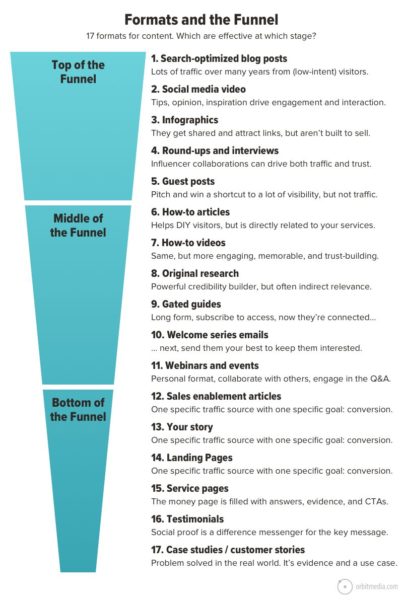
Now, think about how many types of content your business has, or doesn’t have, from each section on that list. When was the last time that content was updated? What content is missing that you’d need to create that would make your offer more competitive?
Let’s say you do a content audit on your site and determine you don’t have any how-to content. Hypothetically, it might cost $500 to $1,000 to get a 1,500-word article written and published on your site so that when people search for something like “how to replace an LG water filter” you have an article that can appear at the top of the SERPs.
If done well, the article is comprehensive about the topic, relevant for a number of terms people are searching for and maintains its ranking on the first page of Google for months if not years. The result is that the initial, one-time cost to create the article contributes to multiple sales thereafter.
That, in a nutshell, is how investing in content optimization delivers value year after year.
SEO Investments based on business size
Now let’s look at how it can be profitable at different levels. Take this with a grain of salt; these are ballpark estimates for the sake of evaluating what an SEO investment breakdown could look like based on annual revenue and company size.
Startup, SMB
- Headcount: 5-50 full time employees
- Annual Revenue: <$50M
- Rough SEO Investment: $1-$5K/month, $60K/yr.
- Revenue from SEO channel: between 2-5%
At the startup and small business level, an investment in SEO is best once a product market fit has been determined. Most startups are in need of acquiring paying customers quickly. Once there’s stability from customers and recurring revenue, SEO can come in and improve upon the existing site content and performance to help cast a wider net thereby amplifying the product and attracting more prospects.
Most small businesses should invest in SEO but they often don’t because it’s expensive and there often isn’t anyone besides the business owner to update the website. Investing a small amount in SEO services will help drive foot traffic to retail locations.
Agencies and/or specialized consultants in the local SEO space are great resources because they can often shoulder the resource load to make the website mobile-friendly and optimize the content for things like Google Maps and a Google Business Profile listing.
For SMBs hiring an SEO should be like hiring a trusted, licensed professional to do your taxes. It’s not something every business owner can or needs to do on their own. Hire an expert that will look out for your SEO needs as it relates to your business.
My recommendation for SMBs would be to start allocating at least $1,000/month towards SEO services. Take it out of your advertising or marketing budget for 3 months and see what you can get done.
Mid-size
- Headcount: 50-250 full time employees
- Annual Revenue: $50M-$1B
- Rough SEO Investment: $10-$20K/month, $240K/yr
- Revenue from SEO channel: between 5-10%
Mid-sized businesses should invest in SEO because it’s a more cost effective way to acquire customers long term and they to benefit the most from SEO investments because they typically have some resources to afford supporting their in-house SEO lead with external agency services and/or consultants. At this level, an investment in SEO can mean the difference between being able to drive efficiencies at scale and pull ahead of competitors or being left behind.
At mid-size companies and agencies it’s usually the marketing team’s responsibility to oversee the website. An SEO specialist can be part of that team but, still both technical and content resources can be scarce.
The midsize level is where SEO can really grow a business. But without a knowledgeable expert that’s overseeing the technical aspects of your site and optimizing your content for what real people are searching for that relates to your business, you’re missing out.
Enterprise organizations
- Headcount: 1,000+
- Annual Revenue: 1M+
- Rough SEO Investment: at least $1M/year
- Revenue from SEO channel: between 5-20%
At the enterprise level, SEO results rely on investment in addition to consistent outputs of multiple teams. Enterprise SEO is more about establishing processes so that different cross functional teams can each improve upon the technical aspects like architecture, internal linking and crawl and index efficiencies.
On the content front, it’s about partnering with internal brand and content teams to write and publish content optimizations at scale that deliver a better user experience than competitor sites.
Large sites often require more than fixing issues flagged in an SEO audit. Because SEO is inherently a cross functional discipline, if a business wants to be able to thrive off of its organic traffic, it requires strategic oversight to prioritize and collaborate internally across many different teams delivering on the SEO work; product, engineering, QA, delivery managers, content, UX, and design teams just to name a few.
“[To] see SEO results you need more than SEO investment – SEO relies on product, technology and content. It’s a hybrid, complex domain that is interdependent on other resources, teams and outputs.”
– Tom Critchlow in his email newsletter SEO MBA
SEO success depends on cross-functional teams, especially the outputs of engineering and content. If you cannot publish code or content, don’t expect to see your SEO traffic improve.
The Benefits of SEO
Even a small investment in maintaining a website’s performance, content and user experience can accumulate over time to provide the business with a return, year after year.
SEO is always a great investment because humans are naturally curious; we’re always searching for ways to solve our problems, new places to eat, directions to where we’re going–we are engineered to ask questions and that handy, mobile device in our pocket that’s connected to the internet 24/7 is ready to answer any and every query.
Here are some key SEO statistics:
- 93% of the time, an online session begins by searching keywords on a search engine.
- As of 2021, 53% of all website traffic (worldwide) clicks on organic results.
- Google alone processes more than 40,000 keyword searches every single second. That’s over 3.5 billion searches in a single day and 1.2 trillion per year!
- 16-20% of keywords searched on Google in any given day have never been searched before.
These compelling stats point to the fact that search isn’t going anywhere anytime soon.
In addition to curious humans, another benefit of investing in SEO is that it addresses many of the same challenges associated with the need for making websites easier to navigate for the percentage of the population that has a disability. This practice is known as accessibility.
It’s not a 1:1 match but there are many principles of technical SEO that also translate into enabling those that must navigate websites with a screen reader (data shows 8.1 million Americans have a vision impairment) to have a better user experience.
On top of that, SEO with accessibility labels used in the QA automation process makes things even more efficient since those labels make testing automation easier. That’s a nice win for multiple in-house teams contributing to SEO and driving business value.
SEO Tactics to invest in
Page speed
In 2022, the North Star of investment is improving website speed and performance according to measurements from Google known as Core Web Vitals (CWV). These are aspects that help a website load quickly for both search engines and users.
Many teams are organizing around:
- LCP (largest contentful paint): loading the heaviest assets first so the rest seems seamless.
- CLS (cumulative layout shift): minimizing the elements that “jump” or move around the screen while it loads.
- FID (first input delay): the time when users first interact with the page and can accomplish what they came to do.
Fundamentally, your website pages should load quickly. Speed became a ranking factor in July 2018 and it’s what users expect. But speed alone won’t result in increased traffic.
Relevant and authoritative content
Improving content (either updating existing content or pruning underperforming pages) is one of the best investments for SEO dollars.
Why?
Google is getting better at determining user intent. Which means it’s table stakes to stay on top of your content making sure it’s helpful, accurate and relevant.
It’s worth investing in overhauling your content to improve your E-A-T signals:
- Expertise
- Authoritativeness
- Trustworthiness
The generic searches that occur at the top of the funnel (TOFU) is largely where SEO is most efficient for enterprise businesses. Big brands can usually afford a larger budget for paid search but over time it benefits the business greatly if the amount of incoming, new visitors arrive at the website due to the efforts of a strategic, ongoing investment in well-written, relevant content.
Technical SEO outputs
This relates to the velocity, or speed, at which engineering and product teams can collaborate with SEO teams to fix the technical aspects of the site. A consistent level of output will contribute to a healthy and strong technical foundation.
Generally speaking, if a site goes 6 months or more without releasing any technical improvements it’s at risk of losing meaningful rankings and therefore traffic because it’s not able to be as competitive online against other teams who are focused on testing and learning to improve upon the SEO results they’re seeing.
A few reasons not to invest in SEO
Let’s say you’re a:
- Startup that hasn’t found a product market fit.
- You’re an affiliate site only trying to generate revenue. Keep reaching out to influencers…
- You’re under the illusion link building is the only way to go. Have fun with that.
- You have a target number of users to hit for investors which means you should look to paid search to acquire customers quickly, then use SEO to keep them.
- If your business has limited engineering resources or none at all. SEO relies on partnerships with engineering and content teams and their frequent output.
- When you can’t afford to pay a knowledgeable consultant or agency for their services. Worldwide, SEO providers charge $112.22 on average per hour and 50% of SEO providers worldwide have a monthly retainer minimum under $3,000 per month.
For SEO to deliver, it requires investment and collaboration
Make no mistake: SEO is two things. It is work and it is worth it!
Ever hear the saying “Anything worth having is hard or requires work?” The same is true for SEO.
A site that loads quickly, is secure for processing transactions, and has relevant and helpful content –those are the table stakes that need looking after in order to be competitive online.
The fallacy that organic traffic “just happens” and doesn’t cost anything is flat out wrong. It takes a level of investment to develop organic traffic into a meaningful marketing channel furthermore driving a sustainable return.
A steady flow of organic traffic is one of the strongest foundations a business can have.
SEO investments are worth it because every human on the planet searches for products, services and information to make their lives easier. Your business needs to be the solution at the top of customers’ consideration list.
It’s crucial for businesses to invest in SEO because it’s a discipline that’s uniquely designed to optimize the technical aspects of a website for search engines so that real humans searching online are able to find it when looking for great products and solutions.
Remember, the ROI of SEO is not immediate; it compounds over time. Whereas paid search is either on or off. When your budget for PPC ads runs out, what then?
SEO is a channel that will always deliver. You just have to keep investing.
The post Why SEO is a great investment, not just a cost appeared first on Search Engine Land.
Courtesy of Search Engine Land: News & Info About SEO, PPC, SEM, Search Engines & Search Marketing
Category seo news | Tags:
Social Networks : Technorati, Stumble it!, Digg, de.licio.us, Yahoo, reddit, Blogmarks, Google, Magnolia.
How to gain insider expertise as an outside SEO vendor in 4 steps
Written on May 9, 2022 at 7:53 am, by admin
You’re an expert in SEO, but when you engage with a new client, you aren’t an expert in what they do. But you do need to learn fast.
Hopefully, the client is a subject matter expert with tens of thousands of experience hours under their belt. As an SEO agency or consultant, you do not need their level of expert knowledge.
But you do need to know what they are saying. In most cases, you need to gain some level of insider expertise if you’re going to earn their trust and make a real difference in their business.
To do that, you need to:
- Get to the heart of why the business stands out in the marketplace.
- Get into the mind of the customer to gain an intimate understanding of their needs.
- Know what makes the website tick.
- Understand the competition, their edge and their SEO strategies.
Let’s look closer at each of these steps that will take you from novice to expert in no time.
1. Client research
To learn about your new client, your primary and most available resource is the people running the client’s business. Your client will be a treasure trove of expert information, from the executives to the customer service call reps.
Start your expert learning process with an in-depth discovery interview with those who oversee the business’s marketing, product development and customer service. You may do this on the project kick-off call, or you might break it up into a series of calls with different folks in the company.
Conversations with customer service can be extremely valuable. Knowing what’s important to their customers can help you make recommendations on everything from content holes to site navigation. Answering common questions is one way to create compelling SEO content for a website.
Regardless, you need to create a template of questions for your client research. You want to make sure that you ask every new client about their business and what they do.
Get intimately familiar with their products and/or services. You can even ask them to onboard you like they would a new hire.
2. Customer research
It’s important to know everything you can about the people your client sells to or interacts with. After all, a good SEO strategy is all about being able to reach these people with the right messages on the web.
A good place to start is to create audience personas with the client. Even better if they already have them. Knowing the audience will set you up for the next step in customer research: keyword research.
I like to say that to catch fish, you need a few things: the bait the fish are eating, to fish where the fish are and hungry fish. Personas help quite a bit. BTW, many people think they have personas well defined… like:
- Highly intellectual
- Advanced degree, hopefully, PhD
- Respected
- Extremely theoretical
- Curious to a fault
- Can invent when called upon
- “White hair” studious
So beyond defining personas, keyword research is an important exercise in getting to know how the audience you are targeting searches for what you have to offer. This is a cornerstone of your SEO strategy; you want to show up for those searches in the search results with the best information possible.
3. Website research
A good SEO strategy is only as good as the website. So you need to understand the state of the client’s website and what could be hindering search engine rankings. Usually, the best way to do this is through an SEO audit.
There are several levels of SEO audits out there, but the best SEO audit is an in-depth technical audit. This takes many hours (ours can take over 100 hours) but offers the most thorough look at a website from the technical back end to on-page optimization and beyond.
And beware, free tools are exactly that, and they often waste time focusing on things that do not matter.
“Any SEO tool will spit out 10s or 100s of ‘recommendations,’ most of those are going to be irrelevant to your site’s visibility in search. Finding the items that make sense to work on takes experience.”
– Google’s John Mueller
4. Competitor research
SEO is about beating the competition in search results. And to beat them, you should know:
- Who they are.
- What they are doing right and wrong with their SEO strategy.
That’s why competitor research is critical. And there’s quite a bit to it.
Start with your target keywords and then analyze who shows up for them on Page 1 in Google.
In competitor research, you might look at:
- The market competition to assess your strengths and weaknesses against theirs.
- The online competition, including everything from on-page and off-page factors to link profiles to the technical health of their websites to the content and much more.
- What keywords they rank for and the extent of content on their site. Often, this exercise identifies keyword gaps on your client’s site.
Spying on your client’s competitors is one of the best ways to improve your client’s SEO strategy and how you present the client online.
Rinse and repeat
Even as you go from novice to expert on your client, there’s always going to be more to learn.
Establish a process for staying up to date and keeping the listening channel open. Or else your SEO strategy could get stale.
And invite feedback from your client so you stay on top of their evolving needs.
The post How to gain insider expertise as an outside SEO vendor in 4 steps appeared first on Search Engine Land.
Courtesy of Search Engine Land: News & Info About SEO, PPC, SEM, Search Engines & Search Marketing
Category seo news | Tags:
Social Networks : Technorati, Stumble it!, Digg, de.licio.us, Yahoo, reddit, Blogmarks, Google, Magnolia.
Google’s Responsive Display Ad go vertical for a better mobile experience
Written on May 9, 2022 at 7:52 am, by admin
The popular automatic display ad type Responsive Display Ads (RDAs) will be undergoing a major transformation in the second half of this year. RDAs have been the default display option since 2018 and these new enhancements are geared toward a better mobile offering for advertisers.
Portrait images and videos now welcome. The versatility of RDAs has the ability to flex images to display on mobile devices, but Google will allow for portrait images and videos to be used.
 RDA using a horizontal image (left) vs RDA with new portrait image (right)
Previous options required a landscape or a square image while using machine learning to fill in the gaps for mobile ads. This new upgrade should be a welcomed option as it gives advertisers more control over their mobile appearance.
Auto-generated vertical video. If you are an advertiser that doesn’t have vertical videos handy, Google will now be able to help create those assets for your RDAs. Google is leveraging machine learning to use existing assets to create vertical video for campaigns.
Google is using “machine learning to speed up the design and iteration process, you can deliver engaging display ads faster than ever.”
If you are an advertiser that has tight branding/brand standards, you may want to view automated vertical videos before testing, as some advertisers have been dissatisfied with auto-created videos within Performance Max campaigns.
Image uncropping, powered by machine learning. A unique addition coming to RDAs is the ability to “uncrop” images via machine learning. Google said this “automatic improvement lets your products shine by seamlessly expanding to fill the available space.”
 RDA using different images in the current state (left) vs RDAs using the uncropping technology (right)
As you can see in the sample image, this does look to be a big improvement with big bold images and less white space. This shouldn’t be a problem if all ad sizes are uploaded, but it should help those advertisers who are missing sizes.
Creative inspiration. If you are an advertiser looking for inspiration with your assets, Google has a new home for you. Creative inspiration is a filterable tool that allows you to surface some of the best ad creative from around the globe.
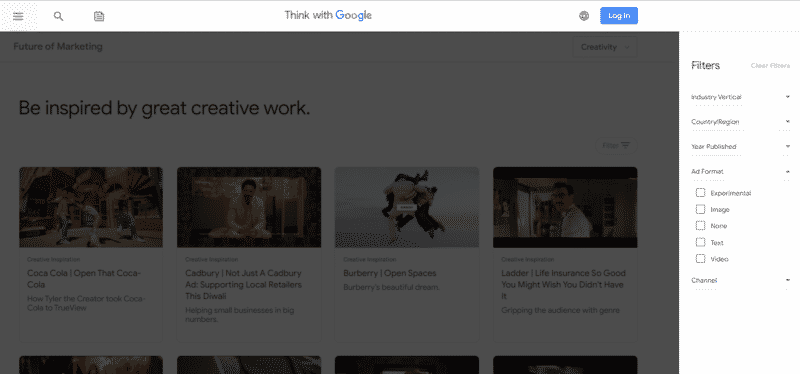
The filtering includes a helpful “Ad Format” option to allow for browsing by ad type.
For more information on the improvements, see the full release and stay tuned for more after the May 24 Google Marketing Live event.
Why we care. Google said its advertisers see “2X more conversions, on average, when adding a responsive display ad to an ad group with a static display ad.” This additional image size and vertical video support should allow advertisers to deliver more specific messaging by device.
The filterable additional creative inspiration center is a nice touch for advertisers looking for new ideas. Additionally, the uncropping of images should help advertisers with a hodgepodge of image sizes in their ad groups. These tools should be warmly welcomed by advertisers everywhere.
The post Google’s Responsive Display Ad go vertical for a better mobile experience appeared first on Search Engine Land.
Courtesy of Search Engine Land: News & Info About SEO, PPC, SEM, Search Engines & Search Marketing
Category seo news | Tags:
Social Networks : Technorati, Stumble it!, Digg, de.licio.us, Yahoo, reddit, Blogmarks, Google, Magnolia.
Accelerate customer journey automation with this CDP roadmap
Written on May 7, 2022 at 1:51 am, by admin

Leading companies are focused on creating stronger customer experiences that span multiple channels and feel cohesive and meaningful to end-users. But many teams struggle to effectively combine legacy tools and emerging technologies required to build effective omnichannel experiences.
Autodesk partnered with ActionIQ to develop a future-proof stack that would empower a self-service approach to achieving superior omnichannel CX. Join this virtual session to learn how you can accelerate your approach to mastering omnichannel customer journeys.
Register today for “Is Your Marketing Stack Ready for Omnichannel CX?” presented by ActionIQ.
The post Accelerate customer journey automation with this CDP roadmap appeared first on Search Engine Land.
Courtesy of Search Engine Land: News & Info About SEO, PPC, SEM, Search Engines & Search Marketing
Category seo news | Tags:
Social Networks : Technorati, Stumble it!, Digg, de.licio.us, Yahoo, reddit, Blogmarks, Google, Magnolia.
LinkedIn changing feed, will show less low-quality content, polls
Written on May 7, 2022 at 1:51 am, by admin
LinkedIn is now reducing the visibility of several types of content in its feed, including polls and engagement bait.
Here’s what LinkedIn announced it is changing.
Less “low-quality content.” Any posts that explicitly ask for or encourage engagement, such as comments or reactions, will have less visibility in the feed. LinkedIn said users find these types of posts that exist solely to boost reach “misleading and frustrating.”
Fewer polls. You had to know this one was coming. If you regularly browse LinkedIn, it’s become common to see multiple polls in your feed every day. Many of these are from people you don’t know. LinkedIn said it has better filtering and promises to show only “helpful and relevant” polls, from people in your network.
Less irrelevant updates. Ever seen a connection congratulate someone you’ve never met about a recent job change? LinkedIn says it will reduce how often users see this and try to show “more targeted activity” from your network.
“I don’t want to see this.” In addition to algorithmic feed changes, LinkedIn is giving users a way to tell LinkedIn what they don’t want to say. All individual posts will include an “I don’t want to see this” option. You can limit content by authors or topic – plus you can choose to not see any political content.
Why we care. These are positive and needed changes that LinkedIn hopes will result in a feed full of relevant, reliable, credible and authentic content. Hopefully, you haven’t been using engagement-baiting tactics on LinkedIn for your clients or brands (or yourself). If you have, expect engagement and reach to decline as LinkedIn’s algorithm will no longer reward these tactics with greater visibility.
The post LinkedIn changing feed, will show less low-quality content, polls appeared first on Search Engine Land.
Courtesy of Search Engine Land: News & Info About SEO, PPC, SEM, Search Engines & Search Marketing
Category seo news | Tags:
Social Networks : Technorati, Stumble it!, Digg, de.licio.us, Yahoo, reddit, Blogmarks, Google, Magnolia.
Business redressal complaint form adds option for ‘This business doesn’t exist’
Written on May 7, 2022 at 1:51 am, by admin
Google has updated its business redressal complaint form over here to add “this business doesn’t exist” as an option on why you think the business listing is fraudulent. This gives you one more way to communicate to Google why the business listing should be removed from Google Search and Google Maps.
You can see the new option, which was added over the past several days, in the form in the screenshot below.
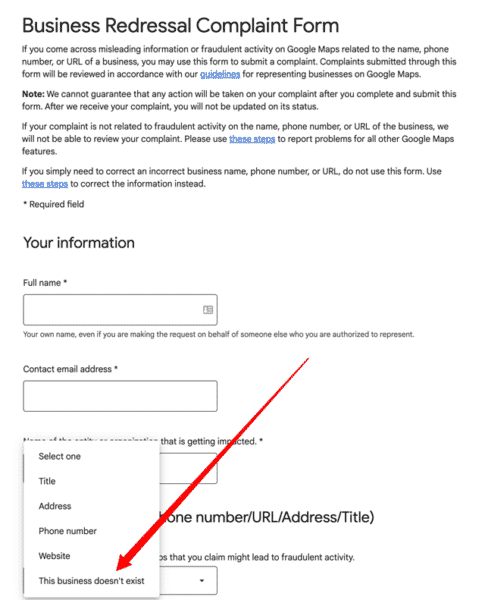
The previous options. The older options were not removed, they just added “this business doesn’t exist” the existing options which include:
- Title
- Address
- Phone number
- Website
What is the business redressal form? Google said you can use this form “if you come across misleading information or fraudulent activity on Google Maps related to the name, phone number, or URL of a business.” Google said, “you may use this form to submit a complaint. Complaints submitted through this form will be reviewed in accordance with our guidelines for representing businesses on Google Maps.”
Why we care. Google Maps and local search business listings have their fair share of spam and fraudulent information. This gives you one more way to communicate to Google that a specific business listing is fake and should not show up in Google Maps or Google Search.
The post Business redressal complaint form adds option for ‘This business doesn’t exist’ appeared first on Search Engine Land.
Courtesy of Search Engine Land: News & Info About SEO, PPC, SEM, Search Engines & Search Marketing
Category seo news | Tags:
Social Networks : Technorati, Stumble it!, Digg, de.licio.us, Yahoo, reddit, Blogmarks, Google, Magnolia.
TikTok Pulse puts brands next to the top 4% of videos
Written on May 5, 2022 at 10:48 pm, by admin
TikTok has announced plans for a “contextual advertising solution” that will let advertisers get visibility next to the top 4% of content in TikTok’s For You feed.
What is TikTok Pulse. This is TikTok’s first exploration of an advertising revenue share program with creators, public figures and media publishers, the company said. Ad revenue will be split 50-50 with creators.
By advertising in Pulse, brands will appear among the top 4% of all videos of TikTok in 12 categories. These categories include:
- Beauty & personal care.
- Fashion.
- Cooking & baking.
- Automotive.
- Gaming.
Brand suitability. One concern for brands could be appearing alongside questionable content. Here’s what TikTok says it’s doing to ensure a safe environment for brands:
- “Our proprietary inventory filter ensures that TikTok Pulse ads are running adjacent to verified content with our highest level of brand suitability applied on the platform. Additional post campaign measurement tools such as third party brand suitability and viewability verification provide advertisers the opportunity and transparency to analyze and understand the impact of their campaigns.”
Eligibility requirements. Creators and publishers must have at least 100,000 TikTok followers.
When it will launch. Pulse will become open to U.S. advertisers in June. It will expand to more countries in the fall.
Why we care. TikTok has become a massive social platform that is hard for brands to ignore. This new program offers brands a way to get exposure alongside the top trending TikTok videos, which can get millions of views.
The post TikTok Pulse puts brands next to the top 4% of videos appeared first on Search Engine Land.
Courtesy of Search Engine Land: News & Info About SEO, PPC, SEM, Search Engines & Search Marketing
Category seo news | Tags:
Social Networks : Technorati, Stumble it!, Digg, de.licio.us, Yahoo, reddit, Blogmarks, Google, Magnolia.
PPC Survey: Adoption of Google Ads automation high, marketers unhappy with recommendations
Written on May 5, 2022 at 10:48 pm, by admin
PPCsurvey.com has just released a new State of PPC Global Report for 2022. It includes input from more than 500 PPC specialists from around the globe.
The findings cover search marketers’ largest concerns, top priorities, spend data, automation insight and a wealth of information about the most pressing trends in paid search.
Here’s a breakdown of some of the largest findings.
High adoption rate of automations in Google Ads. Two eye-opening metrics in the survey:
- 97% of respondents use Responsive Search Ads.
- 95% have implemented Smart Bidding (tCPA).
Most surprisingly a whopping 78% of respondents have used Auto-applied Recommendations.
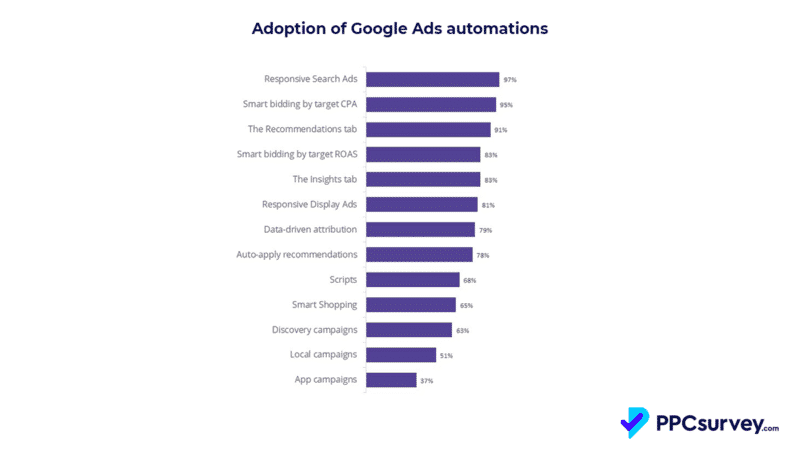
The time has passed when advertisers could compete without adopting automation.
Adoption of automation is high, but marketer satisfaction is mixed. The least satisfying automation, according to respondents, was Auto-applied Recommendations.
- 83% of respondents reported that they were dissatisfied with the Auto-applied Recommendations feature.
Another surprise came from one of Google’s biggest pushes as of late: The Recommendations Tab. The feelings on Recommendations were 63% negative, according to PPCsurvey.com.
Why so negative? Top complaints about the feature include “the ‘one-size-fits-all’ approach and the obvious push for smart bidding, broad match, and budget increases.”
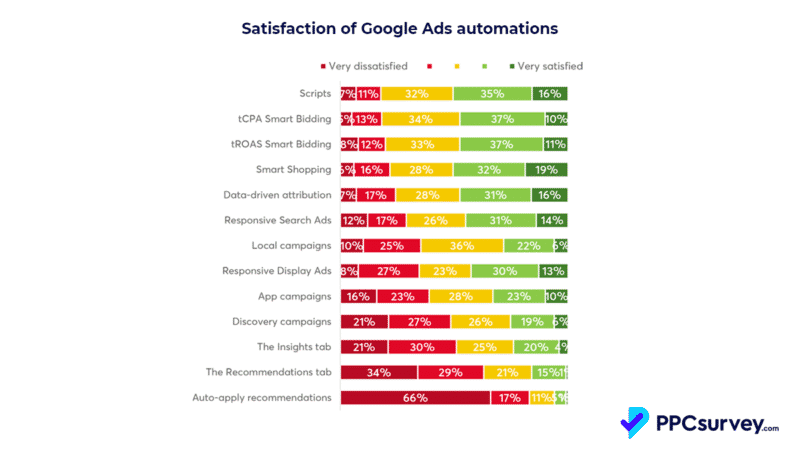
Respondents were more satisfied with other automation.
- 51% of search marketers reported being satisfied with scripts.
- 48% said they were satisfied about tROAS Smart Bidding.
- 47% of respondents were satisfied about tCPA Smart Bidding.
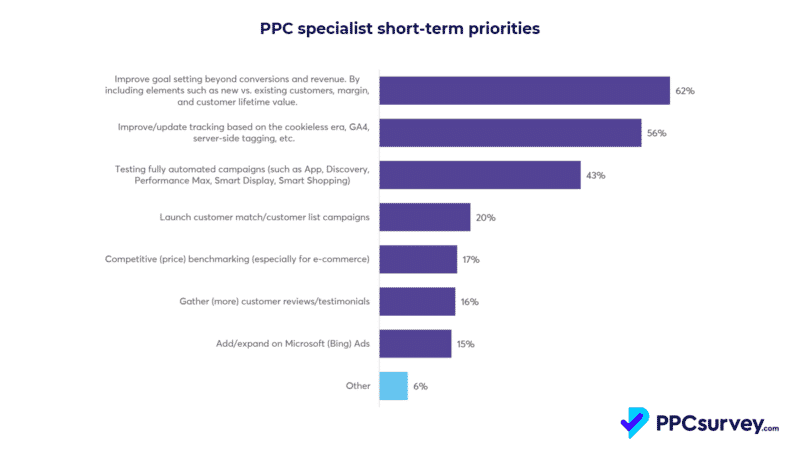
The most pressing priorities for PPC Specialists. What are their clients’ top priorities? Some new concerns appeared this year.
- Priority #1: improve goal-setting beyond traditional metrics (e.g., conversions, revenue). This includes the consideration of margin, including new versus traditional customers and Lifetime Value (LTV), with 62% of respondents stating that these were a top priority.
- Priority #2: Tracking improvements including cookieless concerns, GA4 and server-side tagging came in second with 56%.
Unsatisfactory scores for Optiscore. Google now requires Google Partners to maintain a 70% Optiscore, PPCsurvey.com took a look at the satisfaction levels for the metric. Respondents could rate from 1-10 and the results were turned into a Net promoter score (NPS) to gauge how many participants would recommend.
Only 15% of respondents value a high Optiscore with 41% of respondents considering a high Optiscore a detractor in an account.
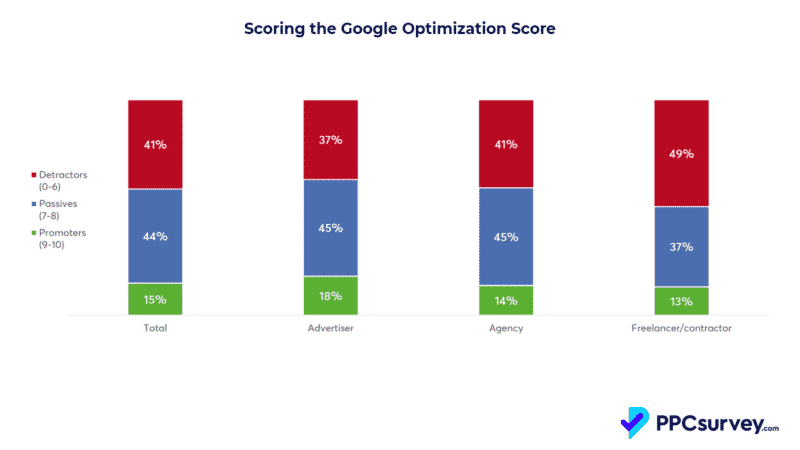
Using NPS methodology, this would give a high Optiscore an overall negative NPS of -26, which is a very undesirable score.
- You can download the full report (PDF) here. It includes more information including global yearly ad spends, ad platform adoption, time-consuming activities, the top challenges for agencies and much more.
Why we care. While the adoption of automation is considerable, the satisfaction is a mixed bag. Some standouts include Smart Bidding and scripts, but recommendations racked up high dissatisfaction numbers.
Additionally, practitioners aren’t fans of having a high Optiscore, with more considering it a detractor than a positive. If you rely on these scores and use these metrics as a barometer for account health, you are going against the collective thought of the PPC experts who participated in this survey.
Lastly, advertisers are looking for better performance tracking. Folks are looking outside simple conversions and to more meaningful performance data while also figuring out better tracking options as ad platforms and analytics platforms are changing.
The post PPC Survey: Adoption of Google Ads automation high, marketers unhappy with recommendations appeared first on Search Engine Land.
Courtesy of Search Engine Land: News & Info About SEO, PPC, SEM, Search Engines & Search Marketing
Category seo news | Tags:
Social Networks : Technorati, Stumble it!, Digg, de.licio.us, Yahoo, reddit, Blogmarks, Google, Magnolia.