

How to analyze your SEO competitors and find opportunities
Written on May 5, 2022 at 10:48 pm, by admin
Understanding your competitors can give you tactical insights to help you discover opportunities.
Before competing, athletes spend many hours understanding weaknesses to exploit and finding possible gaps in the playing field.
Your digital marketing should come with the same level of insight and analysis.
Identifying and reviewing your competitors can help you come up with a strong list of potential keywords, find link building opportunities and build your persona profiles.
Starting your competitor analysis
When putting together a competitor analysis, it is important to make sure that your analysis tells you:
- What a competitor is doing.
- How they are doing it.
- What factors they are most excelling at in their SEO strategy.
- What are their gaps.
Using this information, it is possible to create strategies at scale that will help you exceed your competitors and get higher rankings.
The first step is to assess the bigger picture of your competitors. You can start by using Google and typing in the main keywords to see what sites show up in the rankings.
Next, you can use tools to help you drill down into your competitor analysis process.
Identify your competitors
You can use Semrush to give you a starting point to identify your competitors.
In the Organic Research report, click on the Competitors tab.
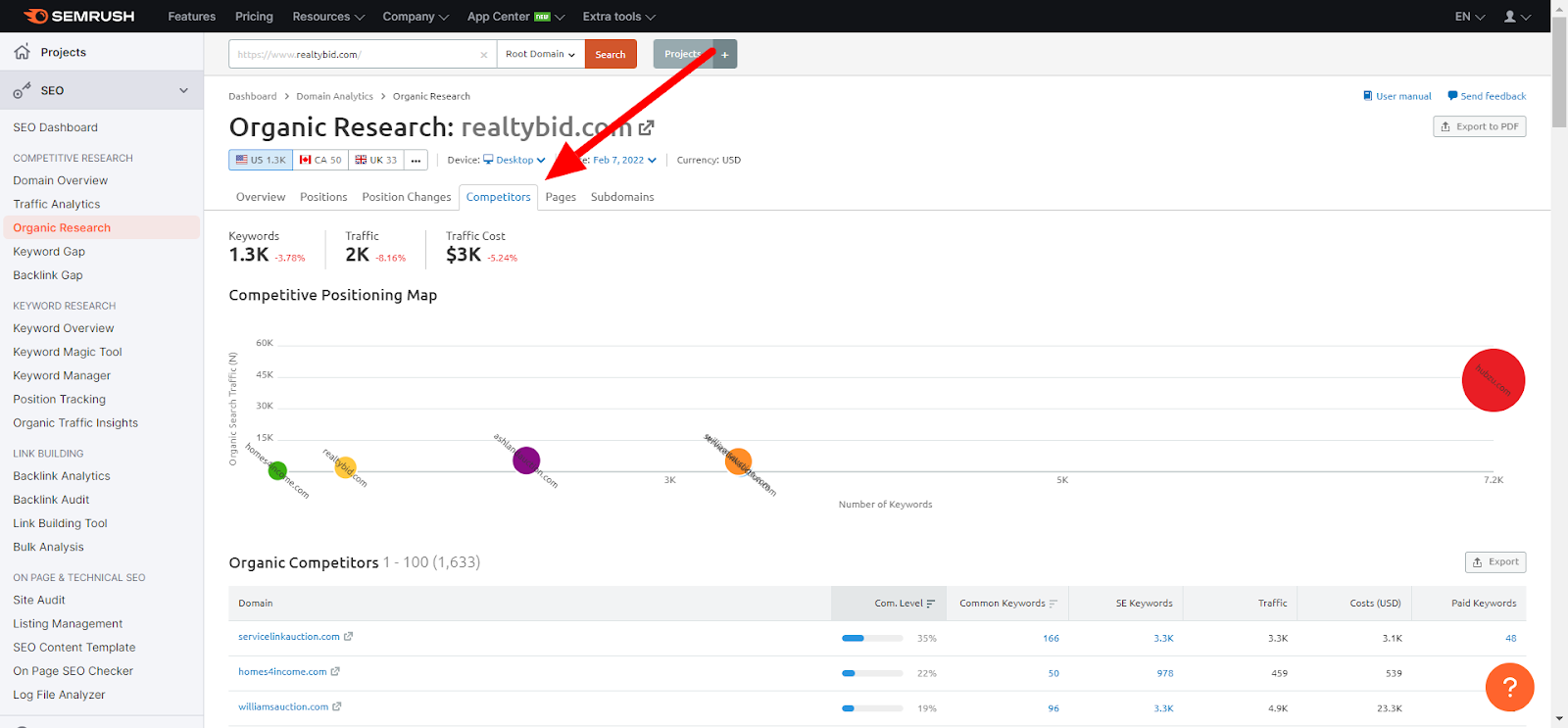
You can use this as a starting point to figure out who your main competitors are.
Some of the data points that can help you in this research are:
- Competition Level: Analysis of the number of keywords of each domain and the number of the domains’ common keywords. The more keywords the domain share in common, the more likely they are to compete with one another.
- Common Keywords: How many keywords do the domains have in common.
- SE Keywords: How many total keywords each site is ranking for.
- Traffic: Estimated organic traffic.
- Cost: Traffic cost based on CPC data and estimated volume.
- Paid Keywords: How many keywords are being paid for via Google Ads.
Backlink profile analysis
Having identified a list of competitors, the next step is to look at their backlink profile.
- How many unique referring links do they have pointing to them?
- What is the quality of those links?
- What is the link velocity of the links they have acquired?
Understanding their link profiles will help you determine how many backlinks you need to acquire before you are capable of competing for specific keywords.
Analyze your site’s backlinks
In Semrush, go to Backlink Analytics and type in your root domain. You can also add up to four competitors to see backlink metrics side by side.
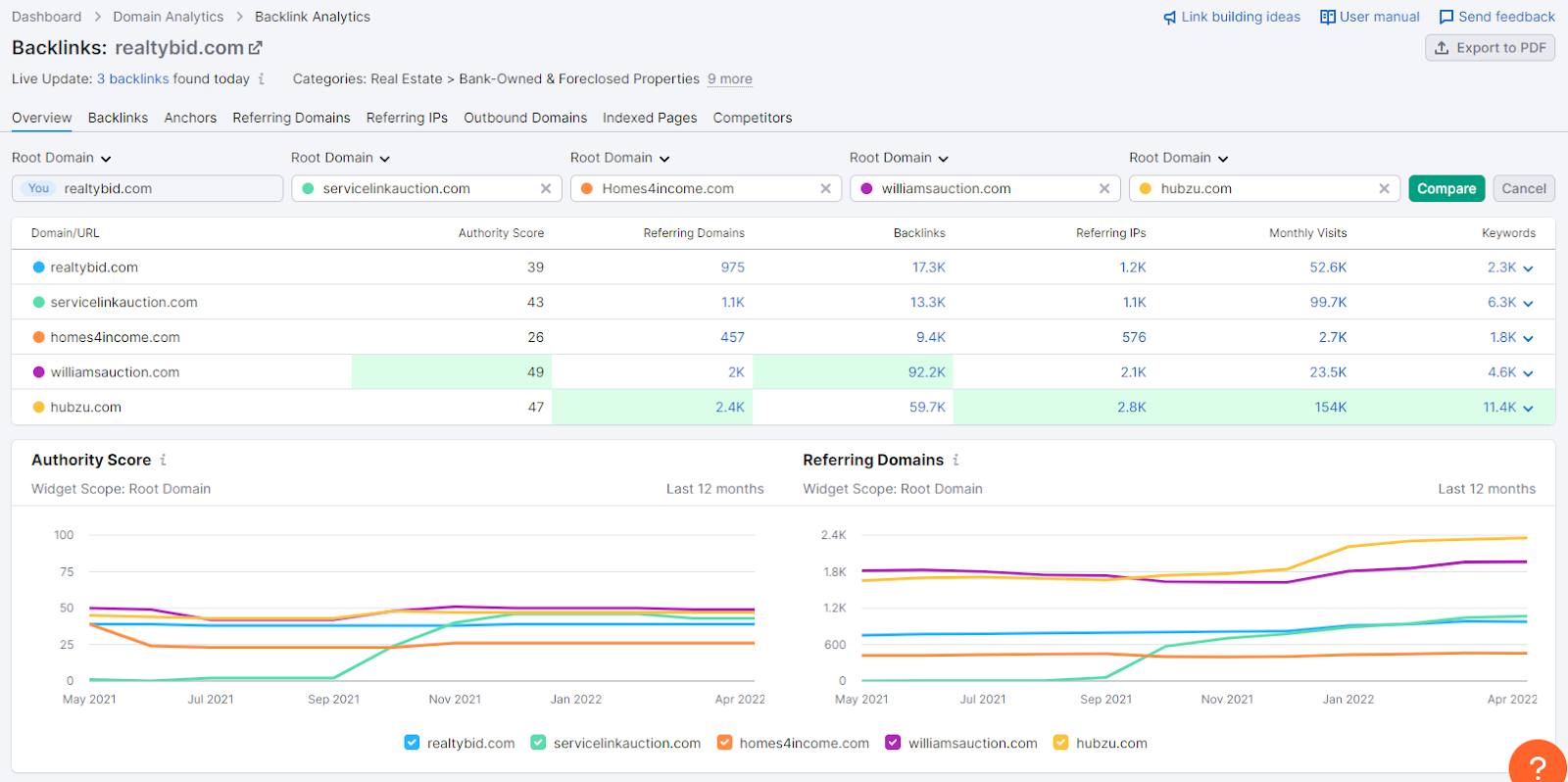
The overview will give you an idea of how your backlink profile looks compared to others vying to rank for the same keywords.
Pay close attention to the number of referring domains you and your competitors have. To drill down, click on Referring Domains at the top of the report and sort the list by Authority Score.
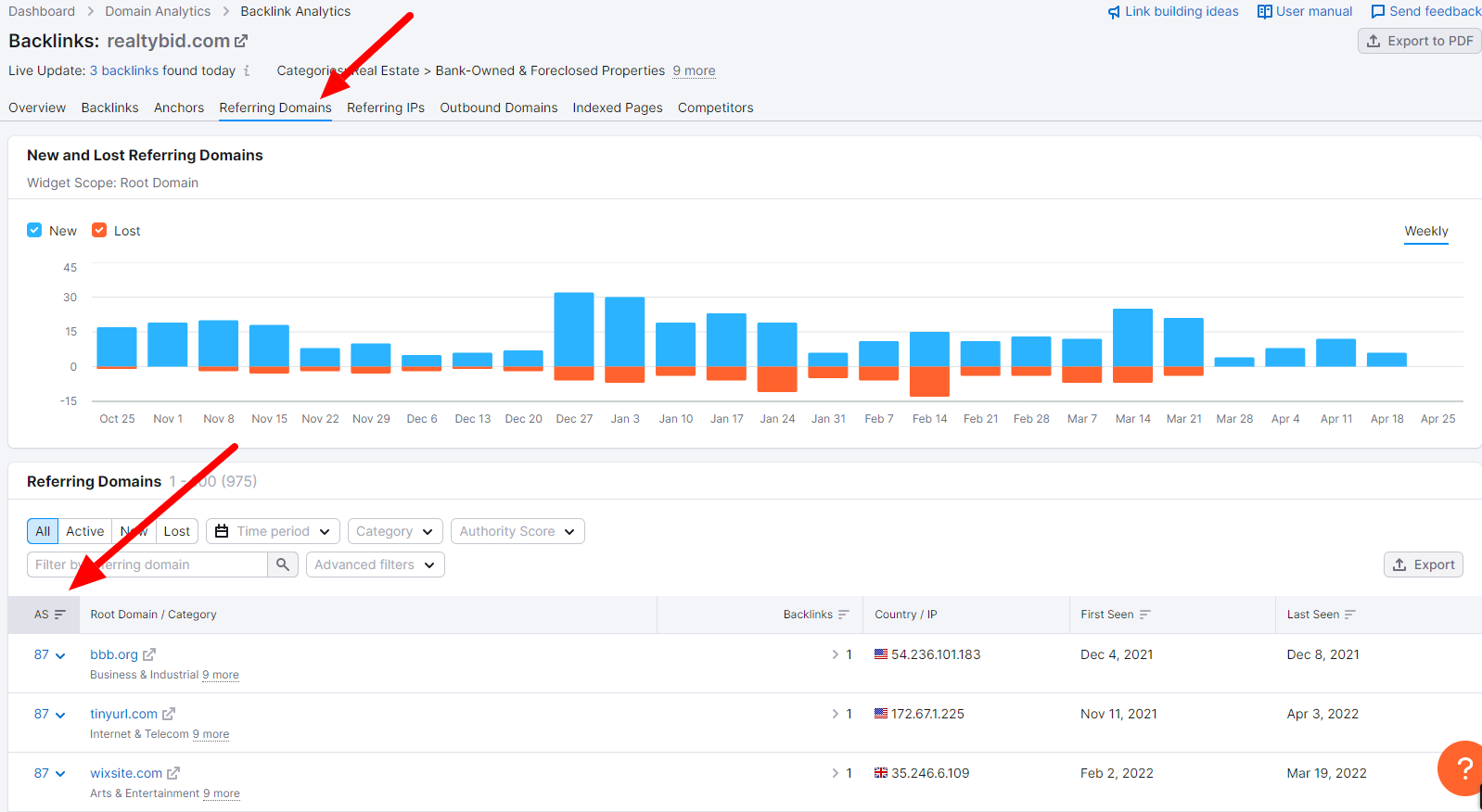
If your site has many referring domains, all with low Authority Score, your site may not have enough power to rank against competitors with better quality inbound links.
The different reports in the Backlink Analytics feature in Semrush will allow you to learn the total number and types of backlinks, whether the majority is followed or nofollowed, and what types of links they are. Analyzing the anchor text will also help you figure out whether link building work has been done and if those links include keywords in the anchor text.
Your backlink analysis data will help you in upcoming research, as it will help you select keywords that you can realistically rank for.
If, for example, your site has an Authority Score of 25, but your competitors average an Authority Score of 45, you will not be likely to outrank them for root terms. You would have to search for keywords with less volume and where the ranking pages have a lower Authority Score.
Keyword data and content decisions should be closely intertwined with your backlink analysis as it will allow you to select “low-hanging fruit” keywords and realistic ranking targets.
Traffic analytics
The Semrush Traffic Analytics tool gives you traffic estimates for competitors. Whereas Google Analytics will show you how your site performs, traffic analytics can give you estimated traffic data for your competitors.
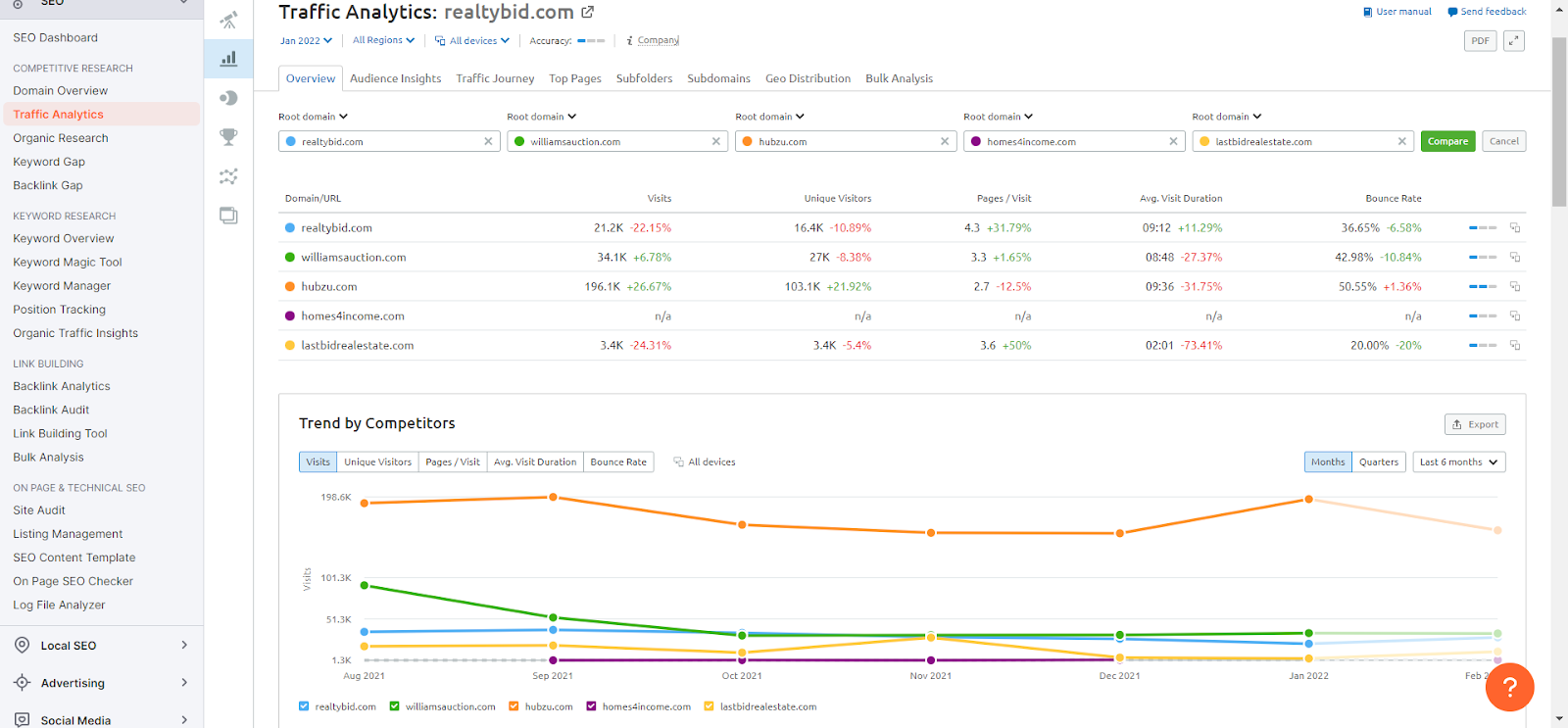
At a glance, you can compare how your competitors match up when it comes to:
- Visits
- Unique visitors
- Pages / visit
- Average visit duration
- Bounce rate
Additionally, you can see trends over time for each of these categories. You’ll see if competitors have recently lost traffic or have made dramatic progress during a specific time period.
There are a myriad other data points and reports that could help you deepen your understanding of your competitors, such as top pages, traffic sources and traffic journeys.
Keyword research
Keyword Research is one of the oldest and most undervalued skills in SEO. Choosing the right keywords can mean the difference between success and failure in SEO.
Keyword research is not sexy, but it is necessary, foundational work to be done properly. Let’s go over a step-by-step process for keyword research.
Think in terms of “Keyword Sets”
Ideally, you should group your keywords into Keyword Sets. Start with a “seed keyword,” then look for long-tail variants of that keyword.
For example, if your primary keyword is “Real Estate Auction,” some of the sets you could use include:
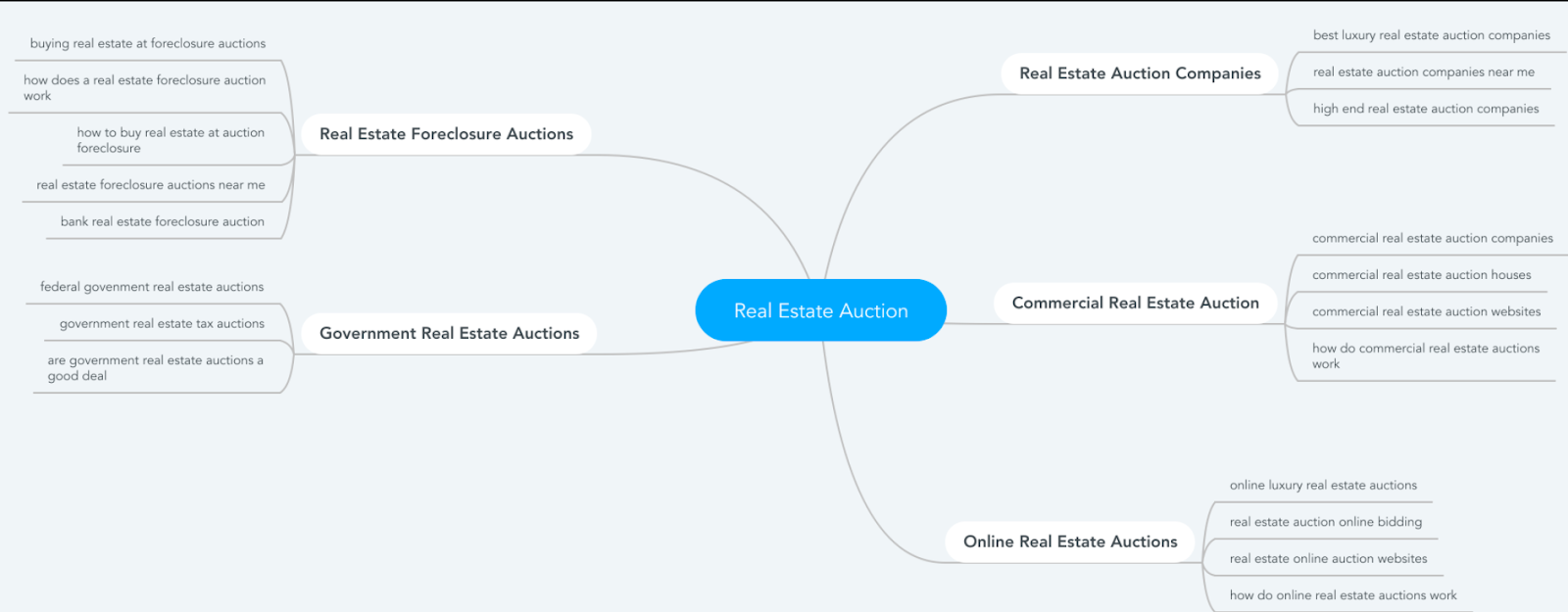
Then you could move to another keyword set and also get variants for that term.
Examples of other seed sets include:
- Online foreclosure auctions
- Home auctions
- Online property auctions
Once you have these in place, you can go deeper and deeper using secondary keywords, questions, and other variants.
Look for long-tail keywords
You can use Semrush’s Keyword Magic tool to obtain these seed sets. Type in the seed sets you’ve uncovered, and Semrush will give you a list of possible keywords.
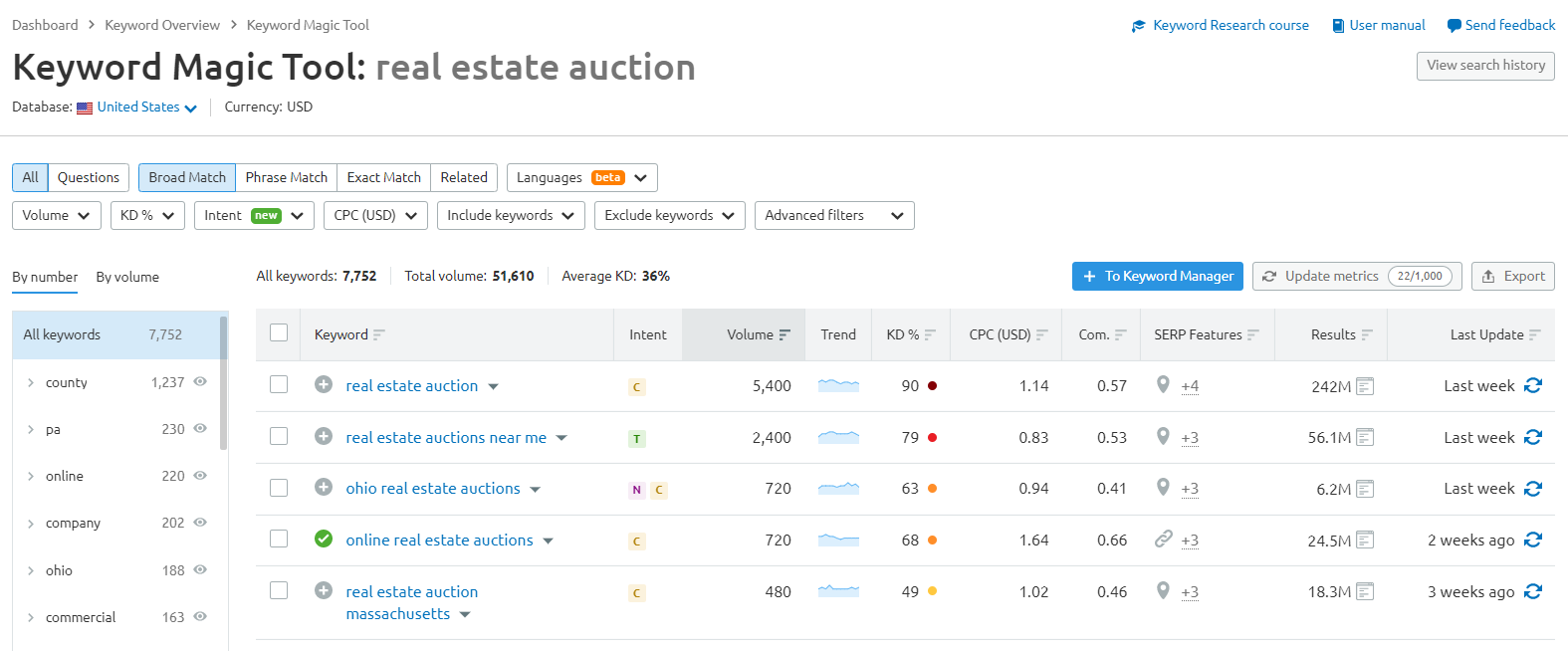
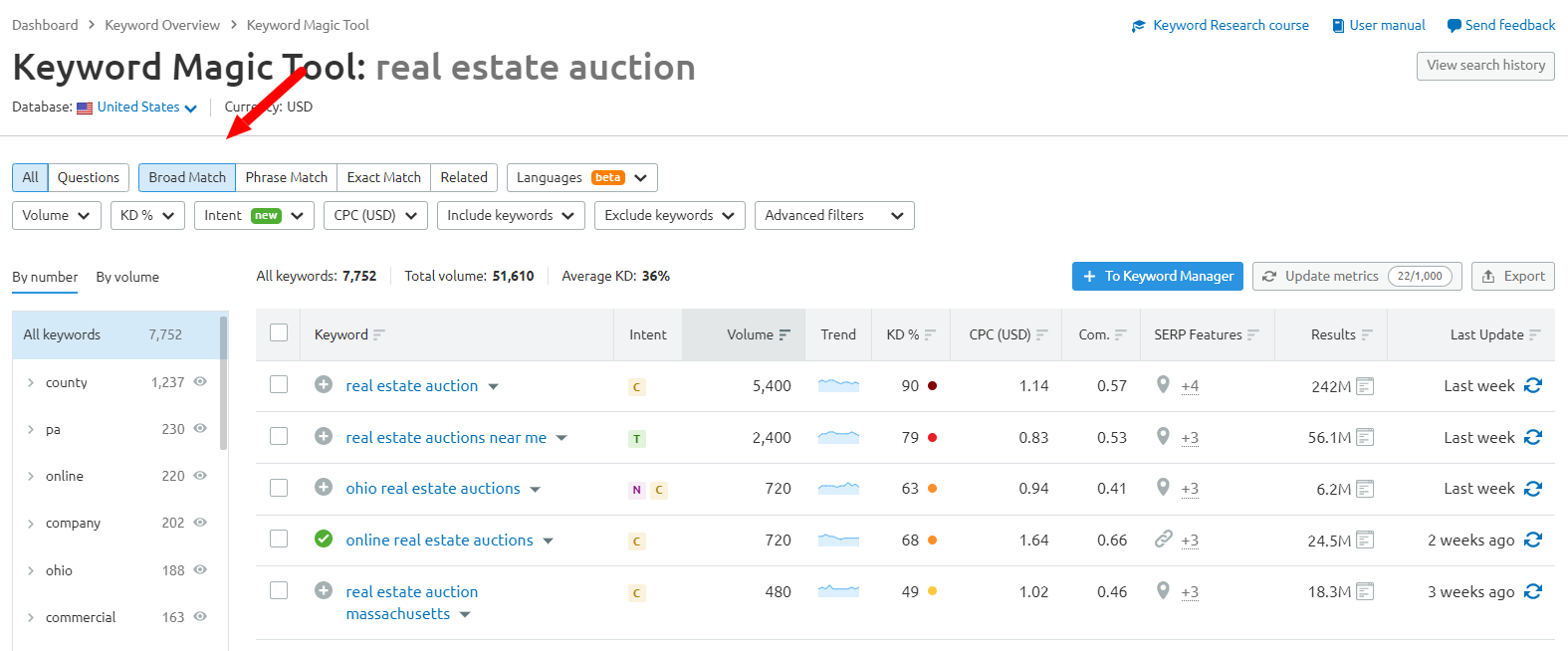
You can group these using the match types:
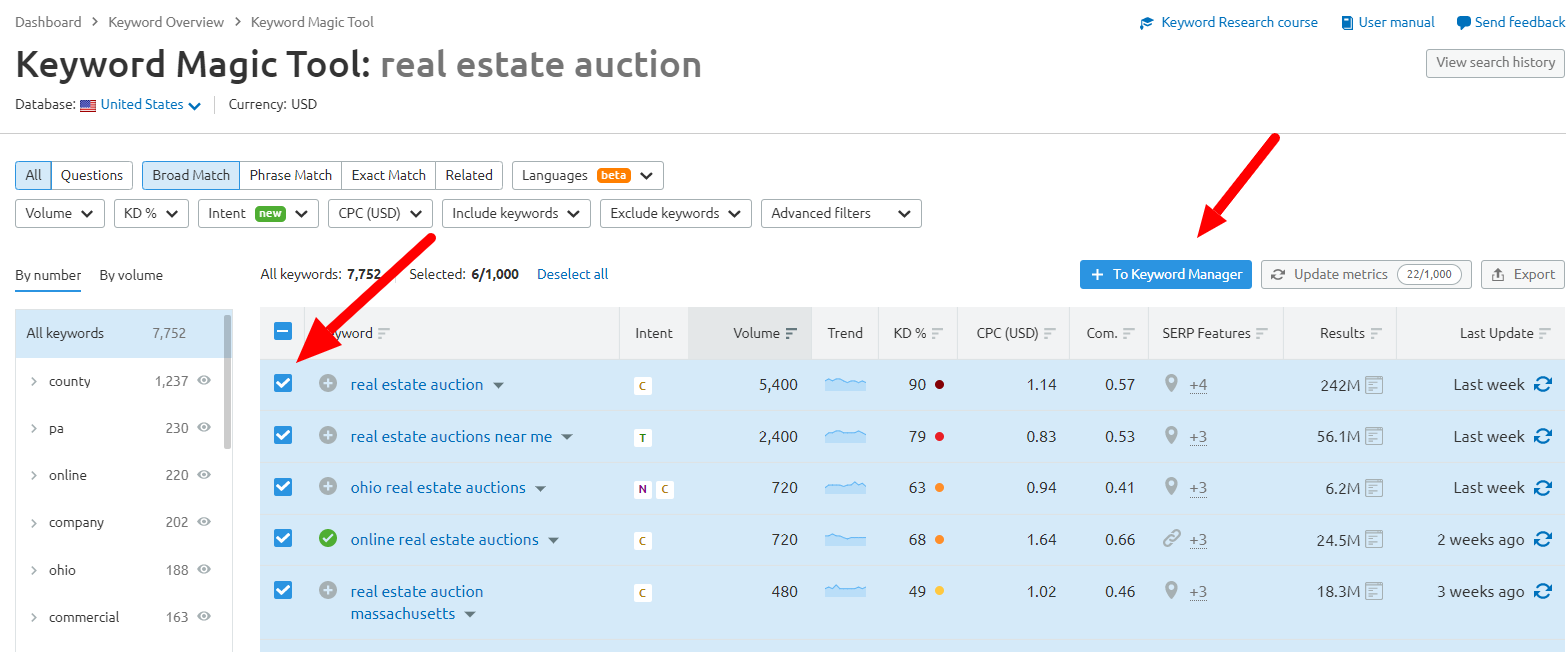
As you find keywords that you would like to rank for and track, use the checkmark and add them to your “Keyword Manager” list.
Assess the competition level
Next, you need to assess the viability of ranking for the keywords you chose. Ranking for your seed keywords can be your end goal, but you have to select keywords that you can realistically rank for based on your site’s current authority score. If you choose keywords that are too competitive, you’ll never see positive results for your SEO efforts.
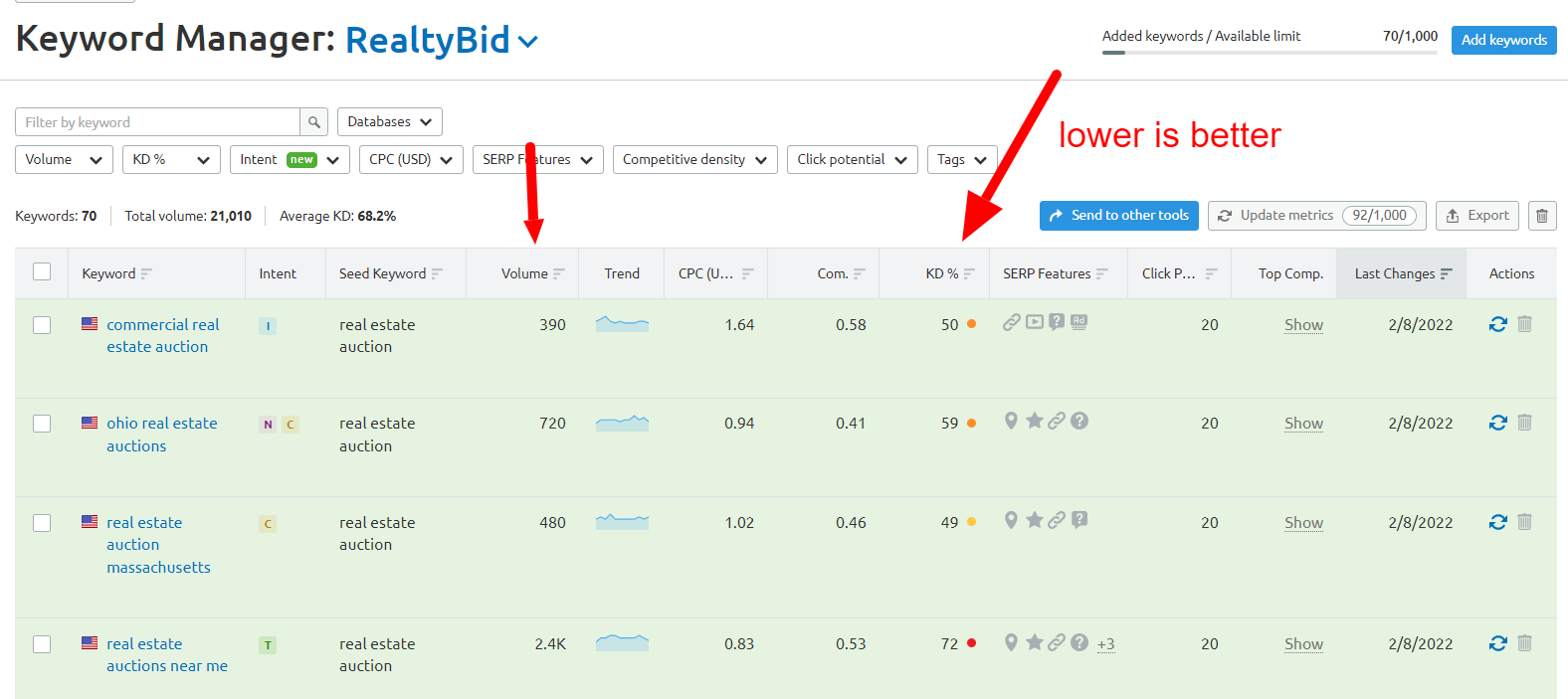
Most keyword research tools use a metric for Keyword Difficulty. You’ll want to identify keywords that have good volume but low KD. What that level is varies based on your site’s age, structure, backlink profile and much more.
Find keyword gaps
You can expand your keyword list by doing a keyword gap analysis. There might be keywords you never thought about that competitors are ranking for.
To perform keyword gap analysis, go to the Keyword Gap report, type the top competitors into the top bar, and click on compare:
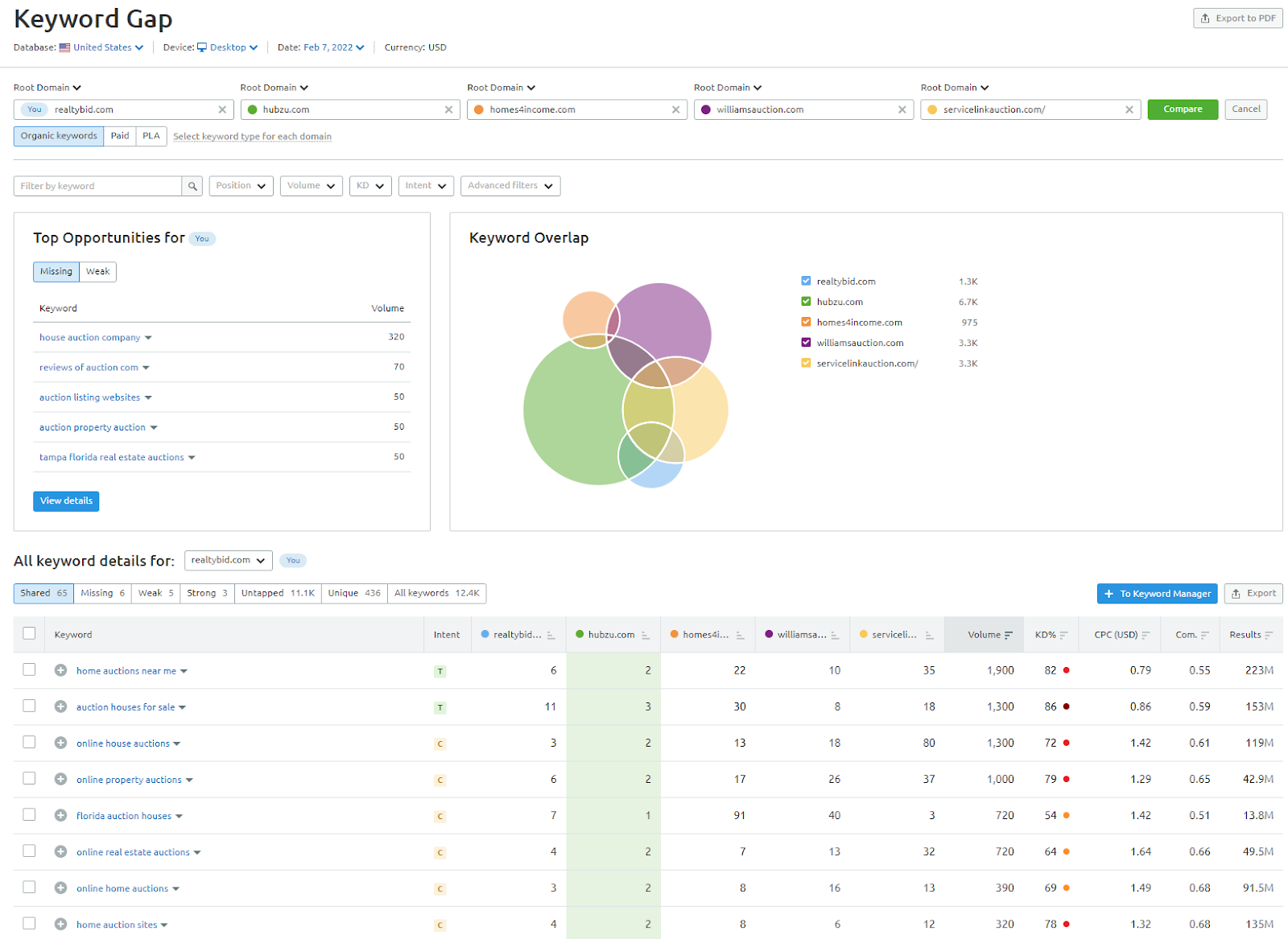
There is a list of keywords that you and your competitors are ranking for in the table below. You’ll see which keywords are shared between all competitors, which ones they are ranking for but your site isn’t, which keywords you rank for but not at the top, and more.
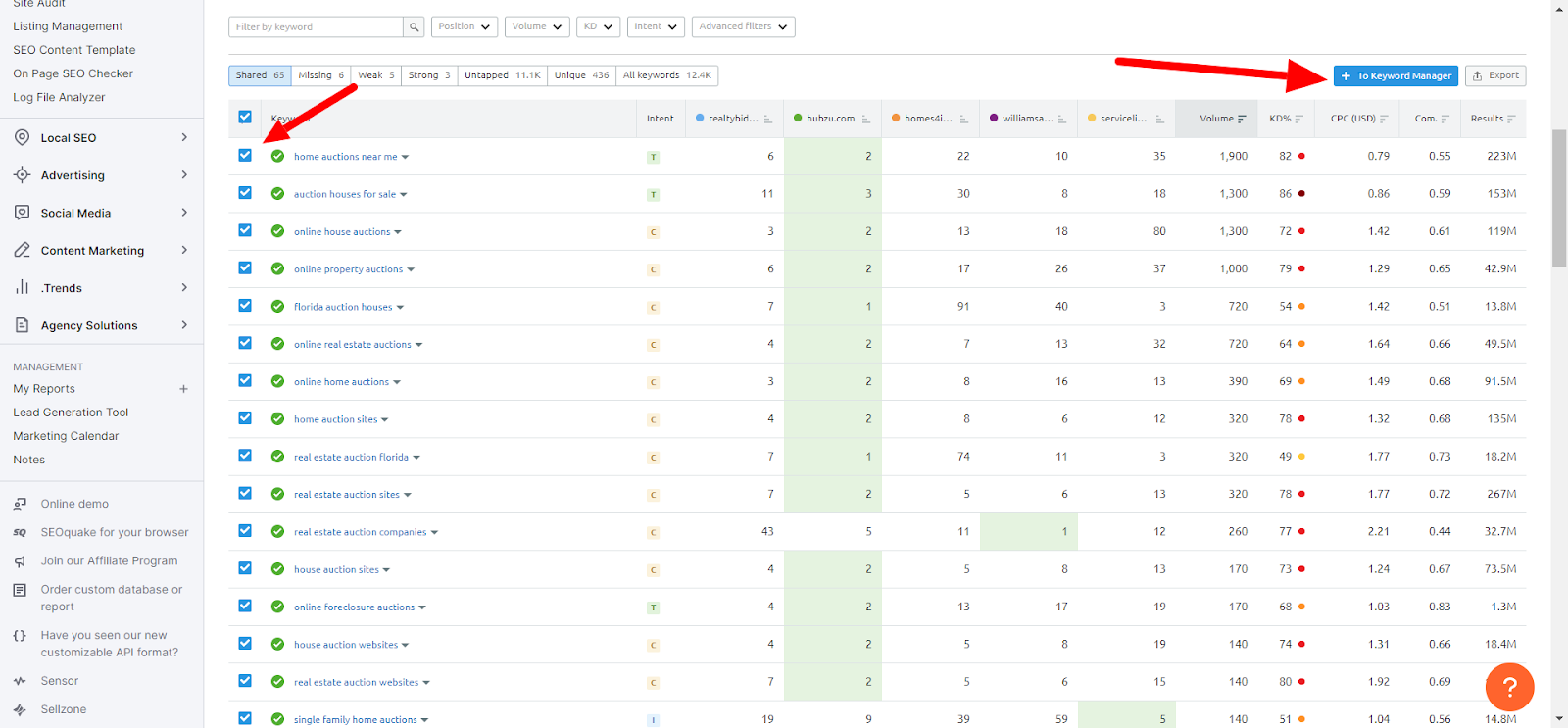
Review these keywords, and if there are keywords that seem relevant, you can add them to your keyword manager list.
Compile your final keyword list
The final step is to collect all of your keyword data into the Keyword Manager. You can segment your lists or create one large list with all of your keywords.
By adding keywords from the keyword magic research, keyword gap analysis, competitor research and baseline assessment, you’ll have a comprehensive list of keywords to work with.
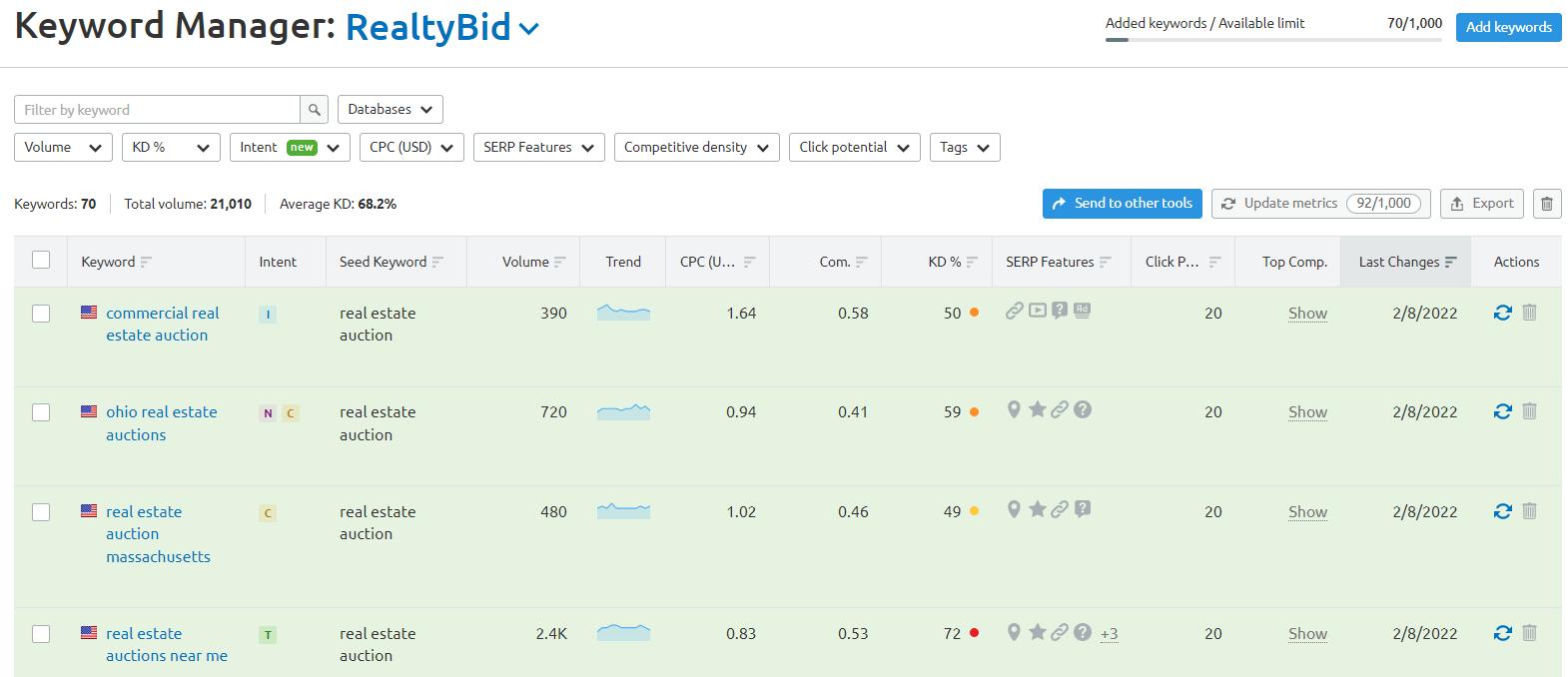
Make sure you click on the “Update Metrics” to get current, accurate data on the volume, competitiveness, and Keyword Difficulty of each of the terms on your list.
Using competitor data to craft your strategy
At this stage, you’ll have a comprehensive understanding of who you’re up against in the SERPs. You’ll know which competitors have the strongest link profiles, what keywords you can target and have various data points about potential opportunities that your competitors have overlooked.
The data you have accumulated can help you build your final target keyword list and prepare you for the next stage, which includes understanding your target audience and building persona profiles.
The post How to analyze your SEO competitors and find opportunities appeared first on Search Engine Land.
Courtesy of Search Engine Land: News & Info About SEO, PPC, SEM, Search Engines & Search Marketing
Category seo news | Tags:
Social Networks : Technorati, Stumble it!, Digg, de.licio.us, Yahoo, reddit, Blogmarks, Google, Magnolia.
DMCA request removes Moz from Google Search index
Written on May 4, 2022 at 7:39 pm, by admin
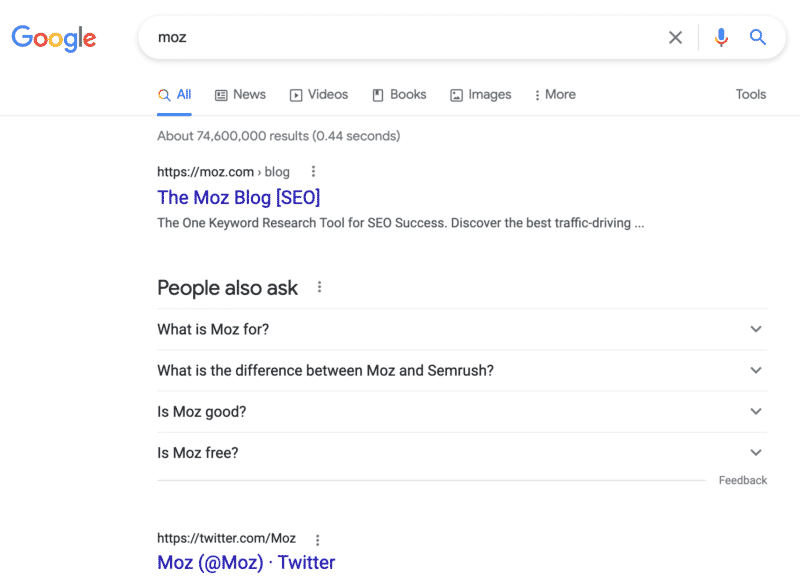
If you search for [Moz] in Google Search, you won’t be seeing the moz.com home page, that page was removed from the Google index due to a DMCA takedown request. The takedown complaint cites that Moz’s home page, along with 185 other URLs were “distribute modified, cracked and unauthorized versions” of the Dr. Driving app.
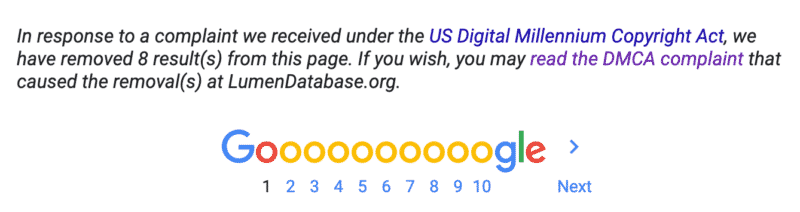
The takedown complaint. The DMCA, The Digital Millennium Copyright Act, takedown complaint can be viewed over here. You can see the Moz home page listed on line 122. As Cyrus Shepard posted on Twitter “Crazy! You can’t access the Moz homepage from Google right now. A search for “Moz” shows an incredible 8(!) removed results from an overly-broad DMCA filing. DMCA literally lets anybody abuse the system, and it breaks Google.
Google is aware. Danny Sullivan, the Google Search Liaison responded saying “I’ve passed it on for review.” We suspect Google will reverse this issue really quickly – but so far, Moz is still not showing.
The Google search results. Here is a screenshot of the search results page showing the Moz blog coming up in the first position, not the Moz home page:
The footer of the Google results show that Google “removed 8 result(s) from this page” due to DMCA violations:
Should not happen but it does. You are all probably thinking, this should not happen – how can Moz not rank for it’s own name in Google Search. How can it be that easy for someone to use a DMCA request to take down a large respected brand from showing in the Google Search results? And you are right, this should not happen – but it does.
We had our own site, Search Engine Land mistakenly removed from Google because Google thought the site was hacked – it was not hacked. Digg was also was removed from Google Search because someone accidentally classified it as spam.
I guess mistakes happen, even in massive companies. But how? We don’t know yet. We have reached out for Google for a statement and if we hear back, we will update this story.
More on DMCA requests and Google Search. Google has its transparency report that says “It is our policy to respond to clear and specific notices of alleged copyright infringement. The form of notice we specify in our web form is consistent with the Digital Millennium Copyright Act (DMCA) and provides a simple and efficient mechanism for copyright owners from countries/regions around the world. To initiate the process to delist content from Search results, a copyright owner who believes a URL points to infringing content sends us a takedown notice for that allegedly infringing material. When we receive a valid takedown notice, our teams carefully review it for completeness and check for other problems. If the notice is complete and we find no other issues, we delist the URL from Search results.”
You can dispute these requests and have them reversed but how long does that take? You can submit DMCA requests to Google over here.
Why we care. This is a nightmare for most SEOs and site owners. To be removed from Google Search for your branded term. It should not happen, it is really inexcusable and sad to see but it did happen.
I am sure Moz will return shortly but there is really nothing we can say on how to prevent this from happening to your site. The good news, Moz is a big enough brand that this caught Google’s radar quickly and likely will be fixed soon because of that. But for small brands – good luck.
The post DMCA request removes Moz from Google Search index appeared first on Search Engine Land.
Courtesy of Search Engine Land: News & Info About SEO, PPC, SEM, Search Engines & Search Marketing
Category seo news | Tags:
Social Networks : Technorati, Stumble it!, Digg, de.licio.us, Yahoo, reddit, Blogmarks, Google, Magnolia.
How hub-and-spoke content marketing can help improve SEO
Written on May 4, 2022 at 7:39 pm, by admin
“When we think about creating topical – evergreen, informational content – it’s sometimes hard to fit all that information on one landing page,” said Zack Kadish, SEO customer success team manager at Conductor, in a recent webinar. “So, we when think about ‘hub-and-spoke models,’ we want to think about generating content on a broad topic while diving deeper into more relevant areas on different parts of the website.”
“This can help increase organic traffic and keywords rankings, and even lead to more downstream metrics such as conversions, leads, and sales,” he added.
Similar to pillar page structures, hub-and-spoke models are designed to establish a site’s authority on the ins and outs of a given topic. But, how do they differ from other content marketing models?
What is hub-and-spoke content marketing?
“Think of the hub as the center of the wheel, and all of the spokes pointing outward,” Kadish said. “In an SEO and digital marketing lens, the hub is the main topic that we want to create more authority around. The spokes are all that supporting content that might help boost authority around that topic.”
Kadish said marketers can identify potential hub-and-spoke topics through keyword research. The higher volume, more transactional keywords are likely to be “hubs,” and the lower volume, long-tail keywords will serve best as “spokes.”
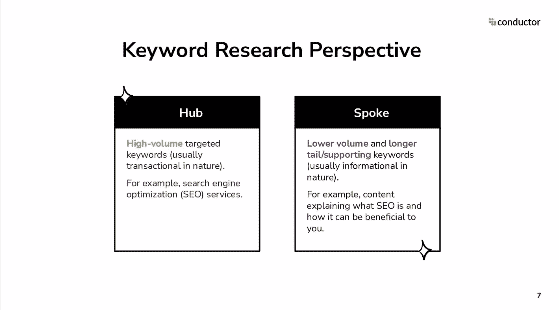
Chaz Marshall, SEO success manager at Conductor, gave a helpful example of a hub-and-spoke strategy in the same presentation:
“Let’s say civil engineering is the hub topic. If someone is researching that career path, a great subtopic to feature would be, ‘What is the average salary of a civil engineer?’ That would be a spoke.
“Each of those topics trails back to your brand, so, why not help Google and people who have never heard of your business notice that you are industry experts?” Marshall added.
Why is hub-and-spoke important for marketers?
“I used to think it was impossible to compete on the web if you weren’t a major domain,” Marshall said. “But, as an SEO, my job was to experiment.”
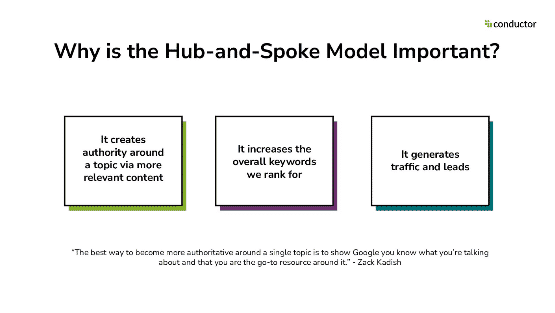
He pointed to a personal example: his family’s ice cream shop. Their content hub was centered around a specific fruit flavor: soursop. So they identified surrounding content (adjacent subjects that they knew people were interested in through trends and keyword research). These pieces on soursop flavors became their spoke topics.
After publishing these hub-and-spoke pieces, Marshall’s family began to see how far-reaching their content marketing efforts could take their brand. They were drawing in users to their site through that popular hub topic and then funneling intrigued readers down the marketing pipeline via spoke pieces.
Marshall noted that one of their customers originally found them simply by searching for information about soursop fruit. He was curious to know what it tasted like but didn’t have an ice cream shop that offered that flavor near him. So, when he decided to visit the store later that year, he told the staff that he found them through one of the specialized spoke content on their site.
The hub-and-spoke framework, when done well, has the potential to turn visitors into leads, even if they’re not ready to convert when they find your site.
Producing evergreen, educational content helps readers learn something, and, in turn, increases the likelihood that they’ll remember your brand.
“From that day on, we knew that content marketing was where it’s at,” Marshall said.
Watch this webinar presentation at Digital Marketing Depot.
The post How hub-and-spoke content marketing can help improve SEO appeared first on Search Engine Land.
Courtesy of Search Engine Land: News & Info About SEO, PPC, SEM, Search Engines & Search Marketing
Category seo news | Tags:
Social Networks : Technorati, Stumble it!, Digg, de.licio.us, Yahoo, reddit, Blogmarks, Google, Magnolia.
Conductor CEO opens up about mental health
Written on May 4, 2022 at 7:39 pm, by admin
May is Mental Health Awareness Month. This inspired Seth Besmertnik, the CEO of enterprise SEO platform Conductor, to reveal his struggle with mental health.
His goal? To encourage his team to seek out help. And it’s a message that everyone in our community should hear.
Here are some highlights from Besmertnik’s message:
“We all face our own demons.” As Besmertnik wrote, everyone goes through tough patches. That’s what initially led him to seek therapy six years ago. He’s been going religiously every Tuesday at noon since.
- “Professional support helps.”
In the process, Besmertnik made it sound like therapy is a normal activity. Because it is. There should be no stigma attached to seeking out mental health services.
- “We are not perfect, we never will be.”
“A powerful tool to navigate life.” Besmertnik credited therapy for helping him become a better CEO and father. He noted that he has other forms of support (his wife, friends), but a therapist is different:
- “They don’t come with an agenda, and it’s the safest place in the world to explore your thoughts and experiences and learn from them over time. I’ve uncovered so much about myself through therapy. And I continue to. I’ve learned how to turn problems into opportunities through therapy.”
Why he shared his story. Besmertnik said he wanted his team to feel “comfortable, safe and proud to seek out help in facing life. You don’t have to be depressed, or anxious or broken to go. We all need help. You all have a chance to be a better you. And I could not recommend more a way to help you get there.”
Besmertnik shared the full message on LinkedIn. You can read it here.
Why we care. We’re all human. We’re all dealing with challenges. And sometimes, those issues can unexpectedly overwhelm you to the point of causing anxiety or depression. When this happens, remember it will be OK. They are just feelings. Feelings are not always reality. That’s why it’s important to seek help. We’ve lost many friends and colleagues to suicide in recent years. We don’t want to lose you. Yes, you.
Jeremy Knauff, CEO of SpartanMedia, recently put it this way in a public Facebook post: “Reaching out for help isn’t a sign of weakness. It’s a sign of strength. It shows that you value yourself, your loved ones, and the contributions that you can make to the world, more than you value the façade of invincibility that so many proudly and foolishly hide behind.”
And as Google put it recently via a tweet: “Your mental health is more valuable than your content.”
The post Conductor CEO opens up about mental health appeared first on Search Engine Land.
Courtesy of Search Engine Land: News & Info About SEO, PPC, SEM, Search Engines & Search Marketing
Category seo news | Tags:
Social Networks : Technorati, Stumble it!, Digg, de.licio.us, Yahoo, reddit, Blogmarks, Google, Magnolia.
Axios news SEO playbook: Speed, authority and brevity
Written on May 4, 2022 at 7:39 pm, by admin

If you’ve ever read Axios, you’ll remember it. At least that’s what Ryan Kellett, VP of Audience at Axios hopes.
A news article on Axios has a distinctive look. It’s all in the name of Smart Brevity.
Smart Brevity: “Axios gets you smarter, faster on what matters.” That’s their mission. And they have five excellent guiding principles:
- Audience first
- Elegant efficiency
- Smart, always
- No BS for sale
- Excellence, always
What about SEO? Axios had 24.8 million visitors in March, with 16% of traffic coming from organic search, according to Semrush’s Website Traffic Checker. (For comparative purposes, the New York Times is the largest news site, with more than a billion visitors in March – but Axios doesn’t cover nearly as many topics as the Times, CNN or other large news publishers.)
News is incredibly competitive. And Smart Brevity seems to go against what many consider to be SEO best practices. Namely, longer and more is better.
So how does Axios make SEO and Smart Brevity work together?
Go deeper. Here are highlights from my recent Q&A with Kellett. It has been edited for smartness and brevity.
SEO is an entry point. For Axios, it’s audience first, always. Kellett said Axios delivers trustworthy breaking news and insights in the smartest and most efficient way possible. So what role does SEO play at Axios? Here’s what Kellett said:
- “The goal with our SEO discipline is to introduce readers to our fact-based coverage and Smart Brevity in a way that earns their time, attention and trust. You’ll notice Axios is distinctive not just in the quality of what we produce but in the actual look of the written article. Have you seen our bullet points and bold before? It’s memorable.”
- “If we can convince a search reader to identify Smart Brevity wherever they next see Axios (say, in a social feed, Apple News or a forwarded email from a friend), chances are good they will eventually convert to being a subscriber to one of our many amazing newsletters.”
- “Sure, we’d love it if they signed up for a newsletter on the spot after coming over from search, but search mostly is a top-of-funnel entry point for readers who may be coming to us for the first or second time.”
One exception: Axios Pro, which is a specialized news subscription. Pro readers coming from search may be looking for a specific company or individual that Axios is covering, Kellett said.
Smart Brevity is core to Axios. It’s hard to stand out in a crowded news space. Making content longer would go against everything Axios is trying to do. Kellett believes shorter is better. And that most news articles across the web could benefit from being shorter and more readable:
- “Everyone focuses on the brevity part. But it’s brevity in combination with making the reader smarter that drives everything we do.”
- “We most certainly get dinged for this in search rankings, but we have to be comfortable knowing that the reader will appreciate Smart Brevity when they encounter us, recognize it in the wild, and eventually seek it out from us. We obviously can’t abide if our stories don’t index or rank at all, so we look to avoid that. But otherwise, we have broad shoulders and navigate the best we can.”
Why Axioms matter. As Kellett noted, Axios articles have a distinctive look. And this look has a name internally at Axios: axioms. The style can be traced back to Axios co-founder Mike Allen’s flagship newsletter, Axios AM. Kellett said axioms have debatable SEO value – but undeniable value for their audience:
- “How many articles have you read where the most important point and the whole reason you should care is buried in paragraph seven or ten? We use the ‘Why it matters’ axiom so you, the reader, can quickly identify why the story is relevant in the first place.”
- “The SEO part of axioms may be quite subtle. I could make the argument we’re giving a consistent pattern for search engines to identify and parse our content. But I’m unsure how much it practically helps us rank at the moment. If you have creative ideas on how to extend axioms for search, my DMs on Twitter are open until Elon Musk shuts me down.”
“Start from a good place and optimize from there.” Their homegrown CMS defaults help nudge reporters to write good URLs and SEO-friendly headlines. Axios doesn’t have a separate search team outside of its larger audience team, so it relies on its newsdesk, copy editing and audience teams every day, Kellett said.
Headlines are one area Axios regularly tries to improve to enhance performance. Their teams do this manually, by looking at performance and going into the CMS. Axios does not use any kind of automated testing of headlines.
5 Axios SEO best practices
1. SEO education. Kellett said this is ongoing and an important part of keeping up with changes to SEO.
- “I am always on the lookout for myths and bad habits to correct. And Director of Audience Neal Rothschild writes a weekly email (produced using our own Axios HQ software) to the newsroom that reviews examples and changes in best practices, which is incredibly helpful to get the word out internally quickly.”
2. Authority and depth. Axios is not CNN.com. They don’t cover every single topic under the sun. Kellett said Axios focuses on reinforcing its areas of authority:
- “Readers may see some of the breaking news coverage we publish, but we also have amazingly, deep coverage on narrow topics like space, sports betting, electric vehicles, China, privacy, immigration, to name a few. All of these are forward-looking areas that will only be more important to the country as time goes on.”
- “And that depth can come into play down the road. As an example, Axios had more authority than you’d think when the war in Ukraine started because we had covered Volodymyr Zelensky, including this amazing interview we did with him for Axios on HBO in 2021. Using that expertise furthers both pure journalistic and SEO goals.”
3. Explainers.
- “I’ve loved working on our explainers, which really help us step back and give regular readers a chance to access a storyline with Smart Brevity. Axios Explains Ukraine is a great example of where we are headed with this.”
4. Speed. For breaking news, Axios is fast. Really fast.
- “Being among the first URLs on the web on a big story helps us rank as news develops. We’ll often get beat when the big publishers come knocking but generally staying fast, pointing to our expertise through internal links, and peeling off really great story angles gives us a fighting chance.”
5. Pillar and evergreen content. Axios publishes more than just short articles.
- “We have a set of Deep Dives that cover topics in-depth and from a bunch of different angles. Those stories have potential to be great pillar content and evergreen too with some continued editorial and technical SEO work.”
Breaking Axios SEO news: Axios has just hired their first Director of SEO: Priyanka Vora, formerly Quartz’s Audience Editor. She will help build out Axios’ SEO practice further.
- “I would also keep an eye on the Axios job listings page as the company is in growth mode across a number of areas, both in and around our newsroom.”
Axios’ SEO tool of choice. “We’re a Semrush shop for now,” Kellett said. Though he is personally partial to exporting GSC data to Google Sheets.
Most important SEO KPIs or metrics? Raw referrals matter to Kellett most. Also, the percentage of overall referred traffic from search.
“Though, of course, I will also celebrate anyone in our newsroom who sends me a screenshot of when Axios is in Top Stories carousel,” Kellett said.
The post Axios news SEO playbook: Speed, authority and brevity appeared first on Search Engine Land.
Courtesy of Search Engine Land: News & Info About SEO, PPC, SEM, Search Engines & Search Marketing
Category seo news | Tags:
Social Networks : Technorati, Stumble it!, Digg, de.licio.us, Yahoo, reddit, Blogmarks, Google, Magnolia.
Twitter Circle: Limit who can view your tweets
Written on May 3, 2022 at 4:35 pm, by admin
Find Twitter too toxic? Now you can limit who sees your tweets to 150 users of your choosing.
The post Twitter Circle: Limit who can view your tweets appeared first on Search Engine Land.


Courtesy of Search Engine Land: News & Info About SEO, PPC, SEM, Search Engines & Search Marketing
Category seo news | Tags:
Social Networks : Technorati, Stumble it!, Digg, de.licio.us, Yahoo, reddit, Blogmarks, Google, Magnolia.
Google Ads reporting issues with APIs and Ads Scripts
Written on May 3, 2022 at 4:35 pm, by admin
The reporting issue was between April 25th 2:32 PM PT and April 26th 12:24 PM PT.
The post Google Ads reporting issues with APIs and Ads Scripts appeared first on Search Engine Land.


Courtesy of Search Engine Land: News & Info About SEO, PPC, SEM, Search Engines & Search Marketing
Category seo news | Tags:
Social Networks : Technorati, Stumble it!, Digg, de.licio.us, Yahoo, reddit, Blogmarks, Google, Magnolia.
Microsoft Advertising is rolling out Auto-generated remarketing lists and more
Written on May 3, 2022 at 4:35 pm, by admin
A handful of new additions this month will be warmly welcomed by Microsoft advertisers.
The post Microsoft Advertising is rolling out Auto-generated remarketing lists and more appeared first on Search Engine Land.


Courtesy of Search Engine Land: News & Info About SEO, PPC, SEM, Search Engines & Search Marketing
Category seo news | Tags:
Social Networks : Technorati, Stumble it!, Digg, de.licio.us, Yahoo, reddit, Blogmarks, Google, Magnolia.
Google Responsive Search Ads: What you need to know
Written on May 3, 2022 at 4:35 pm, by admin
Learn the benefits of RSAs, how the transition from ETAs impacts you search strategy and how to write effective RSAs
The post Google Responsive Search Ads: What you need to know appeared first on Search Engine Land.


Courtesy of Search Engine Land: News & Info About SEO, PPC, SEM, Search Engines & Search Marketing
Category seo news | Tags:
Social Networks : Technorati, Stumble it!, Digg, de.licio.us, Yahoo, reddit, Blogmarks, Google, Magnolia.
How to optimize account structure in an era of automation
Written on April 29, 2022 at 4:27 am, by admin
Learn how you can maximize the positive impacts of automation while maintaining the necessary level of autonomy.


Courtesy of Search Engine Land: News & Info About SEO, PPC, SEM, Search Engines & Search Marketing
Category seo news | Tags:
Social Networks : Technorati, Stumble it!, Digg, de.licio.us, Yahoo, reddit, Blogmarks, Google, Magnolia.