

Microsoft Ads (again) extends RSA migration to Feb. 2023
Written on August 30, 2022 at 3:57 am, by admin
Advertisers now have five additional months to migrate their expanded text ads to RSAs.
The new extended deadline. In April we reported that Microsoft was extending the original June 30 deadline to August 29. Today Microsoft announced that they were once again, extending that deadline to February 1, 2023. Microsoft says the extension is in response to advertisers need for more time.
Expanded Text Ads (ETAs) will continue to serve with RSAs but advertisers will no longer be able to create new or edit existing ETAs.
What Microsoft says. Microsoft says that advertisers who have switched from ETAs to RSAs see an average of 7% conversion rate improvement in their performance.
You can read the announcement here.
RSA best practices. If you’re still migrating your ads, Microsoft suggests the following best practices:
- Ensure all your ad groups have at least one RSA
- Use the Recommendations tab to add AI generated RSAs based on your existing ETA assets.
- Use auto-apply recommendations to help automate implementations
- Use the Google import tool to mirror Google ad campaigns
Why we care. Advertisers who haven’t migrated their campaigns yet have a few more months to get it done. Microsoft won’t support ETAs after February, so migrating as soon as possible will help prevent your ads from being auto-updated, or dropping in performance.
The post Microsoft Ads (again) extends RSA migration to Feb. 2023 appeared first on Search Engine Land.
Courtesy of Search Engine Land: News & Info About SEO, PPC, SEM, Search Engines & Search Marketing
Category seo news | Tags:
Social Networks : Technorati, Stumble it!, Digg, de.licio.us, Yahoo, reddit, Blogmarks, Google, Magnolia.
Google adds 3 new content guidelines for Education Q&A structured data
Written on August 25, 2022 at 3:39 pm, by admin
Google has added a new Content Guidelines section to its help document on Education Q&A structured data.
The new guidelines. Here are the new guidelines Google has added:
- Education Q&A pages must follow the same content guidelines for Q&A pages.
- Your page must contain education related questions and answers. There must be at least one question and answer pairing on your page, and the answer must be related to and answer the user’s question.
- You are responsible for the accuracy and quality of your education Q&A pages through this feature. If a certain amount of your content is found to be inaccurate based on quality and pedagogical review processes, then all or a subset of your Q&A pages may not be eligible for this feature until you resolve the issues.
Why Google added this. Google said these guidelines were created to “ensure that our users are connected with learning resources that are relevant.”
Failure to comply. If Google finds you are violating the guidelines, Google could either:
- Take manual action on your site.
- Not display your content as a rich result.
What is this page? Google released the Education Q&A structured data help document in May. This help document provides guidance on how to add Quiz structured data to flashcard and single Q&A pages so it appears in Google’s Education Q&A carousel, Google Assistant and Google Lens results.
Why we care. If you have site related to education, the Education Q&A structured data could help improve your visibility in Google results and also potentially increase click-throughs. Make sure to follow Google’s specific guidance here around relevancy, accuracy and quality so you maintain eligibility for this feature and avoid possible manual action.
The post Google adds 3 new content guidelines for Education Q&A structured data appeared first on Search Engine Land.
Courtesy of Search Engine Land: News & Info About SEO, PPC, SEM, Search Engines & Search Marketing
Category seo news | Tags:
Social Networks : Technorati, Stumble it!, Digg, de.licio.us, Yahoo, reddit, Blogmarks, Google, Magnolia.
Webinar: Why digital changes drive SEO growth
Written on August 25, 2022 at 3:39 pm, by admin

Effective digital transformation can accelerate organic marketing growth—and maintain that growth despite future economic or regulatory challenges.
Join search experts from Conductor in an upcoming webinar and learn:
- The crucial role organic and SEO play in enterprise digital transformation.
- The importance of diversifying marketing efforts and what that looks like.
- How to apply data-driven insights to elevate the customer experience.
Register today for “Beyond the Buzzword: Transform Digitally to Drive Organic & SEO Growth,” presented by Conductor.
The post Webinar: Why digital changes drive SEO growth appeared first on Search Engine Land.
Courtesy of Search Engine Land: News & Info About SEO, PPC, SEM, Search Engines & Search Marketing
Category seo news | Tags:
Social Networks : Technorati, Stumble it!, Digg, de.licio.us, Yahoo, reddit, Blogmarks, Google, Magnolia.
Google out-of-home ads available for Display and 360
Written on August 25, 2022 at 3:39 pm, by admin
Google has just announced digital out-of-home ads for Display & 360. The new ad formats help to engage shoppers when they’re “out in the real world” in front of screens in public places such as stadiums, airports, bus stops, shopping centers, elevators, taxis, and more.
How they work. With digital out-of-home ads in Display and 360, brands can harness the same power of traditional advertising with placements on public screens, all in one dashboard where they can control strategy, reporting, and optimization.
Digital out-of-home ads also allow brands to run multiple versions of their message and can be based on location and time of day.
Google’s programmatic partners. “Display & Video 360 already partners with exchanges Hivestack, Magnite, PlaceExchange, Ströer SSP, VIOOH and Vistar Media. These exchanges give access to large media owners around the world like ClearChannel, Intersection, JCDecaux, Lamar and Ströer. All of this inventory can be secured via programmatic deals.”
Limited targeting and personalization. Google says that digital out-of-home ads are not personalized and no unique identifiers are used, as well as no user location data. However, advertisers are able to reach people based solely on contextual information such as the screen location.
For example, Google says a fast food business can quickly advertise on a billboard in a busy spot during lunch hour. Later that day the same billboard can promote a concert or event.
Early testing. Retailer ASOS used digital billboards in heavy footfall areas to generate awareness for their brand and drive passersby to visit their online store. Their marketing team arranged Programmatic Guaranteed deals with leading publishers like Intersection in the U.S. and JCDecaux in the U.K. and booked hundreds of digital billboards, generating 22 million viewed impressions across the two countries.

Learn more about digital out-of-home ads. You can read Google’s announcement here. If you’re interested in purchasing out-of-home inventory you can visit the Display & 360 help documentation.
Why we care. Digital out-of-home-ads are similar to traditional billboards, but instead of paying to have your ad shown in one location, all the time, you can elect to have your ad shown at certain times, in multiple locations.
These new ad types may work well for national or global brands like ASOS, Nike, Mcdonald’s, or Facebook, but small and local businesses may have a tougher time justifying their use. If you can’t specify the audience you’re targeting, and can only adjust their location or screen type, it’s likely not a solution for brands hyper-targeting a certain demographic or audience. But if you have the budget, it may be worth it to test a few cities where you operate.
The post Google out-of-home ads available for Display and 360 appeared first on Search Engine Land.
Courtesy of Search Engine Land: News & Info About SEO, PPC, SEM, Search Engines & Search Marketing
Category seo news | Tags:
Social Networks : Technorati, Stumble it!, Digg, de.licio.us, Yahoo, reddit, Blogmarks, Google, Magnolia.
5 ecommerce SEO trends to know for the 2022 holidays
Written on August 25, 2022 at 3:39 pm, by admin
The all-important Q4 holiday shopping season is nearly here. SEO will once again be a critical channel for brands to increase their visibility and sales.
Ahead of the 2022 holidays, enterprise SEO platform BrightEdge has shared its latest research with Search Engine Land on what retailers, brands and publishers should know.
The insights are based on tracking 6,000 ecommerce keywords in 10 categories, which the company has been doing for the past three years.
Here’s what to know:
1. Brands and publishers are big competition for retailers. Retailers are no longer just competing for visibility with other retailers. Now they’re competing with brands that have adopted direct-to-consumer models. Plus, publishers that provide reviews and product overviews have made significant gains in Google’s search results.
For top ecommerce keywords:
- Retailers own 57%, down from 70% in 2020.
- Brands occupy 23%, up from 18% in 2020.
- Publishers have 11%, up from 4% in 2020.
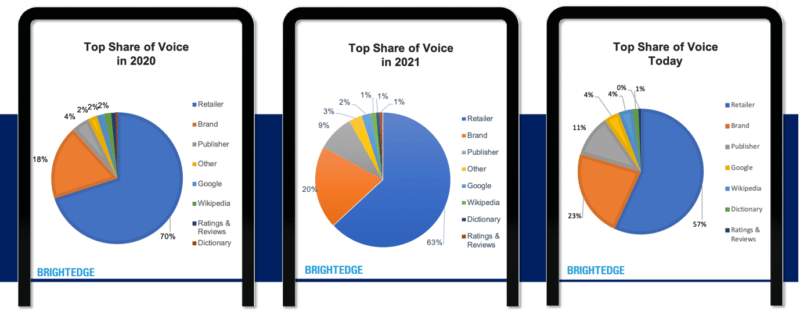 Ecommerce visibility: retailers, brands, publishers and more, 2020-2022, BrightEdge data
2. Content-driven ecommerce. While it remains to be seen how impactful Google’s helpful content update will be, one thing is clear, according to BrightEdge: the time is now for retailers to differentiate their content so it will rank in search results. In other words, offer more than a product description.
Retailers that ultimately will win are those that will provide better content experiences. How? By:
- Focusing on content and context about the product.
- Organizing categories in ways that make it easy for the user to shop across multiple related products.
3. Blue links matter. There’s been a lot of discussion in the past decade or so about how Google is much more than 10 blue links. For key ecommerce terms, however, 70% of all clicks are going to those classic blue links, according to BrightEdge’s data.
It’s still common to find the local three-pack for ecommerce search terms on Google. However, the prominence of local packs has declined from 25% to 19% in the past two years. Also in decline: videos and image carousels. Meanwhile, People Also Ask has grown slightly.
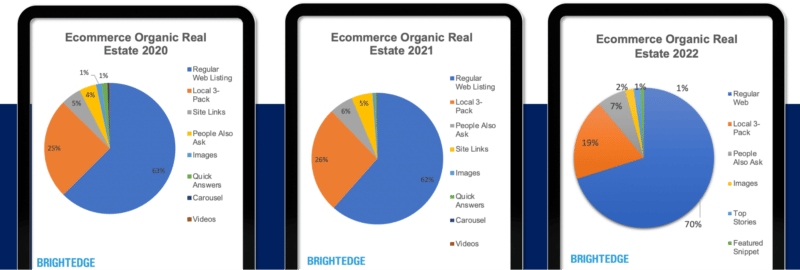 Ecommerce Organic Real Estate, 2020-2022, BrightEdge data
4. Schema usage is growing. Schema is more aligned with shopping than ever this year. Brands, retailers and publishers are increasingly adopting various schema types to markup their content around shopping experiences, such as.
- Product
- ImageObject
- ItemList
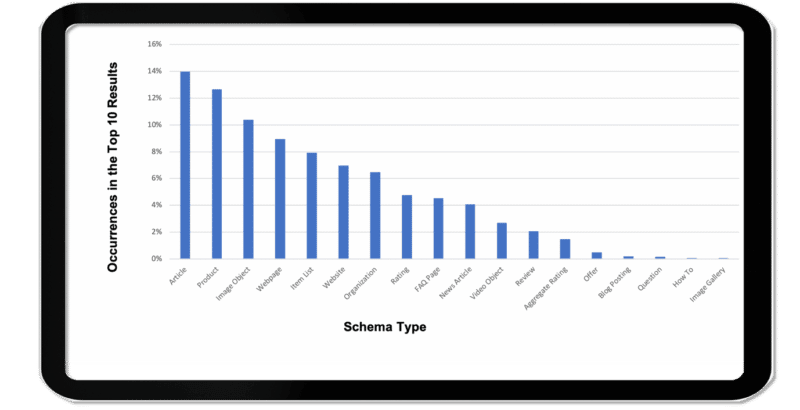 Most common schema types for winning e-commerce rankings, 2022, BrightEdge data
5. Article and category pages dominate ecommerce. Category pages have the highest click-through rate 70% of the time. Also of note: articles about products have higher click-through rates than product pages themselves, according to BrightEdge.
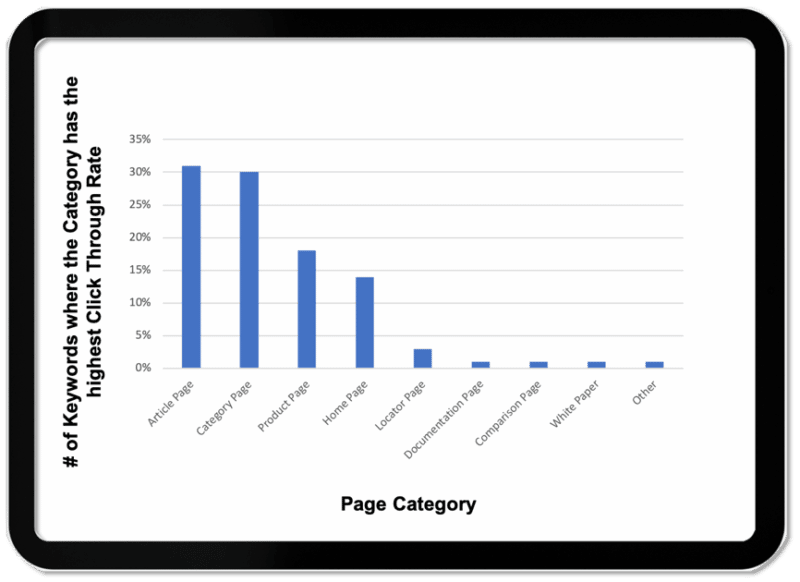 Ecommerce click-through rate by keywords, BrightEdge data
Why we care. Google search – and the way people search – are always evolving. In ecommerce SEO, it’s critical to monitor what’s happening and understand what you can influence now for the upcoming holiday season, while always evolving your SEO strategy to provide the types of content and user experiences Google is likely to reward in the future.
The post 5 ecommerce SEO trends to know for the 2022 holidays appeared first on Search Engine Land.
Courtesy of Search Engine Land: News & Info About SEO, PPC, SEM, Search Engines & Search Marketing
Category seo news | Tags:
Social Networks : Technorati, Stumble it!, Digg, de.licio.us, Yahoo, reddit, Blogmarks, Google, Magnolia.
How to audit your Google Ads account like a pro
Written on August 24, 2022 at 12:31 pm, by admin
Brad Geddes is no stranger to paid search. And as one of the co-founders of Adalysis, he’s done his fair share of audits. In this SMX Advanced 2022 session, he provides a framework for how to audit your own accounts, or perform audits for client proposals. Let’s dive in.
Why perform an audit. There are a few reasons why you’d perform a Google Ads audit:
- Someone is unhappy with performance. Their conversions have decreased and spend has gone up. Something has gone wrong.
- The account owner wants to make sure they are following best practices and nothing is wrong.
- The account owner is happy with what they are getting, but they want more.
- The agency is performing an audit as part of a proposal and they need to know what the products are, how they sell, what their funnel is, and if part of that funnel is being ignored.
Asking the right questions. When you’re performing an account audit there are several pieces of information you need to know. Geddes addresses some of the questions you need to ask yourself or the client.
- What is the goal of your Google ads account?
- What do you want out of it?
- What do you consider a successful account?
Diving into the account. The audit.
The account overview
One of the first things you should look at is the scope. How big is the account? Is it two campaigns or 30? What is the ad spend? Are there search and display campaigns, or just search?
The second thing you want to look at is the sophistication level of the account. Is the account manager new? Will you have to educate that person? If they are a professional then you can address them in a different way than if they’d only been working in Google Ads for a few months.
Next, what are you not seeing? What is not being tracked or only used in certain campaigns? Geddes says that the most common conversions not being tracked are phone calls, downloads, and mailto links. Geddes suggests using Google’s conversion action sets and adding different conversions together and applying different activities to different campaigns. This way you can use interaction goals for top of funnel and CPA goals for bottom of funnel.
Account settings
Once you’re happy with the conversions or know what needs to be fixed, Geddes suggests looking at campaign settings. What you’re looking for is consistency in the setup process.
Some things to look for are:
- Are all of the campaign targeting the same locations?
- Are they creating ads by device?
- Are they using bid adjustments?
- How are they bidding?
Who is managing the account
Is someone actively managing the account? Geddes brings up the point that sometimes an account is spending millions of dollars per month and if it has five changes over the last 30 days, it’s likely that nobody is managing it. Other times it may have a huge number of changes but it’s all done by API, meaning that nobody is overlooking the data. And other times someone is really into the account, actively managing it and you’ll see a ton of changes and what is being worked on.
This should give you an idea of how active the management is and what is being used to make changes. Is it API, third-party scripts, a human, or something else?
Trends
Once you have the base level audit complete, Geddes suggests looking at trends. Instead of looking at month-to-month trends, look at year over year. Consider how last March did compared to this year instead of looking at February vs. March.
Ask the client if they can provide a few time frames when they were happy with the account for reference. This way you can look at date ranges, compare the visual data, and analyze whether search volume has dropped significantly. If search volume dropped, did someone remove keywords? Is impression share going up? Quality score issues could also be present as well as problems with extensions. Was a new landing page launched?
Knowing these factors can help you chase down what happened and isolate areas of change.
Looking at the big picture
Geddes makes the point that in a traditional audit, you don’t have time to look at every detail. Instead, you look into what the problem areas are.
Impression share
How often are those ads showing or not showing? Are you losing impression share due to budget? How about ad ranks? If impression share is high and the client still isn’t happy, can you add new targeting with some different display or keywords?
If the issue is budget, can you manipulate the budget to get more? If you took the budget from another campaign, would you get more? Budget manipulation is likely the easiest way to gain additional conversions, says Geddes.
Is it an ad rank issue? If so, then you’ll want to dig into Quality Score. Is it ad relevance? Is it a landing page issue?Does the landing page match the keywords in the account? Did they launch a new website or page that caused the experience to be affected? Look at the trends and timeframes of when things changed. Have a conversation with the client and find out what happened.
Keywords
What keywords is the client using? What does their targeting look like? Look at their match type usage and trends. What is their conversion rate by match type? Do they have a lot of broad match keywords with conversions, but no exact match? Is anyone going through the query report and adding those keywords to the account?
Duplicate search terms also occur. So Geddes suggests adding a negative keyword to the lower performing ad group can often result in an increase in conversions. Controlled duplicates can often result in additional conversions.
Keyword conflicts can also occur if you are blocking your own keywords. However, he points out that Google doesn’t look at match types, campaign negative lists, or MCC negative lists, so you could be blocking keywords that don’t even show up in Google. Geddes points out that Microsoft does, so you can use that to find Google conflicts.
Geddes also goes over engrams, more with negative keyword lists, search term reports and queries, and more.
Ad group sizes
Geddes uses a simple pivot table to look at ad group sizes. How many keywords are by ad group and how many search terms exist by ad group? How are the ad groups being managed? Do the ad groups need to be broken down smaller?
Consider the top spending ad groups first. Is there is a large number of them? RSAs don’t cover everything, so Geddes suggests still using granular ad group organization – even with the new ad formats.
RSA performance and pinning
When you get an idea of how that client is managing RSAs, we want to know what’s their overall asset breakdown. What is your overall pinning usage? Are they pinning everything a little bit? Nothing pinned? What’s your ad strengths? And then finally, what’s that asset performance breakdown? So you want that high level of? Are these RSAs unique and are they doing well? How is the client thinking about it?
Looking at the overall asset report you can determine how many different ads an asset is in. Is it on purpose? Did multiple people create the pins? Are they consistent?
Geddes reminds us that pinning doesn’t conversion rate or CTR. You’ll likely see a lower ad strength because you’re controlling the message. But once you have an idea of how ad groups are broken down and how they are doing, you also need to know who you should be paying attention to.
The competitor analysis
Auction insight shows you who you’re competing against. What’s that overlap rate? How are different people addressing these search terms? Do we fit the same? Do all the ads look the same? How do we stand out in this crowd? Who are your top competitors? And then looking at how their ads are selling against you, you can devise your own sell against strategy.
Once you do that, you can still do ad testing just like you could before. You may have some ad groups with multiple ad types, and some ad groups that are just all RSAs. So when you’re doing RSA ad testing, you may do them by theme, like RSA one is about discounts, RSA two is about prices, etc..
Geddes notes that clients love insights. Multi ad-group testing is a great way to let clients know that they can increase clicks, conversions, or other metrics by doing X.
Bid methods
Geddes concludes by saying that there is a lot more that can be done than what he’s discussed here, but you only have so much time to complete the audit. The big methods to look into are:
- How are they bidding
- How are they using bid modifiers
- Target CPA is common, but it may not be the best option because it does not use device modifiers to adjust bid
Audiences
How are audiences being used across the account? Geddes says that audiences are are so useful and so much reporting and audience bid adjustments can be used with several types of automated bidding.
Google doesn’t use audience modifiers to change the bids.They use the audience modifiers to say “you want to show your ads more to this audience group, or less to this audience group.” So use your bid modifier in an ad serving way. But if someone has zero audiences or they have zero search audiences, or maybe they have some display ones for remarketing. But that’s often a place of improvement in accounts. Dig deep into audiences and the ways you can create custom audiences
Wrapping up
Geddes wraps up discussing ad extensions and closing out the audit. He discusses presenting the audit to the clients, and how some can be 10 pages or even 100 pages. He concludes by reminding us that not every client will read the audit who understands your level of knowledge. They simply want to know what to do. What are the important highlights and recommendations?
The post How to audit your Google Ads account like a pro appeared first on Search Engine Land.
Courtesy of Search Engine Land: News & Info About SEO, PPC, SEM, Search Engines & Search Marketing
Category seo news | Tags:
Social Networks : Technorati, Stumble it!, Digg, de.licio.us, Yahoo, reddit, Blogmarks, Google, Magnolia.
7 useful Excel formulas and functions for PPC
Written on August 24, 2022 at 12:31 pm, by admin
My approach to PPC is analytical. I realized early in my career that if I focused on developing my ability to manipulate and interpret performance data, the optimizations become obvious.
Leaning into Excel skills can help you become a more efficient worker and improve the quality of your analyses.
One of my favorite parts about Excel is that I continuously find ways to be more efficient. Several functions and formulas can help expedite PPC tasks.
What follows are seven Excel tips to help you quickly identify high-impact PPC optimizations that will move the needle for your brand or client.
Excel 101: Foundational formulas
These are the Excel skills I first introduce to new hires who are expected to take on performance reporting and bulk sheet builds.
If you find yourself in a similar role or feel that those tasks are cumbersome, try incorporating the following into your process.
Delta
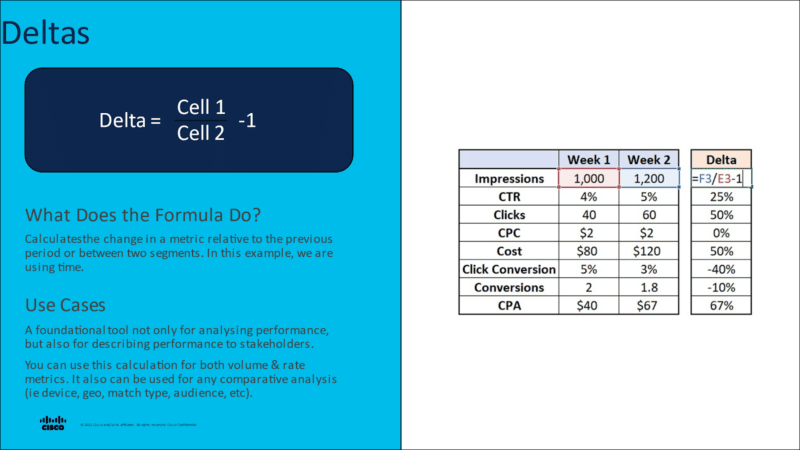
Simply put, a delta is a rate of change. For performance marketers, that is half the battle associated with our jobs. We need to have an acute understanding of the changes we see to develop effective optimizations.
Notice how large the Click Conversion Delta is in the example calculation above. Nominally, a drop from 5% to 3% could be overlooked. However, using the delta calculation, it becomes clear that click conversion needs to improve, to enhance the campaign CPA.
Incremental impact
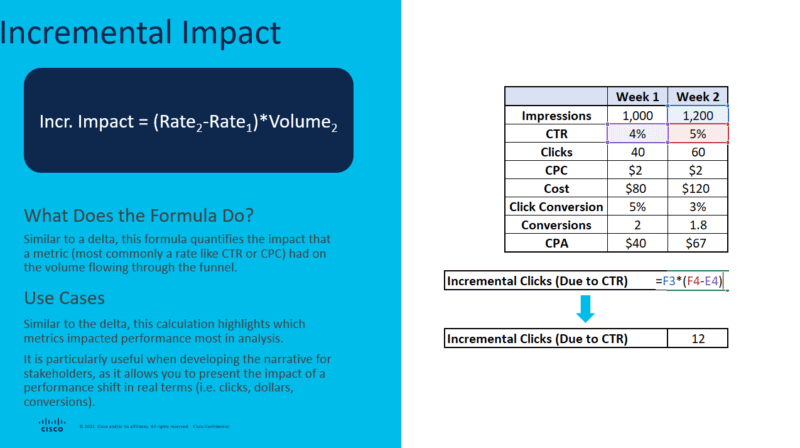
The insights received from the incremental impact calculation will align with the insights from the performance deltas – big deltas will have big incremental impacts. Don’t expect to get any new insights when using these formulas in conjunction.
This formula is handy when developing a performance narrative. It helps answer the “so what” question that all stakeholders understand. Incorporate callouts such as “an X% drop in CTR results in Y fewer clicks” or “an X% increase in CPCs drove $Y more spend” to add more color to the narrative.
One important caveat is that this formula assumes that all else is constant. As marketers, we know that these metrics are all interconnected.
If impressions increase by 50%, CTR will likely decrease. Use deltas first to understand performance changes comprehensively, and only leverage this calculation when it makes logical sense.
Concatenate
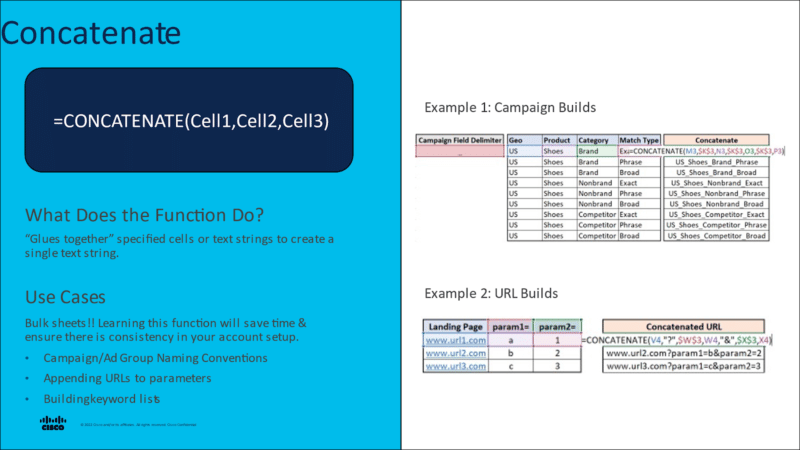
In terms of impact on day-to-day tasks, if CONCATENATE is not a part of your process when creating bulk sheets, this likely will be the most impactful takeaway from this article. This function allows users to combine the contents of multiple cells together in a single text string. Think of it like a glue that can be used to connect cells.
The applications of this function are far-reaching. One important note – the function is not limited to cells. Text/characters can be incorporated as fields within the formula using quotation marks around the text. Example 2 illustrates the incorporation of text into a CONCATENATE formula.
Excel 201: Preparing datasets for analysis
Pivot tables are a PPC marketer’s best friend. However, to best leverage pivot tables, you must invest time to ensure the integrity and granularity of the dataset.
The following functions/formulas included here are most impactful when preparing a dataset for analysis, but the applications are far-reaching.
VLOOKUP
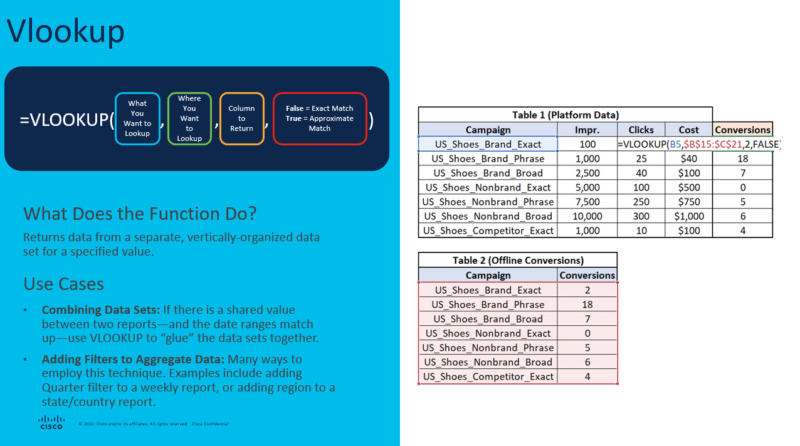
Some may argue that this is the most useful function for search marketers, and I would not put up a huge fight. VLOOKUP is a critical function for search marketers to master, as it’s common that datasets need to be augmented or modified with data from other platforms.
If “source of truth” reporting sits outside of the PPC platforms, you are likely familiar with the challenges of combining datasets. In addition, VLOOKUP is an easy way to add macro-level filters to a granular dataset.
A best practice I recommend is pulling data at the most granular level possible and using VLOOKUP to add filters easily. Start your analysis at higher levels and drill down to the biggest drivers of a change.
For example, if stakeholders ask for a breakdown of geographic performance, pull at the city level, build a table associating the cities to states and regions, and add two columns for State and Region to the dataset using VLOOKUP.
Transform date to week
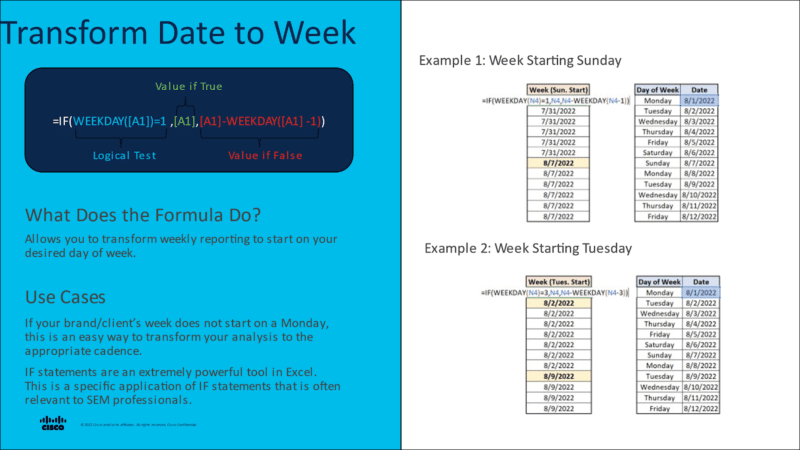
This IF statement is particularly helpful for PPC because weekly reporting options can be limited when pulling reports directly from the platform.
For brands or clients that do not have a traditional Monday to Sunday schedule, pull data at the day/date level. Then add a column to the dataset for Week using this formula.
Note that standard settings in Excel indicate 1=Sunday, 7=Saturday. In Example 2, I have used Tuesday as the start of the week.
Note that the day of week indicator needs to be updated in both the IF statement logic, as well as the returned value if false.
Excel 301: Tools for large-scale datasets
Categorization based on text
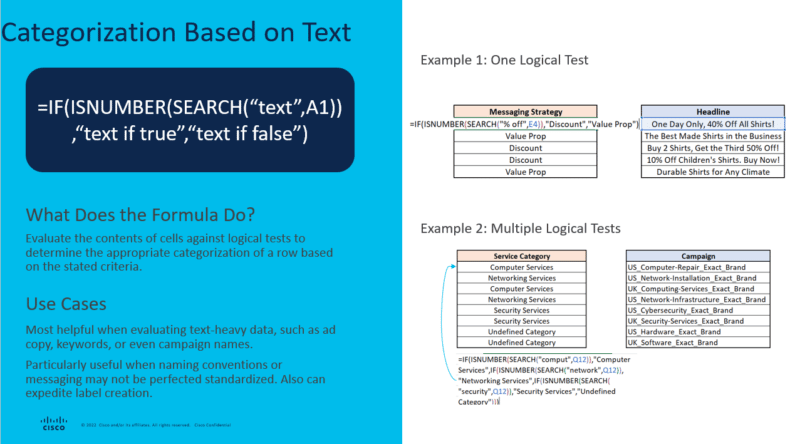
While it might be complex at first glance, this formula is very practical for search marketers. It allows users to search a cell of text for a particular word or phrase.
If the cell meets the criteria, the formula will return text inputted in the ‘text if true’ field. Based on the previous formula we covered, I bet you can guess what happens if it does not match.
The formula has many applications within search marketing. However, categorization is rarely binary – meaning you are not categorizing entities into one of 2 options.
Example 2 shows how multiple logical tests can be stacked on each other. This is referred to as a nested IF statement. To create a nested IF statement, you repeat the IF statement logic in the ‘text if false’ field with different search criteria.
Essentially, this tells Excel to search for the first phrase/text. If it does not find it, search for the second phrase/text. Using nested IF statements, advertisers can quickly categorize data at scale.
Joining complex datasets
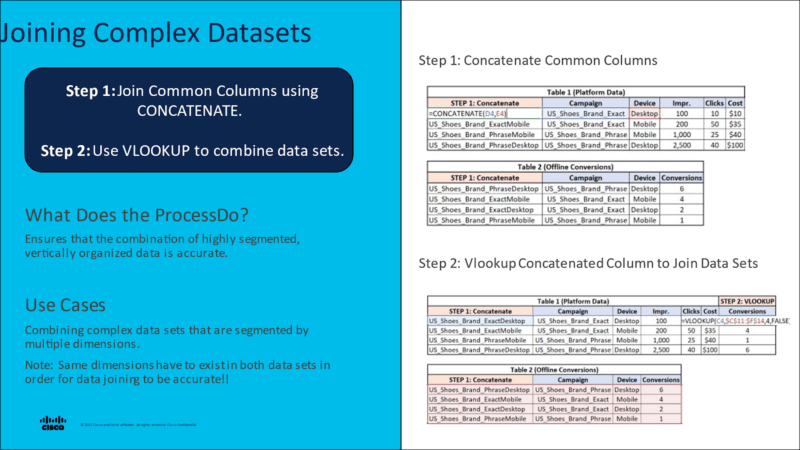
Finally, I want to highlight how the techniques described previously can be leveraged collectively to enhance the quality of analysis.
If you’re following the best practice of pulling platform data at the most granular levels, it’s common for data to contain multiple segmentations (a.k.a., attribute columns in the dataset).
When combining data between two platforms, the datasets must have the same level of granularity. Otherwise, data that you pull into your original dataset will be inaccurate.
To join complex datasets, use CONCATENATE to create an additional column that joins together all segmentations in the original dataset. This should be replicated in the second dataset, using the same order in the concatenation. See Step 1 for an example.
The newly formed column now serves as the connector between the two datasets. Using the VLOOKUP function, search for this newly created column in the second dataset and designate which column of data you’d like to append to dataset #1. Double check the VLOOKUP worked correctly by comparing the sum of the newly imported data to the original table it was imported from.
Happy number crunching!
There’s a lot of information to digest here. Yet, we’ve only scratched the tip of the iceberg here.
Don’t give up if you’re struggling with Excel. It takes time to learn the functions and their capabilities. Search for some videos that walk you through live examples – those were particularly effective for me.
The post 7 useful Excel formulas and functions for PPC appeared first on Search Engine Land.
Courtesy of Search Engine Land: News & Info About SEO, PPC, SEM, Search Engines & Search Marketing
Category seo news | Tags:
Social Networks : Technorati, Stumble it!, Digg, de.licio.us, Yahoo, reddit, Blogmarks, Google, Magnolia.
White label link-building services: How to do it right
Written on August 24, 2022 at 12:31 pm, by admin

If you’re a marketing or digital agency, you’ll know that link building is the most important part of search engine optimization (SEO), but it’s also extremely time-consuming. That’s where white label link building comes in.
You’ll also know just how time-consuming and resource-intensive it is.
Just building a single half-decent link can take hours of phone calls, planning, writing and follow-ups.
Unfortunately, your client probably hasn’t asked for just one link. They need tens or even hundreds.
If this happens and you don’t have a dedicated in-house team, link building can quickly start to drain your resources.
White label link-building services are a great way to overcome this.
At LinkBuilder.io, we’ve developed a process to help some of the world’s best SEO agencies deliver powerful links to their clients to ultimately accelerate their results.

You’ll place high-quality links quicker, and you’ll be able to spend more time keeping your clients happy.
| Key takeaways White label link building services help agencies to build high-quality links without a dedicated in-house team.Outsourcing link building puts it in the hands of specialists and allows agencies to provide clients with more and better quality links.Agencies should be wary when seeking a white label link builder. There are lots of link-building scams looking to make a quick buck off of inexperienced people.White label link building services use HARO, guest blogs, PR links and linkable assets to place high-quality links. |
What is white label link building?
White label link building refers to the practice where a digital marketing agency subcontracts out link building to a specialist agency.
The customer agency presents the links to their client as if they had built them.
White label link building is a common practice because link building forms an essential part of most SEO campaigns. However, it requires specialized skills that many digital marketing or SEO agencies don’t have.
You should consider using white label link building services if:
 Your agency has been asked to build quality links by a client, but you don’t have the in-house skills to do so.
You have an in-house link-building team but it cannot satisfy the high demand.
You want a low-risk way to test offering link-building services.
You want to offer link building but can’t afford to employ people to do so.
Why use a white label link-building service?
At LinkBuilder.io, we work with some of the world’s leading SEO and content marketing companies to provide incredible backlinks for their clients.

Some benefits of working with a white label link-building service include:
 Access to highly-experienced professionals
Specialist agencies are staffed by people who have been building links every day for years. They instinctively know how to place great links and they can do it fast.
 Less investment required
It takes many years to nurture an effective link-building team. Learning to do it yourself or teaching others takes a lot of time and hiring an in-house link-building team is expensive. Using a white label service takes away these issues.
 Ready-made infrastructure
Link building involves contacting other quality websites, finding the right person to speak to, negotiating prices, and pitching ideas. This is hard work that takes time. Specialist link-building companies are already set up to do these things. For example, they have relationships in place with major websites. And if they don’t, they have people dedicated to forming those relationships quickly and successfully.
 There when you need it.
Employing in-house link-building specialists isn’t worth it unless you have a constant stream of work to keep them busy. Using white label link-building experts allows you to access experts as and when you need them.
 High-quality backlinks.
Good link-building agencies get business based on their reputation. Because of this, they only use techniques that adhere to Google’s guidelines. They strive to generate high-quality backlinks that will improve your rankings and last a long time.
 You focus on what you do best.
Paying someone else to do link building for you gives you more time to focus on your core role. You’ll have more time to keep clients happy.
 Scalable
White label link building allows you to take on as many new link-building projects as you like. It also makes it easier to deal with surprise requests from clients.
 Full-service
Subcontracting specialisms like link building allows you to provide clients with a broader range of services, making you more valuable to them.
Agency or freelancer?
Link building agencies aren’t the only option for providing a white label service. You could also hire a freelancer.
Hiring a freelancer has both advantages and disadvantages compared to working with an agency.
Here are the pros and cons of using a freelance link builder:
Pros:
Cheaper.
More flexible.
Cons:
 Hard to gauge quality.
Limited expertise and resources.
A good freelancer can guide you through the link-building process in the same way that an agency would.
If you want to assess freelance link builders, websites like Fiverr and Upwork are great places to start.
How to choose a white label link-building agency
Here are three steps for finding a good quality white label link-building service.
- Understand link building.
A good link-building agency will do everything for you. But it’s still important to understand the basic ideas and processes behind link building.
This way, you can communicate better with the agency and your client. You’ll also be able to tell if you are getting value for money.
You should understand how the following terms are relevant to link building:
Domain Authority.
Organic traffic.
Site relevance.
Search intent.
Nofollow/dofollow.
Quality/poor quality links.
- Check that your client is ready.
Before you contact a link-building agency, you need to be clear about what you and your client want to achieve. You need to have a clear SEO strategy and know how your link-building efforts will contribute to it.
It’s also useful to understand why your client’s site isn’t ranking higher. Reasons for this could include:
- Their content is good but needs to attract more links.
- Their competitors have higher Domain Authority and they need an alternative way to rank.
- The pages that rank above them have more links.
If most of your client’s content ranks outside the top 100 pages on search engines, this is a sign that it is too early for link building.
There are two things you could do to help them in this situation.
 Improve their existing content: Do this by seeing what content currently ranks for the keywords they want to target. Try to work out why Google likes this content and then work out how your own website can improve on this.
 Find better search terms through keyword research: Use an SEO tool and do keyword research to find high-traffic, low-competition search terms. Produce content that targets these keywords. It takes around six months for content to rank properly on search engines, so it’s important that your clients don’t expect instant results.
- Find a good link-building agency.
Next, we’re going to look at some of the key criteria for finding a good link-building agency.
Case studies
Does the agency have a proven track record of placing high-quality links?
At LinkBuilder.io, we showcase some incredible link-building case studies and have a Clutch profile with verifiable reviews from clients.
It’s important to select a company not just based on cost, but someone who can deliver exceedingly high-quality links that you’re proud to show off to your clients.

It’s imperative to ensure that your partner has a tried & tested link-building process when it comes to delivering links for your clients.
Real-time reporting
If you’re trusting another agency to produce work for your clients, then you need a way of checking in on them. The best white label link-building agencies provide reporting systems that demonstrate the value of links built so far and provide progress updates.
End-to-end service
A good white label link building service should be able to take all aspects of link building off your hands—from strategy and research to placing links and reporting their value.
Good links pointing to their own website
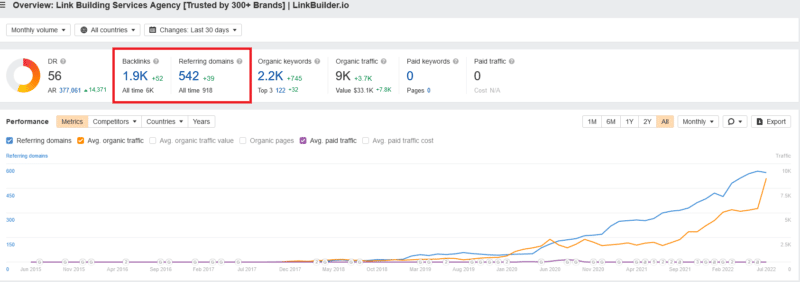
Link-building agencies should practice what they preach. They should have many quality niche-relevant links pointing to their domain. You can check this by using an SEO tool like Ahrefs and looking at the number of referring domains they have.
Realistic guarantees
A good white label link-building agency can rely on its process to build links. They should guarantee a minimum number of quality backlinks per month. But be wary of agencies that promise to place links on certain websites or whose guarantees seem too good to be true.
Demonstrates best practices
Take a look at the agency’s blog and check that they are writing about the latest link building tactics and best practices.
Realistic prices
Link building services are expensive. If a link builder’s prices seem too good to be true then they probably are. A reasonable cost per link is between $300 and $500.
Beware of scams

Link building services are one of the most effective ways of improving a website’s search rankings.
Because of this, there are lots of link-building scams looking to make a quick buck off of inexperienced people.
Here are some common tactics from low-quality link builders:
Public Blog Networks (PBNs): These are networks of websites used to generate a large number of links to sites.
Link farms: These are websites that exist only to host links that people pay for. They are usually low-quality and full of irrelevant content.
Directory, comment or forum links: These kinds of links usually have no impact on your client’s rankings. They won’t harm it, but they’re certainly not worth paying for.
Fake guest post services: These services build links by placing guest posts on PBNs and link farms.
Conclusion
White label link building is a great way for agencies to outsource this key SEO component without having to manage it all in-house.
It can make your agency’s workload more manageable and allows you to focus on keeping clients happy.
The post White label link-building services: How to do it right appeared first on Search Engine Land.
Courtesy of Search Engine Land: News & Info About SEO, PPC, SEM, Search Engines & Search Marketing
Category seo news | Tags:
Social Networks : Technorati, Stumble it!, Digg, de.licio.us, Yahoo, reddit, Blogmarks, Google, Magnolia.
How to manage SEO campaigns during economic downturns
Written on August 24, 2022 at 12:31 pm, by admin
Economic downturns create uncertainty and changes in user behavior that impact markets and forecasts. They also affect the approach and resources allocated to marketing activities.
Because no two recessions are the same, marketers operate in uncharted waters every time it happens.
This article can help marketers manage SEO campaigns and show the value of their efforts despite a recession.
Doing business during a recession
Consumers will naturally reduce their spending during economic downtimes and establish more stringent priorities.
When sales decline, businesses begin to reduce expenses, lower prices and delay making new investments. Unfortunately, marketing expenditures are often the first to get cut. This approach to cost reduction is ineffective and should be avoided.
Clients often judge SEO and paid search as independent channels. SEO can be seen as “OK to turn off for a bit,” while a brand rests on its laurels on the assumption that the current performance won’t worsen during the downturn.
But SEO isn’t the only channel that may see issues here. In 2009, the entire U.S. ad market saw a decline of 13%. This was predominantly driven by radio and magazines, which saw declines of 22% and 18%, while “online” only declined by 2%.
The argument for not reducing spending
It might be a good idea to keep costs down when entering a recession. But if you fail to support brands or examine how your core customers’ needs evolve, you will likely jeopardize your medium to longer-term performance.
Organizations and trade bodies such as the Institute of Practitioners in Advertising (IPA) refer to this as losing the “share of mind.” In the United Kingdom, the IPA has publicly advertised warning brands not to reduce marketing spend in the months ahead.
Reading through research papers and thought leadership content from the International Journal of Business and Social Science, Harvard Business Review, and specialists from the Economist and Financial Times, five key marketing objectives for a recession begin to emerge.
These themes are:
- Smarter spending and investment.
- Retention of the existing customer base should be prioritized.
- Leverage your competitor’s weaknesses.
- Monitor the market and adjust spend targeting segments based on their behaviors.
- Maintain your current spending at a minimum, just spend smarter.
How to keep your SEO efforts going during a downturn
The general message is “do not reduce spending.” That’s great.
But when defending our retainer or contract renewal, businesses want to know how their SEO spend will tangibly impact the bottom line.
To address this, we can look to the 2008 recession and the recent pandemic – when other businesses pivoted and changed messaging across their digital marketing.
Let’s apply the learnings to help our clients or employers power through an economic downturn without pausing their SEO efforts.
Review your TAM and messaging
A total addressable market, or TAM, can be defined in several ways.
The most common is to define it as the total number of people who could possibly use a product or service. For example, the TAM for a new smartphone might be the total number of people who own a cell phone.
Despite its limitations, TAM can be a helpful metric for investors to assess a company’s growth potential. Companies with large TAMs can be desirable to investors because they have the potential to generate a lot of revenue.
During a recession, businesses (in B2B) and consumers will react differently depending on their economic stability.
Depending on your TAM, you may need to pivot your messaging and value propositions. This then ties into your SEO strategy. Align activities to these messaging goals, depending on whether your product is deemed essential, luxury, postponable or expendable.
Essential products are often price-sensitive during a downturn. You may want to highlight the value proposition further for less economically stable consumers.
For those in your TAM who are better off, you should continue awareness campaigns (i.e., top and middle of the funnel activities).
By comparison, luxury products can be communicated as being precisely that – a luxury/treat to be consumed as a reward for austerity in other areas. They can also induce dopamine reactions and raise morale.
The other two categories, postponables and expendables are the most difficult to pivot for.
An example of a postponable is a TV streaming service or magazine subscription. Users ahead of postponing may research cheaper alternatives to avoid missing out. During this research phase, you must be visible and fight to retain your existing users.
For other goods that can be postponed (such as servicing a vehicle, replacing a tire, or updating home security systems), messaging should focus on the long-term financial and opportunity costs of not performing these actions now and providing support messaging.
Expendable products and services will likely impact local SEO more than other sectors. Rather than hire a gardener or decorator, consumers will choose to perform the maintenance and upgrades themselves.
This is both an opportunity and a threat to sell to consumers by enabling them or working to remain visible as a company and build trust.
Smarter opportunity analysis and competitor targeting
Most businesses are focused on maintaining and retaining market position during a recession. It’s an excellent time to identify consumers they currently hold and work to leverage them toward your products and services.
Competitive targeting should be a staple of an SEO campaign anyway.
But during a downturn, when sensitivity to price and value is heightened, your messaging and content can focus on pain points that consumers may have with competitor products and services.
Turn these into a competitive advantage to create a conversation with new prospects. You can produce competitor comparison content and highlight the competitor’s weak spots as non-issues or strengths with your product.
For example, if you’re providing a rotating proxy service and you know that your competitor, Bob’s Proxies has issues with uptime, then make sure your content highlights that your service has no such problems.
Positioning for post-recession
SEO is a long-term strategy, but you must focus on the longer-term and the short-term during an economic downturn.
Typically, consumer trust and spending recover within one to two years of a recession. When consumers return to post-downturn spending levels (or establish new market norms), you want to ensure you’re prominent and visible in the vertical.
You can do so by maintaining a certain level of activity toward establishing and maintaining top-of-vertical awareness and remaining competitive for bottom-of-funnel, conversion-focused queries.
Conclusion
During a recession, marketing may seem like more of a challenge than usual. Customers’ spending habits often change, and you may have to go against your instincts.
It’s essential to optimize your budget and be strategic about your priorities. You can continue marketing your products or services while providing for your customers’ needs. A recession can be an opportunity to build customer loyalty.
During a downturn, SEO can alleviate direct cost channels (such as paid) and offer long-term benefits and short-term stability.
Google and the other search engines will continuously update during this period. Competitors who remain stagnant and withdraw resources will suffer in the medium to long-term, costing more in the future to regain lost performance and the opportunity cost of lost visibility.
The post How to manage SEO campaigns during economic downturns appeared first on Search Engine Land.
Courtesy of Search Engine Land: News & Info About SEO, PPC, SEM, Search Engines & Search Marketing
Category seo news | Tags:
Social Networks : Technorati, Stumble it!, Digg, de.licio.us, Yahoo, reddit, Blogmarks, Google, Magnolia.
Google Performance Max self-upgrade tool for Local campaigns is now available
Written on August 23, 2022 at 9:28 am, by admin
Google has just announced the Performance Max self-upgrade tool for Smart Shopping and Local campaigns.
How to self-upgrade. You can self-upgrade your Smart Shopping and Local campaigns by navigating to the notification in your ads dashboard, the Recommendations page, or the Campaign page.
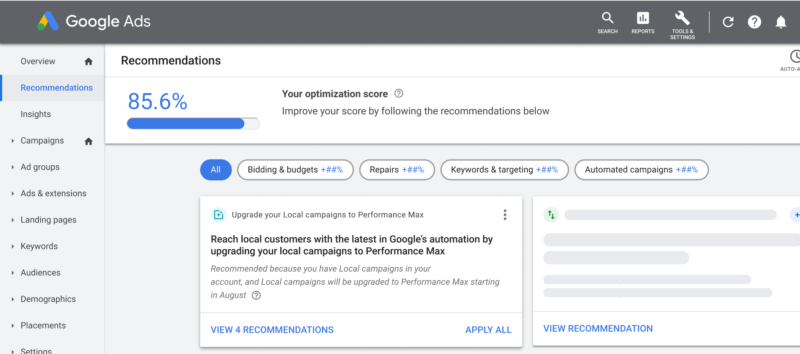
Preserving historical data. When your campaigns are self-upgraded, all historical campaign performance from your previous campaigns will carry over, eliminating the need to go back into the dreaded learning phase. Campaign settings such as budget, creatives, goals, and bid strategy will also carry over.
Automatic upgrades are coming. The self-upgrade tool is available to all eligible advertisers and will continue to roll out throughout the remainder of August and into September. Google recommends using the self-upgrade tool to upgrade your campaigns as soon as possible, “ahead of the holiday season.”
If your campaigns are not eligible for self-upgrade and you are not notified about an automatic update, your Local campaigns will not be upgraded to Performance Max until 2023. If you have access to the self-upgrade tool and do not upgrade your campaigns by the end of September, you’ll continue to have access to the self-upgrade tool until auto-upgrades kick in in 2023.
What happens to the old campaigns. After you upgrade to Performance Max, your previous Local campaigns will be set to “Removed” status. You won’t be able to edit or reactivate these campaigns or create new Local campaigns once your campaigns begin to auto-upgrade. Historical data will continue to be available from the Campaigns page or Overview page in Google Ads.
Best practices. Google lays out five best practices to ensure advertisers are getting the most out of their Performance Max campaigns.
- Use the Performance Planner to plan holiday budgets and assets and assess how budget changes can impact performance.
- Start your holiday campaigns 2-3 weeks in advance, then refresh creative to focus more on specific goals versus generic store ads.
- Set a value for each conversion action. For example, a ‘phone call’ click is worth $3, a ‘form fill’ is worth $5, and a ‘store visit’ could be worth $10.
- Set one call-to-action per asset group. (While Local campaigns support multiple custom call-to-actions per ad group, Performance Max campaigns support one predefined call-to-action per asset group. During the upgrade, up to five customer call-to-actions will be upgraded and supported as read-only in Performance Max.)
- Turn off ad scheduling and/or geo-targeting
Read the Google Ads Help doc. You can learn more about auto and self-updates and read the full help doc here.
Why we care. Automatic updates aren’t fun for anyone. If you’re running a Smart Shopping or Local campaign and you’re eligible to migrate to Performance Max, you should do so as soon as possible. Waiting until the holiday season could leave you in a bad spot if they stop performing. It’s much better to update the campaigns on your own terms so you have time to make adjustments if you need to.
The post Google Performance Max self-upgrade tool for Local campaigns is now available appeared first on Search Engine Land.
Courtesy of Search Engine Land: News & Info About SEO, PPC, SEM, Search Engines & Search Marketing
Category seo news | Tags:
Social Networks : Technorati, Stumble it!, Digg, de.licio.us, Yahoo, reddit, Blogmarks, Google, Magnolia.