

Google Search Console adds Shopping tab listings feature
Written on November 16, 2022 at 9:19 am, by admin
Google is rolling out a new Shopping tab within Google Search Console that contains more information about your product snippets, merchant listings and shopping tab listings in Google Search.
What is new. Google announced “eligible online store owners that have implemented product markup will see a new section called Shopping tab listings.” This is rolling out “gradually over the next few weeks,” Google said, “so you might not see any changes for now.”
What it looks like. Here is a screenshot of this screen:
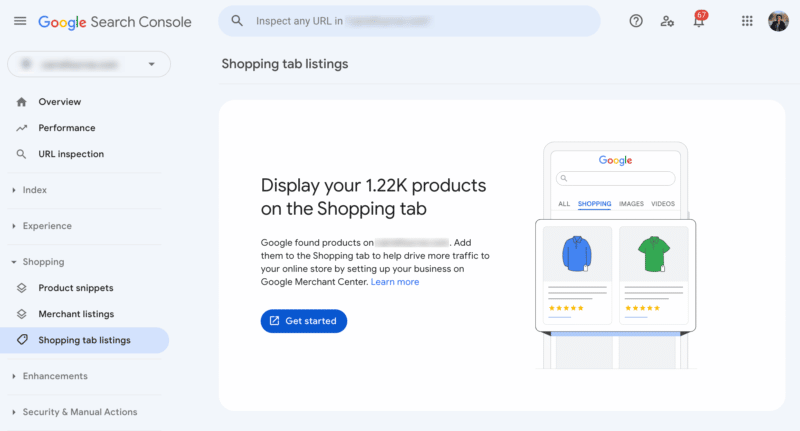
How to access it. If you are an eligible merchant, you can access this feature at google.com/search-console/shopping-tab-listings.
More information. Google wrote “From there, merchants will be able to easily create a Merchant Center account using a simplified assisted sign-up process without the need to re-verify website ownership. With this new option, there is no need to submit a product feed; merchants only need to keep product structured data up-to-date. This streamlined experience will get products quickly on the Shopping tab on Google and help merchants reach people looking for products.”
Why we care. More information from Google on how well you are performing in Google Search, especially as we approach the holiday shopping season, is super useful. So dig in and see how your products are performing in Google Search and see where you can optimize as the holiday shopping season kicks into gear.
The post Google Search Console adds Shopping tab listings feature appeared first on Search Engine Land.
Courtesy of Search Engine Land: News & Info About SEO, PPC, SEM, Search Engines & Search Marketing
Category seo news | Tags:
Social Networks : Technorati, Stumble it!, Digg, de.licio.us, Yahoo, reddit, Blogmarks, Google, Magnolia.
Enterprise SEO is 50% education and culture
Written on November 16, 2022 at 9:19 am, by admin
Pop quiz: What’s the definition of “SEO culture” at an enterprise company?
Sorry, your answer of “Another meeting, email, or team bonding event that I have to fake smile through that has no hope of success” is incorrect.
I’m looking for “That warm cozy feeling you get when laundry first comes out of the dryer that makes you feel safe, comfortable, and trusting.”
It’s OK, I’m here to educate you.
Look, SEO at an enterprise company is fun.
Except for the part where you have to learn a dozen different brands and educate yourself on internal lingo terms like “BU” and “QBR.” And that doesn’t even include the fact that you have more than one (sometimes 10 or 20) different business leads you to have to sell and win over with your SEO strategy.
The fact stands: If you want to gain the respect and trust of your peers for your SEO strategy at an enterprise company, you have to dedicate 50% of your time to education and culture.
If you’re thinking “why,” then you’re doing it wrong.
Too often, the idea of “SEO culture” is to over-promise and under-deliver, which is why I’ve done the heavy lifting for you.
After 12 years of working on SEO at enterprise companies, I’m pulling together some golden nuggets of knowledge I’ve learned to help build “SEO culture.” Ahead are a few of my favorites.
‘Office hours’ for enterprise SEO professionals is more than a meeting – it’s a culture shift
The idea of “office hours” started to trend in the tech world when Jason Fried, CEO of 37Signals, announced he was hosting CEO office hours in 2009.
Reread that sentence again – 2009, people.
It’s safe to say that “office hours” needs a makeover.
Let me be clear: I don’t mean this level of a makeover.
in office hours yesterday i said “i feel completely fucked, i’m so behind” and then my prof hit his vape and blew the smoke into the screen on zoom and told me to take my “stimulant of choice (legal or not) to catch up on missing work”
— grace (@chamberofgrace) November 3, 2022
Within my first 3 months at an enterprise company, I make an effort to create SEO office hours.
Why?
It is all about setting the initiative that SEO is a part of a wider movement – promoting it across the company and different marketing channels.
Even Google’s John Mueller hosts SEO office hours.
If you have SEO / Search questions, please drop them into our new SEO office hours form at https://t.co/KeLoq7p10V — we'll be using this as a basis for the next office hours episodes. Thanks!
— John Mueller is mostly not here
(@JohnMu) October 31, 2022
The key to succeeding with your SEO office hours at a giant company with thousands of employees is having a thorough plan and schedule in advance.
While I set the schedule and agenda for the SEO office hours in month 3, I don’t kick them off until month 6.
I then host the event biweekly, leaving it open to people with questions. If no one has questions, I use the time as an educational opportunity to share a new update.
The biggest lesson I learned from actively listening and learning during these office hours is the importance of establishing trust. Think of your SEO office hours as an open door where people can share their gripes with the SEO team.
I heard about potential worries from the editorial team about SEO delaying work. I listened to complaints from the product marketing team that our keywords don’t align with the brand vision. I had to hear out what the web development team thought of some of the technical SEO recommendations.
At first, it may seem like you’re a punching bag. But the reality is, when you bring SEO into an enterprise company that’s been around for years, you’re bringing change.
People fear change.
Eventually, you’ll settle in. Conversations will flow. Laughs will be had.
You’ll learn stuff about your coworkers that you probably wish you hadn’t (like this person is dating this person). At this point, it would behoove you to grab a frosted donut and pour that bourbon you’ve been saving for a special moment into your lukewarm coffee.
Get the daily newsletter search marketers rely on.
<input type=”hidden” name=”utmMedium” value=”” />
<input type=”hidden” name=”utmCampaign” value=”” />
<input type=”hidden” name=”utmSource” value=”” />
<input type=”hidden” name=”utmContent” value=”” />
<input type=”hidden” name=”pageLink” value=”” />
<input type=”hidden” name=”ipAddress” value=”” />
Processing…Please wait.
Lunch-and-learns help build SEO into the company culture
First order of business: Let’s remove the “lunch” from lunch-and-learns.
No one wants to shovel 63 burritos into their mouth in less than 10 minutes like Joey Chestnut in a hot dog eating contest to pretend to participate.
The most important part of lunch-and-learns is the “learn” part.
Use this as an opportunity to walk through something related to your next quarter plan.
For example, if I’m managing 1,000+ domains and I want to start implementing best practices in Q1 for all domains, I would walk through schema markup best practices, which help set the stage for the next quarter.
It helps generate buy-in for your quarterly plan, and if there are any questions that push back, this opens the floor for a bigger conversation.
Creating a culture around enterprise SEO is more than just drinks on Friday
Defining how you create an SEO culture at an enterprise company is difficult.
As the SEO lead, director or VP, you set the tone. If you want to deliver solid SEO results, it requires a culture and mindset of trust in you and your SEO achievements.
When you can align your enterprise SEO strategy and your leadership, a strong SEO culture engraining within the company will drive positive outcomes for all teams.
The post Enterprise SEO is 50% education and culture appeared first on Search Engine Land.
Courtesy of Search Engine Land: News & Info About SEO, PPC, SEM, Search Engines & Search Marketing
Category seo news | Tags:
Social Networks : Technorati, Stumble it!, Digg, de.licio.us, Yahoo, reddit, Blogmarks, Google, Magnolia.
6 link-building myths and truths by Internet Marketing Ninjas
Written on November 16, 2022 at 9:19 am, by admin

Link building is one of the most misunderstood aspects of an effective digital marketing strategy. Being difficult to properly scale, some avoid it altogether while others outsource the work and hope for the best. Getting it right either internally or with a link-building partner can catapult your SEO performance. Still, in doing so, you must avoid these common link-building myths and mistakes to succeed in the long term.
Myth 1: Links must meet a minimum DA or other score in order to pass value.
A common mistake webmasters make is relying on third-party metrics like Domain Authority, Domain Rating, or Citation Flow when deciding on link opportunities.
It’s important to understand what these numbers represent – and what they don’t.
As an example, Domain Authority is Moz’s best guess at a website’s ability to rank itself and has no bearing on a website’s ability to pass link equity to other sites.
Domain scores from various data providers often vary from one to the next, so who should you rely on? We’d argue none of them.
These solutions have a fraction of the crawl Google has. Their datasets and algorithms all differ from one another, and there’s a lot they miss when determining a site’s score.
Obviously, Google does not use any of these scores when deciding how to rank websites or treat links from them.
A link from a low-scoring domain like a town library or relevant resource site can not only pass link equity. It can drive direct traffic as well.
Rather than tossing link opportunities due to low DA, use common sense. Would the site link to you in a natural way because your content compliments theirs? Is the site authentic, meaning without SEO or commercial intent? If so, it’s likely an opportunity you shouldn’t pass up – even with a low score.
Myth 2: Links must be from relevant websites or they won’t count.
In an ideal world, other websites within your vertical would link to you – it’s a natural fit. For many of you, these are often your competitors and unlikely links to achieve.
Stretching the relevancy gap when looking for link opportunities is often needed in competitive verticals in order to achieve high-quality links on a consistent basis.
When considering websites to earn links from, think outside your core business and look for opportunities a step or two away.
In doing so, the quantity and quality of link prospects can increase tenfold and help you discover link-earning opportunities you would have otherwise missed.
Pretend you sell life insurance. Rather than trying to solely get links from other life insurance websites, you could search for websites in supplementary niches like healthy living and family planning, which are generally more resource-heavy.
This will also allow you to find powerful domains to source links from (ones with a lot of high-quality backlinks pointing to them), therefore passing more link equity to you.
To accomplish this, you’ll need to develop a robust linkable content plan focused on these audiences, giving them something worthy of linking to—more on this in the above-linked video.
Myth 3: Relying on guest blogging or link networks is worth the effort.
Google has been clear on this for many years – guest blogging and link buying as link-building tactics violate their webmaster guidelines.
You can find their messaging regarding this here and here; they also rolled out a link spam update last year detailed here. Some more guidance on this from Search Engine Roundtable is here and here.
TLDR: If you are currently obtaining these types of links, especially in large numbers or as a large percentage of your backlink profile, it’s time to stop.
It’s understandable why many folks lean into these tactics. They’re cost-effective and easy to scale. They can even provide a short-term boost, but it’s only a matter of time before Google discounts them, and you’re back to square one.
The good news is Google’s default for the past couple of years has just been to ignore these types of links in your backlink profile rather than penalize you for them. However, penalties are still imposed in certain cases, so why take the risk when there are alternative options?
At best, you’ve wasted time, dollars, and other resources obtaining them. At worst, they can cause a link penalty if they remain a cornerstone of your link-building efforts.
Myth 4: Internal linking isn’t as important.
One area we find a lot of webmasters ignore is their internal linking optimization.
It can be difficult to manage and keep up with, especially for large e-commerce websites and other very large websites with pages that come and go on a regular basis.
The truth is internal linking optimization is one of the quickest ways to boost your SERP visibility, especially for mid & long-tail keyword phrases.
Internal linking gives you an opportunity to vary internal link anchor text to individual pages, boosting their rankings for a larger volume of keywords.
We optimize internal linking early on in most SEO campaigns, and it almost always produces a measurable lift in a site’s share of search – that is, the number of keywords ranking in Google, the average ranking of those phrases as a whole, and the total non-paid Google organic traffic coming to the site. And this often times happens within 30 days after optimization.
It also allows you to control where links appear throughout your website and provide a secondary navigation path for users and Googlebot.
Not sure where to start? We’ve put together an internal linking guide here, but one of the first things to do is link like-minded content and commercial pages together throughout your website, especially if any of those pages have backlinks to them. Not only will that help establish thematic authority, but it will also pass link equity through to the pages that matter most.
Myth 5: Link building alone will get the job done.
While links are often a necessity to rank in most competitive verticals, they’re not the only piece of the puzzle.
People often view links as the “magic answer” to help them rank better. And in some circumstances, it is links that they need most. But the ability for links to pass maximum value has a lot of assumptions associated with it.
While they can be the biggest needle mover, you won’t get their full benefit if your website is full of technical errors, has poor content, or has a poor user experience.
The latter is especially true once your site begins to rank on Page 1. If you provide a poor user-experience, you’ll unlikely remain there for long.
It’s also important to realize Page 1 of Google continues to move further away from the “10 blue links” of days past. If you’re not optimizing for a variety of search features – images, videos, People Also Ask, carousels, and so on then, you’re leaving a lot of traffic opportunities on the table.
Often, there are dozens of results to click on before reaching the #1 organic result, especially on mobile. And links alone won’t help you capture many of these placements.
While organic rankings remain a top priority, don’t ignore all of the other real estate opportunities on Page 1. You’ll need an optimized content, image, video and schema plan in place to maximize your SERP visibility.
Myth 6: Link building is dead!
We’ve heard this shouted time and time again over the years.
Just last week, John Mueller suggested that links may become less important as time goes on. It’s important to notice the language used: “I imagine,” “my guess,” “over time,” and so on.
In reality, Google has been saying this for nearly a decade. One of the things that historically sets Google apart from every other search engine is its link data and reliance on it to determine search engine rankings. That remains true to this day.
Yes, there are more ranking considerations now than 10 years ago. And as mentioned previously, Page 1 of Google looks much different now than it did then. These present additional optimization opportunities that links alone won’t help with, and in that sense, Mueller is correct.
It’s also likely Google wants to continuously discourage artificial link building through their communications just as they always have, so it’s not surprising to see this messaging as we close out the year.
Interestingly enough, we do find consistent quality link building to produce stronger results as time goes on, likely as Google continues to discount low-quality link-building tactics. The cream always rises to the top.
But ranking a website for high-value keywords in a competitive vertical without strategic linking will remain difficult for the foreseeable future.
Wrapping it up
Link building is an evolving but important ranking factor. If your business relies on SEO traffic, ongoing link earning should be a cornerstone of your digital marketing strategy.
The post 6 link-building myths and truths appeared first on Search Engine Land.
Courtesy of Search Engine Land: News & Info About SEO, PPC, SEM, Search Engines & Search Marketing
Category seo news | Tags:
Social Networks : Technorati, Stumble it!, Digg, de.licio.us, Yahoo, reddit, Blogmarks, Google, Magnolia.
How to reliably predict SEO success before publishing content
Written on November 15, 2022 at 5:18 am, by admin
Only the spammiest of spammy SEOs “guarantee” anything.
“Guaranteed” first position rankings, “guaranteed” traffic estimates, and “guaranteed” ROI only live in the deepest, darkest pits of spammy LinkedIn InMails. And only the unsuspecting, naive, plus frankly ignorant businesses fall for these flagrant falsehoods.
But…
That’s not to say you can’t forecast or predict page rankings, traffic estimates, or search ROI.
Nuance and context make all the difference.
You can – if you know what you’re doing – predict the odds of success or failure ahead of time. Even before publishing a single piece of content or building a single link for a keyword.
In this article, you’ll learn the framework I’ve used to help scale seven, eight, and nine-figure companies into 10-figure companies.
Why ranking takes forever
Ranking for something new can take a looooooooong time.
Anywhere from weeks to months for already-big sites, to years for smallish ones. And it’s why you can’t really “guarantee” much in SEO with a great degree of accuracy.
Here are a few common reasons why.
Catch-22
You need to be a big site to rank for good keywords.
But you need to rank for good keywords before you can build a big site. Therein lies your first dilemma.
Inputs vs. outputs
Rankings, traffic, and sales are lagging indicators.
This means we need to focus instead on leading indicators like keyword and topic selection before we’ll ever see the “outputs” possibly years later.
Balancing act
Selecting “good” keywords involves a balancing act of:
- Relevance.
- Demand.
- Competitiveness.
- Authority.
- Buying intent.
Yet, there’s no such thing as the perfect balance. And you often have to either prioritize or sacrifice different elements based on your short vs. long-term objectives.
Less ‘at bats’
Zero-click SERPs, knowledge graphs, instant answers, new advertising slots, People Also Ask questions, blended SERPs, and more mean that:
- You have fewer organic slots to possibly rank in.
- Those are being pushed well below the fold.
The bar keeps rising
Your direct and indirect competitors are getting smarter and spending more money. So it’s an arms race to the top.
All of these problems affect every single company, brand or person trying to rank anything today.
And all of these problems are only going to get worse over the next few weeks, months, and years.
Over a decade ago, ranking was easy. Then, Panda and Penguin and a slew of other algorithm updates changed everything.
So now, we all have to navigate an ever-growing complex world of whatever AI + search monopolies dream up next.
Get the daily newsletter search marketers rely on.
<input type=”hidden” name=”utmMedium” value=”” />
<input type=”hidden” name=”utmCampaign” value=”” />
<input type=”hidden” name=”utmSource” value=”” />
<input type=”hidden” name=”utmContent” value=”” />
<input type=”hidden” name=”pageLink” value=”” />
<input type=”hidden” name=”ipAddress” value=”” />
Processing…Please wait.
How to reliably predict success
The primary benefit of working with hundreds of companies over the past decade in a variety of spaces and niches is pattern recognition – which is the ability to reliably see what works and what doesn’t to consistently produce results across time or context.
(As opposed to what works one time, for one company, in one very specific context, because they were able to exploit some temporary arbitrage to their advantage.)
And it led to the Planning Predictor framework that we now use for our companies to help de-risk SEO and content planning so that we’re only focusing, right now, on what’s mostly reliably expected to produce results.
Here’s a high-level overview of the five decision-making criteria:
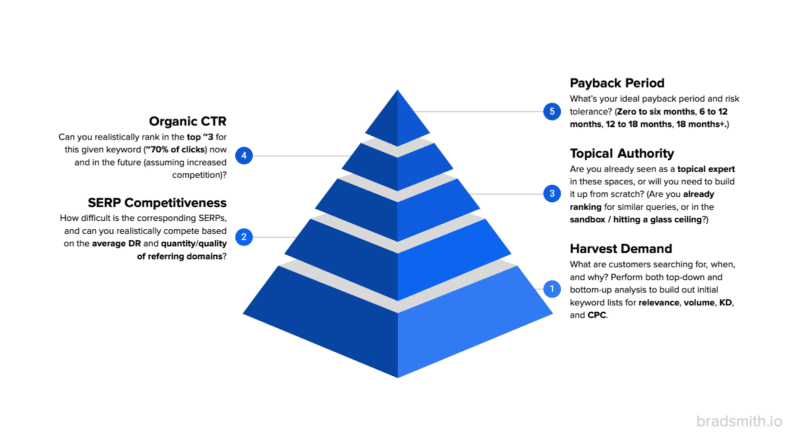
- Harvest demand: What are your customers searching for, when, and why? Perform both top-down and bottom-up analyses to build out initial keyword lists starting with relevance, volume, keyword difficulty (KD), and cost per click (CPC).
- SERP competitiveness: How difficult are the corresponding SERPs, and can you realistically compete based on the average domain rating (DR) and quantity/quality of referring domains – right now and in the years to come?
- Topical authority: Are you already seen as a topical expert in these spaces, or will you need to build it from scratch? (i.e., Are you already ranking for similar queries or hitting a glass ceiling?)
- Organic CTR: Can you realistically rank in the top ~3 for this given keyword now and in the future (assuming increased competition)?
- Payback period: What’s your ideal payback period and risk tolerance? (Zero to six months, 6-12 months, 12-18 months, 18+ months, etc.)
This might sound complicated at first. But it isn’t when you know how to analyze each one. So let’s get started.
1. Harvest demand
There’s a saying in the SEO world: “You can’t create search demand, you can only harvest it.”
In other words, the vast majority of mortals out there (read: 99% of the people reading this) aren’t going to be able to create a brand new category of searches from scratch. It’s too difficult and costly.
Instead, most of our job is to identify what’s already out there, what’s already being searched, and how it lines up with both:
- Our customers.
- Our widgets or products or services.
Think of the typical buyer’s journey or jobs-to-be-done process, where you analyze the decision-making process of customers when they:
- Develop need awareness for a problem in their life, to…
- Begin searching for potential solutions and their respective pros vs. cons, before…
- Deciding on purchasing the ideal solution (hopefully yours).
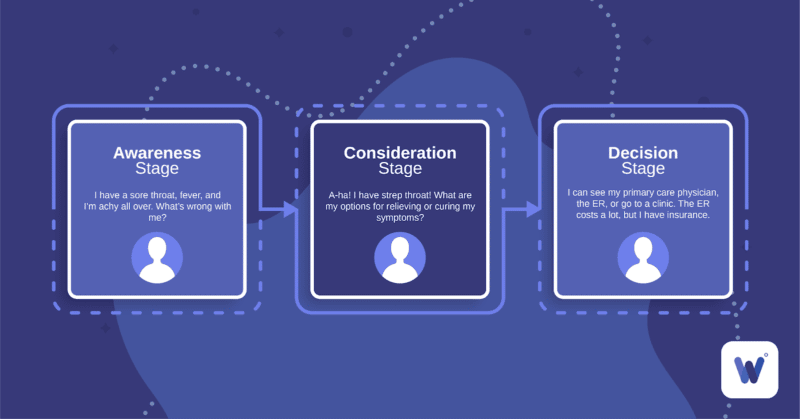
This top-down analysis leads to uncovering all the potential problems, pain points, alternatives, and solutions your customers might face.
Additionally, it should result in dozens to hundreds of potential keywords to target (or potentially thousands if you have multiple customer personas, segments, products, or services).
The next step is to break these down into varieties of variables, like:
- [Customer segment vertical] + [problem or pain point]
For example, [construction] + [project management]:
![[construction] + [project management] query on Ahrefs](http://www.atomiccdrom.com/blog/wp-content/plugins/wp-o-matic/cache/7fa3f_ahrefs-keywords-explorer-construction-and-project-management-800x590.png)
Then, you want to expand these initial keyword ideas for all the potential long-tail variations, weighing up the respective relevance, volume, KD, and CPC of each.
(Fun fact: CPC, while 100% focused on advertising, can help indicate keywords with higher potential buying intent.)
Another example for “best socks” then results in a giant list of related terms, that you can filter, to help cut through the signal-to-noise ratio for stuff you’re most likely to rank for right now (relative to your own site strength).
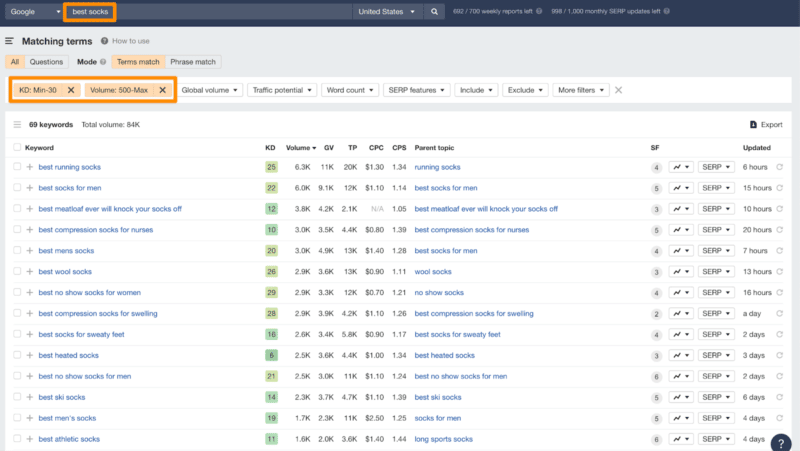
In truth, this is part art and part science. You’re looking to unearth gems. But it’ll take sorting through a lot of junk, first.
2. SERP competitiveness
Psssst. Come closer.
I have a dirty little secret to let you in on.
All SEO tools (even the best ones pictured here!) lie.
Not on purpose necessarily, but out of necessity. Because what they’re trying to do – imitate and classify what Google’s doing – is insanely difficult. Near impossible.
Case in point: the “keyword difficulty” metric.
It’s helpful to understand the perceived difficulty of potentially ranking for a keyword. Nice in theory.
However, in reality (where we all live), it’s badly skewed.
For example, a keyword can have a very low KD (like “6″ out of 100), and yet not be easy to rank for. That’s because it largely focuses on links as a proxy for strength (and page-level referring domains at that).
TL;DR?
The average/median page-level referring domains might indicate the keyword is “less competitive,” even though the domain-level strength (plus content quality) of the ranking sites are actually very competitive.
Like this example:
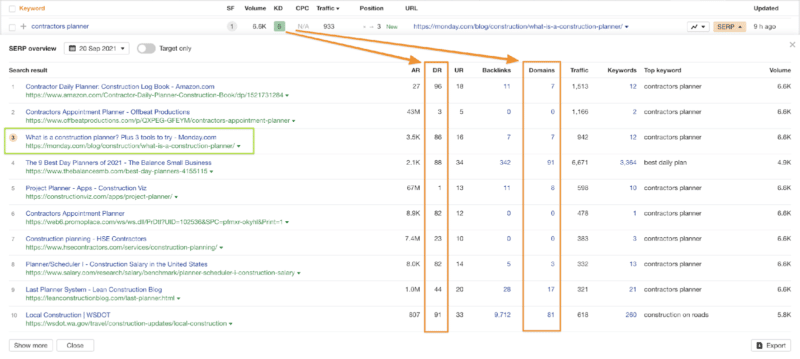
That’s troubling because it can (and often does) lead people to make bad choices about which keywords to target – when and why – and ultimately overestimate how quickly they’ll rank for it (i.e., not as soon as they think!).
As a general rule, if your own site-level strength is significantly below the ones already ranking for a given keyword (like the example below), then forget it.
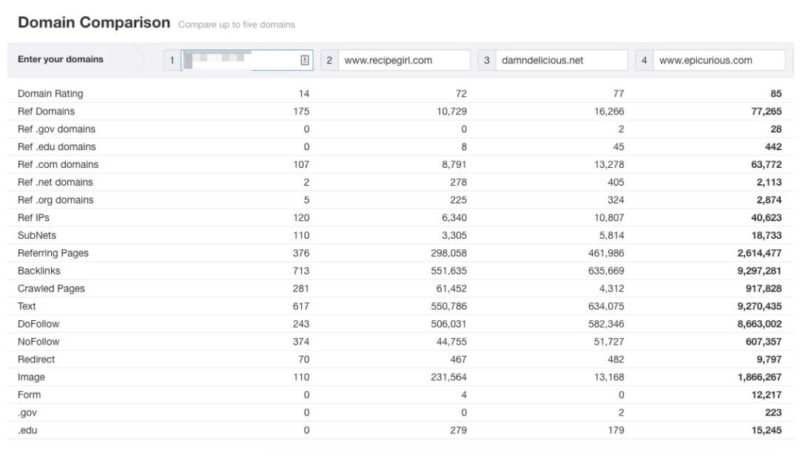
Or, at least, add another XX months (and more $$$) to your estimated time to rank.
This is a giant problem because position 5 might as well be position 50 today. I’ll explain why in the fourth section below on organic CTR.
But first, let’s look at personalizing your keyword difficulty based on whether you already have topical authority on these terms.
3. Topical authority
Contrary to popular belief, HubSpot didn’t invent “inbound marketing.”
Seth Godin did “permission marketing” about a decade earlier. And the Michelin Guide did a century before that.
What’s old is new again.
Take pillars or clusters or hub and spoke models or whatever your favorite marketing guru charlatan comes up with next. All are semantics for describing content hubs that have literally been used for decades.
(OGs like Ian Lurie have been going on and on and on about these since most of you marketers today were still in diapers.)
These pillars or clusters or what-have-yous relate back to site architecture and content hierarchies, creating dense webs of information to help increase your topical authority on certain subjects.
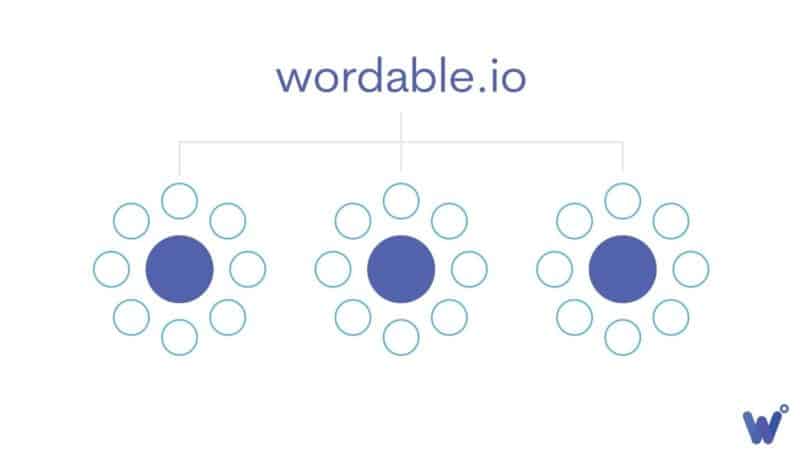
In practice, you should be purposefully planning new keywords and topics in clusters like this, in bulk – vs. a bunch of one-off grab bags – so you can organize it with internal links to develop these silos.
For instance, the monday.com blog organizes topics around specific customer industries. Then, they use a parent-and-child hierarchy to help reinforce topical authority. (Disclosure: My companies have worked with monday.com.)
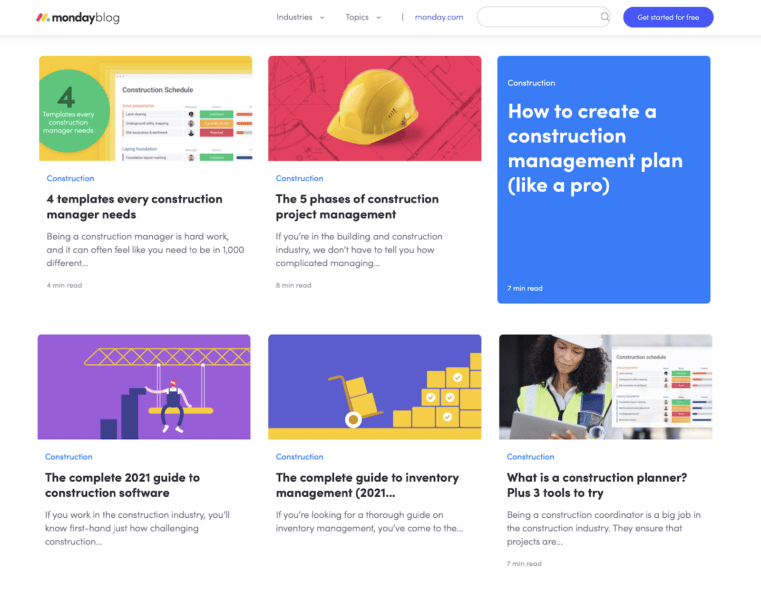

A rising tide lifts all boats.
Topical authority helps you rank higher and faster for related terms.
But the inverse is also true: little to no authority means it’s going to be more difficult (and costly and take longer) to rank vs. those that do already possess it.
So ask yourself:
- Are you already ranking for similar terms? If so, you probably already have some level of topical authority. The more stuff you have ranking higher in a single cluster, the more likely you’ll rank faster with brand-new stuff in this space, too.
- You can also use tools like the MarketMuse Inventory feature to analyze “personalized difficulty,” which helps predict your own personalized topical authority (and therefore the difficulty of ranking for it) vs. relying on vague, general aggregate scores a random SEO tool spits out.
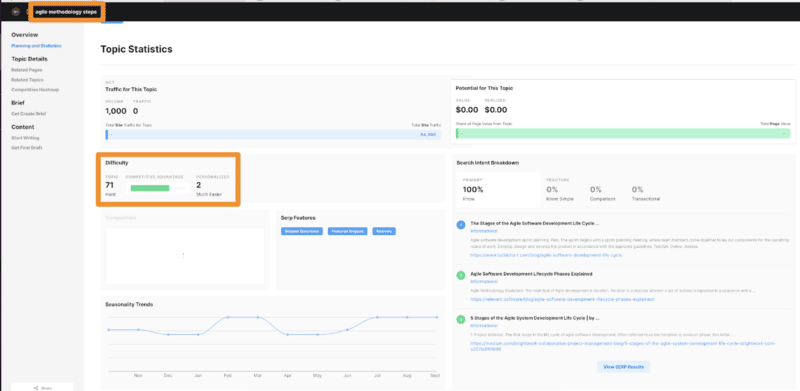
See?
Nuance and context are everything.
A good keyword for your competitor might not be good for you right now.
And what’s good for you right now, when starting out, might not be what’s good for you in two years’ time when you’re trying to make bank.
4. Organic CTR
Position 5 on a SERP might as well be position 50. Why?
Because you can virtually expect the same level of traffic (read: zero, zilch, zip!). Why?
Because based on SERP CTR studies (the number of people who click on different positions), the top three results routinely net around ~70% of the clicks, eyeballs, and therefore credit cards.
(You know, like that whole Pareto thing?!)
A quick glance through Advanced Web Ranking’s CTR studies will bear this out.
So, what does this mean?
It means:
- Ranking in the top 3 is all that matters at the end of the day.
- It’s often better to pick less popular and less competitive and more relevant keywords so that:
- You have a better shot at success (ranking top 3).
- You can rank more stuff, faster, and shrink the time to value (traffic, leads, sales).
And, it means that to compete for the most lucrative keywords in your space, you need to get big ASAP or go somewhere else and feed off the scraps of the competition.
Got it? Good.
Then why is all of this important?
Because SEO and content marketing comes down to a simple cost vs. benefit analysis:
- What is it going to cost you to rank in the top three for a given keyword?
- And what’s the potential payoff if / when you do?
The “international SEO” keyword is a perfect example. (Plus, a solid meta-reference you can’t pass up.)
Weigh up the potential volume, traffic potential, KD, number of links to rank, and CPC of this term below:
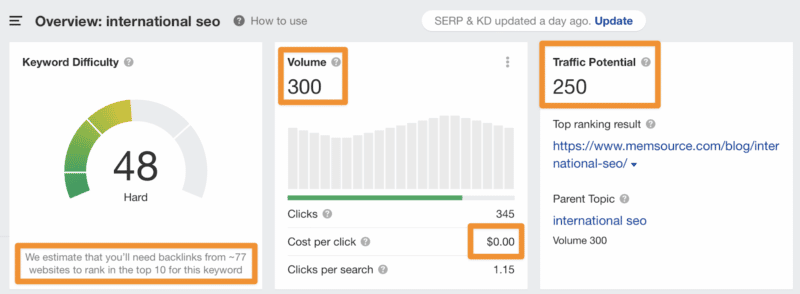
Now. Ask yourself, can you break into the top 3 within the next ~12-24 months?
To answer this questions, we must look at the SERP competitiveness:
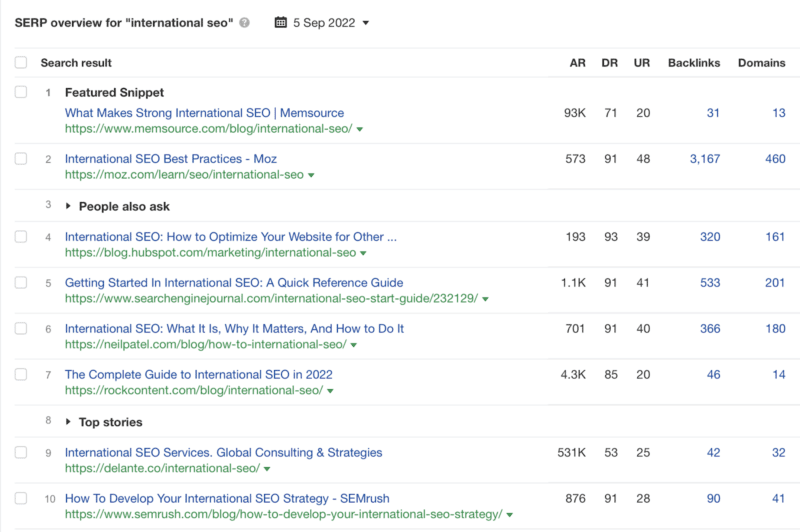
Pretty difficult!
Especially when you consider the loooooooow traffic you’ll get even if you did rank in the top 3. Plus, there’s virtually zero buying intent, too.
Meaning?
Even if you thought you had a shot at ranking for this term in the next ~12-24 months (based on topical authority), why would you even bother?
Unless you literally sold “international SEO” services or similar, it’s most likely not worth it for 99% of sites out there.
So adjust expectations accordingly.
- Pick a new keyword and topic to target.
- Or, adjust your patience and budget and timeline to build a giant site and enough topical authority it might take to rank for this keyword one day.
5. Payback period
Paid search gets the most love (and $$$) because:
- It’s relatively easy to see which specific keyword leads to which specific conversion and how much money you made in return.
- And because marketers + C-suites are lazy. (OK, maybe just “impatient” as well.)
Organic SEO and content, on the other hand, also have a defined payback period. But it’s often harder to track because it might take 6, 12, or even 18+ months to see the true ROI.
Exhibit A: the best converting keywords – even for the web’s biggest brands – might take years to rank in that coveted top 3 position that drives all the pesos or yen or Bitcoins or whatever:
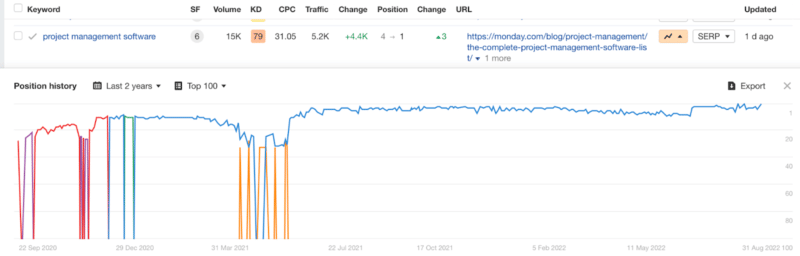
So, your job is to figure out:
- Which keywords are “worth” the “risk” or investment (literally the first four criteria listed in this article)?
- Will the potential ROI make up for the investment of time, money, and resources?
- Can you really wait that long to see the payoff?
This leads you to a simple decision-making tree:
- If the answer is “Yes,” then full speed ahead! Go big and bold, doing hundreds, if not thousands, of new content pieces to dominate your space in the years to come (~18-24+ months).
- If the answer is “Maybe,” then it’s time to get creative. Realistically, which new keywords and content can you prioritize in the next ~12 months to deliver enough results that provide enough of a positive ROI to double down in the future?
- And if the answer is “No,” then it’s time to shift focus onto what you already have – typically updating existing content ranking bottom of page one, top of page two, or adding new content only in spaces you have topical authority – so that you can generate some tangible momentum within ~6 months time.
Simple, right?
Not really.
Because this last part is entirely subjective.
A lot depends on your role, the company you’re in, internal stakeholders or champions, the broader market conditions, and more factors that can be outside your control.
In truth, after working with hundreds of companies over a decade, I’ve seen that most companies fall into #2 or #3 above. Only Unicorns and public companies live in the rarified air of #1.
(Trust me, the air really is better up there!)
Predicting future SEO success is doable
Ranking today is difficult.
And unfortunately, it’s only going to get more expensive and complicated over time.
That means most outside of the web’s top 1% need to prioritize keywords and content to show results within 6, 12 or 18 months’ time.
Showing some short-term results often buys you more time and money to double down later, whether that’s from your boss, clients, spouse, or your own gut.
This typically means going back to the drawing board, starting again at the top of this article, and then:
- Adjusting your keyword selections based on potential traffic and buying intent filters down to target less competitive stuff,
- Scrutinizing SERP competitiveness to make sure the domains and content you’re up against are as “easy” as the link-biased KD makes it out to be,
- Prioritizing areas you already have existing content ranking or some validation of topical authority in these spaces, and
- Can reliably break into the top 3 by publishing enough, building enough links, and/or increasing content quality faster than everyone else, otherwise
- Readjust your payback period expectations to stick it out for the long haul or compete for more realistic, short-term targets.
It’s not easy. You can’t “guarantee” anything.
But it is doable. And you can predict future success if you weigh each category carefully.
The post How to reliably predict SEO success before publishing content appeared first on Search Engine Land.
Courtesy of Search Engine Land: News & Info About SEO, PPC, SEM, Search Engines & Search Marketing
Category seo news | Tags:
Social Networks : Technorati, Stumble it!, Digg, de.licio.us, Yahoo, reddit, Blogmarks, Google, Magnolia.
Google Ads authentication issue causing login problems
Written on November 15, 2022 at 5:18 am, by admin
For the last several hours, Google Ads users have been noticing issues logging in.
Google Ads product liaison Ginny Marvin tweeted the following response, stating that the problem was caused by an authentication issue:
An issue with Google account authentication is preventing some users from accessing Google services, including Google Ads and Display & Video 360. The issue is being investigated. Please see the dashboard for updates: https://t.co/SyAbk6b458
— AdsLiaison (@adsliaison) November 14, 2022
Other issues. Melissa Mackey also noticed that any changes made on the platform took several minutes to update. We’re not sure if the two are related, but it wouldn’t surprise us.
Why does it take @GoogleAds several minutes to save a simple budget change? The slowness of the UI is unworkable #ppcchat
— Melissa L Mackey (@beyondthepaid) November 14, 2022
Watch for updates. Keep an eye on the Google Ads Status Dashboard for updates.
The post Google Ads authentication issue causing login problems appeared first on Search Engine Land.
Courtesy of Search Engine Land: News & Info About SEO, PPC, SEM, Search Engines & Search Marketing
Category seo news | Tags:
Social Networks : Technorati, Stumble it!, Digg, de.licio.us, Yahoo, reddit, Blogmarks, Google, Magnolia.
Report: Google Business Profiles bug causing reviews to disappear
Written on November 15, 2022 at 5:18 am, by admin
There are numerous cases of businesses losing all of their reviews that they have acquired over the years in their Google Business Profile listings. The issue seems to be related to Google automatically applying suggested edits from the web to those business profile listings, which in turn can create a new CID for that business listing, and with that, the reviews get disassociated from that business listing. The result, when you look at the business listing in Google Search or Google Maps, the reviews no longer exist.
The report. Mike Blumenthal covered the issues in greater detail where he documents numerous cases of businesses having their reviews disappear overnight from their business profiles on Google Maps and Google Search. Mike said Google is changing the business listing CIDs, the unique identifier for the business listing, when the suggested edits are automatically applied. That change leads the reviews to stick with the old CID and are not transferred or moved to the new CID.
Reviews disappear. When the new CID is created, Google is not moving the reviews over to that CID, and thus all the reviews appear to disappear from the business profile listing. In reality, the reviews are still there, but on the old business profile listing and not on the new one.
What can you do. You should capture and document your old CID by using either Gatherup’s Google Review Link Generator chrome extension or Pleper’s free Google CID converter, as Mike said. Take screenshots or store your reviews in some sort of database, some even archive the emails they receive from Google Business Profiles with the reviews.
If this happens to you, you can then tell Google that your CID changed and the reviews were not migrated. Either Google can put back your old CID or maybe transfer the reviews, maybe – if you are lucky.
The best thing to do is to stay on top of the emails you receive about suggested edits and disapprove them if they are incorrect, most are likely incorrect if you maintain a good business profile listing.
Why we care. Reviews on your local listings can be the lifeblood of your local Google Search and Maps business. Many searchers look at the reviews before calling the business, many look at the reviews before placing an order and before driving to your location and some even suggest reviews play a roll in local Google search rankings. If your reviews disappear that can be a huge loss for the business.
The post Report: Google Business Profiles bug causing reviews to disappear appeared first on Search Engine Land.
Courtesy of Search Engine Land: News & Info About SEO, PPC, SEM, Search Engines & Search Marketing
Category seo news | Tags:
Social Networks : Technorati, Stumble it!, Digg, de.licio.us, Yahoo, reddit, Blogmarks, Google, Magnolia.
[Tomorrow] Attend SMX online for free!
Written on November 15, 2022 at 5:18 am, by admin

Head into 2023 ready to drive more traffic, leads, and conversions: Join us online tomorrow and Wednesday (Nov. 15-16) at SMX to learn the actionable tactics that can make it happen… for free!
Your free All Access pass unlocks nearly 50 tactic-rich sessions that explore critical SEO and PPC topics, tactics, and trends – everything from E-A-T to GA4, PPC automation, Performance Max, and more.
Stick around for Overtime – live Q&A following SEO, PPC, and select Solutions sessions, to continue the conversation, dig deeper into the material, and get your specific questions answered in real time.
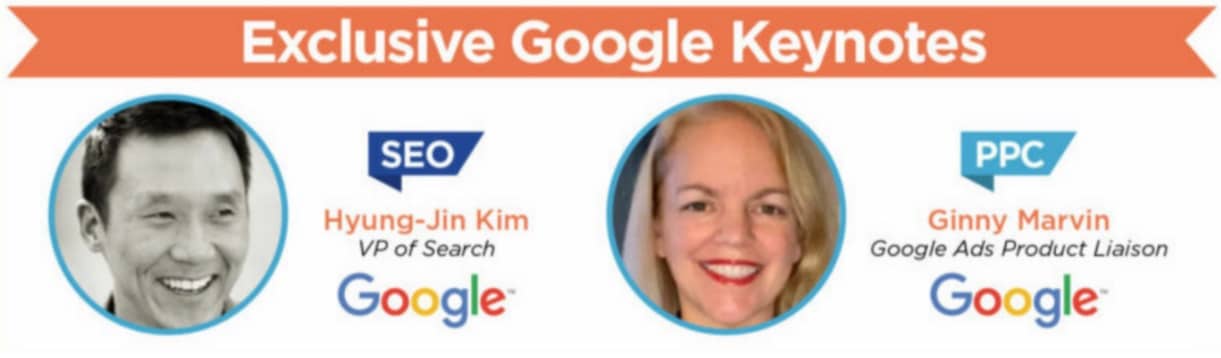
You’ll also unlock two exclusive keynote conversions with Google – loaded with first-hand insights and actionable advice straight from the source – plus your choice of engaging Coffee Talk networking groups designed to connect you with like-minded marketers.
After two exciting days of training with some of the smartest marketers on the planet, you’ll be ready to implement reliable, actionable tactics to end the year on a high note – and prepare for whatever 2023 has in store.
What are you waiting for? Secure your FREE All Access pass now and join us online tomorrow at SMX. The show kicks off at 11:00am ET… don’t miss out! Grab your free pass now!
The post [Tomorrow] Attend SMX online for free! appeared first on Search Engine Land.
Courtesy of Search Engine Land: News & Info About SEO, PPC, SEM, Search Engines & Search Marketing
Category seo news | Tags:
Social Networks : Technorati, Stumble it!, Digg, de.licio.us, Yahoo, reddit, Blogmarks, Google, Magnolia.
TikTok has launched an in-app ecommerce feature
Written on November 11, 2022 at 4:58 pm, by admin
In addition to its most recent shopping features, TikTok has just launched TikTok Shop, where users can now make purchases directly through the app.
Availability. TikTok officially began testing in the U.S. this week. It was previously only available in the UK and seven countries in Southeast Asia.
Invite only. TikTok is currently inviting select U.S. businesses to participate in the initiative. That means live streamers from places where the feature is not live will need to continue directing shoppers to third-party websites.
What TikTok says. “We’ve seen the positive impact of TikTok Shop, and we’re excited to continue experimenting with this new commerce opportunity to support businesses of all sizes.”
In other TikTok news. TikTok has released several new features and products this year, including:
- A look inside TikTok’s new automated Smart Performance Campaigns
- 3 TikTok LIVE features, updates, and policies
- TikTok has a new Focused View campaign objective
- TikTok releases Photo Mode and 7 new editing tools
- YouTube has introduced a TikTok and Twitch co-streaming feature
Why we care. The new feature is invite-only, but if the Shop feature becomes available to advertisers and brands globally, you should start testing it as an alternative way to promote your products.
The post TikTok has launched an in-app ecommerce feature appeared first on Search Engine Land.
Courtesy of Search Engine Land: News & Info About SEO, PPC, SEM, Search Engines & Search Marketing
Category seo news | Tags:
Social Networks : Technorati, Stumble it!, Digg, de.licio.us, Yahoo, reddit, Blogmarks, Google, Magnolia.
The SEO career path: What it may look like and how to level up
Written on November 11, 2022 at 4:58 pm, by admin
People outside of the world of marketing rarely know what SEO is or what the initialism even stands for.
Within the industry, it’s a familiar term to all formidable marketers. Far less is SEO – search engine optimization – actually understood, though.
First, it’s important to understand that, while SEO stands for search engine optimization, it is also often used interchangeably to describe the people who do SEO (a.k.a., SEO professionals). An SEO – or search engine optimizer – does SEO. SEOs do SEO.
To avoid any further confusion, we’ll refer to the people who do SEO as SEO professionals.
SEO professionals are a special breed of marketers from many walks of life.
But there are some characteristics and experiences many of us have in common that I will attempt to organize as some of the most useful and shared professional qualities possessed by SEO professionals.
I’ll also cover what the career path to becoming one may look like.
How do you start an SEO career?
Historically speaking, most SEO professionals didn’t plan on SEO as a career – at least until recently (starting in the late 1990s and early 2000s). That was because they couldn’t, really.
Early in their educational journey, a marketer or digital marketer very rarely – if ever – declared, “I want to optimize websites and chase the Google algorithm for brands to revolutionize the way humans and businesses connect forever.”
The latter part of that dubious statement was probably similar to something many marketers-in-training did declare.
But getting there through website and brand optimization to gain organic visibility on a search engine was not likely the vehicle they had in mind at the time for accomplishing it.
It’s also rare to meet multiple SEO professionals who’ve forged the same path to becoming one.
But there are certainly overlapping journeys, professions and experiences.
Some common previous areas of expertise for SEO professionals that commonly intersection include teaching, journalism, various math-focused professions and the obvious traditional marketing focuses.
But as the worldwide web evolved the way it has over the last 30 years, opportunities to help brands and people in new ways arose in the marketing realm. And some became more specialized – and lucrative – than ever.
Organic search, paid media and social media are all suitable channels for successful marketing strategies. And they indirectly or directly were created (or adapted to be used) for the growth, prominence, and usefulness of websites.
Today, as a result, high schoolers and college students are able to set their aims on a digital marketing gig specializing in SEO. This will continue to become more common as secondary-education institutions evolve with the world’s needs, job demand, and technology.
Get the daily newsletter search marketers rely on.
<input type=”hidden” name=”utmMedium” value=”” />
<input type=”hidden” name=”utmCampaign” value=”” />
<input type=”hidden” name=”utmSource” value=”” />
<input type=”hidden” name=”utmContent” value=”” />
<input type=”hidden” name=”pageLink” value=”” />
<input type=”hidden” name=”ipAddress” value=”” />
Processing…Please wait.
Possible SEO career routes
Like most careers, there are multiple directions an SEO professional can take.
It’s probably most likely to start at an agency, and that’s a wonderful place to kick off almost any career related to marketing (or design, account management, video production or sales).
There are typically a bunch of talented people with a plethora of knowledge and direction to share, so it’s like obtaining an education while getting paid.
You also get the chance to really find your niche in whatever facet of digital marketing you end up in, whether that be SEO itself, or a more-specific component within SEO.
Your first couple of years in SEO are likely to shape your long-term future, at least to some extent.
You can also reinforce and/or stand out demonstrating strengths with the critical soft skills mentioned above and your ability to effectively communicate with internal and external stakeholders.
Agency life allows those skills to shine while also finding out if agency life is for you.
You have to be able to juggle multiple deliverables and multiple deadlines constantly, oftentimes jumping between various projects throughout the same day and throughout the week.
The other direction you could go into is directly in-house at a company.
But if you’re looking to strengthen your SEO skillset as a novice, that could prove difficult without a good SEO at the company to guide you and teach you many of the basics needed to be successful.
Bigger companies would be more likely to have multiple skilled SEO professionals hired on a team at once. Getting into an opportunity like that is tough for someone with little to no experience.
One other potential direction an SEO career could go is strictly freelance or as an independent consultant.
This was probably the most common way to get into SEO back when Google and the marvel of search were still in their adolescent years. Today, it’s become harder as search has become more complex and the choices for vendors have increased significantly across the world.
These are three different potential career routes an SEO could follow. They usually overlap at some or multiple points based on what the SEO wants to do which steers them in that direction.
All three directions also offer the ability to work in a variety of environments (i.e., working in a traditional office setting, working at home, or a hybrid set-up).
SEO, like most digital marketing careers, offers flexibility when it comes to the location worked and also the time of day of which you do that work.
SEO job levels and salary ranges
The SEO career path will likely move from entry-level to experienced roles. And when it comes to salary, like all things in SEO, it depends.
Many variables influence compensation, including your location, work environment, whether you work in-house or agency-side, and experience level, among others. (We’ve done our best to put a general range to put at these levels.)
Entry-level
Salary range: $49K–$72K per year
So many jobs start with a basic, lower-tier position, but it’s also a lot like getting paid to continue hands-on education in your specific field.
Landing that first entry-level position is usually the tougher task. Once you assume the post, you’re going to want to learn as much as you can as fast as you can. Make sure you are absorbing everything you can.
Unfortunately, (or fortunately, for the lucky ones) having a great or terrible leader to guide and train you at this critical stage of your early career could make or break you. Make the most of it.
Junior SEO (SEO analyst, SEO specialist, etc.)
Salary range: $62K–$101K per year
Once you have the basics down and carry out the day-to-day with limited assistance, your entry-level position should move up to something a little bit more senior, like an SEO analyst or specialist (it’s not actually a senior position, though).
These junior SEO positions usually do a lot of the data pulls and living-in-Excel that builds a solid, effective SEO. These are long-winded tasks that build SEO professionals at the core, and they can’t be replaced or abbreviated.
You’ll likely work closely with an SEO manager and their senior SEO leader to:
- Carry out tasks that can have a big impact on a client but take quite a bit of data-diving.
- Explain (then recommend and implement) to get the needle moving significantly.
SEO strategist
Salary range: $69K–$110K per year
After time as a junior SEO, be ready for a bit more reasonability, a bit more account ownership, and even some chances to start training other new hires (regardless of experience levels).
Some of the “training” you do will likely not be highly complicated SEO tasks but rather internal tasks related to the SEO process at the company. This could include:
- Using tools and datasets.
- Working closely with internal and client stakeholders.
- Reviewing and delivering client deliverables.
- And more.
SEO manager
Salary range: $80K–$120K per year
SEO managers are typically the first managing-oriented SEO roles within agencies. New SEO managers usually oversee one or two SEO professionals to get a feel for their style, effectiveness, strengths and weaknesses.
These managers also usually manage several client accounts and their own workloads, too.
This period in an SEO career can also allow people to see what their next role may look like by identifying things they do and don’t like.
For instance:
- Some people love the in-the-trenches SEO work more likely tied to an SEO strategist or analyst.
- Other people clearly prefer the management-oriented role that has a big impact on the teams around them but doesn’t need to get their hands as dirty or as often as the more-junior-level SEO mentioned above.
Senior manager (head of SEO, director of SEO, etc.)
Salary range: $109K–$192K per year
Following successful posts at the helm as an SEO manager, a senior version of that usually follows.
As a senior manager, which could also be a head of SEO or even a director, you assume significantly more responsibilities, not just as an individual, but as a representative of the agency or company you work at, as well as the clients you work with and represent as the leader of their organic initiatives.
These senior managers tend to:
- Be some of the biggest players in agency-client relationships.
- Bring some of the best and brightest ideas.
- Be able to explain – and sometimes even convince – client stakeholders of the best reasons why some of the hardest, most laborious tasks are very much worth the effort and time.
Vice president
Salary range: $124K–$224K per year
VPs tend to be some of the highest-ranking, SEO-focused positions in the climb to the top.
Whereas VPs of SEO/organic are still highly integrated with SEO efforts and usually oversee entire teams or more in that area, they still are very much responsible for:
- SEO strategies.
- Client communication.
- New business pitches and research.
- Operational responsibilities.
- And much more.
C-suite (CMO, CEO, etc.)
Salary range: $192K–$550K per year
This is likely the ultimate goal of many digital marketers, not just SEO professionals.
Some start their own companies, others join companies as veteran thought leaders and try to take said companies to the next level, and others are just so right for the job, there’s nowhere else they really belong.
Good, effective marketers are always going to be in demand, and the better ones are going to be leading the best companies and their organic-growth initiatives.
By the time an SEO makes it to the C-suite, they are likely:
- Focused on so much outside of SEO, like all marketing channels – usually both paid and organic – the “big picture” and the “bottom line” that guides the company.
- Working to achieve the most important goals to ensure growth and profitability for that company and their clients, if they have them.
Of course, these are not definitive paths through the SEO ranks.
Every company and agency has its own way of doing things. Sometimes it looks like this, other times it looks slightly different, and occasionally it looks extremely different.
It’s important to stay on the path that works for you and to take the steps needed to get to where you want to be.
Best ways to advance your SEO career
It’s imperative to understand that SEO education never stops. Staying ahead of the game is one shining factor that separates decent from great SEO professionals.
As such, educating yourself on the many facets of SEO and digital marketing should be a top priority for someone trying to get their feet wet for the first time in the profession.
Stay on top of changes and developments in the industry through online forums and SEO-related news publications. Keep a constant eye on Google’s Search Blog.
From there, once a gig is landed, the most important aspect of building an SEO career comes at you every day: real-life SEO experience with clients, internal stakeholders, vendors, and/or agency partners, among others.
You’ll continue your education after that, too. Pretty much every day you’ll be reading blogs and news in the ever-changing industry.
You’ll attend cutting-edge conferences and virtual seminars. Eventually, you too may be speaking at these events and guiding SEO professionals from around the world.
SEO professionals love to help each other as much as they love to learn from each other. It is one of the best parts of being an SEO and it’s why you’ll be hard-pressed to find any great SEO who dislikes another great SEO. We’re in this together and there’s plenty to go around!
The everyday trials and tribulations in the field are the best way to find your path as an SEO.
This allows you to learn:
- The many unique problems that may arise.
- How to strategically develop solutions.
- The very real (and sometimes complicated) relationship struggles with clients, stakeholders, vendors, and more.
Most of all, you should know if SEO is right for you early and often. I know I did, and still very much do.
The post The SEO career path: What it may look like and how to level up appeared first on Search Engine Land.
Courtesy of Search Engine Land: News & Info About SEO, PPC, SEM, Search Engines & Search Marketing
Category seo news | Tags:
Social Networks : Technorati, Stumble it!, Digg, de.licio.us, Yahoo, reddit, Blogmarks, Google, Magnolia.
The search marketer’s new imperative: Capturing first-party data
Written on November 11, 2022 at 4:58 pm, by admin
Third-party cookies are on their way out. You’ve probably been thinking and talking about this for a few years now.
And you’ve likely seen many blog posts, articles, webinars, podcasts, etc. talking about how first-party data is the path forward for adapting to the cookieless future.
What isn’t being talked about?
The role that search plays in collecting that precious first-party data.
The role of search in capturing first-party data
Oftentimes it’s commerce, loyalty programs, and the like that are deemed responsible for discovering the ins and outs of your customers.
But search plays a critical role, too. It’s uniquely positioned for a few reasons.
Users are purposefully engaging with your site
So many marketing channels engage with consumers during a non-commerce moment – while they’re sitting on the couch binge-watching The Office, drooling over their best friend’s Insta-perfect pictures from that recent trip to Tuscany, etc.
Search is a rare exception. The consumers we engage with are actively raising their hands, and we’re helpfully showing up to meet their needs.
That means that every engagement we have with potential customers is highly intentional. They’ve made the choice to not just look for something we offer, but also to visit our site. What that means is…
Clicks have both high intent and strong timing signals
We can learn a ton of valuable information about a person, even if they don’t immediately make a purchase.
Clicks are considered a first-party cookie, meaning the advertiser has a consented ability to:
- Tag the consumer’s browser.
- Use that information to improve their customer experience and future engagements and interactions with the brand.
We can also very directly and confidently infer interest.
Someone looking for a tent on our ecommerce website shows a much stronger signal of “interest in buying camping gear” than a person browsing an outdoorsy blog or looking up the top 10 tips for hiking the Appalachian Trail.
We also know that they’re thinking about buying that camping gear now.
Search is a demand-capture channel that reveals high intent and purposeful engagement with the benefit of a first-party cookie.
Nothing new, right?
What’s new is the relative importance of each first-party click that comes through search.
As the opportunities to mine data from third-party cookies become fewer and fewer and walled gardens build their fences taller and taller, that importance will only continue to rise.
Search has a new responsibility to take its high-intent first-party data and use it across the marketing ecosystem.
Search data on its own can be valuable, but it becomes even more powerful when paired with other first-party data sources. So, what does that look like?
Search + site behavior data = better user experiences
Garnering an ad click is only half of the battle.
As the consumer digests the website, text, imagery, and value proposition, a lot can happen.
Sometimes, consumers bounce nearly immediately, while other times, they will view 10+ pages and spend over 15 minutes browsing the site.
This metadata can and should be used to build customer segments. Purchase propensity scores can be derived based on on-site behavior.
We recommend using this information to better inform automated customer targeting and suppression lists to be added to digital marketing and remarketing initiatives.
Get the daily newsletter search marketers rely on.
<input type=”hidden” name=”utmMedium” value=”” />
<input type=”hidden” name=”utmCampaign” value=”” />
<input type=”hidden” name=”utmSource” value=”” />
<input type=”hidden” name=”utmContent” value=”” />
<input type=”hidden” name=”pageLink” value=”” />
<input type=”hidden” name=”ipAddress” value=”” />
Processing…Please wait.
Search + CRM = better digital engagement
Extending the view on-site behavior, we can further couple search intent to known online and offline customer engagement.
Is the consumer on our email list or mailing list, or have they previously purchased?
If yes, how active have they been, and what metadata and activity can we add to our customer segmentation models?
These signals can allow brands to alter messaging and value propositions in real time on the website and can also lead to improved customer engagement – a feeling that the brand knows who they are and wants to provide a personalized and tailored experience.
Beyond the site, brands will also have the ability to reach these first-party customers in other paid and organic digital experiences, such as custom-tailored social ads and emails.
Search + CRM = better non-digital outreach
When we’ve historically talked about cross-channel marketing, especially when it pertains to search, the typical “other channels” are paid social, e-retail, display, etc.
We need to start including our offline channels in those conversations, too.
In today’s data-driven world, every brand-to-consumer touch point short of a friend saying “Hey, check out my new backpack!” can be part of a connected journey.
Take direct mail, for example.
Having the ability to tailor a brand’s direct mail campaign by refining the who, the what, and the how is powerful and performant.
By understanding the customer’s intent and product/service desires, as well as the fact that their need is now, we have a unique ability to build propensity models.
Firstly, these customer segment models can be built on the likelihood to purchase – leading to top segments as well as customers to suppress.
Second, the content can be altered to match the exact products/services the customer has expressed interest in.
Finally, the physical mail can be tailored to match the individual and their needs. Delivering a postcard flyer, an envelope, or a catalog to different customer segments becomes possible.
The role of search in creating great customer experiences
Search has always been an important channel (in my extremely unbiased opinion), and it’s only getting more critical as its role in creating great customer experiences grows.
Our guiding light as search marketers has always been to meet hand-raisers with what they’re seeking, when they’re seeking it, in a way that’s responsible for our business.
Now we have another imperative: taking the data those hand-raisers give us to make all of their experiences with our brand better.
The post The search marketer’s new imperative: Capturing first-party data appeared first on Search Engine Land.
Courtesy of Search Engine Land: News & Info About SEO, PPC, SEM, Search Engines & Search Marketing
Category seo news | Tags:
Social Networks : Technorati, Stumble it!, Digg, de.licio.us, Yahoo, reddit, Blogmarks, Google, Magnolia.