

5 best practices for tracking offline conversions in Google Ads
Written on November 18, 2022 at 5:24 pm, by admin
Risk-taking is part of any marketer’s job. No strategy is guaranteed to work.
I like to think of myself as a calculated risk-taker. Because I have TSA PreCheck and monitor my flight status from home, I arrive at the airport just an hour before my flight. I try new restaurants in town, but don’t get in the car until I’ve scoured review sites and scanned the menu.
My approach to taking risks at work is similar. Testing the latest bidding strategies excites me, but my moves are deliberate to avoid disturbing performance.
Major changes to a Google Ads account send the algorithms into a learning phase and create volatility as it re-learns.
Like many marketers who want results yesterday, my patience can be short. But to keep clients happy, balancing future-forward strategies with the risk of upsetting KPIs is imperative.
By now, we know that offline conversion tracking (OCT) is a must-have in any account.
When setting it up for the first time, swapping out web-based campaign optimization goals for CRM-based goals can be tricky. Here are five best practices to mitigate the risk.
1. Add values to your conversions
Maximizing the potential of OCT requires assigning each action a value.
If you can’t use actual and dynamic values from your CRM, Google has a calculator that can help with estimations.
The values don’t have to be precise for the algorithms to benefit from this provided direction.
The assigned values tell machine learning how much each conversion is worth. Therefore, the system can bid accordingly with value-based bidding strategies.
Even if you’re not ready for target return on ad spend (tROAS) or Maximize conversion value, setting these values from the get-go allows for an easy launch when you’re ready.
2. Optimize for all funnel stages
Once all stages of your marketing funnel feed into Google Ads with their respective values, begin optimizing campaigns for all funnel stages.
This tactic will generate more conversion data for your campaigns and speed up the learning phase.
A risk-taker might change the optimization across the account all at once. Go ahead and rip the bandage off:
- If you can stomach performance fluctuations.
- If the account is brand new.
- Or if conversion volume is already dismal.
I prefer to set up an experiment for any major bidding changes to cut down the volatility in the account.
Experiments should run for at least two weeks before determining a winner, but this can take longer if your budgets are small or the conversion lag is long.
A lift in backend conversions should be measured as the key success metric of this experiment.
Get the daily newsletter search marketers rely on.
<input type=”hidden” name=”utmMedium” value=”” />
<input type=”hidden” name=”utmCampaign” value=”” />
<input type=”hidden” name=”utmSource” value=”” />
<input type=”hidden” name=”utmContent” value=”” />
<input type=”hidden” name=”pageLink” value=”” />
<input type=”hidden” name=”ipAddress” value=”” />
Processing…Please wait.
3. Optimize for the lowest conversion point possible
Once the full-funnel approach is successful, you can begin optimizing for one conversion event at a time. Treat each campaign uniquely and adjust the campaigns ready to move down the funnel.
To ease performance fluctuations, set up an experiment that optimizes to the lowest point in the funnel possible, given Google’s need to have at least 15 conversions in the past 30 days.
Creating custom columns in the Google Ads interface allows you to sort and visualize your data easily. Analyze each campaign independently.
In this example, the top two campaigns have enough MQL volume to optimize for MQLs exclusively rather than the entire funnel.
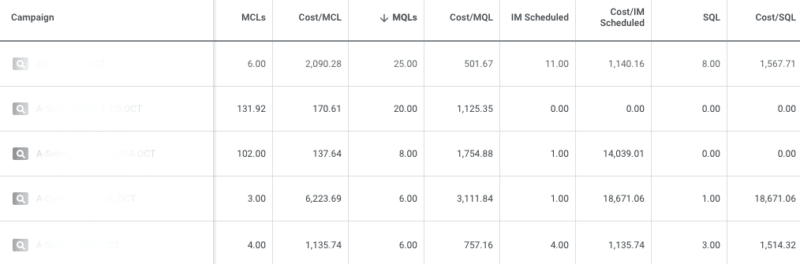
Consider that not all keywords are created equal. Top-of-funnel keywords will generate pipeline slower than your high-intent non-brand or brand terms.
Individual campaigns’ optimization goals and bidding strategies should align with the funnel stage, and what’s working best.
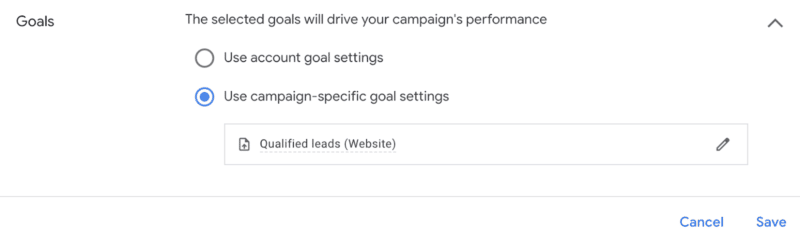
The UI doesn’t allow OCT goals to be set as single conversion events but rather as the conversion category as a whole. Therefore, custom goals should be created when optimizing toward a single point in the funnel.
For example, if your OCT conversion is “sales,” you should create a custom goal for “sales.”
Google says “[...] using custom goals in campaigns might make your bid strategy work less efficiently,” but if your account is well-established with sufficient data, custom goals should work to your benefit.
4. Continue to drive lower-funnel results
As time goes on and data collects, you can continue to push the limits and optimize for lower points in the funnel.
Any bidding strategy can be tested alongside this tactic, but it’s critical that the experiment you create only changes one variable at a time.
For example, the control campaign is on target cost-per-action (tCPA) and optimized for MQLs. The test campaign should remain on tCPA but optimize for the next stage in the funnel (Meeting Scheduled). After a winner is determined, test another variable by conducting a separate experiment.
Depending on the size of the account, nailing down the perfect combination of optimization goals and bidding strategies can take several months. Seeing little to no performance improvement after the initial two weeks can be worrisome, but running experiments for three full cycles is recommended to determine a winner.
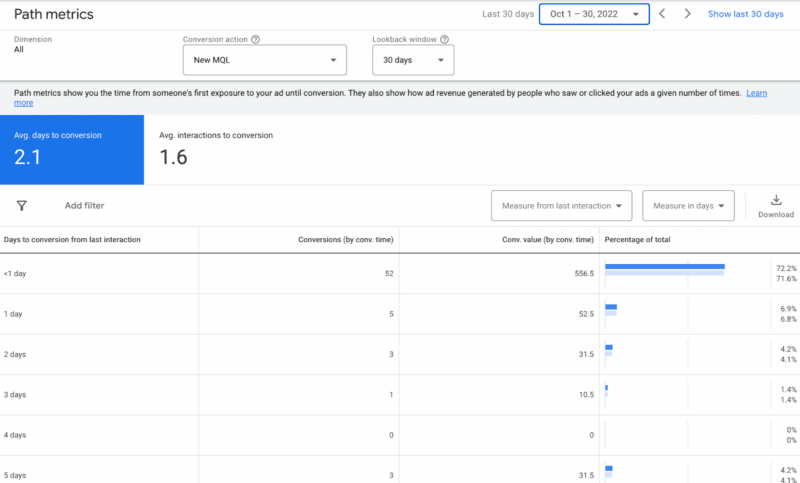
This means if it takes an average of two weeks for an MQL to become a “Meeting Scheduled,” you should run the experiment for at least six weeks before calling it quits. Check out Google’s path metrics report to view how many days each conversion takes.
5. Test value-based bidding
Once you are comfortable optimizing for lower-funnel conversion points, step up your game with Maximize conversion value or tROAS bidding strategies.
These smart bidding strategies adjust bids automatically to predict the value of a potential conversion when a user searches for keywords you’re bidding on.
These bidding strategies can and should be tested in an experiment, especially if you’re terrified of breaking the algorithm.
Despite the risks associated with performance fluctuations, the benefits should outweigh the volatility.
With some patience and breathing exercises, one of my clients saw a 74% improvement in cost per MQL since optimizing for backend conversions with OCT.
When their brand campaign had more than 15 MQLs in a month, we switched to optimizing for MQLs only, resulting in a 4x boost in conversion value on that campaign.
So, get out there and take calculated risks. Be smart, bold and eager to set up experiments when you’re feeling apprehensive.
The post 5 best practices for tracking offline conversions in Google Ads appeared first on Search Engine Land.
Courtesy of Search Engine Land: News & Info About SEO, PPC, SEM, Search Engines & Search Marketing
Category seo news | Tags:
Social Networks : Technorati, Stumble it!, Digg, de.licio.us, Yahoo, reddit, Blogmarks, Google, Magnolia.
Webinar: It’s time to modernize your online experience by Cynthia Ramsaran
Written on November 17, 2022 at 1:21 pm, by admin

Businesses know they need an engaging, scalable way to connect with leads and customers. That’s why they’ve invested big bucks in marketing automation tools, chatbots and other technologies to automate outreach and handle high volumes of contacts.
Unfortunately, many of these once-innovative solutions are falling short as needs evolve and customer expectations mature. What you need is a paradigm shift—a strategic step-change that gives your team the power to engage all your leads and customers in natural, human-like conversations not only while they’re on your site but after they close the window, too. The scripted bot is dead; welcome to the AI-powered revolution.
Join Conversica in a webinar that examines old and new models of automating conversations with customers to drive revenue.
Register today for “The Chatbot Is Dead: It’s Time to Modernize Your Online Experience,” presented by Conversica.
Click here to view more Search Engine Land webinars.
The post Webinar: It’s time to modernize your online experience appeared first on Search Engine Land.
Courtesy of Search Engine Land: News & Info About SEO, PPC, SEM, Search Engines & Search Marketing
Category seo news | Tags:
Social Networks : Technorati, Stumble it!, Digg, de.licio.us, Yahoo, reddit, Blogmarks, Google, Magnolia.
Webinar: It’s time to modernize your online experience by Cynthia Ramsaran
Written on November 17, 2022 at 1:21 pm, by admin
Businesses know they need an engaging, scalable way to connect with leads and customers. That’s why they’ve invested big bucks in marketing automation tools, chatbots and other technologies to automate outreach and handle high volumes of contacts.
Unfortunately, many of these once-innovative solutions are falling short as needs evolve and customer expectations mature. What you need is a paradigm shift—a strategic step-change that gives your team the power to engage all your leads and customers in natural, human-like conversations not only while they’re on your site but after they close the window, too. The scripted bot is dead; welcome to the AI-powered revolution.
Join Conversica in a webinar that examines old and new models of automating conversations with customers to drive revenue.
Register today for “The Chatbot Is Dead: It’s Time to Modernize Your Online Experience,” presented by Conversica.
Click here to view more Search Engine Land webinars.
The post Webinar: It’s time to modernize your online experience appeared first on Search Engine Land.
Courtesy of Search Engine Land: News & Info About SEO, PPC, SEM, Search Engines & Search Marketing
Category seo news | Tags:
Social Networks : Technorati, Stumble it!, Digg, de.licio.us, Yahoo, reddit, Blogmarks, Google, Magnolia.
Walmart’s ad revenue increased 30% in Q3
Written on November 17, 2022 at 1:21 pm, by admin
Walmart released its Q3 earnings this week and things were looking up for the retail giant. Their advertising revenue grew about 30% since Q2.
On the earnings call, President and CEO Doug McMillon attributed the growth to “More items and sellers driving GMV (Gross Merchandise Volume) and improving customer satisfaction.” He continued that success with advertising is “mutually reinforcing. If we double-click on advertising with Walmart Connect in the U.S., we see it’s benefiting from growth in e-commerce and from improvements made within the business itself. And we’ve seen strong growth in return on ad spend over last year.”
Walmart Connect. Connect is Walmart’s self-service ad platform that was recently announced. The platform allows retailers to create an account and upload their product SKUs to the Walmart platform, without the need to go through an approved vendor and wait three days for approval.
As with advertising, growing our marketplace business also unlocks fulfillment services opportunities through both fulfillment centers and last-mile delivery. We’re scaling these businesses in the U.S., and we’re starting to ramp up in Mexico and Canada. The team in Mexico increased the number of sellers on our marketplace by 20% during the quarter. In the U.S., the marketplace on Walmart.com now offers about 370 million SKUs.
That’s an increase of more than 50% from Q2. Many of these sellers want to leverage our fulfillment network. They also want to use our advertising capabilities to drive demand, and we’re making that easier for them. We recently shared that all new marketplace sellers in the U.S.
will be automatically onboarded onto our self-service ad platform. We believe this seamless integration will help both businesses scale even faster. What you see in our results is that we can run compelling stores and clubs, scale of first- and third-party e-commerce business, and connect them together in an omnichannel fashion that saves customers and members money and time. Our strategy unlocks growth opportunities for us and a thread that runs from digital retail to fulfillment and advertising, and opens up even more opportunities with health and wellness and financial services.
Doug McMillon
Roku, TikTok, and Snap partnerships. Walmart also expanded its own ecommerce platform by powering ads on TikTok, Roku, and Snap. Walmart will also have the capability to measure any sales that come from those ads.
Dig deeper. You can review the earnings announcement here.
Why we care. If you’re an ecommerce retailer or brand, Walmart might be a great platform to test if you’re looking to expand your reach and connect with new buyers.
The post Walmart’s ad revenue increased 30% in Q3 appeared first on Search Engine Land.
Courtesy of Search Engine Land: News & Info About SEO, PPC, SEM, Search Engines & Search Marketing
Category seo news | Tags:
Social Networks : Technorati, Stumble it!, Digg, de.licio.us, Yahoo, reddit, Blogmarks, Google, Magnolia.
Walmart’s ad revenue increased 30% in Q3
Written on November 17, 2022 at 1:21 pm, by admin
Walmart released its Q3 earnings this week and things were looking up for the retail giant. Their advertising revenue grew about 30% since Q2.
On the earnings call, President and CEO Doug McMillon attributed the growth to “More items and sellers driving GMV (Gross Merchandise Volume) and improving customer satisfaction.” He continued that success with advertising is “mutually reinforcing. If we double-click on advertising with Walmart Connect in the U.S., we see it’s benefiting from growth in e-commerce and from improvements made within the business itself. And we’ve seen strong growth in return on ad spend over last year.”
Walmart Connect. Connect is Walmart’s self-service ad platform that was recently announced. The platform allows retailers to create an account and upload their product SKUs to the Walmart platform, without the need to go through an approved vendor and wait three days for approval.
As with advertising, growing our marketplace business also unlocks fulfillment services opportunities through both fulfillment centers and last-mile delivery. We’re scaling these businesses in the U.S., and we’re starting to ramp up in Mexico and Canada. The team in Mexico increased the number of sellers on our marketplace by 20% during the quarter. In the U.S., the marketplace on Walmart.com now offers about 370 million SKUs.
That’s an increase of more than 50% from Q2. Many of these sellers want to leverage our fulfillment network. They also want to use our advertising capabilities to drive demand, and we’re making that easier for them. We recently shared that all new marketplace sellers in the U.S.
will be automatically onboarded onto our self-service ad platform. We believe this seamless integration will help both businesses scale even faster. What you see in our results is that we can run compelling stores and clubs, scale of first- and third-party e-commerce business, and connect them together in an omnichannel fashion that saves customers and members money and time. Our strategy unlocks growth opportunities for us and a thread that runs from digital retail to fulfillment and advertising, and opens up even more opportunities with health and wellness and financial services.
Doug McMillon
Roku, TikTok, and Snap partnerships. Walmart also expanded its own ecommerce platform by powering ads on TikTok, Roku, and Snap. Walmart will also have the capability to measure any sales that come from those ads.
Dig deeper. You can review the earnings announcement here.
Why we care. If you’re an ecommerce retailer or brand, Walmart might be a great platform to test if you’re looking to expand your reach and connect with new buyers.
The post Walmart’s ad revenue increased 30% in Q3 appeared first on Search Engine Land.
Courtesy of Search Engine Land: News & Info About SEO, PPC, SEM, Search Engines & Search Marketing
Category seo news | Tags:
Social Networks : Technorati, Stumble it!, Digg, de.licio.us, Yahoo, reddit, Blogmarks, Google, Magnolia.
New AdSense data protection laws coming to CA, CO, CT, and UT in 2023
Written on November 17, 2022 at 1:21 pm, by admin
New data protection laws, which apply to the collection and processing of personal information, will be coming into effect in California, Colorado, Connecticut, Virginia and Utah in 2023.
According to an email sent to all AdSense admins and legal managers, starting January 1, 2023, we will supplement the existing Google Ads Data Processing Terms, Google Ads Controller-Controller Data Protection Terms, and Google Measurement Controller-Controller Data Protection Terms for these 5 new US State laws. No additional action is required to accept these terms if you’ve already agreed to the online data protection terms.
Ads and analytics only. This update relates to Google’s ads and analytics products. If you also use other Google products, such as Workspace or Cloud Identity, this email does not affect your use of those products.
Dig deeper. You can read more about the new laws here.
Why we care. If you’re an AdSense Manager or Admin living or advertising in California, Colorado, Connecticut, and Utah, be sure your account complies with all laws and regulations.
The post New AdSense data protection laws coming to CA, CO, CT, and UT in 2023 appeared first on Search Engine Land.
Courtesy of Search Engine Land: News & Info About SEO, PPC, SEM, Search Engines & Search Marketing
Category seo news | Tags:
Social Networks : Technorati, Stumble it!, Digg, de.licio.us, Yahoo, reddit, Blogmarks, Google, Magnolia.
New AdSense data protection laws coming to CA, CO, CT, and UT in 2023
Written on November 17, 2022 at 1:21 pm, by admin
New data protection laws, which apply to the collection and processing of personal information, will be coming into effect in California, Colorado, Connecticut, Virginia and Utah in 2023.
According to an email sent to all AdSense admins and legal managers, starting January 1, 2023, we will supplement the existing Google Ads Data Processing Terms, Google Ads Controller-Controller Data Protection Terms, and Google Measurement Controller-Controller Data Protection Terms for these 5 new US State laws. No additional action is required to accept these terms if you’ve already agreed to the online data protection terms.
Ads and analytics only. This update relates to Google’s ads and analytics products. If you also use other Google products, such as Workspace or Cloud Identity, this email does not affect your use of those products.
Dig deeper. You can read more about the new laws here.
Why we care. If you’re an AdSense Manager or Admin living or advertising in California, Colorado, Connecticut, and Utah, be sure your account complies with all laws and regulations.
The post New AdSense data protection laws coming to CA, CO, CT, and UT in 2023 appeared first on Search Engine Land.
Courtesy of Search Engine Land: News & Info About SEO, PPC, SEM, Search Engines & Search Marketing
Category seo news | Tags:
Social Networks : Technorati, Stumble it!, Digg, de.licio.us, Yahoo, reddit, Blogmarks, Google, Magnolia.
Google launches new search, shopping and maps features
Written on November 17, 2022 at 1:21 pm, by admin
Google has announced a boatload of new search features across Google Search, Google Lens, Shopping and Maps all aimed at bringing search to more users in more helpful ways. These improvements cross over Multisearch, Google Leons, Google Shopping and Google Maps.
Note that some of these were announced at the Search On event a few months ago.
Find food through Multisearch
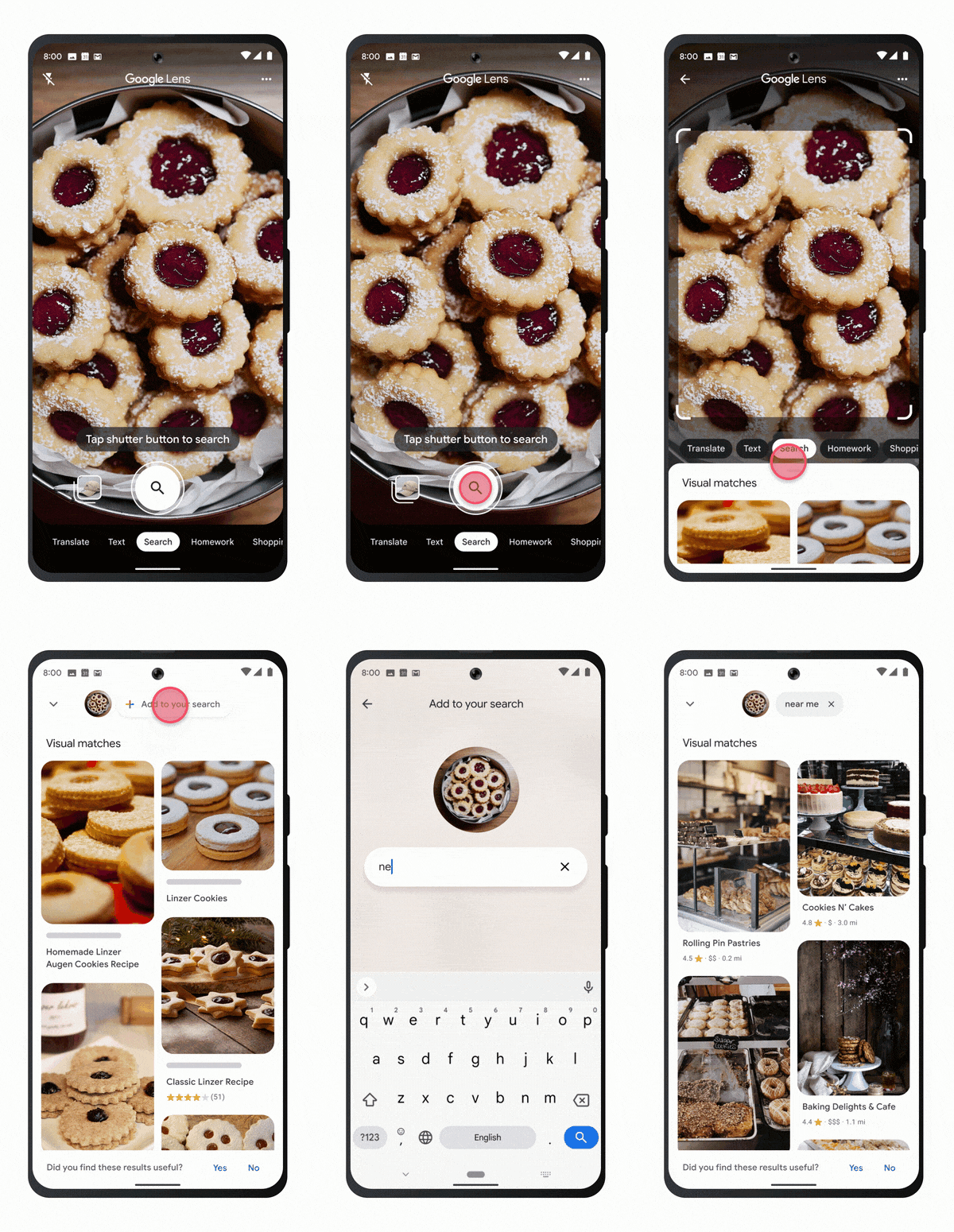
See a food dish you think looks tasty and it makes you hungry? Well, now with Google Lens, you can take a photo of that dish and add then type “near me” in Google Multisearch to have Google show you restaurants where you can order that dish off their menu.
“This new way of searching will help me nd local businesses in my community, so I can more easily support neighborhood shops during the holidays,” said Cindy Huynh, Product Manager, Google Lens.
This feature is launching today in English in the U.S. mobile search results.
Here is a GIF of that in action:
Search for specific dishes
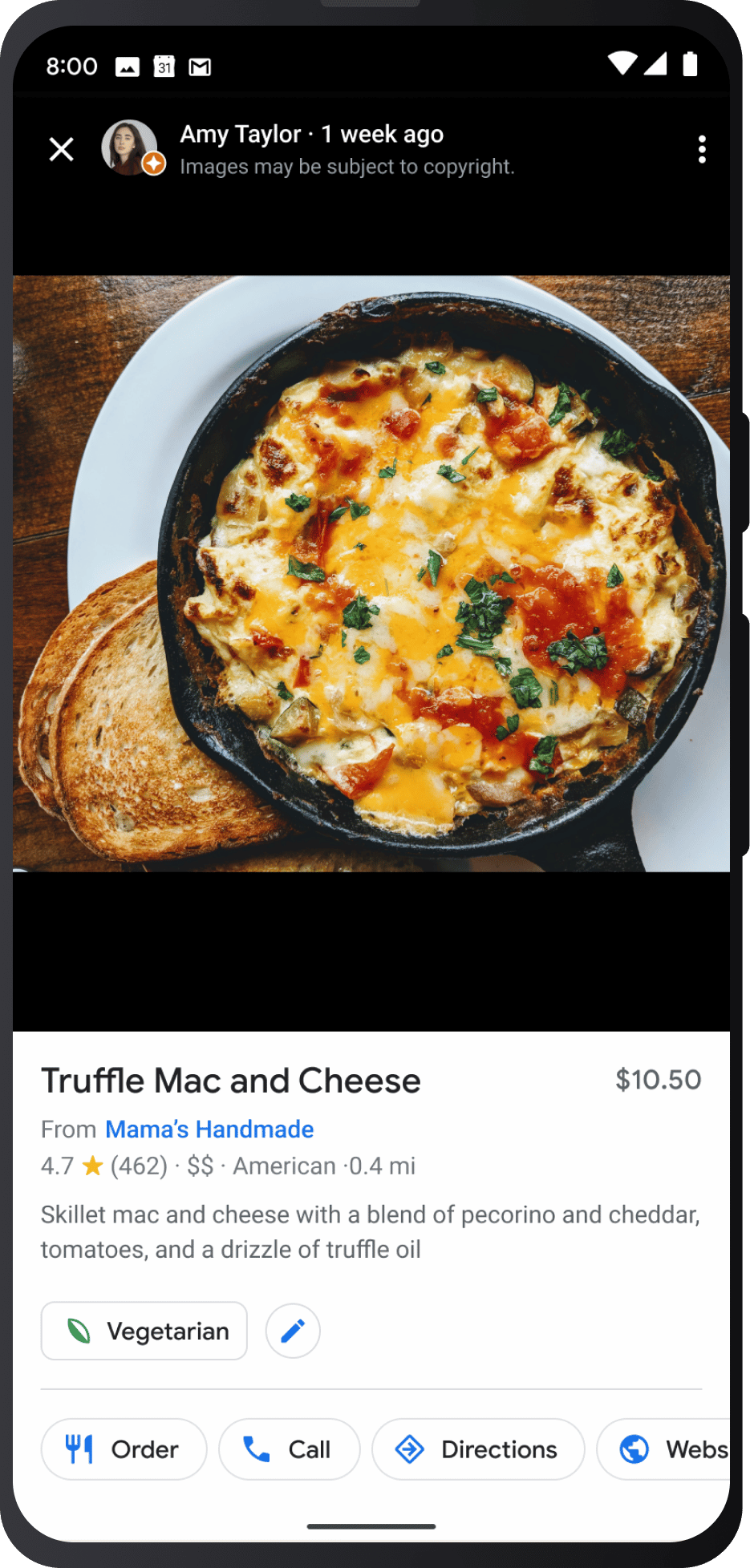
In addition to searching by photo for dishes near you, you can also type in your search to find those specific dishes. Google will show you nearby restaurants to find this dish and Google will also give you more information about pricing, ingredients and additional menu information.
This feature is also launching today in English in the U.S. on mobile devices and in the Google app on Android and iOS.
Here is what it looks like:

Google Lens translate getting an upgrade
Google is rolling out a big update to the Google Lens augmented-related translate capabilities. This update lets searchers translate text on more complex backgrounds. Instead of covering up the original text, Google will erase the original text and recreate the pixels underneath with an AI-generated background, then Google will overlay the translated text on top of the image.
Google is using generative adversarial networks, also known as GAN models, to present the translated text better. It is the same technology Google uses in the Pixel devices as the “Magix Eraser” feature on photos.
Here is a sample showing how Google Lens is overlaying the translation in an easier way for searchers to comprehend:
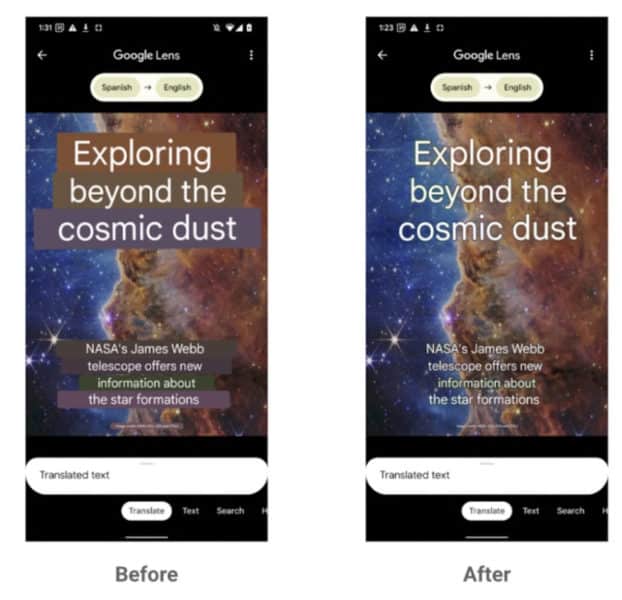
This is launching later this year, before the end of 2022.
Google Shopping with AR shoes
Google is also released shopping features to help you see shoes in AR, augmented reality, over your own shoes. Google said this new shopping AR experience for sneakers, allows you to spin, zoom and see shoes in your space. This will work across brands such as Saucony, VANS and Merrell.
Starts rolling out in the US today, Google said.
Here is a screenshot of what this looks like:

New shopping models for AR beauty
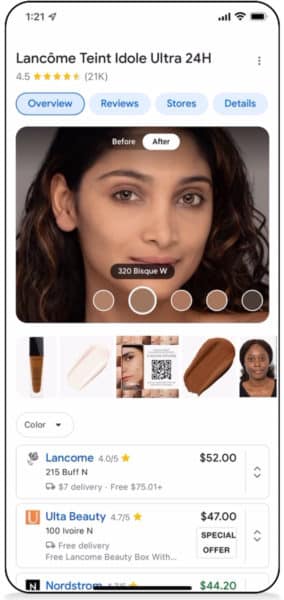
Also, Google has added new augmented reality search features for you to try product on models with various features, skin tones and more. Google added a new photo library with 150 models representing a diverse spectrum of skin tones, ages, genders, face shapes, ethnicities and skin types to help you accurately test over 2,000 foundation shades from a wide selection of brands.
This is a feature we covered a while back but now it is going live today in the US.

Google Maps live view search
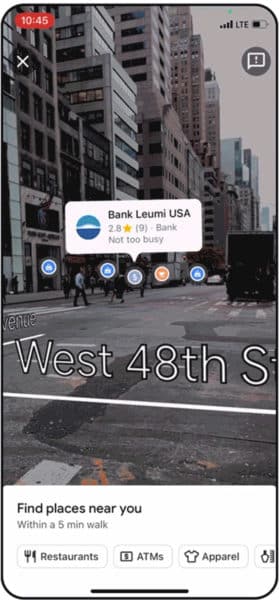
Now you can search and explore neighborhoods with augmented reality using the Google App on your phone. You can now take the Google Maps app on your phone, click on the camera icon and look through the screen to see overlays of what is right near you in real-time.
Google has been demoing this feature for some time but starting next week, this feature will start rolling out in London, Los Angeles, New York, Paris, San Francisco and Tokyo.
Here is a screenshot of what this looks like:
Google Maps adds EV charging filters and wheelchair accessibility
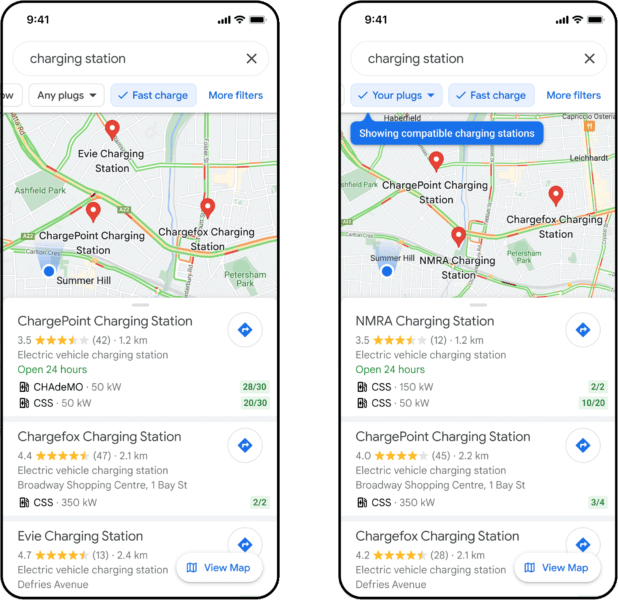
Google also added the ability to filter Google Maps for charging stations with fast-charging plugs, or stations with plugs compatible with your EV. This can show CSS and CHAdeMo charges that do 350kW or even 50Kw, plus Google may even show their availability. This will be available globally on Android and iOS wherever EV charging stations are available.
Plus, Google added filtering Google Maps for if a place has a wheelchair-accessible entrance thanks to the wheelchair icon on Google Maps. This will be available globally on Android and iOS wherever EV charging stations are available.
Why we care
If you or any of your customers are in any of these businesses and can leverage any of these features, you likely should as you may get more exposure from Google Search for doing so. As a searcher, these features are not just fun and useful but also, many are downright cool.
The post Google launches new search, shopping and maps features appeared first on Search Engine Land.
Courtesy of Search Engine Land: News & Info About SEO, PPC, SEM, Search Engines & Search Marketing
Category seo news | Tags:
Social Networks : Technorati, Stumble it!, Digg, de.licio.us, Yahoo, reddit, Blogmarks, Google, Magnolia.
Google launches new search, shopping and maps features
Written on November 17, 2022 at 1:21 pm, by admin
Google has announced a boatload of new search features across Google Search, Google Lens, Shopping and Maps all aimed at bringing search to more users in more helpful ways. These improvements cross over Multisearch, Google Leons, Google Shopping and Google Maps.
Note that some of these were announced at the Search On event a few months ago.
Find food through Multisearch
See a food dish you think looks tasty and it makes you hungry? Well, now with Google Lens, you can take a photo of that dish and add then type “near me” in Google Multisearch to have Google show you restaurants where you can order that dish off their menu.
“This new way of searching will help me nd local businesses in my community, so I can more easily support neighborhood shops during the holidays,” said Cindy Huynh, Product Manager, Google Lens.
This feature is launching today in English in the U.S. mobile search results.
Here is a GIF of that in action:
Search for specific dishes
In addition to searching by photo for dishes near you, you can also type in your search to find those specific dishes. Google will show you nearby restaurants to find this dish and Google will also give you more information about pricing, ingredients and additional menu information.
This feature is also launching today in English in the U.S. on mobile devices and in the Google app on Android and iOS.
Here is what it looks like:
Google Lens translate getting an upgrade
Google is rolling out a big update to the Google Lens augmented-related translate capabilities. This update lets searchers translate text on more complex backgrounds. Instead of covering up the original text, Google will erase the original text and recreate the pixels underneath with an AI-generated background, then Google will overlay the translated text on top of the image.
Google is using generative adversarial networks, also known as GAN models, to present the translated text better. It is the same technology Google uses in the Pixel devices as the “Magix Eraser” feature on photos.
Here is a sample showing how Google Lens is overlaying the translation in an easier way for searchers to comprehend:
This is launching later this year, before the end of 2022.
Google Shopping with AR shoes
Google is also released shopping features to help you see shoes in AR, augmented reality, over your own shoes. Google said this new shopping AR experience for sneakers, allows you to spin, zoom and see shoes in your space. This will work across brands such as Saucony, VANS and Merrell.
Starts rolling out in the US today, Google said.
Here is a screenshot of what this looks like:
New shopping models for AR beauty
Also, Google has added new augmented reality search features for you to try product on models with various features, skin tones and more. Google added a new photo library with 150 models representing a diverse spectrum of skin tones, ages, genders, face shapes, ethnicities and skin types to help you accurately test over 2,000 foundation shades from a wide selection of brands.
This is a feature we covered a while back but now it is going live today in the US.
Google Maps live view search
Now you can search and explore neighborhoods with augmented reality using the Google App on your phone. You can now take the Google Maps app on your phone, click on the camera icon and look through the screen to see overlays of what is right near you in real-time.
Google has been demoing this feature for some time but starting next week, this feature will start rolling out in London, Los Angeles, New York, Paris, San Francisco and Tokyo.
Here is a screenshot of what this looks like:
Google Maps adds EV charging filters and wheelchair accessibility
Google also added the ability to filter Google Maps for charging stations with fast-charging plugs, or stations with plugs compatible with your EV. This can show CSS and CHAdeMo charges that do 350kW or even 50Kw, plus Google may even show their availability. This will be available globally on Android and iOS wherever EV charging stations are available.
Plus, Google added filtering Google Maps for if a place has a wheelchair-accessible entrance thanks to the wheelchair icon on Google Maps. This will be available globally on Android and iOS wherever EV charging stations are available.
Why we care
If you or any of your customers are in any of these businesses and can leverage any of these features, you likely should as you may get more exposure from Google Search for doing so. As a searcher, these features are not just fun and useful but also, many are downright cool.
The post Google launches new search, shopping and maps features appeared first on Search Engine Land.
Courtesy of Search Engine Land: News & Info About SEO, PPC, SEM, Search Engines & Search Marketing
Category seo news | Tags:
Social Networks : Technorati, Stumble it!, Digg, de.licio.us, Yahoo, reddit, Blogmarks, Google, Magnolia.
SMX Next day 2 kicks off in 1 hour with Google’s Ginny Marvin
Written on November 16, 2022 at 9:19 am, by admin
Day 2 of SMX Next starts with a keynote from former Search Engine Land editor-in-chief and now Google Ads Liaison Ginny Marvin.
Marvin helps answer questions about how Google ads products and policies work and bring marketers’ insights and perspectives back to the teams working on them.
The keynote today will cover hot topics from 2022 including:
- How Google is preparing for a cookieless future.
- The importance of implementing GA4 now.
- How is GA4 a move toward a more privacy-centric landscape.
- Google Analytics vs 360 sunset dates.
- RSAs – will we ever be able to measure individual assets.
- What metrics Google uses to assign ratings to RSA assets.
- Automation and brand safety.
- Top three best practices for using automation for both lead gen and commerce.
- Marvin’s advice on irrelevant recommendations.
- Broad match keywords.
- A recap of 2022.
- What’s coming in 2023.
Grab your free pass now and join us online for this exclusive keynote with Google Ads Liaison Ginny Marvin.
The post SMX Next day 2 kicks off in 1 hour with Google’s Ginny Marvin appeared first on Search Engine Land.
Courtesy of Search Engine Land: News & Info About SEO, PPC, SEM, Search Engines & Search Marketing
Category seo news | Tags:
Social Networks : Technorati, Stumble it!, Digg, de.licio.us, Yahoo, reddit, Blogmarks, Google, Magnolia.