

Google Local Service Ads are now available for dentists
Written on January 10, 2023 at 8:27 am, by admin
Last week Google updated its Help Center to include a new vertical: Dentists.
The change was first noted by Matt Casady who wrote about the update on Local U. Carrie Hill posted about it on Twitter.
Great new vertical in LSAs! Jump on this one before your competitors do! https://t.co/8Wjupycczf
— Carrie Hill
(@CarrieHill) January 5, 2023

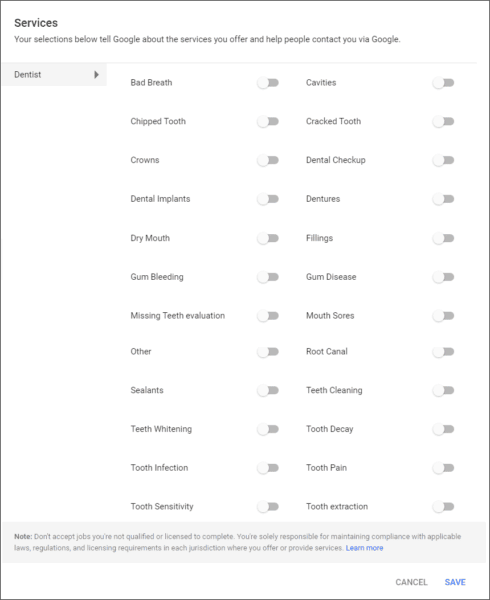
How it works. Prospective dentists will need to complete verification before being eligible to advertise.
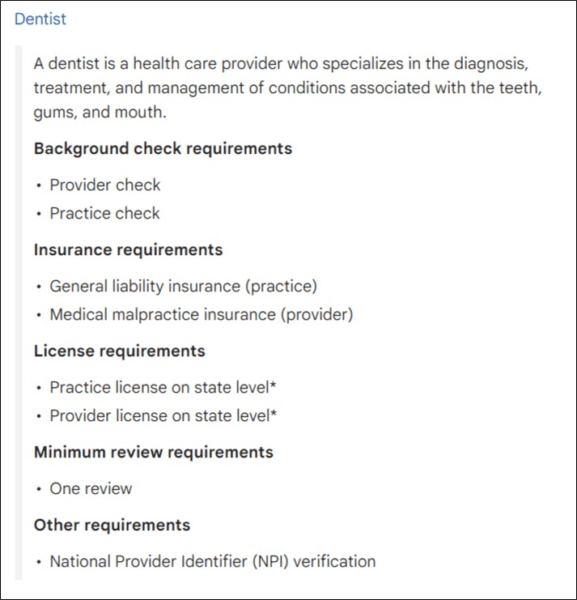
Why we care. If you’re a dentist or you’re running ads for a dentist, start going through the verification process now so you can get your LSA ads up as soon as possible!
The post Google Local Service Ads are now available for dentists appeared first on Search Engine Land.
Courtesy of Search Engine Land: News & Info About SEO, PPC, SEM, Search Engines & Search Marketing
Category seo news | Tags:
Social Networks : Technorati, Stumble it!, Digg, de.licio.us, Yahoo, reddit, Blogmarks, Google, Magnolia.
How to create an awards page that adds authority to your website (plus 7 examples)
Written on January 9, 2023 at 4:24 am, by admin
If you’ve racked up awards or accolades for your business, you’re not wrong in wanting to show them off.
Your achievements signify you’re doing a few things right, so why wouldn’t you display them on your website?
The key is to ensure you don’t look too company-focused or braggy – after all, a cardinal sin of content is using too much “I” or “we” language and forgetting to talk to your audience with “you” language.
To strike the right balance, you need to write an awards page that isn’t distracting or annoying, but rather adds credence to your brand and builds trust.
You want customers to say, “Wow, this company is really successful!” Not, “Yuck, this company is obsessed with itself.”
Let’s talk about how to create an awards page, including how having one builds trust with customers.
Why create an awards page on your website?
Awards pages can help establish your authority, giving your SEO a little boost.
How?
Awards are proof that you’re a force in your industry, doing exceptional work. Other people paid attention and recognized you for what you do, and now they’ve given you physical evidence of your company’s prowess.
Thus, those awards are trust signals to prospects and to search engines (E-A-T, anyone?).
For example, the Search Engine Land Awards are handed out yearly to marketers, teams, and agencies that demonstrate excellence in organic or paid search marketing initiatives or campaigns.
How to create an awards page that shows off your achievements – without turning people off (+ 7 examples)
Wondering how to create an effective awards page? Here are six tips with seven examples from real-life businesses that have done it well.
1. Consider creating a separate awards page
If you have earned a lot of awards over the years (good on you!), consider displaying them on a separate awards page.
For example, the University of Dundee in Scotland has a page dedicated to its awards, with additional pages that explain the context of each award.
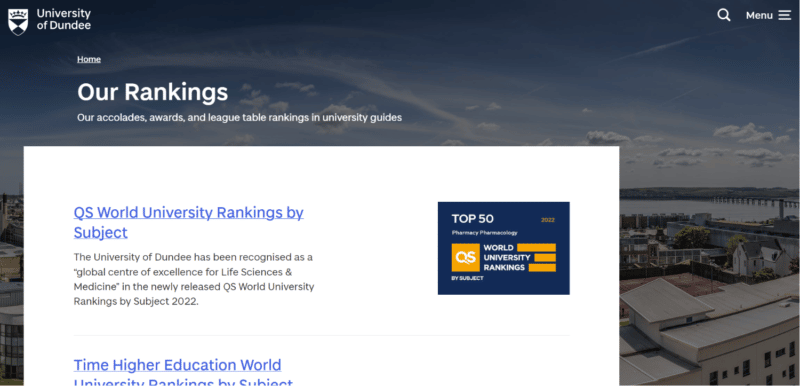 Rankings and awards page
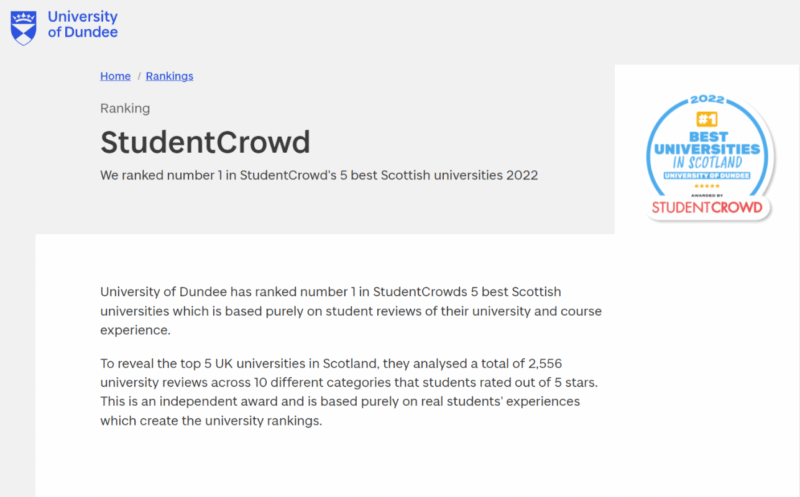 Individual award page
The awards page is linked under their “About” information, which is also a good practice.
This way, people who want to view your awards have an obvious place to click, while people who don’t care won’t be inundated with a long list to scroll through.
2. Include all your important awards, from most recent to least
If you’ve been winning awards for years, that says a great deal about your company and its legacy. If your award history goes back five, 10, 15, or even 20 years, don’t be shy about displaying your pattern of excellence.
That said, also consider the relevance of each award to your audience and whether they’ll care. For instance, if your company won an award for participation five years ago, you can probably leave that one out.
On the other hand, maybe you won “brand of the year” in an industry-wide contest five to 10 years ago – that’s relevant to your customers, your reputation, and your authority. Thus, you should display it on your awards page.
A good example of this in action is Liberty Mutual’s awards page – they have a long list of awards going back to 2016.

3. Include award badges or icons
Most awards come with small badges or icons for displaying on your website. In most cases, it’s a good idea to do so.
Why?
Because many of these badges come replete with their own recognition, especially among those in your industry. Displaying a recognizable (and perhaps coveted) badge is a really easy way for the people who matter to see it and register it in a second.
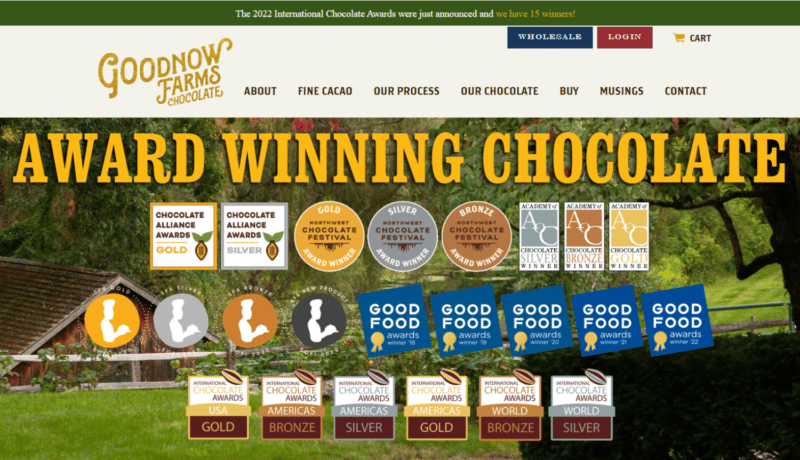
One huge tip – if you have a lot of awards badges, make sure they look clean and organized. Otherwise, your page could look messy and unprofessional, which is the exact opposite of what you want. A good rule of thumb is to keep them on the smaller side and organize them into a list or neat grid.
On the Goodnow Farms Chocolate homepage, they include a tidy list of badges as part of a photo carousel.
4. Briefly describe the context of each award
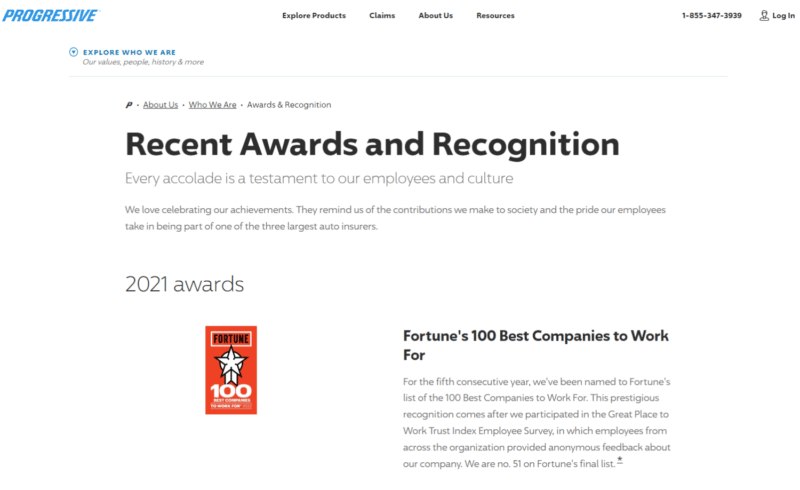
In many cases, simply listing out your awards isn’t enough. Why should customers care if they don’t know what that award means or signifies?
To that end, include a brief description of each award you’ve won, including how you were chosen – especially if customers voted for you (a giant trust signal). Progressive does a good job of this on its awards page:
5. For three or fewer awards, add them to your about page, the sidebar, or the footer
Don’t have a long list of accolades yet? Instead of creating a separate awards page, consider adding your awards badges to a dedicated section on your about page.
This also works if you have more than three awards, by the way, and is a smart strategy to draw attention to them without dedicating an entire page to them.
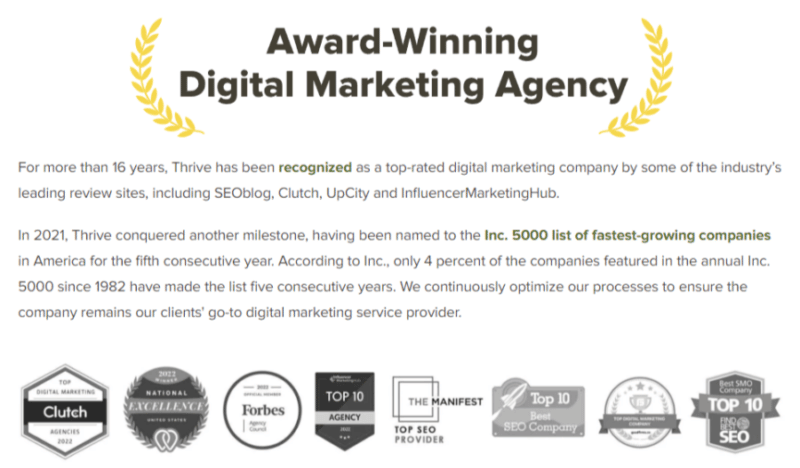
In this vein, Thrive has included a section dedicated to their awards on their about page. They use a simple paragraph to give some context along with an organized row of small badges, and it does the job nicely.
If you have one or two awards to your name, you should consider adding the badges to your sidebar or footer. These are unobtrusive places that benefit from remaining static across your site, so your awards will be displayed on every page.
Remember, you can always create an awards page later if you earn more.
6. More than 25 awards? Create an awards list
Let’s say your business rakes in the awards consistently. That’s incredible, and you have every right to humble-brag a little.
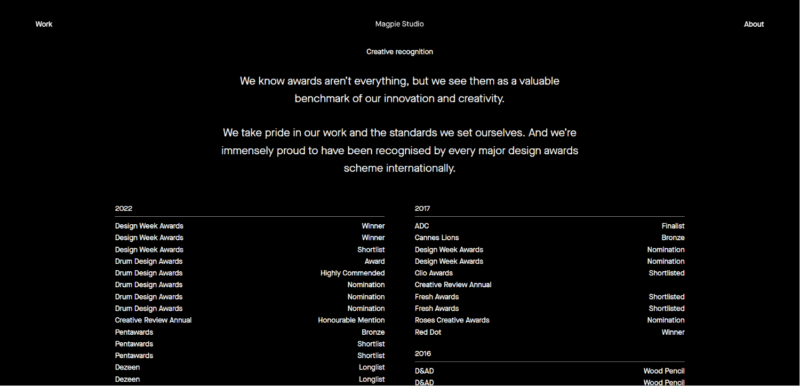
A smart and crafty way to display these awards is to create a list. The more awards you have, the more impressive it will look, especially at first glance.
Magpie Studios, a British design agency, does this to great effect. Their awards list is incredibly long and goes all the way back to 2011. Altogether, it makes a lasting impression that this is a company to be reckoned with.
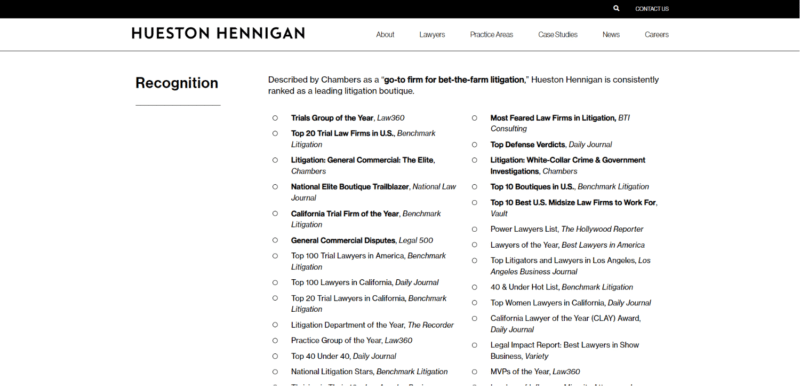
Another company that does this well is Hueston Hennigan, a law firm:
Remember: Awards pages are about authority and building trust
Never create an awards page without intention or a strategy. Just like your other website pages, an awards page has a purpose that will help you build toward reaching your goals.
It’s not about showing off but rather offering proof that your business is credible and trusted. To that end, only display awards your customers will care about and keep your page organized and easy to read.
Ultimately, a well-designed awards page is a good idea as long as you keep your customers, goals, and strategy in mind.
The post How to create an awards page that adds authority to your website (plus 7 examples) appeared first on Search Engine Land.
Courtesy of Search Engine Land: News & Info About SEO, PPC, SEM, Search Engines & Search Marketing
Category seo news | Tags:
Social Networks : Technorati, Stumble it!, Digg, de.licio.us, Yahoo, reddit, Blogmarks, Google, Magnolia.
This day in search marketing history: January 9
Written on January 9, 2023 at 4:24 am, by admin
AdWords Managed Accounts get shared negative lists across accounts
In 2017, Google added the ability to create and share negative keyword lists across accounts for Managed Accounts.
This was welcome news for advertisers who had been adding the same lists of negative keyword accounts manually or using a script to automate cross-account negative lists.
For accounts in a managed account, you could set up a single list of negative keyword in the top-level Shared Library that could then be associated at the account level.
Read all about it in: AdWords Managed Accounts can finally share negative keyword lists across accounts
Also on this day
DuckDuckGo, Info.com crowd out Bing in Google’s Android search options
2020: Bing would appear as an option in the United Kingdom only, while DuckDuckGo and Info.com will appear alongside Google in all 31 EU territories
Conductor launches SEO services marketplace for Searchlight users
2020: Agency and corporate customers could request managed services directly within the platform interface.
Google lets users see their related search history with new card
2019: Google started rolling out a new feature in search named “your related activity” that let signed in Google users pick up on previous searches related to the query they just added.
Google working to disable knowledge graph hack that shows misleading search results
2019: The trick made it possible to show any site for any query in the knowledge panel area.
Har Gobind Khorana Google doodle celebrates first chemist to construct a synthetic gene
2018: Google marked what would have been Har Gobind Khorana’s 96th birthday with a Doodle to celebrate the Nobel Prize winner’s accomplishments in the field of biochemistry.
Google is launching automated call extensions in mobile ads on February 6
2017: The call extensions would automatically pull phone numbers featured on landing pages.
Bing Ads shares Valentine’s Day CPC & CTR trends, including surprising mobile stats
2017: Mobile played a significant role, accounting for nearly half of all Valentine’s Day-related searches on Bing.
What Is The Mountain Of Butterflies? Google Doodle Marks 41st Anniversary Of The Natural Phenomenon
2016: For its first Doodle of the year, Google celebrated the 41st anniversary of the discovery of “The Mountain of Butterflies,” when a research team located millions of Monarch butterflies that had migrated to Mexico’s easternmost Sierra Madre Mountains.
Google Results For “Car Insurance” Could Look Different Very Soon
2015: Google finally seemed ready to launch its long-anticipated comparison site for car insurance.
Report: Yahoo Search Losing Firefox Users Who “Switchback” To Google
2015: An analysis showed a gradual but continual losses back to Google, and Yahoo’s share of Firefox 34 clicks dropped from 43% (Dec. 10) to about 36 percent
Search In Pics: SCU Basketball At Google, Android Professor & Framed Panda
2015: The latest images culled from the web, showing what people eat at the search engine companies, how they play, who they meet, where they speak, what toys they have, and more.
Google Preps “Hotel View” Interior 360 Imagery
2014: Google was photographing hotel interiors as part of an effort to enhance its travel content.
Simone De Beauvoir Google Logo Has Come To Stay In A Number Of Countries, Just Not The US
2014: A number of Google international homepages celebrated feminist writer Simone de Beauvoir’s 106th birthday with a Beauvoir-inspired Google logo, but there’s no sign of her on Google’s U.S. homepage.
Phone Support For Verification Issues With Google Local For Business
2013: Google offered phone support for businesses having issues with verifying their Google Maps listing.
Survey Shows Americans Confused By How Google, Facebook Make Money
2013: A striking 36% of respondents thought that search engines “sell users’ personal data to marketers.” Another 29% thought that “companies pay annual dues for use.”
Bit.ly Releases Search API To Discover Hot Stories & Discussions
2013: The new APIs let you search for top stories in real time over the Bit.ly URL network.
Class Action Lawsuit Against Google For Ads On Parked Domains Turned Down
2012: A lawsuit brought against Google in 2008 over the quality of ads showing on parked or error message web pages was thrown out by the court.
Koreans Accuse Google Of “Obstructing” Antitrust Investigation
2012: A Korean official asserted that Google has obstructed his agency’s investigation “by deleting key files from PCs and asking its employees to telecommute from home.” Google denied obstructing the inquiry and pledged cooperation with Korean government officials.
BBC Report: Google Admits Accepting Illegal AdWords In The UK
2012: Ads for illegal Olympic ticket resellers, ads for cannabis, and ads for fake identification cards and UK passports. All illegal, but all could be found on Google.co.uk
Google Has Well Over A Million Advertisers
2009: Google’s advertiser growth started at 89,000 in 2003, to 201,000 in 2004, 360,000 in 2005 and 600,000 in 2006. In 2009, one estimate said Google had between 1.3 million and 1.5 million advertisers.
Want To Rank Tops In Google? Do YouTube Videos, Stupid!
2009: A small but interesting study on how you can improve your chances, by 50 times, of showing up at the top of the Google search results: Utilize Google’s Universal Search by creating videos.
Ballmer: Do Yahoo Deal Sooner, Not Later
2009: Microsoft CEO Steve Ballmer said that a deal should happen within the next few months, due to Microsoft and Yahoo having new “leaders” in place.
Google Changes, Colorizes Favicon
2009: The new icon was inspired by user submissions as part of a contest.
Google Goes To The Inauguration
2009: Google/YouTube threw its first party for a U.S. president’s inauguration
Search Biz: Yahoo CEO Duel, MSFT Reconsiders Search Brand, MSN ‘Lewd’ In China & Google Won’t Buy Newspapers
2009: Roundup of personnel moves or speculation about who might get the top spot at Yahoo; the ongoing MicroHoo saga; and MSN being branded a “lewd” site in China for user-generated content.
Search In Pictures: Snow Reaches Yahoo, YouTube’s Phone Booth & The Google Bear
2009: The latest images culled from the web, showing what people eat at the search engine companies, how they play, who they meet, where they speak, what toys they have and more.
Google Changes Referral Policy For AdSense Referrals
2008: The two changes made to this referrals pricing structure only impact referrals to the AdSense product.
Real Time US Presidential Primary Results In Google Maps
2008: Google mapped the results of the New Hampshire U.S. presidential primary by candidate and county for both parties.
Microsoft Launches adCenter Add-in Beta for Excel 2007
2008: New features included Keyword Expansion, Keyword Search Volume Historical and Forecast, Keyword Buzz and more.
Google Hiring Investigator / Threat Analyst For Safety & Security
2008: The responsibilities included “investigating deviations from company policies or acts against Google as well as collection and analysis of information helping define and assess threats to Google’s operations and assets.”
Microsoft Provides Local Search Content To Garmin Personal Navigation Devices
2008: Users could get maps, news, weather, local events, and other content.
Google Updates Sky Images & Features In Google Earth
2008: Sky in Google Earth was updated with new content, features, and API integrations.
Jim Safka To Replace Jim Lanzone As CEO Of Ask.com
2008: Safka was previously the CEO of Match.com, IAC’s online dating company, from 2004 to 2007.
Yahoo Acquires MyBlogLog
2007: After several weeks of rumors, Yahoo has officially announced it has agreed to purchase the MyBlogLog service.
Google Named Fortune’s Best Place To Work, But Rich Early Employees Checking Out
2007: A third of Google’s first 300 employees had left the company, and the culture was getting more conservative
Google A “Frenemy” of Traditional Media?
2007: Google had no intention of competing with traditional media by creating content, but many media companies remained wary of Google.
Google Moon, Google Mars, Now Google Universe? Google Partnership With Space Telescope Project May Make UniTube Possible
2007: the company was getting involved with the Large Synoptic Survey Telescope. To be built in Chile, the LSST was planned to scan the sky on a continuous basis, allowing for “movie-like” looks at the universe.
Yahoo China Morphing Into A Business Portal
2007: Due in part to deal with crushing competition from Baidu.com and portal Sina.com.
Fraudwall, New Anti-ClickFraud Company Funded
2007: The company raised millions in venture capital to help online advertisers identify click fraud using statistics, user modeling, machine learning, and IP forensics”
Past contributions from Search Engine Land’s Subject Matter Experts (SMEs)
These columns are a snapshot in time and have not been updated since publishing, unless noted. Opinions expressed in these articles are those of the author and not necessarily Search Engine Land.
- 2020: The dangers of misplaced third-party scripts by Hamlet Batista
- 2018: Best practices for qualifying your link opportunities by Ryan Shelley
- 2018: 5 content distribution strategies for 2018 by Sherry Bonelli
- 2017: Essential voice search strategies for 2017 by Sherry Bonelli
- 2017: 5 B2B marketing tips to jump-start your 2017 results by Jessica Cameron
- 2015: Everything You Need To Know About Google’s Local Algorithm, Pigeon by Neil Patel
- 2014: The Bing Dilemma: What To Do With The Little Search Engine That Can’t by Nathan Safran
- 2014: Google PLAs May Be Bigger And Better Than You Think by Mark Ballard
- 2013: What Does The Re-emergence Of Display Mean For SEM? by Gus Spathis
- 2013: If Your Landing Page Could Talk, What Would It Say? by Brian Massey
- 2012: Tips For Managing Negative Keywords In PPC Campaigns by Matt Van Wagner
- 2012: 6 Mobile Search Optimization Trends For 2012 by Bryson Meunier
- 2012: Large-Scale Content Optimization Tactics For Enterprise Sites by Adam Sherk
- 2009: An Update On Javascript Menus And SEO by Jonathan Hochman
- 2008: 5 Ways To Make 2008 Pay Off Big by Dave Feldman
- 2008: B2B Marketing: Blind Date To White Wedding by Jon Miller
- 2008: Where SEO Belongs In The Web Site Development Cycle by Jessica Bowman
< January 8 | Search Marketing History | January 10 >
The post This day in search marketing history: January 9 appeared first on Search Engine Land.
Courtesy of Search Engine Land: News & Info About SEO, PPC, SEM, Search Engines & Search Marketing
Category seo news | Tags:
Social Networks : Technorati, Stumble it!, Digg, de.licio.us, Yahoo, reddit, Blogmarks, Google, Magnolia.
This day in search marketing history: January 8
Written on January 8, 2023 at 12:22 am, by admin
Intent research vs. keyword research
In 2020, Frédéric Dubut of Bing told us: “Keyword research are probably going to become slowly obsolete and you’ll need to switch to intent research as a practice.”
Barry Schwartz asked Google’s John Mueller about Dubut’s statement. Here’s what Mueller said:
- “There’s probably always gonna be a little bit of room for keyword research because you’re kind of providing those words to users. And even if search engines are trying to understand more than just those words, showing specific words to users can make it a little bit easier for them to understand what your pages are about and can sometimes drive a little bit of that conversion process.”
So, is keyword research obsolete yet? In 2023, there definitely has been a significant shift in the way SEOs think about user intent, or the search intent behind a query. But keyword research is still far from obsolete.
Read all about it in Google’s John Mueller on intent research vs keyword research for 2020.
Also on this day
Halting campaigns shouldn’t be your only brand safety precaution
2021: How advertisers responded to the storming of the Capitol and the cases for and against pausing ads in times of disruption.
Google’s John Mueller on intent research vs keyword research for 2020
2020: Search engines continue to get better at understanding intent and rely less on keywords. But Mueller wouldn’t go as far as to say keyword research practices will or should go away anytime soon.
Google handles reconsideration requests in batches
2020: John Mueller said that the Google team goes through reconsideration requests in batches, so sometimes it can feel like there is a backlog.
With Bing Pages, brands can manage their profiles across Microsoft products, including Bing Search
2020: Page owners could use Bing Pages to aggregate social media links, publish contact details, customize Outlook profiles with images and content and promote social media posts.
Video: Brian Dean on growing YouTube subscribers and the nofollow link change
2020: In this installment of Barry Schwartz’s vlog series, he chatted with Dean about making good quality videos, the nofollow link attribute change and more.
Need to expedite page removal in Google’s search index? Try a temporary sitemap file
2019: if you have hundreds or thousands of pages, removing URLs one by one can be time-consuming. What tocan you do? Use temporary sitemaps, according to John Mueller.
Google Assistant updates: Airline check-ins, hotel bookings, language translation and Maps
2019: Google was working hard to make the Assistant (and by extension, Home) a transactional platform.
Machine vs. man: What really matters for SEO success
2019: Lily Ray on changes to how sites are evaluated, dealing with traffic drops due to algorithm changes, Google’s search quality rater guidelines and more.
Google to roll out new Search Console features in coming weeks
2018: Verified users in Google Search Console were about to get access the new Search Performance, Index Coverage, AMP status and Job posting reports.
Google removes addiction treatment ads from UK search results
2018: An investigation revealed an ongoing issue with middlemen bidding on the terms and receiving large kickbacks from the private centers where the searchers were ultimately referred to – a practice called “patient brokering.”
Google accidentally removes news publishers from Google News
2018: Google called it an “unintentional technical issue.”
It’s Google Home vs. Amazon Alexa at CES in the battle for the voice ecosystem
2018: Google and Amazon both announced new device partnerships; the Google Assistant would be on new “smart display” devices, more TVs, speakers and in cars.
Google announces solution to longstanding AMP cache URL display problem
2018: Google said it was making a change to stop displaying Google URLs, instead of the publisher URLs, in search results served from the AMP cache.
Search In Pics: GoogleBot & BB-8, Google Onesie & Tesla Model X
2016: The latest images culled from the web, showing what people eat at the search engine companies, how they play, who they meet, where they speak, what toys they have and more.
Google Now Bugs Remove Cards From Users While Google Now Tests Custom Background Themes
2015: Some users were missing their Google Now cards, which they rely on to see if there will be traffic on the way to work, how cold it may be or other useful information for their day.
AdWords Reach Reporting Moves To The Campaigns Tab
2015: Google moved the Reach and Frequency report out of the Dimensions tab to the Campaigns tab.
Bing’s New Best-Sellers Carousel Helps Readers Find Just The Right Book
2015: Microsoft’s search engine started displaying a carousel of New York Times best-selling books when searching for specific book genres.
Google France Homepage Goes “Je Suis Charlie” In Memory Of Charlie Hebdo Victims
2015: Google France added the “Je Suis Charlie” (“I am Charlie”) badge on its homepage, honoring the lives lost during the Charlie Hebdo massacre in Paris, France.
Yahoo’s News Digest App Is “Summly 2.0”
2014: CEO Marissa Mayer introduced the new news app at CES. Summly was acquired by Yahoo in March 2013 for an estimated $30 million.
Utah Has Highest Google Usage, West Virginia The Lowest
2014: Ad network Chitika released a new tool that provided a user percentage or traffic market-share breakdown of PC operating system and search usage on a state-by-state basis.
Google’s Matt Cutts On Publishers With Duplicate Content: Use The Canonical Tag
2014: In How should I address a small duplicate content issue?, Cutts said to use the rel=canonical tag to help consolidate the PageRank of the stories and avoid any issues with Google.
Report: US Search Ad Spend Rises 12 Percent YoY In Q4 2013; Smartphone CPCs Drop
2014: IgnitionOne released its fourth quarter Digital Marketing Report, showing that the paid search market in the US continued to grow.
Google Fixes Definition URLs, Makes Them Clickable Links
2013: The URL shown under the definition previously wasn’t clickable. Instead, the only way to click through to the source of the definition was to use the smaller Source link at the bottom of the box.
Google Is Hiring Someone To Find Ways To Make You Want To Search While Signed-In
2013: “As Product Marketing Manager within the search growth team, you will be responsible to developing plans, creatives, campaigns and programs to increase the number of user’s signed in.”
Google, Mobile Search And The Paradox Of Competition
2013: How much does Google figure into the “future of search,” whose advances will largely be determined by mobile and non-traditional devices? That was a hard question to answer.
2011: The Year Google & Bing Took Away From SEOs & Publishers
2012: Danny Sullivan called 2011 “alarming.” Why? Because after years of moving forward, the search engines took a big step back, withholding both linking and keyword data.
The Big List: 168 Marketing Trends, Predictions & Resolutions For 2011
2011: A huge collection of trends, predictions and resolutions on paid search, SEO, local/mobile and more.
Google Mulling Several Ways To Integrate Ads On Maps
2010: Several articles speculated about or discussed ads on Google Maps (PC and mobile).
Yahoo To Keep BOSS In Microsoft Deal, May Charge In Future
2010: Some of the results would be powered by Yahoo, while the search results in BOSS (Build your Own Search Service – a Yahoo Developer Network initiative to provide an open search web services platform) would be powered from Microsoft Bing.
A Year Later, Yahoo’s CEO Gives Herself A B-Minus
2010: Said Yahoo CEO Carol Bartz: “It was a little tougher internally than I think I had anticipated, I did move fast, but this is a big job.”
Where’s AP In Google News? Apparently In Limbo, As Contract Running Out
2010: Associated Press stories – hosted by Google itself — were no longer appearing in Google News. Google had not added any new AP content since Dec. 24.
Google Fast Flip Now On Google News Home Page
2010: The company’s experimental news reading tool became part of the Google News home page, while also still remaining a Google Labs project.
Submit Your Google Spam Suggestions For 2009
2009: An annual tradition, Matt Cutts of Google’s Search Quality team asked for feedback on things Google should work on in relation to search spam.
Are PPC Budgets Increasing Or Decreasing In These Recessionary Times?
2009: 25% of Rimm-Kaufman’s clients increased their PPC spend 2008 Q4 vs. 2007, while 75% pulled back PPC spend.
Google Testing New AdWords Budgeting Option: Timeframe
2009: Timeframe gave advertisers a new budgeting method that automatically adjusted the daily budget based on traffic to reach a set dollar budget as per the calendar month.
Google SMS Search Is Down … For The Count?
2009: “Sorry, ‘[search term]’ did not return any results”.
Google StreetView, GPS Save Kidnapped Girl
2009: Police tracked the girl’s cell phone with GPS and then confirmed her whereabouts in Virginia, using StreetView.
Microsoft To Buy Fast Search For $1.23 Billion
2008: Microsoft got a market-leading enterprise search company and a world-class web crawler (not to mention some of the smartest engineering talent in search).
Google & YouTube TVs Powered By Panasonic
2008: Matsushita Electric Industrial, the company behind Panasonic, said the TVs would enable users to browse and watch YouTube videos from their TVs.
Yahoo’s Yang Outlines Vision For An Integrated, Open Yahoo 2.0
2008: Search appeared to be a piece of the overall approach but not the core here; community and trusted content sources are emphasized.
Sony In Video Deal With Google & Viacom Deals With Five Competing Online Video Providers
2008: Sony announced a deal to provide Google’s YouTube five-minute clips of some of their most popular TV shows, including “Married With Children” and “Newsradio.”
Open Letter To Wikipedia Editors: Yes, Matt Cutts Is Notable
2007: That time when Matt Cutts’s Wikipedia’s page almost got deleted.
Court OKs Narrow Use of Competitor Trademarks in Search Ads & Meta Tags
2007: A U.S. District Court ruled that the use of keyword-triggered ads and keyword metatags using trademarked terms cannot confuse consumers if the resulting ads/search results don’t display a competitor’s trademarks.
An Open Letter to Paid Search Networks
2007: Search marketer Jeffrey Rohrs published an open letter to paid search providers asking critical questions about billing practices, transparency, click fraud and other issues
Yahoo Introduces Yahoo Go 2.0, Mobile Search & Other Apps
2007: While second to Google in Web search, the company was hoping it could lead the market for mobile search and associated advertising with a new offering tailored for use on handsets.
Search Engine ChaCha Announces $6 Million Round
2007: ChaCha employed a network of live guides to help answer user queries in real time in addition to providing traditional algorithmic search.
Advertisers Cutting Google AdWords Spending With Surge of Keyword Prices
2007: Why were advertisers cutting their PPC ad spend significantly in 2007? Because many of the keyword prices have resulted in advertisers being priced out of profitability.
From Search Marketing Expo (SMX)
Past contributions from Search Engine Land’s Subject Matter Experts (SMEs)
These columns are a snapshot in time and have not been updated since publishing, unless noted. Opinions expressed in these articles are those of the author and not necessarily Search Engine Land.
- 2020: Here’s some data to help you understand how to rank better with your brand name by Brian Patterson
- 2019: Learn how one startup doubled CPL and saved money by Duane Brown
- 2018: What the development of visual search will mean for SEO by Kristopher Jones
- 2016: Is Your Account Leaking Money? The Importance Of Query Mapping by Amy Bishop
- 2016: How To Ensure Your SEO Recommendations Get Implemented by Winston Burton
- 2015: What Yahoo’s Firefox Deal Tells Us About Paid Search In 2015 by Mark Ballard
- 2015: AdWords Scripts For Every Level: Part 4, A Real World Use Case (Free Script Included) by Ginny Marvin
- 2014: For SMBs, The Time Is Now To Embrace Search Advertising by John Cosley
- 2013: Why Is Search Engine Results Personalization A Driver For Using Local Domains Internationally? by Andy Atkins-Krüger
- 2013: Propel Promotion Of Your Content: 9 Ways I Promote Sharing Online by Jordan Kasteler
- 2013: 3 Areas That Get Overlooked When Building Links In A Bubble by Julie Joyce
- 2010: 5 Web Analytics New Year Resolutions by Ben Gott
- 2010: Ecommerce Usability Showdown: Affiliate VS. Merchants by Gab Goldenberg
- 2010: Testing In 2010: Tips & Ideas To Get You Started by Carrie Hill
- 2010: The Convergence Of Web Search & Site Search by Shaun Ryan
- 2009: SEO Trends From 2008 & A Look Into 2009 by Jill Whalen
- 2008: New Year’s Resolutions For Your PPC Campaigns by Brad Geddes
- 2008: 10 Simple Steps To Social Media Success In 2008 by Chris Winfield
< January 7 | Search Marketing History | January 9 >
The post This day in search marketing history: January 8 appeared first on Search Engine Land.
Courtesy of Search Engine Land: News & Info About SEO, PPC, SEM, Search Engines & Search Marketing
Category seo news | Tags:
Social Networks : Technorati, Stumble it!, Digg, de.licio.us, Yahoo, reddit, Blogmarks, Google, Magnolia.
This day in search marketing history: January 7
Written on January 8, 2023 at 12:22 am, by admin
The Spam Clock
in 2011, startup search engine Blekko launched a spam clock that estimated 155 million spam pages had been created since Jan. 1 of that year. Blekko said 1 million spam pages were being created every hour.
How bad was Google’s spam problem then? Big. But as Danny Sullivan pointed out at the time, it was hard to judge whether Google’s relevancy had actually decreased, because:
- We expect more from Google than we do in the past, searching for things we might not have in previous years
- We don’t remember all the successful searches, focusing on when things go bad.
- We probably don’t do a comparison check on Bing or Blekko to see if they performed better, nor do we use those services on a regular basis to understand if they’re also “failing” to the degree we might feel Google does.
- Our expectations of Google are higher.
Read all about it in Blekko Launches Spam Clock To Keep Pressure On Google.
In about a month, Google would start making moves to correct its perceived, growing relevancy problems with the Panda Update.
I don’t even want to think about how much spam has been created since the start of this year – especially with the explosion that is ChatGPT.
Also on this day
Google Ads to allow ads for sport betting in New York
2022: Google Ads updated its gambling policy to allow ads for sports betting from certified and state-licensed entities in New York State.
Google AdSense related search experiments re-enabled
2022: After eight months on pause, AdSense publishers could once again create Related search style experiments.
Google My Business launches new performance reporting
2021: The new reports provided 6 months of data on how people interacted with you (calls and messages) and how people discovered you (the search term used to find your Google business listing in Google Search and Google Maps).
Google working on fixing data in URL parameter tool
2020: Google was working on fixing a data issue with the URL parameter tool, a legacy tool within Google Search Console that let SEOs communicate to Google insignificant page variations and direct Google to consolidate those URLs.
Google tests user comments for live TV shows
2020: The user comments appeared in the search results for queries related to live TV shows. It was similar to Google’s live sporting events feature.
Direct site navigation via voice arrives on iOS Bing Search app
2020: The updated Microsoft Bing Search App also had a new look featuring a carousel of common search categories.
Google’s Rich Results testing tool now supports code editing
2019: You could now edit the code in the rich results test and see what those edits did in real time.
Google Manufacturer Center adds rich content, deeper analytics, expands availability
2019: A new “From the manufacturer” section in Google Shopping product pages could feature brand-supplied rich content.
Bing Ads’ AI-powered Performance Insights now available globally
2019: The tool provided an on-the-spot way to take action on performance changes in your accounts.
StrategiQ launches Spark, an SEO deployment platform
2019: The digital marketing agency’s new tool helped SEOs test and deploy SEO-related changes on their own without developer overhead.
Leading local SEO predictions: Reserve with Google will grow, real-time local inventory gets real
2019: GMB messaging, voice search optimization, local inventory data, Q&A and the decline of SMB websites are all explored.
Google Link Removal Requests Climb To 345 Million In 2014
2015: Torrent Freak study reveals the number of Google’s takedown notices were up 75% from 2013.
Report: Yahoo Search Share Up After Firefox Deal
2015: Yahoo saw a nearly 2 point search market share gain in the U.S. in the past month (10.4% vs. 8.6% year vs. year.)
Google Webmaster Tools Search Queries Adds Mobile Stats & No Longer Rounds Data
2014: Google’s John Mueller said, “data in the search queries feature will no longer be rounded / bucketed,” and you will start to notice these changes in Webmaster Tools in the next few days.
WordStream Updates Its Free Google AdWords Performance Grader: Now With Mobile And Automatic 30-Day Reporting
2014: The tool was refined to give advertisers performance benchmarks within their own industries
Zora Neale Hurston Google Logo Marks The 123rd Birthday Of The Harlem Renaissance Writer
2014: The Doodle paid tribute to one of the 20th century’s most celebrated African American female writers.
Twitter Co-Founder Biz Stone Launches New Social Search App Jelly
2014: Calling itself a “new way to search,” ultimately, Jelly would follow the path of social Q&A platform pioneers failures like Ask.com, Quora, Yahoo Answers and Google Answers.
Stats On Mobile Content & Impact On Google Rankings
2013: Having mobile-optimized and rendered content was highly correlated with getting organic traffic from Google.
Library Of Congress Struggling To Make A Searchable Twitter Archive
2013: The Library of Congress was working on plans to create a searchable archive of nearly every public tweet ever sent, but the challenges inherent in that task were making it a slow process.
Google Logo Honors Addams Family Creator, Charles Addams
2012: The black-and-white Doodle featured seven characters from “The Addams Family.”
Bing Adds FanSnap Ticket Inventory Into Search Results
2011: Just in time for the opening round of the NFL playoffs.
Quora Co-Founder Outlines Plans To Deal With Growing Pains
2011: Co-founder Charlie Cheever admitted it had been “a big challenge” to maintain Quora’s character while the site has been flooded with new users.
Bad Directions: Google Maps Sends Local Listing Reports To Wrong Business Owners
2010: Google sent out its Google Local Business Center updates – but the emails didn’t go to the actual business owners.
Armstrong: Google Gets “First Dibs” At AOL Search Deal
2010: AOL’s CEO, Tim Armstrong and former Google executive, said Google (not Microsoft Bing) would get “first dibs” at a search deal.
Yahoo & American Airlines Settle Search Ad Suit
2010: The two companies reached a settlement prior to judgment, although the terms of the settlement were not disclosed.
CES: Microsoft Expands Scope Of HP Search Relationship To 42 Countries
2010: Microsoft CEO Steve Ballmer announced that Bing would become the default search engine and MSN the default homepage on HP computers.
Earthquake: Real-Time Results On Google Make Up For Lack Of Other Content
2010: Google’s Earthquake OneBox didn’t catch it, but Google was saved by its integration of Twitter results.
French Wants To Tax Google & Others
2010: President Nicolas Sarkozy was exploring ways to tax Google and other online advertising companies based outside of France.
Bing Admits MSNbot Is Slow
2010: That was according to Brett Yount, a program manager for Bing, who said “it is well known in the industry that MSNbot is fairly slow.”
Google’s Near Me Now: A Yelp Killer?
2010: Spoiler alert: No, it was not.
Baidu Sued As Search Monopoly In China
2009: Leading Chinese search engine Baidu was sued by Chinese medical B2B marketplace Qmyy.com to prevent its site from being blocked or dropped by the engine.
Bruce Clay Releases Two New Tools
2009: One tool was named the Search Engine Optimization/KSP tool and the other was a toolbar called SEMToolBar.
Report: Sitemaps Decrease Crawler Response Time
2009: Test showed that submitting a sitemap to Google and Yahoo decreased the time it took Google and Yahoo to crawl the page.
Google Maps For Mobile Simplifies Directions
2009: Previously if users entered a business name on the Maps client as a directions end point, Google might not recognize it.
Bush: Fix Your “Miserable Failure” Googlebomb Legacy Before Obama Takes Office
2009: Bush should have stopped redirecting requests for his old biography to the current presidential home page. It left that page with a legacy of ranking for failure.
Microsoft Wins Verizon Mobile Search Derby
2009: Google and Microsoft were in tight competition for the mobile search partnership.
Search Biz: Yahoo-MSFT Update; Google’s 20% Time Changing & Google Router Coming Soon?
2009: The latest twist in the Yahoo-Microsoft saga: a new group was trying to takeover Yahoo with Microsoft’s money.
Deal Puts Microsoft Live Search On Dell Computers, Verizon Phones — Will It Help?
2009: Microsoft CEO Steve Ballmer announced several high-profile distribution deals for Live Search at CES.
Google Confirms Layoffs Of Contract Employees
2009: Google released “a substantial number” of its contract and temporary employees, but the exact number wasn’t known.
Search Wikia: Not Even A Remote Threat To Google
2008: “Widely hyped … it’s really just yet another crappy search service that may, potentially, if all goes well, eventually turn into something useful.” See also: Wikia Search Launches Alpha Version
Googler’s Bet Goobles On Predictive Markets During Their Free Lunch
2008: Why did Google encourage this activity from their employees? Google believed it generated creative ideas from their employees.
David Hirsch Leaving Google & Omid Kordestani Sells 6,000 Shares Of Stock
2008: David Hirsch, the Director, B2B Vertical Markets Group at Google, was leaving at the end of the month to help invest and advise startups.
Yahoo Makes Bid To Become A Mobile Development Platform
2008: There were essentially three pieces to what Yahoo announced: Yahoo Go 3.0, an open mobile widget development platform for third parties, and a redesigned mobile WAP homepage that emphasized personalization and customization.
Google, AOL, Yahoo, & Digg Sued For Playing Online Solitaire
2008: Google, Yahoo, AOL, and Digg were all sued by Sheldon F. Goldberg for patent infringement.
From Search Marketing Expo (SMX)
Past contributions from Search Engine Land’s Subject Matter Experts (SMEs)
These columns are a snapshot in time and have not been updated since publishing, unless noted. Opinions expressed in these articles are those of the author and not necessarily Search Engine Land.
- 2017: Cut The Fat: How To Reduce Wasted Ad Spend In Your AdWords Account by Jacob Baadsgaard
- 2017: How Apple Could Play Spoiler For The Search Ad Business by Mark Ballard
- 2017: Marriage Equality, Healthcare & Low Unemployment: How Search Marketers Can Make A Difference This Tax Season by Purna Virji
- 2015: Reaching The Modern Family: Cross-Device Advertising Is A Must by John Cosley
- 2014: 14 Link Resolutions for 2014 by Julie Joyce
- 2013: Why You Need To Complement Your In-House Team With External Expertise by Eric Enge
- 2013: My 3 Mobile SEO Resolutions For 2013 by Bryson Meunier
- 2013: Five Steps To Successfully Navigate Negative Online Reviews by Neg Norton
- 2013: A Search Marketer’s Guide To Google Display Advertising, Part 3 by Matt Van Wagner
- 2011: Reputation Conversations Start With Search Results by Andy Komack
- 2011: How Human Factors May Affect Information Indexing And Retrieval by Kim Krause Berg
- 2009: Considering In-House SEO? How To Ease Into In-House SEO Smoothly by Jessica Bowman
- 2008: What Does 2008 Have In Store For Local? by Greg Sterling
- 2008: Don’t Blame Google For Your Own Linking Failures by Eric Ward
< January 5 | Search Marketing History | January 7 >
The post This day in search marketing history: January 7 appeared first on Search Engine Land.
Courtesy of Search Engine Land: News & Info About SEO, PPC, SEM, Search Engines & Search Marketing
Category seo news | Tags:
Social Networks : Technorati, Stumble it!, Digg, de.licio.us, Yahoo, reddit, Blogmarks, Google, Magnolia.
Google’s December 2022 helpful content and link spam updates still rolling out
Written on January 6, 2023 at 8:21 pm, by admin
Google said the two different Google search algorithm updates – the December 2022 helpful content system and the December 2022 link spam update – may take another week or two to complete their rollout.
The helpful content update started Dec. 5, and the link spam update started on Dec. 14.
The algorithm update rollouts were supposed to be completed within two weeks, but clearly that has not happened.
Google’s new statement. Danny Sullivan, Google’s Search Liaison, said on Twitter that these two updates will complete “likely within two weeks, maybe only one” week but he added that it is “not a guarantee” and “timings might change.”
Why the delay? The rollouts are taking longer because of the holidays. Sullivan said earlier on Mastodon, “Both the updates are continuing to rollout. Normally these types of updates would have concluded by now, but rollouts can slow or pause when we get into the holiday periods.”
Why we care. As I said above, both updates are still rolling out at the time this was published. It is very hard to accurately say that one ranking change in aggregate is related to a specific ranking update when both are rolling out at the same time. That being said, it is likely easier to look at individual sites and know if the site was hit by a link algorithm versus a helpful content algorithm, especially if you look at the links and content for that site.
We have some early data on the impact of some of these updates, but this long rollout has made it really hard to measure accurately.
So you will need to do the due diligence and dig into sites impacted by each update on an individual basis. This just shows you that it appears that these updates did show movement and did cause ranking volatility in aggregate.
The post Google’s December 2022 helpful content and link spam updates still rolling out appeared first on Search Engine Land.
Courtesy of Search Engine Land: News & Info About SEO, PPC, SEM, Search Engines & Search Marketing
Category seo news | Tags:
Social Networks : Technorati, Stumble it!, Digg, de.licio.us, Yahoo, reddit, Blogmarks, Google, Magnolia.
Google and Meta are losing their edge as TikTok, Amazon, Instacart ads grow
Written on January 6, 2023 at 8:21 pm, by admin
2022 marked the first year since 2014 that Google and Meta’s advertising market share dropped below 50%, standing at 48.4%. By the end of 2023, that number is expected to drop to 44.9%.
What’s going on. Amazon, ByteDance’s TikTok and streaming services like Netflix are continuing to increase their foothold. People are spending less time online on sites like Google and Meta, so it’s no surprise that they’re facing hurdles, despite still growing (albeit slower than other digital ad platforms).
Meta and other platforms also suffered from Apple’s iOS14 update in 2021, which required apps on its devices to ask users if they wanted to be tracked. The majority of iPhone users opted not to be. Google was not affected by this update, as it relies on customer intent, revealed by a user’s search terms.
The TikTok effect. Marketers want more options, and TikTok is it. TikTok’s hold on the digital ad market more than doubled in 2022, while Amazon gained market share due to its ad business being able to target users by their purchases and browsing history.
The Washington Post reported that “Supergut Chief Executive Marc Washington said the maker of gut-health products used to spend about 80% of its ad budget on Meta’s Facebook and Instagram platforms, with the rest going to Google. In early 2022, he noticed that the cost of bringing in new customers through advertising on Meta’s platforms was twice as high as it was before Apple’s privacy changes. Supergut shifted about half of what it spent on Meta to TikTok, a short-form video platform popular with younger audiences.”
Insider Intelligence said that TikTok’s command of the digital ad market more than doubled in 2022 and has nearly 100 million U.S. monthly active users. However, its overall share remained small, at just 2% of U.S. digital ad spending.
Amazon continues to grow. Amazon accounted for 11.7% of U.S. digital-ad spending last year and is poised to grow to 12.4% in 2023, Insider said.
“Our advertising is at the point where consumers are ready to spend,” Amazon Chief Financial Officer Brian Olsavsky said on the company’s October conference call.
Other retailers have followed in Amazon’s footsteps by building digital-ad businesses based on their consumer data, known as retail media networks. Combined, Walmart Inc., eBay Inc., Etsy Inc. and Instacart took in about 1.4% of digital-ad dollars spent in the U.S. last year, according to Insider.
Microsoft & Netflix. We can’t talk about Netflix without talking about Microsoft. Last year they announced a partnership to bring an ad-supported subscription plan to Netflix. Vincent Létang, executive vice president of global market research at Magna, a media- investment firm that is part of Interpublic Group of Cos.‘ Mediabrands, called Netflix and Disney’s entry into the market “a game-changing moment” for ad-supported streaming. “They bring a potentially huge number of viewers,” he said, and a wealth of premium video content.
Why we care. Advertisers should be aware of emerging platforms, just as they should be aware of those experiencing a decline. Though most tend to predict these types of trends long before the numbers get published. But reports like this help solidify what many advertisers already know; diversification is key.
The post Google and Meta are losing their edge as TikTok, Amazon, Instacart ads grow appeared first on Search Engine Land.
Courtesy of Search Engine Land: News & Info About SEO, PPC, SEM, Search Engines & Search Marketing
Category seo news | Tags:
Social Networks : Technorati, Stumble it!, Digg, de.licio.us, Yahoo, reddit, Blogmarks, Google, Magnolia.
What to do when the wrong page ranks for a keyword
Written on January 6, 2023 at 8:21 pm, by admin
We’ve all heard about search engine optimization (SEO), but what about search engine de-optimization?
In one Search Off The Record episode, Martin Splitt, Gary Illyes, and Lizzi Sassman discussed de-optimization – the process of taking a page off SERPs. The goal of deoptimization is ranking the page that is most likely to attract qualified traffic and conversions.
If you’ve ever ranked the “wrong” page for a keyword, this article is for you. Get ready to learn the de-optimization process so you can earn clicks from qualified traffic and increase conversions.
How can you tell if the wrong page is ranking?
The purpose of deoptimization is to remove a page driving the wrong type of traffic to your site. Sometimes you might benefit from removing a page from SERPs entirely. Other times, you might want to replace the page that ranks with a more suitable page.
In the de-SEOing episode, Sassman shares an anecdote where site visitors landing on a particular document, listed on Page 1, were not the right types of traffic.
Sassman said this became clear from feedback coming from users visiting their page. The ranking page caused some misunderstandings. Web users started to submit requests for tasks that were not relevant. As a result, users weren’t satisfied and internal teams were busier handling irrelevant support tickets they could not solve.
The page was generating traffic, but it was the wrong type of traffic. There was a mismatch between what the user was looking for and the page they were landing on.
Ranking the wrong page in SERPs is not unusual. Recognize when you’re ranking the wrong page by looking out for:
- Pages that earn traffic but not conversions.
- Queries from users that don’t make sense for the business offering.
- Pages that were commissioned to achieve a certain goal but are falling short of expectations.
- Articles ranking for conversion keywords that would be better placed on a revenue-generating page (product page, product category, or landing page).
Get the daily newsletter search marketers rely on.
<input type=”hidden” name=”utmMedium” value=”” />
<input type=”hidden” name=”utmCampaign” value=”” />
<input type=”hidden” name=”utmSource” value=”” />
<input type=”hidden” name=”utmContent” value=”” />
<input type=”hidden” name=”pageLink” value=”” />
<input type=”hidden” name=”ipAddress” value=”” />
Processing…Please wait.
Which page should you rank anyway?
Before attempting to rank any page in Google’s SERPs, it’s important to understand the search intent behind a keyword. Only then can you decide if the keyword is suitable for you to try and rank for and the type of page you should be creating.
You help determine which page should rank for a keyword by understanding how Google prioritizes pages based on its search intent.
Take a look at the annotated SERP example below. A search for “red running shoes” returns ecommerce category pages and image packs. The SERP suggests that the user is looking to buy red running shoes or view images of them. It’s a product-led SERP.
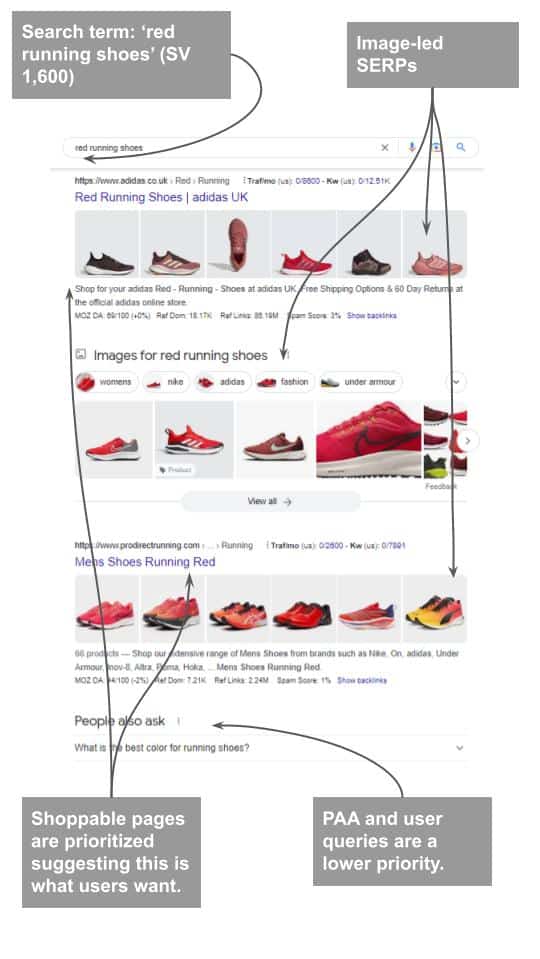
If ranking for red running shoes is your goal, then you should, at minimum, be able to match the intent in the SERPs by providing page users can buy red running shoes and include images.
Based on SERP analysis, you would not expect an article titled “the best red running shoes” to have a good chance of ranking for the search term ‘red running shoes’ because Google is not prioritizing articles in the SERP. Equally, if an article did rank, you would not expect this type of page to satisfy user intent for this particular search.
If you do have a page ranking that is earning traffic but failing to convert, you might want to consider deoptimization.
Below, we cover how to deoptimize a page in favor of a more suitable one.
Deoptimization explained
So you’ve got a page ranking that isn’t converting and you have another page on your site that would be better placed to rank for the target keyword.
How can you deoptimize a page while removing it from SERPs for the desired keyword and putting another page in place?
At this point, it’s important to note that you are at risk of losing your rank – and the traffic that comes with it – altogether. But the goal of SEO is not just to earn traffic but to earn qualified traffic that supports business goals.
If all you are losing is clicks and impressions you are not really losing anything.
Here’s a step-by-step guide to search engine deoptimization.
Step 1: Choose your desired ranking page
Before you do anything, you need to decide which page will rank for your desired keyword and why.
Start by conducting SERP analysis. Based on the prioritized results, decide which page on your site fits among what’s already ranking.
If the SERPs are full of articles, you likely need to write an article that satisfies user intent. If the SERPs prioritize ecommerce pages then you need to have the product to sell.
Step 2: Assign keywords to pages
For the best chance of ranking any page, you need to be the most useful page on the web.
Make sure you cover a topic in full. Look at what’s ranking and which keywords return the same type of content. You can use this data to inspire sections of content on your page.
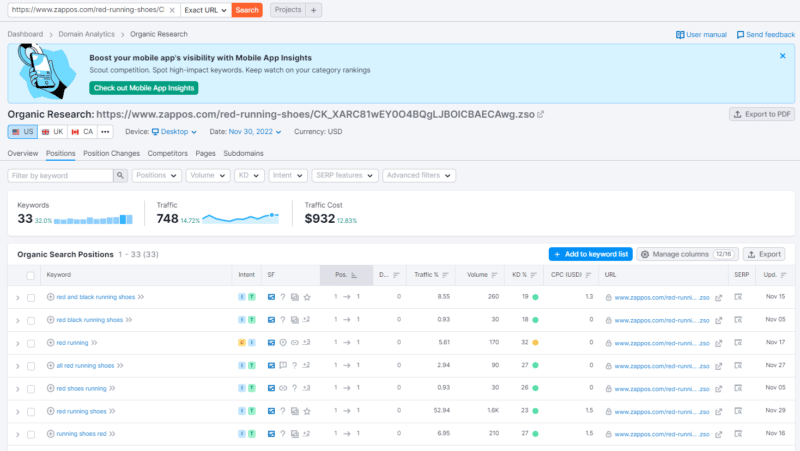
You can find related keywords that you should cover by taking a look at what competitor sites are including in their article and ranking for.
The Organic Research report in Semrush can be a useful starting point to find related keywords.
Make sure you’re using the keywords correctly and in the right places.
The keyword you want to rank the desired page for should be used naturally throughout the article. Go back to SEO basics and check it’s used in the title tag and the URL if it makes sense to do so.
Step 3: Evaluate ranking content vs. your desired content
Compare the page you want to rank to pages that are currently ranking.
What elements do competitors include that your page does not? Make sure your page is ultimately useful and competitive. If ranking pages use high-quality images, you should also use them. If competitive pages include video, add a video to your page.
Aim to do everything competitors do, but don’t focus so hard on competitors that you forget your users and customers.
What more can you add that is genuinely useful to your users? Find out by:
- Speaking with your marketing and sales team.
- Discovering questions customers ask so that you can answer them on your page.
- Digging into reasons for refunds or returns. (Can you be proactive and address issues on the page to save a user from making the wrong purchase or help manage expectations?)
Step 3: Remove keywords from the deoptimized page
One reason for the wrong page ranking can be keyword usage.
Take a look at the page that you don’t want to rank and, where possible, remove keywords that might aid the rank. If you’re using the keyword in your title tag, for example, exchange it for a better keyword that suits this page so your other page can take the rank for the desired keyword.
Naturally, you don’t want to remove all keywords, especially if they’re contextually useful. Instead, remove keywords where you can and work on your internal linking strategy for those that need to stay.
Step 4: Strengthen internal linking
Internal linking is one of the most powerful tools for helping content rank.
Audit the internal links pointing to the ranking page and internal links pointing to the page you want to rank.
You should:
- Have links pointing to the desired page using one of the keywords you want it to rank for as the anchor – be natural about this.
- Link the current ranking page to the desired ranking page using the keyword. On this page, use an exact match as the anchor if you can achieve this naturally.
- Replace links to the current ranking page with links to the desired page as long as it is still contextually relevant.
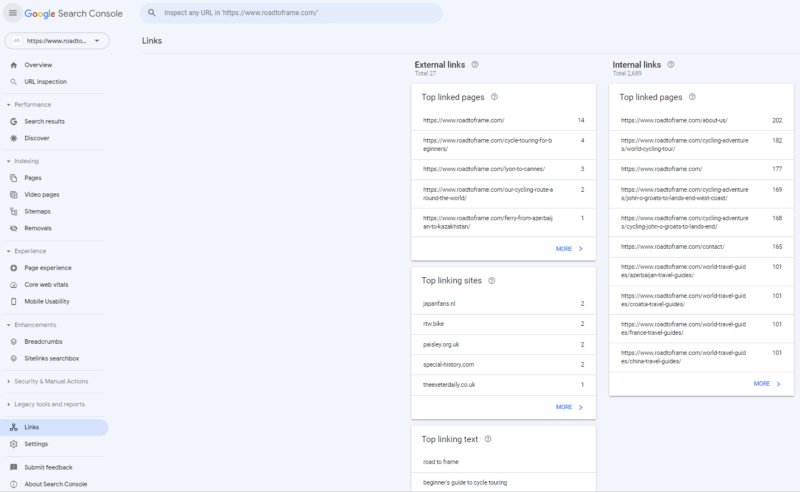
You can use tools like Screaming Frog to audit your internal linking structure or you can do it for free in Google Search Console (GSC). Head to the links report for an overview of your links, including external, internal, top-linked pages and anchor texts. Click on the pages you want to view links to and GSC will give you a list of pages linking to your page.
Finally, build links to the page you want to rank by building your content architecture.
For example, if you’re trying to rank your category page for the search term “red running shoes,” take a look at People Also Ask and see the types of content you can create and link to the category. This builds your authority on the subject and points links to the collection you most want to rank.
Step 5: Submit pages to Google Search Console
Once you’ve completed all of the above, submit your edited pages to GSC and wait for Google to do its thing. You might need to wait a couple of weeks or longer before seeing your edits take effect.
Further considerations to rank your desired page
If you completed all of the steps above, but your desired page still isn’t ranking, here are further steps that you can take.
Check the backlink profile
In a competitive space, you might need to think about increasing your backlink profile. Use SEO tools like Majestic or Ahrefs to see how your backlinks compare to competitors. Aim to close the gap by earning highly relevant backlinks from trusted sites in your niche.
Where natural, you can link directly to the page you want to rank, but if this won’t work, you can link to supporting pages within the content cluster.
Check engagement metrics
Engagement metrics (i.e., conversions, scroll, time on page, etc.) can help you determine whether our page is really helpful to your users.
If your ranking page is long-form content and users scroll to only 25% of the page before they leave, it’s probably not compelling enough to keep the user engaged. Consider a rewrite.
Consider page speed optimizations
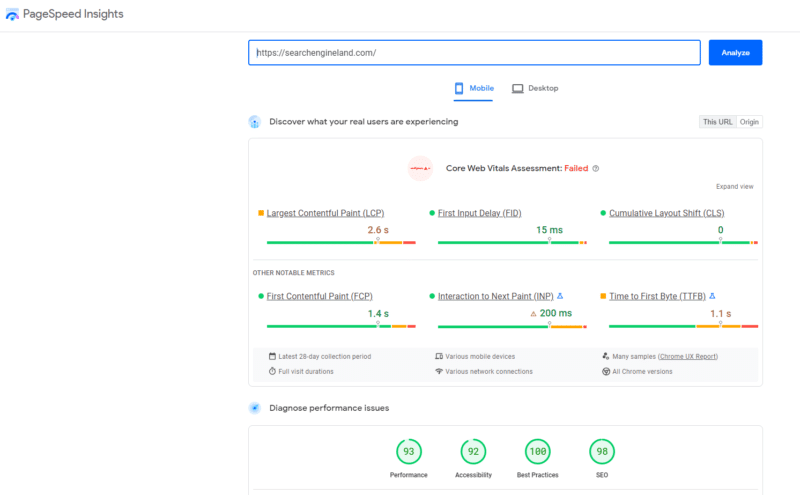
Page speed has become increasingly important and it’s important to stay competitive where you can. In very competitive spaces, page speed could be the difference between your site outranking a competitor.
Google PageSpeed Insights provides all the data about page speed and how to improve it.
301 redirects
If you want to remove your original ranking page in the deoptimization process you must remember to add a 301 redirect.
In some cases, such as in the case of keyword cannibalization, you might want to take a page down to help another rank.
Add 301 redirects, and to be ultimately diligent, go through the links pointing to the old page and edit them so they point directly at the desired ranking page.
Deoptimizing for search
Taking the leap into deoptimization can feel a little scary, especially if you risk losing a lot of traffic.
The thing to remember is that clicks and impressions are meaningless if they’re from the wrong audience or fail to result in conversions.
The post What to do when the wrong page ranks for a keyword appeared first on Search Engine Land.
Courtesy of Search Engine Land: News & Info About SEO, PPC, SEM, Search Engines & Search Marketing
Category seo news | Tags:
Social Networks : Technorati, Stumble it!, Digg, de.licio.us, Yahoo, reddit, Blogmarks, Google, Magnolia.
This day in search marketing history: January 6
Written on January 6, 2023 at 8:21 pm, by admin
Google Webmaster Tools adds ‘unnatural links’ and ‘cloaking’ spam warnings
In 2011, Google Webmaster Tools started sending out two new types of warnings – for “unnatural links” and “cloaking.”
The messages were sent out when Google detected pages on websites that were using techniques that were outside of its quality guidelines.
At the time, Google had been talking about wanting to increase its outreach to webmasters. See this video (published Dec. 18, 2010), in which Google’s Matt Cutts (featuring Danny Sullivan) mentioned that Google wanted to make communication a priority in 2011.
Read all about it in Google Adding New Spam Warnings In Webmaster Tools.
Dig deeper: Google penalties, manual actions and notifications: A complete guide
Also on this day
Google launches ‘Shops’ section in mobile search results
2022: The Shops section showed three to 10 retailers based on their organic search rankings.
Google Ads error tells advertisers exact match keywords are saving as broad match
2022: Search marketers entering exact match keywords may have seen an alert toward the bottom of their Google Ads interface stating, “Broad match keywords are on. Keywords will be saved as broad match.”
Search Engine Land, SMX name Carolyn Lyden content lead
2021: Lyden acted both as editor-in-chief of Search Engine Land and content lead for our SMX events series. She departed Third Door Media in November 2021.
Standard text ads will live on a bit longer, Microsoft Advertising says
2020: Microsoft Advertising, which originally said standard text ads would no longer serve after 2019, announced it would allow existing standard text ads to continue to serve until March 31.
Video: A.J. Ghergich on not chasing the Google algorithm and focusing on human intentions
2020: In this installment of Barry Schwartz’s vlog series, he chatted with Ghergich about how to scale your SEO agency, understanding human intent and more.
Google to start showing local-specific phone numbers when location extensions appear in ads
2017: Google said, starting Jan. 19, it “may” show the local retail phone number when that store’s location extension showed in an ad – even if a call extension in the campaign used a different phone number – in order to increase the relevance of ads that featured specific business locations.
“Illegitimate” SEO Sentenced To 37 Months In Federal Prison For Extortion
2016: William Stanley extorted individuals and companies by threatening to engage in illegitimate SEO work: posting “fraudulent comments and creating negative reviews online, if the victim did not pay him a certain sum of money.”
Google Revamps The Android App-Indexing Crawl Errors Report In The Search Console
2016: Google announced they had finally upgraded the App Indexing Crawl Errors report, which had not been working for months, in the Google Search Console.
German Publisher Group Sues Google Again Under Draconian Copyright Law
2016: Claiming to be enforcing Germany’s “Ancillary Copyright” Law, the publishers were suing to get Google to pay them for showing their content in search results.
Bing Ads, Too, Says Goodbye To Phone Numbers In PPC Ad Copy
2015: Bing Ads told advertisers they soon would no longer be able to put a phone number in the headline, body copy, URL or extensions like Sitelinks. As with AdWords, advertisers would need to use location or call extensions for phone numbers.
Pinterest Beefs Up Its Search Chops With VisualGraph Acquisition
2014: Pinterest said the acquisition would “help us build technology to better understand what people are Pinning. By doing so, we hope to make it easier for people to find the things they love.”
Bing Launches Awards Site In Time For Golden Globes, Grammy’s & The Oscars
2014: The site served as an online resource for “all things awards” with background information on nominees, tips for award-themed parties, and winner predictions based on Bing search statistics.
Bing Makes Driving Directions Twice As Fast
2012: Bing Maps pushed out a major update to their driving directions “routing engine.” The new routing engine was twice as fast as the old one and added more features, such as adding up to three routes in one request.
Search In Pics: Google Bumper Sticker, Knitted Android Sleeve & Yahoo’s CEOs
2012: The latest images culled from the web, showing what people eat at the search engine companies, how they play, who they meet, where they speak, what toys they have, and more.
Google Mobile Strategy Playing Out Almost Flawlessly: Ads Growing, Android Beating iPhone
2011: Google’s AdMob unit reported that it saw more than 2 billion ad requests on a daily basis. Meanwhile, comScore reported that Android passed the iPhone as the number two smartphone platform in the U.S.
South Korea May Arrest Google Execs Over WiFi Data Collection
2011: The country’s national police agency had determined that Google acted illegally when it gathered personal data as part of its Street View mapping service.
Covario: Consumer Electronics Marketers Take Q4 Paid Search Boom Overseas
2011: Among its tech and consumer electronics clients in the Americas, paid search spending only rose 1% in the fourth quarter of 2010, as compared to the third quarter, but that’s because growth from the second to the third quarter was 30%.
Twitter’s New Year Tweet Record Shown In Stunning Video
2011: Twitter started 2011 with a new record: 6,939 tweets were sent at four seconds after midnight in Japan.
Foursquare Puts The Kibosh On Friend-Tip Spamming
2011: Foursquare started limiting the number of friends and friend requests that a user can have.
Google AdWords Testing Lead Capture Forms: Contact Form Extensions
2010: Contact form extensions provided a contact form directly in the search ad, which a searcher can fill out and the advertiser can then use in the future to contact that lead.
Google Loses French Lawsuit Over Google Suggest
2010: Google was ordered to remove the word arnaque, which translates roughly as “scam,” from appearing as a Google Suggest term on searches for the Centre National Privé de Formation a Distance (CNFDI).
Surprise: Google’s Home Page Promoting Nexus One
2010: The promotion was found under the search box and read: “Experience Nexus One, the new Android phone from Google.”
Nexus One: What Exactly Happened Yesterday In Mountain View?
2010: Less than 24 hours after the formal unveiling of the Nexus One by Google, we had a collection of differing perceptions and accounts of what was significant (or not).
Google Claims That Google Checkout Increases Conversion By 40% & Clicks By 10%
2009: Google added claims to its Google Checkout Merchant homepage that having Google Checkout as part of your AdWords ads would lead to higher conversions and a better click-through rate.
Google Testing ‘Blended’ Mobile Ads
2009: As it turned out, Google wasn’t doing anything new. On the Google WAP search experience the company had always placed ads at the end of organic text results but before other types of content.
Yahoo To Advertisers: We Can Create Ads & Edit Keywords Without Asking First
2009: Yahoo emailed their search advertisers about new terms and conditions, including a controversial provision that they are allowed to create ads, remove or add keywords to campaigns and “optimize” accounts.
Google Finally Brings Picasa To The Mac
2009: Picasa was a management system for photo sharing and editing.
Google Wins “Gu Ge” Lawsuit In China
2009: The Beijing Haidian District Court ruled that Beijing Guge Science and Technology had to pay Google China 100,000 yuan ($14,624). In addition, Beijing Guge is required to stop using the name.
Google Trends Features ASCII Art Of 9/11
2009: It was suggested that the art represented an airplane crashing into New York’s former World Trade Center towers on 9/11.
The Big List of 2009 Marketing Predictions
2009: Articles and blog posts filled with forecasts, predictions, and/or resolutions for the new year.
Mahalo Adds More Social Features
2008: The Mahalo Follow toolbar let you post links to Delicious, Ma.gnolia, Mahalo Social, and Twitter with the click of one button. The sidebar displayed quick tips when you were on sites like Twitter and Gmail.
From Search Marketing Expo (SMX)
- How customer reviews can improve your SEO efforts
- Search incrementality: How paid and organic work together for better performance
- SMX Overtime: Broaden your reach with YouTube campaigns
Past contributions from Search Engine Land’s Subject Matter Experts (SMEs)
These columns are a snapshot in time and have not been updated since publishing, unless noted. Opinions expressed in these articles are those of the author and not necessarily Search Engine Land.
- 2022: Apple Maps: What a maps web snapshot can do for your online content by Joy Hawkins
- 2017: The importance of local authenticity by Brian Smith
- 2017: Choosing an attribution model: When, not which by Amy Bishop
- 2017: Brand vs. local Knowledge Graph result: Which is better? by Tony Edward
- 2016: Enhance Search Engagement With A Complementary Paid & Organic Visibility Strategy by Thomas Stern
- 2016: Six Trends Shaping Location Marketing In 2016 by Adam Dorfman
- 2015: Holiday 2014 Learnings: How Delivery Options Impact PPC & Conversions by Rebekah Schelfhout
- 2015: Tool Overview: LinkRisk — Not Just For Detoxing Anymore by Julie Joyce
- 2014: Just Say No To SEO (Sometimes) by Eric Enge
- 2012: 2012: The Year Of The Independent Search Marketer? by George Popstefanov
- 2012: How Much Is A Click Really Worth? by Benny Blum
- 2012: 10 Search & Website Usability New Year Resolutions for 2012 by Kim Krause Berg
- 2011: How (I Think) Crawl Budget Works (Sort Of) by Ian Lurie
- 2011: How To Reduce SEM Churn With Integrated Customer Intelligence by Bill Dinan
- 2010: The 4 Most Siginficant Changes To Paid Search In 2009 by Lori Weiman
- 2010: In-House SEO Reporting: Guide To Succeeding Where Others Fail by Tony Adam
- 2010 A Six-Step Content Marketing Check-Up For B2B Marketers by Galen DeYoung
- 2010: 4 Steps to Setting Better Conversion Optimization Goals by Sandra Niehaus
- 2010: Searching For PPC Success In A Down Economy by Benny Blum
< January 5 | Search Marketing History | January 7 >
The post This day in search marketing history: January 6 appeared first on Search Engine Land.
Courtesy of Search Engine Land: News & Info About SEO, PPC, SEM, Search Engines & Search Marketing
Category seo news | Tags:
Social Networks : Technorati, Stumble it!, Digg, de.licio.us, Yahoo, reddit, Blogmarks, Google, Magnolia.
Webinar: How to make the most out of consumer and social media data by Cynthia Ramsaran
Written on January 5, 2023 at 4:17 pm, by admin
When analyzing consumer behavior at scale, decision-makers need to keep up – making consumer insights matter more now than ever. This means staying on your toes with actionable consumer intelligence from continuous social listening is a must.
Join this live webinar and learn how Purdue University’s Center for Food Demand Analysis and Sustainability created a visualization of online and social datasets to help people throughout the food system. You’ll also gain insights into how online data is used to understand human behaviors and industry trends.
Register today for “Analyze Social Media & Consumer Behavior for the Greater Good,” presented by NetBase Quid.
Click here to view more Search Engine Land webinars.
The post Webinar: How to make the most out of consumer and social media data appeared first on Search Engine Land.
Courtesy of Search Engine Land: News & Info About SEO, PPC, SEM, Search Engines & Search Marketing
Category seo news | Tags:
Social Networks : Technorati, Stumble it!, Digg, de.licio.us, Yahoo, reddit, Blogmarks, Google, Magnolia.