

Google December 2022 link spam update done rolling out
Written on January 12, 2023 at 4:42 pm, by admin
Google has confirmed that the December 2022 link spam update is now finished rolling out. The update took 29 days to roll out, starting on December 14, 2022 and ending on January 12, 2023. Google has posted it was completed today, January 12.
What is a link spam update. A link spam update looks to neutralize, or no longer count, links that Google finds to be spammy and against Google’s guidelines. Google wrote that this launch “may change as spammy links are neutralized and any credit passed by these unnatural links are lost. This launch will affect all languages.”
First time using SpamBrain for links. This is leveraging what Google calls SpamBrain, Google referenced it in the 2018 Google spam report, specifically the spam trends section where Google talks about its “machine learning systems” to improve search spam detection.
Google added that SpamBrain can not only “detect spam directly, it can now detect both sites buying links, and sites used for the purpose of passing outgoing links.”
Nullifying link spam. Google used the word “neutralize” links, and in the previous link spam update Google used the word Google used here was “nullifying,” which does not necessarily mean “penalize,” but instead, to ignore or simply not count. Google’s efforts around link spam have been to ignore and not count spammy links since Penguin 4.0 was released in 2016.
Why we care. If you saw ranking declines in Google over this rollout period, it might be related to this new link spam update. Ensure your links are natural and follow Google’s webmaster guidelines. Work on improving your site to naturally attract new links over time.
As Google wrote with previous link spam updates, “Site owners should ensure that they follow the best practices on links, both incoming and outgoing. Focusing on producing high quality content and improving user experience always wins out compared to manipulating links. Promote awareness of your site using appropriately tagged links, and monetize it with properly tagged affiliate links.”
The post Google December 2022 link spam update done rolling out appeared first on Search Engine Land.
Courtesy of Search Engine Land: News & Info About SEO, PPC, SEM, Search Engines & Search Marketing
Category seo news | Tags:
Social Networks : Technorati, Stumble it!, Digg, de.licio.us, Yahoo, reddit, Blogmarks, Google, Magnolia.
Google search responds to BankRate, more brands using AI to write content
Written on January 12, 2023 at 4:42 pm, by admin
Artificial intelligence (AI) has been a scorching hot topic lately, especially since the launch of ChatGPT Nov. 30. Microsoft Bing has plans to add ChatGPT to search. Some have questioned whether it’s a Google killer.
Now we’re seeing more examples of brands using AI-generated content. Bankrate is the latest example. It is having some of its content written by machines but reviewed by human editors.
It’s a bold strategy (let’s see if it pays off for them). And the SEO community wanted to know Google’s policies around these efforts.
Bankrate example. The example was highlighted by Tony Hill, who posted on Twitter that “BankRate.com, one of the largest finance sites on the web has now started using AI to write some of its content. A big moment in web publishing and SEO.”
The screenshot reads “this article was generated using automated technology and thoroughly edited and fact-checked by an editor on our editorial staff.”
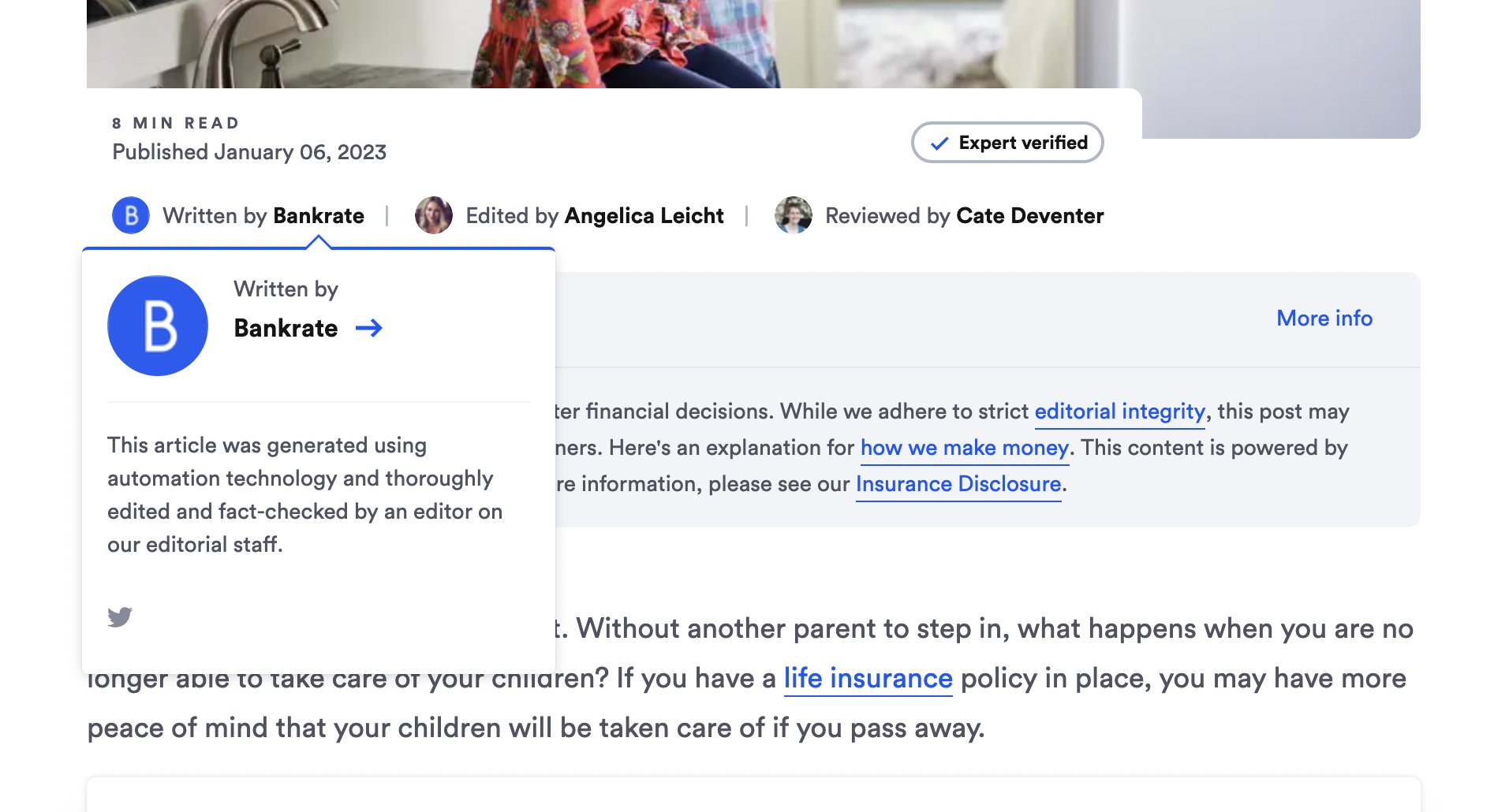
Wondering how Bankrate.com is ranking for these articles? Sistrix did an analysis to find out:
For Bankrate.com, this specific use-case and the current point in time, one can say: yes, it works.
Many , randomly-checked articles rank on the first page for both the main keyword and many other long-tail keywords“How Bankrate.com is ranking with AI-generated text” – Johannes Beus, SISTRIX
Bankrate isn’t the only example of this. CreditCards.com is also using AI-generated content. The first line of the CreditCards.com Team author page says “Content published under this author byline is generated using automation technology.”
CNET has also quietly been using AI to write entire articles from the ground up since November.
Do a Google site search for [“This article was generated using automation technology”] will reveal dozens of CNET articles in Google’s index. CNET also assures readers that these articles have been “thoroughly edited and fact-checked by an editor on our editorial staff.”
The potential issue. If we can have machines and AI write content for us, then the amount of content that can be produced at incredibly low costs can be somewhat exciting for brands and businesses – more content for a minimal investment sounds like the stuff of dreams.
But, at the same time, mass-generated AI content can also frightening for consumers (what should you spend your time reading?) and search engines (what content should Google be ranking in search?).
So much content is being produced daily already; how much more can we consume, and how much more does Google need to crawl, index, and decide to rank for a given query?
Google’s statement on AI-generated content. Is Google OK with crawling and ranking content written by machines? If not, is Google OK if those AI-generated pieces of content are reviewed by human editors before they are published?
Danny Sullivan, Google’s Search Liason, reiterated some of what was said before about Google’s stance on this topic.
Sullivan wrote on Twitter this morning on the topic of AI-generated content, “content created primarily for search engine rankings, however it is done, is against our guidance.” But he added that “if content is helpful & created for people first, that’s not an issue.”
Sullivan then referenced their guidelines for the helpful content update, saying that the “key to being successful with our helpful content system — and if it’s not helpful content, the system catches that.”
If the AI can write helpful content, then it should be fine, one would assume.
Then Sullivan references the revised E-E-A-T quality raters guidelines, saying, “For anyone who uses *any method* to generate a lot content primarily for search rankings, our core systems look at many signals to reward content clearly demonstrating E-E-A-T (experience, expertise, authoritativeness, and trustworthiness).”
Finally, Google has a spam policy for automated content, which states “generated through automated processes without regard for quality or user experience” which is against Google’s guidelines.
Why we care. We know machine-generated content is not new, but what is new, is that the machines are getting better with the help of AI, in generating human-like, high-quality content. The question is, is it being produced with the intent of helping people or ranking in Google Search. If it is the latter, the helpful content system’s aim is to make sure such content does not rank well.
For the time being, Google wants content by the people, for the people but you can use AI for ideas and help you along the way. If machines and AI can write the content, you’d think similar technology can detect content written by AI.
The post Google search responds to BankRate, more brands using AI to write content appeared first on Search Engine Land.
Courtesy of Search Engine Land: News & Info About SEO, PPC, SEM, Search Engines & Search Marketing
Category seo news | Tags:
Social Networks : Technorati, Stumble it!, Digg, de.licio.us, Yahoo, reddit, Blogmarks, Google, Magnolia.
8 dangers of copying another brand’s SEO
Written on January 12, 2023 at 4:42 pm, by admin
A successful SEO strategy includes various must-have components, such as SEO best practices, a proper focus and connection with target audiences and competitive factors.
Best practices and audience aspects are generalized and personal to your brand. Conducting a competitor analysis is also critical, as you want to learn from brands already well-positioned in the space you want to be in.
However, there is a risk of going overboard when we play follow the leader, trying to match what the high-ranking competitor sites are doing.
Ignoring competitors or those currently ranking for topics within your target audience will hurt your chances of reaching and surpassing competitors. But focusing on them too much and copying their SEO strategies can have more damaging effects.
You definitely should know what other brands are doing and match up your strategy with what the search engines are “rewarding” those sites for doing well.
Be mindful, though, of the eight dangers of copying another brand’s SEO.
1. Brand confusion
Most companies want to build a distinctive brand image and identity. Whether it is defined best by creative, messaging, or thought leadership, the goal is to be recognized and known for something.
If your idea of building a brand is by copying another brand’s SEO too closely, you will naturally start looking and sounding like them. This leads to a danger of brand confusion and can result in a lack of awareness of your brand.
Even if you are found in Google search results and get your target audience to click through, you risk not standing out.
Your website will not be distinctive enough if you have many of the same elements as other sites, like page content, pages, navigation structure, and keyword focuses.
If the searcher comes back later and finds your competitor’s site, will they even remember you? Will you stand out?
2. Lack of connection with your audience
Copying another brand’s SEO can also lead to losing connection with your audience.
Even if you are not replicating the competitor’s branded or trademarked content (because you shouldn’t), you will not have much unique content or perspectives if you are driven by copying someone else.
Beyond brand confusion, your content won’t be original and you are less likely to provide something unique and different to your target audience.
If they can get the same content and experience elsewhere, why would they want to give you their money, time, or attention?
Copying a competitor’s SEO will lead you to make trade-offs of unique opportunities you have to authentically engage with your site visitors.
3. Duplicate content and risk of being filtered
Naturally, if you’re literally copying your competitors’ SEO, you’re at risk of copying their copy itself.
Yes, they have some things working for them that might include their web copy and content being ranked well by Google. However, there are so many variables and ranking factors that you can focus on to get ahead.
Plus, when you copy content verbatim or in spurts, expect to see your content filtered from the SERPs. Since you are not the original creator, not in the same authority status as the competitor, or not providing enough unique copy, your site will likely be the one filtered out of Google search results while the competitor continues to rank as the author or originator of the copy.
4. Potential legal action
While I see fewer threats and real legal action in organic search, it can happen.
Copying content, ignoring copyrights and trademarks or harming any business relationships that impact SEO performance can lead you closer to legal action.
I find it hard to come up with a reason to copy another brand’s SEO or to follow what they are doing so closely that you run this risk. Just don’t do it.
Even if you dodge legal action, items 1-3 above should be enough justification for not getting too close to what they are doing.
Get the daily newsletter search marketers rely on.
<input type=”hidden” name=”utmMedium” value=”” />
<input type=”hidden” name=”utmCampaign” value=”” />
<input type=”hidden” name=”utmSource” value=”” />
<input type=”hidden” name=”utmContent” value=”” />
<input type=”hidden” name=”pageLink” value=”” />
<input type=”hidden” name=”ipAddress” value=”” />
Processing…Please wait.
5. Being strategically reactive
Having an SEO strategy is necessary. If the primary drivers of the strategy are to copy another site’s SEO, then that’s not really a strategy.
Again, look at competitors and what’s working for them in your efforts. But, don’t follow them so closely that you’re simply reacting to everything they do. Blindly following along will keep you firmly in a position where you’re chasing them or in parody with them.
You want to include proactive aspects like:
- Exploring new content areas.
- Identifying topics to own.
- Establishing your own authority.
Beat them in areas where they aren’t competing. Find white space to fill and have a farseeing approach to get there.
6. Following a competitor’s poor strategy
Related to being reactive, you run the risk of implementing bad SEO. They could be ranking well for a key term that you want to rank for. However, they could also be doing a lot of tactics poorly.
Maybe you misjudged what SEO factors were truly driving that ranking.
What if they were heavily supported by some high-quality links and brand mentions and not propped up by their content quality?
If you copy their content strategy and don’t have those links, you’re likely going to fall flat and look bad at the same time.
Additionally, with the emergence of SpamBrain from Google and how it further evaluates the quality of content, you have more incentive to differentiate than to follow along when it comes to on-page and content SEO strategy.
7. Measuring the wrong performance metrics
While there are some great “spy” tools out there that help with analyzing competitor sites, they aren’t perfect.
You can’t truly know (unless you have CRM and analytics access or other direct sources of the competitor brand) how well the SEO strategy is working for other sites.
What you can likely see is where they are ranked and connect that with the estimated search volume for the specific rankings or queries. Sure, you can overlay some estimated or benchmark conversion data. However, the more data points you’re estimating and adding together, the more inaccurate your numbers will be.
Ideally, your focus is on your end goal. Whether that is some type of conversion to sales, leads, or other meaningful ROI aspects for your business, you’ll want to start there and work backward to know what the traffic and approach should be.
If you focus purely on your competitor’s rankings and getting to their positions, then you’re copying them without having a complete understanding of what gaining their rankings will do for your business in terms of ROI.
You can spend a lot of time and money investing in copying their SEO strategy to find out that it wasn’t worth it for your specific needs, even if it helped you get on par with their rankings.
8. Risk against new competitors
If you’re overly focused on copying another brand’s SEO, you might fail to pay attention to the wider landscape.
I have had clients focused on one or two other companies jockeying for the top spot, answer boxes, and other prime real estate in the SERPs. So focused, that months down the road, a new competitor – or set of competitors – emerged looking much different and leapfrogged the long-established top-ranking sites.
Having the blinders on looking at a single site or two can cause a narrow SEO focus for all the reasons previously mentioned. It also puts you in danger of being overtaken by newer competitors and those with a different and better strategy for building authority status and relevant content.
Develop your own unique SEO strategy
Remember that applying best practices, focusing on your audience, and paying attention to the competitive landscape are all important for a solid SEO strategy. Doing just one or two won’t get you as far in terms of rankings, traffic and conversion goals.
Competitor analysis and reverse engineering can be useful. However, when you know who is ranking well or seemingly doing well in the space you want to own, be mindful of the dangers of copying their brand’s SEO strategy.
There’s a balance between matching up well with competitors on ranking factors, helpfulness to the audience, and gaining visibility without selling out your own brand or getting on the wrong kinds of radars legally.
Plus, you want to be as resistant as possible to their mistakes taking you down or taking your focus off of those coming up behind you. Leverage the information, but include it in your broader SEO strategy to gain the benefits and minimize the dangers.
The post 8 dangers of copying another brand’s SEO appeared first on Search Engine Land.
Courtesy of Search Engine Land: News & Info About SEO, PPC, SEM, Search Engines & Search Marketing
Category seo news | Tags:
Social Networks : Technorati, Stumble it!, Digg, de.licio.us, Yahoo, reddit, Blogmarks, Google, Magnolia.
Meta introduces new ad targeting limits for teens
Written on January 11, 2023 at 12:42 pm, by admin
Starting next month, Meta will remove the option for targeting advertising to teen users based on gender. They’ll also end advertisers’ ability to target personalized ads to under-18 users based on their in-app activity, including who they follow on Instagram and what Facebook pages they like.
After the changes take effect, personalized ads on Facebook and Instagram will only draw on a user’s age and location to determine relevance (where location is necessary to assess which products and services are available in a user’s area).
Facebook and Instagram will soon roll out new controls for teen users (kids under age 13 aren’t allowed on those apps — technically). Teens will be given an option to “see less” of a given topic, shaping which ads the platform will serve them.
Why we care. Advertisers will no longer be able to target users under the age of 18 based on in-app activity nor target their age or location, except where relevant. You’ll need to restrategize if you advertise a product or service to users under 18.
Not new. Meta recently rolled out new privacy updates for everyone under the age of 16, or 18 in some countries. Starting in November, teens will default to more private settings when they join Facebook. For teens already on the platform, Meta recommends making these changes manually. The new privacy settings affect:
- Who can see their friends list
- Who can see the people, Pages and lists they follow
- Who can see posts they’re tagged in on their profile
This month Meta was fined 390 million euros ($414 million) after European Union (EU) regulators found it had illegally forced users to accept personalized ads.
Google blocks ad targeting for kids under 18. In 2021 Google updated its policies around minors online, letting those under 18 remove images from search. “Children are at particular risk when it comes to controlling their imagery on the internet. In the coming weeks, we’ll introduce a new policy that enables anyone under the age of 18, or their parent or guardian, to request the removal of their images from Google Image results,” wrote Mindy Brooks, product and UX director for kids and families at Google.
YouTube will change the default upload mode to private for kids aged 13-17. SafeSearch will be automatically turned on for those under 18 using Google Search. Those under 18 will not be able to turn on their location history.
The post Meta introduces new ad targeting limits for teens appeared first on Search Engine Land.
Courtesy of Search Engine Land: News & Info About SEO, PPC, SEM, Search Engines & Search Marketing
Category seo news | Tags:
Social Networks : Technorati, Stumble it!, Digg, de.licio.us, Yahoo, reddit, Blogmarks, Google, Magnolia.
How marketing compensation and roles are changing: Take the MarTech Salary and Career Survey
Written on January 11, 2023 at 12:42 pm, by admin
Although we hesitate to use the term post-pandemic with any confidence, marketing takes place today in a space changed — perhaps irrevocably — by COVID-19. Yes, marketers are making their way back to the workplace; many conferences and expos are back in person; it’s possible to meet and greet prospects face-to-face instead of face-to-video.
But the importance of digital marketing looks unlikely to recede. With it comes increased emphasis on digital content and digital experience, the expansion of ecommerce across almost every vertical and the interest in virtual events.
What does that mean? You guessed it: the growing importance of the digital martech stack.
The “great marketing reboot.” We’re also seeing big changes on the human side of marketing. Many marketing professionals have left the space; others have switched from regular positions to freelance or contract work. There are big opportunities — as well as challenges — for people in the early stages of their careers, whether as marketers or marketing operations professionals.
Data scientist and MarTech contributor Chris Penn calls this the “great marketing reboot.” We’ve introduced a new question into this edition of the survey asking if you’re witnessing the same phenomenon, whether in your own marketing organization or others.
Follow the money. We’re also asking, as always, whether circumstances are impacting salaries, in positive or negative ways, as well as your career trajectories.
As before, we’re partnering with Scott Brinker and chiefmartec.com to field the survey. It shouldn’t take more than a few minutes to complete, and we look forward to sharing the results soon.
Take the MarTech Salary and Career Survey
The post How marketing compensation and roles are changing: Take the MarTech Salary and Career Survey appeared first on Search Engine Land.
Courtesy of Search Engine Land: News & Info About SEO, PPC, SEM, Search Engines & Search Marketing
Category seo news | Tags:
Social Networks : Technorati, Stumble it!, Digg, de.licio.us, Yahoo, reddit, Blogmarks, Google, Magnolia.
12 new Google Analytics 4 ecommerce dimensions and metrics
Written on January 11, 2023 at 12:42 pm, by admin
Everyone’s favorite new Google product, Google Analytics 4 (GA4), has just released 12 new item and event-scoped ecommerce metrics and dimensions.
Why we care. Ecommerce advertisers and retailers will now be able to view and analyze specific information about products, services and interactions. You should also be able to see Items purchased and purchases by country, which shows you the number of items purchased and the number of purchases for each country.
ICYMI, Google will sunset Universal Analytics on July 1, 2023.
What’s new. You can now find the following new dimensions and metrics in the Explorations and the Data API:
- Item affiliation
- Item variant
- Items added to cart
- Items checked out
- Items clicked in list
- Items clicked in promotion
- Items viewed
- Items viewed in list
- Items viewed in promotion
- Shipping amount
- Shipping tier
- Tax amount
New naming conventions. Google has also renamed several metrics:
- Add to carts (previously called Add-to-carts)
- Item-list click events (previously called Item list clicks)
- Item-list view events (previously called Item list views)
- Item view events (previously called Item views)
- Items purchased (previously called Item purchase quantity)
- Promotion clicks (previously called Item promotion clicks)
- Promotion views (previously called Item promotion views)
Dig deeper. Review the official Analytics Help documentation here.
The post 12 new Google Analytics 4 ecommerce dimensions and metrics appeared first on Search Engine Land.
Courtesy of Search Engine Land: News & Info About SEO, PPC, SEM, Search Engines & Search Marketing
Category seo news | Tags:
Social Networks : Technorati, Stumble it!, Digg, de.licio.us, Yahoo, reddit, Blogmarks, Google, Magnolia.
Apple Maps relaunches Apple Business Connect
Written on January 11, 2023 at 12:42 pm, by admin
Apple has revamped the Apple Business Connect service, where businesses can update what Apple Maps shows about their business. This service initially launched Apple Maps Connect in 2014, and it is similar to how Google Business Profiles works.
Apple Business Connect. Apple said this is a “free tool allows businesses of all sizes to customize the way their information appears across Apple apps.”
In Business Connect, businesses can manage their place card, including adding and updating photos and logos; inviting customers to take actions like ordering food or making a reservation directly from Maps; and presenting customers with special promotions.
Showcases. Apple also added Showcases, a new feature in the Apple MAps place card that helps businesses present customers with offers and incentives. Apple said, “businesses can easily update the Showcase section of their place card through Business Connect.” The feature is available for US businesses today and rolling out globally in the coming months.
New APIs. Apple also now supports a new API named the Business Connect API. This is designed for businesses with dozens of locations and allows those businesses “to easily deliver accurate, up-to-date information to Maps at scale through listing management agencies such as Reputation, Rio SEO, SOCi, Uberall, and Yext,” Apple said.
Businesses registration. If you already have an Apple Business Connect account, you can log in and add the new details about your business to your listing – I already did that before writing this story. Otherwise, businesses can register their business at businessconnect.apple.com and get started today.
Why we care. Apple Maps is becoming more and more popular, and it makes sense for you to register and maintain your business properly and accurately on the Apple Maps ecosystem. So make sure your business listing is verified and up-to-date.
The post Apple Maps relaunches Apple Business Connect appeared first on Search Engine Land.
Courtesy of Search Engine Land: News & Info About SEO, PPC, SEM, Search Engines & Search Marketing
Category seo news | Tags:
Social Networks : Technorati, Stumble it!, Digg, de.licio.us, Yahoo, reddit, Blogmarks, Google, Magnolia.
3 PPC marketing trends to keep a pulse on in 2023
Written on January 10, 2023 at 8:27 am, by admin
As we begin 2023, it’s a good time to reflect on the macro-level trends we’ve observed last year.
Here are a few trends that I believe have some staying power and should be considered as you build out your 2023 search marketing strategies.
1. A slow economy and heightened focus on efficiency
In case you haven’t heard, the economy has been struggling (that’s a joke). I graduated with a degree in economics, but like most of us, I have no idea how long this downturn will last.
That said, I think many digital marketers are already feeling the impact.
- Budgets are tightening.
- Teams are getting leaner.
- Questions such as “What’s the ROI?” or “What’s the CPA?” are becoming more prevalent.
These environments are tricky to navigate and I certainly don’t have all the answers.
However, the advice I usually start with is leaning into your data. Make sure you have a deep understanding of your top-performing tactics and maximize your investment there first.
An analogy I often use is the concept of a sports team in the playoffs. When it comes to crunch time, a coach will always put their best players in the game for as much time as possible. Those players who are still developing are likely going to be watching the game from the bench.
Take this same mindset when it comes to your search strategies. If your budget is limited, prioritize your investment on the tactics driving the most return.
I’m sure many of you reading this are saying, “Yeah, thanks for stating the obvious.” But when I say this, I don’t mean simply consolidating to a brand keyword strategy. Instead, you should:
- Dig into the various segments of your campaigns’ performance.
- Understand what devices, audiences, geos, times of day/days of week, and campaign types drive the most efficient performance. Focus your investment on those combinations of segments first.
- Consider creating a more granular campaign delineation to more effectively skew spend toward the top-performing combinations.
Get the daily newsletter search marketers rely on.
<input type=”hidden” name=”utmMedium” value=”” />
<input type=”hidden” name=”utmCampaign” value=”” />
<input type=”hidden” name=”utmSource” value=”” />
<input type=”hidden” name=”utmContent” value=”” />
<input type=”hidden” name=”pageLink” value=”” />
<input type=”hidden” name=”ipAddress” value=”” />
Processing…Please wait.
2. Automation vs. autonomy
This debate originated well before 2022. However, I do think the heat was turned up a bit last year with:
- The rise of Performance Max campaigns.
- The revamped broad match.
- The deprecation of Expanded Text Ads in favor of Responsive Search Ads.
- The incorporation of automated performance and creative recommendations.
Machine learning is getting stronger and will continue to be woven into campaign management platforms.
I believe that to be successful in 2023, you must best balance the power of automation with the autonomy required to achieve your stakeholder’s objectives.
Think about when you are setting up an automated bid strategy. Part of that process is providing the algorithm with business-specific guardrails that it should operate between – and toward. The better the inputs you provide, the more closely your results will align with your objectives.
I think that same mindset should be leveraged with applications of AI more broadly in campaign management platforms.
Automation reduces the resources required for foundational tasks. But, we still need to guide it to work toward our business objectives.
More tactically, think about what datasets you can incorporate. The more inputs you’re providing, the more data points that these algorithms can use to inform the optimizations and recommendations.
In addition, think about what levers you need to maintain control over and where you can free up your grasp by relying on machine learning to make the optimizations for you
Lastly, consider how to structure your accounts to allow the automation to perform best.
That balance of automation and autonomy will differ based on the complexity of your strategy.
Advertisers who have the best understanding of what this balance should be for their business stand to benefit.
3. Microsoft on the rise?
What would an article like this be without at least one opinion that is a little “edgy.” Buckle up, folks!
I’ve been pretty impressed with the updates that came out of Microsoft last year. They’ve not only expanded their ad offerings but also their geographic reach by about 70 new markets.
Microsoft Advertising has always touted their lower costs and comparable features to Google, but we are starting to see some innovation (i.e., Multimedia Ads) unique to the platform.
Let’s be clear – I’m not expecting a significant shakeup in search engine market share. However, if you haven’t looked at innovation opportunities on Microsoft Advertising, now might be as good a time as any.
The (generally) lower CPCs make it a solid testing environment and much of the innovation they’ve incorporated can help to improve conversion rates.
Improving conversion rates combined with cheap CPCs sounds like an opportunity worth circling back to in budget-constrained environments.
This recommendation is particularly relevant for B2B advertisers, as Microsoft Bing is an engine where we have seen particularly strong engagement, likely due to research taking place on work devices.
Search marketing’s staying power in 2023
Now is an incredibly exciting time to be in search marketing. The platforms are making plenty of updates that it’s hard to keep up.
Search marketing is one of the most powerful tools in the digital marketing toolbox. Other than search, there are only a few other environments where users indicate their interests so clearly.
I’ve highlighted a few of the trends I’m keeping a pulse on, but in our fast-paced industry, there are likely plenty more trends that you will consider as you build out your 2023 strategy.
The post 3 PPC marketing trends to keep a pulse on in 2023 appeared first on Search Engine Land.
Courtesy of Search Engine Land: News & Info About SEO, PPC, SEM, Search Engines & Search Marketing
Category seo news | Tags:
Social Networks : Technorati, Stumble it!, Digg, de.licio.us, Yahoo, reddit, Blogmarks, Google, Magnolia.
5 times you’ll need an expert SEO in 2023
Written on January 10, 2023 at 8:27 am, by admin
There are many times during the lifecycle of your website that you will need an expert SEO.
If you don’t enlist the help of a true professional for the following five scenarios, you are risking rankings, traffic and revenue in 2023:
- Site redesigns
- Deep analysis
- Ranking for highly competitive terms
- Navigating changes to Google
- Technical SEO
1. Site redesigns
This new year, many are planning to refresh their websites. The problem is that SEO either never enters the conversation during a site redesign or it’s not handled properly. This is a problem.
A site migration is when a website undergoes major changes, such as URL updates, a redesign, or content management system or hosting provider changes.
Any of these changes can negatively impact the website’s performance in the search results when handled well.
And make no mistake – there is a lot to consider. So much so that we usually break up our SEO checklist into pre-launch, launch and post-launch activities when involved in a site migration.
Even when it’s done correctly, it is common for sites to see a temporary drop in organic traffic (80% of SEOs expect it) but it should recover and even excel past previous benchmarks.
When it doesn’t, though, something has gone terribly wrong. The website may never recover and can experience a long-term drop in traffic.
If you’re going to make significant changes to your website, make sure you have the guidance of a seasoned SEO during the entire process. A website design agency may not have the expertise needed.
2. Deep analysis
Even if you are ticking off all the boxes in an SEO checklist, something sinister may be lurking behind the scenes of your website that’s causing a drop in traffic. Only a deep-dive audit can uncover something like this.
It is common for site owners to only focus on the top-performing pages. But that’s only a small representation of your website’s quality. The other 80% of webpages on your site could be harming the overall quality and relevance of it, thus impacting your traffic.
One example? Google’s helpful content update, which looks at the entire website in terms of content quality. If some pages are considered bad, it can impact the whole website.
Let’s also not forget the impact that well-organized, quality content site-wide can have on relevance. According to Google’s Search Engine Optimization Starter Guide:
“The navigation of a website is important in helping visitors quickly find the content they want. It can also help search engines understand what content the website owner thinks is important. Although Google’s search results are provided at a page level, Google also likes to have a sense of what role a page plays in the bigger picture of the site.”
In other words, webpages don’t exist in a vacuum. There are many instances where Google considers the site as a whole when ranking.
There are other hidden issues on a website that can easily be missed without a technical SEO audit. For all these reasons, it’s critical that website publishers get a better understanding of their site through a proper audit.
Get the daily newsletter search marketers rely on.
<input type=”hidden” name=”utmMedium” value=”” />
<input type=”hidden” name=”utmCampaign” value=”” />
<input type=”hidden” name=”utmSource” value=”” />
<input type=”hidden” name=”utmContent” value=”” />
<input type=”hidden” name=”pageLink” value=”” />
<input type=”hidden” name=”ipAddress” value=”” />
Processing…Please wait.
3. Ranking for highly competitive terms
Let’s be honest, what keywords aren’t competitive these days? Do a search for any keyword and you will find millions of results. Yet, Page 1 is all that matters.
Some keywords are easier to rank for than others. For example, you might have an easier time ranking for something like “list of top video games in 2022” versus just “games.”
We should know. It took us years to help a client rank number one for the highly competitive term: “games.” But we did it. And it stuck.
Ranking for million-dollar keywords doesn’t happen by just following a checklist. It happens with deep SEO expertise from professionals with decades of experience – those who live and breathe technical SEO and understand what’s happening in search right now.
Sure, you can get SEO guidance from anywhere, but if you’re trying to rank for highly competitive terms, don’t settle. Get an expert SEO.
4. Navigating changes to Google
The search engine results pages are constantly in flux.
In 2021 alone, Google ran more than 700,000 experiments, which resulted in more than 4,000 changes to search. That’s about 11 changes per day. Do you have the time to follow and dissect all the algorithm updates and how they apply to your website?
Algorithm updates lead to page one shake-ups and competitors pull ahead. Maybe they have more resources and bigger budgets, maybe they just did slightly better than you. Now you must figure out what changed and how to get ahead again.
Countless factors influence your rankings in the search results. Trying to figure it out should be left to an SEO professional.
5. Technical SEO
Anyone can do easy on-page SEO, but it takes knowledge and experience to get the technical part right. Things like mobile usability, site speed, structured data markup, robots.txt, server maintenance, page experience and much, much more.
Technical SEO requires the expertise of a professional working in tandem with a website developer or webmaster to ensure the correct changes are done well. One mistake and it can throw SEO results off quickly.
Every website needs to ensure the technical part is right to rank. Why? Because if a site is not crawlable, it won’t rank.
Google’s Gary Illyes once said on a Reddit thread:
“[I] really wish SEOs went back to the basics (i.e., MAKE THAT DAMN SITE CRAWLABLE) instead of focusing on silly updates and made up terms by the rank trackers, and that they talked more with the developers of the website once done with the first part of this sentence.”
Level up your SEO game in 2023
A new year brings new possibilities for your website.
It’s time to seriously consider how you will integrate expert SEO strategies so you have a chance to compete on Page 1.
The post 5 times you’ll need an expert SEO in 2023 appeared first on Search Engine Land.
Courtesy of Search Engine Land: News & Info About SEO, PPC, SEM, Search Engines & Search Marketing
Category seo news | Tags:
Social Networks : Technorati, Stumble it!, Digg, de.licio.us, Yahoo, reddit, Blogmarks, Google, Magnolia.
This day in search marketing history: January 10
Written on January 10, 2023 at 8:27 am, by admin
Google’s results got more personal with Search Plus Your World
In 2012, Google’s search results were radically transformed as a new “Search Plus Your World” format began rolling out.
Google started mixing together content from the web with content that had been shared with you privately into a single set of listings.
Search Plus Your World didn’t cover content on Facebook, Twitter, or any social networks where content could be shared to a more limited audience. Really, “Search Plus Your World” was best described as “Search Plus Google+”
Twitter was quick to express concerns, stating that Search Plus Your World was “bad for people, publishers, news organizations and Twitter users.”
Read all about it in: Google’s Results Get More Personal With “Search Plus Your World” and follow-up article Search Engines Should Be Like Santa From “Miracle On 34th Street”.
Also on this day
Google Ads releases disapproved ads auditor tool
2022: It let advertisers review and delete policy-violating ads across accounts.
Google launched subtopics ranking in mid-November
2021: Google subtopics ranking was meant to help deliver search results with a greater diversity of content when searching for something broad.
Google Ads testing custom dimensions to enable reporting based on your business structure
2020: Advertisers could group and report on campaigns with a hierarchical structure to see performance by business category or marketing strategy.
Microsoft Advertising’s PromoteIQ integration for retailers, brands is now in beta
2020: The company was also starting to make its new on-site search product Microsoft Bing for Commerce available to retailers.
Yelp cracks down on ‘review rings’ as Google continues to see widespread mapspam
2020: Yelp introduced a new category of consumer alerts intended to flag businesses “that may have received reviews from deceptive review rings.”
Google’s internal SEO strategy: Make small changes, embrace change, consolidate
2019: Google was making, on average, more than 200 changes to its 7,000 internal websites on a daily basis.
SEOs noticing ranking volatility in Google’s search results
2019: An unconfirmed Google update? Especially around Jan. 5, 6 and 9, the SEO community was discussing both positive and negative ranking changes.
Google may be headed for victory in EU right-to-be-forgotten indexing appeal
2019: The top legal advisor for the European Court of Justice has recommended that delisting under RTBF not extend outside the EU.
Google PageSpeed Insights now uses real data from Chrome browser users
2018: The PageSpeed Insights tool was updated to use data from the Chrome user experience report, which meant the tool was using metrics from real-world Chrome users.
Google is sunsetting AdWords Review extensions
2018: Review extensions stopped showing later in the month and would be deleted entirely in AdWords accounts in February.
Google App for Android gets a refresh with new shortcuts to frequently used features
2017: Shortcuts to widgets for Weather, Nearby Restaurants, My Events and more began appearing at top of Google Now home screen.
Powerball Numbers? You’ll Be Surprised Which Search Engines Knew Them
2016: It was the biggest lottery drawing in U.S. history, and neither Google nor Bing showed searchers the winning numbers. Here’s who did.
Google’s Latest Official Stance On Links Within Widgets
2014: A small but significant update to the Google Webmaster Guidelines link schemes page: the page now specified the exact type of links that were not allowed within widgets, as opposed to saying any links.
DuckDuckGo Has Biggest Day Ever In 2014 With More Than 4 Million Queries
2014: More than a billion queries were performed on the search engine during 2013.
Google Apologizes For Berlin Street Being Renamed “Adolf Hitler Platz” On Google Maps
2014: The Berlin square Theodor Heuss Platz was briefly renamed “Adolf Hitler Platz” on Google Maps.
VA Court Delivers Blow To Yelp, Free Speech Of Users
2014: A Virginia state court of appeal ruled that Yelp must disclose the real identities of seven individuals who posted anonymous, critical reviews of an Alexandria, Virginia carpet cleaning business.
Search In Pics: Speedy Delivery, Pinterest & Matt Cutts On TIME Magazine
2014: The latest images culled from the web, showing what people eat at the search engine companies, how they play, who they meet, where they speak, what toys they have, and more.
Reports: Tablet Paid-Search Spend Surpasses Smartphones
2013: Mobile devices accounted for less than 20% of total paid search budgets – and in Q4, tablet metrics grew dramatically faster than those for smartphones.
After Years Of Anti-Competitive Complaints Foundem Sues Google In UK Court
2013: Foundem was seeking damages for revenue lost as a result of Google’s “anti-competitive conduct.”
EU Antitrust Chief: Google “Diverting Traffic” & Will Be Forced To Change
2013: While saying he’s “still investigating,” the head of the European Union’s antitrust regulatory body said he was convinced that Google was “diverting traffic” and that it will be forced to change its results.
The History Of Google Places, All On One Page
2012: David Mihm published A Brief History of Google Places, which documented everything from 2004 (when Google launched what was then called “Google Local”) up to the Google Places era of 2012.
December “Explicit” Search Numbers: Bing Now Ahead Of Yahoo
2012: Google was at 65.9%; Bing at 15.1%; Yahoo at 14.5%
Iran: Google Is A Spying Engine
2012: the Iranian government was looking to form a “national internet” under state control.
Search Engines Should Be Like Santa From “Miracle On 34th Street”
2012:
Google Partner Brings Big Data To Product Search
2011: This deal was about getting more product data directly from their sources and expanding the number of specific attributes or features exposed to consumers
Google Maps’ John Hanke Becomes Head Of New “Entrepreneurial Lab”
2011: Where he would focus on new products and user experiences associated with “mobile, local, and social information.”
Survey: 77% Of Americans Oppose Search Engine Regulation
2011: Of the voters asked if there was “a need for government regulation of the way that search engines select the recommendations they provide,” only 11% said yes while 12% were not sure.
European Commission Wants 7-Year Limit On Google’s Digitization
2011: Google was using a 15-year “preferential use” limit, but a report called for the limit to be cut to seven years.
Google Goggles Has Mad Sudoku Skillz
2011: Spoiler alert: Google Goggles was not the death of Sudoku.
Why You’re Still Waiting For Hulu Plus On Google TV
2011: Google and Hulu were still working out a partnership deal.
SEMPO Releases In-House SEM Salary Survey Results
2008: The average salary fell in the $60,000-$70,000 range and experience was a factor in how much search marketers earned.
Google Maps Gaining On Market Leader Mapquest
2008: Traffic to Mapquest was remained flat year on year and was down 20% in the past 6 months. Meanwhile, Google Maps traffic was up 135% year on year and was up 7% in the past 6 months.”
A Search Product CEO – Necessary To Win The Search Engine Game?
2008: Do successful search companies have to have CEOs or top execs who “grew up” from the search product side? A look at the major players and where those in charge came from.
Spice Up Your Google AdWords Ads With ASCII Art
2008: Real or fake? What is real: Google had removed ASCII ads shortly after they went live, due to content issues.
Zillow Comes Out Of Beta, Improves Zestimates
2008: Zillow had home valuation estimates for almost 90% of all homes in the U.S.
TV Is Dead: Long Live Distributed Video
2008: 48% of internet users said they had visited a video-sharing site (e.g., YouTube) – growth of more than 45% year on year.
Google Blog Search’s People Search Spam Problem
2007: The latest junk on Google Blog Search.
Should Google Pay Off Brand Owners With Cut Of Keyword Sales?
2007: Probably not. Also, a review of Google’s policies and how they came to be.
Stay Master Of Your Feed Domain
2007: Having your own domain name for your feeds was incredibly easy and cheap to do via FeedBurner.
A Search Engine For Geriatrics
2007: The folks behind new search engine Cranky.com thought they had just what you needed to avoid search rage and information overload.
Authorama: Testing If Google Can Restrict Public Domain Books It Offers For Download
2007: Could Google dictate that public domain books that it has scanned and distributed on the web really be subject to restrictions on non-commercial work?
Virtual Earth Enhances Aerial, Satellite Imagery
2007: Microsoft announced that it will integrate more than 400,000 square miles of U.S. aerial imagery into Virtual Earth
Search Engine Land: Top Stories & Stats, Jan. 9, 2007
2007: Looking at the top stories and what made them pop.
From Search Marketing Expo (SMX)
- 3 ways to check technical SEO health issues on your website
- SMX Overtime: Managing Google My Business profiles, reviews and more
Past contributions from Search Engine Land’s Subject Matter Experts (SMEs)
These columns are a snapshot in time and have not been updated since publishing, unless noted. Opinions expressed in these articles are those of the author and not necessarily Search Engine Land.
- 2019: 7 things you might not know about Google My Business categories by Joy Hawkins
- 2018: Looking back at 2018 in search: A time traveler’s year in review by Dave Davies
- 2018: YouTube SEO 101: Get started optimizing video by Stephan Spencer
- 2017: The flexibility requirement for SEO agencies by Casie Gillette
- 2017: Why SEO & lousy content don’t mix by Ryan Shelley
- 2014: Secrets Of Successful Enterprise SEO Part 2: Building A Winning Team by Mitul Gandhi
- 2014: WMT: Google Gets Personal With SEOs? by Benjamin Spiegel
- 2013: 28 Revealing Questions To Ask When Reviewing Last Year’s SEM Performance by George Michie
- 2013: The New SEO Professional: Master Of Both Left & Right Brain by Nathan Safran
- 2012: Will Yahoo Remain A Global Player Under Scott Thompson? by Andy Atkins-Krüger
- 2012: Link For The Real World, Not Just Your Site by Julie Joyce
- 2012: How To Improve Site Credibility Through Search & Social Media by Jordan Kasteler
- 2011: My Search Marketing New Year’s Resolutions, 2011 Edition by David Roth
- 2011: 5 Tips To Get Your Local Business Online In 2011 by Stephanie Hobbs
- 2008: Understanding Search Usability – Part 2 by Shari Thurow
- 2008: When Small Businesses Shouldn’t Act Like A Small Business by Stoney deGeyter
- 2007: The Social Side Of Trustrank by Bill Slawski
< January 9 | Search Marketing History | January 11 >
The post This day in search marketing history: January 10 appeared first on Search Engine Land.
Courtesy of Search Engine Land: News & Info About SEO, PPC, SEM, Search Engines & Search Marketing
Category seo news | Tags:
Social Networks : Technorati, Stumble it!, Digg, de.licio.us, Yahoo, reddit, Blogmarks, Google, Magnolia.