

In-game ads: why brands should be excited
Written on January 25, 2023 at 1:25 pm, by admin
In 2022, it was estimated that 227 million people in the US played video games and 46% of those were women. With game revenues projected to reach $285 billion by 2027, it’s no surprise that this is a huge opportunity for advertisers.
In-game advertising offers businesses the opportunity to reach out to a very wide demographic with eclectic tastes. Almost any product, catering to any demographic can be promoted effectively through in-game advertisements because gaming itself has become a universal pastime.
Video games and ads have come a long way in the last few decades. Search marketers and celebrities alike are embracing the gaming industry as a huge market to reach their target audience. This is the first article in our new series on why video games as a huge opportunity for advertisers in 2023.
What are video game ads?
If you’ve ever played a video game on your mobile phone, PC, or consoles like Xbox or Playstation, it’s likely that you’ve seen several types of ads. These may be in the form of a short video that plays between levels, a banner at the bottom of your screen, or perhaps one of the player characters is wearing a branded shirt or driving a popular make and model car. All of those examples are types of video game ads.
In addition to brands being able to reach new audiences, grow their community, and sell more products or services, game publishers like ads because it allows them to monetize their content. This is especially attractive to mobile game developers who offer a freemium experience, where the game itself is free to play, but ad spots are sold in exchange for a fee.
Who should consider creating an in-game ad campaign
Any brand or advertiser looking to expand their marketing campaigns outside the normal scope would be a great candidate to invest in an in-game ad campaign. Since gaming platforms have evolved, players have consoles right in their hands, which put ad campaigns in front of them at all times.
An in-game ad campaign can help your brand become more visible on platforms that are relatively low competition. You can also reach very specific audiences by advertising on certain game titles. In 2020 the number of gamers worldwide reached about 3.6 billion, so if you have a brand that can benefit from a large audience, in-game ads are a huge asset. If you know who the typical gamer profile is, and who you are trying to reach with your campaigns, you can tailor your message to reach that exact audience.
Natalie Cooke, group managing director at M&C Saatchi, believes that brands can engage gaming audiences – particularly when it’s done right. She noted that Burger King successfully engaged with Elden Ring players on their own terms by encouraging streamers to only use fire- and flame-based weapons and spells within the game world. Since it was a challenge of the sort that many streamers like to impose upon themselves, it felt authentic and true to how gamers like to create content.
The best type of video game ads for most brands
When most people hear the phrase “gaming consoles” they think of Xbox or Playstation. While advertisers can certainly set up ads within these consoles, the market share of players represents only about 32%, and the demographic tends to be male-dominated.
Mobile games are by far the lowest-hanging fruit and the biggest opportunity for advertisers right now in 2022. Since gamers of all ages play on their mobile phones, this platform represents the largest possible audience.
Mobile apps are also the easiest and fastest to set up. Once you know who your audience is and what mobile games they’re playing, you can create and deploy a campaign within minutes. For mobile campaigns, the KPIs you’re most likely to measure are impressions and clicks, and video completion rate.
The benefits of mobile game advertising for brands
Despite this reach and depth of engagement, marketers have been slow to tap into this attention oasis with advertising in games accounting for less than 6% of total digital ad spend.
Shifts in people’s perceptions of gaming, along with technological advances in the way ads can be inserted seamlessly into games, are helping to ease some of the publisher and consumer resistance to implementing ads in games.
1. Reach
With mobile gaming audiences on course to reach over 3 billion by the end of 2023, it represents a huge segment of the population advertisers can potentially be in front of. In-game ads are also more cost-effective than other forms of marketing.
2. Viewability
In-play ads such as banners run during the entire length of the game versus interstitials or rewarded ads only play during breaks. Ad tech companies are working hard on solutions to enable measurement, even on faster-paced games. With this, advertisers will be able to determine how many views their ads are getting. With measurement in place and extensive ad targeting capabilities, fraud protection, and brand safety measurements, in-game ads are becoming more attractive.
3. Engagement
A report from Tapjoy stated that 64% of consumers are more likely to engage with a retail in-app reward ad than a social media post. That added value of in-game rewards in addition to the transaction makes gamers feel like their money is going further. Additionally, 70% of the gamers surveyed said they were open to trying a new subscription product or service.
4. Brand safety
Advertisers can select the genre of game they want their ads to show. Additionally, ad whitelists prevent their ads from appearing in inappropriate environments.
Advertisers and brands interested in setting up an in-game campaign should speak with an ad tech partner that can help them navigate creative requirements, audiences, placements, cost, and more.
Creating in-game ads
Knowing your target audience
For brands that are interested in creating mobile in-game ads, the first thing to consider is the target demographic. Is it the busy mom playing Candy Crush? What countries are they located in? What do they do other than play games? Are you advertising a product, service, or another game? What platforms will you advertise on? Snapchat? Apple? Discord? Twitch? Consider the demographic you’re targeting and where they’re playing.
Game titles are another factor to consider when looking to advertise in games. For example, users of Candy Crush tend to be over 30, while Fortnite players are under 18. League of Legends and DOTA are popular among younger Asians. Counterstrike players are mostly European and North American males between 20-30. When a brand is considering advertising its product, service, or game, they need to ensure they’re promoting it through the right game titles. If your target demographic is women over 40, you’d be wasting your ad spend having your banner show up in Fortnite because your demographic isn’t ever going to see it. There needs to be a consideration of what games your demographic is playing before creating a campaign.
Contextualization is key when beginning to plan an in-game ad campaign. It’s critical to understand your market, learn the game space, and understand how players will interact with the ad. Brands that are self-aware of where they are advertising will see greater success, as not only age and gender need to be considered, but country, game title, and even some ethnicities. Brands should also consider the motivations of the players they are advertising to. Are they playing to pass the time? Are they competing with their friends? Or are they strictly playing free games and are willing to watch video ads to power up?
Knowing player motivations
Game Refinery identified eight player archetypes to help advertisers narrow down their target audiences. It’s not required to use these archetypes to create an ad campaign, but it helps to know the type of player you’ll be reaching, how they interact with the games you’re advertising on, and what other products and services they may subscribe to. The eight archetypes are:
- Expressionists love to express their identity through gameplay
- King of the Hill players prefer games with a high degree of competition with other players
- Networkers see gaming is a social activity
- Skill Masters are always trying to improve their skills
- Strategists enjoy strategic thinking and planning
- Thinkers enjoy brain teasers, puzzles, and anything that will improve their cognitive skills
- For Thrill Seekers, gaming is all about excitement and action
- For Treasure Hunters, Exploration is the main motivation
Capitalize on any first-party data from apps
First-party data is any information game developers and marketers collect directly from their audience. Many times that data comes from players and customers acquiring, converting, or playing within an app. Companies use that information to create ads, content, and experiences that cater to the players’ interests.
Second-party data is also collected directly, but instead, it is transferred to a partner instead of being used directly. Third-party data comes from outside sources that collect the data from sources, aggregate it, segment it, and then sell it to various companies.
First-party data is valuable because it’s all advertisers have to rely on, since the implementation of Apple’s ATT (App Tracking Transparency). First-party data is also preferred because it’s more accurate (it comes directly from the consumer), advertisers can collect the exact data they need for specific campaigns, and it can be managed in real time so advertisers and platforms can learn and adjust accordingly.
You can use first-party data by creating highly personalized messages and targeting those who are looking for your product or service.
Knowing the answers to these questions and researching your audience’s intentions can help brands create a campaign that motivates people to engage with their ad. “Gaming is very different than any other channel. It is 100% interactive. It is live. It is a high-attention inventory. It is many things that traditional advertising isn’t, so the rules of traditional media planning are not always applicable to in-game advertising” says Julia Rast, Director of Global Solutions and Innovation for the media company Xaxis.
Measuring success with an in-game ad strategy
While navigating the landscape of video game advertising can be tricky, the Interactive Advertising Bureau (IAB) recently put together a group of industry stakeholders to develop new standards of measurement for viewability for in-game ads.
Anzu has also announced a collaboration with Oracle Moat to measure the viewability of in-game ads across inventory and describes it as “first-to-market.” Since in-game ads often take the format of billboards, buildings, apparel, and more, they can be hard to measure. Anzu has developed built-in ray casting features “sending out waves of rays from the player’s point-of-view that help to determine how long ads remain in sight, the percentage of the ads viewable and other essential metrics.”
Current success is typically measured in terms of viewability but is based on how long the ad stays up on the screen, how long the ad was viewed, the speed at which it moves across the screen, and the lighting when the ad is seen.
For banner ads, success can be measured in clicks, downloads, purchases, or any other goal the advertiser has set up. However, it should be noted that if the banner or expandable ad interferes with gameplay, clicks should not be measured as success as many of them can happen by accident.
If a brand’s goal is impressions and viewability, rewarded ads may be the best option, as they typically have the greatest viewability rates because they’re tied to game rewards.
Surveys are another way to measure in-game ad success. The surveys are sent to players to complete in exchange for an incentive to the player. This is a simple and effective method but advertisers should consider the game(s) in which the surveys are going, the native language of the majority of the players, the game titles, and whether or not players are being truthful in their responses.
As gaming evolves, developers, platforms, and advertisers are learning more and more about creating experiences for their players. Viewability is an excellent benchmark to start measuring success, but as technology evolves, other KPIs will paint a more clear picture of effectiveness. For now, brands should focus on awareness and viewability.
The post In-game ads: why brands should be excited appeared first on Search Engine Land.
Courtesy of Search Engine Land: News & Info About SEO, PPC, SEM, Search Engines & Search Marketing
Category seo news | Tags:
Social Networks : Technorati, Stumble it!, Digg, de.licio.us, Yahoo, reddit, Blogmarks, Google, Magnolia.
Resolve to get SEO done in 2023 – Here’s how
Written on January 25, 2023 at 1:25 pm, by admin
Millions of people make new year’s resolutions every year, and most fail within the first month. This is not unlike the SEO work we hoped to do last year, but didn’t get done.
Well-meaning businesses often find that there is more work than they expected when they set out on their SEO journey. So they fail for various reasons – lack of buy-in, effort, and so on.
In 2023, resolve to get SEO implemented so that you actually have a chance to compete in the search results. Here are five resolutions to overcome common obstacles to SEO success.
SEO resolution 1: Have a vision you can share
Pointing to an SEO audit and saying, “we have to do this,” is not a strategy. You need to be able to discuss the high-level vision for your SEO program.
This may include things like:
Why you want to make SEO a key initiative
What trends are happening that show SEO as a key marketing activity today? Maybe the fact that there are 5.9 million searches on Google every minute?
The bottom line: It’s not really a question of if you should be on a platform used by almost the entire U.S. population, but do you want to beat the competitors and gain your fair share of organic search revenue?
What goals and KPIs you will set
Show that you’ve thought about the goals you intend to reach and the KPIs you will measure along the way.
How you will you get there
Exactly what are the steps needed to get the program up and running? And whom will you need support from?
SEO resolution 2: Get real buy-in
Do you really have buy-in for SEO? Like the type of buy-in where the CEO would say it’s a key initiative? Without this type of “all-in” attitude, it can be hard to move the needle past your department.
I remember some years ago when my company delivered more than 100 pages of an SEO audit to one of the largest research and review sites in the auto sector.
We proposed radical changes and told them that if they implemented every one of them, they’d see a massive influx of traffic.
It was a big risk for the client. They knew they’d need everyone on board to make it happen, from marketing to IT. So the chairman of the board called a company meeting and said SEO would be a key strategic initiative from that point on.
And guess what? They worked together to implement every recommendation and saw a 900% increase in traffic within the first week after launch. They remain competitive to this day.
Getting this type of buy-in takes preparation. If you want to champion SEO at your place of business, there’s a bit of work to do.
Get the daily newsletter search marketers rely on.
<input type=”hidden” name=”utmMedium” value=”” />
<input type=”hidden” name=”utmCampaign” value=”” />
<input type=”hidden” name=”utmSource” value=”” />
<input type=”hidden” name=”utmContent” value=”” />
<input type=”hidden” name=”pageLink” value=”” />
<input type=”hidden” name=”ipAddress” value=”” />
Processing…Please wait.
SEO resolution 3: Build relationships
At the end of the day, a company is not made up of departments or roles, it’s made up of people. Strong relationships can go a long way in business and getting things done.
Once you have identified the critical folks needed to get SEO done, you can start by meeting with them one-on-one or in teams to:
- Show them how SEO can align with their goals: There is rarely a business goal that cannot be met with SEO in some way. Do a needs assessment of their goals and see how SEO can support them.
- Show them they are a critical part of the process in making it work: Most people will not initially know how their day-to-day work can impact SEO or vice versa. How can they be a part of SEO’s success?
SEO resolution 4: Educate about SEO
When you are trying to get everyone on board with SEO, you must remember that most people will have a limited view of what SEO is (outside of your immediate team). Keep it simple.
Wherever possible, you want to validate your SEO advice with Google’s recommendations (see help files from Google Search Central, Google Search Central videos, etc.).
This helps make the connection that SEO is a partnership with Google – not something you do to game the system.
And SEO training can be key. Back when I started my agency, I quickly realized that the best way to get clients to implement SEO was to train them on SEO. That was a big catalyst for launching our SEO training course in 1999.
Since then, we put all of our clients into our SEO training so that we can have intelligent conversations that help move the needle.
Consider SEO training for all the people who will need to be involved (I’m talking about your web developers and IT folks, too). I find that when companies open up SEO training across teams, it creates a shared understanding and motivates people to get things done.
SEO resolution 5: Make the effort
Not everyone will see a 900% increase in traffic the first week, like the company I told you about earlier. In fact, it can take up to six months to start to see big results, depending on factors like the website’s health, the competitive landscape and more.
Some companies may give up when they don’t see the results right away that they expected. This is obviously a mistake – and a result of not understanding how SEO works (see educate section above).
Companies must invest in SEO for the entire lifecycle of their site to stay competitive. Remember, though, once you invest in it, it’s yours (unlike PPC, where if you turn it off, you disappear from the search results – no offense to PPC, you need both!).
That said, there are ways to get quick wins and see results to get people excited about SEO. For example, consider a pilot project which might look like:
- A plan to prioritize the most impactful SEO tasks first and then track and share your results.
- A small SEO initiative with a key team within the company.
With some smaller wins under your belt, you may be able to build momentum. Do remember, though, that sometimes a website’s biggest SEO issues are technical in nature. And resolving those can take some serious effort.
At the very least, you need IT folks, website developers – whoever is in charge of making changes to the website – on your side.
One piece of advice here: You can always submit technical changes to the site as a “bug fix.” Developers and IT professionals care about fixing bugs and want to stay on top.

Make 2023 count
It’s not always easy to get an SEO program off the ground.
If it’s a challenge for you, start small, make the most impactful moves first and celebrate every win. You will see how these steps can build momentum over time.
The post Resolve to get SEO done in 2023 – Here’s how appeared first on Search Engine Land.
Courtesy of Search Engine Land: News & Info About SEO, PPC, SEM, Search Engines & Search Marketing
Category seo news | Tags:
Social Networks : Technorati, Stumble it!, Digg, de.licio.us, Yahoo, reddit, Blogmarks, Google, Magnolia.
Apple Business Connect: Your guide to getting started
Written on January 25, 2023 at 1:25 pm, by admin
Apple recently launched Business Connect to enable businesses to easily claim and optimize their Apple Maps locations. Getting started as a single or multi-location business only takes a few minutes.
Once you have set up and claimed your locations, you will have access to view and edit your Place Cards. This includes:
- Updating your location details.
- Adding photos.
- Publishing showcases.
- Reviewing the performance and engagement of your locations on Apple Maps.
Apple Business Connect offers three different workflows:
- Small businesses.
- Enterprise brands with 25 or more locations.
- Third-party partners that manage data on behalf of other businesses and can submit this data via API.
In this article, you’ll learn how to get started with Apple Business Connect.
Getting started with Apple Business Connect
First, create an Apple ID if you don’t already have one.
Next, go to the Apple Business Connect website, choose your business type (small, enterprise, or third-party partner), and sign in with your Apple ID.
If you are a brand leveraging a third party to submit and access data via API, you’ll still need to set up and claim your first location in Business Connect. You will then have the option to delegate your account to an agency that can add the remaining of your locations in bulk.
For single locations and small businesses under 25 locations, your first step will be searching or creating your location.
For enterprise businesses, you should click on the prompt at the bottom that says “Register as an Enterprise.”

When you click here, this will take you directly to the Business Verification page where you need to enter your brand information including your D-U-N-S number. (Apple also has a helpful enterprise onboarding guide.)
For small businesses (which Apple considers brands under 25 locations), you will need to search for your location on Apple Maps and either select the matching business displayed in the search results or choose the option to create a new location if your business is not listed.
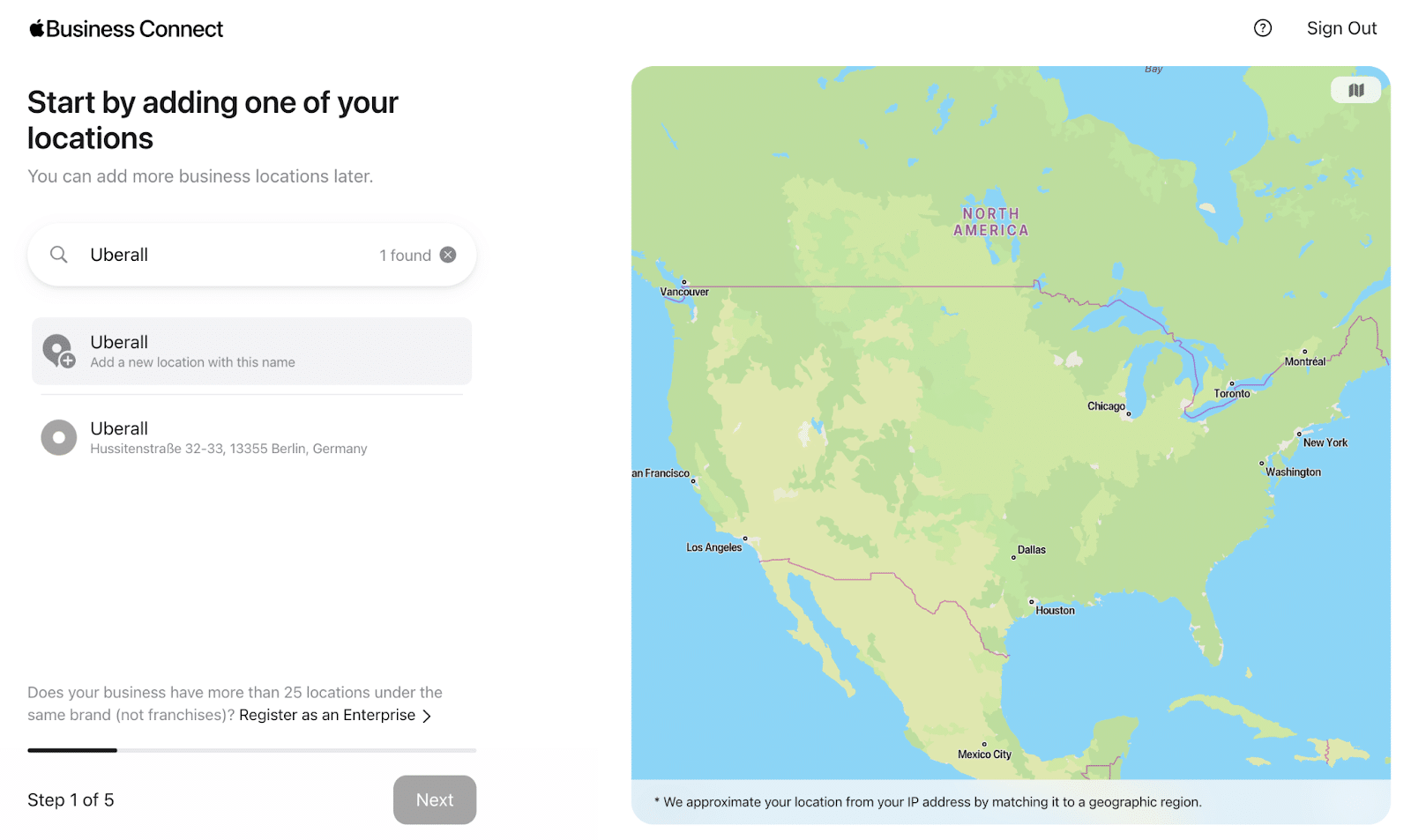
If you are creating a new location, you will need to add your address details and ensure the map pin is over the entrance of your location. You can add the exact coordinates if needed.

In the next two steps, you will want to add your primary, holiday, and special hours.
Special hours are described as custom or a temporary set of hours, such as periods of time when you have extended or shortened availability.
Then you will need to add your primary and additional categories, website, and phone number. (This is a great resource to find the full list of Apple Business categories.)
Apple states that additional categories help with search and can be unique by location.
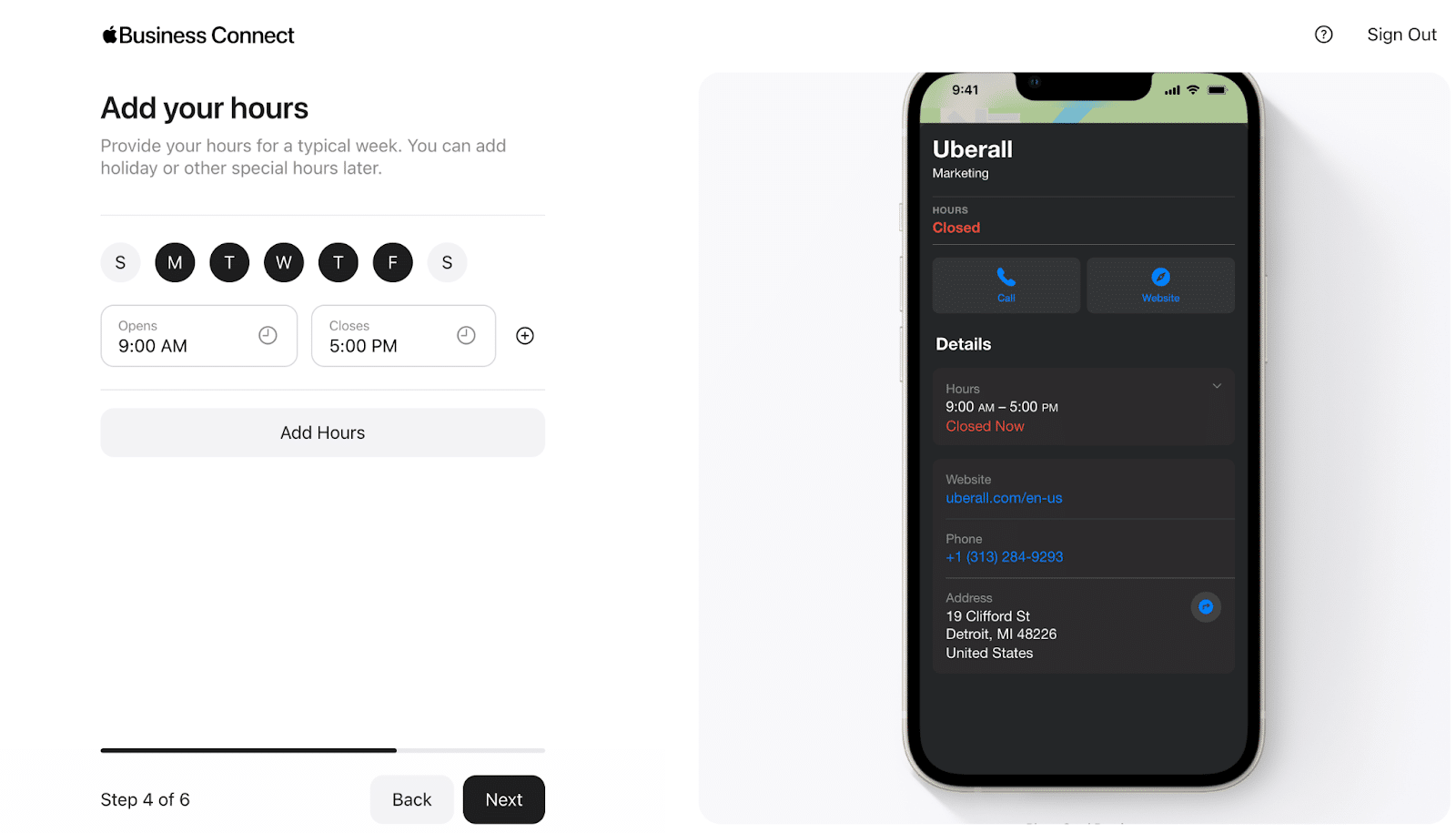
Throughout the setup, Apple begins building your place card preview. According to Apple:
“When you change information about a location in Business Connect, it’s shown in this preview. It can take up to three days for your changes to be published on a location’s place card on Maps after you send them to Apple for review.”
The final steps for setup are focused on verification. You’ll next need to add your company details for verification so that Apple can determine whether you are the proper contact to manage this location on Apple Business Connect.

In order to complete the verification, you will need to provide an identifiable business document such as a business registration, utility bill, or lease agreement as well as a document description.
The verification of your business can take up to five days to process.

Once the verification has been completed, you can begin adding additional information to your Place Card including:
- A unique description of your business location.
- Attributes or additional features of your business. The types of attributes vary by business type but include categories such as:
- Payment options.
- Reservation types (appointment only, walk-ins).
- Accessibility features.
- Parking options.
- Restroom types and availability.
- Tech features (wi-fi and air conditioning).
- COVID-19 Testing and Vaccination options.
- Business Models (co-op, non-profit, membership requirements).
- Safety (cooling center, COVID-19 precautions, sheltering).
- Smoking parameters.
- EV Charging availability.
- Atmosphere details (good for kids, couples, groups).
- What types of pets are or are not permitted.
- A link to an app that supports functions like ordering, making a reservation, or booking an appointment.
- Photos of your business including a logo and cover that will stay positioned at the top of your Place Card. Apple advises that photos will be reviewed and can take up to three days before publishing. You can find photo guidelines here.
- Showcases to highlight timely updates, new features and products for your business. Showcases expire after 30 days unless you set it to end sooner and Apple can take up to three days to review and approve your showcase. Showcases include the following elements:
- A photo and an image tag (should be added for accessibility and screen readers).
- A short title of up to 38 characters.
- A description of the showcase of up to 58 characters.
- One or more calls to action, including:
- “Call Now”
- “Get Directions”
- “Website”
- “Share this Place”
- “Add to Favorites”
- “Rate this Place” – This allows users to provide feedback on overall rating, food and drink, customer service, and atmosphere. It also prompts a user to recommend this place to a friend or family member.
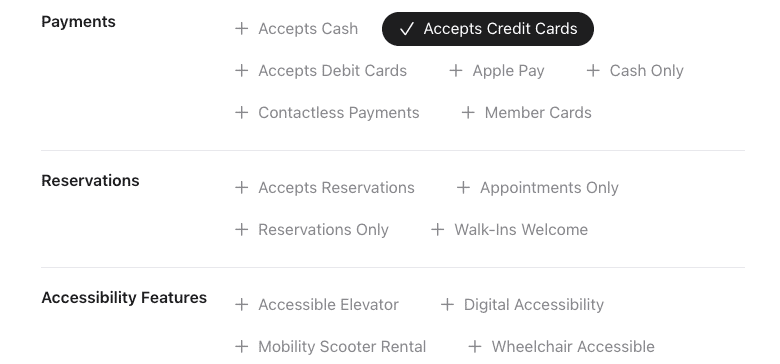 The types of attributes vary by business type.
Note that Showcases are only available to businesses within the United States, but Apple is working to make these available globally in the coming months.
 Walmart’s Showcase, Apple Business Connect
If you manage or own more locations, just click the “Add” button in the top right of the dashboard to begin the process again. You can also invite additional users who need access to manage your locations.
More ways to engage with Apple Maps users
Business Connect is an incredibly exciting and much-welcomed innovation from Apple.
It provides a great opportunity for local businesses to engage with Apple Maps users and is designed in a way that makes it easy for businesses of all types and sizes to get started.
You can find more information in the Apple Business Connect User Guide.
The post Apple Business Connect: Your guide to getting started appeared first on Search Engine Land.
Courtesy of Search Engine Land: News & Info About SEO, PPC, SEM, Search Engines & Search Marketing
Category seo news | Tags:
Social Networks : Technorati, Stumble it!, Digg, de.licio.us, Yahoo, reddit, Blogmarks, Google, Magnolia.
This day in search marketing history: January 25
Written on January 25, 2023 at 1:25 pm, by admin
Google defuses ‘miserable failure’ Google bomb
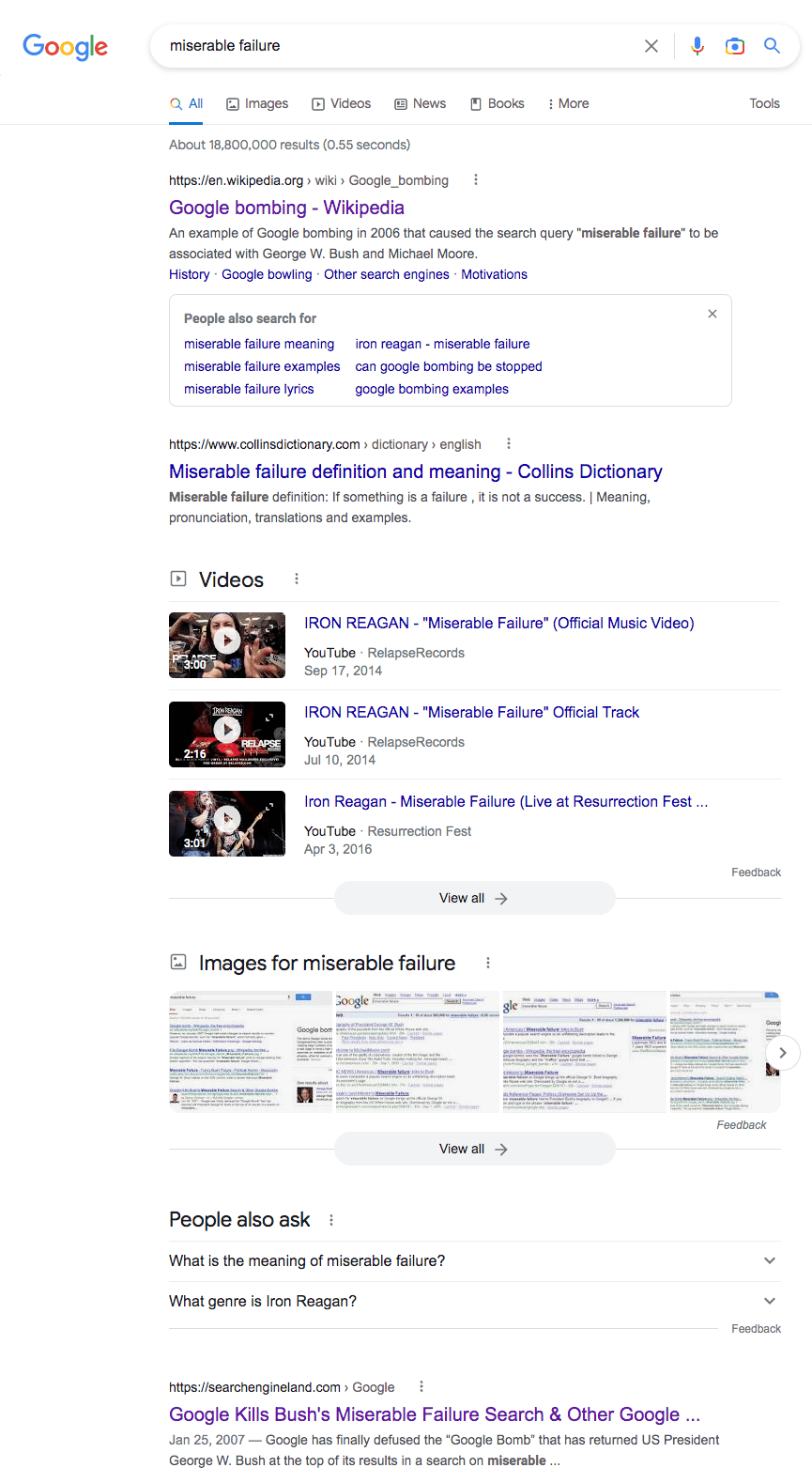
In 2007, Google finally defused a “Google Bomb” that had returned U.S. President George W. Bush as its top organic result since December 2003 when searching for [miserable failure].
Originally, Google was of the belief that “We just reflect the opinion on the Web, for better or worse.” Eventually, however, Google came up with an algorithm change to deal with this and other Google bombing “pranks”:
“People have asked about how we feel about Googlebombs, and we have talked about them in the past. Because these pranks are normally for phrases that are well off the beaten path, they haven’t been a very high priority for us. But over time, we’ve seen more people assume that they are Google’s opinion, or that Google has hand-coded the results for these Googlebombed queries. That’s not true, and it seemed like it was worth trying to correct that misperception. So a few of us who work here got together and came up with an algorithm that minimizes the impact of many Googlebombs.”
Ryan Moulton and Kendra Carattini, A quick word about Googlebombs
How did this Google bomb happen? A campaign encouraged people to link to Bush’s bio using the anchor text “Miserable Failure”.
And while Google defused this bomb, Bush remained in the top organic position for [miserable failure] on Yahoo and Microsoft Live and in second position at Ask.
Read all about it in Google Kills Bush’s Miserable Failure Search & Other Google Bombs and Happy First Birthday, Google Bomb Fix!
Here was the before and after at the time:

Today, here’s what a search for [miserable failure] looks like on Google – with Wikipedia’s Google bombing page in the top spot.
Also on this day
Google kills FLoC, introduces Topics API as its next-gen targeting tech
2022: The Topics API would select topics of interest (based on the user’s browsing history), without involving external servers, and share those topics with participating sites.
tCPA may not be going away (yet), but it should: Why it’s time to embrace value-based bidding
2022: A Google Ads video “Expert Series: Welcome to 2022” had many confused as to the future of non-value bidding strategies with unflattering and cryptic mentions about the popular bid type.
Google’s alternative to third-party cookies open for advertiser testing in Q2 2021
2021: And FLoC would die a year later.
Google adds price drop appearance rich results to search results
2021: Google automatically calculated the price drop based on changes to structured data over time.
Video: Dawn Beobide on the importance of training your developers on SEO
2021: In this installment of Barry Schwartz’s vlog series, he chatted with Beobide about properly sharing the importance of SEO, and building a good relationship with, your developers.
Mueller previews Google image search changes, old Search Console sunsetting at NYC meetup.
2019: Plus, Google was working on switching remaining sites to mobile-first indexing.
Pummeling users with Google remarketing ads they don’t want to see? Now they can mute those, too
2018: Google announced more options for users to control the kinds of ads they see.
Google Search Console’s remove URL report might not work for a short period of time
2018: Google wasupgrading the report.
Marin: Search CPCs outpaced spend growth in Q4 2017
2018: Mobile search click costs increased by 25% year over year.
Virginia Woolf Google doodle honors iconic author of classics ‘Mrs. Dalloway’ & ‘A Room of One’s Own’
2018: The doodle featured the author’s familiar profile.
Google’s 2016 Bad Ads Report: 1.7 billion ads removed, including fake news ads
2018: Efforts to crack down on payday loan ads, ads that look like system errors and “tabloid cloaking” ads were among those that led to an increase in removed ads in 2016.
Google My Business revamps photo management for Google Maps listings
2018: Google wanted to make it easier for business owners to manage their photos within Google My Business.
A Year Later, Google’s Block Sites Feature Remains Blocked
2013: Google said there was no time frame for when or if it would be restored.
Search In Pics: Brin On NYC Subway, Google+ On Who Wants to Be a Millionaire & Android Train
2013: The latest images showing what people eat at the search engine companies, how they play, who they meet, where they speak, what toys they have, and more.
Google Changes Definition Of Average Search Ranking Position
2012: In the past, they would take all the positions of your rankings and average them together. That changed to averaging only the top positions.
Google Revamps Submit Content Page
2012: Google updated its URL submission tool page and redesigned its Submit Your Content page.
WSJ: Federal Prisoner Helped U.S. Sting Against Google’s Pharmacy Ads
2012: Google had to pay $500 million after acknowledging that it both allowed and helped Canadian pharmacies sell drugs in the U.S. in violation of federal law.
Emergency In Your Area? “Public Alerts” On Google Maps Shows Warnings
2012: Google would show emergency alerts in your area on the map, with more details on the alert.
DuckDuckGo Sets New Traffic Record, But Stats Show How Dominant Google, Others Are
2012: DuckDuckGo reached 700,000+ queries in a day for the first two times.
Yahoo Beats Expectations with Weak $1.5B Revenues, But Display Up 17 Percent
2011: CEO Carol Bartz called the revenues “encouraging.”
Google Buys Twitter Sentiment Analyzer fflick To Support “Contextual Discovery”
2011: The fflick service analyzed and organized comments about movies.
US Twitter Users Spending More Time Than Ever On Twitter.com, Report Says
2011: But the report also cautioned that overall visits to Twitter were down.
Browsers To Offer Official Behavioral Targeting Blocking
2011: Google released a new Chrome extension named Keep My Opt-Outs. Firefox was working on a solution for a new version of Firefox.
Google Acquires SayNow
2011: SayNow was a platform that allowed voice messaging, one-on-one conversations, and group calls to be instantly integrated into Facebook, Twitter, MySpace, Android, or iPhone applications.
Google Promotes Boost To All Of U.S., Mobile Devices
2011: Google’s simpler AdWords program, Boost, got its national roll-out, after a three-month test period.
Google To Hire 6,000 Plus, While Yahoo Cuts Additional 1%
2011: Google was primed for its biggest hiring year in company history.
And The Academy Awards Oscar Nomination Goes To … Google & Bing!
2011: Both search engines listed news about the awards at the top of the page.
Google Voice Number Porting Now Available
2011: It took 24 hours and cost $20.
My Life With Google Voice Number Porting, Six Months In
2011: The experience was largely good. Plus, some thoughts on how this gave Android an added boost ahead of Verizon’s iPhone launch.
December 2010: Search Engine Land’s Most Popular Stories
Some SEO Advice For Bill Gates
2010: What could you give to the richest person in the world? Some free SEO advice for his new blog.
Like Ballmer, Bill Gates Dings Google On China
2010: “They’ve done nothing and gotten a lot of credit for it.”
Twitter Testing Local Trends
2010: The local trends version showed you what tweet topics were hot and trending on Twitter by region, country and city
Dress Up Ask Jeeves In The UK
2010: Ask UK had a new game where you could dress up the lovable Jeeves character.
Factery Labs’ New Fact Engine: Just What Real-Time Search Needs
2010: Factery Labs surfaced the facts behind the day’s trending news.
No Feed, No Problem – Google Reader Now Tracks (Mostly) Any Website Change
2010: Google Reader would periodically visit a page and publish any significant changes it found as items in a custom feed created just for that page.
Science Fiction Writer Le Guin Launches Petition Against Google Book Settlement As Opt-Out Deadline Looms
2010: Exempting the US would essentially have rendered the settlement meaningless.
Confirmed: Google Domain Park To Cease Ads On Domain Kiting Sites
2008: Google began preventing “domain tasting” (the practice of trying out a domain name for a 5 day-period) from participating in the AdSense for Domains (aka Domain Park) program.
Survey Says: Search Right Behind Email Marketing In Best-Performing Category
2008: 80% said email marketing performs strongly for their company, with search right behind at 70.6%.
Google AdWords Won’t Allow Personal Attacks On Politicians
2008: Political ads could neither include accusations or attacks relating to an individual’s personal life, nor advocate against a protected group.
Will Google Suffer In A Recession?
2008: The answer appeared to be “no.”
New: Real-Time Google Maps Edits In New Edits Viewer
2008: You could watch the edits made to Google Maps in a live viewer.
Microsoft Earnings Soar, Gates Calls For More Help To Poor
2008: However, in the “online services” division, which housed search and adCenter, there was a loss of $245 million on increased revenues of $863 million.
Doerr And Moritz: A Tale Of Two (Very Wealthy) Google Investors
2008: Both of these men got fabulously rich off their Google shares – likely north of $800 million apiece.
Search in Pictures: Google Cake, Banana Room, Kate Nash @ Yahoo
2008: The latest images showing what people eat at the search engine companies, how they play, who they meet, where they speak, what toys they have, and more.
Google Video Search Now Includes YouTube Results
2007: Searches returned many results from YouTube.
Google To Share Bugs & Bombs At Google Testing Blog
2007: Google would be sharing their debugging and testing experiences with the public.
Fox Subpoenas Google’s YouTube For Identity Of User Who Uploaded “24” Video
2007: The premiere was reportedly posted prior to the live airing of the show.
Google AdSense Tests New Features: My Publishers, Ad Placement & Message Inbox
2007: My Publishers tab, ad placement and a message inbox.
Speculation: The Google Search Results Page With Google Video Ads
2007: A funny mock up of what it would look like if Google added their Google Video ads to the Google search results page.
From Search Marketing Expo (SMX)
Past contributions from Search Engine Land’s Subject Matter Experts (SMEs)
These columns are a snapshot in time and have not been updated since publishing, unless noted. Opinions expressed in these articles are those of the author and not necessarily Search Engine Land.
- 2022: Level-up your PPC forecasting with free modeling tools for Excel by Emma Franks
- 2019: Fighting brand fatigue through A/B testing by Duane Brown
- 2019: How to keep your SEO team (and yourself) relevant by Grant Oster
- 2018: Google Questions and Answers: Everything you need to know by Joy Hawkins
- 2017: Using agile project management for SEO & digital marketing by Marcus Miller
- 2017: SEO priorities for the new year by David Freeman
- 2016: Preserve Your Content Ecosystem By Fixing Link Rot by Garrett French
- 2016: PPC Blunders: Downright Dirty, Inexperienced Or Overwhelmed? by Pauline Jakober
- 2013: How To Estimate Incremental Revenue Opportunities With Impression Share Data by Benjamin Vigneron
- 2012: When A/B Testing Prices, Proceed With Caution by Scott Brinker
- 2012: 4+ Recommendations To Enhance B2B SEO Initiatives by Derek Edmond
- 2012: 2012 Is The Year To Cut Your Site Retargeting Budget by Dax Hamman
- 2011: Why Every SEO Needs A Little Black Book by Ross Hudgens
- 2011: Yandex Keeps On Beating Google In Russia by Andy Atkins-Krüger
- 2011: How To Use Twitter To Boost Your Google Rankings by Kevin Gibbons
- 2010: Enterprise SEM: Q&A With Zappos’ Darrin Shamo by Adam Audette
- 2010: Five Quick Tips For Success On Google’s Content Network by Mona Elesseily
- 2010: Playing Games With Customers: Is Foursquare The Future Of Local Search? by Andrew Shotland
- 2007: 3 Ways To Use Your Competition To Build Links & Targeted Traffic by Nick Wilson
< January 24 | Search Marketing History | January 26 >
The post This day in search marketing history: January 25 appeared first on Search Engine Land.
Courtesy of Search Engine Land: News & Info About SEO, PPC, SEM, Search Engines & Search Marketing
Category seo news | Tags:
Social Networks : Technorati, Stumble it!, Digg, de.licio.us, Yahoo, reddit, Blogmarks, Google, Magnolia.
Microsoft is improving its ad platform. Here’s why brands should give it a shot in 2023
Written on January 24, 2023 at 9:18 am, by admin
ICYMI, Microsoft has ambitious plans: to double the size of its ad business to $20 billion.
So why is this big news? Google and Meta are showing signs of fading, making more room for emerging platforms like TikTok, Amazon and Instacart.
Wait, what about Microsoft Ads?
Microsoft’s search and news advertising revenues have consistently grown over the last four quarters (Q2: 32%; Q3: 18%; Q4: 15%; Q1: 16%).
One advantage of Microsoft Ads is its cost-effectiveness. It’s typically cheaper than Google Ads and offers more opportunities to target specific audiences with relevant ads at a lower cost per click.
Additionally, Microsoft Ads provides detailed analytics that are easy to interpret, making it easier to track ROI and refine campaigns over time.
On the other hand, Microsoft still falls miles behind Google in terms of users. Google typically sits around 83.84% share of the global search market (fallen from 89.95% in the past three years); during the same timeframe, Bing’s share has risen from 3.99% to 8.88%.
But what do other advertisers think?
I asked Christine Askew of Workshop Digital (and 2022 winner of Best B2B Search Marketing Initiative) and Timothy Jensen of M&T Bank (and SMX Next panelist on 2023 PPC trends to get ahead of), their thoughts on why more brands should be giving Microsoft Ads a fair shot.
Why is having competition for Google search a good thing? Why should search marketers root for competitors like Microsoft Ads?
Having competition for Google search encourages companies to innovate, invest in better search technologies, and create better user experiences.
Competition also keeps prices down and helps to ensure that no one search engine has too much market share or power.
By creating a more competitive market, search marketers can benefit from better search options and more competitive pricing.
Additionally, competition helps to ensure that search results remain unbiased and free from manipulation.
Ultimately, competition is a healthy thing for the search industry and helps to ensure a better experience for users.
How has Microsoft improved their Ads dashboard, features, and product offerings?
Microsoft has introduced a unified interface that allows for better cross-platform optimization and insights. They have also included more detailed reporting, data visualization, and new automated campaign management tools.
Additionally, Microsoft has launched new features such as audience insights and automated bidding strategies to help users better target their campaigns.
Finally, Microsoft has improved its product offerings to include more comprehensive features, such as the ability to manage multiple campaigns from a single dashboard and the ability to optimize campaigns for different devices.
Here are just a few of the latest products and features released by Microsoft:
- Extending Shopping campaigns to more markets
- New ad type for service providers
- Automotive Ads get more placements, roll out globally
- Updates to the reporting dashboard with recent reports, real-time previews and more
- Cash back incentives for ads
- New certification badges, levels and a new learning center
- Bing is building a new retail marketplace
- Auto-updates for shopping campaigns are launched
- Netflix, Microsoft partner for ad supported subscription plan
- 5 new ad products and updates are launched
- Multimedia Ads are launched
When will Microsoft Ads get respect?
Microsoft has been playing the long game – for a long, long time now. And Microsoft has an equally long history of mistakes and missed opportunities going back over a decade.
Microsoft Ads has been slow to gain respect from search marketers. But Microsoft has continued to improve its platform (e.g., the introduction of a unified interface, more detailed reporting).
Additionally, search marketers are starting to recognize the value of Microsoft Ads, such as its ability to target campaigns across multiple platforms and its automated bidding strategies.
As more search marketers become aware of Microsoft Ads and its benefits, it is likely that it will gain more respect in the industry.
- “This may just come with time, and by differentiating themselves in any way from Google – their #1 competitor.” Askew said
- “When they improve the reliability of mapping search query intent to keywords. Even exact match keywords are off the rails in matching to a high volume of irrelevant terms. Microsoft should also do more to listen to advertisers’ concerns about the directions Google has taken and be bold enough to take a different direction as opposed to trying to achieve parity with every change Google makes.” Jensen said.
What should Microsoft do to compete more aggressively in the ad space?
One idea, via Jensen, is more comprehensive integration with LinkedIn:
- “The LinkedIn profile targeting capabilities we do have certainly were a good starting point, but we were promised expansion of targeting options that never happened. Group targeting, job seniority targeting, and others could be powerful when combined with the Audience Network. A longer-term pipe dream would be an ability to set up campaigns running on LinkedIn via Microsoft Ads (or vice versa) with a full range of targeting options.” Jensen said.
Why should advertisers and brands try Microsoft ads?
Microsoft offers more detailed reporting and data visualization, as well as automated bidding strategies and audience insights in addition to a wide selection of ad formats, including text, image, and video ads.
Microsoft Ads are also competitively priced, making it an attractive option for budget-conscious advertisers and brands.
And the introduction of Multimedia Ads has given the platform a unique feature that advertisers likely won’t find with other ad solutions.
- “I think Microsoft has the reputation that they ‘”‘just follow whatever Google does months later.’ Our team is always impressed when Microsoft releases a new feature that is different from Google (incentivizing Meta campaign imports, LinkedIn audience integration, action assets, etc). I think that being less of a ‘follower’ and more of a ‘trend-setter’ will help really elevate the adoption of Microsoft Ads,” Askew said.
Why are brands hesitant to try running Microsoft Ads?
There’s a perception that most everyone uses Google as their search engine of choice, Askew said, when in reality 724 million monthly unique desktop searchers globally on the Microsoft Search Network in December 2021 (according to comscore Search):
- “A client asked ‘do people even use Microsoft’s search engine?’ I hit him with that handy dandy stat. Additionally, advertisers who specialize in lead gen may look at lead volume only and say ‘Google is driving more leads for me at a more efficient cost per lead, so why would I continue to fund Microsoft campaigns?’ When in reality, lead volume is only one piece to the puzzle – there’s also lead quality to analyze.
For one of my B2B lead gen clients in particular, we see less lead volume and a less efficient cost per lead on Microsoft compared to Google; however, every month we consistently see a greater percentage of those leads turn into an opportunity in Salesforce – which can then lead to a contract/revenue for the business. This means Microsoft is driving higher quality leads than Google.
If we’d just stopped to look at lead volume alone, we’d be undervaluing Microsoft entirely. Many advertisers who don’t have this kind of closed loop data may be hesitant for this exact reason.”
Besides the obvious point that volume is significantly lower than Google, performance can often be unpredictable as well, Jensen said:
- “While I’ve worked with some brands that see excellent results from Microsoft, more of my recent experience tends to be that leads are lower quality and month-to-month flakiness can occur in both amount of conversions and how qualified they are. Search query mapping to keywords leaves much to be desired. The recent move to “force” Audience Network inclusion in campaigns (unless you opt for an account-wide exclusion) hasn’t helped either.” Jensen said.
The advantage of using Microsoft ads over Google Ads
Microsoft offers some advantages over Google Ads, including a unified interface for cross-platform optimization, more detailed reporting and data visualization.
Additionally, Microsoft offers a variety of pricing options with different ad formats that are likely a cheaper option than Google. Finally, Microsoft provides access to a larger global market, which can be beneficial for advertisers and brands looking to expand their reach. Said Askew:
- “Compared to Google – Certainly the LinkedIn audience integration, Google does not have as many audiences that are relevant for B2B industries in my experience. Cheaper click costs than Google, which means more bang for your buck.
Microsoft has different extensions, now known as assets, than Google including action assets and filter link assets. Microsoft Clarity is also available (a lesser-known & free user recording and heat mapping tool that can be used to understand user behavior on a website).
Compared to Meta – I think the audiences Microsoft has available are more relevant in the B2B space than Meta. Especially since Meta has been steadily removing audience targeting options as time goes on. For businesses that operate B2B, getting the audience targeting right is half the battle.”
Despite its limitations, the LinkedIn integration is a big advantage for Microsoft with a level of B2B data that the other platforms just don’t have, Jensen said:
- “While volume can be a challenge, I’ve seen good conversion data from layering on job functions and industries with the right brands. Another advantage is that with their ‘underdog’ status there has been at least some level of trying to listen to marketers and roll out features that are helpful, although I’ve seen less of this in more recent years.”
So are Microsoft ads better for B2B?
It depends. (I know, I know. Sorry.)
Microsoft has a wide selection of ad formats, including text, image, and video ads, as well as audience insights and automated bidding strategies.
Additionally, Microsoft Ads allow for cross-platform optimization and detailed reporting, making it easier to track and measure campaign performance.
Finally, Microsoft is competitively priced and offers a variety of pricing options, making it an attractive option for budget-conscious B2B campaigns.
But as Askew pointed out, volume would likely be lower than that of its competitor, Google. For that reason alone, brands could be hesitant.
How about the Audience Network?
The Microsoft Ads Audience Network is beneficial for brands as it allows them to reach users on a variety of platforms, such as mobile apps and websites. This can be especially helpful for brands looking to target a wide range of audiences – especially B2B.
Additionally, the Audience Network provides access to more detailed data and insights, allowing brands to better tailor their campaigns to their target audiences.
Finally, the Audience Network is integrated into the Ads platform, allowing brands to manage campaigns across multiple platforms from a single dashboard.
Microsoft Ads has come a long way in recent years
Microsoft continues to improve with the help of AI technology. The company is investing heavily in machine learning and artificial intelligence, which will greatly enhance its advertising capabilities in the future.
The bottom line is that Microsoft shouldn’t be overlooked by search marketers who want better results without breaking the bank. With the right targeting and optimization strategy in place, Microsoft Ads can be just as effective as Google Ads at a fraction of the cost.
The post Microsoft is improving its ad platform. Here’s why brands should give it a shot in 2023 appeared first on Search Engine Land.
Courtesy of Search Engine Land: News & Info About SEO, PPC, SEM, Search Engines & Search Marketing
Category seo news | Tags:
Social Networks : Technorati, Stumble it!, Digg, de.licio.us, Yahoo, reddit, Blogmarks, Google, Magnolia.
Top video marketing trends for 2023 and beyond
Written on January 24, 2023 at 9:18 am, by admin
In today’s world, video ads are the most effective way for businesses to reach their target audience and promote their products or services.
During my SMX Next presentation, we reviewed three innovative trends for video, which helped create a deeper conversation around the role that data and analytics play, along with targeting and optimization.
Let’s revisit some key strategies, questions and thoughts from the presentation.
The rise of vertical video
Each year, I try to think of the most valuable impression in our ad space. For many years, I’ve always sourced the answer to YouTube TrueView Skippable Ads. Rightfully so, since you don’t pay for a user until they watch 30 seconds of an ad (or, if the video is shorter in length, they complete or engage).
However, I’ve changed my opinion recently. I am convinced that vertical video is the most valuable impression on the web today.
Vertical video is a must for any advertiser in 2023 due to the following three ad types:
From a creative standpoint, you can run the same, if not similar, ads across all three platforms. Each carries its own unique set of targeting, which separates them in their ability to drive quality user volume.
- For ecommerce: My recommendation would be Reels first due to the Instagram shops integration. Followed by TikTok due to trends, audience, and engagement opportunities.
- For B2B: I would start on Shorts, a better transition from this ad to the YouTube channel to engage with more content. Also, you can leverage the power of Google Ads and Analytics to serve ads to audiences who have either shown interest in the brand or provided a level of intent within Google Search and/or YouTube.
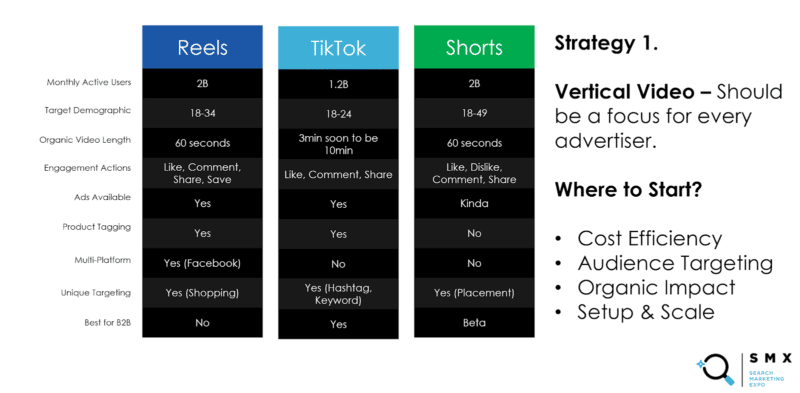 Vertical video: Comparison by platform
TikTok for B2B
Using TikTok for B2B is a common concern for marketers. Can it really be effective, specifically when targeting executives?
The short answer is, “yes.” The long answer, however, includes some nuance.
When targeting executives, we can assume these busy individuals are not necessarily on TikTok, but those who relay key messages to these executives (partners, assistants, managers) would be the ones to relay this type of messaging to the decision-maker.
Thus, I don’t think TikTok needs to hit the target to be effective. Rather, the creative, messaging, and product need to attract the target audience to take action – to learn more and deepen the impact to take the next step of passing it up the ladder to the executive.
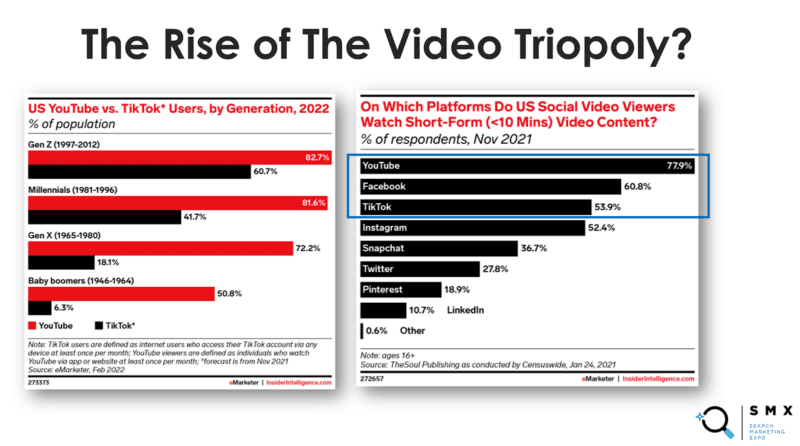
While TikTok can be very effective for brands, we find that it is more effective for some vs. others. However, the platform is building tools to help B2B advertisers, including the following:
- Hashtag targeting: For the first time, we can leverage the power of search intent and video by targeting specific keywords users have either searched or tagged.
- Lead gen campaign: Decrease friction by allowing users to convert directly from an ad to your CRM with a max survey of 10 questions.
- Video length: Organic length has increased to 3 minutes from 1 minute earlier this year, and I believe 10 minutes would be the next jump as TikTok looks to capture longer time spent, where YouTube currently holds the crown.
- Influencers: While not a specific product, this is a tactic we have seen to be a clear advantage. Leveraging product integration with an influencer with your target demographic following can work for B2B.
Jumping on a video trend vs. creating a compelling ad
Another key question from the audience during the presentation was, “Is it better to jump on a video trend or create a compelling ad” from a video perspective.
If you have the budget, you should strive to test both so you understand the impact. There is no right or wrong answer here I would just use my best judgment.
Here are a few points to consider:
- If you are a larger brand, I believe you have a better opportunity to win with a video trend due to your current audience being willing to latch on and push the trend even further. If you are a smaller brand, you are looking for a home run which is rare but not impossible.
- The compelling ad is always a go-to for both large and small brands, in my opinion, because it is designed to grab the viewer’s attention and persuade them to take a specific action. Compelling ads can be effective at reaching a wide range of viewers.

The future of advertising
The future of advertising in the near term is vertical video. Thus, taking a deeper look into the platform opportunities for these placements is extremely important.
Since the presentation, the Variable.Media team and I have been able to generate a few more case studies and gather data specific to these vertical placements.
YouTube Shorts
This is a must for anyone currently running YouTube ads. We see strong engagement, average rates (CPM/CPV), but longer watch times.
The longer time spent could be due to the user and state of mind within a story, having watched all the other content from the subscription or search tab, thus in a short from the home tab.
TikTok
Hashtag targeting works, but we’re finding limited scalability, especially with B2B brands.
A great audience target, however, we will need to see growth to perform at scale.
Instagram Reels
A much more engaging placement than stories or the newsfeed at a fraction of the cost.
For most brands, we run reels as we find the audience is likelier to share, comment, or save than click through, a new behavior that has shifted from newsfeed to stories and now reels.
Maximize vertical video in your advertising strategy
Video creates a unique opportunity to reach a wide range of audiences on platforms while increasing engagement and conversion rates.
Vertical video ads offer a powerful way for businesses to promote their products and services.
However, it is important to remember that the most effective approach will depend on a business’s specific goals and target audience, which can play a critical role in maximizing the impact of vertical video.
Watch: 3 innovative video marketing trends for 2023 and beyond
Below is the complete video of my SMX Next presentation.
The post Top video marketing trends for 2023 and beyond appeared first on Search Engine Land.
Courtesy of Search Engine Land: News & Info About SEO, PPC, SEM, Search Engines & Search Marketing
Category seo news | Tags:
Social Networks : Technorati, Stumble it!, Digg, de.licio.us, Yahoo, reddit, Blogmarks, Google, Magnolia.
Google updates image SEO best practices and Google Discover docs
Written on January 24, 2023 at 9:18 am, by admin
Google has made a couple of tweaks to two of its SEO-related help documents. The changes include specifying that the title and link elements are most important for the RSS feed follow in Google Discover and that Google parses img elements even within other elements, such as the picture element.
Google Discover RSS Feed follow
Google added a new line to the Get On Discover documentation under the feed guidelines for the Follow feature in Google Discover. Google wrote:
“The most important content for the Follow feature is your feed
<title>element and your per item<link>elements. Make sure your feed includes these elements.”
Clearly, if you care about performing well in the follow feature on Chrome, you should include the <title> element and <link> elements in your RSS feed.
Google Image SEO best practices update
Google also updated the image SEO best practices document to clarify that Google parses <img> elements even when they’re enclosed in other elements (such as <picture> elements) when indexing images.
The document used to say “Google parses the HTML of your pages to index images, but doesn’t index CSS images.” It now reads:
“Using semantic HTML markup helps crawlers find and process images. Google parses the HTML <img> elements (even when they’re enclosed in other elements such as <picture> elements) in your pages to index images, but doesn’t index CSS images.”
Why we care
If you are looking to leverage more when it comes to either the Follow feature in Google Chrome powered by Google Discover, or you are looking to perform better with your image SEO, make sure to read the updated documentation that Google has provided. More importantly, if you make any changes to your site, make sure to test to see if there is a positive or negative impact to your search performance.
The post Google updates image SEO best practices and Google Discover docs appeared first on Search Engine Land.
Courtesy of Search Engine Land: News & Info About SEO, PPC, SEM, Search Engines & Search Marketing
Category seo news | Tags:
Social Networks : Technorati, Stumble it!, Digg, de.licio.us, Yahoo, reddit, Blogmarks, Google, Magnolia.
Understanding quiet quitting in SEO – the silent exodus
Written on January 24, 2023 at 9:18 am, by admin
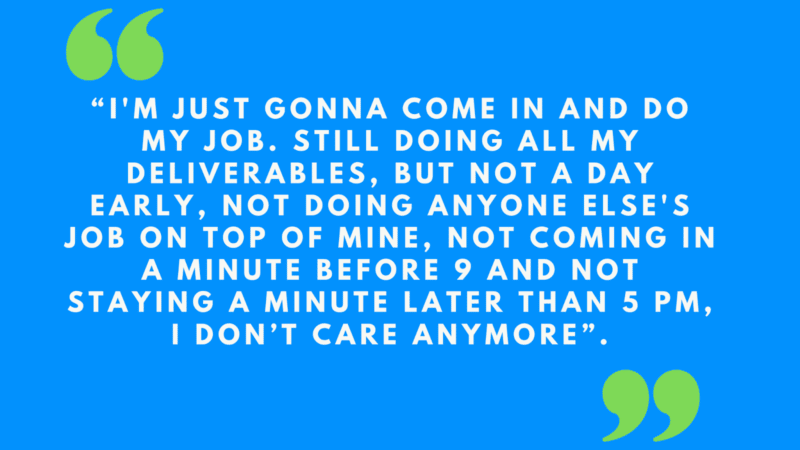
“I’m just gonna come in and do my job. Still doing all my deliverables, but not a day early, not doing anyone else’s job on top of mine, not coming in a minute before 9 a.m. and not staying a minute later than 5 p.m. I don’t care anymore.”
This is quiet quitting.
40% of the global workforce is looking to leave their jobs in the next 3 to 6 months, according to “To quit or not to quit” by Mckinsey and Company. The difference will be in how they will choose to leave, which will also have significant effects on businesses.
While the term “quiet quitting” has been trending recently, there is a misunderstanding that must be addressed regarding the concept.
Setting boundaries, such as declining to work excessive hours, weekends, or being on call for non-urgent requests outside of regular business hours, is not a form of quiet quitting. Rather, it is a matter of self-respect and taking care of one’s own well-being.
True quiet quitting occurs when an employee, unhappy with a situation at work and unable to find a satisfactory resolution, chooses to depart without causing a fuss.
This is not an act of cowardice, but a decision made in the interest of preserving one’s own peace of mind.
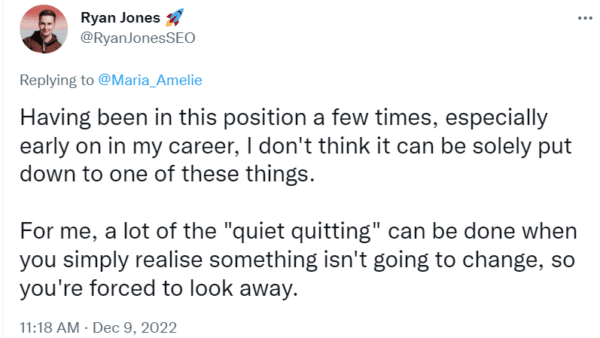
It is a common occurrence that when an employee is quietly quitting, they will focus solely on meeting the minimum requirements of their job, and no more. This is often done for fear of being terminated before securing a new position.
However, the employee will likely go to great lengths to conceal their job search and intent to leave, and their behavior and demeanor at work will not change. None will notice a thing.
It is only when they formally tender their resignation or depart that the full extent of their quiet quitting becomes apparent.
The costs of quiet quitting
An employee who has decided to quietly leave will only stay in a job until the role looks decent in their CV (one year tops if they are new) or only a few months more until they secure the next job.

Other costs associated with quiet quitting are:
Lost productivity
When an employee quits, the company may have to scramble to find a replacement, which can lead to lost productivity as the new hire gets up to speed.
Increased workload
In the meantime, remaining employees may have to take on additional responsibilities to cover the workload of the departed employee, leading to increased stress and burnout.
Training costs
The company may have to invest time and resources into training a new employee to replace the one who quit, which can be costly.
Negative impact on morale
Quiet quitting can also have a negative impact on morale among remaining employees, as it may create a sense of uncertainty and insecurity about the stability of the company.
Reputation damage
If quiet quitting becomes a common occurrence at a company, it may damage its reputation and make it difficult to attract top talent in the future.
Especially if the reason a valuable employee quietly leaves is a manager, once that employee leaves, he or she will start talking among those very close to them.
Let’s not forget the financial costs of recruitment and new equipment, too.
The root cause
Poor management is frequently the root cause of quiet quitting. In particular, a lack of effective communication and excessive micromanagement can contribute to this phenomenon.

When an employee’s attempts at communication with their manager are met with confrontation, misunderstanding or friction, they may feel disheartened and choose to silently depart rather than risk further conflict.
Similarly, a manager who constantly checks on the work of their employees, scrutinizes every detail and micromanages every aspect of their work is likely to drive even the most talented and dedicated staff to consider quietly quitting.
Such behavior fosters a toxic and oppressive work environment that ultimately proves unsustainable for those who value their own well-being and professional satisfaction.

At some point in our lives, we all have quietly quit a job, other reasons include:
Fear of retribution
Some employees may be afraid to speak up or voice their concerns to their manager for fear of retribution or negative consequences.
Lack of trust
Some might feel that their concerns will not be taken seriously, leading them to quit quietly rather than trying to address the issue through communication.
Feeling overwhelmed
Some employees may feel overwhelmed or stressed and may not know how to effectively communicate their concerns to their manager. They may therefore choose to quit quietly rather than to navigate a potentially difficult conversation.
Lack of confidence
Some employees may lack the confidence to speak up or communicate their concerns to their manager, leading them to quit instead quietly.
There’s also fear of damaging relationships in the workplace.
Get the daily newsletter search marketers rely on.
<input type=”hidden” name=”utmMedium” value=”” />
<input type=”hidden” name=”utmCampaign” value=”” />
<input type=”hidden” name=”utmSource” value=”” />
<input type=”hidden” name=”utmContent” value=”” />
<input type=”hidden” name=”pageLink” value=”” />
<input type=”hidden” name=”ipAddress” value=”” />
Processing…Please wait.
Quiet quitting in SEO: 4 common reasons
In a recent Twitter poll, I asked SEOs what they think is the most important reason to push people to “quiet quit” and these were the results:

Burnout
In the fast-paced and high-stress world of agency work, burnout is all too common.
The constant pressure to be alert and responsive, the feeling of being chased by an ever-present deadline, and the constant demand to deliver can take a toll on one’s mental health.

It is a sad reality that burnout is often glamorized in some SEO agencies, particularly those that prioritize acquiring new clients and taking on unrealistic deliverables instead of investing in their teams and considering their capacity.
The result is an environment where new challenges are thrown at already overburdened teams, expected to be delivered, as vulgarly said, “by yesterday.”
The SEO sweatshop: The quiet quitting central
Characterized by large open offices where employees are expected to be onsite from 8 a.m. to 7 p.m., five days a week, with no hybrid or remote work options, these places churn out jargon-laden SEO reports with no value at all, unhelpful content, “land” useless links on the media but all done at a rapid pace, sticking up to the philosophy of done “by yesterday.”
In the SEO sweatshop, the “perks” offered to employees are often little more than sweets, trinkets, and fast food, and the culture is one of unhealthy imbalanced lifestyles.
In such agencies, burnout, quiet quitting, and high staff turnover are all too common, as employees are subjected to long hours, low salaries, and immature, uneducated managers who prioritize profits over the well-being of their teams.

Signs of burnout include:
- Feelings of physical, emotional, and mental exhaustion: The employee may feel drained and unable to keep up with their usual workload.
- Decreased productivity and quality of work: Burnout can also lead to a decrease in productivity, as the person may struggle to focus, make decisions, or complete tasks.
- Negative attitudes: Burnout can lead to negative attitudes, such as cynicism, detachment, or frustration. The person may be more critical of their work or colleagues or be the passive-aggressive SEO starting dramas on Twitter.
- Increased absenteeism: Burnout can also lead to increased absenteeism, as the individual may take more time off or call in sick more often.
At the same time, managers should keep a close eye on the following employee traits that lead to burnout:
- Eating lunch at their desk.
- Staying late.
- Timesheets showing over nine hours done a day.
- Sending and responding to emails over the weekend (which also creates a toxic work environment.)
The most significant issue with the SEO sweatshop model is that it is a problem that is evident to everyone in the company, with the exception of the manager.
In these places, there is a culture of disregard for the well-being and professional satisfaction of employees, leading to a cycle of burnout and turnover that ultimately harms the company as a whole.

Culture in the workplace
When the culture within a company is toxic or negative, employees may feel that they have no other option but to leave.
This can be particularly true in cases where the culture is characterized by excessive micromanagement, harassment, discrimination, and poor career progression.
When employees do not feel safe or supported in their work environment, they may opt to resign quietly rather than confront the issue or raise a complaint.
Additionally, if the culture of the company does not align with an employee’s values or goals, they may choose to depart in favor of a more harmonious and fulfilling work environment that aligns with their personal beliefs and aspirations.
Challenging manager
A challenging manager is someone who does not provide clear direction or support to their team, making it difficult for employees to do their job effectively. This can lead to feelings of frustration and insecurity and may cause employees to question their ability to succeed in their roles.
When an employee feels like their manager is not supportive of their career development or growth, they may choose to leave the company in search of a more supportive and nurturing work environment. This can be especially true if the employee has a long-term career goal in mind and feels like their current manager is not helping them to achieve it.
Salary
In a company where workload and responsibilities increase over time but salaries do not, it is not uncommon for employees to turn to quiet quitting as a means of seeking better opportunities elsewhere.
When career progression is hindered by a lack of pay increases and employees feel undervalued and unappreciated.
The post-COVID-19 landscape has further exacerbated this trend, as employees increasingly prioritize their well-being and seek work environments that align with their values and goals.
To prevent costly and damaging instances of quiet quitting, it is essential for managers to clearly communicate policies on pay and career progression from the outset.
By doing so, they can avoid losing valuable employees and ensure that the talent they have invested in is able to thrive and grow within the company.
Prioritizing well-being in SEO
When speaking up, it is important for a manager and an employee to be factual and avoid reacting at all costs.

To prioritize well-being in your SEO team, consider the following.
- Set clear expectations: Have structure as well as processes in place. There is nothing more unsettling than a manager that expects a new employee to immediately know how to do the job without the appropriate onboarding.
- Encourage work-life balance: Encourage employees to take breaks, use their vacation time, and disconnect from work outside office hours.
- Promote a positive work culture: Create an environment that is supportive, collaborative, and respectful. Encourage open communication and feedback. Positive culture is not equal to forced fun.
- Monitor workload carefully and do not micromanage: Make sure that employees are not taking on too much work and that they have the support they need to manage their workload effectively.
- Provide opportunities for growth and development: Offer training, mentorship, and other opportunities for employees to learn new skills and advance their careers.
Remember, it is all about taking notes, listening and following up by email with a plan.
Additionally, offering support resources such as counseling and health and wellness programs can help employees to manage stress and prevent burnout.
By prioritizing the needs and well-being of your team, you can create a work environment that is conducive to success and retention.
 Anime art created by my 12-year-old son in his project Dekiru Art.
The post Understanding quiet quitting in SEO – the silent exodus appeared first on Search Engine Land.
Courtesy of Search Engine Land: News & Info About SEO, PPC, SEM, Search Engines & Search Marketing
Category seo news | Tags:
Social Networks : Technorati, Stumble it!, Digg, de.licio.us, Yahoo, reddit, Blogmarks, Google, Magnolia.
This day in search marketing history: January 23
Written on January 23, 2023 at 5:13 am, by admin
Expedia buys Travelocity
In 2015, Expedia bought rival Travelocity for $280 million amid sluggish travel industry growth and pressure from insurgent travel providers.
Expedia had actually been powering Travelocity.com since 2013. So the acquisition seemed quite logical from both perspectives.
At the time, Expedia also owned several online travel brands: Hotels.com, Hotwire, eLong and Trivago.
Read all about it in Travel Search Consolidation: Expedia Buys Rival Travelocity For $280M
Also on this day
Neeva seeks to expand user base with free subscriptions
2022: The free basic subscription was an alternative to its full-featured subscription, which cost $4.95 per month.
Google removes ‘ads’ and ‘sponsored’ labels from flight search results
2020: There would be no more referral fees from partners in flight search, as Google sought to emphasize price and convenience in rankings.
Google Dataset Search is out of beta and adds new features
2020: Google added new features to Google Dataset Search with this rollout.
Video: Search pioneer Mike Grehan on everything from the early days of SEO to AI’s role in paid and organic search
2020: In this installment of Barry Schwartz’s vlog series, he chatted with Grehan about the early days of search, how technology like AI and machine learning are impacting search and who originally came up with term “search engine optimization.”
Amazon adds customer acquisition metrics for Sponsored Brands campaigns
2019: The “new-to-brand” set of metrics were also available for Amazon sellers’ display and video ad campaigns.
Searchmetrics wins important victory in patent infringement lawsuit
2018: A federal judge invalidated five patents SEO platform provider BrightEdge claimed in lawsuit against competitor Searchmetrics.
Bing Hotel Ads moving out of beta to general release with Koddi
2018: After running its Hotel Ads offering in beta in 2017, Bing Ads rolled them out widely.
Google mobile search adds book previews
2017: You could now read book previews directly on your smartphone from Google search.
Ed Roberts activist Google Doodle honors leader of the disability rights movement
2017: The Google Doodle paid tribute to Ed Roberts, co-founder of the World Institute on Disability.
Automatic AdWords Currency Conversion Now Enabled In Google Analytics
2015: Advertisers using a different currency in AdWords and Analytics would now be able to easily compare cost data in Analytics.
PLAs Drove 56% Of Non-Brand Google AdWords Clicks In Q4 [RKG]
2015: Click share also rose on Bing’s product ads, doubling from Q3.
Pinterest Search Is Now Customized By Gender
2015: Pinterest adjusted its Guided Search system to serve results that differed depending on whether the user was female or male.
News Aggregator SmartNews Shows Rapid Growth, Adds Local Channels
2015: Local news became available for 12 US cities, including San Francisco, New York City, Los Angeles, Chicago, Washington, D.C., Atlanta, Seattle and Boston.
Search In Pics: Google Glass Mug, Google Pool Table & Gmail Paper
2015: The latest images showing what people eat at the search engine companies, how they play, who they meet, where they speak, what toys they have, and more.
An Easy Way To Check What Referrer Data Google, Bing Or Yahoo Pass To Your Secure Site
2014: There was no way to search for an HTTPS version of a “what is my referrer” site. So Barry Schwartz made one.
Google To Replace Smartphone User-Agent To Improve Smart Phone Indexing
2014: The new smartphone user-agent crawler would follow robots.txt, robots meta tag, and HTTP header directives for Googlebot instead of Googlebot-Mobile
MapQuest Transfers Local Listings Management To Yext
2014: MapQuest notified business users that its local business center and basic local listings product would be formally shutting down.
Google Loses Again In AdWords Patent Infringement Case
2014: A judge determined patent-holding company Vringo was entitled to additional royalties from Google in a patent infringement case involving Google AdWords.
Google Launches Streamlined Image Search
2013: With the new system made it easier to quickly skim through multiple images, rather than the old system that requires a lot of clicking, then closing windows to go back and select a new image.
New Tumblr Blog Raises Privacy Concerns Over Facebook Graph Search
2013: Examples of searches that were a mix of comedy and creepiness.
“Don’t Be Evil” Tool — Backed By Facebook & Twitter — Shows Google’s “Search Plus Your World” Can Go Beyond Google+
2012: The companies behind the tool felt Google hadn’t focused on what was best for its users with Search Plus Your World.
Google Search Showing Results For Punctuation Marks
2012: In the past, Google ignored most punctuation marks and didn’t show any useful results for them.
Projecting 2012 Google Mobile Revenues: $4 or $6 Billion?
2012: The Google 2012 mobile revenue “run rate” range was projected to be between $4 billion and $6 billion (globally). In the US the figure would probably be just over half the number.
A Proposal For Social Network Détente
2012: Some suggestions for how a social-nuclear war between Google, Twitter and Facebook could be averted.
Searching For Old Versions of Web Sites? The Wayback Machine Is New and Improved
2011: The Wayback Machine was redesigned and relaunched with a nicer user interface and migrated to a new platform as a foundation for further improvements.
Google To Push Semantic Search In 2009?
2009: “Wouldn’t it be nice if Google understood the meaning of your phrase rather than just the words that are in that phrase? We have a lot of discoveries in that area that are going to roll out in the next little while,” said Google CEO Eric Schmidt
No Surprise: Google Is No. 1 Internet Property Worldwide
2009: Google’s sites reached 77% of the online population, age 15 and up, in December 2008.
Google Maps: From “OneBox” To Ten Local Links
2008: Google appeared to be serious about showing as many as 10 local listings beside the map and phasing this into results around the world.
Google’s Mysterious Position Six Penalty
2008: Google’s Matt Cutts shrugged off discussion about a pattern of websites ranking in Position 1 or 2 falling to Position 6 in Google.
Google Best Place To Work, According To Fortune Magazine
2008: For the second year in a row.
Search Stocks & The Stock Crash: GOOG, YHOO, & MSFT
2008: Google had the greatest decline, down 19.5%. Yahoo was just behind at 18.5%, with Microsoft at about 12.5%. The NASDAQ overall was at 15.5%.
Google Health Close To Launching?
2008: The login page for Google Health was live, although the service itself was not.
Baidu Relaunches In Japan
2008: As part of this launch, Baidu revamped the Japanese home page and added blog search.
South Korea To Google: Return Our Cities From North Korea
2008: Google had labeled some of the regions in South Korea as being part of North Korea.
FTC Complaint Filed Over AskEraser: “Unfair & Deceptive”
2008: Multiple groups asked the US Federal Trade Commission to rule on whether Ask was using unfair and deceptive trade practices in marketing its tool.
Will The European Union Decide IP Addresses Are Personal?
2008: The head of an EU group looking into search privacy issues said that Internet Protocol addresses assigned to computers should be treated as personal information.
Anything Else? Vivisimo’s Remix Clustering Surfaces Subtler Results
2008: Remix clustering let you click a link to quickly answer the question, “What other, subtler topics are there?”
Google Adds RSS Snippets To Personalized Home Page
2007: Google added plus signs next to each RSS title that, if clicked, would open to show a snippet of the summary from the post.
Google’s Site Exclusion Tool Enables Unlimited Site Exclusions
2007: Google removed the cap on the number of sites you could exclude in the Site Exclusion Tool.
Google Takes Action To ‘Strip’ Confidential Information From Google Blacklist
2007: Google: “procedures have been put in place to strip login information from future submissions.”
Google To Test New Video Ads From BMG and Warner Music Group Over AdSense Network
2007: The ads were to be tested for four weeks.
Use Microsoft Live Search & Microsoft With Donate To Charity
2007: Microsoft said it would donate $1 per search to Team Seattle’s Seattle’s Children’s Hospital fund.
Google To Invest In Indian Companies Via Seedfund
2007: Google was reportedly giving an undisclosed amount to Seedfund, to indirectly invest in technology in India.
Yahoo’s Panama Migration: Mixed Reviews
2007: The reviews and opinions presented were generally positive but some smaller businesses had problems and frustrations.
TellMe To Launch New Mobile Local Search Product
2007: It was free, direct-to-consumer, voice-enabled directory assistance.
SEMPO Institute: Online School For SEMs Announced
2007: The fundamentals course went live and provide 15+ tracks.
Past contributions from Search Engine Land’s Subject Matter Experts (SMEs)
These columns are a snapshot in time and have not been updated since publishing, unless noted. Opinions expressed in these articles are those of the author and not necessarily Search Engine Land.
- 2020: Default Search in Chrome Switched to Bing for Office 365 ProPlus users by Detlef Johnson
- 2019: Don’t give up on Google Posts by Adam Dorfman
- 2018: Will AMP improve your rankings? How to set up an AMP test by Stephanie LeVonne
- 2018: How AI can uncover new insights and drive SEO performance by Jim Yu
- 2017: SEM continuity: The ROI-boosting digital marketing concept you’ve never heard of by Jeff Eckman & Paul Benson
- 2017: Attention search marketers: ALL keywords are branded keywords! by Larry Kim
- 2015: 2 Tales Of Clarity Using Google Analytics’ Multi-Channel Funnel Reporting by Carrie Albright
- 2015: How To Dissect Your Organic Traffic By Intent & Funnel It Into Sales by Neil Patel
- 2014: Are PDFs Optimal For SEO? The Pros And Cons by Janet Driscoll Miller
- 2014: 3 Surprising Benefits Of Retargeting by Larry Kim
- 2013: 25 Questions To Ask When Executing B2B Content Marketing Campaigns by Derek Edmond
- 2013: What Is The Facebook Exchange Opportunity? by Dax Hamman
- 2013: 11 Simple Conversion Strategies Many Product Pages Fail To Incorporate by Stoney deGeyter
- 2012: Google Plus Connections Are The New Links by Andrew Shotland
- 2012: How To Achieve Mobile Search Ranking Clarity
- 2012: 10 Form Optimization Tips For Landing Pages by Mona Elesseily
- 2009: The Extended Brain, Search Marketing & User Experience Design by Kim Krause Berg
- 2008: Building Smarter Landing Pages For Stronger Leads by Julie Mason
- 2008: The Brutal Realities Of The B2B Lead Qualification Process by Patricia Hursh
- 2008: Building A Career In Search Marketing by Duane Forrester
- 2007: Forget ABCs – The Social Media Alphabet Is DNRS by Neil Patel
< January 22 | Search Marketing History | January 24 >
The post This day in search marketing history: January 23 appeared first on Search Engine Land.
Courtesy of Search Engine Land: News & Info About SEO, PPC, SEM, Search Engines & Search Marketing
Category seo news | Tags:
Social Networks : Technorati, Stumble it!, Digg, de.licio.us, Yahoo, reddit, Blogmarks, Google, Magnolia.
This day in search marketing history: January 23
Written on January 23, 2023 at 5:13 am, by admin
Expedia buys Travelocity
In 2015, Expedia bought rival Travelocity for $280 million amid sluggish travel industry growth and pressure from insurgent travel providers.
Expedia had actually been powering Travelocity.com since 2013. So the acquisition seemed quite logical from both perspectives.
At the time, Expedia also owned several online travel brands: Hotels.com, Hotwire, eLong and Trivago.
Read all about it in Travel Search Consolidation: Expedia Buys Rival Travelocity For $280M
Also on this day
Neeva seeks to expand user base with free subscriptions
2022: The free basic subscription was an alternative to its full-featured subscription, which cost $4.95 per month.
Google removes ‘ads’ and ‘sponsored’ labels from flight search results
2020: There would be no more referral fees from partners in flight search, as Google sought to emphasize price and convenience in rankings.
Google Dataset Search is out of beta and adds new features
2020: Google added new features to Google Dataset Search with this rollout.
Video: Search pioneer Mike Grehan on everything from the early days of SEO to AI’s role in paid and organic search
2020: In this installment of Barry Schwartz’s vlog series, he chatted with Grehan about the early days of search, how technology like AI and machine learning are impacting search and who originally came up with term “search engine optimization.”
Amazon adds customer acquisition metrics for Sponsored Brands campaigns
2019: The “new-to-brand” set of metrics were also available for Amazon sellers’ display and video ad campaigns.
Searchmetrics wins important victory in patent infringement lawsuit
2018: A federal judge invalidated five patents SEO platform provider BrightEdge claimed in lawsuit against competitor Searchmetrics.
Bing Hotel Ads moving out of beta to general release with Koddi
2018: After running its Hotel Ads offering in beta in 2017, Bing Ads rolled them out widely.
Google mobile search adds book previews
2017: You could now read book previews directly on your smartphone from Google search.
Ed Roberts activist Google Doodle honors leader of the disability rights movement
2017: The Google Doodle paid tribute to Ed Roberts, co-founder of the World Institute on Disability.
Automatic AdWords Currency Conversion Now Enabled In Google Analytics
2015: Advertisers using a different currency in AdWords and Analytics would now be able to easily compare cost data in Analytics.
PLAs Drove 56% Of Non-Brand Google AdWords Clicks In Q4 [RKG]
2015: Click share also rose on Bing’s product ads, doubling from Q3.
Pinterest Search Is Now Customized By Gender
2015: Pinterest adjusted its Guided Search system to serve results that differed depending on whether the user was female or male.
News Aggregator SmartNews Shows Rapid Growth, Adds Local Channels
2015: Local news became available for 12 US cities, including San Francisco, New York City, Los Angeles, Chicago, Washington, D.C., Atlanta, Seattle and Boston.
Search In Pics: Google Glass Mug, Google Pool Table & Gmail Paper
2015: The latest images showing what people eat at the search engine companies, how they play, who they meet, where they speak, what toys they have, and more.
An Easy Way To Check What Referrer Data Google, Bing Or Yahoo Pass To Your Secure Site
2014: There was no way to search for an HTTPS version of a “what is my referrer” site. So Barry Schwartz made one.
Google To Replace Smartphone User-Agent To Improve Smart Phone Indexing
2014: The new smartphone user-agent crawler would follow robots.txt, robots meta tag, and HTTP header directives for Googlebot instead of Googlebot-Mobile
MapQuest Transfers Local Listings Management To Yext
2014: MapQuest notified business users that its local business center and basic local listings product would be formally shutting down.
Google Loses Again In AdWords Patent Infringement Case
2014: A judge determined patent-holding company Vringo was entitled to additional royalties from Google in a patent infringement case involving Google AdWords.
Google Launches Streamlined Image Search
2013: With the new system made it easier to quickly skim through multiple images, rather than the old system that requires a lot of clicking, then closing windows to go back and select a new image.
New Tumblr Blog Raises Privacy Concerns Over Facebook Graph Search
2013: Examples of searches that were a mix of comedy and creepiness.
“Don’t Be Evil” Tool — Backed By Facebook & Twitter — Shows Google’s “Search Plus Your World” Can Go Beyond Google+
2012: The companies behind the tool felt Google hadn’t focused on what was best for its users with Search Plus Your World.
Google Search Showing Results For Punctuation Marks
2012: In the past, Google ignored most punctuation marks and didn’t show any useful results for them.
Projecting 2012 Google Mobile Revenues: $4 or $6 Billion?
2012: The Google 2012 mobile revenue “run rate” range was projected to be between $4 billion and $6 billion (globally). In the US the figure would probably be just over half the number.
A Proposal For Social Network Détente
2012: Some suggestions for how a social-nuclear war between Google, Twitter and Facebook could be averted.
Searching For Old Versions of Web Sites? The Wayback Machine Is New and Improved
2011: The Wayback Machine was redesigned and relaunched with a nicer user interface and migrated to a new platform as a foundation for further improvements.
Google To Push Semantic Search In 2009?
2009: “Wouldn’t it be nice if Google understood the meaning of your phrase rather than just the words that are in that phrase? We have a lot of discoveries in that area that are going to roll out in the next little while,” said Google CEO Eric Schmidt
No Surprise: Google Is No. 1 Internet Property Worldwide
2009: Google’s sites reached 77% of the online population, age 15 and up, in December 2008.
Google Maps: From “OneBox” To Ten Local Links
2008: Google appeared to be serious about showing as many as 10 local listings beside the map and phasing this into results around the world.
Google’s Mysterious Position Six Penalty
2008: Google’s Matt Cutts shrugged off discussion about a pattern of websites ranking in Position 1 or 2 falling to Position 6 in Google.
Google Best Place To Work, According To Fortune Magazine
2008: For the second year in a row.
Search Stocks & The Stock Crash: GOOG, YHOO, & MSFT
2008: Google had the greatest decline, down 19.5%. Yahoo was just behind at 18.5%, with Microsoft at about 12.5%. The NASDAQ overall was at 15.5%.
Google Health Close To Launching?
2008: The login page for Google Health was live, although the service itself was not.
Baidu Relaunches In Japan
2008: As part of this launch, Baidu revamped the Japanese home page and added blog search.
South Korea To Google: Return Our Cities From North Korea
2008: Google had labeled some of the regions in South Korea as being part of North Korea.
FTC Complaint Filed Over AskEraser: “Unfair & Deceptive”
2008: Multiple groups asked the US Federal Trade Commission to rule on whether Ask was using unfair and deceptive trade practices in marketing its tool.
Will The European Union Decide IP Addresses Are Personal?
2008: The head of an EU group looking into search privacy issues said that Internet Protocol addresses assigned to computers should be treated as personal information.
Anything Else? Vivisimo’s Remix Clustering Surfaces Subtler Results
2008: Remix clustering let you click a link to quickly answer the question, “What other, subtler topics are there?”
Google Adds RSS Snippets To Personalized Home Page
2007: Google added plus signs next to each RSS title that, if clicked, would open to show a snippet of the summary from the post.
Google’s Site Exclusion Tool Enables Unlimited Site Exclusions
2007: Google removed the cap on the number of sites you could exclude in the Site Exclusion Tool.
Google Takes Action To ‘Strip’ Confidential Information From Google Blacklist
2007: Google: “procedures have been put in place to strip login information from future submissions.”
Google To Test New Video Ads From BMG and Warner Music Group Over AdSense Network
2007: The ads were to be tested for four weeks.
Use Microsoft Live Search & Microsoft With Donate To Charity
2007: Microsoft said it would donate $1 per search to Team Seattle’s Seattle’s Children’s Hospital fund.
Google To Invest In Indian Companies Via Seedfund
2007: Google was reportedly giving an undisclosed amount to Seedfund, to indirectly invest in technology in India.
Yahoo’s Panama Migration: Mixed Reviews
2007: The reviews and opinions presented were generally positive but some smaller businesses had problems and frustrations.
TellMe To Launch New Mobile Local Search Product
2007: It was free, direct-to-consumer, voice-enabled directory assistance.
SEMPO Institute: Online School For SEMs Announced
2007: The fundamentals course went live and provide 15+ tracks.
Past contributions from Search Engine Land’s Subject Matter Experts (SMEs)
These columns are a snapshot in time and have not been updated since publishing, unless noted. Opinions expressed in these articles are those of the author and not necessarily Search Engine Land.
- 2020: Default Search in Chrome Switched to Bing for Office 365 ProPlus users by Detlef Johnson
- 2019: Don’t give up on Google Posts by Adam Dorfman
- 2018: Will AMP improve your rankings? How to set up an AMP test by Stephanie LeVonne
- 2018: How AI can uncover new insights and drive SEO performance by Jim Yu
- 2017: SEM continuity: The ROI-boosting digital marketing concept you’ve never heard of by Jeff Eckman & Paul Benson
- 2017: Attention search marketers: ALL keywords are branded keywords! by Larry Kim
- 2015: 2 Tales Of Clarity Using Google Analytics’ Multi-Channel Funnel Reporting by Carrie Albright
- 2015: How To Dissect Your Organic Traffic By Intent & Funnel It Into Sales by Neil Patel
- 2014: Are PDFs Optimal For SEO? The Pros And Cons by Janet Driscoll Miller
- 2014: 3 Surprising Benefits Of Retargeting by Larry Kim
- 2013: 25 Questions To Ask When Executing B2B Content Marketing Campaigns by Derek Edmond
- 2013: What Is The Facebook Exchange Opportunity? by Dax Hamman
- 2013: 11 Simple Conversion Strategies Many Product Pages Fail To Incorporate by Stoney deGeyter
- 2012: Google Plus Connections Are The New Links by Andrew Shotland
- 2012: How To Achieve Mobile Search Ranking Clarity
- 2012: 10 Form Optimization Tips For Landing Pages by Mona Elesseily
- 2009: The Extended Brain, Search Marketing & User Experience Design by Kim Krause Berg
- 2008: Building Smarter Landing Pages For Stronger Leads by Julie Mason
- 2008: The Brutal Realities Of The B2B Lead Qualification Process by Patricia Hursh
- 2008: Building A Career In Search Marketing by Duane Forrester
- 2007: Forget ABCs – The Social Media Alphabet Is DNRS by Neil Patel
< January 22 | Search Marketing History | January 24 >
The post This day in search marketing history: January 23 appeared first on Search Engine Land.
Courtesy of Search Engine Land: News & Info About SEO, PPC, SEM, Search Engines & Search Marketing
Category seo news | Tags:
Social Networks : Technorati, Stumble it!, Digg, de.licio.us, Yahoo, reddit, Blogmarks, Google, Magnolia.