

New updates for the GA4 search bar
Written on January 31, 2023 at 9:34 am, by admin
Google has released three new updates for the GA4 dashboard, allowing advertisers to find information about current properties or accounts.
Dig deeper. The following updates were posted by Google on their Analytics Help documentation.
Find data stream details
The following search terms allow you to open the details for a web or app data stream in the property you are using:
- the keyword “Tracking”
- a web stream measurement ID (i.e., “G-XXXXXXX”)
- an app stream ID (i.e., “XXXXXXX”)
Find the current property and account settings
The following search terms allow you to open the settings for the property you are using:
- the keyword “Property”
- the current property ID or property name
The following search terms allow you to open the settings for the account you are using:
- the keyword “Account”
- the current account ID or account name
Go to other Google Analytics 4 properties
The following search terms allow you to navigate to a different Google Analytics 4 property from the one you are using. Analytics shows you up to 7 properties that match the search query.
- the property ID or property name of the other property
- a web stream measurement ID (i.e., “G-XXXXXXX”) in the other property
- an app stream ID (i.e., “XXXXXXX”) in the other property
Why we care. The additional information will help advertisers analyze streams, accounts, and properties in their GA4 accounts.
The post New updates for the GA4 search bar appeared first on Search Engine Land.
Courtesy of Search Engine Land: News & Info About SEO, PPC, SEM, Search Engines & Search Marketing
Category seo news | Tags:
Social Networks : Technorati, Stumble it!, Digg, de.licio.us, Yahoo, reddit, Blogmarks, Google, Magnolia.
Yahoo is making a return to search
Written on January 30, 2023 at 5:32 am, by admin
Yahoo Search seems like it will be making a comeback in the future. Yahoo has been dropping hints over the past couple of weeks related to this return and is also hiring a Principal Product Manager for the Yahoo Search platform to help lead these initiatives.
The job posting. Yahoo posted a job listing for a “Principal Product Manager, Yahoo Search” a few weeks ago. The job posting, in part, reads, “We’re looking for a Product Manager for Search at Yahoo. We are looking for folks that are interested in pushing beyond the status quo to change the way folks interact and use search.”
“As a Product Manager for Search, you will help develop our search strategy and roadmap and lead its execution. The ideal candidate will leverage strong organizational skills and deep subject matter expertise to partner with design, science, engineering, and other key cross-functional teams. You will determine what we prioritize for our customers in our search experiences and bring the vision to life. You will also lead the effort to discover and amplify content from across the vast Yahoo ecosystem to create new and innovative search experiences across surfaces and for our Search App. The role is also responsible for identifying and documenting product and business requirements and taking them from concept to production, while working with a broad set of stakeholders that include marketing, sales, legal, editorial, design, UXR, and other teams,” it continues to read.
Twitter hints. Yahoo has reactivated its Twitter account for Yahoo Search, posting teasers throughout the past couple of weeks. Here are some of those:
Just popping in to remind everyone that we did search before it was cool.
BRB making it cool again.
— Yahoo Search (@YahooSearch) January 20, 2023
The year of the
is said to bring tranquil energy and opportunity for prosperity.
Love that for us.
— Yahoo Search (@YahooSearch) January 22, 2023


Your last Yahoo Search. No cheating.
— Yahoo Search (@YahooSearch) January 27, 2023
Yahoo executives. Brian Provost, SVP & GM, Yahoo, posted on LinkedIn about this job listing and wrote, “There’s going to be so much innovation in Search in the coming years and there aren’t many places where you can immediately have an impact this big. Would love to hear from you if you have a passion for Search and building product experiences.”
Karen Chin, Sr. Director of Product Management, Yahoo, also posted on LinkedIn, saying, “Looking to drive meaningful and innovative experiences for millions of users? We are looking for a seasoned Search Product Manager to take search into the next phase! Share and join us.”
Jim Lanzone, Chief Executive Officer at Yahoo, took the helm of Yahoo in September 2021. Jim has a lot of deep roots in search. He worked at Ask.com for seven years, starting in 2001 as an SVP, Product Management, then in 2004 as the SVP and GM of Ask Jeeves and then taking over as CEO in 2006. After Ask.com, he became the President and CEO of CBS Interactive, then the CEO at Tinder and now at Yahoo as their CEO. It will be exciting to see what Yahoo Search does under Jim’s leadership. He is a creative mind that produced a lot of search innovation at Ask.
Why we care. Personally, I cannot wait to see what Jim and his team come up with for Yahoo Search. I am excited to see what new ideas, interfaces, and concepts the team brings to Yahoo Search. Yahoo was a pretty big player in search in the early days, then the company continued to decline and even Google veteran Marissa Mayer could not save the company.
But now Yahoo has a blank slate, and it will be very exciting to see if Yahoo can compete again.
The post Yahoo is making a return to search appeared first on Search Engine Land.
Courtesy of Search Engine Land: News & Info About SEO, PPC, SEM, Search Engines & Search Marketing
Category seo news | Tags:
Social Networks : Technorati, Stumble it!, Digg, de.licio.us, Yahoo, reddit, Blogmarks, Google, Magnolia.
This day in search marketing history: January 30
Written on January 30, 2023 at 5:32 am, by admin
Analytics firm Jumpshot shuts down
In 2020, following critical articles about its data collection and sales practices, analytics firm Jumpshot was shut down by its parent company Avast.
Jumpshot was made famous within the SEO industry by SparkToro founder Rand Fishkin’s (heavily criticized and widely circulated) zero-click analysis and presentations.
Articles from Vice, PC Mag and Motherboard claimed that Avast and Jumpshot were “secretly harvesting” users’ browsing behavior, packaging it and reselling without their full knowledge.
Fishkin defended the company and faulted the publications for what he said was incomplete and biased reporting.
Read all about it in With Jumpshot shuttered, where will SEOs get their ‘zero-click’ fix now?
Dig deeper:
- 49% of all Google searches are no-click, study finds
- Now, more than 50% of Google searches end without a click to other content, study finds
- Analysis of 250 million SERPs finds no-click story more complex than it appears
- Zero-click Google searches rose to nearly 65% in 2020
- Google search study: 25.6% of desktop, 17.3% of mobile are zero-click
- Hitwise halts some reporting services in wake of Jumpshot’s closing
Also on this day
Google merges its SafeSearch help information into a single new document
2022: This document explained how SafeSearch works and added some troubleshooting.
Apple’s big maps makeover now available across U.S., Europe coming soon
2020: The new-ish Apple Maps has a range of improved features and content
Will the Discover feed be Google’s next cash cow? What advertisers are saying about Discovery campaigns
2020: Early looks at the new campaign type and native ad formats that have had little fanfare since launching in beta.
New Google Search Console adds a security issues section
2019: In anticipation of the old Google Search Console going away, Google moved the security issues into the new version.
Now your Google text ads can show on YouTube search results, too
2019: Google began incorporating YouTube into its Search Partners network.
Agencies say search, social spend will rise, but increases target 5 platforms
2019: While Amazon and LinkedIn cracked the top five, Marketing Land’s Digital Agency Survey found second-tier platforms were much less likely to see spending increases in the coming year.
Bing offers a trio of new local search APIs
2019: Microsoft released three location APIs: Bing Maps Location Recognition, Bing Maps Local Search API and Bing Maps Local Insights API.
Google publishes comprehensive guide to featured snippets
2018: Google explained what featured snippets are, the various user interfaces and treatments you can get from these featured snippets and how they interact with desktop, mobile and voice search results.
Bing Ads’ new Audience Segmentation feature makes list performance comparisons a breeze
2018: Advertisers could quickly see performance by audience and benchmark against non-targeted users.
Report: Google AMP results in Google News more than double
2017: A report found that AMP results shown in the Google News section for mobile users had more than doubled in the past several days.
Fred Korematsu Google doodle honors Japanese internment camp survivor & civil rights activist
2017: The Doodle featured Korematsu with his Presidential Medal of Freedom.
Quickly See AdWords Performance By Search Query Length In Google Analytics
2015: A new Word Count Query dimension in Analytics let advertisers quickly compare head terms and long-tail queries.
Google Now Cards Integrated With Third-Party Developer Apps
2015: Google Now could now be integrated with 30+ developer apps.
Search “Super Bowl” & See The Best Search Results Page Bing Has Ever Had
2015: Bing’s search results included original content and almost anything a fan would need to know before the game starts.
Search In Pics: Google’s Greyglers, Yahoo Keg, 40 Penguins
2015: The latest images showing what people eat at the search engine companies, how they play, who they meet, where they speak, what toys they have, and more.
Google Q4 2013 Earnings Report $16.86 Billion In Revenues
2014: That was an increase of 17% compared to the fourth quarter of 2012.
Facebook Will Launch Graph Search For Mobile “Pretty Soon”
2014: It had been over a year since Graph Search launched.
Google Search Redesigns Stock Quotes “Card,” Drops Competitor Links, Then Brings Them Back
2014: After attention was drawn to the fact it dropped links to competing financial websites, Google quietly restored the links.
Yahoo Adds Local Business Snapshots Next To Search Results
2014: The local business info included basic business information, photos, hours of operation and some data specific to the business type.
Google Tests B2B Market With Google Shopping For Suppliers
2013: The beta was open only to electrical and electronics industries.
Bing On Super Bowl 47: San Francisco 49ers Twice As Many Searches Than Baltimore Ravens
2013: 49ers quarterback Colin Kaepernick had 50% more searches than Raven’s quarterback Joe Flacco.
Get Me To The Gulag: Google’s Map Maker Becomes A Political Weapon
2013: Some people on Google+ have added satirical, fake reviews to locations in North Korea.
Yandex Joins Bing, Yahoo In Using Nokia-Navteq Map Data
2012: Yandex licensed data from Nokia-owned Navteq to offer better and more comprehensive maps coverage around the world.
A Roundup Of New U.S. Government Search Tools
2012: FAA Mobile Web App, USDA Plant Hardiness Zone Map, National Archives Transcription Pilot Project and more.
Google’s “Instant Previews” Now On iOS (iPhone/iPad) Browser
2011: Many iOS users on iPhone, iPod Touch and iPad devices reported seeing the instant previews button on the right side of the search result.
Google Adds Snow Conditions & Interaction Mobile Weather Results
2011: Google showed live snow results on the search results for ski resorts. The weather results had a slider and larger real estate for interacting with the weather.
Irony: You Need A Map To Find Google Street View On The iPhone
2010: Google Street View was terribly unintuitive on the iPhone.
Losing Hope With Yahoo, After Watching The Paid Search Division Stumble
2009: Rather than fixing its problems and earning more revenue by doing something advertisers actually want, Yahoo seemed more interested in doing manual tweaks to advertiser accounts – without explicit permission – to generate more money.
Marin Software’s Multi-Conversion Tracking Helps Fine Tune Keyword Bidding
2009: It enabled search marketers to define various kinds of actions or “conversions” (e.g., newsletter sign-up, ecommerce transactions, email capture).
Google Universal Search Expands
2008: In particular, Google Universal Search filled more than just 10 spots on the page, while shopping and blog search results were among the new resources being included.
Yahoo Earnings Mixed, Company To Go Through With 1,000 Job Cuts Amid Uncertain 2008
2008: Total revenue in Q4 was $1.83 billion, which represented 8% growth year-over-year ($1.7 billion). Full year 2007 revenues for Yahoo were $6.97 billion.
Scientologists Google Bombed Or Not?
2008: Searching for [dangerous cult] returned the Scientology website in Position 1.
Visualize Earthquake Data In Google Earth
2008: The US Geological Survey and Google made global earthquake data available in Google Earth as one of the layers under “Places of Interest.”
Google Adds Local Reviews In Search Results
2007: Conducting searches on Google.com for local-specific information could now return local reviews and business comparisons.
Yahoo Site Explorer Adds Features: Delete URL From Index
2007: You could now delete URLs from Yahoo’s index with a click of a button.
Yahoo Adds Link Badge In Site Explorer
2007: Anyone could place code on their website to show off the number of links they have to a specific page or to their site.
Click Fraud Reaches New High, Says Click Forensics
2007: The industry average click fraud rate in Q4 2006 was 14.2% versus 13.8% for Q3, 14.1% for Q2 and 13.7% for Q1.
Google Releases New Google Enterprise Search Application
2007: The Google Mini would “enable companies to perform searches on intranets as well as internal business applications.”
Google To Test SMS Feature In Orkut Brazil
2007: The feature would let users send SMS messages to their Orkut friends from their mobile phones.
Google Officially Adds Docs & Spreadsheets Integration With Gmail
2007: When you received an email in your Gmail account, and it contained a Google Docs or Spreadsheet file, the file would have a link to “Open as a Google Document.”
Past contributions from Search Engine Land’s Subject Matter Experts (SMEs)
These columns are a snapshot in time and have not been updated since publishing, unless noted. Opinions expressed in these articles are those of the author and not necessarily Search Engine Land.
- 2020: What’s happening with featured snippets? by Mordy Oberstein
- 2020: The digital marketing transformation led by Google and Amazon by Melissa Reilly
- 2019: Targeted SEO: Here’s how to grow a page from 200 visits per month to 30,000 by Andrew Dennis
- 2018: Channel your inner explorer to find link-building prospects by Julie Joyce
- 2018: What to get right before launching a global business by Thomas Stern
- 2017: Let’s make 2017 the year of honest reviews! by Greg Gifford
- 2017: SMBs are overwhelmed with digital marketing choices. How to stand out and win their business. by Wesley Young
- 2015: 7 Ways To Use Splunk For Technical SEO by Eli Schwartz
- 2014: Excelling (Again) At Excel For Search Engine Marketers by Josh Dreller
- 2014: I Don’t Want No Scrub (Agency) by Mona Elesseily
- 2014: From 10 Blue Links To Entity SERPs: Is Your Website Ready? by Barbara Starr
- 2013: Retargeting Tips For Highly-Regulated Advertisers by Cameron Jonsson
- 2013: Why Big Testing Will Be Bigger Than Big Data by Scott Brinker
- 2012: 10 Basic Bing Local Optimization Tips by Chris Silver Smith
- 2012: What You Need To Know About Targeting iPad & Tablet Searchers by Bryson Meunier
- 2012: 8 Quick Ways to Increase Your AdWords CTR by Brad Geddes
- 2009: Are You An SEO Hybrid? by Shari Thurow
- 2009: How Search Marketing Made Me a Fantasy Football Champion by Josh Dreller
- 2008: Don’t Panic – Plan For Disaster
- 2008: The Big B2B PPC Mistake by Brian Kaminksi
- 2008: Search Engine Reputation Management: Setting & Managing Expectations by Jessica Bowman
- 2007: More Letters Of The Social Media Alphabet by Cameron Olthuis
- 2007: CrossEngine: Fast & Easy Way To Search Several Search Engines by Phil Bradley
< January 29 | Search Marketing History | January 31 >
The post This day in search marketing history: January 30 appeared first on Search Engine Land.
Courtesy of Search Engine Land: News & Info About SEO, PPC, SEM, Search Engines & Search Marketing
Category seo news | Tags:
Social Networks : Technorati, Stumble it!, Digg, de.licio.us, Yahoo, reddit, Blogmarks, Google, Magnolia.
This day in search marketing history: January 29
Written on January 29, 2023 at 1:29 am, by admin
Google penalizes French link network
In 2014, Google’s Matt Cutts tweeted, “Today we’re taking action on a French link network that violates our quality guidelines (Buzzea).”
Buzzea was less than thrilled about being called a link network, saying they “oppose this assertion since we never stopped wanting to keep the ethical side of sponsored articles focusing on quality and natural links created.” As a result of the penalty, Buzzea officially called it quits.
Read all about it in Google Takes Down Another Link Network, France’s Buzzea.
This was hardly the first link network Google had gone after:
- Google Squashes Backlinks.com, Another Link Network Outed By Google’s Matt Cutts
- Google Eliminates Another Link Network, BuildMyRank.com – Just One Of Several?
- Google Busts Yet Another Link Network: Anglo Rank
- Google May Have Penalized Another Major Link Network: Ghost Rank 2.0
- Did Google Just Penalize Another Link Network? SAPE Links
- “Text Link Ads” Was Latest Hit By Google’s Actions Against Link Sellers
- Google Eliminates Another Link Network, BuildMyRank.com – Just One Of Several?
- Google Zaps Another Link Network, ‘Several Thousand’ Link Sellers Hit
Buzzea would be just the first of several link networks Google identified and took action against later in 2014:
- Feb. 6: Google Penalized A Germany Agency & Their Clients For Link Schemes, Says Matt Cutts
- Feb. 24: Google Targets Two Polish Link Networks While Continuing To Target German Link Networks
- March 14: Google Penalizes Two German Link Networks; One Being efamous
- March 15: Google Penalizes Italian & Spanish Link Networks
- March 19: Google’s Matt Cutts: We’ve Taken Action On A Large Guest Blog Network
- July 3: Google Hits Poland Again With Link Network Penalties
- Aug. 18: Google Targets Two European Link Networks
- Nov. 24: Google Takes Action On More Link Networks In Poland
Also on this day
Facebook testing brand safety topic exclusions for advertisers
2021: Citing advertisers’ brand safety concerns, Facebook said the feature would allow marketers to choose whether to show their ads alongside potentially sensitive content.
Google has stopped deduplicating right-sidebar featured snippets
2020: URLs shown in featured snippets that appeared in the right rail of Google desktop results would continue to be included in the main organic listings.
Video: Lisa Barone on the early days of SEO blogging
2020: In this installment of Barry Schwartz’s vlog series, he chatted with Barone about the older days of SEO and then moved on to how her career has changed over the years.
How to know when it’s time to pay for search analytics tools
2019: Search marketing experts offered feedback on when to pay for search analytics tools, factors to consider and making the most out of what you buy.
Google adds voice input and spoken results to mobile web search
2019: Google added a microphone to the Google.com search field on Android phones to enable mobile web voice search.
Tell Google which report you are really missing in new Google Search Console
2018: A button in the beta Search Console explained why all of the old reports had not been migrated.
Merkle Q4 2017: Search ad click growth fell, ad spend rose 23% across Google, Bing, Yahoo
2018: Bing and Yahoo saw search ad spend jump 32% year-over-year. Google spend slowed slightly from Q3.
Adobe: Paid Search Spend Growth Slowed In Q4, Mobile Continued To Eat Into Desktop
2016: Retail advertising spend on mobile Shopping ads nearly doubled year-over-year in Q4.
Search In Pics: GoogleBot Band, Inside Out Post-It Art & Hangouts Pillow
2016: The latest images showing what people eat at the search engine companies, how they play, who they meet, where they speak, what toys they have and more.
Google’s Matt Cutts: Don’t Try To Build Links Through Article Directories
2014: That was Cutts’ answer to “Should I build links using article directories?”
Report: Google Close (Again) To EU Antitrust Settlement
2014: Two previous antitrust settlements were strenuously opposed and thus defeated by Google critics and competitors.
Google May Be Forced To Pay $1 Billion To Patent Troll
2014: Google was asked to pay $15.8 million in 2012. The plaintiffs were also seeking ongoing royalties, which the court awarded.
People, Videos, News: Twitter Adds New Search Filters
2014: There were also “photos,” “people you follow” and “near you” filters to further refine results.
Seattle Seahawks Take The Lead In 33 States For Bing Super Bowl Searches
2014: Bing also measured player searches, with Broncos’ quarterback Peyton Manning winning 72% of the searches over Seahawks’ quarterback Russell Wilson.
Bing Rewards Program Now Available On iOS & Android Devices
2014: iOS and Android users could earn Bing Rewards credits (toward gift cards for brands like Amazon, Xbox and Dominos) by performing searches on their phone.
Advertisers Increased PLA Budgets By 600% In Q4; Trend Likely To Continue
2013: Those advertisers were rewarded with higher click-through rates and lower cost-per-click than text ads.
Study: Reviews & Images Drive Clicks In Mobile
2012: Images and reviews were very important in capturing users’ eye movements and clicks.
A Year Later Even Google Surprised By Success Of Click-To-Call
2011: Google was seeing millions of calls every month and it had become a core part of a large number of mobile search ad campaigns.
Google Mobile Image Search Gets Popular Images
2010: When you visited Google Images on a smartphone, you would see “popular images” and a link to browse more popular images.
Yelp Ratings Appear In Google AdWords
2010: Google confirmed it was “testing a feature in which text ads on Google search results pages may include star ratings and links to third party sites that have reviewed the advertiser’s business.”
Microsoft Earnings Beat Estimates Online Services Post Loss, More On Bing And The iPhone
2010: Online Services, which housed online advertising and Bing, reported $581 million in revenue vs. $609 million the prior year ago.
Goojje, A Google China Knockoff
2010: It is a basic search engine, playing on the Google name and Google logo.
Google AdWords Testing New Interface
2009: The new interface looked similar to the charting/graphing system that Google Analytics used.
Google Toolbar For Firefox Adds Chrome-Like “Most Visited Sites” Tab
2009: The sites you visited most often were listed when you opened a new blank tab in Firefox.
YouTube Searchers: It’s All About The Music
2009: Hitwise research suggested that 72% of the site’s Top 50 search terms from December 2008 were music-related.
Live Search “Auto Suggest” Add-On For Firefox Released
2009: You could add it to your Firefox search box manually via the add-on from Live Search.
Google TV Ads Tells How DVRs Affect Your Ads
2009: Google’s TV Ads team announced the addition of new metrics detailing time-shifted ad viewings.
Martin Schaedel (Lazerzubb) Killed In Plane Crash
2009: Known widely by his online handle lazerzubb, he was a fixture at various events.
Google Street View Car Kills Bambi, Removes Pictures Afterward
2009: Google said the image was removed because of several requests from users using the Street View image removal option.
Google’s Position Six Penalty (Or Bug) A Reality
2008: Google’s Matt Cutts confirmed the behavior and said Google had already begun reversing it.
Microsoft adCenter To Power Ads On Wall Street Journal Digital Network
2008: This was a huge deal for Microsoft, giving their ad program exposure to 20 million unique users and over 330 million page views per month.
Byzantine Legal Fight For Control Of Ask.com Parent IAC
2008: It was “open warfare” between IAC CEO Barry Diller and Liberty Media, one of its largest backers and investors.
Once Again, A Google Murder Case
2008: A UK woman was convicted of trying to murder her husband after researching methods on Google.
Google’s Brin Calls China Censorship A “Net Negative”
2007: Brin was arguing that some information is better than no information.
Google TV Rumors Not Legit
2007: ‘Twas a hoax.
Google To Build Second Life Metaverse On Google Earth In China?
2007: Just lots of rumors.
Topix.net And Tribune In Mutual Classifieds Syndication Deal
2007: Tribune had struck a deal that had Topix providing content and a back-end platform for general merchandise classifieds on their newspaper sites.
News Search + Personalization + Social Media = Wikio
2007: Wikio blended articles from major news web sites and blogs with commentary and tags from Wikio users.
From Search Marketing Expo (SMX)
Past contributions from Search Engine Land’s Subject Matter Experts (SMEs)
These columns are a snapshot in time and have not been updated since publishing, unless noted. Opinions expressed in these articles are those of the author and not necessarily Search Engine Land.
- 2020: Beyond Google and Facebook advertising: 17 ad platforms you should try by John Lincoln
- 2020: Who’s winning on Amazon right now? by Anders Hjorth
- 2019: Save your grant account from suspension with this script by Daniel Gilbert
- 2018: Are you getting credit for all of your organic visits from GMB? by Greg Gifford
- 2018: Customer loyalty: A key ingredient for successful local search results by Wesley Young
- 2016: 3 Reasons B2B Marketers Must Embrace Mobile… Now by Patricia Hursh
- 2016: No-Hype SEO: A Realistic Formula For Making SEO Work For Your Business, Part 2 by Daniel Faggella
- 2015: How Medical Practices & Practitioners Should Set Up Google My Business by Will Scott
- 2015: 5 Search Ad Copy Resolutions For 2015 by Mona Elesseily
- 2015: Big Digital Marketing Resolutions For 2016 by Alistair Dent
- 2014: How To Optimize Database-Driven B2B Websites by Harrison Jones
- 2014: 11 Reasons Link Building Is A Futile Waste Of Time — And One Big Reason It Isn’t by Eric Ward
- 2013: What The Closure Of UK Malls & Main Street Retailers Means For Online by Chris Liversidge
- 2013: The Link Shrink Is In: 3 Crazy Linking Assumptions by Eric Ward
- 2013: Why You Need To Treat Your Social Media Strategy Like Your Content Strategy by Jordan Kasteler
- 2010: The Algorithm Chasers by Kim Krause Berg
- 2010: Click To Conversion Time (Part I): What This Metric Can Tell You About Your Clientele by Siddharth Shah
- 2009: SMB’s Need More “Local” Outreach by David Mihm
- 2009: A Look At Article Directories and Their Influence in Organic Rankings by Michael Gray
- 2009: Obama Inauguration Sets Standard For Live Video Streaming by Eric Papczun
- 2008: 15 Fundamental Truths About Social Media Marketing by Glen Allsopp
- 2008: No Recession For Link Building by Eric Ward
- 2007: Are You Linkbaiting The Right Audience by Eric Ward
< January 28 | Search Marketing History | January 30 >
The post This day in search marketing history: January 29 appeared first on Search Engine Land.
Courtesy of Search Engine Land: News & Info About SEO, PPC, SEM, Search Engines & Search Marketing
Category seo news | Tags:
Social Networks : Technorati, Stumble it!, Digg, de.licio.us, Yahoo, reddit, Blogmarks, Google, Magnolia.
This day in search marketing history: January 28
Written on January 29, 2023 at 1:29 am, by admin
Google begins experimenting with featured snippets
in 2014, Google started answering complex questions at the top of its search results with detailed responses (or answers) taken from websites.
Does that sound like featured snippets? It should. Because it was.

We know from Google that featured snippets were introduced in January 2014. We don’t know the official date Google began testing it, but this was the day Search Engine Land first reported on the new search feature.
We didn’t yet know these answers were called “featured snippets” – Google’s Gary Illyes revealed the name in June 2015 – but clearly that’s what we were seeing. All Google would say at the time was: “we’re always experimenting with different types of answers, but we don’t have more details to share at this point.”
Read our coverage of what was then an experimental feature: Google Search OneBox Answers Are Getting More Detailed
Also on this day
‘Untitled’ search results sending users to spam sites, Google ‘working on it’
2022: Google’s Danny Sullivan said it was “something our systems normally would typically catch, so we’re checking on it to improve.”
SEO community mourns Hamlet Batista, advocate for automation in SEO and beloved friend
2021: Those who knew him, admired him, learned from him and loved him, were left reeling from the loss.
Google Search Console launches new removals tool
2020: The tool temporarily blocked URLs from showing in Google and showed outdated content and content filtered by SafeSearch.
A visual history of Google ad labeling in search results
2020: A look back at how Google had treated ads in search results, from blue shading to the latest version of today.
Botify partnership with Microsoft brings real-time content indexing to Bing
2020: Immediate indexing and more control over content were the benefits for publishers and site owners.
DuckDuckGo has other ideas for Google’s EU search choice screen
2020: The changes included more search engine options and an introductory screen aimed at reducing bias.
Google AMP errors widely reported by webmasters and publishers
2019: This was a Google issue and would be resolved.
DuckDuckGo is growing fast but not enough to grab SEOs’ attention
2019: The search engine’s share was small but some of its metrics were better than Bing’s, according to a third-party analysis.
Google Updates The General Guidelines Section Of Their Webmaster Guidelines
2016: It expanded on examples about how to help Google find your webpages, how to give them better ideas on what those pages were about and how to make webpages that are good for visitors.
iPhone Users, The AdWords App For iOS Has Arrived
2016: You could check AdWords campaign performance, change bids and adjust budgets from your phone.
New US Presidential “Candidate Cards” Are A Disaster For Google’s Search Quality
2016: They added little value in return for Google giving up its valuable search results space.
Yahoo Redesigns Home Page & App To Deliver Consistent Experience With More Relevant News
2016: With its nearly infinite news stream, Yahoo users no longer needed to open news articles in multiple browser tabs.
Google Now Supports Crawling & Indexing Locale-Adaptive Web Pages
2015: Google added support for webpages that dynamically changed their content based on IP origin or language settings.
Bing Maps Shows Super Bowl Spirit With New Venue Map, Streetside & Hi-Res Venue Imagery
2015: The updates involved new satellite and ground-level imagery, and a detailed seat map of the stadium itself.
Google’s Matt Cutts Explains That Older Sites Won’t Always Keep Their Current Rankings
2014: Cutts answers the question, “How can an older site maintain its ranking over time?”
Google Issues Subtle Warning To Affiliates That Have “Thin-Content”
2014: The warning was mostly directed at affiliate sites in the “adult” industry.
Moz 2014 Industry Survey Results: Google Webmaster Tools Ranked Top SEO Tool
2014: 68.8% of participants planned to focus on conversion rates and performance metrics in response to Google’s elimination of keyword data.
Google Showing Date Selector In Knowledge Graph Carousel For Hotels
2014: You could click on the start and/or end date and a calendar pop up would show up to change your check in and check out dates.
The Search Agency: CPC Increases Across The Board, Weaker Bing Ads Spend In Q4 2013
2014: The report showed paid search spend rose 37.4% year-over-year.
DeepMind Buy Another Google “Moonshot” Of Sorts
2014: “It’s not hard to imagine that machine learning and AI would have broad application across Google, from search and mobile … to advertising, robots, autonomous cars, security and the connected home.”
5 Tactics Super Bowl Advertisers Are Using To Boost Their Paid Search Campaigns
2014: Five trends from the Super Bowl advertiser ads that ran on Google and the Yahoo Bing Network.
Google Details How It Responds To Government Requests For User & Search Data
2013: Governments routinely ask search engines like Google for access to user data for various reasons. Google said they take each request incredibly seriously.
Google Promoting AdWords Express In Google+ As Way “To Get More Followers”
2013: Google was apparently trying to cross-promote AdWords Express and Google+.
With $14 Million More Q&A Site ChaCha Soldiers On
2013: Over the previous 18 months, ChaCha had seen 2 billion questions and organized 129 million Q&A pairs.
Two Weeks In, Google Says “Search Plus Your World” Going Well, Critics Should Give It Time
2012: Amit Singhal told Search Engine Land: “… People are judging a product and an overall direction that we have in the first two weeks of a launch … We’re clearly not done. The product is not complete. It will improve.”
Google Logo For Largest Observed Snowflake
2012: It happened 125 years earlier, in Fort Keogh, Montana.
Google launches algorithm to fight low-quality scraper content
2011: The change to their algorithm was to prevent low quality scraper content in Google’s index. It impacted slightly over 2% of queries.
Microsoft Q2 Revs Almost $20 Billion, “Bing Division” Still Losing Money Despite Search Revenue Increase
2011: Online Services, which houses all Microsoft’s online operations including MSN and Bing, posted a $543 million loss. That was up from $463 million in 2010.
AdWords Homepage Gets More Modular, Customizable
2011: Google redesigned the homepage for its AdWords advertiser interface in an effort to bring more relevant, customized information up front for marketers.
Bing Travel Now Offers Destination Comparison Tool
2011: Bing’s destination pages let searchers compare several destinations at once in a side-by-side layout.
Google’s Legal Woes Not Impacting Brand: Survey
2011: Did scandals or an antitrust investigation make people less trusting of Google or tarnish its brand? Not at all.
Google, Connecticut-led Coalition Agree To Negotiate WiFi Data Collection Issues
2011: Google and the Connecticut-led coalition of 40 US states would begin negotiations aimed at settling issues related to Google’s collection of personal data over unsecured WiFi networks.
Google Event on Feb. 2 To Showcase Honeycomb, Tablets
2011: Demos of several tablets were expected
Search In Pics: Google Mannequins, Google Voice Signs & Freezing Yahoo
2011: The latest images showing what people eat at the search engine companies, how they play, who they meet, where they speak, what toys they have, and more.
Google Maps’ Search Suggestions Get Personal
2010: Google tarted personalizing search suggestions that appeared on Google Maps.
Survey: Only 42% Of Americans Have Googled Themselves
2010: That was slightly higher than the 36% of UK consumers who had done so, but far less than in Germany (59%) and France (56%).
Google Updates Google Book Search After Apple iPad Launch
2010: Less than 24 hours after Apple announced the Apple iPad, Google announced improvements to the Google Books home page.
Google Formally Introduces “Clickable Phone Numbers” In Mobile Search Ads
2010: It was a call for the price of a click on mobile handsets.
Bing Debuts In-Depth Stock Pages
2010: Bing’s “Stocks and Funds page” offered in-depth information for users following or doing research related to stocks and finances.
Ballmer Blogs His Thoughts On Google, China
2010: “We have done business in China for more than 20 years and we intend to stay engaged, which means our business must respect the laws of China.”
Click Fraud Rate Hits Highest Level Yet
2009: Click Forensics estimated the overall average click fraud rate for Q4 2008 at 17.1%, the highest level since they began tracking it in 2006.
Yahoo Tries To Justify Automatic Account Optimization
2009: The purpose: to help small- and mid-sized advertisers suffering from “performance issues.”
Pew: Young Or Old, Search Cuts Across Age Categories
2009: Search was almost equally used by all groups across the board.
New “Addressless” Search Feature On Google Maps
2008: Users could get directions or locations of businesses without inputting a destination address.
Google Experimental Search Adds Info View & Map View
2008: Google added map view and a new info view that allows you to show different results on the page.
Google A “Mystery Buyer” In Colorado?
2008: “It’s like dealing with the CIA.”
Today Is “Data Privacy Day;” Bush Admin Launches Internet Monitoring Initiative
2008: Google added a new video to its existing series of privacy videos, plus it developed a privacy booklet (PDF) to educate consumers and parents about online data privacy.
New UK-Based Real Estate Search Engine DotHomes Launches In US
2008: DotHomes sought to become “the Google of property search” and was crawling for listings.
Google Lego Logo: Google Offers Lego 50th Birthday Wishes
2008: The Google logo was made up of legos.
YouTube to Begin Revenue Sharing for Video Providers
2007: This would give original video creators the ability to earn revenue each time their videos were watched on YouTube.
Past contributions from Search Engine Land’s Subject Matter Experts (SMEs)
These columns are a snapshot in time and have not been updated since publishing, unless noted. Opinions expressed in these articles are those of the author and not necessarily Search Engine Land.
- 2022: Messy SEO Part 6: Pillar pages and topic clusters by Corey Patterson
- 2019: Amazon advertising attribution: Here’s how it works by Trevor George
- 2019: Learn how to build an online to offline attribution model for local businesses by Brian Smith
- 2019: Google My Business messaging via SMS to end, but where is the alternative? by Joy Hawkins
- 2016: 7 Traits That Will Make You A Great SEO by Will Scott
- 2016: When You Rank High Organically But Not Locally (Case Study) by Joy Hawkins
- 2016: PPC Geo-Bidding, Simplified by Andrew Goodman
- 2015: 7 Essential Quality Metrics For Evaluating Publishers For Guest Blogging by Jayson DeMers
- 2015: 3 Steps To Optimizing Local Paid Search by Benjamin Vigneron
- 2015: Quality Content Factors: A List That’s Actually Helpful by Nate Dame
- 2014: Secure Search & SEO Methodology: Key Strategies & Enablers by Jim Yu
- 2014: How To Analyze A Link: Link Building Basics by Jon Ball
- 2013: How Google’s Lack Of (Re-)Consideration For Local Businesses Makes Life & Listings Difficult by Chris Silver Smith
- 2013: Why Enterprises Cannot Ignore Deep Link Building by Eric Enge
- 2013: Comparing Mobile Blog Designs: What Works Best? by Sherwood Stranieri
- 2011: Interview With TAT’s Hampus Jakobsson On Digital Natives & Digital Immigrants by Gord Hotchkiss
- 2011: Applying Customer Life time Value To Paid Search by Siddharth Shah
- 2010: A Paid Search Glossary by Josh Dreller
- 2010: 7 Do’s & Don’ts For Working With A Technical SEO During A Redesign by Jill Whalen
- 2010: 8 Opportunities To Optimize Content Beyond Local Listings by David Mihm
- 2010: Google May Be Crawling AJAX Now – How To Best Take Advantage Of It by Vanessa Fox
- 2009: Change (& In-House SEO) by Andrea Harris
- 2009: Your 2009 Marketing Budget: Why It’s Worth Revisiting by Andrew Wheeler
- 2009: Content: The Once, Current & Future King Of Big Site SEO by Jonathan Ashton
- 2008: Why Local Businesses Should Be Like The Jerk by Chris Linnett
- 2008: Spying On Your Paid Search Competitors by Mona Elesseily
< January 27 | Search Marketing History | January 29 >
The post This day in search marketing history: January 28 appeared first on Search Engine Land.
Courtesy of Search Engine Land: News & Info About SEO, PPC, SEM, Search Engines & Search Marketing
Category seo news | Tags:
Social Networks : Technorati, Stumble it!, Digg, de.licio.us, Yahoo, reddit, Blogmarks, Google, Magnolia.
Yandex ‘leak’ reveals 1,922 search ranking factors
Written on January 27, 2023 at 9:27 pm, by admin
A former employee allegedly leaked a Yandex source code repository, part of which contained more than 1,900 factors the search engines uses for ranking search results.
Why we care. This leak has revealed 1,922 ranking factors Yandex used in its search algorithm, at least as of July 2022. Perhaps Martin MacDonald put it best on Twitter today: “The Yandex hack is probably the most interesting thing to have happened in SEO in years.”
Yandex is not Google. If you plan to read the full list of Yandex ranking factors, remember that Yandex is not Google. If you see a ranking factor listed by Yandex, that doesn’t mean Google gives that signal that same amount of weight. In fact, Google may not use all of the 1,922 factors listed.
That said, a lof of these ranking factors may be quite similar. So reviewing this document may provide some useful insights to better help you understand how search engines, such as Google, work from a technological standpoint.
The bigger picture. The code appeared as a Torrent on a popular hacking forum, as reported by Bleeping Computer:
…the leaker posted a magnet link that they claim are ‘Yandex git sources’ consisting of 44.7 GB of files stolen from the company in July 2022. These code repositories allegedly contain all of the company’s source code besides anti-spam rules.
Yandex calls it a leak. Because the code appeared on a popular hacking forum, it was first thought that Yandex was hacked. Yandex has denied this, and provided the following statement:
“Yandex was not hacked. Our security service found code fragments from an internal repository in the public domain, but the content differs from the current version of the repository used in Yandex services.
A repository is a tool for storing and working with code. Code is used in this way internally by most companies.
Repositories are needed to work with code and are not intended for the storage of personal user data. We are conducting an internal investigation into the reasons for the release of source code fragments to the public, but we do not see any threat to user data or platform performance.”
Dig deeper. You can find more coverage of the leak on Techmeme.
Yandex ranking factors list. MacDonald shared the full list of 1,922 factors here on Web Marketing School. I highly recommend downloading it, as I fully expect Yandex will try to scrub this information from the internet. There is also a translated version on Dropbox.
Alex Buraks also has an ongoing Twitter thread analyzing the various ranking factors. Many are what you’d expect to see – PageRank, text relevancy, content age and freshness, lots of end-user behavior factors, host reliability and many link-related factors (e.g., age, relevancy, etc.)
Some of the ranking factors SEOs are finding surprising: number of unique visitors, percent of organic traffic and average domain ranking across queries.
The post Yandex ‘leak’ reveals 1,922 search ranking factors appeared first on Search Engine Land.
Courtesy of Search Engine Land: News & Info About SEO, PPC, SEM, Search Engines & Search Marketing
Category seo news | Tags:
Social Networks : Technorati, Stumble it!, Digg, de.licio.us, Yahoo, reddit, Blogmarks, Google, Magnolia.
Twitter has launched a Search Keyword Ads beta test to all advertisers
Written on January 26, 2023 at 5:26 pm, by admin
Twitter just launched a beta program that’s available to all advertisers called Search Keyword Ads. The announcement was made on Twitter.
How it works. Twitter says “Now advertisers can bid to insert Promoted Tweets solely among specific search results, reaching people with high real-time intent & improving ad relevance.”
“Search Keywords Ads differ from other Twitter Keywords campaigns in that they only reach people who are searching for targeted terms when they are searching, offering a stronger signal of intent.”
Why we care. If you’re one of the remaining few advertisers left on Twitter, give Search Keyword Ads a try. The new ads can be an effective way for marketers to reach their target audience at the right time and with the right message, potentially leading to better conversion rates and ROI.
Additionally, this feature provides more specific targeting options to reach audiences, it can help to improve the effectiveness of campaigns and lower the cost of reaching targeted audiences.
Today we are rolling out Search Keywords Ads to all advertisers as a beta test
— Twitter Business (@TwitterBusiness) January 25, 2023

Millions of people on Twitter search for what's happening every day.
Now advertisers can bid to insert Promoted Tweets solely among specific search results, reaching people with high real-time intent & improving ad relevance.
— Twitter Business (@TwitterBusiness) January 25, 2023
Search Keywords Ads are a new Conversion 'campaign objective' in the Twitter Ads interface.
For now, these campaigns will optimize only for conversions to advertiser websites, and they require the integration of the Twitter Pixel or Conversion API (CAPI) to maximize relevance. pic.twitter.com/xCowp8yvfL
— Twitter Business (@TwitterBusiness) January 25, 2023
Existing Keywords targeting will still function as before for all other objectives.
Search Keywords Ads differ from other Twitter Keywords campaigns in that they only reach people who are searching for targeted terms when they are searching, offering a stronger signal of intent.
— Twitter Business (@TwitterBusiness) January 25, 2023
We’ll expand this capability to support other campaign objectives soon.
— Twitter Business (@TwitterBusiness) January 25, 2023
The post Twitter has launched a Search Keyword Ads beta test to all advertisers appeared first on Search Engine Land.
Courtesy of Search Engine Land: News & Info About SEO, PPC, SEM, Search Engines & Search Marketing
Category seo news | Tags:
Social Networks : Technorati, Stumble it!, Digg, de.licio.us, Yahoo, reddit, Blogmarks, Google, Magnolia.
What is ChatGPT and why SEOs should care
Written on January 26, 2023 at 5:26 pm, by admin
Interest in AI technology and, more specifically, OpenAI’s ChatGPT product has skyrocketed in recent weeks.
People are looking for information about both topics.
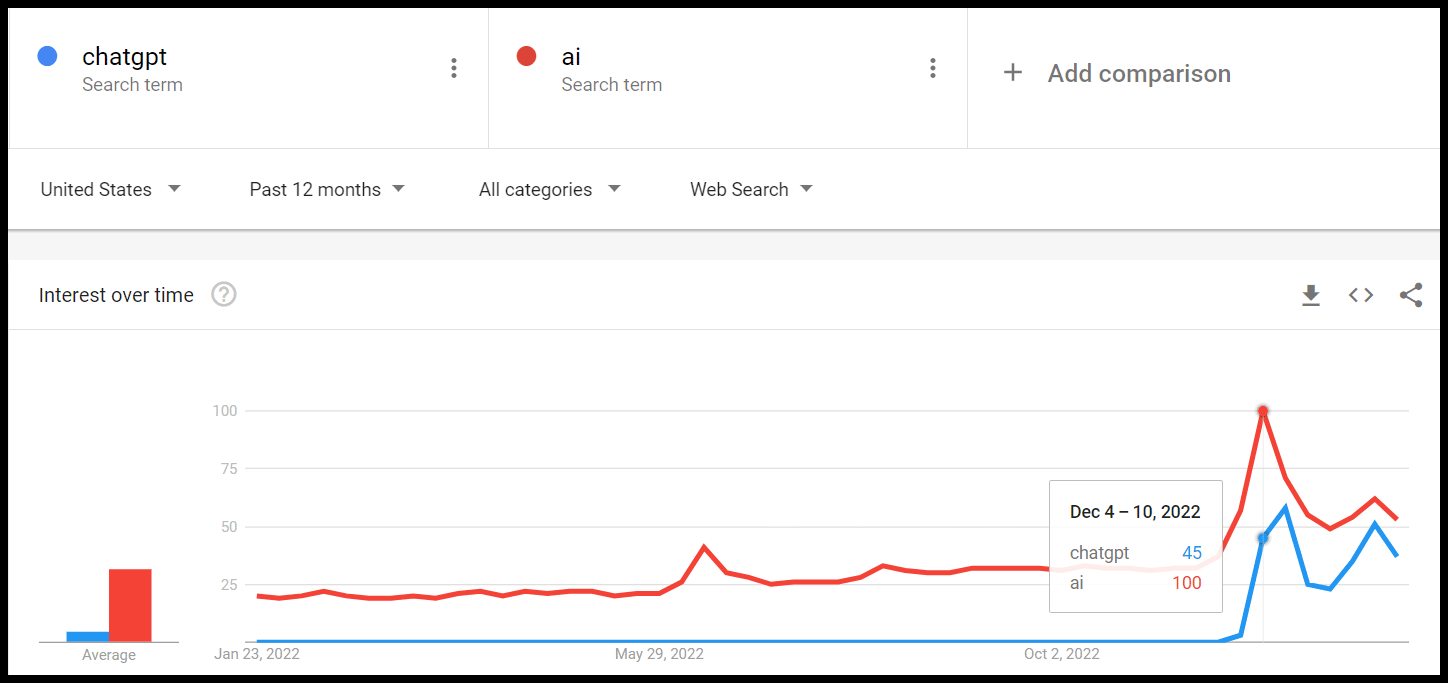 Source: Google Trends
Thousands are writing about ChatGPT across the web…
 Source: Google Search
…and talking about it in various communities.
 Source: Exploding Topics
And as you can tell from the graphs, all of this happened quickly.
Whether your Twitter and LinkedIn feeds have been inundated with threads and posts about ChatGPT (like mine) or you’re just stumbling on the topic, you may want answers to two questions before investing your time and energy into learning ChatGPT:
- Is ChatGPT specifically likely to be an enduring product?
- What does it actually do and what can you personally use it for?
In this article, I’ll help you answer these questions by telling you:
- What ChatGPT is.
- How it works.
- Who built it and is currently behind the technology.
- Why it’s important for SEOs specifically.
- Some of the current and likely future uses for it.
What is ChatGPT?
ChatGPT is an AI-powered chatbot created by OpenAI that can be accessed at https://chat.openai.com/.

As of this writing, ChatGPT offers a free version of the tool that users can access, but there have been indications that they will be charging $42/month for a pro version. OpenAI has also indicated that they’ll make an API for the tool available soon.
The interface is simple, with an empty dialog to enter a prompt. The tool can perform various tasks and return text in response. Some examples of tasks ChatGPT can execute include:
- Answering questions.
- Writing things like ads, emails, paragraphs, whole blog posts, or even college papers.
- Writing, commenting or marking up code.
- Changing the formatting on a block of text for you.
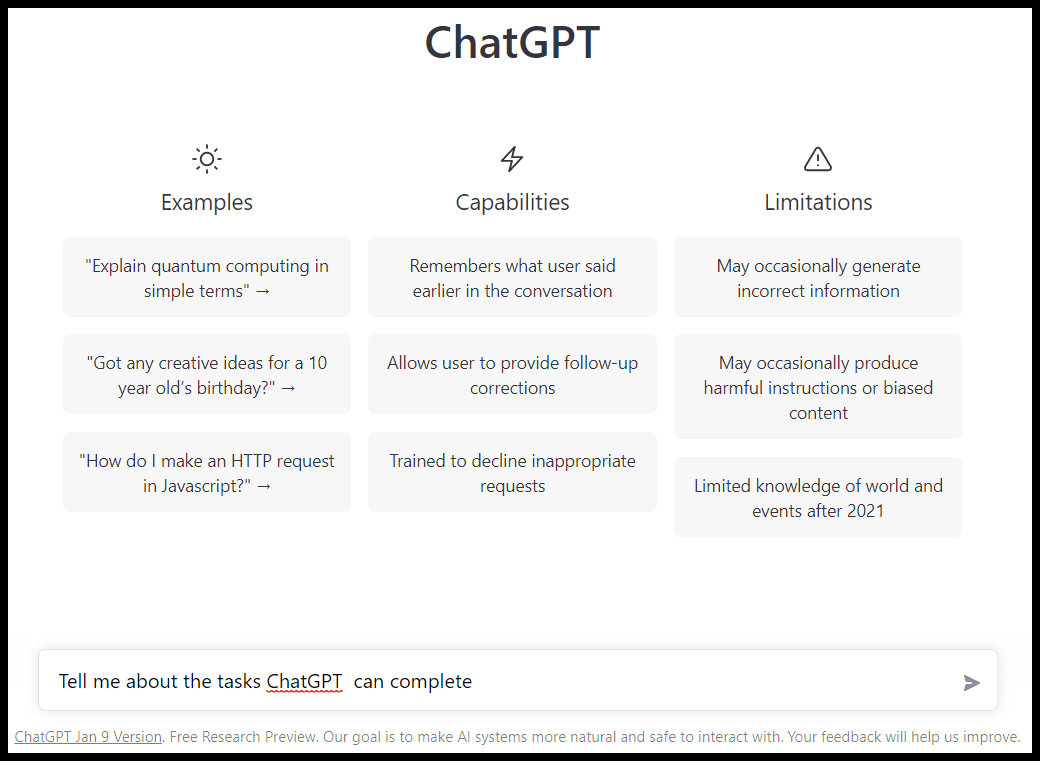
ChatGPT launched in late November 2022, on the heels of AI Content Generator Jasper.ai receiving $125 million in funding at a $1.5 billion valuation earlier the same month. The tool reached a million users in less than a week.
ChatGPT launched on wednesday. today it crossed 1 million users!
— Sam Altman (@sama) December 5, 2022
But each session has a specific cost associated with it:
average is probably single-digits cents per chat; trying to figure out more precisely and also how we can optimize it
— Sam Altman (@sama) December 5, 2022
In the interest of helping fund those costs (and further growth) Microsoft invested $10 billion in OpenAI at a $29 billion valuation. A move which, combined with ChatGPT’s growth and word of mouth, might be fueling Google’s reported concerns about ChatGPT as a possible threat.
OpenAI has also indicated that there will be a “professional” version of the tool and Greg Brockman the President & Co-Founder of OpenAI shared a link to a Google Form to get on the waitlist:
Working on a professional version of ChatGPT; will offer higher limits & faster performance. If interested, please join our waitlist here: https://t.co/Eh87OViRie
— Greg Brockman (@gdb) January 11, 2023
Some users have reported seeing an option to upgrade to a $42 free version when logged into their account.
Even with the Microsoft investment, ChatGPT has continued to experience outages and even had to limit new users on the platform:
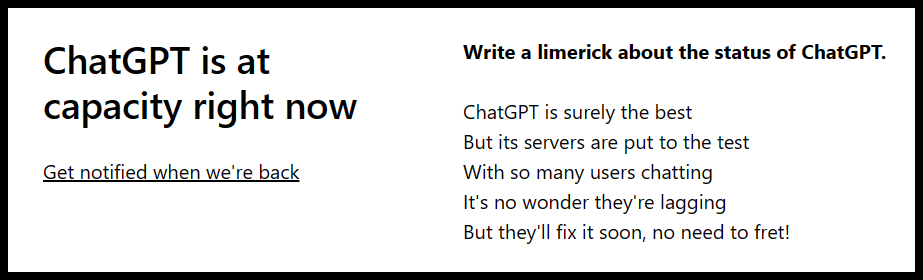
And ChatGPT is starting to face criticisms over the accuracy of some of the output of the tool, while also staring down competition from rivals (which one would have to assume will only increase and intensify in the wake of the platform’s early success).
Now that you know what ChatGPT is, it’s also helpful to understand a bit more about how it works and who built it (and what their goals and motivations may be).
Get the daily newsletter search marketers rely on.
<input type=”hidden” name=”utmMedium” value=”” />
<input type=”hidden” name=”utmCampaign” value=”” />
<input type=”hidden” name=”utmSource” value=”” />
<input type=”hidden” name=”utmContent” value=”” />
<input type=”hidden” name=”pageLink” value=”” />
<input type=”hidden” name=”ipAddress” value=”” />
Processing…Please wait.
How does it work and how was it trained?
If you’re an SEO looking for ways to leverage AI in your everyday work, you don’t need to know how to build your own chatbot.
That said, when using tools like ChatGPT, you will want to know where the information it generates comes from, how it determines what to return as an answer, and how that might change over time.
That way you can understand what level of trust to put in the output of ChatGPT chats, how to better craft your prompts, and what tasks you may want to use it for (or not use it for).
Before you start to use ChatGPT for anything, I’d strongly recommend you check out OpenAI’s own blog post about ChatGPT. There they have a nice graphic explaining how it works, along with a more in-depth explanation.

AssemblyAI also has a detailed third-party breakdown of how ChatGPT works, some of its strengths and weaknesses, and a number of additional sources if you’re looking to dive deeper.
One of the most important things to remember about how ChatGPT works is its limitations. In OpenAI’s own words:
“ChatGPT sometimes writes plausible-sounding but incorrect or nonsensical answers. Fixing this issue is challenging, as: (1) during RL training, there’s currently no source of truth; (2) training the model to be more cautious causes it to decline questions that it can answer correctly; and (3) supervised training misleads the model because the ideal answer depends on what the model knows, rather than what the human demonstrator knows.”
Another that’s important to highlight:
“While we’ve made efforts to make the model refuse inappropriate requests, it will sometimes respond to harmful instructions or exhibit biased behavior. We’re using the Moderation API to warn or block certain types of unsafe content, but we expect it to have some false negatives and positives for now. We’re eager to collect user feedback to aid our ongoing work to improve this system.”
As many people know, the ChatGPT was fine-tuned on a GPT model which finished training in early 2022 – meaning it won’t have knowledge of more current events.
It is also trained on a “vast amount” of text from the web, so of course answers can be incorrect. From ChatGPT’s own FAQs:
“Can I trust that the AI is telling me the truth?
ChatGPT is not connected to the internet, and it can occasionally produce incorrect answers. It has limited knowledge of the world and events after 2021 and may also occasionally produce harmful instructions or biased content.
We’d recommend checking whether responses from the model are accurate or not. If you find an answer is incorrect, please provide that feedback by using the “Thumbs Down” button.”
Who built ChatGPT?
Similarly, understanding who built the application and why is an important background if you hope to use it in your day-to-day work.
Again, ChatGPT is an OpenAI product. Here’s some background on the company and their stated goals:
- OpenAI has a non-profit parent organization (OpenAI Inc.) and a for-profit corporation called OpenAI LP (which has a “capped profit” model with a 100x profit cap, at which point the rest of the money flows up to the non-profit entity).
- The biggest investor is Microsoft. OpenAI employees also own equity.
- Former Y Combinator President Sam Altman is the CEO of OpenAI and was one of the original founders (along with prominent Silicon Valley personalities such as Elon Musk, Jessica Livingston, Reid Hoffman, Peter Thiel, and others). Many people ask about Musk’s involvement in the company and ChatGPT. He stepped down as a board member in 2018 and wouldn’t have had any meaningful involvement in the development of ChatGPT (which obviously didn’t launch until November 2022).
Notable elements here if you’re interested in ChatGPT either as an SEO or as a viable alternative to Google are obviously:
- Microsoft’s involvement (with Microsoft Bing being the number 2 search engine – a distant second behind Google).
- ChatGPT obviously isn’t designed to specifically be either an SEO or a content tool (unlike tools like Jasper.ai, Copy.ai and other competitors – many of which are built on top of the GPT-3 framework).
Why should SEOs care about ChatGPT?
While it’s possible that ChatGPT or another AI-powered chatbot could become a viable alternative to Google and traditional search, that’s likely at least far enough away that most SEOs won’t be primarily concerned with the tool for that reason. So why should SEOs care?
ChatGPT has a variety of functionality that can be helpful for SEOs. Additionally, given the platform’s ability to generate AI content, it’s important to understand both what the tool is capable of on that front, and how Google talks and thinks about AI content generally.
What follows are ChatGPT’s use cases for SEO.
AI content generation
By far the “buzziest” early 2023 SEO topic has been AI content broadly, and ChatGPT has been at the center of that discussion since it launched.
From creating blog posts whole cloth to selecting images, generating meta descriptions or rewriting content, there are a number of specific functions ChatGPT can serve when it comes to content creation generally and SEO-focused content creation specifically.
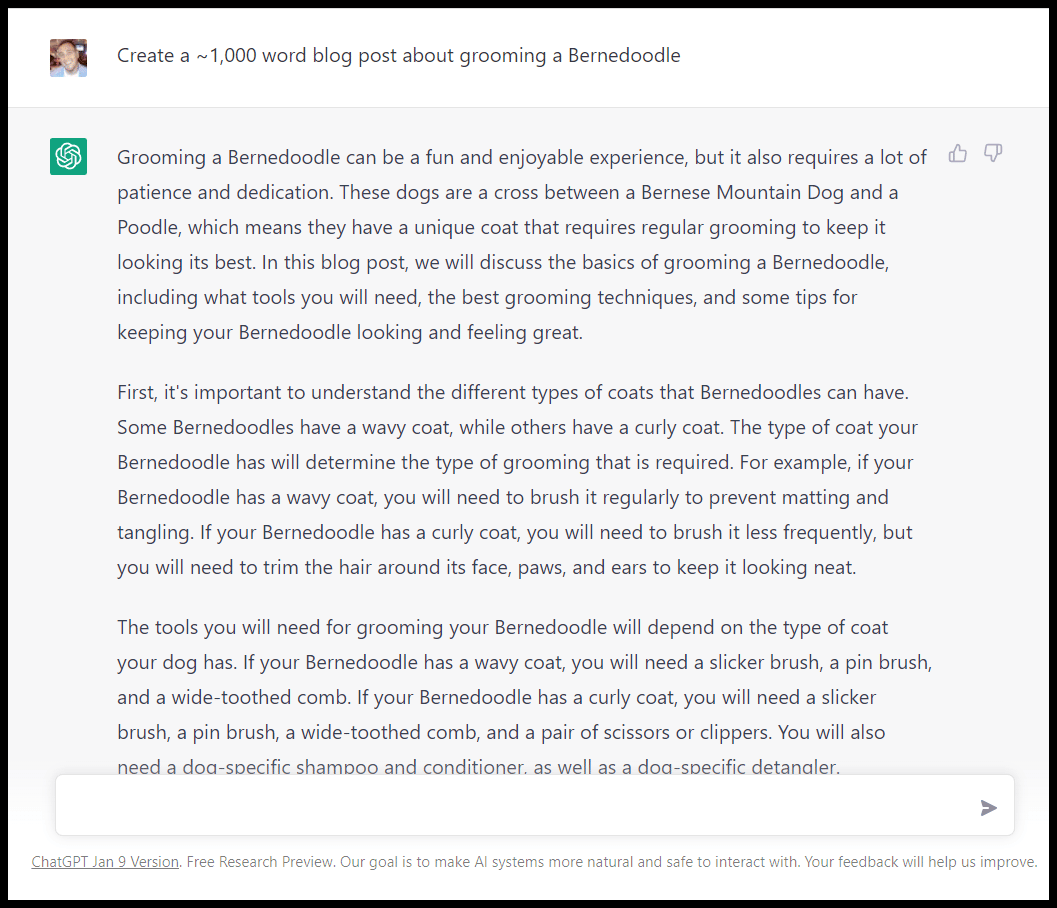
But, of course, an important concern here is how Google thinks about AI content in general.
SEOs need to identify the specific instances where ChatGPT can make them more efficient or enhance their content. At the same time, it’s crucial to understand the potential risks to rankings and organic traffic when using ChatGPT-generated content in different ways (particularly if you’re relying on content created by writers you don’t have a relationship with).
Keyword research and organization
Similarly, there are a number of specific tasks ChatGPT can execute related to keyword research and optimization, such as:
- Suggestions for keywords to target or blog topics.
- Keyword clustering or categorization.

A key consideration for SEOs is how this relates to your current and optimal processes for these tasks.
ChatGPT isn’t designed to be an “SEO tool,” so won’t have the emphasis on search volume, competition, or relevance and co-occurrence that more focused keyword research or organization tools will.
Code generation and technical SEO
ChatGPT is helping people generate code and build things, and it’s no different for specific technical SEO tasks.
Depending on the prompts, ChatGPT can help with things like schema markups, robots.txt directives, redirect codes, and building widgets and free tools to promote via link outreach, among others.

As with any type of content creation, you must QA the code that ChatGPT generates. Your site’s template, hosting environment, CMS, and more can break if the code ChatGPT generates is incorrect.
Link building
ChatGPT can generate lists of outreach targets, emails, free tool ideas, and more that may assist with link building work.
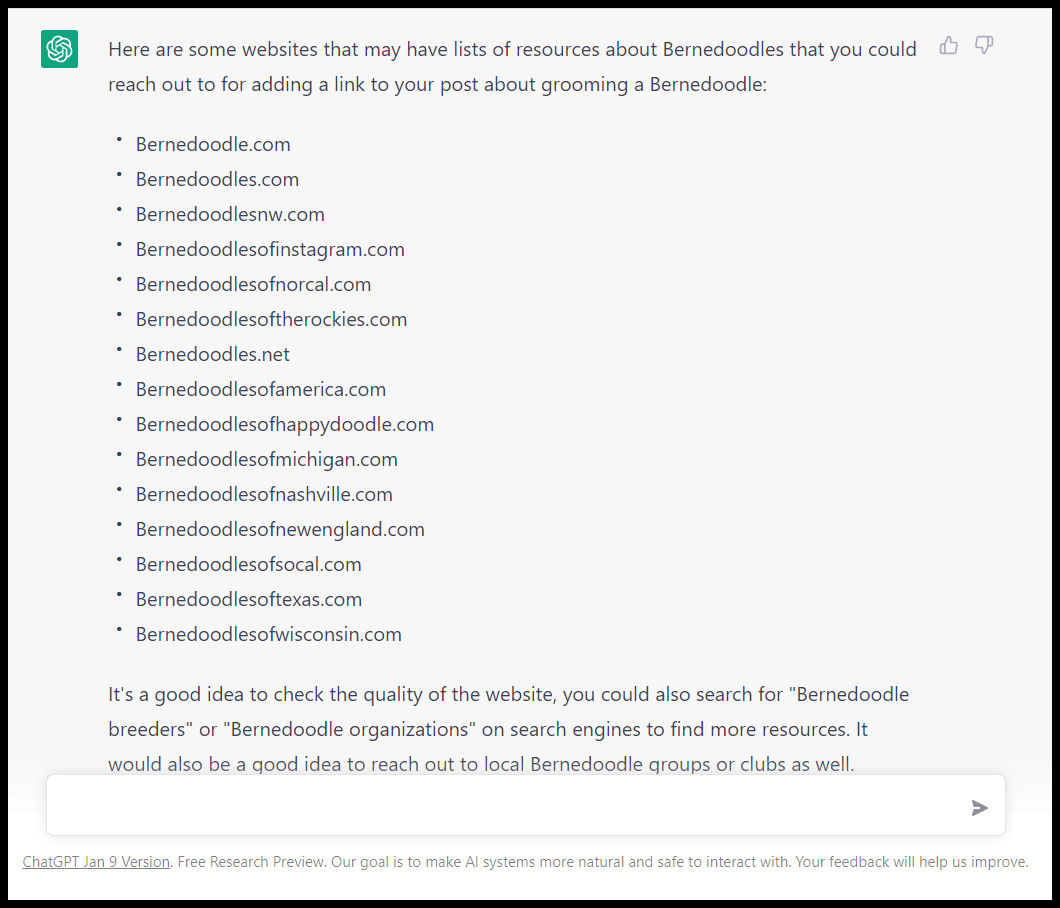
Here again (you may be sensing a theme) two things to keep in mind:
- Since ChatGPT was not built to be a link building tool, it may not prioritize opportunities or generate ideas that will specifically help with SEO success.
- GPT-3 is trained on old data, so the information you’re getting may be wrong or outdated.
How to think about ChatGPT as an SEO
Ultimately, given its early functionality and reception along with OpenAI’s founding team and investors (and level of investment), ChatGPT is likely to have longevity as a tool.
It’s highly useful, with a high potential for getting folks who misuse it into trouble.
I would encourage SEOs to become familiar with ChatGPT (and tools like it) and get used to carefully checking its output.
The post What is ChatGPT and why SEOs should care appeared first on Search Engine Land.
Courtesy of Search Engine Land: News & Info About SEO, PPC, SEM, Search Engines & Search Marketing
Category seo news | Tags:
Social Networks : Technorati, Stumble it!, Digg, de.licio.us, Yahoo, reddit, Blogmarks, Google, Magnolia.
Performance Max for B2B: 4 best practices
Written on January 26, 2023 at 5:26 pm, by admin
Google strong-armed ecommerce marketers into Performance Max campaigns in 2022 by deprecating Smart Shopping and Local campaigns in favor of fewer levers and more AI-driven results.
As I wrote in a column looking back on Google’s biggest 2022 moves, most advanced search marketers begrudged this direction since more controls provide good marketers more room to outpace their peers, giving their brands a competitive edge.
B2B marketers weren’t nearly as broadly impacted by the move to Performance Max, since their old campaign structures remained unchanged by Google.
There’s no denying, however, that the writing is on the wall. Google is moving hard toward machine learning and AI, which means Performance Max may well be the lay of the entire Google search land in the near future.
So as we get into the teeth of 2023, how should B2B marketers approach Performance Max?
Get the daily newsletter search marketers rely on.
<input type=”hidden” name=”utmMedium” value=”” />
<input type=”hidden” name=”utmCampaign” value=”” />
<input type=”hidden” name=”utmSource” value=”” />
<input type=”hidden” name=”utmContent” value=”” />
<input type=”hidden” name=”pageLink” value=”” />
<input type=”hidden” name=”ipAddress” value=”” />
Processing…Please wait.
Failing to plan might be planning to fail
If I were a betting person, I’d put down some money on the idea that Google will begin steering B2B campaigns toward Performance Max this year.
If that happens, marketers who are more aggressive in familiarizing themselves with the ins and outs will have a leg up when Google takes away other campaign options.
If your search campaigns are in a position to do so, I’d suggest you begin to test Performance Max ASAP.
That said, here are some conditions I strongly recommend you meet before you devote any budget to testing:
- You must have fully funded search campaigns to justify moving some discretionary budget to Performance Max. This means that you’ve built out all the keyword themes that make sense and have achieved solid market share for them. In other words, if you have a small budget, don’t compromise the pursuit of your full search opportunity at hand by testing Performance Max campaigns.
- Your account has a healthy volume of conversion data through search.
- For reasons we’ll get into in a minute, you must have reliable offline conversion data syncing to your account.
- To engage the right people, you must have good, rich audience lists and a solid definition of your ICP.
If you meet all these conditions, you’re good to go – with some additional caveats and best practices I’ll spell out now.
1. Stay skeptical
The idea behind Performance Max is that it delivers your ads to the right people wherever they are – Discover, Gmail, Maps, YouTube, Display Network, etc.
You’re using automatic bidding and trusting that Google’s algorithm can discern valuable levels of intent.
That said, Google’s algorithm is still learning, and it has built a history of optimizing for spend over efficiency.
As you approach Performance Max, look for ways to strong-arm the algorithm into doing what you want it to.
2. Get your first-party data ready
CRM data is vital for Performance Max campaigns in general for a couple of reasons, both of which apply in force for B2B – audience quality and offline conversions.
Let’s tackle offline conversions first. If we simply rely on pixels that fire for leads as signals for Performance Max, we’ll set ourselves up for failure.
Consider the lead spam most B2B campaigns have to sift through, then understand that Performance Max will take the path of least resistance to get the “desired” action.
Without integrating a layer of CRM data and telling Performance Max to optimize toward MQLs, SQLs or opportunities (essentially, whatever your most valuable stage is that also carries enough data volume for PMax to use effectively), the system will optimize toward leads, using up your budget to keep bringing in ROI-unfriendly amounts of spam.
On the audience side, remember, Performance Max uses the signals you give to find the right users. Signals might incorporate audience lists like current customers, closed/won opportunities, etc.
Performance Max, like Similar Audiences, isn’t constrained to the audience lists you give Google. It might even be a little broader than Similar Audiences, given that it extends across GDN, Gmail, and YouTube.
So, button up your lists and make sure the common attributes are clear enough for Performance Max to read and react to in its targeting.
The upshot? Google doesn’t have great built-in B2B targeting, so stay away from using their audiences and give it enough volume and clarity to work with.
3. Experiment
When approaching Performance Max setup, keep in mind that you can do experiments.
But there’s a caveat – you only have visibility into results at the campaign level. Thus, I recommend testing at least two Performance Max campaigns, each relying on different audience signals, to see which is more effective.
Note: To make the two-experiment setup work, you’ll have to be able to carve out enough budget to make the findings clear and actionable.
4. Get familiar with reporting – and act on results quickly
One of Google’s better releases in 2022, Custom Columns, allows advertisers to see offline conversions at the campaign level, even for Performance Max campaigns:

Beyond that, Performance Max reporting diverges from familiar ad group-level reporting and breaks everything into asset groups, providing a view of all provided assets and possible combinations.

We’ve found the campaign-level view to be most helpful, which is why I recommend starting with at least two campaign-level experiments.
Once you’re relatively fluent with the reporting structure, keep a close eye on quality and opportunities to add negatives, whether keywords or placement exclusions, to shore up efficiency.
Making Performance Max work for B2B
My overall take on Performance Max is that Google hasn’t yet put much effort into making the product work for B2B or lead gen.
Make sure to keep a close eye on results and quality, using any levers in your control to keep Google focused on your best potential user. Establish clear goalposts and standards for when to pull the plug.
In a best-case scenario, Performance Max will be a pleasant surprise and enable you to access a larger pool of valuable users at reasonable CPLs.
But if you take my advice, even a worst-case scenario with some fruitless spend will give you valuable insights into the future of Google for B2B.
The post Performance Max for B2B: 4 best practices appeared first on Search Engine Land.
Courtesy of Search Engine Land: News & Info About SEO, PPC, SEM, Search Engines & Search Marketing
Category seo news | Tags:
Social Networks : Technorati, Stumble it!, Digg, de.licio.us, Yahoo, reddit, Blogmarks, Google, Magnolia.
Google rolling out cars for sale in Google Business Profiles
Written on January 26, 2023 at 5:26 pm, by admin
Google is opening access to the local car inventory beta feature to all US dealerships using the cars for sale feature in Google Business Profiles. Greg Gifford reports that Google has opened this beta feature now to all US-based dealerships.
Cars for Sale open. Google has opened up the “Cars for Sale” feature in Google Business Profiles to any product with a vehicle identification number (VIN). “Until this week, only US-based car dealers could list their inventory on their Google Business Profiles. Now, anything that has a Vehicle Identification Number is eligible to be listed. That means motorcycles, RVs, powersports, and Commercial vehicles are all allowed now,” Gifford explained.
What it looks like. Here is a GIF of this cars for sale feature in action while in beta:

More details. Google has a dedicated section about this feature over here, where it is called “vehicle listings.” Google wrote, “Vehicle listings on Google allows businesses to display their for sale vehicle inventory on various Google surfaces, including dealerships’ Business Profiles and Google Search. Google users can then search, filter, and easily learn more about vehicles for sale such as availability, pricing, and key information about the vehicles for sale, potentially directing customers to your business.”
To manage vehicle listings through your Business Profile account, perform the following steps:
- Access your web Business Profile account at business.google.com/locations.
- Select See your profile for the business that you want to change settings for.
- Click Edit profile, and then click Vehicle listings.
To manage your vehicle listings through a Google Search, perform the following steps:
- Search for your business’s name or “my business” on Google Search.
- Click Edit profile, and then click Vehicle listings.
Why we care. You probably want to jump on this feature if you work for an auto dealership. Listing your vehicles in Google Search and the local search results may help you get more customers in your showroom and potentially lead to more sales.
The post Google rolling out cars for sale in Google Business Profiles appeared first on Search Engine Land.
Courtesy of Search Engine Land: News & Info About SEO, PPC, SEM, Search Engines & Search Marketing
Category seo news | Tags:
Social Networks : Technorati, Stumble it!, Digg, de.licio.us, Yahoo, reddit, Blogmarks, Google, Magnolia.