

Meta blames weak advertising demand, rivals for Q4 2022 revenue decline
Written on February 2, 2023 at 6:06 pm, by admin
Weak advertising demand and competition from TikTok and other rivals yielded lower fourth quarter revenue and profit for Meta, Facebook’s parent company.
Ad revenue was down 4% to $31.3 billion at Meta’s advertising-supported properties, including Facebook, Instagram, Messenger, and WhatsApp. Advertising revenue was 97% of Meta’s total revenue in the quarter.
Ad revenue in North America was flat, declined 16% in Europe and 3% in the Asia-Pacific. Revenue increased by 5% elsewhere (“Rest of World” in the table below).
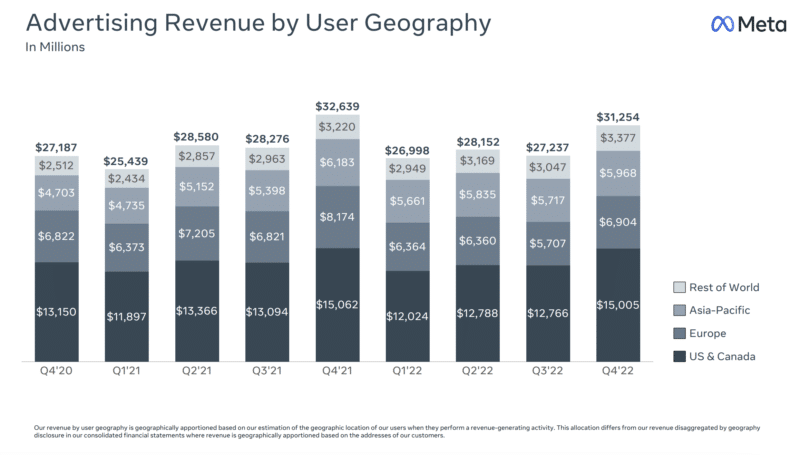
The decline was attributed to “weak advertising demand, which we believe continues to be impacted by the uncertain and volatile macroeconomic landscape,” by Meta CFO Susan Li.
Strategy shift for Facebook and Instagram content. “Facebook and Instagram are shifting from being organized solely around people and accounts you follow to increasingly showing more relevant content recommended by our AI systems,” Meta CEO Mark Zuckerberg said on the company’s earnings call.
Reels growth. Zuckerberg also said that Reels plays across Facebook and Instagram have more than doubled over the last year, and the social component of people resharing Reels has more than doubled on both in just the last 6 months.
The challenge for Reels is “improving monetization efficiency, or the revenue that’s generated per minute of Reels watched,” according to Zuckerberg.
The future for Meta ads. Meta will continue to monetize WhatsApp as well as messaging ads by utilizing an in-app feature allowing consumers to interact directly with businesses.
- Plans to continue monetizing messaging with click-to-message ads, which currently generate revenue of $10 billion
- Onboarding more businesses to the WhatsApp Business Platform, where businesses can answer customer questions, send updates and sell directly in chat
Apple’s App Tracking Transparency measures still reducing revenue. “I think what I would say is there is still certainly an absolute headwind to our revenue number,” Li said when asked whether Apple’s ATT (app tracking transparency) measures were reducing revenue.
“Having said that, we are lapping its rollout and adoption, and we’re making progress in mitigating the impact due to a lot of the work that … I just talked about, including the different advertiser tools, including ad formats that bring conversions on site and including the longer-term AI investments in privacy-enhancing technologies.”
Dig deeper. You can review the earnings transcript on Meta’s Investor Relations site.
The post Meta blames weak advertising demand, rivals for Q4 2022 revenue decline appeared first on Search Engine Land.
Courtesy of Search Engine Land: News & Info About SEO, PPC, SEM, Search Engines & Search Marketing
Category seo news | Tags:
Social Networks : Technorati, Stumble it!, Digg, de.licio.us, Yahoo, reddit, Blogmarks, Google, Magnolia.
Google’s search quality raters protest for higher pay
Written on February 2, 2023 at 6:06 pm, by admin
Dozens of Google’s raters, seeking raises and access to benefits, rallied at the Googleplex in Mountain View yesterday, with the goal of putting an end to “poverty wages.”
Why we care. Google has said it uses as many as 16,000 raters – and about 5,000 are based in the U.S. As a group, Google’s human raters help ensure the helpfulness, quality and relevance of search results by identifying potentially harmful results, spam, outdated information and all the other elements that go into what is now known as E-E-A-T.
Protest in Mountain View. The goal was to deliver a petition, signed by more than 600 workers, to Google SVP Prabhakar Raghavan (who is responsible for Google’s Search, Assistant, Geo, Ads, Commerce, and Payments products).
They wanted Raghavan to meet and negotiate with the workers. The group, however, was stopped by security, according to KPIX, a CBS-owned Bay Area news channel.
Alphabet Workers Union tweets about the protest. In a Twitter thread, the Alphabet Workers Union laid out their case for the raters, noting they are “responsible for training, testing & evaluating search algorithms. Their work makes Google billions while they get paid pennies.”
The group noted that Google’s raters can’t get benefits, such as health insurance, paid sick leave or parental leave.
Raters provide an invisible service to Google, rating the quality of Google search & Google ads—products that make billions for the company.
Yet, Google has denied these workers access to the company’s own “minimum standard” of pay and benefits for “extended workforce workers.”
Raises for raters? At least some of Google’s raters reportedly were given a raise this year.
Historically, we know U.S.-based raters (who are actually employed through subcontractors) were paid as little as $10 an hour up to $14.50, which is lower than the $15 an hour minimum Google pays to its TVCs (temporary, vendor and contractor staff). (For additional context, California’s minimum wage is $15.50 per hour and the U.S. minimum wage is $7.25 per hour.)
“We’re Google’s lowest-paid workers,” Michelle Curtis, one of Google’s quality raters, told MarketWatch in an interview. “But we play a vital role in its growing source of revenue.”
However, in an interview with Search Engine Land in 2012, we learned that one quality rater was making $14.50 per hour. That means that this most recent “raise” for today’s raters merely put them back to the same pay level some raters were earning over a decade ago.
The bigger picture. The protest comes not long after Alphabet, Google’s parent company, announced 12,000 layoffs that impacted employees and contractors.
However, those layoffs followed a two-year period of massive hiring, as Google’s headcount went from 119,000 employees in 2019, to 150,000 by the end of 2021. As of September 2022, Alphabet had 187,000 employees.
Dig deeper. Google ‘rater’ contract workers rally at Mountain View headquarters to demand higher pay by Kelsi Thorud.
The post Google’s search quality raters protest for higher pay appeared first on Search Engine Land.
Courtesy of Search Engine Land: News & Info About SEO, PPC, SEM, Search Engines & Search Marketing
Category seo news | Tags:
Social Networks : Technorati, Stumble it!, Digg, de.licio.us, Yahoo, reddit, Blogmarks, Google, Magnolia.
Microsoft revises multi-channel advertising approach and discontinues bid modifiers for audience ads
Written on February 2, 2023 at 6:06 pm, by admin
Microsoft has revised its multi-channel strategy, which will be accessible for all advertisers on February 21st. Additionally, the audience ad bid modifier will no longer be visible in your campaign settings.
Microsoft says “Instead of using positive or negative bid modifiers to manually adjust participation in the audience network, all you need to do is define your goals, and Microsoft Advertising will fully optimize your campaigns across channels. This will help you more easily manage your campaigns and find the best users in every auction to drive a strong ROI.”
Driving new changes. Microsoft conducted research on accounts utilizing both search and audience traffic and showed that advertisers get the best results by combining their efforts on Microsoft Search and the Audience Network. Their findings reveal that people who view a brand’s ad on both networks visit the website 2.6 times more frequently compared to those who only see the ad on search. Microsoft says this increased website traffic also leads to higher conversion rates, with users converting 6.6 times more frequently. This highlights the importance of utilizing both search and audience together, as reaching the same user through multiple channels can increase engagement and sales.
Early testing. Microsoft has been piloting the new multi-channel approach over the past year. “After strong beta results, we’re rolling out this experience to all advertisers. Our results show that accounts already using multi-channel management have seen 14% higher conversion rates at 21% lower cost per acquisition (CPA).”
More Microsoft changes and updates. Microsoft has been making an effort to improve its ad platform significantly. Last year they announced ambitious plans to double the size of its ad business to $20 billion, though no specific timeframe was given.
But some brands are still unsure. Their FY23Q2 earnings reported that advertising spend declined slightly more than expected. Mass layoffs also impacted about 5% of its 220,000 workers. But despite a mediocre performance, ad revenue still increased by 5%, and LinkedIn revenue was up 14%.
It could be possible that the number of changes and updates Microsoft has made over the last year was enough to increase revenue. With Google continuing to push automation and taking away advertisers’ control, advertisers could look at Microsoft as a hail Mary.
Dig deeper. You can read the announcement from Microsoft here.
Why we care. Microsoft provides innovative tools, channels, and creative options to advertisers. Utilizing both search and audience together could lead to higher performance and drive lift in your campaigns. However, without more widespread adoption of the platform, these advancements may not reach their full potential.
The post Microsoft revises multi-channel advertising approach and discontinues bid modifiers for audience ads appeared first on Search Engine Land.
Courtesy of Search Engine Land: News & Info About SEO, PPC, SEM, Search Engines & Search Marketing
Category seo news | Tags:
Social Networks : Technorati, Stumble it!, Digg, de.licio.us, Yahoo, reddit, Blogmarks, Google, Magnolia.
ChatGPT Plus launches, it costs $20 a month
Written on February 1, 2023 at 1:54 pm, by admin
OpenAI announced that its highly-anticipated paid version of ChatGPT has launched. Called ChatGPT Plus, it will only be available for people who live in the U.S.
Despite earlier pricing rumors reported in the media, ChatGPT Plus won’t cost $42 a month. It will cost $20 per month.
People who have been on the waitlist for the paid version should expect an invite “over the coming weeks.” The company also said it plans to “soon” offer the service in additional countries.
What you get for $20 a month. OpenAI said the paid version will offer three benefits over the free version:
- General access to ChatGPT, even during peak times
- Faster response times
- Priority access to new features and improvements
Why we care. ChatGPT is a technology that has several use cases in search marketing, whether it’s for SEO or PPC. So if you’ve found yourself unable to use ChatGPT because the service was at capacity, now you have the cure – and it will cost you $20 a month.
The post ChatGPT Plus launches, it costs $20 a month appeared first on Search Engine Land.
Courtesy of Search Engine Land: News & Info About SEO, PPC, SEM, Search Engines & Search Marketing
Category seo news | Tags:
Social Networks : Technorati, Stumble it!, Digg, de.licio.us, Yahoo, reddit, Blogmarks, Google, Magnolia.
Webinar: 4 disciplines for SEO teams to drive performance by Cynthia Ramsaran
Written on February 1, 2023 at 1:54 pm, by admin

How do you make sure your SEO team is working on activities that will make the most significant impact on your goals? Have you ever set goals only to realize a month or two later that no one has been keeping track of progress? Have you ever reached the end of a year and felt you’ve made no progress on your organic growth targets? Also, is organic growth the only target to measure?
In this webinar, Craig Bradford, COO of SearchPilot, will show you how to set and achieve better goals using the 4 Disciplines of Execution (4DX) framework.
Register today for “Drive Performance With These 4 Disciplines for SEO Teams,” presented by SearchPilot.
Click here to view more Search Engine Land webinars.
The post Webinar: 4 disciplines for SEO teams to drive performance appeared first on Search Engine Land.
Courtesy of Search Engine Land: News & Info About SEO, PPC, SEM, Search Engines & Search Marketing
Category seo news | Tags:
Social Networks : Technorati, Stumble it!, Digg, de.licio.us, Yahoo, reddit, Blogmarks, Google, Magnolia.
Google Maps removed policy-abiding reviews from Local Guides
Written on February 1, 2023 at 1:54 pm, by admin
Google has accidentally removed legit, policy-abiding reviews submitted by Local Guides from Google Maps. Google acknowledged the issue and said it is working on reinstating those reviews over the next few weeks.
What happened. According to Google’s Local Guides Connect blog, Google said they are “constantly improving our moderation system to keep policy-violating content off the map.” With those efforts, Google said its “protections took down more than expected policy abiding reviews from a set of Local Guides.” Google added that they “acknowledge that this change has affected a lot of your accounts,” and is working to restore the reviews that were impacted.
Fixing the issue. Google said, “as part of our efforts to resolve this situation, we have launched an update to our protections to fix them.” Google added that the search company “will also automatically reinstate” any of the policy-abiding reviews over the “next few weeks.”
What if your review is not reinstated. Google said if your policy-abiding review is not reinstated, then you can submit a request through this form to challenge the decision.
Why we care. If you noticed your reviews are not going through as a Local Guide, Google says to continue to post reviews as normal, and they will automatically fix the issues. At least, you can hope Google does, and if not, you can always request Google to manually review your submission.
So you may see a number of reviews previously not listed on your business show up in a few weeks when Google reruns its review protections.
The post Google Maps removed policy-abiding reviews from Local Guides appeared first on Search Engine Land.
Courtesy of Search Engine Land: News & Info About SEO, PPC, SEM, Search Engines & Search Marketing
Category seo news | Tags:
Social Networks : Technorati, Stumble it!, Digg, de.licio.us, Yahoo, reddit, Blogmarks, Google, Magnolia.
Google testing new search design with AI answers over organic results
Written on February 1, 2023 at 1:54 pm, by admin
Google has reportedly started testing a new desktop search page design that integrates chat technology.
We already knew Google wants to add chatbot features to search this year. A new CNBC report provides more details on what the experimental search page may look like.
Google’s alternate search page. In one version of Google’s search results, the company replaced the iconic I’m Feeling Lucky button under the search bar with five prompts for potential questions. There was also a small chat logo” inside the far right end of the search bar, according to the report.
Based on this description, here’s a fairly terrible rendering of what that would look like:
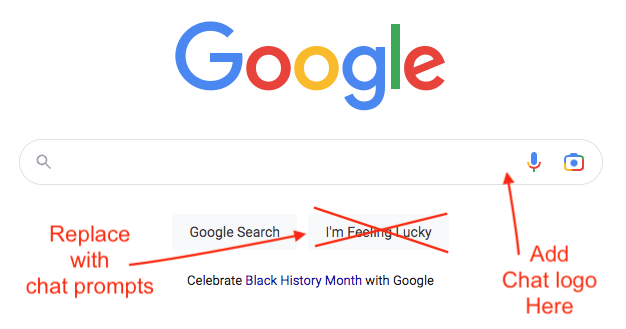
Google’s alternate SERP. It sounds like this would push Google’s organic search results much further down the page. As CNBC explained:
When a question is entered, the search results show a gray bubble directly under the search bar, offering more human-like responses than typical search results. Directly beneath that, the page suggests several follow-up questions related to the first one. Under that, it shows typical search results, including links and headlines.
Now I haven’t seen this experimental design.
However, based on how this was described, it may look similar to certain SERPs where there is a featured snippet followed by People also ask, then organic results. For example, [what is cheese made of]:
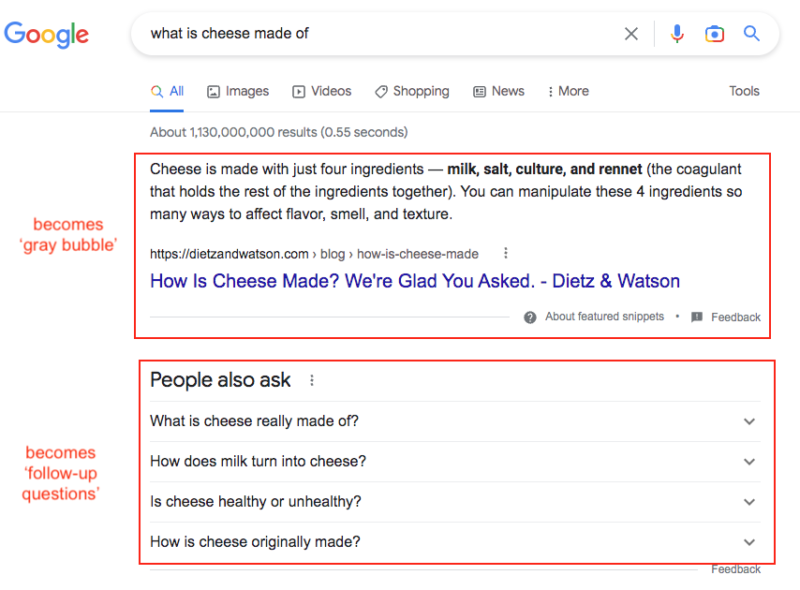
So you could imagine the “gray bubble” in place of the featured snippet explaining how cheese is made (with an answer generated by Google AI instead of awarded to the source of the featured snippet here), and the “follow-up questions” replacing PAA.
Why we care. Could this be what chatbot-style Google desktop search results will look like later this year? While it’s not a radical departure from the current Google desktop design, this would mean that visibility for websites – and perhaps traffic – will be impacted. If you thought Google was stealing your traffic and clicks before, well… it’s safe to say there will be many angry search marketers.
What Google is saying. According to a Google spokesperson:
- “We have long been focused on developing and deploying AI to improve people’s lives. We believe that AI is foundational and transformative technology that is incredibly useful for individuals, businesses and communities, and as our AI Principles outline, we need to consider the broader societal impacts these innovations can have. We continue to test our AI technology internally to make sure it’s helpful and safe, and we look forward to sharing more experiences externally soon.”
Dig deeper. Jennifer Elias on CNBC (Google is asking employees to test potential ChatGPT competitors, including a chatbot called ‘Apprentice Bard’) also reports on how Google is also testing out its version of ChatGPT, which uses its LaMDA technology that includes answers based on recent events (which is is something ChatGPT can’t do at this time).
The post Google testing new search design with AI answers over organic results appeared first on Search Engine Land.
Courtesy of Search Engine Land: News & Info About SEO, PPC, SEM, Search Engines & Search Marketing
Category seo news | Tags:
Social Networks : Technorati, Stumble it!, Digg, de.licio.us, Yahoo, reddit, Blogmarks, Google, Magnolia.
Internal linking for ecommerce: The ultimate guide
Written on January 31, 2023 at 9:34 am, by admin
Internal linking is a crucial aspect of any website, but it is especially important for ecommerce websites.
Internal linking helps improve the navigation and user experience for your website visitors and can also help improve your website’s search engine optimization (SEO).
This article will discuss the best practices for internally linking pages on ecommerce websites. To help illustrate these opportunities, I’ll use some of my favorite examples of ecommerce SEO done well – the portfolio of Williams Sonoma brands. (Disclaimer: I have no affiliation and have never worked on any of these sites.)
But first, let’s lay the groundwork for why these tactics are so important.
What is internal linking?
Internal linking refers to linking one webpage to another on the same website domain. When a user clicks on an internal link, they will be taken to a different page on your website. These links can be words, phrases, or images.
Internal linking is important because it helps people find the information they are looking for on your website and helps them move from one page to another.
It also helps search engines understand the structure and hierarchy of your website, making it easier to find in search results.
What internal linking is not
Internal linking is not the same as external linking.
External linking is when you put links on your website that take users to other websites. This can help them find relevant information from other sources.
Using both types of linking is essential, but they have different purposes.
Why is internal linking important for ecommerce websites?
Internal linking is an important aspect of search engine optimization (SEO) for all websites, especially ecommerce.
While there are probably many more reasons than I’ve listed below, these are the four primary reasons that are always top of mind when working on an ecommerce website with tens of thousands, if not millions, of pages.
- Ecommerce websites often have a large number of pages, including product pages, category pages, and other informational pages. Internal linking helps users navigate these pages and find the information they want.
- Ecommerce websites often have a lot of competition and potentially many vendors offering the same or highly similar products. Internal linking can help improve the SEO of the website, making it more visible in search results.
- Internal linking can help improve the discoverability of ecommerce websites by helping search engines discover and crawl all of the pages on the website. This can lead to more traffic and potential customers for the website.
- Internal linking can highlight promotions and sales, new products, and customer reviews on ecommerce websites. This can draw attention to these items and encourage users to take advantage of them.
It helps improve the visibility and ranking of a website on search engine results pages (SERPs) and improves the user experience by allowing visitors to navigate the website easily.
But, before we get into general best practices, as noted in the items above, it is essential to note the difference between navigational internal linking and in-content internal linking.
Get the daily newsletter search marketers rely on.
<input type=”hidden” name=”utmMedium” value=”” />
<input type=”hidden” name=”utmCampaign” value=”” />
<input type=”hidden” name=”utmSource” value=”” />
<input type=”hidden” name=”utmContent” value=”” />
<input type=”hidden” name=”pageLink” value=”” />
<input type=”hidden” name=”ipAddress” value=”” />
Processing…Please wait.
In-content vs. navigation internal linking: What’s the difference?
In-content internal linking includes links within the content of a page (typically a blog post), while navigation internal linking is when you have links in your website’s navigation menu.
For example, if you are writing a blog post about men’s shoes, you may want to link to a page about sneakers. This would help users find additional information related to the current page’s content.
In contrast, navigation internal linking helps people find the main pages on your website and navigate your website more easily.
With that explanation out of the way, here are 9 best practices for internally linking pages on ecommerce websites, broken down by in-content or navigational.
Navigation internal linking best practices
Let’s start with some of the basics for a solid ecommerce website.
1. Sitewide navigation menu
The organization and utilization of your primary navigation are table stakes for a robust internal linking strategy.
When a page is linked from the sitewide menu, it essentially means that it is linked from every page on the site, which can signal to Google that the page is essential. However, it’s necessary to be mindful of not overcrowding your menu.
Across the Williams Sonoma portfolio of sites, the main navigation is a master class of effective internal linking strategy. I’ll use the below example from West Elm’s Kids section to illustrate.
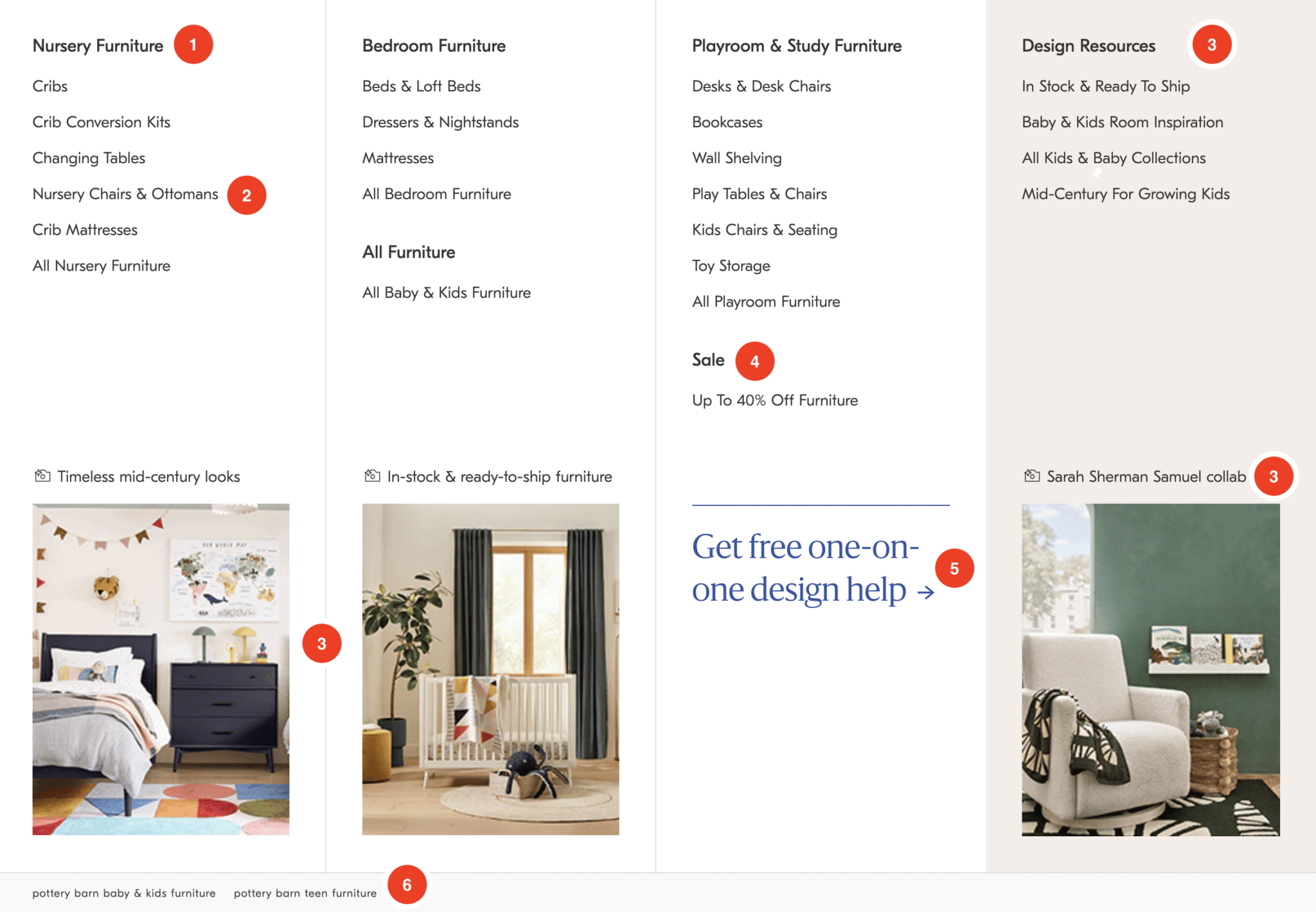
1 and 2 – Category / Sub-Category Linking: West Elm links to crucial category pages from the sitewide menu, boosting these pages’ internal authority. The sub-category links assist in providing Google with a better understanding of the organization of the website and the semantic relationships between them.
3 – Focusing on the user journey: Having dealt with this myself, I know design paralysis is a big blocker to purchasing furniture. With the Design Resources section, West Elm not only provides search engines an entry to all products in the category (All Kids & Baby Collections) but also answers common blockers to purchase (inspiration, in stock, etc.).
Ross Hudgens summarizes the additional benefits of including this content more eloquently than I could:
“Integrating content into navigation categories can help drive significantly more outcomes. Most people don’t care to visit “Resources” or “Blog.” This will lead them to ignore dropdowns like that.
They want to solve a specific problem and are more likely to be driven down the path of reading up on it if it’s naturally embedded within each category.
This will help drive users down the funnel, especially for products with a long sales cycle. In the nav, you can link directly to the hub category for the section that discusses that content.
If it doesn’t exist, that’s a hint your content hub could use better architecture around the actual problems people have.
You can see how this powerfully ties together from an internal linking and engagement benefit point of view.”
4 – Internally link to support business priorities: The critical thing to note about this example is the internal link doesn’t just say “Sale.” It is a specific sale (“Up To 40% Off Furniture”) aligned with the category.
As you navigate each sub-menu, you’ll find that the sale references align with the primary category. Great use of deep linking, even within the sale section.
5 – Internal link to support secondary KPIs: In an age where first-party data collection must be a priority, West Elm provides a clear CTA driving users into their design center to schedule an appointment.
While I cannot validate this, I would expect the data collected to be used to fuel additional marketing efforts.
Ultimately, if someone chose to utilize these services, I expect these average order sizes to be much larger (I know it was for me), which is also likely why they can offer these design services at no cost.
6 – Portfolio-wide internal linking strategy: I’ve worked on many ecommerce sites that were part of portfolio companies. The typical approach is to add a bunch of footer links to the portfolio domains and call it a day.
This is the first time I have seen such a focused effort on utilizing an internal linking structure to elevate all domains in a portfolio. The important element to note here is that even the cross-domain internal link is highly relevant (e.g., West Elm Kids Furniture → Pottery Barn Baby & Kids Furniture).
Kudos to whoever sold this enterprise SEO strategy!
2. Sitewide secondary navigation menu
The Williams Sonoma site portfolio uses a mix of global navigation menus. I’ll focus on the two in the screenshot below.

At the top, again, we see a list of external links to ecommerce sites in the portfolio. (Gap also does this well.)
Directly below the logo, Mark & Graham utilizes a row of “quick links” that are updated to support seasonal efforts, promotions and sales, new product categories, and other deep links to category pages that otherwise might not have a home in the fixed navigation menu (i.e., Occasions, Interests, etc.)
This is an excellent example of secondary navigation that adds value to the user (and search engines) beyond just Find a Store, Shopping Cart, etc.
3. HTML breadcrumb navigation
HTML breadcrumbs are typically displayed at the top of the category and product pages. They include a series of links that show the path a user has taken to reach the current page.
There are a handful of benefits of implementing breadcrumbs:
They help users understand where they are on the website and make navigating to previous pages easy.
- Improved crawlability: Breadcrumb internal linking helps search engines discover and crawl the pages on your website and can help minimize orphaned pages. This can improve the overall visibility of your website in search results.
- Enhanced user experience: Breadcrumb internal linking can improve the user experience of your website by making it easier for users to navigate and find the information they are looking for. This can lead to increased engagement with your website and can also help improve your rankings in search results.
- Increased relevancy: By using internal breadcrumb linking to show the relationship between different pages on your website, you can help search engines understand the site structure of your pages – especially when marked up with breadcrumb schema.
A perfect illustration of this is Williams Sonoma’s utilization of breadcrumbs to build natural internal links to essential category pages based on my navigational path to the same product:
 Williams Sonoma’s “OXO” brand breadcrumb
 Williams Sonoma’s “mandoline slicers” breadcrumb
 Williams Sonoma’s “all food prep tools” breadcrumb
4. HTML sitemap
An HTML sitemap is a page that lists all pages on your website and provides links to these pages.
For example, you might include a sitemap on your website that lists all of the pages on your website and provides links to these pages, or you could use internal linking to highlight the most critical pages on your website.
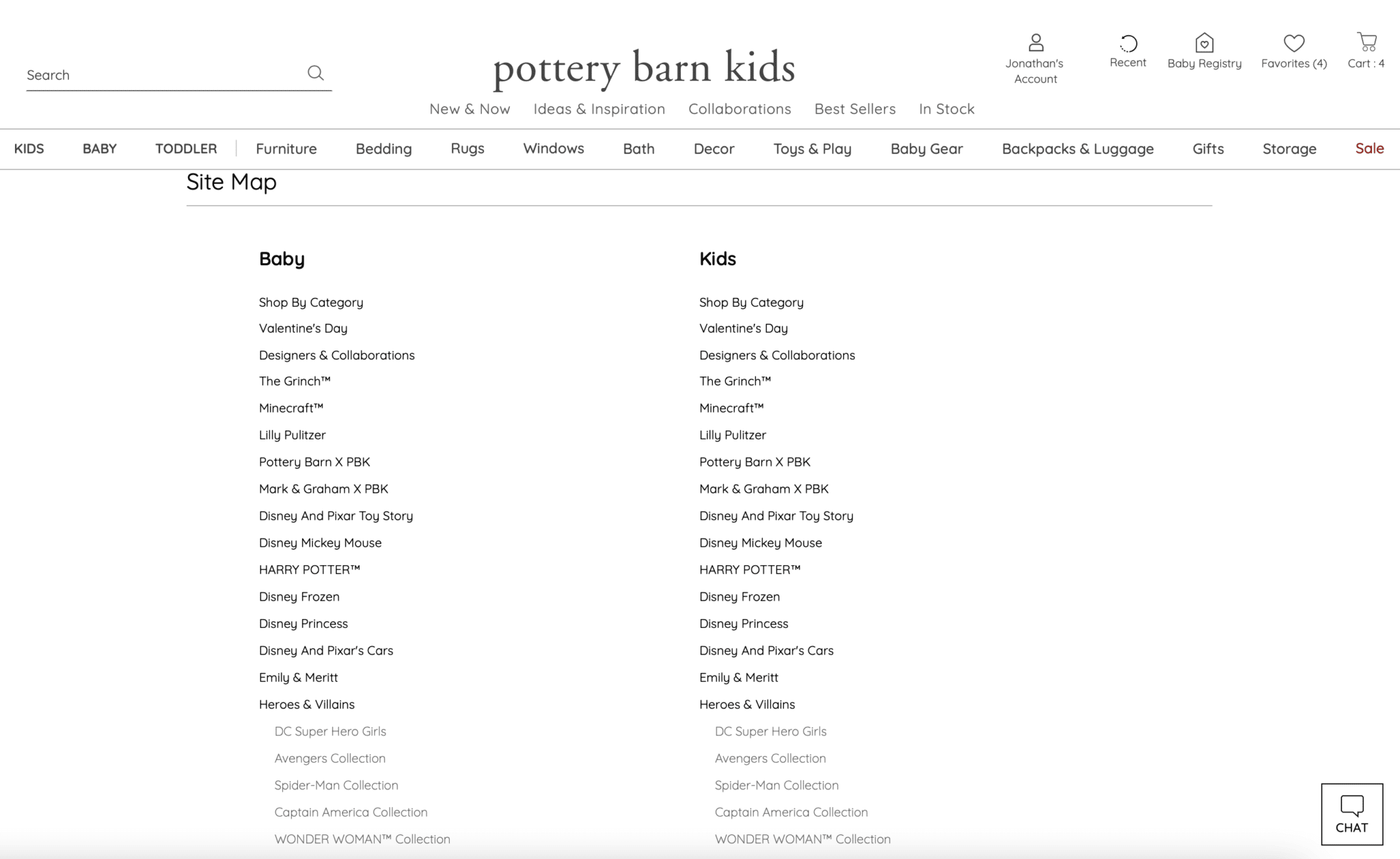
Creating a well-structured HTML sitemap and linking to it from the footer, as Pottery Barn Kids has done, ensures that most site pages are only a few clicks away, which aids in both user accessibility and SEO.
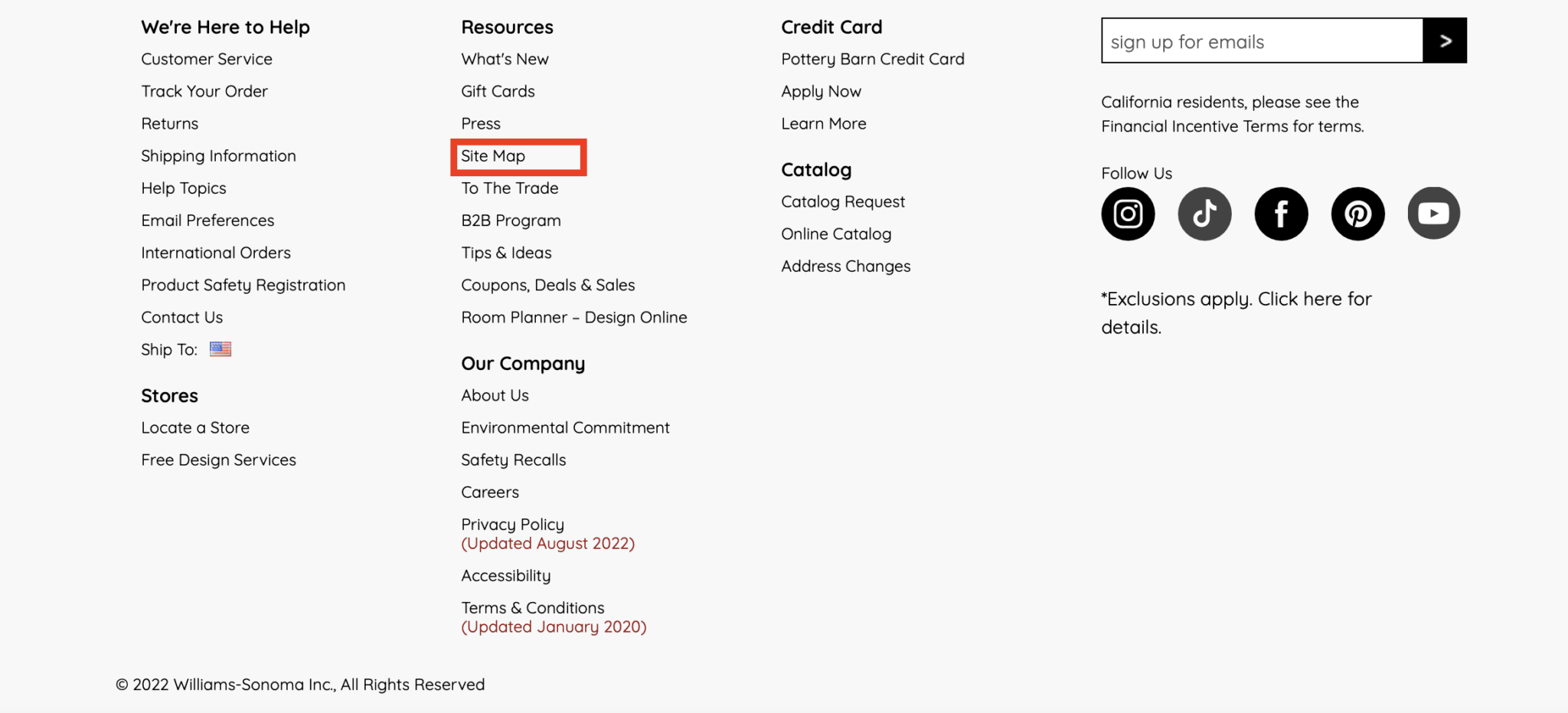
Since search engines crawl sites in a sequential manner and follow contextual cues, it is beneficial to have a single page that links to the site’s primary and secondary pages.
This can be helpful for users looking for specific pages on your website and help search engines discover and crawl all of the pages on your website.
Once created, it is essential to maintain an updated HTML sitemap on the site to ensure users and search engines can reach any page via minimal navigation.
In-content internal linking best practices
Ecommerce sites are notorious for lacking content – especially across category and sub-category pages. As a result, it could be argued some of these examples are “navigational” in nature.
However, I might argue these implementations are less ‘standard’ for navigational purposes and typically buried at the bottom of the page (where content is generally added for category pages).
5. Supporting category page content
There are many ways to build in supporting content on category pages – that could be a separate article.
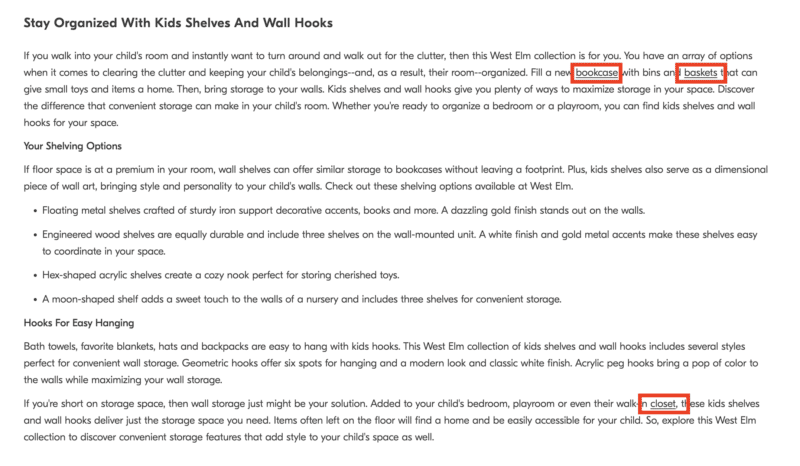
In the example below, West Elm adds a few supporting paragraphs at the bottom of their category pages with additional heading tags and content that adds value to the user experience.
Within that content, they naturally include links to other category and sub-category pages, individual product pages, and even educational/blog content where it makes sense.
6. Internal linking modules
Above the supporting page content, Pottery Barn, Mark & Graham, and West Elm utilize a row of Related Searches (read more about internal link modules here).

Pottery Barn Kids utilizes this same row directly above the footer.

In all cases, these text links take the form of long-tailed keyword-rich internal links to sub-categories and product detail pages (PDPs).
As you can see from the example above, this provides opportunities to build rich anchor text links to pages around color, texture, and even sizing – incredibly valuable for those long-tailed but highly-qualified searches.
7. Related products/browsing
Ecommerce SEO 101 requires a related products widget of some sort. This can help users discover additional products they may be interested in and is one of the foundational tactics for internal link building.
However, what was traditionally reserved for the product detail page, has expanded to category pages, and even the “types” of related products have grown exponentially.
For example, Williams Sonoma uses the standard “Related Products,” while Pottery Barn uses a “Top Picks for You” widget on their category pages.

On product detail pages, this implementation expands to a wide variety of implementations and names, typically with multiple rows per page in a carousel allowing for a more extensive list of internal links per page:
- “People Also Viewed” (Pottery Barn Kids)
- “People Also Bought” (Pottery Barn Kids)
- “Also in This Collection” (Pottery Barn)
- “Pairs Well With” (West Elm)
- “People Also Browsed” (West Elm)
- “Customers Also Viewed” (Williams Sonoma)
- “Customers Also Bought” (Williams Sonoma)
- “Related Products” (Williams Sonoma)
- “You May Also Like” (Rejuvenation)
- And more!
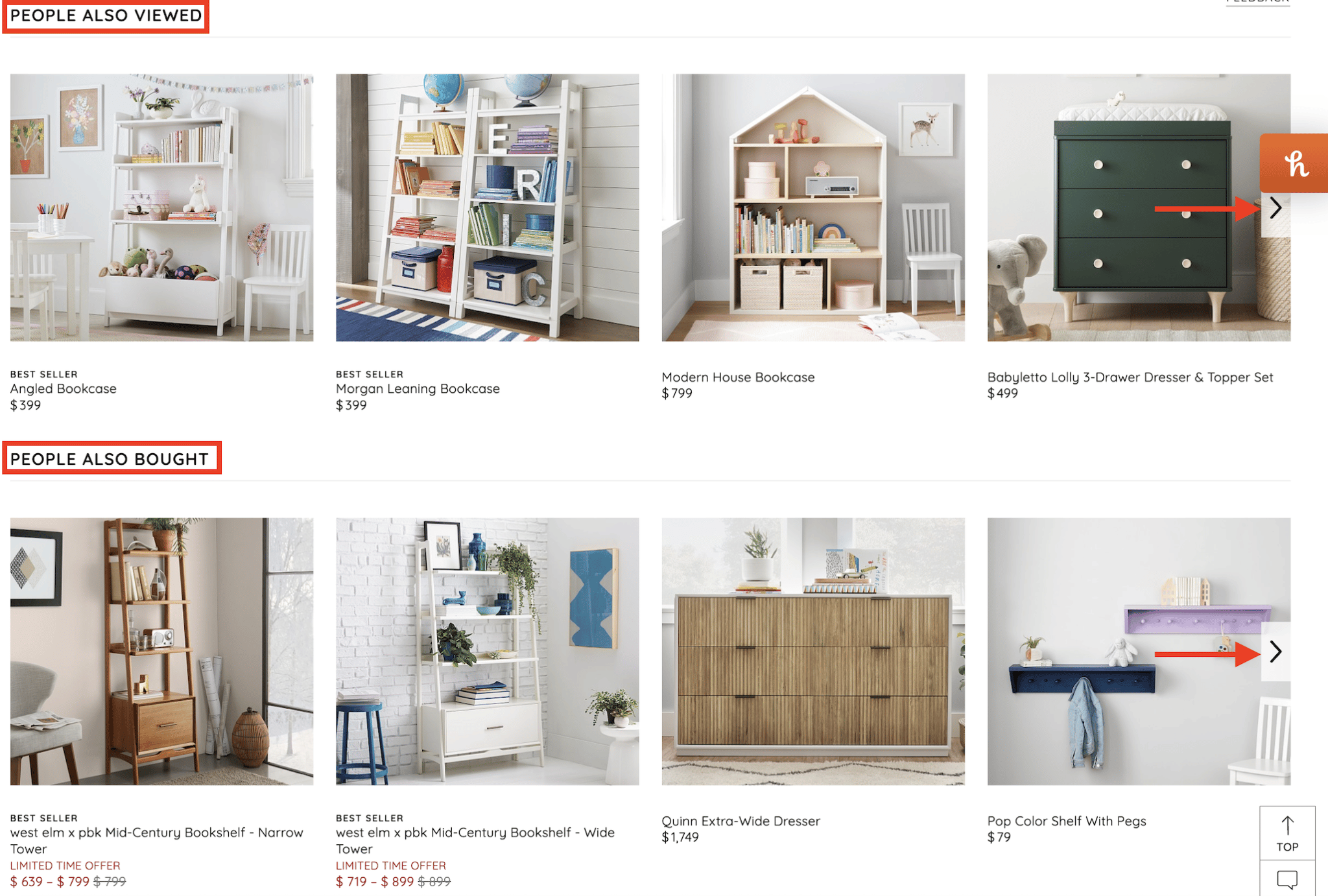
These links are invaluable for cross-selling, upselling, and flattening the overall website architecture.
8. Product attributes
Where breadcrumbs might not be possible, product attributes can fill the void.
When both can be used, they are an effective complement for each other and can reference any/all attributes a product might have:
- Size
- Style
- Color
- Brand
- Flavor
- Texture
While this type of internal link is perhaps better showcased on another site (check out REI.com), I was able to find an example of this on West Elm:
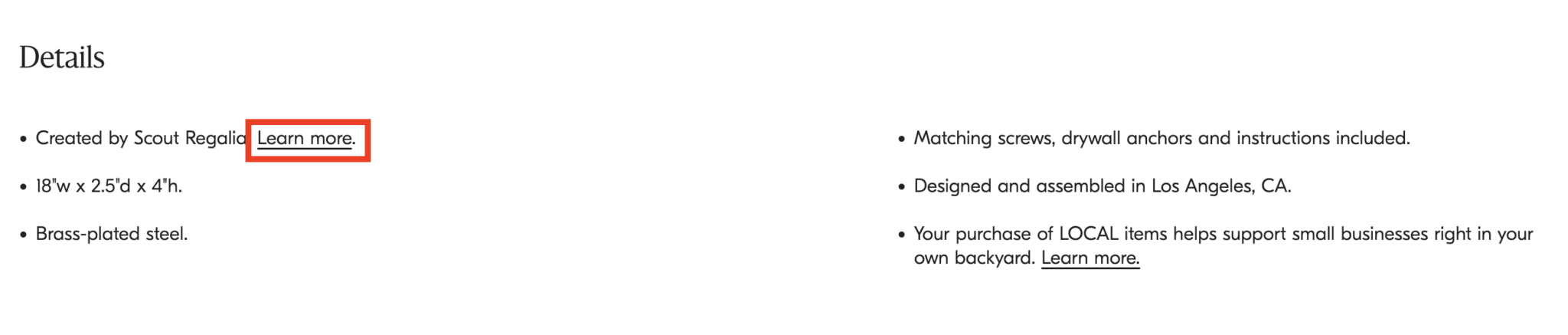
In this case, “Learn more” links to the collaboration page for Scout Regalia. I would argue that a better anchor text implementation could be done here.
There are broader opportunities across the collective sites to take advantage of interlinking among collaborations and brand pages on product detail pages themselves.
9. User-generated content (UGC)
UGC content can take on many forms:
- Reviews.
- Testimonials.
- Question and Answers.
It’s hard to find fault in Williams Sonoma’s SEO strategy. This, however, is one area where there might be a significant opportunity.
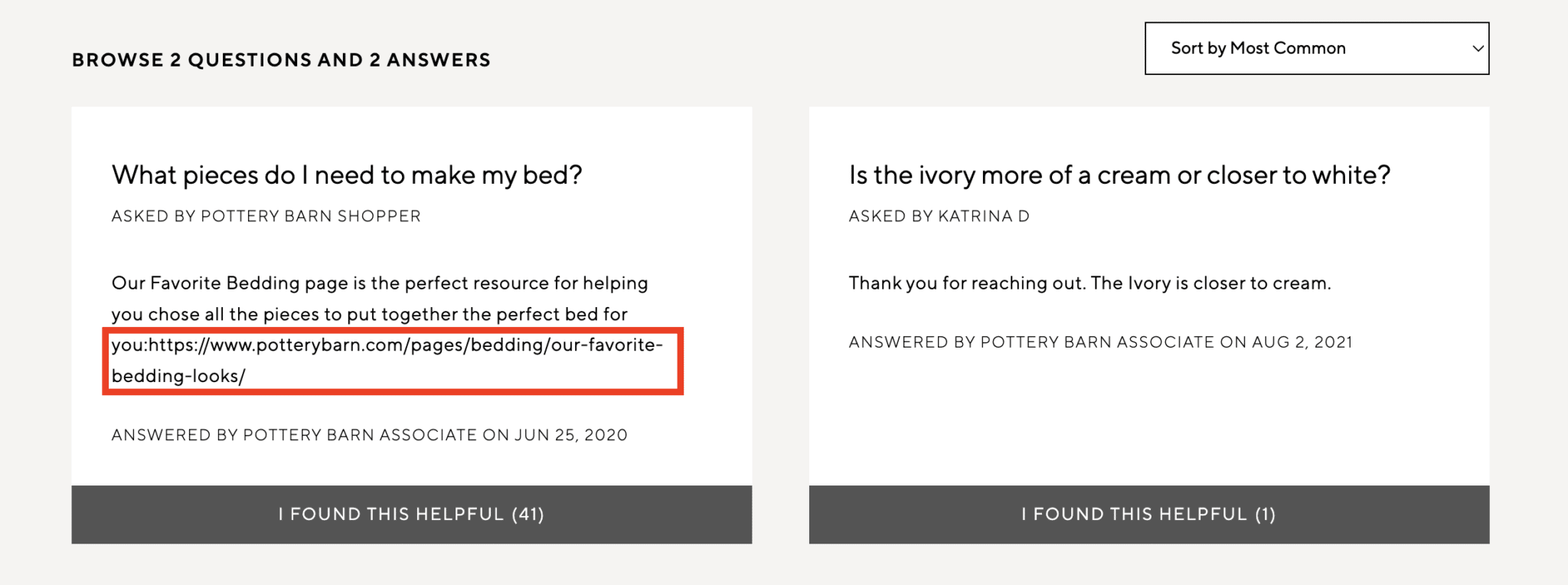
In the example above, a Pottery Barn associate left a response to a comment with a naked URL. However, the link is not clickable.
Generally, the Q&A section across the domains offers many opportunities for internal linking automation.
What are general internal linking best practices?
Now that you have a roundup of the why and where to incorporate internal links, you might wonder “what to do” and “how to do it.”
A myriad of articles outlines these internal linking best practices very well, including Moz, Semrush, and, of course, Google.
I suggest you dive into the links above for a more detailed breakdown. In my opinion, the five most crucial internal linking best practices to follow, in no particular order, are below:
- Link to deep pages.
- Use descriptive anchor text.
- Link to relevant/related pages.
- Link to the canonical version of the URL.
- Don’t use the same anchor text for multiple pages.
How do I implement internal linking on my ecommerce site?
Much of this may require some grunt work and a partnership with your development team to implement these strategies effectively.
The implementation with the most bang for your buck (and potentially the highest level of effort) is internal linking modules. I linked it above, but I highly recommend reading this article from Holly Miller Anderson for more details.
Alternatively, auditing your existing internal links to determine which pages could benefit from increased internal linking is always a great place to start.
Paul Shapiro defines this process as determining “internal PageRank,” which is an intelligent way of thinking about it.
No matter how you define it, the outcome of this exercise will no doubt provide valuable insights to get started.
Maximizing internal linking for ecommerce
Internal linking is an essential aspect of any ecommerce website.
By following the best practices discussed in this article, you can ensure that your website is easy to navigate for users and is optimized for search engines.
The post Internal linking for ecommerce: The ultimate guide appeared first on Search Engine Land.
Courtesy of Search Engine Land: News & Info About SEO, PPC, SEM, Search Engines & Search Marketing
Category seo news | Tags:
Social Networks : Technorati, Stumble it!, Digg, de.licio.us, Yahoo, reddit, Blogmarks, Google, Magnolia.
Meta advertising: 5 best practices for 2023
Written on January 31, 2023 at 9:34 am, by admin
As Instagram and Facebook continue to lead the social platform arena, Meta remains a media channel where advertisers must stay visible and competitive in 2023. Much has changed over the past year, with Meta releasing many new tools and features. Advertisers now have more resources to scale their campaigns faster than ever.
Meta continues to dominate machine learning, launching new automated campaign types proven incredibly efficient. Advertisers have more options to control certain elements in campaigns.
The media giant also improved the experience of working with influencers, a value-add to advertisers who seek to focus on their brand awareness budgets over direct response.
With all the new updates in 2022, several best practices were uncovered through rigorous testing, many of which prove vital for any brand’s long-term Meta advertising strategy.
Here are five recommendations to consider when running Facebook and Instagram advertising campaigns in 2023.
1. Leverage Advantage+ campaigns
Advantage+ campaigns is a new feature Meta released in 2022. I’ve always advocated for Meta’s machine learning because they have mastered it. Advantage+ campaigns are a great addition to app and shopping initiatives.
Meta does the work for advertisers by finding the right audience and the right creative. We have succeeded across app install and shopping (dynamic product ads).
To capitalize on Advantage+ campaigns, it’s essential to ensure you have a healthy amount of creative to get these running effectively. Meta recommends the creative assets they think will perform the best, but marketers can manually select the ones they desire.
Experiment with your options and try a combination of ads known to perform well while also letting Meta choose ads. By testing and optimizing what works, you’ll likely see an improvement in your cost-per-acquisition running with Advantage+ campaigns. Keep your eye on these for 2023.
2. Work with influencers
Not a new tactic, but Meta has recently put forth new playbooks and guides to help advertisers work with influencers.
Influencers are a large part of B2C advertising budgets, and Meta has recognized that marketers want to leverage user-generated content on brand channels with paid media.
The process isn’t perfect, but here are a few key best practices to make your strategy go as smoothly as possible.
- Connect your influencers as partners under your company page’s “Paid Partnership.” This function allows you to promote their content on your brand channels.
- When promoting on Instagram, ensure influencers include the paid partnership label with your brand – “Paid Partnership with [Brand Name].” This is very important as it ensures you can pull the partner’s content onto your own pages to advertise within the ads manager. Make sure each partner specifically includes your brand name in the partnership label because if they only include the generic label that says “Paid Partnership” you will likely run into trouble getting their content promoted and will have to have them edit the post.
- For Instagram Reels and Stories, verify that there are no stickers or copyrighted music in videos created. Otherwise, Meta will not approve your ads. In addition, you’ll have to work with influencers to re-record their content, which can be a major inconvenience if your campaigns are timely. Typically, the quality of content decreases when we have to go back to influencers and ask for last-minute changes to content that was initially in final approval.
Also, keep in mind that if you’re promoting Reels, advertisers can only add links to these if you create a dark post. If it’s important that you have a link, but you don’t want a dark post, Facebook recommends going with the “Story” placement.
Advertisers working with influencers can additionally find success with the “Instagram Explore” placement, so it’s highly recommended to keep an eye on that one for 2023. We’ve seen our lowest CPMs and CPAs from Instagram’s new “Explore” placement and plan to increase spend here on future influencer initiatives.
Get the daily newsletter search marketers rely on.
<input type=”hidden” name=”utmMedium” value=”” />
<input type=”hidden” name=”utmCampaign” value=”” />
<input type=”hidden” name=”utmSource” value=”” />
<input type=”hidden” name=”utmContent” value=”” />
<input type=”hidden” name=”pageLink” value=”” />
<input type=”hidden” name=”ipAddress” value=”” />
Processing…Please wait.
3. Set up Meta’s Conversions API
Yes, there are still many pain points and kinks to be worked out when setting up Meta’s Conversion API (CAPI). However, Meta has recently rolled out various setup methods to help more advertisers get up and running.
While CAPI isn’t mandatory, it’s worth keeping in mind since it’s a deeper level of optimization. With the new setup methods, it also appears Meta is (hopefully) working to offer more integrations for advertisers to get set up faster without needing a full dev team.
After successfully getting CAPI set up and launched, we delivered our lowest cost-per-acquisition of the year in Q4. Our CPA decreased by 34% in our first month and 70% in our second month while optimizing for conversions using CAPI. We were able to feed a deeper data point to Facebook’s algorithm.
Stay on the lookout for more Meta updates regarding CAPI setup. This is one feature you don’t want to miss out on.
4. Use ‘open’ and ‘broad’ targeting
Aligning even more with Meta’s machine learning algorithm, “Open” or “Broad” targeting will continue to be king when scaling your campaigns.
Meta’s algorithm can efficiently find the audience most likely interested in your ads and taking action when doing either of these two options:
- Leaving your targeting open, meaning you don’t add any targeting beyond demographics.
- Leaving your targeting very broad, using minimal interest targeting that keeps audience scale in the millions.
Open and broad targeting feeds Meta the most audience data to allow it to make the best optimizations, which is the best way to make machine learning work for your advertising efforts.
5. Make the best of lead gen forms
Long has been the theme of “less is more” regarding lead gen forms. This remains true in many cases. But if you’re struggling with the quality of leads, consider adding more questions to qualify the customer.
We’ve seen this successful when needing to drive quality over quantity. Yes, your front-end cost per lead will likely increase. Still, we’ve found that the quality on the backend significantly improves and decreases the efficiency of qualified leads while driving increased revenue for businesses.
It’s also recommended to test manual fill for first name, last name and/or email address if you’re struggling with the quality. There is a balance to be found when it comes to manual fill vs. autofill so you’ll likely want to test a few variations to find what works best for your business.
Don’t have too many manual fill questions to avoid accidentally increasing the volume of abandoned forms. Consider additionally giving the consumer a short and sweet introduction on the form that details what they will get from filling out the form. This can be a snippet of a whitepaper or a few bullets about the company – whatever makes the most sense for your ad.
Moreover, ensure your thank you page or the landing page you are driving the consumer to is engaging with helpful information and resources. This provides more education for the consumer to make decisions and can help build your retargeting audiences for nurture campaigns.
Lastly, keep the creative for your lead gen forms scroll-stopping. You have seconds to grab someone’s attention in their feed and make them stop to open your form, so be bold!
The takeaway
As Meta continues to evolve and unroll new features, one thing is certain – automation will become a core campaign tactic.
With automation at the forefront, advertisers have more ability to test and learn at a faster pace than ever with tools like CAPI and Advantage+ campaigns.
Furthermore, don’t hesitate to lean into open and broad targeting, where possible, to feed audience optimization.
2023 will be a big year for testing to see where advertisers can uncover additional efficiencies and remain competitive on Facebook and Instagram.
The post Meta advertising: 5 best practices for 2023 appeared first on Search Engine Land.
Courtesy of Search Engine Land: News & Info About SEO, PPC, SEM, Search Engines & Search Marketing
Category seo news | Tags:
Social Networks : Technorati, Stumble it!, Digg, de.licio.us, Yahoo, reddit, Blogmarks, Google, Magnolia.
This day in search marketing history: January 31
Written on January 31, 2023 at 9:34 am, by admin
Google releases URL Inspection Tool API
In 2022, Google released a new API under the Search Console APIs for the URL Inspection Tool. The new URL Inspection API let you programmatically access the data and reporting you’d get from the URL Inspection Tool but through software.
Google’s URL Inspection Tool API had a limit of 2,000 queries per day and 600 queries per minute.
Google provided some use cases for the API:
- SEO tools and agencies can provide ongoing monitoring for important pages and single page debugging options. For example, checking if there are differences between user-declared and Google-selected canonicals, or debugging structured data issues from a group of pages.
- CMS and plugin developers can add page or template-level insights and ongoing checks for existing pages. For example, monitoring changes over time for key pages to diagnose issues and help prioritize fixes.
Within a week, several SEO professionals developed free new tools and shared scripts, and established SEO crawlers integrated this data with their own insights, as Aleyda Solis rounded up in 8 SEO tools to get Google Search Console URL Inspection API insights.
Also on this day
Google Search Console error reporting for Breadcrumbs and HowTo structured data changed
2022: This change may have resulted in seeing more or less errors in your Breadcrumbs and HowTo structured data Search Console enhancement and error reports.
Recommendations roll out to Discovery campaigns
2022: Google Ads also launched auto-applied recommendations for manager accounts and more recommendations for Video campaigns.
Google Ads creates unified advertiser verification program
2022: Google would combine its advertiser identity and business operations verification programs under a unified Advertiser verification program.
Deepcrawl launches technical SEO app for Wix
2022: Designed for small and mid-sized enterprises, the app automated weekly site crawls and detects issues ranging from broken pages to content that doesn’t meet best-practice guidelines for SEO.
Pinterest rolls out AR ‘Try on’ feature for furniture items
2022: The augmented reality feature, called “Try On for Home Decor,” let users see what furniture looked like in their home before buying.
Meta descriptions and branding have the most influence on search clickthrough, survey finds
2020: The majority of participants also agreed that rich results improved Google search.
Microsoft: Search advertising revenue grew slower than expected last quarter
2020: LinkedIn sessions grew faster than the previous three quarters, though revenue growth slowed slightly in the second quarter of its fiscal 2020.
Bing lets webmasters submit 10,000 URLs per day through Webmaster Tools
2019: Previously you were able to submit up to 10 URLs per day and maximum of 50 URLs per month. Bing increased these limits by 1000x and removed the monthly quota.
Client in-housing, competition for talent top digital agency concerns
2019: Marketing Land’s Digital Agency Survey found the sector was weathering digital transformation well, but the growth of data-driven marketing made it clear where they needed to hire.
Quora adds search-like keyword targeting, Auction Insights for advertisers
2019: Quora introduced three new metrics (Auctions Lost to Competition, Impression Share, Absolute Impression Share) to help advertisers understand how they performed in the ad auctions.
Google’s Page Speed Update does not impact indexing
2018: Indexing and ranking are two separate processes – and this specific algorithm had no impact on indexing.
Bing Ads has a conversion tracking fix for Apple’s Intelligent Tracking Prevention
2018: Advertisers had to enable auto-tagging of the Microsoft Click ID in their accounts to get consistent ad conversion tracking from Safari.
Google EU shopping rivals complain antitrust remedies aren’t working
2018: They demanded more changes, saying their problems have intensified rather than improved since the EC ruling in June 2017.
Google mobile-friendly testing tool now has API access
2017: Developers could now build their own tools around the mobile-friendly testing tool to see if pages are mobile-friendly.
AdWords IF functions roll out for ad customization as Standard Text Ads sunset
2017: IF functions arrived to let advertisers customize ads based on device and retargeting list membership.
Google launches Ads Added by AdWords pilot: What we know so far
2017: Ads based on existing ad and landing page content were added to ad groups by Google.
New AdWords interface alpha is rolling out to more advertisers
2017: It would roll out to even more AdWords accounts in the next few months.
Majestic successfully prints the internet in 3D in outer space
2017: The 3D printer worked in outer space, and the Majestic Landscape was printed at the International Space Station.
Nadella Would Bring Search Cred To Microsoft CEO Role
2014: For the prior three years Nadella had run Microsoft’s Server & Tools business. Before that he was in charge of Bing and online advertising.
Bing Ads Editor Update Gives The Lowly “Sync Update” Window Real Functionality
2014: The sync window showed the total number of changes and the number of those that had been successfully downloaded from or posted to the account.
What Time Does Super Bowl 2014 Start? Look Up!
2014: Google showed the start time at the top of its results.
Who’s Tops? Bud Light Is Unseated As Number One Super Bowl Advertiser On Google And Bing
2014: Volkswagen garnered the top spot with the most ad impressions on Google.
Search In Pics: The Simpsons With Google Glass, Oscar Mayer Car At Google & Google Military Truck
2014: The latest images culled from the web, showing what people eat at the search engine companies, how they play, who they meet, where they speak, what toys they have, and more.
Adwords For Video Gets Reporting Enhancements
2013: Google added three new measurement features to the AdWords for video reporting interface (Reach & Frequency, Column Sets Tailored to Marketing Goals, Geographic Visualization).
Jackie Robinson Google Baseball Player Logo
2013: The Doodle honored Robinson for his 94th birthday.
Google & Bing: We’re Not Involved In “Local Paid Inclusion”
2012: A program that guaranteed top listings for local searches on Google, Yahoo and Bing? An “officially approved” one in “cooperation” with those search engines? Not true, said Google and Bing.
Report: Search Ad Spend To Rise 27% In 2012
2012: Search ad spend was expected to grow 27% from 2011 to 2012, up from $15.36 billion to $19.51 billion. And by 2016, it was expected to reach almost $30 billion annually.
Matt Cutts Convinces Some South Korean Govt. Websites To Stop Blocking Googlebot
2012: Cutts managed to singlehandedly convince some government reps to let Googlebot crawl and index their websites.
DOJ Exploring “Search Fairness” With Google As Rivals Protest Potential ITA Licensing Deal
2011: FairSearch.org opposed any such potential licensing deal.
Review Sites’ Rancor Rises With Prominence of Google Place Pages
2011: Google’s relationship with review sites like TripAdvisor and Yelp was as complicated as ever.
Google’s Android Now “The World’s Leading Smartphone Platform”: Report
2011: More Android handsets were shipped in Q4 2010 than other platforms.
Blekko Launches Mobile Apps For iPhone, Android
2011: Slashtags and the personalization that Blekko offered were even better suited to the mobile search use case in some respects.
Topsy Social Analytics: Twitter Analytics For The Masses (& Free, Too)
2011: You could analyze domains, Twitter usernames, or keywords — and they can be compared over four timeframes: one day, a week, two weeks or a month.
Google Executive Believed Missing After Egypt Protests
2011: Wael Ghonim went missing not long after tweeting about being “very worried” and “ready to die.”
Apple CEO: Google Wants To “Kill The iPhone”
2010: “We did not enter the search business,” Jobs said. “They entered the phone business. Make no mistake they want to kill the iPhone. We won’t let them.”
Google Gets Fearful, Flags Entire Internet As Malware Briefly
2009: Due to a human error, Google told users “This site may harm your computer” for every website listed in search results.
Google Revenues Up 51 Percent, Social Networking Monetization “Disappointing”
2008: Google’s Q4, 2007 revenues were $4.83 billion, compared with $3.21 billion the year before.
Google’s Marissa Mayer On Social Search / Search 4.0
2008: How the search engine was considering using social data to improve its search results.
Report: Click Fraud Up 15% In 2007
2008: The overall industry average click fraud rate rose to 16.6% for Q4 2007. That was up from 14.2% for the same quarter in 2006, and 16.2% in Q3 2007.
New “Show Search Options” Broadens Google Maps
2008: A pull-down menu allowed users to narrow or expand results for the same query and more easily discover non-traditional content in Google Maps.
Google’s Founders & CEO Promised To Work Together Until 2024
2008: Spoiler alert: Schmidt left Google’s parent company Alphabet for good in February 2020.
Google Reports Revenues Up 19 Percent From Previous Quarter
2007: Google reported revenues of $3.21 billion for Q4 2006, representing a 67% increase over Q4 2005 revenues of $1.92 billion
Google Pushes Back On Click Fraud Estimates, Says Don’t Forget The Back Button
2007: Google’s Shuman Ghosemajumdersome said third-party auditing firms don’t appear to be
matching up estimated fraud figures with refunds or even actual clicks registered by advertisers.
Google, Microsoft, & Yahoo Ask For Help With International Censorship
2007: The search engines had to make “moral judgments” about international authorities’ requests for information when they do not have to do the same for US requests.
Yahoo To Build New Keyword Research Tool & Wordtracker Launches Free Tool
2007: YSM’s public keyword research tool was sporadically offline, but Yahoo had plans to offer a new public keyword research tool.
Gmail Locks Out User For Using Greasemonkey & Reports Of Gmail Contacts Disappearing
2007: The account was disabled for 24 hours due to “unusual usage.”
Yahoo To Build “Brand Universe” To Connect Entertainment Brands
2007: Brand Universe would create about 100 websites built around entertainment brands and pull together content from various Yahoo properties.
Google Can’t Use “Gmail” Name In Europe
2007: Due to a trademark of the term.
Boorah Restaurant Reviews: Zagat On Steroids
2007: Boorah collected reviews from existing local search and content sites, summarized and enhanced the data and built additional features on top.
Q&A With Stephen Baker, CEO Of Reed Business Search
2007: What was new with Zibb, a B2B search engines, and the opportunities he saw going forward in B2B search.
January 2007: Search Engine Land’s Most Popular Stories
From Search Marketing Expo (SMX)
Past contributions from Search Engine Land’s Subject Matter Experts (SMEs)
These columns are a snapshot in time and have not been updated since publishing, unless noted. Opinions expressed in these articles are those of the author and not necessarily Search Engine Land.
- 2019: Getting started with Google Search Console by Detlef Johnson
- 2017: The PPC industry would not exist under Trump’s immigration policy by Frederick Vallaeys
- 2017: How machine learning impacts the need for quality content by Eric Enge
- 2017: How to go above and beyond with your content by Julie Joyce
- 2014: Single Page Websites & SEO by Tom Schmitz
- 2014: 4 Content Marketing Strategies That Still Build Links by Nate Dame
- 2013: German Parliament Hears Experts On Proposed Law To Limit Search Engines From Using News Content by Mathias Schindler
- 2013: The Christmas Jump, Tablet Hump & CPC Bump: Recent Trends In Mobile Usage by Siddharth Shah
- 2013: 9 SEO Quirks You Should Be Aware Of by Tom Schmitz
- 2013: Will Facebook’s Graph Search Be Big For Bing Advertisers? by Mark Ballard
- 2012: The Ultimate Guide To Enterprise SEO: 25 Things To Know Before You Take The Plunge by Brian Provost
- 2012: 3 Essential Features For Multinational Content Delivery by Chris Liversidge
- 2012: Link Building Tool Review: WordTracker Link Builder by Debra Mastaler
- 2012: 12 Steps To Optimize A Webpage For Organic Keywords by George Aspland
- 2012: Google+ Growing Your Social Network: Quantity vs. Quality by Aaron Friedman
- 2011: The Rise And Fall Of Content Farms by Eric Enge
- 2011: 6 Tactics That May Put You At Risk Of Being Banned From AdWords by Brad Geddes
- 2011: Advanced Development Should Be The Future For Yellow Pages by Chris Silver Smith
- 2008: 5 Reasons Why Rankings Are A Poor Measure Of Success by Jill Whalen
- 2008: Making a Good Impression With About Us Pages by Bill Slawski
- 2008: Internet Yellow Page Video SEM: Worth The Effort? by Grant Crowell
< January 30 | Search Marketing History | February 1 >
The post This day in search marketing history: January 31 appeared first on Search Engine Land.
Courtesy of Search Engine Land: News & Info About SEO, PPC, SEM, Search Engines & Search Marketing
Category seo news | Tags:
Social Networks : Technorati, Stumble it!, Digg, de.licio.us, Yahoo, reddit, Blogmarks, Google, Magnolia.