

How to implement generative engine optimization (GEO) strategies
Written on September 19, 2024 at 2:54 pm, by admin

Generative AI is transforming how consumers discover and engage with content, making it essential for brands to rethink and adapt traditional SEO strategies.
Leading this shift is generative engine optimization (GEO) – an evolution of SEO that leverages AI-driven insights to optimize content for visibility and authority across platforms like ChatGPT, Perplexity and Google’s AI Overviews.
This article will dive into the five key strategies to help you implement GEO effectively:
- Generative AI research and analysis.
- Optimizing content for generative AI.
- Technical optimization for AI accessibility.
- Content distribution and engagement.
- Building brand authority and credibility.
Let’s explore these strategies so you can boost engagement, increase visibility and achieve lasting success, positioning your brand as a leader in AI-driven search.
1. Generative AI research and analysis
Generative AI research is the foundation of your GEO strategy, focused on gathering insights to optimize your content and enhance visibility.
By knowing what your audience is looking for and how your brand matches up with AI algorithms focusing on relevance and authority, you can ensure your content meets their needs.
Let’s break down GEO research into these core components:
- GEO keyword research.
- AI Overview response analysis.
- Competitor research and analysis.
- Brand perception intelligence.
GEO keyword research
GEO keyword research identifies the keywords, queries and conversational phrases that AI-driven search engines prioritize.
AI algorithms favor content that mirrors natural language and comprehensively addresses user intent, so creating contextually rich, conversational content has become more essential than ever.
With over a billion voice searches occurring every month and 8.4 billion voice assistants expected to be in use by the end of the year, optimizing for natural language is no longer optional – it’s crucial.
By effectively leveraging GEO keyword research, you can ensure your content gives users what they’re looking for and aligns with AI preferences, enhancing user engagement and creating stronger connections with your audience.
Actionable tips:
- Understand your target audience:
- Start by gaining a deep understanding of what drives your audience’s searches – are they looking for information, products or solutions?
- Focus on the words, phrases and questions they use to craft content that effectively meets their needs.
- Identify relevant keywords, phrases and entities:
- Find keywords and phrases that resonate with your audience while aligning with AI’s focus on natural language processing:
- Long-tail keywords and conversational queries: Longer, more specific phrases that capture user intent and reflect natural, conversational search behavior.
- Semantic keywords: Related terms, synonyms or variations that add context and depth to your main keyword, making your content more meaningful and relevant.
- Entities: Recognizable people, places, things or specific concepts that enable AI to accurately categorize and reference your content.
- Contextually relevant phrases: Phrases that naturally occur within discussions around a topic and reinforce your content’s overall theme, helping AI understand the overall context of your content.
- Incorporating these elements into your content will help meet user needs while making it easier for AI to interpret and categorize effectively.
- Example: “best wireless headphones”
- Long-tail keywords: best wireless headphones under $200, best wireless headphones for working out, wireless headphones with long battery life
- Conversational queries: what are the best wireless headphones in 2024, which wireless headphones are best for noise cancellation?
- Semantic keywords: Bluetooth headphones, wireless earbuds, over-ear wireless headphones
- Entities: Apple, Bluetooth, Bose, Sony
- Contextually relevant phrases: crystal-clear sound quality, long-lasting battery, comfortable fit for all-day wear
- Example: “digital marketing strategies”
- Long-tail keyword: best digital marketing strategies in 2024, digital marketing strategies for small businesses
- Conversational query: what are the most effective digital marketing strategies, what type of marketing is best for small businesses
- Semantic keywords: digital marketing channels, digital marketing tips, online advertising strategies, inbound marketing strategies
- Entities: search engine optimization (SEO), content marketing, email marketing
- Contextually relevant phrases: grow your business, increase brand awareness, drive qualified traffic, reach your target audience
- Example: “best wireless headphones”
- Find keywords and phrases that resonate with your audience while aligning with AI’s focus on natural language processing:
- Explore SERP features and use AI tools:
- Explore SERP features: Use tools like Google’s “People Also Ask” and Autocomplete to find long-tail queries and related search terms. Tools like AlsoAsked can extract additional insights from this data.
- Leverage AI tools for topic research: Use platforms like ChatGPT to generate relevant concepts, phrases and queries. This will deepen your content’s relevance and align with AI’s understanding of the topic.
- Prompt example
- “Generate a list of long-tail keywords, conversational queries and contextually relevant phrases related to ‘[KEYWORD]’ that address different types of user intent (informational, navigational, commercial, transactional). Include common user queries, semantically related terms and key entities that should be emphasized to create comprehensive, user-focused content. Also, highlight areas where users often seek deeper insights, specific pain points or actionable solutions.”
AI Overview response analysis
AI Overview response analysis involves:
- Identifying the queries that trigger AI-generated overviews in Google.
- Understanding the prioritized topics and structures.
- Ensuring your brand is well-represented.
As these overviews grow in popularity and become the go-to choice for users seeking personalized, quick and concise answers, they are becoming critical touchpoints with the power to significantly influence your content’s visibility and credibility.
- Expanded visibility: AI Overviews are visible to all U.S. users, including those in incognito mode, offering broader visibility and new opportunities for content discovery. Google also expanded AI Overview availability to six new countries, increasing its global reach and potential impact on content visibility.
- Semrush AI Overview tracking enhancement: Semrush has enhanced its tracking for AI Overviews, simplifying large-scale analysis. While not all keyword data is fully integrated, the Organic Research report can help track the performance of queries triggering AI Overviews.
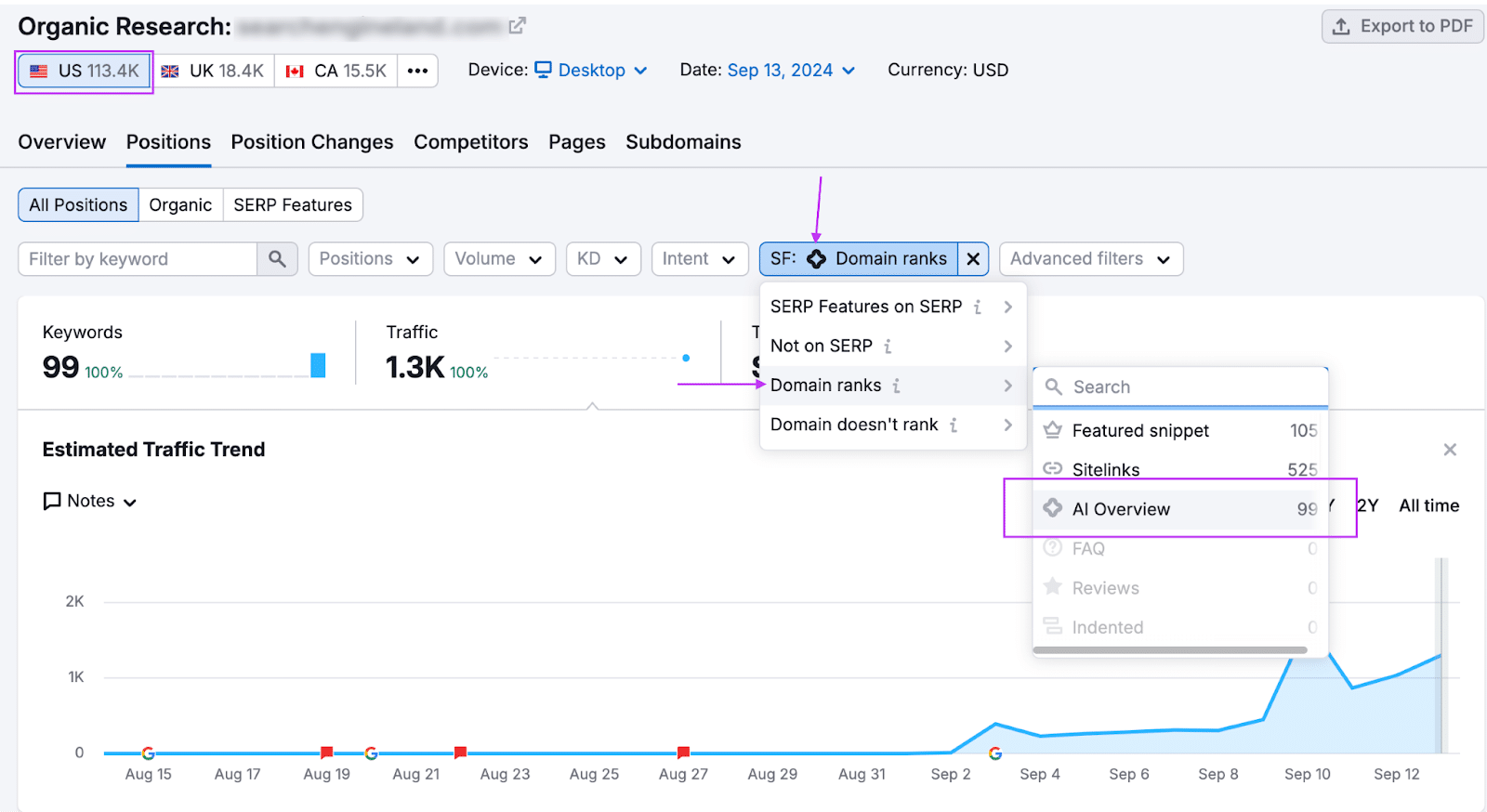
Actionable tips:
- Track your key queries triggering AI Overviews:
- Pinpoint the queries that trigger AI Overviews using a combination of tools to assess content performance and prioritize topics in your GEO strategy.
- Keyword rank tracking tools: Use tools like Semrush, BrightEdge and others to track keywords, keeping in mind that visibility may still be limited for less frequent triggers.
- Google Search Console: While it lacks direct AI Overview tracking, GSC provides valuable insights when used alongside other tools.
- Google Chrome extensions
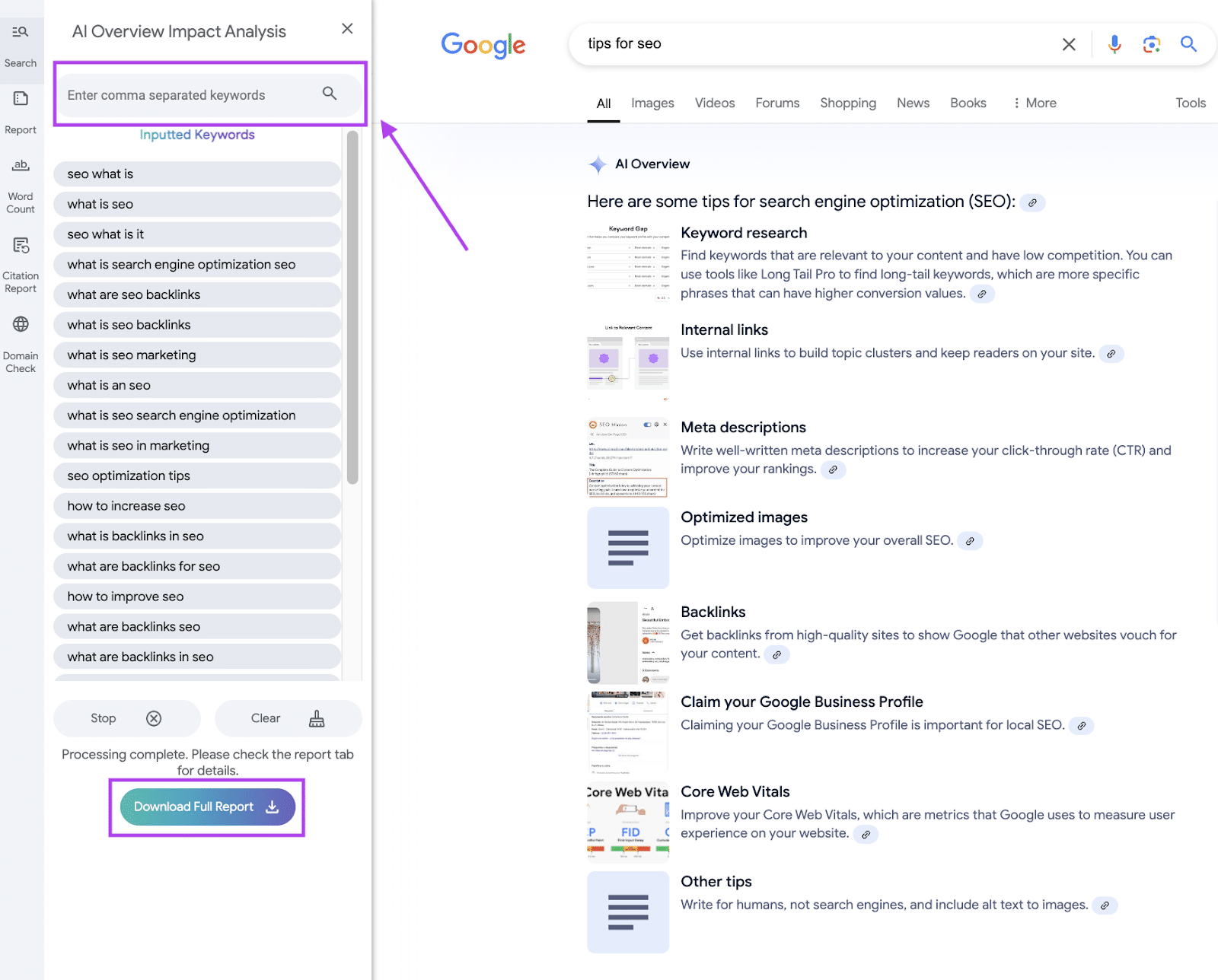
- Google AI Overview Impact Analysis: This free extension tracks AI Overviews and cited sources across multiple keywords. You can export data, identify trends and refine your strategy.
- Google AI Overview Citation Analysis: Use this free extension to compare links cited in AI Overviews with traditional SERPs, allowing for side-by-side comparisons, competitor tracking and trend identification.
- Pinpoint the queries that trigger AI Overviews using a combination of tools to assess content performance and prioritize topics in your GEO strategy.
- Analyze your brand’s placement in AI Overviews:
- Ensure your content appears in AI Overviews for key queries, especially if it ranks well organically. AI doesn’t always pull from top-ranking SERP content, so being featured in overviews is essential for maintaining visibility.
- A recent seoClarity analysis by Mark Traphagen revealed that 99.5% of AI Overview citations now match one or more of the top 10 Google search results. However, the correlation can vary, making it essential to monitor regularly.
- Tip: Use a regex pattern with ChatGPT to filter top queries from a ranking export likely to trigger AI Overviews. As seen below, run these keywords through the AI Overview Impact Analysis extension to identify which queries generate overviews and the sources cited.
- By combining the downloaded report with your ranking data using VLOOKUP, you can effectively analyze AI Overviews in relation to your organic performance.
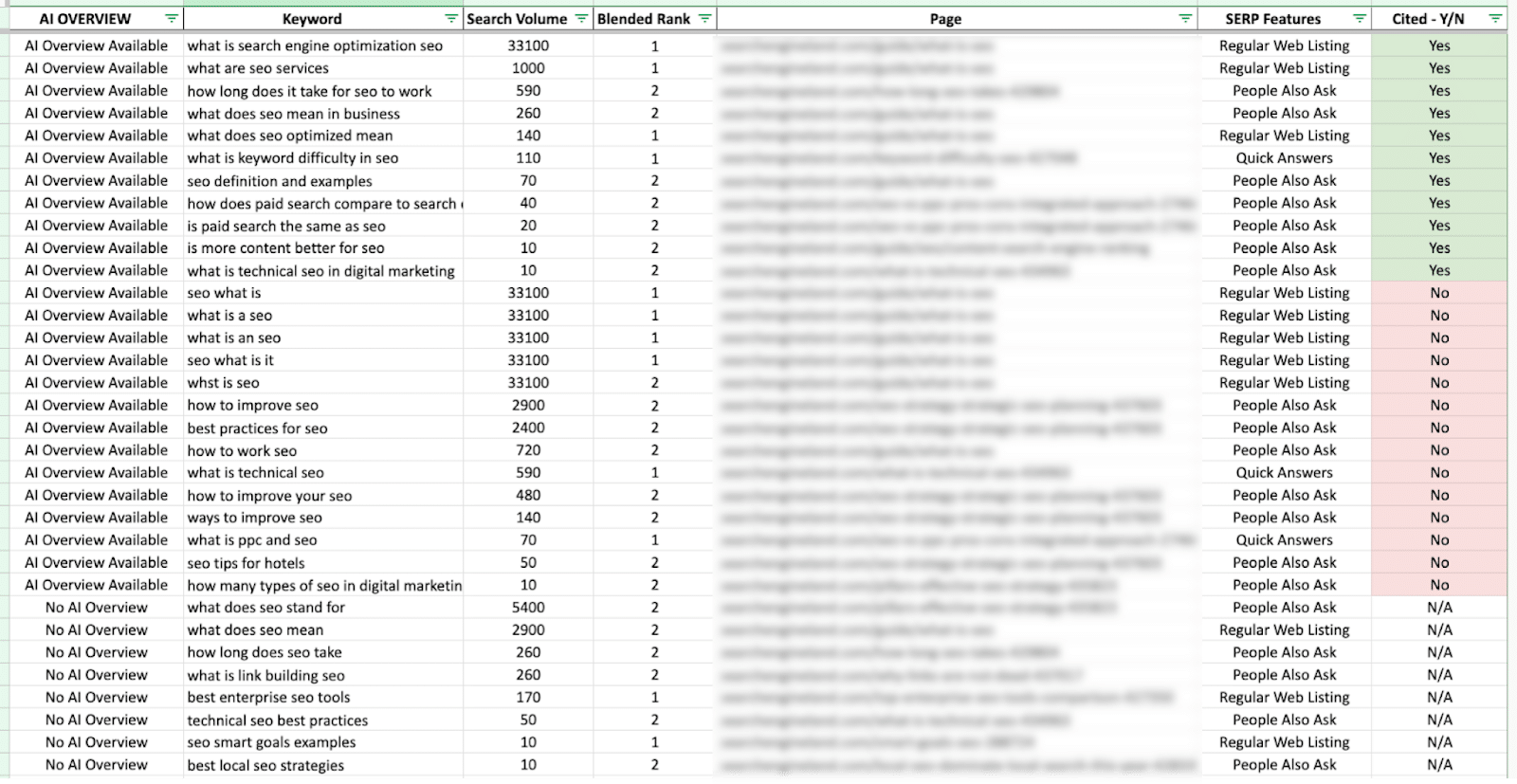
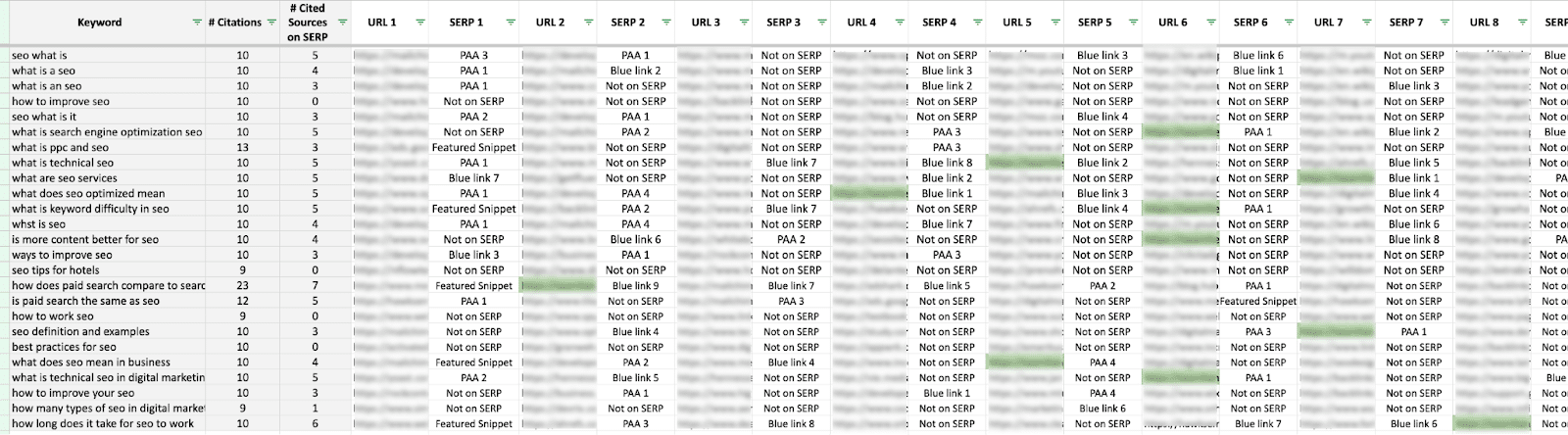
- With conditional formatting, you can easily track your brand’s placement and monitor the sources being cited.
- Analyze AI Overview response structures and content elements to:
- Optimize your content for AI Overviews, it’s essential to understand how AI structures its responses to your key queries.
- Identify the common formats – whether lists, tables or videos – and tailor your content to incorporate elements like data points, topics, multimedia and key phrases that AI deems relevant.
- Examples:
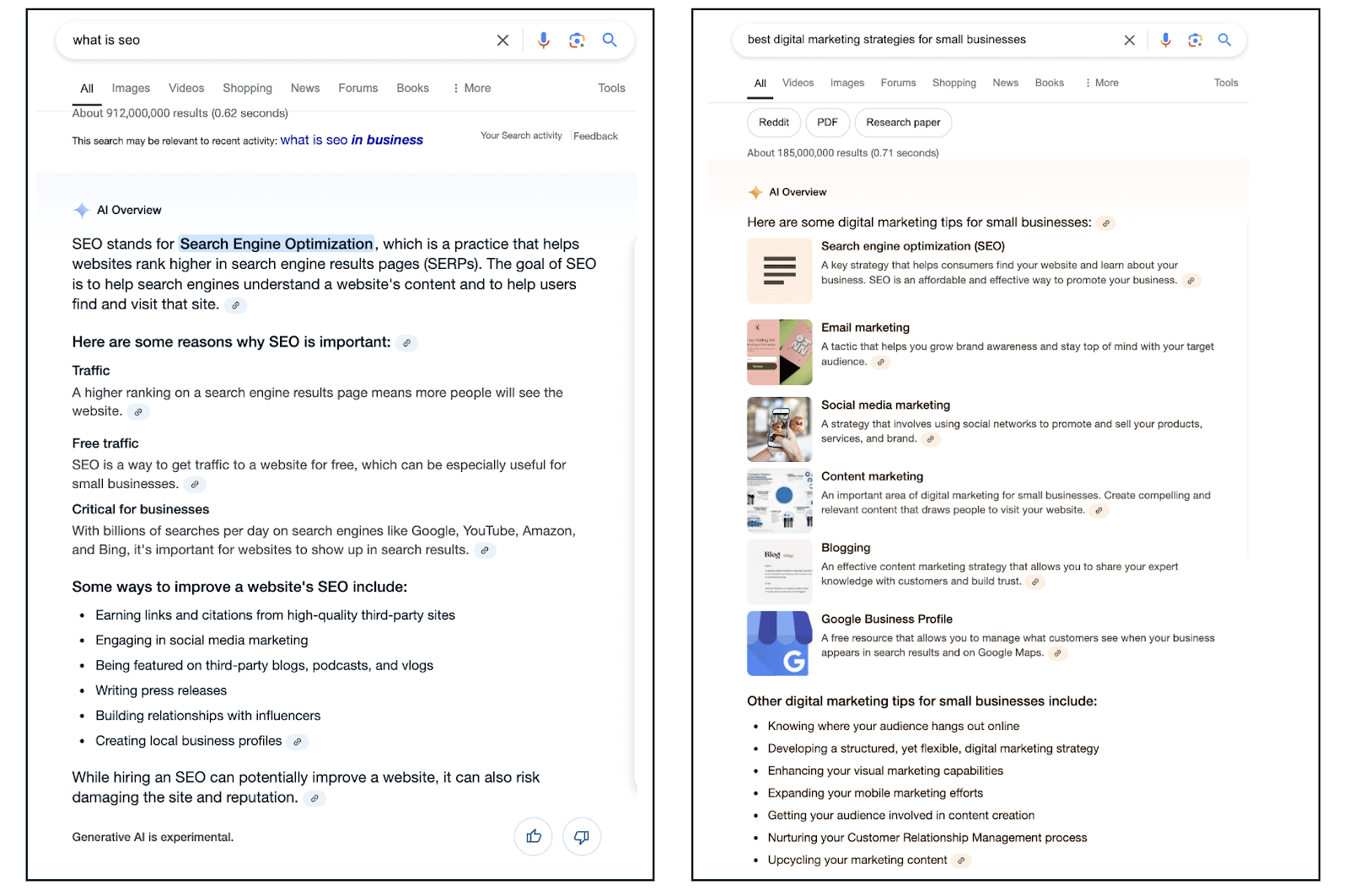
- “What is SEO” AI Overview: Begins with a concise paragraph, followed by headings and lists that cover the reasons SEO is important and ways to improve a website’s SEO performance. To increase chances of being featured, content should comprehensively address these core aspects.
- “Best digital marketing strategies for small businesses” AI Overview: Combines text, images and a bulleted list that covers specific digital marketing channels, strategies and actionable tips. If you aim to target this AI Overview, adjust your content to mention similar topics and actionable tips.
Competitor research and analysis
GEO competitor research helps you identify how competitors perform in AI-driven search results. By analyzing their successes, you can uncover effective strategies, spot content gaps and refine your approach to improve visibility and stay competitive.
This research is an opportunity to learn from those excelling in AI-driven search. Analyze how competitors are referenced, then adapt their strategies to improve your own content.
Focus on areas where you can offer more insights or add value while always showcasing your brand’s unique perspective.
Actionable tips:
- Track competitors cited by AI:
- Start by identifying competitors frequently appearing in AI-generated overviews for your target keywords.
- Use monitoring tools: Use the free tools mentioned above, like the AI Overview Impact Analysis and Citation Analysis Chrome extensions, to track competitors.
- Leverage Advanced AI Tools: Integrate tools like the ChatGPT API with Google Sheets to build custom solutions that allow you to efficiently track and analyze your brand’s visibility in AI-driven responses.
- Start by identifying competitors frequently appearing in AI-generated overviews for your target keywords.
- Monitor trends and shifts in sources cited over time:
- Stay updated on AI’s evolving content preferences, such as shifts toward newer publications or specialized sources and adjust your strategy to maintain relevance and competitiveness.
- Analyze competitors’ source content and adapt successful strategies:
- Analyze competitors’ content to uncover gaps and opportunities where you can offer more value.
- Look at both the structure and depth of their content and adapt successful strategies to improve your own.
- Evaluate structure and format: Identify the content formats competitors consistently use (e.g., lists, tables or multimedia) that AI may favor.
- Assess the depth of coverage: Determine if competitors provide comprehensive coverage of key topics or if there are gaps you can fill by expanding on neglected areas.
- Incorporate multimedia: If competitors frequently use visuals like infographics or videos, enhance your content by including similar elements to engage both AI algorithms and users.
- Adopt effective formats: Pay attention to how competitors use structures like bullet points, QandA sections or visual elements that improve AI-driven content discoverability.
- Enhance with your unique perspective: While adopting successful strategies, maintain your brand’s voice and insights to stand out from competitors.
- Example:
- For the keyword “benefits of content marketing,” if AI often references competitor content with numbered lists and visuals, consider using similar elements while incorporating your unique perspective to increase your chances of being featured.
Dig deeper: Entity-based competitor analysis: An SEO’s guide
Brand perception intelligence
Brand perception intelligence involves gathering insights from AI platforms on how both AI systems and users perceive your brand.
In an AI-driven world, brand perception and customer sentiment heavily influence search visibility. AI systems favor brands viewed as authoritative, credible and trustworthy, improving visibility and building customer trust.
Actionable tips:
- Conduct research about your brand on AI platforms:
- Regularly assess how AI platforms like ChatGPT and Perplexity portray your brand.
- Analyze AI-generated summaries, user queries and brand representation in user-generated content (UGC) to identify gaps and areas for improvement.
- Use UGC insights:
- Analyze how AI platforms use UGC to gauge customer sentiment and overall brand perception.
- Automate UGC collection and analysis with AI tools to refine your brand strategy.
- Tip: Use tailored prompts and custom-built GPT solutions to automate the collection and analysis of brand perception data.
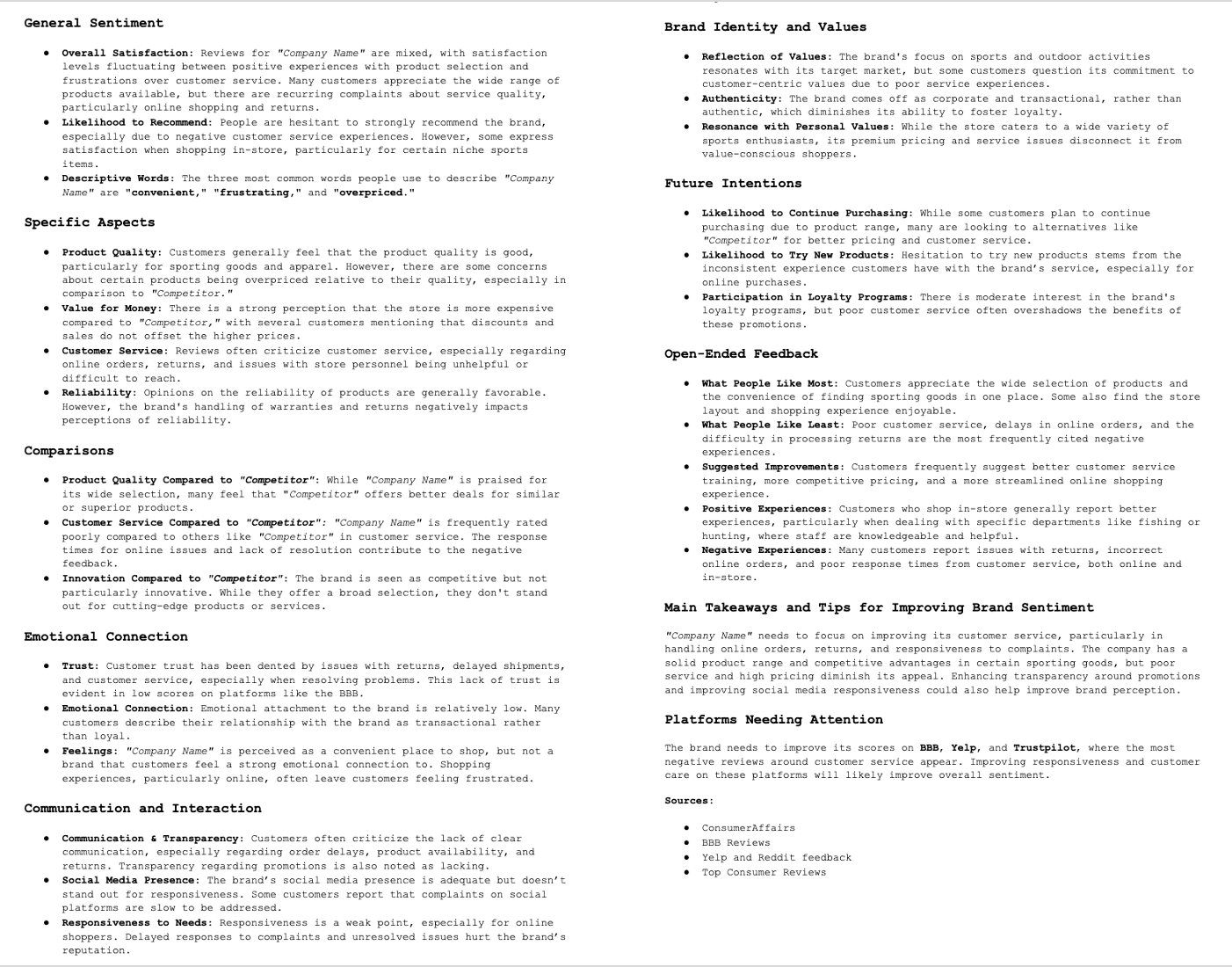
- Example research output: Showcases a comprehensive sentiment analysis report, including key elements like general sentiment, specific aspects of product/service perception, comparisons with competitors, emotional connection and communication effectiveness.
- Why this is useful: Helps quickly assess where your brand excels and where it needs improvement. By leveraging these insights, you can make data-driven improvements to your brand’s strategy, both in terms of product/service offerings and customer communication.
- Adapt to customer sentiment:
- Monitor AI-generated queries and responses to understand customer sentiment. Adjust your content and communication strategies to maintain a positive brand image across digital platforms.
- Monitor brand perception on AI platforms over time:
- As AI systems evolve, so will the perception of your brand. Continuously track how AI platforms represent your brand and adjust strategies to maintain a consistent and positive narrative as AI systems evolve.
- Integrate insights into your brand strategy:
- Use AI-driven insights to inform your overall content and brand strategy. Ensure consistency across all channels to enhance your brand’s perception, visibility and credibility.
- Example: If AI frequently mentions your brand in connection with specific keywords or topics, analyze these mentions to ensure they align with your desired brand image. Adjust your content strategy as needed to emphasize key aspects of your brand.
Dig deeper: How to become a recommended solution provider on Google entity lists
2. Optimizing content for generative AI
Once your research is complete, the next step is putting those insights into action by optimizing your content and applying insights to ensure your content is relevant, structured and accessible for AI systems.
Today, high-quality content alone isn’t enough. Your content must be optimized for AI algorithms to maintain visibility and authority.
Content quality and relevance
Crafting credible, contextually rich and engaging content that meets user needs is essential. By aligning your content with AI systems, you ensure it remains relevant and trusted by both AI platforms and users.
Actionable tips:
- Expand contextual relevance:
- Incorporate relevant keywords: Use long-tail, conversational and semantic keywords identified during research to optimize your content. Integrate these keywords naturally to match how users search and interact with AI-driven platforms.
- Expand related concepts: Apply insights from research to deepen your content, making it more comprehensive and valuable to users. Align with AI’s preference for in-depth content by filling market gaps and offering unique value.
- Integrate key entities and phrases: Use key entities, phrases and concepts identified during research to build a narrative that resonates with AI’s contextual algorithms, ensuring relevance and authority.
- Establish authority and credibility:
- Citations: Reference credible, up-to-date sources to validate your claims and connect your content with established research.
- Quotations: Incorporate authoritative quotes from industry experts to add depth and authority.
- Statistics: Include relevant and timely data points presented in impactful formats like graphs or charts.
- Align with E-E-A-T principles: Build websites demonstrating experience, expertise, authority and trustworthiness (E-E-A-T).
- Craft comprehensive and engaging content:
- Provide thorough, engaging and varied content that fully addresses user queries and aligns with AI preferences for diverse content types.
- Provide comprehensive responses: Offer thorough answers that fully address user queries, as AI favors in-depth content.
- Make content informative and engaging: Focus on creating content that is informative, easy to understand and provides clear, actionable insights.
- Use varied multi-modal formats: Incorporate a mix of formats – blog posts, guides, videos and interactive content – to keep your audience engaged and align with AI’s preference for diverse content.
- Maintain content freshness:
- Regularly update your content to signal to search engines that the information is current and relevant. Fresh content aligns with current trends and user interests, improving your content’s relevance.
- Example: Update a blog post on “2023 Digital Marketing Trends” to reflect the latest trends in 2024, ensuring it remains relevant, timely and more likely to be prioritized in results.
- Regularly update your content to signal to search engines that the information is current and relevant. Fresh content aligns with current trends and user interests, improving your content’s relevance.
Content structure and clarity
A well-organized, clear structure is essential for engaging users and ensuring alignment with AI.
Simplifying language, maintaining logical flow and integrating visuals make your content more accessible to both AI systems and users.
Actionable tips:
- Improve content clarity and readability:
- Simplify language: Use clear, straightforward language, avoiding jargon and complex sentences.
- Break down complex information: Use bullet points, lists and short paragraphs to make ideas more scannable and understandable.
- Highlight key information: Emphasize important points with bold text, callout boxes or summaries to ensure they stand out.
- Incorporate visuals and multimedia: Use high-quality images, infographics and other visuals to break up text and illustrate key concepts, enhancing engagement and readability.
- Consistent formatting: Maintain uniform font sizes, styles and colors across all content elements to enhance readability.
- Enable quick comprehension of your content:
- Optimize your content to make key details easily accessible, ensuring that AI and users quickly grasp the most important points.
- State what to expect: Clearly articulate the main purpose or topic at the beginning of the content.
- Summarize key points: Include brief summaries or lists of key takeaways at the top of your content and throughout relevant sections.
- Incorporate FAQ sections: Add FAQs to longer content to address common questions, increasing the likelihood of AI using it to answer specific queries.
- Deliver quick answers: Provide direct answers to queries within the first few sentences, making it easier for AI and users to find the information they need quickly.
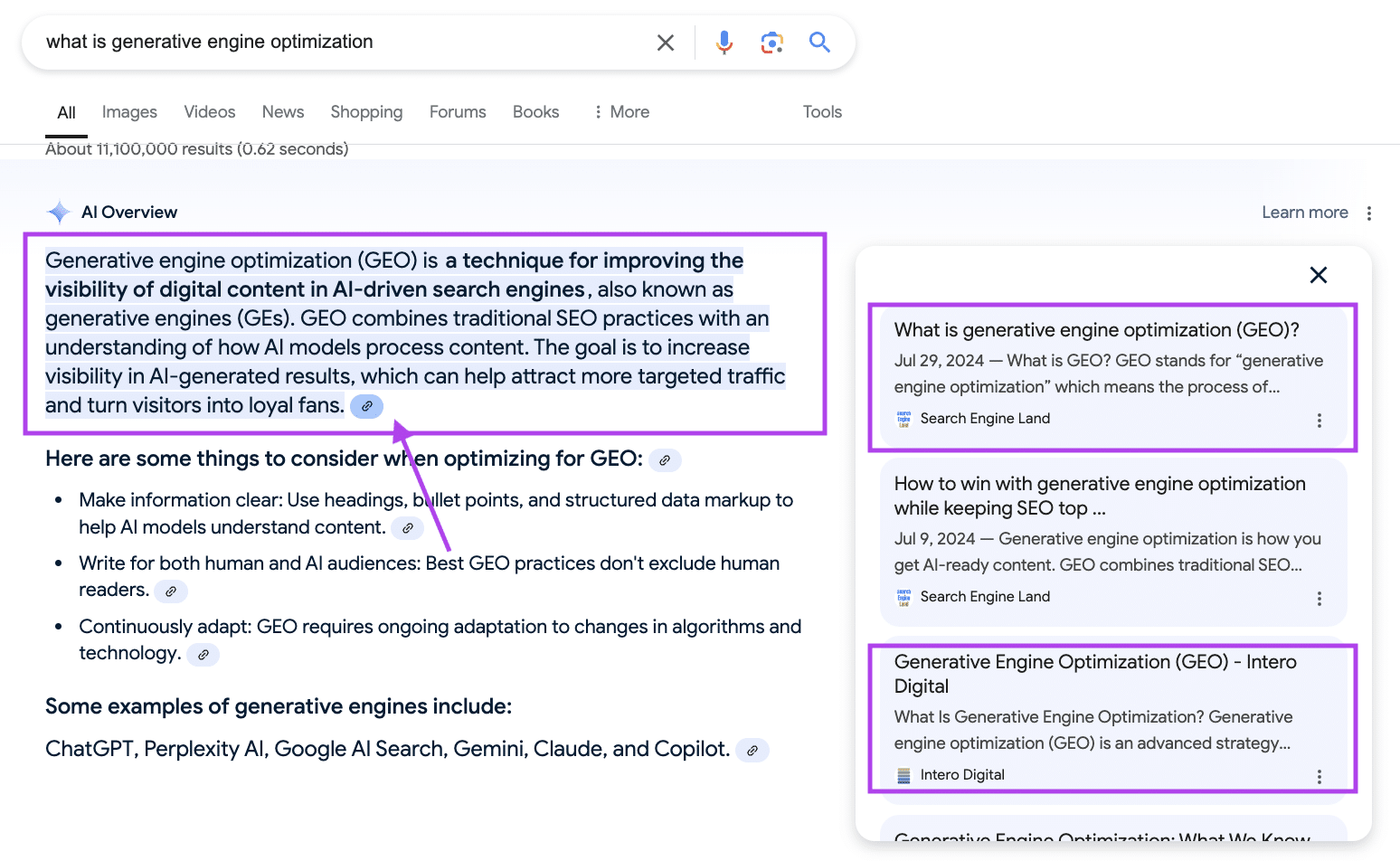
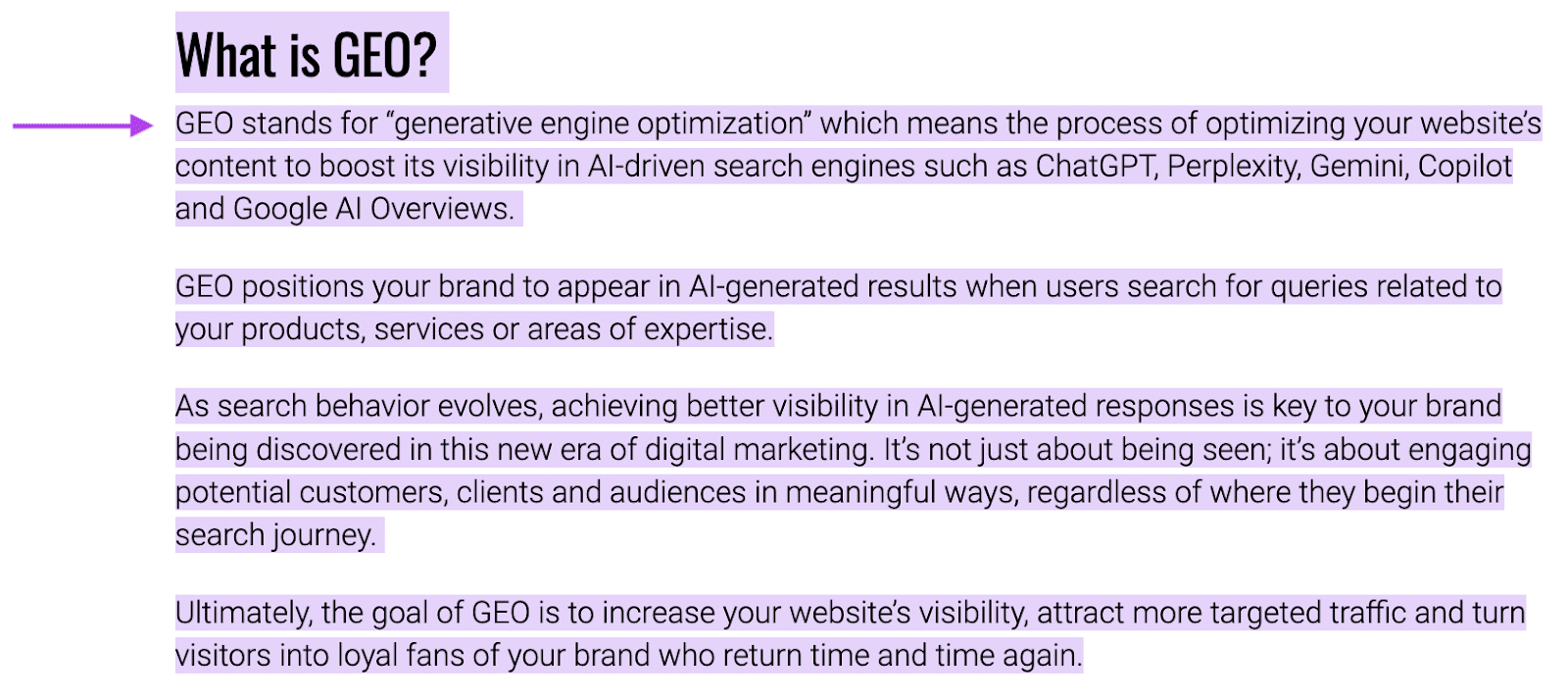
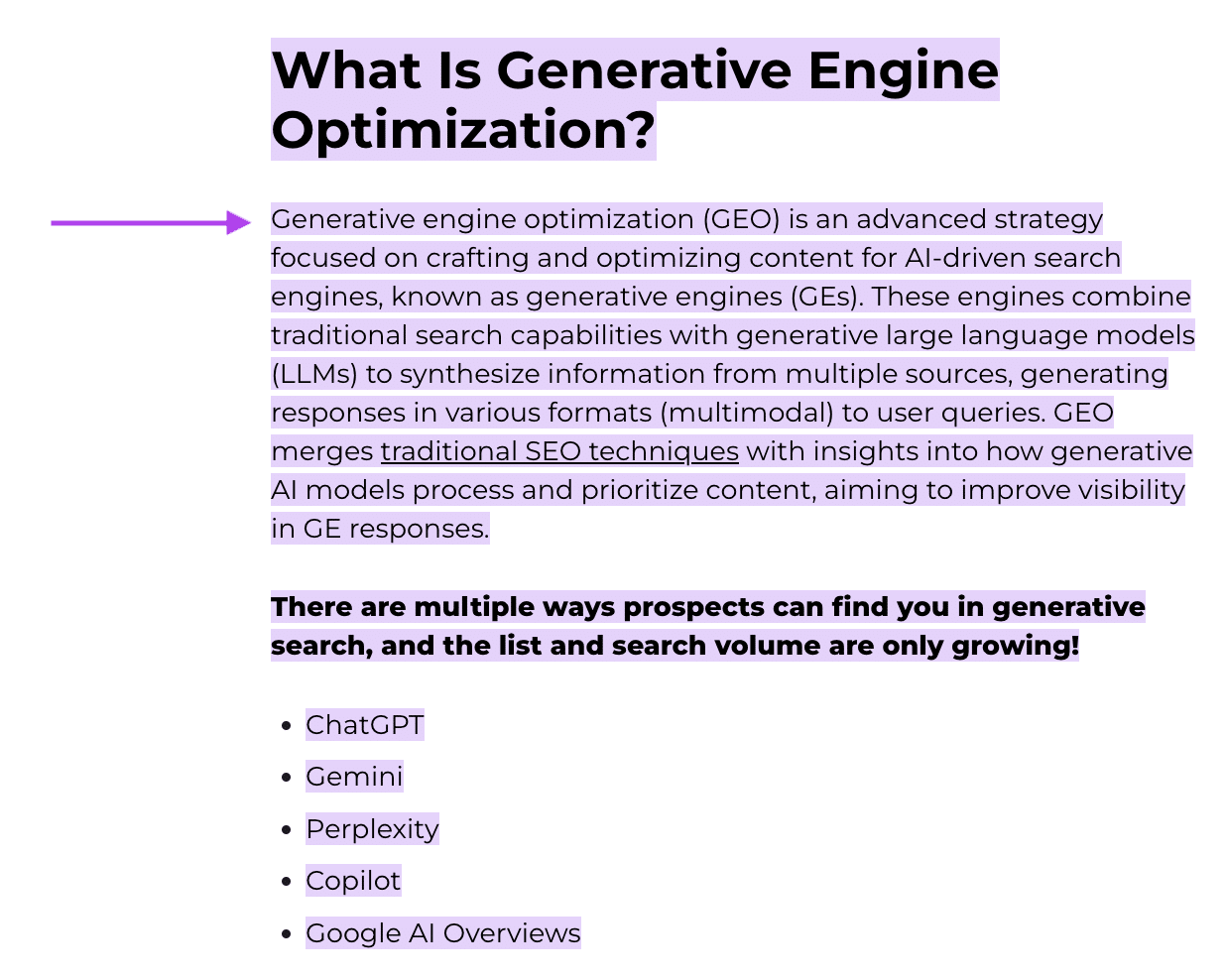
- Example: For the query “What is Generative Engine Optimization?” AI tends to pull responses from content that provides clear, immediate answers, like those in the examples shown below. These examples use structured summaries and concise, digestible points throughout each piece, helping both AI systems and users digest the most relevant information.
- Optimize content structure and fluidity:
- Prioritize content fluidity: Create a smooth, logical progression throughout your content. Use clear transitions and well-structured paragraphs to enhance readability and engagement.
- Use clear and descriptive headings: Organize your content with headings that logically guide readers and AI through the material.
- Design effective navigation: Create a clear hierarchical structure using H1 to H5 headings and distinct sections like FAQs or step-by-step guides to enhance usability and relevance.
- Leverage key insights from research:
- Use insights from your GEO research to enhance content structure and clarity around your key queries.
- Refine content structure and format: Adapt your content to align with trends observed in AI-generated responses and cited sources, incorporating elements like lists, tables and other effective formats.
- Emphasize key information: Incorporate common data points, topics and details that AI frequently emphasizes, filling gaps in your content.
- Integrate multimedia: Include videos, infographics or other visual elements if AI tends to favor these in its responses.
- Leverage competitor strategies: Implement content structures and formats used by top competitors frequently cited by AI for your key queries.
Dig deeper: What is content readability and how to make your content easier to read
3. Technical optimization for AI accessibility
Now that your content is well-structured and engaging, it’s crucial to ensure AI systems can easily access, interpret and prioritize it in AI-driven search.
As the digital landscape evolves, traditional SEO must adapt to meet the sophisticated needs of AI, ensuring your content is not only visible but also understood and valued by search algorithms.
Structured data for AI understanding
Think of structured data as a roadmap that helps AI navigate your content, highlighting what’s most important and ensuring it’s interpreted accurately.
By using the right schema markup, you’re not just organizing your content – you’re making it easier for AI to recognize, categorize and present it in relevant searches.
Whether optimizing for voice search, product listings or user-generated content, the appropriate schema ensures AI delivers your message to the right audience.
Actionable tips:
- Organize and structure content: Use schemas like Article, Organization and Breadcrumb to help AI understand your content’s structure and context, boosting visibility in relevant searches.
- Support natural language queries: Implement FAQ and QandA schemas to optimize for voice search and generative AI, helping AI find direct answers and increasing your content’s chances of appearing in AI-generated results and featured snippets.
- Highlight important elements: Apply schema markup to key content like products, reviews and FAQs to ensure AI recognizes and prioritizes these elements in enhanced search results.
- Boost visual content visibility: Use ImageObject and VideoObject schemas to enhance the visibility of your visual and video content. Proper markup helps AI identify and prioritize this content in search results.
- Showcase user-generated content: Implement Review, AggregateRating and Testimonial schemas to highlight user feedback, increasing your content’s credibility and visibility in AI-driven searches.
- Broaden schema application: Consider using additional schema types to help AI better understand and prioritize your content in specific contexts.
Technical SEO enhancements
Structured data is just one piece of the puzzle. A strong SEO foundation that focuses on various technical aspects is essential to ensure your site is accessible and efficient, giving AI the best possible framework to work with.
Actionable tips:
- Optimize for speed and accessibility: Ensure fast loading times, mobile-friendliness and clean code. These factors help search engines crawl and index your site efficiently, giving AI systems the data they need for generating relevant responses.
- Enhance performance: Improve server response times, optimize images and fix crawl errors or broken links. A well-performing site is more likely to be accurately indexed, which leads to better search visibility.
- Secure your site: Implement HTTPS and maintain strong security practices. AI systems prioritize secure sites, so ensuring your site is safe boosts credibility and trustworthiness.
- Streamline site architecture: Clear content hierarchy and effective internal linking help AI understand relationships between different pieces of content, improving relevance in search results.
- Prioritize mobile optimization: As mobile search dominates, ensure your content is mobile-friendly. AI favors content optimized for mobile, directly impacting your visibility.
By integrating structured data and improving your technical SEO, you create a solid foundation that allows search engines to accurately index your site. This enables AI to access, understand and prioritize your content based on the data collected.
4. Content distribution and engagement
Your content is only as powerful as the audience it reaches.
To maximize its impact, you need to strategically distribute it across multiple platforms, ensuring it resonates with different audience segments and meets the evolving demands of AI-driven systems.
The more places your content appears, the more opportunities AI has to recognize, elevate and share it, expanding your reach and influence.
Actionable tips:
- Focus on the right platforms:
- What to do: Identify 3-5 platforms where your audience is active (e.g., social media, Reddit, Quora) and tailor your content to fit each platform’s style while maintaining a consistent posting schedule.
- Why: Spreading your content across these platforms signals to AI that it’s credible and worth prioritizing. More visibility across multiple channels increases the chances of AI recognizing and elevating your content.
- Incorporate UGC:
- What to do: Encourage your audience to share their experiences with campaigns like hashtag challenges or reviews and feature the best UGC on your platforms.
- Why: User-generated content enhances your brand’s credibility by reflecting authentic user interactions, which AI systems prioritize. This authenticity boosts engagement and makes your content more appealing to both users and AI.
- Engage proactively on social media:
- What to do: Dedicate time daily to interact with your audience on social media by responding to comments, answering questions and joining conversations.
- Why: Regular engagement shows AI that your content is relevant and valued, increasing its visibility and helping you reach a wider audience.
- Create shareable content:
- What to do: Create shareable content like infographics, tips and visually appealing posts. Use clear calls to action and social sharing buttons to encourage sharing.
- Why: Shared content gains more visibility, signaling its importance to AI, which can lead to broader reach and greater influence.
- Keep content fresh and relevant:
- What to do: Regularly update top-performing content with new keywords, relevant links and fresh visuals. Repurpose and re-share it across platforms to keep it current.
- Why: AI favors content that is consistently updated and aligned with trends, keeping it relevant and visible.
By distributing content strategically and engaging with your audience actively, you significantly increase your visibility across platforms.
This ensures that both AI systems and a wider audience recognize, prioritize and interact with your content.
5. Building brand authority and credibility
In an AI-driven world, building your brand as a trusted authority means more than just creating great content. It requires a strategic approach that combines credibility, consistency and ethical practices across everything your brand does.
To truly stand out, your brand must deliver accurate, valuable information while building trust through collaborations, clear communication and a consistent brand identity.
Actionable tips:
- Build backlinks from authoritative sites: Secure backlinks from credible websites to signal trustworthiness to AI systems.
- Guest blogging: Contribute to reputable industry sites.
- Partnerships: Collaborate with trusted brands.
- Shareable content: Create content that naturally attracts high-quality backlinks.
- Use ethical content practices: AI favors content that aligns with user intent and delivers genuine value.
- Transparency: Be clear and honest, avoiding clickbait.
- User-centered approach: Create content that truly meets your audience’s needs.
- Fact-checking and accuracy: Always fact-check your content to ensure accuracy.
- Accessibility: Ensure accessibility for all users, including those with disabilities.
- Demonstrate your expertise: Consistently showcase your knowledge and insights to reinforce your authority.
- Original research: Publish unique, data-driven insights.
- Case studies: Highlight successful strategies and innovations.
- Expert opinions: Include industry experts in your content.
- Implement consistent branding: Maintain a recognizable and trustworthy identity across all platforms.
- Unified messaging: Keep your brand messaging consistent.
- Visual identity: Ensure cohesive use of logos, colors and design elements.
- Foster relationships with influencers and thought leaders: Collaborations with recognized influencers and thought leaders can significantly amplify your brand’s authority. Focus on:
- Content collaboration: Co-create content with industry influencers.
- Endorsements: Seek testimonials from respected figures.
- Guest appearances: Participate in industry podcasts and panels.
By focusing on credibility, ethical practices and consistent expertise, you can build lasting authority and trust. Aligning your brand with AI systems and maintaining a strong, cohesive identity will pave the way for long-term success.
Key takeaways for mastering GEO strategies
Adapting to AI-driven search isn’t just beneficial. It’s essential to your brand’s long-term success.
Here’s a quick recap of the actionable strategies you need to lead in this evolving landscape:
- Embrace GEO as the future of SEO: Traditional SEO is evolving. GEO ensures your brand remains visible and competitive in AI-powered search.
- Leverage AI research: Success starts with understanding how AI interprets content. Dive into semantic analysis, user intent, competitor strategies, AI-generated responses and brand perception insights to align your content with AI algorithms and position your brand as authoritative.
- Optimize content for AI prioritization: High-quality content is just the start. Structure it for AI by making it clear, relevant and designed to be prioritized in AI-driven results.
- Master technical SEO: Keep your site technically sound with structured data, fast load times and mobile optimization to ensure AI can easily access and rank your content.
- Strategically distribute and engage: Amplify your content across platforms and engage with your audience regularly. The more visible and active your content, the higher AI will prioritize it – so stay consistent and share often.
- Build and maintain brand authority: Trust is everything. Focus on securing high-quality backlinks, consistent branding and ethical, value-driven content to build credibility with both AI and users.
Take the next step
The future of search is AI-driven. By embracing GEO now, you position your brand to lead in this evolving landscape.
The strategies you implement today will ensure your success tomorrow. Get started now and future-proof your brand’s online presence.
Courtesy of Search Engine Land: News & Info About SEO, PPC, SEM, Search Engines & Search Marketing
Category seo news | Tags:
Social Networks : Technorati, Stumble it!, Digg, de.licio.us, Yahoo, reddit, Blogmarks, Google, Magnolia.
How to develop a paid search strategy
Written on September 19, 2024 at 2:54 pm, by admin
A successful Google Ads PPC strategy involves more than just picking a few keywords. It requires a structured plan that aligns with your business goals, optimizes your budget and uses data to boost performance.
Whether your audience is solution-aware or problem-aware, understanding the nuances of each stage in the sales funnel and selecting the right Google Ads campaign types is essential.
In this article, “solution-aware” refers to people who know a solution exists, while “problem-aware” describes those encountering innovative solutions that are new to the market.
Let’s dive in and get those ads working smarter, not harder.
Define your end goal: Revenue
Every successful PPC strategy starts with clearly understanding your end goal: revenue.
Not all revenue is the same. The path to earning it varies between ecommerce and lead generation, so your strategy should reflect those differences.
For ecommerce businesses, the objective is to generate sales directly through purchase checkouts.
This means your PPC campaigns should focus on attracting high-intent buyers ready to whip out their credit cards.
Think of high-conversion keywords and dynamic product ads that directly showcase your offerings and promotions in the search results.
You want to make the sale as efficiently as possible.
Lead generation businesses focus on gathering potential customers’ information – through forms, calls or other interactions – so you can later turn these leads into sales.
Here, success isn’t just about the volume of leads but their quality.
Your PPC campaigns should engage potential customers with compelling offers, informative content or demonstrations encouraging them to share their contact details. It’s about starting a conversation that successfully leads to a sale.
Google Ads strategies can maximize ecommerce and lead generation outcomes by tailoring campaigns to align with the specific stages of the sales funnel.
Dig deeper: Lead gen vs. ecommerce: How to tailor your PPC strategies for success
Evaluate first-party data
Before you launch any campaigns, look hard at the first-party data available. This is your goldmine for creating a targeted and effective strategy.
Zero data
- If you’re starting from scratch, your focus should be on branded and high-intent campaigns to gather initial performance insights.
- This will help refine audience targeting and identify high-performing segments.
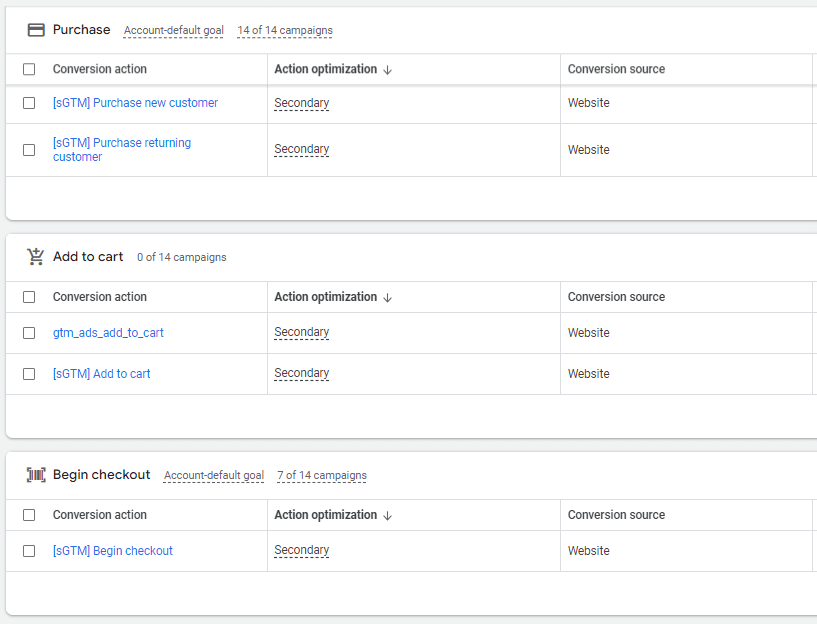
- Think about micro-conversion actions such as button clicks or add-to-carts to propel you faster.
Conversion data
- Use past conversion data to optimize campaigns, honing in on keywords, audiences and ad strategies that have historically delivered.
- Google’s bidding algorithms have a strong relationship with your conversion data. You want to preserve it to the best of your ability.
Customer match lists
- If you have them, use customer match lists to create targeted remarketing campaigns and expand your reach through high-quality audience signals.
- These lists are like a secret weapon – the higher the list quality the better your results will be.
First-party data is the backbone of your strategy, enabling you to make informed decisions and refine your approach over time. The more you know, the better your campaigns will perform.
Map out the sales funnel and develop strategies
Understanding the sales funnel is crucial to creating a PPC strategy that guides your audience from awareness to conversion.
Whether your audience is solution-aware or problem-aware, your approach should vary, using different campaign types and targeting methods to achieve optimal results.
Bottom of funnel (BOFU): Converting prospects to customers
The bottom of the funnel is where the magic happens. Your focus here is on converting high-intent prospects into customers.
This stage is crucial for increasing Return on Ad Spend (ROAS) and ensuring efficiency, so you should maximize your budget here first.
- Branded search campaigns: Capture users searching specifically for your brand. It’s all about staying top-of-mind and ensuring you’re there when they’re ready to take action.
- Non-branded search campaigns: Target high-intent, non-branded keywords that signal a readiness to purchase. Highlight your unique selling propositions (USPs) and competitive advantages to address the needs people are searching for.
- Performance Max campaigns: These are your full-funnel champions, leveraging Google’s machine learning to optimize ad delivery and reach the right audience at the right time.
- Remarketing campaigns: Reengage users who have interacted with your website but haven’t converted yet. Use messaging that emphasizes urgency – like limited-time offers or discounts – to nudge these users toward a purchase.
Focus on high-intent keywords and use clear, action-oriented messaging highlighting product benefits and competitive pricing.
Differentiate your product from competitors with comparisons, testimonials and guarantees. Show them why you’re the best choice, no contest.
Middle of funnel (MOFU): Nurturing prospects
Once you’ve nailed it at the bottom of the funnel, it’s time to move to the middle.
In the middle of the funnel, you nurture interested prospects who aren’t quite ready to commit. This is your opportunity to engage users in the research phase.
- Non-branded search and dynamic search ads campaigns: Target broader keywords related to your product or service. These users are still browsing but are starting to get serious. Test different keywords and measure what works based on your average click costs and conversion rates.
- Video campaigns: Use informative or educational videos to build trust and give more insight into your product. Storytelling helps create a connection and build credibility. Target custom segments and in-market audiences specific to your product or service.
- Remarketing campaigns: Keep the conversation with users who have shown initial interest but need further nurturing before converting. Address their objections and provide additional information to guide them toward a decision.
For solution-aware audiences, provide content that emphasizes the effectiveness of your product or service, like case studies or detailed demonstrations.
For problem-aware audiences, focus on educating them about the problem and how your product can provide a solution. You’re not just selling a product; you’re solving a problem.
Top of funnel (TOFU): Building awareness
The top of the funnel is all about casting a wide net. Your goal here is to build brand awareness and attract a healthy, engaged audience.
- Video campaigns (YouTube ads): Use video content to introduce your brand and its products to potential customers. Create engaging, informative content that captures interest and establishes your brand’s identity. Think of this as your brand’s first handshake.
- Demand Gen campaigns: Target broader audience segments and lookalikes to engage users who haven’t visited your website before. Use soft calls to action, like “Learn More,” to encourage exploration.
For solution-aware audiences, use educational and entertaining content to pique curiosity and demonstrate the unique value proposition.
For problem-aware audiences, provide valuable insights or resources to help them understand their problem and consider your product a potential solution. You’re planting seeds that, with the right nurturing, will grow into loyal customers.
Dig deeper: How to implement a full-funnel PPC marketing strategy
Allocate budget strategically for maximum ROAS
If you have a limited budget, start at the bottom of the funnel and work your way up.
By focusing on high-intent, lower-funnel campaigns first, you maximize ROAS and ensure that your ad spend drives immediate and measurable results.
Once you’ve solidified that foundation, you can move up the funnel, allocating the remaining budget to nurture leads in the middle and build awareness at the top.
This approach ensures that you efficiently spend your budget on the highest-return activities first while still investing in future growth.
Why starting with the top of the funnel is a smart approach
When you have the budget to support it, starting with top-of-funnel (TOFU) strategies can be one of the smartest moves you make in your PPC campaigns. Here’s why:
Build brand awareness and trust early
Focusing on TOFU activities allows you to introduce your brand to potential customers who may not yet know they need your product or service.
By engaging them with educational content, videos and awareness campaigns, you establish trust and build a strong foundation for future conversions.
Trust and recognition are cultivated through consistent, valuable interactions, making your brand the go-to choice when they’re ready to buy.
Capture attention and influence decisions
Engaging customers early in their journey means you’re shaping their perception before they even consider your competitors.
The sooner you can capture their attention, the more you can influence their decision-making process, guiding them down the funnel towards conversion.
Prime your audience for conversion
A top-of-funnel strategy doesn’t just generate awareness – it primes your audience for conversion.
By nurturing these prospects with valuable content and building a relationship from the start, you’re setting the stage for higher conversion rates as they move through the funnel.
When they’re ready to make a purchase, they already know and trust your brand.
Starting at the top of the funnel isn’t just about casting a wide net; it’s about building a strong, loyal customer base that drives long-term success.
If your budget allows, don’t hesitate to invest in TOFU strategies. This forward-thinking approach pays dividends down the road.
Dig deeper: How to manage a paid media budget: Allocation, risk and scaling
Crafting a comprehensive PPC strategy for long-term success
By creating a comprehensive PPC strategy that encompasses every stage of the sales funnel, from awareness to conversion, you set your business up for immediate wins and sustainable growth.
With a thoughtful approach that considers both short-term and long-term goals, your Google Ads campaigns can drive meaningful results and build a loyal customer base.
Focus on building a strategy that is data-driven, customer-centric and adaptable to the changing landscape of digital advertising.
This way, you’ll achieve your revenue goals and cultivate a robust and loyal customer base that will sustain your business for years to come.
Gear up, plan smart and let your Google Ads campaigns work hard for you. Every click has the potential to build something great.
Courtesy of Search Engine Land: News & Info About SEO, PPC, SEM, Search Engines & Search Marketing
Category seo news | Tags:
Social Networks : Technorati, Stumble it!, Digg, de.licio.us, Yahoo, reddit, Blogmarks, Google, Magnolia.
Google wins $1.7B EU antitrust fine appeal
Written on September 18, 2024 at 11:53 am, by admin

Google successfully challenged a €1.49 billion ($1.66 billion) antitrust fine imposed by the European Union in 2019.
- The EU’s General Court annulled the fine, citing the European Commission’s failure to consider all relevant circumstances.
Why we care. This ruling marks a significant victory for Google in its ongoing legal battles with EU regulators and highlights the challenges faced by antitrust enforcers in their efforts to rein in Big Tech. This could also create a favorable precedent that helps Google in the ongoing case with the Department of Justice in the U.S.
The big picture. The case is part of a broader crackdown on tech giants by EU antitrust chief Margrethe Vestager, who has had mixed success in defending her decisions in court.
- Last week, Vestager secured major wins against Google in a separate case and against Apple’s tax deal with Ireland.
Details. The fine was related to Google’s AdSense platform and alleged anticompetitive practices from 2006 to 2016.
- The court agreed with many of the Commission’s assessments but found that it failed to prove the harm to innovation, competition and consumers.
- Google had already made changes to its contracts in 2016 to remove the relevant provisions.
Between the lines. This case focused on a narrow subset of text-only search ads on certain publishers’ websites, which Google emphasized in its response to the ruling.
What’s next. The European Commission can appeal the Google ruling to the European Court of Justice on points of law.
- The Commission said it would study the judgment and consider possible next steps.
Bottom line. This ruling underscores the ongoing legal challenges faced by both tech giants and regulators in the complex landscape of digital competition.
Courtesy of Search Engine Land: News & Info About SEO, PPC, SEM, Search Engines & Search Marketing
Category seo news | Tags:
Social Networks : Technorati, Stumble it!, Digg, de.licio.us, Yahoo, reddit, Blogmarks, Google, Magnolia.
Google Ads ad copy: what works and what doesn’t in 2024
Written on September 17, 2024 at 8:51 am, by admin
Great ad copy is crucial for Google Ads success, but the rules of engagement can be elusive. Optmyzr analyzed over 1 million ads, providing fresh insights into what drives performance.
Why we care. Having a solid ad copy strategy as a PPC expert is crucial. However experts of many years are still struggling to assess the best approach to ad copy. It doesn’t help that the goal post of good ad copy keeps changing, thanks to the platforms. Lately the conversation has been on the importance of Ad strength. This research could help to shine a light on what path you should take.
By the numbers:
- Over 22,000 accounts analyzed, with a monthly spend of at least $1,500.
- Over one million ads, across Responsive Search Ads (RSAs), Expanded Text Ads (ETAs), and Demand Gen, were reviewed.
- Key metrics like cost per acquisition (CPA), click-through rates (CTR), and ROAS were studied.
Key questions analyzed:
- Is there a link between Ad Strength and performance?
- How does pinning assets impact outcomes?
- Title case vs. sentence case: which format performs better?
- Does creative length influence results?
Ad Strength: A misleading metric?
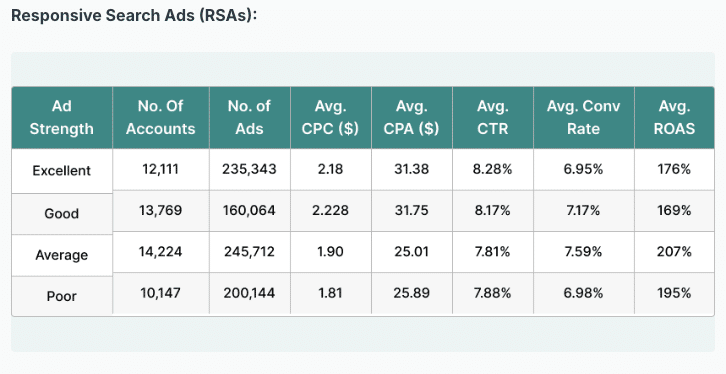
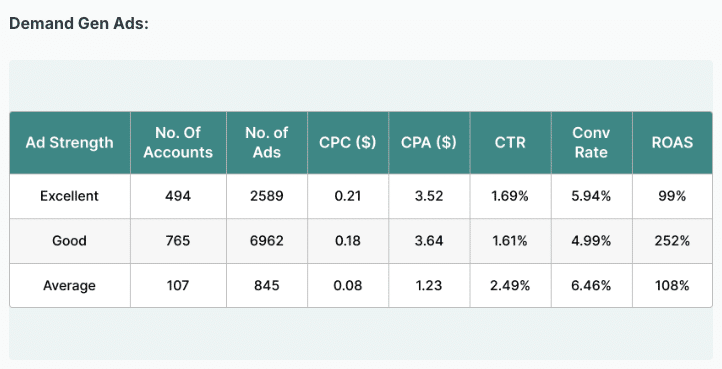
Google’s Ad Strength metric is often considered a helpful guide, but does it actually lead to better performance? Optmyzr’s data indicates no clear correlation between Ad Strength and the key metrics that matter.
- Findings: RSAs with an “average” Ad Strength had better CPA, conversion rates, and ROAS than those with “excellent” Ad Strength.
- Takeaway: Don’t obsess over Ad Strength. Instead, focus on creating ads that resonate with your audience and prioritize results.
To pin or not to pin?
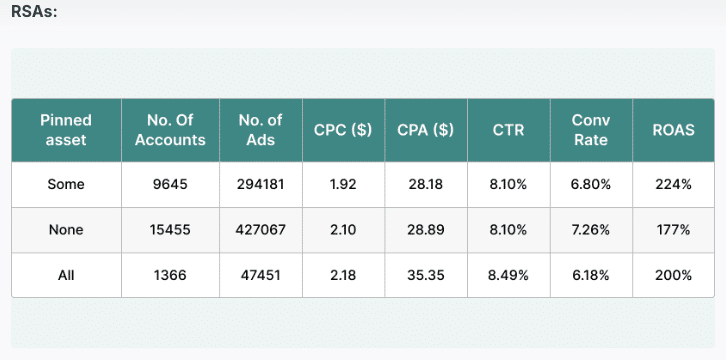
Pinning assets to specific positions within ads is a hotly debated tactic. Some marketers swear by it to enforce creative control, while others prefer to let Google’s automation handle asset placement.
- Findings: Ads with “some pinning” perform well on cost-based metrics like CPA and ROAS. However, fully pinned ads show higher CTRs, though the differences are minor.
- Takeaway: Pin strategically, but don’t overdo it. Trust Google’s AI to handle asset placement where appropriate.
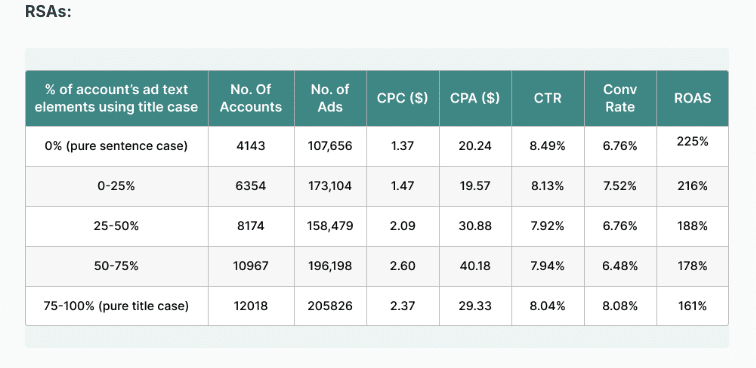
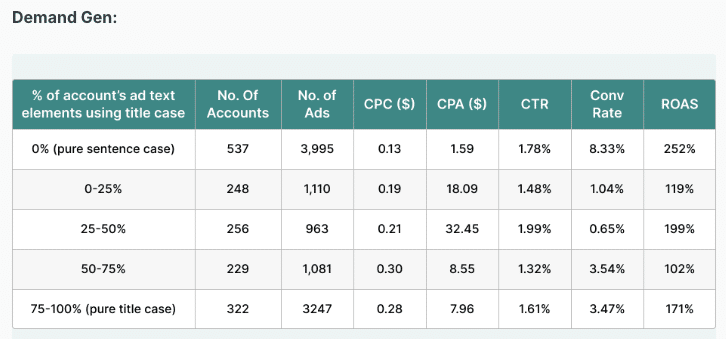
Title case vs. sentence case: Which is better?
This debate has persisted for years. Optmyzr’s data revealed that sentence case, surprisingly, outperformed title case in most key metrics.
- Findings: Sentence case ads had higher ROAS and lower CPAs, particularly for RSAs and Demand Gen ads.
- Takeaway: Test sentence case in your ads—especially if your current ads aren’t performing well.
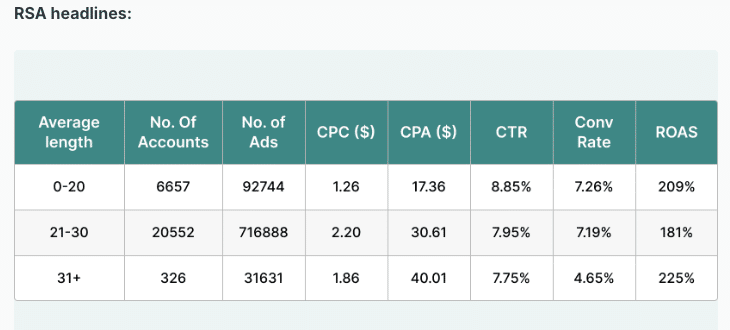
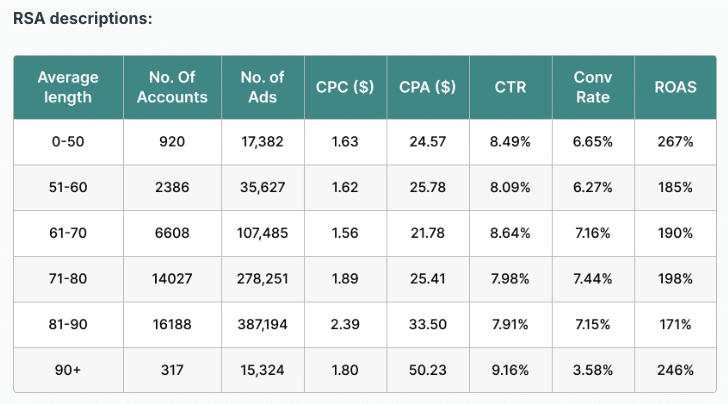
Creative length: Does bigger mean better?
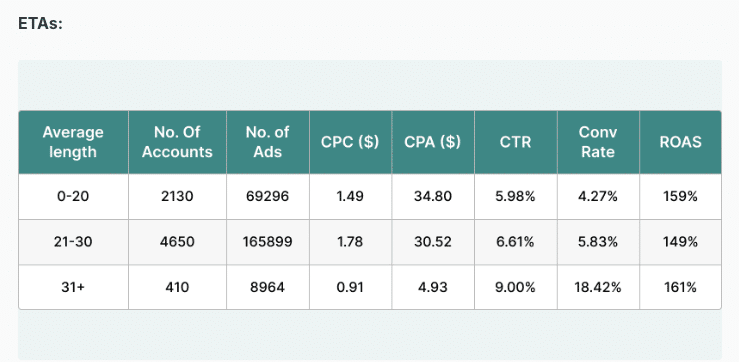
Advertisers often believe that longer ads, which take up more screen real estate, perform better. However, Optmyzr’s research debunks that theory.
- Findings: Shorter headlines consistently outperformed longer ones, while longer descriptions seemed to have a slight edge, though not by much.
- Takeaway: Focus on clear, compelling messaging over character count. Quality trumps quantity in today’s Google Ads environment.
Bottom line. Optmyzr’s data-driven analysis offers actionable insights for marketers. Don’t get bogged down by Google’s Ad Strength or old creative habits like title case and longer ads. Instead, prioritize creating impactful, concise messaging and trust the data to guide your decisions.
Courtesy of Search Engine Land: News & Info About SEO, PPC, SEM, Search Engines & Search Marketing
Category seo news | Tags:
Social Networks : Technorati, Stumble it!, Digg, de.licio.us, Yahoo, reddit, Blogmarks, Google, Magnolia.
Why is this ranking on Google?
Written on September 17, 2024 at 8:51 am, by admin

As SEOs, we often come across the weirdest things ranking in the SERPs:
Why is Reddit ranking for a purely commercial keyword that usually returns ecommerce URLs?
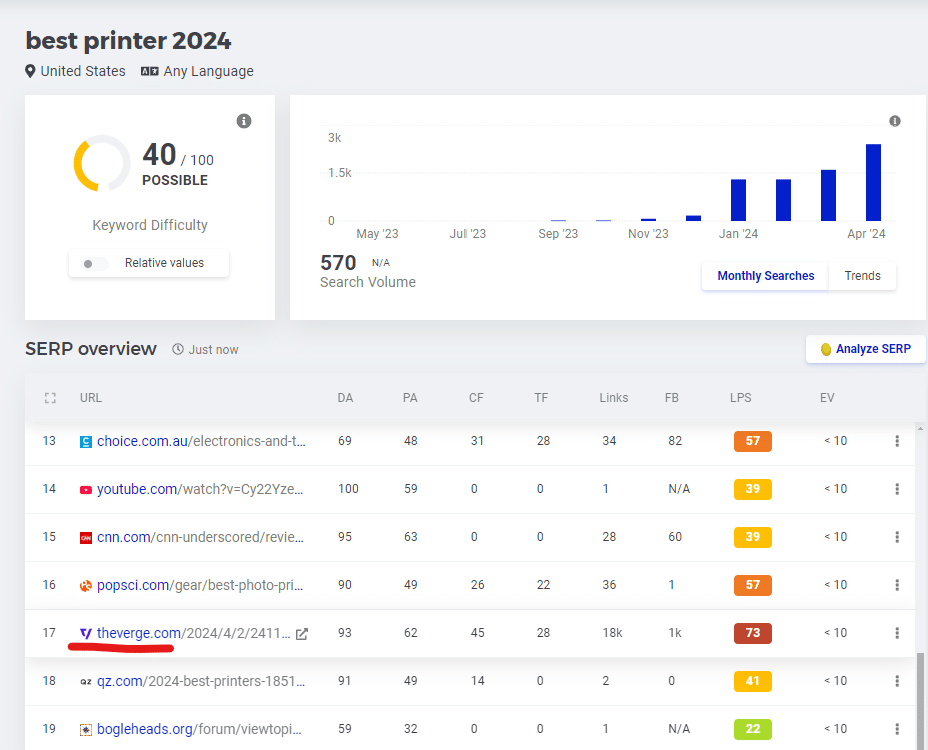
Why is The Verge ranking high with a spammy, sarcastic and seemingly AI-generated article stuffed with keywords like “best printer 2024”?
The Verge article was doing well when it was first published in April 2024 but started dropping in rank by mid-May. It’s still a high ranking that boggles me  , but at least now we know it’s not worthy of a top 10 spot (or do we?).
People often have outdated ideas about how Google ranks pages. We stick to old methods because they’re familiar, even though we don’t fully understand how Google’s current system works.
For instance, we still emphasize keywords as a key factor for ranking. But do they really matter as much as we think? And if they don’t, what should we focus on instead?
‘Best printer 2024’: What’s ranking?
The content types of the top 10 results for “best printer 2024” are interesting. There are three UGC URLs in the top 10:
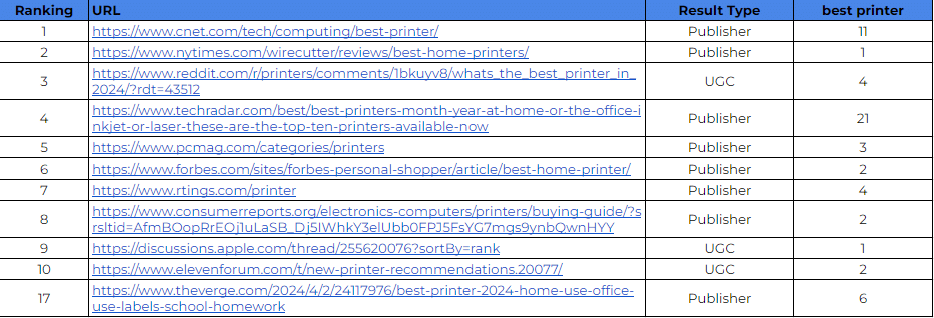
Then, the other type of result is publishers ranking with listicles. No ecommerce stores in the result, including big names like Amazon.
Why is this ranking on Google?
If you’re surprised that Google ranks a URL you think shouldn’t be on Page 1, it might be because your understanding of ranking is outdated.
Here are some reasons, or call them ranking signals if you’d like, that I believe are important today.
1. Authority
Google favors established brands. Whether we like it or not, well-known brands have a better chance of ranking higher in search results than lesser-known websites.
Here are things that are often associated with authoritative well-branded websites in SERPs:
- Brands people know because this means users are more likely to click and trust their URLs when they see them in SERPs. Better branding simply means better CTR.
- Naturally cited/linked to websites from other websites in relevant contexts. Yes, backlinks still matter.
- Websites with social media presence.
- Websites that have been recognized as entities in SERPs and have their own knowledge panel.
- Secure websites with clear purpose and transparent editorial policies, shipping and return policies, good legal and privacy pages and information about their team and who wrote/reviewed the content. Remember that E-E-A-T importance varies depending on the niche, but applying best practices is always good.
Takeaway
Brand matters, and SEO is no longer a standalone marketing channel. As SEOs, we need to work with other marketing functions to find opportunities to build a strong brand in SERPs.
Dig deeper: Top 10 SEO benefits of building a brand that people trust
2. User behavior
Some in the SEO community resist focusing on user behavior because there aren’t clear tactics for improving it.
It often feels easier to stick with familiar tactics, even if they no longer work, rather than explore new, uncertain approaches.
We now know that Google uses “user interaction” data in their rankings, as stated in this Google document from the antitrust trial: “This dialogue is the source of magic.”
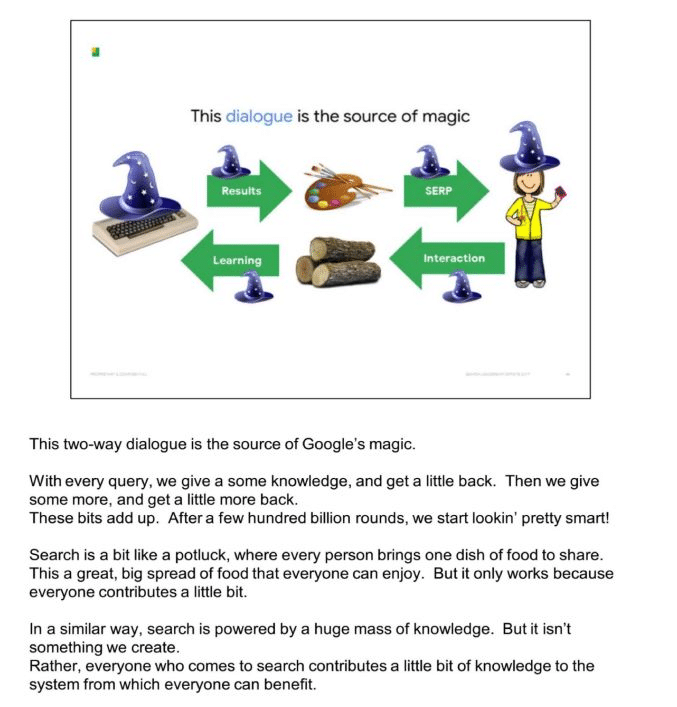
We also know from the Google Data Warehouse API leaks that Google collects data about “goodClicks,” “badClicks,” “lastLongestClicks,” etc.
The DOJ testimony also revealed NavBoost and Glue, which are core ranking signals related to user behavior in search results.
We also know from the leaks that Google appears to use Chrome browser clickstream data in ranking.
Takeaway
All these point to the same conclusion: user behavior matters. A lot.
As SEOs, we should analyze user behavior on a page using tools like Hotjar and Lucky Orange. These tools help us understand how users interact with the page.
These insights allow us to test ideas to improve user experience and boost rankings. Additionally, testing click-through rates (CTR) is also crucial for SEO.
3. Machine learning
The best way to explain this is using a 2013 Facebook study.
“A study by Cambridge University in collaboration with Microsoft found that by using the Like data, which is available publicly by default, they could make accurate predictions about personal attributes – the most surprising being an apparent link between Liking “Curly Fries” and having a high IQ”
– “Liking curly fries on Facebook reveals your high IQ,” WIRED
How does that make any sense? It does not. This is a pattern that the machine identified.
For some reason, people with higher IQs have liked photos of “curly fries” on Facebook, and a machine learning algorithm picked that pattern.
In search, machine learning has undoubtedly identified some patterns that may not make sense to us but do make sense from a machine standpoint.
For example, if a page has blue buttons, users might like the page more. (This is just an example to explain the idea; it is not based on actual research.)
Takeaway
There’s little we can do in this “man against the machine” war, but it’s worth analyzing, looking at pages and trying to find patterns.
While I don’t see a lot of practical tips for us here as SEOs, I see an explanation for why some things rank.
4. User intent
User intent is arguably the most important ranking signal, at least when it comes to signals we can control.
Recently, I’ve noticed that Reddit and blogs often appear in the SERPs. They rank for what we thought to be a purely commercial/transactional keyword.
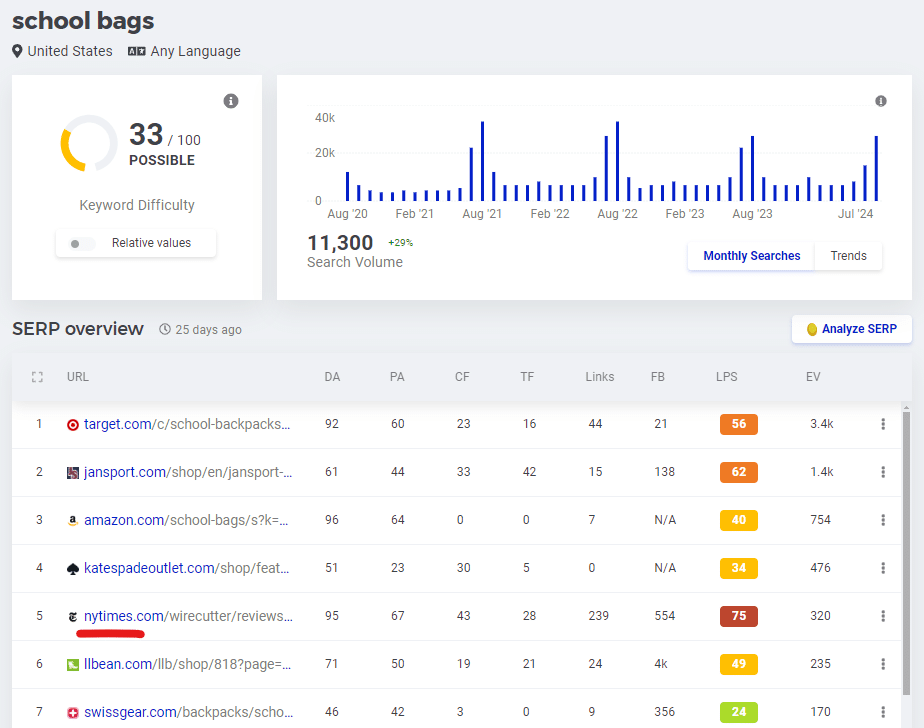
Here’s an example of a New York Times article ranking in Position 5 for the keyword “school bags”:
Takeaway
Analyze search intent and make sure your pages cover different intents.
If there are blogs in the SERPs you’re targeting, your content should include more information, even if it’s a product category page.
You can create a supporting blog without the fear of cannibalization because that’s what users are looking for.
If there is user-generated content (UGC) in the results, you may want to have reviews on your pages or enable comments for blogs, for example. There’s no one established way to go about this.
My advice? Keep testing.
Dig deeper: How to optimize for search intent: 19 practical tips
5. Bugs and tests
Many factors come into play when something ranks on Google. Sometimes, it’s just a bug from their side, and they will fix it.
For example, Google confirmed a search ranking bug on Aug. 16 that went unresolved until Aug. 20.
The Verge article ranked high at first, but its position dropped after less than two months.
This shows that a high ranking doesn’t always mean it’s permanent; Google is likely testing the URL and gathering user data.
Takeaway
We should not jump to conclusions when we see movement. We should be patient and monitor before reaching a verdict or a ranking theory.
Decoding Google’s unexpected search results
There’s more to SEO than meets the eye.
SEO today is much more than keywords and traditional tactics.
We need to be open to more creative approaches.
Times in search have changed. We need to do the same.
Let’s embrace an era of “new SEO.”
Courtesy of Search Engine Land: News & Info About SEO, PPC, SEM, Search Engines & Search Marketing
Category seo news | Tags:
Social Networks : Technorati, Stumble it!, Digg, de.licio.us, Yahoo, reddit, Blogmarks, Google, Magnolia.
4 initiatives to combat AI-driven SEO traffic losses
Written on September 17, 2024 at 8:51 am, by admin

There seems to be a consensus in SEO that AI Overviews (AIO) and other AI-driven content will reduce traffic to external websites.
Even Google is open about AIO’s goal of keeping users on the SERP longer, which means more time with Google and less time with your business.
No matter how good your SEO strategy is, you’re likely heading toward (or already experiencing) erosion of traffic beyond your control.
That sucks. Point-blank, period.
OK, that’s done. Now, let’s talk about how to cope.
We’re leading our clients toward four main initiatives:
- Digital PR and content distribution.
- Adding trust signals in the SERP.
- Testing influencers.
- Leaning into CRO.
Here’s how we’re approaching each.
1. Digital PR and content distribution
For many brands, Google is the primary platform for their content distribution.
If you’re in that boat – and even if you’re dutifully adapting and cross-posting your content on LinkedIn, YouTube, etc. – it’s time to get more resourceful on the distribution piece.
If you have a PR team or vendor, that would be great. They should already be well-versed in getting your experts’ thoughts and bylines placed on third-party platforms.
Even if you don’t, there are grassroots ways to use digital PR to get on the radar of your industry’s key publications and outlets.
First things first: develop a list of the outlets, influencers, journalists, etc., with whom you want to build a relationship.
I’m sure you already have a shortlist of resources, but you can supplement that by setting up alerts for mentions of competing brands and seeing who’s writing or talking about them.
Google pushes high-value content with its E-E-A-T guidelines, including:
- Proprietary research and reports.
- Expert POVs.
- Deep technical dives.
These types of content should also be the kind of content that can pique a journalist’s interest.
Just make sure any outreach is centered around what your content can do to engage their readers instead of promoting your brand or service.
Even if what you’re pushing isn’t what a journalist is looking for, it’s important to get on their radar; building relationships should be viewed as a long-term strategy.
Eventually, effective approaches can result in mentions, backlinks, social media shout-outs and earned placements – all powerful ways to build your brand.
One last tip here: don’t forget your readers and the role they can play in grassroots brand-building.
Make sure your content is both worth sharing and easy to share – down to visible social media icons and prompts for the reader to engage.
Dig deeper: How to use digital PR to drive backlinks and business growth
2. Adding trust signals in the SERP
Since we’re talking about less real estate (and/or less prominent real estate) in the SERP, one way to maximize that is to make sure you’re leaning on social proof and trust signals to encourage the user to click on your link, not your competitors.
This means potentially testing words like “top,” “best,” “trusted,” etc. in your metadata and claiming and optimizing your brand’s knowledge panel, among other initiatives.
You should be leveraging these best practices anyway, but since we’re competing for fewer clicks, maximizing your opportunities is important.
Dig deeper: Top 10 SEO benefits of building a brand that people trust
3. Testing influencers
If you’ve ever been curious about testing influencer marketing, now would be a great time to get serious.
The more people in your space talking positively about your brand, the more traffic you’ll get from non-Google sources, the bigger brand halo you’ll build and the more fodder you’ll give Google for brand-related AIOs.
Influencers must be considered when building and protecting your brand’s reputation in the SERP.
Dig deeper: How to ensure influencers help your SEO campaigns
4. Leaning into CRO
Great SEO is about business impact, not just engagement (impressions, clicks, rankings).
That means introducing people to your brand and bringing them to your site is only half the job.
Along with using conversion rate optimization (CRO) tools, heatmaps, etc., try initiatives like testing different options and CTAs to see if any move the needle.
Make sure your prescribed next steps align with the user’s intent. Don’t ask them to sign up for a demo if they just met you on a top-of-funnel query.
Once you start gathering data for deeper-funnel metrics, you can identify high-converting and high-traffic, low-converting pages.
For the former, try to replicate the formula for conversion on other similar pages and see if there are any good opportunities to optimize that page further.
Even if it just gets you a few more clicks in the new SERP. For the latter, prioritize tests and adjustments that can help you drive more impact from the traffic you’re already getting.
Dig deeper: Driving traffic but not leads? How to win with SEO and CRO
Thriving despite AI-induced traffic drops
Only time will tell how AI will impact search traffic.
You can throw up your hands and wait to see what happens, or you can get proactive and take mitigating measures to bolster the ultimate impact of your SEO campaigns.
Courtesy of Search Engine Land: News & Info About SEO, PPC, SEM, Search Engines & Search Marketing
Category seo news | Tags:
Social Networks : Technorati, Stumble it!, Digg, de.licio.us, Yahoo, reddit, Blogmarks, Google, Magnolia.
A guide to creating social media videos (for search and beyond)
Written on September 17, 2024 at 8:51 am, by admin
Many brands and content creators are struggling to stand out and effectively engage audiences on social media platforms.
With the rise of video content and the increasing importance of social search, those who fail to adapt risk becoming invisible in the crowded social media space.
Traditional content strategies are no longer enough to capture attention and drive engagement.
This comprehensive guide equips you with the knowledge and tools to create compelling social media videos that capture attention, drive engagement and achieve your marketing goals.
Discovering video content in the era of social search
The way users discover and interact with video content on social media platforms, with social search at the core, has already evolved the way users interact with social content.
Unlike traditional search engines, social search algorithms are designed to surface content based on user behavior, preferences and engagement patterns within social networks.
This means social search doesn’t rely on assuming the user’s intent. The algorithm is aware of what the search is looking for.
Understanding this concept is now crucial for brands looking to maximize the visibility and reach of their videos, especially for organic content.
Dig deeper: Why video is key to building brand identity and engagement
Mastering social search: Why and how to maximize your video content’s reach across platforms
The rise of social search brings important changes content creators must consider:
- Increased importance of engagement metrics.
- Greater emphasis on trending topics and timely content.
- Reduced reliance on follower count for reach.
- Higher potential for viral content from lesser-known creators.
- Need for consistent posting and audience interaction.
To use social search effectively, focus on producing high-quality, engaging content that encourages user interaction and aligns with trends.
Content must also be optimized, ensuring keywords and vital hashtags are included as appropriate.
TikTok is getting a lot of attention for social search due to its For You page, targeted algorithm and built-in search features, but this shift is happening on many other social platforms:
- Instagram Reels: It promotes short-form videos to a wider audience beyond just a user’s followers.
- YouTube: It uses past content interactions, search history and subscriptions to recommend content to users.
- YouTube Shorts: Uses social search features to recommend short-form videos based on users’ viewing history, interactions and searches.
- Pinterest: Uses visual search technology to help users discover content related to images they continue to evidence they are interested in.
- Snapchat: Uses social search in its “Discover” feature to surface relevant content and stories for its users, creating unique discover feeds for every user.
This is what is leading to the emergence of a search universe.
As audiences use different platforms at various stages, understanding the nuances of social search on each is key to tailoring your video strategy and maximizing reach.
A search universe analysis can help refine your content strategy to meet these needs.
Dig deeper: Is TikTok a search engine? Why meeting searchers’ needs matters more than semantics
Developing a holistic video strategy
Creating successful social media videos goes beyond just producing engaging content.
It requires a comprehensive approach that aligns with your overall business goals and target audience.
Let’s explore how to develop a holistic video strategy that sets you up for success.
Setting clear goals and objectives
Before you start creating videos, define what you want to achieve.
This will depend on how your audience is engaging with the platform and their expectations alongside what you are trying to achieve within your strategy.
It’s likely you are trying to achieve one of the following:
- Brand awareness: Increase visibility and recognition of your brand.
- Engagement: Boost likes, comments, shares and overall interaction.
- Lead generation: Attract potential customers and grow your audience.
- Sales: Drive conversions and revenue through your video content.
- Education: Inform your audience about your products, services or industry.
- Visibility: Gain presence on a social-SERP for relevant topic/conversation.
Clearly defined goals will guide your content creation and help measure success.
Identifying target audience and platforms
Understanding your audience is crucial for creating content that resonates.
By analyzing demographics and psychographics, you can create specific personas to identify which platforms will help you reach different audience groups.
Once you know your audience, choose the platforms that match their preferences and content goals.
Each platform has unique features and audience expectations, so pick the ones that best align with your strategic objectives. For instance:
- TikTok: Short-form, trend-driven content for a younger audience.
- Instagram: Visual content for a broad demographic, with Reels gaining popularity.
- YouTube: Long-form and short-form content perfect for education.
- LinkedIn: Professional content for B2B audiences.
- Facebook: Diverse content types for a wide age range, focusing on older groups.
To find out where your video content should appear, use GLIMPSE to see which platforms are popular for your topic.
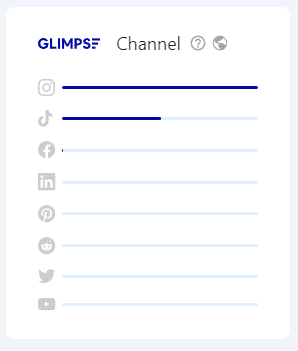
Here is a look at the “Channel Breakdown” from within Google Trends (Supercharged with Glimpse).
I’ve searched for “Hyrox Workout” and as you can see, Glimpse has identified that this topic is indexing favourably on Instagram and TikTok.
This could inform the platforms I choose to create content on in various ways.
I could decide to join the Red Ocean on these popular platforms (after all, that is where the conversation is already popular) or grow the conversation on a separate channel (I think YouTube and YouTube Shorts would be a great choice).
Aligning video content with overall brand strategy
Your video content should be a cohesive part of your broader brand strategy.
Crafting a cohesive brand presence across your content strategy is essential for building recognition and developing trustworthiness.
For social content, make sure your videos consistently reflect your brand’s voice and values.
Use a unified visual style with consistent colors, fonts and design elements, but don’t stress over minor deviations. The key is to keep it clear that it’s your brand communicating.
A good tactic is to develop recurring series or themes that align with your brand identity. This will create a sense of familiarity and anticipation among your audience, a reason to click the notification icon to “On.”
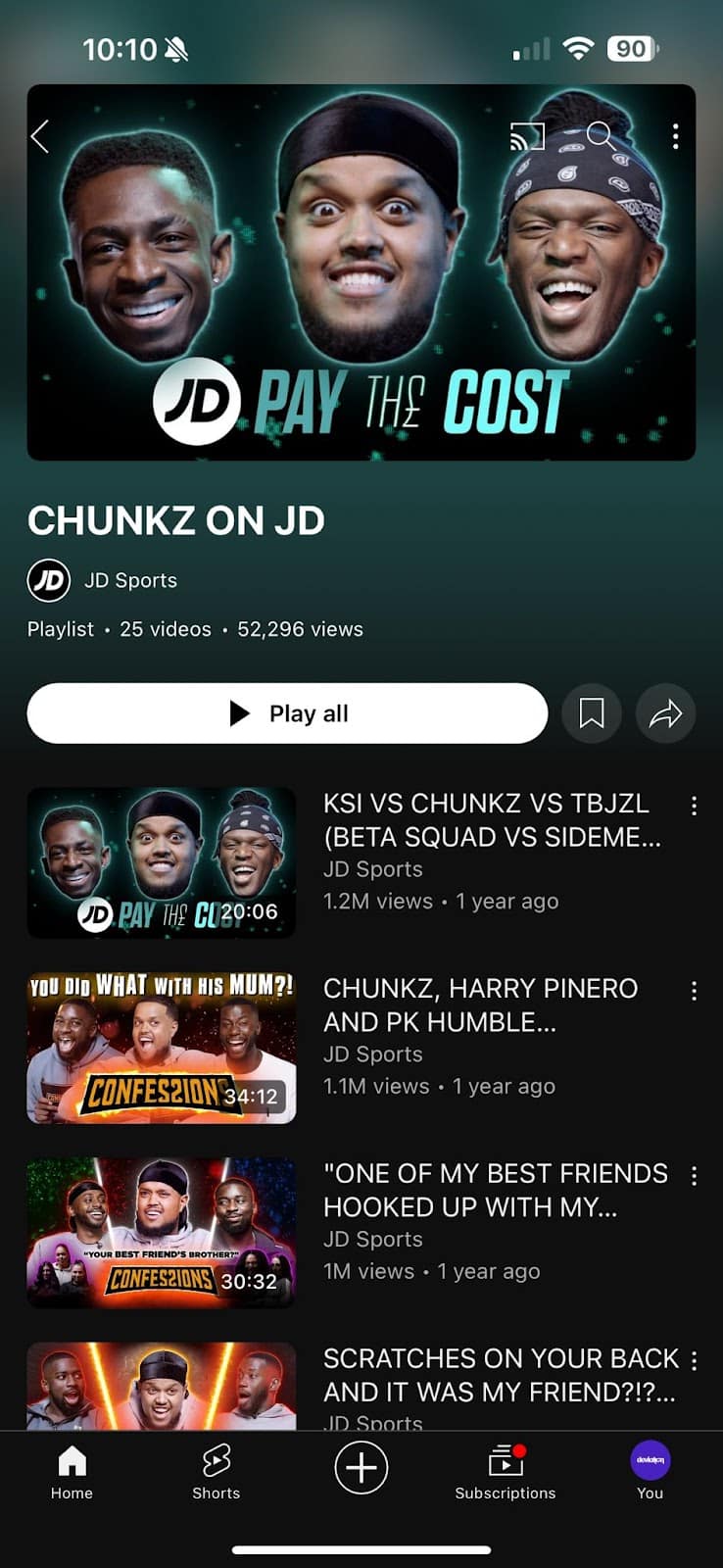
JD Sports does this well on its YouTube channel by collaborating with content creator Chunkz and other influencers.
They create a series of videos that connect with their audience, building brand loyalty and encouraging users to subscribe to their channel.
As you create content for different platforms, aim for a consistent experience across your messaging and styles.
Consider collaborating with influencers and content creators. Encourage your community to contribute. Just make sure the content aligns with your brand.
A well-rounded video strategy will help you produce engaging content that achieves meaningful results for your brand.
Video creation essentials
Creating compelling social videos involves three key stages:
- Pre-production.
- Production.
- Post-production.
Each phase plays a crucial role in crafting content that resonates with your audience and aligns with your strategy.
Pre-production
- This stage sets the foundation for concept development, scripting and planning.
- Consider your video’s purpose, target audience and platform-specific requirements.
- Use a search brief to ensure the video is effectively optimized for search, from the outset. Ultimately, you want to outline your key messages and visual elements to guide your content.
Production
- Focus on capturing high-quality footage based on your content needs.
- While professional equipment can enhance your video, many smartphones now offer great video quality.
- Pay attention to lighting, composition and audio to ensure your message comes across clearly.
- Tailor the production quality to fit the platform. What works for a 4K film may not suit a 15-second TikTok.
- Meet the expectations for each platform to avoid disconnecting from your audience.
Post-production
- Bring your vision to life through editing.
- Add captions, music and effects to develop better engagement, keeping in mind platform-specific best practices.
- This stage is crucial for optimizing your video for social search, which we’ll explore specifically in the next section.
The key to successful video creation is balancing quality with efficiency.
With experience, you’ll create a workflow that helps you consistently produce engaging content, meeting audience expectations and including what’s needed in each piece.
Top tip: Use AI to find ‘highlights’ from long-form videos for short-form recycling
For social media content, you can reuse and repurpose material from YouTube, podcasts, webinars and public speaking events.
Extract key insights from your long-form content to create engaging snippets and teasers for social media.
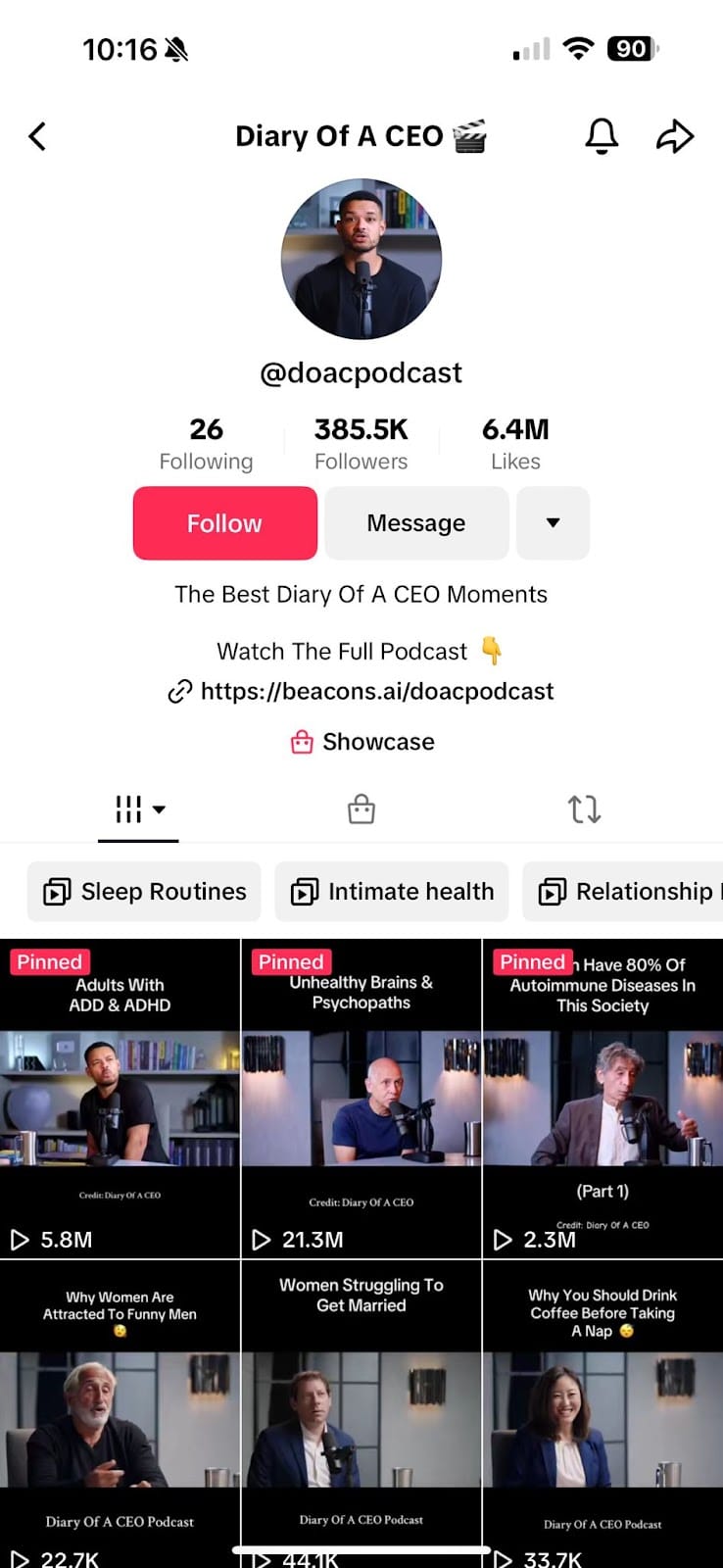 The Diary of a CEO’s TikTok channel effectively uses “clips” to encourage users to listen to full episodes.
 This strategy was adopted by Steven Bartlett in his Diary of a CEO podcast and popularized as the “Gary Vee” method after marketer Gary Vaynerchuk brought it to the mainstream.
Tools like Canva and Wistia, along with new AI tools, can automatically find highlights in your content. This lets you quickly create multiple social media pieces by repurposing your existing content.
In Wistia, go to the Video Editor, click Highlights and it will do the work for you. Canva provides a similar feature.
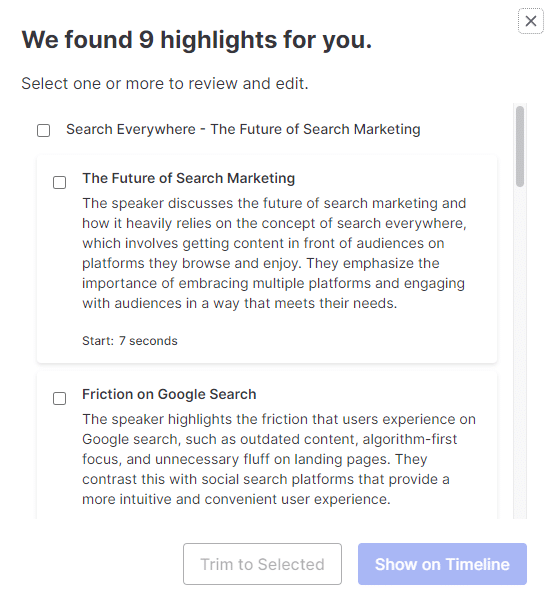 Above is an example of Wistia’s Highlights feature, which finds clippable sections from one of our agency’s webinars.
 Optimizing videos for social search
Maximizing your video’s visibility in social search is essential for reaching a larger audience and boosting engagement.
We can borrow a lot from traditional SEO tactics here and repurpose them for social search.
To optimize your video content:
- Use relevant keywords in titles and descriptions, ensuring they match the video’s content and spark interest.
- Add trending but relevant hashtags to improve discoverability without misleading viewers.
- Incorporate current trends or challenges to boost your video’s reach, as social algorithms favor timely content. Just make sure to stay authentic and align trends with your brand’s voice.
- Include closed captions for accessibility and extra text for algorithms.
- Focus on a strong thumbnail to boost click-through rates.
- Encourage interaction with questions or calls-to-action to improve rankings in social search.
- Regularly analyze video performance to understand what resonates with your audience and refine your content strategy.
While optimization is key, prioritize creating high-quality, engaging content. Balancing optimization with authentic value for viewers will lead to the best results.
Just like with traditional SEO, focus on building relationships with your audience, not just algorithms. Prioritize the user experience!
When your videos perform poorly: Delete and re-edit
Not seeing the results you expected?
Editing content used to be difficult, especially on TikTok, often requiring a fresh start.
Now, platforms are adopting a “fail fast, test and learn” approach, making updating and improving content easier.
TikTok, for example, now allows you to “Delete and Re-Edit” instead of just deleting your content, a feature YouTube has offered for a while.
This allows you to head back into your drafts, find the content and edit away, ensuring you can optimize your content and republish.
This is a game changer for that test and learn approach and should better enable creators to optimize for social search on the platform.
 A look at the new ‘Delete and re-edit’ feature within TikTok.
Measuring success
You must understand how your content performs to refine your content strategy and maximize impact.
Track the right metrics and interpret data effectively to improve and achieve better results.
Key performance indicators (KPIs)
KPIs can vary by brand and strategy, but here are some important ones for social search content:
- Views and reach: Measures visibility of your video. Important but should be considered with other metrics.
- Engagement rates: Includes likes, comments, shares and saves. Shows how well your content resonates.
- Watch time and completion rates: Indicates viewer interest and content quality.
- Click-through rates and conversion metrics: Essential for videos aimed at driving actions.
- Follower growth: Reflects how well your video attracts new audience members.
Tools for tracking performance
- Platform native analytics: Use YouTube Analytics, Facebook Insights and TikTok Analytics for detailed performance data.
- Third-party tools: Hootsuite, Sprout Social and Buffer offer cross-platform analytics and advanced reporting features.
Interpreting data
- Identify patterns: Look for trends in top-performing content, such as themes, styles or posting times.
- Compare benchmarks: Set realistic goals by comparing your performance against industry standards.
- Adjust strategies: Do more of what works and less of what doesn’t.
- Audience insights: Pay attention to demographics and behaviors to ensure you’re reaching your target audience.
- A/B testing: Experiment with different approaches to optimize content based on results.
Balancing data and feedback
Use metrics to guide your strategy, but balance quantitative data with qualitative feedback from your audience. This approach helps create content that resonates and achieves your goals.
Case study: Makeup tutorials by Jade Rain
Let’s see these principles in action with a real-world example from the beauty industry.
@jaderainbeauty Stop struggling with red lips! These tricks help me get a perfect pout every time. Did you know you have 2 lip lines? Lip color Red from Graftobian Best lip brush ever Lip Dagger from Bdellium #lipsticktutorial #lipstickhack #lipstickhacks #redlipstick #redlips ♬ original sound – jaderainbeauty
- The video has an effective hook that addresses a pain point for the target audience (Clown Lips when applying Red Lipstick).
- Captions and descriptions effectively relay the message that the presenter is discussing within the video, sending the necessary signals to the platform (TikTok).
- The video includes visual and audio “show and tell” instructions which makes the video engaging and educational.
- Relevant hashtags are used effectively.
All of this helped the video earn a search highlight feature for “how to apply lipstick” on TikTok.
Creating social media videos that resonate
Video content is a powerful tool for connecting with audiences and achieving marketing goals in today’s social media landscape.
By embracing the strategies outlined in this guide, you can create impactful content that resonates with viewers and drives results:
- Understand social search: Learn about its role in video discoverability and tailor your content strategy accordingly.
- Adopt a holistic approach: Set clear goals, identify your target audience and maintain consistent branding across platforms.
- Master the creation process: From pre-production planning to post-production optimization, each stage is crucial for producing high-quality content.
- Optimize for platforms: Adapt your content to platform-specific algorithms and user behaviors to maximize reach and engagement.
- Measure and refine: Use analytics to track performance and continuously improve your strategy.
Remember, successful video content prioritizes audience needs while aligning with your brand’s objectives.
As you implement these strategies, stay adaptable and open to emerging trends. The social search landscape is ever-changing and your ability to evolve with it will be key to long-term success.
Dig deeper: How advertisers can capitalize on vertical video
Courtesy of Search Engine Land: News & Info About SEO, PPC, SEM, Search Engines & Search Marketing
Category seo news | Tags:
Social Networks : Technorati, Stumble it!, Digg, de.licio.us, Yahoo, reddit, Blogmarks, Google, Magnolia.
How to make your display campaigns profitable
Written on September 16, 2024 at 5:49 am, by admin
If you use display campaigns correctly, they can be profitable.
The problem is that most people use them wrong, turn them off and then claim that “display campaigns don’t work.”
This guide will show you how to use display campaigns correctly in all stages of the funnel to make them profitable.
Display campaign: Your targeting options
There are two categories of how you can target people with display ad campaigns.
Content targeting
This option shows your ads to people that are currently on website content that you specified.
- Topics: Topics of websites’ content.
- Placements: Hand-picked website placements.
- Keywords: Keywords or content “themes” of websites’ content.
Audience targeting
This option shows ads to people regardless of the website on which they are currently viewing. The ads will follow people around like remarketing ads do, except they aren’t necessarily remarketing audiences.
- Demographics: Based on Google’s data to estimate demographics, not 100% accurate, but may be worth testing.
- Affinity: Based on interests and habits.
- In-market and life events: Users shopping for certain items or life events, such as marriage, graduation, retirement, etc.
- Your data segments: Customer list you uploaded or remarketing to previous website visitors.
- Combined segments: Combining multiple segments as one targeting option.
- Custom segments: Custom audiences you created based on people’s recent searches, recent website visits or app usage. One of the most profitable options.
Fitting in display campaigns to your overall advertising strategy is easier than you may think.
Below are the targeting options again, organized by stage of funnel and with detailed explanations and examples for how to use them correctly so you don’t waste money on irrelevant traffic.
Top-of-funnel display ad campaigns
Placement content targeting option
Think of it as buying ad space in a magazine that your target demographic reads or in more modern terms, sponsoring a podcast that your target audience listens to.
You can directly track clicks, time spent on your site, pages viewed, conversions and micro-conversions such as signing up for a newsletter, viewing the pricing page or watching a key video.
Top-of-funnel ad campaigns don’t need to stop at just clicks, they can achieve many small or large conversions as well. Sometimes users can quickly go through the entire funnel in a short amount of time, even with one click.
Case study example
Our agency tested display and search campaigns for a client offering services for attorneys.
Display ads on attorney news websites, used for lead generation and as the first touchpoint, generated more leads at a lower cost than search campaigns.
Targeting websites attorneys already frequent proved to be an easy win.
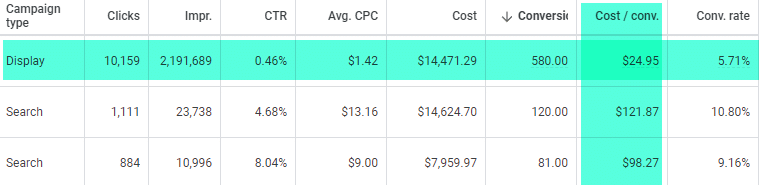
Other example usage
- Target local news websites for local services, events, restaurants, and home goods.
- Target health and wellness sites with ads for supplements, products, or fitness programs.
- Target gaming websites with ads for games.
The potential of placement targeting for display campaigns becomes clear once explored.
Topic and keyword content targeting option
This is usually at the top of the funnel but sometimes performs well at the middle or bottom of the funnel.
For the technical setup, auto bidding is recommended since it rotates through many related sites, not a few specific websites like Placement targeting does.
Once the campaign has been running for a week or two, you can start to see data to block placements that aren’t relevant or not producing results.
Also, we recommend only showing on desktop or blocking all apps.
Often, Google will show your ads on many apps with this targeting option, which may not produce the best results, depending on the campaign.
If you keep apps in the targeting option, watch them very closely.
Also, Google doesn’t allow the double layer of topics and keywords or placements and keywords anymore.
Now it will use or, such as the topics you selected or the keyword you picked, which isn’t as useful.
Example usage
- Target website topic of Homes and Garden > Home Safety and Security with ads for home security products.
- Target website topic of Pets and Animals > Animal Products and Service with ads about animal products or services.
- Target website keyword content for “accounting software” with ads about accounting software.
Affinity audience targeting option
Great usage for top-of-funnel and awareness. These audiences will likely be a first touch point and can be paired with a micro-conversion, like getting an email address.
Example usage
Showing an ad for stock trading software targeting the Affinity Audience of Avid Investors (under Banking and Finance audience). The micro-conversion could be watching a demo video or signing up for the newsletter.
Also, it’s not unrealistic to expect this top-of-funnel traffic to book a demo or sign up for a free trial. This would not be considered a micro-conversion.
You don’t always have to build a large funnel. If a first-touch point will buy something immediately, let them.
Demographics audience targeting option
To get more clarity on where Google gets their demographics data, Google explains in their help article. It is not entirely clear how they get this data.
In Google’s words:
“When people are signed in from their Google Account, we may use demographics derived from their preferences or settings, depending on their account status”; “In addition, some sites might provide us with demographic information that people share on certain websites, such as social networking sites”; “We sometimes also estimate people’s demographic information based on their activity from Google properties or the Display Network.”
You may have good results with targeting or blocking Demographics, but keep in mind Google is assuming the user is a “homeowner” or is assuming the user is “18-24.”
It’s not perfect, but may be worth testing.
Example usage
You could target Google’s demographic audience of “Parents of Infants” with ads for baby products or “Homeowners” with homeowner’s insurance ads.
It’s not perfect data, but in the worst-case scenario, you showed a baby product to someone who doesn’t have a baby or an ad for homeowner’s insurance to someone who doesn’t own a home.
Middle and bottom-of-funnel display ad campaigns
Custom audiences targeting option: The most profitable display targeting option
One great option is to target keywords and related keywords, people recently searched. This is kind of like “broad-broad” match.
Keep in mind, it doesn’t target people who searched these exact terms, but it provides a general keyword theme to reach potentially interested audiences.
Custom audiences can also target by websites similar to “www.yourcompetitor.com.” Again, it isn’t necessarily targeting people that visited that exact URL, it uses it as a starting point for a theme of websites they visited.
Tip: Use one custom targeting option at a time, don’t use keywords and URLs and apps all in one audience. The data doesn’t show separately if you put multiple options in the custom audience at once.
The same option is available for creating a custom audience based on the apps they use.
The secret is to combine this with auto-bidding. Since it follows the user no matter what website they are currently on, auto-bidding works to determine which websites and users turn into conversions for you.
Max Conversions is usually safe, but it can be risky with high CPC search campaigns. You can later switch to tCPA or tROAS, or keep Max Conversions long-term if it works for you.
Example case study
We tested this on one of our clients in the home services industry and found that the cost per lead was much lower, and the volume of leads was higher.
Although the conversion rate was lower, ultimately, it generated more leads at a lower cost per lead than the search campaign.
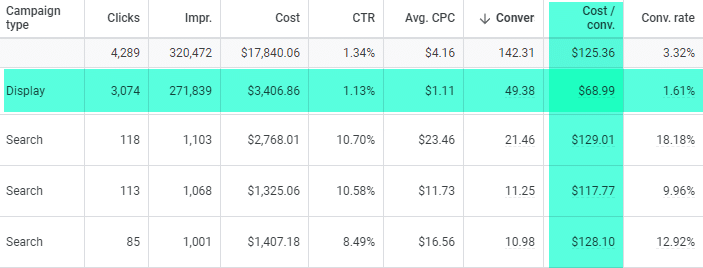
Also, we verified from the client’s CRM that the display campaign did not have issues with lead quality.
This is a common complaint about using display or Performance Max campaigns for lead gen.
Regardless of the campaign type, always check lead quality in a CRM.
Other example usage
- Create custom audience targeting users that went to your competitor’s site (or similar sites).
- Create a custom audience targeting your top three converting keywords from your search campaigns.
‘Your data segments’ audience targeting option
The most common use of “Your data segments” as a targeting audience is remarketing to previous website visitors or uploading a list of previous customers.
This is typically the bottom of the funnel since the user is nearly ready to make the decision. The most common remarketing audience is website visitors who did not convert within the last 30 days.
Example usage
- Target previous customer list with an ad about a new product.
- Target previous website visitors who viewed the Pricing page.
- Target previous website visitors who viewed multiple products but did not purchase.
- Targeting previous website visitors who signed up for a free trial but have not upgraded yet.
In-market and life events audience targeting option
These can work for any stage of the funnel, depending on the event.
They will mostly be at the bottom and middle of the funnel because they are currently shopping for something or just went through a major life event.
In-market can be especially effective because the user is actively researching a specific product, like a car or a house.
Example usage
- Target Audience of Life Events > Retiring Soon with an ad for retirement management services.
- Target Audience of Life Events > Recently Purchased a Home with ads for furniture, home security, solar, yard care or home improvement.
- Target Audience of In-Market > Motor Vehicles > Motor Vehicles by Type > Luxury Vehicles with ads for luxury vehicles.
Critical settings and optimizations: How to not waste money on display ads
- Target one option per ad group or one per campaign. Don’t stuff them all in one ad group. You won’t be able to clearly see what’s working or not.
- Avoid using “Optimized targeting” or “targeting expansion” in ad group settings, as it broadens your reach beyond your intended audience or content, making ad targeting unclear.
- Typically, you’ll block all apps or even only show your ads on desktops in the device settings.
- When targeting based on content, Google often shows your ads on many apps, sometimes apps that are not relevant.
- For example, you targeted retirement content and received 500 clicks on a dating app for people in their 20s. Keep a close eye on the app’s traffic, or consider blocking it entirely.
- Block bad placements frequently, like you would block bad search terms in search campaigns.
- If needed, you can block YouTube.com or other sites that are taking all of the traffic and not getting results. This is done under Insights and Reports > When and where ads showed > Where ads showed.
- In the example below, most placements received a $30 to $50 cost per conversion, whereas the few highlighted in red were over $100 per conversion, so they should be blocked.
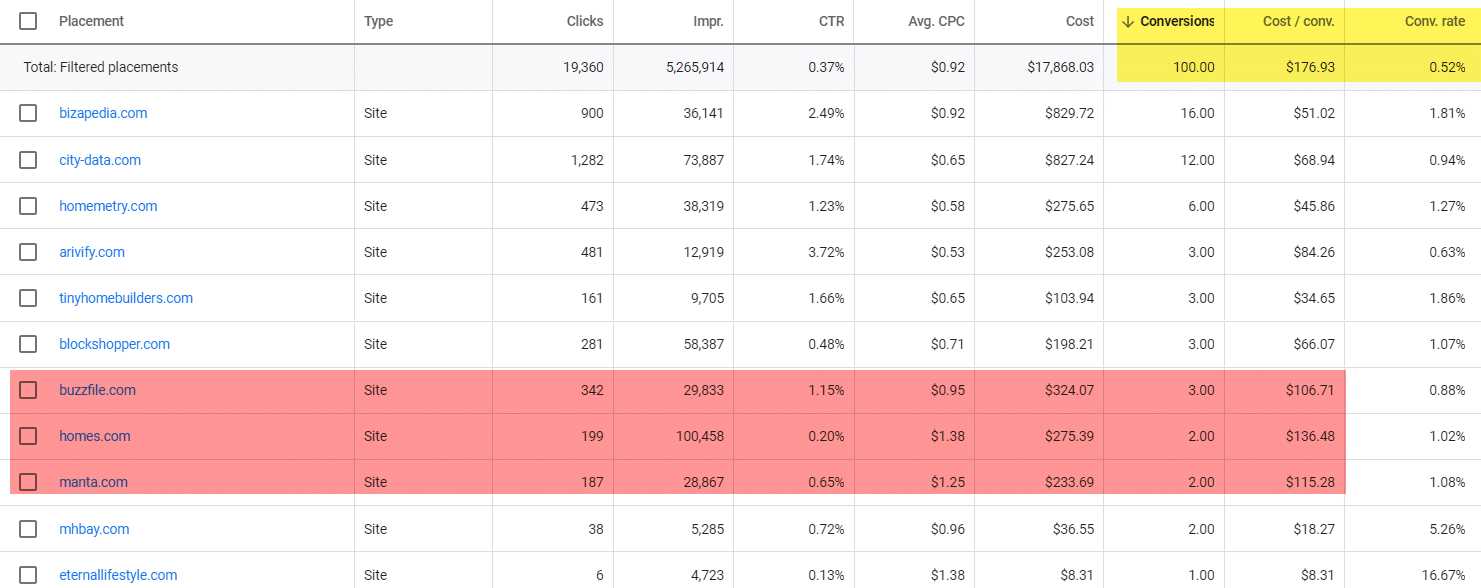
- Exclude irrelevant topics like gossip, tabloid news or games, as they can lead to wasted clicks if your ads don’t fit those websites.
- Use negative keywords in the display campaigns.
- Exclude your remarketing audiences so the new display campaigns don’t also show to the remarketing audiences you are targeting in the remarketing campaigns.
The obvious question: Why not just use Performance Max?
The simple answer is that you don’t have as much control.
Is your Performance Max campaign appearing on a specific site your audience visits?
With Performance Max’s limited data transparency, it’s hard to know. Instead, use a display campaign to target that site directly and easily track results.
I’m not against Performance Max, but marketers should explore other options. Performance Max doesn’t always work, and running separate campaign types can be more profitable.
You can also test display campaigns first, then use that data to improve your Performance Max campaigns, combining it with top search keywords for better success.
Courtesy of Search Engine Land: News & Info About SEO, PPC, SEM, Search Engines & Search Marketing
Category seo news | Tags:
Social Networks : Technorati, Stumble it!, Digg, de.licio.us, Yahoo, reddit, Blogmarks, Google, Magnolia.
How to create and optimize Google Ads custom segment audiences
Written on September 16, 2024 at 5:49 am, by admin
Google Ads offers several ways to create audiences, with custom segments being the most flexible and powerful option.
However, most custom segments we see are poorly created. Poorly created audience segments are impossible to refine or optimize since you do not know why the ad is being displayed.
Well-crafted audience segments can be optimized similarly to how you optimize search terms.
In this video, you’ll learn:
- Why you should create small audience segments.
- How to create audience segments that can be optimized.
- Why you should create both interest and search segments.
- The results from an advertiser who went through this optimization process.
Courtesy of Search Engine Land: News & Info About SEO, PPC, SEM, Search Engines & Search Marketing
Category seo news | Tags:
Social Networks : Technorati, Stumble it!, Digg, de.licio.us, Yahoo, reddit, Blogmarks, Google, Magnolia.
Google updates crawlers and user-triggered fetchers documentation
Written on September 16, 2024 at 5:49 am, by admin
Google has made a series of updates to its crawlers and user-triggered fetchers documentation, mostly breaking out the single-page document into multiple pages and documents. But Google also expanded what product each crawler affects with a new section next to each crawler and added a robots.txt snippet for each crawler to demonstrate how to use the user agent tokens by each crawler.
What Google said. Google posted about these changes saying:
“Reorganized the documentation for Google’s crawlers and user-triggered fetchers. We also added explicit notes about what product each crawler affects, and added a robots.txt snippet for each crawler to demonstrate how to use the user agent tokens. There were no meaningful changes to the content otherwise.”
“The documentation grew very long which limited our ability to extend the content about our crawlers and user-triggered fetchers.”
What is new. Besides for just moving a lot of content around, to organize the content. Google also added the “affected products” sections and also the “Example robots.txt group” sections. Here is a screenshot of this applied to the Googlebot crawler, but it was added to each individual crawler:
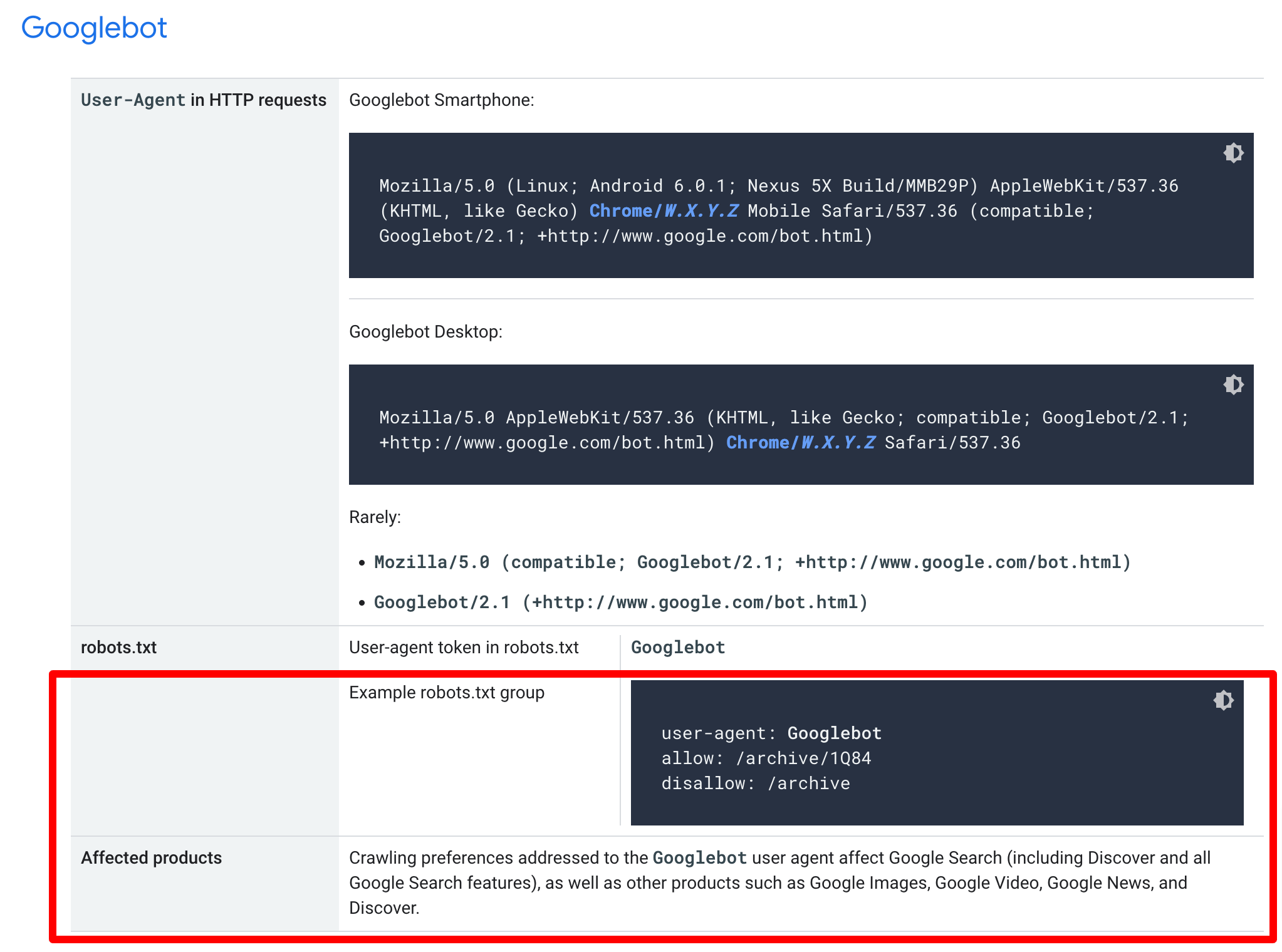
I pulled out each one for you:
- Googlebot: Crawling preferences addressed to the Googlebot user agent affect Google Search (including Discover and all Google Search features), as well as other products such as Google Images, Google Video, Google News, and Discover.
- Googlebot Image: Crawling preferences addressed to the Googlebot-Image user agent affect Google Images, Discover, Google Video, and all features in Google Search where images, logos, and favicons are presented.
- Googlebot Video: Crawling preferences addressed to the Googlebot-Video user agent affect video-related Google Search features and other products dependent on videos.
- Googlebot News: Crawling preferences addressed to the Googlebot-News user agent affect all surfaces of Google News (for example, the News tab in Google Search and the Google News app).
- Google StoreBot: Crawling preferences addressed to the Storebot-Google user agent affect all surfaces of Google Shopping (for example, the Shopping tab in Google Search and Google Shopping).
- Google-InspectionTool: Crawling preferences addressed to the Storebot-Google user agent affect Search testing tools such as the Rich Result Test and URL inspection in Search Console. It has no effect on Google Search or other products.
- GoogleOther: Crawling preferences addressed to the GoogleOther user agent don’t affect any specific product. GoogleOther is the generic crawler that may be used by various product teams for fetching publicly accessible content from sites. For example, it may be used for one-off crawls for internal research and development. It has no effect on Google Search or other products.
- GoogleOther-Image: Crawling preferences addressed to the GoogleOther-Image user agent don’t affect any specific product, similar to GoogleOther. GoogleOther-Image is the version of GoogleOther optimized for fetching publicly accessible image URLs.
- GoogleOther-Video: Crawling preferences addressed to the GoogleOther-Video user agent don’t affect any specific product, similar to GoogleOther. GoogleOther-Video is the version of GoogleOther optimized for fetching publicly accessible video URLs.
- Google-CloudVertexBot: Crawling preferences addressed to the Google-CloudVertexBot user agent affect crawls requested by the site owners’ for building Vertex AI Agents. It has no effect on Google Search or other products.
- Google-Extended: Google-Extended is a standalone product token that web publishers can use to manage whether their sites help improve Gemini Apps and Vertex AI generative APIs, including future generations of models that power those products. Google-Extended does not impact a site’s inclusion or ranking in Google Search.
- APIs-Google: Crawling preferences addressed to the APIs-Google user agent affect the delivery of push notification messages by Google APIs.
- AdsBot Mobile Web: Crawling preferences addressed to the AdsBot-Google-Mobile user agent affect Google Ads’ ability to check web page ad quality.
- AdsBot: Crawling preferences addressed to the AdsBot-Google user agent affect Google Ads’ ability to check web page ad quality.
- AdSense: Crawling preferences addressed to the Mediapartners-Google user agent affect Google AdSense. The AdSense crawler visits participating sites in order to provide them with relevant ads.
- Google-Safety: The Google-Safety user agent handles abuse-specific crawling, such as malware discovery for publicly posted links on Google properties. As such it’s unaffected by crawling preferences.
- Feedfetcher: Feedfetcher is used for crawling RSS or Atom feeds for Google News and PubSubHubbub.
- Google Publisher Center: Google Publisher Center fetches and processes feeds that publishers explicitly supplied for use in Google News landing pages.
- Google Read Aloud: Upon user request, Google Read Aloud fetches and reads out web pages using text-to-speech (TTS).
- Google Site Verifier: Google Site Verifier fetches Search Console verification tokens.
Why we care. Reading through these affected product sections may help you better understand how each crawler affects various aspects of Google. Some don’t impact Google Search at all, while others are fundamental to how Google Search works.
Also the new robots.txt examples may be very useful to you and your development teams.
Courtesy of Search Engine Land: News & Info About SEO, PPC, SEM, Search Engines & Search Marketing
Category seo news | Tags:
Social Networks : Technorati, Stumble it!, Digg, de.licio.us, Yahoo, reddit, Blogmarks, Google, Magnolia.