

Instagram expands Creator Marketplace to help brands find creators for ads
Written on February 22, 2024 at 2:50 pm, by admin
Instagram is expanding its Creator Marketplace, aiming to make it simpler for brands to discover creators for partnership ads.
The platform will start inviting creators and brands based in Canada, Australia, New Zealand, United Kingdom, Japan, India and Brazil to join Creator Marketplace in the coming weeks.
Chinese export brands will also be invited to connect with onboarded creators in countries outside of China.
Why we care. Instagram’s Creator Marketplace can help brands find the creators best suited for their campaigns, and also help creators get discovered by brands.
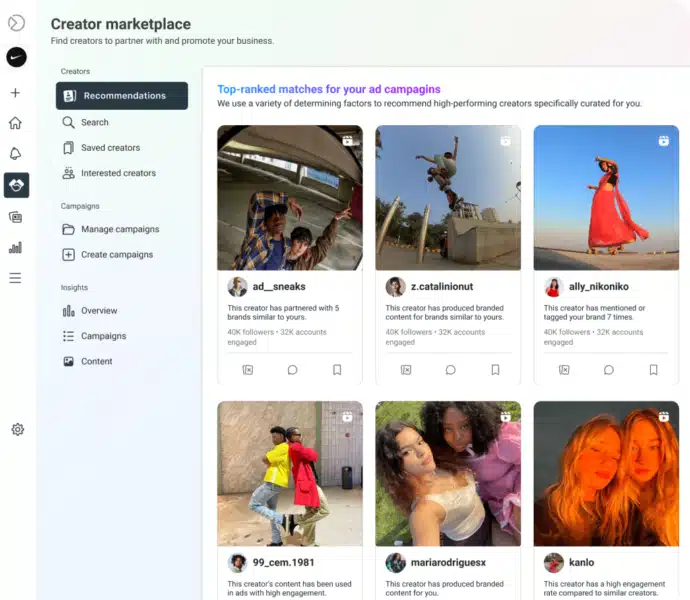
How it works. The Creator Marketplace leverages Instagram’s data to offer machine learning-based recommendations, making it simpler for brands to identify creators perfectly suited for their campaigns. Brands can also conduct targeted searches for creators, applying filters for both creator and audience attributes. Furthermore, they have access to a list of creators who have shown interest and can explore creator portfolios.
Getting started. To get started using Met’a Creator Marketplace, follow these steps:
- Join Instagram’s Creator Marketplace: Brands join Instagram’s Creator Marketplace in Meta Business Suite, and creators sign up via their professional dashboard in the Instagram app, indicating relevant brands and interests while showcasing their uniqueness through portfolios.
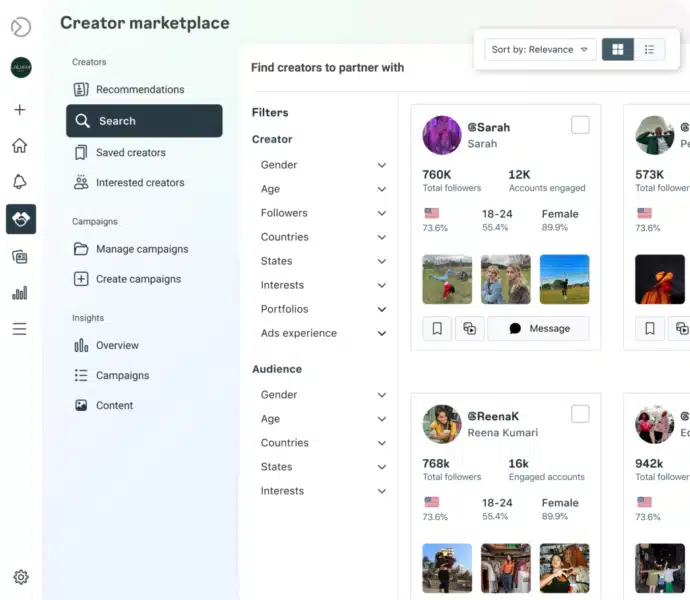
2. Find the Right Match: Go through the recommendations and choose a creator you would like to collaborate with.
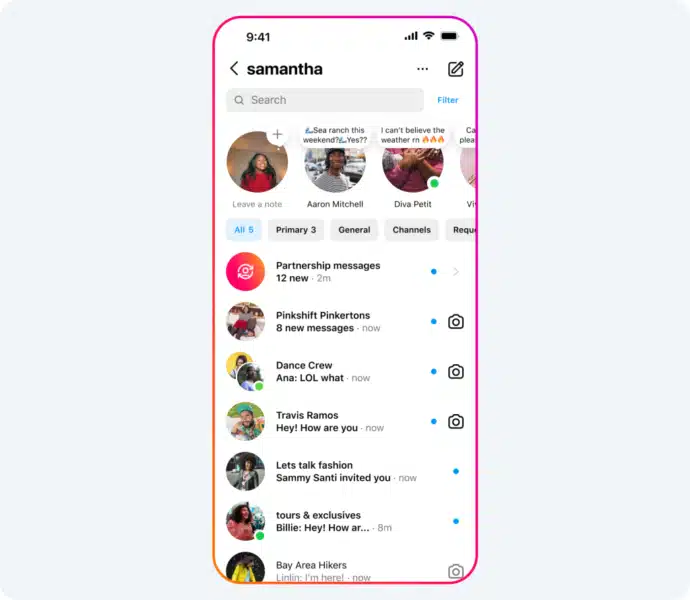
3. Connect and Collaborate: Creators get brand messages in a dedicated folder, additionally, brands can reach out directly or send project details to multiple creators, including opportunity specifics and rates, all within the Instagram app. Creators then review the details and requirements of the opportunity, as well as the rate, all within the Instagram app.
4. Create and Launch: Once brands and creators agree, they can create partnership ads by boosting existing organic Instagram content or generating new ones in Ads Manager.

Partnership ads explained. Partnership ads, previously branded content ads, enable advertisers to amplify content featuring a creator or other partner’s handle, enhancing the reach of their collaborations. This approach, facilitated by Instagram’s Creator Marketplace, offers a high-performing and transparent avenue for advertisers and creators to collaborate on running ads together.
What Meta is saying. A Meta spokesperson said in a statement:
- “Brands have told us it can be challenging to source creators for partnership ads.”
- “That’s why we’re excited to begin testing our brand new, machine learning-based recommendations that use Instagram data to help brands more easily discover creators who are the best fit for their campaigns”
- “Partnership ads are the most performant and transparent way for advertisers and creators to run ads together and Instagram’s creator marketplace helps brands discover creators to partner with.”
Deep dive. Read Instagram’s announcement in full for more information.
Courtesy of Search Engine Land: News & Info About SEO, PPC, SEM, Search Engines & Search Marketing
Category seo news | Tags:
Social Networks : Technorati, Stumble it!, Digg, de.licio.us, Yahoo, reddit, Blogmarks, Google, Magnolia.
Google Ads’ ‘pushes’ Performance Max with new Call To Action
Written on February 22, 2024 at 2:50 pm, by admin
Google Ads introduced a “Recently Used” Call To Action on Performance Max cards.
You’ll see the label when setting up a new Google Ads campaign. Noticeably, the CTA is missing from other campaign types, making the PMax card stand out more than others.
Why we care. Marketers have long claimed that Google is pushing automation to gain more advertising control. The exclusive presence of this label on PMax campaign cards suggests the search engine is subtly trying to promote PMax over other campaign types.
First spotted. The new CTA was first spotted by Senior Performance Marketing Manager and Google Ads expert, Thomas Eccel, who shared a preview on X:

Eccel commented: “Spotted this ‘Recently Used’ CTA next to the Performance Max campaign type when setting up a new campaign. Made me smile.”
Pushing automation? Commenting on Eccel’s post, Digital Marketing Consultant MD Alamin Munsi said on X:
- “The PMax box is already way bigger than the other campaign-type boxes and Google Ads is now pushing it further with ‘Recently Used.’”
What Google is saying. A Google spokesperson told Search Engine Land that the new CTA is an experiment designed to simplify and guide the advertiser through the campaign selection process.
Deep dive. Read Google’s response to advertisers’ concerns about the rapid rise of automation in digital advertising.
Courtesy of Search Engine Land: News & Info About SEO, PPC, SEM, Search Engines & Search Marketing
Category seo news | Tags:
Social Networks : Technorati, Stumble it!, Digg, de.licio.us, Yahoo, reddit, Blogmarks, Google, Magnolia.
Google Analytics 4 updates Advertising workspace to simplify reporting
Written on February 22, 2024 at 2:50 pm, by admin
Google Analytics 4 is updating its Advertising workspace to simplify reporting for advertisers and publishers.
The update will see the implementation of two dedicated spaces for GA4 users: one for marketers to track and analyze their campaigns, and another for behavioral insights.
What’s changing? With this update, you can now use the following sections for either behavioral or performance reporting:
- The Reports section provides insights into how users engage with your websites and apps so you can improve your product and user experience.
- The Advertising section will become the hub to monitor and analyze your campaigns whether you’re a publisher or an advertiser.
Additionally, the Explore section, Custom Reports, and the Data API will provide behavioral insights as well as anonymized and aggregated insights from ads campaigns.
Timeline. All advertisers and publishers who have their GA4 properties linked with Google Ads will see this update by the end of next week.
Next steps. There is no action needed for this change.
Why we care. These updates make it simpler to switch between behavioral insights and advertising/publisher insights, making the reporting process smoother and allowing users to focus better on data relevant to them.
What Google is saying. A Google spokesperson said in a statement:
- “To simplify reporting in Google Analytics, we’re updating the Advertising workspace, to bring all relevant reporting for advertisers and publishers together in one place.”
- “With these updates, you will be able to access more tailored experiences across behavioral and advertising or publisher insights.”
- “If you currently run ads campaigns or monetize your properties with ads, make sure your ads accounts are linked to continue getting these actionable insights. If no account is linked, you will see a page that prompts you to link to an ads or publisher account.”
Deep dive. Read our GA4 guide for more information on how to use the platform.
Courtesy of Search Engine Land: News & Info About SEO, PPC, SEM, Search Engines & Search Marketing
Category seo news | Tags:
Social Networks : Technorati, Stumble it!, Digg, de.licio.us, Yahoo, reddit, Blogmarks, Google, Magnolia.
What should Google rank in Search when all the content sucks?
Written on February 21, 2024 at 10:49 am, by admin
Many people have an incredibly low bar for what they consider to be “great” content that deserves to rank in Google Search.
So often, I see people bemoaning the fact that their content is great and high-quality. They just can’t understand why it isn’t ranking. But inevitably, when I go look at that great content, it typically is, at best, subpar.
The problem is everyone creating subpar content (and website experiences) is blind to this reality. They all think their content is great and high quality.
But it isn’t. It just isn’t. They just can’t admit their content babies are ugly.
Truly great content is rare.
It’s not about whether it was generated by AI or human. AI tools can write crap. But humans have been mastering the art and science of mediocre content creation for far longer.
The web is full of generic content. Just because you think it’s high-quality content doesn’t mean that people – or Google – will.
Google, the cesspool and brands
The web is a cesspool. That’s how former Google CEO Eric Schmidt put it in 2008.
And Google – despite its best efforts, all these years later, still hasn’t really figured it out.
Google’s solution was brands. Which is why you’re seeing so many complaints lately (none of which are actually new, though they may be new to you) about:
- Big sites outranking smaller publishers.
- Reddit drowning in search visibility.
- The overall quality of Google Search getting worse.
Who’s to blame for Google’s Search quality?
There is an endless circular argument to be made here – it’s almost the case of which came first, the chicken or the egg.
Content came first. Then Google. But now Google is a Search monopoly that can send lots of incredibly valuable search traffic – or barely any or none. SEO can be very much feast or famine.
Google, for its part, absolutely bears part of the blame. (If you haven’t read A.J. Kohn’s brilliant piece, It’s Goog Enough! I highly suggest reading it for a full teardown of some of the huge problems with Google’s search experience.)
So people essentially copy or mimic the type of mediocre content Google ranks for a given query in the hopes of outranking whatever is ranking – which often isn’t that great anyway.
Multiply on a massive scale and you’ve got steaming trash piles of content that Google now has to make sense of and rank.
So Google does Google and reverts to what it knows: when in doubt, rank content from a brand.
But what about the content creators? They also bear part of the blame.
In 2022, before ChatGPT and generative AI became available to anyone and everyone to flood the web with even more low-quality and spammy content, we published Is Google Search getting worse? Former Googler Marissa Mayer said she thought the “quality of the Internet has taken a hit”:
- “When you see the quality of your search results go down, it’s natural to blame Google and be like, ‘Why are they worse?’ To me, the more interesting and sophisticated thought is if you say, ‘Wait, but Google’s just a window onto the web. The real question is, why is the web getting worse?’”
And oh, by the way, Google search quality crises are not new. At all.
I won’t rehash it all since former Search Engine Land editor Danny Sullivan (now Google Search Liaison) did a great job of that in his 2017 article, A deep look at Google’s biggest-ever search quality crisis.
In addition to discussing the flood of fake news and dubious content at the time, it goes into the long history of Google’s other challenges of when Google’s Search results became the “worst ever” – including the rise of low-quality content farms ranking well in Search results that resulted in the Google Panda algorithm update nearly 13 years ago.
Let’s be real: Google and content creators can both take some blame here.
Meanwhile, Searchers lose.
How should Google rank mediocre content?
HouseFresh published an excellent tirade against Google two days ago, How Google is killing independent sites like ours. Today, I decided to look at some of the “high-quality content” HouseFresh is publishing – not to do a teardown of any SEO issues, just as a consumer of content and searcher of products.
My first article, picked at random, was titled 5 best air purifiers for cigarette smoke we have tested. Here’s how the review starts:

Is that high-quality content? Is that at all helpful? When is the actual review going to start?
That opening line is just painfully generically written. Talking about “one person smoking as they walk by” is how you kick off your product review? That’s your hook? Really?
Why do I need to read a bad book report before I get to the actual thing I came for – a review? This is the same type of approach to bland content that made so many people despise recipe blogs.
But turns out, this habit of generic writing isn’t at all unique to HouseFresh. Curious, I looked to see what content ranks in Google Search for [best air purifiers for cigarette smoke]? Here’s what I see:
Good Houseskeeping in position 1:

Compared to what else is ranking in the top 10 organic positions, this one appears to be the best. The intro could use some shortening (and the overall review could use some tightening up), but overall, it delivers a content experience. I’m not unhappy that this is in Position One.
Things go downhill from here.
Better Homes & Gardens in position 2:

This isn’t bad or offensive, but it’s not particularly helpful to me, as a searcher who is in the mode of buying. I don’t need all this preamble. Can we please get to the point? I came for a review, not several non-essential generic paragraphs of text forcing me to scroll or just leave out of annoyance.
Of course, a Google SERP wouldn’t be complete without Forbes, an absolute respected authority on air purifiers (and nearly everything else under the sun, according to Google) in Position 7:

The intro doesn’t mention cigarette smoke – the one and only mention comes much later in the section explaining how they chose the best air purifiers (“It’s no secret that breathing in smoke, be it from wildfires or cigarettes…”).
(Fun aside, once upon a time, Forbes used to complain loudly about the unfairness of Google. Look at them now.)
And digging much deeper after some retail content (Amazon, Best Buy, etc.), you’ll find whatever the opposite of a hidden gem is from Blueair in Position 9, with painfully terrible content:

Just. Wow. So awful. Thanks for that irrelevant history lesson, I needed a nap.
Look, this is just one query. I could easily spend hours, finding examples across endless queries and industries. But we all know the results will be similar.
Google is a baby wading through a content trash heap
The featured image I used for this article is the best metaphor I could come up with – Google is a baby in a content landfill that’s run out of space.

We seem stuck in a repeating cycle where people mimic sucky content, because it’s successful, and then expect it to rank because that’s what Google ranks, only to be annoyed when that content is unsuccessful.
To me, the solution is clear – though not easy:
Become a useful, credible brand. This is not a quick or easy process.
So continue to play the “long game” of SEO and don’t just hope Google will rank your content and complain when they don’t.
Create better content that is legitimately useful to people. Keep improving every aspect of your SEO.
Content creators need to improve. But so does Google.
For its part, Google has signaled that changes are coming. In November, Google advised us to “buckle up.” The company reiterated this in January. And again in February.
History tells me that when Google is faced with an onslaught of criticism about its Search quality, Google tends to respond. When that will be remains the big question.
Courtesy of Search Engine Land: News & Info About SEO, PPC, SEM, Search Engines & Search Marketing
Category seo news | Tags:
Social Networks : Technorati, Stumble it!, Digg, de.licio.us, Yahoo, reddit, Blogmarks, Google, Magnolia.
Instagram pilots background editing tool and in-stream ordering
Written on February 21, 2024 at 10:49 am, by admin
Instagram started testing two new features for brands and content creators:
- Backdrop: An AI background editing tool for Stories.
- Get Orders: In-steam ordering for feed posts and Stories.
Backdrop explained. This new feature can automatically identify a main focus or let you choose one manually. It then removes the background, and you can use the Backdrop feature to pick a new background from a carousel of options or create one by inputting a prompt, such as “National Park” ad demonstrated in the screenshot below:

When you share the Story, the prompt becomes a sticker that others can then use.
Getting started. Associate Director of Influencer Innovation at Mavrck, Lindsey Gamble, shared a screenshot on Threads to show where the new Backdrop feature is located within Instagram. Under the sticker menu, it appears in between “Add Yours” and “Add Yours Templates”:

In-stream ordering. The ‘Get Orders’ sticker, which was first flagged on Threads by Co-Founder of Satiné Ahmed Ghanem, enables content creators and brands to create a product, link it to their story, and receive orders directly. This presents a potential avenue to drive orders through Instagram content without the necessity of setting up an Instagram Shop.
Ghanem shared a screenshot of the Get Orders sticker below:

Why we care. With the Backdrop feature, marketers can try out different backgrounds until they find the perfect one for their ads. Meanwhile, the ‘Get Orders’ feature is a simple and free way to increase sales.
Deep dive. Read our guide for building effective Instagram ad creatives for more information.
Courtesy of Search Engine Land: News & Info About SEO, PPC, SEM, Search Engines & Search Marketing
Category seo news | Tags:
Social Networks : Technorati, Stumble it!, Digg, de.licio.us, Yahoo, reddit, Blogmarks, Google, Magnolia.
[Next week] Actionable search marketing training from SMX!
Written on February 21, 2024 at 10:49 am, by admin

In an industry that’s constantly evolving…
- Machine learning in Google Ads – friend or foe?
- How can you leverage generative AI right now to power success?
- Email deliverability is on the verge of a shake-up… are you prepared?
- Google’s definition of quality content keeps changing – how can you stay ahead?
… it’s never been more critical to learn trusted, actionable tactics to drive more awareness, traffic, conversions, and sales.
Don’t miss your chance to participate in tactic-rich, expert-led training on your search marketing specialty: Register now for your choice of live, two-day SMX Master Class for just $299 each – happening online next Wednesday and Thursday, February 28-29!
(Need to get your boss on board? We can help.)
Choose one or more of these expert-led classes:

- Mastering advanced Google Ads with Brad Geddes (updated!)
- Leveraging technical SEO and AI to drive growth with Eric Enge (updated!)
- Unlocking comprehensive SEO excellence with Bruce Clay (updated!)
- Getting the most out of GA4 (and beyond!) with Colleen Harris (updated!)
- Crafting SEO content for today’s Google with Heather Lloyd-Martin (new!)
- Designing PPC landing pages that convert with Brian Massey (updated!)
- Excelling in email marketing with Ryan Phelan and Kathy Pay (new!)
- Mastering generative AI for SEO and PPC with the SMX all-stars (updated!)
Attending a Master Class is a rewarding step toward a more successful campaign, company, and career. Check out past attendees’ favorite reasons to attend:
- Learn actionable tactics and next steps to improve campaign performance and achieve measurable results, no matter your KPIs.
- Train with experienced instructors from all walks of the search marketing spectrum and validate your instincts and initiatives.
- Get trusted answers to your specific questions during live Q&A, happening throughout your Master Class.
- Soak up the knowledge you need to know in two days rather than wasting valuable time with multi-week training programs.
- Train at your own pace – and watch and rewatch for deeper learning – with the convenience of on-demand access, available until June 28, 2024 (120 days).
- Digital access means you can attend from anywhere in the world – and anywhere in your home or office: couch, cubicle, kitchen table – wherever.
- Unlock hours of premium search marketing content for just $299 per class – less than the cost of a plane ticket to an in-person event.
- Earn a personalized certificate of completion and a digital badge to showcase your expertise and involvement in the search marketing community.
- Enjoy a rewarding team-building experience when you attend as a group – and save up to 20% depending on party size.
- Cross-train on multiple critical search marketing disciplines and save 15%* when purchasing more than one Master Class.
For nearly 20 years, more than 150,000 search marketers from some of the world’s most prestigious brands have attended SMX to learn the latest in SEO and PPC, sharpen their professional skills, and take their careers to new heights.
Now, it’s your turn. Secure your spot now!
Please note: Discounts cannot be combined.
Courtesy of Search Engine Land: News & Info About SEO, PPC, SEM, Search Engines & Search Marketing
Category seo news | Tags:
Social Networks : Technorati, Stumble it!, Digg, de.licio.us, Yahoo, reddit, Blogmarks, Google, Magnolia.
Google Ads offering businesses free consultations through Gmail pop-ups
Written on February 21, 2024 at 10:49 am, by admin
Google Ads is targeting businesses within their Gmail accounts, offering them free consultations.
Notably, the promotion is delivered through pop-up notifications rather than emails, making the message look less like an ad, possibly increasing the chances of conversions.
Why we care. Prompting businesses to engage directly with Google Ads, especially when they already have an advertising agency, may lead to confusion for the business and undermine the agency’s ability to perform effectively.
Pop-up notifications. The pop-up message reads:
- “Get a free 1-on-1 consultation with a Google Ads expert: You don’t have to start on your own. Let our experts help you set your strategy, budget and keywords.”
Businesses can choose to respond by clicking either ‘No thanks’ or ‘Schedule’ to arrange a free consultation meeting.
First spotted. The Google Ads pop-up notifications within Gmail were first flagged by Anthony Higman, CEO of online advertising agency Adsquire, on X. He wrote:
- “Wow, just wow. A client just sent me This screenshot of a pop up in his Gmail account about setting up a consultation for Google Ads. IN HIS GMAIL ACCOUNT!!!! So that just happened.”
HIgman then shared a screen of the notification:

Reaction. Melissa Mackey, paid search director at Compound Growth Marketing, also reported seeing the pop-up notification being served to her clients. She wrote on X:
- “We were on a zoom with a client last week and he was googling something and there were his Google Ads account stats at the top of the SERP… this client is knowledgeable about search so in this case it’s ok, but I don’t like this popping up for any random client – just brings more questions/confusion.”
Deep dive. Read our report on why advertisers think Google Ads support is at an all-time low for more information.
Courtesy of Search Engine Land: News & Info About SEO, PPC, SEM, Search Engines & Search Marketing
Category seo news | Tags:
Social Networks : Technorati, Stumble it!, Digg, de.licio.us, Yahoo, reddit, Blogmarks, Google, Magnolia.
Video search optimization: Top tips for 2024
Written on February 20, 2024 at 6:48 am, by admin
The SERPs of 2024 are certainly not what they were a few years ago, and they’re due to change even more in the coming months as Google aggressively rolls out SGE.
Defining an SEO strategy to capture SERP real estate is increasingly complex due to recent additions like SGE, rich snippets, and other features.
Surprisingly, video search optimization, a method to dominate real estate, remains underutilized.
Let’s look at a quick how-to fitness-related search to see video’s SERP dominance in action:

Reason enough to keep reading, right? Well, there are two main approaches for hosting your video – YouTube and self-hosting – and each requires a different set of optimization techniques.
This article compares YouTube to self-hosted video, highlights key optimization factors for each, and discusses strategies to extend your video content‘s reach beyond views.
YouTube video optimization
I’ll start with this option because it’s the one I recommend my clients use for one simple reason: you get the benefits of organic search on both Google and YouTube.
Another pro of YouTube hosting is that it’s easy to upload videos on the platform – much easier, anyway, than embedding them into your owned media, which you have to do with self-hosted videos.
YouTube also bears the brunt of storing the content, while self-hosted videos can take a toll on site speed and processing power.
YouTube optimization relies on a few major factors:
- Keyword research that lets you feed Google the right signals to show up for related queries.
- Video page optimization, including headlines (the most important factor and one that should include your top keyword), descriptions, tags, and thumbnails.
- Video structure that enables watch time signals; and
- Watch time optimization means that videos with longer watch times may rank more highly – so the content should be compelling.
One of the things I like to remind my clients to do for YouTube optimization is to build a good YouTube channel subscriber list, so when you launch a video, you can get subscriber engagement early on.
Dig deeper: How to audit your YouTube channel for brand success
Self-hosted video optimization
The big benefit of self-hosting your videos is that you have full control of the branding and cookies, which YouTube hosting compromises somewhat.
That can carry different levels of importance depending on brand priorities, but YouTube’s audience is generally a more powerful consideration.
Self-hosted video optimization relies on some traditional SEO practices, like structured data and sitemaps and making the video crawlable and eligible to rank in video search features on the SERP (as explained in these Google guidelines).
Veteran SEOs should have a few issues translating their skills from other content forms to video SEO.
How to leverage video to its fullest
Use it to spin out content
You’ll notice I haven’t claimed anywhere that creating videos is easy (although AI is certainly producing options to make it easier). Anytime you invest in video (especially longer-form video), make sure you’re using it to produce a full range of content.
A couple of use cases I love to recommend include:
- Picking any of a number of free software services to provide a translation for your video (if you’re going with YouTube video, YouTube will automatically create a transcript). Feed the transcript into ChatGPT and ask for some kind of blog content (as always, with ChatGPT, you’ll have to refine your queries to get what you want, then ruthlessly edit the results).
- Using highlight clips from your video in discrete social media posts and tag any guests to extend reach. If you have enough quotes to highlight from those, pull them out into a “10 top moments from {video} blog, which you should then add to your next newsletter.
In those and similar cases, make sure you’re embedding the video where it makes sense so you can capture more video views.
You can do this with either YouTube or self-hosted videos. This creates a virtuous cycle of content (e.g., video content translated into a blog with the embedded video).
Use the video in your email campaigns
Adding video to your emails does more than just make the content engaging; it makes users more likely to check out the content in the first place. Simply adding “VIDEO” to your email subject lines increases open rate by almost 20%, according to Covideo.
Monetize the video
If it’s hard to track view-through performance and impact in paid media, you can correctly guess that it’s even harder for organic video.
But you can use links (ideally shortened links with UTMs from a tool like Bitly), either in:
- The YouTube description.
- Content close to a self-hosted video.
This helps people find landing pages or product pages that are a natural extension of the user journey. (For instance, a running shoe store might create a video showing “best shoes to correct pronation” and add the link to the top-selling model in the video.)
If your priority is to drive leads or revenue with your video, you can always sacrifice organic performance by gating it. Or you could try adding it in full to your YouTube channel, writing a blog post and including a snippet, then asking the user for an email for the full video link (and hoping the user will do that instead of searching YouTube – hey, it can work).
Ultimately, video’s primary function will be to increase brand awareness, measured by an increase in brand search. While the above tactics can help video push people toward purchase, good video campaigns usually lead to more brand searches first, then conversions.
Check things like video views, YouTube search trends (you can see a mapping of video watch time per keyword), and related upticks in brand search trends and corresponding conversions, and you’ll have at least some directional data on revenue impact.
Maximizing video’s impact for better search visibility
Ultimately, I view video optimization as a smart strategy for hedging against any negative effects from the fast-evolving SERP.
Start with great content that will keep users’ eyes on the screen, pull some levers to help your content show up when they need to see it, and you can afford to be a little less worried about the impact of SGE’s evolution.
Courtesy of Search Engine Land: News & Info About SEO, PPC, SEM, Search Engines & Search Marketing
Category seo news | Tags:
Social Networks : Technorati, Stumble it!, Digg, de.licio.us, Yahoo, reddit, Blogmarks, Google, Magnolia.
How to improve and monitor Interaction to Next Paint by DebugBear
Written on February 20, 2024 at 6:48 am, by admin
Google has announced that the new Interaction to Next Paint (INP) metric will become one of the three Core Web Vitals metrics on March 12, 2024. It’s replacing the older First Input Delay metric.
This marks the biggest change to the web vitals since Google first introduced them as a ranking factor in 2021.
What is Interaction to Next Paint?
The three Core Web Vitals metrics each measure a different aspect of the experience users have on your website. INP assesses how quickly your website responds to user interactions.
For example, if a visitor clicks on a button on your website and it takes a second for the updated page content to render, that represents a poor user experience.
Interaction to Next Paint measures how much time elapses between the user interaction and the next time the browser can update the content on the screen. The more CPU processing is required to handle the interaction and display the new content, the worse the INP score will be.

Does Interaction to Next impact Google rankings?
Google has confirmed that the Core Web Vitals are a ranking factor. That means if your site does worse on the INP score, it may rank lower than competitors that do well on all three web vitals metrics.
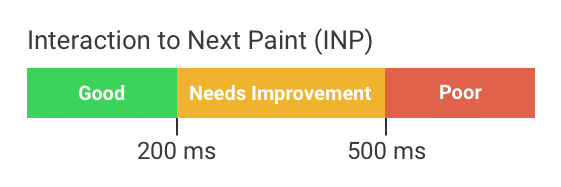
To get a good score, the INP should be below 200 milliseconds. A delay of over 500 milliseconds is considered poor. Your SEO is gradually impacted as INP worsens between the Good and Poor thresholds.
How does Google know how fast your website responds to user interactions? This data is collected from real Chrome users as part of the Chrome User Experience Report (CrUX).
How to test Interaction to Next Paint on your website
Want to find out how well your website does on the INP metric and other Core Web Vitals? Running a free Core Web Vitals test on your website is one quick way to check. Just enter a page URL and wait for the test result.
The real user Interaction to Next Paint data can be found in the Web Vitals tab. The 25-week trend lets you know whether the page is getting better or worse over time.
The data that’s shown here comes from the Google CrUX report.

To get a broader view of different page groups on your website, you can also check the Core Web Vitals tab in Google Search Console. Here you’ll see how many pages are affected by INP issues or otherwise don’t pass the Core Web Vitals assessment.

Unfortunately, the data Google provides isn’t very nuanced, and due to the page grouping mechanism, you may not be able to tell which specific pages are impacted by slow Interaction to next Paint.
Google CrUX data is also aggregated over 28 days. That means you’ll have to wait several weeks to see the impact of any optimizations.
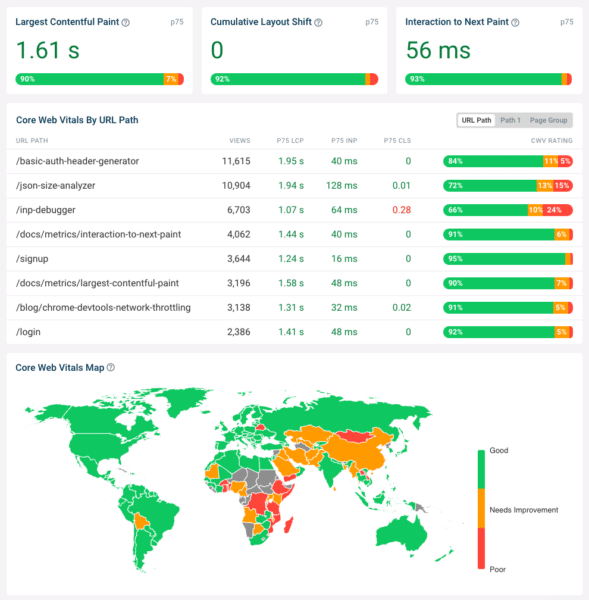
To get more in-depth insight, a dedicated real-user Core Web Vitals monitoring tool like DebugBear can help. This way, you get detailed Core Web Vitals data across your whole website, updating as soon as a change is rolled out.
How do you speed up interactions and improve INP?
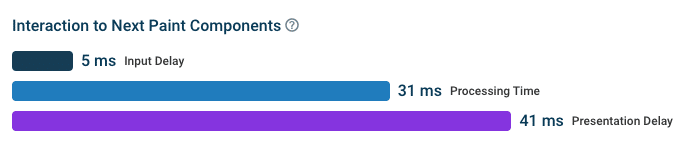
To improve INP scores on your website, you need to know what CPU processing is involved in a user interaction. INP can be divided into three components:
- Input delay: background tasks that prevent the browser from handling an interaction until after the tasks are complete
- Processing time: running code that handles the user interaction and schedules updates to the user interface
- Presentation delay: after UI updates are scheduled, the browser has to update the page layout and present the new content
The performance tab in Chrome DevTools shows how long interactions on the page took and what was responsible for the CPU processing.
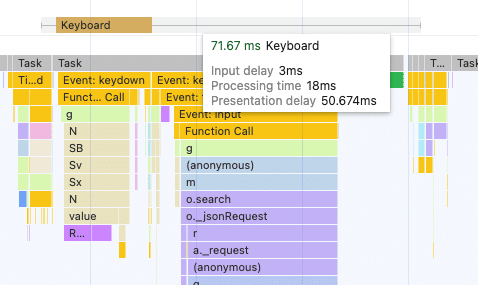
The data in the DevTools performance tab can be hard to read, so you’ll usually want a developer involved. But it provides an explanation for every millisecond that the browser spends while handling the event.
For example, you may find that:
- Third-party code is running in the background and slowing down interactions.
- The JavaScript code your website runs in response to an interaction must be optimized.
- You can schedule CPU tasks more efficiently to reduce the time that interactions are blocked.
Real user monitoring with DebugBear will show you which INP component contributes the most to poor responsiveness on your website.
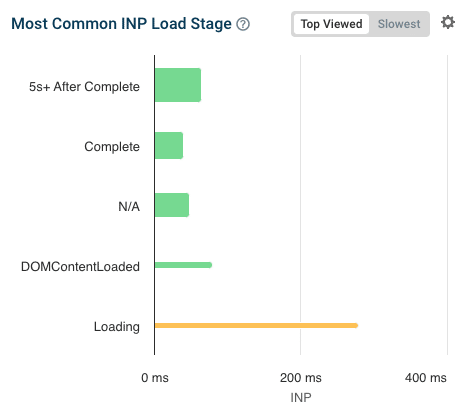
You’ll also often find that interactions take longer during the initial loading process of the website. That’s because when a page first starts loading, many small tasks are run in the background to set up the page, for example, loading ads or initializing a form or chat widget.
DebugBear shows a breakdown of how fast interactions are at different stages and how frequently interactions occur in these time periods (indicated by the height of the bar).
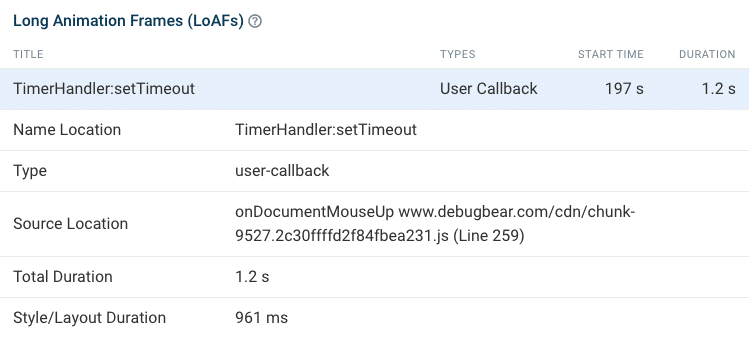
If your website supports the Long Animation Frames API, you’ll also be able to see specific scripts and JavaScript functions that are causing slow interactions for your visitors.
How do I know which page interactions are impacted by slow INP?
If you want to optimize your code and test interactions on your website, you need to know what elements users most often interact with on your website and which interactions often cause slow INP.
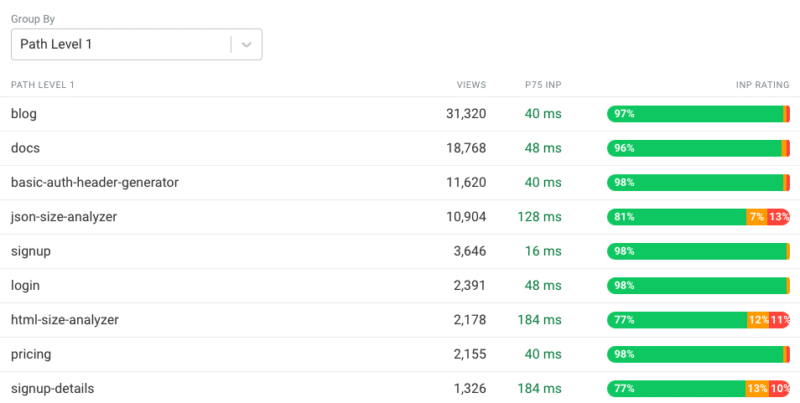
This isn’t data you can get from Google CrUX reports, but a dedicated Core Web Vitals monitoring tool like DebugBear will collect this information for you.
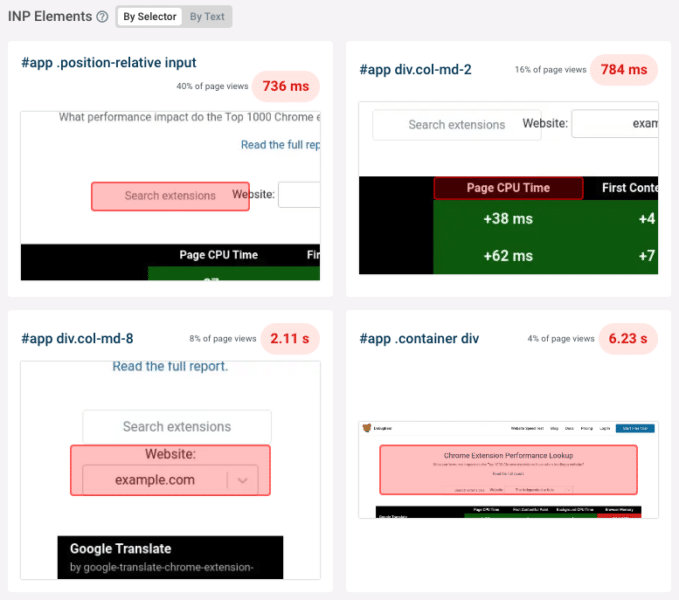
You can filter the data by page, device type, and many other factors to better understand how visitors experience your website. DebugBear reporting can give you targeted advice on how to improve Interaction to Next Paint.
How to monitor Interaction to Next Paint and other Core Web Vitals
A real user monitoring (RUM) solution can help you get ready for the new Interaction to Next Paint metric and help you stay on top of your Core Web Vitals over time.
Try DebugBear with a free 14-day trial. Continuously measure your web vitals and see what pages would benefit the most from optimizations.
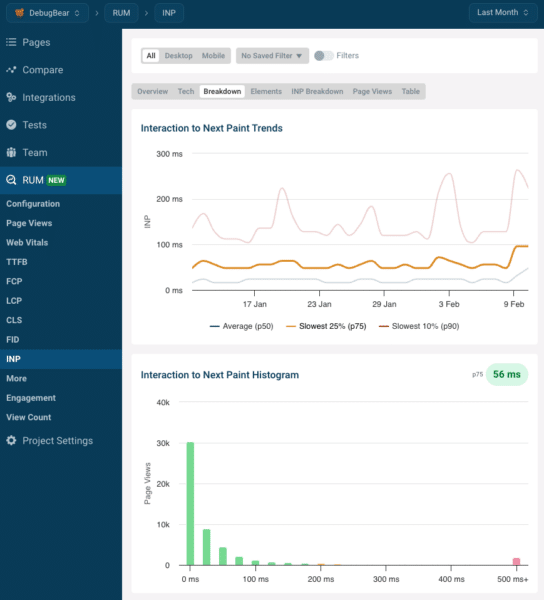
Simply install the DebugBear analytics snippet to gain insight into your visitor experiences. Avoid the 28-day delay that comes with Google’s web vitals data and get detailed reports you can use to deliver a better website experience and rank higher in Google.
Courtesy of Search Engine Land: News & Info About SEO, PPC, SEM, Search Engines & Search Marketing
Category seo news | Tags:
Social Networks : Technorati, Stumble it!, Digg, de.licio.us, Yahoo, reddit, Blogmarks, Google, Magnolia.
Google adds support for product variants and clarifies return fees
Written on February 20, 2024 at 6:48 am, by admin
Google added new structured data to support product variants on e-commerce stores, this includes new technical documentation on how to implement the new structured data and Search Console and rich result testing tools for validation of the new markup. This is called product variant structured data.
Also, Google clarified when to use FreeReturn versus ReturnShippingFees as value for returnFees for product returns in the product structured data documentation.
Product variant details. Google explained that e-commerce sites “for variant products are more complex than single-product sites, and, consequently, the associated structured data is more complex as well. One added complexity is that variants must be grouped together under one “parent” product.” Google’s solution to allow such grouping of variants is by adding new support for the Schema.org ProductGroup type and three new properties:
hasVariant(to nestProductvariants under their parentProductGroup),variesBy(to list the variant-identifying properties), andproductGroupID(the ID, also known as “parent sku” of theProductGroup).
Also added a new isVariantOf property to the product structured data documentation and clarified that Google support product variants with distinct URLs.
Validation support. In addition to the new documentation, Google updated Search Console to support validation and error handling for this new structured data. Google said, “New validations for variants have been added to the Product snippets and Merchant listings reports in Search Console and Rich Results Test.”
Here is what that report looks like:

Return clarifications. As a side note, Google Clarified when to use FreeReturn versus ReturnShippingFees as value for returnFees for product returns in the product structured data documentation.
Why we care. If you run an e-commerce site and you have products that have product variants, such as by sizes, colors, materials, or patterns or different memory sizes, screen sizes, and processors, etc – then you will want to check out this new product variant structured data support.
Utilize the documentation and the testing tools and track any success in search with these implementations.
Courtesy of Search Engine Land: News & Info About SEO, PPC, SEM, Search Engines & Search Marketing
Category seo news | Tags:
Social Networks : Technorati, Stumble it!, Digg, de.licio.us, Yahoo, reddit, Blogmarks, Google, Magnolia.