

How to avoid an SEO disaster during a website redesign
Written on May 6, 2024 at 9:10 am, by admin

If you’ve been investing in SEO for some time and are considering a web redesign or re-platform project, consult with an SEO familiar with site migrations early on in your project.
Just last year my agency partnered with a company in the fertility medicine space that lost an estimated $200,000 in revenue after their organic visibility all but vanished after a website redesign. This could have been avoided with SEO guidance and proper planning
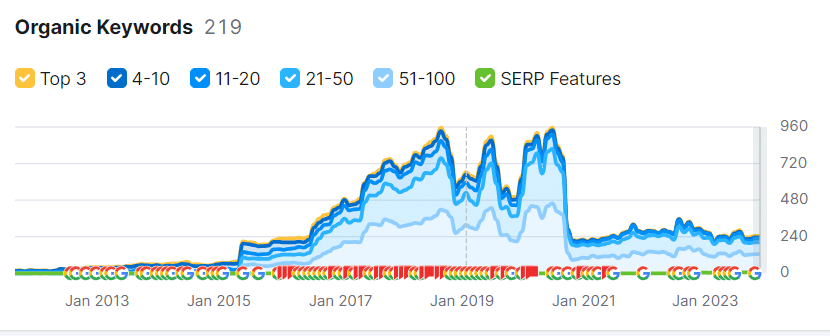
This article tackles a proven process for retaining SEO assets during a redesign. Learn about key failure points, deciding which URLs to keep, prioritizing them and using efficient tools.
Common causes of SEO declines after a website redesign
Here are a handful of items that can wreak havoc on Google’s index and rankings of your website when not handled properly:
- Domain change.
- New URLs and missing 301 redirects.
- Page content (removal/additions).
- Removal of on-site keyword targeting (unintentional retargeting).
- Unintentional website performance changes (Core Web Vitals and page speed).
- Unintentionally blocking crawlers.
These elements are crucial as they impact indexability and keyword relevance. Additionally, I include a thorough audit of internal links, backlinks and keyword rankings, which are more nuanced in how they will affect your performance but are important to consider nonetheless.
Domains, URLs and their role in your rankings
It is common for URLs to change during a website redesign. The key lies in creating proper 301- redirects. A 301 redirect communicates to Google that the destination of your page has changed.
For every URL that ceases to exist, causing a 404 error, you risk losing organic rankings and precious traffic. Google does not like ranking webpages that end in a “dead click.” There’s nothing worse than clicking on a Google result and landing on a 404.
The more you can do to retain your original URL structure and minimize the number of 301 redirects you need, the less likely your pages are to drop from Google’s index.
If you must change a URL, I suggest using Screaming Frog to crawl and catalog all the URLs on your website. This will allow you to individually map old URLs to any receiving changes. Most SEO tools or CMS platforms can import CSV files containing a list of redirects, so you’re stuck adding them one by one.
This is an extremely tedious portion of SEO asset retention, but it is the only surefire way to guarantee that Google will connect the dots between what is old and new.
In some cases, I actually suggest creating 404s to encourage Google to drop low-value pages from its index. A website redesign is a great time to clean house. I prefer websites to be lean and mean. Concentrating the SEO value across fewer URLs on a new website can actually see ranking improvements.
A less common occurrence is a change to your domain name. Say you want to change your website URL from “sitename.com” to “newsitename.com”, though Google has provided a means for communicating the change within Google Search Console via their Change of Address Tool, you still run the risk of losing performance if redirects are not set up properly.
I recommend avoiding a change in domain name at all costs. Even if everything goes off without a hitch, Google may have little to no history with the new domain name, essentially wiping the slate clean (in a bad way).
Webpage content and keyword targeting
Google’s index is primarily composed of content gathered from crawled websites, which is then processed through ranking systems to generate organic search results. Ranking depends heavily on the relevance of a page’s content to specific keyword phrases.
Website redesigns often entail restructuring and rewriting content, potentially leading to shifts in relevance and subsequent changes in rank positions. For example, a page initially optimized for “dog training services” may become more relevant to “pet behavioral assistance,” resulting in a decrease in its rank for the original phrase.
Sometimes, content changes are inevitable and may be much needed to improve a website’s overall effectiveness. However, consider that the more drastic the changes to your content, the more potential there is for volatility in your keyword rankings. You will likely lose some and gain others simply because Google must reevaluate your website’s new content altogether.
Metadata considerations
When website content changes, metadata often changes unintentionally with it. Elements like title tags, meta descriptions and alt text influence Google’s ability to understand the meaning of your page’s content.
I typically refer to this as a page being “untargeted or retargeted.” When new word choices within headers, body or metadata on the new site inadvertently remove on-page SEO elements, keyword relevance changes and rankings fluctuate.
Web performance and Core Web Vitals
Many factors play into website performance, including your CMS or builder of choice and even design elements like image carousels and video embeds.
Today’s website builders offer a massive amount of flexibility and features giving the average marketer the ability to produce an acceptable website, however as the number of available features increases within your chosen platform, typically website performance decreases.
Finding the right platform to suit your needs, while balancing Google’s performance metric standards can be a challenge.
I have had success with Duda, a cloud-hosted drag-and-drop builder, as well as Oxygen Builder, a lightweight WordPress builder.
Unintentionally blocking Google’s crawlers
A common practice among web designers today is to create a staging environment that allows them to design, build and test your new website in a “live environment.”
To keep Googlebot from crawling and indexing the testing environment, you can block crawlers via a disallow protocol in the robots.txt file. Alternatively, you can implement a noindex meta tag that instructs Googlebot not to index the content on the page.

As silly as it may seem, websites are launched all the time without removing these protocols. Webmasters then wonder why their site immediately disappears from Google’s results.
This task is a must-check before your new site launches. If Google crawls these protocols your website will be removed from organic search.
Dig deeper: How to redesign your site without losing your Google rankings
Tools for SEO asset migration
In my mind, there are three major factors for determining what pages of your website constitute an “SEO asset” – links, traffic and top keyword rankings.
Any page receiving backlinks, regular organic traffic or ranking well for many phrases should be recreated on the new website as close to the original as possible. In certain instances, there will be pages that meet all three criteria.
Treat these like gold bars. Most often, you will have to decide how much traffic you’re OK with losing by removing certain pages. If those pages never contributed traffic to the site, your decision is much easier.
Here’s the short list of tools I use to audit large numbers of pages quickly. (Note that Google Search Console gathers data over time, so if possible, it should be set up and tracked months ahead of your project.)
Links (internal and external)
- Semrush (or another alternative with backlink audit capabilities)
- Google Search Console
- Screaming Frog (great for managing and tracking internal links to key pages)
Website traffic
- Google Analytics 4
- Google Search Console
Keyword rankings
- Semrush (or another alternative with keyword rank tracking)
- Google Search Console
Information architecture
- Octopus.do (lo-fi wireframing and sitemap planning)
How to identify SEO assets on your website
As mentioned above, I consider any webpage that currently receives backlinks, drives organic traffic or ranks well for many keywords an SEO asset – especially pages meeting all three criteria.
These are pages where your SEO equity is concentrated and should be transitioned to the new website with extreme care.
If you’re familiar with VLOOKUP in Excel or Google Sheets, this process should be relatively easy.
1. Find and catalog backlinked pages
Begin by downloading a complete list of URLs and their backlink counts from your SEO tool of choice. In Semrush you can use the Backlink Analytics tool to export a list of your top backlinked pages.
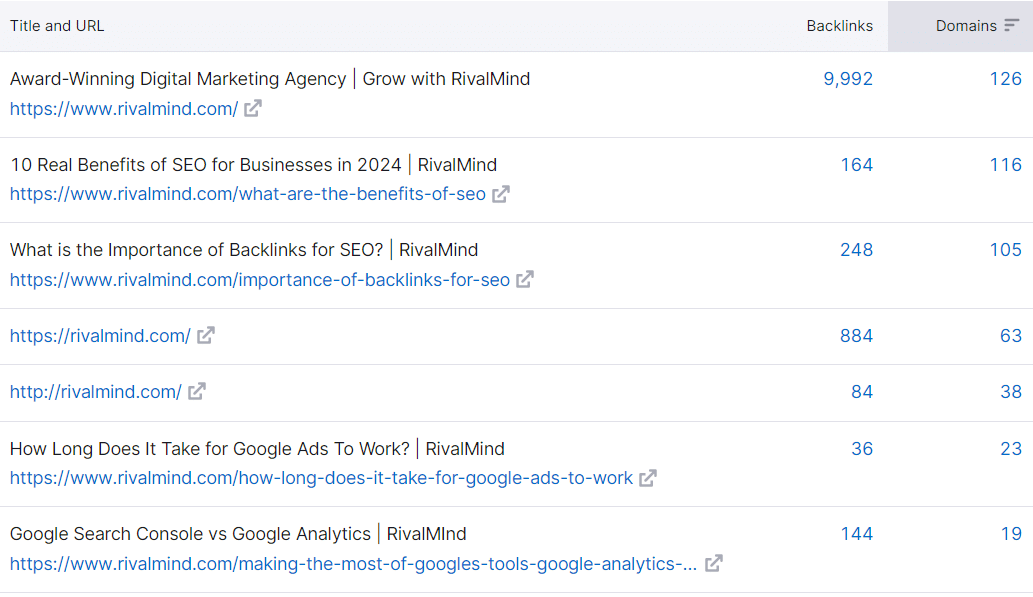
Because your SEO tool has a finite dataset, it’s always a smart idea to gather the same data from a different tool, this is why I set up Google Search Console in advance. We can pull the same data type from Google Search Console, giving us more data to review.
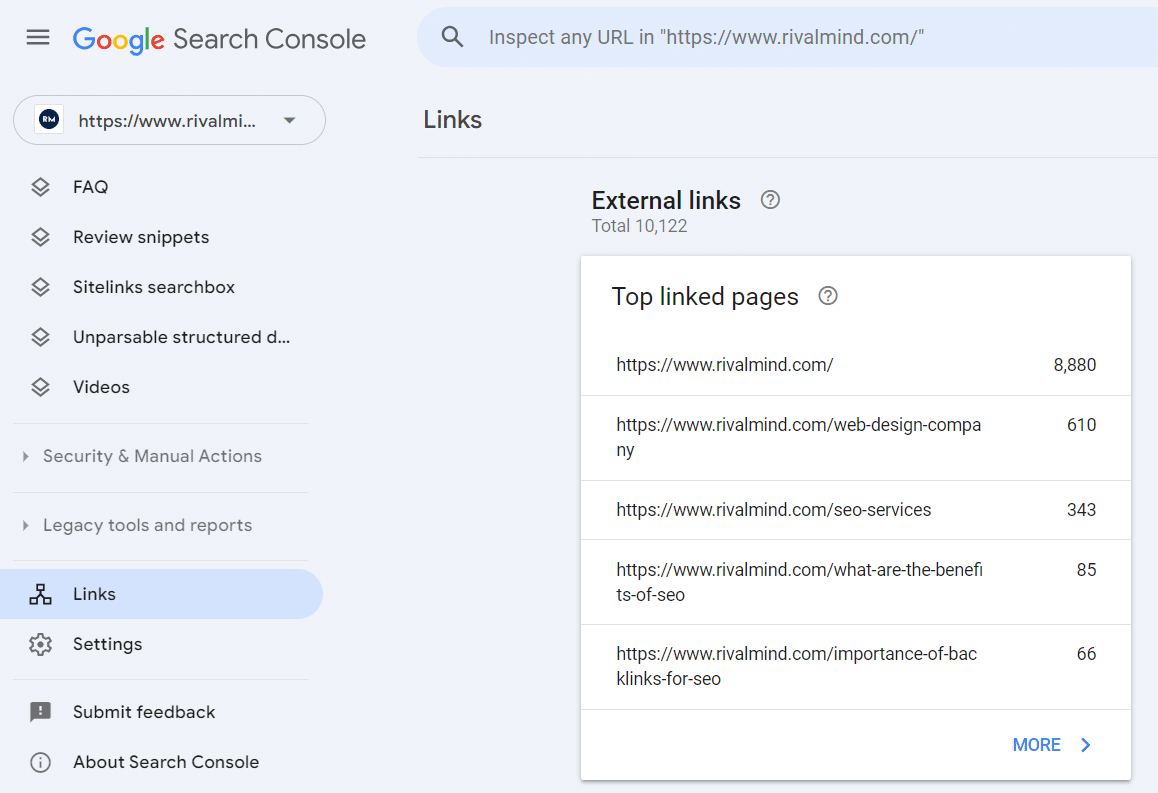
Now cross-reference your data, looking for additional pages missed by either tool, and remove any duplicates.
You can also sum up the number of links between the two datasets to see which pages have the most backlinks overall. This will help you prioritize which URLs have the most link equity across your site.
Internal link value
Now that you know which pages are receiving the most links from external sources, consider cataloging which pages on your website have the highest concentration of internal links from other pages within your site.
Pages with higher internal link counts also carry more equity, which contributes to their ability to rank. This information can be gathered from a Screaming Frog Crawl in the URL Details or Inlinks report.
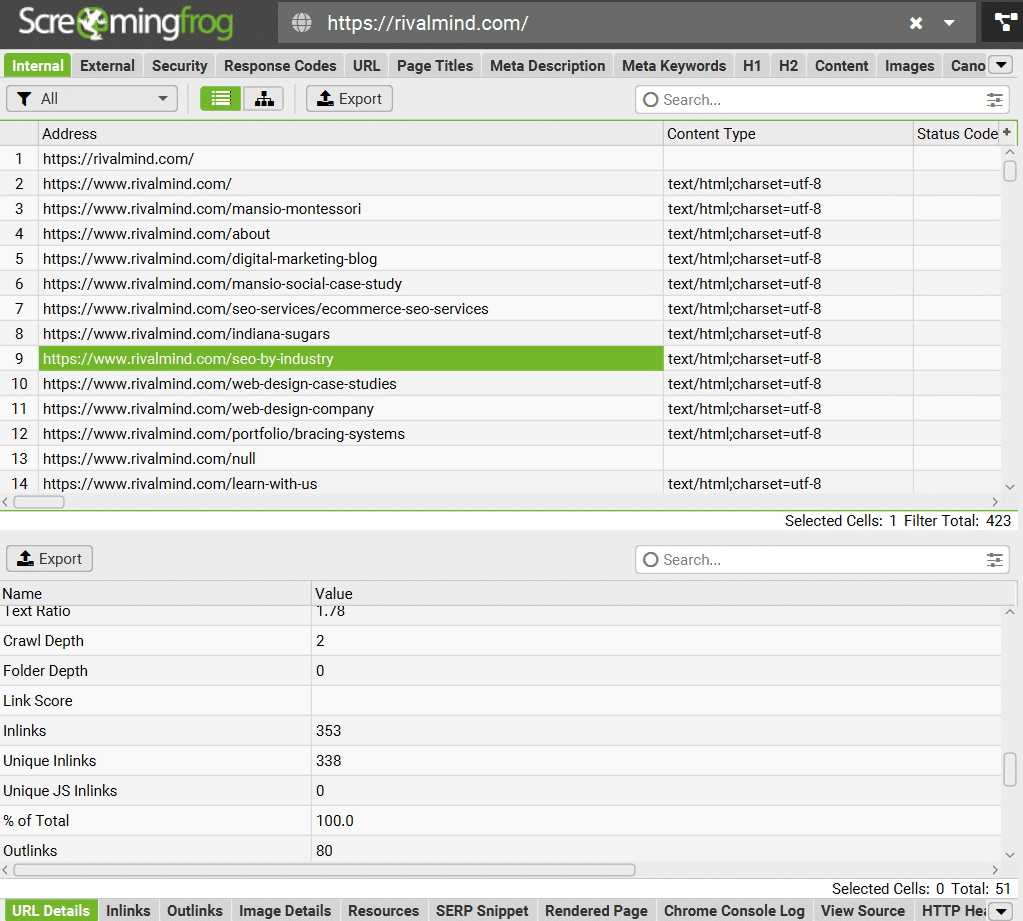
Consider what internal links you plan to use. Internal links are Google’s primary way of crawling through your website and carry link equity from page to page.
Removing internal links and changing your site’s crawlability can affect its ability to be indexed as a whole.
2. Catalog top organic traffic contributors
For this portion of the project, I deviate slightly from an “organic only” focus.
It’s important to remember that webpages draw traffic from many different channels and just because something doesn’t drive oodles of organic visitors, doesn’t mean it’s not a valuable destination for referral, social or even email visitors.
The Landing Pages report in Google Analytics 4 is a great way to see how many sessions began on a specific page. Access this by selecting Reports > Engagement > Landing Page.
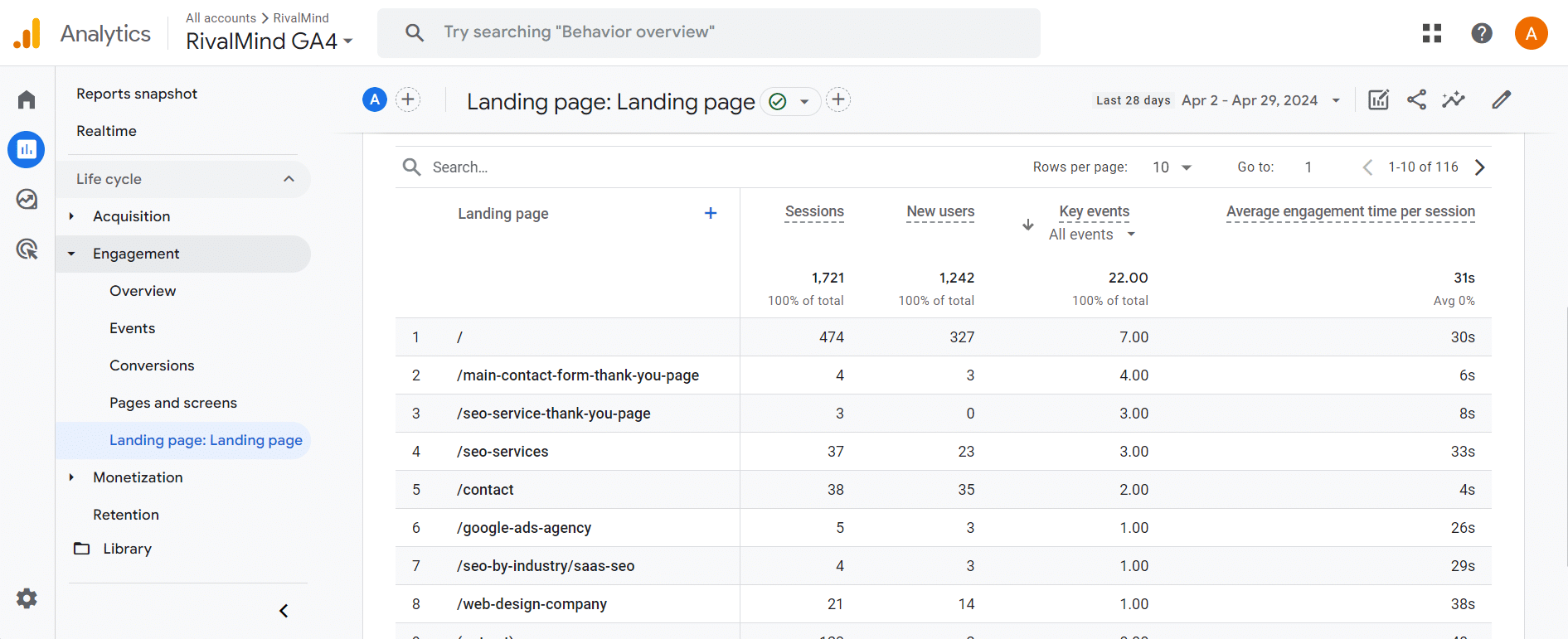
These pages are responsible for drawing people to your website, whether it be organically or through another channel.
Depending on how many monthly visitors your website attracts, consider increasing your date range to have a larger dataset to examine.
I typically review all landing page data from the prior 12 months and exclude any new pages implemented as a result of an ongoing SEO strategy. These should be carried over to your new website regardless.
To granularize your data, feel free to implement a Session Source filter for Organic Search to see only Organic sessions from search engines.
3. Catalog pages with top rankings
This final step is somewhat superfluous, but I am a stickler for seeing the complete picture when it comes to understanding what pages hold SEO value.
Semrush allows you to easily gather a spreadsheet of your webpages that have keyword rankings in the top 20 positions on Google. I consider rankings in position 20 or better very valuable because they usually require less effort to improve than keyword rankings in a worse position.
Use the Organic Research tool and select Pages. From here you can export a list of your URLs with keyword rankings in the top 20.
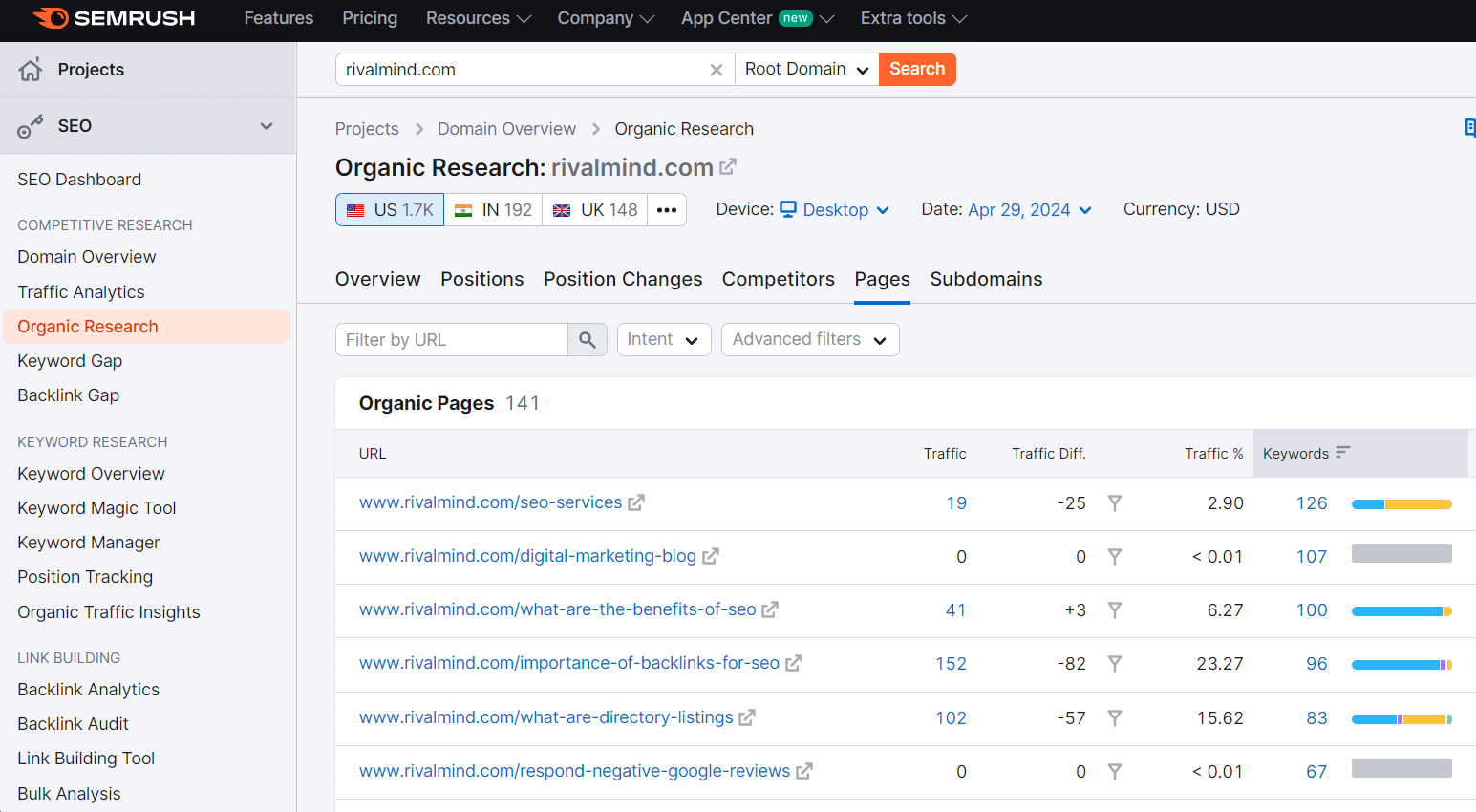
By combining this data with your top backlinks and top traffic drivers, you have a complete list of URLs that meet one or more criteria to be considered an SEO asset.
I then prioritize URLs that meet all three criteria first, followed by URLs that meet two and finally, URLs that meet just one of the criteria.
By adjusting thresholds for the number of backlinks, minimum monthly traffic and keyword rank position, you can change how strict the criteria are for which pages you truly consider to be an SEO asset.
A rule of thumb to follow: Highest priority pages should be modified as little as possible, to preserve as much of the original SEO value you can.
Seamlessly transition your SEO assets during a website redesign
SEO success in a website redesign project boils down to planning. Strategize your new website around the assets you already have, don’t try to shoehorn assets into a new design.
Even with all the boxes checked, there’s no guarantee you’ll mitigate rankings and traffic loss.
Don’t inherently trust your web designer when they say it will all be fine. Create the plan yourself or find someone who can do this for you. The opportunity cost of poor planning is simply too great.
Courtesy of Search Engine Land: News & Info About SEO, PPC, SEM, Search Engines & Search Marketing
Category seo news | Tags:
Social Networks : Technorati, Stumble it!, Digg, de.licio.us, Yahoo, reddit, Blogmarks, Google, Magnolia.
How to uncover hidden gems in your paid search accounts
Written on May 6, 2024 at 9:10 am, by admin

A PPC professional’s job goes beyond just launching paid search campaigns.
An equally important task is optimizing and scaling those campaigns for maximum effectiveness and impact.
This requires diving deep into the performance data to uncover valuable insights that can inform optimization strategies.
The data from your paid search campaigns contains a wealth of insights waiting to be uncovered. By analyzing metrics, keywords, competitive landscape and user paths, you can identify opportunities to improve targeting, messaging, budgets and overall campaign performance.
This guide will walk through some key reports, tools and analyses that can yield impactful insights for optimizing your paid search efforts.
Harness the power of ad platforms and campaigns
Our friendly ad interfaces, Google Ads and Microsoft Ads, offer a wealth of powerful information if you know where and how to look for it.
Metrics matter
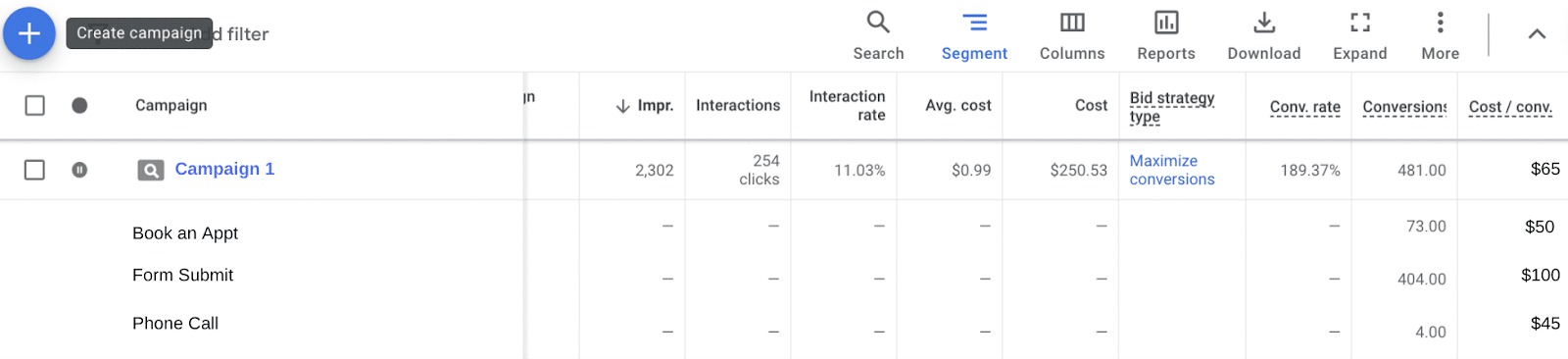
Analyze key metrics like click-through rate (CTR), cost-per-click (CPC), conversion rate (CVR), conversion volume and cost-per-conversion across the different objectives and campaign types in your account and note any discrepancy or misalignment.
For example, let’s say you’re looking at a campaign and notice a high CTR coupled with a low CVR. What does this indicate?
It could mean there is:
- A mismatch between your ad copy messaging and the intended audience.
- A misalignment in who your target audience is.
- Or a need to refine your landing page experience.
Testing will determine which element needs adjusting, but uncovering this misalignment provides a starting point.
In another example, let’s look at cost-per-conversion. With a thorough conversion setup including conversion values, you can examine cost-per-conversion across the different conversion actions to understand the true value of a campaign.
If a campaign has a high overall cost-per-conversion you may be inclined to turn it off.
If you notice that segmented actions have a low cost-per-conversion for a high-priority action, you might be inclined to:
- Adjust your conversion scoring (primary vs. secondary).
- Update landing pages to feature the high-priority action more.
- Increase investment in the campaign because it drives high-quality conversion actions.
Keywords are cornerstone
Keywords are the foundation of a paid search account. Foundational keyword research often determines the entire structure and segmentation of an account.
Analyzing keywords post-launch is a typical part of account maintenance and provides a window into several important insights.
I always start by doing an n-gram analysis – a streamlined way to examine your keywords on a larger scale than combing through search query reports or keyword reports individually.
N-gram analysis allows you to break down and group your keyword sets into themes, making it easier and clearer to discover otherwise hidden trends and areas of opportunity.
I like to use these breakdowns to identify what themes show up most often with especially strong or weak performance (remember that metrics matter).
- For themes with strong performance, you can consider creating new campaigns or ad groups to prioritize messaging, budget allocation, etc.
- For those with weaker performance, you can incorporate negative phrase match keywords that align with the underperforming themes to save your ad spend and ensure you’re reaching the right audience.

Understand where you are showing up
Take a look at your Auction Insights reports, they may surprise you. You often have an idea of who your direct competitors are, but that doesn’t mean that they are the only people in the ads auction that you are up against.
Reviewing your impression share via the Auction Insights report regularly can help uncover hidden insights to help with competitor identification as well as keyword targeting and refinement.
A couple of things to keep an eye out for and what kinds of insights they may uncover:
- New advertisers listed that are aligned in industry, product/service with you: New competition to keep an eye on for market share availability, competitor research, potential conquesting opportunity.
- New advertisers listed that are not aligned in industry, product or service: You may be targeting keywords that are pulling in queries that are less relevant than is ideal, either by match type or the term itself.
- Large fluctuations in impression share (for yourself or other advertisers): This can indicate greater or reduced investment which can influence things like CPC, cost-per-conversion and in turn your bid strategies and ad spend budget allocations.
Dig deeper: How to improve PPC campaign performance: A checklist
Beyond the platform: Using Google Analytics 4 to dive deeper
In addition to the insights you can gather from the platforms themselves, you can also use other reporting and analytics tools to uncover more holistic insights about paid search.
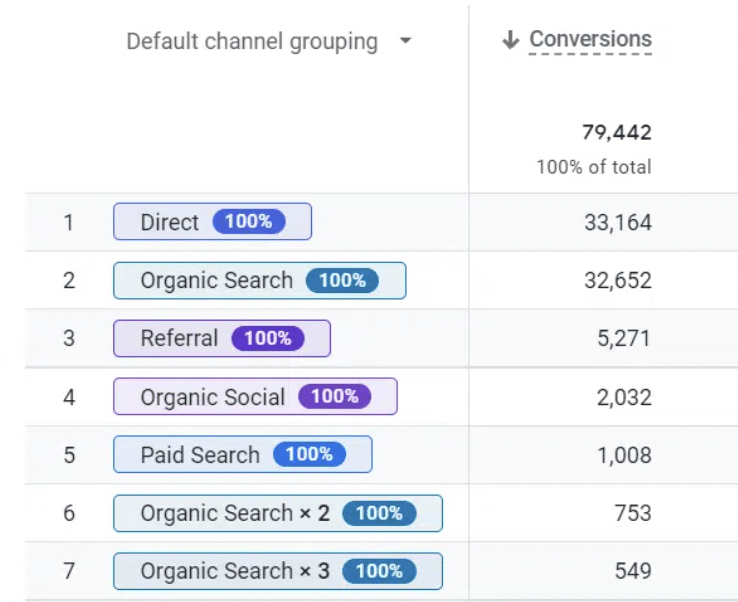
So many valuable insights can be found by delving deeper into the user journey of your customers. The conversion path reporting in GA4 is the perfect tool for this and allows visibility and insight into the number of touchpoints a user takes before converting, the different channels they interact with on this path and several associated metrics.
This insight helps you understand how paid search interacts with other marketing channels, letting you identify gaps or a need for further paid search coverage and develop a holistic omnichannel approach.
For example, if you notice that the most frequent path to conversion is a journey that includes Paid Search > Organic > Paid Search, this may indicate that users aren’t far enough down the funnel to make a decision the first time they see an ad and are conducting deeper research before converting.
You can use this insight to incorporate more nurture elements into your ad strategy, adjust landing page content, etc.
Dig deeper: How to combine GA4 and Google Ads for powerful paid search results
Revealing untapped potential within your paid search accounts
There is an endless wealth of insights you can gather from your paid search accounts. Some that I have found to be impactful and have shared here for you are:
- Focus on key metrics and their relationship to each other, your campaign objectives and campaign types.
- Use n-gram analysis to uncover keyword themes, trends and areas of opportunity.
- Be mindful of the Auction Insights report to monitor competitive activity, changes in investment and seek potential coverage gaps.
- Use Google Analytics 4 conversion path reports to understand where paid search fits into the bigger picture.
This is by no means a comprehensive list of strategies for uncovering hidden gems in your paid search accounts, but it is a good place to start.
Courtesy of Search Engine Land: News & Info About SEO, PPC, SEM, Search Engines & Search Marketing
Category seo news | Tags:
Social Networks : Technorati, Stumble it!, Digg, de.licio.us, Yahoo, reddit, Blogmarks, Google, Magnolia.
Google unveils new ways to reach streaming audiences
Written on May 4, 2024 at 3:09 am, by admin

Google took center stage at the IAB NewFronts in New York City, pitching advertisers on their evolving streaming ad offerings.
The big idea: With streaming continuing to fragment audiences across various platforms and services, ad giants are competing to offer marketers unified solutions for reaching those viewers.
Why we care: This new means of doing programmatic will allow advertisers to manage video campaigns much more quickly through an already familiar platform.
State of play: Google introduced a plan to “rethink programmatic TV” by having advertisers centralize their streaming ad buys through its web-focused demand-side platform, Display & Video 360 (DV360).
The company touted DV360’s ability to stitch together fragmented streaming inventory sources, reaching 92% of U.S. connected TV households, according to Sean Downey, Google’s president of Americas and global partners.
In one cited case study, SAP used DV360 to reach 29 million unique viewers, with 5.6 million incremental.
Between the lines: Google is replicating its strategy of using YouTube as the foundational driver for ad sales across streaming TV, leveraging DV360’s direct access to the platform’s dominant viewership.
- DV360 also pulls in third-party inventory like Disney’s streaming ad supply through a new partnership.
Google is adding new measurement capabilities like cross-device conversion reporting for connected TV campaigns.
Bottom line: The connected TV ad market is rapidly evolving and highly fragmented. Google is staking its claim as a unified solution, but it remains a wide-open field.
Google’s announcement. Display & Video 360 updates from Google NewFront
Courtesy of Search Engine Land: News & Info About SEO, PPC, SEM, Search Engines & Search Marketing
Category seo news | Tags:
Social Networks : Technorati, Stumble it!, Digg, de.licio.us, Yahoo, reddit, Blogmarks, Google, Magnolia.
Google, DOJ make closing arguments in antitrust trial
Written on May 3, 2024 at 12:09 am, by admin

Google and the Department of Justice are presenting their closing arguments today and tomorrow in the government’s landmark antitrust case against the company that owns a global search monopoly.
Rewind. The 10-week, high-stakes legal battle probed the business practices of Googe Search last fall.
- Catch up on all the issues at play in U.S. vs. Google antitrust trial: Everything you need to know.
Why we care: The outcome of this case could forever change how Google operates, which would have downstream impacts on search marketers. The ruling could lead to a leveling of the advertising market, meaning lower costs and more choice.
What to watch: The DOJ will summarise its significant allegations against Google on Thursday and Friday. Allegations come down to these three main points:
- Google used lucrative deals with partners like Apple to cement itself as the default search engine across devices and platforms.
- Google paid billions annually to secure those default positions – $26 billion in 2021 alone. (This includes $20 billion alone to be the default on Apple’s Safari browser, according to newly unsealed court records.)
- Google failing to justify why it pays so much beyond stifling competition
The other side: Google rejected accusations of anticompetitive conduct, asserting that users prefer its best-in-class search engine and that its dominance is not due to any alleged monopolistic tactics.
- “We are working very, very hard; for any given query we provide the best experience,” CEO Sundar Pichai testified. “That’s always been our true north.”
Bottom line: This landmark case carries existential implications for Google’s core search business if the DOJ prevails.
What’s next: After closing arguments, Judge Amit Mehta will weigh the liability case before him. One potential (though unlikely) outcome could be a breakup of Google, which will be determined later if he rules against the company.
Courtesy of Search Engine Land: News & Info About SEO, PPC, SEM, Search Engines & Search Marketing
Category seo news | Tags:
Social Networks : Technorati, Stumble it!, Digg, de.licio.us, Yahoo, reddit, Blogmarks, Google, Magnolia.
Small review site lost 91% of its Google traffic to affiliate-focused SEO content
Written on May 3, 2024 at 12:09 am, by admin

HouseFresh, a small, independent product review website that called out Google after being consistently outranked by larger publishers – has lost 91% of its Google traffic following the March 2024 core update.
In a new blog post, HouseFresh has virtually disappeared from Google Search results. Now what?, Gisele Navarro highlighted ongoing issues with Google’s product search results favoring “affiliate-focused SEO content” from big media brands, what they’ve learned and what’s next for the site.
Why we care. There has been a lot of anger about Google killing websites and industries in the wake of the March 2024 core update – and more is on the way in the form of Google’s new reputation abuse policy, which goes into effect after May 5.
Keyword swarming. Big media brands (e.g., Dotdash Meredith, Forbes) are using a tactic called “keyword swarming” and flooding the web with subpar content, yet dominating Google’s search results.
- Meanwhile, hollowed-out carcasses of legacy brands (e.g., DeadSpin and Money) pump out commercial (sometimes AI-generated) content, all designed to drive affiliate revenue while squeezing out every ounce of brand value that remains.
Traffic loss. HouseFresh also revealed how much traffic it has lost since October:
- “Since October 2023, we’ve gone from welcoming 4,000 people from Google Search each day to just receiving 200. And of those 200, most are adding ‘HouseFresh’ to their searches to find us specifically.”
Google doesn’t owe HouseFresh traffic. Navarro acknowledged that “Google doesn’t owe us anything. We don’t simply deserve to get search traffic because we exist or because we say we should.”
- She also hit back at people for “gaslighting us into thinking that our content is not helpful enough for readers.” (However, from what I saw, this was an honest critique, not gaslighting).
History repeats itself (again). SEO pioneer Mike Grehan discussed a similar experience that occurred at a search conference right after Google’s huge Florida update in 2003:
“So many attendees … felt that Google was putting them out of business.
One guy … explained loudly to the packed room that he had been the number one result at Google in his niche for two years, and his business was booming. Then, after the update, there was no sign of him in the SERP.
I suggested that he, perhaps, should not have ‘bet the farm’ on this one source of revenue to sustain his business. I also suggested that, yes, we should go to Mountain View and visit Google. And when we see either [Larry] Page or Sergey Brin come through the reception, he should walk right up to whichever one it was, kneel down and kiss his ass ‘because he’s been sending you free customers for two years!’”
Google’s Florida update: 20 years since the SEO ‘volcanic eruption’,
None of this is new. People have complained about Google driving them out of business for 20+ years. That won’t make HouseFresh feel better – but the reality is Google doesn’t owe you traffic, rankings or a living.
What’s next for HouseFresh. Navarro promises to be “relentless” on every platform where it makes sense for them to be. Sounds a bit like diversification, doesn’t it?
Courtesy of Search Engine Land: News & Info About SEO, PPC, SEM, Search Engines & Search Marketing
Category seo news | Tags:
Social Networks : Technorati, Stumble it!, Digg, de.licio.us, Yahoo, reddit, Blogmarks, Google, Magnolia.
Google restricts promotion of deep fake sexual content
Written on May 3, 2024 at 12:09 am, by admin

Google introduced new restrictions on deep fake sexual content for Shopping ads. Google also updated its general content policy prohibiting promoting synthetic content that has been altered or generated to be sexually explicit or contain nudity
Why we care. Google will issue a warning to advertisers if they violate this policy. Continued violations could result in an account suspension.
What changed. Google advertisers can no longer use Shopping ads to:
- Promote services that generate, distribute or store synthetic sexually explicit content or synthetic content containing nudity. This includes services that create “deepfakes” and other manipulated imagery.
- Create ads for content that provides instructions on the creation of synthetic sexually explicit content or synthetic content with nudity.
Enforcement. The enforcement started yesterday (May 1) for Shopping ads. For all other ad types, advertisers have until May 30 to make all necessary changes to ensure their ads fall within the scope of the policy.
Courtesy of Search Engine Land: News & Info About SEO, PPC, SEM, Search Engines & Search Marketing
Category seo news | Tags:
Social Networks : Technorati, Stumble it!, Digg, de.licio.us, Yahoo, reddit, Blogmarks, Google, Magnolia.
7 ways to use the ‘inspect element’ tool for SEO
Written on May 3, 2024 at 12:09 am, by admin

The Inspect feature on Chrome (also called “inspect element”) lets you check under the hood of any page or website. You can use it to diagnose problems, test changes on your site and even spy on your competitors.
Right-click on any page and scroll down to Inspect to see the code with which the site is built.
You’ll see the page on the left window and different tabs on the right with all the site’s code. You can expand and collapse elements to browse that page’s code.

From the Elements tab, you can see what the page would look like if you edited, removed or added elements. You can also find information about how a website is set up. The Console, Sources, Network and other tabs can also help with more advanced technical audits.
It helps to know basic HTML and CSS, but you can answer many basic questions just from the Elements tab if you know what kind of code to look for.
1. What color is that?
Find the unique hex code for any color on the web by using Inspect.
- Right-click on the element you want to see.
- Scroll down to find the color swatch and hex code.
- Click the swatch to play around with different colors for that element.
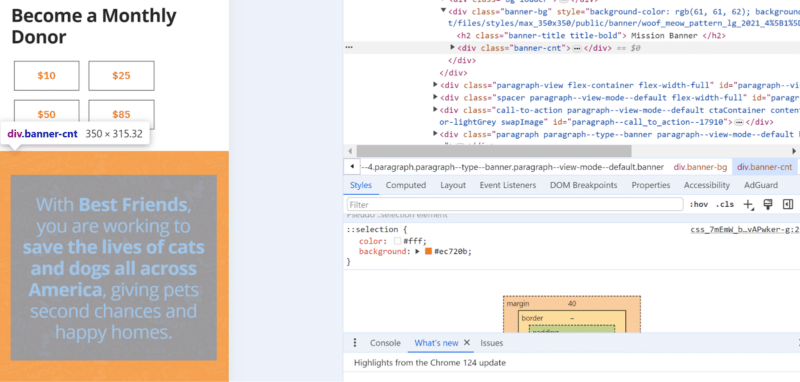
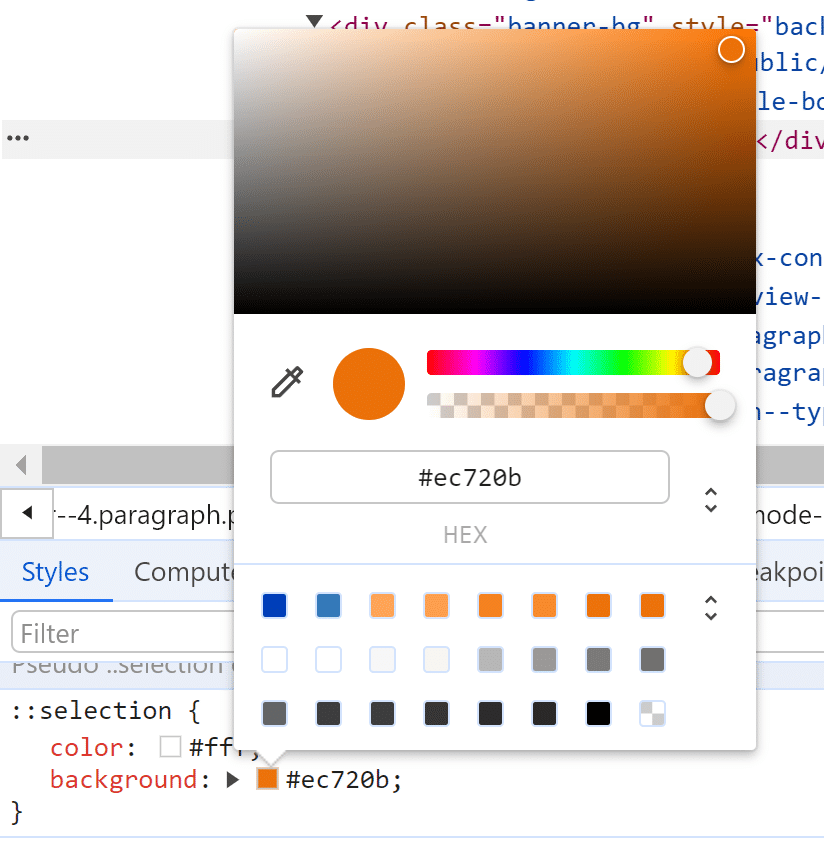
Every color has a unique hex code or a universal 6-digit code combo that represents the color. For example, pure white is #FFFFFF, pure black is #000000 and mint green is #98FF98.
If you don’t see the color you’re looking for, check for any parent element color settings that might override the child elements.
This is handy for solving questions like:
- What colors do users prefer? Can I find a fresh color to try?
- What color is my competitor testing for their call to action?
- Are my site colors following brand guidelines?
- Does that color combo follow usability guidelines?
2. What font is that?
Serif fonts are hot right now. You can find new fonts on any site by right-clicking the element and looking for the font CSS.
- Right-click the copy.
- In the Styles tab at the bottom, look for the same tag.
- Scroll down to the font tags.
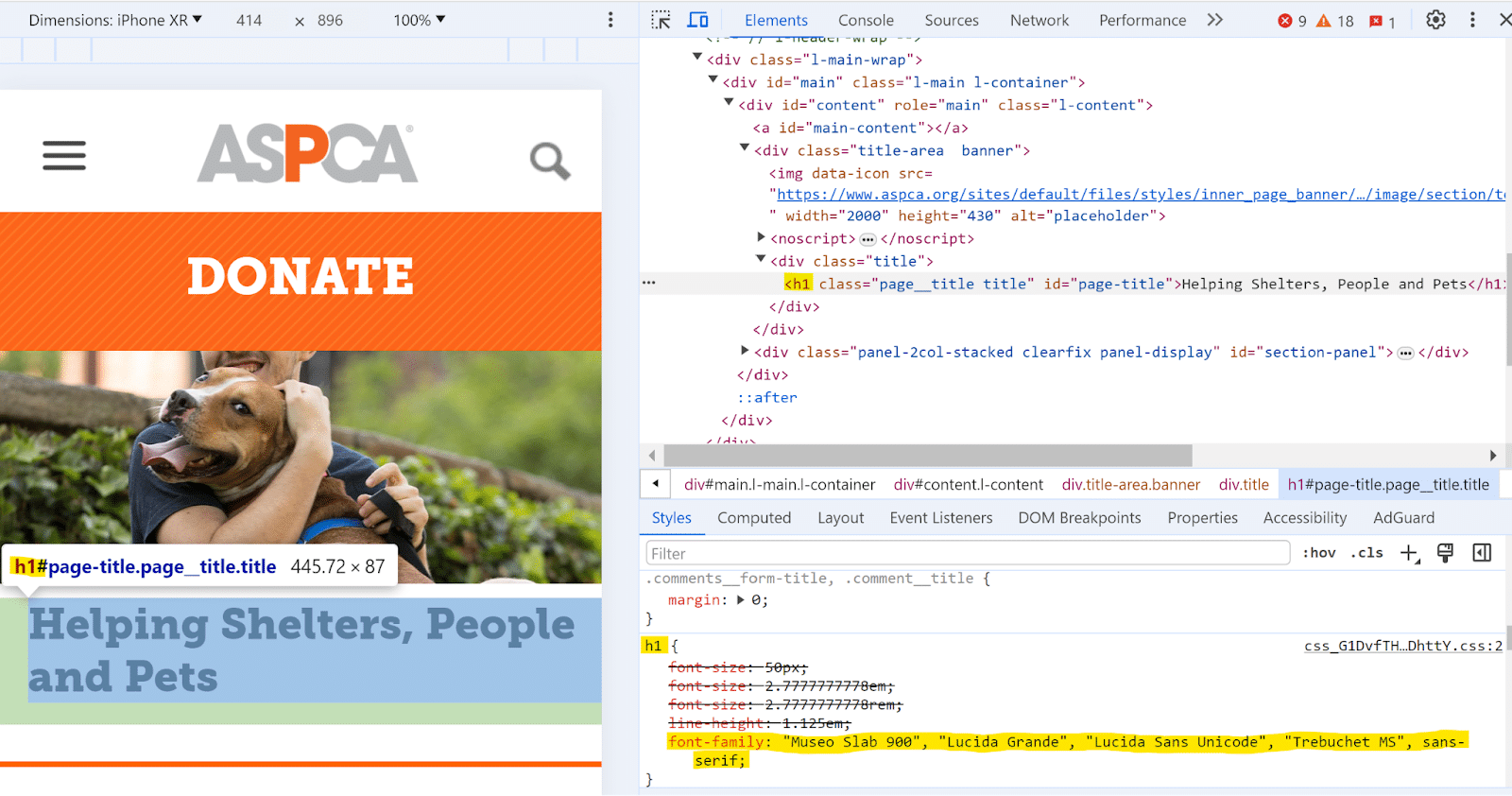
If you see multiple fonts listed in the code, those are backup fonts. The first font is the default, which will appear if the user’s browser has access to that font. If that font isn’t available for some reason, the browser will fall back to the second font listed and so on through the list.
You can also check the font size and line height too.
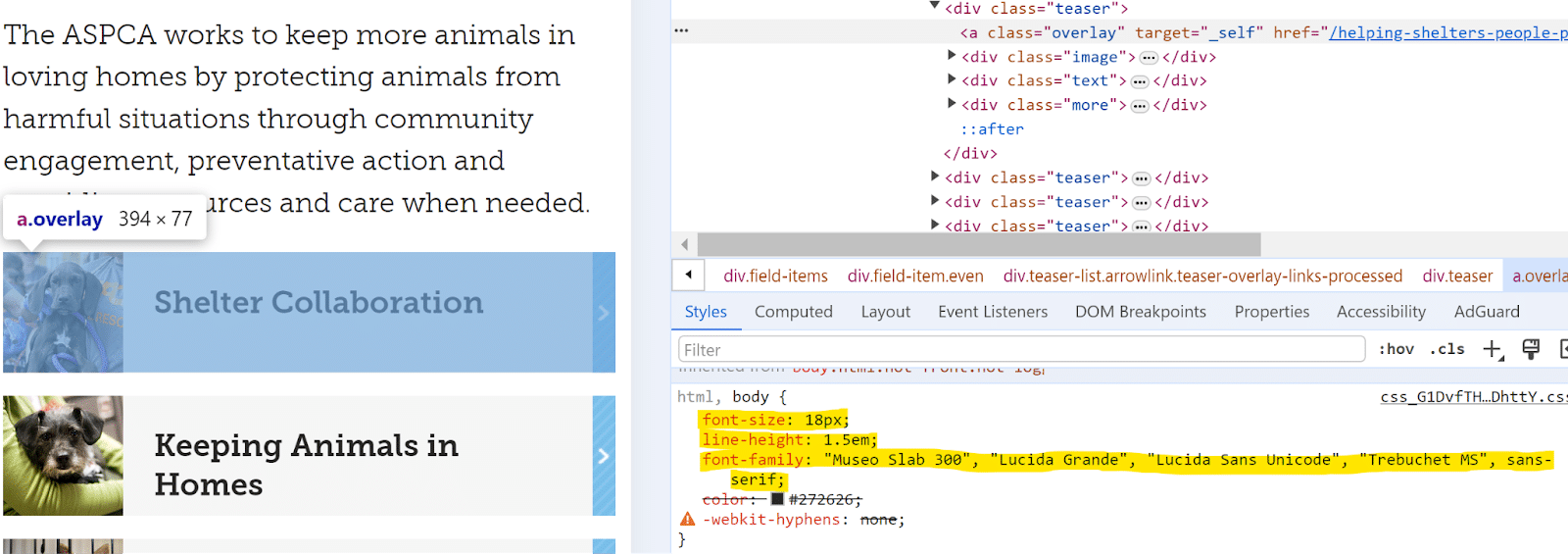
Choosing a good font size depends on the font, line height and boldness. A good rule of thumb is to aim for a minimum of 14 pixels for body copy and 20 pixels for header fonts.
- H1: 30-34 pixels
- H2: 28-30 pixels
- H3: 24-26 pixels
- H4: 20-22 pixels
- Body: 16-18 pixels
3. Will that content change look good?
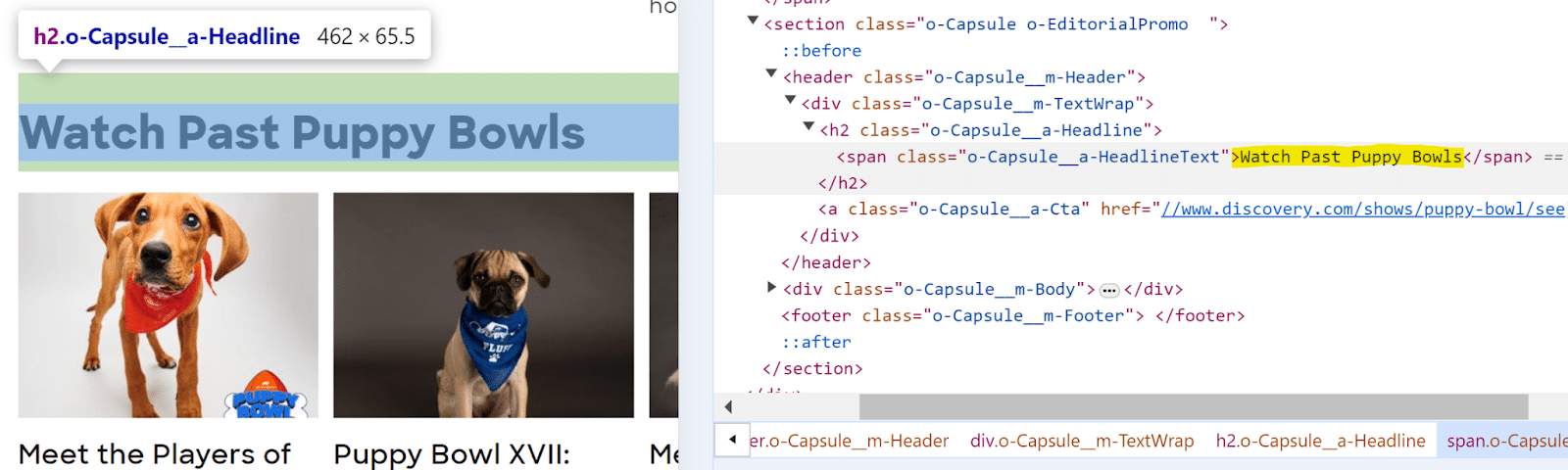
Use Inspect to see what a change will look like before going live. This is especially helpful if you need to take a screenshot to get approval before or after you go live with a page edit or if you want to check how a change will look on desktop and mobile first.
- Inspect the element you want to change.
- Double-click the copy you want to edit.
- Edit the copy.
- Click outside the element.
- Make tweaks until you’re happy with it.

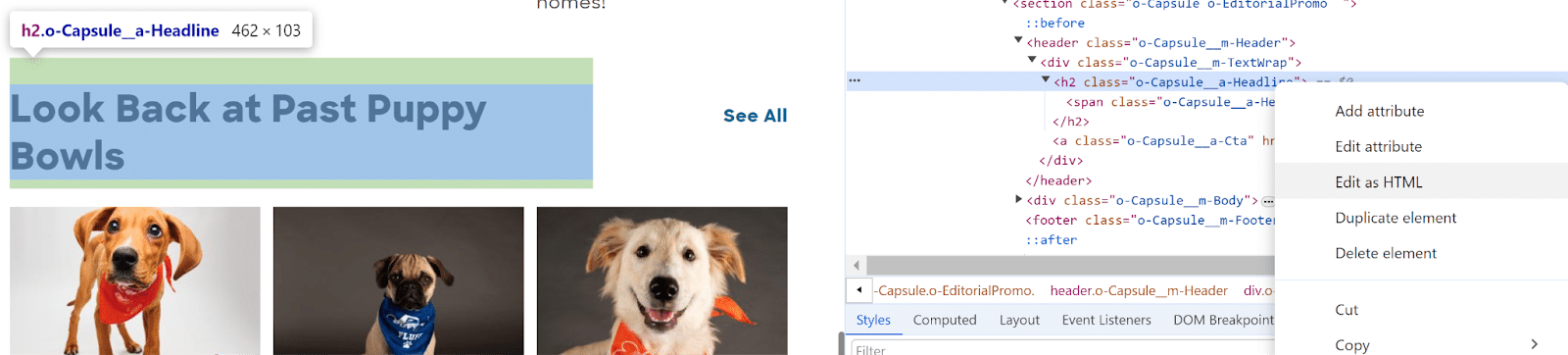
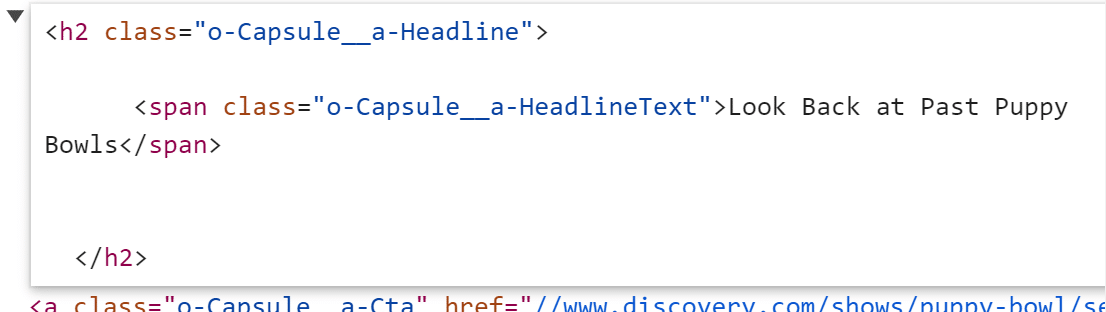
If the element you’re editing has multiple pieces of code within the element, like a link within a paragraph, you can right-click the copy and choose Edit as HTML to edit the entire selection.
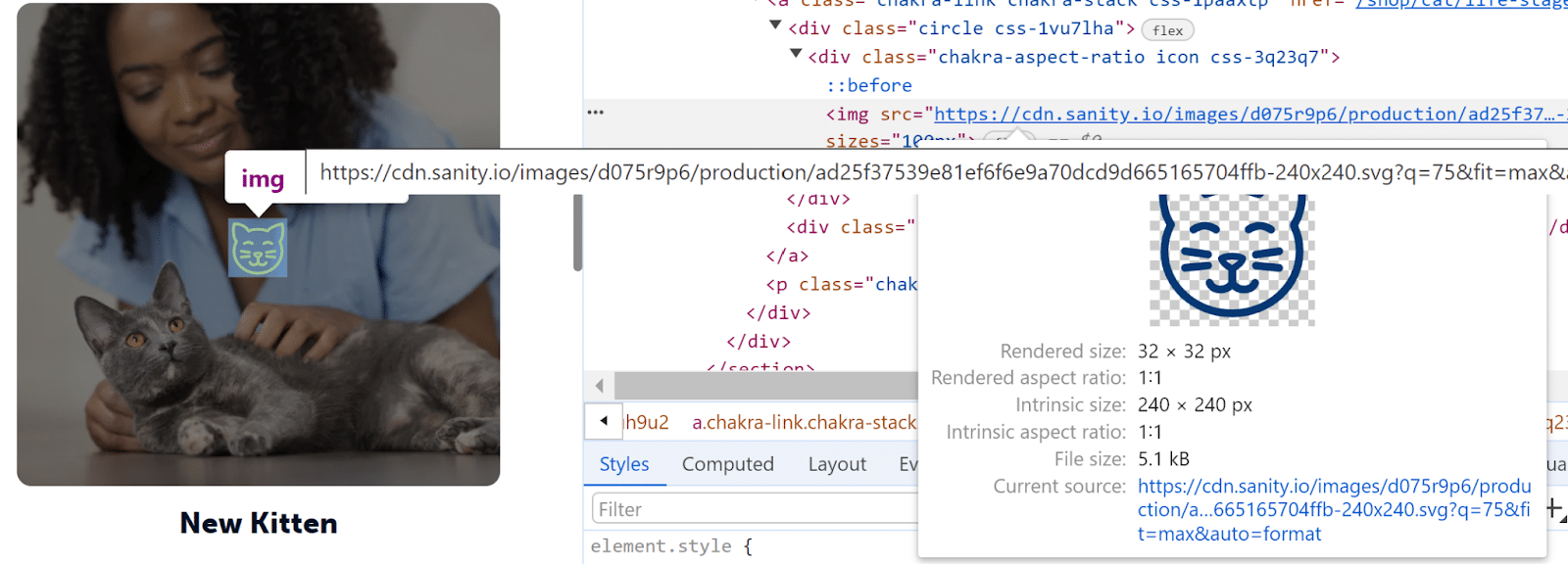
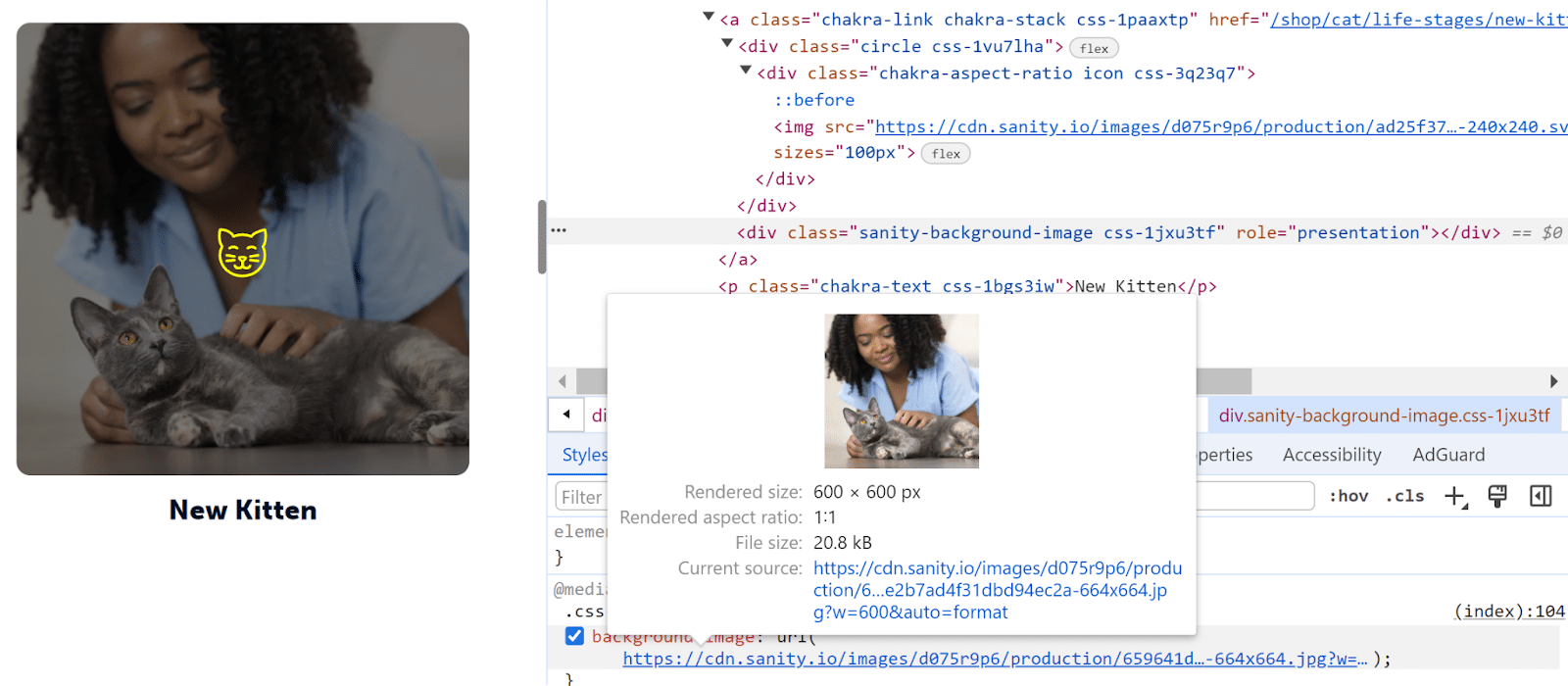
4. What image is that?
Find an image link, size and alt text by right-clicking to Inspect any image.
Answer basic technical questions about any image:
- Does my image have good alt text?
- Is that image a duplicate?
- Is the image size too large?
- Could the image size impact page speed?
- Where is the original image source?
- What kind of image is my competitor using?
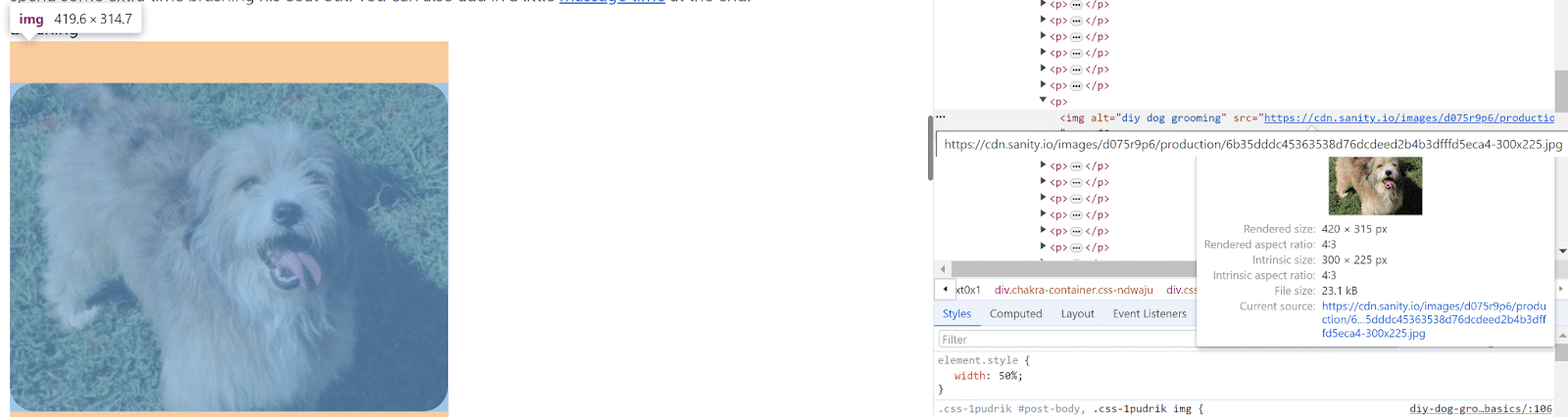
This works for any kind of image, including icons and background images. If you don’t see the image you want, look for phrases in the code like image, background, src, img, jpg, png or carousel.
5. What kind of link is that?
Use Inspect to check to see if your links are set up the way you want without actually clicking any links. Test whether links are set to nofollow or follow and if they open in the same or a different tab. Or use Inspect to find a redirect chain or 301.
- Right-click any link.
- Find the <a href> tag.
- Check what URL the target is linking to.
- Look for a tag like rel=“nofollow”, which tells Google to ignore that link for ranking purposes.
- Look for a tag like target=“_blank”, which tells the browser to open the link in a new/blank tab.

You can also confirm whether you got a new follow or nofollow backlink on another site. This is handy if you just want to check one link instead of running a check in a backlink tool like Ahrefs or Semrush.
If you check links often, you can also use browser extensions to automatically highlight different types of links depending on their tags.
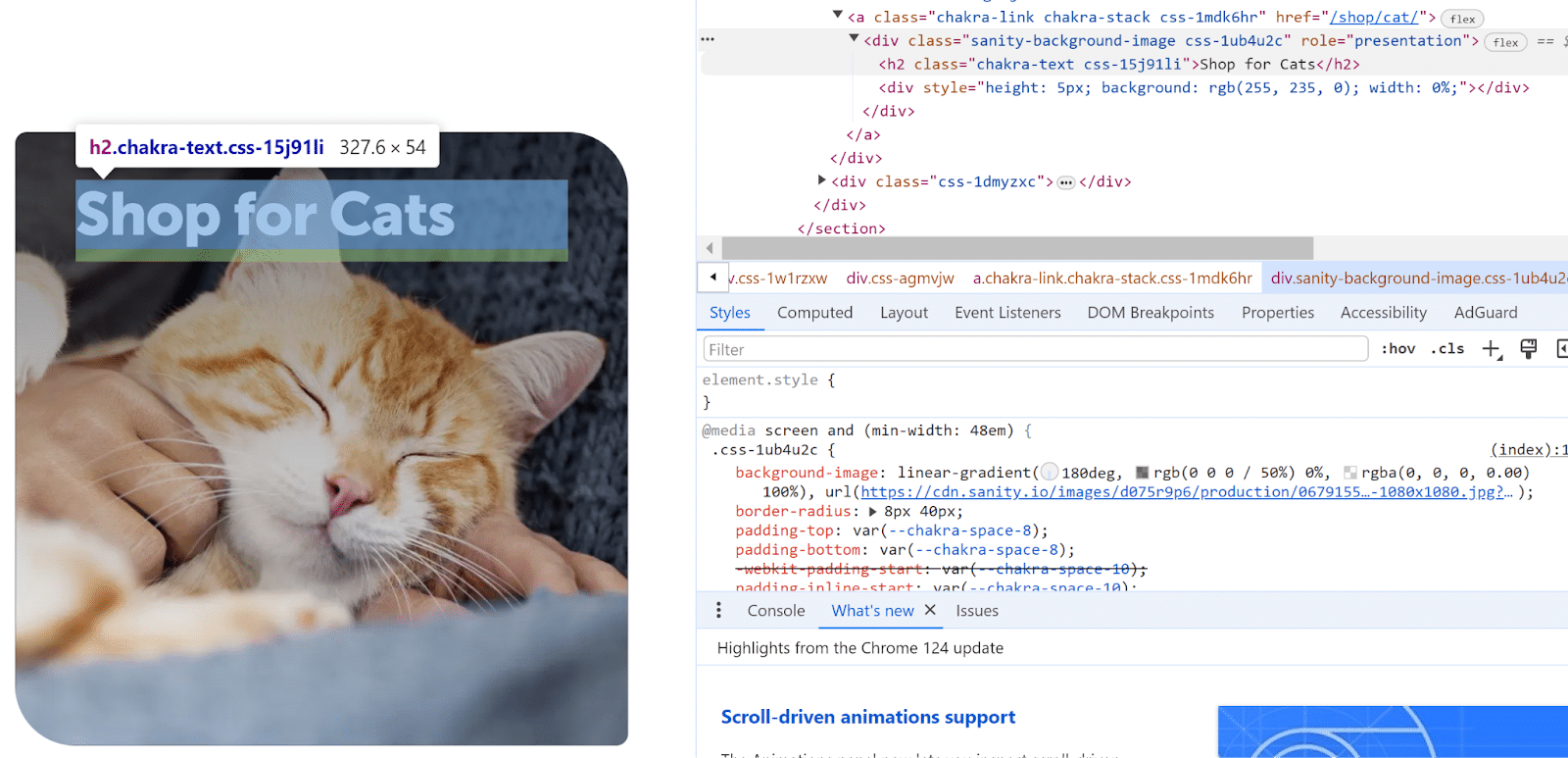
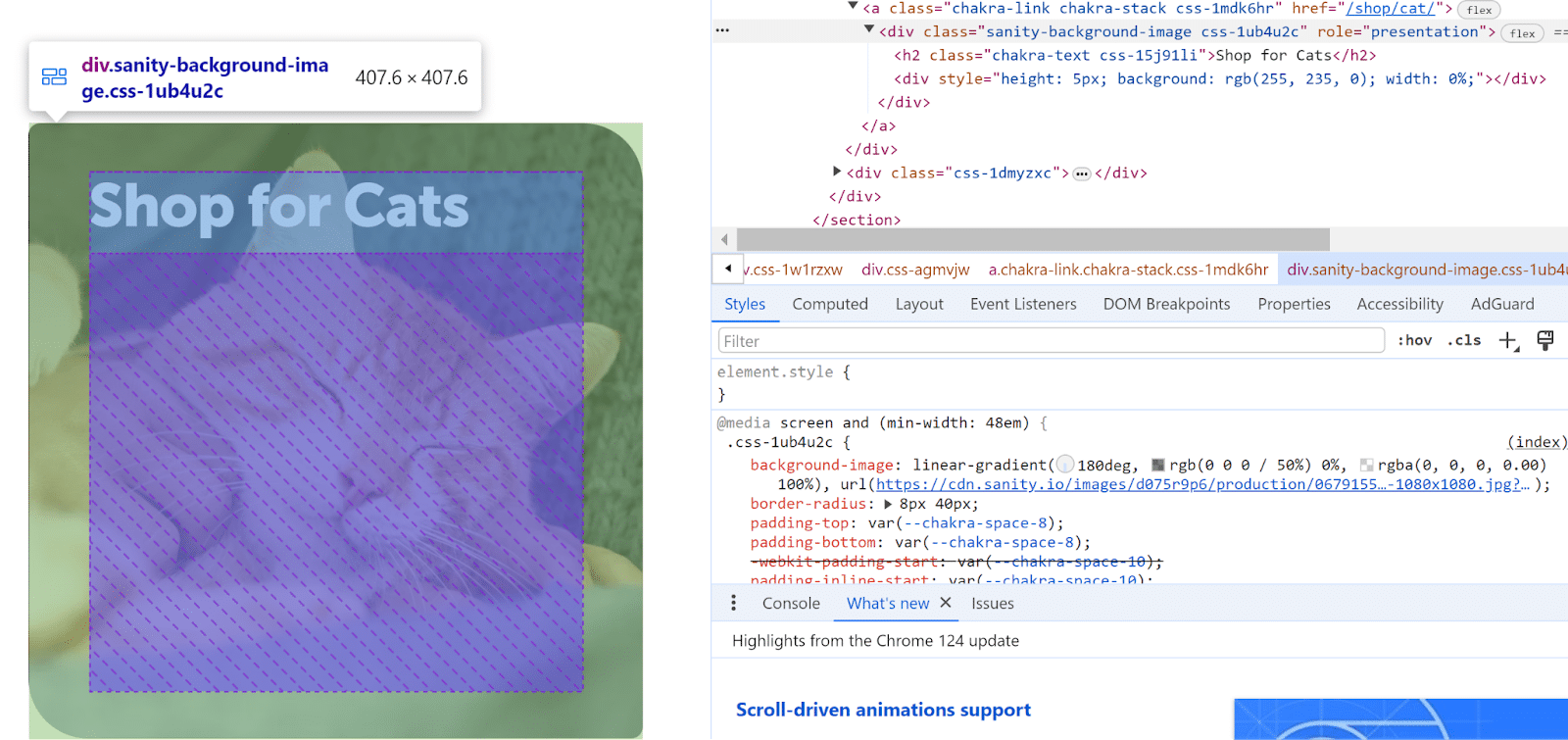
6. Which piece of code is broken?
Troubleshoot issues with your site elements using Inspect. Once you figure out which piece of code is causing an issue, you can solve the problem.
If you need to work with your developers or technical team to fix the problem, it’s easier to be able to highlight exactly what you need within the code.
- Right-click anywhere on the element.
- In the Elements sidebar, hover over each HTML element to find the one you want.
- Use the arrows to expand sections to see child code elements.
- The element that the code corresponds to will be highlighted on your site in the left window. Keep hovering and expanding until you find it.
7. What kind of schema is that?
Most sites let you check their site schema using Schema Validator. However, some sites block the Schema Validator bot from using the Fetch URL option directly.
You can still check your competitors’ site schema with this tool or directly into the code.
- Go to the page you want to check.
- Right-click anywhere on the page and click View Page Source.
- Select all the page code (Ctrl+A and Ctrl+C).
- Go to https://validator.schema.org/.
- Click Code Snippet.
- Paste all the code (Ctrl+V).
- Click Run Test.
- You’ll see all the detected schema elements for that page.
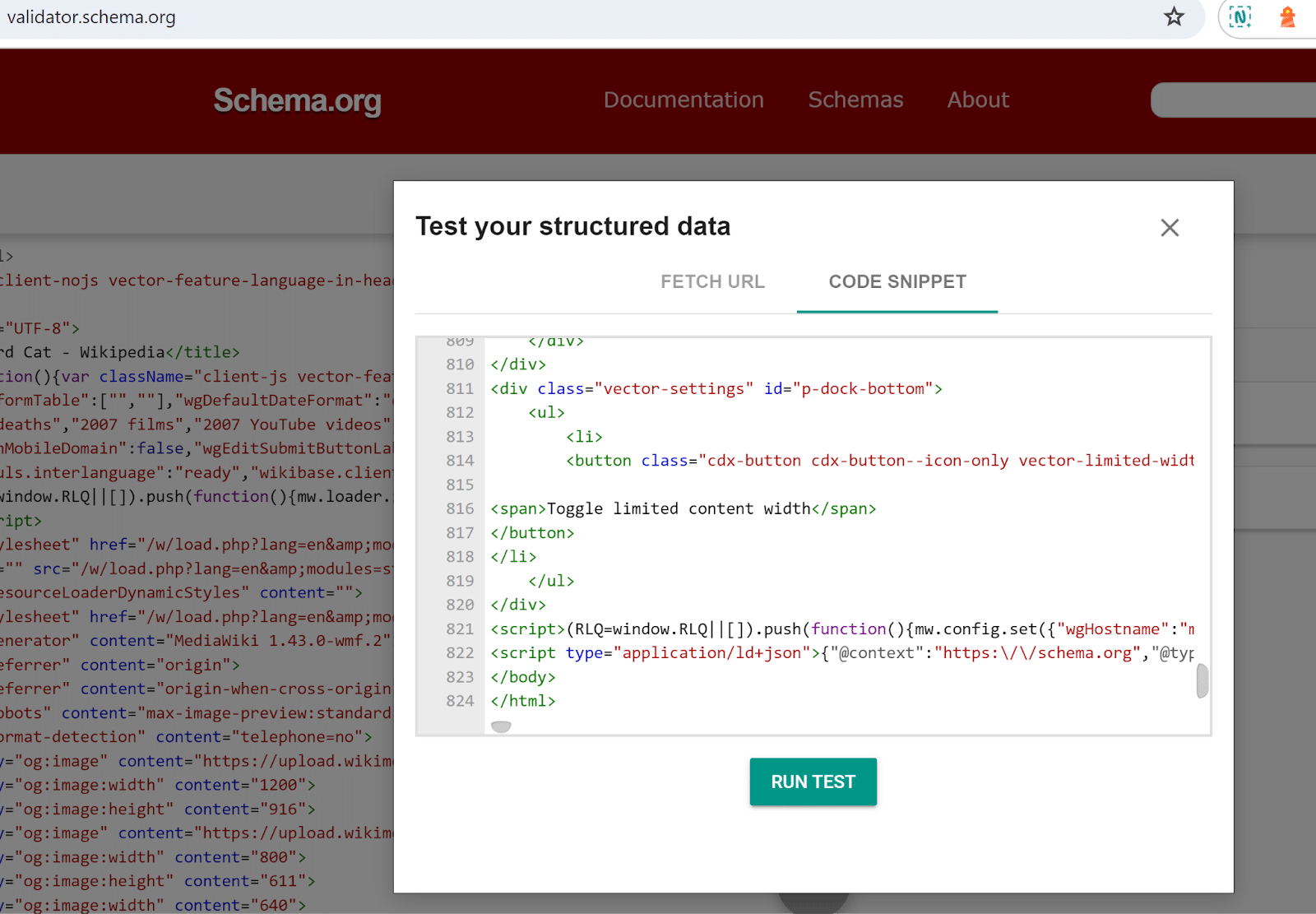
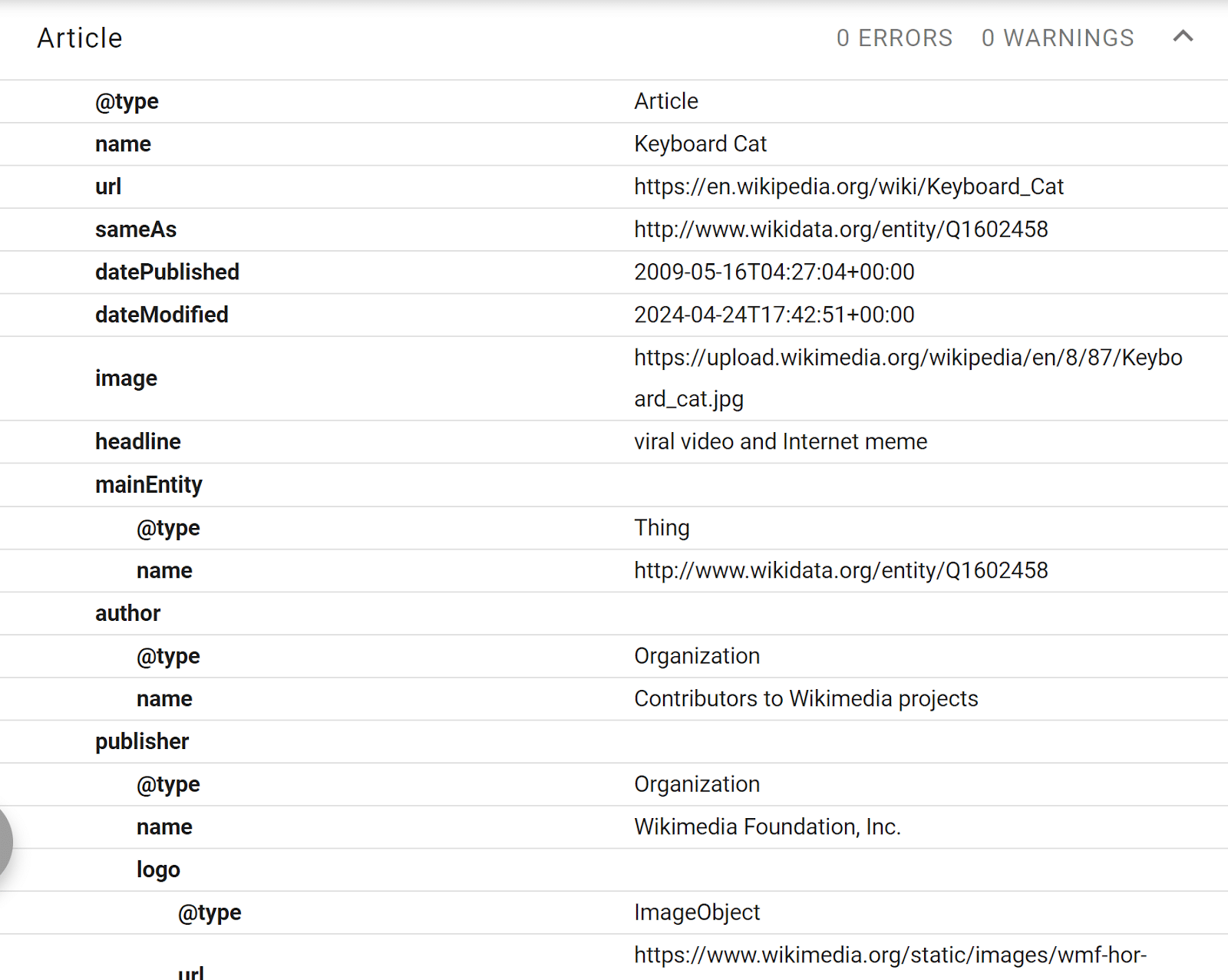
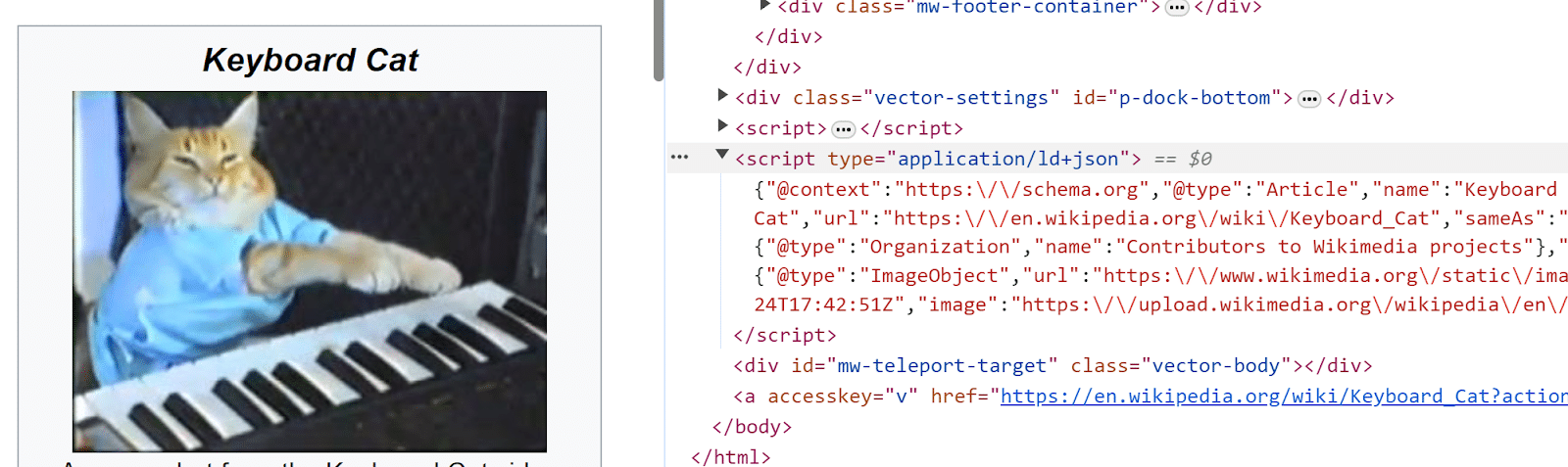
If the validator tool seems incorrect or flags broken schema, you can check for any schema-like code directly in the markup. This is helpful if you’re trying to troubleshoot schema fields or discover why your schema isn’t appearing in the SERP.
- Right-click anywhere on the page.
- Expand sections in the Elements tag until you find the schema.org tags. Schema is usually contained somewhere in the <body> tag.
- If it’s not organized cleanly, right-click and edit as HTML, then copy the whole block into a Notepad program.
- If you still don’t see it, right-click on the page to View Page Source, then search for “schema” in the page code (Ctrl+F).
Courtesy of Search Engine Land: News & Info About SEO, PPC, SEM, Search Engines & Search Marketing
Category seo news | Tags:
Social Networks : Technorati, Stumble it!, Digg, de.licio.us, Yahoo, reddit, Blogmarks, Google, Magnolia.
Did Google really lose search market share to Microsoft Bing in April?
Written on May 1, 2024 at 9:08 pm, by admin

Statcounter has updated its search engine market share stats for April – and the results are shocking. If they’re true. I’m doubtful – but hoping Statcounter will confirm whether these numbers are indeed accurate.
By the numbers. Google’s U.S. search market share in the U.S. fell to 77.52% in April, down from 86.94% in March and down from 88.8% in April 2023. Meanwhile:
- Microsoft Bing grew to 13.05% in April, up from 8.04% in March.
- Yahoo (!) grew to 7.3%, up from 2.48% in March.
See why I’m skeptical yet? How are Microsoft Bing and Yahoo growing that much in one month?
But wait, there’s more.
Google’s global search engine market share dropped from 91.38% in March to 86.99% in April. Meanwhile:
- Microsoft Bing grew to 5.8% in April, up from 3.35% in March.
- Yahoo grew to 3.06% in April, up from 1.1% in March.
There are other unexplainable swings – some bigger than others – found in other regions as well, based on Statcounter’s data.
But. Before you start cheering, the data seems suspect. Some are expecting Statcounter to “correct” these figures because these sorts of big swings seem impossible and unprecedented.
About the data. How does Statcounter get this data? According to its About page:
Stats are based on aggregate data collected by Statcounter on a sample exceeding 5 billion pageviews per month collected from across the Statcounter network of more than 1.5 million websites. Stats are updated and made available every day, however are subject to quality assurance testing and revision for 45 days from publication.
Based on this explanation, it’s entirely possible that at some point in the next 45 days Statcounter’s search market share data could change.
Why we care. My first thought after seeing these numbers was: they seem wrong. User behavior doesn’t change this rapidly. While SEOs and others have been heavily critical of Google over the past few years, often with good reason, I’ve never seen market share figures swing like this in one month unless there was a change to how the data was collected or there is some sort of issue with the data.
What Statcounter is saying. I’ve emailed the company to get some insight into whether these numbers are accurate. I’m told their staff is “checking things out.”
Courtesy of Search Engine Land: News & Info About SEO, PPC, SEM, Search Engines & Search Marketing
Category seo news | Tags:
Social Networks : Technorati, Stumble it!, Digg, de.licio.us, Yahoo, reddit, Blogmarks, Google, Magnolia.
The future of search is social by Edna Chavira
Written on May 1, 2024 at 9:08 pm, by admin

Is your social media strategy keeping pace with the latest industry trends and innovations?
Deloitte’s comprehensive “State of Social Media” report reveals that social-first brands are achieving remarkable outcomes – including an average 10.2% revenue increase – by repositioning social at the core of their entire brand and customer experience.
In this can’t miss MarTech webinar, attendees will learn directly from two of Deloitte’s top social media and innovation experts who will share eye-opening insights from the “State of Social Media” report, including:
- The new “Share of Culture” approach driving vibrant social communities
- How leading brands are unleashing the power of creator partnerships through “Co-Creation”
- Why the future of search – and commerce – is inherently social
RSVP today for “Social Means Business, Serious Business–Driving Resilience Through Social Business Transformation” and get up to date on the latest trends and tactics driving real results.
Courtesy of Search Engine Land: News & Info About SEO, PPC, SEM, Search Engines & Search Marketing
Category seo news | Tags:
Social Networks : Technorati, Stumble it!, Digg, de.licio.us, Yahoo, reddit, Blogmarks, Google, Magnolia.
6 ways to use AI for paid search account restructuring
Written on May 1, 2024 at 9:08 pm, by admin

As the paid search advertising landscape evolves, AI and language model tools are gaining traction in streamlining and optimizing campaign restructuring processes.
Some paid search specialists are no longer content with the status quo. Others argue that our industry has been using AI all along and that the AI revolution is only a shift in terminology.

Many favor chatbots for answers, driven by a quest for efficiency, creativity and staying current. Julie F. Bacchini, managing director of the PPC Chat community, emphasized the last point during her weekly Slack chat on “Diversification in PPC.”
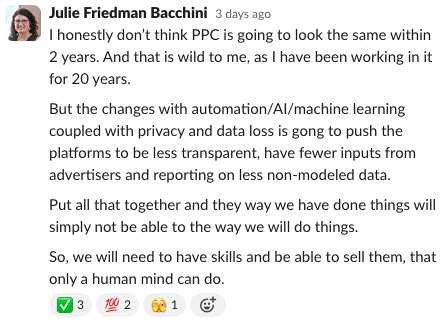
One area where AI shines is streamlining the often tedious and time-consuming process of account restructuring.
Below are six practical ways AI can assist PPC managers when restructuring ad accounts.
1. Finding new keyword ideas for accounts
Keywords are the cornerstone of an ads account.
To reorganize ad accounts effectively, you need to analyze the search term reports and identify fresh keywords to incorporate into ad groups or campaigns.
While necessary, this process can be time-consuming in large accounts. It’s especially confusing for B2B accounts, where separating consumer intent from commercial intent is key.
Here’s where AI can assist. There are tools in the market to help you:
- Analyze datasets: AI can identify new and valuable keywords that might have been overlooked.
- Surface statistically significant opportunities: Some search terms need more data before they are actionable.
AI tools don’t just identify new terms; they also assess statistical significance. This ensures you focus on terms with a proven track record of driving conversions.
Consider Optmyzr, a popular AI-powered tool that seamlessly integrates with platforms like Google Ads and Microsoft Advertising and automatically analyzes your search terms report.
Based on its analysis, it recommends relevant keywords for inclusion in existing ad groups or the creation of new ones.
This eliminates the need for manual data downloads, spreadsheet analysis and filtering.
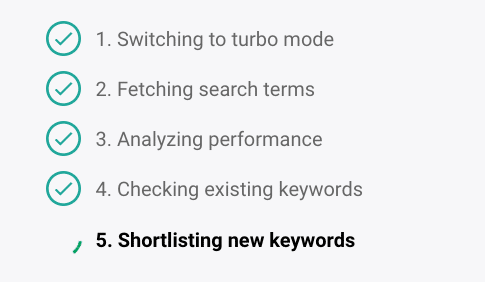
Most importantly, Optmyzr utilizes statistical significance to ensure its recommendations are impactful.
2. Categorizing keywords by theme
Effective paid search campaigns rely on well-organized ad groups with thematically related keywords.
Another reason to restructure is if a previous ad manager accidentally added thousands of keywords from auto-recommendations or didn’t understand the importance of keeping ad groups tightly themed.
Grouping keywords by theme ensures your ads resonate with user search terms. This is where large language models like ChatGPT and Google’s Gemini come into play.
Imagine this:
You can effortlessly paste thousands of keywords in a chatbox and ask the tool to organize all the keywords by theme.
Manually grouping thousands of keywords by theme can be an overwhelming task.
Enter large language models. By feeding these models your keyword list (even exceeding 2,000 keywords), they can identify and categorize themes with remarkable speed and accuracy.
Checking for duplicates is crucial because ad groups often have overlapping keywords. Keep refining the themed keyword list until it’s more manageable to reduce redundancy.
3. Tailoring ads more closely to the user’s search query
This translates to improved ad relevance, higher quality scores and increased campaign effectiveness.
Once you have thematically grouped keywords, writing ad copy becomes a necessity.
You need to tailor your ad copy to the specific theme of each ad group, ensuring a more relevant and impactful message for users.
Restructuring often involves creating new ad groups.
Writing responsive search ads (RSAs) can be arduous because of the many headlines and descriptions needed. However, AI can help.

Let’s consider ChatGPT and the following prompt:
- “Write me 15 different headlines that are 30 characters or less for a Google Search Ad for my gourmet cookie business.”
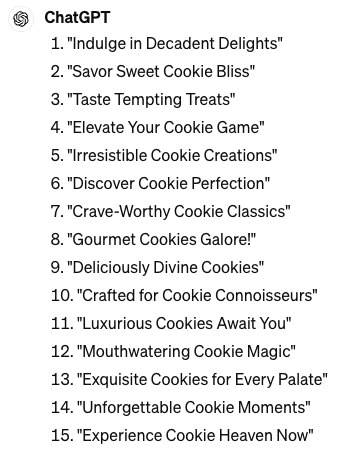
Remember that human oversight is still important. While AI can certainly spur creativity, the human factor remains irreplaceable. In the example above, some AI-generated headlines might exceed the character limit or lack the desired punch.
 This example highlights the importance of human oversight and refinement.
The best approach is to leverage AI for initial brainstorming and then refine the generated content with your unique human touch.
4. Assisting with image creation
Google Ads’ AI-powered image generation tool accelerates the testing process and economizes time and resources by generating fresh imagery.
Reducing time and cost is particularly impactful for brands operating on limited budgets competing in a platform where images are an important tool.
Also, there’s a theory that platforms might prioritize content created with new features like AI generation. This could temporarily boost your ads while the platform gathers data on its tool.
While the exact impact is unclear, some advertisers can benefit from AI-generated images.
Take an online-only gourmet soup shop, for example. Unlike clothing with distinct styles, soup bowls can look similar across brands. This is where AI shines.
It can create unique and appetizing visuals for your soup, freeing you from reliance on seasonal photoshoots.
These images can offer variety for testing in an account that otherwise wouldn’t have many images.
Dig deeper: Creating Google Ads campaigns with Gemini conversational AI: How good is it really?
5. Predictive modeling in Google’s Performance Planner
Google’s Performance Planner is an example of AI-driven predictive modeling.
It allows advertisers to forecast how changes in campaigns could affect key metrics like conversions and clicks.
Leveraging the Google Performance Planner both before and after an account reorganization is an excellent method to showcase scalability.
It helps make informed decisions about budget adjustments and optimize campaigns for better results.

6. Automatic bidding in ad platforms
When reorganizing ad campaigns and centralizing data, the reasoning is often to allow campaigns to leverage larger datasets and automatic bidding strategies to work effectively.
Bid strategies are not always considered AI but rather machine learning.
However, bid strategies use machine learning to automatically adjust bids based on various factors, such as the likelihood of a conversion or the competitiveness of an auction. So, in that sense, bid strategies can be considered a form of AI.
Dig deeper: How each Google Ads bid strategy influences campaign success
AI-powered PPC optimization: Boosting efficiency and strategy
Despite being available for years, AI tools like Optimzr and various in-platform features frequently go unrecognized as AI, largely because the prevailing perception equates AI with chatbots.
However, AI encompasses more than just chatbots; it involves computers making decisions rapidly.
These technologies offer options for advertisers, encompassing everything from keyword research and ad group organization to writing RSA ad copy and generating images.
Predictive modeling and automatic bidding strategies enhance campaign optimization and save paid search managers valuable time, fitting perfectly within the broad definition of AI tools.
AI integration enables paid search managers to be more effective in building campaigns and changing accounts. This lets you transition into a more strategic role, moving beyond merely executing tasks to shaping strategies and outcomes.
Courtesy of Search Engine Land: News & Info About SEO, PPC, SEM, Search Engines & Search Marketing
Category seo news | Tags:
Social Networks : Technorati, Stumble it!, Digg, de.licio.us, Yahoo, reddit, Blogmarks, Google, Magnolia.