

Google streamlines product listings via website crawl
Written on June 14, 2024 at 6:50 pm, by admin

Google is making it easier for merchants to pull in product listings from their sites through automated “website crawl” feeds in Merchant Center.
How it works. Google uses structured data markup on merchant websites to automatically extract up-to-date product information like titles, pricing, availability and images.
The big picture. The automated feeds aim to reduce the work required to keep product listings current as assortment and pricing changes – a challenge with traditional feed file uploads.
Why we care. This update could help reduce manual grunt work when it comes to updating product listings in the Merchant Center, although there may be a learning curve to ensure all products have the correct schema markup, which may not be the advertisers’ role in the marketing team.
The details. To use automated feeds, merchants must implement required schema.org markup for product details like:
- Title [title]
- Price [price]
- Availability [availability]
- Image [image_link]
Additional attributes like GTIN, brand, size and condition can further enrich listings when provided via markup or supplemental feeds.
What’s new. Some merchants now see an alternative “Website” feed experience that allows them to simply toggle automated product ingestion on/off in the Merchant Center.
Products get automatically added or removed from the Merchant Center based on the website crawl.
It complements other product data sources without duplication.
The challenges. Proper structured data implementation is key, as is managing crawl directives via sitemaps and robots.txt to avoid indexing issues.
What they’re saying. “Supplemental feeds provide additional information…and you can refresh [them] more often,” per Google’s automated feed documentation.
Between the lines. Automated feeds align with Google’s push toward entities and structured data as core to its modern “AI-first” approach across products.
First spotted. This update was first spotted on Thomas Eccel’s profile:

Bottom line. By reducing manual feed labor, automated product ingestion could lower barriers for merchants to participate across Google’s growing array of surfaces like Search, Shopping, Images and more.
Courtesy of Search Engine Land: News & Info About SEO, PPC, SEM, Search Engines & Search Marketing
Category seo news | Tags:
Social Networks : Technorati, Stumble it!, Digg, de.licio.us, Yahoo, reddit, Blogmarks, Google, Magnolia.
Pinterest launches AI ad tools
Written on June 14, 2024 at 6:50 pm, by admin

Pinterest is rolling out new AI-powered ad tools and measurement partnerships to drive better performance and brand safety for advertisers.
The big picture. Pinterest is investing heavily in generative AI capabilities for more engaging, personalized ad formats and automating campaign optimization.
What’s new. Pinterest is launching an “Ad Labs” innovation program to test prototypes like:
- Personalized background generation using its visual search AI to create aesthetically tailored lifestyle backgrounds for Product Pins.



- Interactive, shoppable collage ads that let users curate brand imagery, with early tests driving strong engagement.
 Brands like John Lewis, Wayfair and Bumble are testing collages for advertisers.
It’s also expanding brand safety validation through partnerships with measurement firms IAS and DoubleVerify.
Why we care. These AI-powered updates show a desire for Pinterest’s to evolve their ad platform with cutting-edge technology that can drive performance, effective personalisation, efficiency, improved brand safety and unique experiences for advertisers aiming to effectively reach its audience.
The AI boost. Pinterest Performance+, currently in closed beta, uses automation and AI to optimize campaigns for better cost efficiency.
- Early tests showed 10%+ improvements in cost per acquisition for conversion campaigns.
- It also reduced campaign setup time by 50% thanks to automated inputs.
What they’re saying. “We saw the unique opportunity with collages to take customers from inspiration to action with a single ad creative,” said Wayfair’s Sandro Corsaro, an early Ad Labs partner.
Brand safety matters. Pinterest says 99% of measurable ad impressions were rated brand safe by IAS and DoubleVerify during testing.
Limitation. The collage ads are initially limited to select brands like Nike, Wayfair and NYX Cosmetics, with more advertisers to come.
What’s next. Expect further AI-powered upgrades as Pinterest aims to stand out through automation and personalization at scale.
Courtesy of Search Engine Land: News & Info About SEO, PPC, SEM, Search Engines & Search Marketing
Category seo news | Tags:
Social Networks : Technorati, Stumble it!, Digg, de.licio.us, Yahoo, reddit, Blogmarks, Google, Magnolia.
Google Analytics fixes paid search attribution
Written on June 13, 2024 at 3:49 pm, by admin
Google is rolling out an update to attribution models in Google Analytics 4 (GA4) to more accurately credit paid search campaigns for driving conversions.
Why it matters. The change addresses an issue where conversions that should be attributed to paid search clicks were sometimes incorrectly assigned to organic search, especially for single-page applications.
Why we care. This attribution adjustment in GA4 is aimed at giving advertisers more accurate data to make informed decisions, invest efficiently and optimize based on actual paid search performance – which is critical as measurement and attribution grow more complex.
How it works. Currently, the ‘gclid’ parameter that identifies a paid search click doesn’t always persist across pageviews.
The upcoming update will adjust how GA4 captures campaign data on the first event of each new page.
If users leave and return through a different channel, the attribution will update accordingly.
What to watch. The attribution fix may increase the number of conversions counted as coming from paid search campaigns.
This could have an impact on advertisers’ Ads campaign budgets and spending. Google recommends reviewing and adjusting budget caps before the update rolls out over the next two weeks.
Between the lines. Accurate attribution has long been a challenge as user journeys grow more complex across multiple sessions and channels. This update aims to resolve a specific blind spot in how GA4 tracks paid search conversions.
The big picture. As Google moves toward a cookieless future with initiatives like Topics API, robust first-party analytics and attribution capabilities across its products will be crucial for advertisers.
Courtesy of Search Engine Land: News & Info About SEO, PPC, SEM, Search Engines & Search Marketing
Category seo news | Tags:
Social Networks : Technorati, Stumble it!, Digg, de.licio.us, Yahoo, reddit, Blogmarks, Google, Magnolia.
YouTube embeds ads into videos to beat ad blockers
Written on June 13, 2024 at 3:49 pm, by admin

YouTube is testing serving ads directly embedded into video streams – the latest move in its war on ad-blockers.
Why it matters. The “server-side ad injection” approach bakes ads into the core video file itself, making them indistinguishable from content for client software and extensions that try to filter out advertising.
Why we care. By embedding ads directly into video streams, this approach will have an advertiser’s ads mirror the look of the content, effectively bypassing ad-blockers and enhancing the visibility and effectiveness of ad campaigns.

The details. SponsorBlock, a crowdsourced extension to skip sponsored segments, said on X YouTube is “experimenting with server-side ad injection.”
- This offsets all timestamps submitted to SponsorBlock, as ads become embedded into the actual video stream.
- To prevent bad data, SponsorBlock is temporarily rejecting submissions from users encountering the embedded ads.
The big picture. YouTube’s latest technical maneuver is part of its broader crackdown on ad-blocking over the past year.
- It first targeted browser ad-blockers, then third-party YouTube apps popular on mobile.
- The goal is to protect YouTube’s key revenue stream from advertising.
What they’re saying. “Users are encouraged to subscribe to YouTube Premium,” Google suggests, offering an ad-free paid tier.
Between the lines. Google is unlikely to detail how the server-side ad embedding works, but it requires changes to YouTube’s core video delivery infrastructure.
What’s next. The embedded ad test is still limited but likely to expand as YouTube aims to make ad-blocking tools ineffective.
Courtesy of Search Engine Land: News & Info About SEO, PPC, SEM, Search Engines & Search Marketing
Category seo news | Tags:
Social Networks : Technorati, Stumble it!, Digg, de.licio.us, Yahoo, reddit, Blogmarks, Google, Magnolia.
AI analysis of 8,000 top YouTube Ads reveals key trends for brands
Written on June 13, 2024 at 3:49 pm, by admin
YouTube tapped its machine learning capabilities to analyze over 8,000 of the top ads on its platform this year, surfacing five key creative trends that resonated.
Why it matters. The findings, extracted using custom AI models that processed text, visuals, audio and more, provide a data-backed playbook for how brands can stand out on YouTube.
Trend 1: Spotlighting underrepresented voices. Campaigns actively challenged stereotypes and celebrated people with disabilities and diverse backgrounds in prominent roles. Here are examples from Apple, Google Pixel and Maybelline:
Trend 2: Celebrating individuality. Ads leaned into characters’ unique personalities, styles and self-expression. Here’s an example from Tissot that got 42 million views:
Trend 3: Reinforcing community. Storytelling evolved from pandemic isolation to public gatherings and affectionate human connections. Here are examples from BMW and Nintendo Switch:
Trend 4: Sparking wonder. Through dreamlike backdrops and fantastical settings allowed viewers to imagine varied destination possibilities. Here are examples from Yugiohtae and Pedigree:
Trend 5: Building trust via creators brands. Leveraging creator endorsements and authenticity to foster connections. Here are examples from Lululemon, Axe and Pizza Hut:
Why we care. These insights can help brands get more value from their YouTube ads. The key is making your content more engaging and targeting your audience more accurately.
Between the lines. Tried-and-true tactics like strong openers, pop culture ties and humor still resonated. But the top ads went beyond to tap into deeper emotional insights.
The report. We used AI to analyze over 8,000 top ads. Here’s what we learned
Dig deeper. 4 elements of good content, according to Google research
Courtesy of Search Engine Land: News & Info About SEO, PPC, SEM, Search Engines & Search Marketing
Category seo news | Tags:
Social Networks : Technorati, Stumble it!, Digg, de.licio.us, Yahoo, reddit, Blogmarks, Google, Magnolia.
Reddit adds third-party verification for advertisers
Written on June 13, 2024 at 3:49 pm, by admin

Reddit is partnering with ad measurement firm Integral Ad Science (IAS) to provide advertisers with third-party validation for campaign delivery across its platform.
Why it matters. The integration of IAS’s Total Media Quality suite gives Reddit advertisers globally an added layer of trusted, independent measurement around brand safety, viewability and invalid traffic.
Why we care. Brand safety and transparency have always been concerns for advertisers. Integrating trusted third-party verification directly into Reddit’s ad platform could provide vital campaign insights to justify ad spend and growth on the platform.
The details. Through the new offering, Reddit advertisers can:
- Leverage GARM-aligned brand suitability and quality metrics from a trusted third party.
- Gain video-level insights using IAS’s AI-powered multimedia analysis.
- Layer IAS’s measurement with Reddit’s existing moderation capabilities for enhanced brand protection at scale.
- Access unified campaign reporting and insights within IAS Signal.
What they’re saying. “Third-party validation…equips Reddit advertisers with the tools they need to grow on our platform confidently,” said Reddit’s Jim Squires.
From IAS’s Lisa Utzschneider. “Our partnership will give Reddit customers…reliable and accurate data, so they can focus on driving business growth.”
Between the lines. Transparency has become table stakes for ad platforms courting big brands’ budgets. Reddit’s IAS integration aims to provide that assurance.
The big picture. Social platforms are working to combine their rich first-party data with trusted third-party verification to drive advertiser confidence and spending.
What’s next. The IAS integration will roll out to Reddit’s global advertiser base later this year.
Courtesy of Search Engine Land: News & Info About SEO, PPC, SEM, Search Engines & Search Marketing
Category seo news | Tags:
Social Networks : Technorati, Stumble it!, Digg, de.licio.us, Yahoo, reddit, Blogmarks, Google, Magnolia.
Google’s auto-pause for idle keywords: overreach or overdue?
Written on June 12, 2024 at 12:46 pm, by admin

A short while after Google announced it would pause low-activity keywords, the Optmyzr team ran a study and got reactions from paid search experts to figure out how marketers may be affected, what shifts (if any) it would cause in advertiser management styles and what risks come with this update.
The big picture. Google’s plans to automatically pause long-idle ad keywords have sparked debate among marketers – some see it as overreach, while others say it’s overdue account maintenance.
What’s happening? Google will start automatically pausing search ad keywords and ad groups that have gone 13+ months without any impressions or activity. The change, initially met with mixed reactions, aims to streamline the management of stale entities.

The concerns. Some advertisers believe leaving dormant keywords maintains account history and relevance signals. Others fear prematurely pausing viable terms that see sporadic bursts of traffic.
The data. The Optmyzr study of over 9,400 Google Ads accounts found:
- 84% of accounts had 50%+ keywords with zero impressions in 13+ months.
- Pausing those terms likely won’t hurt performance for most.
- Only 145 large accounts (1.5%) risk potential performance loss.

Why we care. While most small account advertisers may welcome the account clean-up, larger brands with established keyword-level control may face challenges adapting to increasingly automated, opaque Google Ads management
The upside. Most accounts stand to gain streamlined structures and simpler budgeting after the pauses, aligning with Google’s push for automation over manual management.
What they’re saying. “Google continues to blur the lines between platform and ad partner” by making organizational calls like this, marketing consultant Kirk Williams, owner of ZATO, told Optmyzr.
Bottom line. While valid fears exist around losing viable keywords, most advertisers likely have little to lose – and may see gains – once long-dormant terms get automatically parked.
Courtesy of Search Engine Land: News & Info About SEO, PPC, SEM, Search Engines & Search Marketing
Category seo news | Tags:
Social Networks : Technorati, Stumble it!, Digg, de.licio.us, Yahoo, reddit, Blogmarks, Google, Magnolia.
10 search marketing takeaways from digital marketing leader Aaron Levy at SMX Advanced
Written on June 12, 2024 at 12:46 pm, by admin
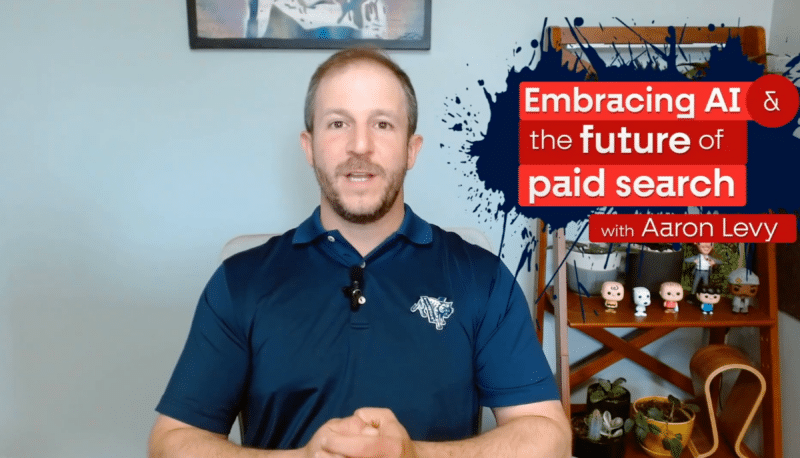
SMX Advanced Day 2 kicked off with Aaron Levy reminding us about the complex nature of search marketing and the need to focus on customers in our strategy.
Here are some highlights of his keynote talk, which included a look back at what the search marketing industry has been through, how the new wave of AI change is nothing new and his bet on the fact that search isn’t going away anytime soon.
1. Search will not die but it will evolve from its current state so long as marketers stop clinging to outdated views of paid search as a perfect direct response channel.
“Search survived some serious hits, in the case of the show, Nuclear Fallout, it carries the weight of what it used to be and what it’s known for. It’s adapted into a really hostile environment and is sometimes not so savory to survive. I think too many search marketers are just holding on too closely to what we think paid search used to be – that is a perfect direct response channel, which I’ll argue it never really was.
It certainly isn’t now – it’s a factor in a customer journey.”
2. Generative AI and assistants are transforming search into more of an ‘answer engine’ that tries to understand and address queries before they are asked.
“Sundar Pichai from Google’s Q4 earnings call earlier this year said that generative AI will allow Google Assistant to act more like an agent over time, and that it could eventually go beyond answers and follow through for users and even more. And then at I/O in mid May, Google announced a number of new features that even further reflected their intention, which is to become an answer engine rather than a search engine.”
3. Modern search marketers need a broad and deep understanding of all available marketing tools/channels beyond just search ads.
“[Search Marketers] needs a broad and deep understanding of all the tools in their toolbox. These features can be and often are extremely profitable, but developing a core understanding of exactly how they work and help you understand when and where you want to deploy them.
Should you be exploring in your branded search campaigns?
Probably not.
Should you be exploiting retargeting even though it’s not particularly incremental?
I don’t think so, but that’s up to you to determine. And developing an understanding of how the machine makes decisions is crucial to making that decision for yourself.”
4. Performance marketing metrics alone are inadequate – there needs to be a mindset shift towards branding and incrementality.
“We have to evolve away from a performance only view, or what I like to call the searchy view. There’s always been this weird battle between performance and brand marketers.
And it’s time for that fight to end. Performance and branding are not separate. They are done at the same time. They are one and the same. We use different metrics, we use different measurements and we might have different goals and certainly the tactics are different, but they happen at the same time.
We very likely contributed to a conversion, but did we cause it? Not sure. We’re part of a more complicated journey and so one of the most complicated things that we have to do as modern search marketers is to provide engines the right guidance, the right reward mechanism, the right incentives and the right assets to do their job properly incentives or goals or conversions or whatever you want to call them are probably best thought of as compasses for automation.”
5. Customer-centricity is crucial – leverage audiences, alternative KPIs, and creative assets to move customers through the full funnel journey.
“For the past couple of years, I’ve comfortably been saying that keywords are optional in PPC and audiences are not. I stand by that. Think about the good old-fashioned marketing funnel. Yes, the customer journey is complex, but a funnel is the easiest way to understand it.
We don’t need every date with a customer to point directly towards marriage. You have to leverage alternative KPIs to help move people through the funnel rather than just swinging for the fences on the first pitch.
Especially when the industry is so much more crowded now, there’s so much more competition within search. We have to get a little bit more creative.”
6. Search is no longer just about keywords and language – it’s about understanding customer behaviors, problems, and emotions to provide relevant answers/solutions.
“Aim for the heart and the head will follow. What it’s going to mean is that we have to go beyond a simple question and answer. The question that people are asking is never as simple as what they’re actually saying, and the answer we provide needs to speak toward their emotions, their problems, whether they know they exist or not, we have to tell them – ‘Hey, I’m going to make your life better’
We’ve never really done that in search because we made the relationship so transactional.”
7. Search is part of a larger, complex customer journey that spans multiple touchpoints before and after the search.
“People are weird and people are inconsistent. Search isn’t always the most influential part of the journey. It’s almost always part of it, but it’s rarely what actually caused the conversion.”
8. New AI-powered search experiences may reduce site traffic, necessitating new affiliate/commission ad models.
“I think the interesting thing will be that we expect SGE experiences to generate way less site traffic.
I anticipate there’s going to be some sort of an affiliate negotiable commission model coming soon. We’ll see, but in my opinion, I think local services ads and some of the other products that Google and Microsoft have that are commission based, I think those are going to become more of the norm, which is going to make evaluating the value of a conversion even more important.”
9. Search marketing’s evolution requires adaptability – understand how new AI tools work and how to strategically deploy them to solve customer problems.
“We have to remember that these new tools coming our way are just that. Tools.
We have to understand how they work, what they do, and how best to deploy them. There’s an old quote that says ‘if the only tool you have is a hammer, every problem looks like a nail.’ We have complex problems, we have complex tools to solve them.”
10. While search advertising faces changes, search itself is not going away as long as people have questions that need answering.
“Search as a medium is not going anywhere. As long as internet users have a question that needs answering, search will be there.
We simply have to understand that we are structuring our efforts around people, not just language. We are looking at problems. We are looking at their behaviors. We’re looking at their hopes and their dreams. We are saying that we are the answer.”
How to watch the keynote
Register for SMX Advanced to see Levy’s full keynote – as well as dozens of other sessions from yesterday and today.
Courtesy of Search Engine Land: News & Info About SEO, PPC, SEM, Search Engines & Search Marketing
Category seo news | Tags:
Social Networks : Technorati, Stumble it!, Digg, de.licio.us, Yahoo, reddit, Blogmarks, Google, Magnolia.
How to use Performance Max for any type of business
Written on June 12, 2024 at 12:46 pm, by admin
Performance Max is a versatile campaign, but understanding the nuances and adapting it to the account you’re working on can be the difference between investing budget and burning it.
One significant reason is that the quality and intent of traffic from Performance Max can vary considerably based on how you configure it. This will depend on your choices around retargeting, new customer bidding and segmentation with other campaigns like Search or Shopping.
In this guide, I’ll walk you through the different approaches to Performance Max:
- Three ways you can set it up.
- How to use it for different types of ecommerce brands.
- How to use it with lead generation businesses with differing budgets.
- Why it’s the only way to access local ads.
3 different ways to set up Performance Max
Performance Max can be a different beast depending on how you set it up and how much data you feed it, but there are three general approaches:
- The full-funnel version (or Performance Max as intended by Google) covers all inventory types and uses the full range of creative assets, audience signals and data feeds. This can be used for ecommerce, private label brands, retailers, lead generation and multitudes of products and services.
- The “Smart Shopping” style only uses the product feed by disabling or turning off all creative assets. When creating a new asset group, all fields must be empty: headlines, descriptions, images, videos, logo, business name, etc. The CTA must be set to automatic. You’ll also want to turn off URL expansion to prevent the system from choosing an alternate page to send traffic. Also, consider excluding your brand name to force the algorithm to focus on searches from net new users who don’t already have you in mind.
- The “social style” campaign emphasizes creative assets with strong audience signals, first-party data and customer lists. Accounts with large budgets can use this to grow reach and awareness.
Now let’s look at the nuances of the different types of ad accounts that might use one or more of these Performance Max setups.
Performance Max for ecommerce
Performance Max and ecommerce seem to be made for each other; it’s certainly the best use case we have today for Google’s machine-driven campaign.
However, many ecommerce advertisers continue to make fundamental errors that impede success such as:
- Treating audiences and audience signals like they work the same way.
- Forgetting to optimize or keep their product feed up to standard.
- Structuring their campaigns poorly, such as too many or too few asset groups.
- Ignoring the potential to run Shopping campaigns alongside Performance Max.
- Accepting auto-apply recommendations from Google without knowing what they do.
- Not optimizing assets and asset groups to each win the right traffic.
- Using the wrong bid strategy at the wrong time.
Fortunately, these are all fixable. If you struggle with any of these, learn how to solve seven mistakes that tank retail Performance Max campaigns.
DTC ecommerce
For direct-to-consumer ecommerce brands, Meta is still the holy grail of advertising channels. It’s tough to argue with that position, given how many brands have scaled on the back of growth programs centered around Facebook and Instagram ad campaigns.
But no channel is immune to challenges like volatility, saturation and reliability. This is why I recommend that ecommerce advertisers test out Google Ads, even if they want to remain Meta-first.
When it comes to Performance Max, these brands have a couple of traits that are relevant:
- They generally have relatively fewer SKUs, often in the single digits or a few dozen.
- Products are closely related (i.e., brands won’t sell a popcorn maker or makeup).
- All these products are clustered under a single brand.
- Very often, these are invented/formulated products rather than branded commodities.
These all impact decisions around how many campaigns you need, how to structure each one and what work you need to do on your feed, creatives and landing pages.
With all of those in place, you’ll want to make sure your product feed is in order, that you use captivating product imagery and that you build a post-click experience that excites people enough to convert.
Retail ecommerce
One key distinction between DTC and retail ecommerce is that the latter generally advertise a larger number of SKUs across multiple brands. Within this segment, I see two clear distinctions:
- There is the mass retailer with hundreds or thousands of commoditized products from dozens or hundreds of brands. This advertiser is almost always going to want to do either Smart Shopping-style Performance Max or Shopping, very rarely opting for creative or audience signals.
- Then you have what’s called private label brands. These advertisers sell their own line of products like fashion apparel, generally with fewer SKUs than mass retail. Private labels also sell products that typically do well with ads on Meta and YouTube, so Performance Max can lean into that.
For both, Performance Max can send very different types of traffic to their website or landing page. Much of the quality will be determined by how the campaign is structured, including bid strategies and whether the account uses brand exclusions to ensure incrementality.
Teaser of an analysis for bid strategies in Performance Max ecommerce campaigns. Click like and I'll either tag you or DM you when the research drops next week.
95% of PMax advertisers are using max conv. val
Any guesses how many are setting an efficiency target?#ppcchat pic.twitter.com/sH6vI4HpKc
— Mike Ryan (@mikeryanretail) June 23, 2023
I spoke to one advertiser who shared an audit of his Google Ads account, saying that he paused Google Ads and overall revenue was not impacted at all.
I can see why in that audit.
The campaign simply brought back people who were already going to purchase from him (i.e., a lot of branded and retargeting traffic). But you can set up Performance Max to focus on net new customers and new business.
Performance Max for lead generation
What exactly makes Performance Max such a hassle for lead-generation accounts? Aside from the variety of inventory these campaigns can serve, the biggest challenge is the actual nature of lead generation.
In ecommerce, a purchase actually is the conversion.
The creation of a lead, however, is just the start. Just because you get a conversion from a form doesn’t mean you’ve made the sale or that they’re even qualified to sell to.
This is why offline conversions are critical: You can train Performance Max on which “conversions” became sales or at least got close to contributing revenue. Without that, you’re letting Google optimize future leads based on that limited window of data.
Low-budget lead generation
Running ads for a service or lead-based business is difficult enough. When that account is new or limited by budget, competing against high-spending accounts with plenty of historical data makes it even tougher to crack the code.
If your business or client is new to Google Ads or has a modest budget, that’s when they need more support and calculated decision-making.
With just a few hundred or thousand dollars in budget, the pressure is on for everything to be dialed in and working well. The truth is that in this scenario, Performance Max is probably not your best friend.
We've had some success on lead gen with PMax, and verified the quality with lead tracking. Many times the traffic is garbage, but we've had a few clients that get a good number of leads from PMax that are quality.
— Mark Subel (@marksubel) May 30, 2024
Because Performance Max is driven by machine learning, a new account with no historical data – or one that doesn’t spend enough to gather enough of it – is better off running a traditional Search campaign.
Additional reading:
- If your account is still young, I suggest reviewing the suggestions in my guide on paid search for new accounts.
- Or if you’re ready to scale that account, there’s a guide for that as well.
High-budget lead generation
If you’ve got the budget to tolerate some of Performance Max’s issues and lower-quality placements, there are also ways of making it work for lead generation.
The most important prerequisites for this are:
- Implementing some type of spam protection, like a reCAPTCHA for form submissions or a qualifying script for call conversions. Performance Max has a very real issue with spam traffic, so you’ll want measures in place to minimize this.
- Setting up offline conversion tracking by connecting your CRM or other customer database to Google Ads, either natively (for Salesforce or HubSpot) or through Zapier. This feeds the post-conversion sales data back to Google, using the hashed Google Click ID (GCLID) to tell the system which leads were most valuable.
Check out this detailed guide on how to set up these protective measures for lead-generation Performance Max.
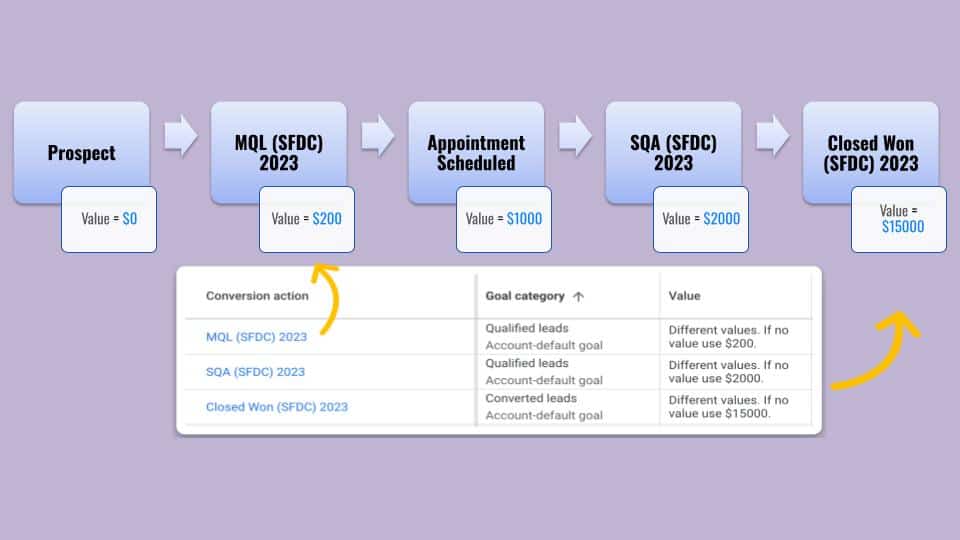
You might also want to consider implementing a value-based bidding strategy, where you assign pipeline stages different values based on what each CRM deal stage is worth to your business.
Google is then able to find more leads in the future who share the data points that it determines your revenue-generating conversions have in common (this is also done using the GCLID as an identifier).
Here’s an example of how that looks for a Salesforce-connected account progressing from prospect to closed-won. You can see that an appointment being scheduled makes a lead five times more valuable than the previous stage, while a closed-won deal is 15 times more valuable.
This approach to lead valuation tells Google to find more people who are likely to progress further down this path, improving your overall conversion rate and limiting how many low-quality leads clog the pipeline.
Performance Max for local businesses
In 2022, Performance Max absorbed local campaigns.
For businesses that make sales from physical locations but advertise on Google, Performance Max is the primary way to access these features that include paid placements on Google Maps, Display, Search, YouTube and other inventory.
5⃣ Can I run Performance Max for a local business?
Yes. Local campaigns were rolled into PMax, so if you want to advertise on Maps, you’ll have to use it.
Turn off Location Expansion in campaign settings. I recommend setting target areas to within a 30- or 45-minute drive.
— Menachem Ani – Google Ads
(@MenachemAni) February 20, 2023
We’ll consider this somewhere between lead generation and ecommerce for the purposes of this exercise since conversions can span anything from actual orders to local actions like calls or requests for direction, where the actual transaction takes place offline.
Needless to say, offline conversions are critical if your business doesn’t or can’t sell online, such as a hairstylist or a shop with a limited delivery range. If this proves too difficult an obstacle, you will need to switch to something less dependent on offline data, such as Search or Display.
Bottom line: Test it before you write it off
As we go deeper and deeper into what was once a future vision of automated advertising, Performance Max occupies a unique place: it is at once a powerful tool and one that can drive accounts into the ground if poorly used.
Whether you’re a DTC ecommerce giant with deep pockets, a small business trying to get leads on the internet – or an agency or marketer working with those kinds of brands – it’s important that you understand its capabilities and limitations.
As always, test everything. If you don’t like what you see in Performance Max, you can always double down on another campaign, go back to what works or find something new to experiment with!
Courtesy of Search Engine Land: News & Info About SEO, PPC, SEM, Search Engines & Search Marketing
Category seo news | Tags:
Social Networks : Technorati, Stumble it!, Digg, de.licio.us, Yahoo, reddit, Blogmarks, Google, Magnolia.
Beware of anti-SEO studies that misguide your marketing strategy
Written on June 12, 2024 at 12:46 pm, by admin

In March 2024, SparkToro and Datos published a study revealing insights about “where users spent time vs. where traffic referrals originate.” It has been seen by over 250,000 people since being released.
SparkToro Founder Rand Fishkin later wrote a clarifying article concluding that you should never focus on SEO, stating:
“The only reasonable move is to invest in the sources of influence to which your audience pays attention: social accounts they follow, YouTube channels they watch, podcasts they listen to, websites they visit, events they attend, etc. Anything else is missing out on opportunity.”
At a glance, I thought the data was insightful. But as I dug deeper, I found that the insights seemed misleading.
Fishkin holds enormous sway over some marketers. If you’re one of the thousands who read this study and analysis, I urge you to read this article before leaving SEO out of your marketing mix and overly focusing on social channels and Threads.
Study overview
Based on the data’s story, you might conclude the following:
- Search engines drive the most traffic, but you can’t generate any business results, so focus on marketing on sites with the most traffic and audience.
- Social is the largest count of visits, so focus the budget there.
- Threads is the fastest-growing visited site, so pay attention to it.
The first sentence in the report stated:
“‘Most of our site’s traffic comes from Google, so most of our digital marketing efforts and spending should be on Google, too.’ – An absolutely terrible way to invest in marketing.”
This sets the tone for how a reader should interpret the report’s data.
The “Site Categories That Sent Referrals vs. Received Visits” chart is a great summary of the data. It shows that visitors visit sites to learn or engage on that platform, while search engines drive more traffic than the other sites combined. Social is the top-visited site category.

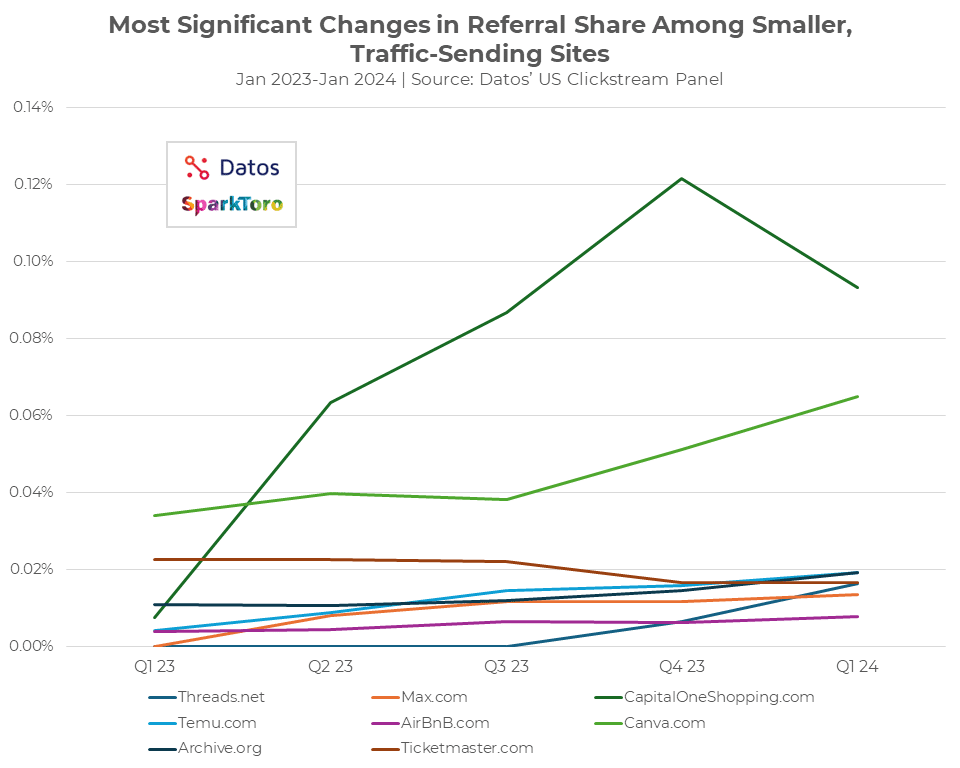
The study further demonstrates that Threads’ traffic is growing faster than other top-visited sites
Now, the comment from Fishkin above becomes important:
“The only reasonable move is to invest in the sources of influence to which your audience pays attention: social accounts they follow, YouTube channels they watch, podcasts they listen to, websites they visit, events they attend, etc. Anything else is missing out on opportunity.”
So we’re being encouraged to invest in Threads and social over SEO. But does it work?
SparkToro follows this mix – and appears to be failing
If excluding SEO and focusing only on social media worked, why is SparkToro losing traction and growth?
SparkToro is Fishkin’s tool for audience research. It grew almost entirely because of Fishkin’s following and push on social media. This following created a short-lived interest that started to decline heavily in 2024.
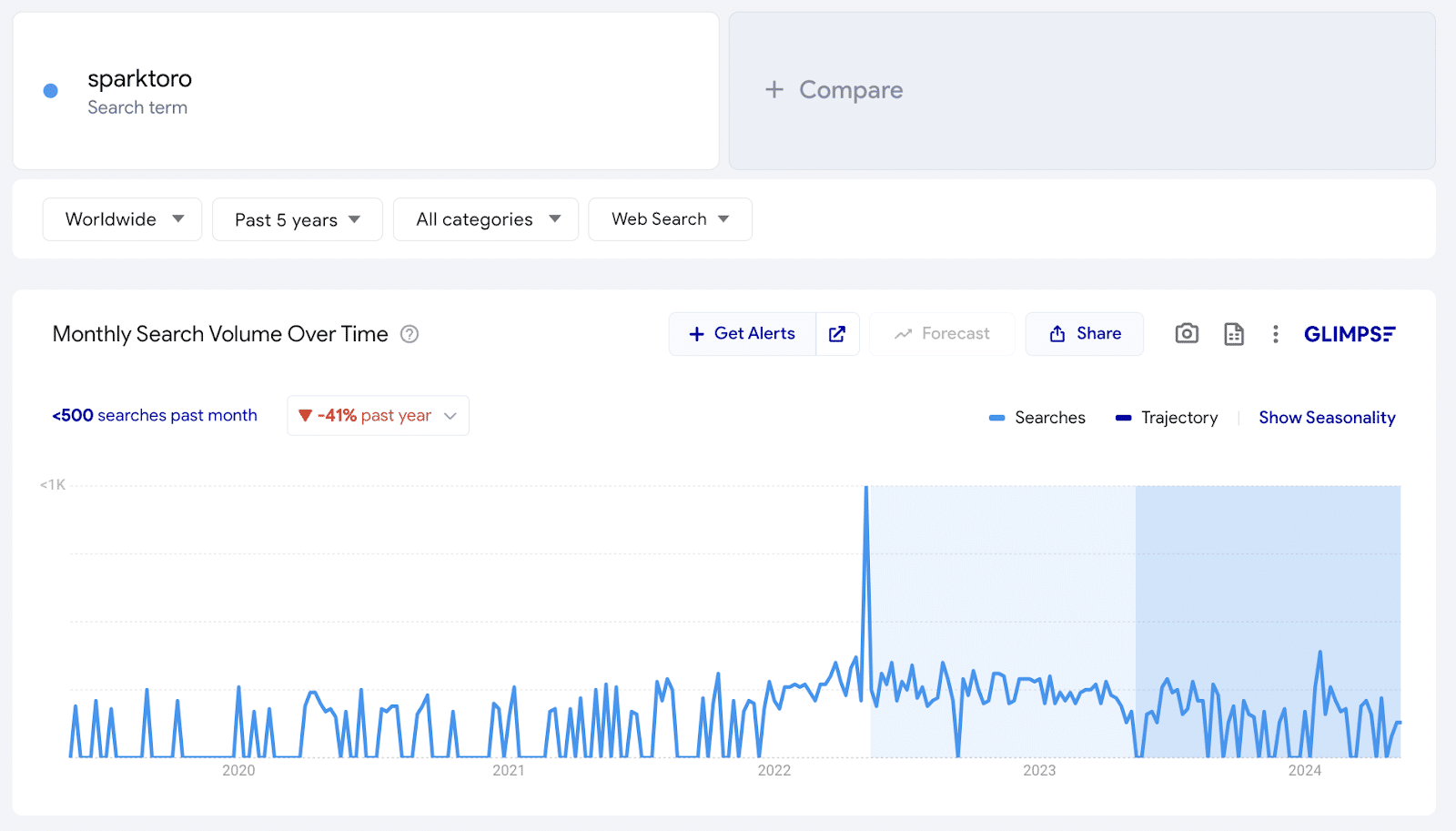
The tool only ranks in the top 3 for brand keywords like “SparkToro” or “audience research tool,” which have low interest and an average monthly search of 170.

Google Trends shows a 41% decrease in brand search volume for “SparkToro” in 2024 from 2023. Looking at the SparkToro pricing page on archive.org, the lowest-paid package’s pricing in April 2022 was $150/month and is $50/month as of 2024.
A decrease in price and brand search shows a declining user base and a need to attract or retain users. Overall, the tool gained interest but then started to decline.
If focusing on social works, shouldn’t SparkToro be doing better?
SparkToro seems to be underperforming right now. However, the team may be playing a long game and focusing on designing an entirely new category for “audience research tools.”
Search volume for the keyword “audience research tool” started to grow after SparkToro launched in 2018 and increased by 33% in the past year. These are the telltale signs of an emerging category.

“Audience research tools” is a keyword someone would use to find a tool for “audience research.” This keyword has high buyer intent for software that provides insights into where a brand’s audience lives online.
SparkToro is actually doing SEO but trying to create demand for the keywords it already ranks for. It ranks in Position 1 for the keyword “audience research tools,” according to Semrush.
Users from non-brand searches are looking for something specifically to solve a problem and understand how products or services relate to the solution they need. This is a buying intent.
But if you are not creating a new market category, why not rank for high-search keywords in your existing category with buyer intent?
Can search work in new market categories?
SEO can drive growth by ranking for adjacent market segment keywords in new market categories but solving similar problems for that audience.
Adjacent markets are ones where your product, service or idea solves a similar problem or opportunities with a different audience.
For example, SparkToro allows you to build a list of contacts on press sites with overlapping audiences. The site could then create an integrated PR and SEO campaign to help corporate PR or communication professionals find audiences related to their target publications.
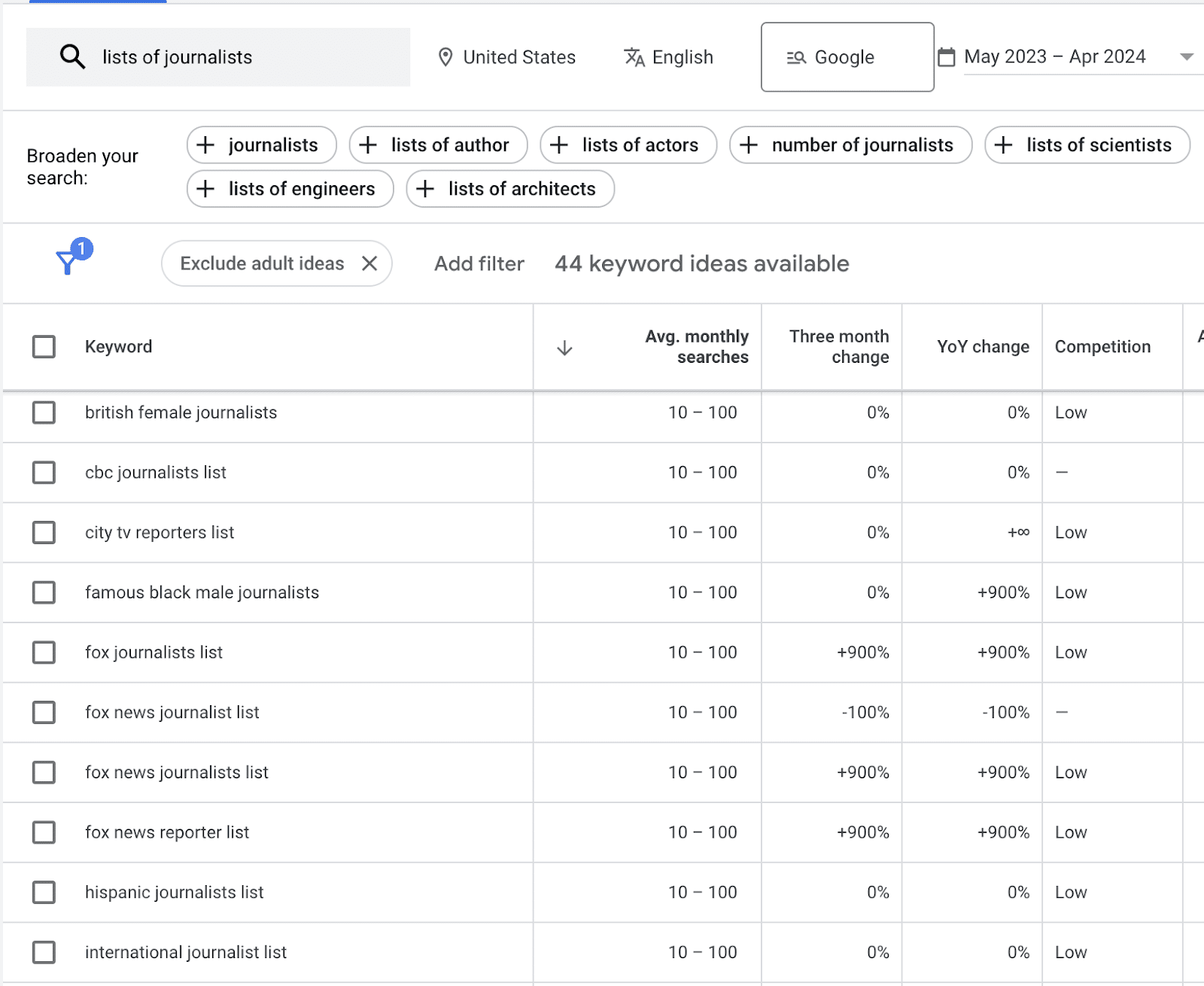
In this scenario, they could create a campaign around “journalists seed list audiences” where they build a landing page with a list of contacts at CBC or Fox.
The purpose of this page would be to help comms professionals looking for contacts at one publication convert and build a list of all publications and platforms where the same audience visits.
Although these individual keywords have low search volume (e.g., “CBC journalists lists has 10-100 avg. monthly searches), creating these across hundreds of publications and then doing a PR topic tour to explain how comms professionals can improve campaign performance by these targeted publications.
The campaign could look something like this:
- Funnel: Drive demands around finding the audience for Fox or CBC, then sign up for a new tool or feature specific to finding audiences for these major publications or journalists.
- On-page: Create landing pages around each media outlet or an “audience profile kit” of sorts. This landing page could highlight all the places the audience visits for those publications, contacts, audience demographics, etc.
- Search engines: Ranks the audience scorecard for “CBC journalists list” or other publication names.
- PR topic tour: Have an expert appear on podcasts or webinars to talk about how to find the audiences for these publications and create a study showing the audience’s path.
Searching for an audience by specific groups of journalists would make targeting more precise, as people often read only certain sections, like business or lifestyle. This data could be useful on the landing page.
These pages’ content could also be a new feature or widget for the site, showing that keyword data can be used to understand the audience’s needs and test new features.
You could argue that this type of SEO may not be needed for a product-led growth strategy. However, product-led growth focuses on technical users finding specific applications and sharing how they solved a problem with the tool.
People with similar issues will then see how they solved the problem and do the same. This type of SEO strategy gives technical users (e.g., media list builders) in a corporate communications role a way to use a seed list to find other relevant audiences.
This type of campaign provides unique value in a product-led growth strategy (i.e., a technical audience uses and loves the product, so they share it with other technical users). The page could provide an asset that technical users, PR or media relations people, in this case, could easily share when someone needs a list of sites and contacts for an audience.
SEO does have applications in new markets and with product-led growth, but the amount of traffic in these markets may not be as robust as in emerging or established markets.
What about search marketing in emerging or mature markets?
As a market matures, buyers use search engines to learn more about the products, services or ideas in that category.
I like to use the innovation adoption curve to understand and plan keyword targets and media communication strategy since as technology or innovation adoption grows, so does search volume.
- Innovators: Technical enthusiasts who are looking to solve new problems.
- Early adopters: Visionaries who see a big opportunity when solving problems.
- Early majority: Pragmatic users who want to solve problems but need proof it works.
- Late majority: Skeptical about technology or changes.
- Laggards: Do things in the market standard.
Ebikes, for example, are an emerging market in the U.S., with some states and cities having a much higher adoption rate than the national rate. As more people use and talk about using ebikes, the demand and Google searches for the product grow.
A recent case study I wrote for Search Engine Land about the ebikes category illustrates this.
The keyword “ebike” has between 100,000 to 1 million average monthly searches with a +900% increase YoY (Google keywords planner).
Keywords planner aggregates multiple keywords into this search volume beyond “ebike” so Google Trends can provide another perspective on growth. But Google Trends show a growing interest in the category with over 17% increase in search in 2024 from 2023.

For this rapidly growing term, the brand has spots in the shopping feature, paid ads and standard Google blue listings.
The standard organic rankings could get a 35% click-through rate (CTR) alone, but taking up three key positions could drive up CTR due to brand presence on the page.
The CTR could also be improved since the brand’s ebike has strong brand recognition through its PR efforts.
Let’s use some rough numbers to estimate the traffic for this keyword that a person would use when looking to buy an ebike.
- 300,000 monthly searches.
- 40% CTR.
- 120,000 monthly clicks.
- Last-click conversion rate of 5%.
- 6,000 sales per month.
This doesn’t include the return visits with latent conversions (e.g., non-last click conversions) for those shopping around during the first click.

Why would an ebike brand not want to have the same dominance for this keyword as Lectric?
An insightful conclusion
Target each stage of your audience’s journey with the right messaging based on the medium they are using and how they use it, using an integrated PR and SEO strategy.
This graph above tells an important story about designing your marketing strategy, and this data point is an important part of that story:
- “70% of online shoppers who are also active weekly on social media report using Google Search to inform or evaluate purchases that caught their attention on social media.”
Thus, the audience may start their journey on social media sites, but they will also use search engines as they progress to make buying decisions.
This means that a budget should be invested in each stage of the audience’s online journey, including using PR and SEO techniques.
Courtesy of Search Engine Land: News & Info About SEO, PPC, SEM, Search Engines & Search Marketing
Category seo news | Tags:
Social Networks : Technorati, Stumble it!, Digg, de.licio.us, Yahoo, reddit, Blogmarks, Google, Magnolia.