

Why 100% indexing isn’t possible, and why that’s OK
Written on June 14, 2022 at 9:57 am, by admin
When it comes to topics like crawl budget, the historic rhetoric has always been that it’s a problem reserved for large websites (classified by Google as 1-million-plus webpages) and medium-sized websites with high content change frequency.
In recent months, however, crawling and indexing have become more common topics on the SEO forums and in questions posed to Googlers on Twitter.
From my own anecdotal experience, websites of varying size and change frequency have since November seen greater fluctuations and report changes in Google Search Console (both crawl stats and coverage reports) than they have historically.
A number of the major coverage changes I’ve witnessed have also correlated with unconfirmed Google updates and high volatility from the SERP sensors/watchers. Given none of the websites have too much in common in terms of stack, niche or even technical issues – is this an indication that 100% indexed (for most websites) isn’t now possible, and that’s OK?
This makes sense.
Google, in their own docs, outlines that the web is expanding at a pace far outstretching its own capability and means to crawl (and index) every URL.
In the same documentation, Google outlines a number of factors that impact their crawl capacity, as well as crawl demand, including:
- The popularity of your URLs (and content).
- It’s staleness.
- How quickly the site responds.
- Google’s knowledge (perceived inventory) of URLs on our website.
From conversations with Google’s John Mueller on Twitter, the popularity of your URL isn’t necessarily impacted by the popularity of your brand and/or domain.
Having had first-hand experience of a major publisher not having content indexed based on its uniqueness to similar content already published online – as if it is falling below both the quality threshold and doesn’t have a high enough SERP inclusion value.
This is why, when working with all websites of a certain size or type (e.g., e-commerce), I lay down from day one that 100% indexed is not always a success metric.
Indexing tiers and shards
Google has been quite open in explaining how their indexing works.
They use tiered indexing (some content on better servers for faster access) and that they have a serving index stored across a number of data centers that essentially stores the data served in a SERP.
Oversimplifying this further:
The contents of the webpage (the HTML document) document are then tokenized and stored across shards, and the shards themselves are indexed (like a glossary) so that they can be queried quicker and easier for specific keywords (when a user searches).
A lot of the time, indexing issues are blamed on technical SEO, and if you have a noindex or issues and inconsistencies preventing Google from indexing content, then it is technical, but more often than not – it’s a value proposition issue.
Beneficial purpose and SERP inclusion value
When I talk about value proposition, I’m referring to two concepts from Google’s quality rater guidelines (QRGs), these being:
- Beneficial purpose
- Page quality
And combined, these create something I reference as the SERP inclusion value.
This is commonly the reason why webpages fall into the “Discovered – currently not indexed” category within Google Search Console’s coverage report.
In the QRGs, Google makes this statement:
Remember that if a page lacks a beneficial purpose, it should always be rated Lowest Page Quality regardless of the page’s Needs Met rating or how well-designed the page may be.
What does this mean? That a page can target the right keywords and tick the right boxes. But if it’s generally repetitive to other content and lacks additional value, then Google may choose not to index it.
This is where we come across Google’s quality threshold, a concept for whether a page meets the necessary “quality” to be indexed.
A key part of how this quality threshold works is that it’s almost real-time and fluid.
Google’s Gary Illyes confirmed this on Twitter, where a URL may become indexed when first found and then dropped when new (better) URLs are found or even given a temporary “freshness” boost from manual submission in GSC.
Working out whether you have an issue
The first thing to identify is if you’re seeing the number of pages in Google Search Console’s coverage report being moved from included to excluded.
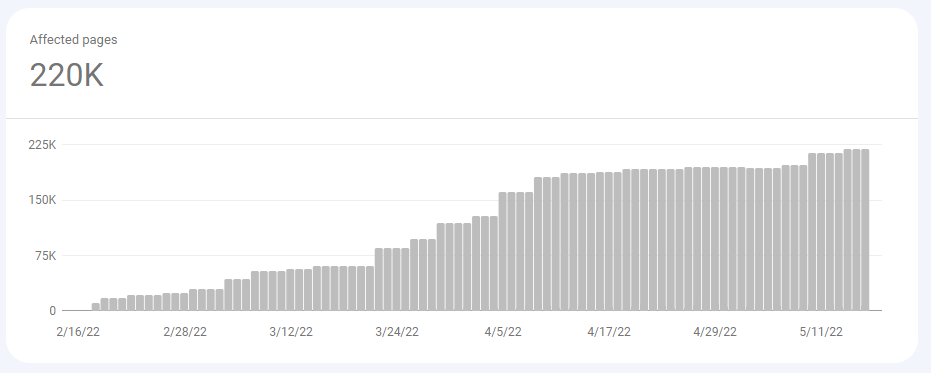
This graph on its own and out of context is enough to cause concern amongst most marketing stakeholders.
But how many of these pages do you care about? How many of these pages drive value?
You’ll be able to identify this through your collective data. You’ll see if traffic and revenue/leads are decreasing in your analytics platform, and you’ll notice in third-party tools if you’re losing overall market visibility and rank.
Once you’ve identified if you are seeing valuable pages dropping out of Google’s index, the next steps are to understand the why and Search Console breaks down excluded into further categories. The main ones you need to be aware of and understand are:
Crawled – currently not indexed
This is something I’ve encountered more with e-commerce and real estate than any other vertical.
In 2021 the number of new business applications registrations in the U.S. broke previous records, and with more businesses competing for users, there is a lot of new content being published – but likely not a lot of new and unique information or perspectives.
Discovered – currently not indexed
When debugging indexing issues, I find this a lot on e-commerce websites or websites that have deployed a considerable programmatic approach to content creation and published a large number of pages at once.
The main reasons pages fall into this category can be down to crawl budget, in that you’ve just published a large amount of content and new URLs and grown the number of crawlable and indexable pages on the site exponentially, and the crawl budget that Google has determined for your site isn’t geared to this many pages.
There’s not a lot you can do to influence this. However, you can help Google through XML sitemaps, HTML sitemaps and good internal linking to pass page rank from important (indexed) pages to these new pages.
The second reason why content may fall into this category is down to quality – and this is common in programmatic content or e-commerce sites with a large number of products and PDPs that are similar or variable products.
Google can identify patterns in URLs, and if it visits a percentage of these pages and finds no value, it can (and sometimes will) make an assumption that the HTML documents with similar URLs will be of equal (low) quality, and it will choose not to crawl them.
A lot of these pages will have been created intentionally with a customer acquisition objective, such as programmatic location pages or comparison pages targeting niche users, but these queries are searched in low frequency, will likely not get many eyes, and the content may not be unique enough versus the other programmatic pages, so Google will not index the low-value proposition content when other alternatives are available.
If this is the case, you will need to assess and determine whether the objectives can be achieved within the project resource and parameters without the excessive pages that are clogging up crawl and not being seen as valuable.
Duplicate content
Duplicate content is one of the more straightforward and is common in e-commerce, publishing and programmatic.
If the main content of the page, which holds the value proposition, is duplicated across other websites or internal pages, then Google won’t invest the resource in indexing the content.
This also ties into the value proposition and the concept of beneficial purpose. I’ve encountered numerous examples where large, authoritative websites have had content not indexed because it is the same as other content available – not offering unique perspectives or unique value propositions.
Taking action
For most large websites and decent-sized medium websites, achieving 100% indexing is only going to get harder as Google has to process all existing and new content on the web.
If you find valuable content being deemed below the quality threshold, what actions should you take?
- Improve internal linking from pages that are “high value”: This doesn’t necessarily mean the pages with the most backlinks, but those pages that rank for a large number of keywords and have good visibility can pass positive signals through descriptive anchors to other pages.
- Prune low-quality, low-value content. If the pages being excluded from the index are low value and not driving any value (e.g., pageviews, conversions), they should be pruned. Having them live is just wasting Google’s crawl resource when it chooses to crawl them, and this can affect their assumptions of quality based on URL pattern matching and perceived inventory.
The post Why 100% indexing isn’t possible, and why that’s OK appeared first on Search Engine Land.
Courtesy of Search Engine Land: News & Info About SEO, PPC, SEM, Search Engines & Search Marketing
Category seo news | Tags:
Social Networks : Technorati, Stumble it!, Digg, de.licio.us, Yahoo, reddit, Blogmarks, Google, Magnolia.
Top 7 SEO tips for WordPress sites
Written on June 13, 2022 at 6:50 am, by admin
If your WordPress site rank is not performing as expected, all hope is not lost.
There are a couple of things you can do to improve your SEO ranking. The seven methods outlined below are quick, simple, and proven to show results.
1. Make sure HTTPS is enabled
Using an SSL certificate to secure your website lets your viewers know your site is secure, which helps with ranking.
SSL certificates are available both free and paid. Once you have an SSL certificate installed for your site, use a plugin like Really Simple SSL to assure your content is served from the secure protocol.
2. Optimize your URLs
A good permalink structure is crucial to SEO-friendly URLs.
WordPress gives you this functionality from installation, but you can make changes to it with plugins for more modifications.
URL optimization is important when optimizing your pages on your site for certain search queries and keyword phrases.
Placing your primary keyword in the URL is considered a best practice for on-page SEO.
When a search engine crawls your site, it’s easy for them to understand what your content is about.
3. Use an SEO plugin
SEO plugins are a great way to diagnose and improve both technical and on-page SEO recommendations. Consider installing one of these recommended plugins.
- Yoast SEO – One of WordPress’s most popular plugins. The free version of Yoast boasts tools to help optimize your content for SEO and improve overall readability.
- Rank Math – Rank Math has an intuitive panel on your page or post that allows you to see changes that would positively affect your SEO.
4. Meta descriptions
Meta descriptions or tags is an element that summarizes the content of your post or page. It gives search engines a brief description of what they will read or find on your website.
A meta description should not be longer than 275 characters long as that is all Google will display.
A compelling meta description can bring more readers to your post, adding to your SEO rank. You will want to add your keyword to your meta description for easy lookups and add it to your content.
5. Craft good content
High-quality content is one of the best ways to improve your SEO. Good quality content goes deeper than the material you write or create on your website.
Assure you have a deep understanding of the subject you are writing about and do some keyword research to best capture your audience’s attention.
Avoid creating duplicate content on your site. Duplicate content refers to ideas or topics that have already been created or discussed on your website and will negatively affect your SEO score.
A good model to follow is the E-A-T model, which creates trust with your user and an overall better SEO ranking.
What is E-A-T content? Google uses search quality guidelines to ensure the content on a site is good for users. It is not a ranking factor for SEO, but it affects how your content is read.
E-A-T stands for the expertise of the writer, authoritativeness of the content or site itself and trustworthiness of the content provided.
Assuring your website has an about us page will show your authoritativeness and expertise to your readers. Because of this, collaborating with other experts contributes to your SEO.
6. Site optimization
Today, site speed is another important factor for SEO optimization, as serving content as fast as possible is what a lot of users need—every second matters.
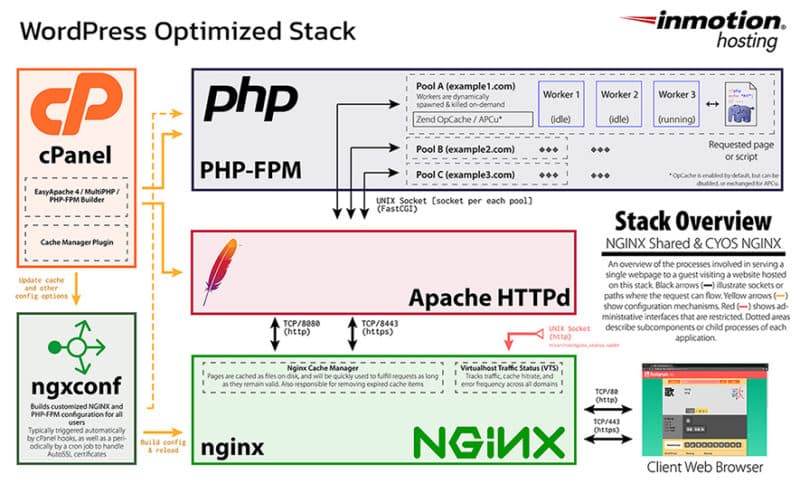
Use a hosting provider that is optimized for your WordPress site with options such as NGINX or Redis for server-side caching.
An example of WordPress optimized hosting is InMotion Hosting’s Ultrastack, which uses NGINX to intelligently cache frequently-used resources to save memory.
Images should also be optimized. If they are too large or take too long to load, it will strain your website. Using a CDN (Content Delivery Network) to serve your content helps reduce load times.
The Jetpack plugin provides a free image CDN, but there are other hosting resources that can be used such as Cloudflare.
If your current hosting provider does not provide server-side caching, you can use a caching plugin such as W3 Total Cache or WP Rocket.
7. Keep an eye on your analytics
Google Search Console and Google Analytics go hand in hand to track how your website is performing. These metrics give you detailed information about how visitors interact with the content on your website.
Other resources are Bing’s Webmaster Tools and third-party options such as Semrush.
Utilizing these tools also allow you to review your keyword rate, as well as site speed.
Final words
SEO can be challenging, especially if you are a new website creator or small business owner; however, keeping the tips above in mind will help you along the way. Having the right foundation to start and creating good quality content will ensure your website and media rise to the top.
Get WordPress Hosting that’s optimized for performance and SEO.
The post Top 7 SEO tips for WordPress sites appeared first on Search Engine Land.
Courtesy of Search Engine Land: News & Info About SEO, PPC, SEM, Search Engines & Search Marketing
Category seo news | Tags:
Social Networks : Technorati, Stumble it!, Digg, de.licio.us, Yahoo, reddit, Blogmarks, Google, Magnolia.
6 Amazon marketing strategies to implement in 2022
Written on June 13, 2022 at 6:50 am, by admin
Amazon’s reign as the king of ecommerce won’t end any time soon.
More than 2 billion people visit Amazon each month, according to Statista.
So, how do you stand out and generate more sales?
The core belief behind Amazon’s algorithm is straightforward. They want customers to continue buying. They are interested in sales just as much (if not more) than you are as a seller.
The difference? Amazon doesn’t have any loyalty toward any brand other than their own.
More sales lead to higher rankings, which in turn, leads to more sales.
But how can you get past the chicken vs. egg scenario to start seeing improvements?
Here are the six marketing strategies you can use to grow your Amazon sales.
1. Cover the basics
Tips and tricks don’t replace solid marketing fundamentals. In general, you should be thinking in terms of strategy, not just tactics.
Do you have high-quality photos and strong copy? How are you positioning your brand/product? Are your prices competitive or is your product differentiated?
These matter on every channel — especially Amazon. You can’t start optimizing until your basics are covered.
2. Reanalyze your keywords and focus on keyword relevancy
Amazon’s algorithm may be focused on customers buying products, but that is similar to saying Google’s algorithm is focused on providing the best answer. While it may be true, a lot of variables and nuances go into rankings. This includes:
- Ratings.
- Sales fulfillment.
- Sales velocity.
- Inventory.
- Pricing.
- CTR.
With the A10 Algorithm update (which seems to be based on several updates throughout the years instead of one major update), matching the shopper’s interest/intent has taken center stage. Amazon is attempting to show products based more on searchers vs. their own profitability.
While you may have done keyword research when you first set up your product detail page, shopping behaviors may have changed. You should regularly conduct keyword research and make sure you have the terms placed throughout the product detail page. This includes important areas like title, description, and bullet points.
This isn’t simply stuffing keywords in your copy. You still have to write for shoppers in a way that drives conversions. The algorithm may rank your product, but it doesn’t buy it.
Shoppers are the ones reading and making the decision whether to purchase. Your copy must help convince them that your product is the right choice.
3. Invest more in advertising
As expected, Amazon Advertising continues to grow and be an essential part of the company’s revenue.
Amazon’s ad revenue was more than $31 billion in 2021. That’s more than triple its 2018 ad revenue of $10 billion.
If you want to be successful on Amazon, an ad campaign is a must.
Amazon rewards sales and running Amazon ads allows you to get those sales. Unlike Google Ads, where paid ads have no impact on organic placement, Amazon does. You can stimulate sales velocity and improve your rankings by investing more in Amazon Ads.
As the competition continues to grow, so does the cost.
The good news is that Amazon also continues to refine its ads platform to give you more options and data to improve your Advertising Cost of Sales (ACoS). ACoS is calculated by dividing your ad spend by your ad revenue and multiplying it by 100.
4. Bring in more off-Amazon traffic
Amazon is dominant online and they want to remain that way. A good way to do that is to get traffic from other sites. That is why Amazon does take into account traffic that leads to sales from off-Amazon channels like Google and Facebook.
Take advantage of the Brand Referral Bonus program and create an external traffic campaign for your product listings. Whether it is Google Ads, Facebook Ads, or any other type of campaign to drive traffic, you can set yourself up to receive a commission from Amazon and higher organic listings for your products when done properly.
5. Use a coupon with Amazon advertising
Everyone loves a discount and a good deal. You can play off both psychological triggers by running a coupon for your sponsored product ads.
Sponsored product ads allow your product to be shown within the search results for specific terms.
When you run a coupon at the same time searchers can see your product with a discount. This not only helps the CTR from the search results but also leads to a higher conversion rate – both crucial metrics for successful Amazon marketing strategies.
In many cases, it isn’t even the amount of the coupon that makes the difference, but simply having one is enough.
Even if you can’t offer a coupon with advertising and turn a sustainable profit on your sales, you should still consider it for a period of time. The improvements in your rankings could lead to higher sales well past the full advertising blitz.
Keep your guard up, however, because you are never operating in a silo. Competitors will always be after your market share.
6. Invest in high-quality videos
Photos still get most of the attention (rightfully so), but videos have earned their place among the must-haves when it comes to listing quality.
The more information you can give to potential buyers to make them understand and trust your product the higher your sales and the better your reviews will be.
These four video tips may help you produce more sales from your Amazon listing:
- Shoot a video describing and using your products.
- Make sure you have a plan to address the pain points your product solves and highlight other important differentiating factors.
- Highlight how your product compares to others and show it being used with a lifestyle video to determine what resonates most with your buyers.
- Keep it focused on sales.
Remember, Amazon wants happy customers and more sales — just like you.
Even though it may feel like it, it isn’t you vs. Amazon. It is you vs. the other products someone would buy instead of yours on Amazon.
Keep strategy focused on awareness and conversion. If you implement the right strategy, Amazon should reward you with higher rankings.
The post 6 Amazon marketing strategies to implement in 2022 appeared first on Search Engine Land.
Courtesy of Search Engine Land: News & Info About SEO, PPC, SEM, Search Engines & Search Marketing
Category seo news | Tags:
Social Networks : Technorati, Stumble it!, Digg, de.licio.us, Yahoo, reddit, Blogmarks, Google, Magnolia.
YouTube lifts some restrictions for mastheads ads
Written on June 11, 2022 at 12:46 am, by admin
Google has just announced that they are pulling back restrictions on some previously prohibited categories from showing on the YouTube masthead.
Effective today. Google will now allow booking for masthead ads for the following categories:
- Sports betting (US only)
- Alcohol (where legal)
- Prescription drugs (US, CA, NZ)
What Google says. A spokesperson from Google stated “We’re constantly reviewing our ad requirements to improve our products and services. Given the evolving regulatory landscape for sports betting and following our successful implementation of our new “per market” YouTube masthead format, we believe that this decision balances the needs of advertisers and consumers.”
Categories for election and political ads, as well as (non-sports) gambling remain restricted.
Additional YouTube masthead changes. In 2020 we reported on Google’s announcement that they would discontinue full-day masthead reservations and replace them with more targeted options. The new CPM option allowed mastheads to be more accessible to a broader market of advertisers.
View the changelog. You can view the changelog and new policies here.
Why we care. Mastheads are just one of many YouTube and Google advertising formats, and only a fraction of overall ad impressions for YouTube on any single day. But advertisers in any one of the previously restricted categories above can now select that placement, giving them more options for their ad campaigns.
The post YouTube lifts some restrictions for mastheads ads appeared first on Search Engine Land.
Courtesy of Search Engine Land: News & Info About SEO, PPC, SEM, Search Engines & Search Marketing
Category seo news | Tags:
Social Networks : Technorati, Stumble it!, Digg, de.licio.us, Yahoo, reddit, Blogmarks, Google, Magnolia.
Twitter removes nofollow attribute from links in tweets
Written on June 11, 2022 at 12:46 am, by admin
Twitter has removed the nofollow link attribute from Twitter posts, tweets, in its source code. It is unclear if Twitter removed this attribute on purpose or not and if even search engines, like Google, would value links from Twitter or not.
Timing. According to Chris Silver Smith, Twitter removed the nofollow link attribute sometime in the past couple weeks or so. He said on Twitter “Twitter is apparently no longer using rel=”nofollow”. This includes links you find on “profiles, tweets, and other pages on Twitter may now contain followed links,” he said.
SEO folks, you might be interested to know that Twitter is apparently no longer using rel="nofollow". So, profiles, tweets, and other pages on Twitter may now contain followed links!
Observations
pic.twitter.com/P5ldLSfaxq
— Chris Silver Smith (@si1very) June 10, 2022


Back in 2008, former search quality lead and spam fighter, Matt Cutts, posted that Twitter added the nofollow link attribute to bio sections on Twitter. Within a year later, Twitter added the attribute to all tweets and other sections of their site.
Will these links count? It is hard to know if Google or Bing or other search engines will start to now follow and count links found on Twitter.com and within tweets. We know Google can sometimes treat links that do not have a nofollow attribute, as if it does have a nofollow attribute. I would assume Google would by default do that with most social networks, including Twitter, because user generated content and links, are hard to trust in general.
Will it last. Also, I suspect Twitter will soon add the nofollow link attribute back to external links as soon as they hear about this publicly. So this may be short-lived. We have reached out to Twitter for a statement.
Why we care. Twitter is one of the largest social networks and is used heavily by SEOs and marketers. If links remain unfollowed, it potentially might lead to more link spam on that network and both hurt the usefulness of Twitter and potentially the value of links in general on Twitter.
But again, I really don’t think Twitter intentionally removed the nofollow but we will see.
The post Twitter removes nofollow attribute from links in tweets appeared first on Search Engine Land.
Courtesy of Search Engine Land: News & Info About SEO, PPC, SEM, Search Engines & Search Marketing
Category seo news | Tags:
Social Networks : Technorati, Stumble it!, Digg, de.licio.us, Yahoo, reddit, Blogmarks, Google, Magnolia.
10 quick and easy tips from LinkedIn for creators
Written on June 11, 2022 at 12:46 am, by admin
Want to publish great content on LinkedIn?
Coming up with content ideas can be a challenge.
Sometimes the hardest part is coming up with the right idea.
It also can be easy to talk yourself out of your own ideas.
So if you’re in need of some ideas or inspiration, here are 10 quick and easy tips to come up with topics.
All of the following tips were provided by various LinkedIn for Creators team members during their live What Creators Need to Know: Episode 4. I’ve summarized those for brevity and also sprinkled in a few of my own thoughts to add some context.
1. Look up common hashtags
Focus on hashtags that are used by, and relevant to, your industry.
Click on the hashtag to find high-performing posts. Use this for some inspiration on topics.
However, don’t steal or slightly reword posts from other creators. You will more likely than not be called out.
2. Talk about timely topics
This can be current events or industry news. You can also use LinkedIn’s trending section to find popular news stories and conversations, which you can use as inspiration for your next post.
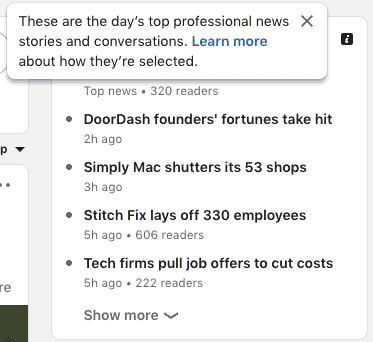
Do you have to weigh in on partisan or controversial issues? That’s your call. Just know that your post could get filtered out if it’s political or you could lose followers who disagree with you.
3. Experiment with formats and publishing times
Try out a variety of content formats – mix up photo, video and text posts. See what works with your audience.
If you do livestreams, for example, figure out what works best for your audience. Try out a couple of different days of the week and times of day to see which gets you the most views.
Consider polling your followers to find out when they would be most likely to watch. Once you figure out your time, be consistent to make watching you a habit.
4. Quality over quantity
Not every LinkedIn post has to go viral.
Focus on creating content that could directly help one person – or even just a few people.
If that post also happens to go viral, that’s an awesome bonus.
But numbers shouldn’t be the only way you measure success.
Before hitting Post, think about your audience. Could your content help them:
- Become better at their job.
- Advance in their career.
- Solve a problem they’re experiencing.
- Learn something new.
- Understand current events, an issue, or other types of changes.
5. Share your truth
The good, the bad, the ugly. Show your personality.
People want to see your real life, voice and story.
LinkedIn is a professional network, but that doesn’t mean you always have to be super polished and super professional.
6. Spark conversations – and keep them going.
Ask your audience a question that will elicit a response and also encourage them to share their insights and thoughts. Help keep the conversation going by responding to comments.
Aside from adding questions to your post, you can use polls or tag others who you think would be beneficial to the conversation or anyone your audience would like to hear from.
That said, tag wisely. Don’t just make a post and tag dozens of your contact – those people may find it annoying and it may do more harm than good.
Also, avoid sales pitches.
You want to be approachable. Selling is the exact opposite of being approachable. It will turn off people and can hurt your engagement.
7. Be authentic
Be yourself. Tell your story. Just be you and stay true.
Hair, makeup, lighting, audio – it doesn’t always have to be perfect. Show up as your best, most authentic self. Do what you love and show it on video.
I believe it was Dr. Seuss who said “There is no one alive who is Youer than You.”
8. Share your experiences
Share your entire journey with your followers – your wins, challenges, losses, and everything else in between.
Be vulnerable. Be open with your audience.
Great content doesn’t have to be perfect. Life is a little messy – so record it.
9. Stop overthinking content
Approach content with a mindset of documenting rather than creating all the time.
Things you read or hear, conversations you have, questions you answer, problems you solve – all of this is content just waiting to be created every day.
10. Ask for a quarter off for metrics
This ties back to experimenting.
Sometimes you need space to test, learn and set a baseline to measure performance. It typically takes time to see results on a new platform – so the last thing you want to do is think you have no traction when, in fact, you’re just starting to build the traction you will need for start seeing tangible results in three, six, or 12 months.
The best time to start creating great content on LinkedIn was years ago. But the second-best time is now.
The post 10 quick and easy tips from LinkedIn for creators appeared first on Search Engine Land.
Courtesy of Search Engine Land: News & Info About SEO, PPC, SEM, Search Engines & Search Marketing
Category seo news | Tags:
Social Networks : Technorati, Stumble it!, Digg, de.licio.us, Yahoo, reddit, Blogmarks, Google, Magnolia.
LinkedIn announces boosting for Event posts
Written on June 11, 2022 at 12:46 am, by admin
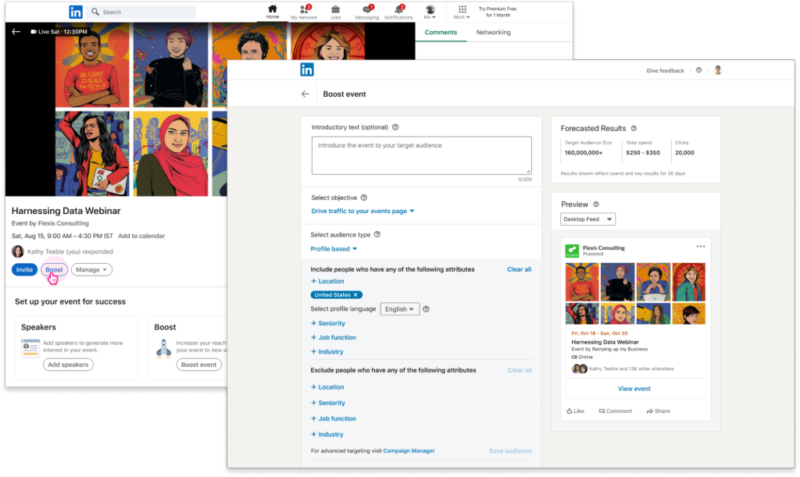
LinkedIn has just announced that they’re expanding the Boost button to the LinkedIn Events page. This means that advertisers will be able to promote events and drive registrations.
Last year LinkedIn gave advertisers a new feature to Boost organic posts from their page. This allowed them to promote an organic post to more of their followers, or specific professional audiences of their choice.
How it works. To Boost an event, simply navigate to the Boost button on your Events page. Select the target audience you want to see the ad. Set the schedule, and budget, and enter the payment info. This will create an event ad that will appear in the feed of professionals you’ve selected as your target audience.
What LinkedIn says. “Over the last few years, we have seen virtual events bringing communities together. Companies across industries have used LinkedIn Events to promote their content and continue building on their community of professionals.”
Learn more. Read the full article here.
Why we care. Boosting posts isn’t new. Facebook has been allowing advertisers to boost posts for years. The option allows time-sensitive content to be shared easily, without having to navigate the ads manager dashboard. This week LinkedIn also announced the introduction of a centralized Business Manager. While we’re glad they’re finally catching up to where the rest of the platforms have been, we are curious, what’s next?
The post LinkedIn announces boosting for Event posts appeared first on Search Engine Land.
Courtesy of Search Engine Land: News & Info About SEO, PPC, SEM, Search Engines & Search Marketing
Category seo news | Tags:
Social Networks : Technorati, Stumble it!, Digg, de.licio.us, Yahoo, reddit, Blogmarks, Google, Magnolia.
Twitter announces Product Drops for merchants
Written on June 9, 2022 at 9:37 pm, by admin
Merchants have a new Twitter feature, called Product Drops, to help engage their followers and stay on top of new product releases.
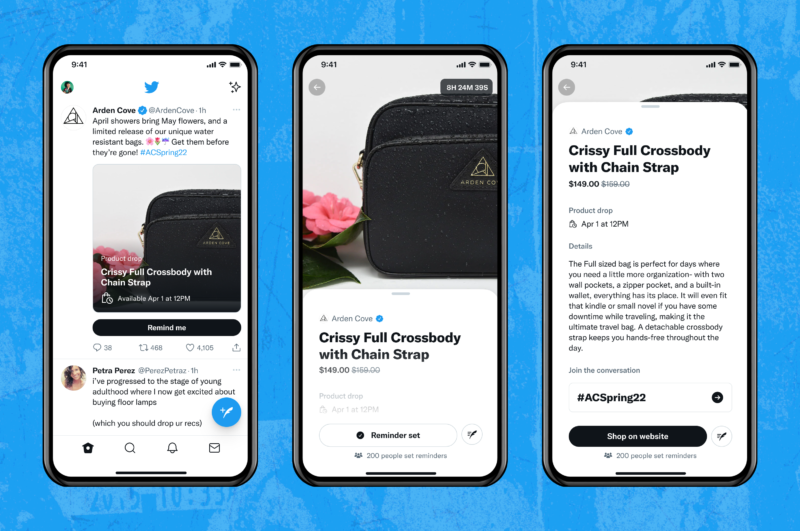
What are Product Drops. Product Drops from Twitter is a new feature that allows brands to notify their followers when they launch a new product. The feature is the first of its kind for a social media platform.
How does it work. When a merchant tweets about an upcoming launch, followers will see a “Remind me” button at the bottom of the tweet. They’ll simply tap that button to be reminded of the launch day.
On the product’s launch day, they’ll receive a notification in the app 15 minutes before, and at the time of the drop. Clicking the notification will bring them to the merchant’s website where they can shop for the product and (hopefully) grab it in time.
The devil is in the details. Before followers click the “Remind me” button they can view the full details of the product that’s dropping. To do this, they’ll just click on the tweet and the Product Details page will open. From there, they can view the price, description, and more.
Ready. Set. Launch. Twitter is rolling out Product Drops to merchants in the US only, on English iOS devices. It’s being tested with select partners including:
- Dior
- Fossil
- Jeff Staple
- Home Depot
There is no word on when the feature will roll out to all merchants.
What Twitter says. “People come to Twitter to talk about products and product drops every day. And merchants have long been dropping products on Twitter without any native product support. We’re excited to change that and introduce new shopping features that empower shoppers to stay on top of the launches that matter most to them and provide merchants with another way to engage shoppers around big product moments.”
Check it out. Read the full announcement from Twitter here.
Why we care. Shopping on Twitter isn’t new. But until recently, there hasn’t been any native support surrounding it. This feature aims to help alleviate some of the frustration people feel around missed product drops, angry customers, and overwhelmed brand reps. However, not all of a brands followers are on Twitter. And even if they are, this feature requires they be near their phone or logged into Twitter to receive the notifications. This feature is a good start to increasing brand engagement, but may miss the mark with many of their fans.
The post Twitter announces Product Drops for merchants appeared first on Search Engine Land.
Courtesy of Search Engine Land: News & Info About SEO, PPC, SEM, Search Engines & Search Marketing
Category seo news | Tags:
Social Networks : Technorati, Stumble it!, Digg, de.licio.us, Yahoo, reddit, Blogmarks, Google, Magnolia.
Webinar: Get beyond the blast with this next-level email strategy
Written on June 9, 2022 at 9:37 pm, by admin

Ever feel like you’re shouting into the void with your email campaigns? You send thousands and thousands of messages; the only response you get is link clicks. It’s useful to see who’s at least somewhat paying attention, but how do you handle all those leads who clicked and didn’t convert?
Join experts from Conversica and learn how companies using conversation automation as part of their email flow see an average of 9.88% response rate, nearly 4x more opportunities and over 10x ROI.
Register today for “Beyond the Blast: Next-Level Email Strategy Requires Conversation,” presented by Conversica.
The post Webinar: Get beyond the blast with this next-level email strategy appeared first on Search Engine Land.
Courtesy of Search Engine Land: News & Info About SEO, PPC, SEM, Search Engines & Search Marketing
Category seo news | Tags:
Social Networks : Technorati, Stumble it!, Digg, de.licio.us, Yahoo, reddit, Blogmarks, Google, Magnolia.
How to win in the SERPs with Google’s auction insights and search intelligence
Written on June 9, 2022 at 9:37 pm, by admin
Search marketing channels are experiencing a surge in revenue. Macroeconomic and hiring impacts the world over have led to companies like Google experiencing massive growth, highlighting how search has become a key channel for marketers.
“It’s great for Google, but that means rising costs for us,” said Sean O’Connor, senior CSM and sales engineer at Adthena, in a recent webinar (scroll down to watch the video).
Attribution is one reason why these developments have made it difficult for paid search marketers to succeed in the space.
Google holds more data than ever before but doesn’t always show marketers the full picture when it comes to their campaigns. At the same time, its growth in the search space, and the decline of other marketing avenues, mean growing pressure on paid marketing teams.
“We are going to experience a higher level of scrutiny for Google Ads than we have in the past few years,” O’Connor said. “Search is the first thing you start, and the last thing you stop, when it comes to brand advertising. That isn’t going to change, but it is going to put the microscope over all the activities that we’re doing.”
“We need to have a clear attribution to the success we’re bringing to our businesses,” he added.
Here’s how paid search marketers can better attribute success using Google Ads’ auction insights tool and search intelligence.
Google Ads auction insights
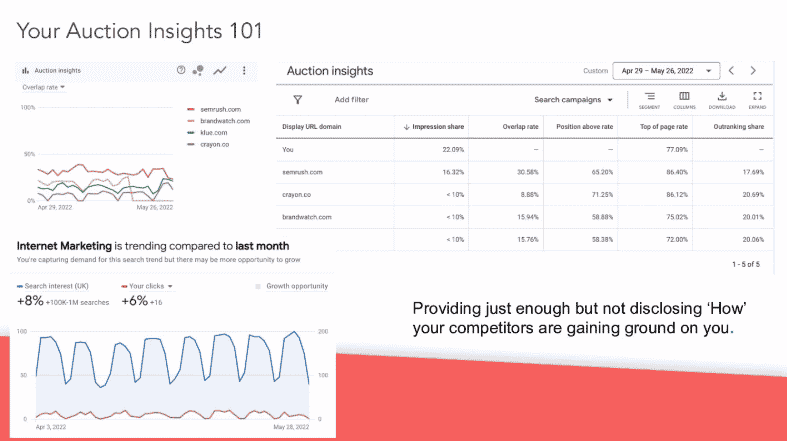
“Auction insights is particularly valuable in providing context on what our competition is doing, but not how they are gaining ground,” O’Connor said. “Impression share and overlapping position rate are somewhat relevant, but they’re not the metrics I particularly care about.”
While many marketers long for the days of “old school” metrics such as average position for individual terms, auction insights still provides useful campaign stats. These include information such as marketing trends, which essentially gives marketers Share of Search data so they can see where they stand.
 Source: Sean O’Connor
“It’s not so much about campaign optimization, but rather an insurance policy,” O’Connor said.
To get the most out of auction insights, he recommends the following:
- Installation: Build out enhanced dashboards to review campaign data alongside business metrics.
- Establish a new workflow: Segment campaigns to enable messaging and market share analysis.
- Take action: Focus on product roadmap development, regional/local segmenting, and spend adjustments.
Search intelligence
“Google is taking information away from the auction insights section, so we need to be able to shed some light behind the curtain,” O’Connor said. “Considering automation policies, do we let it run? How long does it take to learn? How bundled does it need to be?”
“We need to be able to get past this ‘black box,’” he added.
Auction insights give a good amount of campaign information (e.g., impression share, positive above rate, outranking share), but limit your ability to gauge their efforts against competitors in areas they’re not showing up in, according to O’Connor.
This is why he suggests teams craft their own “formula” that combines data gained from auction insights and a search intelligence platform.
“This creates a ‘whole marketing view,’ which [includes] your terms and closely related competitor terms,” he said. “That whole marketing view is going to show your market opportunity.”
Apply the formulas for success
Acquiring and analyzing search data from auction insights and search intelligence tools isn’t enough to improve Google Ads campaigns. Marketers need to activate the combined data to adjust targets and set benchmarks.
“With enough evidence from auction insights and analytics, you can combine them into a nice visualization that can justify your job and make it easier,” he said.
However, marketers should note when it’s time to conserve budgets. The additional insights gained from these formulas will help teams spend more carefully – when it’s called for – and go after new targets when it makes sense.
“Google’s showing you just what you’re focused on,” O’Connor said, “But we need the context of everything else happening.”
Register to watch the full webinar now:
The post How to win in the SERPs with Google’s auction insights and search intelligence appeared first on Search Engine Land.
Courtesy of Search Engine Land: News & Info About SEO, PPC, SEM, Search Engines & Search Marketing
Category seo news | Tags:
Social Networks : Technorati, Stumble it!, Digg, de.licio.us, Yahoo, reddit, Blogmarks, Google, Magnolia.