

A 3-phased approach to proactive online reputation management
Written on August 20, 2022 at 12:08 am, by admin
I’ve helped several brands with their online reputation management (ORM) during my digital marketing career.
Unfortunately, most of this work involved trying to help the brands recover from a crisis.
Even more unfortunate was that the damage to their reputations could have been greatly mitigated with some proactive effort.
What follows is a basic, three-pronged approach to a proactive ORM strategy.
1. Own your name
Often, what looks like a reputation problem is more of an SEO problem related to entity optimization. Because the search engines seek to understand brands as entities, it’s important to amplify the signals that help them know who you are and what you do.
For most businesses, using Organization schema is a significant first step in letting the search engines know who you are.
This simple tagging system hides in the source code of a page on your website and acts as a data feed to show information about your brand or business.
At a minimum, the following information should be tagged:
- Name.
- Address.
- Link to your logo.
- Links to official active social media sites (and to Wikipedia if you already have a page).
Another aspect is to claim your business name on major social media sites. Even if you don’t use a channel, it’s a good idea to grab your brand to keep someone else from trying to impersonate you.
If your brand is big enough, it would be beneficial to ensure your Wikipedia page is correct and up-to-date or, to have one created if there isn’t one already.
Directly making and editing pages by brand representatives is frowned upon and problematic, so hiring an agency specializing in this type of work would be best.
If you are part of a brand with well-known leaders, claiming domain names and social media sites under their names should also be considered.
Politicians, especially, seem to forget this step and often have to contend with parody and impersonator sites set up by their opponents.
Lastly, owning your main website’s .com, .net and .org versions is a great idea.
Global brands may wish to extend this to ccTLDs where the business operates or may operate in the future.
For even more insurance, it is helpful to buy domains with negative messaging like:
- ihatebrand.com or i-hate-brand.com
- boycottbrand.com or boycott-brand.com
You may think those last examples are a bit extreme, but I’ve seen brand detractors go to great lengths and spend much of their own money to set up hater websites on domains like these.
2. Own your story
In SEO, we say, “content is king.” This concept is also true in ORM.
Owning your story often means creating content on your website that will potentially outrank any negative content that others may post online.
The more content you can rank in branded searches on owned and controlled channels like your website or social media accounts, the more you can push negative content off Page 1 of search results and out of view of most searchers.
As the old joke goes, the best place to hide a dead body is on Page 2 of Google search results because no one will find it there.
In extreme cases, it might become necessary to create content to hit on a specific topic around which a brand detractor has generated a lot of content.
When this happens, bringing in an ORM and SEO expert would be helpful if you don’t have that expertise in-house.
What looks entirely innocuous for the casual website visitor is a targeted volley against negative content. For example, don’t strike back directly if a hater created content around alleged food poisoning targets your restaurant.
Create content on your website highlighting the brand’s commitment to food safety and the number of passed inspections conducted by health officials.
3. Own your reviews
Some businesses revolve around reviews. For them, this can be life or death.
I’ve worked with many brands that had trouble recruiting. The reason? Too many negative reviews on Indeed and Glassdoor.
If you think your company doesn’t live and die by reviews, I recommend you take heed anyway.
One primary key to reviews is to respond to each one. Respond to positive reviews with a quick “thank you” and move on. Negative reviews take a bit more work.
Many negative reviews are the result of missed expectations. You can often diffuse the negativity of the review by how you respond. A simple apology, an offer to make things right, and an invitation to give you another chance can mitigate the hit of a negative review.
It’s important not to be too defensive or shift the blame for the problem back onto the complainant. This will nearly always backfire.
Hint: Don’t respond when you’re angry!
Some businesses, especially those in regulated industries, must be careful how they respond.
Thus, a response guide is critical to help everyone stay within guidelines while responding effectively to reviews. An invitation to contact a customer support rep via phone or secure message would be appropriate.
Prepare for a crisis
Another critical process in proactive ORM work is to prepare for a crisis before it begins.
Set up documented procedures to guide the entire company when a situation occurs. At a minimum, the plan should include:
- Who will monitor for potential crises?
- Who needs to be informed when one comes up?
- Who will do what during the crisis?
- Monitoring
- Reporting
- Responding
If you can also include potential scenarios that might come up, all the better.
The more you prepare, the easier it is to walk through a challenging time.
Already in a crisis? Please don’t panic
A vital part of any ORM strategy must include reviews of all content written about the brand. This information can be an invaluable part of a business.
Your customers are the best focus group you can get. They don’t have to pay for them to tell you about your business.
You can do this efficiently by setting up Google Alerts to notify you anytime your brand or key people are mentioned by name.
Taking criticism and plowing it back into product and service improvements can help ensure your reputation stays positive.
According to speaker and author Jay Baer, some brands even reward their detractors because of the valuable information they provide.
A great resource to help you get started in a proactive ORM program is Repped: 30 Days to a Better Online Reputation by Andy Beal. Considered by many to be the “godfather” of online reputation management, Beal’s book is filled with great information and helpful tips to get your business moving in the right direction.
The post A 3-phased approach to proactive online reputation management appeared first on Search Engine Land.
Courtesy of Search Engine Land: News & Info About SEO, PPC, SEM, Search Engines & Search Marketing
Category seo news | Tags:
Social Networks : Technorati, Stumble it!, Digg, de.licio.us, Yahoo, reddit, Blogmarks, Google, Magnolia.
How to maximize insights from Performance Max
Written on August 20, 2022 at 12:08 am, by admin
You’ve set up your Google Ads Performance Max campaigns for success.
Now you need insights into performance, keyword themes, where your dollars are being spent and more.
The problem?
Getting data and insights from Performance Max can be frustrating.
Here are some tips and tricks we’ve uncovered so far.
Insights: Performance trends
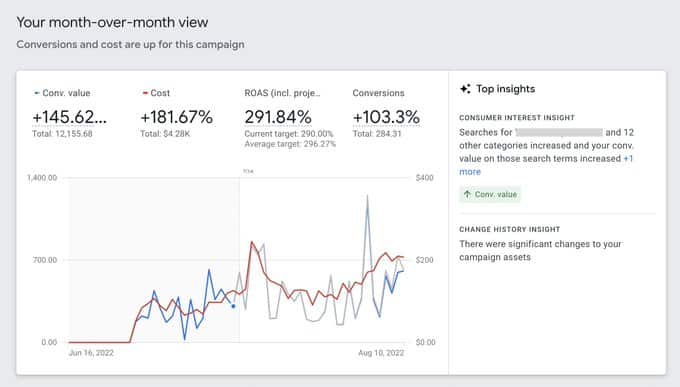
While more granular data is limited, take advantage of the Insights tab.
There is some useful info on overall trends.
You can view week-over-week or month-over-month data.
Insights: Keyword themes
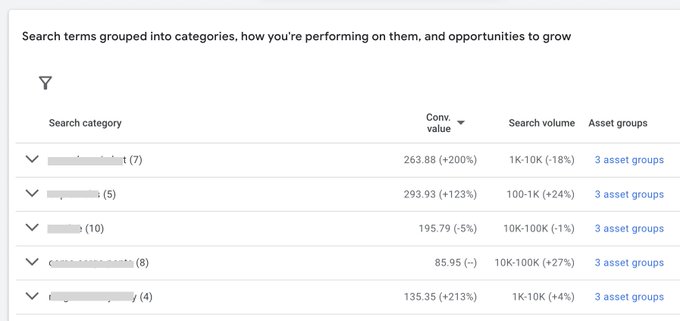
Additionally, while you cannot see actual search terms, you can see keyword themes as well as basic performance data.
Listing groups vs display: Where are your dollars being spent?
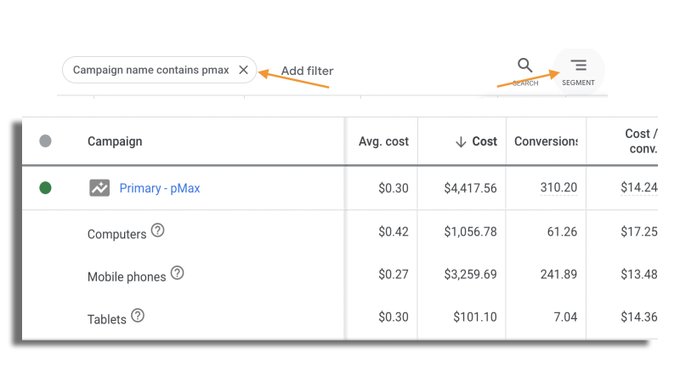
Compare overall campaign spend in the Campaigns tab vs. overall spend of all Listing Groups
This will help you understand the spend breakdown between Video/Display and ad units created with the datafeed.
Note: If you find that Display/Video traffic is not converting as well as your datafeed, you can turn off URL expansion in the campaign settings.
You can also try running a Smart Shopping style Performance Max campaign:
For eCommerce: Something worth testing for Google Shopping, especially if you've seen success with Smart Shopping historically: Launch a pMax campaign with no assets aside from the datafeed.
Note: You'll likely need to create a new Asset Group. https://t.co/4EUj1KQuwx
— ???????????????????????????????? ????????????
Google Ads
(@MenachemAni) July 21, 2022
Segment: Your data
In the campaigns tab, you can filter by campaign and segment by:
- Device
- Day/Time
Landing pages: What pages are getting traffic/conversions?
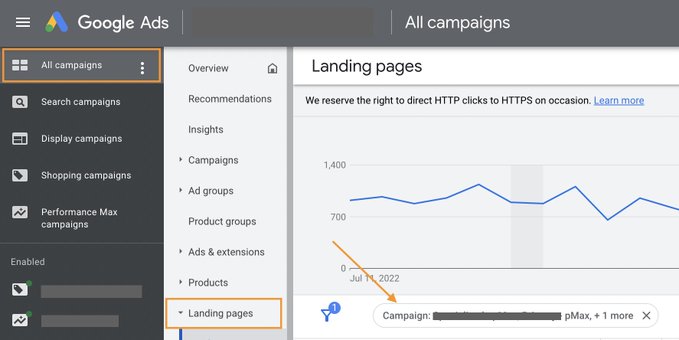
Note: This report is not available within a Performance Max campaign, you’ll need to access it from the All Campaigns tab and filter your PMax campaigns only.
All Campaigns > Landing Pages > Filter by Campaign
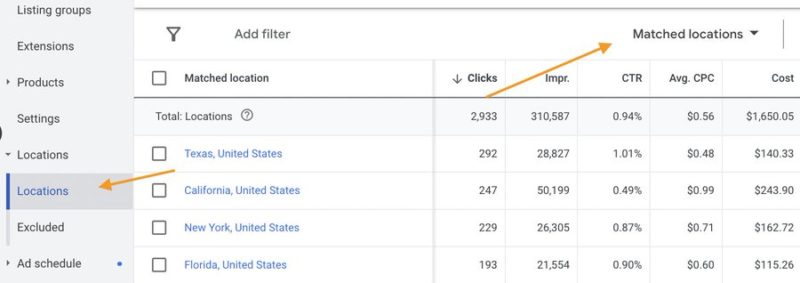
Locations: Where is the traffic and sales coming from?
In the Locations tab, you can drill down performance by:
Reports: Use custom reports to roll up your data
Go to the reports tab and build a custom table showcasing performance by:
- Placements (Display/Video/Datafeed)
- Brand (Datafeed)
- Category/Collection (Datafeed)
- Custom Labels (Datafeed)
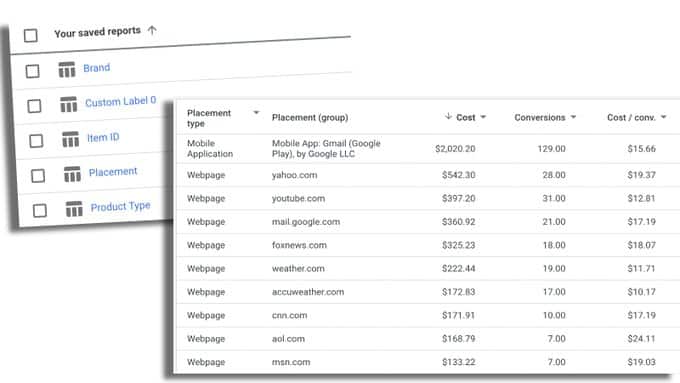
Note: Placements can be excluded on the account level:
So, I have to post a retraction of yesterday's snarky TikTok video. There IS a way to see AND exclude placements for Performance Max campaigns.
I wrote up how to do this here, and also wrote this really complex apology-song to Google
#performancemax #ppcchat
— Kirk Williams (Out of Office) (@PPCKirk) August 3, 2022
The post How to maximize insights from Performance Max appeared first on Search Engine Land.
Courtesy of Search Engine Land: News & Info About SEO, PPC, SEM, Search Engines & Search Marketing
Category seo news | Tags:
Social Networks : Technorati, Stumble it!, Digg, de.licio.us, Yahoo, reddit, Blogmarks, Google, Magnolia.
Google’s new helpful content update targets sites creating content for search engines first
Written on August 18, 2022 at 9:01 pm, by admin
Google is about to launch a new and large search algorithm update, called the helpful content update.
The helpful content update will target websites that have a relatively high amount of unsatisfying or unhelpful content, where the content has been written for search engines rather than humans.
This update, which will start rolling out soon, will have a meaningful impact on the search results, Google told Search Engine Land.
What is Google’s helpful content update?
Google’s new helpful content update specifically targets “content that seems to have been primarily created for ranking well in search engines rather than to help or inform people.”
The purpose of this algorithm update is to help searchers find “high-quality content,” Google told us. Google wants to reward better and more useful content that was written for humans and to help users.
Content written for the purpose of ranking in search engines – what you might call “search engine-first content” or “SEO content,” has been frequently written about lately and discussed across social media.
In short, searchers are getting frustrated when they land on unhelpful webpages that rank well in search because they were designed to rank well.
Google’s new algorithm aims to downgrade those types of websites while promoting more helpful websites, designed for humans, above search engines.
Google said this is an “ongoing effort to reduce low-quality content and make it easier to find content that feels authentic and useful in search.”
When will Google’s helpful content update launch?
The update will start rolling out next week. The helpful content update will take up to two weeks to fully roll out, Google said.
We will post a new story when it begins rolling out and when it is completed here on Search Engine Land. Google will also post on its updates page when it launches and when it is done rolling out.
What types of content will the helpful content update impact?
While these algorithms do not specifically target any specific niche, Google said these types of content may be impacted the most:
- Online educational materials.
- Arts and entertainment.
- Shopping.
- Tech-related.
This is because content written in those areas has historically been written more for search engines than humans.
Based on Google’s analysis, those areas may be more impacted by this Google helpful content update than other areas.
I asked Google for a specific example of a search where the helpful content update would make an impact. Here’s what Google told me:
- “If you search for information about a new movie, you might have previously encountered articles that aggregated reviews from other sites without adding perspectives beyond what’s available elsewhere on the web. This isn’t very helpful if you’re expecting to read something new. With this update, you’ll see more results with unique information, so you’re more likely to read something you haven’t seen before.”
Google’s Search Liaison Danny Sullivan was asked on Twitter to elaborate more about what Google meant by “online education.” Sullivan’s response:
“Generally tutorial, things meant to teach something, not really formal courses. But again, it’s not focused on any particular area. That’s just one example where we see notable improvement but there are others and any query about any thing might benefit.”
Helpful content update is a sitewide algorithm
Unlike many Google algorithms that get applied on a page-by-page basis, this new helpful content update will be sitewide.
That means that if Google determines your site is producing a relatively high amount of unhelpful content, primarily written for ranking in search, then your whole site will be impacted.
This will not just impact individual pages or sections of your site, but rather, it will impact the whole site.
Google won’t say exactly what percentage of the pages on your site need to be helpful versus unhelpful to trigger this classifier but they did say it is sitewide and will impact the whole site, even if you have many pages that are helpful.
Again, if you have helpful pages but a relatively high amount of your content is unhelpful, even your helpful content or sections of your site will be hit by this update.
Google said “removing unhelpful content could help the rankings of your other content.”
How to build human-first content – Google’s advice
Google, like with previous updates, like the Panda update, core updates, and product reviews update, has provided a list of questions you can ask yourself about your content, in order to build content that is rewarded by the helpful content update.
Google shared these questions around building human-first content:
- Do you have an existing or intended audience for your business or site that would find the content useful if they came directly to you?
- Does your content clearly demonstrate first-hand expertise and a depth of knowledge (for example, expertise that comes from having actually used a product or service, or visiting a place)?
- Does your site have a primary purpose or focus?
- After reading your content, will someone leave feeling they’ve learned enough about a topic to help achieve their goal?
- Will someone reading your content leave feeling like they’ve had a satisfying experience?
- Are you keeping in mind our guidance for core updates and for product reviews?
And when it comes to avoiding search-engine first content, Google laid out these questions:
- Is the content primarily to attract people from search engines, rather than made for humans?
- Are you producing lots of content on different topics in hopes that some of it might perform well in search results?
- Are you using extensive automation to produce content on many topics?
- Are you mainly summarizing what others have to say without adding much value?
- Are you writing about things simply because they seem trending and not because you’d write about them otherwise for your existing audience?
- Does your content leave readers feeling like they need to search again to get better information from other sources?
- Are you writing to a particular word count because you’ve heard or read that Google has a preferred word count? (No, we don’t).
- Did you decide to enter some niche topic area without any real expertise, but instead mainly because you thought you’d get search traffic?
- Does your content promise to answer a question that actually has no answer, such as suggesting there’s a release date for a product, movie, or TV show when one isn’t confirmed?
It could take months to recover
This algorithm will run automatically, Google said. The scores or classifiers will continue to update all the time.
But if a site gets hit by this helpful content update, it can take several months for the site to recover.
A site needs to prove itself over time that it no longer publishes content with the sole reason to rank in search engines, a search engine first content experience, and that takes time.
So it seems there will be some type of waiting period – maybe a validation period – that sites need to go through, to show Google’s algorithms that the site is providing helpful content to humans first.
This validation period is automated and while Google updates the scores for its classifiers on your site on an ongoing basis, making a change today, likely won’t be reflected in Google’s rankings for several months, Sullivan told Search Engine Land.
According to Google:
- “Sites identified by this update may find the signal applied to them over a period of months. Our classifier for this update runs continuously, allowing it to monitor newly-launched sites and existing ones. As it determines that the unhelpful content has not returned in the long-term, the classification will no longer apply.”
Google is using machine learning to identify unhelpful content
Google is using a new machine learning algorithm that is able to evaluate and identify unhelpful content.
The algorithms should get better over time between the automated machine learning improvements and Google engineers tweaking and improving the overall algorithms on a regular basis.
Google said the helpful content update looks at a variety of signals about the page and site to determine the ranking of a page.
Google was not specific with us on exactly which signals are used, as you would imagine.
Quality raters validated
Google said the search company validated these new results with its quality raters and confirmed that using this system improves Google’s search quality. This is done for most, if not all, ranking and user experience improvements Google makes to search.
Again, the quality raters do not directly influence the rankings but rather help confirm to Google’s search engineers if the algorithms are making improvements to the overall search quality.
U.S. English searches only
This update will initially launch for English-language searches globally.
Google plans to expand to other languages in the future.
Search-only right now
Google told us this update targets only Google search right now. However, Google may look to cover additional products (e.g., Google Discover) in the coming months.
Will the helpful content update be as significant as Panda?
For many SEOs who lived through the Google Panda update of February 2012, it forever changed how SEOs recommended you write content going forward. Now Panda is built into the core update, so it is still being used today.
This update sounds a lot like the past Panda update.
I suspect, like with Panda, SEOs will look back at Google’s helpful content update and say it caused a fundamental shift in SEO content strategy. Time will tell, and we will see how large of an update this is over the course of the next few weeks.
Why we care
Google’s helpful content update will likely be a significant update that SEOs will look back at as the catalyst of change in terms of the advice SEOs gives clients when building content.
Granted, it is too soon to tell how large of an impact this update will have on Google’s search results, your site or your clients’ sites.
As the update rolls out, make sure to watch your analytics and, if necessary, reevaluate your content strategy around the advice Google has provided above.
We’ll continue to report on all the latest developments around the helpful content update.
You can read Google’s official announcement, here: More content by people, for people in Search.
The post Google’s new helpful content update targets sites creating content for search engines first appeared first on Search Engine Land.
Courtesy of Search Engine Land: News & Info About SEO, PPC, SEM, Search Engines & Search Marketing
Category seo news | Tags:
Social Networks : Technorati, Stumble it!, Digg, de.licio.us, Yahoo, reddit, Blogmarks, Google, Magnolia.
Google to release August 2022 product reviews update in coming weeks
Written on August 18, 2022 at 9:01 pm, by admin
Google will be releasing another product reviews update, the August 2022 product reviews update, in the coming weeks, the search company also announced along with the helpful content update.
Google said they are launching another update “in the coming weeks to make it even easier to find high-quality, original reviews.” Google said this is another refinement to the product reviews ranking system that aims to “make sure you find the most useful information when you’re researching a purchase on the web.”
Timing. Google will post on its updates page when it launches and when it is done rolling out, we will also post a new story when it begins rolling out and when it is completed here on Search Engine Land.
Google did tell us they are targeting to roll it out the week of August 29th but the date may change.
Previous updates. This is the fifth version of the product reviews update, a search ranking algorithm update targeted at ranking product review-related content on the web that is most helpful and useful to searchers. The first product reviews update was launched on April 8, 2021, the second was launched on December 1, 2021, the third has been released on March 23, 2022, and now the fourth has been released on July 27, 0222. The fourth one was named the July 2022 product reviews update and released on July 27, 2022 and completed on August 2, 2022.
Google product reviews update. The Google product reviews update aims to promote review content that is above and beyond much of the templated information you see on the web. Google said it will promote these types of product reviews in its search results rankings.
Google is not directly punishing lower-quality product reviews that have “thin content that simply summarizes a bunch of products.” However, if you provide such content and find your rankings demoted because other content is promoted above yours, it will definitely feel like a penalty. Technically, according to Google, this is not a penalty against your content, Google is just rewarding sites with more insightful review content with rankings above yours.
Technically, this update should only impact product review content and not other types of content.
What is impacted? Google said this update may in the future impact those who “create product reviews in any language,” but Google said the initial rollout will be “English-language product reviews.” Google added they have seen “positive effects” from this update in the past and the search company “plans to open up product review support for more languages” in the future.
Please note that these updates can be very big, almost as big as core updates.
Previous advice on the product reviews update. The “focus overall is on providing users with content that provides insightful analysis and original research, content written by experts or enthusiasts who know the topic well,” Google said about this update. That is similar advice to the core update recommendations mentioned above, but here is a list of “additional useful questions to consider in terms of product reviews.” Google recommends your product reviews cover these areas and answer these questions. Do your product reviews…
- Express expert knowledge about products where appropriate?
- Show what the product is like physically, or how it is used, with unique content beyond what’s provided by the manufacturer?
- Provide quantitative measurements about how a product measures up in various categories of performance?
- Explain what sets a product apart from its competitors?
- Cover comparable products to consider, or explain which products might be best for certain uses or circumstances?
- Discuss the benefits and drawbacks of a particular product, based on research into it?
- Describe how a product has evolved from previous models or releases to provide improvements, address issues, or otherwise help users in making a purchase decision?
- Identify key decision-making factors for the product’s category and how the product performs in those areas? For example, a car review might determine that fuel economy, safety, and handling are key decision-making factors and rate performance in those areas.
- Describe key choices in how a product has been designed and their effect on the users beyond what the manufacturer says?
- Provide evidence such as visuals, audio, or other links of your own experience with the product, to support your expertise and reinforce the authenticity of your review.
- Include links to multiple sellers to give the reader the option to purchase from their merchant of choice.
Google also linked to its blog post from earlier this year named providing better product information for shoppers.
Google added three new points of new advice for this third release of the products reviews update:
- Are product review updates relevant to ranked lists and comparison reviews? Yes. Product review updates apply to all forms of review content. The best practices we’ve shared also apply. However, due to the shorter nature of ranked lists, you may want to demonstrate expertise and reinforce authenticity in a more concise way. Citing pertinent results and including original images from tests you performed with the product can be good ways to do this.
- Are there any recommendations for reviews recommending “best” products? If you recommend a product as the best overall or the best for a certain purpose, be sure to share with the reader why you consider that product the best. What sets the product apart from others in the market? Why is the product particularly suited for its recommended purpose? Be sure to include supporting first-hand evidence.
- If I create a review that covers multiple products, should I still create reviews for the products individually? It can be effective to write a high-quality ranked list of related products in combination with in-depth single-product reviews for each recommended product. If you write both, make sure there is enough useful content in the ranked list for it to stand on its own.
Not a core update. Google also previously said that product review updates are not the same as core updates. This is a standalone update they’re calling the product reviews update. This is separate from Google’s regular core updates, the company told us. Nonetheless, Google did add that the advice it originally provided for core updates, “about producing quality content for those is also relevant here.” In addition to that advice, Google provided additional guidance specific to this update.
Why we care. If your website offers product review content, you will want to check your rankings to see if you were impacted. Did your Google organic traffic improve, decline, or stay the same?
Long term, you are going to want to ensure that going forward, you put a lot more detail and effort into your product review content so that it is unique and stands out from the competition on the web.
Also, those impacted by previous core updates, that put in the work, may be rewarded by this August 2022 product reviews update.
The post Google to release August 2022 product reviews update in coming weeks appeared first on Search Engine Land.
Courtesy of Search Engine Land: News & Info About SEO, PPC, SEM, Search Engines & Search Marketing
Category seo news | Tags:
Social Networks : Technorati, Stumble it!, Digg, de.licio.us, Yahoo, reddit, Blogmarks, Google, Magnolia.
Google adds additional CTV buying options in Display & Video 360
Written on August 18, 2022 at 9:01 pm, by admin
Google is adding three new options for brands advertising on CTV.
Audience guarantees based on Nielsen Digital Ad Ratings (DAR). The Nielsen DAR is used to understand how many unique viewers CTV and video ad buyers reach within their core audiences and prove campaign impact across digital media platforms. Google is releasing Nielsen audience guarantees to make it easier to plan and measure CTV, Display, and Video 360.
When advertisers are setting up their guaranteed deal, they can select specific ages and demographics and pay only for the ad impressions that reach their target audience as measured by Nielsen DAR.
Advanced Programmatic Guaranteed. Google audiences for Programmatic Guaranteed will now be available across Google Ad Manager, Xandr and Magnite. Google said they hope to add more soon.
Google has already expanded reach capabilities with Google audiences on CTV campaigns when bidding on open auction inventory. With the new update, you can also use affinity, in-market and demo segments while buying Programmatic Guaranteed deals across a variety of participating publishers, which should give advertisers additional flexibility in audience strategies for CTV.
Google is also aware of frequency capping and once your campaign frequency goal is reached for certain users, whether via open auction, Programmatic Guaranteed, or a combination of the two, Display & Video 360 will stop showing ads to those users.
Consolidated CTV workflow across YouTube and other CTV apps. Google is implementing a consolidated workflow to help advertisers plan, manage, and measure performance across YouTube and CTV inventory. Google is also allowing YouTube ads to be purchased within Display & Video 360’s insertion order dedicated to connected TV ad buying.
Having YouTube and CTV inventory side-by-side makes it easier to optimize for common goals, Google said.
Google brings Display and Video 360 to CTV. At Google Marketing Live in May, Google announced they were introducing audiences for CTV inventory in Display & Video 360, which display ads across Hulu, Peacock, YouTube and most other ad-supported CTV apps.
“We’re committed to helping you deliver high quality ad experiences to all streamers by bringing the best of digital ad technology to the TV screen. One of the most effective digital strategies is creating relevant connections with your core audience. So we’re introducing Google audiences for CTV inventory in Display & Video 360, which will work across Hulu, Peacock, YouTube and most other ad-supported CTV apps,” writes Jake Jolly, Senior Product Manager, Display & Video 360.
Why we care. Expanding audience reach, limiting frequency and creating a consolidated workflow are positive updates to Google’s effort to expand into connected TV. If your brand is using Display or Video 360 to advertise on connected TV, take advantage of these new features to expand your reach, test new audiences and measure your CTV ad efforts with the Nielsen DAR.
The post Google adds additional CTV buying options in Display & Video 360 appeared first on Search Engine Land.
Courtesy of Search Engine Land: News & Info About SEO, PPC, SEM, Search Engines & Search Marketing
Category seo news | Tags:
Social Networks : Technorati, Stumble it!, Digg, de.licio.us, Yahoo, reddit, Blogmarks, Google, Magnolia.
Google releases Ads API version 11
Written on August 18, 2022 at 9:01 pm, by admin
Google has just released the newest version of the Ads API, version v11_1.
What’s changed. Here are the major changes according to Google’s release notes.
Assets
- Added
AssetGroup.ad_strengthto represent the overall quality of the asset group.- When advertisers mutate asset groups or assets associated with the asset groups, this field is recalculated. Until the recalculation is finished, the value is
PENDING.
- When advertisers mutate asset groups or assets associated with the asset groups, this field is recalculated. Until the recalculation is finished, the value is
- Added
AssetLinkError.EXCLUDED_PARENT_FIELD_TYPE.
Audiences
- Added
FlexibleRuleUserListInfoandRuleBasedUserListInfo.flexible_rule_user_list. - Added more values to the
LeadFormFieldUserInputTypeenum (used as predefined questions for lead form extensions). - Added the following fields to
UserAttribute:lifecycle_stagefirst_purchase_date_timeevent_attribute
- Added the following errors to
OfflineUserDataJobError:FIRST_PURCHASE_TIME_GREATER_THAN_LAST_PURCHASE_TIMEINVALID_LIFECYCLE_STAGEINVALID_EVENT_VALUEEVENT_ATTRIBUTE_ALL_FIELDS_ARE_REQUIRED
Bidding
- Added
Campaign.bidding_strategy_system_statusto show the system status of the bidding strategy, such as whether it is learning, limited, or misconfigured. Learn more.
Campaigns
- Added support for the following metrics in the campaign report:
all_conversions_from_click_to_callall_conversions_from_directionsall_conversions_from_menuall_conversions_from_orderall_conversions_from_other_engagementall_conversions_from_store_visitall_conversions_from_store_website
- Made
metrics.phone_callcompatible withsegments.hourin the campaign report.
Experiments
- You can now create experiments using
GoogleAdsService.Mutate(). Previously, it was possible only when usingExperimentService.
Planning
- Added
Targeting.audience_targeting, which allows for specifying affinity and in-market categories to generate a reach forecast usingReachPlanService.GenerateReachForecast. - Added support for YouTube Select:
- Added support for returning
YouTubeSelectLineUpas product metadata when callingReachPlanService.ListPlannableProducts. - Added
PlannedProduct.advanced_product_targeting, which allows for specifyingYouTubeSelectSettingsto generate a reach forecast usingReachPlanService.GenerateReachForecast.
- Added support for returning
- Added
AudienceInsightsService.GenerateAudienceCompositionInsights(available to allowlisted accounts only), used to find attributes strongly associated with a particular audience, similar to Insights Finder.
Recommendations
- Added
UpgradeLocalCampaignToPerformanceMaxRecommendation. Learn more. - Added
DisplayExpansionOptInRecommendation.
What is the Google API. The Google API allows developers to interact directly with the ads platform, making large or robust accounts and campaigns easier to manage. With the ads API, you can:
- Automate account management
- Create custom reports
- Manage inventory
- Manage smart bidding strategies
Why we care. Developers who use the Google Ads API should make note of the new updates and plan management of their accounts accordingly.
The post Google releases Ads API version 11 appeared first on Search Engine Land.
Courtesy of Search Engine Land: News & Info About SEO, PPC, SEM, Search Engines & Search Marketing
Category seo news | Tags:
Social Networks : Technorati, Stumble it!, Digg, de.licio.us, Yahoo, reddit, Blogmarks, Google, Magnolia.
Apple Search Ads can now be edited in bulk
Written on August 17, 2022 at 5:57 pm, by admin
Apple has just launched a new bulk ads editor that allows advertisers to update multiple campaigns and ad groups all at once.
What does it do. The bulk ads editor allows you to make edits to settings, daily budget, max bids, audiences, and more. You can access the bulk editor from the Actions menu of the campaigns dashboard. From there you download the settings you want to edit. Then upload the new spreadsheet and your new campaigns will go live.
Apple’s official advice. Apple offers the following guidelines regarding the inputting of campaign and ad group settings.
- You can add a maximum of 500 rows to your spreadsheet. Each row will contain information for a specific campaign and ad group. All campaigns must be in the same campaign group.
- When entering multiple values, use commas to separate each. For example, if you wanted to set a campaign to run in the U.S., Italy, and Greece, you would enter the values US, IT, GR in the Countries or Regions column for the campaign.
- All monetary data, such as daily budget and bid amounts, will use the currency set for your Apple Search Ads account. Note that cost-per-tap (CPT) pricing appears as CPC, or cost-per-click, in the Pricing Model column.
- Search tab campaigns previously created using cost-per-thousand-impressions (CPM) pricing will list CPM in the Pricing Model column. However, all active Search tab campaigns now use CPT pricing.
- When formatting dates and times for campaign or ad group start or end dates and times, use year-month-day and hour-minute-second formatting: YYYY-MM-DD HH:MM:SS. Dates and times will use the same time zone set for your Apple Search Ads account.
- If you want your ads to run only on certain days of the week or at certain times, you can enter times in the Dayparting column. Numbers should range from 0 to 167, representing the hours of a week beginning at Sunday 12:00 a.m. So if, for example, you wanted your ads to appear on the App Store on Fridays starting at 6:00 a.m. and run until Saturdays at noon, you would enter 126 to 156.
- Applying any audience refinements to your ad groups will automatically exclude customers with Personalized Ads turned Off. This will limit the number of customers who see your ads on the App Store.
- You can use the Include Returning Users and Exclude Returning Users columns in the template to focus your ad group on specific audience types. Here’s how:
- All users: Leave cells in both the Include Returning Users and Exclude Returning Users columns blank in your spreadsheet.
- New users: In the Exclude Returning Users column, enter the app ID of the app featured in your campaign.
- Returning users: In the Include Returning Users column, enter the app ID of the app featured in your campaign.
- Users of my other apps: In the Include Returning Users column, enter the app IDs of any of your other apps. Ads in your campaign will be shown to users of those apps, allowing you to cross-promote your products.
Access the template download. You can review the official Apple help document and download the templates here.
Why we care. Bulk editors generally make advertisers’ lives much easier by allowing edits to more than one ad at a time. However, Apple’s version seems technical and time-consuming, requiring template uploads and downloads. But if you manage Apple Search Ads, try the bulk editor and see if it’s worth your time.
The post Apple Search Ads can now be edited in bulk appeared first on Search Engine Land.
Courtesy of Search Engine Land: News & Info About SEO, PPC, SEM, Search Engines & Search Marketing
Category seo news | Tags:
Social Networks : Technorati, Stumble it!, Digg, de.licio.us, Yahoo, reddit, Blogmarks, Google, Magnolia.
Driving SEM success: Lessons learned from $1 billion+ in ad spend
Written on August 17, 2022 at 5:57 pm, by admin
Luanne Marek has been working in the digital customer acquisition space for 12 years. Throughout her six years leading the media buying team at Centerfield, Marek and her team have managed about a billion in ad spend, half a dozen Fortune 100 companies, several dozen Fortune 500 companies, and many other brands in the B2B, ecommerce, wireless and insurance industries.
At SMX Advanced, Marek shared ways they have been successful with some of the world’s leading brands by sharing six lessons her team has learned over the last several years.
1. Test your campaigns
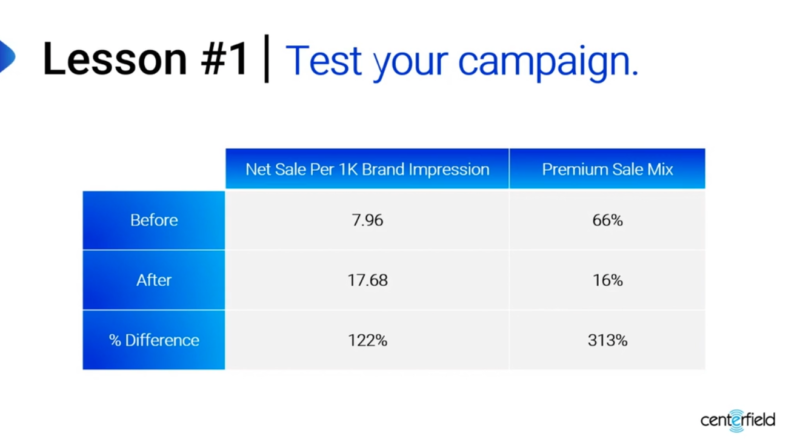
Because branded campaigns are lower funnel and high converting, many brands don’t think there is a reason to make changes. Marek didn’t go into detail on what tests should be conducted, but she explains that on tests they performed, they were able to increase sales by 122%, as well as increase the quality of the sales by another 313%.
2. Measure with third-party tools
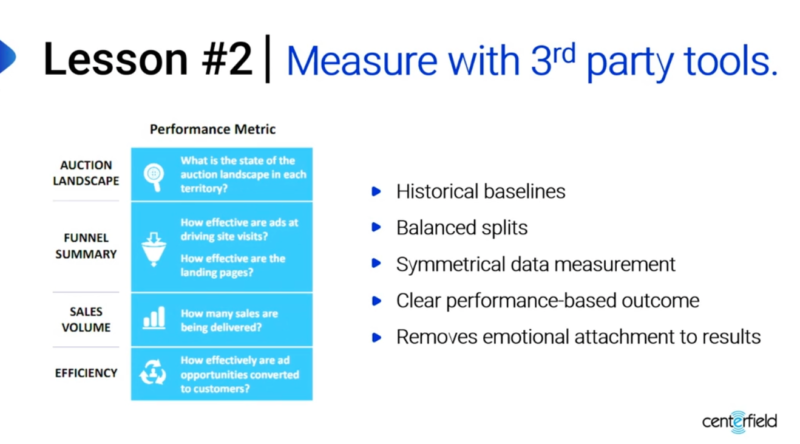
Once you decide to take the step and test your campaigns, making sure your data measurement is laid out correctly is the next step.
Too often they see tests flop because the data was not well laid out.
There is also a lot of emotional attachment to the results from the people that have been managing or working with the search campaigns. When that happens, Marek explains, it makes it difficult to look at the data in an unbiased way.
Marek suggests bringing in a third-party that specializes in this type of data analysis is the ideal way to:
- Correct baselines
- Create balance
- Use symmetrical data and measurement
- Ensure there are clear performance-based outcomes
- Allows the test to be run without emotional attachment to the readouts
3. Always be experimenting
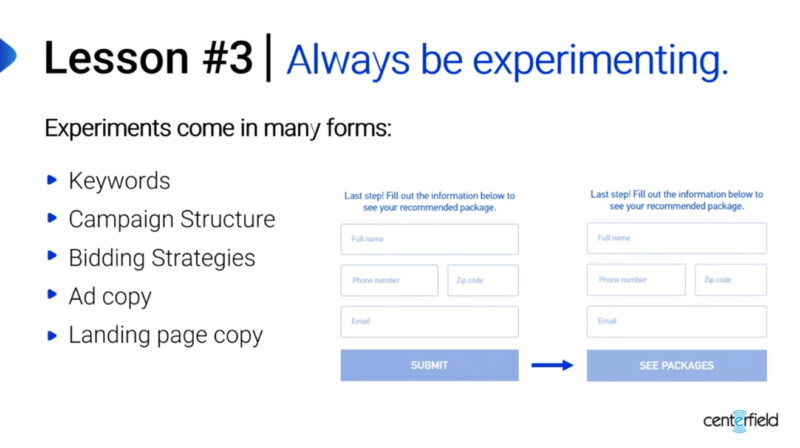
Marek and her team perform thousands of tests a month on:
- Keywords.
- Campaign structure.
- Bidding strategies.
- Ad copy.
- Landing pages.
About 80% of the tests don’t pan out, and the winners typically win by only 5-10%.
When a winning test is found, scale it across other campaigns. Test additional iterations, and make sure you can measure it through to your end goal.
In the example they provide, Marek explains that while the submit button resulted in more form submissions, the see package button resulted in the most sales per page view and ultimately won by 33%.
4. Optimize your real estate
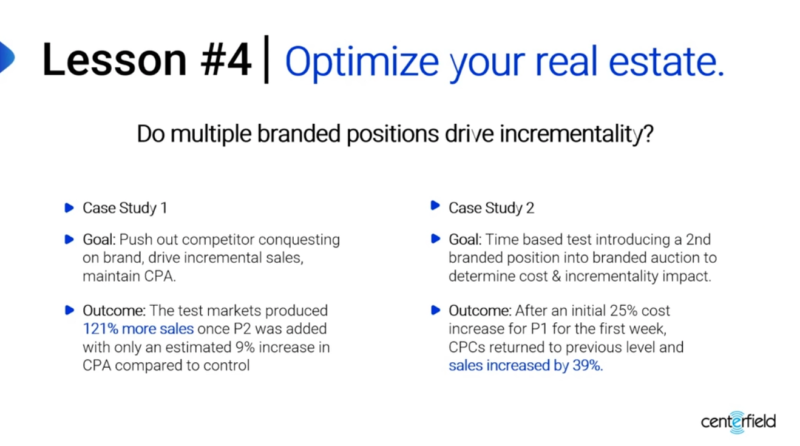
One of the areas Marek and her team see many brands fall apart is not taking full advantage of the real estate provided in the paid search results.
She suggests testing multiple branded positions.
Because other brands can show up in your results, adding a second paid branded position into the SERP will push those conquesting to the bottom of the page and instead of a user looking for your brand and seeing a compelling message from one of your competitors in between your paid search ad and your organic ad, they’ll only see your brand’s message.
Testing this method resulted in a 121% increase in sales and only a 9% increase in CPA for Marek and her team.
5. Personalize the experience
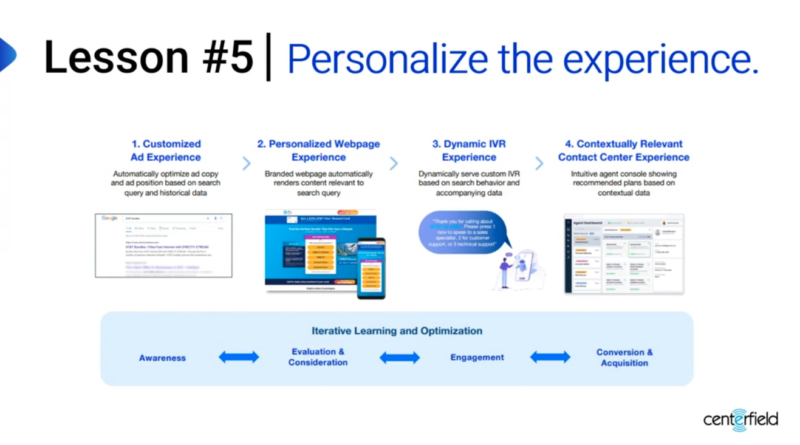
Adding a bunch of keywords to your landing page just isn’t enough anymore. It’s the bare minimum.
Marek suggests personalizing the entire experience. She suggests using a technology that can personalize and speak to the user about what’s important to them.
Her advice: Look for a technology platform that flows throughout the entire user experience, including the landing page. Choose one that offers contextualization and AI to personalize every step of the users’ journey to keep them engaged.
6. The buyer journey isn’t linear
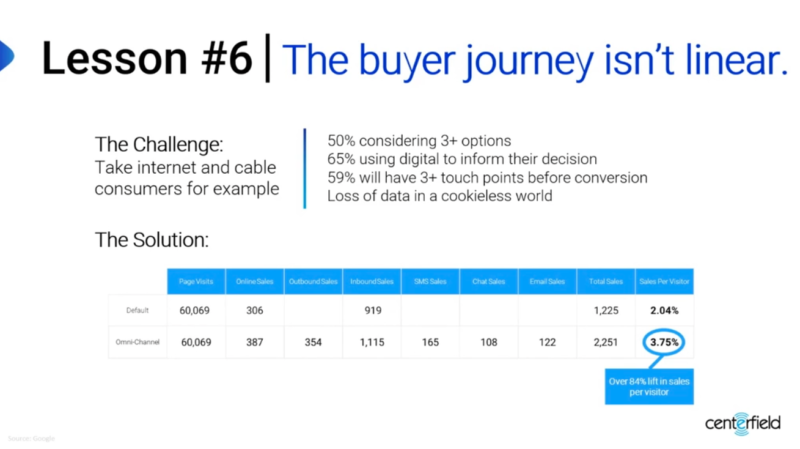
The market is increasingly competitive. Users will often have three or more touch points before making a conversion.
Using automation and omnichannel optimization to meet the customer at every stage of the buying journey is the way forward, especially with the loss of cookies and other third-party data.
Marek gives us the example of using chat and SMS, which did not exist as a conversion channel a few years ago. Marek suggests getting ahead of the trends before your competition does and letting the consumer be reached where and how they want to.
3 key takeaways
- Set up tests.
- Validate results with a third-party vendor.
- Give consumers choice.
“There are many options out there, so test your current paid brand search strategy against others. And facilitating the testing is the next best option. And lastly, push the envelope on giving consumers choice. Just because one conversion path has worked well for you doesn’t mean it’s the only one you should focus on. It’s not about spreading the same conversions amongst alternatives,” Marek said.
The post Driving SEM success: Lessons learned from $1 billion+ in ad spend appeared first on Search Engine Land.
Courtesy of Search Engine Land: News & Info About SEO, PPC, SEM, Search Engines & Search Marketing
Category seo news | Tags:
Social Networks : Technorati, Stumble it!, Digg, de.licio.us, Yahoo, reddit, Blogmarks, Google, Magnolia.
Google Search Console reported pages as being indexed when they were not indexed
Written on August 17, 2022 at 5:57 pm, by admin
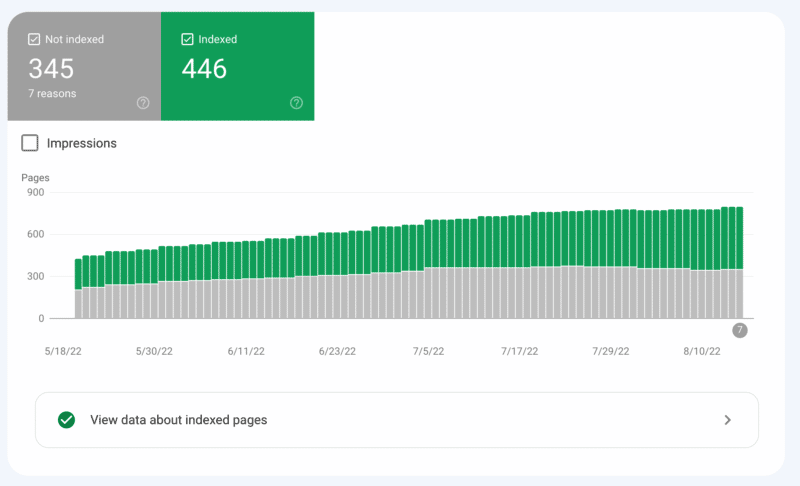
Google said there was a bug with its coverage report in Search Console where Google reported pages as being indexed, when in fact, they were not indexed by Google Search. Google said this “affected many properties” and thus, you should probably double-check your coverage reports for the sites you manage over the next few days.
The announcement. Google wrote “Today we fixed a Search Console issue that affected many properties: we were reporting pages that are not indexed as being indexed. As a consequence, you might see a drop in your indexed pages in the Index Coverage report.”
Here is the tweet:
Today we fixed a Search Console issue that affected many properties: we were reporting pages that are not indexed as being indexed. As a consequence, you might see a drop in your indexed pages in the Index Coverage report.
— Google Search Central (@googlesearchc) August 17, 2022
What to do. For now, you should probably add to your calendar to recheck the coverage report within Google Search Console to see if your indexed versus not indexed pages have changed in any significant manner.
Google has annotated the report, but you need to check back daily to see if you notice any major changes in the index saturation of your site’s pages in Google Search:
Why we care. If you provide reports to clients or stakeholders on the index versus not indexed pages on a site, then you will want to make sure to annotate your reports for clients. Hopefully, this does not add to any stress you already have with your SEO job.
The post Google Search Console reported pages as being indexed when they were not indexed appeared first on Search Engine Land.
Courtesy of Search Engine Land: News & Info About SEO, PPC, SEM, Search Engines & Search Marketing
Category seo news | Tags:
Social Networks : Technorati, Stumble it!, Digg, de.licio.us, Yahoo, reddit, Blogmarks, Google, Magnolia.
The WORST SEO advice I heard this year (and what you should do instead)
Written on August 17, 2022 at 5:57 pm, by admin
The most common complaint I receive from audit clients and bloggers is the inability to “know which SEO advice to follow.”
Unlike search engines which can rank, re-rank, or penalize information or practices that are unethical or unscrupulous in nature, the same can’t be achieved by the average blogger weeding through multiple courses, gurus or podcasts.
Unfortunately, 2022 has taken things to a whole new level.
The amount of emails and instant messages I received from bloggers asking, “Is this true?” or “I was told to do this, what do you think?” cannot be quantified other than to say, “It was a lot.”
Executing a correct and competent SEO strategy has never been more challenging, especially in light of the explosion of new websites launched during the pandemic.
As such, understanding what advice is worthwhile and which is complete and utter garbage has never been more important.
To that end, I present some of the worst pieces of SEO advice I was asked about in 2022, with the hope that the answers will help you decide what not to do.
Worst SEO advice #1: “I should never remove content from my website.”

The benefits of removing old content from an existing site have been known and practiced for years.
Think of your site as a garden. All the content generating traffic, links, and regular social signals are your flowers. Everything that is not? Those are your weeds. Just like in a real garden, you can kill your flowers if you don’t pull those weeds.
Leaving expired, low-quality or thin content on your site can result in a myriad of bad SEO outcomes, including:
- Diluting your overall crawl budget.
- Reducing overall site authority.
- Creating page and keyword cannibalization issues.
- Reducing on-page UX and time-on-site metrics.
- Lowering sitewide revenue per thousand impressions (RPM) for ad income.
It’s also been well-documented by Google’s John Mueller that low-quality content on one part of a site can negatively impact the search rankings of the entire site.
Bottom line
If you can update and improve existing content, do that!
But if not, delete it, and move on. Think quality with your site content, not quantity.
Worst SEO advice #2: “All I need is to write longer content to rank higher.”

It has been stated repeatedly that word count is not a ranking factor with Google. And yet, daily, I run into clients who have been directed to write a longer resource as their main method to “recapture” a lost ranking or improve existing visibility.
When asked about word count, Mueller said, “just blindly adding content to a page will not make it (rank) better.”
What does help a resource is adding content that is useful to the audience.
For example, nobody wants to read a 2,000-plus-word treatise on artichoke hearts. As such, understanding what your audience is seeking and what is considered “useful” can still be confusing to the average site owner.
Bottom line
A content update or rewrite has to have a clear purpose and an understanding of why your page isn’t ranking in the first place.
- Is there an intent mismatch with your query?
- Does the page have technical deficiencies?
- Are you competing against much bigger sites?
These are just a few questions to answer before deciding “just to write a longer resource” for ranking consideration.
Worst SEO advice #3: “I should include my focus keyword in every page heading.”

During the “good ol’ days” of SEO, it was very common to optimize a page around a focus keyword by including the focus keyword in the title, the meta description, the URL, and every heading on the page.
For example, just a few years ago, a typical recipe post trying to rank for “banana cream pie” may have looked like this:
<H1> Best Banana Cream Pie
<H2> Why this Banana Cream Pie is the Best
<H2> Banana Cream Ingredients
<H2> Step by Step to Make Banana Cream Pie
<H2> Banana Cream Pie Questions & Answers
<H2> Related Banana Cream Pie Recipes
<H2> Banana Cream Pie (recipe card)
Unfortunately, following Google updates from November 2019, and later announced Core Updates in January and May 2020, a clear pattern emerged whereby bloggers who had been over-optimizing their headings (among other issues) suffered decimated ranking and traffic drops.
The pattern was incredibly easy to see in audits and online Facebook groups and was soon backed up by a Food Blogger Study by SEO firm Top Hat Rank published in February of 2020.
In the study, food blogs saw a 60% drop in direct Google search engine traffic to recipes and posts that had engaged in heading keyword over-optimization.
Fortunately, bloggers who went back through their site and started de-optimizing their headings ended up with recoveries by the May 2020 Core Update, or much later, when Google did their next announced update in December.
Bottom line
Any recommendation to stuff your headings with keywords is not only outdated advice but possibly dangerous for the average site in the current algorithmic climate.
Referencing your keyword naturally in the H1 and one or two other H2s seems fine. More than that, it will look spammy and should be avoided!
Worst SEO advice #4: “Alt text should be used for SEO keywords.”
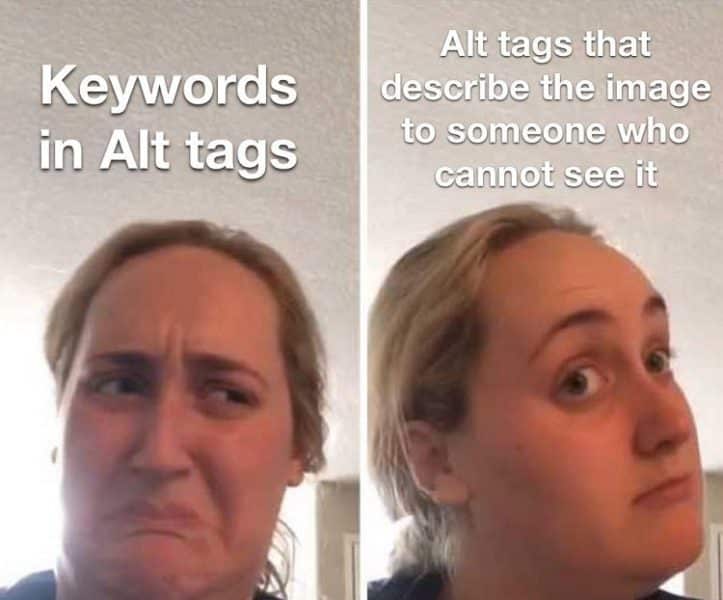
Alt text, or alternative text, is one of the most important and misunderstood topics in all of SEO and accessibility. Having good and correct alt text for images is not just a simple SEO best practice, but it’s essential for people with visual disabilities who visit the site.
Alt text exists first and foremost to describe the image to someone who cannot see it. The focus is on those accessing the site with screen readers who cannot see the image and, as such, must have the images read out to them for descriptive purposes.
Nothing annoys visually impaired users more than visiting a site and seeing every image read out as “keyword – keyword – keyword.”
And yet, even today, with as much literature that exists on the correct use of alt text, this still happens more than it should!
Bottom line
Ditch the keywords and describe what is in the photo to someone who cannot see it.
Don’t say “image of” or “photo of” in your alt text. Be short but descriptive.
Finally, add a “period” at the end as a prompt for screen readers to know the alt text has completed.
Worst SEO advice #5: “Semrush says that I have toxic links and I must submit a disavow file.”
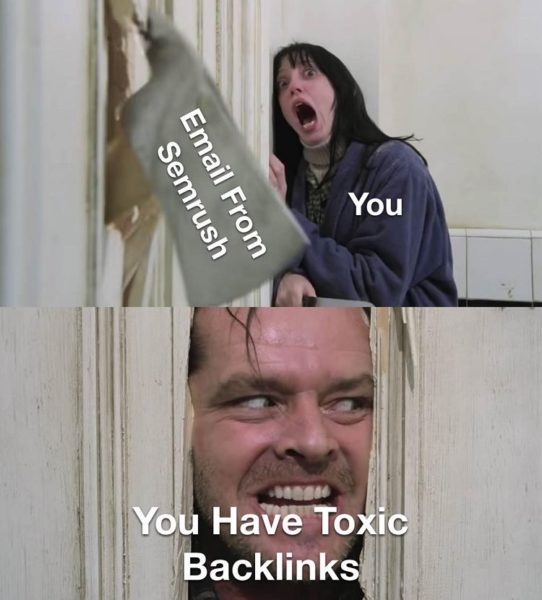
Oh, Semrush, you never disappoint!
Although the Semrush suite of tools is, by and large, a quality investment for users and SEOs alike, this is by far its biggest drawback. In this specific example, the tool fails miserably!
I have yet to run a crawl for a client with Semrush and have the tool not spit out a huge “Danger, Will Robinson! Danger!” warning when reviewing a link profile.
Semrush identifies random links as toxic and then recommends that the user submit a disavow file. The problem with this recommendation is it’s unnecessary and completely arbitrary.
Google is very clear that:
- The average site owner should never worry about toxic links.
- Arbitrary toxicity determinations by tools are not accurate.
- It’s all about selling the tools.
In fact, Google doesn’t even have a concept of toxic domains, and blindly following a tool that says “otherwise” should always be avoided.
Bottom line
Unless you have a manual action, or you know you built in bad links yourself, a disavow file is a complete waste of time for the average site owner.
Ignore the tools and move on to something else that will actually help move your site.
Final thoughts
You’ve heard that SEO is a marathon, not a sprint. As with any marathon, it’s all about training and preparation.
Don’t derail your SEO marathon by succumbing to poor advice baked into a course, a podcast or a guru trying to sell you their latest tool.
Instead, use a little common sense and push back against advice that “may” seem questionable when given. The site you save may be your own. Good luck out there!
The post The WORST SEO advice I heard this year (and what you should do instead) appeared first on Search Engine Land.
Courtesy of Search Engine Land: News & Info About SEO, PPC, SEM, Search Engines & Search Marketing
Category seo news | Tags:
Social Networks : Technorati, Stumble it!, Digg, de.licio.us, Yahoo, reddit, Blogmarks, Google, Magnolia.