

It’s time to de-frenzy PPC
Written on September 12, 2022 at 4:41 pm, by admin
I have a secret to share.
I’m almost embarrassed by it in this hustle culture, but I’m also proud of it.
My secret is that I obsess over keeping PPC at our little agency frenzy-free (as much as possible).
Sure, there’s the occasional client mishap, last-minute promo, and late-night conversation (about once a year for us). But, overall, everybody on my team doesn’t work nights or weekends and we just don’t really have many last-minute “urgent” requests by clients.
Let me repeat that:
We’re a PPC agency that doesn’t work nights and weekends!
Hard to believe, huh?
The reason this is almost scandalous to admit is that PPC has become known as a frenzied activity. In fact, I’ve seen it worn like a badge of honor!
Unlike our professional counterparts, we must work night and day, managing budgets, replacing ad creative, and taking 2 a.m. calls from anxious clients. Why? Because, PPC! (Or so we’re told.)
But, I’d like to push back on this culture.
I’d like to make the bold claim that PPC doesn’t have to be so frenzied, and for the good of everyone’s mental wellness, we should begin making purposeful steps within our departments and agencies to de-frenzy PPC.
Rather than frenzy being a hallmark of PPC, I think we should work toward stability. Stability is the opposite of frenzy and the goal with which to aim. Stability will improve your client relationships and employee morale (as well as your own mental well-being, if you’re a PPC manager or owner).
With stability, you have the time and energy and resources (let’s call that, margin – more on that later) to actually focus on building and managing well rather than be constantly tossed around by the urgent nature of frenzied tasks.
So how does one push for stability in PPC? Shouldn’t PPC, by its nature, be frenzied? I don’t think so, and I will identify the seven key causes of PPC frenzy below – and solutions.
Ready? Let’s begin to make healthy changes and de-frenzy our industry.
1. Mistakes
One of the primary causes for frenzy in PPC is the need to make up for a mistake that was made – oftentimes by the PPC manager, but sometimes by someone else (like the client).
For instance, a novice PPCer may be in a rush to hit their quota of tasks for the day, so they push forward a campaign with tROAS set to 20% rather than 200%.
They also set a daily budget far higher than it should be, causing the bidding algorithm to run amok in spending all of that client’s monthly budget in one day.
The client sees it that night and angrily calls the agency to fix it. Hurry! Fix this costly mistake! Emergency! Frenzy!
On one hand, it’s an emergency. On the other hand, it could have been easily avoided.
Not all mistakes are avoidable, but I think most are. In PPC, I actually think pretty darn close to all mistakes are avoidable.
The solution
Slow down and check your work. An ounce of prevention is worth a pound of cure, so build into your agency process a plan for double-checking work as part of campaign builds and optimizations.
Also, make sure you’re hiring people with strong attention to detail. I think PPC frenzy often happens because managers get sloppy, and I have found that hiring team members who notice things naturally is an immensely valuable soft skill to obtain.
Finally, if a team member has strong attention to detail, but is making mistakes, it could be that the mistakes are coming from an unrealistic level of tasks and priorities.
Perhaps you need to rethink what your team can actually accomplish within the allotted time they have in a day, rather than just assigning them all the things and expecting them to get it done. That is a key source of employee burnout.
2. Poor planning
Another primary cause for frenzy in PPC I run across is the age-old failure of poor strategic planning. You’ve probably seen a version of this quote somewhere:
“Your lack of preparation does not my emergency make.”
Well, the same goes through for our own failure to plan in PPC.
A last-minute urgent email from a client leading to a team needing to work late in order to finish getting creative ads live before the promotion begins at 12 a.m. Eastern time isn’t actually an emergency. The team should have had knowledge of the promotion for two months, and the failure here was in the last-minute nature of the request.
So what about when the client fails to adequately notify the PPC team of necessary changes?
This gets a little more complex, but communication and expectation-setting are important parts of PPC. In that case, an honest discussion should be had as to the correct way to notify of something like upcoming promotions.
Perhaps it could go like this:
“Hello, {Client}. We are unable to get that promotion live by the end of today since our team is heading out the door. However, we will jump on this first thing tomorrow. Also, let’s plan to connect on our next call as to a good way to plan promotions together so we ensure these ads are live when they need to be for future sales. I want to make sure we do everything we can to set you up for success, and being included on your promotion calendar will give us the information we need to get this done on our end.”
The solution
Recognize that emergencies based on a failure to plan accordingly can (and should) be avoided, and take the necessary steps to educate and train your team or collaborate with your clients to be able to anticipate the inevitable activity.
The great PPC team is the anticipatory team. Many false emergencies arise that could have been easily avoided had they simply been thought of beforehand.
For instance, if an important holiday is coming, and your team hasn’t heard from a specific client on a sale, but your team knows this client loves to run promotions, then great planning means your account manager proactively contacts that particular client to inquire about a sale (and perhaps even introduce the thought to the busy client business owner) well before the week of the event – when the client suddenly decides they want to do a sale and causes everyone to scramble. An unnecessary, and poorly planned, false emergency.
3. Disorganization
Ahhh, disorganization. This has caused many innocent-sounding account managers to feel more mentally stressed than they actually should be.
A disorganized account, task management solution or communication parameter leads to false emergencies.
For instance, when you land a client, there are certain things you will need to know about every single account that you take on to manage, and it’s important to have an organized process for gathering, storing and accessing that information.
Failure to identify this, gather, store, and make accessible this data will increase the likelihood that this important information cannot be used for the good of an account.
False emergencies are worsened by disorganization as it leads to faulty decisions made in the account that would never have been made if the information to avoid the false emergency had been taken into account.
This is also where lack of margin (below) comes into play, and we’ll discuss that at length. I have found that some people are naturally disorganized, true. However, some disorganization can come instead from poor internal processes and policies, or too many tasks.
It’s difficult for your account manager to be organized when they are stressed and overworked and jumping from task to task without time to think and plan ahead and organize their lives.
See how many of these things blend together?
The solution
Recognize that easily accessible and properly organized information lays the foundation for proper planning and proactive choices that stop false emergencies before they ever can get started.
4. Unrealistic expectations
While many of the frenzy causes I address can be applied to either client or PPCer, this is about the only one that is solely the fault of either a manager or client (i.e., not the PPCer). Sometimes, false emergencies thrust upon the PPCer are simply because the client or the PPCer’s manager has faulty expectations for what can or should be accomplished.
Let’s say a PPCer gets three voicemails over lunch and six emails from a client in the same timeframe. They are alarmed. “Call me back immediately!”
When the PPCer calls them, they hear something like, “I’ve been looking at our keywords and I noticed that CPCs have risen by 25% from yesterday! This is alarming, something has to be done! I’d like to hear of three action steps you’re going to take as soon as you hang up to address this.”
In this made-up (yet not far off-base story), the client has suddenly taken it upon themselves to wipe clean the PPCer’s task list for the afternoon to address what they consider an emergency but is not actually an emergency.
The reality is that those outside of PPC (especially those with some power over the PPCer) can have faulty views of what should occur. Thus, they can try to instill a sense of urgency onto the PPCer that may not actually result in improved account performance (the goal we’re all after here!).
The solution
This may be one of the trickiest for the PPCer to navigate since this covers a whole lot more than simply planning better or getting more organized. It involves working with clients or managers who themselves may be viewing this the wrong way.
Unfortunately, since they hold the power in this dynamic, it can feel impossible to actually stop the endless “emergencies” that arise every time the client has a good idea and wants you to “hop on a call” to discuss it.
I think the solution here is at least two-fold.
First, it includes education and sometimes, healthy pushback. “I got your message, can we plan to connect on this during our regularly scheduled call next week?”
If they say no, it’s important (with your boss’s permission) to push back a little with something like, “I apologize but I don’t have the bandwidth today or tomorrow to discuss so may have to wait on that idea until next week.”
I will note that there are a million things that could come up here in the client’s mind as emergencies, and a million ways to reply, so growing in soft skills is the way to address this (not to only use what I say in this article).
The bigger picture solution here is more complex but even more important. That is to be able to identify signs of this sort of client before you ever land them (while in the discovery process), so you can consider whether this is a client to avoid ever taking on.
Or, you may determine you will take them on, but set extremely clear expectations as to communication cadence so you can stick to that in replies.
A great client, even an excited one who likes to hop on calls, will respect a tactful pushback because they properly understand the role you play in their growth.
5. Bad timing pushes
This cause probably fits under “poor planning” but I like calling it out because it’s a really specific use case with a clearly achievable solution. This will be the shortest since it’s so simple, yet rarely followed.
A significant number of emergencies arise from something big changing in an account. Therefore, never push anything big in late afternoons, or on a Friday. It’s just not more complex than that.
The miracle campaign you have built that you really, really, really want to gather data over the weekend is just begging you to push live on Friday afternoon.
But, consider what would happen if something blows up with it and suddenly you’re at the swim park on your phone trying to frantically lower bids in the Google Ads app while your kids splash around.
What if the campaign isn’t actually a miracle? What if you need to monitor it more closely? Doesn’t pushing it live on Monday morning make so much more sense?
Did the client want you to push it live before the Sunday holiday? Then plan better, push it live on Thursday so you have a day to analyze it so it’s ready for Sunday.
Sure, there will be exceptions to this, but the goal is to knock out as many non-emergencies as possible so you have the margin (see next point) to deal with the actual emergencies.
Not pushing major initiatives live in the late afternoon/evening or on Fridays will prevent a lot of last-minute work when you’re not technically at work.
Note, international campaigns are a different beast when it comes to time and management so apply the above accordingly.
The solution
Don’t push stuff live unless you have the scheduled bandwidth on your team to be on hand for the inevitable monitoring and adjustments needed for big changes.
6. Lack of margin
This one is my absolute favorite because I think it’s the most underrated, yet most important.
The simple fact of life is, that poo happens. The coffee mug version is too sweary for this article, so I’ll keep it to “poo” here.
One of the biggest things you can do to actually navigate true or false emergencies is to work time to deal with the inevitable in your agency structure, process and calendar.
Margin looks like a team that has the time and bandwidth to deal with things, especially in key calendar times when the likelihood of something going haywire rises.
It’s not complicated. We just need to do it.
The solution
Here is what I have learned about margin over a decade of PPC agency management:
- Actual emergencies (once the previous causes I discuss here are eliminated) are incredibly rare. Like, really, incredibly rare. If you have hired the right clients, planned well, and built margin into your agency life, then an actual emergency may account for only 5% of what normal agencies consider “emergencies.” Recognizing this itself and acting on it is a cheat code to stability!
- Building margin into your agency means you can actually deal with actual emergencies. For example, while our agency is naturally busier during Black Friday and Cyber Monday (BFCM) week, we purposefully build additional margin into the week to account for the unexpected by:
- Canceling normal client calls scheduled for that week.
- Slowing down or even pausing our normal account optimization schedule.
- Spend more time in analysis and monitoring accounts for changes so we can be proactive in dealing with the unexpected. (2 a.m. work during BFCM tends to occur for other PPC agency employees because they have to fit the unexpected into their normal expected schedule. This just doesn’t really happen for us, ever.)
Literally, build margin into anticipated busy times for the unexpected, and any true emergencies will be able to be addressed in a way that doesn’t actually sacrifice well-being.
Planned stability is a beautiful (achievable!) thing.
7. Actual, true emergencies (often platform-created)
If all of the previous frenzied causes have been addressed and planned for and organized, it is possible for the frenzy to be caused by a true emergency!
Yes, there are actual emergencies that come up in PPC, and it would be negligent of me to not admit that.
I think one of the key ways we see true emergencies occur in PPC is when an ad platform makes an unexpected, sweeping change that causes disruption in our normal operations.
Google may release a new policy overnight that causes your clients’ ads to get disapproved and you have to act urgently.
Google Merchant Center might disapprove a product for something random, and your client’s top product disappears, so you need to clear your day to deal with this.
BFCM week is busy for ecommerce. It just is. Even with all of our team’s planning, we still find that we work more on BFCM than a normal week with unexpected things that arise.
Another thing may be some sort of natural disaster or unrelated to PPC event.
A friend told me recently that he held a job a few years ago in which their CEO and COO went for a drive to check out his new sportscar, lost control of the vehicle, and heartbreakingly, both of the key execs died in the event.
Horrible and unexpected events such as that can will cause mental difficulties, margin stresses, and impact planning in ways that nobody could anticipate.
The solution
In many cases, simply admitting that emergencies can occur and building proper margin into key times can help assuage them.
Our BFCM margin planning schedule is a way we’ve identified a time of the year when an “emergency” is more likely to happen and built margin around it.
That doesn’t negate the fact that sometimes true emergencies happen, but eliminating the previous six causes of PPC frenzy will at least help give your team additional energy and mental acuity to navigate the actual emergency when it finally comes along.
They’re not being thrown about from one emergency to another until they finally burn out and leave with a bad taste in their mouths for your agency, or PPC in general. It just doesn’t have to be this way!
The post It’s time to de-frenzy PPC appeared first on Search Engine Land.
Courtesy of Search Engine Land: News & Info About SEO, PPC, SEM, Search Engines & Search Marketing
Category seo news | Tags:
Social Networks : Technorati, Stumble it!, Digg, de.licio.us, Yahoo, reddit, Blogmarks, Google, Magnolia.
The search marketer’s guide to connected TV: best practices for making the jump
Written on September 10, 2022 at 10:36 am, by admin
Lack of video creative and imprecise targeting historically meant that channels like paid search were a better use of a limited ad budget for agencies and small businesses.
With the growth of connected TV (CTV), and its ability to accurately target and measure performance, the largest screen in the house is now available to B2B businesses.
And the great news? As a paid search expert, you already have the tools to make your B2B brand’s jump to CTV successful.
At SMX Advanced, Join Hooman Javidan-Nejad, Director of Performance Marketing at MNTN, shared five best practices to bring advertising to the TV screen.
By taking what you already know about a channel that is working that is performing and driving results (paid search), you can apply those lessons and best practices to CTV advertising, Javidan-Nejad said.
CTV: An untapped market for B2B
Connected TV (CTV) is a virtually untapped performance channel for B2B advertisers because not a lot of B2B advertisers are running ads on connected TV today. And it’s a channel that can be easily activated with tried and true paid search, Javidan-Nejad said.
So why is CTV now a viable solution for B2B advertisers? CTV checks all the main boxes that a B2B advertiser needs (e.g., precision targeting, cheaper video creation).
- Precision targeting. Unline linear TV, you can target by job title, company size, etc., so no impressions are wasted
- Video creative that won’t break the bank. The switch to video advertising doesn’t mean engaging in an expensive agency.
Measurement. To track cross-device site visits and conversions.
Best practices for your CTV campaigns
1. Create a sophisticated account structure
Cover the full funnel. The way you organize your paid search efforts can be leveraged for CTV as well. Include:
- Campaigns that align with each funnel stage
- Organization by campaigns, ad groups, etc.
- Follow your paid search structure and address each funnel phase such as prospecting (top of the funnel), CRM (mid-funnel), and retargeting (lower funnel)
- Segment audiences, budgets, and creative by campaign to maximize performance and align with business goals
2. Optimize your budget.
Reallocate ad spend from poor-performing keywords to somewhere it can be more effective and avoid PPC plateaus by repurposing ad dollars for CTV.
The issue Javidan-Nejad sees with B2B companies on paid search is that they spend about 80% of their ad dollars there and then don’t have the budget for new channels. B2B businesses “overdo it” he says.
He suggests that advertisers go to their search term report, sort the search terms that are driving traffic to your website and analyzing which ones are costing the most and not converting. That practice alone will allow some B2B businesses to reallocate some of that ad spend toward CTV.
3. Use your existing keyword targets
The third best practice is to rely on the keyword strategy you already know works.
- Employ broad search terms to capture a wider audience
- Use exact keywords, phrases, etc. to capture high-intent users
With paid search, you have to make sure that you are leveraging exact keywords and phrases to capture high-intent users. And if you’re interested in driving some top-funnel users to your website, you can do that with broad search terms to capture a wider audience.
You can also use some of those learnings from those keywords to structure your connected TV advertising campaigns, Javidan-Nejad explains. You can set up your CTV campaign to use the existing keywords you’re already targeting. He suggests using the search terms report here, too.
4. A/B test to find what works
Your PPC campaigns likely involve continuous testing, including both creative testing and audience testing.
In CTV you can run 2 versions of video creatives for CTV and see which one performed better and which one drove higher website traffic. You can also run the same video, or the winning video to different audiences to learn which one engages more.
5. Make relevancy a key component
In PPC, the title, description, and landing page experience need to align. A higher relevancy means a higher ad score, and you pay less for those targeted keywords and your ads will be served at a higher position. And when we talk about relevancy in the context of paid search.
The same concept applies with CTV. Relevancy is just as important.
- Video creatives, audience extension, display ads, and landing pages all need to align
- Look for an ad platform that allows you to target the same CTV viewers with companion banners on display. Javidan-Nejad says that this strategy can lead to an increased campaign performance of up to 8x.
Other considerations
Brand safety
- Just like paid search, CTV is a brand safety haven
- Look for a platform that offers premium non-skippable inventory on the screen
Remove creative barriers
- If you dont have video assets, vheck with your team to see if you can repurpose their videos
- Look for non-agency solutions that allow for easy creative updates
The post The search marketer’s guide to connected TV: best practices for making the jump appeared first on Search Engine Land.
Courtesy of Search Engine Land: News & Info About SEO, PPC, SEM, Search Engines & Search Marketing
Category seo news | Tags:
Social Networks : Technorati, Stumble it!, Digg, de.licio.us, Yahoo, reddit, Blogmarks, Google, Magnolia.
Google helpful content update is now done rolling out
Written on September 10, 2022 at 10:36 am, by admin
Google has confirmed that the helpful content update is now finished rolling out. The update took 15 days to roll out, starting on August 25, 2022 and ending on September 9, 2022. Google has posted it completed today, September 9th.
As a reminder, Google’s helpful content update is a sitewide signal. It targets websites that have a relatively high amount of unsatisfying or unhelpful content, where the content is written for search engines first.
In short, did you write that piece of content to rank on Google or did you write it to help users?
What to do if you are hit. Google has provided a list of questions you can ask yourself about your content. Read through those questions as we posted over here, and in an unbiased manner, ask yourself if your content is in sync with this update.
Note, if you were hit by this update, it can take several months to recover, if you do everything right and make changes to your content over time.
More on the helpful content update. The new helpful content update specifically targets “content that seems to have been primarily created for ranking well in search engines rather than to help or inform people,” Google said. This update aims at helping searchers find “high-quality content.”
Google wants to reward better and more useful content that was written for humans and to help users.
Content written for the purpose of ranking in search engines, maybe called search engine first content, has been a topic coming up more and more across social media and other areas. In short, searchers are getting frustrated with landing on web pages that do not help them but rank well in search because they were designed to rank well.
This algorithm aims to downgrade those types of websites while promoting more helpful websites, designed for humans, above search engines.
Google said this is an “ongoing effort to reduce low-quality content and make it easier to find content that feels authentic and useful in Search.” This targets content written for search engines over human-first content.
Impact. This update did not feel tremendously widespread but Google did say it was a big update but did not cause a huge shakeup. We did not see widespread volatility until this morning, and it is hard to say if those fluctuations were related to this update or not.
Google discussed the helpful content update just a few days before launching it, which was hardly enough time to address potential sitewide content issues. Overall, SEOs weren’t overly concerned about the helpful content update.
Why we care. If you notice any ranking and visibility changes in Google search over the past two weeks or so, especially if those were big changes, you can likely attribute it to this update. Read Google’s advice, make the necessary changes, and hope for a recovery in the upcoming months.
We hope you all benefited from this update and if not, we hope you recover quickly.
The post Google helpful content update is now done rolling out appeared first on Search Engine Land.
Courtesy of Search Engine Land: News & Info About SEO, PPC, SEM, Search Engines & Search Marketing
Category seo news | Tags:
Social Networks : Technorati, Stumble it!, Digg, de.licio.us, Yahoo, reddit, Blogmarks, Google, Magnolia.
Smart Shopping campaigns in Merchant Center will automatically upgrade to Performance Max
Written on September 9, 2022 at 7:34 am, by admin
Any new campaigns created in Merchant Center will now be Performance Max campaigns.
Completing the transition. In July we reported that Google was beginning to automatically upgrade Smart Shopping campaigns to Performance Max. The upgrades were to begin in Google accounts between July and September.
Additionally, Google just announced that any campaigns in the Merchant Center would automatically be upgraded as well, and any new campaigns created would be Performance Max. Any campaign settings and budgets will also be transferred over.
Get the daily newsletter search marketers rely on.
<input type=”hidden” name=”utmMedium” value=”” />
<input type=”hidden” name=”utmCampaign” value=”” />
<input type=”hidden” name=”utmSource” value=”” />
<input type=”hidden” name=”utmContent” value=”” />
<input type=”hidden” name=”pageLink” value=”” />
<input type=”hidden” name=”ipAddress” value=”” />
Processing…Please wait.
To upgrade or not to upgrade. If you’re confused about what to do or not sure if you should upgrade your campaigns yourself, here’s what you need to know:
- The automatic updates from Google should finish sometime this month
- If you are still running Smart Shopping campaigns in Google, use the one-click upgrade tool to switch your Smart Shopping campaigns to Performance Max
- If you are running Smart Shopping campaigns through Merchant Center, pause it and create a new Performance Max campaign, or let Google upgrade it automatically and look for the “Performance Max (Upgraded)” notification in your account
- Once the upgrades are complete, double-check your budget and settings to ensure that everything is set to where you want it
- Read the FAQs from Google and the announcement about Merchant Center upgrades here
Why we care. Google’s constant reminders about the automatic upgrades can be confusing and redundant, but if you’re still running Smart Shopping campaigns, all you need to do is upgrade them yourself, or wait for Google to do it for you. The transition to Performance Max should be finished this month.
The post Smart Shopping campaigns in Merchant Center will automatically upgrade to Performance Max appeared first on Search Engine Land.
Courtesy of Search Engine Land: News & Info About SEO, PPC, SEM, Search Engines & Search Marketing
Category seo news | Tags:
Social Networks : Technorati, Stumble it!, Digg, de.licio.us, Yahoo, reddit, Blogmarks, Google, Magnolia.
PPC management for ecommerce: 28 tools to explore
Written on September 9, 2022 at 7:34 am, by admin
Managing ad campaigns can be daunting and laborious.
Once campaigns are launched you need to actively manage them by monitoring and making adjustments on a regular basis.
This, along with other marketing tasks, can be overwhelming for managers, causing important notifications and optimization opportunities to be missed.
Why use a campaign management tool?
Campaign management software and tools allow advertisers and brands to streamline and automate different aspects of their advertising including planning, execution, bulk editing, sharing, monitoring, reporting and analysis.
Other reasons teams may choose to use management software are:
- To save time
- Improve efficiency
- Make decisions based on visual data
- Access multiple platforms with one dashboard
- Collaborate with other team members
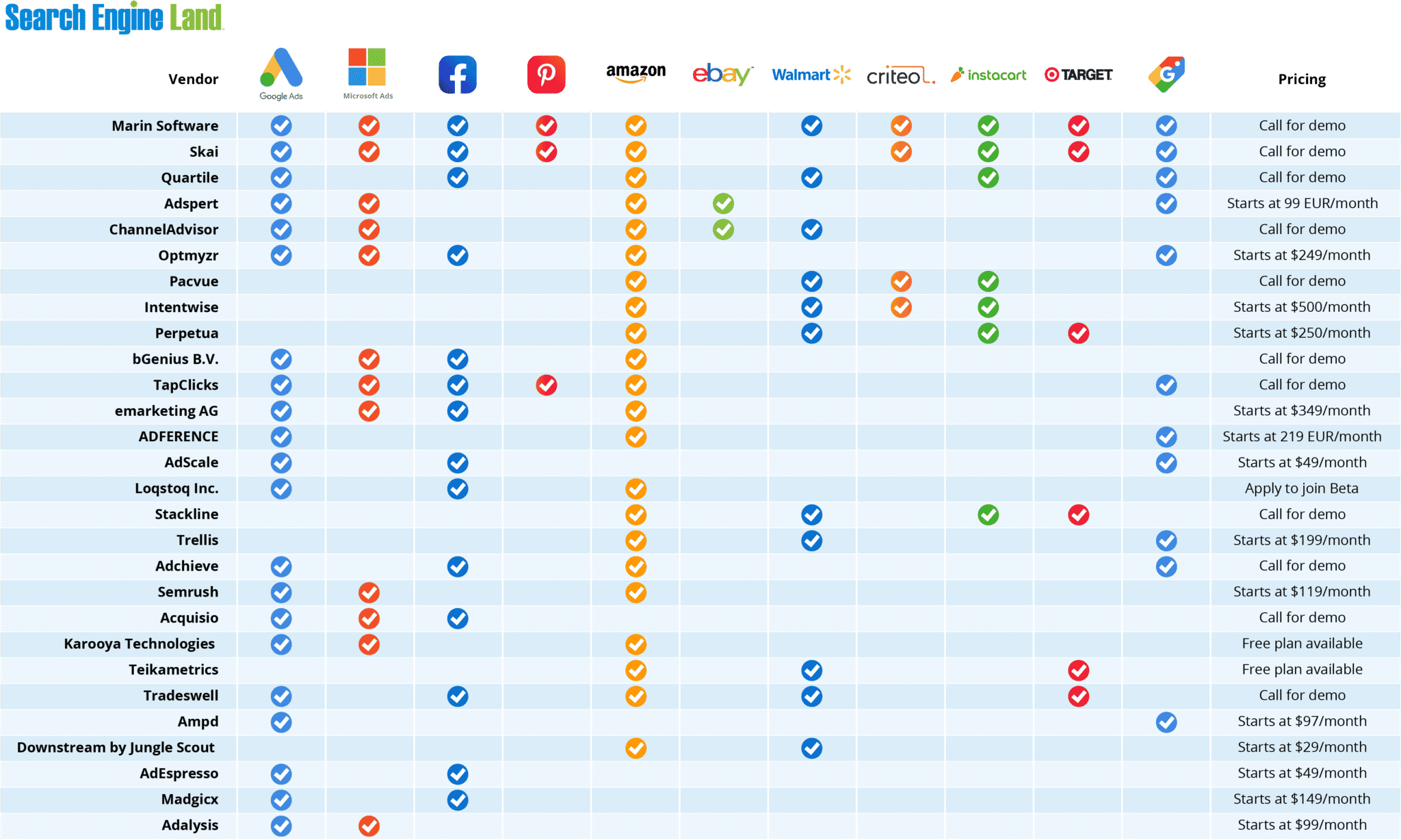
But when it comes to management tools, there is no one size fits all. Some tools manage search and social, while others only manage search and e-commerce. If you’re with an agency that only manages Google Ads, a tool like Adalysis may be a good choice. On the other hand, if you’re in charge of managing a brand’s Google, Facebook, Pinterest, TikTok, and Twitter ads, you’ll have a tougher time finding one solution that meets all of your needs.
Pricing and features
Several platforms such as Marin, Skai, and Quartile don’t have prices listed on their website. But a quick Google search told us that their monthly fees can go up to as much as $2,000 or more.
Management platforms ampd and AdEspresso by Hootsuite seem to be on the lower end of the spectrum, starting at just $49 per month.
It’s also important to note that most platforms base their monthly fees on the total ad spend of the accounts being managed. For example, Adalysis starts at just $99 per month for ad spending up to $50,000 per month. From there, fees are incrementally increased by about $100 per month, with custom quotes provided for portfolios spending above $500,000.
28 popular PPC campaign management tools
Whether you’re with an agency, working with an in-house team, or as a freelancer, ad campaign management platforms can be a tremendously helpful tool for time management and efficiency.
There are hundreds of tools available to use and new ones are being launched every day. So, in no particular order, we’ve compiled a list of the 28 most popular ones, ranging in platform, price, and features to help you successfully scale and optimize your campaigns.
Here’s a graphic comparing the platforms – but keep reading for more about each platform.
Marin Software a.k.a MarinOne
MarinOne was founded in 2006 and is based in San Francisco Calif. They provide a unified platform for search, social, and e-commerce advertising and management. Features include helping digital marketers convert precise audiences, win new customers, and make better decisions.
Channel integrations:
- Bing
- Apple Search
- TikTok
- Amazon
- Criteo
- Instacart
- CitrusAd
- Target
Pricing: MarinOne has not provided pricing on their website, but prospective users can book a demo on their website for more info.
Skai (formerly Kenshoo)
Skai enables marketers to make smarter decisions and gain better outcomes with actionable intelligence in making customer connections. The platform includes a suite of data-driven products for market intelligence, omnichannel media activation, testing and measurement, enabling brands and agencies to make predictions, improve strategic planning and drive growth on customer channels.
Channel integrations:
- AOL
- Criteo
- DoubleClick
- Microsoft
- Amazon
- Instacart
Pricing: Skai has not provided pricing on their website, but prospective users can book a demo on their website for more info.
Quartile
Quartile is an e-commerce cross-channel advertising platform. Built on machine learning technologies, the platform automates and optimizes e-commerce advertising on Google, Facebook, Amazon, Instacart, Walmart, and more. Quartile pairs technology with leading marketing experts who can create a strategy that’s tailored to different business goals.
Channel integrations:
- Amazon Advertising
- Amazon DSP
- Google Search
- Google Shopping
- Instacart Advertising
- Walmart Advertising
- Facebook Advertising
Pricing: Quartile has not provided pricing on their website, but prospective users can book a demo on their website for more info.
Adspert
Adspert is based in Berlin and supports e-commerce companies in maximizing their profit on Amazon, eBay, Google and Bing by optimizing their PPC campaigns. Brands and agencies utilize the artificial intelligence algorithm to improve their advertising performance and save time in their day-to-day operations.
Channel integrations:
- Amazon
- eBay
- Microsoft
Pricing: Pricing is in Euros and starts at €99 per month for the lite plan, which manages Amazon ads up to €6,000 in paid sales. Visit their website for more details.
ChannelAdvisor
ChannelAdvisor helps brands and retailers worldwide improve their online performance by expanding sales channels, connecting with consumers across the entire buying cycle, optimizing their operations for peak performance, and providing actionable analytics to improve competitiveness.
Channel integrations:
- Microsoft
- Amazon
- eBay
- Walmart
Pricing: ChannelAdvisor has not provided pricing on their website, but prospective users can book a demo on their website for more info.
Optmyzr
Founded by former pioneers at Google, Optmyzr helps advanced marketers achieve greatness in their pay-per-click programs. The SaaS-based system’s simplicity, power and innovation automate key tasks and elevate PPC professionals’ capabilities and relevance in the era of digital marketing.
Channel integrations:
- Microsoft
- Amazon
Pricing: Optmyzr starts at $249 per month for managing ad spends up to $10,000. Visit their website for more details.
Pacvue
Pacvue is the enterprise platform for e-commerce advertising, sales, and intelligence. Combining unified retail analytics with the tools needed to take recommended actions, brands and sellers use Pacvue to grow their business across Amazon, Walmart, Instacart, and other marketplaces.
Channel integrations:
- Amazon
- Walmart
- Criteo
- Instacart
- Kroger
Pricing: Pacvue has not provided pricing on their website, but prospective users can book a demo on their website for more info.
Get the daily newsletter search marketers rely on.
<input type=”hidden” name=”utmMedium” value=”” />
<input type=”hidden” name=”utmCampaign” value=”” />
<input type=”hidden” name=”utmSource” value=”” />
<input type=”hidden” name=”utmContent” value=”” />
<input type=”hidden” name=”pageLink” value=”” />
<input type=”hidden” name=”ipAddress” value=”” />
Processing…Please wait.
Intentwise
Intentwise’s technology platform empowers professional advertisers, large-scale aggregators, and high-volume agencies with recommendations, automation, competitive intelligence, and data infrastructure for Amazon, Instacart, Target, Walmart, and more.
Channel integrations:
- Amazon
- Walmart
- Instacart
- Criteo
Pricing: Pricing is tiered and starts at $500 per month. Visit their website for more details.
Perpetua
Perpetua provides growth optimization and reporting technology for e-commerce businesses. On the platform, brands and sellers create goals based on strategy and rely on Perpetua’s always-on optimization to execute tactically. Reporting tools will also surface the most important metrics needed in order to quantify and examine the investment of advertising dollars into your business.
Channel integrations:
- Amazon
- Walmart
- Instacart
- Target
Pricing: Pricing is tiered and starts at $250 per month for one retail platform and up to $5,000 in ad spend. Visit their website for more details.
bGenius
bGenius bid management software gives online marketers the opportunity to optimize and manage campaigns in different search engines in one system. bGenius was not built for automated bid management, although it is possible. The system provides suggestions based on your input in combination with your Search Advertising, Web Analytics and Back Office data.
Channel integrations:
- Microsoft
- Amazon
Pricing: bGenius has not provided pricing on their website, but prospective users can book a demo on their website for more info.
TapClicks (formerly AdStage)
TapClicks, Inc. is a marketing technology company for agencies, media companies, brands, and enterprises. Its integrated Marketing Operations Platform includes sales enablement, workflow and order management, analytics, and automated reporting — all within a single intuitive user interface available on demand in the cloud.
Channel integrations:
- Microsoft
- Amazon
Pricing: TapClicks has not provided pricing on their website, but prospective users can book a demo on their website for more info.
emarketing
emarketing is considered one of the largest Google, Microsoft and Amazon partners in Europe. With four offerings repricing.com, intelliAd, intelliTracking and DataFeedManager, emarketing covers the entire marketing value chain (connections to marketplaces, advertising, performance measurement, pricing) for advertisers.
Channel integrations:
- Microsoft
- Amazon
Pricing: emarketing starts at $349 per month. Visit their website for more details.
ADFERENCE
ADFERENCE launched one of the worlds first Amazon PPC tools that uses automation to optimizes ad campaigns for both sellers and vendors. They are also recognized as one of the largest Google CSS partners in the German-speaking market and part of Amazon’s official Solution Provider Network (Amazon SPN).
Channel integrations:
- Amazon
Pricing: ADFERENCE starts at 219€ per month. Visit their website for more details.
AdScale
AdScale elevates businesses Google and Facebook campaigns using customer data & AI-Powered marketing. Users can easily run data-driven campaigns across channels on one platform.
Channel integrations:
Pricing: AdScale starts at $49 per month. Visit their website for more details.
Loqstoq
Loqstoq unlocks full potential of Google Ads and Facebook Ads to promote Amazon listings. Loqstoq is a fully self-funded, self-directed venture and are looking for user feedback on what features to add to the platform.
Channel integrations:
- Amazon
Pricing: Loqstoq doesn’t have pricing or membership info on their website, but if you’re interested you can apply to join their private Beta program.
Stackline
Stackline is a retail intelligence and software company founded by a group of industry veterans and headquartered in Seattle, WA. Our technology optimizes e-commerce marketing performance for thousands of the world’s largest brands and retailers.
Channel integrations:
- Walmart
- Instacart
- Amazon
- Target
Pricing: Stackline has not provided pricing on their website, but prospective users can book a demo on their website for more info.
Trellis
Trellis helps Amazon e-commerce merchants increase their product sales with an easy-to-use ad optimization platform. Trellis saves time and removes complexity by continually optimizing bids, budgets & keywords to deliver maximum campaign performance.
Channel integrations:
- Walmart
- Amazon
- Google Shopping
Pricing: Trellis starts at $199 per month. Visit their website for more details.
Adchieve
Adchieve works with customers who have a leading position in their market: that fits the winner’s brand and status. Therefore, Adchieve’s motto is engineering success. Adchieve works together with customers that offer a large and varied assortment and want to stay ahead of their competitors.
Channel integrations:
- Google Shopping
- Amazon
Pricing: Adchieve has not provided pricing on their website, but prospective users can book a demo on their website for more info.
Semrush
Semrushs’ paid marketing tools help annalyze competitors, carry out keyword research, and create compelling ad copy for advertisers looking to automate their campaign management.
Channel integrations:
- Microsoft
- Amazon
Pricing: Semrush plans starts at $119 per month. Visit their website for more details.
Acquisio
Acquisio provides software that facilitates customer acquisition using ad platforms like Google Ads, Facebook Ads, and Microsoft Advertising. Acquisio was one of the first SaaS companies to apply advanced machine learning technology to advertising. Their high-frequency optimization algorithms perform nearly 2.5 million campaign adjustments per day for 400 clients running over 300,000 campaigns.
Channel integrations:
- Microsoft
Pricing: Acquisio has not provided pricing on their website, but prospective users can book a demo on their website for more info.
Karooya
Karooya builds products to help minimize some of the repetitive tasks in PPC campaign management. We help GoogleAds and Microsoft Ads advertisers eliminate wasted ad spend on irrelevant traffic to their campaigns, with ourNegative Keywords Tool.
Channel integrations:
- Microsoft
Pricing: Karooya has a free plan available. If you’re interested, visit their website for more info.
Teikametrics
Teikametrics is building the first Marketplace Optimization Platform that helps thousands of sellers and brand owners easily optimize their performance, across the most valuable marketplaces and business verticals.
Channel integrations:
- Amazon
- Walmart
- Target
Pricing: Teikametrics has a free plan available. If you’re interested, visit their website for more info.
Treadswell
Tradeswell is the operating system for real-time commerce. They operate through a quantitative trading platform that uses real-time algorithms and insights, to reveal and execute the optimal actions companies need to grow.
Channel integrations:
- Amazon
- Walmart
- Target
Pricing: Treadswell has not provided pricing on their website, but prospective users can book a demo on their website for more info.
Ampd
Ampd is the ad automation toolkit that puts Google Ads to work for business. We offer the fastest, simplest, mosteffective way to amplify your efforts and ad dollars.
Channel integrations:
Pricing: Ampd plans starts at $97 per month. Visit their website for more details.
Jungle Scout
Jungle Scout is an all-in-one platform for selling on Amazon. Founded in 2015 as the first Amazon product research tool, Jungle Scout today features a full suite of management solutions and powerful market intelligence to help entrepreneurs and brands manage their Amazon businesses.
Channel integrations:
- Amazon
- Walmart
Pricing: Ampd plans starts at $29 per month. Visit their website for more details.
AdEspresso
Using AdEspresso customers can split test every aspect of their Facebook Ads Campaigns, discovering which creatives and demographic targets deliver the best result. AdEspresso also performs conversion tracking on external websites allowing users to optimize by leads & customer acquisitions.
Channel integrations:
Pricing: AdEspresso plans starts at $49 per month. Visit their website for more details.
Madgicx
Madgicx is an Autonomous Ad Optimization Platform for Facebook, Instagram and Google ads.
Channel integrations:
Pricing: Madgicx plans starts at $149 per month. Visit their website for more details.
Adalysis
Adalysis is a workflow suite for Google Ads & Bing Ads. The platform scans your data and automatically creates recommendations for you to take to improve your PPC performance. The analysis and recommendations span your account from ad testing to n-grams to budget spend rates, and much more.
Channel integrations:
- Microsoft
Pricing: Adalysis plans start at $99 per month. Visit their website for more details.
The post PPC management for ecommerce: 28 tools to explore appeared first on Search Engine Land.
Courtesy of Search Engine Land: News & Info About SEO, PPC, SEM, Search Engines & Search Marketing
Category seo news | Tags:
Social Networks : Technorati, Stumble it!, Digg, de.licio.us, Yahoo, reddit, Blogmarks, Google, Magnolia.
What is quality content?
Written on September 9, 2022 at 7:34 am, by admin
Quality content is subjective. Some people will want a beginner-level summary while others want more depth and expert insights. Quality content will be better than the content that currently exists and readers will find it useful, memorable and are likely to share the content.
As SEOs, we typically write about things that people are searching for. This makes the content useful, but if you read many top-ranking sites, they often say the same things. Reading the first few results might feel like you’re reading the same content over and over again.
There are a lot of buzzwords like 10x content or skyscraper content, but all you really need to do is to make something better than what exists.
When writing new content, you have an advantage. You can see the content that ranks, and that’s the bar you need to exceed.
Let’s look at how to do that.
How to create quality content
Creating quality content is part science and part art. It also requires a lot of hard work and expertise.
SEOs have access to a ton of data. We can see:
- All the things people search for with keyword research.
- All the things that top content ranks for.
- All the things that existing content talks about.
Many people making a query intend to find basic information in a quick and easy format. Content that is organized, simplified, and easy to read and scan is useful.
Much of the content created by SEOs is intended to rank in search engines, but it’s also useful for users. We tend to cover what users are searching for and answer questions about the topic. For many users, that kind of content makes for a great introduction to a topic.
The problem is that, in many cases, we’re just faking expertise, or we have writers who are faking expertise.
To create quality content, you need real expertise.
You can differentiate your content from what currently exists by:
- Sharing your experience, stories, and insights.
- Including data only available to you.
- Having an opinion, a unique take or a different viewpoint.
Many of the pages that are currently ranking have likely been ranking for years. They may have updated and refined their content in that time to make it better.
Existing content may also have a lot of powerful and relevant links. There’s a phenomenon where top-ranking content tends to get more links, making it difficult to beat.
You have to be extraordinary and put in the effort to overcome content like that. It won’t be easy.
If you want to beat them, you likely need a team of people.
- An SEO to do the research.
- A great writer and storyteller.
- An expert for their unique insights.
- An editor to correct any mistakes.
Each person adds valuable skills needed to create quality content.
Creating this kind of content takes more effort than most companies are willing to invest in. Without showing some sort of initial results, it can be hard to get buy-in. Once you have a couple of hits or some initial results, it can be much easier to argue for the resources needed to create this content.
A trap I find many companies fall into is creating content as a one-off task rather than an iterative process. You can always improve your current content when you have more resources and want to get better results.
For example, this is actually my second time writing this article for Search Engine Land. I originally wrote a piece about quality content for them back in 2016, and I have a lot more experience and expertise to share now than I did all those years ago.
How to measure quality
Measuring quality is hard because it is subjective. Many SEOs will look at things like word count and keyword density, but these are bad metrics. Some queries, like a person’s age, can be fully answered with one number. You don’t need their entire life story.
There’s no one right way to measure quality.
SEOs may want to look at:
- Rankings.
- Traffic.
- Links.
- Mentions.
- Social shares.
Businesses will want to measure:
- Conversions.
- Qualified leads.
- Revenue.
You may also want to consider things like user satisfaction.
Search engines have the difficult job of figuring out what are good results for many different users with many different wants and needs. In general, they tend to show a variety of content that meets different user intents so that each person will likely find something useful to them.
Let’s take a look at some of the guidance search engines have provided for creating content.
How search engines think about quality content
Google created many algorithms intended to determine what content is best for users. They also provide a lot of guidance on what they are looking for.
Some of the terms they use to describe the type of content they are looking for are:
- Expert.
- Authoritative.
- Trustworthy.
- Relevant.
- Useful, helpful.
- High-quality.
- Original.
- Comprehensive.
- Interesting.
- Insightful.
- Factual.
- Detailed.
- Engaging.
- Credible.
- Informative.
- Valuable.
- User-centric.
- Authentic.
Most of those are subjective adjectives and are hard to measure. Still, they provide a lot of guidance with the questions their engineers are asking themselves and even the guidance they give their quality raters.
Google Webmaster Quality Guidelines
Google has quality guidelines, which are:
Basic principles
- Make pages primarily for users, not for search engines.
- Don’t deceive your users.
- Avoid tricks intended to improve search engine rankings. A good rule of thumb is whether you’d feel comfortable explaining what you’ve done to a website that competes with you, or to a Google employee. Another useful test is to ask, “Does this help my users? Would I do this if search engines didn’t exist?”
- Think about what makes your website unique, valuable, or engaging. Make your website stand out from others in your field.
Specific guidelines
Avoid the following techniques:
- Automatically generated content intended to manipulate search rankings
- Participating in link schemes
- Creating pages with little or no original content
- Cloaking
- Sneaky redirects
- Hidden text or links
- Doorway pages
- Scraped content
- Participating in affiliate programs without adding sufficient value
- Loading pages with irrelevant keywords
- Creating pages with malicious behavior, such as phishing or installing viruses, trojans, or other badware
- Abusing structured data markup
- Sending automated queries to Google
Follow good practices:
- Monitoring your site for hacking and removing hacked content as soon as it appears
- Preventing and removing user-generated spam on your site
Google on how to create valuable content
Then there’s this section (archived via the Wayback Machine) from Google’s Webmaster Academy course, which provided guidance on how to “create valuable content.”
As you begin creating content, make sure your website is:
Useful and informative: If you’re launching a site for a restaurant, you can include the location, hours of operation, contact information, menu and a blog to share upcoming events.
More valuable and useful than other sites: If you write about how to train a dog, make sure your article provides more value or a different perspective than the numerous articles on the web on dog training.
Credible: Show your site’s credibility by using original research, citations, links, reviews and testimonials. An author biography or testimonials from real customers can help boost your site’s trustworthiness and reputation.
High-quality: Your site’s content should be unique, specific and high-quality. It should not be mass-produced or outsourced on a large number of other sites. Keep in mind that your content should be created primarily to give visitors a good user experience, not to rank well in search engines.
Engaging: Bring color and life to your site by adding images of your products, your team or yourself. Make sure visitors are not distracted by spelling, stylistic and factual errors. An excessive number of ads can also be distracting for visitors. Engage visitors by interacting with them through regular updates, comment boxes or social media widgets.
Google’s Quality Rater Guidelines
It’s worth reading the Google Search Quality Ratings Guidelines (multiple times). I’ve pulled out some of the important parts specific to quality here:
4.1 Characteristics of High Quality Pages
High quality pages exist for almost any beneficial purpose, from giving information to making people laugh to expressing oneself artistically to purchasing products or services online.
What makes a High quality page? A High quality page should have a beneficial purpose and achieve that purpose well. In addition, High quality pages have the following characteristics:
• High level of Expertise, Authoritativeness, and Trustworthiness (E-A-T).
• A satisfying amount of high quality MC, including a descriptive or helpful title.
• Satisfying website information and/or information about who is responsible for the website. If the page is primarily for shopping or includes financial transactions, then it should have satisfying customer service information.
• Positive website reputation for a website that is responsible for the MC on the page. Positive reputation of the creator of the MC, if different from that of the website.
4.2 A Satisfying Amount of High Quality Main Content
The quality of the MC is one of the most important criteria in Page Quality rating, and informs the E-A-T of the page. For all types of webpages, creating high quality MC takes a significant amount of at least one of the following: time, effort, expertise, and talent/skill. For news articles and information pages, high quality MC must be factually accurate for the topic and must be supported by expert consensus where such consensus exists.
For each page you evaluate, spend a few minutes examining the MC before drawing a conclusion about it. Read the article, watch the video, examine the pictures, use the calculator, play the online game, etc. Remember that MC also includes page features and functionality, so test the page out. For example, if the page is a product page on a store website, put at least one product in the cart to make sure the shopping cart is functioning. If the page is an online game, spend a few minutes playing it.
The purpose of the page will help you determine what high quality content means for that page. For example, High quality information pages should be factually accurate, clearly written, and comprehensive. High quality shopping content should allow users to find the products they want and to purchase the products easily. High quality humor or satire should be entertaining, while factual accuracy is not a requirement as long as the page would be understood as satire by users.
The amount of content necessary for the page to be satisfying depends on the topic and purpose of the page. A High quality page on a broad topic with a lot of available information will have more content than a High quality page on a narrower topic. Here are some examples of pages with a satisfying amount of high quality MC.
How does Google define helpful content?
Google has also provided best practices and questions to ask yourself around some of its major algorithm updates – Panda, Core, Product Review and helpful content.
You can find that all compiled in this article: What is helpful content, according to Google.
Google algorithms and related resources:
How Microsoft Bing considers content quality
Microsoft Bing also provides some guidance that breaks down content quality into three “pillars”:
- Authority: Can we trust this content?
- Utility: Is the content useful and sufficiently detailed?
- Presentation: Is the content well-presented and easy to find?
Final thoughts
Creating quality content takes time, effort, resources and expertise.
You have to put in more work, be more creative and have more knowledge than those who came before you to create something great.
If you can pull it off, you can create a moat that makes it difficult for others to cross. Even if they manage to surpass you, with a little more work you may be able to retake the top spot from them.
Keep at it and create something awesome!
The post What is quality content? appeared first on Search Engine Land.
Courtesy of Search Engine Land: News & Info About SEO, PPC, SEM, Search Engines & Search Marketing
Category seo news | Tags:
Social Networks : Technorati, Stumble it!, Digg, de.licio.us, Yahoo, reddit, Blogmarks, Google, Magnolia.
Instagram is cutting back on its shopping features
Written on September 9, 2022 at 7:34 am, by admin
Instagram is planning to scale back on its shopping features to focus more on e-commerce efforts that directly drive advertising.
A change in priorities. In an internal memo this week Instagram staffers were told that the Shopping page would eventually disappear “given shifts in company priorities.” The memo states that Instagram isn’t going to abandon shopping altogether, but instead test a simpler, less personalized version of the page known as “Tab Lite.”
TikTok Lite. Instagram has come under criticism as of late for focusing too much on Reels and short-form videos, giving the platform more of a TikTok feel rather than the photo-sharing app it used to be. Celebrities like Kylie Kardashian made headlines when she shared a post urging Instagram to “stop trying to be like TikTok.”
There is a petition on Change.org to “Make Instagram Instagram Again.”
Will Instagram retreat. According to Reuters, this latest effort is an attempt by Instagram to move away from some of its longer-term projects to double down on video.
Why we care. Advertisers and brands who relied heavily on Instagram shopping features may need to find another way of promoting their products. Tough there is no word on when the changes will take effect, advertisers should start preparing for the changes as soon as possible.
The post Instagram is cutting back on its shopping features appeared first on Search Engine Land.
Courtesy of Search Engine Land: News & Info About SEO, PPC, SEM, Search Engines & Search Marketing
Category seo news | Tags:
Social Networks : Technorati, Stumble it!, Digg, de.licio.us, Yahoo, reddit, Blogmarks, Google, Magnolia.
4 tips to get the most out of the Google Ads interface
Written on September 8, 2022 at 4:25 am, by admin
Nora Ephron tells the story of when she first fell in love with journalism.
Her journalism teacher, Mr. Simms, asked the class to write the lead for an article using these facts:
“Kenneth L. Peters, the principal of Beverly Hills High School, announced today that the entire high school faculty will travel to Sacramento next Thursday for a colloquium in new teaching methods. Among the speakers will be anthropologist Margaret Mead, college president Dr. Robert Maynard Hutchins, and California governor Edmund ‘Pat’ Brown.”
The class followed the “who / what / where / when / why” rubric they’d learned to create leads about the colloquium and its agenda, all of which Mr. Simms rejected.
The lead, he finally explained, was “There will be no school on Thursday.”
That was when Ephron learned that “the point” was more important than the details.
With that in mind, if the Google Ads interface were in a journalism course, it’d probably fail.
The charts and tables in Google Ads provide an overwhelming amount of facts and data, but don’t distinguish between high and low importance. Instead, the interface jumbles everything together, often leaving out key information and focusing on the trivial.
In this article, you’ll learn how to turn that around.
Even though the “factory settings” bury the lead, key details reveal the hook of your data story hidden in the Google Ads interface.
Fire up your Google Ads account, and let’s dive in.
1. Un-bury the lead
Just like young Ephron and her journalism classmates, Google Ads will give you a lot of details without ever getting to the point.
Your mission is to find what matters most, and make that the focus of your tables and charts.
If you feel overwhelmed just looking at all the data and metrics in the Google Ads interface, start here:
Fix your overview summary card
The summary card in your overview page features unimportant metrics by default.
Here we see a card with clicks, impressions, CPC, and cost. Most likely, none of these are your most important metrics, so why would you feature them on an overview card?
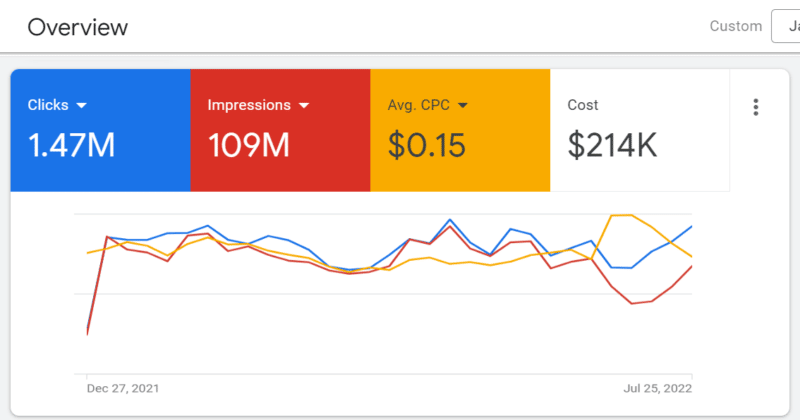
How to fix the overview summary card
- Click the drop-down arrow next to each metric to change it.
- Click the background of the scorecard to toggle between adding or removing it from the chart.
- Click the three dots in the upper right corner to change the date segment or download the data.
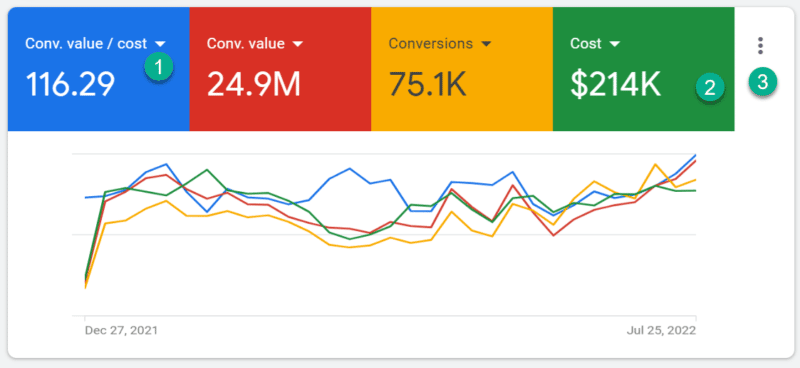
Simply switching your metrics to your key performance indicators (KPIs) already makes the card much more useful.
Most clients don’t care how many clicks they got, but they care very much that they drove $25 million in revenue, and how that metric is trending.
Setting your card to reflect your KPIs helps you know whether you’re on track to hit your targets, and where to dig deeper.
Fix your statistics table
As with the overview summary card, the statistics tables in the Google Ads interface aren’t calibrated to help you find the point.
In English, we read left to right, so the most important metrics should be on the left.
But are they?
If looking at your metrics in the interface makes your eyes glaze over, you probably don’t have your columns organized correctly.
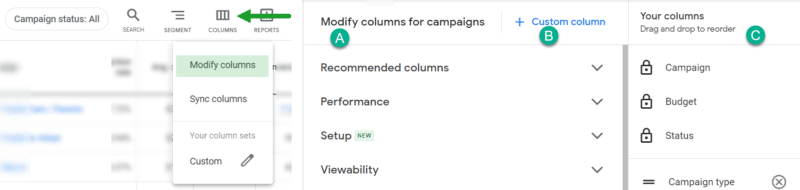
How to add and arrange columns
- Click on Columns and select Modify columns from the drop-down.
- Modify or customize columns to reflect your key metrics.
- Reorder columns to lead with the most important.
- Hit Apply to save.
While modifying columns isn’t a deep secret of the Google Ads interface, it will give you a huge edge in your account optimization if you aren’t doing it already.
Reviewing a statistic table setup like this makes it almost impossible to know what to do next:
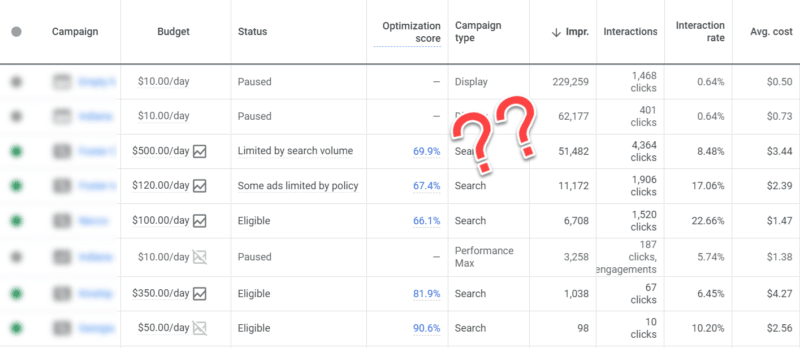
After arranging the columns and adding a time period comparison, it’s a different story:
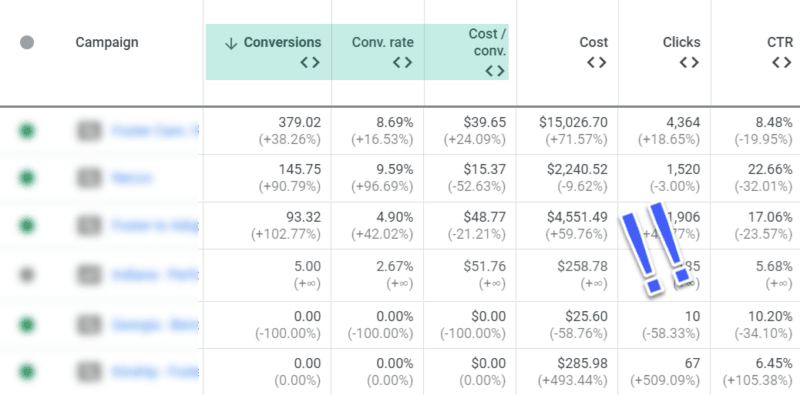
You can immediately tell which campaigns are performing well, compared to each other and compared to last year.
Prioritize the most important info to make better decisions in the account, and prevent that feeling of dread when you’re just staring at data but have no idea what to do next.
2. Decouple your conversion actions
We’ve established that prioritizing Google Ads conversions in the interface will make it easier for you to optimize.
But not all conversions are created equal.
That’s because “conversions” aren’t a standardized metric, and can refer to different actions with different values for your business.
Any of these can be tracked as a conversion in Google Ads:
- A sale
- A page view
- A download
- A phone call
- A link click
It’s up to the advertiser to define which actions are tracked as conversions, but by default, all conversions are rolled up and reported on as a single activity.
Here we see a Google Ad statistics table with 358 conversions, for a nice CPA of only $5.19:

But what exactly are the conversions that are shown here?
To find out, go to Segment and select Conversions > Conversion action.
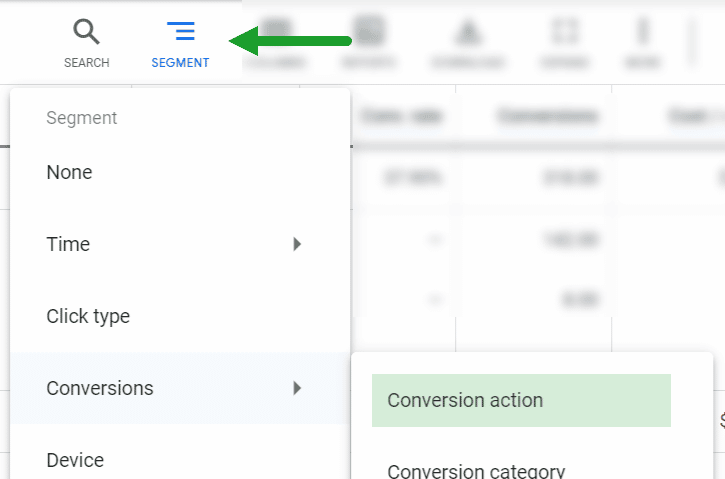
It turns out that less than 4% of conversions were actually for booked demos, the company’s primary KPI. The remaining 96% of conversions were page views (About Us, View Pricing) which were automatically imported into the account and tracked as conversions:
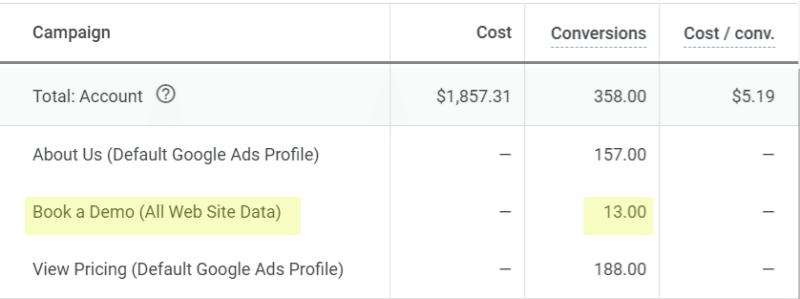
The actual CPA for a booked demo isn’t $5 but $142. ($1,857 divided by 13 demos.)
Applying this segment can help you quickly get to the bottom of which conversions are being tracked and how each performs at a campaign level, so you can fix your tracking or change your optimization strategy.
It may not be the story you want, but it’s the story you need.
Get the daily newsletter search marketers rely on.
<input type=”hidden” name=”utmMedium” value=”” />
<input type=”hidden” name=”utmCampaign” value=”” />
<input type=”hidden” name=”utmSource” value=”” />
<input type=”hidden” name=”utmContent” value=”” />
<input type=”hidden” name=”pageLink” value=”” />
<input type=”hidden” name=”ipAddress” value=”” />
Processing…Please wait.
3. Are you really ‘message matching’ (or do you just think you are)?
You know what message match is. It’s when the keyword, ad and landing page are all about the same thing.
Also known as “congruence,” message match is critical for improving your quality score, boosting your performance, and keeping the attention of your prospects.
But getting every single keyword in alignment with every single ad is no small thing, especially now that responsive search ads (RSAs) introduce so much variation to ad text. (Maybe the keyword matches perfectly on versions 1,2 and 4 but bombs on version 3.)
Here’s how to tell if your keywords and ads are aligned.
Segment your ads by keywords
In your Ad page’s statistics table, go to Segment > Keyword text.
In this view, you’ll play a game of “one of these things is not like the other” to see if all your keywords are performing similarly, or whether there are any outliers.
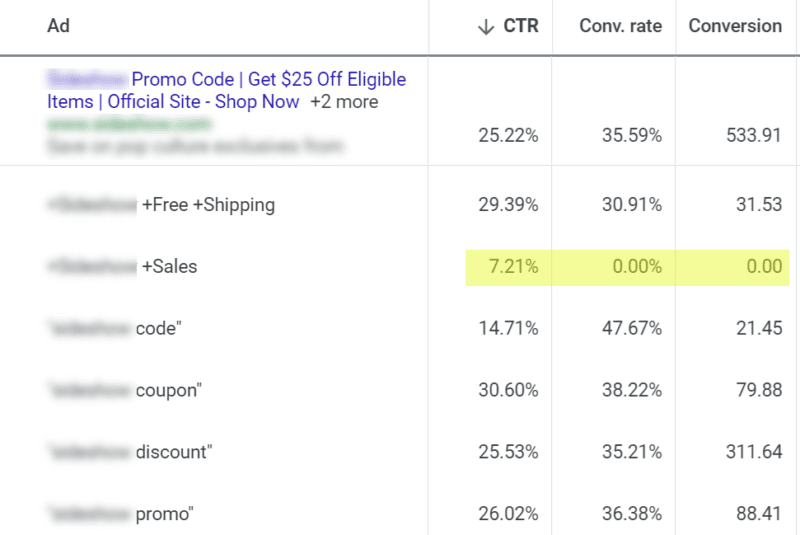
The table above shows that the brand “promo” ad is doing great on searches for discounts and coupons, but “sales” isn’t driving any sales. Not only that, the CTR is only 7%, which is far below the average 25% for this ad.
So what now?
You could:
- Pause the keyword.
- Edit the ad.
- Create a new ad group that better emphasizes the keyword in the ads.
Any of these options could be the best choice for improved message match, it all depends on the keyword, ads and offer.
4. If you don’t segment ad extensions, your data will be wrong
Is there any part of the Google Ads interface that’s as misleading as Extensions tables? This table goes beyond “burying” the lead and makes it disappear completely.
For example, let’s pop in to check on how our “Gift Cards” sitelink is performing.

Looks great, right? $1.6 million in revenue, 73K clicks – this extension is on fire!
You know where this is going. Head over to Segment and select This Extension vs. Other. Now let’s have another look at the performance:
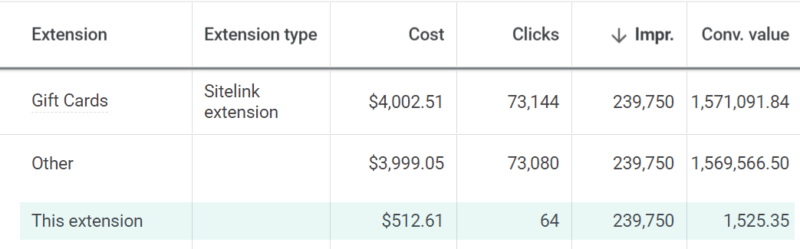
Turns out the sitelink only got 64 clicks, driving less than $2K in revenue.
The rest of the performance data relates to the headline or literally any other part of the ad that wasn’t the sitelink, but served when the sitelink served.
By default, the table will show you incomplete or inaccurate data about your extensions. Always use This Extension vs. Other for a true evaluation of performance.
Channel your inner journalist
Like an investigative journalist, you can learn to uncover the lead, and focus on what matters most in your account.
The Google Ads interface is constantly changing, without much announcement or fanfare. This article only scratches the surface of what you can uncover.
For instance:
- Find out how mobile landing pages affect your conversion rates by segmenting landing pages by device type.
- See if Search Partner volume has changed by segmenting for Network (with search partners).
- Filter your search term data by search term text to quickly see the spread of keywords triggered by similar queries.
Be curious, and see how you can use new filters, segments, columns and report features. You’ll be an expert in getting to the point of your data in no time!
The post 4 tips to get the most out of the Google Ads interface appeared first on Search Engine Land.
Courtesy of Search Engine Land: News & Info About SEO, PPC, SEM, Search Engines & Search Marketing
Category seo news | Tags:
Social Networks : Technorati, Stumble it!, Digg, de.licio.us, Yahoo, reddit, Blogmarks, Google, Magnolia.
Webinar: 5 ways to survive an uncertain economy
Written on September 8, 2022 at 4:25 am, by admin

Most marketers work day in and day out to stay on top of how their market is evolving, but just one unexpected factor can shift the entire trajectory of your industry.
Join this webinar for an eye-opening discussion about how to identify consumer concerns, determine market barriers and where potential gaps may be using consumer and market intelligence.
Register today for “Sink or Swim: 5 Ways to Survive a Struggling Economy,” presented by NetBase Quid.
The post Webinar: 5 ways to survive an uncertain economy appeared first on Search Engine Land.
Courtesy of Search Engine Land: News & Info About SEO, PPC, SEM, Search Engines & Search Marketing
Category seo news | Tags:
Social Networks : Technorati, Stumble it!, Digg, de.licio.us, Yahoo, reddit, Blogmarks, Google, Magnolia.
YouTube updates Masthead ad requirements to allow sports betting
Written on September 8, 2022 at 4:25 am, by admin
YouTube is now allowing sports betting ads to serve on the masthead as long as the ads comply with the related gambling and games policy.

Recent masthead updates. Additional masthead updates were released in June for alcohol and prescription drugs. Full-day masthead reservations were discontinued and replaces with more targeted options. The new CPM option allows mastheads to be more accessible to a broader market of advertisers.
Read the announcement. You can read the announcement from Google here. Google’s guidelines for advertising sports and gambling can also be found here.
Why we care. Advertisers who run YouTube campaigns for sports and gambling can now have their ads in the most prominent ad space, so long as they comply with YouTube policies.
The post YouTube updates Masthead ad requirements to allow sports betting appeared first on Search Engine Land.
Courtesy of Search Engine Land: News & Info About SEO, PPC, SEM, Search Engines & Search Marketing
Category seo news | Tags:
Social Networks : Technorati, Stumble it!, Digg, de.licio.us, Yahoo, reddit, Blogmarks, Google, Magnolia.