

5 SEO mistakes sacrificing quantity and quality (and how to fix them)
Written on October 18, 2023 at 11:08 pm, by admin
Quantity and quality are often diametrically opposed.
Increase the former, the latter drops like a rock.
Try to bring it back up, and pretty soon, you’re back where you started; lowering quantity back down to bring them into balance.
But here’s the thing.
It doesn’t have to be this way. In a world of endless competition, incredibly savvy competitors, AI, and zero-click SERPs, you simply can’t afford not to scale both quality and quantity at the same exact time.
Don’t just take my word for it. Go look at the SERPs. Look at what is actually working vs. what anyone “tells” you should work.
I’ve had the fortune of working with countless billion-dollar brands. And what separates them from everyone else isn’t just a budget number on a spreadsheet.
But a deeper understanding of how to avoid these five self-imposed mistakes below.
Mistake 1: Poor operational systems create self-imposed ‘glass ceilings’
It’s true to a degree.
SEO is complex. Getting more so by the day.
It is technical. Canonicalization and Time to First Byte (TTFB) are living proof.
But there is a giant misconception about why SEO campaigns fail.
That’s because, contrary to popular belief, SEO is not just a technical problem. It’s also a people problem.
Obviously, a site that doesn’t get indexed properly is a problem. That’s a technical issue.
But the bigger, more fundamental, and common underlying issue is that you’re not publishing enough good stuff around highly relevant keywords or getting attention and clicks back to those pages.
Simple as that.
Go look up the biggest sites across any category. The biggest brands in your industry. And what do you notice?
An overwhelming number of websites whose pages number into the thousands (or more), and referring domains into the tens of thousands (or more).
That’s what you’re up against. Welcome to the future of SEO. Where the big get bigger, the rich get richer.
And the faster you come to realize this, the faster you’ll be able to set up your workflows, processes, roles, and responsibilities accordingly to unlock insane growth.
The trouble is, most SEOs continue to think too small. Too tactical. Too minute.
They’re busy scrappin’ around, looking for those one or two or three “NiNjA rOcKsTaR uNiCoRnS” – except they don’t exist!
Or, at least, your over-reliance on them continues to undermine future potential because you rely more on raw talent than proven systems.
And therefore, your workflows are garbage. Processes full of holes like a stinky, sweaty block of Swiss cheese.
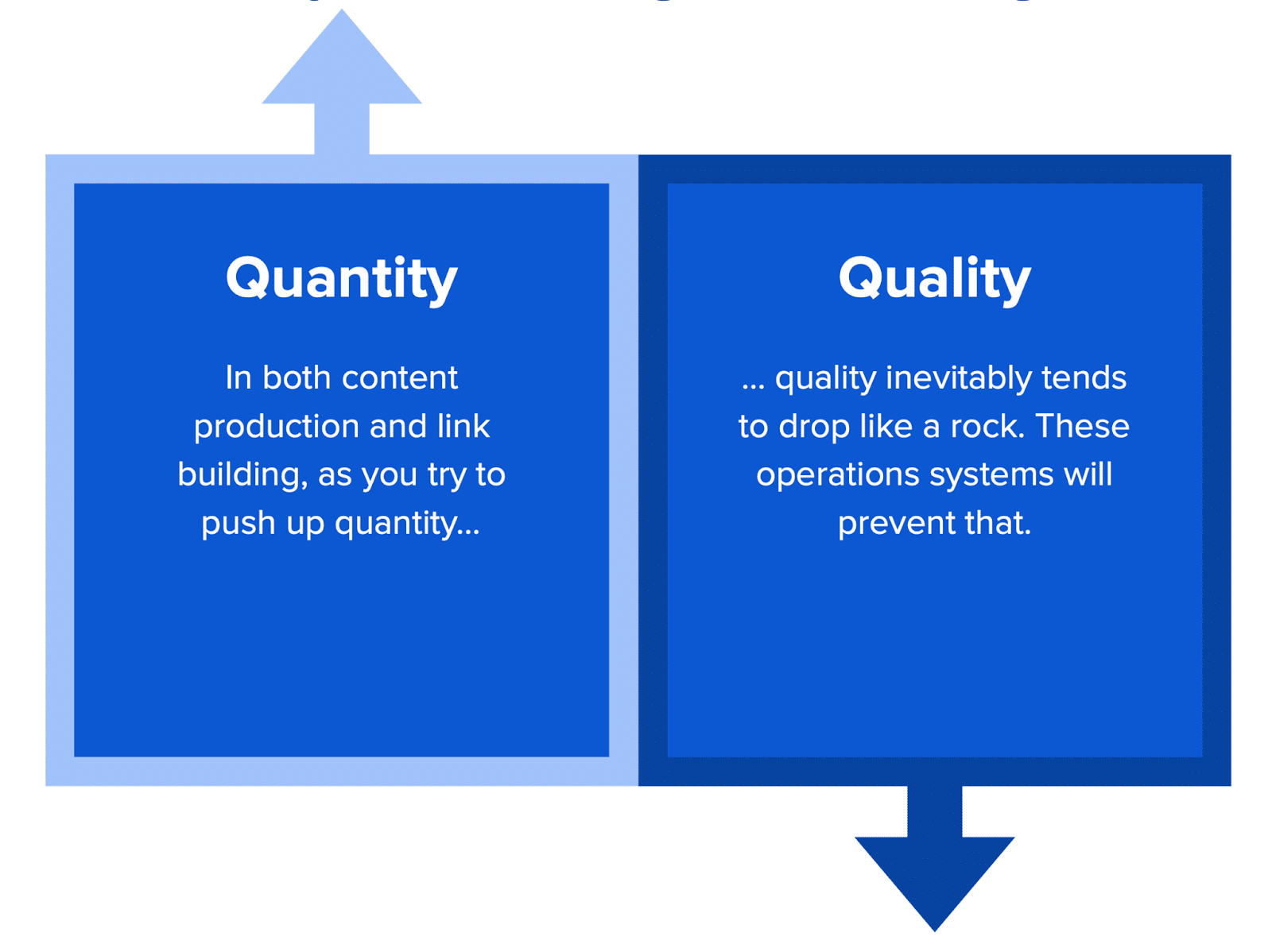
So the first lesson is to stop. Look at yourself in the mirror. And admit that what got you here won’t get you there.
You need better internal operating systems – not just better, more talented people – to scale million-dollar brands into billion-dollar ones.
Mistake 2: You don’t have processes to simplify complex activities
I <3 Andy Crestodina.
One, because he’s incredibly nice. Two, incredibly smart. But three, ‘cause he drops truth bombs on the regular.
He’s been publishing a study on blogging statistics for years – possibly even a decade by now.
And there are always two overwhelming conclusions staring marketers in the face:
- The stuff most people do consistently don’t correlate highly with success.
- The things that most likely correlate to success are often practiced the least.
Let that sink in a moment.
Here’s my favorite excerpt. Let’s take a look at the top seven activities that correlate most with “chance of success,” as reported in the increased likelihood from those with “strong results:”
- Publish daily – 128%
- Write 3,000+ word articles – 116%
- Write 10+ draft headlines before choosing one – 84%
- Research keywords for every post – 80%
- Include 10+ images per post – 56%
- Include contributor quotes for every post – 56%
- Use a team of editors – 52%
Now. Ask yourself. How many of those are you practicing on a regular basis?
One? Maybe two? Imagine you pushed that to six or all seven.
How on Earth is that possible? To publish loooooong, in-depth, action-packed articles that include expert insight backed by a team of editors – all on a daily basis?
The short answer? You can’t.
At least, not without excellent processes that break down complex, multi-faceted challenges into simple steps and checklists.
Take even one of those, like publishing daily. Only the greatest workhorses of writers could publish one 3,000-word article on a daily basis.
Why?
Because they’re also often getting pulled into too many other directions and distractions.
Because you’re also falling victim to the third common mistake below.
Mistake 3: You have the wrong people in the wrong roles
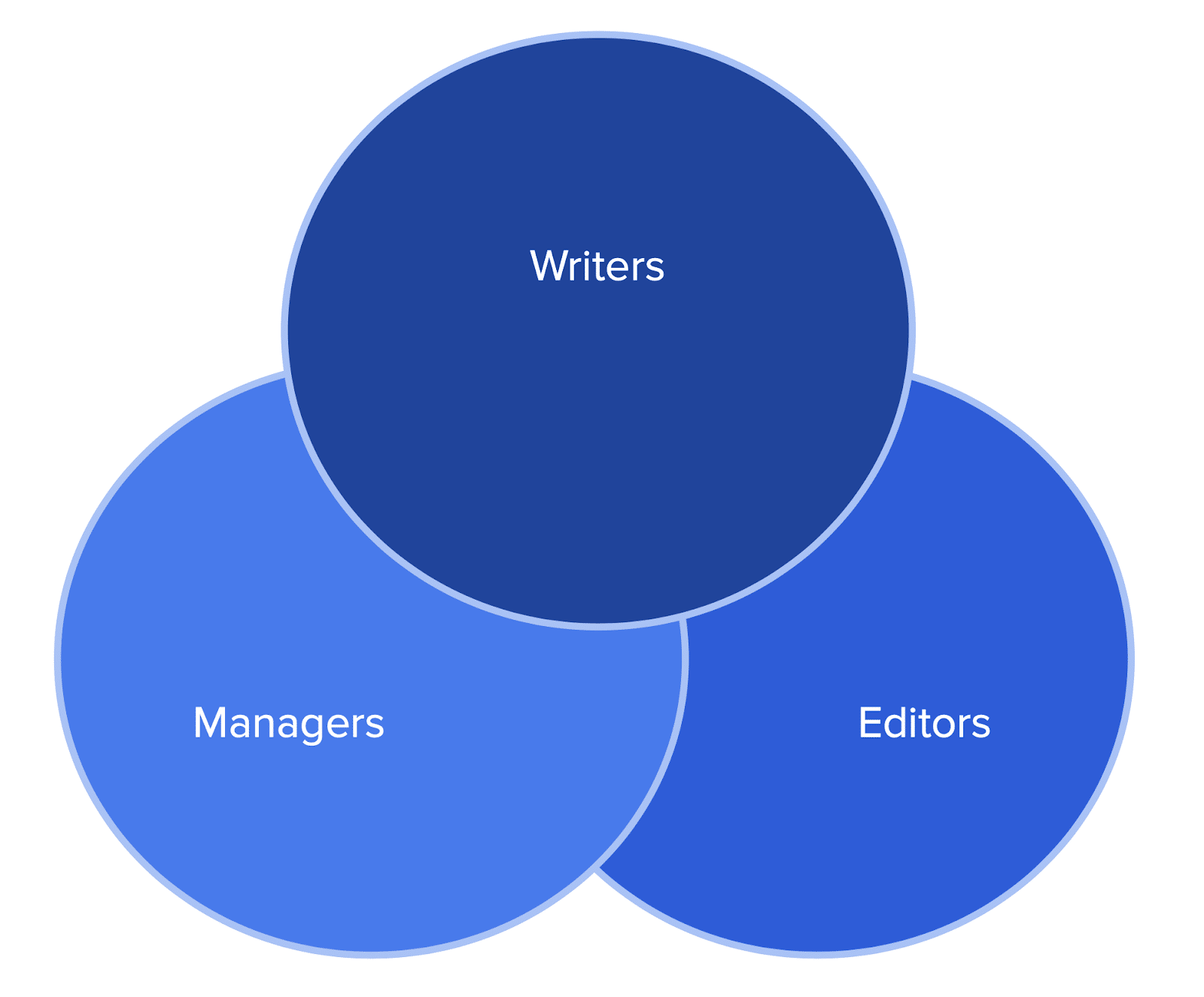
Great writers make bad editors and even terrible content managers because their skill sets are often contradictory. For instance:
- Great writers thrive on ingenuity, on saying the same thing multiple different ways at different times.
- Great editors, meanwhile, thrive on consistency, making sure that all content under their purview has consistent standards and a unifying voice.
- Great content managers thrive on orderly logistics, keeping their teams on task to guarantee milestones and due dates are met, and output continues to increase.
OK, thanks for the lecture. What does all this mean?
It means to publish a 3,000+ word article on a daily basis, you’re not just looking for one killer writer. You’re looking for a team of them.
That team of subject-matter experts needs to be supported by a team of editors. Who’re all backed up by a team of content managers working in sync like a professional kitchen on a busy night.
The only way you get teams of people to work together, day after day, is through having the right people in the right roles.
So everyone’s playing to their strengths. And nobody is pulled into their areas of weakness.
This is easy in theory but difficult in practice. And it’s why most can’t – or won’t – do it.
Mistake 4: You’re ‘guessing’ instead of ‘knowing’ what works
The Internet’s rich keep getting richer.
I don’t need to tell you that.
All you need to do is look up the SERPs in your space and notice how giant “business” publishers are now dominating categories like “best mattress for your home.”
They often don’t need to play by the same rules as the rest of us, sweating over concepts like “topical authority” that their mere presence makes a mockery of.
Except…
When the big brands drop the ball on the basics.
Their SEO complacency and entitlement ultimately do them in. And that’s how you beat them at their own game.
Take a super competitive, saturated space like “make money online.”
Big brands often fall short when they “guess” instead of measuring twice and cutting once – knowing exactly what they should be doing before even writing a single word.
Exhibit A:
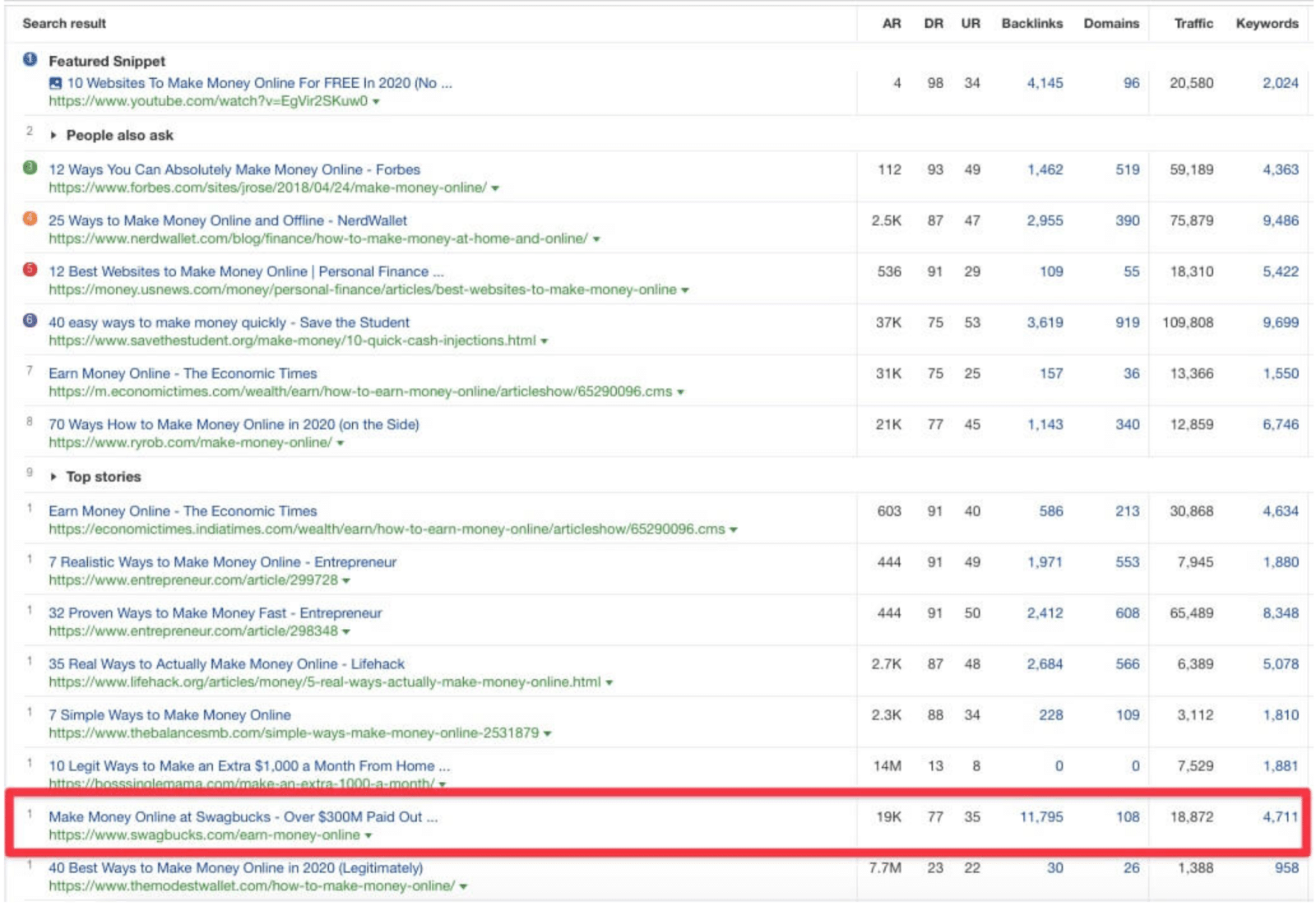
No way this should be happening. Except, it’s obvious to experts: search intent is simply misaligned.
They’re just publishing whatever they feel like, a product landing page, expecting it to work instantly.
Instead of rolling up their sleeves, understanding what the SERPs are telling them, and then executing accordingly.
Mistake 5: You haven’t transformed ‘subjective’ elements into ‘objective’ ones
Understand that nearly everything in life is subjective – varying shades of gray.
There are few truly “black” or “white” issues where one side is always wrong and the other is always right. (No matter what loud people on X.com lead you to believe.)
The real world isn’t binary. But that doesn’t mean you can’t (or shouldn’t) do everything possible to transform subjective elements in your process into objective ones.
Take a look at the following edits and tell me which ones are “right” vs. “wrong”:

One person reading this might like the first example. While others, the second.
So what’s the right answer?
Trick question, because there is none.
The point is to take something subjective, like the phrasing of a sentence, and turn it into objective truths for your brand or style.
And then consistently re-train your team to align around that tone going forward.
Unlocking SEO success: People and processes, not just tech, matter
It’s true. You can’t guarantee SEO success.
But that’s OK in the long run.
‘Cause it means that most of your competitors will continue to take shortcuts and miss the obvious facts staring them in the face.
You, putting your head down and trusting the process, can lap them over the next few years before they even know what hit them.
You can’t guarantee SEO results. But you can predict SEO success before publishing a single thing.
You just need to look at what actually works, what is actually driving results in real time.
And then align your workflows, processes and people accordingly.
The post 5 SEO mistakes sacrificing quantity and quality (and how to fix them) appeared first on Search Engine Land.
Courtesy of Search Engine Land: News & Info About SEO, PPC, SEM, Search Engines & Search Marketing
Category seo news | Tags:
Social Networks : Technorati, Stumble it!, Digg, de.licio.us, Yahoo, reddit, Blogmarks, Google, Magnolia.
Google confirms sunset details for 4 attribution models in Ads and Analytics
Written on October 17, 2023 at 8:07 pm, by admin
Google is retiring four rules-based attribution models for all properties in Google Ads and Google Analytics in mid-October 2023:
- First-click.
- Linear.
- Time decay.
- Position-based.
The models listed above will be removed from both the Analytics user interface and Admin API.
Why we care. If you’re using these models in Google Ads, it will affect you. And tracking anything other than the last click is about to become more challenging because the data-driven attribution formula differs for each advertiser – and it’s not visible. As Greg Finn, director of marketing for Cypress North, told Search Engine Land:
- “In the past, you could use linear and give each touch the same credit. You will no longer be able to do so. There will be no impact on last touch, as that is still available. But finding some of the first-touch information will be much muddier because there will no longer be a way to see the formulas that compute the attribution scores.”
What happens next. If your existing property uses one of the impacted models, it will automatically default to paid and organic data-driven attribution. Paid and organic last-click and Google paid channels last-click models will also continue to be available.
Why the change. Google is retiring these four attribution models because of “increasingly low adoption rates, with fewer than 3% of conversions in Google Ads using these models” according to a Google spokesperson. They added:
- “Switching to the data-driven attribution model typically results in a 6% increase in conversions for advertisers.”
Get the daily newsletter search marketers rely on.
<input type=”hidden” name=”utmMedium” value=”“>
<input type=”hidden” name=”utmCampaign” value=”“>
<input type=”hidden” name=”utmSource” value=”“>
<input type=”hidden” name=”utmContent” value=”“>
<input type=”hidden” name=”pageLink” value=”“>
<input type=”hidden” name=”ipAddress” value=”“>
Processing…Please wait.
What Google is saying. A Google spokesperson said in a statement:
- “Rules-based attribution models assign value to each advertising touchpoint based on predefined rules.”
- “These models don’t provide the flexibility needed to adapt to evolving consumer journeys. Data-driven attribution uses advanced AI to understand the impact each touchpoint has on a conversion. That’s why we made Data-driven attribution the default attribution model in Google Analytics 4 and Google Ads.”
- “For these reasons, First click, Linear, Time decay, and Position-based attribution models across Google Analytics 4 will be going away.”
Dig deeper. Data-driven attribution: How to think about Google’s default attribution model
The post Google confirms sunset details for 4 attribution models in Ads and Analytics appeared first on Search Engine Land.
Courtesy of Search Engine Land: News & Info About SEO, PPC, SEM, Search Engines & Search Marketing
Category seo news | Tags:
Social Networks : Technorati, Stumble it!, Digg, de.licio.us, Yahoo, reddit, Blogmarks, Google, Magnolia.
Awaken dead content with AI and DAM by Cynthia Ramsaran
Written on October 17, 2023 at 8:07 pm, by admin

Don’t let old visuals and dead designs haunt your brand’s customer experience. With the right mix of a digital asset manager and AI, it’s easy to increase the use and repurposing of digital assets across teams and regions.
Join content experts and learn how digital asset management (DAM) and AI can help your marketing and creative teams reuse, repurpose, and transform assets to bring your customer experience to the next level.
Learn more by registering and attending “Awakening Dead Content with DAM and AI,” presented by Acquia.
Click here to view more Search Engine Land webinars.
The post Awaken dead content with AI and DAM appeared first on Search Engine Land.
Courtesy of Search Engine Land: News & Info About SEO, PPC, SEM, Search Engines & Search Marketing
Category seo news | Tags:
Social Networks : Technorati, Stumble it!, Digg, de.licio.us, Yahoo, reddit, Blogmarks, Google, Magnolia.
Baidu to integrate ERNIE 4.0, which ‘rivals’ GPT-4, into Search
Written on October 17, 2023 at 8:07 pm, by admin
Baidu has unveiled the latest edition of its generative AI model, ERNIE 4.0.
The Chinese technology company has said that the chatbot’s capabilities rival those of OpenAI’s GPT-4. ERNIE is an acronym for “Enhanced Representation from kNowledge IntEgration”.
Search engine plans. Baidu is planning to integrate ERNIE 4.0 into its search engine, maps, business tools and cloud services. This will change how the search engine responds to queries, by providing customized answers instead of lists of results and links, according to Baidu CEO Robin Li.
The exact timeline for these changes is yet to be confirmed.
Capabilities. Baidu CEO, Li, claimed that the ERNIE model has been “significantly improved” in terms of understanding queries, generating more advanced responses and memory functionality. Speaking at an event in Beijing, he said that the 4.0 version can:
- Generate a car commercial within minutes.
- Solve complicated math problems.
- Create plots for novels from scratch.
Why we care. The potential ramifications of integrating ERNIE across its suite of products, including its search engine. are substantial, potentially reshaping rankings, traffic and advertising. The exact magnitude of these effects is uncertain at this point, so international search marketers should stay on top of the latest developments.
Language issues. ERNIE 4.0’s primary language is Mandarin Chinese. It isn’t yet able to process English queries to the same advanced level.
Availability. The ERNIE Bot was first unveiled in March and was made available to the public in August. The 4.0 model has not yet been rolled out to the general public, however, Baidu has invited some people to test it.
Get the daily newsletter search marketers rely on.
<input type=”hidden” name=”utmMedium” value=”“>
<input type=”hidden” name=”utmCampaign” value=”“>
<input type=”hidden” name=”utmSource” value=”“>
<input type=”hidden” name=”utmContent” value=”“>
<input type=”hidden” name=”pageLink” value=”“>
<input type=”hidden” name=”ipAddress” value=”“>
Processing…Please wait.
What Baidu is saying. Li said in a statement:
- “ERNIE 4.0 has achieved a full upgrade with drastically improved performance in understanding, generation, reasoning, and memory.”
- “These four core capabilities form the foundation of AI-native applications and have now unleashed unlimited opportunities for new innovations.”
But. Despite Li’s big claims, analysts seem unimpressed, according to Reuters.
The post Baidu to integrate ERNIE 4.0, which ‘rivals’ GPT-4, into Search appeared first on Search Engine Land.
Courtesy of Search Engine Land: News & Info About SEO, PPC, SEM, Search Engines & Search Marketing
Category seo news | Tags:
Social Networks : Technorati, Stumble it!, Digg, de.licio.us, Yahoo, reddit, Blogmarks, Google, Magnolia.
Google Business Profiles adds disabled-owned attribute to listings
Written on October 17, 2023 at 8:07 pm, by admin
Google has added a new business attributed within Google Business Profiles for “disabled-owned” businesses. This new disabled-owned attribute can show up on businesses that are owned by disabled business owners.
Google said, “When businesses choose to identify as disabled-owned in their Business Profile, the attribute will appear on their listings in Maps and Search. This update builds on our existing business attributes, including Asian-owned, Black-owned, Latino-owned, LGBTQ+ owned, veteran-owned, and women-owned.”
What it looks like. Here is a screenshot of this new “disabled-owned” badge or label on business listings in Google Search and Google Maps:

You should be able to add this attribute by editing your Google Business Profile within Google Search.
Other features. Google also added a number of other features to Google Maps and Google Search:
- Use screen reader capabilities with Lens in Maps
- Get around more easily with accessible walking routes in Google Maps
- See wheelchair-accessible information in more places
- Customize your Assistant Routines with more options
- Search faster in the Chrome address bar
- A more accessible camera for your Pixel
Why we care. Adding these labels and attributes to your business listing may drive more attention and more foot traffic into your store.
The post Google Business Profiles adds disabled-owned attribute to listings appeared first on Search Engine Land.
Courtesy of Search Engine Land: News & Info About SEO, PPC, SEM, Search Engines & Search Marketing
Category seo news | Tags:
Social Networks : Technorati, Stumble it!, Digg, de.licio.us, Yahoo, reddit, Blogmarks, Google, Magnolia.
10 reasons to join us at SMX online this November
Written on October 16, 2023 at 5:07 pm, by admin

The rise of generative AI is unprecedented. Google’s SGE is redefining everything we know about organic and paid search results. Algorithm updates and ranking factor rollouts are endless.
Turn these daunting challenges into opportunities to stay one step ahead of your competitors and drive measurable results: Attend SMX Next for free, online November 14-15!
Check out the brand-new agenda, featuring exclusive generative AI keynotes from search marketing experts…

…plus 65+ tactic-rich sessions, Overtime live Q&As, Coffee Talk meetups, engaging demos, and more!
Keep reading for 10 undeniable reasons why you should join us online next month:
- You’ll unlock unbiased, trustworthy content from the experts at Search Engine Land, the industry publication of record.
- 100% digital means you can attend from anywhere: office, home, cafe, couch, etc. No travel headaches, no time out of the office, no carbon emissions.
- No budget for training? No problem. SMX is 100% free to attend.
- You’ll only learn safe, reputable, reliable training — no get-rich-quick schemes or dodgy tactics.
- Hours or live Q&A (Overtime!) means you’ll get expert answers to your toughest questions.
- Can’t attend live? Instant on-demand access is included with your free pass, so you can train at your own pace.
- Hear what the best in the biz are up to… and validate your own initiatives and instincts.
- Forge game-changing connections during Coffee Talk meetups with like-minded search marketers.
- Unite your departments with a shared training experience – invaluable to on-site and remote teams alike.
- Earn a personalized certificate of attendance to demonstrate your commitment to continued training and furthering your career.
Need more convincing? Read more about attendees’ favorite reasons to attend SMX.
Ready to register? It’s fast, easy, and free. Don’t miss your final chance in 2023 to learn from and connect with the best and brightest in the search marketing community.
The post 10 reasons to join us at SMX online this November appeared first on Search Engine Land.
Courtesy of Search Engine Land: News & Info About SEO, PPC, SEM, Search Engines & Search Marketing
Category seo news | Tags:
Social Networks : Technorati, Stumble it!, Digg, de.licio.us, Yahoo, reddit, Blogmarks, Google, Magnolia.
YouTube Spotlight Moments lets brands align ads with cultural moments
Written on October 16, 2023 at 5:07 pm, by admin
YouTube today introduced Spotlight Moments – a new advertising package that will serve your brand’s videos next to “the most relevant and engaging content associated with the moment.”
How it works. Using, AI, YouTube can identify popular videos around cultural moments. For example, with Halloween coming up, Spotlight Moments:
- Lets advertiser serve ads across Halloween-related content on YouTube.
- Curates YouTube videos into dynamically updated playlists on a sponsored hub.
YouTube Culture Hub. All the videos will live on the sponsored YouTube Culture Hub. This hub will include the advertiser’s logo. Here’s what that looks like:

Why we care. YouTube’s new advertising offering has the potential to give your brand visibility during key cultural moments and help you reach your target audience. The big question to be determined is what kind of ROI your brand with this ad format.
The full announcement. New ways to show up where the world watches, powered by AI
The post YouTube Spotlight Moments lets brands align ads with cultural moments appeared first on Search Engine Land.
Courtesy of Search Engine Land: News & Info About SEO, PPC, SEM, Search Engines & Search Marketing
Category seo news | Tags:
Social Networks : Technorati, Stumble it!, Digg, de.licio.us, Yahoo, reddit, Blogmarks, Google, Magnolia.
Google adds new vehicle listings structured data
Written on October 16, 2023 at 5:07 pm, by admin
Google has added new markup and structured data support for new vehicle listings, designed to help car dealerships get more exposure for their listings. “Vehicle listings on Google allows car dealerships to show their for-sale inventory on Google Search and other Google surfaces,” Google announced.
This comes with new reports and debugging tools within Google Search Console.
Vehicle listing structured data. Google’s structured data help documentation added a new section for vehicle listing (car) structured data. Google provides two ways for dealerships to add their inventory. One is through structured data markup on their websites, which is the main focus of this document, and the other is through feed files uploaded to the vehicle listings partner portal.
Google said the vehicle listing rich result is currently only available in English in the US and US territories for both mobile and desktop interfaces.
You can follow the technical guidelines over here to learn more.
New Search Console report. Google also launched a new rich result report in Search Console to monitor markup issues. This report will show valid and invalid items for pages with structured data for your vehicle listing markup.

Rich results test updated. Google also updated its Rich Results Test to support vehicle listing structured data. You can post your URL of a page or a code snippet to the tool. Using the tool, you can confirm whether or not your markup is valid instantly without waiting for Rich result reports to be updated, Google added.

Why we care. If you have a dealership or you have clients that are dealerships and want more ways to get visibility in Google Search, you now have new markup and structured data you can use to get more eye-balls on your cars.
The post Google adds new vehicle listings structured data appeared first on Search Engine Land.
Courtesy of Search Engine Land: News & Info About SEO, PPC, SEM, Search Engines & Search Marketing
Category seo news | Tags:
Social Networks : Technorati, Stumble it!, Digg, de.licio.us, Yahoo, reddit, Blogmarks, Google, Magnolia.
How to fix unassigned traffic in GA4
Written on October 16, 2023 at 5:07 pm, by admin
Unassigned traffic in Google Analytics 4 (GA4) is a common headache for digital marketers.
It’s like trying to solve a puzzle with missing pieces: your data is incomplete, making it hard to measure the success of your marketing efforts.
This article covers the common causes of unassigned traffic in GA4 and tips to ensure your campaigns are accurately tracked and optimized.
What is unassigned traffic?
Unassigned traffic refers to web traffic that isn’t categorized under any of the traffic sources or mediums provided by Google Analytics 4 (GA4).

Often, this arises when we use UTMs that reference traffic sources or mediums that GA4 doesn’t recognize. In such cases, Google labels this as Unassigned.
While this is a frequent reason, there can be other factors causing this classification.
How does GA4 classify user acquisition and traffic?
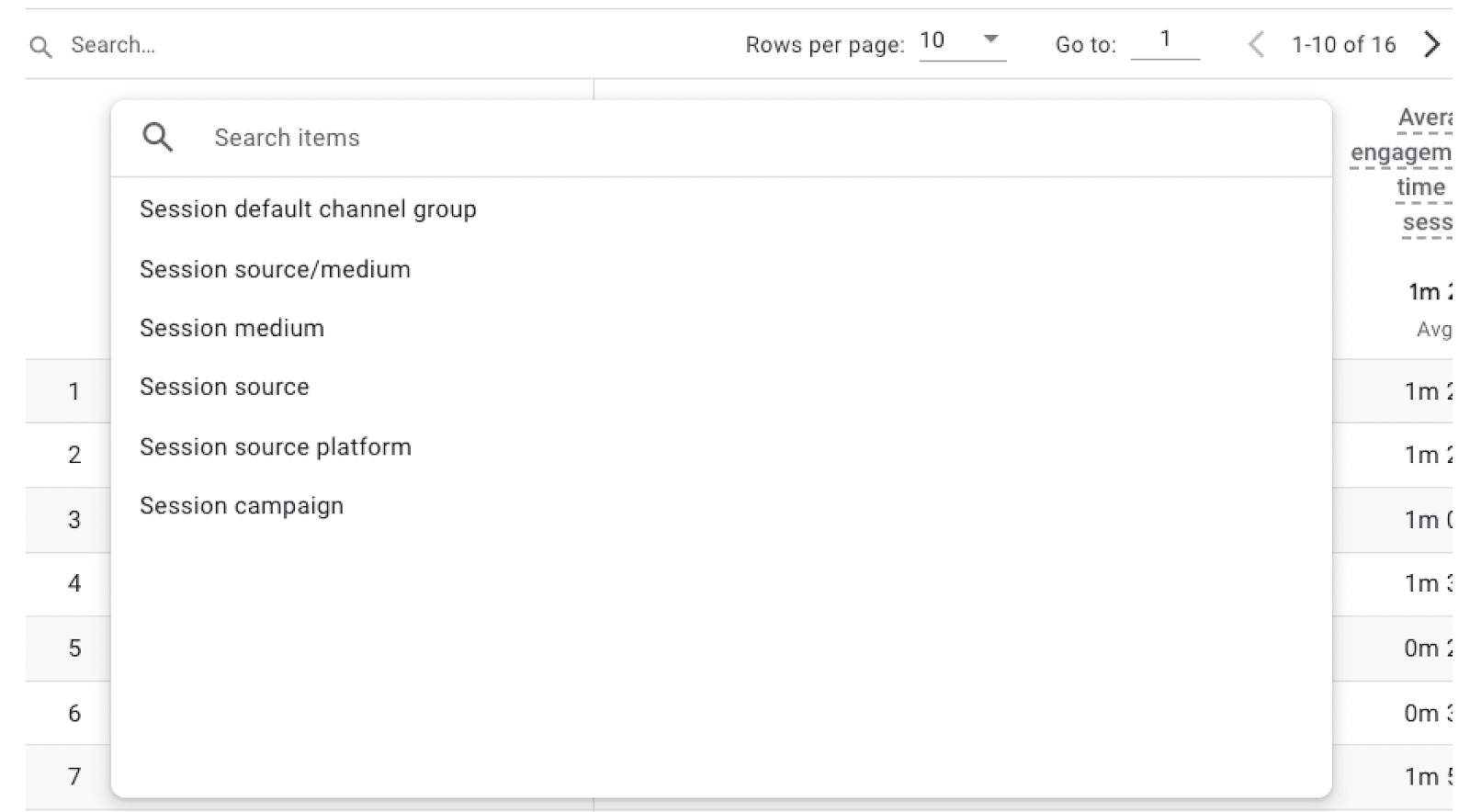
The traffic source dimensions provide information about where the website or app traffic comes from. GA4 provides different dimensions to analyze it. Among the most used include:
Default channel groups
- This dimension lets you delve into the channels that bring users to your site. Google offers a default set list of channel groups.
Source
- Identifies the origin of your traffic, like from a search engine such as Google, or another website.
Medium
- Indicates through which method you acquired the website traffic, i.e., via organic, CPC, etc.
First user source / medium
- Given at the user level, this indicates the source or medium responsible for the user’s initial session.
Session source / medium
- Assigned at the session level, this represents what originated the session.
Get the daily newsletter search marketers rely on.
<input type=”hidden” name=”utmMedium” value=”“>
<input type=”hidden” name=”utmCampaign” value=”“>
<input type=”hidden” name=”utmSource” value=”“>
<input type=”hidden” name=”utmContent” value=”“>
<input type=”hidden” name=”pageLink” value=”“>
<input type=”hidden” name=”ipAddress” value=”“>
Processing…Please wait.
What are the causes and how to prevent unassigned traffic in GA4?
Manual tagging based on source and medium
One of the main causes of unassigned traffic is the manual tagging of UTMs that do not follow Google’s recommendations.
UTM parameters enable you to manually tag URLs for emails, ads, and more. They can be easily added using Google’s Campaign URL Builder, providing insights into the origin of visits.
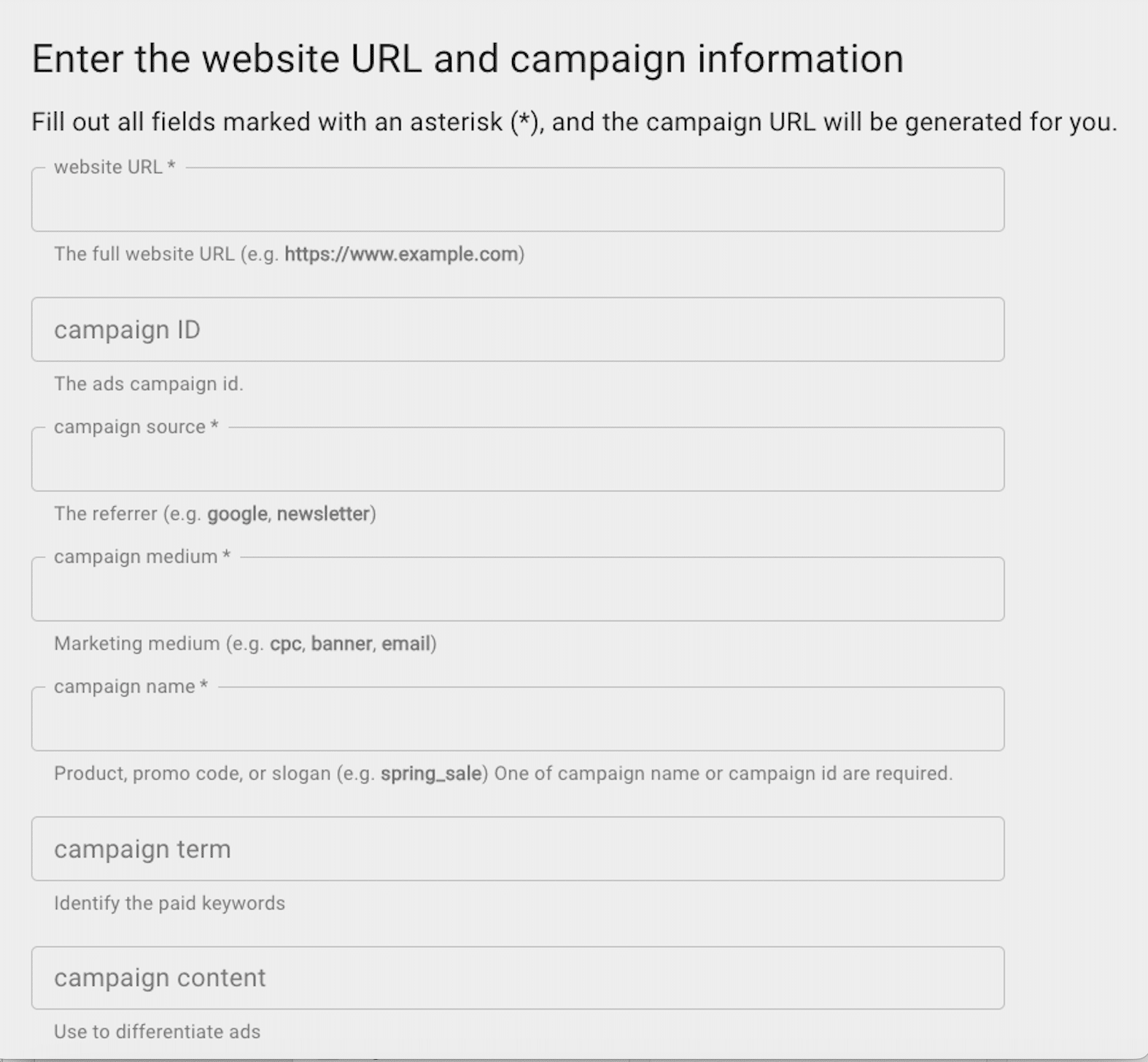
The essential and most recommended tagging fields are:
- Source and medium, which will allow you to identify where the campaigns come from.
- Campaign name, which allows you to assign a name to the campaign so you can analyze its results through the campaign dimension.
Below are common channels for manual traffic:
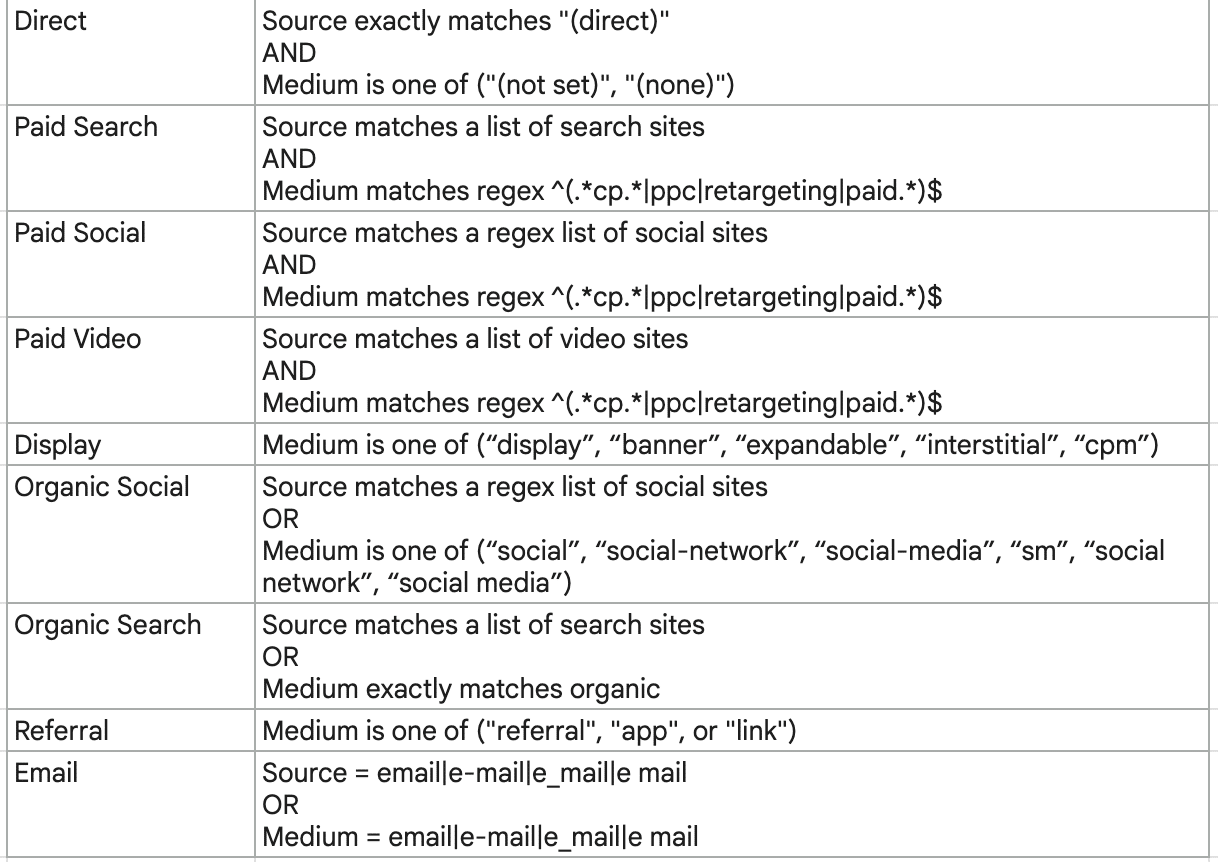
If you don’t tag these fields per Google’s recommendations, GA4 will not be able to group them into its predefined categories, so the traffic will be labeled as Unassigned.
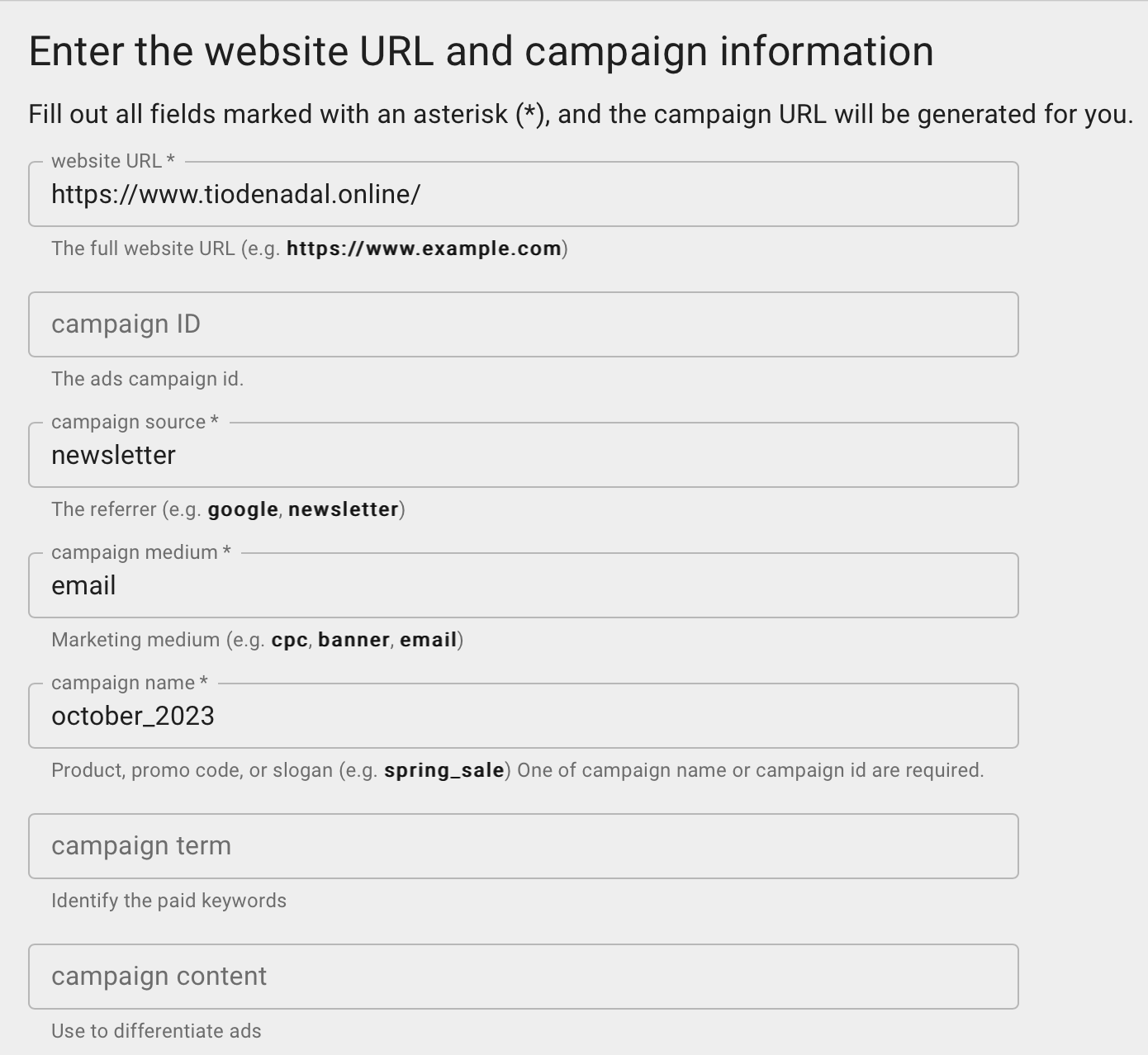
For instance, if we want to manually tag a newsletter URL, we will have to fill in the UTMs parameter fields using Google’s predefined ones:
https://www.tiodenadal.online/?utm_source=newsletter&utm_medium=email&utm_campaign=october_2023
*Newsletter is optional. If you choose to put this source, it is always recommended to stick with it. If not, we can set the name of the ESP used or look for how the source is tagged.
When tracking links from another website, verify your source and medium tracking, then create a UTM with a campaign ID:
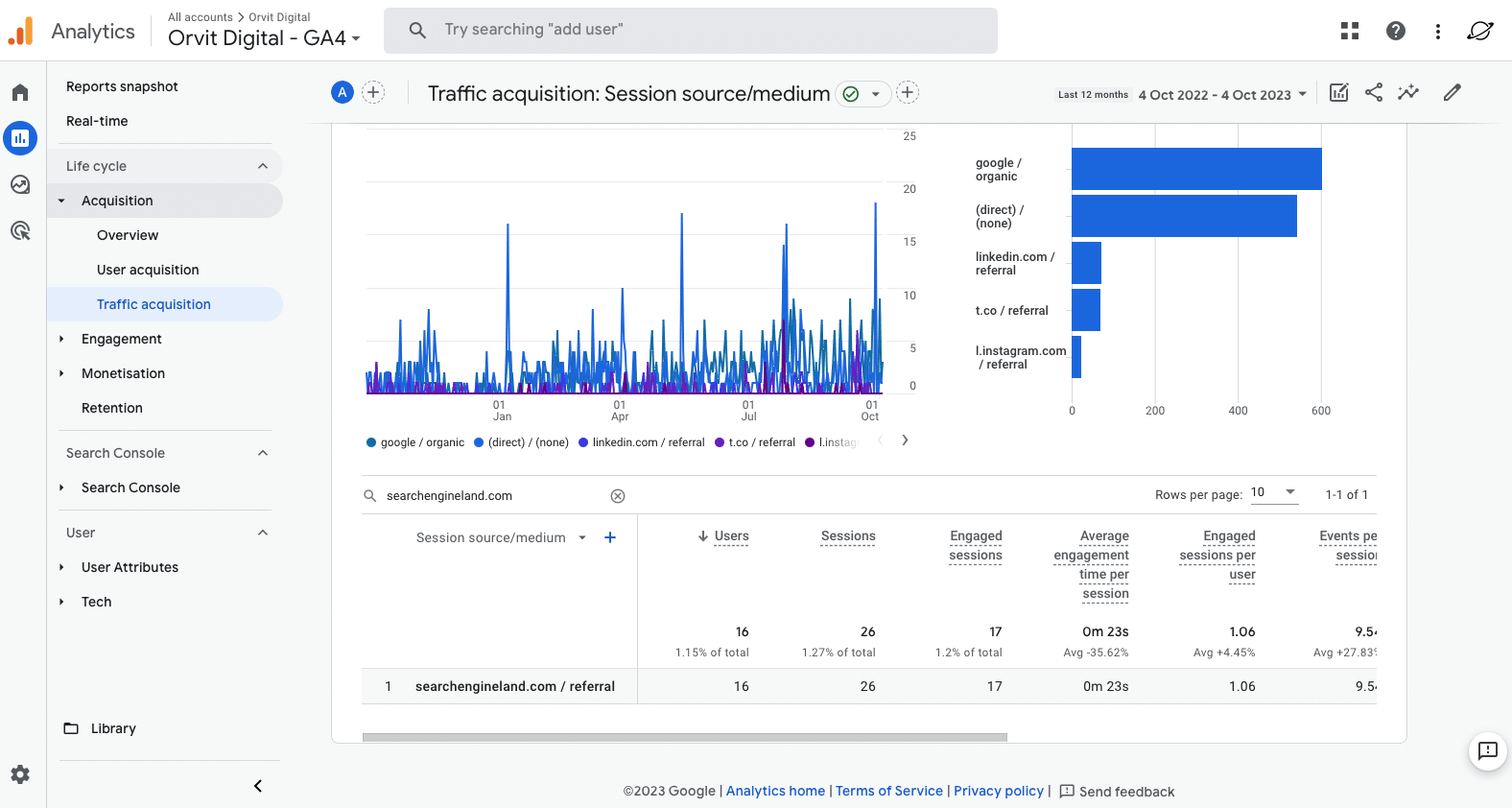
https://orvitdigital.com/?utm_source=searchengineland.com&utm_medium=referral&utm_campaign=Post_Unassigned_Traffic
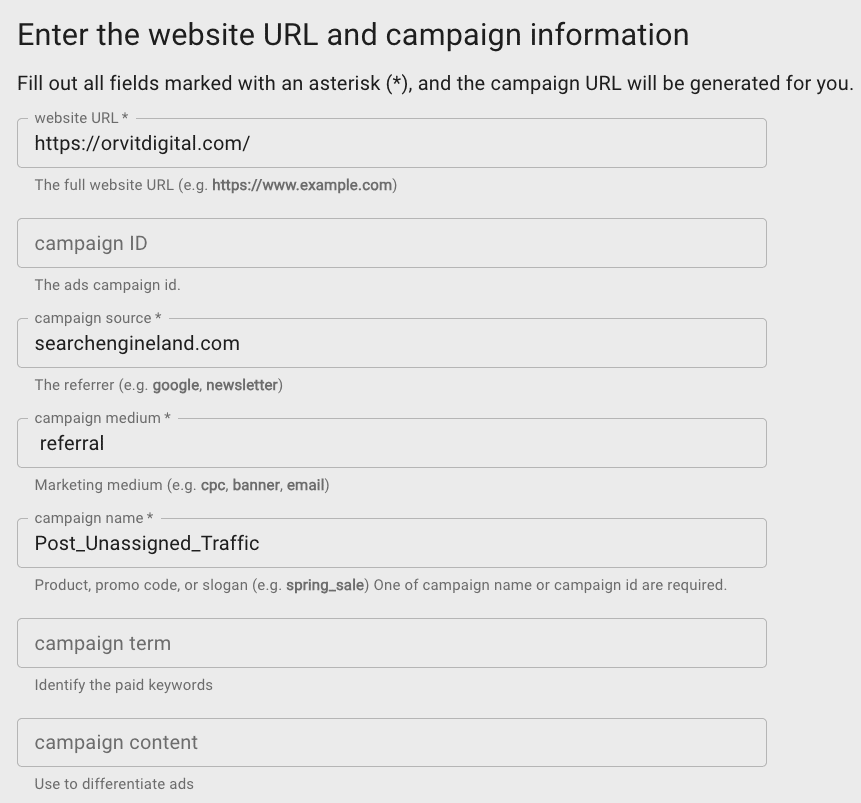
https://orvitdigital.com/?utm_source=searchengineland.com&utm_medium=referral&utm_campaign=Post_Unassigned_Traffic
For platforms like social networks or marketplaces, Google has a list of sources and categories to ensure accurate tagging and prevent unassigned traffic.
Other ways to prevent unassigned traffic
Since Universal Analytics ceased processing data beginning July 2023, GA4 has become the primary analytics tool from Google.
This means the tool may still have bugs, discoveries and improvements. As of today, some other actions we can do to prevent unassigned traffic include:
Reporting identity
Google Analytics 4 uses methods like User ID, Google signals, Device ID, and Modeling for tracking user data across platforms. Selecting the right method can help prevent unassigned traffic. Device-based is the recommended one nowadays.
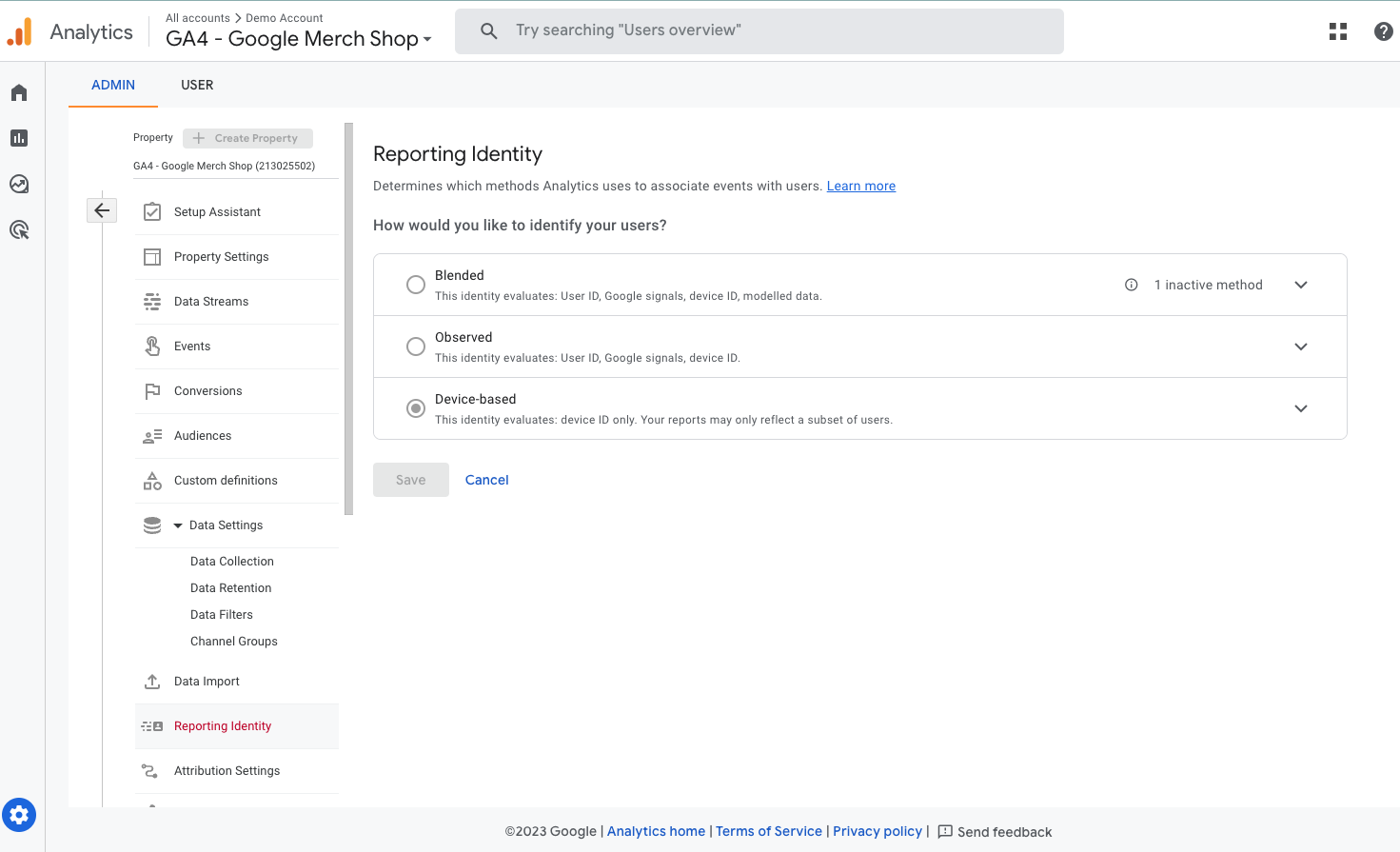
Event configuration
Unassigned traffic can also stem from incorrectly configured events. Ensure your Google Tag Manager settings are spot-on. Events and parameters must also be tagged following Google’s guidelines.
Other causes of unassigned traffic include:
- Events sent through regular tracking without session_start (h/t Antoine Eripre).
- Incorrect session tracking due to short user visits, ad blockers, or connection and data collection errors.
Ad blockers and other devices
Devices or ad blockers that hinder Google’s data capturing can also cause misclassifications of traffic, Himani Kankaria has found.
Simon Vreeman noted mobile apps as a potential source of channel assignment issues.
Use of audience triggers
As Himanshu Sharma highlighted the use of audience triggers in GA4 can greatly increase the volume of unassigned traffic.
If the event generated by the audience trigger isn’t tied to an existing session, perhaps because the session has ended or the criteria are met outside of the user’s current session, the source/medium might default to (not set) / (not set), which then appears as Unassigned in some GA4 reports.
Managing unassigned traffic in GA4
Addressing unassigned traffic in GA4 requires a combination of best practices, accurate tracking, and awareness of potential causes.
Implement these tips to ensure your campaigns are accurately tracked and optimized, providing a more comprehensive view of your marketing performance.
The post How to fix unassigned traffic in GA4 appeared first on Search Engine Land.
Courtesy of Search Engine Land: News & Info About SEO, PPC, SEM, Search Engines & Search Marketing
Category seo news | Tags:
Social Networks : Technorati, Stumble it!, Digg, de.licio.us, Yahoo, reddit, Blogmarks, Google, Magnolia.
Google Ads serving/spending issue resolved after almost 3 days
Written on October 14, 2023 at 11:01 am, by admin
Google has fixed the Google Ads issue with serving and spending that started on Wednesday morning and lasted almost three days.
Google posted an update at 5:28 pm ET today saying, “The problem with Google Ads has been resolved. We apologize for the inconvenience and thank you for your patience and continued support.”
The issue started on October 11th at 12:59 am ET.
What has Google said? A Google spokesperson said in a statement:
- “We are aware of an issue affecting serving/spending for campaigns running on Google Ads.”
- “This is an acknowledgement note to assure you that the issue is being actively investigated.”
Why we care. You may want to check your Google Ads account to see if there are any anomalies with your account and speak to Google with any necessary refunds or adjustments.
The post Google Ads serving/spending issue resolved after almost 3 days appeared first on Search Engine Land.
Courtesy of Search Engine Land: News & Info About SEO, PPC, SEM, Search Engines & Search Marketing
Category seo news | Tags:
Social Networks : Technorati, Stumble it!, Digg, de.licio.us, Yahoo, reddit, Blogmarks, Google, Magnolia.