

Ahrefs again calls out Semrush for ‘unethical practices’
Written on October 26, 2023 at 8:18 pm, by admin
Ahrefs leadership is once again calling out Semrush for making “7 shameless edits” to an Ahrefs vs. Semrush comparison article written by Brian Dean before his site, Backlinko, was acquired by Semrush.
The saga continues. That would actually be seven additional edits. Because previously, in Ahrefs mentions vanishing from Semrush-owned Backlinko, Ahrefs called out Semrush for, among other edits, changing Dean’s recommendation from Ahrefs to Semrush in a sentence preceded by “if you had to make me pick ONE tool to use for SEO, I’d have to go with…”
The 7 ‘shameless edits’. So what’s changed now? In his own words, Ahrefs CMO Tim Soulo said these changes were made:
- Erased the fact that Brian used to be our customer for many years (since 2013)
- Changed Brian’s preference from Ahrefs to Semrush
- Tried to upend the narrative that backlink analysis is Ahrefs’ “bread and butter feature”
- Link Intersect is no longer “awesome:”
- No more praise for “Best by links” report
- Erased the statement about the accuracy of our traffic estimations
- Relegated our Site Audit tool from “web-based version of ScreamingFrog” to a “toned-down version of ScreamingFrog:”
The one edit Ahrefs wants. What Soulo and Dmytro Gerasymenko, founder and CEO, want is a disclosure that the article was edited by Semrush. The only mention of a connection between Backlinko and Semrush is in the footer of the page:
- © 2023 Backlinko is a Trademark of Semrush Inc
Deceptive endorsement? Ahrefs seemed to indicate they believe the article (which now has the title of Ahrefs vs Semrush: Which SEO Tool Should You Use in 2023?) could be violating Federal Trade Commision’s Endorsement Guides, which, in part say:
- “If there’s a connection between an endorser and the marketer that a significant minority of consumers wouldn’t expect and it would affect how they evaluate the endorsement, that connection should be disclosed clearly and conspicuously.”
You can dig deeper into the FTC rules here.
Semrush response. “Overreach” was the word used by Nick Eubanks, Semrush’s head of digital asset acquisition:
- “’Intentionally deceptive’ is overreaching here. ‘Doing business’ as in strategically owning media.. Semrush is far from the first company to do this,” Eubanks posted.
Little sympathy for Ahrefs. Reaction within the industry has been mixed. While both companies have their die-hard supporters/customers, various X posts accused Ahrefs of whining. Here are a couple of the negative reactions.
You're attempting to elicit empathy from a community that takes pride in faking EEAT, faking CTR data, PBNs, GSA, pushing 10,000 AI pages, rank and rent, negative link attacks, etc.
You'll get more empathy from a pile of rocks than you will from SEOs.
— Nick Jordan (@nickfromseattle) October 23, 2023

You aren't going to win customers by whining about the competition. Ditch the credit system & yep, fix your infrastructure reliability. This is what is costing you customers not semrush's failure to disclose.
— Kris Roadruck (@KrisRoadruck) October 23, 2023
But Ahrefs also had supporters:
The pushback you’re getting here is wild. They’re doing something unethical that any editorial or journalistic org would recognize easily. It’s disappointing to see so many SEOs push for the industry to retain its low reputation.
— Nick Moore (@nickwritesit) October 25, 2023
Don't agree with most comments here. This is shady business. Good on @timsoulo getting out the truth
— Iron Brands
(@IronBrands16) October 24, 2023
Why we care. Nobody really “wins” here from a reputation perspective. Ahrefs is viewed negatively for complaining about a competitor. Semrush looks like it’s being deceptive (and perhaps a tad arrogant). But for Gerasymenko, this battle won’t be won in X posts. As Terry Van Horne put it on X, “report them to the FTC and move on”:
If SEMrush is contrary to FTC regulations (which I agree is the case) report them and move on. By pointing the finger and making this about reputation, credibility and ethics of the Industry you have done nothing to improve Industry perceptions! You've actually done the opposite!
— Terry Van Horne (@terryvanhorne) October 24, 2023
The post Ahrefs again calls out Semrush for ‘unethical practices’ appeared first on Search Engine Land.
Courtesy of Search Engine Land: News & Info About SEO, PPC, SEM, Search Engines & Search Marketing
Category seo news | Tags:
Social Networks : Technorati, Stumble it!, Digg, de.licio.us, Yahoo, reddit, Blogmarks, Google, Magnolia.
Why marketers should care about customer journey orchestration by Digital Marketing Depot
Written on October 26, 2023 at 8:18 pm, by admin

In today’s omnichannel world, customers engage with brands across many different touchpoints both online and offline. This makes mapping the customer journey more complex for marketers. Customers expect seamless experiences across channels and devices. If the journey is disjointed, they will quickly become frustrated and take their business elsewhere.
This is where customer journey orchestration (CJO) comes in. CJO platforms empower marketers to optimize the customer experience by:
- Identifying pain points in the journey where customers struggle
- Orchestrating personalized interactions to delight customers
- Responding quickly to changing customer needs and expectations
With CJO, marketing is no longer limited to siloed campaigns. You can take an outside-in approach starting from the customer perspective. This results in increased satisfaction, loyalty, and advocacy.
According to a recent Forrester study, 65% of marketers plan to increase spend on CJO platforms in the next year. But with many solutions now available, how do you choose the right one?
That’s where our MarTech guide comes in. This comprehensive report profiles leading platforms and provides actionable insights to guide your buying process including.
Visit Digital Marketing Depot to download Customer Journey Orchestration Platforms: A Marketer’s Guide and learn how to connect journeys, increase loyalty, and drive growth.
The post Why marketers should care about customer journey orchestration appeared first on Search Engine Land.
Courtesy of Search Engine Land: News & Info About SEO, PPC, SEM, Search Engines & Search Marketing
Category seo news | Tags:
Social Networks : Technorati, Stumble it!, Digg, de.licio.us, Yahoo, reddit, Blogmarks, Google, Magnolia.
Build trust and boost profits with programmatic ads by Cynthia Ramsaran
Written on October 26, 2023 at 8:18 pm, by admin

When it comes to programmatic advertising, consent isn’t just a requirement; it’s the key to unprecedented revenue potential. Programmatic advertising thrives on precision and relevance, but how can you achieve these without compromising user trust or regulatory compliance?
Register and attend this digital advertising webinar to stay ahead, mastering consent-driven ad strategies so you can build trust and boost profits: “Why Consent and Compliance Matter With Programmatic Ads,” presented by OneTrust.
Click here to view more Search Engine Land webinars.
The post Build trust and boost profits with programmatic ads appeared first on Search Engine Land.
Courtesy of Search Engine Land: News & Info About SEO, PPC, SEM, Search Engines & Search Marketing
Category seo news | Tags:
Social Networks : Technorati, Stumble it!, Digg, de.licio.us, Yahoo, reddit, Blogmarks, Google, Magnolia.
Google Ads testing new overview dashboard for advertisers
Written on October 25, 2023 at 5:15 pm, by admin
Google is currently testing a new overview dashboard within the Google Ads console. This new dashboard looks similar to the existing one but it gives you the ability to customize what data you see in the dashboard and also let’s you scroll through more data in a carousel format.
More details. Anthony Higman spotted this change and posted some screenshots of this. He said on X “it lets select ALL the metrics and then click through on the right to see other things in the overview slide.” He added, “Also looks like they are working on you being able to segment by time right from the overview slide.” He said he loves site!
What it looks like. Here are some screenshots he posted:

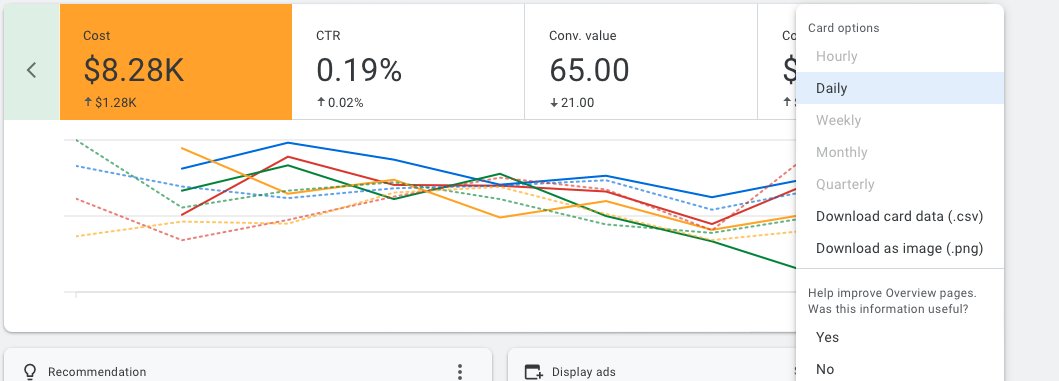
Confirmed. Ginny Marvin, Google’s Ads Liaison, confirmed this feature this morning saying on X, “We’re currently running an experiment with a limited number of advertisers to offer more flexibility from the overview page.”
Why we care. This new feature, if rolled out, can be a huge time saver for advertisers using Google Ads. While the standard data in this Google Ads dashboard is useful, each advertiser may want to see the data that is important to them, the way they want to see it. So this should be a welcomed addition to Google Ads, if it rolls out more widely.
The post Google Ads testing new overview dashboard for advertisers appeared first on Search Engine Land.
Courtesy of Search Engine Land: News & Info About SEO, PPC, SEM, Search Engines & Search Marketing
Category seo news | Tags:
Social Networks : Technorati, Stumble it!, Digg, de.licio.us, Yahoo, reddit, Blogmarks, Google, Magnolia.
Google rolls out about this image and more SGE links
Written on October 25, 2023 at 5:15 pm, by admin
Google is now rolling out the about this image feature that it announced back in May and is also adding new links to the SGE AI powered answers, the company announced.
SGE AI answers with supporting links
Google said it is now adding to the Search Generative Experience‘s AI-generated AI answers
“descriptions of some sources, supported by information on high-quality sites that talk about that website.” Google added new links to these sites in the AI-generated description of the source.
It does look and feel familiar to the links we saw earlier but these are different. Google said “These AI-generated descriptions of the source will show up in the “more about this page” section of About this result for some sources where there isn’t an existing overview from Wikipedia or the Google Knowledge Graph.”
“At this stage, we’re starting small in exploring how this technology can be useful to support and supplement our existing information literacy efforts,” Google added.
To replicate this, you search for a site by name, generate the AI snapshot, then go to the first traditional search result and click on the About this result on the top result of that result. Then click “more about this page” and you will see how the experience looks under “About the source.”
Here is a GIF of this feature in action:

About this image
Google is now rolling out the about this image feature in Google Search. Google said, “today, this feature is rolling out to English language users globally in Google Search.” The about this image feature tells you more about the image, specifically:
- History of an image: About this image shows you when an image or similar images may have first been seen by Google Search, and whether it was previously published much earlier on other webpages. “This can be helpful if an image is being taken out of context and shared in relation to a current event, but it’s actually much older,” Google explained.
- How sites describe and use your image: You can see how an image is used on other pages, and what other sources, like news and fact checking sites, have to say about it. “This information can be helpful to assess the claims being made about an image, and to see evidence and perspectives from other sources,” Google added.
- Image metadata including AI: This feature will also show you metadata, if it is available, that image creators and publishers have added to an image, including fields that may indicate that it has been generated or enhanced by AI. “All Google AI-generated images will have this markup in the original file,” Google added.

The post Google rolls out about this image and more SGE links appeared first on Search Engine Land.
Courtesy of Search Engine Land: News & Info About SEO, PPC, SEM, Search Engines & Search Marketing
Category seo news | Tags:
Social Networks : Technorati, Stumble it!, Digg, de.licio.us, Yahoo, reddit, Blogmarks, Google, Magnolia.
Snap revenue up 5%, promises better ROI for advertisers
Written on October 25, 2023 at 5:15 pm, by admin
Snap, the parent company of Snapchat, reported its revenue rose 5% in the latest quarter after two straight quarters of declines on a rebound in the digital advertising market.
Advertising is the biggest source of Snap’s revenue – and the company cautioned the ad market remains volatile, pointing to the impact of war in the Middle East:
- “We have had a number of primarily brand-oriented campaigns pause spending in the early period, I will say that we have seen a lot of those campaigns resume spending and the impact to our daily run rate has reduced significantly as a result of that but we also have seen a very small amount of incremental campaign pauses trickle in more recently,” said Snap CFO Derek Andersen said in an analyst call yesterday.
Revenue for the third quarter was $1.19 billion, up from $1.13 billion a year ago. In the previous two quarters, Snap’s revenue had fallen between 4% and 7%.
The company remains unprofitable – its net loss of $368 million for the third quarter is wider than a loss of $360 million a year ago.
Ad platform improvements. In a letter to investors, Snap said the company has “focused on improving our advertising platform” to generate higher returns for advertisers.
- “We continue to make really significant investments in the ad ranking and optimization of creating a much broader range of signals into the ad platform and driving much larger models. And we’ve also instituted a much faster pace of experimentation. All of that’s leading to more precise conversion predictions, improved ROI for advertisers,” Andersen said.
Snap invested in improving ad ranking and optimization using ML models. This has led to a significant improvement in ROI for advertisers and an increase in lower-funnel revenue year-over-year and quarter-over-quarter. Also, its 7/0 Pixel Purchase optimization now lets advertisers bid for attributed seven-day clickthrough conversions.
Snapchat also reported working with advertisers to improve the effectiveness of their privacy-centric integrations with the ad platform. This resulted in significantly higher signal quality for those advertisers.
Last quarter, Snapchat introduced the Event Quality Score (EQS) system for advertisers to measure the quality and integrity of their data and identify opportunities to optimize their integrations with the ad platform.
Increase in paid subscribers. Daily active users for the third quarter were 406 million, up 12% from a year ago. Last month, Snap said it had reached five million users for its paid subscription services, up from 4 million in June.
Because Snap is primarily used as a messaging platform – and doesn’t run ads in those messages – it’s had a hard time monetizing its users.
To rectify that it has ads in features like Stories and Spotlight, scrollable feeds of photos and videos from creators. Last month, Snap partnered with Microsoft to include sponsored links in Snap’s AI chatbot My AI.
Snap reported more than 200 million people have used My AI, sending more than 20 billion messages. CEO Evan Spiegel said in yesterday’s analyst call that while My AI is just getting started, it will eventually be a revenue driver.
- “Our primary focus right now is just improving response quality. We’re seeing some of the work we’re doing to improve those responses lead to higher retention with the product overall. There’s certainly plenty of commercial intent. We are taking steps to integrate into our models to help folks see more relevant content and advertising,” Spiegel said.
The post Snap revenue up 5%, promises better ROI for advertisers appeared first on Search Engine Land.
Courtesy of Search Engine Land: News & Info About SEO, PPC, SEM, Search Engines & Search Marketing
Category seo news | Tags:
Social Networks : Technorati, Stumble it!, Digg, de.licio.us, Yahoo, reddit, Blogmarks, Google, Magnolia.
Amazon Ads launches AI image generation
Written on October 25, 2023 at 5:15 pm, by admin
Select Amazon advertisers can now create AI-generated images to use in ad campaigns.
Essentially, what the tool offers advertisers is the ability to add backgrounds or scenery to plain product images.
Why we care. Amazon said its tool could lead to better ad performance. Products shown within a “lifestyle scene” can get 40% higher click-through rates, the company said.
How it works. Head to Amazon Ad Console, select your product, then click Generate. Using generative AI, Amazon will show you various “lifestyle and brand-themed images, based on product details, in a matter of seconds,” Amazon explained.
You can then further customize your AI-generated images using short text prompts or “enhance” them with a pre-set theme. You can save multiple versions to test and optimize performance, the company said.
You can add up to five images in your Amazon ad. Choosing multiple images will automatically create a looping slideshow.
Here’s a video showing it in action:
Limited availability. AI-generated images is only available to “select” advertisers now. But Amazon said it will “expand availability over time.”
What Amazon is saying. The image generation tool is easy to use and requires no technical expertise, according to Amazon.
- “This solution is helpful for advertisers of all sizes—enabling those that do not have in-house capabilities or agency support to more easily create brand-themed imagery, while also supporting bigger brands, who are constantly looking for ways to be more efficient around creative development,” the company wrote in its announcement.
This was expected. Like most ad platforms, Amazon has been working to add generative AI capabilities. We reported that Amazon was working on AI tools to generate images for advertisers in May. Now it’s finally here, nearly six months later.
The post Amazon Ads launches AI image generation appeared first on Search Engine Land.
Courtesy of Search Engine Land: News & Info About SEO, PPC, SEM, Search Engines & Search Marketing
Category seo news | Tags:
Social Networks : Technorati, Stumble it!, Digg, de.licio.us, Yahoo, reddit, Blogmarks, Google, Magnolia.
Google search revenue rises 11%, solid increase in total ad revenue
Written on October 24, 2023 at 2:15 pm, by admin
Alphabet Inc., Google’s parent company, reported higher advertising revenue in the third quarter of 2023, year on year.
An 11.3% gain in search revenue was accompanied by an increase in revenue for YouTube ads (12.5%).
Google’s advertising network was down 2.6%, however, this was an improvement on the 5% loss reported in the second quarter of 2023.

- “The fundamental strength of our business was apparent again in Q3, with $77 billion in revenue, up 11% year over year, driven by meaningful growth in Search and YouTube, and momentum in Cloud. We continue to focus on judicious capital allocation to deliver sustainable financial value,” said Alphabet Chief Financial Officer Ruth Porat.
Google’s ad revenue increased by $5.17 billion from the previous year, while YouTube ad revenue was $7.95 billion, up from $7 billion in 2022.
Although results surpassed analysts’ expectations, the single-digit growth percentage for total ad revenue suggests that digital ad spend has yet to fully recover to its former glory. Experts forecast that double-digit growth should return by the final quarter of 2023.
Why we care. The stronger-than-anticipated results could indicate a positive trend where trust and confidence in digital advertising are stabilizing after the economic downturn. This is excellent news for digital marketers, as it hints at potential ad spend growth, particularly as we approach the crucial holiday season in the next quarter.
What Google is saying. Sundar Pichai, CEO, said in a statement:
- “I’m pleased with our financial results and our product momentum this quarter, with AIdriven innovations across Search, YouTube, Cloud, our Pixel devices and more. We’re continuing to focus on making AI more helpful for everyone; there’s exciting progress and lots more to come.”
Earnings report. You can read Alphabet’s full third quarter 2023 results report for more information.
The post Google search revenue rises 11%, solid increase in total ad revenue appeared first on Search Engine Land.
Courtesy of Search Engine Land: News & Info About SEO, PPC, SEM, Search Engines & Search Marketing
Category seo news | Tags:
Social Networks : Technorati, Stumble it!, Digg, de.licio.us, Yahoo, reddit, Blogmarks, Google, Magnolia.
Google testing ads between organic results?
Written on October 24, 2023 at 2:15 pm, by admin
Is Google testing placing ads between organic search results?
Patrick Stox, Ahrefs product advisor, technical SEO and brand ambassador, first noticed that sponsored posts have started appearing where the third and fifth organic positions normally run.
He shared a screenshot of the SERP on X:

Here’s a video of it Stox shared on X:
I don't think this would count as page 2. A video. pic.twitter.com/skJIBZTIYF
— Patrick Stox (@patrickstox) October 24, 2023
Why we care. Expanding this experiment could potentially lead to more clicks for advertisers in areas that have always been organic spots in Google Search. However, this is potentially more bad news for SEOs as Google continues its ongoing trend of removing and minimizing organic search real estate. It could also be bad for users who are already complaining about the quality of Google Search results, potentially leading to negative user experiences.
What Google is saying. Google’s Ads Liaison Ginny Marvin responded on X, neither confirming nor denying this is a test. But she also didn’t call it a bug:
- “We’re regularly experimenting and don’t have anything more to share at this point.”
Get the daily newsletter search marketers rely on.
<input type=”hidden” name=”utmMedium” value=”“>
<input type=”hidden” name=”utmCampaign” value=”“>
<input type=”hidden” name=”utmSource” value=”“>
<input type=”hidden” name=”utmContent” value=”“>
<input type=”hidden” name=”pageLink” value=”“>
<input type=”hidden” name=”ipAddress” value=”“>
Processing…Please wait.
The post Google testing ads between organic results? appeared first on Search Engine Land.
Courtesy of Search Engine Land: News & Info About SEO, PPC, SEM, Search Engines & Search Marketing
Category seo news | Tags:
Social Networks : Technorati, Stumble it!, Digg, de.licio.us, Yahoo, reddit, Blogmarks, Google, Magnolia.
Survey: Marketers reducing ad platform investments
Written on October 24, 2023 at 2:15 pm, by admin
Marketers plan to invest in fewer advertising platforms over the next 12 months than at the beginning of the year, according to an ongoing survey of Search Engine Land readers.
Of the 16 ad platforms we asked about, fewer respondents said they expect to invest on 12 in the third quarter of this year compared to the first quarter of this year.
- Only Meta, Microsoft, and Microsoft’s LinkedIn will get more investment from advertisers, according to the survey. The number planning to invest with TikTok will be flat.

Search engines. More advertisers plan to invest dollars with Microsoft properties than at the beginning of the year. Investment with Google will be flat.
Fewer advertisers expect to invest with Apple in app store placements. Nine percentage points fewer respondents said they will invest with Apple in the third quarter compared to the first, the most significant change for any platform included in the survey.
- (Note: Google and Microsoft responses included their other advertising options, e.g. YouTube and Start.)

Social platforms. Meta was the platform experiencing the largest increase in expected investment of all of the platforms included in the survey. Seven percentage points more respondents said they expected to advertise on Meta in the third quarter than in the first.
Those predicting dollars earmarked for Pinterest and X declined 6 percentage points.
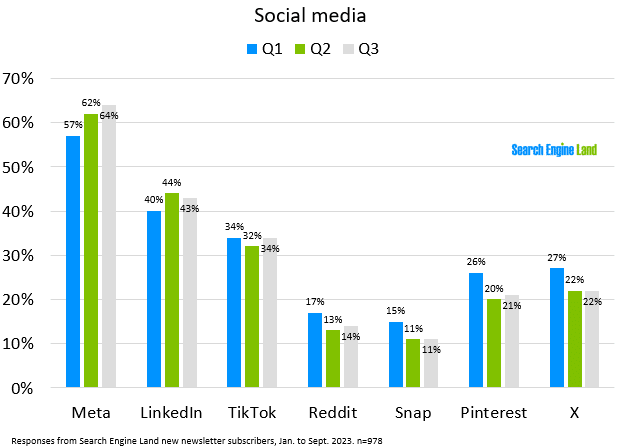
Retail platforms. Counter to the reports of explosive growth at shopping sites (a.k.a., retail media networks), fewer Search Engine Land readers said they’d be investing in those platforms (Amazon, Instacart, Walmart) in the third quarter compared to the first. We’re expecting that trend to reverse in the make-or-break ecommerce fourth quarter.

Fewer respondents will invest in all three of the audio/video platforms included in the survey (Spotify, Hulu, Netflix).

Why we care. It’s difficult to wrap your head around survey results that seem to contradict earnings reports and prevailing wisdom so profoundly. The reality is it likely says more about the mindset of the Search Engine Land audience than anything else.
Our conclusion is, that when faced with diminishing budgets and the difficult choices they create, the Search Engine Land audience chooses to invest in the platforms that have delivered results over the years, i.e. Google.
Investing in less proven platforms will have to wait for more prosperous times.
The post Survey: Marketers reducing ad platform investments appeared first on Search Engine Land.
Courtesy of Search Engine Land: News & Info About SEO, PPC, SEM, Search Engines & Search Marketing
Category seo news | Tags:
Social Networks : Technorati, Stumble it!, Digg, de.licio.us, Yahoo, reddit, Blogmarks, Google, Magnolia.