

Early bird rates for SMX Advanced expire Saturday. Register today and save $400!
Written on May 17, 2016 at 4:12 am, by admin
If you’re seriously obsessed with SEO and SEM, keep reading to find out what SMX Advanced has in store for you! Register for an All Access Pass by Saturday and pay the early bird rate of $1,895, a $400 savings compared to on-site rates. — The SMX Advanced Conference Team
The post Early…


Courtesy of Search Engine Land: News & Info About SEO, PPC, SEM, Search Engines & Search Marketing
Category seo news | Tags:
Social Networks : Technorati, Stumble it!, Digg, de.licio.us, Yahoo, reddit, Blogmarks, Google, Magnolia.
SearchCap: Google sitemaps, Gboard ads & Sitelink card ads
Written on May 13, 2016 at 6:56 pm, by admin
Below is what happened in search today, as reported on Search Engine Land and from other places across the web.
The post SearchCap: Google sitemaps, Gboard ads & Sitelink card ads appeared first on Search Engine Land.


Courtesy of Search Engine Land: News & Info About SEO, PPC, SEM, Search Engines & Search Marketing
Category seo news | Tags:
Social Networks : Technorati, Stumble it!, Digg, de.licio.us, Yahoo, reddit, Blogmarks, Google, Magnolia.
Google: “No current plans” for ads in Gboard
Written on May 13, 2016 at 6:56 pm, by admin
But the new iOS keyboard app from Google sure looks like a big new opportunity for mobile search ads.
The post Google: “No current plans” for ads in Gboard appeared first on Search Engine Land.


Courtesy of Search Engine Land: News & Info About SEO, PPC, SEM, Search Engines & Search Marketing
Category seo news | Tags:
Social Networks : Technorati, Stumble it!, Digg, de.licio.us, Yahoo, reddit, Blogmarks, Google, Magnolia.
The SEM agency is dying (and what to do about it)
Written on May 13, 2016 at 6:56 pm, by admin
Search engine marketing is an ever-changing field, and columnist David Rodnitzky warns that agencies that fail to adapt will be left out in the cold.
The post The SEM agency is dying (and what to do about it) appeared first on Search Engine Land.


Courtesy of Search Engine Land: News & Info About SEO, PPC, SEM, Search Engines & Search Marketing
Category seo news | Tags:
Social Networks : Technorati, Stumble it!, Digg, de.licio.us, Yahoo, reddit, Blogmarks, Google, Magnolia.
Google testing a carousel of Sitelink cards in search ads
Written on May 13, 2016 at 6:56 pm, by admin
Spotted on mobile, the carousel features individual cards that link to separate landing pages.
The post Google testing a carousel of Sitelink cards in search ads appeared first on Search Engine Land.


Courtesy of Search Engine Land: News & Info About SEO, PPC, SEM, Search Engines & Search Marketing
Category seo news | Tags:
Social Networks : Technorati, Stumble it!, Digg, de.licio.us, Yahoo, reddit, Blogmarks, Google, Magnolia.
Reinventing SEO
Written on May 12, 2016 at 3:56 pm, by admin
Back in the Day…
If you are new to SEO it is hard to appreciate how easy SEO was say 6 to 8 years ago.
Almost everything worked quickly, cheaply, and predictably.
Go back a few years earlier and you could rank a site without even looking at it. 
Links, links, links.
Meritocracy to Something Different
Back then sharing SEO information acted like a meritocracy. If you had something fantastic to share & it worked great you were rewarded. Sure you gave away some of your competitive advantage by sharing it publicly, but you would get links and mentions and recommendations.
These days most of the best minds in SEO don’t blog often. And some of the authors who frequently publish literally everywhere are a series of ghostwriters.
Further, most of the sharing has shifted to channels like Twitter, where the half-life of the share is maybe a couple hours.
Yet if you share something which causes search engineers to change their relevancy algorithms in response the half-life of that algorithm shift can last years or maybe even decades.
Investing Big
These days breaking in can be much harder. I see some sites with over 1,000 high quality links that are 3 or 4 months old which have clearly invested deep into 6 figures which appear to be getting about 80 organic search visitors a month.
From a short enough timeframe it appears nothing works, even if you are using a system which has worked, should work, and is currently working on other existing & trusted projects.
Time delays have an amazing impact on our perceptions and how our reward circuitry is wired.
Most the types of people who have the confidence and knowledge to invest deep into 6 figures on a brand new project aren’t creating “how to” SEO information and giving it away free. Doing so would only harm their earnings and lower their competitive advantage.
Derivatives, Amplifications & Omissions
Most of the info created about SEO today is derivative (people who write about SEO but don’t practice it) or people overstating the risks and claiming x and y and z don’t work, can’t work, and will never work.
And then from there you get the derivative amplifications of don’t, can’t, won’t.
And then there are people who read and old blog post about how things were x years ago and write as though everything is still the same.
Measuring the Risks
If you are using lagging knowledge from derivative “experts” to drive strategy you are most likely going to lose money.
- First, if you are investing in conventional wisdom then there is little competitive advantage to that investment.
- Secondly, as techniques become more widespread and widely advocated Google is more likely to step in and punish those who use those strategies.
- It is when the strategy is most widely used and seems safest that both the risk is at its peak while the rewards are de minimus.
With all the misinformation, how do you find out what works?
Testing
You can pay for good advice. But most people don’t want to do that, they’d rather lose. 
The other option is to do your own testing. Then when you find out somewhere where conventional wisdom is wrong, invest aggressively.
“To invent you have to experiment, and if you know in advance that it’s going to work, it’s not an experiment. Most large organizations embrace the idea of invention, but are not willing to suffer the string of failed experiments necessary to get there. Outsized returns often come from betting against conventional wisdom, and conventional wisdom is usually right.” - Jeff Bezos
That doesn’t mean you should try to go against consensus view everywhere, but wherever you are investing the most it makes sense to invest in something that is either hard for others to do or something others wouldn’t consider doing. That is how you stand out & differentiate.
But to do your own testing you need to have a number of sites. If you have one site that means everything to you and you get wildly experimental then the first time one of those tests goes astray you’re hosed.
False Positives
And, even if you do nothing wrong, if you don’t build up a stash of savings you can still get screwed by a false positive. Even having a connection in Google may not be enough to overcome a false positive.
Cutts said, “Oh yeah, I think you’re ensnared in this update. I see a couple weird things. But sit tight, and in a month or two we’ll re-index you and everything will be fine.” Then like an idiot, I made some changes but just waited and waited. I didn’t want to bother him because he’s kind of a famous person to me and I didn’t want to waste his time. At the time Google paid someone to answer his email. Crazy, right? He just got thousands and thousands of messages a day.
I kept waiting. For a year and a half, I waited. The revenues kept trickling down. It was this long terrible process, losing half overnight but then also roughly 3% a month for a year and a half after. It got to the point where we couldn’t pay our bills. That’s when I reached out again to Matt Cutts, “Things never got better.” He was like, “What, really? I’m sorry.” He looked into it and was like, “Oh yeah, it never reversed. It should have. You were accidentally put in the bad pile.”
“How did you go bankrupt?”
Two ways. Gradually, then suddenly.”
― Ernest Hemingway, The Sun Also Rises
True Positives
A lot of SEMrush charts look like the following

What happened there?
Well, obviously that site stopped ranking.
But why?
You can’t be certain why without doing some investigation. And even then you can never be 100% certain, because you are dealing with a black box.
That said, there are constant shifts in the algorithms across regions and across time.
Paraphrasing quite a bit here, but in this video Search Quality Senior Strategist at Google Andrey Lipattsev suggested…
He also explained the hole Google has in their Arabic index, with spam being much more effective there due to there being little useful content to index and rank & Google modeling their ranking algorithms largely based on publishing strategies in the western world. Fixing many of these holes is also less of a priority because they view evolving with mobile friendly, AMP, etc. as being a higher priority. They algorithmically ignore many localized issues & try to clean up some aspects of that manually. But even whoever is winning by the spam stuff at the moment might not only lose due to an algorithm update or manual clean up, but once Google has something great to rank there it will eventually win, displacing some of the older spam on a near permanent basis. The new entrant raises the barrier to entry for the lower-quality stuff that was winning via sketchy means.
Over time the relevancy algorithms shift. As new ingredients get added to the algorithms & old ingredients get used in new ways it doesn’t mean that a site which once ranked
- deserved to rank
- will keep on ranking
In fact, sites which don’t get a constant stream of effort & investment are more likely to slide than have their rankings sustained.
The above SEMchart is for a site which uses the following as their header graphic

When there is literally no competition and the algorithms are weak, something like that can rank.
But if Google looks at how well people respond to what is in the result set, a site as ugly as that is going nowhere fast.
Further, a site like that would struggle to get any quality inbound links or shares.
If nobody reads it then nobody will share it.
The content on the page could be Pulitzer prize level writing and few would take it seriously.
With that design, death is certain in many markets.
Many Ways to Become Outmoded
The above ugly header design with no taste and a really dumb condescending image is one way to lose. But there are also many other ways.
Excessive keyword repetition like the footer with the phrase repeated 100 times.
Excessive focus on monetization to where most visitors quickly bounce back to the search results to click on a different listing.
Ignoring the growing impact of mobile.
Blowing out the content footprint with pagination and tons of lower quality backfill content.
Stale content full of outdated information and broken links.
A lack of investment in new content creation AND promotion.
Aggressive link anchor text combined with low quality links.
Investing in Other Channels
The harder & more expensive Google makes it to enter the search channel the greater incentive there is to spend elsewhere.
Why is Facebook doing so well? In part because Google did the search equivalent to what Yahoo! did with their web portal. The rich diversity in the tail was sacrificed to send users down well worn paths. If Google doesn’t want to rank smaller sites, their associated algorithmic biases mean Facebook and Amazon.com rank better, thus perhaps it makes more sense to play on those platforms & get Google traffic as a free throw-in.
Of course aggregate stats are useless and what really matters is what works for your business. Some may find Snapchat, Instagram, Pinterest or even long forgotten StumbleUpon as solid traffic drivers. Other sites might do well with an email newsletter and exposure on Twitter.
Each bit of exposure (anywhere) leads to further awareness. Which can in turn bleed into aggregate search performance.
People can’t explicitly look for you in a differentiated way unless they are already aware you exist.
Some amount of remarketing can make sense because it helps elevate the perceived status of the site, so long as it is not overdone. However if you are selling a product the customer already bought or you are marketing to marketers there is a good chance such investments will be money wasted while you alienate pas
Years ago people complained about an SEO site being far too aggressive with ad retargeting. And while surfing today I saw that same site running retargeting ads to where you can’t scroll down the page enough to have their ad disappear before seeing their ad once again.
If you don’t have awareness in channels other than search it is easy to get hit by an algorithm update if you rank in competitive markets, particularly if you managed to do so via some means which is the equivalent of, erm, stuffing the ballot box.
And if you get hit and then immediately run off to do disavows and link removals, and then only market your business in ways that are passively driven & tied to SEO you’ll likely stay penalized in a long, long time.
While waiting for an update, you may find you are Waiting for Godot.

Courtesy of SEO Book.com
Category seo news | Tags:
Social Networks : Technorati, Stumble it!, Digg, de.licio.us, Yahoo, reddit, Blogmarks, Google, Magnolia.
Google Rethinking Payday Loans & Doorway Pages?
Written on May 12, 2016 at 3:56 pm, by admin
Nov 12, 2013 WSJ: Google Ventures Backs LendUp to Rethink Payday Loans
Google Ventures Partner Blake Byers joined LendUp’s board of directors with his firm’s investment. The investor said he expects LendUp to make short-term lending reasonable and favorable for the “80 million people banks won’t give credit cards to,” and help reshape what had been “a pretty terrible industry.”
What sort of strategy is helping to drive that industry transformation?
How about doorway pages.
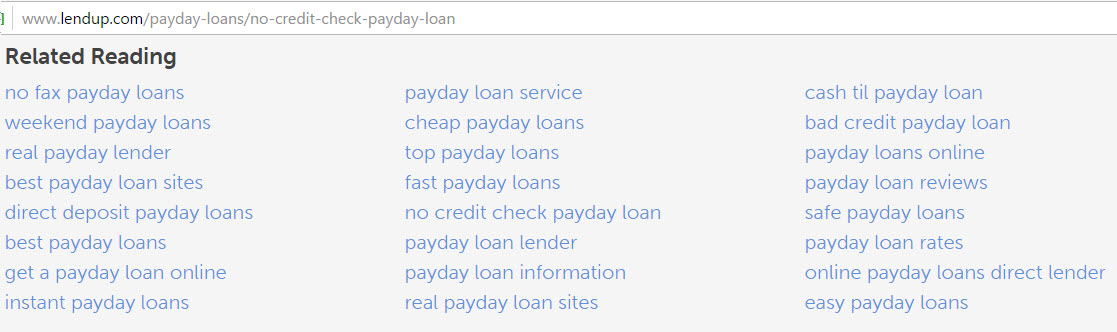
That in spite of last year Google going out of their way to say they were going to kill those sorts of strategies.
March 16, 2015 Google To Launch New Doorway Page Penalty Algorithm
Google does not want to rank doorway pages in their search results. The purpose behind many of these doorway pages is to maximize their search footprint by creating pages both externally on the web or internally on their existing web site, with the goal of ranking multiple pages in the search results, all leading to the same destination.
These sorts of doorway pages are still live to this day.
Simply look at the footer area of lendup.com/payday-loans
But the pages existing doesn’t mean they rank.
For that let’s head over to SEMrush and search for LendUp.com
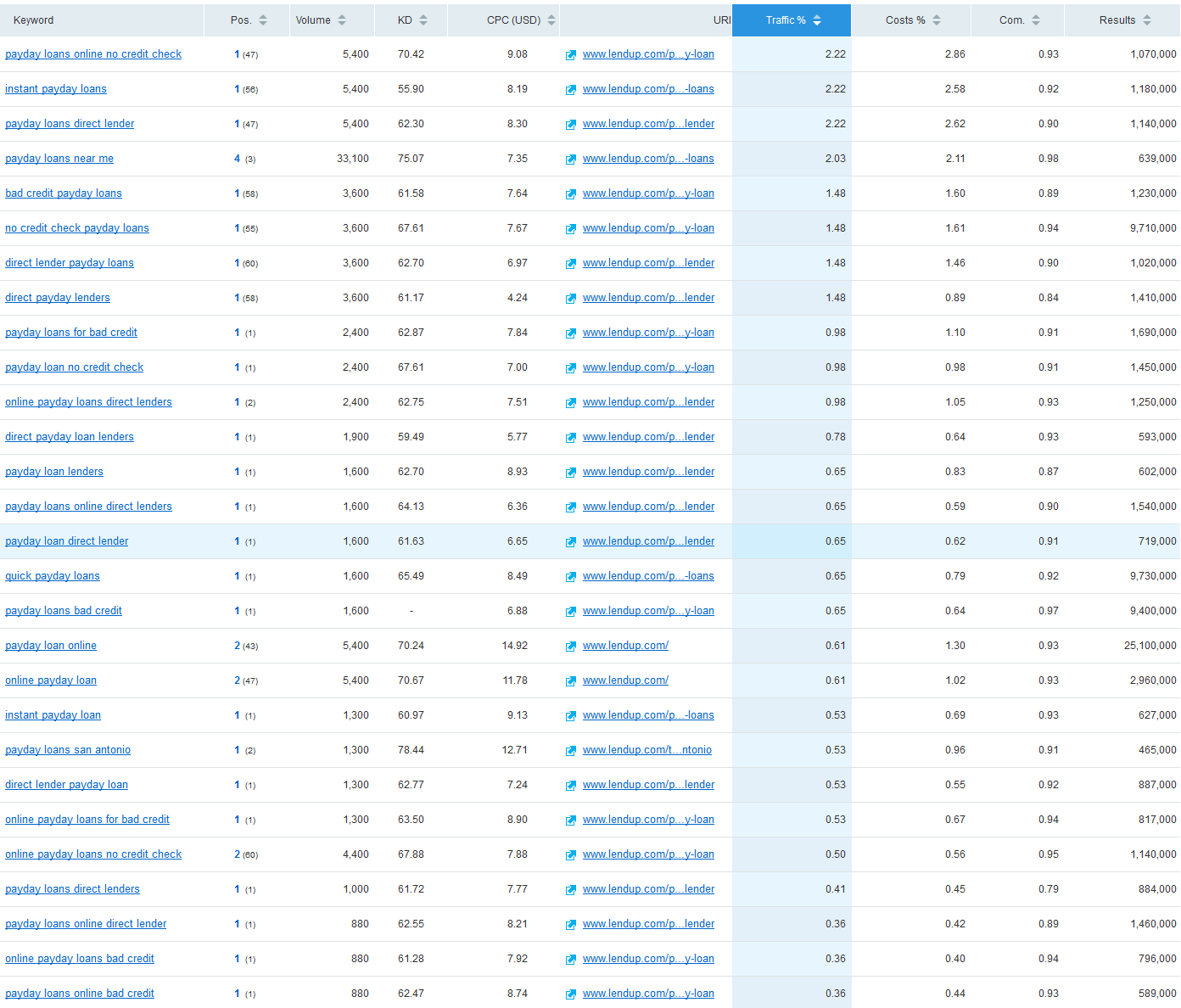
Hot damn, they rank for about “payday” keywords.
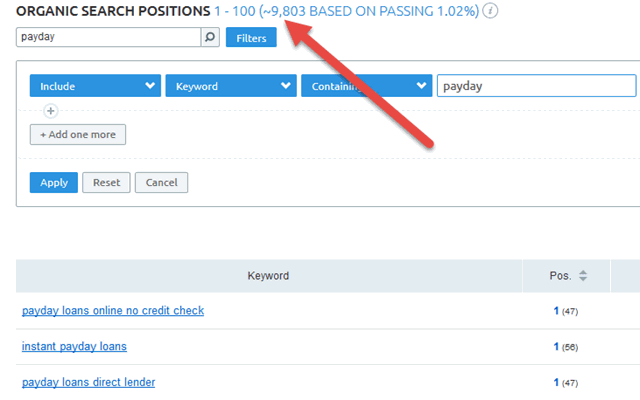
And you know their search traffic is only going to increase now that competitors are getting scrubbed from the marketplace.

Today we get journalists conduits for Google’s public relations efforts writing headlines like: Google: Payday Loans Are Too Harmful to Advertise.
Today those sorts of stories are literally everywhere.
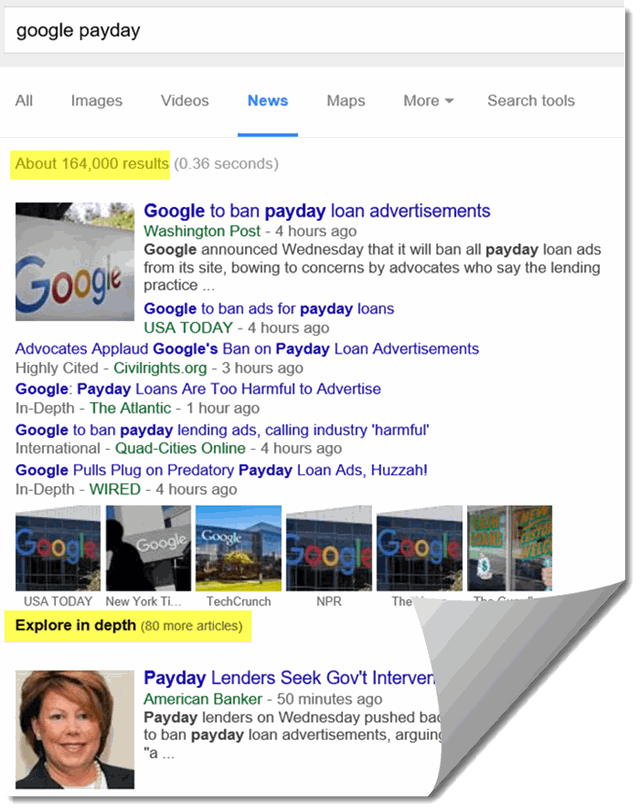
Tomorrow the story will be over.
And when it is.
Precisely zero journalists will have covered the above contrasting behaviors.
As they weren’t in the press release.
Best yet, not only does Google maintain their investment in payday loans via LendUp, but there is also a bubble in the personal loans space, so Google will be able to show effectively the same ads for effectively the same service & by the time the P2P loan bubble pops some of the payday lenders will have followed LendUp’s lead in re-branding their offers as being something else in name.
A user comment on Google’s announcement blog post gets right to the point…
Are you disgusted by Google’s backing of LendUp, which lends money at rates of ~ 395% for short periods of time? Check it out. GV (formerly known as Google Ventures) has an investment in LendUp. They currently hold that position.
Oh, the former CIO and VP of Engineering of Google is the CEO of Zest Finance and Zest Cash. Zest Cash lends at an APR of 390%.
Meanwhile, off to revolutionize the next industry by claiming everyone else is greedy and scummy and there is a wholesome way to do the same thing leveraging new technology, when in reality the primary difference between the business models is simply a thin veneer of tech utopian PR misinformation.
Don’t expect to see a link to this blog post on TechCrunch.
There you’ll read some hard-hitting cutting edge tech news like:
Banks are so greedy that LendUp can undercut them, help people avoid debt, and still make a profit on its payday loans and credit card.
#MomentOfZeroTruth #ZMOT
Courtesy of SEO Book.com
Category seo news | Tags:
Social Networks : Technorati, Stumble it!, Digg, de.licio.us, Yahoo, reddit, Blogmarks, Google, Magnolia.
Report: 2 years in, 75 percent of Right to Be Forgotten asks denied by Google
Written on May 12, 2016 at 3:56 pm, by admin
More than 50 percent of requests come from Germany and the UK.
The post Report: 2 years in, 75 percent of Right to Be Forgotten asks denied by Google appeared first on Search Engine Land.


Courtesy of Search Engine Land: News & Info About SEO, PPC, SEM, Search Engines & Search Marketing
Category seo news | Tags:
Social Networks : Technorati, Stumble it!, Digg, de.licio.us, Yahoo, reddit, Blogmarks, Google, Magnolia.
SearchCap: Google mobile friendly, Search Console update & Bing Ads bans
Written on May 12, 2016 at 3:56 pm, by admin
Below is what happened in search today, as reported on Search Engine Land and from other places across the web.
The post SearchCap: Google mobile friendly, Search Console update & Bing Ads bans appeared first on Search Engine Land.


Courtesy of Search Engine Land: News & Info About SEO, PPC, SEM, Search Engines & Search Marketing
Category seo news | Tags:
Social Networks : Technorati, Stumble it!, Digg, de.licio.us, Yahoo, reddit, Blogmarks, Google, Magnolia.
Marin Software & SMX Launch 8th Annual Biggest Search Geek Contest
Written on May 12, 2016 at 3:56 pm, by admin
Enter the 8th Annual SMX Biggest Search Geek Contest! The challenging quiz-based contest is where the world’s brightest search marketers compete to outsmart fellow search geeks from across the globe. The contestant who answers the most questions correctly in the shortest amount of time will…


Courtesy of Search Engine Land: News & Info About SEO, PPC, SEM, Search Engines & Search Marketing
Category seo news | Tags:
Social Networks : Technorati, Stumble it!, Digg, de.licio.us, Yahoo, reddit, Blogmarks, Google, Magnolia.