

Snapchat outlines Three Es for advanced marketing measurement
Written on May 16, 2024 at 12:26 pm, by admin

With rising data restrictions, Snapchat says “Execution, Experimentation and Evaluation” are the key pillars marketers need to focus on to ensure strategic measurement evolves with the times.
Why we care. While Google keeps delaying deprecating third-party cookies, it will happen. So it’s important for advertisers to maintain accurate campaign insights and revenue accountability to conduct effective marketing measurement with tighter data privacy laws.
How it works. The framework aims to create a cycle of constant testing, learning and iteration.
- Execution refers to the core campaign components that power marketing efforts day-to-day.
- Experimentation involves methods like A/B testing to course correct along the way.
- Evaluation uses techniques like media mix modeling to quantify real performance impact.

What they’re saying. “Advertisers who adopt this robust measurement approach see better advertising outcomes,” per Snapchat.
Between the lines. The real emphasis is on evaluating actual results over chasing vanity metrics.
- Snap says brands often prioritize “easy accessible correlation metrics over causal experimentation KPIs.”
- But if experimentation isn’t tied to evaluating bottom-line impact, “media optimization may be driving negative progress.”
Zoom out. Snapchat’s push is part of a broader industry reckoning as user privacy changes upend traditional digital measurement.
The bottom line. As ad measurement evolves, Snapchat is encouraging a more holistic, cyclical approach centered on continuous optimization and tying performance to real business outcomes.
Courtesy of Search Engine Land: News & Info About SEO, PPC, SEM, Search Engines & Search Marketing
Category seo news | Tags:
Social Networks : Technorati, Stumble it!, Digg, de.licio.us, Yahoo, reddit, Blogmarks, Google, Magnolia.
Google AI Overviews: More searches, less satisfaction
Written on May 16, 2024 at 12:26 pm, by admin

I don’t know for a fact that people are searching less on Google. I just know it’s true.
During Google I/O, Alphabet/Google CEO Sundar Pichai told us AI Overviews have resulted in an “increase in Search usage.” Pichai said the same thing during Alphabet’s Q1 2024 earnings call.
But if that’s the case – doesn’t that mean AI Overviews, or the artist formerly known as Search Generative Experience (SGE), isn’t solving a problem it was supposedly invented to fix?
Namely, giving users the answer or information they want, faster?
Yes, in the same week that OpenAI basically created Samantha, the AI virtual assistant from the movie “Her,” Google’s tagline became “Let Google do the Googling for you.”
Well, if Google is now doing the Googling for you, Search volume will likely go up when Google can’t find what Google is Googling for on Google!
No blue links
Google’s Search in the Gemini era video was telling.
Watch this:
What did you notice was missing?
The subheading already gave it away, but there are no blue links in sight.
Former Google CEO said Google is not about blue links. Clearly, he wasn’t wrong.
In Google’s Gemini era, apparently, links will now live in a Web filter.
If you’re lucky, Web will be the fourth option you can choose (after All, Images, Video and News) – or you may have to hunt for the Web filter under the More options.
We knew this was coming. For two decades, Google has talked about Search being like the computer from “Star Trek”:
- “When search grows up, it will look like Star Trek: you talk into the air (“Computer! What’s the situation down on the planet?”) and the computer processes your question, figures out its context, figures out what response you’re looking for, searches a giant database in who-knows-how-many languages, translates/analyses/summarises all the results, and presents them back to you in a pleasant voice. I think this technology is about, oh, 300 years off.”
That quote, from former Google Chief Technology Officer Craig Silverstein, is from 2003.
It didn’t take 300 years. It took just 20.
The future is here.
Search was already fragmenting
We don’t know exact data on overall Google Search usage in 2024 and how it compares to previous years. Google doesn’t reveal that.
But reporting an increase in Search usage is like reporting on Domain Authority. It’s a meaningless vanity metric.
Google claims user satisfaction has also gone up during the same time. But I can’t remember an extended period of sustained negativity around the quality of Google’s Search results as I’ve seen over the past two years – both inside and outside of the search marketing industry.
Google’s own data has shown that younger Internet users going to TikTok and Instagram instead of Google. While Google is a monopoly general search engine, people are searching on other platforms – Amazon, TikTok, YouTube, Facebook, Reddit and more.
Meanwhile, we’ve been hearing rumors about ChatGPT search – and I fully expect OpenAI to launch a search product in the near future.
Dig deeper. The modern search landscape: How and where to reach your target audience
AI Overviews apocalypse
The inevitable SGE doomsday we’ve been warning you about since last May has finally arrived.
Publishers who weren’t already freaking out about losing traffic from Google’s helpful content or core updates – or Gartner’s prediction that traffic from search engines fall 25% by 2026 – are definitely starting to freak out now as AI Overviews start rolling out.
Here are just a few headlines we’ve seen following the launch of AI overviews:
- News publishers sound alarm on Google’s new AI-infused search, warn of ‘catastrophic’ impacts
- Google’s AI Search Feature Fuels Content Traffic Concerns
- Google unleashes AI in search, raising hopes for better results and fears about less web traffic
- Why I’d Rather Use TikTok Than Google Search’s AI Overviews
- Site Traffic Down? Google Just Made Some Big Search AI Changes
- Google’s AI search revamp puts publishers in a quandary
- Google Search’s AI Overview a threat to journalism, warns NMA chief
This quote from Owen Meredith, CEO of the News Media Association, is a variation on one that we’ve heard in recent months from content creators who have recently been frustrated by Google algorithm updates:
- “Google’s stated mission is to ‘organise the world’s information and make it universally accessible’ by sending visitors to websites. Introducing [generative AI] into search and AI Overviews that directly synthesise and present information to the user risks discouraging users from clicking through to the original links, in turn threatening the business model of those who invest in journalism and quality information.”
Relying entirely or mostly on one platform like Google to send you traffic via clicks on links isn’t a business model. It’s gambling. Because anytime Google changes something, you risk losing everything.
Ten blue links were a transitory way to provide answers. Now we have AI Overviews.
Tying a bow on it
So we don’t know for a fact that people are searching less on Google. We just know it’s true.
People are unhappy with Search. Google remains a monopoly but people are searching elsewhere.
AI Overviews are designed to reduce the number of Searches – but again, the whole message from Google is “Let Google do the Googling for you.” That itself indicates users should have to do less searches.
Although Google has definitely seen an uptick in the number of Searches for how to turn off AI results.
 Screenshot via Adam Di Frisco/X
Oops.
Google seems to be increasingly detaching itself from reality.
In this brave new Google world, advertisers should expect costs to increase (hello, tuning and squashing), websites should expect less organic traffic, while Google sends Searchers down rabbit holes of follow-up queries to inflate Search usage stats nobody cares about – or uses agents to complete tasks like purchases (where I’m sure Google will tack on some hidden Ticketmaster-type fees that turn what should be a $50 purchase into $120).
Courtesy of Search Engine Land: News & Info About SEO, PPC, SEM, Search Engines & Search Marketing
Category seo news | Tags:
Social Networks : Technorati, Stumble it!, Digg, de.licio.us, Yahoo, reddit, Blogmarks, Google, Magnolia.
Netflix ads tier hits 40 million subscribers
Written on May 16, 2024 at 12:26 pm, by admin

Netflix’s ad-supported tier is rapidly gaining traction, reaching 40 million monthly users globally, the streamer announced at its 2024 Upfront presentation.
The paid ad offering, initially seen as a risky move, has quickly become a hit for Netflix as it seeks new revenue streams amid intensifying streaming competition.
Why we care. Netflix’s platform offers advertisers a large and expanding pool of potential customers. If you’re looking for new advertising opportunities, you may want to explore streaming audiences.
Driving the news. Just six months after hitting 5 million ad-supported subscribers post-launch in late 2022, that number has now swelled to 40 million.
- In regions where the ad tier is available, over 40% of new Netflix sign-ups are opting for the cheaper ad-supported plan.
- The service now has 270 million total subscribers across all its pricing tiers.
Between the lines. Netflix is doubling down on the ad business by bringing its ad tech in-house.
- It’s launching its own advertising platform to “power the ads plan with the same level of excellence” as its streaming tech, per Netflix’s president of advertising Amy Reinhard.
- While initially partnering solely with Microsoft, Netflix is now also tapping Google, The Trade Desk and Magnite for its ad sales and tech.
What they’re saying. “Our ad membership has been an overwhelming success,” Netflix co-CEO Ted Sarandos said during the presentation. “We’re just getting started on that journey.”
The bottom line. Netflix’s ability to rapidly scale its ad business demonstrates the power of its brand and content – signaling a secure new revenue pipeline as it branches further into advertising.
Courtesy of Search Engine Land: News & Info About SEO, PPC, SEM, Search Engines & Search Marketing
Category seo news | Tags:
Social Networks : Technorati, Stumble it!, Digg, de.licio.us, Yahoo, reddit, Blogmarks, Google, Magnolia.
A better approach to B2B lead gen in 2024
Written on May 16, 2024 at 12:26 pm, by admin

B2B advertising, with its long sales cycles and relatively thin data density, has never been easy. And the tracking upheaval from cookies disappearing is about to make it harder.
That means that some of the pervasive flaws I’ve seen in inheriting B2B lead gen accounts over the years are about to produce even shakier results.
Even without talking about cookies and alternative measurement set-ups, there’s a better path forward for lead gen in 2024. This article will examine:
- What brands still get wrong about their lead gen fundamentals.
- How to align the offer and the funnel stage.
- How to align the channel mix and the funnel stage.
- How to qualify users with content.
What brands are getting wrong about lead gen
The single biggest mistake I see brands making with lead gen is misjudging (or ignoring) the intent of the lead.
A common example here is asking a cold prospect to request a demo, which is a leap of faith that will very rarely be rewarded with positive ROI or pestering prospects that download content to engage with sales.
The second big mistake is that brands will stop measuring beyond the lead, which leads to misappropriating budget and clear blind spots in performance.
Movement between funnel stages, lead quality and lead progression to MQLs > SQLs > opportunities > closed deals are all vital for lead gen marketers to understand. This lets you assess your campaigns’ performance and optimization priorities – and spend your budget where it will have the biggest impact on the bottom line.
Dig deeper: Top 5 paid search B2B lead gen strategies for 2024
How to align your offer with the user’s funnel stage
I use this chart all the time with my clients (and sometimes in my articles for Search Engine Land):
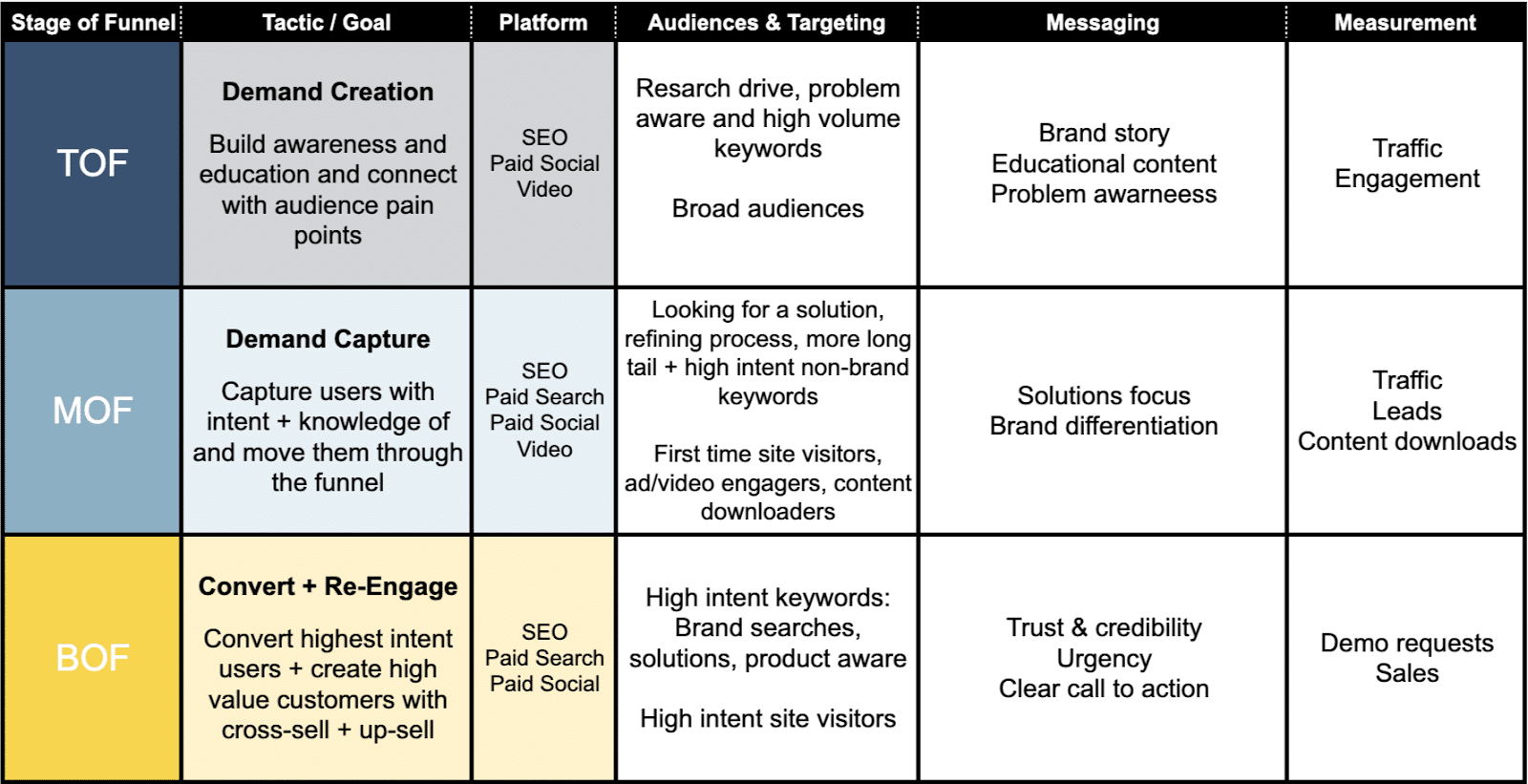
The top of the funnel is about educating and relating to the user:
- What they need to learn.
- What challenges they need to solve.
- What they need to know about their problem.
At this point, it’s about relating to their pain points and starting to build trust more than what they need to solve than they do about who’s solving it for them.
The middle of the funnel starts tying solutions to problems and introduces your brand as the option:
- Why your solution works.
- How it’s different from your competitors.
- The results you’ve driven for brands with similar challenges.
This stage assumes the user has their head around their challenge and is now actively researching solutions to help.
The bottom of the funnel brings in more emotion and third-party proof. This stage assumes the users have a shortlist of solutions in mind and are looking for reassurance, from case studies and testimonials, that yours is the one for them. This is also when you can start leaning on urgency, with limited sales windows or expiring promotions.
The most important thing to remember from all of this is that thoughtful nurturing is key to good lead gen. If you’re using bottom-funnel tactics for people who haven’t heard of you yet, you’re only wasting time and possibly turning users off from your brand.
How to align the channel mix and the funnel stage
Top-of-funnel channels
Starting with awareness/top-of-funnel targeting should mean starting on LinkedIn (and, for some brands with access to the right audiences, possibly on Facebook).
My first option is always to start with LinkedIn prospecting because:
- Costs are cheaper for top-of-funnel engagement than they are for lead generation or conversion.
- LinkedIn’s company-based targeting means you can go fairly broad and still stay within your ICP.
LinkedIn is a great place for educating users and positioning your brand as a thought leader; people go to LinkedIn to consume content, perhaps in the form of thought leader ads, and are open to high-quality, informative engagements.
I approach Facebook prospecting with caution, but it can be worth testing depending on the audience.
Middle-of-funnel and retargeting channels
Once someone has engaged with your brand and content, you should have started to narrow your audience.
Whether you’re retargeting content engagers or focused on accounts that have engaged with sales in some way or piped-in audiences from tools like Clearbit or 6Sense, I recommend choosing the following combinations of ad types and channels:
- LinkedIn sponsored content and conversation ads.
- Facebook and Instagram in-feed ads or video ads, with messaging that aligns with your audience and funnel stage.
Given my thoughts on Facebook prospecting, you might be surprised at my preference here. But you’ve already defined the audience.
Facebook/Instagram can help expand your audience matching scope beyond LinkedIn (where we’ve seen plenty of audience match degradation), and retargeting costs tend to be lower.
Bottom-of-funnel channels
Focusing on users who have engaged with high-intent content or visited your site multiple times is a crucial audience for this stage.
Ensuring coverage for paid search and high-intent SEO queries are the bread and butter for capturing intent at this stage, but paid social is a great way to generate that last step of intent by using social proof like case studies, testimonials, etc. – and sealing the deal with demo offers.
These will be your highest engagement costs of the campaign, and they should be, since leads at this stage are (assuming you’ve qualified them along the way) extremely valuable.
Dig deeper: How to implement a full-funnel PPC marketing strategy
How to qualify users with content
This happens throughout the funnel, and lots of this work is done with the type of content you’re offering.
For instance, your content should help the platforms’ bidding and targeting algorithms identify the audience’s pain points, solutions, etc. (Facebook’s algorithm can do this, but it doesn’t have the all-important layer of company targeting that LinkedIn does.)
There can also be ways to increase engagement within your ICP by speaking directly to them in your copy. Identifying opportunities to call out your audience in messaging is a great tactic.
For example, if you’re targeting CFOs, try “CFOs’ Favorite Answer to {Challenge} in 2024” or something similar that lets them know your content is for them.
The bonus here is that the more tightly you align your messaging with your ICP, the more you can delineate who falls outside your ICP and shouldn’t bother engaging with your ad.
Dig deeper: Paid search for lead gen: Tips for new accounts with limited budgets
Aligning tactics to intent: A better B2B lead gen approach
Above all, remember to consider the user’s mentality when developing your lead gen campaigns.
Don’t:
- Ask for too much too early.
- Get silly with retargeting frequency.
- Bother spending for bottom-funnel engagement without so much as a how-do-you-do.
Cookies or not, adhering to those principles will help you eliminate a lot of waste from your lead gen campaigns and keep your brand from developing a pushy reputation.
Courtesy of Search Engine Land: News & Info About SEO, PPC, SEM, Search Engines & Search Marketing
Category seo news | Tags:
Social Networks : Technorati, Stumble it!, Digg, de.licio.us, Yahoo, reddit, Blogmarks, Google, Magnolia.
How entity-based strategies can contribute to PPC success
Written on May 15, 2024 at 9:26 am, by admin

While the concept of entities for SEO has been around since 2012, it hasn’t been a widely adopted in PPC. Entities are essentially unique people, places, things or concepts that provide context and relationships for keywords.
As AI becomes more prevalent in digital marketing, incorporating an entity-based approach into your PPC campaigns is a way to get ahead of the competition. This article dives into how leveraging entities can significantly contribute to PPC success.
1. Entities for PPC keyword expansion
If you’re struggling to expand your keyword list, taking an entity-based approach could expand your horizons.
Entities are important because of their relationships with other entities. Thinking about these relationships can help you uncover ideas and insights that resonate with different groups of people based on their intent. In short, consider the context and assumptions behind searches and use that to brainstorm new keywords.
Here are some questions to consider when brainstorming entity-based keywords:
Activities: What are people doing in relation to my product/service?
- Entity identification: What specific activities or interests are associated with my business and product/service?
- Entity relevance: How does my product/service relate to these activities as entities?
- Entity pain points: What challenges do people performing these activities typically encounter?
- Entity solutions: How does my product/service address and solve these pain points?
Location: Where are people who may need my product/service?
- Entity scope: What geographical locations are relevant to my business as entities?
- Entity presence: Where are the majority of my customers located and how does that relate to location-based entities?
- Entity associations: What local landmarks, neighborhoods or events can I associate with my business to enhance local entity relevance?
- Entity impact: How do geographical entities influence consumer behavior and preferences in my target locations?
Season or event: When would people need my product/service?
- Entity timing: What seasonal trends or events are relevant to my business?
- Entity impact: How do seasonal or event-based entities influence my potential consumer behavior and preferences?
- Entity integration: How can I integrate seasonal or event-based entities into my copy and imagery to enhance relevance?
- Entity promotions: What special promotions or offers can I create to capitalize on seasonal or event-based entities and drive engagement?
By incorporating these entity-based principles into your PPC keyword expansion strategy, you’re building a more comprehensive advertising approach that closely ties into your site’s relevance and authority.
2. Entities for improved PPC quality scores
In PPC, it’s relatively easy to determine if your website accurately presents the entities and relationships you want it to; simply check out your quality scores.
If your website follows an entity approach and the accompanying PPC campaigns are aligned with that approach, you will see high quality scores, which mean lower costs-per-click and higher click-through rates.
Quality Score is calculated by Google based on three factors that are heavily influenced by entity recognition:
- Expected click-through rate (CTR): Entities influence the click-through rate of your ads by ensuring that your campaigns align with the interests, intents and preferences of your audience. When your ads resonate with users based on their search queries and interests, they are more likely to click through to your website, resulting in a higher expected CTR.
- Ad relevance: Entities ensure your ads are relevant to users’ intent, not just matching keywords. By optimizing your ad copy to relevant entities, you increase your chance of delivering ads that match what users intend to find, which boosts ad relevance.
- Landing page experience: The entities on your landing pages directly impact the landing page experience. When your landing pages provide relevant content that aligns with the entities highlighted in your ads, users are more likely to have their expectations met by your website and a positive experience with it.
Essentially, the more cohesive the journey from search term to delivered ad to landing page is, the more positive the user experience will likely be.
Quality score is the search engine’s attempt to evaluate whether you’re delivering content that users want to see. Giving them something that perfectly matches their intent with the final result is a quality search experience. And it’s much easier to account for intent with entities than keywords alone.
3. Entities for strategic PPC audience targeting
Traditional audience segmentation lets you identify key demographics to target, such as age, device and location. But when you combine those insights with the contextual relevance of entity-based targeting, you hone in on who your audience is and who your audience could be.
For example, you may be working on the PPC campaigns for a local restaurant. Sure, they may only want to target the local geographic area, but don’t stop there.
Using entity-based PPC strategies, you would have a campaign targeting the local geographic area and targeting users’ interests, behaviors and relationships with entities across the broader geographic region. This could be a campaign targeting all audiences interested in a local food festival or a campaign targeting users searching for a tourist activity nearby.
AI-powered targeting options, such as behavior and audience-based targeting, have been used in ad platforms for some time. Custom combination segments can make them even more effective.
Admittedly, they are a respectable attempt by search engines to find relevant consumer segments that are connected but that may not be directly related to your product or service. If you’re not taking advantage of these audience options, you’re wasting potential.
The real beauty of entity-based targeting is in the numbers and information it provides, even if it “fails.” Remember that you always learn something from a well-designed experiment.
By analyzing the data on different audience segments, you can refine your targeting strategy to identify the high-performing segments that deliver the best ROI. You may also discover new consumer groups and behavioral insights that can guide your broader marketing strategy.
In our earlier restaurant example, they may find that adding a new dish to their menu directly referencing nearby tourist attractions increases the number of out-of-town visitors. I can guarantee they will not discover this by limiting their reach to only a local campaign sourced from Google’s Keyword Planner.
Optimizing your campaigns with an entity-based approach
I like to think of entities as AI’s attempt to codify the human penchant for assumptions, undertones and subtleties in our communication.
If you’re looking to get ahead of your competition, tailoring your PPC efforts to account for entities is a great approach because so few companies are investing time in it right now.
Whether you’re a global brand or a local restaurant, incorporating entity-based strategies into your PPC playbook will help future-proof your marketing efforts and drive performance.
Courtesy of Search Engine Land: News & Info About SEO, PPC, SEM, Search Engines & Search Marketing
Category seo news | Tags:
Social Networks : Technorati, Stumble it!, Digg, de.licio.us, Yahoo, reddit, Blogmarks, Google, Magnolia.
Google adds “web” filter to only show text-based links in Google Search results
Written on May 15, 2024 at 9:26 am, by admin

Google is rolling out a new search filter to show only text-based links in the search results. The filter is named “Web”. Clicking it removes images, videos, or other forms of search results; only classic blue links are displayed.
Web filter. You can find the web filter next to the other filters in the menu. Sometimes that means it is on the same line as the video filter, news filter and so on. Other times it is under the “more” menu.
Here are some screenshots Google posted on X:


More. Google Search Liaison Danny Sullivan apparently championed creation of Web filter. He wrote, “Since I joined Google, I’ve just been a boy standing in front of the search group asking it to love a Web filter. So happy to see it’s arrived – congrats to the hard-working team on this project that through their own efforts made it a reality!”
He added, “We’ve launched a new “Web” filter that shows only text-based links, just like you might filter to show other types of results, such as images or videos. The filter appears on the top of the results page alongside other filters or as part of the “More” option, rolling out today and tomorrow globally. We’ve added this after hearing from some that there are times when they’d prefer to just see links to web pages in their search results, such as if they’re looking for longer-form text documents, using a device with limited internet access, or those who just prefer text-based results shown separately from search features. If you’re in that group, enjoy!”
Google tested this in the form of “web results” back in February of this year.
Why we care. Now if you want to remove forums, videos, news, images or other forms of search results you can. You can just filter by text-links, and go back to the pre-2007 universal search days.
Courtesy of Search Engine Land: News & Info About SEO, PPC, SEM, Search Engines & Search Marketing
Category seo news | Tags:
Social Networks : Technorati, Stumble it!, Digg, de.licio.us, Yahoo, reddit, Blogmarks, Google, Magnolia.
Reddit appoints ex-Googler as first VP of Ads Product
Written on May 15, 2024 at 9:26 am, by admin

Reddit named Jyoti Vaidee as its first VP of Ads Product, a newly created role overseeing the platform’s monetization engine.
Vaidee joins from Google, where she spent over 11 years leading ads products and monetization, most recently as product lead for Google’s Display Ads business. She also served stints working at Microsoft on Xbox and Outlook.
The new role underscores Reddit’s focus on scaling its ads business globally following its March IPO.
Why we care. Reddit Ads fans that love the platform and use it will be encouraged to learn of Vaidee’s hiring. It demonstrates Reddit’s commitment to improve the platform and add much needed functionality – especially when it comes to AI ad creation.
Reddit has been eyeing entering the search market after achieving 1 billion monthly searches, due at least in part to it’s content licensing agreement with Google. They’ve even introduced Dynamic Product Ads that connect users with products they are looking for or may be interested in.
What Reddit advertisers are saying. Reddit advertisers said the platform needs improvement.
Kyle Golembiewski, Founder at 4Chord Marketing, told Search Engine Land:
“If you want to compare performance/ease of use to that of Meta or Google, it’s heavily lacking in AI creative optimization, which appears to be the future. I’ve found the only way around bots/click farms on Reddit is by breaking an ad group out for each subreddit I’m targeting. That’s unfortunate but not unlike the “hacks” we used to use on other platforms.”
He added, “Reddit, in general, is lower CPC with lower conversion rates. The audiences are quite engaged with organic conversations but less receptive to sponsored ads.”
Gil Gildner, Co-Founder at Discosloth said, “I am a big fan of Reddit Ads in terms of targeting subreddits (very similar to intent-focused searches like Google Ads offers) but the platform itself is very crude and doesn’t offer a lot of fine-tuning or insight. Reddit still has a lot of work to do in terms of branding. Many of our advertisers want to be super cautious with their placements, and Reddit etiquette is notoriously low.”
The intrigue. Vaidee replaces Shariq Rizvi, who built Reddit’s ads platform from scratch over the past five years as EVP of Ads Monetization. Rizvi is leaving the company.
What they’re saying. “Jyoti’s two decades of product management and engineering experience make her uniquely poised to lead Reddit’s Ads products as our business continues to scale globally,” said COO Jen Wong when announcing Vaidee’s hiring.
Vaidee will be responsible for driving the product strategy, execution, and management of the Ads Product organization at Reddit. She will report to Roelof van Zwol, the VP of Ads Product and Engineering.
Courtesy of Search Engine Land: News & Info About SEO, PPC, SEM, Search Engines & Search Marketing
Category seo news | Tags:
Social Networks : Technorati, Stumble it!, Digg, de.licio.us, Yahoo, reddit, Blogmarks, Google, Magnolia.
New Google Search AI features to help you plan, research and learn
Written on May 15, 2024 at 9:26 am, by admin

Google is adding new AI-powered search features to Google Search and in Google Search Labs, in addition to rolling out AI Overviews to searchers in the U.S. this week.
The new AI-powered features include the ability to adjust AI Overviews, multistep reasoning capabilities, planning capabilities, AI-organized search results and a new Google Lens ask-with-video feature. The new capabilities require users to opt-in.
Adjusting AI Overviews
Coming to Search Labs is the ability to adjust the AI Overviews to “simplify the language or break it down in more detail,” Liz Reid, the head of Google Search, explained. Clicking on “Simpler” will give users a more basic AI Overview response; clicking on “Break it down” will provide a much more detailed response.
This functionality refines search results without requiring multiple searches in the same search session.
Here is how it looks:
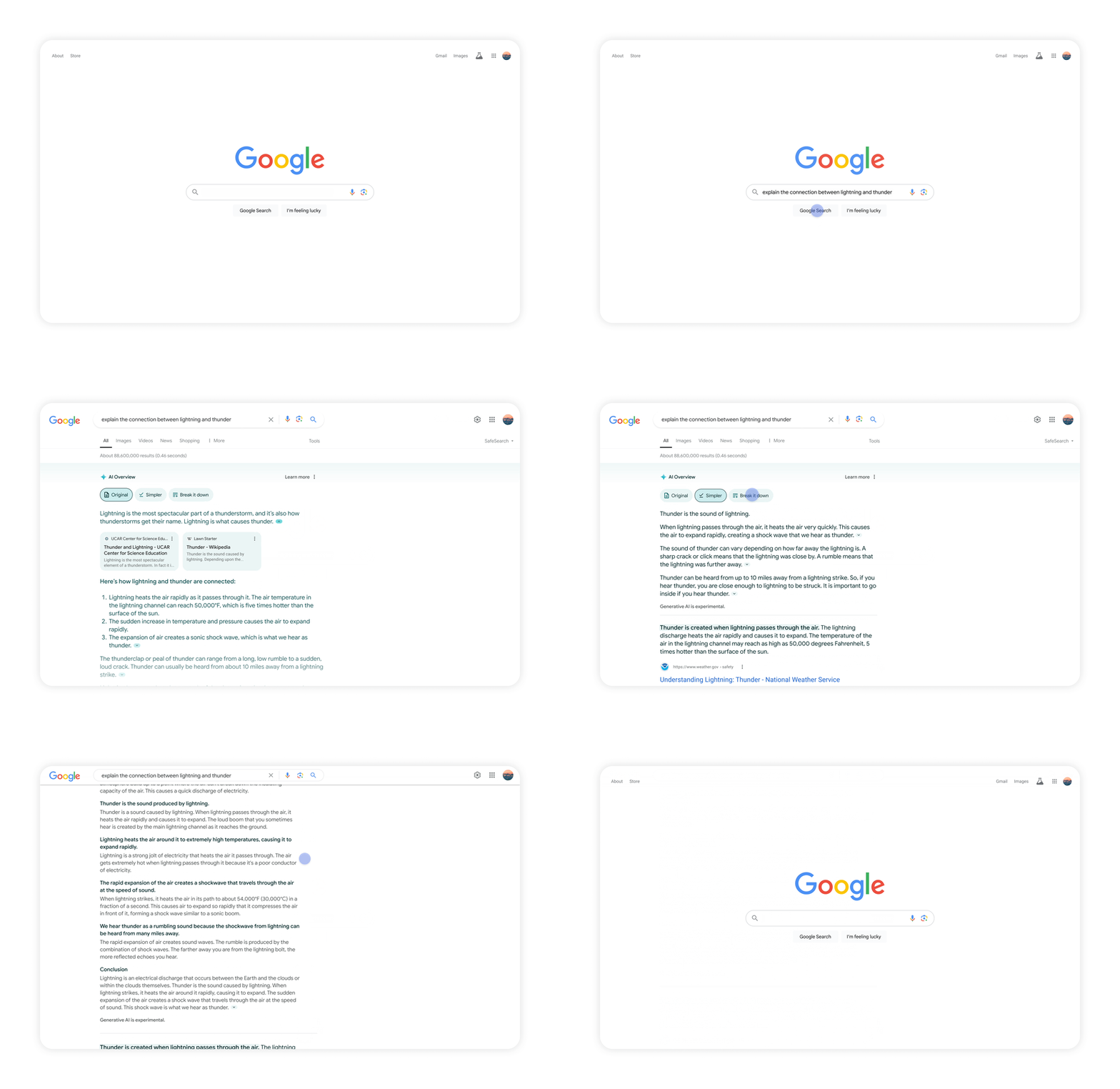
Refining AI Overviews is coming soon to Search Labs for English-language queries in the U.S.
Multistep reasoning capability
Google Search can now provide multistep reasoning using Gemini step-by-step reasoning logic. “Rather than breaking your question into multiple searches, you can ask your most complex questions, with all the nuances and caveats you have in mind, all in one go,” Reid wrote.
The example provided by Google below demonstrates how multistep reasoning works. The example shows when you’re searching for a new yoga or pilates studio, that is popular in your community, conveniently located for your daily commute, and that also offers a discount for new members. You can ask Google Search to “find the best yoga or pilates studios in Boston and show details on their intro offers and walking time from Beacon Hill.”
Here is how it looks:

Multistep reasoning is also coming soon to Search Labs, for English queries in the U.S.
Planning capabilities
The planning capabilities feature gives you the ability to plan what you need directly in Google Search. This will give you choices and the ability to co-create plans with others, it will show you links to recipes across the web, you can export those results, and replace specific plan details with another option within the various plan set. Plus it is not just showing you search results but planning them with you along the way with you.
For example, you can search for “create a 3 day meal plan for a group that’s easy to prepare,” and you’ll get a starting point with a wide range of recipes from across the web. You can swap out parts of the plan, as you wish and then export them to Google Docs or Gmail.
Here is how it looks:
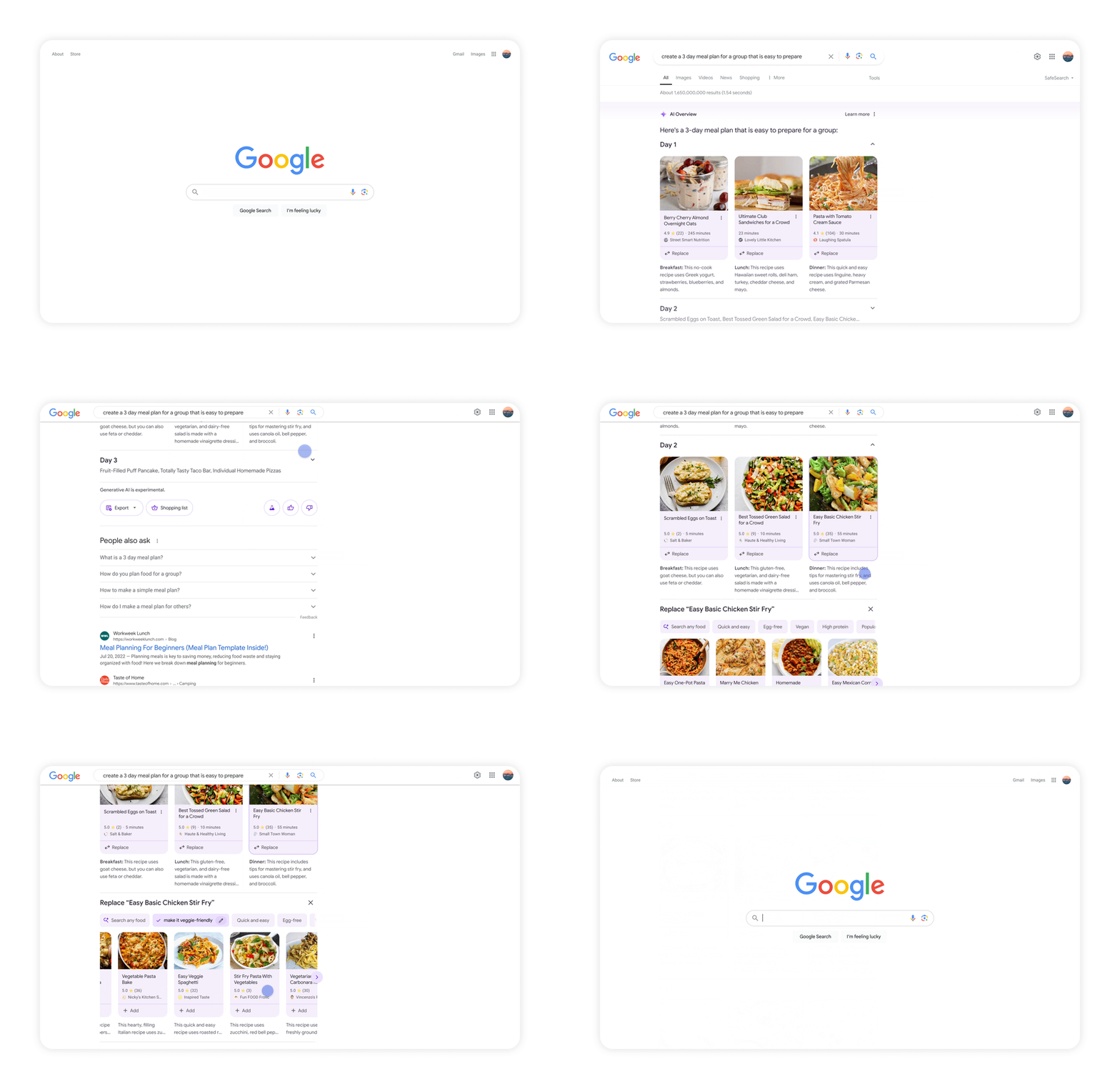
Planning is coming to parties, date night and workouts in Search Labs later this year within the U.S.
AI-organized search results
Google Search will use AI to group the search results into specific categories. This will help you brainstorm options for your query, Hema Budaraju, the Senior Director of Product, Search Generative Experience, Google told us. You will be given search results “categorized under unique, AI-generated headlines, featuring a wide range of perspectives and content types,” Google wrote.
Here is how AI-organized search results will appear:

This functionality will roll out for dining and recipes, followed by movies, music, books, hotels, shopping and more later this year directly in Google Search for U.S. English results. It is not available as a Google Search Labs opt-in feature.
Lens search with video
Lens search with video enables users to record a video and ask questions while recording; Google will respond to based on the questions asked. “We’re able to take visual search to a whole new level, with the ability to ask questions with video,” Reid said.
This reminds me of Multisearch with images and Circle to search but with video.
Here is how this will work when it goes live later this year.

Searching with video will be available soon for Search Labs users in English in the U.S.
Courtesy of Search Engine Land: News & Info About SEO, PPC, SEM, Search Engines & Search Marketing
Category seo news | Tags:
Social Networks : Technorati, Stumble it!, Digg, de.licio.us, Yahoo, reddit, Blogmarks, Google, Magnolia.
How to build a custom GPT to redefine keyword research
Written on May 14, 2024 at 6:26 am, by admin

A new era of customized AI models is emerging. Known as custom GPTs (generative pre-trained transformers), these tools enable SEO professionals to harness the capabilities of language models like ChatGPT and tailor them to their unique processes and philosophies.
This article covers the benefits of custom GPTs and provides a step-by-step guide to building your own “Striking Distance Keyword Opportunity Analyzer” – a GPT specifically designed to identify high-potential keyword opportunities that align with your website’s existing rankings.
From plugins to custom GPTs
The arrival of GPT-4, available in ChatGPT Plus, ushered in a new era with the introduction of plugins. These add-ons extended the functionalities of the already robust language model, integrating it with third-party tools.
This integration allowed ChatGPT to perform previously unachievable tasks, such as syncing with Google Sheets for extensive keyword data analysis or using Noteable for data manipulation in shared databases.
However, ChatGPT plugins had their limitations. They offered one-size-fits-all approaches that often struggled to handle the intricacies of specific niches and complex SEO activities.
With the sunsetting of ChatGPT’s plugins, custom GPTs took center stage. Unlike plugins, GPTs are standalone AI models, each designed from the ground up to meet specific requirements. These models are not just about extending functionality; they create unique solutions finely tuned to the tasks at hand.
Imagine having a dedicated SEO GPT that can understand industry jargon and best practices while leveraging built-in features like DALL-E image generation or Advanced Data Analysis to consume and analyze large data sets. This level of customization unlocks a whole new realm of possibilities in SEO workflows.
Building your competitive edge: Why SEOs need custom GPTs
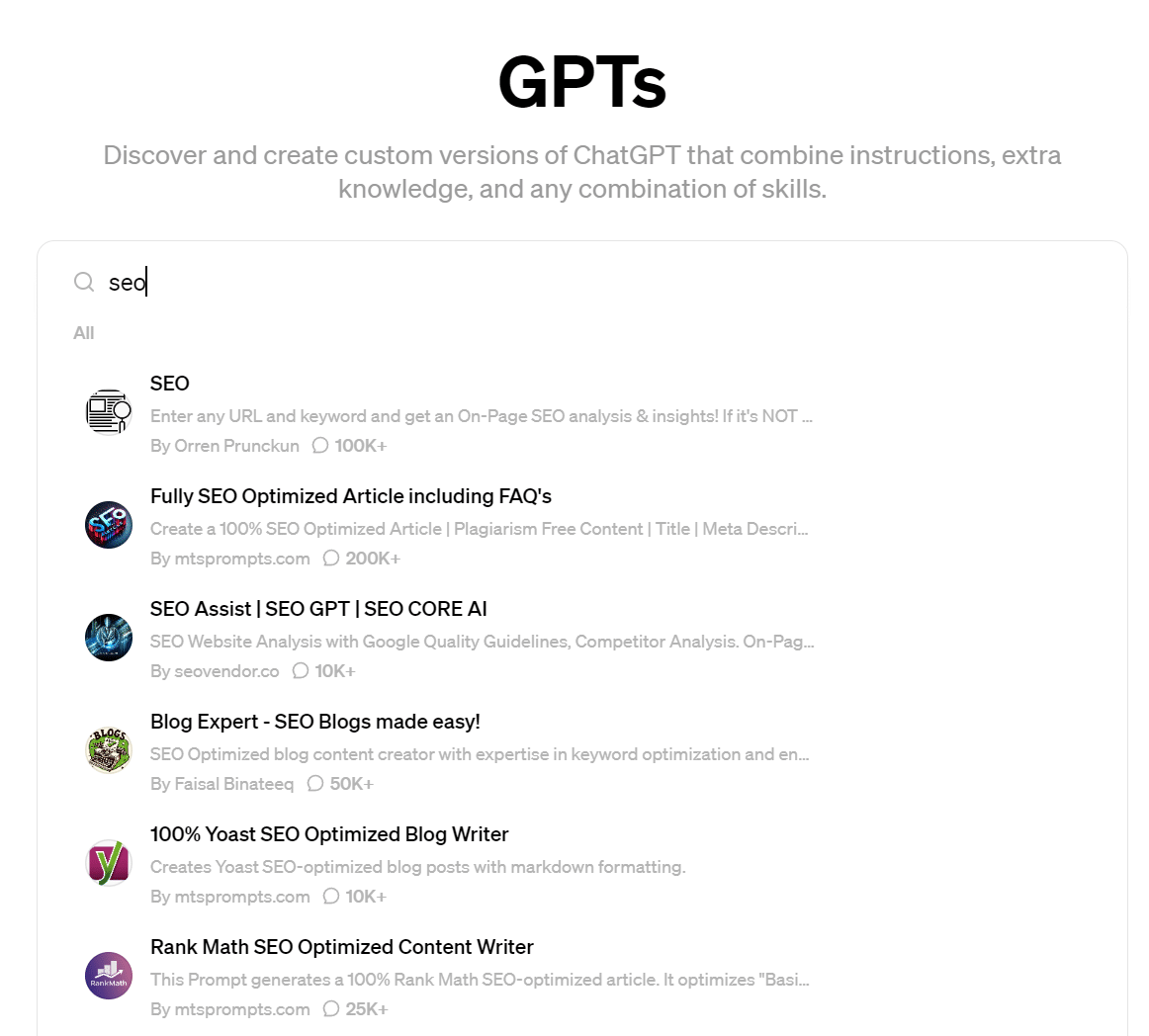
Pre-built GPTs can be both impressive and powerful. The GPT library is filled with GPTs built by SEOs and designed to handle complex initiatives like keyword ideation and analysis, content brief creation, on-page analysis and more. But here’s the secret sauce: SEO isn’t just about automation; it’s an art form honed by your unique approach.
That’s where custom GPTs come in. Imagine having an AI partner specifically designed to understand your SEO philosophy. You’ve poured years into crafting your niche expertise; now, a custom GPT can leverage that knowledge. It becomes an extension of your strategic thinking, analyzing data through the lens of your unique approach to SEO.
This isn’t about replacing your expertise; it’s about amplifying it. Custom GPTs become tireless assistants, automating mundane tasks and freeing you to focus on the strategic nuances that make you a standout SEO.
Dig deeper: 9 of the best custom GPTs for SEO in the GPT store
From theory to practice: Building a real-world GPT
Imagine a custom GPT specifically designed to identify high-potential keyword opportunities within striking distance of your website’s rankings.
This “striking distance” keyword opportunity analyzer would be a powerful tool, saving you time and effort in uncovering hidden SEO gems. Better yet, you can build this tool based on your unique approach to SEO and you don’t need to be a programmer to do it.
Here’s a glimpse into how we might build this custom GPT using ChatGPT’s conversational GPT builder. This innovative platform takes the complexity out of custom GPT development. ChatGPT’s builder has a user-friendly interface that feels more like a conversation than coding.
You simply interact with the platform, providing clear instructions and training data and the builder guides you through the process step-by-step.
This intuitive approach makes building custom GPTs accessible to SEO professionals of all technical backgrounds, allowing you to harness the power of AI regardless of your coding experience.
1. Identifying the goal: Setting your sights
We begin by clearly defining the GPT’s purpose. In this case, we want it to analyze your website’s existing keyword rankings and identify keywords where you’re already ranking on the second or third page of search results (striking distance).
These keywords represent low-hanging fruit with the potential to drive significant traffic by boosting rankings to the top of the SERPs with focused SEO efforts.

2. Naming and appearance: A touch of personality
Next, we choose a name that reflects the GPT’s function – Striking Distance Keyword Opportunity Analyzer. We can even leverage DALL-E to generate a creative image visually representing this concept.
3. Training the knowledge vault: Feeding the machine
This is where our expertise comes into play. We’ll provide the GPT with a curated set of training data, including:
Sample datasets
We’ll feed the GPT a sample Semrush ranking data export to train it on the inputs to expect and what to do with them. Define position, volume, URL and other fields the GPT will need to analyze in the uploaded datasets.
Specific SEO expertise
This is our secret sauce. What makes our GPT unique is the expertise we add to it. We’ll share our distinct approach to SEO analysis as it relates to striking distance exploration.
Make sure your training data includes:
- Your unique SEO perspective.
- How you define striking distance keywords.
- Why striking distance keywords are a good SEO opportunity.
Expected output
By providing details on the exact output we expect (e.g., .csv file, table format, specific columns), the GPT can perform the analysis as intended, delivering actionable insights from the start.
Be as detailed as possible – outline every column you want included, how the GPT should calculate or analyze data and how you want the results prioritized.
For example, if your site has 200 pages with striking distance opportunities, define how the GPT should prioritize them.
Remember, the quality and relevance of your training data are paramount. While providing enough data is important, focus on curated high-quality information that aligns with your specific SEO approach and your expected outcome.
Configuration tweaks
By default, the GPT builder does not activate Advanced Data Analysis, which is necessary for reading and analyzing .csv files.
Once you have closed your training data, click the Configure tab and select Advanced Data Analysis as a capability.
4. Refining your GPT through testing
The GPT Builder utilizes a conversational interface to build on the left side, with a test environment on the right side. This allows you to iterate on your GPT while testing.

You may need to refine your training data based on the GPT’s performance. View this as an ongoing conversation with your GPT, constantly refining its knowledge to maximize its potential as your SEO superpower. It took me 20+ iterations to get the output to match my expectations.
Also, consider comparing the GPT’s output with your own analysis. This will allow you to adjust its training data until it meets your expectations.
5. Unleashing your SEO superpower: The power of ‘like-minded’ analysis
Congratulations! You’ve built a custom-trained Striking Distance Keyword Opportunity Analyzer to reflect your unique SEO approach.
This GPT becomes your SEO partner, identifying high-potential keywords that might fly under the radar of traditional tools. It analyzes data through the lens of your expertise, saving you time and effort in uncovering hidden SEO gems.
Now, the power is in your hands. You can choose to publish your GPT to the library for all users to benefit from, keep it for yourself, or make it available to anyone who has the direct link.
Efficiency and expertise combined
Custom GPTs are powerful because they supercharge your SEO workflow, combining the efficiency of automation with the power of your unique SEO expertise.
Sure, you could recreate this analysis with a complex spreadsheet, but it would be time-consuming and error-prone. The custom GPT, however, has freed you from the tedious task of building the analysis, allowing you to focus on strategic SEO implementation.
This doesn’t replace your expertise; it amplifies it, making you a more efficient and effective SEO. Don’t fear the “robot revolution” – embrace it as a tool to empower your SEO skills and achieve greater results.
Bonus: The Striking Distance Keyword Opportunity Analyzer we built here is now live in the GPT library within ChatGPT.
Dig deeper: GPT-4 vs. Google Cloud: Performance comparison on 9 SEO tasks
Courtesy of Search Engine Land: News & Info About SEO, PPC, SEM, Search Engines & Search Marketing
Category seo news | Tags:
Social Networks : Technorati, Stumble it!, Digg, de.licio.us, Yahoo, reddit, Blogmarks, Google, Magnolia.
Google RSAs in 2024: Everything you need to know
Written on May 14, 2024 at 6:26 am, by admin

Responsive search ads (RSAs) are the bread and butter of Google Ads search campaigns. Launched in 2018 and originally a beta ad format, RSAs became the default ad format for search campaigns on June 30, 2022, when Google sunsetted Expanded Text Ads (ETAs).
The magic behind RSAs is that by providing multiple headlines and descriptions, Google Ads will test different combinations and determine which combinations work best. These combinations are also tailored to better match the search term of the individual searcher, providing ad content flexibility and improving relevancy.
Most PPC advertisers have transitioned away from using ETAs, and RSAs have become standard practice. However, there have been updates to RSAs you must be aware of. Here’s a rundown of everything you should know about RSAs in 2024.
3 headlines and 2 descriptions: A thing of the past
The concept of your RSAs displaying three headlines and two descriptions has gone out the window, with Google Ads recently shaking up how RSAs can appear in search results.
Single-headline ads are popping up more frequently in search results, and the system sometimes chooses to add a headline and the beginning of the description line.
What assets appear and where are based on whether or not the system predicts that performance will be improved by moving away from the “original” three headlines and two description format.
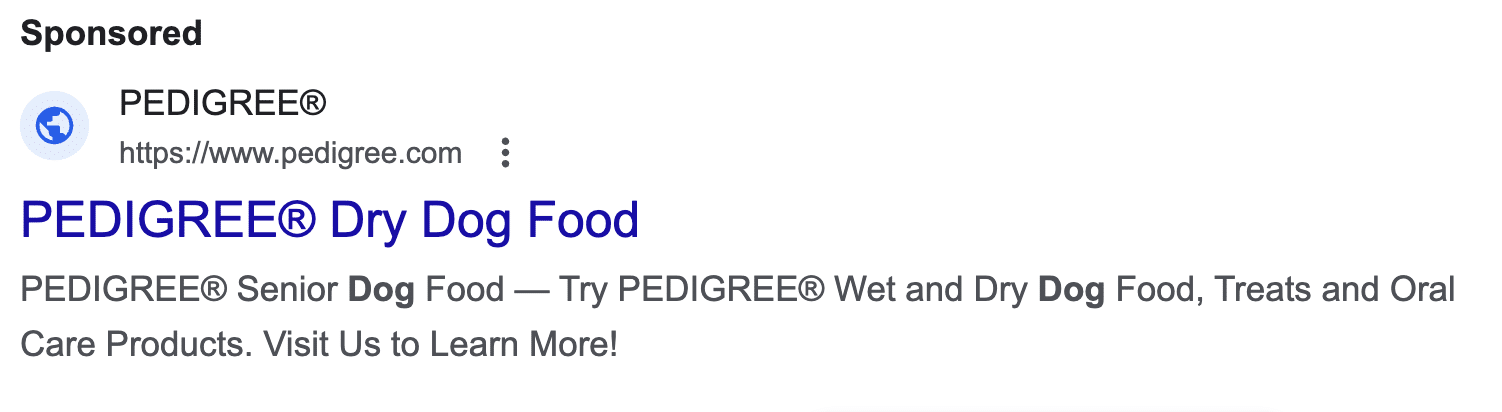 Above: An example of a Search ad with only one Headline and a headline featuring at the beginning of the description line.
This takes more control away from the advertiser, as how RSAs appear can never be guaranteed. The responsive nature of this ad format means you don’t control which combinations are shown either.
As such, make sure your ads are coherent in any order and with any number of headlines and descriptions. For example, a sentence should not need to be covered over two descriptions, which would mean that both would need to appear and in the right order for it to make sense.
Dig deeper: Craft winning paid search ads: 4 best practices
Ad strength: The great debate
Ad strength is a diagnostic tool for advertisers to see how their RSA scores in terms of relevance, diversity of assets and quality. It can be found either by adding the Ad Strength column to your ads page, or in a blue box at the top of the box when creating or editing a RSA.
 Above: When creating or editing a RSA, an Ad Strength score will show at the top of the box.
Ad strength provides a score (either Incomplete, Poor, Average, Good or Excellent); the higher the score, the more likely the system thinks the ad will be effective.
Google also provides recommendations and ideas on optimizing your ads to improve the score, such as including popular keywords and adding additional headlines.
After much online discussion, in April 2024, Google’s Ginny Marvin confirmed that Ad Strength is not used by Ad Rank, meaning that a low-scoring ad could still perform well. This was following concerns that a low Ad Strength would impact Ad Rank and, therefore, reduce visibility.
While Ad strength is not used for Ad Rank, improving the relevance and diversity of assets facilitates more combination creations, which opens up the opportunity to show more relevant ads in more auctions.
To pin or not to pin
There’s been an ongoing debate about whether pinning headlines and descriptions helps or hurts RSA performance. Case studies offer differing opinions, with some saying pinning boosts performance, while others report decreased visibility and CTR when they try it.
However, the general consensus is that pinning can impact the system’s ability to create effective asset combinations. The system is being instructed to put certain assets in certain positions, reducing its flexibility and responsiveness. Remember to pin sparingly and strategically whenever possible.
Advertisers might choose to pin assets despite the limitations it imposes because they want their company name in every ad, need to include a legal disclaimer or have strong historical data showing that an asset performs well for the account.
Campaign-level RSA assets
Another update from the beginning of 2024 is the ability to apply up to three headlines and two descriptions at a campaign level. This means these assets will be eligible to appear in any RSA within that campaign.
 Above: Headlines and Descriptions can now be added at a campaign level
You can also pin these assets in certain positions and give them a start and end date, making them perfect for promotional periods or seasonal content.
Asset and combination performance report
While sadly not as thorough as most advertisers would like them to be, there are performance reports available for both individual assets and combinations.
To locate them, go to Campaigns > Ads > View asset details (Please note these instructions are based on the new interface design.)
Under the Assets section, you can find information including:
- How many impressions an asset has had during the set time.
- A Performance column, which compares how the asset performs compared to others of the same type within that ad group and rates it either Low, Good or Best.
If the rating is Learning, then that means that it still needs to receive more impressions to be ranked, usually around the 2,000-impression mark.
This report can help you identify which assets need to be improved or replaced based on your impression performance.

Under the Combinations section, you can see what types of asset combinations have been created and how many Impressions they have had.
This is a great opportunity to check your assets, as it allows you to see how they may be appearing in searches — and sometimes, the results can be unexpected.
Google Ads RSAs: The latest updates and best practices
While the foundation of responsive search ads hasn’t changed since they were launched, there have been plenty of developments in the background regarding reporting and best practices.
As Google Ads continues to emphasize the importance of AI-powered search, it will be interesting to see what the next few years will hold for search ads.
Dig deeper: 7 ways to elevate your responsive search ads
Courtesy of Search Engine Land: News & Info About SEO, PPC, SEM, Search Engines & Search Marketing
Category seo news | Tags:
Social Networks : Technorati, Stumble it!, Digg, de.licio.us, Yahoo, reddit, Blogmarks, Google, Magnolia.