

The old marketing playbook isn’t enough during COVID [Video]
Written on May 14, 2020 at 7:47 pm, by admin
Experimentation and fresh data are needed to identify opportunities as consumer behavior adapts to the unfolding pandemic.


Courtesy of Search Engine Land: News & Info About SEO, PPC, SEM, Search Engines & Search Marketing
Category seo news | Tags:
Social Networks : Technorati, Stumble it!, Digg, de.licio.us, Yahoo, reddit, Blogmarks, Google, Magnolia.
Easy for You
Written on May 13, 2020 at 4:36 pm, by admin
To Teach, One Must Learn
One of the benefits of writing is it forces you to structure your thoughts.
If you are doing something to pass a test rote memorization can work, but if you are trying to teach someone else and care it forces you to know with certainty what you are teaching.
When I was in nuclear power school one guy was about to flunk out and I did not want to let him so I taught him stuff for days. He passed that test and as a side effect I got my highest score I ever got on one of those tests. He eventually did flunk out, but he knew other people were rooting for him and tried to help him.
Market Your Work or Become Redundant
Going forward as more work becomes remote it is going to be easier to hire and fire people. The people who are great at sharing their work and leaving a public record of it will likely be swimming in great opportunities, whereas some equally talented people who haven’t built up a bit of personal brand equity will repeatedly get fired in spite of being amazingly talented, simply because there was a turn in the economy and management is far removed from the talent. As bad as petty office politics can be, it will likely become more arbitrary when everyone is taking credit for the work of others & people are not sitting side by side to see who actually did the work.

Uber recently announced they were laying off thousands of employees while looking to move a lot of their core infrastructure work overseas where labor is cheaper. Lots of people will be made redundant as unicorn workers in a recession suddenly enjoy the job stability and all the perks of the gig working economy.
Design
We have a great graphic designer who is deeply passionate about his work. He can hand draw amazing art or comics and is also great at understanding illustration software, web design, web usability, etc. I have no idea why he was fired from his prior employer but am thankful he was as he has been a joy to work with.
Before COVID-19 killed office work I sat right next to our lead graphic designer and when I would watch him use Adobe Illustrator I was both in awe of him and annoyed at how easy he would make things look. He is so good at it that and endless array of features are second nature to him. When I would ask him how to do something I just saw him do frequently it would be harder for him to explain how he does it than doing it.
Programming
Our graphics designer is also a quite solid HTML designer, though strictly front end design. One day when I took an early lunch with my wife I asked him to create a Wordpress theme off his HTML design and when I got back he was like … ummm. 
We are all wizards at some things and horrible at others. When I use Adobe Illustrator for even the most basic tasks I feel like a guy going to a breakdancing party with no cardboard and 2 left shoes.
There are a number of things that are great about programming
- it is largely logic-based
- people drawn toward it tend to be smart
- people who can organize code also tend to use language directly (making finding solutions via search rather easy)
Though over time programming languages change features & some changes are not backward compatible. And as some free & open source projects accumulate dependencies they end up promoting the use of managers. Some of these may not be easy to install & configure on a remote shared server (with user permission issues) from a Windows computer. So then you install another package on your local computer and then have to research how it came with a deprecated php track_errors setting. And on and on.
One software program I installed on about a half-dozen sites many moons ago launched a new version recently & the typical quick 5 minute install turned into a half day of nothing. The experience felt a bit like a “choose your own adventure” book, where almost every choice you make leads to: start again at the beginning.
At that point a lot of the advice one keeps running into sort of presumes one has the exact same computer set up they do, so search again, solve that problem, turn on error messaging, and find the next problem to … once again start at the beginning.
That sort of experience is more than a bit humbling & very easy to run into when one goes outside their own sphere of expertise.
Losing the Beginner’s Mindset
If you do anything for an extended period of time it is easy to take many things for granted as you lose the beginner’s mindset.
One of the reasons it is important to go outside your field of expertise is to remind yourself of what that experience feels like.

Anyone who has been in SEO for a decade likely does the same thing when communicating about search by presuming the same level of domain expertise and talking past people. Some aspects of programming are hard because they are complex. But when things absolutely do not work you often get the answer right away. Whereas with SEO you can be unsure of the results of a large capital and labor investment until the next time a core algorithm update happens a quarter year from now. That uncertainty acts as the barrier to entry & blocker of institutional investments which allow for sustained above average profit margins for those who make the cut, but it also means a long lag time and requiring a high level of certainty to make a big investment.
The hard part about losing the beginners mindset with SEO is sometimes the algorithms do change dramatically and you have to absolutely reinvent yourself while throwing out what you know (use keyword rich anchor text aggressively, build tons of links, exact match domains beat out brands, repeat keyword in bold on page, etc.) and start afresh as the algorithms reshuffle the playing field.
The Web Keeps Changing
While the core algorithms are shifting so too is how people use the web. Any user behaviors are shifting as search results add more features and people search on mobile devices or search using their voice. Now that user engagement is a big part of ranking, anything which impacts brand perception or user experience also impacts SEO. Social distancing will have major impacts on how people engage with search. We have already seen a rapid rise of e-commerce at the expense of offline sales & some colleges are planning on holding next year entirely online. The University of California will have roughly a half-million students attending school online next year unless students opt for something cheaper.
Colleges have to convince students for the next year that a remote education is worth every bit as much as an in-person one, and then pivot back before students actually start believing it.
It’s like only being able to sell your competitor’s product for a year.— Naval (@naval) May 6, 2020
What Resolution?
I am horrible with Adobe Illustrator. But one of the things I have learned with that and Photoshop is that if you edit in a rather high resolution you can have many of your errors disappear to the naked eye when it is viewed at a normal resolution. The same analogy holds true for web design but in the opposite direction … if your usability is solid on a mobile device & the design looks good on a mobile device then it will probably be decent on desktop as well.
Some people also make a resolution mistake with SEO.
- If nobody knows about a site or brand or company having perfect valid HTML, supporting progressive web apps, supporting AMP, using microformats, etc. … does not matter.
- On the flip side, if a site is well known it can get away with doing many things sub-optimally & can perhaps improve a lot by emulating sites which are growing over time in spite of having weaker brand strength.
Free, so Good Enough?
Many open source software programs do not do usability testing or track the efforts of a somewhat average user or new user in their ability to download and install software because they figure it is free so oh well people should figure it out. That thinking is a mistake though, because each successive increase in barrier to entry limits your potential market size & eventually some old users leave for one reason or another.
Any free software project which accumulates attention and influence can be monetized in other ways (through consulting, parallel SaaS offerings, affiliate ad integration, partnering with Hot Nacho to feature some great content in a hidden div using poetic code, etc.). But if they lack reach, see slowing growth, and then increase the barrier to entry they are likely to die.
When you ask someone to pay for something you’ll know if they like it and where they think it can be improved. Relying on the free price point hides many problems and allows them to accumulate.
The ability to make things easy for absolute beginners is a big part of why Wordpress is worth many multiples of what Acquia sold for. And Wordpress has their VIP hosting service, Akismet, and a bunch of other revenue streams while Acquia is now owned by a private equity company.
The ability to be 0.0000001% as successful as Wordpress has been without losing the beginner mindset is hard.
Courtesy of SEO Book.com
Category seo news | Tags:
Social Networks : Technorati, Stumble it!, Digg, de.licio.us, Yahoo, reddit, Blogmarks, Google, Magnolia.
The benefits of using workflow and project management tools
Written on May 13, 2020 at 4:36 pm, by admin
Considering adding a workflow or project management solution to your martech stack, but looking for a business case?


Courtesy of Search Engine Land: News & Info About SEO, PPC, SEM, Search Engines & Search Marketing
Category seo news | Tags:
Social Networks : Technorati, Stumble it!, Digg, de.licio.us, Yahoo, reddit, Blogmarks, Google, Magnolia.
Emotional ROI should be one of your key performance indicators during COVID [Video]
Written on May 13, 2020 at 4:36 pm, by admin
Continue to foster brand connections now, say marketers on Live with Search Engine Land.


Courtesy of Search Engine Land: News & Info About SEO, PPC, SEM, Search Engines & Search Marketing
Category seo news | Tags:
Social Networks : Technorati, Stumble it!, Digg, de.licio.us, Yahoo, reddit, Blogmarks, Google, Magnolia.
Foursquare, PlaceIQ CEOs join Live with Search Engine Land Friday
Written on May 13, 2020 at 4:36 pm, by admin
Group to discuss how brands and marketers can use location intelligence as they plot a way forward.


Courtesy of Search Engine Land: News & Info About SEO, PPC, SEM, Search Engines & Search Marketing
Category seo news | Tags:
Social Networks : Technorati, Stumble it!, Digg, de.licio.us, Yahoo, reddit, Blogmarks, Google, Magnolia.
New Age Cloaking
Written on May 12, 2020 at 1:17 pm, by admin
Historically cloaking was considered bad because a consumer would click expecting a particular piece of content or user experience while being delivered an experience which differed dramatically.
As publishers have become more aggressive with paywalls they’ve put their brands & user trust in the back seat in an attempt to increase revenue per visit.
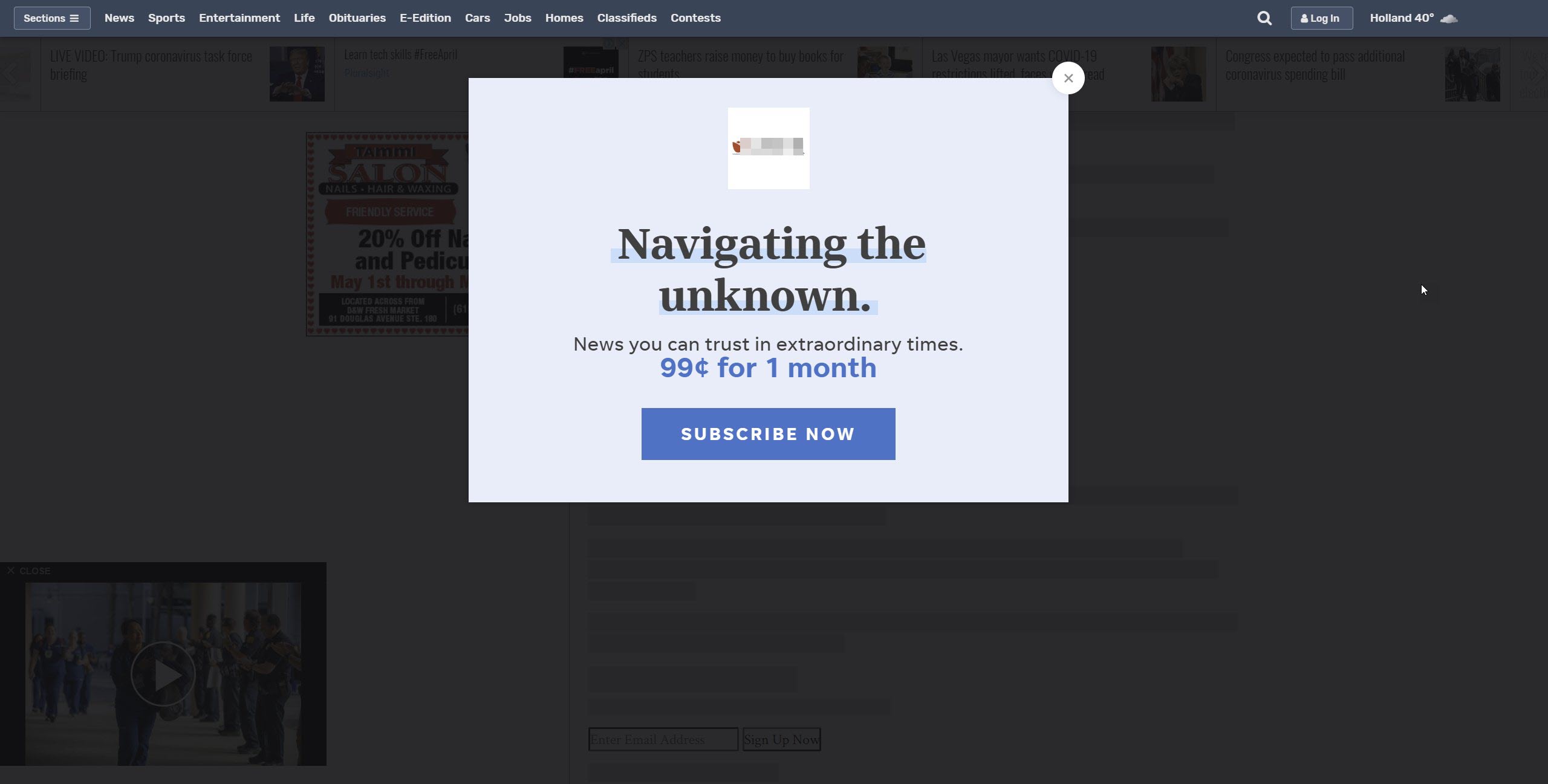
Below are 2 screenshots from one of the more extreme versions I have seen recently.
The first is a subscribe-now modal which shows by default when you visit the newspaper website.
The second is the page as it appears after you close the modal.
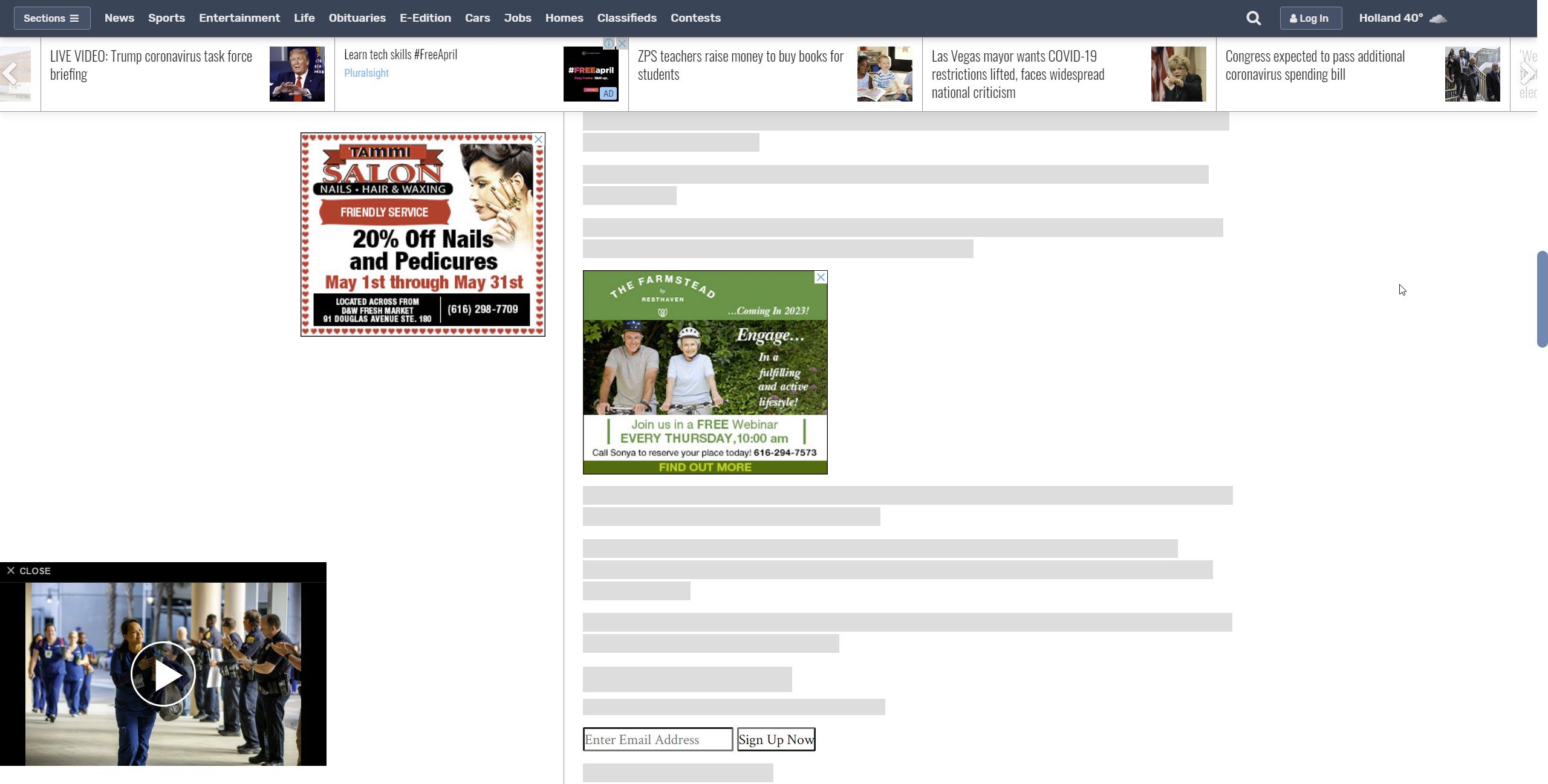
Basically all page content is cloaked other than ads and navigation.
The content is hidden - cloaked.
That sort of behavior would not only have a horrible impact on time on site metrics, but it would teach users not to click on their sites in the future, if users even have any recall of the publisher brand.
The sort of disdain that user experience earns will cause the publishers to lose relevancy even faster.
On the above screenshot I blurred out the logo of the brand on the initial popover, but when you look at the end article after that modal pop over you get a cloaked article with all the ads showing and the brand of the site is utterly invisible. A site which hides its brand except for when it is asking for money is unlikely to get many conversions.
Many news sites now look as awful as the ugly user created MySpace pages did back in the day. And outside of the MySpace pages that delivered malware the user experience is arguably worse.
Each news site which adopts this approach effectively increases user hate toward all websites adopting the approach.
It builds up. Then users eventually say screw this. And they are gone - forever.

Audiences will thus continue to migrate across from news sites to anywhere else that hosts their content like Google AMP, Facebook Instant Articles, Apple News, Twitter, Opera or Edge or Chrome mobile browser new article recommendations, MSN News, Yahoo News, etc.
Any lifetime customer value models built on assumptions around any early success with the above approach should consider churn as well as the brand impact the following experience will have on most users before going that aggressive.

One small positive note for news publishers is more countries are looking to have attention merchants pay for their content, though I suspect as the above sort of double modal paywall stuff gets normalized other revenue streams won’t make the practice go away, particularly as many local papers have been acquired by PE chop shops extracting all blood out of the operations through interest payments to themselves.
Courtesy of SEO Book.com
Category seo news | Tags:
Social Networks : Technorati, Stumble it!, Digg, de.licio.us, Yahoo, reddit, Blogmarks, Google, Magnolia.
Managing Algorithmic Volatility
Written on May 12, 2020 at 1:17 pm, by admin
Upon the recently announced Google update I’ve seen some people Tweet things like
- if you are afraid of algorithm updates, you must be a crappy SEO
- if you are technically perfect in your SEO, updates will only help you
I read those sorts of lines and cringe.
Here’s why…
Fragility
Different businesses, business models, and business structures have varying degrees of fragility.
If your business is almost entirely based on serving clients then no matter what you do there is going to be a diverse range of outcomes for clients on any major update.
Let’s say 40% of your clients are utterly unaffected by an update & of those who saw any noticeable impact there was a 2:1 ratio in your favor, with twice as many clients improving as falling.
Is that a good update? Does that work well for you?
If you do nothing other than client services as your entire business model, then that update will likely suck for you even though the net client impact was positive.
Why?
Many businesses are hurting after the Covid-19 crisis. Entire categories have been gutted & many people are looking for any reason possible to pull back on budget. Some of the clients who won big on the update might end up cutting their SEO budget figuring they had already won big and that problem was already sorted.
Some of the clients that fell hard are also likely to either cut their budget or call endlessly asking for updates and stressing the hell out of your team.
Capacity Utilization Impacts Profit Margins
Your capacity utilization depends on how high you can keep your steady state load relative to what your load looks like at peaks. When there are big updates management or founders can decide to work double shifts and do other things to temporarily deal with increased loads at the peak, but that can still be stressful as hell & eat away at your mental and physical health as sleep and exercise are curtailed while diet gets worse. The stress can be immense if clients want results almost immediately & the next big algorithm update which reflects your current work may not happen for another quarter year.
How many clients want to be told that their investments went sour but the problem was they needed to double their investment while cashflow is tight and wait a season or two while holding on to hope?
Category-based Fragility
Businesses which appear to be diversified often are not.
- Everything in hospitality was clipped by Covid-19.
- 40% of small businesses across the United States have stopped making rent payments.
- When restaurants massively close that’s going to hit Yelp’s business hard.
- Auto sales are off sharply.
Likewise there can be other commonalities in sites which get hit during an update. Not only could it include business category, but it could also be business size, promotional strategies, etc.
Sustained profits either come from brand strength, creative differentiation, or systemization. Many prospective clients do not have the budget to build a strong brand nor the willingness to create something that is truly differentiated. That leaves systemization. Systemization can leave footprints which act as statistical outliers that can be easily neutralized.
Sharp changes can happen at any point in time.
For years Google was funding absolute garbage like Mahalo autogenerated spam and eHow with each month being a new record. It is very hard to say “we are doing it wrong” or “we need to change everything” when it works month after month after month.
Then an update happens and poof.
- Was eHow decent back in the first Internet bubble? Sure. But it lost money.
- Was it decent after it got bought out for a song and had the paywall dropped in favor of using the new Google AdSense program? Sure.
- Was it decent the day Demand Media acquired it? Sure.
- Was it decent on the day of the Demand Media IPO? Almost certainly not. But there was a lag between that day and getting penalized.
Panda Trivia
The first Panda update missed eHow because journalists were so outraged by the narrative associated with the pump-n-dump IPO. They feared their jobs going away and being displaced by that low level garbage, particularly as the market cap of Demand Media eclipsed the New York Times.
Journalist coverage of the pump-n-dump IPO added credence to it from an algorithmic perspective. By constantly writing hate about eHow they made eHow look like a popular brand, generating algorithmic signals that carried the site until Google created an extension which allowed journalists and other webmasters to vote against the site they had been voting for through all their outrage coverage.
Algorithms & the Very Visible Hand
And all algorithmic channels like organic search, the Facebook news feed, or Amazon’s product pages go through large shifts across time. If they don’t, they get gamed, repetitive, and lose relevance as consumer tastes change and upstarts like Tiktok emerge.
Consolidation by the Attention Merchants
Frequent product updates, cloning of upstarts, or outright acquisitions are required to maintain control of distribution:
“The startups of the Rebellion benefited tremendously from 2009 to 2012. But from 2013 on, the spoils of smartphone growth went to an entirely different group: the Empire. … A network effect to engage your users, AND preferred distribution channels to grow, AND the best resources to build products? Oh my! It’s no wonder why the Empire has captured so much smartphone value and created a dark time for the Rebellion. … Now startups are fighting for only 5% of the top spots as the Top Free Apps list is dominated by incumbents. Facebook (4 apps), Google (6 apps), and Amazon (4 apps) EACH have as many apps in the Top 100 list as all the new startups combined.”
Apple & Amazon
Emojis are popular, so those features got copied, those apps got blocked & then apps using the official emojis also got blocked from distribution. The same thing happens with products on Amazon.com in terms of getting undercut by a house brand which was funded by using the vendor’s sales data. Re-buy your brand or else.
Before the Facebook IPO some thought buying Zynga shares was a backdoor way to invest into Facebook because gaming was such a large part of the ecosystem. That turned out to be a dumb thesis and horrible trade. At times other things trended including quizzes, videos, live videos, news, self hosted Instant Articles, etc.
Over time the general trend was edge rank of professional publishers fell as a greater share of inventory went to content from friends & advertisers. The metrics associated with the ads often overstated their contribution to sales due to bogus math and selection bias.
Internet-first publishers like CollegeHumor struggled to keep up with the changes & influencers waiting for a Facebook deal had to monetize using third parties:
“I did 1.8 billion views last year,” [Ryan Hamilton] said. “I made no money from Facebook. Not even a dollar.” … “While waiting for Facebook to invite them into a revenue-sharing program, some influencers struck deals with viral publishers such as Diply and LittleThings, which paid the creators to share links on their pages. Those publishers paid top influencers around $500 per link, often with multiple links being posted per day, according to a person who reached such deals.”
YouTube
YouTube had a Panda-like update back in 2012 to favor watch time over raw view counts. They also adjust the ranking algorithms on breaking news topics to favor large & trusted channels over conspiracy theorist content, alternative health advice, hate speech & ridiculous memes like the Tide pod challenge.
All unproven channels need to start somewhat open to gain usage, feedback & marketshare. Once they become real businesses they clamp down. Some of the clamp down can be editorial, forced by regulators, or simply anticompetitive monpolistic abuse.
Kid videos were a huge area on YouTube (perhaps still are) but that area got cleaned up after autogenerated junk videos were covered & the FTC clipped YouTube for delivering targeted ads on channels which primarily catered to children.
Dominant channels can enforce tying & bundling to wipe out competitors:
“Google’s response to the threat from AppNexus was that of a classic monopolist. They announced that YouTube would no longer allow third-party advertising technology. This was a devastating move for AppNexus and other independent ad technology companies. YouTube was (and is) the largest ad-supported video publisher, with more than 50% market share in most major markets. … Over the next few months, Google’s ad technology team went to each of our clients and told them that, regardless of how much they liked working with AppNexus, they would have to also use Google’s ad technology products to continue buying YouTube. This is the definition of bundling, and we had no recourse. Even WPP, our largest customer and largest investors, had no choice but to start using Google’s technology. AppNexus growth slowed, and we were forced to lay off 100 employees in 2016.”
Everyone Else
Every moderately large platform like eBay, Etsy, Zillow, TripAdvisor or the above sorts of companies runs into these sorts of issues with changing distribution & how they charge for distribution.
Building Anti-fragility Into Your Business Model
Growing as fast as you can until the economy craters or an algorithm clips you almost guarantees a hard fall along with an inability to deal with it.
Markets ebb and flow. And that would be true even if the above algorithmic platforms did not make large, sudden shifts.
Build Optionality Into Your Business Model
If your business primarily relies on publishing your own websites or you have a mix of a few clients and your own sites then you have a bit more optionality to your approach in dealing with updates.
Even if you only have one site and your business goes to crap maybe you at least temporarily take on a few more consulting clients or do other gig work to make ends meet.
Focus on What is Working
If you have a number of websites you can pour more resources into whatever sites reacted positively to the update while (at least temporarily) ignoring any site that was burned to a crisp.
Ignore the Dead Projects
The holding cost of many websites is close to zero unless they use proprietary and complex content management systems. Waiting out a penalty until you run out of obvious improvements on your winning sites is not a bad strategy. Plus, if you think the burned site is going to be perpetually burned to a crisp (alternative health anyone?) then you could sell links off it or generate other alternative revenue streams not directly reliant on search rankings.
Build a Cushion
If you have cash savings maybe you guy out and buy some websites or domain names from other people who are scared of the volatility or got clipped for issues you think you could easily fix.
When the tide goes out debt leverage limits your optionality. Savings gives you optionality. Having slack in your schedule also gives you optionality.
The person with a lot of experience & savings would love to see highly volatile search markets because those will wash out some of the competition, curtail investments from existing players, and make other potential competitors more hesitant to enter the market.
Courtesy of SEO Book.com
Category seo news | Tags:
Social Networks : Technorati, Stumble it!, Digg, de.licio.us, Yahoo, reddit, Blogmarks, Google, Magnolia.
Why digital commerce marketers shouldn’t ‘go dark’ during COVID [Video]
Written on May 12, 2020 at 1:17 pm, by admin
Keeping up your marketing momentum is more important than ever as shopping habits shift.


Courtesy of Search Engine Land: News & Info About SEO, PPC, SEM, Search Engines & Search Marketing
Category seo news | Tags:
Social Networks : Technorati, Stumble it!, Digg, de.licio.us, Yahoo, reddit, Blogmarks, Google, Magnolia.
Black Friday in April: e-commerce is booming according to three reports
Written on May 12, 2020 at 1:17 pm, by admin
Store closures crashed traditional retail spending, but online sales are still on fire.


Courtesy of Search Engine Land: News & Info About SEO, PPC, SEM, Search Engines & Search Marketing
Category seo news | Tags:
Social Networks : Technorati, Stumble it!, Digg, de.licio.us, Yahoo, reddit, Blogmarks, Google, Magnolia.
Retailers can now link their PayPal and Google Merchant Center accounts
Written on May 12, 2020 at 1:17 pm, by admin
The integration makes it easier to get up and running with Google’s free Shopping listings.


Courtesy of Search Engine Land: News & Info About SEO, PPC, SEM, Search Engines & Search Marketing
Category seo news | Tags:
Social Networks : Technorati, Stumble it!, Digg, de.licio.us, Yahoo, reddit, Blogmarks, Google, Magnolia.