

Google Ads launches Cross-Media Reach Measurement for video campaigns
Written on June 26, 2024 at 1:01 am, by admin
A new Google Ads tool – Cross-Media Reach Measurement – lets advertisers measure deduplicated, on-target reach and frequency across video campaigns.
Why it matters. This tool helps advertisers understand the efficiency of their YouTube video campaigns compared to TV, providing a comprehensive view of brand campaign performance.
Why we care. This tool essentially empowers advertisers to make more data-driven decisions, potentially leading to more effective branding campaigns and better use of advertising budgets across different media channels and over a long-term period.
How it works.
- Aggregates and deduplicates reach and frequency across multiple campaigns
- Shows total on-target reach for specific demographics
- Measures unique reach across different devices, formats, sites, apps and networks
Key features.
- Digital Video Only report: Available globally, measures reach and frequency for Google Ads video campaigns
- Digital Video + Traditional TV report: Available in select countries, combines Google Ads metrics with third-party TV data

How to use it.
- Access through the Measurement menu in Google Ads.
- Select country and video campaigns (preferably with Target CPM bidding).
- Generate reports for various age and gender groups over periods up to 92 days.
The big picture. This tool aims to help advertisers optimize their advertising investments by providing insights into campaign planning and performance across digital and traditional media.
What’s next. Advertisers can now use this tool to make more informed decisions about their video advertising strategies on YouTube and TV.
Courtesy of Search Engine Land: News & Info About SEO, PPC, SEM, Search Engines & Search Marketing
Category seo news | Tags:
Social Networks : Technorati, Stumble it!, Digg, de.licio.us, Yahoo, reddit, Blogmarks, Google, Magnolia.
How to use the ‘perfect click’ to optimize for AI-assisted search results
Written on June 26, 2024 at 1:01 am, by admin

The perfect click refers to a click from a SERP that takes the user directly to the single best webpage or resource that directly solves their problem.
The ultimate aim of assistive search features like Google’s AI Overviews and Bing’s Copilot is to bring the user down the funnel and get them to the Perfect Click without leaving the search interface (for now, that is a SERP).
Off-SERP assistive engines such as ChatGPT and Perplexity operate from a similar perspective. However, for this article, I will focus on Google’s AI Overviews and Bing Copilot, which are simply assistive engines integrated into the SERPs.
The perfect click is official
Fabrice Canel, Principal Program Manager at Microsoft Bing, has confirmed that they use this concept and term internally and that they are guiding the user on SERP to the ideal bottom-of-the-funnel action – conversion.
Google hasn’t communicated about this but certainly has the same concept, perhaps by a different name.
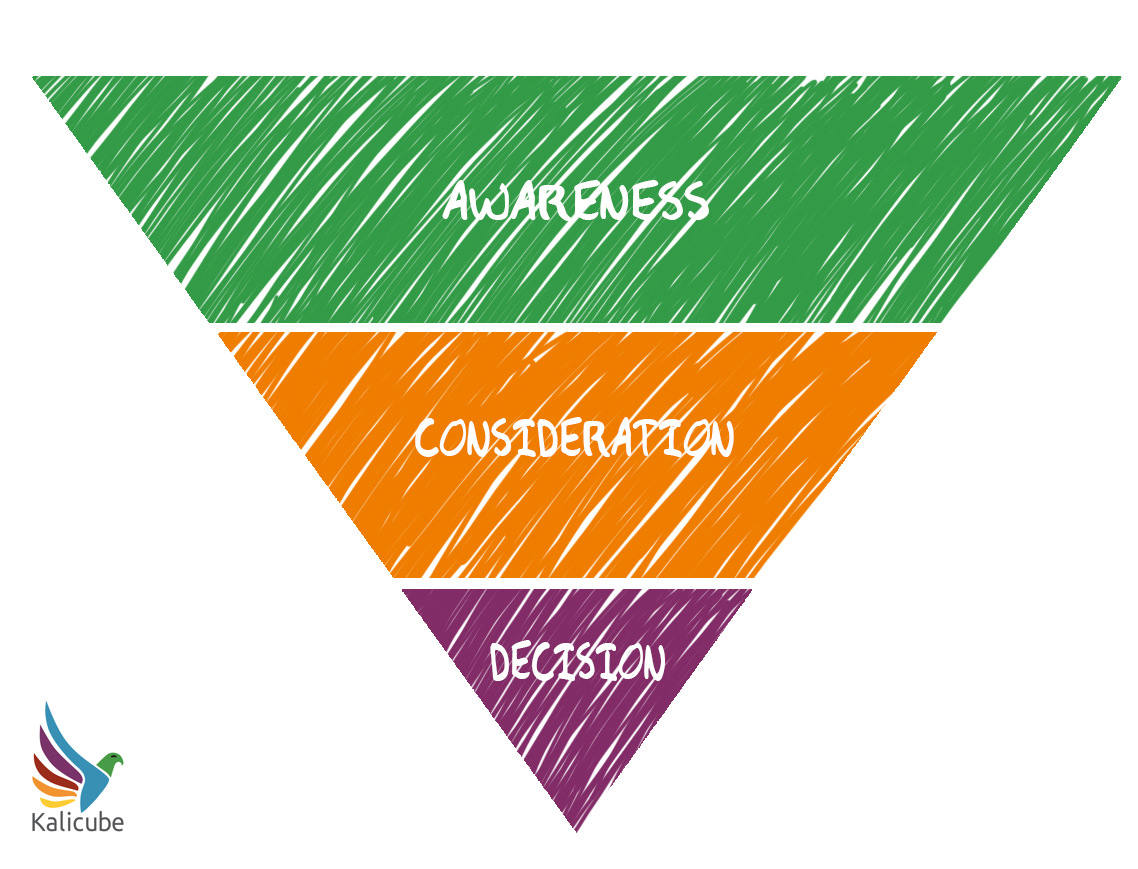
A typical three-step marketing acquisition funnel
Marketers often represent acquisition as a funnel with three stages:
- Awareness: Where the target audience becomes aware of a problem they need to solve and research to find the solution to that problem.
- Consideration: Where the user researches which providers (company or person) offer a viable solution, and narrows down their choices to a select few.
- Decision: Where the user makes their final choice about the most suitable solution for their problem and the best provider of that solution.
Google’s AI Overviews mimics the acquisition funnel
The aim of Google’s AI Overviews and Bing’s Copilot is to guide the user through the funnel from awareness to the final decision.
The assistive engine does this through a conversation between the human user and the machine. The user asks questions, and the assistive engine answers the question by:
- Providing answers in the form of summaries from information found around the web.
- Making research suggestions based on behavioral data, query pools and information from the web.
- Making recommendations about solution providers based on algorithmic evaluations of E-E-A-T (N-E-E-A-T) credibility.
How to build a successful strategy for Google’s AI Overviews
This strategy is universal. Bing Copilot, ChatGPT, Perplexity and Google Gemini all function the same way, and this approach satisfies the fundamental pillars and ticks all the right boxes.
The secret to optimizing for assistive search engines and assistive SERP features is to understand:
- How the algorithms find, digest and communicate your content to users in the SERP (traditional SEO).
- How your content fits into the funnel (marketing).
- That the “who” behind the content is key (entity optimization).
Only the last point requires skills and strategies that are new. Luckily, it is very simple since it focuses on how well the algorithms understand the website owner (generally a corporation, but sometimes a person) and the content creator (generally a person, but sometimes a corporation).
Focus on the nature of the conversation between the human and the machine
The human has a single goal: to find the best solution to their problem. The machine is designed to fulfill a single function: guide the human to the best solution to their problem. This is the perfect match.
The human starts this journey with sketchy knowledge of the problem, a very limited understanding of the possible solutions and little or no idea about credible solution providers.
The human is confident that the machine understands the problem, has an encyclopedic knowledge of the possible solutions and can reliably evaluate the credibility of the solution providers.
The machine/algorithm is in control.
The machine is single-minded about the funnel
The algorithms want to guide the human user down the funnel:
- Provide helpful research information and advice in a way that reduces the time and effort a person needs to invest in research.
- Identify the providers who can best solve the problem for the human user.
- Help the human user identify the solution provider they are comfortable with.
You need to become the focus of the conversation between machine and human
As an SEO, you must influence the algorithms to act in your favor and guide their users to you rather than your competitors.
Let’s look at the marketing funnel again, adding what you want the machine to do for you on the left-hand side.

Awareness
- If the human user is unaware of you, you want the assistive engine to introduce you to the conversation.
- If the user is aware of you, then you want to ensure it doesn’t lead the user away from you.
- The human user is mostly in control at this stage.
Consideration
- You are in the conversation, and you want the assistive engine to systematically place you first in every list of options and constantly re-introduce you to the conversation.
- The human user still feels in control but is unlikely to insist on you as a candidate for consideration if the assistive engine doesn’t naturally keep you in the conversation.
Decision
- The choice is being narrowed down to one. The perfect click.
- The assistive engine (or assistive search feature) is now in control.
- You need to ensure that it prioritizes you and doesn’t guide the human user toward your competitor as a better solution provider.
Steps you can take to become the focus of the conversation between machine and human
To create a situation where the assistive engine algorithms make you the focus of its conversation with human users:
- First, you must communicate understanding about who you are, what you offer and who you serve.
- Second, establish your credibility.
- Third, ensure that you provide deliverable content that will ensure the assistive engine reliably includes you in the conversation more often than not.

Your aim is to become the ideal candidate for the perfect click
Assistive engines like ChatGPT and assistive search features like Google’s AI Overviews aim to get the user to the perfect click within their own walled garden. Your aim is that the Perfect Click they choose to present to the user is you.
There is only one single perfect click. the perfect click is the click that converts. you cannot allow the perfect click to go to your competitor.
To get the perfect click, focus on three pillars in this order of importance:
- Understanding (you need to educate it about yourself).
- Credibility (you need to convince it you are the most legitimate solution provider).
- Deliverability (you need to provide the educational content that will encourage it to cite you as it guides people to the perfect click).
The key to optimizing for Google’s AI Overviews: Build the traditional marketing funnel
If you look at the illustration of the funnel above, it seems that we are building the funnel upside down. That is a question of perspective. A perspective that many people have
Google can only start to consider your credibility as a solution if it understands who you are, what you offer and who you serve.
Once it understands who you are and believes that you are a credible solution provider, it will be enthusiastic about introducing you to the conversation it is having with its human user.
Your content will only be a candidate for visibility on assistive features of search engines, answer engines and assistive engines if the algorithms understand you, your offer and your credibility.
These engines are designed to guide the human user down the funnel to the best (most credible or recommendable) solution to their problem.
They need to:
- Understand who you are (solution provider).
- Be convinced of your credibility and trustworthiness to deliver that solution.
- Have access to your branded content so it can deliver a convincing argument for you.
The last point is hugely important since it demonstrates that the assistive engines and their algorithms are delivering your sales pitch for you.
The perfect click as the future of SEO
How can you ensure that the assistive engines and assistive search features reliably and regularly bring the right people to the perfect click?
Tell search engines clearly who you are, what you do, and why you’re trustworthy. Then, provide detailed information so they can consistently recommend you to users and guide potential customers through your sales process, leading them to click directly on your most conversion-ready page.
Courtesy of Search Engine Land: News & Info About SEO, PPC, SEM, Search Engines & Search Marketing
Category seo news | Tags:
Social Networks : Technorati, Stumble it!, Digg, de.licio.us, Yahoo, reddit, Blogmarks, Google, Magnolia.
Google rolls out new shopping tools ahead of summer sales
Written on June 24, 2024 at 10:00 pm, by admin
Google is launching enhanced shopping features to help consumers navigate the upcoming summer sales season, responding to increased interest in online deals.
What’s new:
- Updated deals destination:
- – Shows freshest deals from across retailers in a carousel
- – Organizes promotions by product categories
- – Available on mobile and desktop in the U.S.

- Membership price display:
- – Shows regular prices alongside discounted costs for loyalty program members
- – Currently available for retailers like BestBuy, Petco, and Minted

Why we care. Retail advertisers might need to shift more focus towards promoting deals and special offers to appear in these new features.
Why it matters. With 44% of shoppers saying deal days prompt them to shop more than usual (according to Google/Ipsos Deal Days Survey), these tools aim to help consumers find the best discounts across retailers.
The big picture. These features leverage Google’s Shopping Graph, which contains 45 billion product listings, to provide a centralized shopping experience.
By the numbers.
- Online searches for “deals” spike in mid-July, surpassing interest in “vacation”
- 25% of people who regret purchases during big sales say it’s due to finding lower prices later
Between the lines. Google is positioning itself as a one-stop shop for deal-hunting, potentially increasing its importance in the e-commerce ecosystem.
Courtesy of Search Engine Land: News & Info About SEO, PPC, SEM, Search Engines & Search Marketing
Category seo news | Tags:
Social Networks : Technorati, Stumble it!, Digg, de.licio.us, Yahoo, reddit, Blogmarks, Google, Magnolia.
Google tightens EU consent rules for Customer Match ads
Written on June 24, 2024 at 10:00 pm, by admin
Google Ads is updating its EU user consent policy, affecting advertisers using Customer Match lists for ad personalization in the European Economic Area (EEA).
The big picture. This change aligns with increasing privacy regulations in Europe and Google’s efforts to ensure compliance.
Why it matters. Advertisers must now explicitly pass granted consent signals to Google to continue using Customer Match for personalized advertising in the EEA.
Why we care. This update puts more responsibility on advertisers to collect and transmit user consent, potentially impacting campaign reach and effectiveness.
How it works. Advertisers have four options to pass consent signals:
- Google Ads API
- Partner and Audience Partner API
- Manual input in Audience Manager (Google Ads UI)
- Conversion-based Customer lists (requires Consent Mode enabled)
First seen. This update was first seen on Thomas Eccel’s X post:

What’s next. Advertisers targeting EEA users need to implement one of these consent signal methods to maintain their Customer Match capabilities.
Bottom line. Failing to adapt to these new consent requirements could result in limited ad personalization options for EEA audiences.
Courtesy of Search Engine Land: News & Info About SEO, PPC, SEM, Search Engines & Search Marketing
Category seo news | Tags:
Social Networks : Technorati, Stumble it!, Digg, de.licio.us, Yahoo, reddit, Blogmarks, Google, Magnolia.
Google automates lead credits for Local Services Ads
Written on June 24, 2024 at 10:00 pm, by admin
Google is rolling out automated Local Services Ads lead credits in July, streamlining the process for advertisers to receive credit for poor-quality leads.
Why it matters. This change aims to save time for advertisers and ensure more equitable distribution of ad credits, particularly benefiting those with limited resources. This will potentially affect advertisers’ budgets, lead quality and overall experience with the platform.
How it works:
- Google’s machine learning models will automatically review all leads.
- Invalid leads will be credited without manual disputes.
- Credits typically are applied within 30 days.
The big picture. Since launching in 2017, Local Services Ads have evolved, but the manual dispute system has become challenging to scale and vulnerable to gaming.
- This automation addresses disparities in lead disputing practices among advertisers and aims to improve overall lead quality.
Key changes.
- No more manual lead disputes are required.
- “Job type not serviced” and “geo not serviced” leads will no longer be credited.
- Overall, more leads are expected to be credited on average.
Exceptions. The system won’t apply to healthcare verticals or advertisers in EMEA.
What’s next. Advertisers are encouraged to provide feedback on every lead through the Lead Feedback survey to help improve future lead quality.
Between the lines. This shift reflects Google’s growing capability to use AI for quality control in its advertising products.
Courtesy of Search Engine Land: News & Info About SEO, PPC, SEM, Search Engines & Search Marketing
Category seo news | Tags:
Social Networks : Technorati, Stumble it!, Digg, de.licio.us, Yahoo, reddit, Blogmarks, Google, Magnolia.
Accurate tracking data: The key to optimal ad performance
Written on June 24, 2024 at 10:00 pm, by admin

In the early days of digital advertising, it was pretty straightforward. Put in some keywords, set budgets and track your clicks and click-through rate.
As ad platforms evolved to measure actual conversions, we improved our PPC ads to better achieve our business goals.
In recent years, ad platforms have evolved even more, introducing smart bidding options that allow advertisers to control bidding to generate the most conversions, highest conversion value or lowest cost per conversion.
However, when utilizing these bid strategies, your ad performance can only be as effective if your data is correct.
You may have heard the term GIGO – garbage in, garbage out. In data analysis, if we put bad data into the system, regardless of its advancement, the data we get out of that system will not be accurate.
How accurate is the data we’re feeding back into these ad systems?
Take the target ROAS (return on ad spend) as an example. Suppose the revenue data we feed back into the ad platform is incorrect. In that case, our ROAS calculation will be incorrect and may falsely inflate or deflate the ROAS, leading to potentially higher costs for a campaign.
Users create data inaccuracy
Despite your organization’s best efforts, it’s probably a safe bet that employees created data inaccuracies.
From incorrect destination URL tagging to missing tracking tags on key website pages to applying the wrong conversion actions in campaigns, inevitably, your organization has some data inaccuracy.
Here’s an example I recently found for a new Google Ads client. In this scenario, the client is using both the Google pixel and the GA4 purchase event to track purchase conversions in Google Ads.
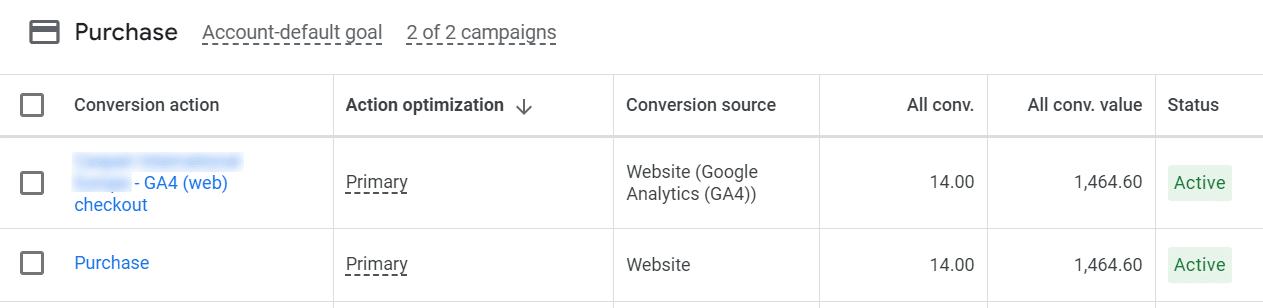
The two purchase events (pixel-driven and GA4 event-driven) are both being counted as a purchase conversion in Google Ads, and their combined conversion value would count as the total purchase conversion value.
This means that although the actual purchase conversion total is 14, it would be counted as 28, and the conversion value, which should be $1,464.60, would be doubled to $2,929.20.
Let’s review how these inaccuracies affect campaign performance.
For a campaign that uses a bid strategy of target CPA, the campaign would use the 28 purchase conversions as the total instead of the actual 14 purchase conversions.
If we set our target CPA at $10/conversion, the campaign then believes that the total cost for the campaign should be as high as $2,800 for 28 conversions; whereas the total cost should only be $1,400 for the actual 14 conversions. Incorrect data can lead to the campaign spending too much based on our stated goals.
Organizations need to minimize inaccuracy to help ensure that the data that passes back to the ad platforms is as correct as possible. Perform an analytics and advertising audit and check to be sure data is passed correctly.
Dig deeper: How to combine GA4 and Google Ads for powerful paid search results
Cookie tracking creates data inaccuracy
In addition to user-created data inaccuracy, cookie tracking, which has traditionally been how we measure conversions from digital ads, can also create data inaccuracy. Cookies, by the very nature of how they work, have limitations to their data visibility.
Here’s an example of how cookies can lead to data inaccuracy. In this client’s case, they are running Microsoft Ads and are tracking with the Microsoft UET tag. The client also sends email promotions to its email list. Both channels are also tracked using events in GA4.
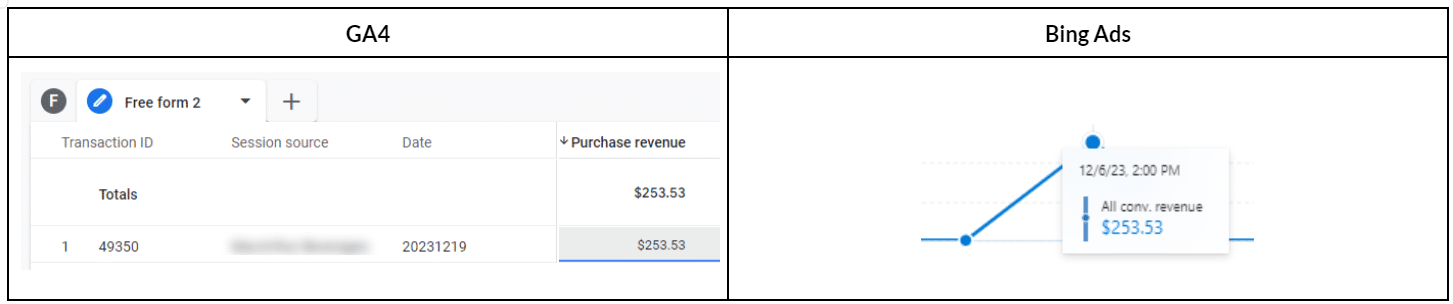
The company had a purchase for $253.53. In GA4, the session source for this conversion on 12/14 was an email marketing campaign.
However, in Microsoft Ads, the same purchase event was tracked by the pixel and attributed to the original Microsoft Ad, which the buyer clicked on 12/6, even though the buyer didn’t purchase until after the email on 12/14.
Microsoft Ads’ pixel claims the purchase conversion wholly for Microsoft Ads because the pixel doesn’t have the holistic view we have in GA4, where we track multiple channels’ performance.
While the ad contributed to the conversion, it was not ultimately the last touch channel. In reality, Microsoft Ads should likely only have 50% of the credit for this purchase, but because the pixel cannot see all of the data, it attributes 100% of the credit to Microsoft Ads.
If we spent $126.77 on the campaign and generated the reported $253.53 in revenue, then our ROAS is 200%. But if we were tracking and attributing the sale to only give 50% to the Microsoft Ad, then the actual ROAS would only be 100%.
So, if our bid strategy is a target ROAS of 200%, the pixel assumes we have met this threshold when perhaps we have not.
While this is a simple, two-step customer journey, many customer journeys are much more complex, with multiple steps in between.
Additionally, if your organization does not use a single source of truth (SSOT), such as GA4, for reporting, then each channel manager may attribute the same conversions to their channel.
In our client example, the Microsoft Ads manager and the email manager would both count this single purchase as $253.53 in revenue for a total across both platforms of $597.06 in revenue generated, which will not match our actual purchase revenue.
Dig deeper: Tracking in 2024: Where we are and how to prep
Third-party cookie tracking is being phased out
Ad platform cookies are considered third-party cookies because they are not cookies generated directly by your website.
To become more compliant with various privacy laws, Google is in the process of phasing out third-party cookie tracking.
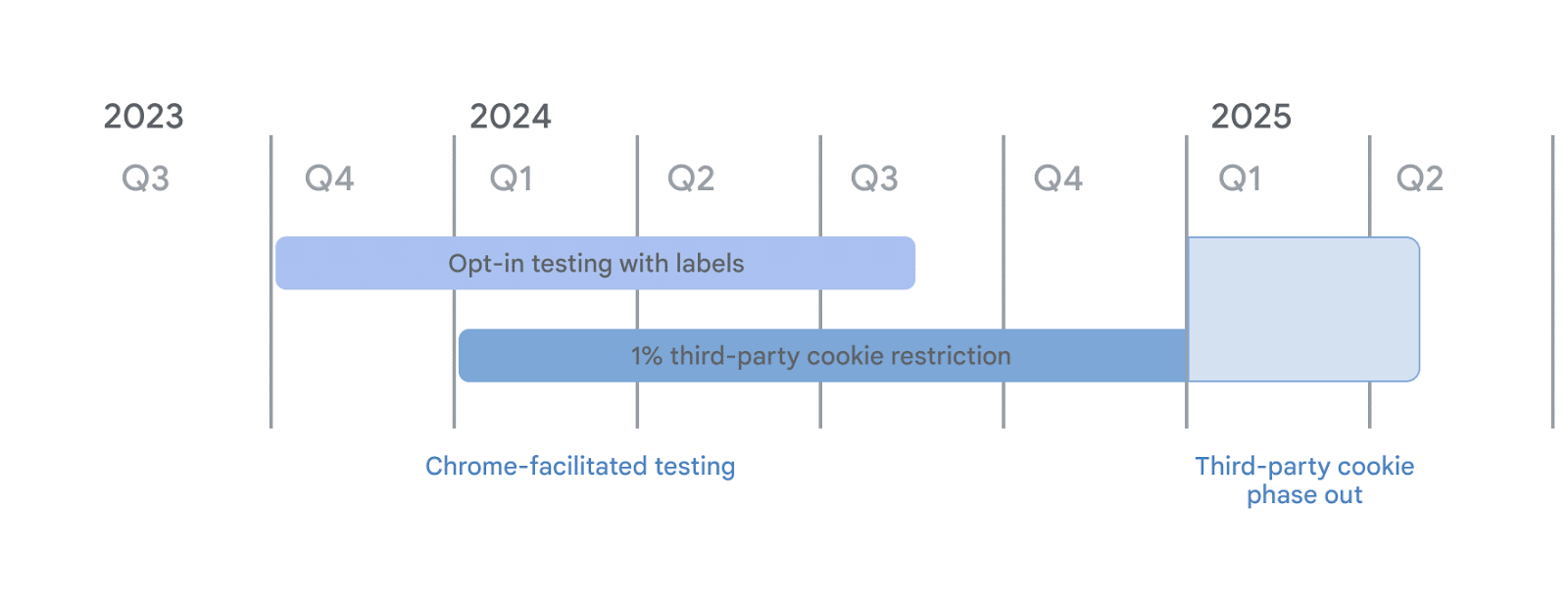
While cookie tracking hasn’t always provided the most accurate data, it’s been the workhorse we’ve relied on as digital marketers. However, there’s a new option your organization should be moving to now, ahead of the cookie phase-out, to ensure data continuity and accuracy.
Conversion APIs fix cookie tracking inaccuracy
If you advertise on Google, Facebook, LinkedIn, TikTok, Pinterest or Snapchat, you may have seen their attempts to have advertisers adopt their conversion APIs.
Unlike third-party cookies, which rely on the browser to set and be read, conversion API-based tracking sends user information directly from the platform’s server.
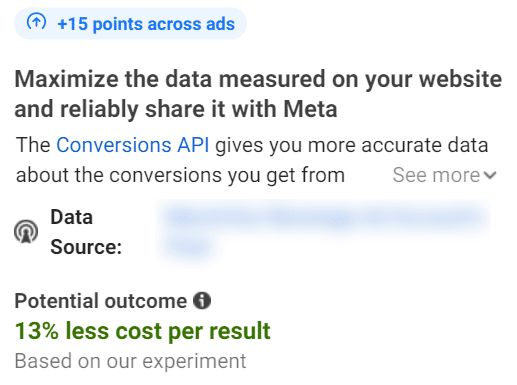
Since the conversion API method works on the server side and doesn’t rely on the browser, it can provide more accurate data because it doesn’t face certain limitations, such as ad and cookie blocking software and the tunnel vision that pixel tracking incurs.
Getting the data right
Your organization can take two main steps now to shore up your conversion data with ad platforms.
- First, audit your ads to ensure that users are tagging and tracking conversions correctly. Look for common missteps, similar to the Google Ads purchase example.
- Second, convert to the conversion API (CAPI) method. Implementing CAPI can be a bit technical, so you may need your web developer to assist.
Courtesy of Search Engine Land: News & Info About SEO, PPC, SEM, Search Engines & Search Marketing
Category seo news | Tags:
Social Networks : Technorati, Stumble it!, Digg, de.licio.us, Yahoo, reddit, Blogmarks, Google, Magnolia.
Google turns off Universal Analytics July 1: What you need to know
Written on June 21, 2024 at 12:55 pm, by admin

Google is discontinuing Universal Analytics, its legacy web analytics platform. This is the final shift in the transition to Google Analytics 4 (GA4).
Why it matters. Businesses that relied on Universal Analytics for website measurement and data analysis need to act quickly to avoid losing access to their historical data and maintain continuity in their analytics capabilities.
Key dates.
- July 1: Users will lose access to Universal Analytics data and interface.
- After July 1: All Universal Analytics data will be permanently deleted.
Why we care. We’ve finally reached the “now or never” moment. Export your historical data or you’ll lose it all in July.
The big picture. This transition marks a significant shift in Google’s analytics offerings, with GA4 designed to be more privacy-focused and adaptable to future changes in technology and regulations. However, search marketers remain unimpressed with GA4 – many of them still absolutely hate GA4.
Details:
- Universal Analytics properties are identifiable by tracking codes starting with “UA-“.
- Google has been automatically creating GA4 properties for users since March 2023.
- Several features, including real-time reports and certain advertising capabilities, have already been deprecated.
- There will be no visibility of historical UA bidding, audience or conversion data.
- Universal Analytics 360 contract holders will no longer be able to create standard Universal Analytics properties.
- Publisher or other product integrations (e.g. UA audience list, BigQuery exports, UA API requests) will be unavailable when services have stopped.
What to do.
- Export your Universal Analytics data before July 1, 2024.
- Set up and configure a Google Analytics 4 property if you haven’t already.
- Migrate Google Ads links and create new conversions based on GA4 events.
Bottom line. If you haven’t already, you need to act swiftly to preserve your historical Google Universal Analytics data.
Courtesy of Search Engine Land: News & Info About SEO, PPC, SEM, Search Engines & Search Marketing
Category seo news | Tags:
Social Networks : Technorati, Stumble it!, Digg, de.licio.us, Yahoo, reddit, Blogmarks, Google, Magnolia.
Google streamlining YouTube, Display ad content controls
Written on June 20, 2024 at 9:53 am, by admin
Google is consolidating its content suitability levers for advertisers across YouTube and the Display Network starting in September.
What’s changing:
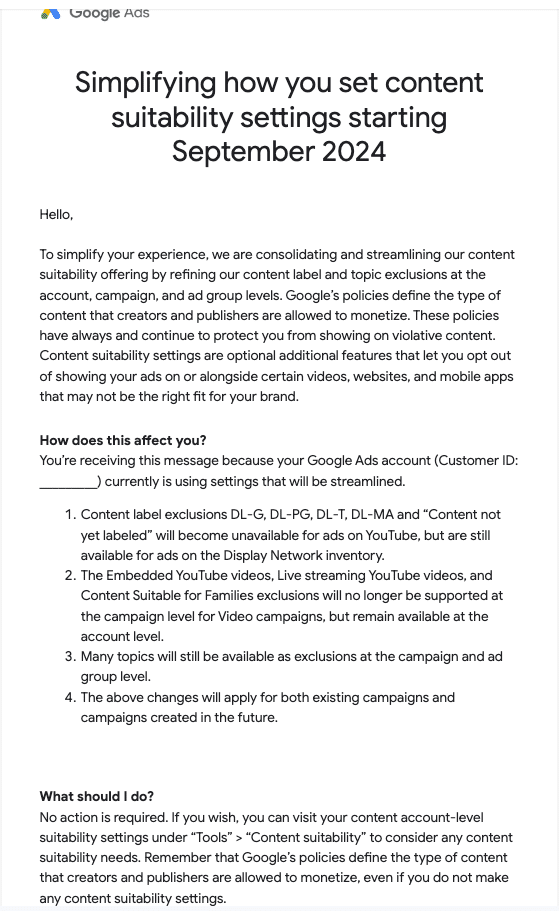
- Several content label exclusions will be removed for YouTube ads (DL-G, DL-PG, DL-T, DL-MA, “not yet labeled”) but remain for Display
- “Embedded YouTube videos”, “Live streaming”, and “Families” exclusions only available account-wide, not per YouTube campaign
- Many topic-based exclusions still offered at campaign and ad group levels
Why we care. The updates could have implications for brand suitability, campaign targeting strategies, and ultimately return on ad spend on YouTube and Display campaigns that advertisers will want to get ahead of.
Why it matters. The updates aim to simplify Google’s array of brand suitability controls while preserving flexibility for advertisers.
Key details.
- Changes impact both existing and new campaigns created after September
- No action required for advertisers currently using affected exclusion settings
- Google’s core ad policies prohibiting violative content remain in place
The email. Search Engine Land contributor and Founder of JXT group Menachem Ani shared with me the email he received from Google.
The big picture. As brand safety remains a priority, Google is looking to streamline suitability options and controls across its advertising platforms.
What’s next? Check account-level suitability settings closer to the September rollout for any needed adjustments.
Courtesy of Search Engine Land: News & Info About SEO, PPC, SEM, Search Engines & Search Marketing
Category seo news | Tags:
Social Networks : Technorati, Stumble it!, Digg, de.licio.us, Yahoo, reddit, Blogmarks, Google, Magnolia.
Display & Video 360 instant reports coming to Bid Manager API
Written on June 20, 2024 at 9:53 am, by admin
Google will make Display & Video 360’s instant reports accessible through the Bid Manager API over the next few months as part of a migration from offline reporting.
The big change. Once a partner is migrated, instant reports will be included in responses from the queries.list API endpoint.
Why we care. Instant reports provide advertisers with real-time or near real-time reporting data, as opposed to waiting for offline/batch reports. This allows for more timely analysis and optimizations.
What’s happening.
- Existing standard, reach, YouTube, and URA reports will only be available under the Instant Reporting tab, with same query/report IDs.
- Any new standard, reach, YouTube, and URA reports must be built under the Instant Reporting tab.
- The migration will happen in batches by partner over the coming months, with all reports for a partner migrating at once.
Context. This follows Google’s previously announced move to migrate certain report types to instant reporting for faster data access.
Support.
- General migration questions can go through the standard DV360 support form.
- API-specific issues should use the new Bid Manager API technical support contact form.
The big picture. The API integration allows advertisers to programmatically access DV360’s real-time reporting data for analytics and optimizations.
Courtesy of Search Engine Land: News & Info About SEO, PPC, SEM, Search Engines & Search Marketing
Category seo news | Tags:
Social Networks : Technorati, Stumble it!, Digg, de.licio.us, Yahoo, reddit, Blogmarks, Google, Magnolia.
Google unleashes June 2024 spam update
Written on June 20, 2024 at 9:53 am, by admin

Google has unleashed a new search spam update today, the June 2024 spam update. This spam update may take up to one week to complete, Google wrote.
Google posted this update and wrote:
One week to roll out. Released the June 2024 spam update. The rollout may take up to 1 week to complete.
Spam updates. Google linked to its standard spam updates documentation that reads:
While Google’s automated systems to detect search spam are constantly operating, we occasionally make notable improvements to how they work. When we do, we refer to this as a spam update and share when they happen on our list of Google Search ranking updates.
For example, SpamBrain is our AI-based spam-prevention system. From time-to-time, we improve that system to make it better at spotting spam and to help ensure it catches new types of spam.
Sites that see a change after a spam update should review our spam policies to ensure they are complying with those. Sites that violate our policies may rank lower in results or not appear in results at all. Making changes may help a site improve if our automated systems learn over a period of months that the site complies with our spam policies.
In the case of a link spam update (an update that specifically deals with link spam), making changes might not generate an improvement. This is because when our systems remove the effects spammy links may have, any ranking benefit the links may have previously generated for your site is lost. Any potential ranking benefits generated by those links cannot be regained.
Previous spam updates. The last spam update was on March 5, 2024 and was named March 2024 spam update, it completed on March 20th.
Here’s our past coverage of confirmed Google spam updates:
- March 2024 spam update
- October 2023 spam update
- December 2022 link spam update
- October 2022 spam update
- November 2021 spam update
- July 2021 link spam update.
- A two-part Spam Update – June 23 and June 28
Why we care. This is the first Google search algorithm update we had since the massive March 2024 core update and spam updates. It is unclear exactly what type of spam this targets but if you notice any ranking changes over the coming week, it might be related to this spam update.
Courtesy of Search Engine Land: News & Info About SEO, PPC, SEM, Search Engines & Search Marketing
Category seo news | Tags:
Social Networks : Technorati, Stumble it!, Digg, de.licio.us, Yahoo, reddit, Blogmarks, Google, Magnolia.