

1 million URLs: How to pivot your SEO strategy when you reach enterprise level
Written on June 6, 2022 at 12:11 pm, by admin
“We don’t have enough content on the website. We need to publish 100 pages per month.”
That is typically what I hear from the C-suite and across departments when they hire an SEO director for the first time at an enterprise company.
Content has long been considered the holy grail of SEO – continually sought after but difficult to grasp intent, relevance and trust.
More content published doesn’t mean better rankings. Martin Splitt and Lily Ray debunked this myth advising not to produce content for the sake of producing content.
So, when you get to the one million URLs, does your view on content frequency change? How do you maintain organic traffic increases without more content? And without an increase in organic traffic, how does more revenue come in from organic?
The truth is when it comes to enterprise SEO, if your work doesn’t improve the bottom line, then your SEO strategy needs a gut check.
Your enterprise company now recognizes that SEO drives revenue. Seize the shift.
There is a clear paradigm shift from small business SEO to enterprise SEO. It can often feel like an unwelcome sense of deja vu. The reality is when you get to millions of webpages; your SEO strategy needs to adapt.
Also, the relationship between technical, content and backlinks is entering a new era. Page experience is here to stay.
Over the past few years, enterprise SEO professionals have been forced to tailor their strategies to focus more on content topical relevance and authority and improve Core Web Vitals.
Luckily, if your enterprise company hired a director of SEO, they understand the importance of SEO for revenue. SEO is integrally connected to sales.
Now is the time to create a new enterprise SEO strategy that balances short and long-term results. Think of this as an opportunity to be on equal footing as your marketing counterparts.
As your mindset shifts from small business SEO to enterprise SEO, think about the entire funnel – from top to bottom – to create a holistic approach to SEO to support the different areas of business within your company.
Segment your technical SEO audit by categories or business function
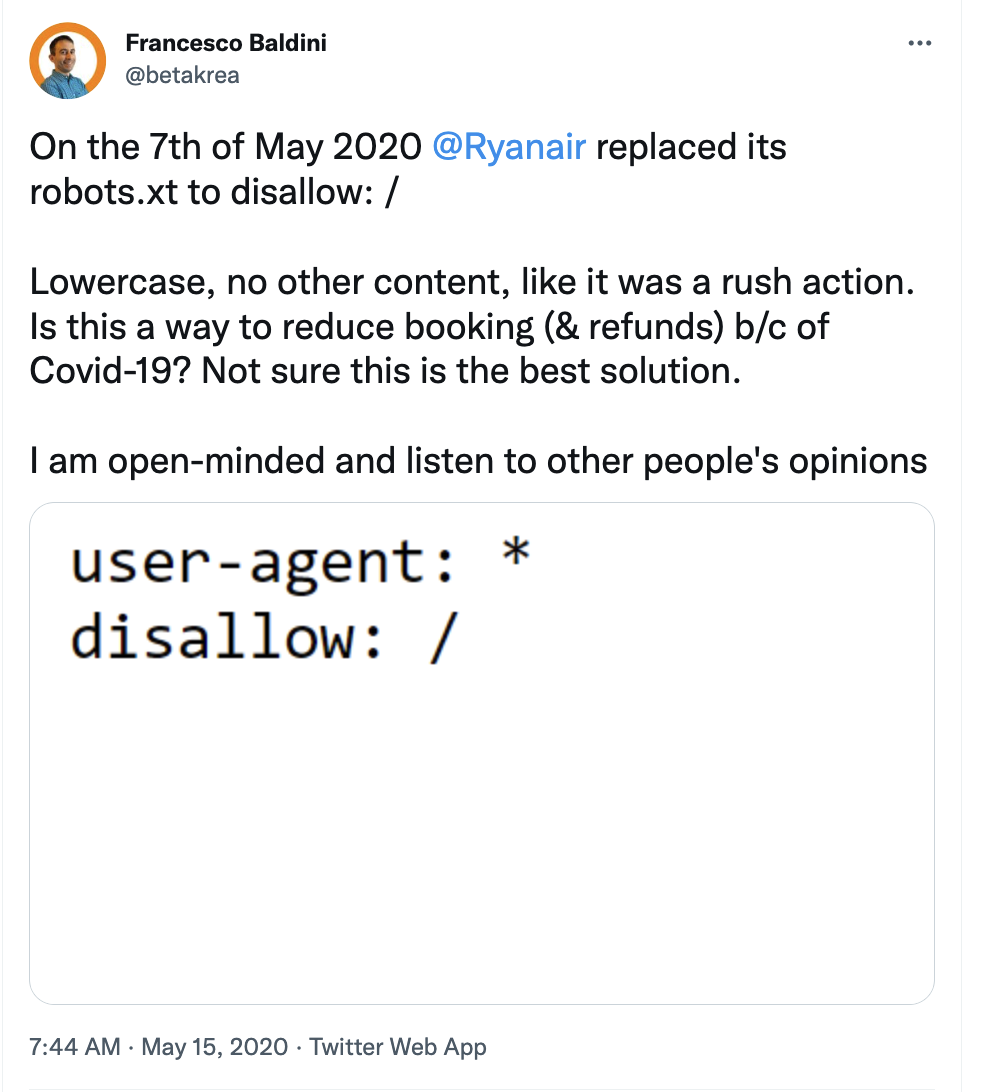
The transition from SEO to enterprise SEO can be a bit scary from a technical perspective. One small change can have a major impact on your revenue.
This is what happened with Ryanair.
On the flip side, one small change to your page speed can have massive improvements across your entire website.
EBay targeted its category pages for image optimizations and eventually trickled this down to all website pages. For every 100 milliseconds improvement in search page loading time, eBay saw a 0.5% increase in “Add to Cart” count.
Enterprise SEO professionals need to get away from top-level and understand the inner workings of a company’s org structure.
As an enterprise SEO professional, your job is to respect and prioritize your technical SEO audits and roadmap based on categories or themes on the website or business function.
When you begin to segment your technical SEO by your company’s org structure, you’re opening the door for a collaborative discussion across multiple departments.
For example, I’m working on an audit for a company that sells printers, sewing machines, scanners, label makers, etc.
The business has structured its org chart by business unit (BU). There is one department that supports printers. If I presented a technical SEO audit to the printer’s team about sewing machines, that would be a complete waste of time for those BU leaders.
By sectioning your technical SEO based on BU, you can prioritize what’s most important to each.
Audit content by type and department
When it comes to auditing and strategizing on your enterprise SEO content, you want to rinse and repeat how you segment your technical SEO. Stick to the auditing based on content type and company org chart.
Remember, your value is created by a more holistic approach to content that drives last-mile decisions as opposed to a siloed approach. Utilize key stakeholders across teams to better understand pain points and see how you can help solve a problem with content.
Then, you want to focus on the right content fueling the engine for each department.
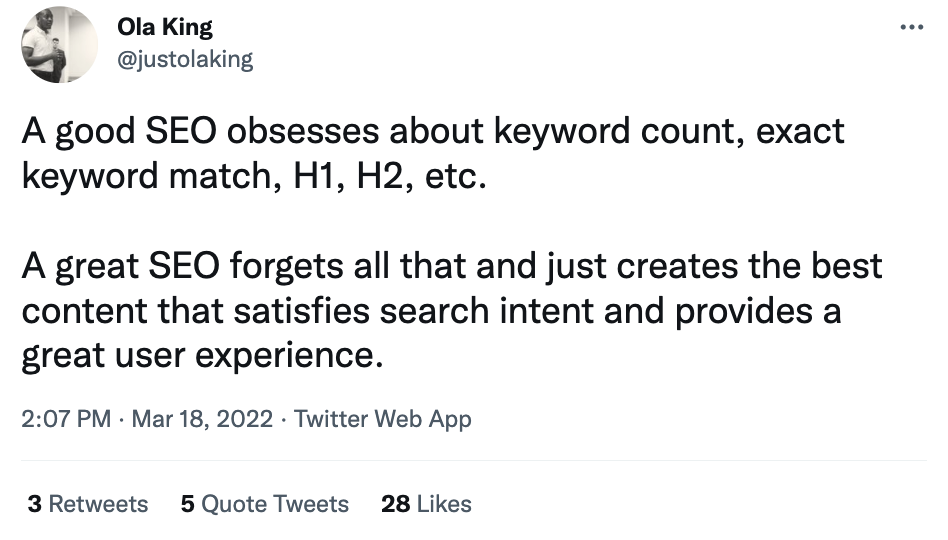
Ola King said it beautifully.
Once you’ve identified the top-performing content, start establishing templates and documentation to replicate the process on a larger scale.
By supporting other department initiatives with your content, you create a true partnership that drives meaningful, high-value organic traffic.
Leave the link building to digital PR and content distribution teams
Link building is dead. There I said it.
Now before you start to troll me on Twitter, let me explain.
Link building is dead at enterprise companies.
Why?
There are already multiple departments managing the link building work internally.
The goal of enterprise SEO with link building should be more about collaboration across your org structure.
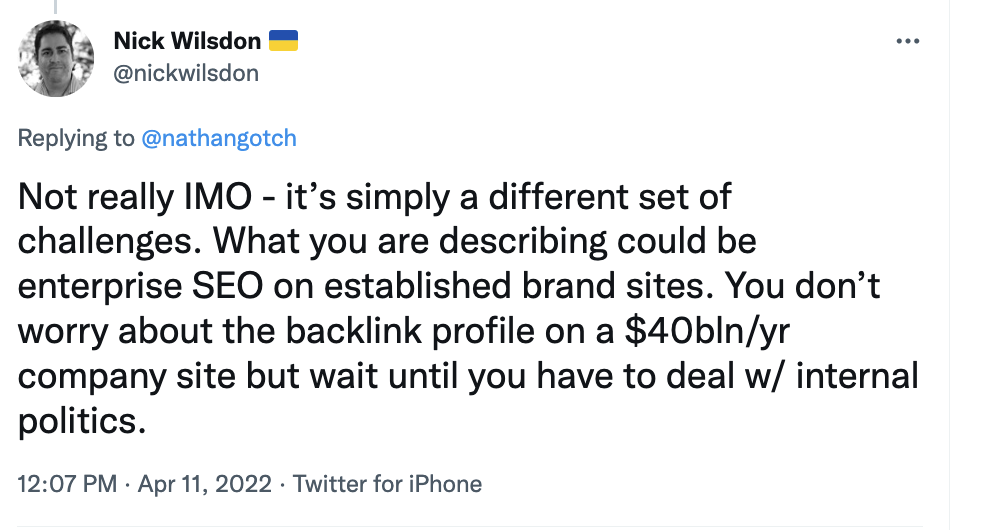
I’m not alone in this ideation. See what Nick Wildson, CEO and founder of Torque Partnership, says.
Think about it.
Your PR department is already doing link building by increasing brand reputation and guest posts for your CEO (or other department head).
Under the PR department, you may have an Influencer or Ambassador Manager generating sponsored content and user-generated content.
Your social media team is already repurposing your content into social media, even repurposing to the C-suite social channels. And the social team manages your YouTube or Google Profile. If you’re lucky, the social team also owns Reddit, Quora and Wikipedia.
You want to create documentation and guidelines to support these department initiatives. You don’t have to own their strategies, but you can contribute to them with an SEO eye to establish guardrails.
With that said, there are certain SEO link-building tactics like broken link building that should continue to be on your radar quarterly for quick wins.
A solid enterprise SEO foundation is the key to scaling to one million organic landing pages
I noticed enterprise SEO professionals often ignore or don’t take the time to invest in foundational SEO. Even if it’s not sexy, foundational SEO will get you over the finish line.
Today, enterprise SEO leaders have an opportunity to connect the customer journey to the full-growth business plan. Your goals should be focused on scaling content and website performance in a more meaningful way for the customer.
By building connective tissue across other departments, your enterprise SEO strategy will begin to get engrained into the culture and transform your company to be more competitive and unlock new levels of content creation, giving you center stage in the C-suite.
The post 1 million URLs: How to pivot your SEO strategy when you reach enterprise level appeared first on Search Engine Land.
Courtesy of Search Engine Land: News & Info About SEO, PPC, SEM, Search Engines & Search Marketing
Category seo news | Tags:
Social Networks : Technorati, Stumble it!, Digg, de.licio.us, Yahoo, reddit, Blogmarks, Google, Magnolia.
Google Chrome’s Topics API test going public July 1
Written on June 4, 2022 at 6:01 am, by admin
“A small percentage of traffic” will soon see the initial testing of Google Chrome Topics API go live on July 1. The new feature will enable users to enable interest-based advertising without having to track the site a user visits.
Interest-based advertising. According to recent developer documentation, “IBA can help advertisers to reach potential customers and help fund websites that cannot otherwise easily monetize visits to their site purely via contextual advertising. IBA can also supplement contextual information for the current page to help find an appropriate advertisement for the visitor.”
The Topics API. The Topics API has three main tasks:
- Maps website hosts to topics of interest. For example, a yoga website would be categorized under “Fitness”
- Calculate the main topics for a user based on their browsing history
- Provide a JavaScript API to help select appropriate ads based on the user’s interest
Review the official developer’s documentation. You can find the entire developer’s documentation on the new Topics API test here.
What Google is saying. Google states that this initial test is to validate that their systems are operating as designed, and no revenue or performance impact is expected. But advertisers who prefer not to be included in the initial test can opt out using Chrome’s Permissions-policy header.
Why we care. When Google announced the API trial in January, advertisers were less than enthused. Marketers from various agencies raised concerns around the 350 topics outlined not being sufficient enough to provide relevant targeting. Less topics means more competition around less targeted ads, which is a problem for everyone involved. Google may already be aware of the issue, but unless they have significantly improved this list in advance of the test, we may not see a change advertisers opinion or projected outcome. There is no word on how long the trial will go on.
The post Google Chrome’s Topics API test going public July 1 appeared first on Search Engine Land.
Courtesy of Search Engine Land: News & Info About SEO, PPC, SEM, Search Engines & Search Marketing
Category seo news | Tags:
Social Networks : Technorati, Stumble it!, Digg, de.licio.us, Yahoo, reddit, Blogmarks, Google, Magnolia.
Yandex CEO and founder resigns following sanctions
Written on June 4, 2022 at 6:01 am, by admin
Arkady Volozh, Yandex’s CEO and executive director, resigned from his position, the company announced today.
The European Union imposed sanctions on Volozh personally. Yandex has not been sanctioned by the EU, U.S., or UK. Volozh had a 45.3% voting and 8.6% economic interest in Yandex.
Why we care. Yandex is generally regarded as Russia’s Google, even though Yandex pre-dates Google (Yandex launched in 1997). Yandex’s share of the Russian search market is estimated to be at 48%, behind Google’s 49%, according to StatCounter – but Yandex says it owns 61% of the search market. So this development, as well as others below, mean it’s worth keeping an eye on the state of the company if you work on any sites that rely on Yandex organic traffic.
What Volozh said. “While I consider this decision to be misguided and ultimately counterproductive, I do not intend to give any instructions to my family trust as long as sanctions are in place. During this time the trust will vote in line with the recommendations of the Board. While I will continue to support the team wherever possible, this decision is in the best interests of the company and its stakeholders.”
Go deeper. On March 22, Wired published Is Russia’s Largest Tech Company Too Big to Fail? The article details how everything Volzh helped build over 20 years began crumbling in 20 days.
Timeline of Yandex turmoil. Here are some significant Yandex stories since Russia’s invasion of Ukraine on Feb. 24:
- Feb. 28: Nasdaq suspended trading of Yandex shares. (Nasdaq)
- March 3: “We believe that our current data center capacity and other technology critical to operations will allow us to continue to operate in the ordinary course for at least the next 12 to 18 months. In the event of any prolonged suspension of supplies of hardware, software or other technology used in our business or offerings, if we are unable to secure alternative sources, our operations could be materially adversely affected over time.” (Yandex)
- March 7: Esther Dyson and Ilya Strebulaev resigned from Yandex’s board of directors (Yandex).
- March 15: Yandex Deputy CEO and Executive Director Tigran Khudaverdyan, who had been sanctioned earlier in the week, resigned. (Yandex)
- March 16: Yandex rumored to be in negotiations to sell its media division (news and Zen). (TechCrunch)
- April 27: Yandex’s Q1 financials were released. Yandex reported an adjusted net loss of 8.1 billion roubles ($110 million). The company said it experienced continued stable operations and strong growth across most of its businesses until Feb. 23. (Reuters)
- April 28: Yandex announced the sale of news and Zen to VK. (Yandex)
- May 18: It was reported that Yandex was exploring selling search and mail and moving its headquarters to Israel. (Data Center Dynamics)
The post Yandex CEO and founder resigns following sanctions appeared first on Search Engine Land.
Courtesy of Search Engine Land: News & Info About SEO, PPC, SEM, Search Engines & Search Marketing
Category seo news | Tags:
Social Networks : Technorati, Stumble it!, Digg, de.licio.us, Yahoo, reddit, Blogmarks, Google, Magnolia.
Google introduces three new travel products for hotels
Written on June 4, 2022 at 6:01 am, by admin
Hotels looking to book new travelers and capitalize on this summer’s travel frenzy will soon discover a much easier way to manage and change their rates.
What’s new. Earlier this week Google announced three new features to actively open the onboarding process for hotels wanting to list their rates or provide booking links through Google.
Update 1: Industry-standard protocols. Google will support industry-standard protocols for bringing hotel rates online. These protocols are created to help different hotels remain consistent with booking, uploading new rates and making changes.
Update 2: No more spreadsheets. Hotels will no longer be required to upload complicated spreadsheets and files to add rates to their Google Business Profile. Instead, Google is simplifying this process by allowing to directly input their rates into their profiles. This change should make it easier for hotels to keep up with demand and change rates quickly, without getting technology providers or partners involved.
Update 3: Open access to Hotel Ads. Soon, hotels will no longer need a Hotel Center account to run campaigns. This means that any Google advertiser can search for and run campaigns for any hotel’s website. When asked whether they would phase out Hotel Center accounts altogether, Google stated “We will not be phasing out Hotel Center accounts. Current hotel advertisers with existing Hotel Center accounts will continue to operate and serve ads as usual.”
Launch date. Google is actively supporting industry protocols and allowing hotels to input their rates into Google My Business. However, there is no word yet on when the Hotel Center account requirement will be lifted.
What Google is saying. In regards to the reason for the changes, a Google spokesperson told Search Engine Land: “We’re streamlining this process to help more advertisers utilize hotel ads, and activate them more quickly. This is part of our overall efforts to help more hotel businesses get online.”
Travel on the rise. Google indicates that searches for passport appointments increased 300% over the first four months of 2022.
Earlier this week Snapchat also announced the introduction of Dynamic Ads for Travel. The new feature allows brands such as Booking.com to create catalogs and serve to audiences based on travel intent. The focus on travel-related products should give us an early indication of where the industry is headed.
The good and the bad. Adding rates to a hotel’s Google Business Profile allows them to appear in search, maps, and YouTube. Those free booking links will also direct users to book on a hotels actual website – not a third party. Which means more revenue for the hotel and less for sites such as Booking.com or Hotels.com. Hotels are also not allowed to add multiple rates for different room types, minimum stay restrictions, or discounts for multi-night stays.
Official announcement. Read the complete announcement and current setup documents here.
Why we care. Travel is bouncing back and consumers want an easy streamlined process for booking hotels directly, as well as real-time room prices. These updates should help advertisers and hotels managing the listings stay ahead of the competition by being able to change rates directly on their Google Business Profiles.
The post Google introduces three new travel products for hotels appeared first on Search Engine Land.
Courtesy of Search Engine Land: News & Info About SEO, PPC, SEM, Search Engines & Search Marketing
Category seo news | Tags:
Social Networks : Technorati, Stumble it!, Digg, de.licio.us, Yahoo, reddit, Blogmarks, Google, Magnolia.
Google Ads shares three automation best practices
Written on June 4, 2022 at 6:01 am, by admin
Google has released a Search Ads Automation Guide that shares some best practices on how to use automation to reach customers. The guide is long overdue for some marketers who have an unfavorable opinion about automation in general. According to a recent Search Engine Land article, adoption of automation and recommendations is overwhelmingly positive, while satisfaction is low, with over half of users reporting a negative experience.
This new guide attempts to answer users questions and concerns around automation and ease the anxieties most advertisers have around letting go of control of their keywords and bids.
Best practice 1: use a broad match keyword strategy. Historically advertisers that used broad match keywords found wasted ad spend and irrelevant clicks. It seems like there haven’t been any new features or updates around broad match. But Googles is attempting to help users better understand why they should use them, and with what bid strategy they feel will have the biggest impact for their account. Google states “Broad match keywords work best with Smart Bidding because it ensures you only bid on searches that are expected to perform for you.”
Best practice 2: using smart bidding strategies. Google says that evolutions in automation and machine learning will allow us to simplify how we setup and manage campaigns. The guide goes into great detail on why a smart bidding structure is best to use with broad keywords. But veteran advertisers know that making too many account changes at once, especially moving toward a hands-off automatic approach, can be detrimental for performance. Testing smart bidding strategies are a great idea in general, but be cautious of spend, conversion changes, and general advice around this topic from your Google rep.
Best practice 3: use responsive search ads. Google advises to “use multiple headlines and descriptions to automatically build and serve relevant ads for every query based on auction-time signals.” This is one strategy we can get behind. Responsive search ads allow a level of automation, but within the parameters you define. You maintain control of your ads by creating multiple headlines and descriptions, and allowing Google to show the most relevant combination to your audience
The guide. All info is taken from Googles guide “Unlock the Power of Search: Inside Search Automation with Google Ads.” The guide is long at 28 pages and likely makes for great bedtime reading. The guide features a promising but generic case study from Tails.com (a pet food company for which Nestlé Purina Pet Care is their biggest investor), but provides no insight into their (what was likely a large) budget and ad spend, which is information most businesses would be interested in knowing.
Read the guide. The full PDF can be downloaded here.
Why we care. Google’s efforts at getting their users to understand automation is likely an attempt to get more people to not only adopt the best practices they define, but to leave those campaigns running long enough to see results. For many advertisers, this is simply not possible. If you have a large budget, go ahead and test these strategies and best practices. But as far as letting your campaigns run on autopilot, or firing your agency, we’re not there yet.
The post Google Ads shares three automation best practices appeared first on Search Engine Land.
Courtesy of Search Engine Land: News & Info About SEO, PPC, SEM, Search Engines & Search Marketing
Category seo news | Tags:
Social Networks : Technorati, Stumble it!, Digg, de.licio.us, Yahoo, reddit, Blogmarks, Google, Magnolia.
New Twitter ‘Search Subscribe’ feature coming soon?
Written on June 3, 2022 at 2:59 am, by admin
You may soon have a new way to get push notifications from Twitter whenever someone’s tweets match a search query that you specify.
The Twitter feature is called “Search Subscribe.”
Twitter has not confirmed if or when the feature will roll out to users. It was first spotted by Dylan Rousse, an Android developer, in the latest pre-release version of Twitter’s mobile app.
Twitter is working on a feature allowing you to subscribe to search results. Once subscribed, you'll receive push notifications for Tweets about your search query!
pic.twitter.com/plTlt484oN
— Dylan Roussel
(@evowizz) May 31, 2022
How it works. When you do a search in the Twitter app, you will see a bell icon next to the search bar. Tapping that bell will bring up a message: “You’re subscribed to receive push notifications for Tweets about [insert your search query here]”.
Similar to TweetDeck. TweetDeck, which is also owned by Twitter, gives you an option to add a column. “Search” is a column type. So if you put in the search term “SEO” you would see every tweet that matches “SEO” in that column. Or, you can filter those results by location, authors and engagement levels.
Push notifications. Twitter lets you enable or disable a variety of notifications. This includes mentions, replies, retweets, new followers, direct messages and more. To date, search has never been one of these options.
For Twitter Blue? We previously reported that an edit button is coming to Twitter. But if and when that does finally launch, it will be part of the paid Twitter Blue service. Early speculation is that Search Subscribe would be part of Twitter Blue.
Why we care. If Search Subscribe works similarly to TweetDeck, this could be helpful for monitoring any keywords that are of interest to you. However, it could also become incredibly noisy so you’ll want to choose your search terms wisely.
The post New Twitter ‘Search Subscribe’ feature coming soon? appeared first on Search Engine Land.
Courtesy of Search Engine Land: News & Info About SEO, PPC, SEM, Search Engines & Search Marketing
Category seo news | Tags:
Social Networks : Technorati, Stumble it!, Digg, de.licio.us, Yahoo, reddit, Blogmarks, Google, Magnolia.
Snapchat now offers Dynamic Ads for Travel
Written on June 3, 2022 at 2:59 am, by admin
Snapchat has released an easy and automated way for businesses to reach travelers. The new product is called Dynamic Ads for Travel.
The new ad features. According to Snapchat’s announcement, the new ads will include the following components:
- Customized catalogs built to meet the needs of travel advertisers
- Advanced audience targeting based on intent
- Locally relevant delivery based on destination popularity
Good news for travel brands. Dynamic Ads for Travel, originally developed for companies such as Booking.com, allows advertisers and businesses to upload catalogs or feeds and show targeted ads to serve users based on their travel preferences and intent.
The announcement comes just months after many pandemic-related restrictions on masks and testing are being lifted, allowing tourism a chance to bounce back to pre-2020 levels.
Audience targeting uses machine learning and product ranking to serve ads to users who haven’t been to the advertisers website previously. While locally relevant targeting dynamically retargets users who have been to your website or app with listings they may be interested in.
Early results. Booking.com recently adopted the new strategy, serving ads with locally relevant listings of properties users had already viewed. The results were 20x lower cost per purchase, 1.3 times higher swipe rate, and 10.7 million impressions.
 Booking.com used Snapchats Dynamic Ads to serve locally relevant listings to those interested in their properties
What Snapchat says. Snap head of U.S. verticals Sharon Silverstein said in a statement, “As the summer vacation season approaches, travel businesses are looking to optimize reach and drive conversions. Snapchatters are a particularly salient audience for the industry, with many eager and more likely to travel than users of other platforms. Dynamic Travel Ads are driving impressive results for our partners, and we look forward to unlocking them for more businesses as the travel industry enters its busiest season.”
Official Snapchat documentation. Read the complete ad setup guidelines here.
Why we care. When it comes to advertising dollars spent, Snapchat trails behind industry giants such as Facebook and Instagram. But Snapchat is gaining momentum, with most of its users falling into Gen Z and millennial age groups. And with those groups being the most diverse travelers, Snapchat is a great place to advertise airline and hotel deals, new destinations, and popular hotspots.
The post Snapchat now offers Dynamic Ads for Travel appeared first on Search Engine Land.
Courtesy of Search Engine Land: News & Info About SEO, PPC, SEM, Search Engines & Search Marketing
Category seo news | Tags:
Social Networks : Technorati, Stumble it!, Digg, de.licio.us, Yahoo, reddit, Blogmarks, Google, Magnolia.
How to create captivating, compelling and optimized content
Written on June 3, 2022 at 2:59 am, by admin
We all know that “content is king.”
What many don’t understand is that for content to be king, it needs the support of its court.
To make the most out of your content strategy, it’s important for you to:
- Identify entities and topically-related keywords.
- Optimize for on-page elements.
- Build content that will stand out.
Create your editorial strategy
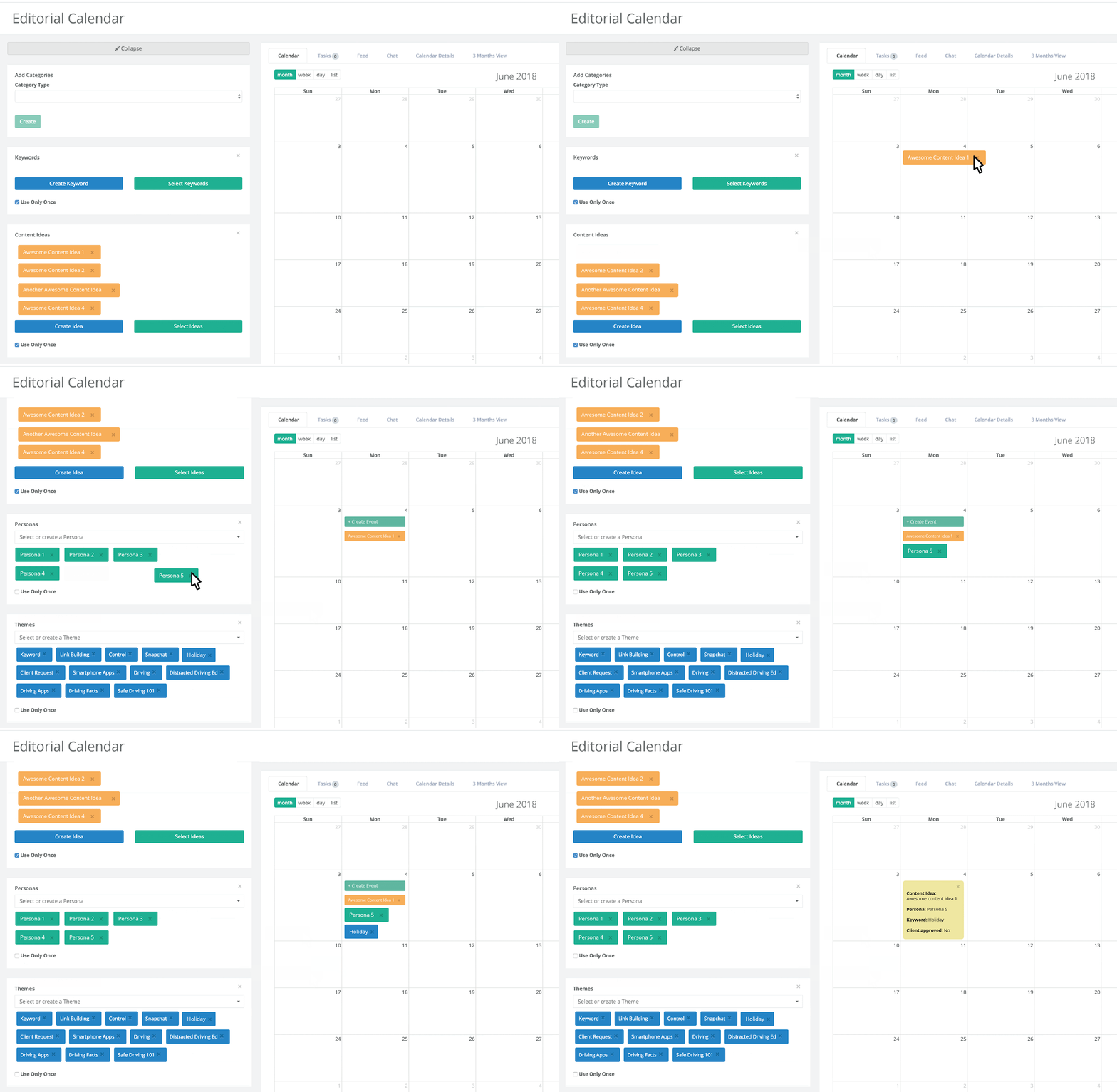
At this stage, you should have a comprehensive list of keywords. You should also have insights about your target audience, personas and buying cycle and what your competitors are doing.
Now it’s time to put that data to use.
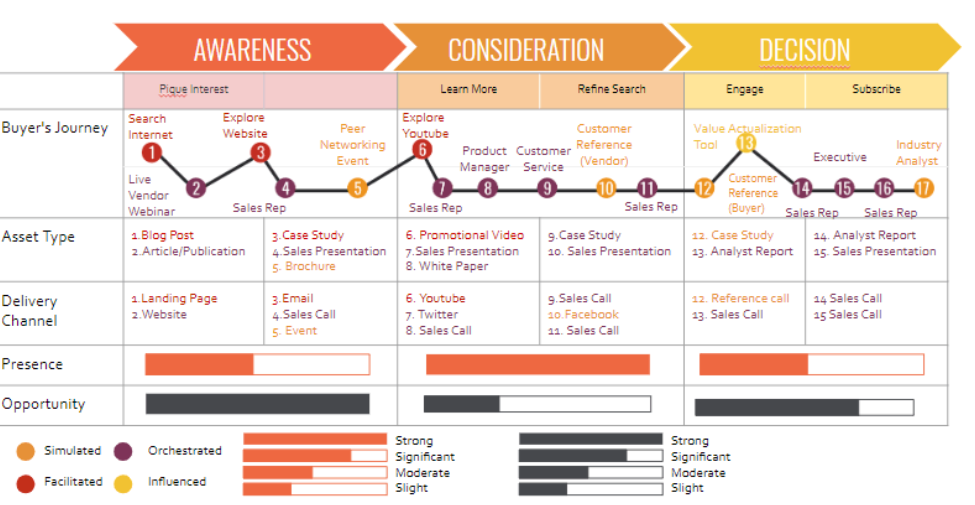
In the planning stage, you’ll need to determine:
- Cadence: How often will you publish content on your website/blog? Daily? Weekly? Monthly?
- Resources: How many writers do you have available? What about editors? How many words can they write every week while maintaining quality?
- Formats: What type of content will you be producing? Long-form articles? Infographics? Tutorials? Ebooks?
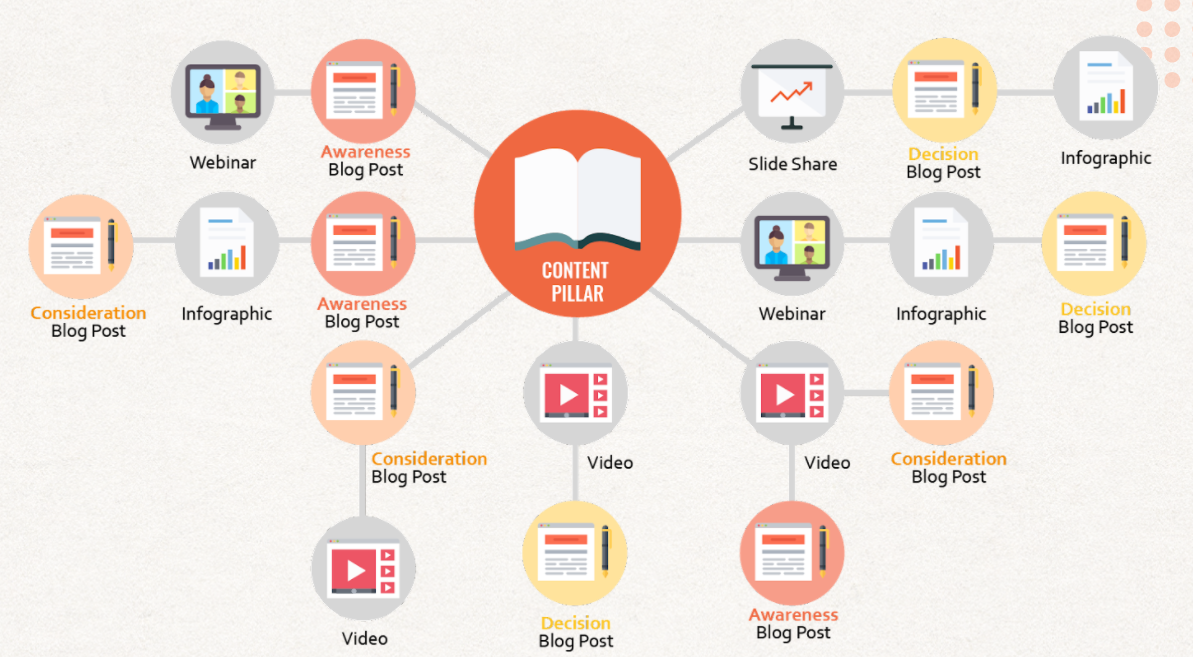
When developing your strategy, make sure you develop different types of content for the different ways of learning that your audience personas may exhibit. Some may learn visually, others prefer videos, yet others might enjoy looking at infographics or images.
Here’s how you should conceptualize your topic clusters or content pillars:
Style guides
Before developing content, make sure you have a style guide in place. For marketing agencies, this can be used as a library for assets: style guides, brand books, etc., provided to you by clients.
If you’re creating content for your own brand, this is where you can brainstorm your own style:
- What kind of imagery do you want to add to your content?
- What kind of voice should your authors use?
- What color palette should be used when creating visual content?
- What types of citations and references should your writers use?
Trending topics
What are some interesting trends in your industry that might appeal to your target audience? You can supplement your editorial calendar with trending topic ideas by setting up keyword alerts or an XML feed of relevant industry sites.
Tip: Watch for new patents or studies being released in your space. If you find a new patent that can significantly impact your industry, translating it into “people-speak” can help you gain news coverage.
A fantastic tool for monitoring news and staying up to date with your industry is BuzzSumo:
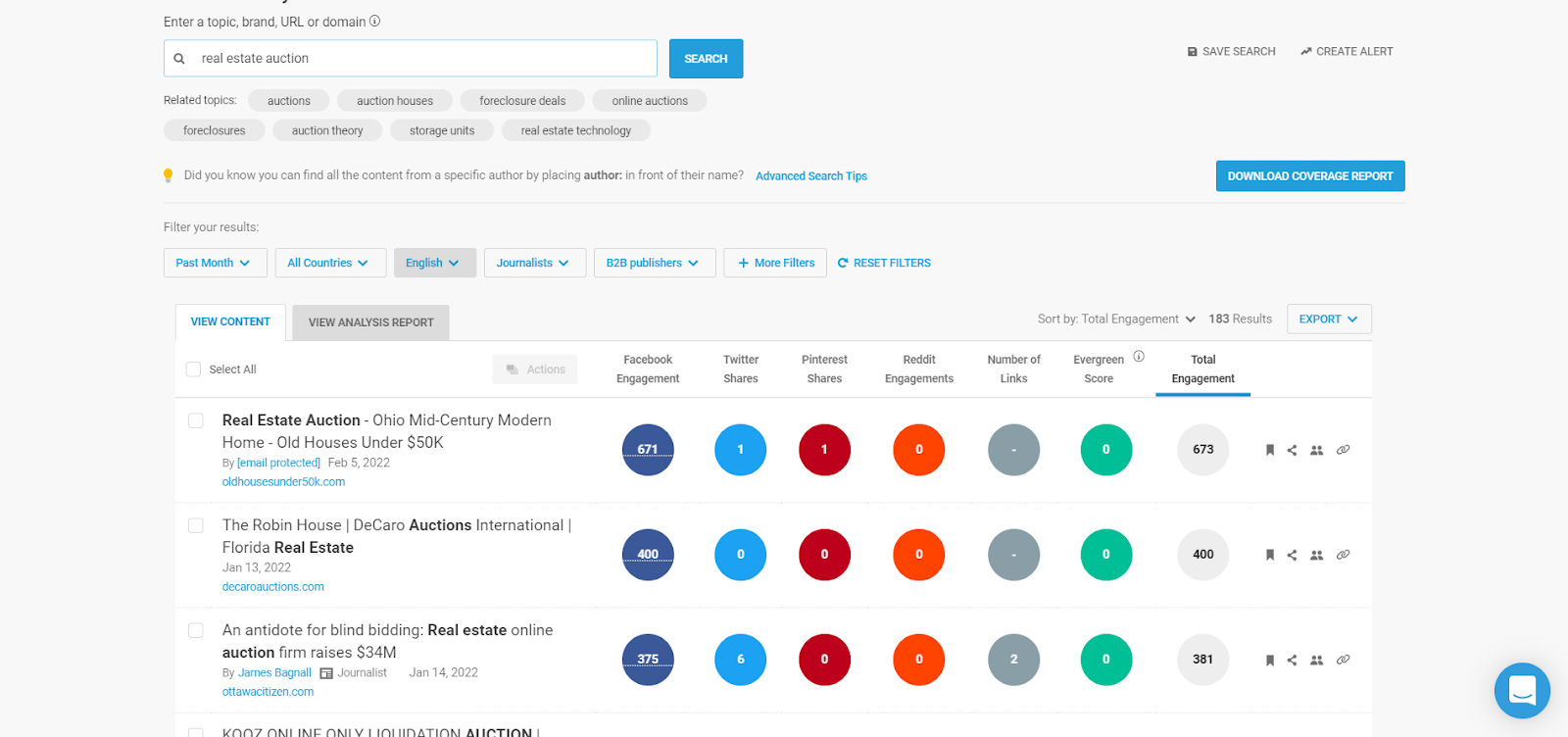
You can filter by keyword, site or date and see which articles resonated the most based on social shares.
Create your editorial calendar
Next, you can formulate topics and themes based on your topics, keywords and target persons. Mind mapping can help you organize your thoughts and create a strategy.
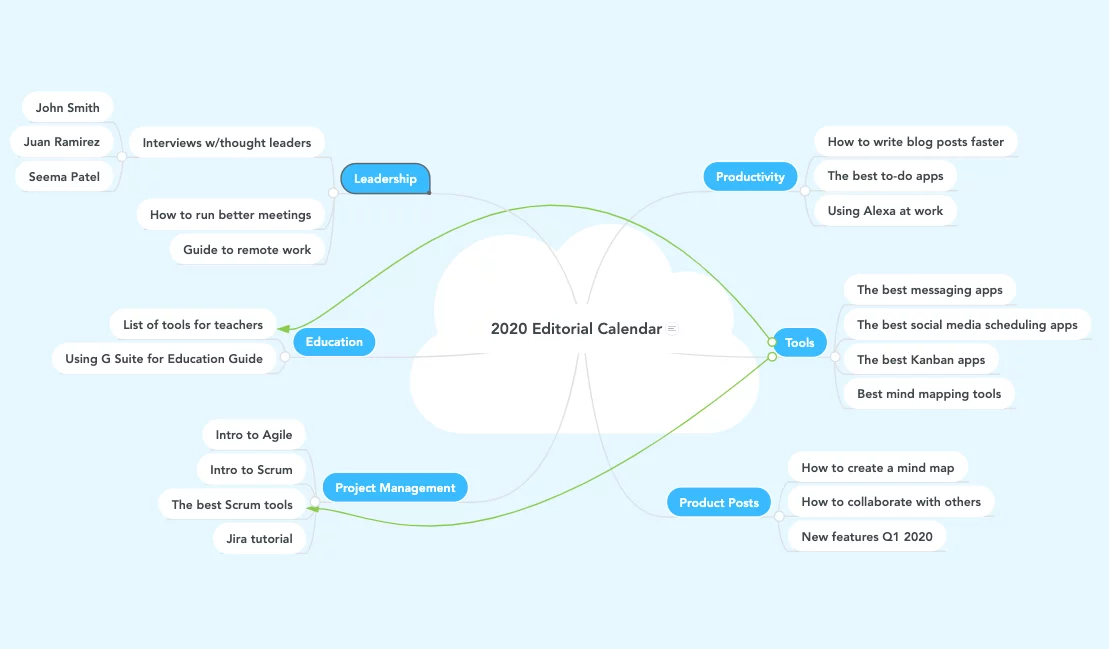
Next, map out your calendar by following these steps:
- Assign a theme, topic or seed set to each publication date.
- Segment each content piece by adding a buyer persona and buying stage.
- Select primary and secondary keywords for each content piece.
Here’s what it may look like at this stage:
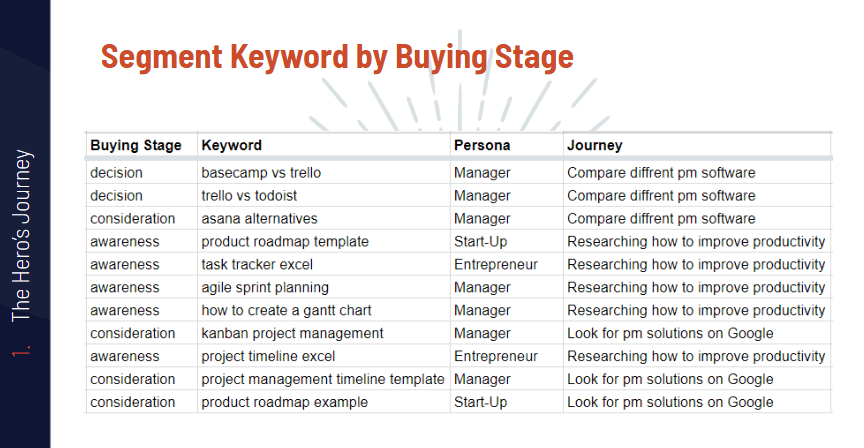
Next, you’ll want to find out what channels present an opportunity and create content for each specific channel. Some of these channels and content types include:
- Featured Snippets
- People Also Ask
- Knowledge Graph
- Videos
- Images
Here’s what your editorial calendar might look like at this stage:
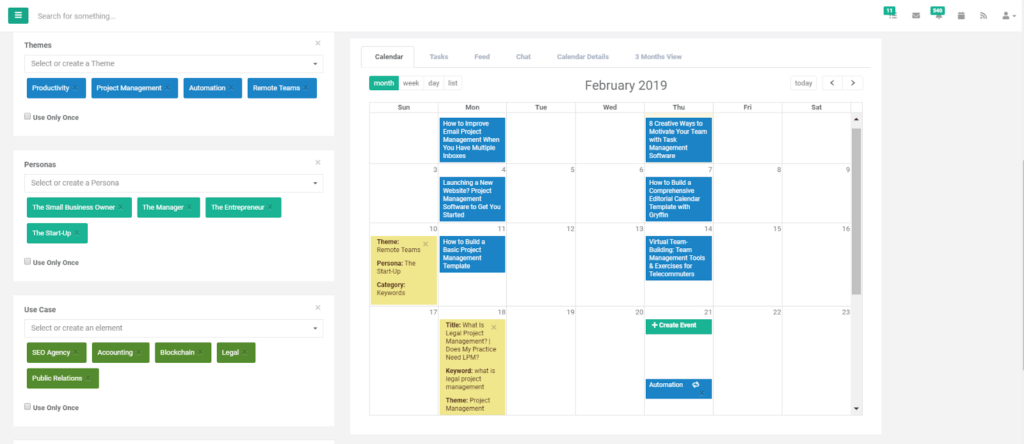
Your content cadence can help you determine what elements you use and how often. If you publish daily or multiple times a day, you can address all of your opportunity gaps faster than if you’re only publishing once a week or once a month.
The idea is to be strategic in the content you publish so it focuses on keyword gaps, your most devoted personas at their most advantageous stage in the buyer’s journey.
Having all the research handy can make your editorial calendar creation as simple as drag and drop!
When all of the elements are properly “framed,” it’s pretty easy to create appealing titles and to give your writers detailed descriptions to work with.
Manage your editorial calendar
To stay organized and strategic, you’ll want to include as much data as possible for each content piece. Here are some fields you should consider tracking:
- Article title
- Author
- Editor
- Date scheduled to publish
- Campaign
- Word count
- Content type
- Target persona
- Buying stage
- Primary keyword
- Secondary keywords
- People Also Ask questions
- Article description
Once you have all of these data points in place for each content piece, let’s look at your workflow.
Editorial workflow
Your workflow will change based on your content type. If you are creating a long-form article that does not need to be reviewed by a client, your workflow could look this:
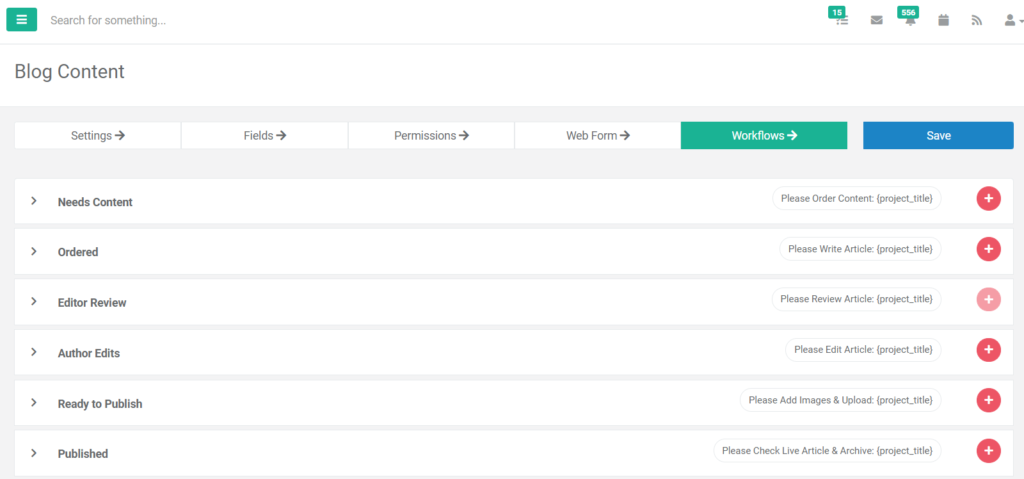
If you are creating a visual asset, such as an infographic, the workflow would require more steps and might end up looking like this:
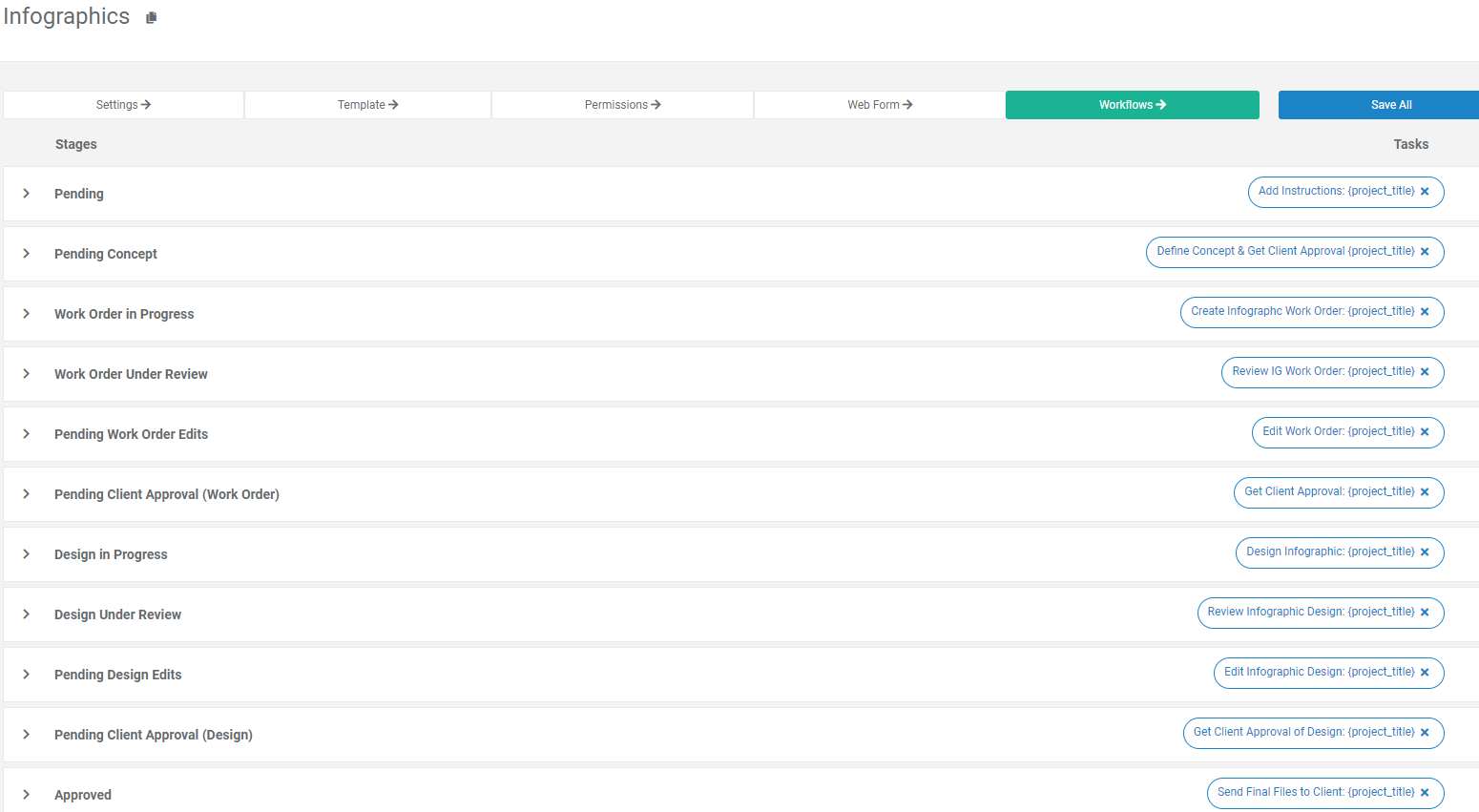
As you go through the editorial process, ensure that you check the content for Readability level, use of keyword variants, topical entities and proper formatting such as header tags.
Content length
How long should your articles be? Is Google truly rewarding long-form articles? How can you determine how long each article should be?
When planning content length, it’s important to use a tool such as SurferSEO or Semrush’s SEO Writing Assistant so you can map content length to the target query.
If someone searches Google for the question, “How tall is the Eiffel tower?” they probably don’t want to read a 5,000-word essay about the history of the Eiffel tower. They know exactly what they are looking for and want a quick, direct answer.
However, if your article is about “how real estate agents can get into the commercial auction field,” the person researching is more likely to want a detailed, comprehensive article and will be willing to read an ebook or a 3,000-word long-form article.
If you already use Semrush, the SEO Content Template or SEO Writing Assistant will allow you to search for a keyword and get an idea of what’s working in the SERPs for that particular query set, such as:
- Semantically Related Words
- Backlinks
- Readability Score
- Text Length
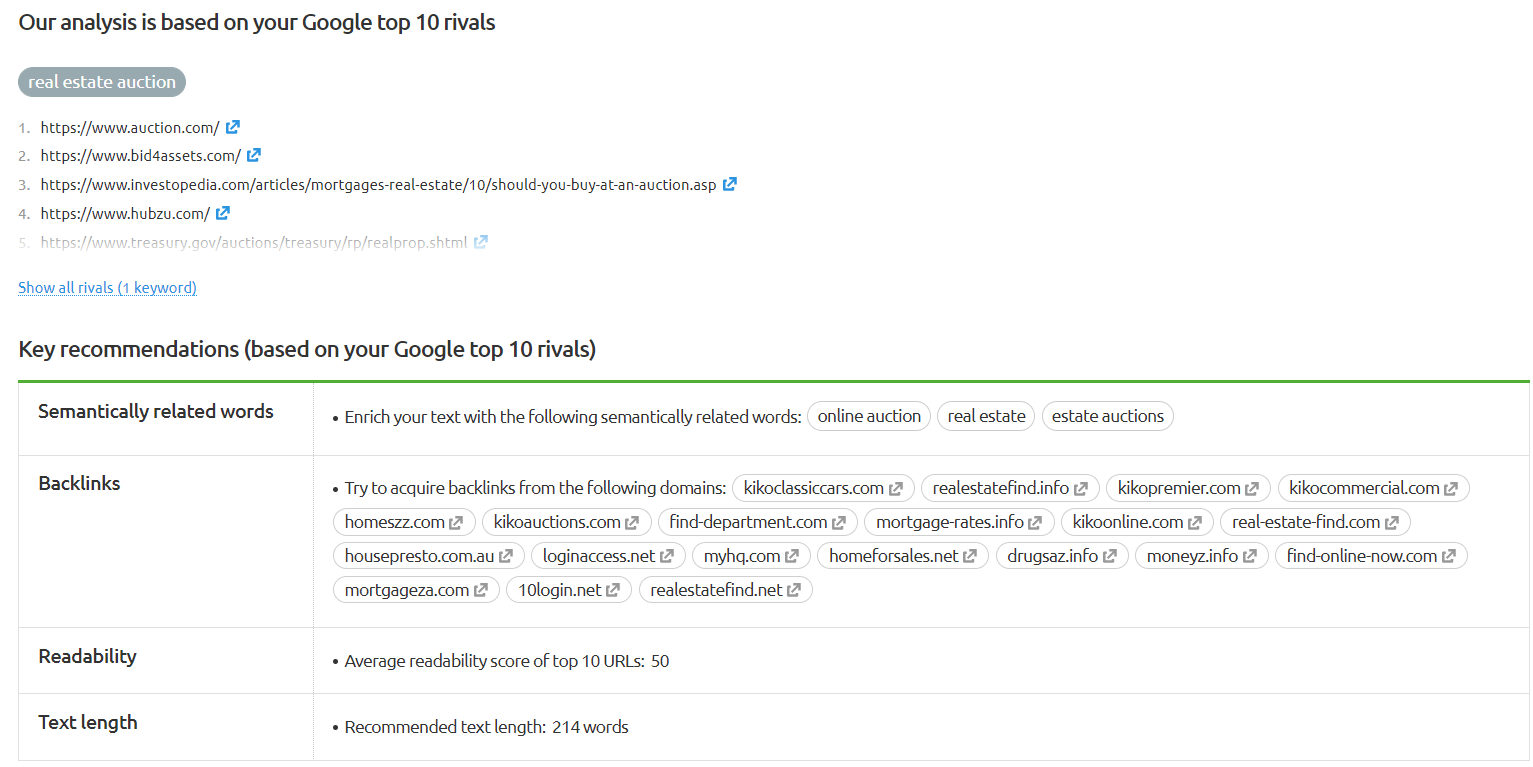
It’s ideal to use this data in the instructions given to your writing team for each content piece.
Beware the ides of duplicate content
Before finalizing and publishing your content pieces, make sure there is no duplicate content used by your authors.
It’s human nature to give others the benefit of the doubt, but it’s important to make sure that the content you’re publishing is not duplicated elsewhere on your site or the web.
Two great tools to check for duplicate content are:
- Copyscape: You can add a content block to Copyscape and it will show you other places on the web where your content is duplicated.
- SiteLiner: Siteliner will provide you with a detailed report based on duplicate content percentages and many more data points.
Sometimes, other sites scrape and publish your content on their sites after you publish. By running duplicate content checkers, you can identify those situations and request them to remove your content.
Adding internal and external links
Make sure all of your content pieces have links to other relevant pages of your own site within the body of the content. Internal, contextual links can help increase the topical relevance of your pages. Simultaneously, add links to authoritative external sources when it makes sense.
Publish your content pieces
Once your content pieces have gone through all the workflow steps and are approved, it’s finally time to get them live on your site!
When you upload to your CMS, verify that your content has all the proper tags in place and that you include the target keywords in your:
- Meta title
- Meta description
- URL
- Breadcrumbs
- H1 tag (primary keyword)
- H2/H3 tags (secondary keywords)
- …etc
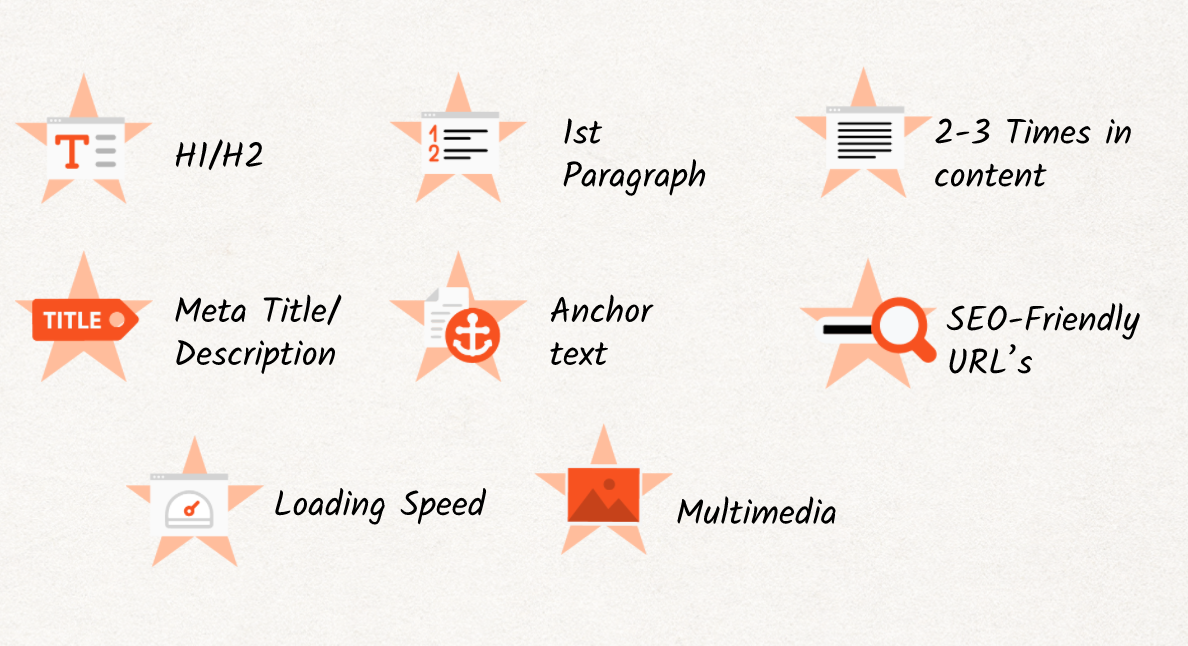
Also, make sure you assign your article to the most relevant category, which will help Google understand your site’s hierarchy.
Track your content pieces
Once you’ve published your content, create a reminder to check its performance after 30, 60 and 90 days.
This way, you can quickly identify pages that are not gaining traction and can work on adjusting the keywords or on-page SEO.
You can look at the metrics in Google Analytics and Google Search Console and change the date ranges to figure out how your articles perform.
Here are some of the elements you can review and track:
- No traction: The article doesn’t have any traffic and needs to be optimized.
- Trending up/down: If the article is trending up, you can enhance and extend it to target more keywords. If the article was doing well but started dropping, optimize for the keywords dropping and add more inbound links.
- Low CTR: These are articles ranking well and have good impressions but have low CTR, which means people aren’t clicking on your link from the Google results page. If you update the title and/or description, it might help to improve the CTR and increase clicks.
Promote your content pieces
Many marketers believe that publishing an article is the end of the content creation cycle. In reality, the end of content creation is just the beginning of the content promotion stage.
Here are a few ideas for ways to promote your article after you hit publish:
- Amplify with Facebook Ads: Boost your post to reach a wider audience and increase the chances of it being shared and linked to.
- Share in Facebook and LinkedIn industry groups: Join industry groups and, sporadically, share your articles. Make sure you engage with others, share thought leadership, and comment on other people’s content.
- Email marketing and networking: Build your email list and send out a newsletter sharing your latest blog posts. You can also email people directly by building a list based on relevant keywords.
- Answer questions on Quora or forums: Search quora for content related to your target keyword and, where possible, link to the relevant blog post. Make sure your answers are detailed, comprehensive, and valuable.
Ideally, you should only create as many content pieces as you can promote.
As Google’s database becomes increasingly crowded, Google will continue to emphasize quality content, and getting your content promoted is key to standing out.
The days of spaghetti marketing are over
You can’t just throw a bunch of content at Google and hope a few stick. Instead, focus on being strategic and producing truly helpful, unique content differentiating you from your competitors.
The content creation journey is the glue that makes SEO stick. If your approach is strategic and focused on quality, the next stage, outreach, will happen naturally.
The post How to create captivating, compelling and optimized content appeared first on Search Engine Land.
Courtesy of Search Engine Land: News & Info About SEO, PPC, SEM, Search Engines & Search Marketing
Category seo news | Tags:
Social Networks : Technorati, Stumble it!, Digg, de.licio.us, Yahoo, reddit, Blogmarks, Google, Magnolia.
Webinar: An easy-to-use, actionable ABM framework (finally!)
Written on June 1, 2022 at 11:48 pm, by admin

ABM is more than just another marketing channel to add to your mix. It’s a complete go-to-market strategy that requires new processes, better collaboration, and more accountability.
But don’t let that intimidate you. We’re here to help you get started and create a clear path for iteration and scalability.
Register today for “Take a Crawl, Walk, Run Approach to Multi-Channel ABM” presented by Terminus.
The post Webinar: An easy-to-use, actionable ABM framework (finally!) appeared first on Search Engine Land.
Courtesy of Search Engine Land: News & Info About SEO, PPC, SEM, Search Engines & Search Marketing
Category seo news | Tags:
Social Networks : Technorati, Stumble it!, Digg, de.licio.us, Yahoo, reddit, Blogmarks, Google, Magnolia.
Apple Search campaigns shifting to cost-per-tap (CPT) pricing model
Written on June 1, 2022 at 11:48 pm, by admin
Apple Search users will soon notice a new campaign pricing type. CPT, or cost-per-tap is Apple’s version of CPC, or cost per click. It is calculated by dividing your total spend by the number of taps your ad received.
Apple Search ads help people discover your app when they search on the app store. Like traditional manual cost per click ads:
- you choose a maximum amount you’re willing to pay each time someone clicks, or taps, your ad
- the actual amount you’re charged is based on what your nearest competitor is willing to pay for a tap on their ad.
The current CPM model. Apple will phase out the current CPM, or cost per thousand model as soon as the transition to CPT is complete. The current CPM model charges your account for every thousand impressions your ads receive – regardless of whether users click or tap.
Apple Search users promoting their apps can soon create the new campaigns in their accounts. Those new CPT campaigns will automatically be placed on hold.
When the transition goes live, current CPM campaigns will go on hold and the new CPT campaigns will go live.
If you prefer not to create new CPT campaigns until Apple releases the update, keep an eye out for an announcement to avoid a lapse in your ads serving.
As of right now there is no set launch date for CPT campaigns.
Why we care: This new CPT model reflects the traditional cost per click method advertisers are used to within search results ads. This means you can bid competitively without the worry of overpaying, and get more for your ad dollars by only paying when those most interested tap on your ad.
The post Apple Search campaigns shifting to cost-per-tap (CPT) pricing model appeared first on Search Engine Land.
Courtesy of Search Engine Land: News & Info About SEO, PPC, SEM, Search Engines & Search Marketing
Category seo news | Tags:
Social Networks : Technorati, Stumble it!, Digg, de.licio.us, Yahoo, reddit, Blogmarks, Google, Magnolia.