

How to get more out of your email marketing with SafeOpt
Written on September 27, 2022 at 9:29 am, by admin

Let’s face it: many consider email marketing boring. It’s not as flashy as jumping onto BeReal or TikTok, and besides, does Gen Z even use email?
Email marketing can be an exciting channel because it drives a lot of revenue for your business. Research shows that you can expect a 42X ROI when you invest in email marketing. So, let’s go over a few ways you can supercharge your email marketing and make it exciting again.
And yes, Gen Z still uses email – they actually prefer it as the way for brands to communicate with them.
Recover lost shoppers with verified offers
Online shoppers routinely abandon their carts, leading to lost sales. If it’s someone you have in your existing customer database, you might rescue that sale with an abandoned cart email. But if they weren’t logged in, the only option is to buy retargeting ads which don’t guarantee a strong ROI.
Thanks to platforms like SafeOpt, you can tap into an email list of 175M+ U.S. shoppers to send them a brand-approved offer and recover lost sales. You generate more revenue, and your abandoned shoppers are delighted because they save time and money.
Make sure your emails are built for mobile first
The majority of emails are now viewed on mobile. It’s no longer good enough to have your emails optimized for mobile. It has to be built with mobile as the primary screen and then optimized for desktop.
This means you might have to rethink a few things. For instance, research suggests mobile email readers click less than desktop. This makes a bit of intuitive sense because there’s less real estate to work with on mobile.
This might mean you consciously decide to build your emails with fewer calls to action and items to click on. This constraint can be good sometimes, as it forces you to focus on what clicks in the email will really drive business outcomes for you.
The name of the game is “personalization”
The average person gets more than 100 emails per day. Personalizing your emails is the best way to stand out from the crowded inbox and to get your messages noticed and read.
You can start small with your personalization journey. Maybe you just include their name in the subject line or the body of the email. Don’t have their name? You can include a recent product they’ve purchased or shown interest in.
Your personalization of emails can get more sophisticated as you gather more first-party data and incorporate it into your messages. You can include wishlist items, references to sections of the website they visited and much more.
Personalizing pays off, too. A personalized subject line is 50% more likely to be opened than a generic one.
Test, test and perfect
If you love data and experimentation, then email marketing is amazing because you can constantly be testing. Some elements you should routinely be testing are:
- Subject lines
- Day or time of send
- Main call to action
- The images within your email.
Testing can become unwieldy unless you come at it with the right strategy. First off, know what kind of testing you’re going to do and why. An A/B test or split testing only focuses on a single variable and will get you different results than a multivariate test, which tests different variable combinations at once.
Second, have an end goal in mind with your testing. This should be more than just a hunch or hypothesis: you should have an important goal like improving click-through rates by 15%.
From there, make sure that you’re waiting until you have statistically significant results. This might mean running your test for longer or expanding the sample size. This can be a pain if you have a smaller sample size but it’s worth it to make sure you’re getting actionable results.
Once you do get those insights, be sure to take action! If your test revealed that personalized subject lines get higher open rates, then start incorporating personalized subject lines into as many relevant emails as possible. Insight without action is worthless.
Finally, remember that you’re never done testing. You should implement the winners of your tests but that should lead to the next set of tests. You can always improve your email performance if you have a test-and-learn mindset.
Make email marketing exciting again
If you follow some of the strategies outlined above, your email marketing program will deliver a ton of value. And a growing business is always exciting.
The post How to get more out of your email marketing with SafeOpt appeared first on Search Engine Land.
Courtesy of Search Engine Land: News & Info About SEO, PPC, SEM, Search Engines & Search Marketing
Category seo news | Tags:
Social Networks : Technorati, Stumble it!, Digg, de.licio.us, Yahoo, reddit, Blogmarks, Google, Magnolia.
Google Analytics 4: A breakdown of Demographic and Tech details reports
Written on September 27, 2022 at 9:29 am, by admin
Google Analytics 4 may look simple on the surface, but there’s more to it than meets the eye. Did you know that there are multiple reports hidden in GA4?
Out of the box, the left-side navigation in GA4 looks pretty bare.
There are only 18 reports vs. the 90+ (not including integration reports) in Universal Analytics.
But contrary to popular belief, GA4 actually has a lot of the same reports built in.
The best examples of this are the GA4 Demographic details and Tech details reports.

Where the reports are in Universal Analytics
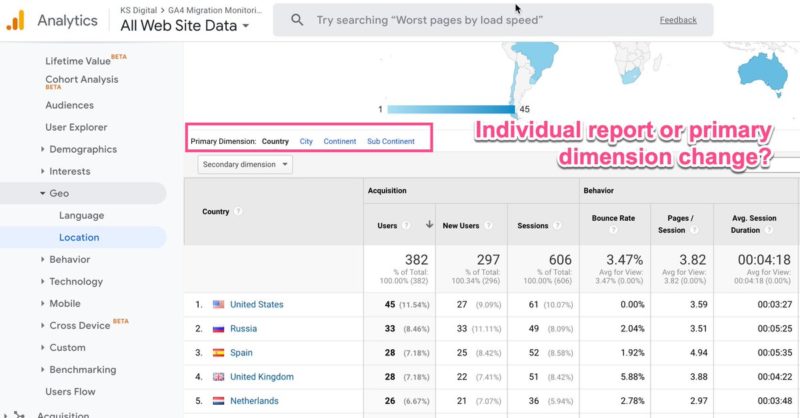
In Universal Analytics, these are all separate reports and each report is separated into subcategories as seen below.

On top of this, UA sometimes has additional dimensions you can choose from.
For instance, you can switch to “City” instead of “Country.”
But this made it confusing to know whether a report was standalone or another dimension in a single report.
Get the daily newsletter search marketers rely on.
<input type=”hidden” name=”utmMedium” value=”” />
<input type=”hidden” name=”utmCampaign” value=”” />
<input type=”hidden” name=”utmSource” value=”” />
<input type=”hidden” name=”utmContent” value=”” />
<input type=”hidden” name=”pageLink” value=”” />
<input type=”hidden” name=”ipAddress” value=”” />
Processing…Please wait.
The Demographics details report in GA4
Instead of multiple reports and a primary dimension change, GA4 combines all logical demographic dimensions into a single report, the Demographic details report.

The Tech details report in GA4
The same goes for the Tech details report.
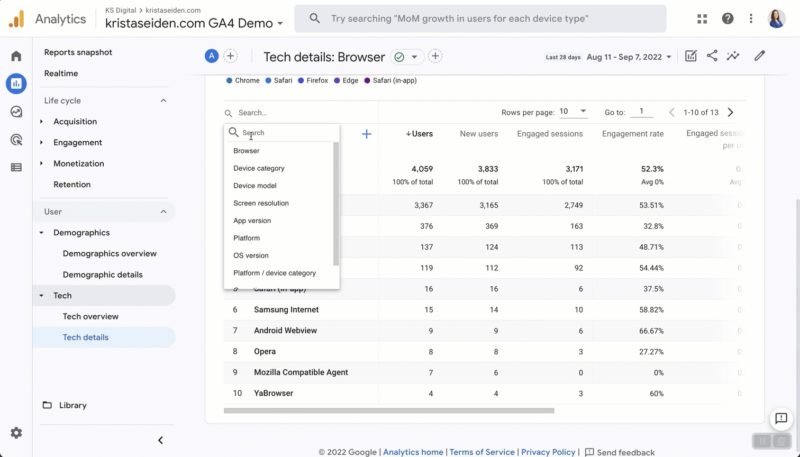
Here, you get 10 reports in one, including:
- Browser
- Device category
- Device model
- Screen resolution
- App version
- Platform
- OS version
- Platform / device category
- Operating system
- OS with version
Now that you know where some of your favorite and most used reports have moved to, hopefully, GA4 feels a little more comfortable.
The post Google Analytics 4: A breakdown of Demographic and Tech details reports appeared first on Search Engine Land.
Courtesy of Search Engine Land: News & Info About SEO, PPC, SEM, Search Engines & Search Marketing
Category seo news | Tags:
Social Networks : Technorati, Stumble it!, Digg, de.licio.us, Yahoo, reddit, Blogmarks, Google, Magnolia.
Natural language search – what’s all the hype?
Written on September 26, 2022 at 6:25 am, by admin

Traditional search engines use manual tagging or keywords queried against their index to provide results to a customer. This neglects what your customers think, how they behave and what they expect from their search experience.
With the evolution of search experiences provided by personalization masters like Google, Amazon and Netflix, customers want the same personalized experience on every website they visit.
Natural language search is essential to providing users with the relevant search they crave. It moves beyond keyword matching and programming tedious manual rules. It uses artificial intelligence to infer meaning from complex queries. It learns from data and search patterns to provide a uniquely personal search experience to every customer.
During this webinar, presenters discuss why NLP is gaining momentum and why companies should start investing in tools with NLP to help organizations better predict intent, surface content and customize digital experiences for everyone.
Key takeaways:
- Keep up to date with the latest trends in the evolution of search technology.
- Gain crucial insight into the world of natural language processing (to stay ahead of the competition).
- Learn to enhance your search experience with the help of machine learning (it’s easier than you think!)
Speakers:
Hanieh Deilamsalehy, machine learning researcher, Adobe
Eric Immermann, practice director, search and content, Perficient
Kurt Cagle, managing editor, Data Science Central
Vincent Bernard, R&D director, Coveo
The post Natural language search – what’s all the hype? appeared first on Search Engine Land.
Courtesy of Search Engine Land: News & Info About SEO, PPC, SEM, Search Engines & Search Marketing
Category seo news | Tags:
Social Networks : Technorati, Stumble it!, Digg, de.licio.us, Yahoo, reddit, Blogmarks, Google, Magnolia.
15 horrible mistakes even professional online writers make
Written on September 26, 2022 at 6:25 am, by admin
Writing. Everyone thinks they can do it, no one wants to do it, and it’s never perfect.
We love writing because it stimulates the mind, informs us of something new, and teaches us new ways to think about important topics in our lives.
However, writing can be a difficult skill to master. Even when you think you have, you’ll keep making the same mistakes as when you started.
Likewise, writing requires intense discipline and is not for the wandering or distracted mind.
So the next time you make a mistake or find yourself procrastinating content for a client, don’t sweat it. Even professional writers make some of these common mistakes.
1. Not knowing your target audience
Content requires focus and purpose.
Unfortunately, even as a seasoned veteran in the digital marketing industry, it’s easy to write broad content based on a few high-volume keywords with little relevance.
Writing content without understanding your audience is like throwing money at the wall and hoping it sticks.
Solution
Meet your audience where they surf. Use social listening tools like Hootsuite, examine Reddit forums, and look at other popular blogs/publications in your industry to examine what keywords users use to discuss and research topics in your industry.
In addition, keyword and topic research will uncover various subtopics that users are searching for and want answers to enrich your content.
Bonus tip: If you’re creating content for a client or business and want to excite them, focus on their top ROI products and services first. Find those money keywords with high relevance and low competition to create content that speaks to their audience and gains them traffic quickly.
2. Thinking too narrow
Writing quick blog posts around a single keyword may fulfill your client’s needs, but it most likely won’t net them much return on their investment. If your content thinks too narrow or fails to provide any unique perspective or educational value, it’s just as valuable if you never wrote it in the first place.
Solution
If you’re calling yourself a professional writer, you need to produce high-quality content. Research high-ranking content in your field and find new ways to provide additional insight or personal tips to enrich content.
It’s easy to regurgitate the same content as everyone else, but if you want to move the needle with your content, you’ll need to think outside the box.
3. Having a boring headline
There’s nothing more frustrating than failing to gain any traction on a piece of content you worked incredibly hard and long on.
Often, the problem isn’t your content; it’s your headline.
Solution
To garner clicks on your content, you’ll need to first research what keywords drive clicks and traffic. From there, I follow a simple formula for most of my headlines:
- Keep titles to an appropriate length (55-60 characters).
- Insert relevant keyword toward the front of the title.
- Provide a solution or reason for reading (e.g., Become a Better Writer Today).
- Use power words to entice clicks.
4. Not having a strong hook
The two most common reasons people click on content are for quick answers and stories. So, ideally, your headers should provide quick answers to subtopics and your opening has a strong hook to pull the reader into your piece.
Like a headline, your hook will determine whether or not you get clicks for content.
Solution
Make an impression on the reader. Easier said than done, right? But the point is to avoid going straight into a story or description. You need to give the reader a reason to read your post.
While there is no hard and fast rule for writing hooks, here are a few general tips:
- Cite a wild statistic. (e.g., Did you know that 50% of writers don’t even know how to write hooks?)
- Make a surprising or controversial statement.
- Ask a thought-provoking question.
- Start a story in medias res.
- Use an insightful quote.
Bonus tip: Use your first one or two paragraphs to lead people into a story. In certain cases, you might not dive into the details of your content until the first body paragraph.
5. Not optimizing your header and meta tags
I often come across several articles on highly reputable publications with unoptimized header tags or one-word lists that provide minimal context. Optimizing header tags allow readers to scan your article and find the right subtopics they’re researching.
Furthermore, optimizing header tags allows Google to direct users from an answer box to the highlighted portion of your webpage.
Solution
Find a seed keyword and then add question phrases to answer specific subtopic questions on Google SERPs.
Additionally, create subtopics for any related long-tail keywords. For example, if you write about motorcycles, listing out specs, like the suspension and motor, in specific sections with optimized keywords will give users the exact information they’re looking for and tell them where to find it.
Bonus tip: Take a note from the pyramid writing style of journalism. Start with the main topic at the top of your article, then write specific sections of your article with subtopics that relate to the main topic.
6. Not making content scannable
Good content should be easily scannable and consumable.
Most people will bounce right off a page that contains large run-on paragraphs and scrolls for a mile.
Solution
Make content less intimidating by breaking paragraphs up with images, videos, infographics, spaces and well-optimized headers.
Experiment with multimedia where it would make more sense to tell a story or explain a specific topic.
People are typically visual and kinesthetic learners, so find ways to appeal to those learning styles without inundating them with large paragraphs.
7. Failing to invest enough in editing
According to Stephen King, about 10% of writing is editing, but I’ve heard some authors say it’s a lot more. Realistically, any error you make in writing should be attributed to your editing. For this reason, writers need to master the editing process.
Solution
Ever heard the phrase “work smarter, not harder?” When I say invest more time in editing, I’m not talking about devoting more time or spending more money; I mean optimizing the process.
Pass your editing to another team member and get some fresh eyes on a piece.
Bonus tip: Wait a day or two and then quickly edit a draft so that you have an entirely fresh perspective on a topic. This strategy will make the editing process more efficient and less cumbersome.
Get the daily newsletter search marketers rely on.
<input type=”hidden” name=”utmMedium” value=”” />
<input type=”hidden” name=”utmCampaign” value=”” />
<input type=”hidden” name=”utmSource” value=”” />
<input type=”hidden” name=”utmContent” value=”” />
<input type=”hidden” name=”pageLink” value=”” />
<input type=”hidden” name=”ipAddress” value=”” />
Processing…Please wait.
8. Using complex jargon and words
This point relates to not knowing your audience, but it’s a mistake that we’re all guilty of making as writers and SEO professionals.
Using overly complex jargon and language can be difficult for readers to interpret and follow along with your content. If readers need to constantly Google every other word or phrase you’re saying, they’ll quickly grow bored and irritated.
Solution
Always substitute complex words with simple language. Ideally, you should be writing for an audience with the vocabulary of a 5th or 6th grader to make content easy to consume and retain.
Bonus tip: If you’re forced to use jargon, explain it, link it to another page on your site, and spell out any acronyms.
9. Making content too long
One of the hardest habits for long-time writers to kick is creating lengthy sentences and paragraphs. Unfortunately, we all have a natural impulse to say as much as possible or over-explain our points at the risk of overwhelming our audience.
I always recommend limiting the wording of online content to its medium. For example, blog posts don’t need to be over 2,500 words – save that content for an ebook!
Solution
Depending on the medium, paragraphs in blog posts should only be one to three sentences at most. Additionally, if you’re not writing an evergreen guide, keep subtopics short and sweet, saving content for each subtopic on a separate post!
Bonus tip: Take some inspiration from Hemmingway and his infamous iceberg theory. In some cases, your content can be simple and doesn’t need to explain every argument. For example, most readers understand why “content is king” and don’t need a paragraph reinforcing this point.
10. Not providing a clear call to action
Realistically, your content should provide solutions or next steps to motivate your readers toward a desired action. However, if you don’t include a clear call to action (CTA) or related content on your website, you could risk losing website visitors forever.
Solution
Give readers a reason to stay on your site or interact with your writing more. Offer a newsletter signup link at the end of an article or provide a CTA button that leads to a sale or consultation if you’re writing for a business.
Bonus tip: Create a drip campaign for readers who sign up for your newsletter using related content that eventually leads them to purchase something from your website.
11. Failing to properly interlink between content
You should always provide relevant links throughout your content to build authority on your website. Additionally, interlinking also increases website time on page and increases your website’s likelihood of a conversion.
Solution
Use your favorite organic research tool like Semrush to find your top-performing/highest ROI pages and insert links in your content relevant that reinforce the main topic of the article.
Bonus tip: Form content clusters around main topics and provide supporting links to subtopics on separate pages that interlink with each other. For example, suppose you have a top-navigation page for content marketing and a supporting page on link building. In this case, insert links in both pages of content to link between each other.
12. Forgetting to promote your content
On the flip side, most professional writers are often lazy when it comes to promoting their content. Unless you have an established audience on social media or your blog, your content’s reach won’t go far without links and shares.
Solution
Build links to your content by reaching out to other authors who have written about similar topics and asking for a link. In addition, there are several ways to build links to your site and specific content pages, such as guest posting, content syndication, reaching out to influencers, etc.
The goal is exposure, which will drive relevant metrics to your site and help it rank for various keywords.
Bonus tip: Advertise your content on sites like Facebook and Twitter to help put your content directly in front of your targeted audience. Sure, many people are skeptical of ads on social media, but if your content is good, it will drive engagement.
13. Not reviewing content
If we’re not tracking the performance of our content after it’s written, we’re not gaining any insight into what we’re doing wrong.
Solution
Use Google Search Console, Google Analytics, or your favorite organic research tool to see which content is driving traffic to your site and which is not generating clicks. Compare this data to its keyword ranking and identify areas where meta tag optimizations, different keywords, or adding multimedia could give your content an edge over the competition.
Content is a serious investment, so track its performance to get the best return out of your investment.
Bonus tip: Consider repurposing content by updating it to modern standards or adding video or infographics to content to help it rank organically again.
14. Spending too much time on one piece
Time management is one of the hardest skills for a writer to master. Depending on the length and topic of a piece, you could spend hours working on a single piece.
As a writer, your living is based on your work output. So how do you improve your output and spend less time on each piece without sacrificing quality?
Solution
Optimize your process with a few helpful hints:
- Block off a specific time in your day for writing.
- Set a goal for each piece of content, along with times to hit.
- Create a separate space in your home office for writing.
- Hone your craft by constantly writing (not when you’re in the mood).
- Create a template and then go in and fill in the blanks.
- Eliminate any distractions in your workspace.
Bonus tip: Find your flow state. Everyone has a way to enter a flow state of total concentration and focus. Meditate or listen to music if it helps you get into that flow state.
15. Not reading enough
I find that very few professional writers don’t read, but it’s still a helpful reminder that you’re not reading enough.
Reading is like weight lifting for a writer; it helps strengthen those brain muscles and form new neural pathways.
In addition, reading more about your industry and the topics you’re writing about will make you a topical authority and increase your credibility.
Solution
Set aside time each day or every other day for reading. I often block off some time during my lunch hour to read from my favorite publications, like Search Engine Land, so I’m always informed of the latest news in the SEO industry.
Bonus tip: Practice different forms of writing to improve your writing. For example, try writing about new topics, writing fiction, or writing for different formats like newsletters or press releases. This helps keep the mind fresh, and you’ll never get bored of writing.
All professionals make mistakes, but most of them are not published online for the whole world to see. However, your work will only improve if you go back to basics from time to time and refresh your writing knowledge.
This is why I read William Zinsser’s “On Writing Well” almost annually to hone my writing skills and get back to the basics.
However, the best way to overcome these mistakes is to keep writing. Never feel discouraged because even the most seasoned writers make mistakes constantly.
The post 15 horrible mistakes even professional online writers make appeared first on Search Engine Land.
Courtesy of Search Engine Land: News & Info About SEO, PPC, SEM, Search Engines & Search Marketing
Category seo news | Tags:
Social Networks : Technorati, Stumble it!, Digg, de.licio.us, Yahoo, reddit, Blogmarks, Google, Magnolia.
TikTok video descriptions now have a 2,200 character limit
Written on September 24, 2022 at 12:22 am, by admin
TikTok video descriptions, once limited to 300 characters, have now been updated to 2,200 characters.
What this means. The update was first noticed by social media consultant Matta Navarra on Twitter, who posted that the new character limit allowed users to express more details about their content, generate more engagement, and make their videos more searchable.
Woah…! TikTok has increased video description character limit to 2,200 characters!
This is huge for creators and massive in terms of TikTok’s plans for becoming a search engine pic.twitter.com/kGhnL97uUM
— Matt Navarra (@MattNavarra) September 23, 2022
Early reactions. Some people on Twitter aren’t too thrilled with the update. Ash-win Fern-&-es posting “But no one really reads the description there. Would be helpful for some to add more hashtags though.” Grady Hopper says “I don’t get why this matters 95% of most people’s views probably come from fyp not search.” FYP is TikTok’s “For You” Page, where they show users suggestions of accounts to follow and videos to watch.
TikTok, the new Google. Though the general reaction here is “meh,” some people see the value in longer captions for optimizing SEO. In response to tweets saying that nobody reads the descriptions, Rhayven J says “Even if they don’t, the algorithm will. If folks know SEO, then this is a huge game changer.”
TikTok is known for trying to replace Google search among its Gen Z users. This latest update could be a step in that direction.
Why we care. If you’re using TikTok as part of your social or ad strategy, have your copywriters on standby and take advantage of the new 2,200 character limit. Don’t forget to keep SEO and Helpful Content best practices in mind when creating your new captions
The post TikTok video descriptions now have a 2,200 character limit appeared first on Search Engine Land.
Courtesy of Search Engine Land: News & Info About SEO, PPC, SEM, Search Engines & Search Marketing
Category seo news | Tags:
Social Networks : Technorati, Stumble it!, Digg, de.licio.us, Yahoo, reddit, Blogmarks, Google, Magnolia.
TikTok video descriptions now have a 2,200 character limit
Written on September 24, 2022 at 12:22 am, by admin
TikTok video descriptions, once limited to 300 characters, have now been updated to 2,200 characters.
What this means. The update was first noticed by social media consultant Matta Navarra on Twitter, who posted that the new character limit allowed users to express more details about their content, generate more engagement, and make their videos more searchable.
Woah…! TikTok has increased video description character limit to 2,200 characters!
This is huge for creators and massive in terms of TikTok’s plans for becoming a search engine pic.twitter.com/kGhnL97uUM
— Matt Navarra (@MattNavarra) September 23, 2022
Early reactions. Some people on Twitter aren’t too thrilled with the update. Ash-win Fern-&-es posting “But no one really reads the description there. Would be helpful for some to add more hashtags though.” Grady Hopper says “I don’t get why this matters 95% of most people’s views probably come from fyp not search.” FYP is TikTok’s “For You” Page, where they show users suggestions of accounts to follow and videos to watch.
TikTok, the new Google. Though the general reaction here is “meh,” some people see the value in longer captions for optimizing SEO. In response to tweets saying that nobody reads the descriptions, Rhayven J says “Even if they don’t, the algorithm will. If folks know SEO, then this is a huge game changer.”
TikTok is known for trying to replace Google search among its Gen Z users. This latest update could be a step in that direction.
Why we care. If you’re using TikTok as part of your social or ad strategy, have your copywriters on standby and take advantage of the new 2,200 character limit. Don’t forget to keep SEO and Helpful Content best practices in mind when creating your new captions
The post TikTok video descriptions now have a 2,200 character limit appeared first on Search Engine Land.
Courtesy of Search Engine Land: News & Info About SEO, PPC, SEM, Search Engines & Search Marketing
Category seo news | Tags:
Social Networks : Technorati, Stumble it!, Digg, de.licio.us, Yahoo, reddit, Blogmarks, Google, Magnolia.
The biggest mystery of Google’s algorithm: Everything ever said about clicks, CTR and bounce rate
Written on September 24, 2022 at 12:22 am, by admin
It’s the biggest mystery and controversy of Google’s search ranking algorithm. For a long time, the SEO community has debated: is the click-through rate (“CTR”) of search results listings a ranking factor? Or the closely related “bounce rate” and “dwell time”?
I present to you everything Google has ever said about this, along with some observations and opinions.
Clicks, CTR, bounce rate and dwell time
If you are newer to SEO, the concept of clicks or click-through rate (“CTR”) being ranking factors is simple to explain. Once a user performs a keyword search, they can then click on a listing on Google’s search results page. Google could count those clicks as a type of vote for the content in the results and lend more ranking ability to those listings that draw more clicks for the keyword in question.
Similarly, “dwell time” would be counting how long one stays on a webpage after clicking through to a page from the search results.
A “bounce” happens when one clicks through to a webpage and leaves without navigating to another page. The assumption is that if a bounce happens too rapidly, the user may have found the page’s content unsatisfactory for their query.
“Dwell time” is also how long the user may linger on the webpage before clicking elsewhere or back to the search results. All of these signals center upon the click to listings in the search results.
 Click-through rate, or “CTR”, is the most controversial and mysterious of Google’s “ranking factors.”
The mystery: Are CTR and bounce rate ranking factors?
Despite many of my colleagues believing Google’s official line about CTR or bounce rates not being ranking factors, I will confess that I have long wavered on the question, and I have often suspected it indeed could be a ranking factor. In a recent poll I took on Twitter, CTR was voted the most controversial of all ranking factors.
What would you say the most controversial ranking factor is? As in, is it, or isn't it? Not counting "Helpfulness" for this!
— Chris Silver Smith (@si1very) August 29, 2022
However, there are a lot of good reasons to believe Googlers when they tell you what does or does not influence search rankings. I have worked in information retrieval myself, and I have known and conversed with a number of official Google evangelists in person or via chats, emails, etc. – and they uniformly give great advice and all seem to be highly honest and generally good people.
But…
…there have been those moments when something rises and sticks in rankings that do not seem like it should, based on all the classic ranking factors that we know.
I have long worked in online reputation management where SEO is leveraged heavily to try to improve how a person or organization appears in search when their name is queried.
There have been these weird instances where a nasty blog post or article with few or no major external links will abruptly pop up in the rankings – and, it just stays.
In contrast, other content that has been around longer and has stronger links just cannot gain traction against the nasty-gram item.
You cannot help but notice the difference when these reputation-damaging items arise on the scene. Such pages often have scandalous and intriguing titles, while all the other pages about a subject have more normal, conservative titles.
When you search for a name, and you see some title referencing them along with the word “lawsuit”, “indictment”, “exposed”, “arrested”, “scam”, etc., you are immediately curious, and you will want to click to hear what it is all about.
I have sometimes described this as “rubbernecking on the information super-highway” because it is like how people are drawn to slow down and look when they see a terrible wreck on the road. You see the scandalous title in the search results, and the impulse is to click it.
It has often seemed like the scandalous headlines keep drawing clicks, and this activity seems to buoy the content into appearing high in the rankings on Google’s Page 1.
I have even engineered more scandalous headlines on positive pages to draw attention for a client. Once that engineered content is getting most of the attention, the original negative item starts to subside in the results. When this happens, it seems like users’ clicks are to blame.
But, is the dynamic just coincidental correlation? Or is it exactly what it appears it could be – an outcome based, in part, on quantities of relative click-through numbers?
Get the daily newsletter search marketers rely on.
<input type=”hidden” name=”utmMedium” value=”” />
<input type=”hidden” name=”utmCampaign” value=”” />
<input type=”hidden” name=”utmSource” value=”” />
<input type=”hidden” name=”utmContent” value=”” />
<input type=”hidden” name=”pageLink” value=”” />
<input type=”hidden” name=”ipAddress” value=”” />
Processing…Please wait.
Reasons to suspect Google uses CTR as a ranking factor
Beyond my anecdotal examples, there are a number of good reasons to suspect that Google could use clicks of links in the search results as a ranking factor. Here are a few:
1. Google has long tracked clicks on its links
If this is unused data, why track the clicks? I tried to recall when I first glanced at Google results’ HTML and saw that the links were being tracked. It might be sometime in the early 2000s.
What do they do with all that data? After the advent of the inclusion of search analytics in Google’s Webmaster Tools (later renamed to Google Search Console), this click data was at least used in webmaster reports.
But, it was collected by Google well before the search analytics report.
2. Google tracks clicks on ads
Click data affects rankings within the paid ads section. So, why wouldn’t they do the same in organic?
It would not be a surprise if Google used a similar method in organic that they use in paid search, because they essentially have done that with their Quality Score.
Over 15 years ago, Google rolled out its Quality Score, which affects ad rankings – and there is now ample evidence of Google using quality criteria in organic rankings.
While different parts of Google – such as keyword search versus Maps – use different ranking methods and criteria, Google sometimes cross-pollinate methods.
3. Google disclosed in 2009 that clicks on search results affect rankings under personalized search
If it is used or has been used in the past for personalized search results, it clearly can be used for regular results, too.
4. An independent researcher examined click-throughs as a ranking factor and found it to be a potentially valuable method
Dr. Thorsten Joachims examined click-throughs as a ranking factor and found it to be a potentially valuable method. Notably, he found:
- “The theoretical results are verified in a controlled experiment. It shows that the method can effectively adapt the retrieval function of a meta-search engine to a particular group of users, outperforming Google in terms of retrieval quality after only a couple of hundred training examples.”
Thus, in a limited study, it was found to be effective. Considering this, why wouldn’t Google use it? Of course, his definitions for “outperforming Google” and determining usefulness likely differ from the criteria used by Google.
5. Bing uses click-throughs and bounce rate as ranking factors
Microsoft Bing search engine confirmed that they use click-throughs and bounce rate as ranking factors. However, they mentioned caveats around it, so some other user engagement context is also used for evaluation.
Search engines certainly use different signals and methods to rank content in search results. But, it is an interesting counterpoint to rhetoric that it is “too noisy” of a signal to be useful. If one search engine can use the signal, the potential is there for another.
6. If Google convinces people that CTR is not a ranking factor, then it reduces Google search as a target for artificial click activity
This makes it seem like there could be a substantial motive to downplay and disavow click activities as ranking factors. A parallel for this is Autocomplete functionality, where users’ searches, and potentially also click activity, used to be very prone to bot manipulation.
Google has long disliked artificial activity, like automated requests made by rank-checking software, and has evolved to detect and discount such activities.
However, bot activity in search results targeting ranking improvement through artificial clicks would likely quickly become more significant than they already handle. This can potentially create a negative impact on services similar to DDoS attacks.
Despite the years and years of stating that CTR is not a ranking factor, I have seen many jobs posted over time on microtask platforms for people to perform keyword searches and click upon specific listings. The statements may not have accomplished deterrence, and Google may already be effectively discounting such manipulation attempts (or they are hopefully keeping some of that artificial activity out of Analytics data).
7. Google AI systems could potentially use CTR and Googlers would not know if or when it was impacting rankings
Three years ago, when I wrote about how Google could be using machine learning to assess quality of webpages, I strongly suggested that user interactions, such as click-through rate, could be incorporated into the machine learning models generated for a quality scoring system.
An aspect of that idea could potentially happen, depending upon how Google builds its ML systems. All potential data points about websites and webpages could be poured into the algorithm. The system could select ranking factors and weight them according to what matches up with human quality rater assessments of search results.
With such massive processing power to assess ranking factors, an algorithm could theoretically decide if CTR was or was not a useful predictor of quality for a particular type of webpage and/or website.
This could produce ranking models for many thousands of different kinds of webpage and search query combinations. In such a system, CTR might be incorporated for ranking scientific papers but not for Viagra product pages, for instance.
The mystery remains
You might think that that third point would essentially set the record straight as Google flat out stated the ranking factor for personalization. But the mystery and controversy remain as the question centers upon overall rankings in a broader sense beyond just personalized results. The controversy surrounds whether CTR is used as a core ranking signal. The blog post disclosing clicks as a personalized ranking factor was from 2009 – when personalization effects seemed a little more overt in search.
Because there is some reasonable basis for thinking Google could use CTR as a ranking factor more broadly beyond limited effect in personalization, it creates the groundwork for many SEOs to easily believe that it is indeed a major ranking factor.
Of course, one of the biggest reasons people in SEO have come to think CTR is a ranking factor is because it naturally has a high correlation with rankings.
This is the high-tech version of the age-old question: which came first – the chicken or the egg?
The links on the first page of search results have the vast majority of clicks for any given query, and on the first page of search results, the higher ranking listings typically receive more clicks than those that are lower. This makes CTR as a ranking factor seductive.
The obvious question is: Is this coincidental correlation or is it evidence of causation?
Where cause and effect are so closely intertwined, the prospect of confirmation bias is very easy – and this is why one should be extremely careful.
This leads us to what Google has said over time about CTR as a ranking factor.
Everything Google has ever said about CTR as a ranking factor
2008
Former Googler Matt Cutts commented that bounce rate was not a ranking factor, stating that it would be spammable and noisy (meaning it would contain a lot of irrelevant data that is unhelpful to ranking determinations).

2009
In a Google Search Central video, Cutts was asked, “Are title and description tags helpful to increase the organic CTR – clicks generated from organic (unpaid) search – which in turn will help in better ranking with a personalized search perspective?”
He only answered a part of the question, saying that “…so many people think about rankings, and stop right there…”, advising the person to improve their page title, URL and snippet text to help their CTR.
He avoided answering whether CTR could affect rankings. Of course, this question was specific to personalized search.
Nine months later, Bryan Horling, a Google Software Engineer, and Matthew Kulick, a Google Product Manager, disclosed that clicks on listings were used in rankings in personalized search, as I noted above.
2012
An FTC Google Probe document (regarding an antitrust evaluation) was leaked to the Wall Street Journal. It recorded a statement from Google’s former chief of search, Udi Manber, saying:
- “The ranking itself is affected by the click data. If we discover that, for a particular query, hypothetically, 80 percent of people click on Result No. 2 and only 10 percent click on Result No. 1, after a while we figure out, well, probably Result 2 is the one people want. So we’ll switch it.”
The document further reported that:
- “Testimony from Sergey Brin and Eric Schmidt confirms that click data is important for many purposes, including, most importantly, providing ‘feedback’ on whether Google’s search algorithms are offering its users high quality results.”
A bit of the context is missing in this document because the segment about rankings and click data comes directly after a missing page – it appears that all the odd pages from the document are missing.
 Leaked Google Antitrust Hearing Recommendation Document, FTC
Danny Sullivan, former Editor-in-Chief of Search Engine Land, and current Search Liaison at Google, tweeted about the leaked document’s reference to rankings being affected by click data, stating:
Google confirms watching clicks to evaluate results quality. FYI Google still won't say if clicks used as rank signal pic.twitter.com/jzNGc5reQk
— Danny Sullivan (@dannysullivan) March 25, 2015
In the comments, he further stated, “I asked again a few months ago  no answer.”
It seemed mysterious that Google declined to answer one way or the other, and some interpreted this to mean that they indeed did use clicks as a ranking factor.
Or, perhaps the reason was that clicks are used only in certain, limited contexts rather than broadly as an across-the-board ranking factor.
2014
Rand Fishkin performed a test by watching the ranking of one of his blog posts. He called on his social media followers to conduct searches for it and then click on the listing in the search results. The page’s listing climbed to the top ranking position. This is worth mentioning in the timeline because Googlers appear to have become irritated at Fishkin’s publicized test and the conclusions.
Fishkin acknowledged that the test did not eliminate the possibility that other ranking factors might have caused the ranking improvement, such as links produced by the social media post. But, the sequence of events showed apparently considerable correlation between the clicks and the ranking change.
A 2015 post on the topic of CTR as a ranking factor by the late Bill Slawski with feedback from Fishkin, suggested that some thresholds of clicks would need to be reached for the listing before CTR begins to play a role in rankings.
Slawski’s blog post examined a Google patent that had been recently granted that described “user feedback,” which could potentially be clicks in search results, as a ranking factor.
The patent was: “Modifying search result ranking based on a temporal element of user feedback.” Notably, the patent’s description specifically mentions factors that can affect the appearance of materials in search, such as recency and trends.
One interpretation of Fishkin’s test results could be that items like news articles and blog posts may achieve higher than typical rankings after their introduction, combined with click-through rate data, as part of Google’s freshness or recency algorithms. (Eric Enge similarly theorized this in a 2016 blog post.)
Thus, topics spiking up in popularity shortly after introduction, like blog posts and news articles, might be able to appear higher as part of Universal Search for brief periods. Such ranking ability might not last, however, and arguably might not be deemed ranking factors in the broad sense that affects keyword search rankings over the longer term.
2015
At the SMX Advanced conference, Jennifer Slegg reported that Gary Illyes from Google stated that they “see those trying to induce noise into clicks,” and for that reason, they know that using those types of clicks for ranking purposes would not be good.
This speaks directly to the idea that Google would claim not to use it to reduce the likelihood that people would attempt to manipulate the signal.
The statement here asserts that Google is already seeing artificially influenced clicks in search results and because they already see such click campaigns going on, they are not using the signal.
Illyes went on to essentially confirm the earlier 2009 disclosure that Google uses clicks in a limited way to feature previously-visited search results higher for individuals through personalization. He also stated that clicks in search results were used for evaluation, such as checking whether algorithm changes or UI changes had impacted the overall usefulness of search results.
In a Google Search Central hangout, John Mueller states that click-through rate is used to check algorithms at a high level after making changes to see if people are still finding what they’re looking for.
- “That’s something that on a very aggregated level makes sense for us to use, but on a very detailed site or page-wide level it’s a very, very noisy signal, so I don’t think that would really make sense as something kind of to use as a ranking factor there.”
While the wording of the statement seems a bit ambiguous, Mueller seems to be trying to persuade the audience that it would not make sense for Google to use the signal because it is noisy. Thus, no one should worry about it as a ranking factor.
Nearly a month later, in another hangout, Mueller refers to “CTR manipulation, dwell time manipulation,” saying, “these things may not even work,” which is, again, a little ambiguous.
But, much later in 2015, Mueller states more absolutely in regards to bounce rate:
- “So we don’t use anything from Analytics as a ranking factor in search. So from that point of view, that’s something that you can kind of skip over. We do sometimes use some information about clicks from search when it comes to analyzing algorithms. So when we try to figure out which of these algorithms are working better, which ones are causing problems, which ones are causing problems, which ones are causing improvements in the search results, that’s where we would look into that. But it’s not something that you would see on a per-site or per-page basis.”
In late 2015, a Googler posted in the Google My Business help forums (Google My Business has since been renamed “Google Business Profile”) that one of the main types of factors they use for ranking local business listings is:
- “Search history: In the past how many times has the listing been clicked on by users searching with the keyword.”
Naturally, this excited some commentary and attention. Google rapidly edited the part within a couple of days of its publication to remove the mention of clicks, restating it to read:
- “Search history: The number of times it has been useful historically on the basis of relevance, prominence and distance.”

Interestingly, I was told by a Googler in the past that local listings used “listing engagement” as a ranking factor.
In Google Maps search results, or those same local listings embedded within regular keyword search results (Google pulls local search listings into the keyword search results under Universal Search for appropriate queries), the listing engagement factor is some combined metric of all interactions with local listings and not just limited to clicks on the link to the website.
It can include clicks to get Driving Directions, clicks to call the phone number, clicks to copy the address, clicks to share the listing, etc.
The Googler’s accidental disclosure of listing clicks as a ranking factor would seem to confirm what I was told about listing engagement.
As Barry Schwartz conjectured, the sequence of events implied that the Googler made a mistake about what he wrote or accidentally posted accurate information that Google does not want SEOs to know.
Google would not confirm or deny that clicks are a ranking factor. Again, while Google can and does cross-pollinate some methods from one vertical to another, the ranking factor post was very specifically about Maps and local search listings rankings and not about core rankings of webpages.
2016
At the SMX Conference in San Jose, Google engineer Paul Haar provided an overview presentation on how Google develops its search rankings.
In the slideshow presentation, two of his slides spoke about using click statistics to evaluate changes to the algorithm.
One item they look at when they test algorithm updates is “changes in click patterns,” which in the presentation included the caveat, “Harder to understand than you might expect” (which Haar did not mention verbally).
It was clear that the click data, as he described it, was only used to evaluate changes to the algorithm versus being used as core ranking signals. But, some attendees used the click references in the presentation as proof positive that Google uses CTR for rankings.

2018
Google’s Gary Illyes did an AMA on Reddit where Darth_Autocrat asked him:
- “Rank Brain: Lots of people keep saying that part of the RB system includes UX signals, including Dwell Time, Bounce Rate, Click Through Rate etc. As I understood it, RB was about trying to fathom what results to serve for unrecognised searches. Can you please confirm/deny whether RB uses UX signals of any kind?”
Illyes answered:
- “No. RankBrain is a PR-sexy machine learning ranking component that uses historical search data to predict what would a user most likely click on for a previously unseen query. It is a really cool piece of engineering that saved our butts countless times whenever traditional algos were like, e.g. “oh look a “not” in the query string! let’s ignore the hell out of it!”, but it’s generally just relying on (sometimes) months old data about what happened on the results page itself, not on the landing page. Dwell time, CTR, whatever Fishkin’s new theory is, those are generally made up crap. Search is much more simple than people think.”
Illyes displayed some clear irritation with Fishkin’s prior experiments/statements around CTR as a ranking factor in denying user experience (”UX”) signals as ranking factors.
The harsh mention directed at someone specific is very unusual in my experience with the typically polite, friendly and patient Googlers, so this denouncement attracted a lot of attention.
The vehemence, characterizing CTR as “made up crap,” and laying responsibility for CTR as a rank element theory at Fishkin’s feet seemed very oddly out of proportion – especially as you add the various other information around click-throughs-as-ranking-factors I have cited herein.
So, was Illyes’ irritation caused by having to answer questions about a bogus ranking factor repeatedly, or because Fishkin showed some real effects that called into question Google’s insistence that CTR does not affect core rankings?
2019
Moz’s then-Senior SEO Scientist Britney Muller pointed out Google Cloud documentation that implied that CTR was a ranking factor. The document said:
- “When you click a link in Google Search, Google considers your click when ranking that search result in future queries.”
However, Barry Schwartz reminded everyone that this document appeared to quote from the 2009 blog post establishing that clicks were used in personalized search.
2020
At the U.S. House of Representatives Subcommittee Antitrust Hearing examining big tech companies, Google provided very interesting text about how it uses “long clicks” versus “short clicks” in determining whether:
- Users who clicked through to ad links may have found value in the page associated with the ad.
- Changes to the search results presentation of ads may have negatively impacted the quality of paid or organic content or increased the time it takes for users to click on the search results.
The text Google provided reads:
- “Changes to the presentation of search ads are rigorously tested across a wide variety of metrics, including impact on users and advertisers. For example, a proposed change may lead to more “short clicks” (where users quickly hit the back button on their browser to return to the Google SERP) and fewer “long clicks” (where users stay on the advertiser’s landing page for a relatively long time, suggesting that they found the ad and corresponding website useful). Or, a proposed change may affect the amount of time it takes users to decide on what to click (known as “time to first click”) or adversely affect quality trade-offs between paid and organic content (known as “whole-page metrics”).”
The verbiage involving “short clicks” and “long clicks” is a description of bounce rate and dwell time for ads. The parenthetical aside about how long clicks can indicate the users found the ad and corresponding website useful seems a bit out of place within this text, which is otherwise a description of how Google assesses overall changes impacting the search results page.
What is interesting about this is that Google apparently finds bounce rate to be useful in some contexts. If useful for assessing an ad’s effectiveness, why not a search result listing?
But, it is also clear that this refers specifically to assessing the impact of overall search results presentation and/or algorithmic changes – it is not stating that it impacts rankings.
It is further notable that this is the very way that Google has stated it uses click-through data in search results – as a means of assessing the overall impact of changes to the search results.
In a Google Search Central video titled “Google and the SEO community: SEO Mythbusting,” Schwartz asked Google’s Martin Splitt about whether search engined used user data from Chrome and Android, mentioning how the Direct Hit search engine years ago had used click data for rankings and it got compromised by people clicking to manipulate the results.
Splitt responded:
- “It is very noisy as a data source. It’s so noisy… when I say, ‘no we’re not using it for ranking,’ then I mean exactly that. And we might use it for A/B testing of different ways of presenting things in the front end, or we might be using it for I don’t know what. But, people tend to only hear the bits they want to hear, and then you get misrepresented, and then we have to clean up that rather than doing other good things for the community.”
2021
An SEO professional tweeted the question to Mueller, “Is CTR a ranking factor?”
Mueller tweeted the reply:
- “If CTR were what drove search rankings, the results would be all click-bait. I don’t see that happening.”
So, what is the takeaway after reviewing some of the most prominent Google mentions about CTR as a ranking factor over time? Definitively, is it, or isn’t it a ranking factor?
There really is no mystery about click-through rate as a ranking factor
Google has been pretty consistent across time in its communications about how it uses clicks in search results. Sometimes the language is ambiguous where it should not be. Other times, they’ve been uncoordinated in messaging around the topic.
Considering the company’s large size, relatively few employees know the specifics of the ranking system. Unsurprisingly, some flubs have occurred around this.
But, a large part of the issue has been caused by some degree of semantics and miscommunications about what people mean when they discuss “ranking factors.” It seems very clear in retrospect that when Googlers say that CTR is not a ranking factor, they mean it is not a “core ranking factor” applicable to all webpages.
This reminds me of how Google Maps / Google Local personnel used to state that “review rating scores are not a ranking factor.” But after some years, they moved away from that language.
The reason is that while business rating numbers do not help rankings of listings in general, there are search interfaces where users are allowed to filter the search results based on ratings – making it a de facto ranking factor in those instances.
Unfortunately, CTR appears to be in a similar category: It actually is a ranking factor in some limited contexts.
3 instances where click-throughs are likely ranking factors in Google
1. Personalized search
Google records your historical search keywords and the results listings you clicked upon.
This history of search can cause previously visited pages to rank higher in your search results for the same keyword next time. This one is confirmed by Google.
2. Recency and trending topics
Google can temporarily enhance rankings of listings when there has been a surge in searches and clicks to specific webpages. It ought to be noted that there is some likelihood that the clicks on listings alone are likely not the only signal incorporated, however.
Google may detect an increase of mentions in social media and other sources in tandem with the item. Research has indicated that a minimum threshold of searches and clicks must be reached before the ranking enhancement occurs. Also, there is some likelihood that the ranking benefit may evaporate after a while.
3. Local search and maps
Google slipped up when they disclosed this and then “corrected” their statement. However, the revised text did not remove the possibility they use listing engagement data – since the “number of times it has been useful historically” would only be assessed through usage of the listing.
User interactions with business listings verify searcher interest after seeing the listing in the search results.
Users can click upon several potential elements in local listings, including clicking to call, getting directions, saving the listing, sharing the listing, viewing photos, and more.
Using clicks in local/maps is likely less noisy, as the interfaces may be less prone to bot activity. It may not be feasible to have cheap labor conducting the engagement activities with contextual tech factors verifying real usage.
CTR data matters
The above are cases where Google apparently uses click-through data to affect rankings. They have confirmed the first instance, which can only affect individuals’ search results.
Various research cases, such as ones conducted by Fishkin, suggest the second instance also occurs, but it is also pretty limited in scope.
It would also explain some of the content rankings I have seen anecdotally in reputation management cases involving news articles or blog posts that rank against stronger materials. This is not entirely certain, because some of these items may be ranked due more to mentions, links and references via social media.
The third instance seems highly likely due to the sequence involved with the unintentional disclosure in Google Business Profile forums. It is also supported by some anecdotal evidence and industry analysis of usage data.
Compared to the broader rankings of all webpages, these three instances where clicks are likely incorporated are practically edge cases. Technically, these ranking processes do not comprise evidence of CTR as a core ranking factor.
I believe Google’s multiple personnel have consistently been forthright over time in representing that CTR is not a core ranking factor.
They do not use it generally to determine rankings of webpages, but they do use it in aggregate to assess the impact of changes made to the search results – either changes to the user interface of the results or the overall rankings.
Google’s overall guidance on this has been pretty consistent over time in denying CTR as a core ranking factor.
Inconsistency in terminology confuses the question of CTR as a ‘ranking factor’
There has been inconsistency in definitions when talking about this. The fact that CTR affects rankings of pages under personalized search means that CTR is indeed a “ranking factor,” period, full-stop.
It is a game of semantics to say that it affects some personalized rankings, but it is not a ranking factor. Several of Google’s ranking factors are contextual or specific to particular topics or search verticals.
Google’s algorithm is also a hybrid of multiple algorithms. For instance, for local searches, some Maps listing rankings are replicated in the keyword search results. For current event topics, some News rankings get embedded in the keyword search results.
The likelihood is that ranking factors, the weighting of them, and ranking assessment algorithms are becoming more individualized by types of queries over time – and this is likely to continue.
Google has chosen not to use CTR as a core ranking factor because it is prone to manipulation through bots and cheap labor.
They have called the signal too “noisy” because of this, and perhaps also because users click in and out of pages at many speeds and for many reasons.
But, Googlers have said it was “noisy” for at least 14 years, which now seems odd.
The company that has so effectively fought webspam is unable to filter out artificial click influence?
A top black hat SEO wizard confided in me a few years ago that he had discontinued doing black hat work because it had just gotten so progressively hard that he sought a different means of income. So, Google is not an easy target for artificial manipulation. At this point, black hat SEO is unstable.
Google polices its ad clicks for exactly this type of fraudulent manipulation. So, the “noisy” excuse seems a bit worn out, doesn’t it?
However, I believe Matt Cutts, Gary Illyes, John Mueller and Martin Splitt when they say that Google does not use it as a core ranking signal.
Mueller is also believable in that Google would not want page titles to become terribly click-baity as a reaction to a disclosure that CTR could improve rankings.
The signal is “noisy,” not just due to potential artificial manipulation – it is also noisy because people click in and out of search results listings in varying patterns.
If a user clicks on five listings in the SERP before choosing one, what is the takeaway?
Google has determined that the signal is too blurry to be beneficial except in some specific cases.
Some will never be persuaded that CTR is not a core ranking factor in Google. It will always correlate to a large degree with rankings, which will be misconstrued as cause as much as effect.
But, all the former and current Googlers I have known have been honest and have given good advice. Why disbelieve so many of them?
Attempting to manipulate CTR to gain rankings is contraindicated. The three instances where CTR likely affects rankings are not terribly good targets for trying manipulation.
Where personalization is concerned, CTR only affects rankings for the person who clicked on the listing.
Where recency or trending topics are concerned, it is highly likely that other signals would need to be included in the mix, such as freshness of the content and social media buzz. The buzz and engagement would likely need to be continued to maintain the ranking, plus there could be a time limit for how long the effect lasts, too.
In the case of Local/Maps listing rankings, it will not be easy to game – can a bot request driving directions and geospatially follow them to the location? The clicks used are not isolated signals in a vacuum – there are ancillary activities that go along with them which may be assessed in conjunction with the click.
Will a bot access the listing through the mobile app or make a phone call? In general, cheap labor paid to click on search results may often be foreign, and Google detects foreign users, proxied IP addresses, and artificial usage patterns.
I think Google should probably change its standard messaging around CTR at this point. They ought to make an official document on the various ways it uses click-throughs in search results as its definitive guidance on the matter.
It may be that more transparent disclosure might reduce artificial influence attempts. Google could acknowledge that it affects personalized search and potentially contributes to recent/trending topics and Maps listings.
The post The biggest mystery of Google’s algorithm: Everything ever said about clicks, CTR and bounce rate appeared first on Search Engine Land.
Courtesy of Search Engine Land: News & Info About SEO, PPC, SEM, Search Engines & Search Marketing
Category seo news | Tags:
Social Networks : Technorati, Stumble it!, Digg, de.licio.us, Yahoo, reddit, Blogmarks, Google, Magnolia.
The biggest mystery of Google’s algorithm: Everything ever said about clicks, CTR and bounce rate
Written on September 24, 2022 at 12:22 am, by admin
It’s the biggest mystery and controversy of Google’s search ranking algorithm. For a long time, the SEO community has debated: is the click-through rate (“CTR”) of search results listings a ranking factor? Or the closely related “bounce rate” and “dwell time”?
I present to you everything Google has ever said about this, along with some observations and opinions.
Clicks, CTR, bounce rate and dwell time
If you are newer to SEO, the concept of clicks or click-through rate (“CTR”) being ranking factors is simple to explain. Once a user performs a keyword search, they can then click on a listing on Google’s search results page. Google could count those clicks as a type of vote for the content in the results and lend more ranking ability to those listings that draw more clicks for the keyword in question.
Similarly, “dwell time” would be counting how long one stays on a webpage after clicking through to a page from the search results.
A “bounce” happens when one clicks through to a webpage and leaves without navigating to another page. The assumption is that if a bounce happens too rapidly, the user may have found the page’s content unsatisfactory for their query.
“Dwell time” is also how long the user may linger on the webpage before clicking elsewhere or back to the search results. All of these signals center upon the click to listings in the search results.
Click-through rate, or “CTR”, is the most controversial and mysterious of Google’s “ranking factors.”The mystery: Are CTR and bounce rate ranking factors?
Despite many of my colleagues believing Google’s official line about CTR or bounce rates not being ranking factors, I will confess that I have long wavered on the question, and I have often suspected it indeed could be a ranking factor. In a recent poll I took on Twitter, CTR was voted the most controversial of all ranking factors.
What would you say the most controversial ranking factor is? As in, is it, or isn't it? Not counting "Helpfulness" for this!
— Chris Silver Smith (@si1very) August 29, 2022
However, there are a lot of good reasons to believe Googlers when they tell you what does or does not influence search rankings. I have worked in information retrieval myself, and I have known and conversed with a number of official Google evangelists in person or via chats, emails, etc. – and they uniformly give great advice and all seem to be highly honest and generally good people.
But…
…there have been those moments when something rises and sticks in rankings that do not seem like it should, based on all the classic ranking factors that we know.
I have long worked in online reputation management where SEO is leveraged heavily to try to improve how a person or organization appears in search when their name is queried.
There have been these weird instances where a nasty blog post or article with few or no major external links will abruptly pop up in the rankings – and, it just stays.
In contrast, other content that has been around longer and has stronger links just cannot gain traction against the nasty-gram item.
You cannot help but notice the difference when these reputation-damaging items arise on the scene. Such pages often have scandalous and intriguing titles, while all the other pages about a subject have more normal, conservative titles.
When you search for a name, and you see some title referencing them along with the word “lawsuit”, “indictment”, “exposed”, “arrested”, “scam”, etc., you are immediately curious, and you will want to click to hear what it is all about.
I have sometimes described this as “rubbernecking on the information super-highway” because it is like how people are drawn to slow down and look when they see a terrible wreck on the road. You see the scandalous title in the search results, and the impulse is to click it.
It has often seemed like the scandalous headlines keep drawing clicks, and this activity seems to buoy the content into appearing high in the rankings on Google’s Page 1.
I have even engineered more scandalous headlines on positive pages to draw attention for a client. Once that engineered content is getting most of the attention, the original negative item starts to subside in the results. When this happens, it seems like users’ clicks are to blame.
But, is the dynamic just coincidental correlation? Or is it exactly what it appears it could be – an outcome based, in part, on quantities of relative click-through numbers?
Get the daily newsletter search marketers rely on.
<input type=”hidden” name=”utmMedium” value=”” />
<input type=”hidden” name=”utmCampaign” value=”” />
<input type=”hidden” name=”utmSource” value=”” />
<input type=”hidden” name=”utmContent” value=”” />
<input type=”hidden” name=”pageLink” value=”” />
<input type=”hidden” name=”ipAddress” value=”” />
Processing…Please wait.
Reasons to suspect Google uses CTR as a ranking factor
Beyond my anecdotal examples, there are a number of good reasons to suspect that Google could use clicks of links in the search results as a ranking factor. Here are a few:
1. Google has long tracked clicks on its links
If this is unused data, why track the clicks? I tried to recall when I first glanced at Google results’ HTML and saw that the links were being tracked. It might be sometime in the early 2000s.
What do they do with all that data? After the advent of the inclusion of search analytics in Google’s Webmaster Tools (later renamed to Google Search Console), this click data was at least used in webmaster reports.
But, it was collected by Google well before the search analytics report.
2. Google tracks clicks on ads
Click data affects rankings within the paid ads section. So, why wouldn’t they do the same in organic?
It would not be a surprise if Google used a similar method in organic that they use in paid search, because they essentially have done that with their Quality Score.
Over 15 years ago, Google rolled out its Quality Score, which affects ad rankings – and there is now ample evidence of Google using quality criteria in organic rankings.
While different parts of Google – such as keyword search versus Maps – use different ranking methods and criteria, Google sometimes cross-pollinate methods.
3. Google disclosed in 2009 that clicks on search results affect rankings under personalized search
If it is used or has been used in the past for personalized search results, it clearly can be used for regular results, too.
4. An independent researcher examined click-throughs as a ranking factor and found it to be a potentially valuable method
Dr. Thorsten Joachims examined click-throughs as a ranking factor and found it to be a potentially valuable method. Notably, he found:
- “The theoretical results are verified in a controlled experiment. It shows that the method can effectively adapt the retrieval function of a meta-search engine to a particular group of users, outperforming Google in terms of retrieval quality after only a couple of hundred training examples.”
Thus, in a limited study, it was found to be effective. Considering this, why wouldn’t Google use it? Of course, his definitions for “outperforming Google” and determining usefulness likely differ from the criteria used by Google.
5. Bing uses click-throughs and bounce rate as ranking factors
Microsoft Bing search engine confirmed that they use click-throughs and bounce rate as ranking factors. However, they mentioned caveats around it, so some other user engagement context is also used for evaluation.
Search engines certainly use different signals and methods to rank content in search results. But, it is an interesting counterpoint to rhetoric that it is “too noisy” of a signal to be useful. If one search engine can use the signal, the potential is there for another.
6. If Google convinces people that CTR is not a ranking factor, then it reduces Google search as a target for artificial click activity
This makes it seem like there could be a substantial motive to downplay and disavow click activities as ranking factors. A parallel for this is Autocomplete functionality, where users’ searches, and potentially also click activity, used to be very prone to bot manipulation.
Google has long disliked artificial activity, like automated requests made by rank-checking software, and has evolved to detect and discount such activities.
However, bot activity in search results targeting ranking improvement through artificial clicks would likely quickly become more significant than they already handle. This can potentially create a negative impact on services similar to DDoS attacks.
Despite the years and years of stating that CTR is not a ranking factor, I have seen many jobs posted over time on microtask platforms for people to perform keyword searches and click upon specific listings. The statements may not have accomplished deterrence, and Google may already be effectively discounting such manipulation attempts (or they are hopefully keeping some of that artificial activity out of Analytics data).
7. Google AI systems could potentially use CTR and Googlers would not know if or when it was impacting rankings
Three years ago, when I wrote about how Google could be using machine learning to assess quality of webpages, I strongly suggested that user interactions, such as click-through rate, could be incorporated into the machine learning models generated for a quality scoring system.
An aspect of that idea could potentially happen, depending upon how Google builds its ML systems. All potential data points about websites and webpages could be poured into the algorithm. The system could select ranking factors and weight them according to what matches up with human quality rater assessments of search results.
With such massive processing power to assess ranking factors, an algorithm could theoretically decide if CTR was or was not a useful predictor of quality for a particular type of webpage and/or website.
This could produce ranking models for many thousands of different kinds of webpage and search query combinations. In such a system, CTR might be incorporated for ranking scientific papers but not for Viagra product pages, for instance.
The mystery remains
You might think that that third point would essentially set the record straight as Google flat out stated the ranking factor for personalization. But the mystery and controversy remain as the question centers upon overall rankings in a broader sense beyond just personalized results. The controversy surrounds whether CTR is used as a core ranking signal. The blog post disclosing clicks as a personalized ranking factor was from 2009 – when personalization effects seemed a little more overt in search.
Because there is some reasonable basis for thinking Google could use CTR as a ranking factor more broadly beyond limited effect in personalization, it creates the groundwork for many SEOs to easily believe that it is indeed a major ranking factor.
Of course, one of the biggest reasons people in SEO have come to think CTR is a ranking factor is because it naturally has a high correlation with rankings.
This is the high-tech version of the age-old question: which came first – the chicken or the egg?
The links on the first page of search results have the vast majority of clicks for any given query, and on the first page of search results, the higher ranking listings typically receive more clicks than those that are lower. This makes CTR as a ranking factor seductive.
The obvious question is: Is this coincidental correlation or is it evidence of causation?
Where cause and effect are so closely intertwined, the prospect of confirmation bias is very easy – and this is why one should be extremely careful.
This leads us to what Google has said over time about CTR as a ranking factor.
Everything Google has ever said about CTR as a ranking factor
2008
Former Googler Matt Cutts commented that bounce rate was not a ranking factor, stating that it would be spammable and noisy (meaning it would contain a lot of irrelevant data that is unhelpful to ranking determinations).
2009
In a Google Search Central video, Cutts was asked, “Are title and description tags helpful to increase the organic CTR – clicks generated from organic (unpaid) search – which in turn will help in better ranking with a personalized search perspective?”
He only answered a part of the question, saying that “…so many people think about rankings, and stop right there…”, advising the person to improve their page title, URL and snippet text to help their CTR.
He avoided answering whether CTR could affect rankings. Of course, this question was specific to personalized search.
Nine months later, Bryan Horling, a Google Software Engineer, and Matthew Kulick, a Google Product Manager, disclosed that clicks on listings were used in rankings in personalized search, as I noted above.
2012
An FTC Google Probe document (regarding an antitrust evaluation) was leaked to the Wall Street Journal. It recorded a statement from Google’s former chief of search, Udi Manber, saying:
- “The ranking itself is affected by the click data. If we discover that, for a particular query, hypothetically, 80 percent of people click on Result No. 2 and only 10 percent click on Result No. 1, after a while we figure out, well, probably Result 2 is the one people want. So we’ll switch it.”
The document further reported that:
- “Testimony from Sergey Brin and Eric Schmidt confirms that click data is important for many purposes, including, most importantly, providing ‘feedback’ on whether Google’s search algorithms are offering its users high quality results.”
A bit of the context is missing in this document because the segment about rankings and click data comes directly after a missing page – it appears that all the odd pages from the document are missing.
Leaked Google Antitrust Hearing Recommendation Document, FTCDanny Sullivan, former Editor-in-Chief of Search Engine Land, and current Search Liaison at Google, tweeted about the leaked document’s reference to rankings being affected by click data, stating:
Google confirms watching clicks to evaluate results quality. FYI Google still won't say if clicks used as rank signal pic.twitter.com/jzNGc5reQk
— Danny Sullivan (@dannysullivan) March 25, 2015
In the comments, he further stated, “I asked again a few months ago no answer.”
It seemed mysterious that Google declined to answer one way or the other, and some interpreted this to mean that they indeed did use clicks as a ranking factor.
Or, perhaps the reason was that clicks are used only in certain, limited contexts rather than broadly as an across-the-board ranking factor.
2014
Rand Fishkin performed a test by watching the ranking of one of his blog posts. He called on his social media followers to conduct searches for it and then click on the listing in the search results. The page’s listing climbed to the top ranking position. This is worth mentioning in the timeline because Googlers appear to have become irritated at Fishkin’s publicized test and the conclusions.
Fishkin acknowledged that the test did not eliminate the possibility that other ranking factors might have caused the ranking improvement, such as links produced by the social media post. But, the sequence of events showed apparently considerable correlation between the clicks and the ranking change.
A 2015 post on the topic of CTR as a ranking factor by the late Bill Slawski with feedback from Fishkin, suggested that some thresholds of clicks would need to be reached for the listing before CTR begins to play a role in rankings.
Slawski’s blog post examined a Google patent that had been recently granted that described “user feedback,” which could potentially be clicks in search results, as a ranking factor.
The patent was: “Modifying search result ranking based on a temporal element of user feedback.” Notably, the patent’s description specifically mentions factors that can affect the appearance of materials in search, such as recency and trends.
One interpretation of Fishkin’s test results could be that items like news articles and blog posts may achieve higher than typical rankings after their introduction, combined with click-through rate data, as part of Google’s freshness or recency algorithms. (Eric Enge similarly theorized this in a 2016 blog post.)
Thus, topics spiking up in popularity shortly after introduction, like blog posts and news articles, might be able to appear higher as part of Universal Search for brief periods. Such ranking ability might not last, however, and arguably might not be deemed ranking factors in the broad sense that affects keyword search rankings over the longer term.
2015
At the SMX Advanced conference, Jennifer Slegg reported that Gary Illyes from Google stated that they “see those trying to induce noise into clicks,” and for that reason, they know that using those types of clicks for ranking purposes would not be good.
This speaks directly to the idea that Google would claim not to use it to reduce the likelihood that people would attempt to manipulate the signal.
The statement here asserts that Google is already seeing artificially influenced clicks in search results and because they already see such click campaigns going on, they are not using the signal.
Illyes went on to essentially confirm the earlier 2009 disclosure that Google uses clicks in a limited way to feature previously-visited search results higher for individuals through personalization. He also stated that clicks in search results were used for evaluation, such as checking whether algorithm changes or UI changes had impacted the overall usefulness of search results.
In a Google Search Central hangout, John Mueller states that click-through rate is used to check algorithms at a high level after making changes to see if people are still finding what they’re looking for.
- “That’s something that on a very aggregated level makes sense for us to use, but on a very detailed site or page-wide level it’s a very, very noisy signal, so I don’t think that would really make sense as something kind of to use as a ranking factor there.”
While the wording of the statement seems a bit ambiguous, Mueller seems to be trying to persuade the audience that it would not make sense for Google to use the signal because it is noisy. Thus, no one should worry about it as a ranking factor.
Nearly a month later, in another hangout, Mueller refers to “CTR manipulation, dwell time manipulation,” saying, “these things may not even work,” which is, again, a little ambiguous.
But, much later in 2015, Mueller states more absolutely in regards to bounce rate:
- “So we don’t use anything from Analytics as a ranking factor in search. So from that point of view, that’s something that you can kind of skip over. We do sometimes use some information about clicks from search when it comes to analyzing algorithms. So when we try to figure out which of these algorithms are working better, which ones are causing problems, which ones are causing problems, which ones are causing improvements in the search results, that’s where we would look into that. But it’s not something that you would see on a per-site or per-page basis.”
In late 2015, a Googler posted in the Google My Business help forums (Google My Business has since been renamed “Google Business Profile”) that one of the main types of factors they use for ranking local business listings is:
- “Search history: In the past how many times has the listing been clicked on by users searching with the keyword.”
Naturally, this excited some commentary and attention. Google rapidly edited the part within a couple of days of its publication to remove the mention of clicks, restating it to read:
- “Search history: The number of times it has been useful historically on the basis of relevance, prominence and distance.”
Interestingly, I was told by a Googler in the past that local listings used “listing engagement” as a ranking factor.
In Google Maps search results, or those same local listings embedded within regular keyword search results (Google pulls local search listings into the keyword search results under Universal Search for appropriate queries), the listing engagement factor is some combined metric of all interactions with local listings and not just limited to clicks on the link to the website.
It can include clicks to get Driving Directions, clicks to call the phone number, clicks to copy the address, clicks to share the listing, etc.
The Googler’s accidental disclosure of listing clicks as a ranking factor would seem to confirm what I was told about listing engagement.
As Barry Schwartz conjectured, the sequence of events implied that the Googler made a mistake about what he wrote or accidentally posted accurate information that Google does not want SEOs to know.
Google would not confirm or deny that clicks are a ranking factor. Again, while Google can and does cross-pollinate some methods from one vertical to another, the ranking factor post was very specifically about Maps and local search listings rankings and not about core rankings of webpages.
2016
At the SMX Conference in San Jose, Google engineer Paul Haar provided an overview presentation on how Google develops its search rankings.
In the slideshow presentation, two of his slides spoke about using click statistics to evaluate changes to the algorithm.
One item they look at when they test algorithm updates is “changes in click patterns,” which in the presentation included the caveat, “Harder to understand than you might expect” (which Haar did not mention verbally).
It was clear that the click data, as he described it, was only used to evaluate changes to the algorithm versus being used as core ranking signals. But, some attendees used the click references in the presentation as proof positive that Google uses CTR for rankings.
2018
Google’s Gary Illyes did an AMA on Reddit where Darth_Autocrat asked him:
- “Rank Brain: Lots of people keep saying that part of the RB system includes UX signals, including Dwell Time, Bounce Rate, Click Through Rate etc. As I understood it, RB was about trying to fathom what results to serve for unrecognised searches. Can you please confirm/deny whether RB uses UX signals of any kind?”
Illyes answered:
- “No. RankBrain is a PR-sexy machine learning ranking component that uses historical search data to predict what would a user most likely click on for a previously unseen query. It is a really cool piece of engineering that saved our butts countless times whenever traditional algos were like, e.g. “oh look a “not” in the query string! let’s ignore the hell out of it!”, but it’s generally just relying on (sometimes) months old data about what happened on the results page itself, not on the landing page. Dwell time, CTR, whatever Fishkin’s new theory is, those are generally made up crap. Search is much more simple than people think.”
Illyes displayed some clear irritation with Fishkin’s prior experiments/statements around CTR as a ranking factor in denying user experience (”UX”) signals as ranking factors.
The harsh mention directed at someone specific is very unusual in my experience with the typically polite, friendly and patient Googlers, so this denouncement attracted a lot of attention.
The vehemence, characterizing CTR as “made up crap,” and laying responsibility for CTR as a rank element theory at Fishkin’s feet seemed very oddly out of proportion – especially as you add the various other information around click-throughs-as-ranking-factors I have cited herein.
So, was Illyes’ irritation caused by having to answer questions about a bogus ranking factor repeatedly, or because Fishkin showed some real effects that called into question Google’s insistence that CTR does not affect core rankings?
2019
Moz’s then-Senior SEO Scientist Britney Muller pointed out Google Cloud documentation that implied that CTR was a ranking factor. The document said:
- “When you click a link in Google Search, Google considers your click when ranking that search result in future queries.”
However, Barry Schwartz reminded everyone that this document appeared to quote from the 2009 blog post establishing that clicks were used in personalized search.
2020
At the U.S. House of Representatives Subcommittee Antitrust Hearing examining big tech companies, Google provided very interesting text about how it uses “long clicks” versus “short clicks” in determining whether:
- Users who clicked through to ad links may have found value in the page associated with the ad.
- Changes to the search results presentation of ads may have negatively impacted the quality of paid or organic content or increased the time it takes for users to click on the search results.
The text Google provided reads:
- “Changes to the presentation of search ads are rigorously tested across a wide variety of metrics, including impact on users and advertisers. For example, a proposed change may lead to more “short clicks” (where users quickly hit the back button on their browser to return to the Google SERP) and fewer “long clicks” (where users stay on the advertiser’s landing page for a relatively long time, suggesting that they found the ad and corresponding website useful). Or, a proposed change may affect the amount of time it takes users to decide on what to click (known as “time to first click”) or adversely affect quality trade-offs between paid and organic content (known as “whole-page metrics”).”
The verbiage involving “short clicks” and “long clicks” is a description of bounce rate and dwell time for ads. The parenthetical aside about how long clicks can indicate the users found the ad and corresponding website useful seems a bit out of place within this text, which is otherwise a description of how Google assesses overall changes impacting the search results page.
What is interesting about this is that Google apparently finds bounce rate to be useful in some contexts. If useful for assessing an ad’s effectiveness, why not a search result listing?
But, it is also clear that this refers specifically to assessing the impact of overall search results presentation and/or algorithmic changes – it is not stating that it impacts rankings.
It is further notable that this is the very way that Google has stated it uses click-through data in search results – as a means of assessing the overall impact of changes to the search results.
In a Google Search Central video titled “Google and the SEO community: SEO Mythbusting,” Schwartz asked Google’s Martin Splitt about whether search engined used user data from Chrome and Android, mentioning how the Direct Hit search engine years ago had used click data for rankings and it got compromised by people clicking to manipulate the results.
Splitt responded:
- “It is very noisy as a data source. It’s so noisy… when I say, ‘no we’re not using it for ranking,’ then I mean exactly that. And we might use it for A/B testing of different ways of presenting things in the front end, or we might be using it for I don’t know what. But, people tend to only hear the bits they want to hear, and then you get misrepresented, and then we have to clean up that rather than doing other good things for the community.”
2021
An SEO professional tweeted the question to Mueller, “Is CTR a ranking factor?”
Mueller tweeted the reply:
- “If CTR were what drove search rankings, the results would be all click-bait. I don’t see that happening.”
So, what is the takeaway after reviewing some of the most prominent Google mentions about CTR as a ranking factor over time? Definitively, is it, or isn’t it a ranking factor?
There really is no mystery about click-through rate as a ranking factor
Google has been pretty consistent across time in its communications about how it uses clicks in search results. Sometimes the language is ambiguous where it should not be. Other times, they’ve been uncoordinated in messaging around the topic.
Considering the company’s large size, relatively few employees know the specifics of the ranking system. Unsurprisingly, some flubs have occurred around this.
But, a large part of the issue has been caused by some degree of semantics and miscommunications about what people mean when they discuss “ranking factors.” It seems very clear in retrospect that when Googlers say that CTR is not a ranking factor, they mean it is not a “core ranking factor” applicable to all webpages.
This reminds me of how Google Maps / Google Local personnel used to state that “review rating scores are not a ranking factor.” But after some years, they moved away from that language.
The reason is that while business rating numbers do not help rankings of listings in general, there are search interfaces where users are allowed to filter the search results based on ratings – making it a de facto ranking factor in those instances.
Unfortunately, CTR appears to be in a similar category: It actually is a ranking factor in some limited contexts.
3 instances where click-throughs are likely ranking factors in Google
1. Personalized search
Google records your historical search keywords and the results listings you clicked upon.
This history of search can cause previously visited pages to rank higher in your search results for the same keyword next time. This one is confirmed by Google.
2. Recency and trending topics
Google can temporarily enhance rankings of listings when there has been a surge in searches and clicks to specific webpages. It ought to be noted that there is some likelihood that the clicks on listings alone are likely not the only signal incorporated, however.
Google may detect an increase of mentions in social media and other sources in tandem with the item. Research has indicated that a minimum threshold of searches and clicks must be reached before the ranking enhancement occurs. Also, there is some likelihood that the ranking benefit may evaporate after a while.
3. Local search and maps
Google slipped up when they disclosed this and then “corrected” their statement. However, the revised text did not remove the possibility they use listing engagement data – since the “number of times it has been useful historically” would only be assessed through usage of the listing.
User interactions with business listings verify searcher interest after seeing the listing in the search results.
Users can click upon several potential elements in local listings, including clicking to call, getting directions, saving the listing, sharing the listing, viewing photos, and more.
Using clicks in local/maps is likely less noisy, as the interfaces may be less prone to bot activity. It may not be feasible to have cheap labor conducting the engagement activities with contextual tech factors verifying real usage.
CTR data matters
The above are cases where Google apparently uses click-through data to affect rankings. They have confirmed the first instance, which can only affect individuals’ search results.
Various research cases, such as ones conducted by Fishkin, suggest the second instance also occurs, but it is also pretty limited in scope.
It would also explain some of the content rankings I have seen anecdotally in reputation management cases involving news articles or blog posts that rank against stronger materials. This is not entirely certain, because some of these items may be ranked due more to mentions, links and references via social media.
The third instance seems highly likely due to the sequence involved with the unintentional disclosure in Google Business Profile forums. It is also supported by some anecdotal evidence and industry analysis of usage data.
Compared to the broader rankings of all webpages, these three instances where clicks are likely incorporated are practically edge cases. Technically, these ranking processes do not comprise evidence of CTR as a core ranking factor.
I believe Google’s multiple personnel have consistently been forthright over time in representing that CTR is not a core ranking factor.
They do not use it generally to determine rankings of webpages, but they do use it in aggregate to assess the impact of changes made to the search results – either changes to the user interface of the results or the overall rankings.
Google’s overall guidance on this has been pretty consistent over time in denying CTR as a core ranking factor.
Inconsistency in terminology confuses the question of CTR as a ‘ranking factor’
There has been inconsistency in definitions when talking about this. The fact that CTR affects rankings of pages under personalized search means that CTR is indeed a “ranking factor,” period, full-stop.
It is a game of semantics to say that it affects some personalized rankings, but it is not a ranking factor. Several of Google’s ranking factors are contextual or specific to particular topics or search verticals.
Google’s algorithm is also a hybrid of multiple algorithms. For instance, for local searches, some Maps listing rankings are replicated in the keyword search results. For current event topics, some News rankings get embedded in the keyword search results.
The likelihood is that ranking factors, the weighting of them, and ranking assessment algorithms are becoming more individualized by types of queries over time – and this is likely to continue.
Google has chosen not to use CTR as a core ranking factor because it is prone to manipulation through bots and cheap labor.
They have called the signal too “noisy” because of this, and perhaps also because users click in and out of pages at many speeds and for many reasons.
But, Googlers have said it was “noisy” for at least 14 years, which now seems odd.
The company that has so effectively fought webspam is unable to filter out artificial click influence?
A top black hat SEO wizard confided in me a few years ago that he had discontinued doing black hat work because it had just gotten so progressively hard that he sought a different means of income. So, Google is not an easy target for artificial manipulation. At this point, black hat SEO is unstable.
Google polices its ad clicks for exactly this type of fraudulent manipulation. So, the “noisy” excuse seems a bit worn out, doesn’t it?
However, I believe Matt Cutts, Gary Illyes, John Mueller and Martin Splitt when they say that Google does not use it as a core ranking signal.
Mueller is also believable in that Google would not want page titles to become terribly click-baity as a reaction to a disclosure that CTR could improve rankings.
The signal is “noisy,” not just due to potential artificial manipulation – it is also noisy because people click in and out of search results listings in varying patterns.
If a user clicks on five listings in the SERP before choosing one, what is the takeaway?
Google has determined that the signal is too blurry to be beneficial except in some specific cases.
Some will never be persuaded that CTR is not a core ranking factor in Google. It will always correlate to a large degree with rankings, which will be misconstrued as cause as much as effect.
But, all the former and current Googlers I have known have been honest and have given good advice. Why disbelieve so many of them?
Attempting to manipulate CTR to gain rankings is contraindicated. The three instances where CTR likely affects rankings are not terribly good targets for trying manipulation.
Where personalization is concerned, CTR only affects rankings for the person who clicked on the listing.
Where recency or trending topics are concerned, it is highly likely that other signals would need to be included in the mix, such as freshness of the content and social media buzz. The buzz and engagement would likely need to be continued to maintain the ranking, plus there could be a time limit for how long the effect lasts, too.
In the case of Local/Maps listing rankings, it will not be easy to game – can a bot request driving directions and geospatially follow them to the location? The clicks used are not isolated signals in a vacuum – there are ancillary activities that go along with them which may be assessed in conjunction with the click.
Will a bot access the listing through the mobile app or make a phone call? In general, cheap labor paid to click on search results may often be foreign, and Google detects foreign users, proxied IP addresses, and artificial usage patterns.
I think Google should probably change its standard messaging around CTR at this point. They ought to make an official document on the various ways it uses click-throughs in search results as its definitive guidance on the matter.
It may be that more transparent disclosure might reduce artificial influence attempts. Google could acknowledge that it affects personalized search and potentially contributes to recent/trending topics and Maps listings.
The post The biggest mystery of Google’s algorithm: Everything ever said about clicks, CTR and bounce rate appeared first on Search Engine Land.
Courtesy of Search Engine Land: News & Info About SEO, PPC, SEM, Search Engines & Search Marketing
Category seo news | Tags:
Social Networks : Technorati, Stumble it!, Digg, de.licio.us, Yahoo, reddit, Blogmarks, Google, Magnolia.
Content API for Shopping and Google Ads API updated for country targeting
Written on September 22, 2022 at 9:03 pm, by admin
Updates to the country targeting for shopping products, with the introduction of the feedLabel field, have begun.
Recent updates to the API. Last month we announced that Google was removing the country targeting requirements were being removed and replaced with a new feedLabel field. Today Google announced updates to those changes including:
For Google Ads
- Any Google Ads account can set the
feed_labelfield inShoppingSettingfor Shopping and Performance Max campaigns. You can set feed_label in the Google Ads UI and the Google Ads API.
For Merchant center
- As of September 14th, 2022 we‘ve started the gradual rollout of feed labels in the Merchant Center UI. When this feature is enabled in the UI, merchants will be able to create a new feed with feed label set to any valid string.
In the Content API:
- Products that have only feedLabel, and not targetCountry, if they were added in the Merchant Center UI.
- Products with feed labels that aren’t two-letter country codes.
API behavior summary. Additionally, the following is a clarification from Google about the current API behavior for feedLabel:
- Insertion: You can only call
Products.inserton products with a matching feedLabel and targetCountry. Currently, Products.insert might return an error if you don’t provide a matching targetCountry. This behavior hasn’t changed if you continue to use only targetCountry. - Targeting: If you set feedLabel to a valid 2-letter CLDR territory code, you must still set the shipping attribute of the products resource to the same country in order to target that country. For example, if you set a new feedLabel to “US”, you must also set the
countryfield in the shipping attribute to “US”. If you don’t set both fields, the product might not be eligible to serve in that country. You can configure targeting for an entire feed in the Merchant Center UI. - Get/List: When you use Products.list or Products.get, you might see products that only have feedLabel (and not targetCountry) set if they were added in the Merchant Center UI.
- Product IDs: Once a feedLabel is set for a product it becomes part of the product Id. This means you can’t modify the feedLabel for that product (this is similar to how language works). If you wish to change the feedLabel you will need to create a new product with a different product Id.
Coming next. Google says that once the rollout of feed labels is complete, they will accept Products.insert calls with feedLabel set to any string. targetCountry will be optional.
For datafeeds, the datafeeds resource will be updated to include feedLabel in the Content API for Shopping.
Dig deeper. You can read the full announcement from Google here.
Why we care. If you’re a developer and you’re using APIs for content or shopping campaigns, you’ll no longer have to set a target country, but instead use the feedLabel in its place. You can opt-in or out of these features,
The post Content API for Shopping and Google Ads API updated for country targeting appeared first on Search Engine Land.
Courtesy of Search Engine Land: News & Info About SEO, PPC, SEM, Search Engines & Search Marketing
Category seo news | Tags:
Social Networks : Technorati, Stumble it!, Digg, de.licio.us, Yahoo, reddit, Blogmarks, Google, Magnolia.
New Google issue may affect ad serving
Written on September 22, 2022 at 9:03 pm, by admin
It’s just not Google’s week… or month… or year. Today, Google Ads Liason Ginny Marvin just posted to Twitter that they’re currently aware of an internal issue impacting ads serving. Here’s what she said.
Google is aware of an internal issue impacting ads serving. Our product and policy teams are actively working on a solution. Currently, the impact of this issue may prevent ads from serving in certain circumstances for your account. We will follow up with updates/resolutions ASAP
— AdsLiaison (@adsliaison) September 22, 2022
Is this related to the other Ads Manager issues they’ve reported this month? We’re not sure. The Tweet is too vague to know what specifically is happening.
This sounds familiar. Just yesterday we reported on other outages and “updates” from Google affecting publishers. This new issue could be related, but again, we’re not sure. Check that out here.
Why we care. The constant outages and issues from Google are getting a little out of hand, don’t you think? Maybe it seems like a lot because we report on them, but, correct me if I’m wrong, we don’t see this many issues from Facebook or Instagram, or even Microsoft for that matter.
Google’s Googleyness here is lacking.
The post New Google issue may affect ad serving appeared first on Search Engine Land.
Courtesy of Search Engine Land: News & Info About SEO, PPC, SEM, Search Engines & Search Marketing
Category seo news | Tags:
Social Networks : Technorati, Stumble it!, Digg, de.licio.us, Yahoo, reddit, Blogmarks, Google, Magnolia.