

Google October 2022 spam update done rolling out in less than 48 hours
Written on October 22, 2022 at 5:02 am, by admin
The Google October 2022 spam update that started to roll out on October 19, 2022, at around 11 am ET, is now complete less than 48 hours after it began. The update finished rolling out on October 21, 2022, at around 5 am ET.
The announcement. Google quietly updated the search updates page adding “Released the October 2022 spam update. This update is global and affects all languages. The rollout was complete as of October 21, 2022.“
The part added was bolded above and reads “The rollout was complete as of October 21, 2022.”
What are spam updates. Google wrote:
“While Google’s automated systems to detect search spam are constantly operating, we occasionally make notable improvements to how they work. When we do, we refer to this as a spam update and share when they happen on our list of Google Search ranking updates. For example, SpamBrain is our AI-based spam-prevention system. From time-to-time, we improve that system to make it better at spotting spam and to help ensure it catches new types of spam. Sites that see a change after a spam update should review our spam policies to ensure they are complying with those. Sites that violate our policies may rank lower in results or not appear in results at all. Making changes may help a site improve if our automated systems learn over a period of months that the site complies with our spam policies.”
Previous updates. Before this, the most recent confirmed Google spam update was the November 2021 spam update. Google also released a two-part Spam Update – on June 23 and June 28 in 2021, as well as the July 2021 link spam update.
Note, the November 2021 spam update took 8 days to fully roll out.
Why we care. If you notice large ranking or traffic changes from your organic Google search results, you may have been hit by this spam update. Spam updates target specific guideline violations. This update may have been more focused on content spam efforts. Check your rankings and Google organic traffic over the past week to see if you noticed any big changes to your positions.
The post Google October 2022 spam update done rolling out in less than 48 hours appeared first on Search Engine Land.
Courtesy of Search Engine Land: News & Info About SEO, PPC, SEM, Search Engines & Search Marketing
Category seo news | Tags:
Social Networks : Technorati, Stumble it!, Digg, de.licio.us, Yahoo, reddit, Blogmarks, Google, Magnolia.
Webinar: 5 ways to improve content strategy in 2023 by Cynthia Ramsaran
Written on October 21, 2022 at 2:02 am, by admin

Digital content creation and management have never been more complicated. These workflows now need to accommodate remote workers and resources, worldwide offices, and security and privacy concerns, not to mention the growing need for content and creative teams to produce more content in less time.
So how are the most successful content and creative teams currently executing production and managing workflows? To answer these questions and more, Canto surveyed over 600 professionals involved in their organization’s production, management and/or strategy for content and creative assets.
Register today for “5 Ways to Improve your Content Workflows and Strategy in 2023,” presented by Canto, and get the survey results to learn content strategies, workflows and technology that have made these organizations successful.
Click here to view more Search Engine Land webinars.
The post Webinar: 5 ways to improve content strategy in 2023 appeared first on Search Engine Land.
Courtesy of Search Engine Land: News & Info About SEO, PPC, SEM, Search Engines & Search Marketing
Category seo news | Tags:
Social Networks : Technorati, Stumble it!, Digg, de.licio.us, Yahoo, reddit, Blogmarks, Google, Magnolia.
Uber ads are coming, and they’re already raising privacy concerns
Written on October 21, 2022 at 2:02 am, by admin
Ubers’ new journey ads will be shown in the Uber app at least three times during the riders’ journey. The new feature will let brands place ads using data drawn from riders’ travel history and their precise geographic destinations, according to Uber. In an example from The Wall Street Journal, if a user books an Uber to a specific retailer, cinema or airport, for example, a company could buy ads centered on that location.
How the new ads will work. Though not available globally yet, Uber is testing the ads with a few brands at launch. The new product will also let brands sponsor an entire trip, starting with when a rider first calls a car. The ad spots will be sold on a per-trip basis instead of digital advertising’s common pricing by consumer impression, let brands show a user different ads at three points in the user’s trip: while waiting for a car, while riding in the car and upon reaching the destination.
The rider can also conduct transactions, such as clicking the ad to buy a product without leaving the Uber app, said Mark Grether, general manager of Uber Advertising. Separate pilot programs in the U.S. and India will also include ads on in-car tablets, he said.
Privacy concerns. It’s not news to anyone that the US has been facing abortion rights issues. With Uber’s new ad targeting products based on riders’ trip history, we have to wonder what this means for sensitive situations such as a rider who has taken a trip to an abortion provider.
Although this does raise concerns, platforms such as Google, Meta, and Simpli.fi have been tracking users’ locations for many years. The FTC even sued data broker Kachava Inc. this past August claiming that the broker was selling data that tracks people at sensitive locations such as reproductive clinics and places of worship.
According to The Wall Street Journal article, Uber’s advertising policy forbids targeting users by factors such as race, religion or sexual orientation, and it also prohibits basing ad targeting on certain types of destinations, including government buildings, hospitals and reproductive-health centers.
Get the daily newsletter search marketers rely on.
<input type=”hidden” name=”utmMedium” value=”” />
<input type=”hidden” name=”utmCampaign” value=”” />
<input type=”hidden” name=”utmSource” value=”” />
<input type=”hidden” name=”utmContent” value=”” />
<input type=”hidden” name=”pageLink” value=”” />
<input type=”hidden” name=”ipAddress” value=”” />
Processing…Please wait.
What Uber says. An Uber spokeswoman said the company doesn’t share individual users’ data with advertisers. The data it does share is aggregated information or data related to ad-campaign performance, she said. Users can opt-out of targeted ads on the Uber app at any time, said Grether.
Why we care. Additional ad platforms and placements are usually good news for advertisers and brands. Ad space is expensive and competitive, so when a new player enters the chat, brands typically win, at least for a little while.
If your brand or client can benefit from Uber ads, keep an eye out for announcements on when they’ll be rolled out globally. As always, act ethically, keep the rider in mind, and don’t promote anything insensitive or controversial.
The post Uber ads are coming, and they’re already raising privacy concerns appeared first on Search Engine Land.
Courtesy of Search Engine Land: News & Info About SEO, PPC, SEM, Search Engines & Search Marketing
Category seo news | Tags:
Social Networks : Technorati, Stumble it!, Digg, de.licio.us, Yahoo, reddit, Blogmarks, Google, Magnolia.
Google penalties, manual actions and notifications: A complete guide
Written on October 21, 2022 at 2:02 am, by admin
Google reserves the right to apply manual actions, which are more often called penalties within SEO, to websites it finds in violation of its Search Essentials (previously known as Google’s Webmaster Guidelines).
The specific reasons and scope of manual actions can be manifold, and the actual impact may range from barely noticeable to utterly disastrous for a website’s presence in organic Google Search results.
This guide describes what types of penalties exist, demystifies Google’s messaging, and explains how to go about successfully getting a Google manual action removed.
We’ll cover the following violations and notifications:
- On-page guideline violations and related notifications
- Off-page guideline violations and related notifications
- Reconsideration requests and related notifications
About manual penalties and this guide
Since 2012, Google has scaled up its communication efforts via Google Search Console (previously known as Google Webmaster Tools) about website issues that are likely to negatively impact how visible a site ends up being in organic Google search for relevant user queries.
This guide focuses on how you should interpret and respond to these notifications, which Google euphemistically calls “warnings,” many of which are related to Google Search Essentials violations – spammy techniques spotted by the Google Search Quality team deemed egregious enough to trigger sanctions.
But notifications aren’t solely about using techniques that are in opposition to Google’s guidelines.
We’ll also explore some warnings about issues that could be considered sins of omission, in that the site owner has failed to secure the site – allowed it to host spam or be hacked – or has failed to implement structured data markup correctly.
Google also brings attention to technical issues it identifies. While these may equally impact a site’s visibility in organic Google search, they are not related to any Google guideline violations and will be omitted here.
That said, any piece of information highlighted in Google Search Console should be considered important and be taken seriously.
All sample messages discussed in this guide have been spotted “in the wild” within the last 24 months as of this writing. Older messages, not issued in years, such as the warning highlighting hidden content are not included in the manual action overview.
All sample screenshots have been adapted to highlight the most relevant pieces of information that provide guidance on how to resolve the existing issue.
On-page guideline violations and related notifications
This set of violations and notifications apply to problems that have been identified on a site.
Major and pure spam problems
When site owners receive the manual action notification highlighting major spam problems, Google has identified the page content as entirely spammy, with no value to users.
This message tends to indicate that, at the time the recipient reads it, the most severe consequence has already come into effect and, in the majority of cases, the website is completely gone from organic Google Search. In some instances, however, the removal may affect only a subset of site pages.
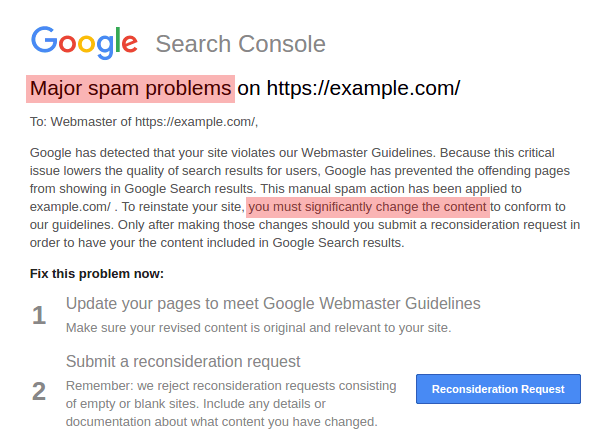 Major spam problems Google notification, with its most crucial point highlighted.
A rare variation of the major spam problems action highlights the gravity of the violation in more stark wording, referring to the website as pure spam. That message seems to be on the verge of being deprecated as in recent months it has been sporadically registered (in comparison to the major spam penalty, which is very common).
When issued, the pure spam problems penalty seems to be most frequently related to user-agent (or similar) cloaking. Displaying vastly different content to search engine bots and users based on the user-agent has become rare. At the same time, Google has stepped up their detection methods. This is a likely explanation for why this specific penalty has become less frequent.
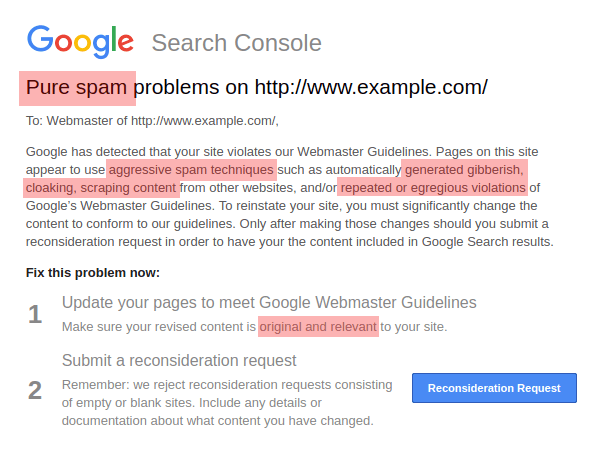 Pure spam problems Google notification, with its most crucial points highlighted.
Both major spam and pure spam problem notifications indicate that the site affected has, at a fundamental level, failed to live up to Google users’ expectations. The major spam penalty is most frequently applied to scraped content and/or gibberish sites.
Spam problems
The message highlighting just spam problems is a toned-down version of the major spam problems notification. The wording is similar, albeit less bleak.
While past variations of this message occasionally mentioned specifically “thin content” and/or “internal doorway pages,” recently a single message applied more generally to “spam problems” has become the standard.
This manual action suggests that, while the website isn’t entirely bad, bits and pieces are not good enough. That could refer to thin content (generally considered spammy), and it may very well refer to doorway pages – which, by definition, must be of low quality, as their primary purpose is to redirect users to another location rather than immediately providing an answer.
Typically, a penalty associated with the spam problems message does not result in complete removal from Google Search. Querying the site: search operator will often confirm that the site is still indexed, though it will likely be much less visible in organic Google Search results.
Google may try to go about the penalty surgically, penalizing only the offending pages and folders, but leaving the rest of the site intact. That tends to be the case if the violation is clearly isolatable, e.g., doorway pages are located exclusively within a directory like example.com/doorways/.
The exact scope of the penalty is usually not revealed to the site owner, and it can, therefore, be difficult to determine the impact the penalty has on site visibility.
How to go about removing the penalty
Removing this penalty will require a thorough site review, especially with regard to content quality. Large sites are better off conducting an all-out audit in order to identify which content is being indexed and which is not.
For the thin content, you will need to decide if (and how) it can be improved to meet standards, or if it is best to utilize noindex to avoid indexing low-quality content (which could possibly improve crawl budget distribution in the long run as well).
The evaluation process must include a landing page engagement assessment. It must not be driven by looking at word counts. It is not the length of content that may be an important factor, but rather how useful and engaging the content is to users.
Before a reconsideration request can be submitted to Google, doorway pages will need to be removed, and the content strategy will require revamping (often shifting toward less content that is more useful and robust).
All these steps are to be properly documented for the reconsideration request in order to put the best foot forward.
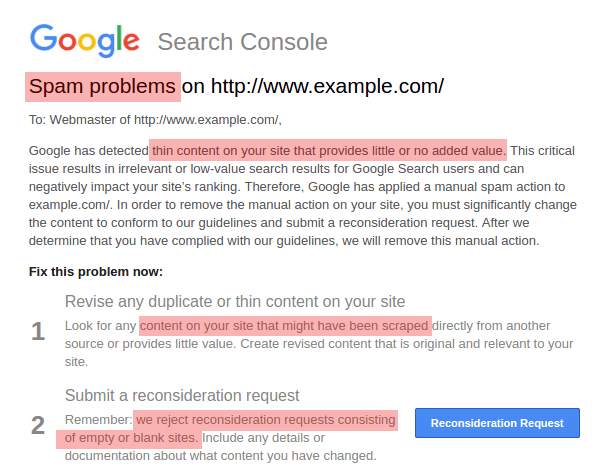 Spam problems Google notification, indicating thin content and/or possibly doorway pages.
Regardless of the penalty applied, under no circumstances should an empty or placeholder page with a bare “Hello world!” message be submitted for reconsideration.
Google clearly states in their notifications that such sites/pages do not qualify for reconsideration and will be rejected due to insufficient efforts made.
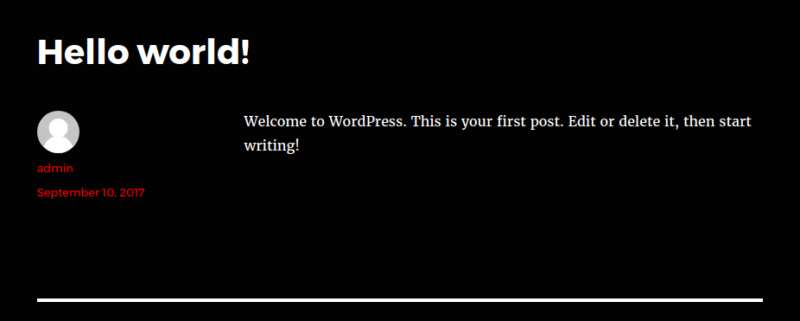 A blank or placeholder page instead of a thin content site is no substitute and will be deemed an insufficient effort for a reconsideration request to be successful.
Manual penalties in regard to thin content tend to affect large websites with tens of thousands or more crawlable and indexable pages.
A successful reconsideration with the very first attempt is an achievable goal, and a speedy recovery is possible.
Cases of sites actually doing better in organic Google Search after dropping their thin content and focusing on quality landing pages are not uncommon.
Unlike sites hit with major spam or pure spam penalties, sites affected by this manual action are not fundamentally on a collision course with Google Search Essentials. In most cases, improvements are needed and a fresh start from square one is required.
Thin content
The Google thin content warning is triggered in Google Search Console when a website is found to lack substantially in added value.
That is not to say that websites deemed by Google as thin content websites contain few landing pages or too little content. They may contain large amounts of content, that is however also readily available across many other websites.
This is why the thin content penalty is often applied to heavily monetized affiliate websites with prominently displayed commercial intent, so-called MfA (or “made for AdSense”) websites, and monetized scraped content websites.
Google and other search engines do not generally frown upon affiliation or monetization of websites as long as these add some unique value.
That said, websites that seem to be templated, do not represent a real brand nor provide tangible information about their authors tend to add little to the diversity of search results.
Search engines are interested in providing users diverse results, instead of ranking almost identical websites for a given query.
As a consequence of the thin content penalty, a website can be expected to initially drop in organic search rankings significantly, then continue to slowly decline after the first nosedive.
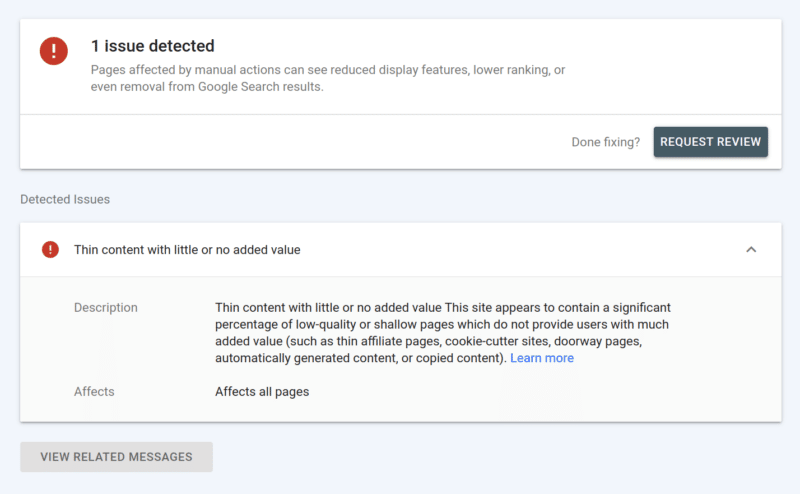 Without a discernible unique selling proposition, Google may consider a website to be thin content.
Convincing Google to lift the thin content penalty imposed, while possible, may require both pruning poor landing pages and enriching existing landing pages with fresh, relevant content.
In many cases, using data in order to provide relevant and unique information is a great way to make the website stand out.
Next to compelling About us and contact information as well as consistent, high-quality brand representation, a Google Reconsideration Request rationale outlining the specific added value the website represents is likely to be required in order to get back to Google’s good graces.
News and Discover
In a drive to combat false information and maintain information quality standards, Google has sharpened their focus on news and media website content quality. In consequence, the public list of News and Discover policy violations has been substantially expanded.
Online news platforms now face more scrutiny with regard to the factual accuracy of published content. At the same time, misleading, antisocial, offensive and explicit content has become less acceptable.
As these policies are being enforced, offending websites are confronted with a number of Google Search Console penalty messages.
The consequence of an imposed News and Discover-related penalty is always a significant (if at times much delayed) drop in organic Google Search results.
If a penalty is left to linger for a prolonged period of time, the entire website’s visibility in SERPs is certain to continuously, slowly decline.
Potential News and Discover violations which may trigger a Google penalty include, among others, explicit, unqualified medical or otherwise misleading content.
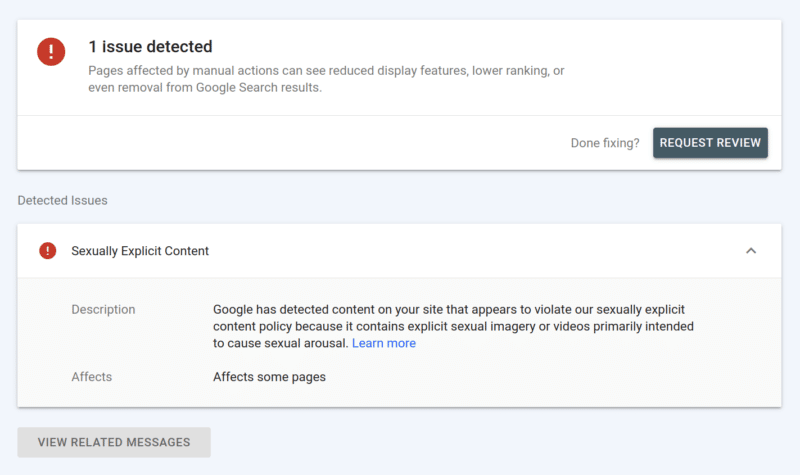 Explicit content violation
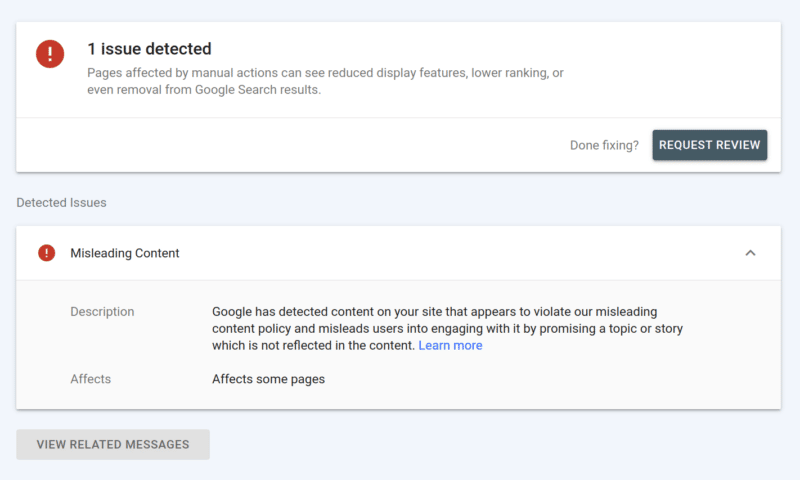 Misleading content violation
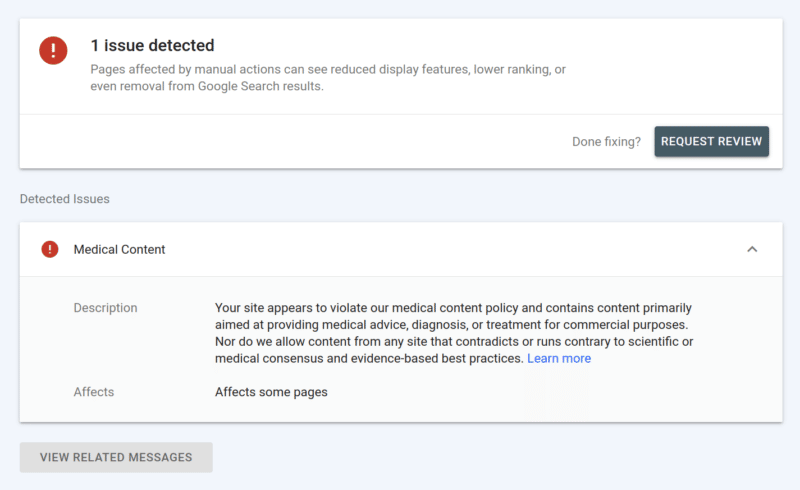 Medical content violation
The confirmed offense is typically accurately described in the Google Search Console message received. Google often chooses to pinpoint specific URL examples representative of the behavior that triggered the penalty.
While never exhaustive, these examples are tremendously helpful in the initial stages of the analysis and penalty recovery effort.
Regaining Google’s confidence with the prospect of improved future rankings depends largely on how thorough the clean-up effort, preceding a reconsideration request submission, really is.
Because Google is unlikely to issue a penalty for relatively minor offenses, any website actually penalized is almost certainly violating Google policies in an excessive way.
For that reason affected websites face the prospect of editing or purging a substantial amount of the offending content.
Merely removing problematic landing pages, without supplementing the website with quality content is typically not considered a comprehensive effort though.
AMP content mismatch
In line with the objective to ensure a fast user experience, Google continues to push AMP as a desirable technical solution. This policy spills over into Google Search Essentials, where content parity for all users is specifically required.
Google strives to keep the user experience as consistent as possible. Therefore, displaying significantly different content or offering a substantially different user experience to mobile and desktop users constitutes a Google Search Essentials violation.
AMP landing pages are not required to match the content on their original, canonical landing pages 100%. But the gist of the content, including the user experience, must be comparable for users regardless of the device used to access it.
This is why Google does not like users to have to navigate from an AMP landing page to another landing page in order to access the actual content. The latter solution in effect makes an AMP page a doorway page, which Google considers an egregious Google Search Essentials violation.
Unlike most Google penalties, the AMP content mismatch warning does not trigger sitewide repercussions. Instead, Google takes a more nuanced approach dropping only the rankings of AMP landing pages of a website. All other contents of the website remain unaffected.
This may appear as a relatively light penalty. However, no Google penalty should be left to linger for a prolonged period of time.
Google recommends utilizing the URL inspection tool to test the parity of both AMP and canonical landing pages and in doing so ensure a uniform experience for all users.
Once the landing pages can be considered similar enough, a reconsideration request including a compelling rationale briefly outlining the changes introduced should be submitted.
Alternatively, a technological switch can be considered a viable option. With AMP limitations in mind, the Google penalty imposed due to parity issues can be considered a stepping stone toward embracing a more robust technical solution, such as progressive web apps.
Cloaking and redirects
Search engines, including Google, want to rank ultimate destination landing pages. When a landing page redirects users, it is likely that search engines prefer to rank the final destination page, instead of an intermediary landing page.
There are of course legitimate reasons for maintaining redirects, which do not trigger any search engine sanctions.
However, when Google deems the intention of redirects to be deceptive (e.g., to intentionally redirect unsuspecting users to strongly commercialized landing pages), a manual spam action is likely to be applied to the website.
At the same time, Google considers showing significantly different landing pages to search engine bots and to human users known as cloaking as equally deceptive.
Similar to using redirects, when cloaking is implemented, search engines can’t trust that users will be presented with the expected content. From a search engine’s perspective, their user’s experience is likely to suffer, which they cannot ignore.
Since both cloaking and sneaky redirects are considered egregious Google Search Essentials violations, websites penalized for these offenses are likely to experience an imminent, steep drop in Google Search rankings.
In rare, extremely egregious instances, websites have even been known to be temporarily removed from Google’s index entirely.
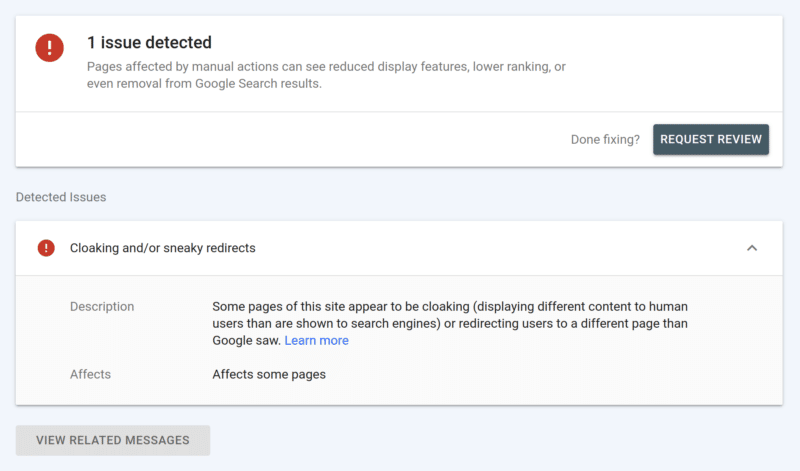 When landing pages show different content to search engines and human users or when users are redirected, Google is likely to penalize the deceptive behavior.
Lifting a penalty applied for cloaking and/or sneaky redirects requires a thorough clean-up and documentation effort first. All deceptive behavior must be discontinued entirely.
Because of the egregiousness of the violation, haphazard changes to the website will only prolong the penalty.
Once all cloaking and/or deceptive redirects have been removed, it is best to conduct a crawling test, before a compelling Reconsideration Request can be submitted to Google.
User-generated spam
User-generated spam tends to be an issue for large, user-driven sites. If this penalty is applied, that generally indicates that the affected site is being exploited by spammers.
Here, Google is essentially asking the site owner to get their own house in order – or else.
The message usually includes a sample URL where user-generated spam has been detected. Accordingly, the penalty’s impact (removal from Google Search results) is limited to the exact URL or directory mentioned.
While this may seem like a small price to pay, it is important to see the big picture. Sites affected by user-generated spam often receive a lot of user-generated spam messages, even on pages not identified by Google.
If the vulnerability isn’t swiftly taken care of, chances are there will be thousands of potentially malicious, user-generated pages which Google will remove from their index in order to protect their users.
On several occasions, Google has provided useful and actionable general guidance on how to protect sites from user-generated spam.
Ignoring a specific Google manual action message is never a good idea and a particularly dangerous strategy in the case of user-generated spam.
If you’ve received a message, that indicates Google deems the site useful but neglected. Thus, they raise the issue to help.
Hoping for the best, or for Google to fix the issue at their end, isn’t going to solve the problem.
Solving user-generated spam is mostly a technical challenge and rather simple when compared with the previously discussed penalties applied for spam content.
The following security measures should be considered and implemented as necessary:
- Make sure your forum or discussion software is up to date, especially with regard to any security patches that have been issued.
- Use moderation capabilities for the following:
- Blacklist obviously spammy words or inappropriate words (like pharma-related) and continue to add to your blacklists based on spam that you’re seeing.
- Identify and review content when a single account or IP address accounts for a large volume of posts in a short time.
- Subject posts from new members or new posters to editorial review before they are published, lifting the restriction once they have established themselves as trustworthy.
- Limit users’ ability to link.
- Consider disallowing links entirely or allowing only trusted contributors with spotless track records to link to other sites.
- If you allow links, you may nofollow them to remove some of the incentives to link externally.
- Close comments or discussions on threads after a reasonable period of time, as they’ll often collect spam after real users have ceased to engage with them.
Beyond getting you back in Google’s good graces, all of these steps are in the best interests of your business anyway, as they’ll help protect your brand integrity and your relationship with your user base.
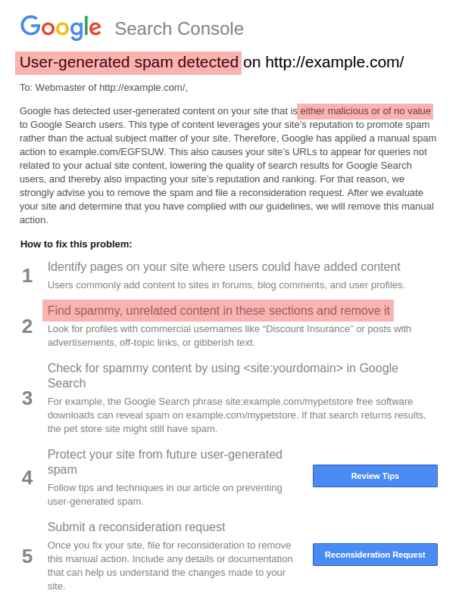 User-generated spam can trigger limited spam removal action. The problem, if neglected, will likely grow and can prompt more severe consequences.
Hacked content spam
The hacked content spam penalty resembles user-generated spam for one reason: It is a case of a compromised website that is being abused by spammers to inject malicious and/or irrelevant content without the site owner’s consent.
Again, Google’s message includes a sample URL, which provides a clue to where to start the investigation and what type of content to look for while cleansing the site of spam.
There are, however, two important differences between hacked content spam and user-generated spam.
- First, the hacked content spam penalty is applied to sites that are not user-driven and where the vulnerability isn’t caused by poor quality enforcement, but rather insufficient security.
- Second, the consequence of a hacked content spam action is a prominent label in SERPs, warning users of the possible threat if they dare to open the website. This means imminent and potentially lasting loss of user traffic coming from organic Google Search.
In this instance, Google provides some assistance. But ultimately, you need to identify a permanent solution.
A simple clean-up and malicious content removal alone are not likely to have the desired effect unless the underlying vulnerability is identified and patched.
As in all previous cases, submitting a compelling reconsideration request is the first step toward resolving the problem and removing the “hacked” SERP label.
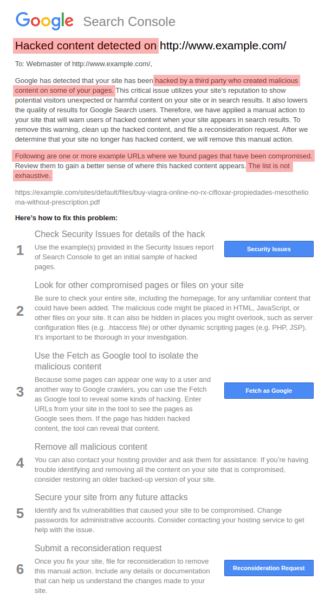 Legitimate, yet compromised, websites run the risk of misrepresentation in search engine results. Fixing the issue is the only way to remove a SERP warning, as it is a necessity to protect users and brand integrity.
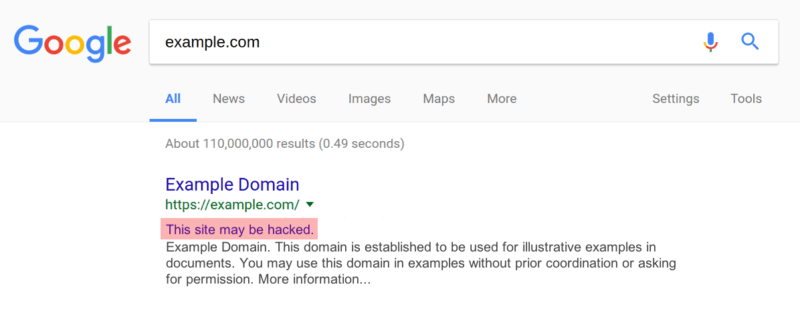 Hacked sites remain indexed and visible to Google Search users. However, they are labeled with a prominent warning and therefore are likely to be disregarded by users.
Incorrect structured data
Structured data is as much a means of making the content and context of a website better understood by search engines as it is a method to claim more SERP real estate.
When properly implemented, structured data can enhance your SERP listing with an eye-catching display known as a “rich snippet.”
The image below depicts the commonly seen Review rich snippet.
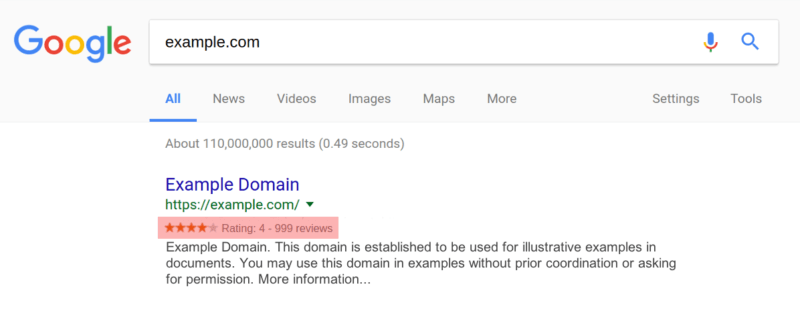 Sites with poorly implemented or deceptive structured data are likely to lose their additional SERP real estate.
The prospect of obtaining a rich snippet is enticing, especially in competitive verticals, which is why attempts to game the system using inflated or deceptive structured data are very much on Google’s radar.
If spotted, a notification highlighting incorrect structured data is the consequence, and your rich snippets will no longer appear in search results.
The recovery and reconsideration process is similar to what you would do for other types of manual penalties.
House cleaning, spotless implementation and documentation are key. In practical terms, once the confidence in the accuracy of structured data is lost, fully regaining it is rare.
Gaming structured data is, therefore, a risky business. It is not only not recommended, but it is also likely to indefinitely impact the look and feel of a site in Google SERPs.
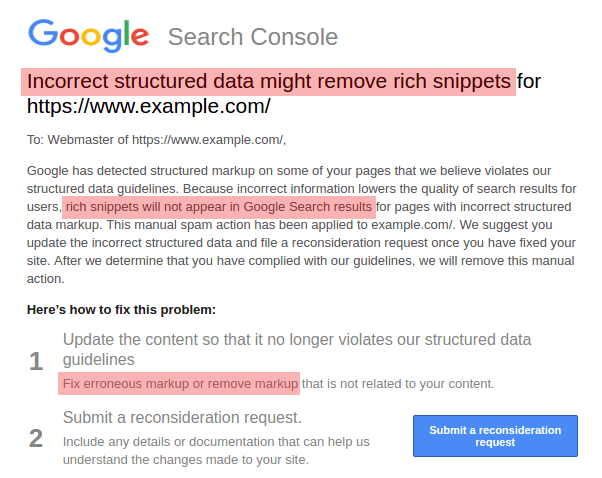 Google does not seem to appreciate incorrect or deceiving information, which is why losing structured data once may mean doing without them for an extended period of time.
Unnatural outbound links
Selling links for the purpose of manipulating PageRank is yet another Google Search Essentials violation that triggers a corresponding manual action and a message highlighting the issue.
Unlike in the past, however, the associated penalty does not necessarily cause a dramatic loss of site visibility in organic Google Search nowadays.
That said, the penalty is not to be taken lightly. Given the site owner’s total control over their own website, narrowing down the problem and applying a suitable solution, such as no-following questionable links, is easy and requires comparatively few resources.
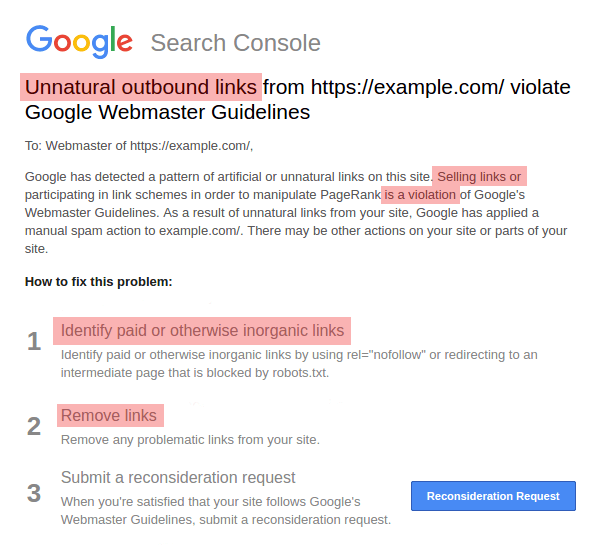 Initially, an unnatural outbound links penalty rarely correlates with a massive loss of visibility in organic Google Search results.
Spammy free host
When free hosting providers receive a Google Search Console penalty notification highlighting a spammy free host, Google has deemed an overwhelming majority of the user content hosted to be either spammy or otherwise of no value to internet users.
The specific Google Search Console message notifies the recipient and free host operator of the impending impact on the entire service’s visibility in Google Search results. In most cases, the service remains indexed by Google and can be found when users apply an exact, navigational query, e.g., site:example.ai.
However, the service is most likely to temporarily lose nearly all SERP visibility, even for what may be considered relevant queries. Because the entire website is affected, rather than only granular parts of the service, the spammy free host manual spam action is considered a harsh penalty.
Historically, Google seems to have been reluctant to take these wide-reaching measures against free hosting platforms, unless in the most egregious cases.
Confirmed past cases indicate that only free hosting services with approximately 99% of the indexable user-generated content abused, have been penalized as spammy free hosts.
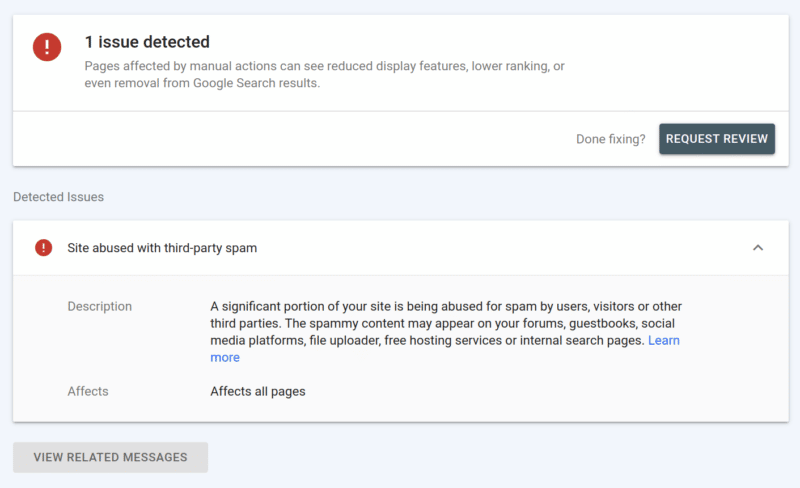 Spammy free host notification in the Google Search Console, highlighting the egregious nature of the ongoing platform abuse.
Despite the excessive scale of the spam problem highlighted, Google still refrains from applying the ultimate penalty, comparable to pure spam, to remove the entire free hosting service from the index.
It is worth noting that the Google Search Console notification is brought exclusively to the free hosting service operators’ attention. Its legitimate users remain unaware of the impact on their content’s visibility in organic Google Search results.
This reflects the fact that only the service operator is in a position to impose some level of quality control and spam abuse prevention, which is a necessary step to build a comprehensive case before submitting a Google reconsideration request.
Off-page guideline violations and related notifications
While a site owner may theoretically be unable to control what other places link to the site, risky practices like buying links or spamming other sites have led Google to be concerned with off-page issues as well.
Unnatural inbound links
The most frequently experienced Google manual action by far is the one applied as a consequence of unnatural inbound links to a website.
Affected sites are deemed to be engaging in link schemes (link building intended to manipulate Google rankings), which Google considers a major violation. The penalty’s impact can be partial or affect the entire domain.
The consequent loss in visibility in Google ranges anywhere from barely noticeable to a steady decline over time to a dramatic total loss of visibility overnight. The vertical and brand prominence seem to play no role – large, reputable sites have been affected by this penalty.
Very rarely, we’ve seen sample URLs (even as many as five) listed on the unnatural inbound links message, which gives the site owner a starting point for their investigation. These samples may be of great use if they can indicate the pattern that raised a red flag – for example, if they all show low-quality PR services that scrape and reproduce pieces that include commercial anchor text links.
Whether examples are provided or not, it is vital to conduct a full backlink audit. Based on that evaluation – which, depending on the backlink data volume, could take up to several weeks – all questionable backlinks are to be noted in a separate file.
It is important to bear in mind that, for large websites with millions of backlinks, samples provided in Google Search Console will likely be too fragmented and offer insufficient data for a successful reconsideration request. Therefore, you must identify all of the questionable links yourself before asking to be reconsidered.
To boost the prospects for a favorable result with the very first reconsideration request, it is crucial to consider not only backlink volumes and distribution, but also the linking site’s quality and its general approach to linking out.
A solid backlink risk assessment is inclusive of all historic linking liabilities, without neglecting any legacy link building remnants, like directory entries of a long-gone SEO era.
Once you’ve created a file containing all your questionable or spammy backlinks, it’s time to work on getting those links removed from the web. This may require reaching out and asking other websites to take down links to your site or have them marked as “nofollow.”
Any spammy backlinks that you are not able to get removed, despite your best efforts, should be isolated and included in a .txt file called a disavow file.
Once the review is finalized and a disavow file created, it is recommended to upload the disavow file first (and receive confirmation of the change) before submitting documentation outlining all relevant steps taken to resolve the issues Google has highlighted.
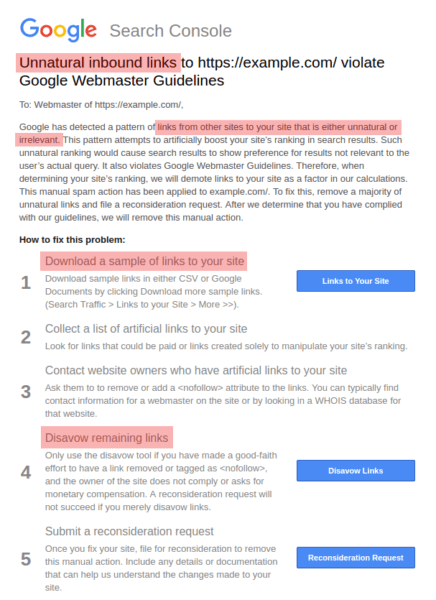 The first step upon receiving an unnatural inbound links message is to compare the backlink profile and current link building practice against Google Search Essentials.
Reconsideration requests and related notifications
Any Google penalty can be lifted and the website will not be held back because of past transgressions.
If you’ve received a manual action and have made a good faith effort to fix the issues that triggered it, you can request for Google to review your site so that you can have the penalty lifted.
This is what is known as filing a reconsideration request.
Any time you receive a manual action notification, it should outline all the steps you should take to rectify the problem. These steps will vary depending on the specific penalty that has been issued.
Once you’ve satisfied all of the requirements outlined by Google, the final step should contain a “Reconsideration Request” button that will initiate the process once clicked.
As part of the reconsideration request process, you may need to provide the Google team with documentation outlining the steps you have taken to bring the site into compliance with Google Search Essentials. This will help build a case for why the manual action should be lifted.
Once you’ve fixed all your website issues and submitted a reconsideration request, you may receive one of the following notifications in Google Search Console.
Disavow file updated notification
Any promising attempt to resolve a manual action related to unnatural backlinks will involve submitting a disavow file, which contains all the spammy backlinks to your site that you were unable to remove.
Submitting your disavow file will trigger a message confirming that a disavow file has been uploaded. It will specify the number of URLs and domains submitted.
Please note that while updating an existing disavow file, previously submitted URLs will be overwritten unless they are expressly included in a new file that is about to be submitted. Google’s Disavow Links Tool does not, as of this writing, support incremental updates.
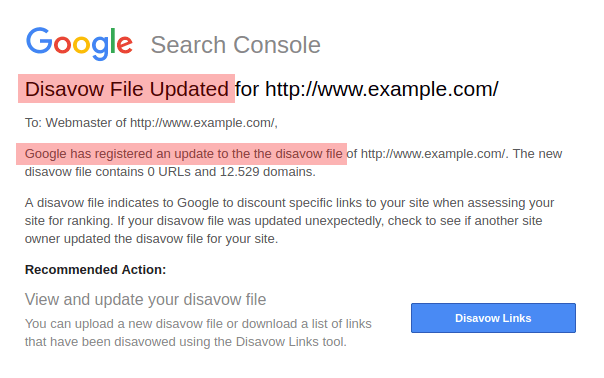 Not a manual action message, but a confirmation that the first step toward resolving an unnatural inbound links penalty has been made.
Reconsideration request (submission confirmed)
If you’ve received a manual action and have made a good faith effort to fix the issues that triggered it, you can request for Google to review your site so that you can have the penalty lifted. This is what is known as a reconsideration request.
After you submit your site for reconsideration, Google will confirm receiving a reconsideration request in the same way they acknowledge receiving a disavow file. The specific text seems to vary, often to manage expectations regarding the expected processing time.
Currently, there’s no officially guaranteed turnaround time for reconsideration requests to be processed. Experience shows that this process can take anywhere from a few hours (rare) to a few days (more common) to several weeks (worst-case scenario).
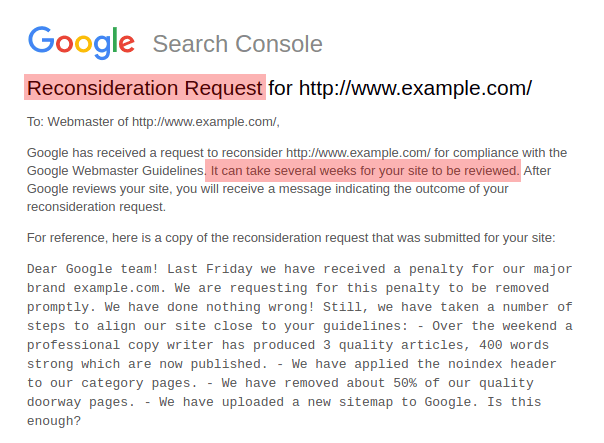 Google does acknowledge receiving a reconsideration request and includes the rationale provided underneath their message. In this case, because of the haphazard rationale, prospects for succeeding are bleak.
Reconsideration request rejected
If the efforts made to get back into Google’s good graces are deemed insufficient, a reconsideration request rejected message is forthcoming. That message seems to be uniform and merely states the active status of the penalty.
There are occasionally variations of the message which go beyond notifying the site owner and offer a little guidance regarding the persistent violation.
Those messages, which seem to be most common in the case of unnatural inbound link penalties, are customized and include specific violation examples.
Any spam backlink samples that are explicitly mentioned in such a message must inevitably be disavowed. Merely disavowing the links Google highlighted in its notification is insufficient, and a complete backlink audit is in order.
Regardless of the type of penalty applied, repeated reconsideration request attempts are possible. Currently, Google seems to have no cap on the total number of requests that are allowed.
However, every new request must reflect an increased effort to align the website with Google Search Essentials, or there’s little chance of eventual success.
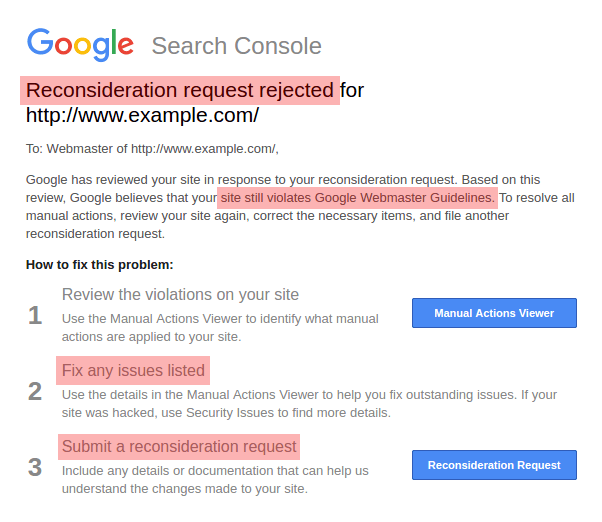 A standard reconsideration request rejected message is most common for sites that have not been sufficiently aligned with Google Search Essentials. It includes no additional clues.
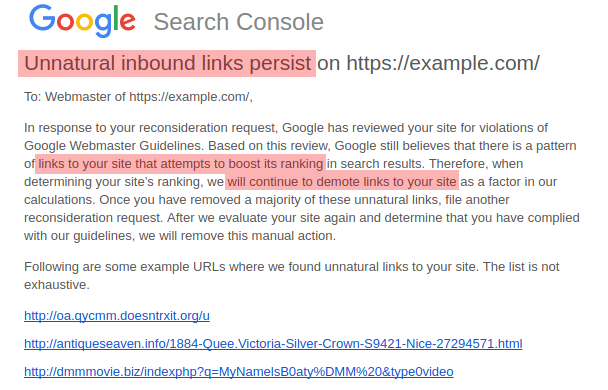 At times, a custom reconsideration request rejected notification does include some clues. Sites identified as backlink spammers may receive messages with up to five individual unnatural link URLs to aid their anticipated, increased efforts to apply for reconsideration.
Reconsideration request processed
The majority of all reconsideration requests submitted to Google are processed and either approved or rejected.
However, there are rare exceptions in a small number of edge cases where a clear-cut decision does not seem to be possible. These cases are met with a Reconsideration request processed notification.
Judging by the wording, this seems to indicate that while a worthwhile effort was recognized, there’s more than just one type of violation present.
This may explain why it implies that one penalty may have been lifted while another one was refined.
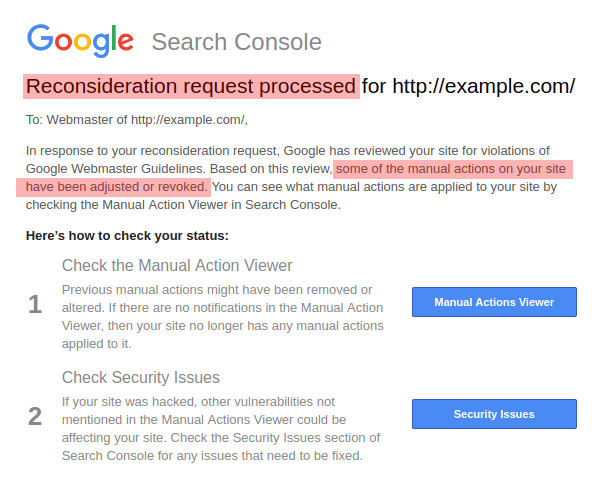 A rare Reconsideration request processed notification, which almost always seems to come with a friendly reviewer hint.
Without a doubt, this message does not mean good news for the site’s owner – or the site’s visibility. Consequently, more investigative work is required.
There’s a silver lining on the horizon, however.
Most reconsideration request processed notifications come with a specific “note from your reviewer.” This is a manually edited message from a sympathetic Googler trying to help – an encouraging signal for the site’s future prospects.
Reconsideration request approved
Google’s manual action removal triggers a short, uniform reconsideration request approved notification.
Aside from mentioning that the penalty has been lifted, this notification makes it clear that coming back into compliance with Google Search Essentials does not necessarily mean that your site will experience improved rankings in organic Google Search. The site may grow in visibility, stagnate or drop.
There’s no further action required once this message is received, other than focusing on users and the core of the website activity again. It is the best possible outcome to be expected.
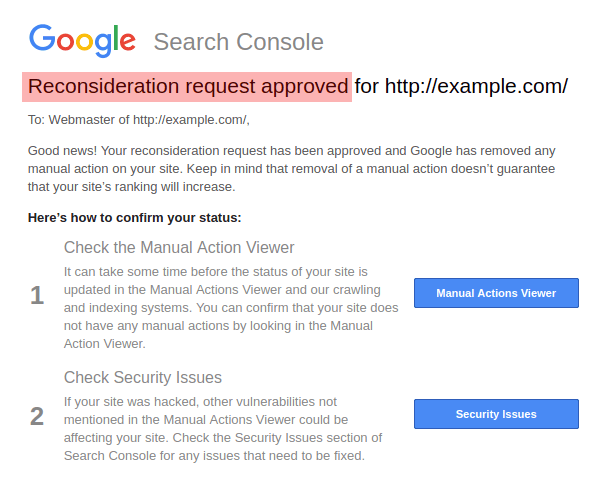 The reconsideration request approved notification says the spam situation is resolved and there is no further action required.
Any questions about Google’s manual penalties not addressed sufficiently in this article are welcome and appreciated. All reader input received will be considered to keep this ultimate guide covering manual penalties up to date.
The post Google penalties, manual actions and notifications: A complete guide appeared first on Search Engine Land.
Courtesy of Search Engine Land: News & Info About SEO, PPC, SEM, Search Engines & Search Marketing
Category seo news | Tags:
Social Networks : Technorati, Stumble it!, Digg, de.licio.us, Yahoo, reddit, Blogmarks, Google, Magnolia.
Google My Ad Center updates give users more, expanded controls
Written on October 21, 2022 at 2:02 am, by admin
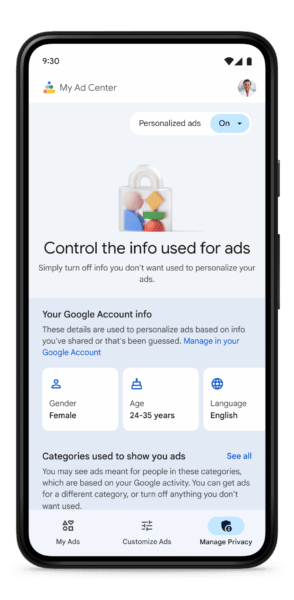
Google’s My Ad Center today will start rolling out to users, globally, to provide control over the kinds of ads they see across Google on Search, YouTube and Discover.
“81% of consumers are more concerned with how their data is being used and 48% are turning away from services due to privacy concerns. At the same time, our research also says that people only want to see ads that are relevant and useful to them,” says Jerry Dischler, VP/GM Google Ads. “To build more trust, we want to continue ensuring that ads respect people’s privacy; and offer transparency, choice, and control. We see these principles as foundational to the future of advertising. It is a key priority for our business – and the foundation My Ad Center was built on.”
New features and controls. The new My Ad Center controls will also allow you to block sensitive ads and learn more about the information used to personalize your ad experience.
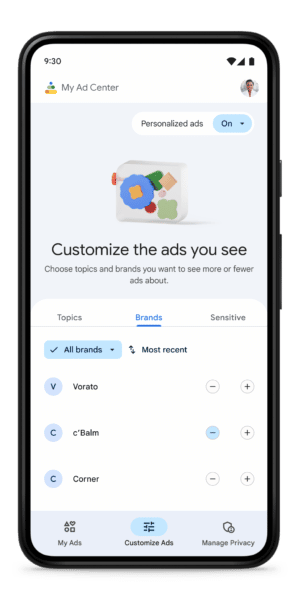
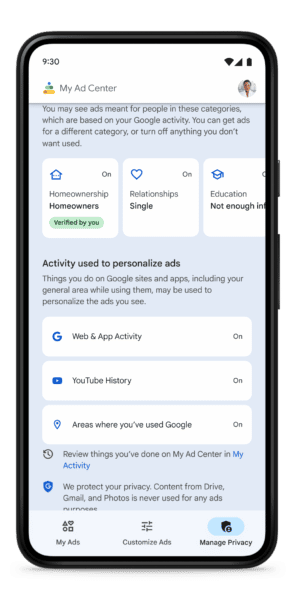
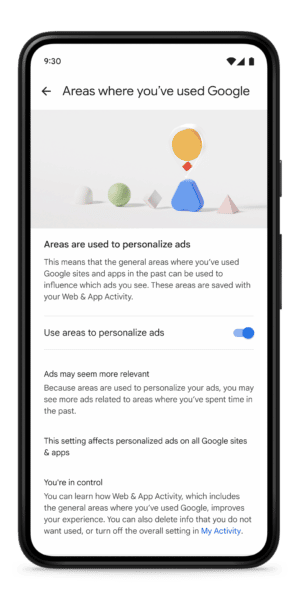
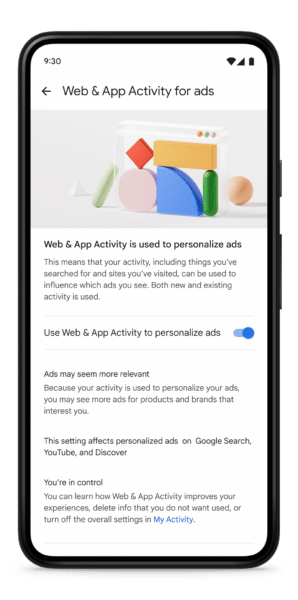
More controls for activities used to personalize ads. My Ad Center expands Google’s privacy controls to allow users more direct control over which data sources — specifically Web & App Activity and YouTube History — are used to personalize your ads across Google Search, YouTube and Discover.
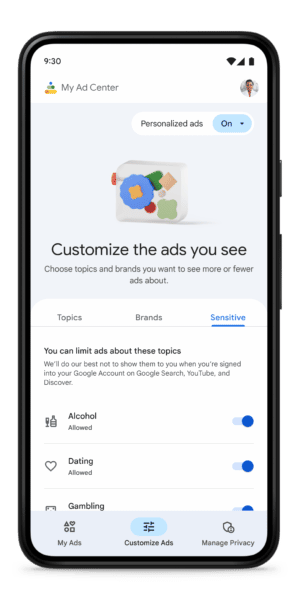
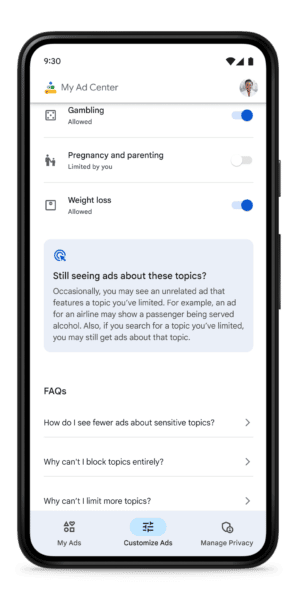
Expanding user control for sensitive categories. In My Ad Center, users have the ability to see fewer ads in five sensitive categories:
- Alcohol.
- Dating.
- Gambling.
- Pregnancy and parenting.
- Weight loss.
Before, this feature affected ads shown on YouTube and Display. Now, it expands to ads shown on Search and Discover.
Advertiser pages. To give people even more transparency, Google is enhancing ad disclosures with new advertiser pages. Users can access these disclosures in the new My Ad Center panel and see the ads a specific verified advertiser has run over the past 30 days.
How it works. In My Ad Center, users can tap on the three-dot menu next to an ad type they want to see less of. They can also choose to see ads about things that they care about, like deals for sneakers or holiday gifts for loved ones, according to examples provided by Google.
Users can also completely turn off ad personalization. Those who choose not to see personalized ads, will still be served ads, but Google says those ads may be less relevant or useful.
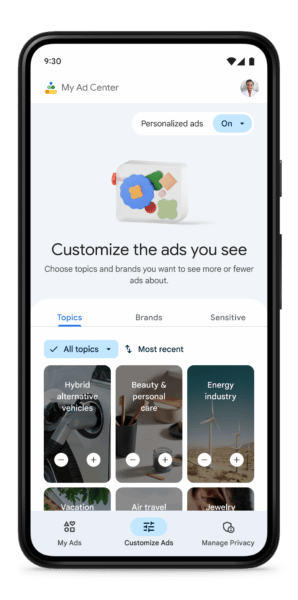
More privacy controls. With the new My Ad Center added controls, you can see what information Google uses and control it based on your preferences. You can decide what types of your Google activity are used to show you ads.
In the past, if your YouTube History was on, it automatically informed how your ads were personalized. Now, if you don’t want your YouTube History to be used for ads personalization, you can turn it off in My Ad Center, without impacting relevant recommendations in your feed.
What Google says. Dischler adds, “I see our role in this evolving industry as innovating through our products. Building products that are secure by default, private by design, and put the control of data in the hands of our consumers. When it comes to advertisers, publishers, and our other partners, we are taking a privacy-preserving approach to advertising, built on first-party data, and unlocked by the benefits of machine learning.”
“We are doing all this because we believe it’s essential to the open web to build a long-term stable ads ecosystem. And we intend to help navigate the industry to a privacy-first, pro-consumer-focused future.”
Dig deeper. You can read more info about the new My Ad Center experience here.
Why we care. Since Google’s announcement of My Ad Center in May, we have been waiting for it to roll out to users globally. With the sunsetting of cookies in 2024, the new privacy features give users their best chance at privacy and having a say in the ads they are served.
Additionally, the new features could be a benefit to advertisers as well since users who take advantage of My Ad Center will have access to the ads and brands they are most interested in. Advertisers will also benefit from higher ad relevance.
The post Google My Ad Center updates give users more, expanded controls appeared first on Search Engine Land.
Courtesy of Search Engine Land: News & Info About SEO, PPC, SEM, Search Engines & Search Marketing
Category seo news | Tags:
Social Networks : Technorati, Stumble it!, Digg, de.licio.us, Yahoo, reddit, Blogmarks, Google, Magnolia.
[Sponsored]: Webinar: An SEO guide to fixing keyword cannibalism
Written on October 19, 2022 at 11:01 pm, by admin

Keyword cannibalization can occur when multiple URLs on your site rank for the same keyword. This can become a problem for your website if you have multiple pages competing for the same keyword and one or more of your pages are underperforming. If you’re concerned your website is experiencing harmful keyword cannibalization, don’t panic!
Join Conductor for a discussion on identifying keyword cannibalization and what steps you can take to resolve instances of harmful cannibalization on your website.
Register today for “An SEO Guide to Finding and Fixing Keyword Cannibalism,” presented by Conductor.
The post Webinar: An SEO guide to fixing keyword cannibalism appeared first on Search Engine Land.
Courtesy of Search Engine Land: News & Info About SEO, PPC, SEM, Search Engines & Search Marketing
Category seo news | Tags:
Social Networks : Technorati, Stumble it!, Digg, de.licio.us, Yahoo, reddit, Blogmarks, Google, Magnolia.
Google releases October 2022 spam update
Written on October 19, 2022 at 11:01 pm, by admin
Google is rolling out a new search ranking algorithm update targeting the more spammy side of the search results.
The company is calling this update the “October 2022 spam update.” It should take about a week to fully roll out and be noticed in the search results.
Google said this update is global and affects all languages.
What are spam updates. Google wrote:
“While Google’s automated systems to detect search spam are constantly operating, we occasionally make notable improvements to how they work. When we do, we refer to this as a spam update and share when they happen on our list of Google Search ranking updates. For example, SpamBrain is our AI-based spam-prevention system. From time-to-time, we improve that system to make it better at spotting spam and to help ensure it catches new types of spam. Sites that see a change after a spam update should review our spam policies to ensure they are complying with those. Sites that violate our policies may rank lower in results or not appear in results at all. Making changes may help a site improve if our automated systems learn over a period of months that the site complies with our spam policies.”
The announcement. Google announced this on Twitter saying “Today we released the October 2022 spam update.”
Today we released the October 2022 spam update. Find out more about spam updates at https://t.co/XthD5GF06M . We'll update our ranking release history page when the rollout is complete: https://t.co/sQ5COfvo3J
— Google Search Central (@googlesearchc) October 19, 2022
Previous updates. Before this, the most recent confirmed Google spam update was the November 2021 spam update. Google also released a two-part Spam Update – on June 23 and June 28 in 2021, as well as the July 2021 link spam update.
Why we care. If you notice large ranking or traffic changes from your organic Google search results, you may have been hit by this spam update. Spam updates target specific guideline violations. Google did not say if this was links, content or other forms of spam, but rather just said it is spam-related in general.
The post Google releases October 2022 spam update appeared first on Search Engine Land.
Courtesy of Search Engine Land: News & Info About SEO, PPC, SEM, Search Engines & Search Marketing
Category seo news | Tags:
Social Networks : Technorati, Stumble it!, Digg, de.licio.us, Yahoo, reddit, Blogmarks, Google, Magnolia.
[Sponsored]: Balancing active and passive collaboration in today’s workspace
Written on October 19, 2022 at 11:01 pm, by admin

When it comes to collaboration, there is no one-size-fits-all approach. Especially now, as businesses operate in many different ways, the way employees work together is ever-evolving.
Because of this, leaders need to rethink how to collaborate successfully by removing barriers and empowering their teams to do the best work of their lives.
Still, many companies are failing at meaningful collaboration. And if marketers cannot work well together digitally – when they have that chance to hit edit before they hit send – they’re going to have trouble working together again face to face.
Join Patrick Rohlfsen, principal consultant at Wrike, to hear recommendations for collaborating in harmony, in his inspiring MarTech session. He will walk you through the difference between active collaboration (Slack and Teams chatting, instant messaging, etc.) and passive collaboration (responding to emails or phone calls without urgency).
After this session, you’ll be able to:
- Understand the importance of recalibrating technology in the modern workplace.
- Build stronger relationships, have better conversations and build trust.
- Have a better resolution for where technology fits in your collaboration equation.
Tune in to the session and session, and you’ll better understand the potential and value human beings (with the support of technology) have when they are intentional about collaboration. The more thought you give to creating environments and experiences for stakeholders, the better the results you’ll have as project managers.
The post Balancing active and passive collaboration in today’s workspace appeared first on Search Engine Land.
Courtesy of Search Engine Land: News & Info About SEO, PPC, SEM, Search Engines & Search Marketing
Category seo news | Tags:
Social Networks : Technorati, Stumble it!, Digg, de.licio.us, Yahoo, reddit, Blogmarks, Google, Magnolia.
4 communication best practices agencies must employ early in Q4
Written on October 19, 2022 at 11:01 pm, by admin
Let’s run through a scenario that agencies see from time to time (not just in Q4, but the stakes are higher across the board right now):
On the client side, a main point of contact is relatively new to the team. It’s Q4. They’re feeling stressed.
On the agency side, things seem to be going well. KPIs are in line with established goals, there’s a strategy in place for the next few months, weekly calls haven’t surfaced any concerns, and there’s a healthy test-and-learn methodology in place for creative optimization and channel expansion.
Then the email drops: counter to what the agency is seeing, company data shows that the marketing team isn’t hitting goals.
If things don’t improve quickly, there are going to be some tough conversations about ending the partnership.
What happened? And how could the agency have prevented it?
I’ll dig into the answers in this post.
1. Treat alignment as an activity
Agencies and brands are generally diligent about aligning goals, KPIs, and data sources as part of the onboarding process.
But the agency can’t assume brands will automatically alert all parties when things change internally.
Factors that agencies must plan to solicit regular updates on include:
Goals
Every marketing department I’ve ever worked for or with has changed goals from time to time.
Whether it’s pivoting from lead gen to site traffic or shifting focus from driving growth to improving CPA, change is a constant.
This needs to be reflected in your campaigns and reporting, or you’ll be driving headlong down the wrong road in optimizing the wrong KPIs.
Data sources
Internal dashboards are always a big point of discussion in onboarding and kickoff calls, but the conversation can’t end there.
Attribution models change and improve, tech stacks evolve, internal business intelligence teams build dashboards, etc.
Agencies that aren’t asking for access to that data are flying without a map.
One important component of internal reports that agencies need to know is the fields that client dashboards use to attribute to advertising.
We use UTMs and campaign IDs, but clients may be able to attribute advertising-influenced actions beyond that first touch that we can bake into our reporting and optimization.
If a client is using HubSpot, that can add an extra layer of complication.
HubSpot reports are hard to export and look at in a clean way. The data needs to be analyzed in a native environment in order for agencies to tie campaigns to offline data.
While HubSpot data can be pulled into better reporting environments like Salesforce, which can build reports based on any specified UTMs (e.g., ad group or keyword), any advanced offline insights will rely on client resources to build the reporting.
In short, those conversations, and how to share and reconcile different data sources, are important to have to maintain a similar construct around campaign performance for whatever layer of analysis you’re seeking.
Calendars/pricing
We all know, on the consumer level, that retail discounts are all the rage in Q4 – online, offline, and both.
In the B2B world, it’s common for brands to incorporate an end-of-year sales push, or buyer incentives, that could include more motivation to book meetings.
Agencies that aren’t asking for that information right around now will likely suffer from a lack of lead time in setting up plans, including how to monitor and adjust to pipeline data and funnel flow (e.g., lead-to-meetings booked rates could artificially increase, which could have bidding and budgeting ramifications).
Websites and landing pages
Websites and landing pages change all the time.
Maybe there’s a homepage banner advertising a brand-new report or new CTAs in rotation on a demo-focused landing page.
Or maybe the client has done some brand tweaking to update messaging and value props.
That report would make a great sitelink for brand search ads. Those CTAs and value props should be reflected in ad copy and creatives to keep the user journey as friction-free as possible.
Those might seem minor, but little things can compound over time if you’re not keeping track of a client’s owned media updates.
External campaigns
This is an extreme example, but imagine you’re watching the Super Bowl, and you see a commercial for a client that you had no idea was about to happen. Your search budget could be blown by halftime.
When clients have major campaigns afoot beyond the ones you’re managing, you need to know in order to effectively prepare for any downstream ripples.
Make sure you’re checking with your clients – especially those working with multiple agencies – on whether they have initiatives outside of your partnership that you should be aware of.
This includes things like billboards, radio commercials with discount codes that could make for cool sitelinks, CTV or podcast campaigns, etc.
2. Build – and stick to – a communication cadence
Do not wait for QBRs to bring up big topics like goals. Internal marketing teams don’t plan their strategy around agency meetings.
At my agency, we’re working on a strategic planning template that we’ll review quarterly with clients in 2023, but we’ll supplement that by bringing up goals regularly on weekly calls to build the habit and make those conversations second nature.
Along with reporting on progress to goal, as most agencies do in weekly calls, we’ll manage alignment by:
- Asking if anything has changed.
- Getting context and providing initial feedback on feasibility if goals have changed.
- Openly discussing possible concerns and brainstorming solutions.
Once those steps are completed, we’ll revise the current roadmap or build a new one to make sure we’re fully incorporating the goals into our partnership.
Get the daily newsletter search marketers rely on.
<input type=”hidden” name=”utmMedium” value=”” />
<input type=”hidden” name=”utmCampaign” value=”” />
<input type=”hidden” name=”utmSource” value=”” />
<input type=”hidden” name=”utmContent” value=”” />
<input type=”hidden” name=”pageLink” value=”” />
<input type=”hidden” name=”ipAddress” value=”” />
Processing…Please wait.
3. Err on the side of over-communicating
Over-communication can make the consumption of important content challenging, especially in today’s digital environment. (Quick, count the number of log-ins you do daily to keep up with company and external goings-on.)
But under-communicating is a worse option.
Simply put, you can ignore the questions or content you don’t have time to read, but you can’t respond to something if it’s never put in front of you. That’s the approach agencies should take, especially in relatively busy/chaotic times like Q4.
Repeat info. Overshare updates. Ask questions (politely) until you get answers.
In general, assume your client contacts are busy and under pressure and don’t have “keep agency up to speed” first on their list of daily priorities.
4. Work backward and build project plans
As agencies well know, it takes time to plan properly for initiatives like end-of-year software sales discounts and ecommerce promotional calendars – especially since there’s also a lot of daily rigor and optimization that needs to happen in the meantime.
I like to set an ideal endpoint (“We launch on X date”) and work backward to schedule every preparatory step needed to hit the goal.
- Give the client a heads-up that you’re working on a project plan.
- Detail each step and assign rough dates and owners.
- Send the proposal to your clients for review ASAP.
Once their feedback is incorporated and the parties are aligned, make sure you’re tracking and updating the project somewhere common like Asana to keep all parties on track.
Conclusion
For both the client and the agency, the absolute worst time to surface any possible issues is after a long stretch of misaligned perspectives of performance.
Prolonged misalignment often results in the end of a partnership and missed goals on the client side.
It’s especially important for agencies to establish a rhythm of questions and proactive communication in Q4, with the bonus that you’ll condition both parties to keep lines of communication open and enable better longer-term planning.
The post 4 communication best practices agencies must employ early in Q4 appeared first on Search Engine Land.
Courtesy of Search Engine Land: News & Info About SEO, PPC, SEM, Search Engines & Search Marketing
Category seo news | Tags:
Social Networks : Technorati, Stumble it!, Digg, de.licio.us, Yahoo, reddit, Blogmarks, Google, Magnolia.
A look inside TikTok’s new automated Smart Performance Campaigns
Written on October 18, 2022 at 7:55 pm, by admin
TikTok announced a new campaign type for brands to further enhance their performance in the app. The new solution is called Smart Performance Campaigns.
Sounds familiar. If the new campaign type sounds familiar, it might be because it’s almost identical to Google’s smart and Performance Max campaign types which require advertisers to put their full trust into the platform’s AI and machine learning systems.
What TikTok says. From their blog post announcement, TikTok says:
“Smart Performance Campaign is our first end to end automation solution that leverages machine learning to optimize for best performance and marketing goals. In order to reach the right people and maximize results, Smart Performance Campaign is designed to run performance campaigns at scale, while reducing the number of manual steps to drive results.
It’s completely hands off, with minimum input needed from advertisers to get started. Through leveraging machine learning, getting started with Smart Performance Campaign is as easy as it sounds. All you need is a marketing objective, budget, country, and creative assets to get started.”
Who should use Smart Performance Campaigns. TikTok says that the new Smart Performance Campaigns are perfect for advertisers who are new to advertising on the platform, Enterprise or SMB advertisers who don’t have the resources to have hands-on campaign management, performance-oriented advertisers who are looking to optimize, and gaming advertisers launching new titles.
Early testing. In their announcement, TikTok said Bolt ran a 14-day A/B test campaign with Smart Performance Campaign that lowered CPA by 27% and generated 40% more purchase actions. To continue the success, Bolt has rolled out Smart Performance Campaign across additional markets including the UK, Spain, Sweden, Romania, and Portugal.
Launch date. Smart Performance Campaign will be globally available for Android App Promotion campaigns at the end of the month, with more to come later this year for iOS and Website Campaigns.
Why we care. Just like with Google, automated smart campaign types will work better for some brands than others. Advertisers should be cautious and ensure their performance tracking is accurate and pixels installed properly before use. It is worth testing with a small portion of your budget, but it’s not available to all advertisers just yet so keep an eye on your account.
The post A look inside TikTok’s new automated Smart Performance Campaigns appeared first on Search Engine Land.
Courtesy of Search Engine Land: News & Info About SEO, PPC, SEM, Search Engines & Search Marketing
Category seo news | Tags:
Social Networks : Technorati, Stumble it!, Digg, de.licio.us, Yahoo, reddit, Blogmarks, Google, Magnolia.