

Programmatic SEO: Your missing link to 1M+ sessions
Written on December 13, 2022 at 6:40 am, by admin
It’s time to rethink SEO growth.
Not every strategy needs to start with a blog post regurgitating the same information across the top Google results and end with an agency begging for links.
In the era of Google Ads becoming more expensive and organic discoverability becoming less effective, companies need to differentiate themselves in SEO.
We must push the envelope and create something that has yet to be seen online.
With creativity, thoughtfulness, and CSV magic, programmatic SEO can do this, resulting in millions of new customers per year.
This sounds impossible, but it’s not.
In this guide, I will walk you through exactly how to get started with programmatic SEO.
What is programmatic SEO?
Programmatic SEO is the strategy of publishing unique, high-quality pages at scale using a template and a database.
The goal of programmatic SEO is to create content with the same depth and thoroughness as a traditionally published article but repeated thousands, if not millions, of times at scale. A programmatic site can be as small as 200 pages and as large as 4 million. The key is ensuring each page serves a unique purpose in the search journey.
An oversimplification of programmatic SEO is building a database, connecting it to a template, and publishing thousands of pages.
But if this is all you do, congratulations, you just created thousands of pieces of spam.
Programmatically building content is a powerful tool that can exponentially grow a site or completely spam it. To become a true player in SEO growth, we must start thinking bigger – or should I say, we need to think “deeper” about our content.
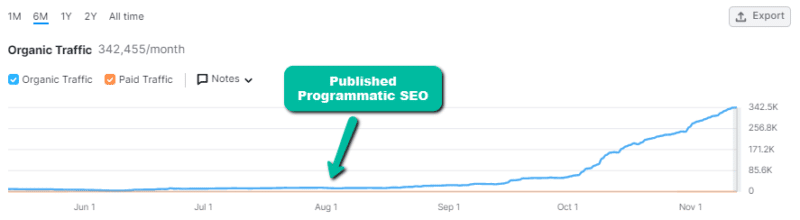
 A newly published programmatic site since June 2022.
The benefits of programmatic SEO
Programmatic SEO unlocks traffic in the nooks and crannies of the internet. You no longer need to pick a handful of keywords, pay for written content, publish the post and hope it ranks for a cluster of terms. Now we can target entire categories and win all available searches in one template.
With programmatic SEO, businesses can:
- Win keywords at scale.
- Produce in-depth content quickly.
- Gain low engineering lift.
- Get “quicker” results – I use this delicately. Quickly, meaning results and challenges escalate quickly.
The drawbacks to programmatic SEO
As with any strategy, programmatic SEO also has its disadvantages, such as the following:
- Indexing is difficult.
- High risk – poor execution can hurt site growth.
- Limited by data resources.
Remember, if you’re trying to use programmatic SEO to trick Google or create People Also Ask (PAA) scraper sites, you’ll lose.
Great programmatic content enhances content production through data depth and production efficiency.
What follows is a four-step guide to implementing a programmatic SEO structure.
Step 1: Keyword research for programmatic SEO
Instead of picking out a handful of keywords and paying for expensive bespoke content hubs, programmatic SEO aims to target entire directories of keywords under the same entity.
Here are the steps in identifying your keywords.
Define your goals and intent
This will start similarly to a traditional SEO keyword analysis. Identify what category or topical group will drive business value. Hard stop.
Driving traffic to show a cool graph to your client or boss means nothing if the traffic doesn’t move the business forward.
Remember, business value can be as obvious as full conversions through transactional keywords or as light as a session hit to introduce your brand and possibly trigger a returning visit later in the research process.
Here are resources to help complete a thorough opportunity analysis:
- Keyword research: A key element of SEO and content marketing
- 13 uses for keyword research to help you win in the search engines
Identify main topics
Start broadly. Once you’ve identified the target intent and goals, we need to define the category in which we want to rank.
Think of this as one step below a head term. We call this the “niche” of your site, driven by your product.
For example, “trucks” is a main head term and a broad topic. However, it’s not very intuitive and doesn’t have strong intent for a business-driving keyword, so we want to take it a step further.
“Ford F-150” is a bit more specific but broad enough for our target.
Note that this is a specific brand search; however, that’s perfectly OK. We’ll not try to outrank Ford, but enhance the search experience for the Ford F-150 audience.
Identify modifiers and related terms
Ford F-150 is not our keyword, it is the vessel by which we will morph into a traffic machine.
We do this by identifying questions surrounding the main topic. This is the jumping point from traditional content assets and programmatic building.
If your main topic cannot be modified through repeatable searches, your product may not be viable for programmatic SEO. But if you find common questions surrounding a product, you can win traffic at scale.
- Timely: Questions that are impactful in a specific timeframe.
- Examples: 2022 F-150, stock prices at November 18 2022, inflation rates last year, sporting event scores from last week.
- Comparable: Questions that create value by comparing to others.
- Examples: F-150 vs Chevy Silverado, housing costs in 2008, book reviews vs book categories, political affiliation by state, hobbies and interests by zodiac signs.
- Hyper-specific: Questions that are only valuable within certain parameters and not the broader audience. Also known as the hyper long-tail.
- Examples: F-150 for sale in Marietta, Georgia, 1997 crime rates in Philadelphia PA, David Eckstein’s World Series batting average in 2006, answering public questions (i.e., Reddit and UGC).
For our F-150 example:
- F-150 vs Chevy Silverado
- F-150 under $50k
- F-150 in Marietta, Georgia
If you were using a traditional SEO system, you’d see three pages, potentially 100 if you’re doing the math in your head for states and other car comparisons and weeks to scale handwriting all of these pages.
But for a programmatic approach, we have at least three templates and potentially thousands of pages to publish as soon as our template is ready.
Look for signs that the keyword can be modified. In the example, we have three modifiers – “vs,” “under,” and “in.”
A quick way to find the keyword gold within your topic is to go back into your keyword aggregator and type in the [topic + modifier] (i.e., “F-150 vs” / “F-150 under” / “F-150 in”).
This gives you a better look at the opportunity size of each directory.
Take it one step further: identify other topics that can be modified by the same keywords. In our example: F-150 can be swapped out for Chevy Silverado, Ram 1500, and even targeting “Trucks” with additional modifiers could be viable for a strong site.
Our keyword research should look like this:
| Entity | Modifiers | Parameters |
| F-150 | under | 10-100 by ten |
| Chevy | in | Zip code |
| Ram | vs | All |
The additional “parameters” column will define the level of detail you need. You can build this out for as deep or as wide as your product calls for. The more modifiers and entities you find, the more pages you’ll have.
Target long-tail search
The sweet spot is a repeatable, mid- to long-tail keyword.
In the example above, we very obviously made an ecommerce website, which is a great visual, but programmatic SEO as a growth strategy is most effective in targeting long-tail searches for informational intent keywords.
- Example: Weather in Philadelphia, PA today
- pSEO approach: Weather in {location} {date}
You might think this is impossible to drive meaningful traffic, but again, think deeper.
By targeting specific ZIP codes and low-search volume towns, a relatively unknown site with a decent backlink profile wins an estimated 3,000,000 sessions* per month from these searches. *Estimated with traditional keyword research tools.
There’s no denying that Google is absorbing more of their own traffic. Keywords with multi-intents or hyper-specific keywords are usually pulled directly onto the SERP without needing a click.
As a business owner and growth strategist, you must define the value of each keyword group.
Is showing within a featured snippet helpful for a brand introduction, even if it doesn’t result in a click?
If yes, go after it. If not, look for keywords that focus more on research and action.
The weather example may not be a viable strategy for a casual environmental blogger.
But if your product is a weather app, programmatically winning thousands, if not millions, of keyword variations that are extremely relevant to your targeted audience could exponentially increase app downloads.
Get the daily newsletter search marketers rely on.
<input type=”hidden” name=”utmMedium” value=”” />
<input type=”hidden” name=”utmCampaign” value=”” />
<input type=”hidden” name=”utmSource” value=”” />
<input type=”hidden” name=”utmContent” value=”” />
<input type=”hidden” name=”pageLink” value=”” />
<input type=”hidden” name=”ipAddress” value=”” />
Processing…Please wait.
Step 2: Building the content template
A programmatic template is the most important aspect of the build.
This is where the art and science of SEO collide by stacking data points to create one cohesive, impactful piece of content that satisfies the user’s intent programmatically.
The biggest difference between traditional SEO and programmatic strategies is that you’re building templates, not final pages.
For SEOs, this means all of your traditionally bespoke updates must be done at scale and, yes, through engineering tickets.
A page template should accomplish three goals:
Goal 1: Create value where the traditional content pipeline cannot
Sometimes, content is better when we stop trying to fit it into a blog post.
Being able to programmatically compare pain points is a great use case to use a programmatic approach.
G2 does this seamlessly by comparing prices, reviews, and related products directly on a category page, bringing additional value to the page that handwritten content cannot.
Goal 2: Go a mile deep into the query, but set boundaries
Consider your audience and Google search results (SERPs) when building your template.
Start by setting limits. If you’re building geo-based content, ask yourself when your content stops changing.
Does your offering change state? By county? By zip code?
Building thousands of pages based on the same content are called gateway pages. They’re easy for Google to eliminate and extremely unhelpful to the visitor.
The goal of a template is to dive extremely deep into a topic, and the result is scale. Not the other way around.
Goal 3: Give access to information previously unavailable
Programmatic content can give access to data that was previously unobtainable because your template is built for a human, powered by a database. It becomes a storytelling medium.
Election data today is so refined that we can visualize results down to the individual county. Is this new data?
Of course not, but through visualizing an extremely large, overwhelming database into an easily consumed medium, we’ve created new value to the conversation.
| High-quality templates | Low-quality templates |
| Answers multiple questions | Answers 1 obvious question |
| Unique data points | Scrapes other websites |
| More page value than traditional pipeline | Provides little value but can scale quickly |
| Each page is uniquely valuable | Gateway pages created to trick Google |
A great template will check most, if not all boxes.
Be warned – low-quality templates checking only one box are spam, and Google will quickly drop them from the index.
Step 3: Connect to a database
Your database can be any source of information used to build content.
It can be as simple as a CSV export from a government data source or as complex as a proprietary data warehouse updated by the second.
The key is building a database that meets the goals set by your template.
And don’t let the term database scare you. You don’t need to be a data scientist to find the right data.
Being in tune with your audience’s needs and potentially a few skills in Excel are what’s important. (You can always outsource if you don’t have Excel or Python skills).
Ian Nuttall, creator of Niche Site Metrics, built a depository of where to find all publicly available data.
But it doesn’t only need to be open-source data.
- Listen to your customers.
- Build a repository of reviews.
- Group support ticket questions by topic.
- Track industry prices over time and by geography.
Build your database around transforming your product or brand into a uniquely useful resource.
Step 4: Publish and get indexed
Your first challenge in successfully driving traffic with programmatic SEO is indexing because everything happens at scale.
Don’t be alarmed when you do everything by programmatic SEO best practices and your indexing is less than 30%.
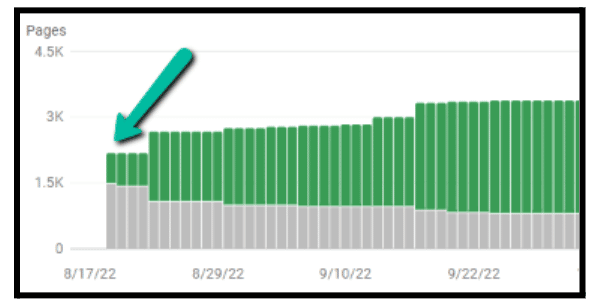
Programmatic pages will be similar in nature, kicking most pages into Discovered - currently not indexed or Crawled - currently not indexed.
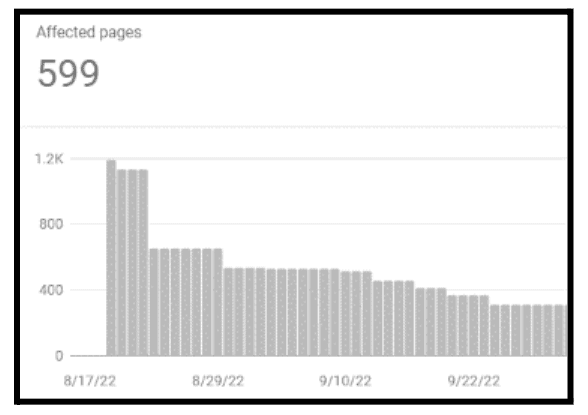
If you publish more content at once, more pages start in the abyss of discovered or crawled but not indexed.
Don’t panic. Take a hard look at the published templates and ask yourself, are you bringing something new to the SERP?
If yes, move forward with these three steps
Build a better internal link structure
Internal links for programmatic SEO are 10x more important than traditional editorial pages.
You are building hundreds, thousands, or even millions of pages from one directory and will need to build context between each related page.
Create link silos from Directory > Leaf pages. Hardcoding the same 20 links into every page will be disregarded by the visitor and Google, rendering it useless.
Just as you would for traditional SEO, dedicate time to contextual linking and work with your engineer to set the correct logic for each individual page.
If you forget internal linking, you’ll create thousands of orphaned pages and increase the number of dead ends on your site. These will almost entirely be seen as non-influential pages and may never be crawled.
Create a robust sitemap structure
Programmatic SEO sitemaps are as important as robust internal linking. The maximum list of URLs on a robots.txt sitemap is about 50k. For larger sites, you’ll need dozens of sitemaps and sitemap indexes.
Structure your robots.txt file as you would your site structure. If possible, build a sitemap for each individual directory. This will categorize sitemaps by subject rather than publishing date and allows Google to index each category more easily.
Once it’s set, make sure you force crawl each individual sitemap (yes, even if you have hundreds of sitemaps) two times or until Google has returned to the page multiple times.
Create HTML sitemaps
These are not your HTML sitemaps from 2009. Identify each directory page and use it as a linking guide for every “milestone” page.
For a site with millions of leaf pages, you won’t be able to link to each individual, but you can target Category > Subcategory links.
This allows your directories to function as link hubs and creates an easy flow from Homepage > Category > Subcategory that enhances your internal link structure.
To recap, below is a repeatable process for implementing a programmatic SEO structure.
- Identify a repeatable search opportunity.
- Build a diverse content template.
- Build and connect a robust database.
- Implement internal links into templates.
- Create robots.txt sitemap structure.
- Publish.
- Optimize and repeat.
The post Programmatic SEO: Your missing link to 1M+ sessions appeared first on Search Engine Land.
Courtesy of Search Engine Land: News & Info About SEO, PPC, SEM, Search Engines & Search Marketing
Category seo news | Tags:
Social Networks : Technorati, Stumble it!, Digg, de.licio.us, Yahoo, reddit, Blogmarks, Google, Magnolia.
Microsoft now requires verification for UK Financial Services advertisers
Written on December 13, 2022 at 6:40 am, by admin
Starting early this year, Microsoft will allow only advertisers duly authorized by the UK Financial Conduct Authority (FCA) to present regulated financial promotions in the UK. Advertisers will be required to provide proof of authorization by the UK FCA to present Financial Promotion Ads or specify if they’re either 1) a non-financial services advertiser who may target consumers seeking financial services, such as e-commerce platforms or 2) government entities such as authorities or regulators under the “.gov.uk” domain.
Why we care. If you live in the UK or advertise for a UK financial services company, you’ll need to start the verification process here.
Keep in mind. Microsoft says to keep the following into consideration:
- These requirements are in addition to the Advertiser Identity Verification requirements laid out by Microsoft as part of its safety measures to protect consumers, advertisers, and publishers.
- Failure to complete this verification process will result in ads being blocked from serving in the UK—the account will continue to perform as before with respect to non-Financial Services Ads and in markets outside of the UK.
Dig deeper. Read the announcement on the Microsoft blog here.
The post Microsoft now requires verification for UK Financial Services advertisers appeared first on Search Engine Land.
Courtesy of Search Engine Land: News & Info About SEO, PPC, SEM, Search Engines & Search Marketing
Category seo news | Tags:
Social Networks : Technorati, Stumble it!, Digg, de.licio.us, Yahoo, reddit, Blogmarks, Google, Magnolia.
Search Engine Land celebrates its 16th birthday
Written on December 12, 2022 at 2:38 am, by admin
Search Engine Land celebrates its Sweet 16 today.
While most of the original team from 2006 has moved on, the mission of Search Engine Land remains nearly the same as it has been since day 1.
As explained by founding editor Danny Sullivan, Search Engine Land was created to be:
- A place where you can keep up with what’s happening in the search space.
- A community.
- An entire new world revolving around the important tools of search engines, a world that continues to grow and be shaped, with such a huge impact on society and our daily lives.
There’s a lot to look forward to in 2023.
But first, let’s take a look back on the past year of Search Engine Land, give some thanks to those who have helped make this year a success, and tease a few things you can expect from us over the next year.
Thank you for reading!
If you’re still reading this, thank you! Yes, you!
Every day, our mission is to bring you the latest news and information as it happens, as well as useful guides and insights to help you thrive and advance in your career, navigate the ever-changing search landscape and understand what’s coming next.
Hopefully, you found our news coverage and articles helpful over the past year.
And just as a reminder: if you’d like all the latest search news, analysis and intelligence in your inbox, make sure to subscribe to Search Engine Land’s newsletter.
Thanks to the Search Engine Land team
Search Engine Land has a small team. But as the late Steve Jobs once said, “A small team of A+ players can run circles around a giant team of B and C players.”
And I truly we believe we have those A+ players here.
- Barry Schwartz. Barry is a legend – he’s been writing on Search Engine Land since the beginning and covering search for an astounding 19 years. He’s written a ridiculous number of news articles (somewhere around 40,000), documenting all the latest updates and developments in our space. His work ethic is beyond impressive and it’s been an honor to work with him this year.
- Nicole Farley: Nicole has been a great addition to the team. I was impressed by her when we first met a couple of years ago. Since joining the team, Nicole has well far exceeded my expectations and does a fantastic job staying on top of all the latest developments in the world of PPC.
- Angel Niñofranco: I was beyond excited to have Angel join the team and to work with her for a second time. Fun fact: Angel now has been my first hire at two different companies. Angel is a truly excellent editor and helps make sure our SME content is worthy of your time and attention.
- Kathy Bushman: It’s been great working with Kathy on the SMX events. Her focus never wavers from what’s most important: making sure we deliver top-level content (and experience to match) to everyone who attends our events. I’m already looking forward to thinking about the agendas for SMX Advanced and Next in 2023 – both will be here much sooner than we think!
- Sarah Slifko-Camarra & Karen DeWeese: I can’t thank them enough for all their help in getting our SME program established and organized. Plus, Sarah and Karen do some great work behind the scenes with SMX.
- Marc Sirkin: Marc has been a huge ally and sounding board for starting to make some big and much-needed changes to our website and SEO strategy.
- Chris Elwell: I truly appreciate Chris for his leadership, for always challenging us to be better, and for the thoughtfulness in how he approaches business decisions and processes. He has truly created a great team and company. (And, in case you didn’t know, he has been a key figure in the development of our entire industry. Watch this video interview he did with Barry in 2020 to learn more.)
There are so many other fantastic humans who are part of the Third Door Media team who I haven’t mentioned. Just know, even if I didn’t mention you, I appreciate you and all you do to help make our company successful.
Gone, but not forgotten
It has undoubtedly been a year of change for Search Engine Land. I joined Search Engine Land in January. And Nicole and Angel joined around halfway through 2022.
We also bid farewell to some team members. So cue the “In Memoriam” theme for:
- Henry Powderly, former vice president of content for Third Door Media, the publisher of Search Engine Land and MarTech (August 2018 – June 2022)
- George Nguyen, former editor (June 2020 – March 2022)
- Corey Patterson, former editor (November 2021 – June 2022)
Top 3 highlights of 2022
Despite some challenges, I’d say it’s safe to call 2022 an overall success for Search Engine Land.
SMX Advanced and SMX Next
Both shows had the highest audience ratings in the history of Third Door Media. More than 8,500 search marketers signed up for both events.
While those numbers are great, what really mattered to me was the feedback we received from people who invested their time in our events. It was overwhelmingly positive for the speakers, content and experience.
It was also great to have Google back at SMX, with keynotes featuring Hyung-Jin Kim and Ginny Marvin.
Plus, the 2022 Search Engine Land Awards revealed some of the truly great work going on in our industry. I can’t wait to see what successes y’all have over the next several months – so make sure to enter next year.
SME program relaunch
One of my top priorities was launching our Subject Matter Expert (SME) program.
A huge thank you to all of our excellent SMEs for all the great content and insights you shared in 2022. We’ll be highlighting the top 10 most popular SEO and PPC columns of the year – so check back Dec. 29-30, when those will be revealed. I look forward to reading even more great advice and insights from you in 2023!
Speaking of 2023 – I’ll be looking for new contributors very soon. More details to come. But if you’re interested in becoming a contributor on Search Engine Land, 2023 may just be your year.
Traffic and audience growth
I won’t lie – not that it’s any secret – Search Engine Land has its share of SEO messes to clean up, including a fairly disastrous “consolidation” of categories that was handled with a blowtorch instead of a scalpel. Most of that SEO damage has, thankfully, been dealt with.
Despite our long SEO to-do list, traffic and audience growth are trending in the right direction:
- Sessions – up 30%
- Pageviews – up 25%
- Users – up 16%
- Organic search traffic – up 22%
- Direct traffic – up 34%
What’s next for Search Engine Land?
We’re already looking ahead to 2023. You can expect us to continue providing breaking news coverage and insights on all things search.
Plus, we’ll be debuting a couple of new regular features we hope you’ll like.
Also on our to-do list: some long overdue updates to our popular SEO and PPC periodic tables, and accompanying guides.
And save the dates for our SMX events:
- SMX Advanced: June 13-14.
- SMX Next: Nov. 15-16.
And there’s plenty more to come.
On behalf of everyone at Search Engine Land and Third Door Media, I wish you a great rest of 2022 and a successful and healthy 2023.
The post Search Engine Land celebrates its 16th birthday appeared first on Search Engine Land.
Courtesy of Search Engine Land: News & Info About SEO, PPC, SEM, Search Engines & Search Marketing
Category seo news | Tags:
Social Networks : Technorati, Stumble it!, Digg, de.licio.us, Yahoo, reddit, Blogmarks, Google, Magnolia.
Content ideas may be coming to Google Search Console
Written on December 9, 2022 at 6:38 pm, by admin
Google Search Console is experimenting with a new feature named “content ideas.” Content ideas give the content creator, publisher, SEO, webmaster, etc., some tips and advice on what new topics they can write about on their site.
Experimental feature. This feature is not live for me in my verified Search Console profiles, but Nicolas Ockier noticed it and posted about it on Mastodon sharing this screenshot:
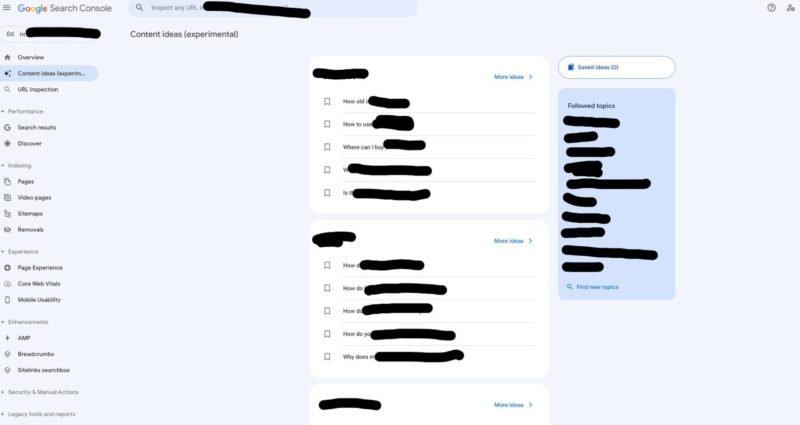
Looks like Question Hub. This looks a lot like the Google Question Hub that launched in the US around two years ago.
It gives you topic ideas that you can write about and publish on your website.
What is Question Hub? Google says, “Question Hub is a tool that enables creators to create richer content by leveraging unanswered questions. Question Hub collects these unanswered user questions and surfaces them to bloggers, writers, and content creators like you.”
It is basically a way for Google to enable searchers to tell it that the search results provided are not answering the query. Then, Google takes those questions and feeds them to publishers, who, in turn, can create content that does answer the query.
Content ideas seem similar.
Why we care. Creating content ideas can sometimes be a struggle for writers, which may help content creators with that process. At the same time, this gives Google more content to crawl, index, and potentially rank in its search results. Check your Search Console, it might have this feature, if not, go play with Question Hub until then.
The post Content ideas may be coming to Google Search Console appeared first on Search Engine Land.
Courtesy of Search Engine Land: News & Info About SEO, PPC, SEM, Search Engines & Search Marketing
Category seo news | Tags:
Social Networks : Technorati, Stumble it!, Digg, de.licio.us, Yahoo, reddit, Blogmarks, Google, Magnolia.
JavaScript rendering and indexing: Cautionary tales and how to avoid them
Written on December 9, 2022 at 6:38 pm, by admin
I recently read Ziemek Bucko’s fascinating article, Rendering Queue: Google Needs 9X More Time To Crawl JS Than HTML, on the Onely blog.
Bucko described a test they did showing significant delays by Googlebot following links in JavaScript-reliant pages compared to links in plain-text HTML.
While it isn’t a good idea to rely on only one test like this, their experience matches up with my own. I have seen and supported many websites relying too much on JavaScript (JS) to function properly. I expect I’m not alone in that respect.
My experience is that JavaScript-only content can take longer to get indexed compared to plain HTML.
I recall several instances of fielding phone calls and emails from frustrated clients asking why their stuff wasn’t showing up in search results.
In all but one case, the challenge appeared to be because the pages were built on a JS-only or mostly JS platform.
Before we go further, I want to clarify that this is not a “hit piece” on JavaScript. JS is a valuable tool.
Like any tool, however, it’s best used for tasks other tools cannot do. I’m not against JS. I’m against using it where it doesn’t make sense.
But there are other reasons to consider judiciously using JS instead of relying on it for everything.
Here are some tales from my experience to illustrate some of them.
1. Text? What text?!
A site I supported was relaunched with an all-new design on a platform that relied heavily on JavaScript.
Within a week of the new site going live, organic search traffic plummeted to near zero, causing an understandable panic among the clients.
A quick investigation revealed that besides the site being considerably slower (see the next tales), Google’s live page test showed the pages to be blank.
My team did an evaluation and surmised that it would take Google some time to render the pages. After 2-3 more weeks, though, it was apparent that something else was going on.
I met with the site’s lead developer to puzzle through what was happening. As part of our conversation, they shared their screen to show me what was happening on the back end.
That’s when the “aha!” moment hit. As the developer stepped through the code line by line in their console, I noticed that each page’s text was loading outside the viewport using a line of CSS but was pulled into the visible frame by some JS.
This was intended to make for a fun animation effect where the text content “slid” into view. However, because the page rendered so slowly in the browser, the text was already in view when the page’s content was finally displayed.
The actual slide-in effect was not visible to users. I guessed Google couldn’t pick up on the slide-in effect and did not see the content.
Once that effect was removed and the site was recrawled, the traffic numbers started to recover.
2. It’s just too slow
This could be several tales, but I’ll summarize several in one. JS platforms like AngularJS and React are fantastic for rapidly developing applications, including websites.
They are well-suited for sites needing dynamic content. The challenge comes in when websites have a lot of static content that is dynamically driven.
Several pages on one website I evaluated scored very low in Google’s PageSpeed Insights (PSI) tool.
As I dug into it using the Coverage report in Chrome’s Developer Tools across those pages, I found that 90% of the downloaded JavaScript wasn’t used, accounting for over 1MB of code.
When you examine this from the Core Web Vitals side, that accounted for nearly 8 seconds of blocking time as all the code has to be downloaded and run in the browser.
Talking to the development team, they pointed out that if they front-load all the JavaScript and CSS that will ever be needed on the site, it will make subsequent page visits all that much faster for visitors since the code will be in the browser caches.
While the former developer in me agreed with that concept, the SEO in me could not accept how Google’s apparent negative perception of the site’s user experience was likely to degrade traffic from organic search.
Unfortunately, in my experience, SEO often loses out to a lack of desire to change things once they have been launched.
3. This is the slowest site ever!
Similar to the previous tale comes a site I recently reviewed that scored zero on Google’s PSI. Up to that time, I’d never seen a zero score before. Lots of twos, threes and a one, but never a zero.
I’ll give you three guesses about what happened to that site’s traffic and conversions, and the first two don’t count!
Get the daily newsletter search marketers rely on.
<input type=”hidden” name=”utmMedium” value=”” />
<input type=”hidden” name=”utmCampaign” value=”” />
<input type=”hidden” name=”utmSource” value=”” />
<input type=”hidden” name=”utmContent” value=”” />
<input type=”hidden” name=”pageLink” value=”” />
<input type=”hidden” name=”ipAddress” value=”” />
Processing…Please wait.
Sometimes, it’s more than just JavaScript
To be fair, excessive CSS, images that are far larger than needed, and autoplay video backgrounds can also slow download times and cause indexing issues.
I wrote a bit about those in two previous articles:
- 5 ways content helps create a better user experience
- Bad website design: Bad for SEO, UX and business
For example, in my second tale, the sites involved also tended to have excessive CSS that was not used on most pages.
So, what is the SEO to do in these situations?
Solutions to problems like this involve close collaboration between SEO, development, and client or other business teams.
Building a coalition can be delicate and involves giving and taking. As an SEO practitioner, you must work out where compromises can and cannot be made and move accordingly.
Start from the beginning
It’s best to build SEO into a website from the start. Once a site is launched, changing or updating it to meet SEO requirements is much more complicated and expensive.
Work to get involved in the website development process at the very beginning when requirements, specifications, and business goals are set.
Try to get search engine bots as user stories early in the process so teams can understand their unique quirks to help get content spidered indexed quickly and efficiently.
Be a teacher
Part of the process is education. Developer teams often need to be informed about the importance of SEO, so you need to tell them.
Put your ego aside and try to see things from the other teams’ perspectives.
Help them learn the importance of implementing SEO best practices while understanding their needs and finding a good balance between them.
Sometimes it’s helpful to hold a lunch-and-learn session and bring some food. Sharing a meal during discussions helps break down walls – and it doesn’t hurt as a bit of a bribe either.
Some of the most productive discussions I’ve had with developer teams have been over a few slices of pizza.
For existing sites, get creative
You’ll have to get more creative if a site has already launched.
Frequently, the developer teams have moved on to other projects and may not have time to circle back and “fix” things that are working according to the requirements they received.
There is also a good chance that clients or business owners will not want to invest more money in another website project. This is especially true if the website in question was recently launched.
One possible solution is server-side rendering. This offloads the client-side work and can speed things up significantly.
A variation of this is combining server-side rendering caching the plain-text HTML content. This can be an effective solution for static or semi-static content.
It also saves a lot of overhead on the server side because pages are rendered only when changes are made or on a regular schedule instead of each time the content is requested.
Other alternatives that can help but may not totally solve speed challenges are minification and compression.
Minification removes the empty spaces between characters, making files smaller. GZIP compression can be used for downloaded JS and CSS files.
Minification and compression don’t resolve blocking time challenges. But, at least they reduce the time needed to pull down the files themselves.
Google and JavaScript indexing: What gives?
For a long time, I believed that at least part of the reason Google was slower in indexing JS content was the higher cost of processing it.
It seemed logical based on the way I’ve heard this described:
- A first pass grabbed all the plain text.
- A second pass was needed to grab, process, and render JS.
I surmised that the second step would require more bandwidth and processing time.
I asked Google’s John Mueller on Twitter if this was a fair assumption, and he gave an interesting answer.
From what he sees, JS pages are not a huge cost factor. What is expensive in Google’s eyes is respidering pages that are never updated.
In the end, the most important factor to them was the relevance and usefulness of the content.
The post JavaScript rendering and indexing: Cautionary tales and how to avoid them appeared first on Search Engine Land.
Courtesy of Search Engine Land: News & Info About SEO, PPC, SEM, Search Engines & Search Marketing
Category seo news | Tags:
Social Networks : Technorati, Stumble it!, Digg, de.licio.us, Yahoo, reddit, Blogmarks, Google, Magnolia.
Airbnb’s search marketing shift: Should advertisers follow suit?
Written on December 9, 2022 at 6:38 pm, by admin
A recent Wall Street Journal article reported that Airbnb’s “strategy of slashing advertising spending, investing in brand marketing and lessening its reliance on search-engine marketing is continuing to pay off.”
This remark has sparked discussions among many advertisers, wondering if a similar strategy may work for them.
In 2019, Airbnb started to move budget away from search marketing in favor of broader marketing initiatives.
The pandemic accelerated the shift, with video and social media picking up the largest share of digital spend in 2021, according to data gathered from Semrush and Pathmatics.
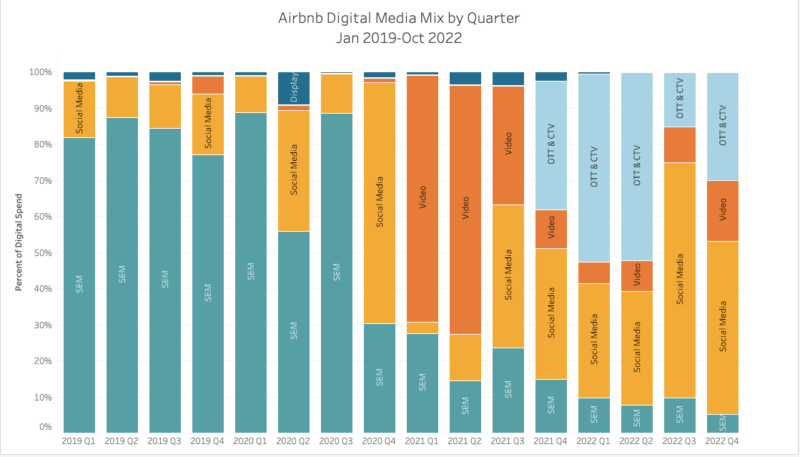
In Q4 2021, The company then expanded its digital strategy into OTT and CTV, further reducing the budget share for PPC.
With CPCs rising across performance media channels, advertisers are left wondering if moving away from performance marketing channels is the right move.
But before you take a similar leap, let’s look at three key considerations.
1. What external forces are impacting your business?
The pandemic played a considerable part in Airbnb’s strategy shift.
The company dropped its marketing spend from April 2020 through November 2020, when it reappeared with a strong social media presence.
Then in December, Airbnb reminded customers with video ads that the brand will be there when people are ready to travel.
Consumer behavior changed, and Airbnb needed to employ a medium that would reassure and inspire trust. What better way to do that than with video?
It’s critical to be aligned with the external forces impacting your marketing mix.
Are you creating a new category? Or trying to change consumer behavior?
If so, a shift to brand-heavy advertising may make good sense.
Get the daily newsletter search marketers rely on.
<input type=”hidden” name=”utmMedium” value=”” />
<input type=”hidden” name=”utmCampaign” value=”” />
<input type=”hidden” name=”utmSource” value=”” />
<input type=”hidden” name=”utmContent” value=”” />
<input type=”hidden” name=”pageLink” value=”” />
<input type=”hidden” name=”ipAddress” value=”” />
Processing…Please wait.
2. Have you reached a tipping point?
Ninety percent of Airbnb’s traffic comes directly to the site. Their market share in the space is nearly 20%, according to Second Measure.
Airbnb had already reached its tipping point. Its category was well-established, and it was a leader in that category.
Instead of using performance media to drive new customers, they could use it as strategic levers for supply and demand.
Think of their brand awareness spend as the large workhorse and performance media as fine-tuning.
Before deciding where to spend your marketing dollars, know where you’re coming.
Are you the leader in your category? Are the majority of your visitors coming directly to your site?
If so, it makes sense to place a heavier weight on brand advertising and rely on performance media for fine-tuning.
But if you need to acquire more customers to reach a tipping point, consider a heavier performance media strategy.
3. Do you have wasted spend?
Finally, from the outside, it’s difficult to say how much of Airbnb’s performance marketing spend was wasted.
But surveys from Rakuten Marketing and Commerce Signals indicate that marketers routinely waste 25-40% of their marketing budget.
Simply cutting this wasted spend and reusing the dollars for broader marketing initiatives may give advertisers similar effects to what Airbnb saw.
Evaluate your existing performance marketing dollars to find the wasted spend hiding in plain sight. Online audit tools can help, as well as audits from marketing agencies.
Rethink your marketing mix based on your unique situation
It’s worth reemphasizing that Airbnb still spends ~50% of its budget on performance media.
So while their mix shifted from the previous 80%, the company still heavily relies on performance media to help balance supply and demand.
As advertisers look at whether to move budget to brand awareness, the roles of marketing channels should be reevaluated.
Allowing each channel to play to its superpowers can create a wonderful symbiotic relationship within your marketing mix.
So if you are considering a strategy shift similar to Airbnb, it’s important to think critically about your business before making the move.
Think about your category, consumer behavior, and market position. Finally, evaluate any wasted spend.
And if you’re ready to take the plunge, remember to test, measure, evaluate and repeat.
The post Airbnb’s search marketing shift: Should advertisers follow suit? appeared first on Search Engine Land.
Courtesy of Search Engine Land: News & Info About SEO, PPC, SEM, Search Engines & Search Marketing
Category seo news | Tags:
Social Networks : Technorati, Stumble it!, Digg, de.licio.us, Yahoo, reddit, Blogmarks, Google, Magnolia.
Subscribe with Google publishers may see an increase in clicks and impressions from Google Search
Written on December 8, 2022 at 2:38 pm, by admin
Publishers using the Subscribe with Google feature may see an increase in the reported clicks and impressions within the Google Search Console search performance report. This started around December 6, 2022.
Google’s announcement. Google posted that on December 6, 2022, “Google created an additional search result feature for sites that use Subscribe with Google. As a result, these websites may see an increase in impressions and clicks in the Search Performance report.”
As a note, the feature was created in March 2018, but it may be that Google didn’t accurately track the feature in Google Search Console until several years later.
What is Subscribe with Google. Subscribe with Google is a linchpin in that second objective to foster sustainable business models for publishers, as we previously reported. The aim is to make it as easy as possible for users to subscribe — particularly on mobile. For Google account holders with payment information on file, subscriptions can be purchased with a couple of clicks. The user’s Google credentials are then used as their login information for their subscriptions. Subscriber information will be turned over to publishers.

Why we care. If you see a jump in impressions and clicks reported in the Search Console performance report on or after December 6th and you use the Subscribe with Google feature, this may be why. Understanding the source of an increase or decrease in clicks and impressions but no other changes to your other metrics, like conversions or traffic, is useful. It seems this is a reporting change and not a new feature change that would actually result in more traffic and conversions.
Although, the wording Google used above is a bit confusing.
The post Subscribe with Google publishers may see an increase in clicks and impressions from Google Search appeared first on Search Engine Land.
Courtesy of Search Engine Land: News & Info About SEO, PPC, SEM, Search Engines & Search Marketing
Category seo news | Tags:
Social Networks : Technorati, Stumble it!, Digg, de.licio.us, Yahoo, reddit, Blogmarks, Google, Magnolia.
Hit by the Google spam update? Here’s what you might be doing wrong
Written on December 8, 2022 at 2:37 pm, by admin
When Google launched a new spam update at the end of 2022, complaints poured in as webmasters were caught off-guard.
Why are people still using outdated SEO tactics like “keyword stuffing”?
Here’s what else you may have done wrong and how you can practice actual SEO that benefits real-world users.
Seriously? Is keyword stuffing still a thing?!
I’ll be honest with you. I was flabbergasted that some websites affected by Google’s recent spam update were using an antiquated SEO tactic called “keyword stuffing,” according to analysis based on Ubersuggest data.
Keyword stuffing was a thing in the late ’90s of the last century! That was way before I was into SEO myself.
When I started practicing SEO in 2004, Google was already the market-leading search engine, and keyword stuffing was essentially a thing of the past.
Sure, people still tried to achieve the “ideal keyword density” [sic!] (there is no such thing, by the way). Yet, those were the noobs even back then.
In 2001, when Google launched the revolutionary PageRank algorithm for counting and measuring the value of incoming links, the dirty SEO trick referred to as keyword stuffing was officially on the way out.
So why do people still embarrass and shoot themselves in the foot using 25-year-old spam tactics?
It’s probably the same principle as putting your hand on the burning stove to find out for yourself what hot means. I get that logic, but when it comes to adults and SEO, it’s like telling me that you are still watching movies on a VCR!
If you do keyword stuffing in 2023 or beyond, you are embarrassing yourself and the whole SEO industry. In reality, it’s even worse than the steam engine comparison.
Do you hate the blind? Or are you blind to the suffering of others?
Using ages-old spam tactics like keyword stuffing, hidden text, or repetitive meta tags is akin to letting the blind trip on purpose. Why would someone do that?
Either you hate them or are blind to the suffering you’re causing others. Now it’s too late. You can’t claim you didn’t know anymore.
In a recent Mastodon update, Google Search Advocate John Mueller stressed the additional burden prehistoric spam tactics have on the blind or visually impaired (people who are not blind but who often can’t read on screen) who use screen readers.

Even uppercase letters are a nuisance for the blind. Unless you are using an acronym like SEO, do not use them as every single letter will be spelled out one by one for visually impaired website visitors.
Ariel Gaster provides an insightful guide on properly designing website content for those with low or no vision.
Proper SEO involves findability and ensures that all users find what they want on the website. Thus, website usability and accessibility should be considered – not sabotaged.
Thin content? Beat it now!
Another common issue found in sites affected by the Google spam update was thin content, which was debated to death years ago.
It’s such a boring topic by now that I guess a new generation of spammers grew up without knowing about it because nobody cares to write about it anymore.
What can I say about thin content? Beat it now!
How? Revisit existing articles on thin content.
Hire actual writers and editors and/or write the content yourself and get help from experts – either in-house or freelancers – who can share insights from first-hand experience.
Don’t just assume that you can use an artificial intelligence tool to create all your content.
Even though these tools have matured and can aid in content creation, you shouldn’t completely “outsource” content to AI without appropriate human oversight.
Get the daily newsletter search marketers rely on.
<input type=”hidden” name=”utmMedium” value=”” />
<input type=”hidden” name=”utmCampaign” value=”” />
<input type=”hidden” name=”utmSource” value=”” />
<input type=”hidden” name=”utmContent” value=”” />
<input type=”hidden” name=”pageLink” value=”” />
<input type=”hidden” name=”ipAddress” value=”” />
Processing…Please wait.
AI content has been hit to some extent
True SEO experts are always testing new things, discovering new technologies, being early adopters and improving their work using automation. I get that, as I am a tinkerer myself.
It’s often trial and error, and you will waste time and effort again and again on such things.
But it’s when people forget about ethics that automation usually fails.
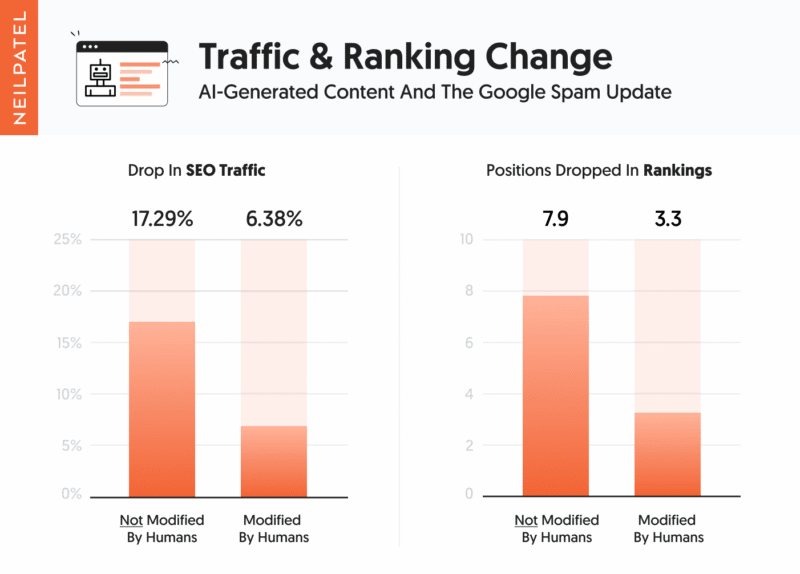
Some AI content has been hit by the late 2022 spam update. If you ask me, that was overdue.
I was expecting a big trashing earlier during the helpful content update.
But AI-generated content is not “evil” by itself.
Almost every technology can be used in a useful and harmful manner. The same thing applies to content AI.
“What is the purpose of automation?” should be the question.
Do you want to create many thin content pages to trick Google into believing you’re a content-rich site with many helpful resources?
Then the likelihood of being weeded out with the next spam update is high.
Do you want to save resources by using automation to reduce repetitive tasks so that you can spend more time and effort on truly creative ones?
Then you will probably be much more successful with your automation efforts in the long run, and Google will reward it.
Essentially, AI content did not get wiped out completely.
Most of it simply got downgraded to lower positions in the organic SERPs. AI content without human intervention (think editing) lost the most.
What else are you doing wrong so that you deserve to get hit by the spam update?
Again, I’ll be honest with you. I’m an SEO, not a spammer. That’s one of the main reasons why I established myself in the industry.
I did it the ethical way from day one, even back when tricking Google was still commonplace, and content creation was not an actual part of SEO.
I did my share in showing the industry that we can do better than that, and we don’t need to inflate the rankings of low-quality sites artificially.
To me, SEO means you can take any crappy website and let it shine with the right approach.
Thus, I’m taken aback each time I see someone falling back below the level of real SEO using spam tactics.
I won’t focus too much on the dubious tactics hit by the latest spam update. They do not interest me in the slightest, and some might be tempted to try other, still “under the radar” spam tactics to game Google.
Instead, I will share what might be wrong with your overall SEO approach or philosophy so you can steer clear of them.
Taking lazy shortcuts
As noted above, automation is fine. I’d love a future where nobody needs to do boring, repetitive tasks anymore.
That said, there are things you can but should not automate. In our line of work, human interaction and creativity are still paramount.
So whenever you think you can “get rich quick” by creating a million automated “content” pages, you are probably doing it wrong.
Sometimes taking it slow and going through the harder route will result in arriving on top and having a better view from there. (This is not just about hiking!)
Viewing Google as the enemy
Over the years, I’ve been a victim of this misconception myself.
When I’m angry, I’m more likely to blame someone else for my bad mood, especially “evil” corporations like Google. But thinking this way is a mistake.
The reality is much less sensational. Even corporations are comprised of people who simply do their work and try to be helpful.
Do your part whether you work for Google or clients. When doing SEO, treat the search engine like a referee while you compete with others to be among the top athletes of the discipline.
Being selfish or egocentric
Satisfying your needs before you help others is the first thing to do. Nobody wants you to work for free as an SEO.
However, straining to rank on Google to chase money, status, or even fame/notoriety is the same dead end as doing such things in other areas of life.
When you just care about yourself and ignore other people’s needs, you have a very narrow tunnel vision that won’t allow you to optimize content and websites properly. Effective SEO involves anticipating other people’s needs and empathizing with them. Just get over yourself and embrace those around you.
SEO is about helping people to find what they need, not only about buying you a bigger car than your neighbor owns or you had last year.
Focusing on quantity over quality
So instead of writing one unique article, you created a dozen or a hundred automated articles based on data everybody else has access to.
In the short term, that may be a good idea for your bank account. But that’s a bad decision for your overall authority and long-term revenue.
Nobody wants to sift through tons of fluff, and even content that can get easily automated or reproduced (think lyrics, sports scores or weather updates) requires some additional work so that people can relate to it.
Why else would people still watch weather reports on TV where presenters show how clouds will move over maps?
Maybe it’s better to do one great thing than a dozen mediocre or a hundred low-level ones?
Not doing what you love, only what pays
When we were young, in many cases, someone told us that we can’t become:
- Artists.
- Musicians.
- Poets.
Instead, we need to get a “real job,” meaning either some purposeless toil or something highly appreciated, both money and status-wise, like becoming:
- Doctors.
- Lawyers.
- Executives.
Fast forward to today, and there are many unhappy doctors, lawyers and executives who hate their jobs and are looking for a way out to find their true purpose or follow their passion.
In SEO, some keywords and industries pay much more than others, and you can get a lot of status by working for “Fortune 500″ companies.
Or you become a “rotten scoundrel” doing the dirty work that pays even more because ethics are not in the way.
At the end of the day, it won’t make you feel good about yourself. You will most likely be trying to use money and status to forget about the work you hate.
Why not do work that you’ll love, then?
Sometimes you can combine the useful with what you love and still get paid.
I’ve been a poet once, but I prefer to directly help real people and make some money while at it. I can’t imagine someone loving to spam, though.
Ignoring actual website visitors
In the early SEO era, you would focus mostly on Google and how to make the search engine believe that your site needs to be on top of the first page of results.
That’s only one little step from “the ends justify the means” logic and simply cheating so that you show up on top no matter whether you deserve it or not.
Make sure you remember who you actually optimize for – real people who visit your site and use it in the best case to buy something.
Instead of focusing solely on Google, you can behave like a real-life shop owner, be helpful to your customers and convert potential visitors into buyers. That’s a huge difference.
Google is just the middleman, and amorphous “traffic” is not the goal of SEO.
Traffic is the cars that drive by your store, and inside are passengers who don’t buy anything. So just focus on the outcome you desire and find a way to get there while also serving the interest of actual people.
No matter what spam tactics were made obsolete by the latest update, you can make sure not to fall prey to the next ones by applying the opposite “strategy.”
How to steer clear of future spam updates
Let’s focus on the bright side, then. While SEO means search engine optimization, we can’t optimize search engines directly. Rather, what we do is “search result optimization.”
Do you deserve to rank on top? Use Google and search for your favorite keywords. Look at what’s on top there and then think again.
Here are some timeless ways to get there without tricking anybody, neither Google nor visitors, nor yourself down the road.
Find out what people want through market research
Many SEO projects or campaigns only start at the keyword research phase.
When this happens, all important decisions have already been made even before the feasibility of an actual market demand driven by technological means has not been established.
Startups tend to create some supposedly revolutionary product or service that everybody should need, but nobody knows about that yet.
Thus, they have to invest huge resources into convincing people that they need something by leveraging questionable methods like FOMO (”fear of missing out”) or needy design patterns (”we haven’t seen you since yesterday, please come back to our website!”).
It’s far easier to serve an existing market in many cases unless there is overwhelming competition. You can find out both upfront what people are asking for. Often, these people do not even know that there is a name for it.
To ensure you don’t fall for the trap of annoying people until they need your solution, you have to start before identifying the keywords everybody else has already researched before you.
Take a step back and start with actual market research. Don’t assume everybody needs your “me too” site just because a keyword tool says so.
Decide how you personally can help and establish a unique selling proposition
So you have identified a true need that already exists, not something you have to peddle as the “next big thing” until people are finally brainwashed into believing it.
Now the interesting part begins: deciding how to help personally or as a business.
What is the one thing that has been annoying you all the time already? Think of solutions to actual real-world problems.
What is the specific part of the problem you’d like to be solved? You can’t solve climate change, but you can provide one solution for a particular issue that leads to it.
Many apps and tools help you solve climate change-related issues now. Almost nobody will look for a [climate change solution app] unless they know there is at least one such solution.
You may want to check out People Also Ask questions on Google to get an idea of what people are searching for that relates to your potential offering.
Spammers often do not help anybody. They just help themselves by tricking everybody else with their make-believe statements or dirty tricks.
If your offering, website or content is not helpful, you are much more likely to become a spammer, whether you like it or not. The “circumstances” will force you to howl with the wolves unless you can provide something truly helpful.
Ideally, nobody else has come up with a solution like you can provide. Then you have the proverbial unique selling proposition (USP).
Established businesses can do that by investing a lot in product development. Think about all the inventions that Braun or Dyson created over the years.
Small businesses and agile startups can find a micro-niche that no other or larger company can squeeze in.
Once you have the USP, create valuable content that has value by itself, such as guides, tutorials or infographics that helps people identify and deal with the problems you can solve.
Make a real business model (beyond ranking on Google and pushing ads)
This is the major mistake that makes many people become spammers. Their business model is “make money by plastering ads all over a random website.”
So they will look for expensive and competitive keywords first, then create a website nobody would visit on their own accord. Instead of solving an issue to make people click their ads, they have to lure or misdirect existing traffic to their website.
An even more limited mindset applies to many affiliate sites. Not only do they have to lure visitors to their intermediary website, but they also have to ensure that they buy using an affiliate link of theirs. This makes many affiliate websites not only spammy but also misleading.
When you come up with a self-sustaining business model, you can often take care of the SEO simultaneously.
For instance, software is often free to some private users, while business users have to pay. Alternatively, you can have free entry-level plans while upgrades with more features need to be paid for.
This way, free users often become brand evangelists by spreading the word organically and linking to your website.
The post Hit by the Google spam update? Here’s what you might be doing wrong appeared first on Search Engine Land.
Courtesy of Search Engine Land: News & Info About SEO, PPC, SEM, Search Engines & Search Marketing
Category seo news | Tags:
Social Networks : Technorati, Stumble it!, Digg, de.licio.us, Yahoo, reddit, Blogmarks, Google, Magnolia.
Maximize your search marketing budget with first-party conversation data by Invoca
Written on December 8, 2022 at 2:37 pm, by admin

Although we are all somewhat uncertain about the economy, marketers are still bullish on 2023. After recovering from the pandemic shutdowns and cutting back on budgets, growth is still predicted for next year.
That growth may not be exponential, though. Because of that, you need to make the most of every dollar you spend on your campaigns. Marketers have to focus their budgets on the most effective ads and keyword buys, and they can’t afford retargeting converted customers or targeting the wrong audiences.
Consumers have also taken a big hit to their budgets due to inflation. With this all in mind, companies that do not meet customer expectations risk losing their business altogether. According to Invoca’s 2022 Buyer Experience report, 76% of consumers will stop doing business with you after one bad experience.
Today’s buyer journey is multi-channel, with customers using digital channels to discover brands and learn about products and services. But when it comes time to make a purchase or book an appointment, they look for human assistance to ensure they’re making the right decision. To get customers to convert, marketers must make it easy for them to get what they want.
Join Owen Ray, director of content marketing at Invoca, in his informative SMX Next session to learn how to use an untapped first-party data source — customer conversations — to drive more conversions, reduce your CPA and maximize every dollar you spend on search marketing.
After this session, you’ll be able to:
- Understand what marketing data you can get from customer conversations
- Accurately measure and reduce your CPA
- Optimize and automate keyword bidding with conversation intelligence and Google Ads
- Use conversation intelligence data to reduce wasted ad spend
- Explain the results marketers see from using conversation data to optimize their marketing
Tune into the session and learn why utilizing conversation data won’t only help you weather the storm that’s coming up and how it’s going to help you come out stronger when the sky is clear.
The post Maximize your search marketing budget with first-party conversation data appeared first on Search Engine Land.
Courtesy of Search Engine Land: News & Info About SEO, PPC, SEM, Search Engines & Search Marketing
Category seo news | Tags:
Social Networks : Technorati, Stumble it!, Digg, de.licio.us, Yahoo, reddit, Blogmarks, Google, Magnolia.
How to make the most of the new Google Business Profile dashboard
Written on December 8, 2022 at 2:37 pm, by admin
Google’s new editing experience for Business Profiles has rolled out. While the initial sentiment isn’t positive, everyone can agree that it’s an experience.
So, what has changed? The Google Business Profile Manager is still here, but the ability to edit a listing in the interface is gone.
Users no longer have access to their old dashboards and are now forcefully entered into the NMX, or New Merchant Experience, where GBP edits are made directly within the SERPs.
This is a massive change that business owners and SEOs alike are not thrilled about.
What is the Google NMX?
The NMX, or New Merchant Experience, removes the Google Business Profile dashboard and allows profile managers to access and edit profile information directly within the SERPs.
While in-SERP editing is not new, removing the old business.google.com dashboard is.
Moving forward, profile managers will be required to edit listing information, review performance, and manage Google Business Profile information from within the SERP.
What has changed in the move to Google NMX?
Users see big changes between their Google Business Profile dashboards and the New Merchant Experience.
The most dramatic change is the loss of the ability to work within the dashboard.
Historically, most things in your Google Business Profile were accessible via the GBP dashboard, and some were available via the in-SERP NMX. This is no longer the case.
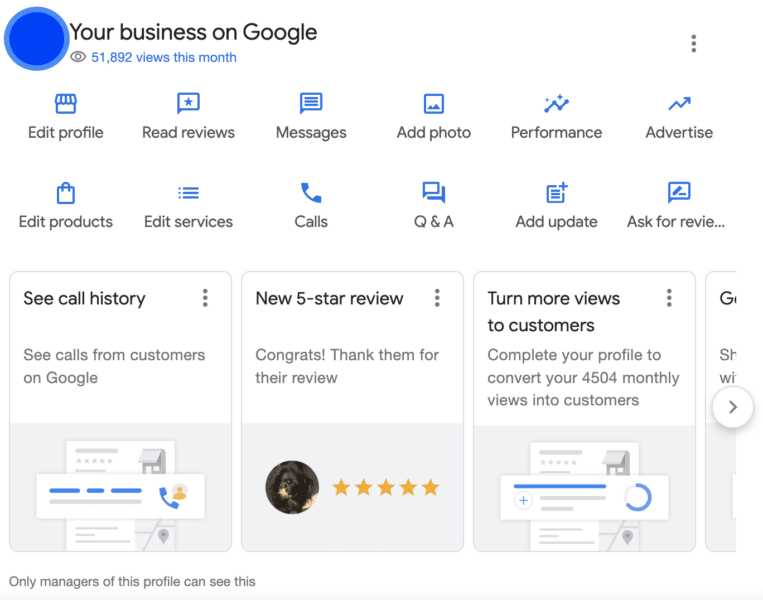
Here’s a rundown of the changes:
- Google Business Profiles are now only editable within the SERPs. The dashboard is no longer available.
- Some things still send users over to the old dashboard, but it’s inconsistent across users and likely will not continue.
- Photo insights are no longer available. This data was often criticized for being inaccurate and unreliable. The prospect of better photo data in the future has users hopeful.
If you liked the photo insights that existed in the Google My Business dashboard, this is NOT going to be moved over to the new dashboard that is rolling out right now to everyone. pic.twitter.com/ID6IM7oVwV
— Joy Hawkins (@JoyanneHawkins) October 28, 2022
- The “how customers search for your business” metrics are no longer available.
- Location information (when customers ask for directions to a business) is also gone. The NMX instead shows direction requests over time.
- You do not need to utilize a dashboard even if you manage multiple profiles. You access all profiles via the SERP, and that SERP will show you all the profiles you manage.
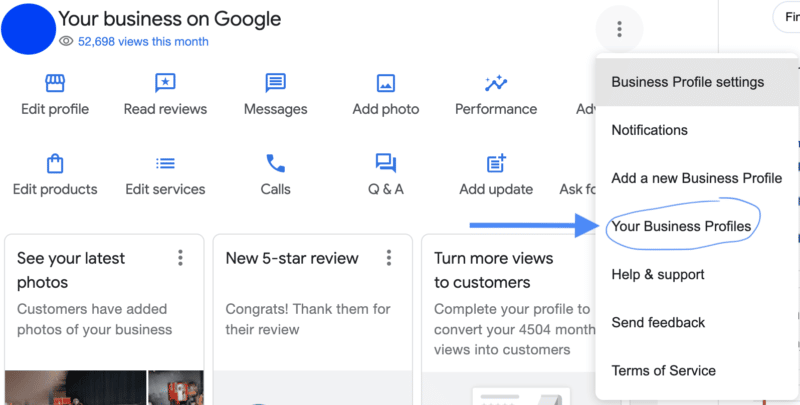
- Google “posts” in the dashboard are now labeled as “updates” in the NMX.
- Google has re-labeled “users.” They’re now referred to as “managers.”
- Branded search spikes in analytics for the brand (and for competitors that appear in the SERP) due to having to do branded searches to open the dashboard.
Get the daily newsletter search marketers rely on.
<input type=”hidden” name=”utmMedium” value=”” />
<input type=”hidden” name=”utmCampaign” value=”” />
<input type=”hidden” name=”utmSource” value=”” />
<input type=”hidden” name=”utmContent” value=”” />
<input type=”hidden” name=”pageLink” value=”” />
<input type=”hidden” name=”ipAddress” value=”” />
Processing…Please wait.
The benefits of the NMX
Further confirmation that the initial sentiment is not optimistic: a BrightLocal Twitter survey showed more than 83% of users find the NMX difficult to navigate.
However, there are some positives to the New Merchant Experience.
After exploring the layout and features, users find they still have access to most of the features that the old dashboard provided.
For small businesses and non-agency managers, working within the SERP eliminates a step by removing the need to go to a separate URL to access their business manager.
While the local SEO community might be up in arms about this, the average user is unlikely to be upset about the change.
Some features are more accessible than in the former dashboard, making them easier for the average user to find and utilize.
The change from a menu structure to a more visible icon layout encourages business owners to spend more time within the NMX, which is likely Google’s goal.
Tips for getting the most out of your Google Business Profile via NMX
The old interface will not return, so the faster we get accustomed to working within the NMX, the better.
Here are some tips for getting the most out of the New Merchant Experience.
Dive in
The fastest way to enjoy a new tool or update is to understand how it works and get comfortable with it. The quickest way to get comfortable with NMX is to jump in and use it.
Many of us have attempted to get back to the old dashboard (myself included), but this isn’t helpful in the long run.
Test the NMX, find out where things are, and then send suggestions for improvement. If we want to drive how this works, we need to participate.
Pay attention
Look at the features Google places front and center for users, as these are what they consider most important.
Ads are at the top of that list, but the prevalence of the review request option, Q&A, products, and services may indicate what Google will soon prioritize. (Remember, products are not limited to just physical product offerings!)
Continue to follow local SEO best practices
The dashboard may have gone away. Yet, the fundamentals have stayed the same.
The value of understanding local SEO and optimizing your Google Business Profile accordingly will continue to be the way to grow and maintain rankings and increase profit.
Expand your reporting
Some insights we’ve gotten used to seeing may be gone, but there are opportunities to create fantastic customized reporting if you’re comfortable working with data.
Prioritize reviews
Users and Google alike keep a close eye on reviews. Up to 96% of users rely on reviews to make purchasing decisions, and 70% of those users go to Google reviews most.
Ask your customers for reviews. Respond to all reviews – good, bad, and indifferent.
When you resolve an issue from a negative review, ask the reviewer to update their review.
Roll with the punches
This is not the first big change Google has made, and it definitely won’t be the last.
Get annoyed, get over it, and figure out how the changes can best serve your brand.
Share feedback
Joy Hawkins has offered to take suggestions for dashboard improvement to Google.
The NMX is here to stay, but that doesn’t mean it can’t be enhanced.
Decide what would improve it, and share your ideas with Google and the local SEO community.
Geotagging images
It still doesn’t help rankings, so we can stop talking about it.
The post How to make the most of the new Google Business Profile dashboard appeared first on Search Engine Land.
Courtesy of Search Engine Land: News & Info About SEO, PPC, SEM, Search Engines & Search Marketing
Category seo news | Tags:
Social Networks : Technorati, Stumble it!, Digg, de.licio.us, Yahoo, reddit, Blogmarks, Google, Magnolia.