

6 steps to AI-driven budgeting and forecasting for digital marketing

AI is transforming how businesses approach their digital marketing budgeting and forecasting processes.
Companies can develop robust forecasting and budgeting models that focus on data-driven decisions.
This approach enables customized strategies that align with specific business goals and can be adjusted based on organizational needs and channels.
AI is a key driver for transformation.
- Up to 86% of organizations implementing generative AI report seeing revenue growth of 6% or more in their total annual company revenue, per a Google Cloud report.
This article covers how to leverage AI with the right data to come up with forecasting and budgeting prioritization, specifically for digital marketing efforts.
Below are the six steps to craft a model that aligns with your unique business needs.
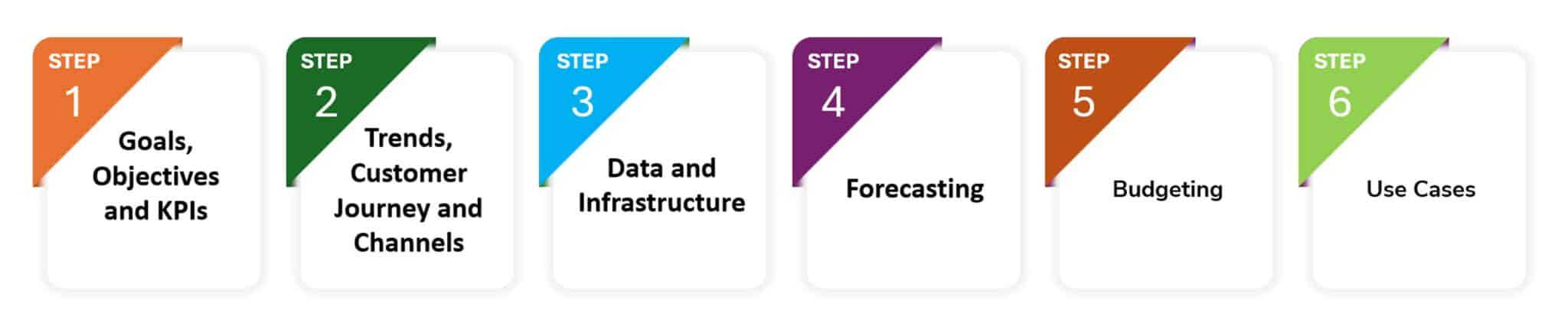
Step 1: Define business goals, objectives and KPIs
This step is divided into two parts: setting goals and identifying key performance indicators (KPIs).
Clearly articulate business objectives
Specify the overall business objectives, such as increasing revenue, enhancing brand awareness, generating leads or boosting engagement rates.
Identify specific KPIs
Determine the relevant KPIs for each targeted channel, such as views, conversion rates or cost per acquisition (CPA).
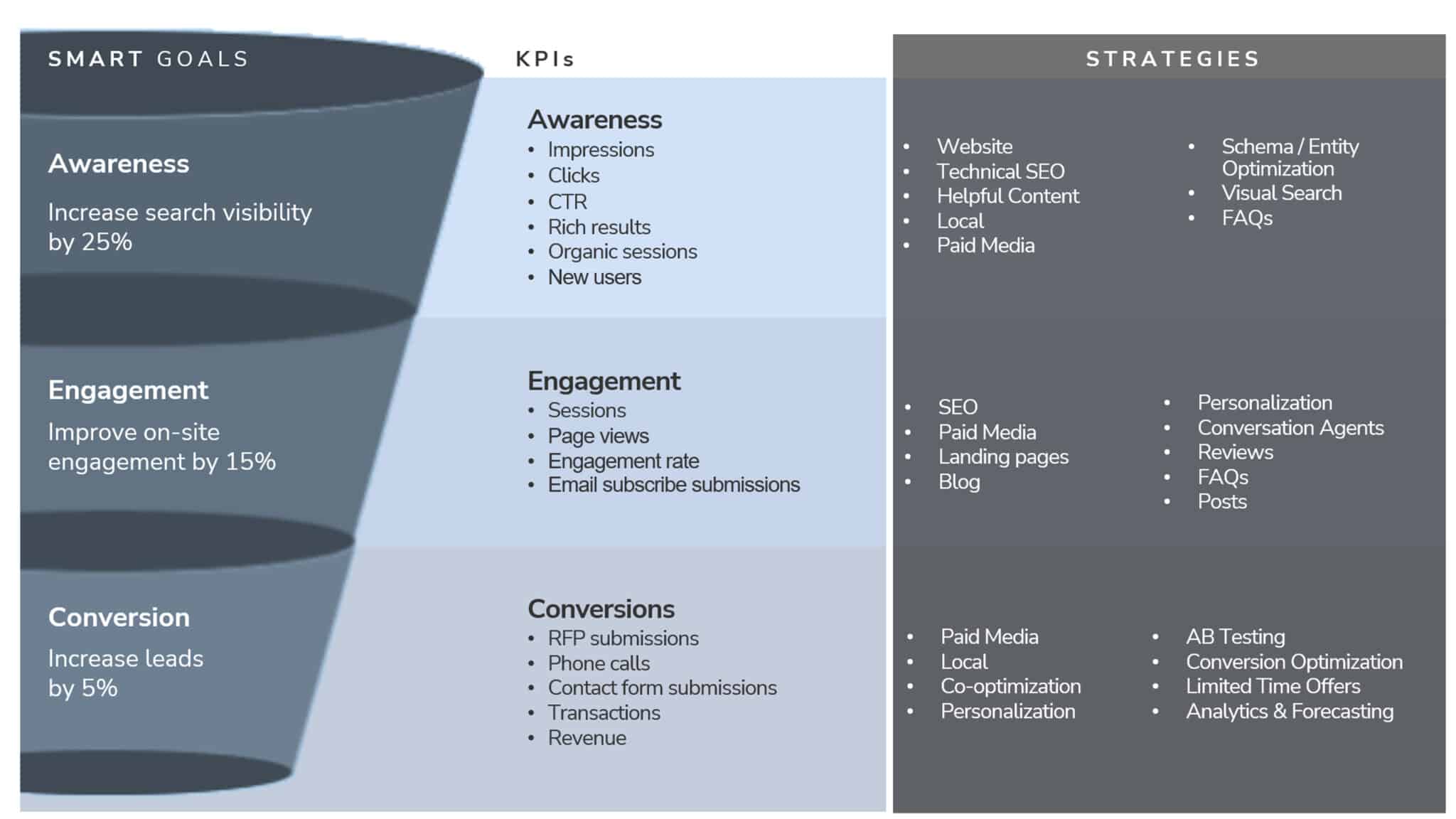 Goals, KPIs, strategies alignment
After aligning on goals and KPIs, analyze historical trends to identify channels and strategies that can contribute toward achieving the goals.
Step 2: Trends, customer journey and channels
Channel distribution analysis
- Gather historical data: Collect data on marketing spend, revenue and key performance indicators for each channel.
- Identify performance levels: Analyze the data to determine which channels are high-performing and which are low-performing.
- Calculate ROI: Know the return on investment (ROI) and other relevant metrics for each channel.
Market and trends analysis
- Identify industry and market trends: Examine industry trends, including market demand and supply patterns for the upcoming year and the previous year.
- Assess consumer behavior and emerging technologies: Identify shifts in consumer behavior and emerging technologies, such as AI, virtual agents and the shift to mobile platforms.
- Analyze competitor activity: Evaluate competitor performance across different channels.
Search trends and customer journey
- Analyze customer discovery channels: Determine how your customers are finding your business. While new marketing strategies may seem promising, ensure these channels align with your customer’s journey.
- Use Google Search Console and Google Analytics: Leverage tools like search console and analytics to understand customer search trends and compare them with industry-wide search changes.
- Evaluate content formats: Assess whether your business is gaining traction through videos, AI-generated overviews or images and compare these results with industry and competitor benchmarks.
Step 3: Data and infrastructure
Evaluate the existing technology stack
- Assess the technology infrastructure for its ability to centralize data, maintain data quality and ensure data security.
Centralize data
- Consolidate all data from various channels and touchpoints into a single location, such as a data lake. Test if data can be used to run analysis and reporting.
Data cleaning and pre-processing
- With all the data collected, the next step is to prepare it for forecasting and budgeting models.
- Begin by cleaning and organizing the data, focusing on the most relevant data points aligned with business goals and KPIs.
- Ensure data accuracy and consistency by removing outliers and addressing any inconsistencies.
- Conduct exploratory data analysis to identify patterns and correlations.
Step 4: Forecasting
Forecasting is key to budgeting because it helps manage risks, seize opportunities, optimize resources and make smart investment decisions.
The following machine learning and language-based models can be used to generate these forecasts:
ARIMA (Auto Regressive Integrated Moving Average)
- Combines autoregression and moving average.
- Flexible for various time series patterns.
- SARIMA, or seasonal ARIMA, accounts for seasonal fluctuations.
Prophet
- Developed by Facebook.
- Decomposes time series data into trend, seasonality and holiday effects.
- Works best with time series with strong seasonal effects and multiple seasons of historical data.
Chronos (language-based model)
- Developed by Amazon.
- A family of pretrained time series forecasting models based on language model architectures.
- A time series is transformed into a sequence of tokens via scaling and quantization and a language model is trained on these tokens using the cross-entropy loss.
- Once trained, probabilistic forecasts are obtained by sampling multiple future trajectories given the historical context.
Consider using Claude 3.5 Sonnet by Anthropic to easily generate Python code for implementing the forecasting models.
Step 5: Budgeting
Determining the optimum channel allocation
- Determine the most suitable budget allocation method based on business objectives, such as percentage of revenue or a fixed amount per channel.
- Consider factors like channel maturity, potential ROI and customer and market trends.
- Use statistical techniques such as Linear Regression to generate a market mix model that optimizes the budget allocation across channels to meet your business goal.
Regular monitoring and optimization
- Continuously track channel performance against budget and KPIs.
- Identify underperforming channels and reallocate budget accordingly.
- Optimize campaigns based on real-time data and insights.
Step 6: Use cases
Finally, create specific use cases for each step of your marketing plan. For example:
- “As the chief marketing officer of an upscale hotel, I want to increase online revenue by 20% year over year. To help achieve this goal, recommend the best budget allocation across digital channels.”
Solution steps
Define business goals and KPIs
- Goal – Increase revenue by 20% overall
- KPIs – Revenue
Channel distribution, ROI, revenue and conversions
- Gather historical revenue and conversion data from Google Analytics across all channels.
- Collect spend data for all channels.
- Calculate ROI for each channel.
Data and infrastructure
- All data should be available in a centralized storage such as a data lake.
- It is easier to access clean and centralized data for training the model.
- Install required python libraries such as pandas, numpy or scipy.
- Perform exploratory data analysis to identify trends and seasonal patterns by running python libraries and statistical analysis
Forecasting and budgeting
- Use forecasting models such as SARIMA to forecast the revenue from each channel based on the spend. The model will account for seasonality trends in the data
- Use statistical optimization techniques to find the best budget allocation across channels.
Working model output
Current average spend across the top channels:

After executing all the steps given above, here’s the recommended allocation by the budgeting model:
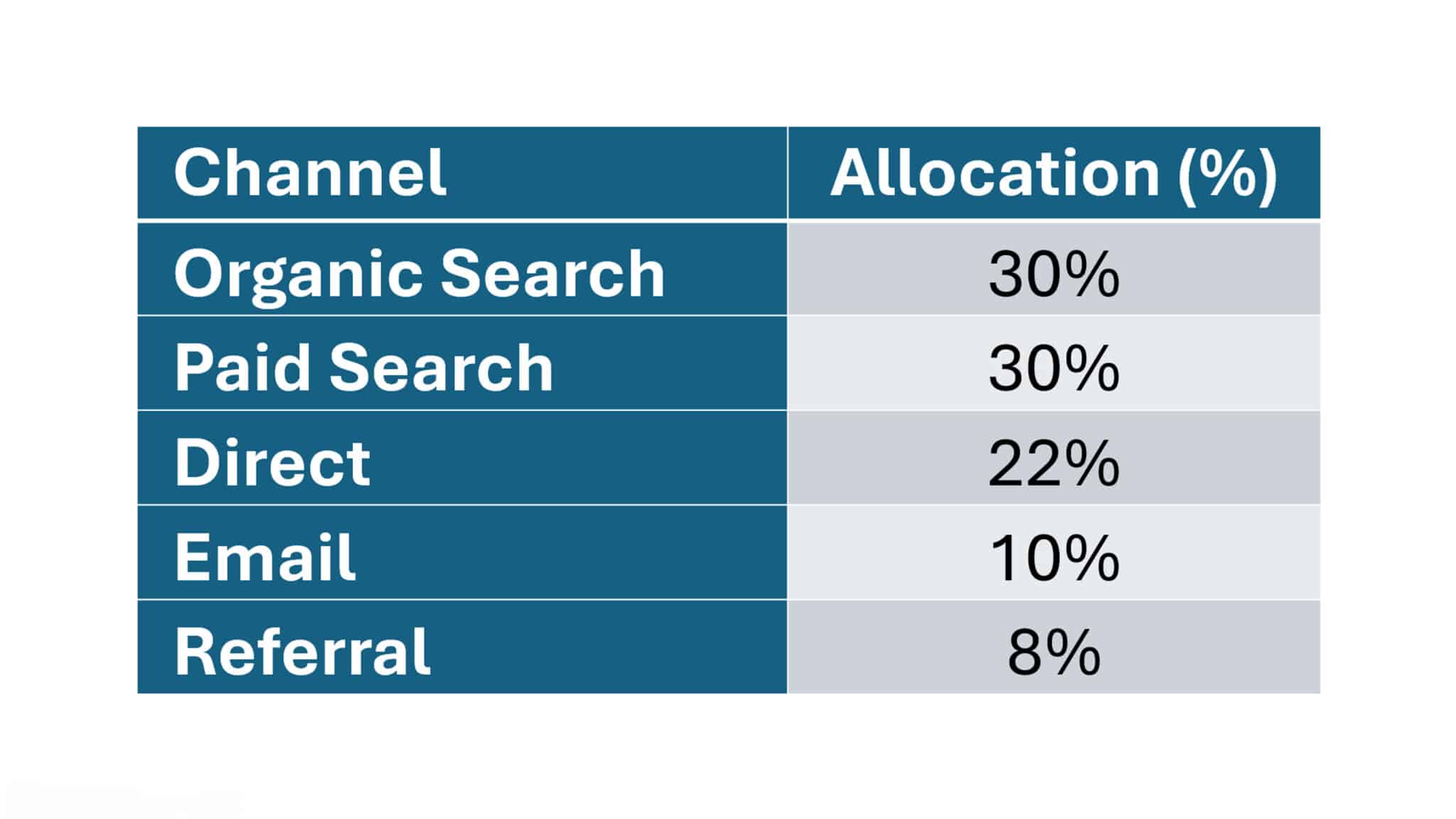
Individual channel allocation
Once you have the budget allocation for each channel, the next step is to break it down further and identify specific sources or platforms within each channel.
For example:
- Within the organic search channel, you might consider sources like Google Business.
- For paid search, platforms like Google Ads and Facebook.
This helps determine the precise budget needed for each source.
For our use case, focus on the organic search channel. Run the budgeting model for all sources within this channel to determine each source’s allocation.
After executing all the steps, here’s the recommended budget allocation for organic search sources:
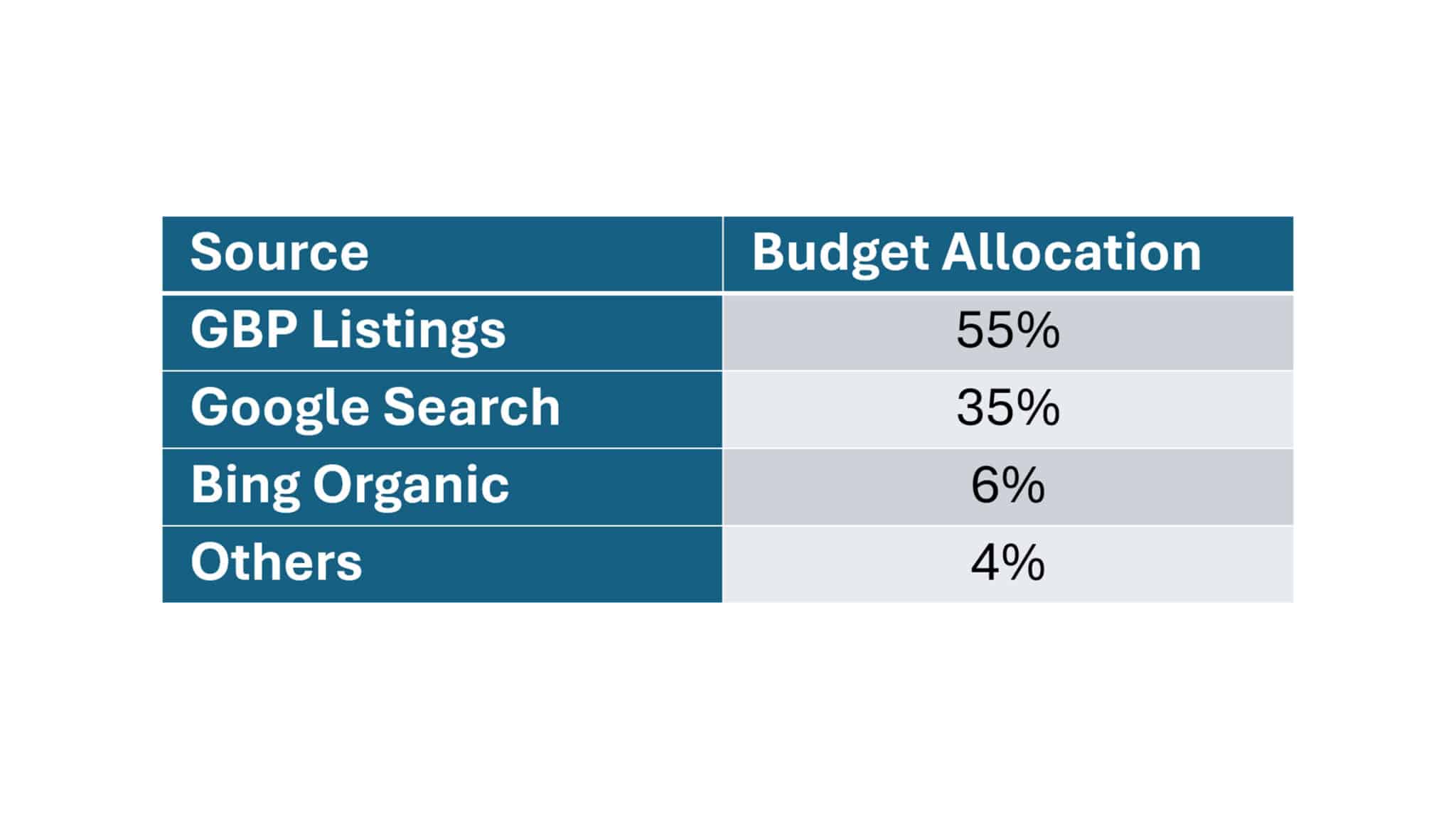
Strategies and solutions to maximize the full-funnel digital experience
Now based on the recommended allocation, deploy the strategies to optimize GBP Listings and Google Search.
AI in digital marketing: Smarter budgeting and forecasting
In the AI era, budgeting and forecasting can be done in real time if data from various customer touchpoints and channels is centralized and readily available throughout the customer journey.
By leveraging AI, you can optimize marketing performance by allocating the right budget to each channel based on its contribution to achieving your business goals.
Courtesy of Search Engine Land: News & Info About SEO, PPC, SEM, Search Engines & Search Marketing
Category seo news | Tags:
Social Networks : Technorati, Stumble it!, Digg, de.licio.us, Yahoo, reddit, Blogmarks, Google, Magnolia.
You can follow any responses to this entry through the RSS 2.0 feed.