

Building a winning Facebook and Instagram strategy for 2024
Advertising on Meta presents unique opportunities that Google Ads doesn’t offer.
Whether your goal is lead generation or ecommerce, Menachem Ani, PPC expert and founder of JXT Group, shared valuable insights at SMX Next on how to optimize campaigns for Facebook and Instagram.
Read on to learn Ani’s seven-step frameworks for building winning lead generation and ecommerce strategies in Meta’s automated landscape.
Meta Ads > Google Ads?
When advertising on platforms like Google, you’re restricted to reaching people searching for your product or service.
However, when placing ads on social platforms like Facebook and Instagram, the possibilities are more diverse, according to Ani. He explained:
- “There are similarities between Google and Meta ads in the sense that they are both pushing towards automation with fewer levels and less controls. But that’s where the similarities end.”
- “With Google Ads, you’re capturing existing demand, somebody searching for the product or service – but it’s finite. There’s only a certain amount of search happening for a specific keyword. Whereas with paid social, you can, you can educate consumers a little higher up in the funnel, create demand and then capture it later on.”
Should you spend more on Google or Meta?
A multi-channel approach is usually best but the answer depends on the nature of your business, according to Ani. He said:
- “If your brand sells products, then Meta will likely work for you. If you’re selling more commoditized products like electronic appliances, then it’s best to lead with Google.”
- “However, we’ve found that it’s usually best to run campaigns across all channels because it gives you multiple sources of revenue – and diversification is always a good thing.”
Lead generation on Facebook and Instagram
Although Meta ads are probably best known for driving results in ecommerce, Facebook and Instagram ads can also be used to effectively generate leads. The key is to focus on quality over quantity (i.e., leads that will actually convert into sales). Ani explained:
- “The last thing you want is to generate leads that you can’t sell to. Ultimately a lead is only worth something if it if it can turn into revenue.”
- “To do this, you need a well thought out strategy to ensure that your message reaches the right consumer.”
The challenge with Meta lead generation
Although lead generation campaigns on Facebook and Instagram can drive great results, you’re also likely to receive a lot of spam leads, according to Ani.
The system tends to optimize for form submissions rather than real-time revenue like in ecommerce, which can result in more leads of lower quality. The challenge is finding a balance to get better quality leads, even if it means fewer form submissions:
- “Remember that leads are not sales – you can’t deposit leads in your bank account. It’s super important to figure out how to get good quality leads.”
7-step lead generation framework
Ani shared a seven-step strategy to address issues like spam and enhance lead generation results through Facebook and Instagram ads.
1. Leads > traffic
The campaign goal you choose is crucial. The Meta algorithm is powerful but specific.
If you run a traffic-focused campaign, you’ll get traffic – but that doesn’t necessarily translate into leads. To sell and get inbound inquiries, you need leads, Ani explained:
- “For this, I recommend always using a conversion-focused campaign specifically focused to driving leads based off of your pixel tracking.”
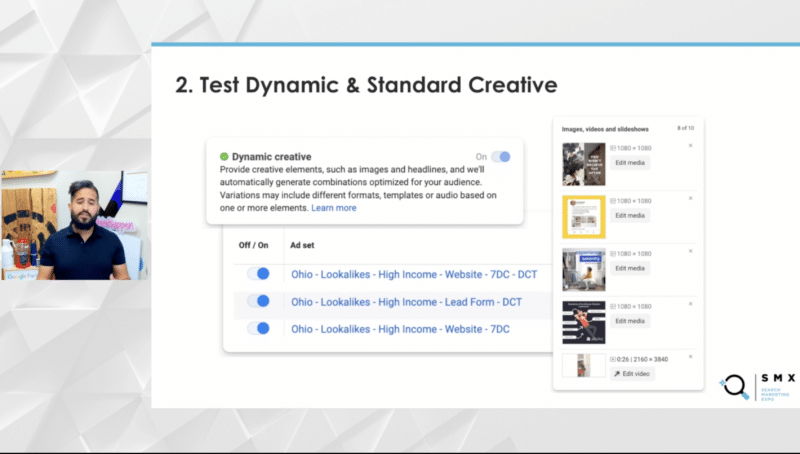
2. Test dynamic and standard creative
When setting up your campaign on Facebook, you can choose to create individual ads or use dynamic creative, which is like responsive search ads on Google – and it’s important to explore both options.
Although testing various targeting and ad creatives is usually advised, dynamic creative works well for smaller lead generation campaigns. Ani explained:
- “With dynamic creative, you provide a list of ad copy and creative elements (like images and videos), and the system personalizes the ad for each user.”
- “This is particularly useful for small budgets on lead generation campaigns where you may lack sufficient data to optimize specific ads as it allows the system to algorithmically target users.”
3. Use customer lookalikes and interests
Ani explained that while the pixel is powerful for targeting based on website activity, when it comes to lead generation, especially on newer or smaller accounts, custom audiences can be effective.
Instead of broad targeting, he recommends creating lookalike audiences from your customer list or qualified leads.
- “Telling the system that people who are interested in x or belong to specific demographics are likely the potential consumer for you can be helpful.”
- “It’s also a good idea to allow the system to use Advantage+ targeting (which is where it expands outside of your audiences) as an additional 20% or so to find users who may not be in the specific audiences you set up.”
- “Unlike ecommerce, where the system can see the revenue coming in in real-time, sometimes you need a bit more of a signal and this helps with lead quality because your ads are being shown to more interested users.”
4. Use Facebook and Instagram
Advertisers often try to manually control where their ads appear, but the algorithm is powerful. It’s best to let the system show ads wherever on Facebook, Instagram, and Messenger, according to Ani.
The algorithm efficiently regulates ad placements based on where conversions are happening. So Ani recommends allowing the algorithm to do the heavy lifting.
Limiting exposure with manual adjustments can increase costs and you may miss out on untapped potential, Ani said:
- “What we’ve learned is that this holds true across most ad platforms today. … When you limit your exposure with manual adjustments, you end up increasing your costs and you lose out on untapped potential.”
5. Think beyond video creatives
Once you’ve identified your audience, the next step is crafting your message.
While ecommerce often emphasizes video creative, for lead generation, image ads surprisingly work well, according to Ani. Video ads are effective too, but creating good videos, especially for lead gen, can be challenging.
Plain images or overlaying text onto an image, like banner ads, are effective. Because your audiences are broad, the messaging in your image ad or the accompanying copy serves as a form of targeting.
6. Create dedicated landing pages
When a user clicks your ad, the destination matters, especially in lead generation. So consider options like sending them to your homepage, a dedicated landing page, or using embedded Facebook or Instagram forms. Ani recommended creating embedded forms:
- “You’re likely going to get less leads if you use an embedded form, but the leads you do get will be better quality because the ones that were going to be spam are less likely to fill out that form due to the extra effort needed.”
- “Remember, embedded forms on Facebook and Instagram are pre-populated with the user’s Instagram or Facebook account information. So it’ll have their name, email and so on. And that makes the form a lot easier to fill out.”
- “I would also recommend adding an additional question to sort of forcefully add friction to the process so that fewer people accidentally fill out the form and you’ll end up with slightly better quality leads – remembering that leads are not sales.”
7. Conversions are not sales
Tracking the source of each lead is crucial. You can add UTM parameters to your ads to see, in real time, which campaign, ad set, and ad creative a specific lead came from.
Over time, by analyzing this data in your CRM, you can establish patterns.
For example, a breakdown of 30 leads from a specific campaign, including their current status, can reveal insights. Isolating and analyzing such data helps identify what’s working well, whether it’s a specific creative resonating with consumers or certain audiences performing better.
This information is valuable for optimizing your future lead generation efforts, Ani explained.

Ecommerce ads for Facebook and Instagram
Ecommerce differs in that the system automatically tracks revenue in real time, according to Ani. This simplifies the process, as a lead often translates directly to a sale.
However, industries with high fraud rates may pose challenges. Tracking revenue in real time lets you assign a dollar value to each order, making it easier to align with profit-centric optimization.
Many direct-to-consumer (DTC) operators use Meta ads and email in their marketing mix. Yet, ecommerce doesn’t have to be purely transactional, Ani said:
- “You can lean into other campaigns on the Google side, like Performance Max, Demand Gen, YouTube, and so on, to capture additional demand that way too.”
7-point ecommerce framework
Here is Ani’s seven-step guide to drive ecommerce results using Facebook and Instagram ads.
1. Test Advantage+ carefully
Unlike lead generation campaigns, where the primary option is conversion-focused, ecommerce allows for a different campaign type called Advantage Plus Shopping. This automated and algorithmic approach, with fewer controls, is akin to Google’s Performance Max.
Advantage Plus Shopping is broad and less structured than a standard conversion purchase-optimized campaign.
- “What we’ve found is that you want to try using both [Advantage Plus Shopping and conversion campaign types] and see how it goes.”
- “For some of our clients, Advantage Plus typically performs better, but for others, we have found that standard purchase conversions work better – but for others, we find a mixture of running them both side-by-side for different products or promotions is best.”
2. Go broad on targeting
For broad targeting in ecommerce campaigns, it’s often effective to let the system go “crazy”, according to Ani. Allow it to target whoever it deems most likely to purchase, excluding recent purchasers, such as those in the last 30 days.
Additional audience limitations can artificially increase CPMs, so it’s generally better to go broad and let the powerful Meta algorithm determine the most promising targets based on real-time revenue data. Trusting the algorithm’s capabilities and leaning into its power tends to yield positive results.
3. Purchase > Add to cart > Clicks
In ecommerce, when running conversion campaigns, it’s crucial to be specific in your objectives.
While the powerful system will deliver what you ask for, specifying actions like “add to carts” or “clicks” might not lead to actual sales. Ani explained:
- “If you tell it you want clicks, you’re going to get clicks, but they typically don’t convert into sales.”
- “So if you’re going to run a purchase conversions campaign, make sure you’re focusing on purchases very specifically because you want purchases – you need revenue. Make sure to focus on that.”
4. Trust in seven-day click
In ecommerce, attribution is different from lead generation. While one day is often sufficient for leads, ecommerce purchases may require more time.
Leaning into a seven-day click attribution is generally recommended. This longer period accommodates the full purchase journey, acknowledging that a user who clicks on an ad may not be ready to buy on the same day.
Avoid one-day view attributions, which can inflate attribution figures due to the widespread exposure of ads on Facebook and Instagram. Ani added:
- “Typically, we recommend using seven-day click attribution unless you’re selling an impulse purchase. In those cases, a one-day click should be enough.”
5. Get creative with creatives
When it comes to creative in online marketing, testing is key, according to Ani. You can experiment with various formats like image ads, video ads, and carousel ads.
Within each type, there are diverse approaches.
- For image ads, you can try product shots, lifestyle images, comparison visuals, or showcase media mentions and customer reviews.
- Videos offer versatility, ranging from high-production to user-generated content, testimonials and different lengths.
- Carousels allow for dynamic catalog ads, providing a range of options.
There’s no one-size-fits-all solution, so it’s essential to test different creative elements to discover what resonates best with your brand. What works for one brand may not necessarily work for another.

6. Match creative cycling to spend
When it comes to testing new creative assets, the focus should be on the traffic flow through a specific ad rather than a specific time or budget. Ideally, you want a significant amount of traffic in the hundreds or even a couple of thousand clicks, to establish statistical significance.
This ensures that the data collected is reliable and can be trusted for making informed decisions. With only a few clicks or orders, it’s challenging to gauge whether the creative will work at a larger scale. Emphasizing the amount of traffic passing through an ad allows for a more robust evaluation of its effectiveness.
7. Keep naming consistent
Maintaining consistent ad naming conventions is crucial for effectively tracking the performance of your creative assets.
By properly naming your ads (including details like asset type, destination, call-to-action, and more), you can easily filter and report on their effectiveness. This approach allows you to compare the performance of different ad types, such as image ads versus video ads or influencer campaigns versus others.
Consistent ad naming ensures that you can quickly and accurately analyze your data to make informed decisions about your advertising strategy.
Key takeaways
Whether running a lead generation or ecommerce campaign on Facebook and Instagram, there are key strategies to consider. For lead gen, focus on:
- Limiting spam.
- Precise targeting.
- Emphasizing the offer.
- Messaging.
Meanwhile, in ecommerce, allow the system to handle more targeting, placing greater emphasis on creative component testing.
Both Facebook and Instagram are valuable additions to your marketing efforts. However, it’s essential to integrate them holistically into your overall strategy.
As ad platforms become more sophisticated and algorithmic, understanding when to let the system handle tasks and when to intervene is crucial.
Courtesy of Search Engine Land: News & Info About SEO, PPC, SEM, Search Engines & Search Marketing
Category seo news | Tags:
Social Networks : Technorati, Stumble it!, Digg, de.licio.us, Yahoo, reddit, Blogmarks, Google, Magnolia.
You can follow any responses to this entry through the RSS 2.0 feed.