

The enterprise guide to elevating findability and ROI
The concept of findability has evolved into a critical factor for businesses striving to connect with consumers.
It’s no longer just about being present, but being discoverable, chosen and seamlessly integrated into the intricate web of customer journeys.
This article explores findability and how a robust omnichannel findability strategy can help brands create meaningful and lasting customer relationships.
What is findability?
The discipline of findability is centered around connecting the appropriate consumer with the suitable product or service, at the right moment and in the correct location – whether physical or digital.
At my company, Vodafone Spain, our findability approach signifies a shift from solely addressing specific digital requirements and platforms (a static concept) to engaging with a comprehensive journey to discover, locate and fulfill those requirements (a dynamic concept).
Simply put, it emphasizes customer-centricity (the complete journey) and omnichannel focus (consumer behavior regardless of channels).
With the evolution of the web, consumers have transitioned from restricted searches within a solely digital platform to exploring various channels, contingent on their journey phase.
There are now multiple search properties and formats (text, image, video, virtual reality, augmented reality, etc.) that have gradually contributed to addressing diverse needs:
- Search engines: “I want to know” searches.
- Digital video platforms (e.g., YouTube, Vimeo): “I want to know” and “I want to do” searches.
- Geolocation platforms (e.g., Google Maps, store locators): “I want to go” and “I want to buy ” searches.
- Ecommerce platforms (e.g., Amazon, AliExpress, eBay): “I want to buy” searches.
- Social platforms (e.g., Facebook, LinkedIn, TikTok, X, Pinterest): “I want to know” searches (through acquaintances and friends).
As these different aspects of search strategies developed, the focus changed from optimizing for specific elements (like the environment, product or service, and keywords) to a more comprehensive approach that aligns with the various stages of the consumer’s journey.
The findability model: A 4-phase framework
Our findability approach is based on a 360-degree model, spanning analysis to operations.
It prioritizes continuous tactic review for potential corrections and strategy evaluation to adapt to market or competitive changes.
Moreover, findability has visibility in our digital direction, which serves a dual purpose:
- Enhancing our brand and product visibility.
- Functioning as a source of business intelligence.
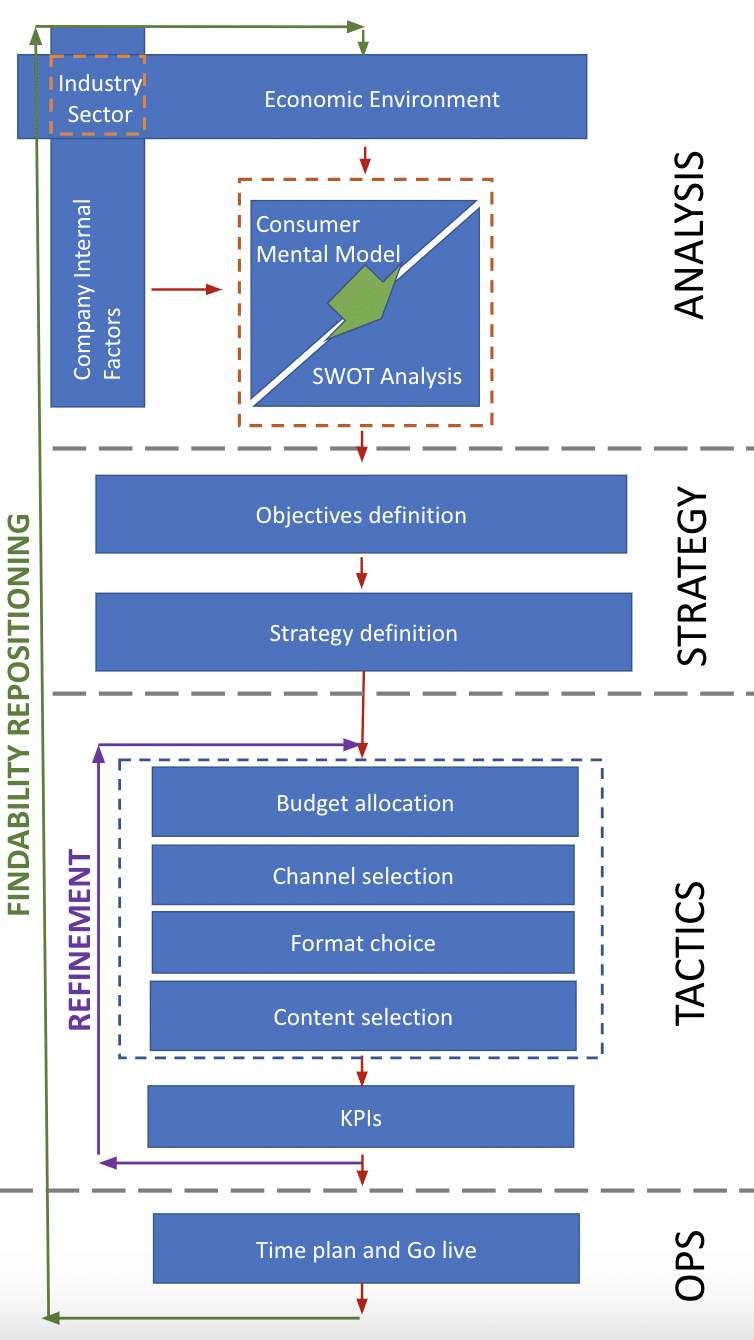 Vodafone Spain’s findability model
Phase 1: Analysis
Economic environment
Understanding the economic environment is crucial for crafting an impactful findability strategy. It helps make informed decisions about resource allocation and ROI-focused marketing tactics.
Within this segment, our focus centers on these key areas:
- Demographic trends.
- Consumption trends.
- Allocation of consumer expenditures across product and service categories.
- Political landscape.
- GDP trajectory.
Company internal factors
While analyzing the economic landscape is crucial, don’t overlook internal factors like organization, innovation, logistics and other intrinsic dimensions in shaping a successful findability strategy.
We are particularly attentive to these pivotal elements:
- Products and services differentiation.
- Market share – splitting by digital and non-digital.
- Internal digital skills vs. outsourcing.
- Attribution model maturity implementation.
- Omnichannel maturity.
Industry sector
The industry sector includes all factors that simultaneously characterize the economic environment and the company internal factors.
Exploring the industrial sector is essential, as economic trends can significantly impact performance. A thorough evaluation helps:
- Identify opportunities and threats.
- Refine the findability strategy to adapt to changing market dynamics.
This allows businesses to innovate and stay competitive.
Within this segment, our focus is directed toward these key aspects:
- Competitors.
- Elasticity of demand.
- Demand growth rate.
- Regulatory environment.
- Annual growth trends.
- Volume of revenue.
You can also use public information repositories to access some of this information.
For instance, Google Trends can be a valuable resource.
Let’s imagine exploring the demand growth rate in relation to the most popular mobile handsets brands from 2004 to the present day:

Consumer mental model
Products and services aren’t merely the results of supply and demand but are intricately tied to the consumer’s engagement within their environment.
How consumers connect with their environment, mental constructs and worldviews shapes their perception and use of products and services.
Exploring their mental models helps us understand how people reference and value concepts.
Analyzing consumers’ search queries and using matrices to identify critical product attributes (i.e., usage frequency and volume) can provide valuable insights.
Consider the scenario of Sarah, a tech-savvy individual considering upgrading her home internet connection.
Here’s how you can approach this:
- Conduct a comprehensive analysis of searches across various platforms to build a detailed consumer profile.
- Adopt models like the Kano model to pinpoint which product attributes resonate with the consumer’s mental framework.
- Delve into the process of how consumers search for and categorize each type of attribute within the Kano model, examining these actions in every micro-moment:
 Attributes categorization for micro-moments
SWOT analysis
Companies can capitalize on economic opportunities by having the right tools and processes that align with consumer thinking to create an effective findability strategy.
At my company, we assign a Visibility Index we developed internally to each attribute in correspondence with a specific micro-moment:
 Representation of Visibility Index
 Example of attributes categorization for micro-moments by Visibility Index
Dig deeper: SEO SWOT analysis: How to optimize where it counts
Phase 2: Strategy
Objectives definition
For our products or services to be discoverable by potential customers, we define specific objectives to implement the model seamlessly.
Objectives can be categorized into:
- Revenues
- Savings
- Orders
- Leads
- Etc.
The objectives must align with both the company and the digital unit’s goals to synchronize efforts on findability with the company’s overall objectives, actions and budget allocation.
Strategy definition starting from customer journey conceptualization and design
This marks the next phase in findability strategy planning, involving the analysis and synthesis of preceding aspects. Here, we aim to streamline potential strategic options and select the implementation strategy.
Customer journey empowers us to define a strategy to position ourselves where the customer is, in a manner and format that resonates with their expectations, precisely when they anticipate encountering them:
- Where
- How
- When
Prioritize enhancing user experiences for both digital and physical assets.
Dig deeper: How to create and execute a buyer journey-based content strategy
Get the daily newsletter search marketers rely on.
<input type=”hidden” name=”utmMedium” value=”“>
<input type=”hidden” name=”utmCampaign” value=”“>
<input type=”hidden” name=”utmSource” value=”“>
<input type=”hidden” name=”utmContent” value=”“>
<input type=”hidden” name=”pageLink” value=”“>
<input type=”hidden” name=”ipAddress” value=”“>
Processing…Please wait.
Phase 3: Tactics
Budget allocation
Effectively allocating the budget to various marketing channels is crucial for brand visibility and consumer discovery.
Consider investing in:
- Pay per click (PPC).
- Pay per acquisition (PPA), including affiliate marketing.
- Pay per impressions.
- Optimizing store locations.
- Enhancing signage.
- And more.
By assessing these channels and their strengths, you can customize our budget strategy to match your brand’s goals and audience.
There’s no one-size-fits-all approach; each business has its unique combination. Regularly monitoring and adjusting budget allocation is vital for a successful findability strategy.
Channel selection, format choice and content selection
Every strategic decision and budget allocation must translate into tactics supported by:
- Channel selection: Utilizing search environments/search engines such as Google, YouTube, Amazon, Facebook, X (formerly Twitetr), physical stores, corners, malls, etc.
- Format choice: Considering options like video, voice, text, PDFs, images, photos, catalogs. It’s essential to assess the feasibility of generating new content or repurposing existing material.
- Content selection: Focusing on aspects like inspiration, education, entertainment, persuasion, etc.
All of this aims to achieve specific business goals defined at each stage of the purchase funnel.
 Example of Findability strategy and specific tactics by purchase funnel stage
Key performance indicators
Defining your key performance indicators (KPIs) will enable you to clarify objectives and track progress, ultimately leading to the initiative’s launch.
Below are some of the main KPIs we track:
- Zero results searches
- This KPI measures the number of searches that don’t yield any results or satisfactory responses for the user, which is crucial for improving search result accuracy and relevance.
- This can be improved by offering search suggestions, autocomplete and related links, or even making a suggestion to add a new product or service to the portfolio to cover the unmatched demand.
- Most common queries
- This KPI tracks popular keywords or search terms used by searchers to find information or products on a website.
- Monitoring this KPI helps identify relevant and popular search terms, aiding in SEO.
- Trending search terms
- Refers to search terms gaining or declining popularity among users.
- Analyzing these trends is vital to adjust the findability strategy to changing user needs.
- Context
- Refers to where users search from (i.e., webpages, Google, site search, social media).
- This KPI examines different platforms or sources from which users initiate searches, helping tailor the findability strategy to those platforms.
- Date
- Refers to when users searched.
- Relates to search trends based on the date or time when searches occur. Important for planning findability strategies in sync with seasonal trends.
- Geographic area
- Analyzes the geographic location from which users perform searches, useful for adapting search strategies to different regions.
- Devices
- Examines the devices used for searches, helping optimize the search experience for each type of device.
- Bounce rate
- Measures how often users leave a website after searching without clicking on any results, indicating relevance issues.
- Popular content/products
- Measures the popularity of products or content that users search for.
- Search refinements
- Additional search terms users add after an initial query to refine their search, indicating the need for more precise results.
- Digital searches to store visits
- Measures the effectiveness of Findability efforts in driving physical foot traffic to a retail store.
- Online-to-offline conversion rate
- The percentage of online visitors who make a purchase in a physical store.
- Offline-to-online conversion rate
- The percentage of in-store visitors who make a purchase online.
- In-store traffic influenced by online
- The number of store visits that can be attributed to online marketing efforts.
- Local SEO rankings
- The positions of the physical stores in local search results in a context of unbranded product or service searches.
- Customer lifetime value (CLV) by channel
- The value a customer brings over their entire relationship with your brand, broken down by channel.
- Omnichannel customer effort score (CES)
- Measures how easy it is for customers to interact with your brand across all channels.
- Mobile search traffic to physical store visits
- Measuring how many users who found you through mobile search actually visited your physical store.
By consistently measuring and reviewing KPIs, we can enhance the performance of our tactics across all the channels at every stage of the purchase funnel.
This iterative process aims to amplify each tactic’s impact on our business, ultimately driving greater overall success.
Dig deeper: 13 key SEO metrics to track
Phase 4: Operations
4.1: Time plan and go live
In this phase, we plan meticulously and set implementation dates for specified tactics.
We prioritize swift and adaptable execution using agile methodologies, like Kanban for content changes and Scrum for programming code interventions.
Modernizing enterprise search for improved ROI
Mastering findability is vital for enterprise companies.
By seamlessly optimizing for search, integrating online and offline channels and leveraging data-driven insights, enterprise brands can meet their customers where they are and provide a seamless, personalized experience.
Remember, findability isn’t just about being discovered; it’s about being chosen.
As you embark on this journey, continuously monitor KPIs, adapt strategies and stay attuned to the evolving needs of your audience.
With a robust omnichannel findability strategy, you’re not just connecting with customers but creating lasting, meaningful relationships.
The post The enterprise guide to elevating findability and ROI appeared first on Search Engine Land.
Courtesy of Search Engine Land: News & Info About SEO, PPC, SEM, Search Engines & Search Marketing
Category seo news | Tags:
Social Networks : Technorati, Stumble it!, Digg, de.licio.us, Yahoo, reddit, Blogmarks, Google, Magnolia.
You can follow any responses to this entry through the RSS 2.0 feed.