Archive for the ‘seo news’ Category
Monday, March 25th, 2024
The EU announced it is investigating Google over potential violations of the Digital Markets Act (DMA).
If the tech giant is found to have violated the DMA, it could face fines of up to 10% of its annual turnover and may be required to divest certain business divisions.
Meta and Apple are also currently under investigation by the EU Commission for alleged breaches of the DMA.
What is the Digital Markets Act (DMA)? The DMA is a piece of legislation introduced in 2022 designed to ensure that large online platforms, called “gatekeepers”, behave in a fair way online to create a fair and open environment for online businesses. Only six gatekeepers have obligations under the DMA:
- Alphabet (Google’s parent company).
- Apple.
- Meta.
- Amazon.
- Microsoft.
- ByteDance.
All six companies, none of which are based in the EU, were required to ensure they fully complied with DMA obligations and submit compliance reports by March 7.
DMA violation penalties. The consequences of non-compliance with the DMA includes:
- Fines: Up to 10% of the company’s total worldwide annual turnover, or up to 20% in the event of repeated infringements.
- Periodic penalty payments: Up to 5% of a company’s average daily turnover.
- Remedies: These can include behavioural and structural remedies, such as the divestiture of (parts of) a business.
Under investigation. EU antitrust boss Margrethe Vestager and industry head Thierry Breton confirmed that investigations Google is being investigated for”
- Allegedly not allowing apps to freely communicate with users and form contracts with them.
- Reportedly giving its own goods and services preference in its SERPs.
App store concerns. The Commission is investigating whether Google has broken the DMA rules regarding its app stores. According to Article 5(4) of the DMA, gatekeepers (the six companies the DMA applies to) must let app developers guide users to offers outside their app stores without any fees. The Commission is concerned that Google might not be following this rule entirely as its existing measures seem to limit developers’ freedom to advertise and promote offers. They also impose charges, which reportedly make it harder for developers to communicate and make deals directly.
Self-preferencing concerns. The Commission is also investigating Alphabet to see if Google’s search results give preference to Alphabet’s own services like Google Shopping, Google Flights, and Google Hotels over similar rival services. They’re worried that Alphabet’s actions to comply with the DMA might not ensure fair treatment for third-party services listed on Google’s search results page compared to Alphabet’s own services, as demanded by Article 6(5) of the DMA.
Why we care. Tougher data privacy policies might affect Google’s capacity to deliver personalized ads and content. This could potentially reduce the effectiveness of advertising campaigns, as they may not effectively reach the desired target audience as accurately.
Additional concerns. The EU Commission is also conducting three additional investigations into Meta and Apple for:
- Meta allegedly unfairly asking individuals to pay to stop their data from being utilized for ads.
- Apple reportedly not allowing apps to openly communicate with users and form contracts with them.
- Apple reportedly not offering users enough choice.
All five investigations are expected to be complete in approximately 12 months.
What the EU is saying. EU antitrust boss Margrethe Vestager said in a statement:
- “We suspect that the suggested solutions put forward by the three companies do not fully comply with the DMA.”
- “We will now investigate the companies’ compliance with the DMA, to ensure open and contestable digital markets in Europe.”
Industry head Thierry Breton added:
- “We have been in discussions with gatekeepers for months to help them adapt, and we can already see changes happening on the market. But we are not convinced that the solutions by Alphabet, Apple and Meta respect their obligations for a fairer and more open digital space for European citizens and businesses.”
- “Should our investigation conclude that there is lack of full compliance with the DMA, gatekeepers could face heavy fines.”
What Google is saying. Oliver Bethell, a competition executive at Google, said in a statement:
- “To comply with the Digital Markets Act, we have made significant changes to the way our services operate in Europe.”
- “We have engaged with the European Commission, stakeholders and third parties in dozens of events over the past year to receive and respond to feedback, and to balance conflicting needs within the ecosystem. We will continue to defend our approach in the coming months.”
What Meta is saying. Meta said in a statement:
- “Meta said: “Subscriptions as an alternative to advertising are a well-established business model across many industries . . . We will continue to engage constructively with the Commission.”
Get the daily newsletter search marketers rely on.
Deep dive. Read the European Commission’s announcement in full for more information.
Courtesy of Search Engine Land: News & Info About SEO, PPC, SEM, Search Engines & Search Marketing
Saturday, March 23rd, 2024
You should expect to see “some erosion of current traffic levels” from brand-related terms as a result of Google’s Search Generative Experience, according to a new Authoritas analysis.
Why we care. Google just today announced it is rolling out SGE to users who aren’t opted into Search Labs, under the name of AI overviews. We’re still in the dark about how large of an impact the AI-generated answers will have on organic traffic. And, as Authoritas put it in their analysis:
- “These new types of generative results introduce more opportunities for third-party sites and even competitors to rank for your brand terms and related brand and product terms that you care about.”
Google SGE displayed for 91.4% of all search queries. Only 8.6% of keywords in this analysis did not have an AI-generated response.
 Image source: Authoritas
Quora doing well in SGE. Question-and-answer site Quora finished “in the top 20 performing generative domains in 11 of 15 categories,” according to Authoritas.
Wikipedia was another winner, appearing in the top 20 for every category – including being the top or second-best performing domain in 11 of the categories examined.
SGE links. On average:
- 10.75 links appeared in SGE answers.
- 4.3 unique domains were featured per answer.
- 62% of generative links came from sources outside the top 10 ranking organic domains.
- 20.1% of generative URLs directly matched a page 1 organic URL and 17.9% showed a different URL from the same organic ranking domain.
PPC ads. Just over 50% of keywords had paid search ads. Those ads appear above SGE 51% of the time and beneath 49% of the time, on average. Here’s a chart showing a more nuanced breakdown by industry:
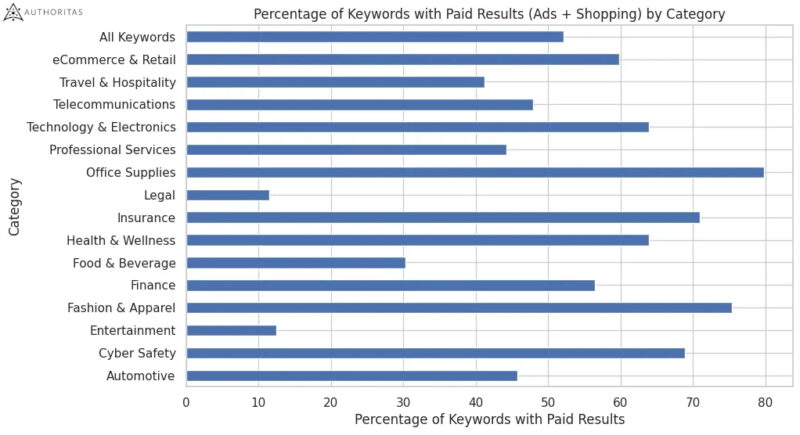
Shopping Ads, meanwhile, appear below SGE 64% of the time, on average.
About the Analysis. It looked at 2,900 keywords for 251 prominent U.S. brands across 15 industry verticals. You can read it here: SGE Research Study – The Impact of Google Search Generative Experience on Brand and Product Terms
Dig deeper:
Courtesy of Search Engine Land: News & Info About SEO, PPC, SEM, Search Engines & Search Marketing
Saturday, March 23rd, 2024
TikTok published a new guide offering best practices for lead generation on the platform.
The comprehensive 25-page document, which was released in partnership with Hubspot, provides actionable tips on:
- Lead generation forms.
- Hooks.
- Messaging.
- Calls to action.
Why we care. Even if feel confident in your lead generation abilities, this document could shed light on areas you may have overlooked. Additionally, receiving best practice guidance about TikTok directly from TikTok is clearly more reliable and trustworthy than other sources.
Lead gen forms. TikTok provides a variety of tips for boosting lead generation through forms on your website or app, such as:
- Visual help: TikTok suggests adding a logo, header image, and footer image to showcase your business and products and/or services more effectively.
- Be conscious of number of questions: If youʼre looking to generate more lead volume, set a maximum of 6 questions.
- Use logic settings and custom questions: With the advanced form, use logic settings to switch up questions based on how someone responded to the first question
- Link to your privacy policy: Link to your privacy policy in your form to guarantee users that any personal information collected is secure and in accordance with local laws.
- Include a review screen: This could potentially help with higher intent.
- Don’t forget to say thank you: Include a thank you message and specify what the next steps are and how/when you’ll get back to them.
Hooks. Educational videos covering finance, real estate, and career services are highly effective, according to TikTok. So the platform recommends starting by highlighting your product or service’s benefits to attract viewers. Showcase how it can enhance their lives and solve their problems, offering a glimpse into an aspirational lifestyle. By proactively addressing viewers’ challenges, TikTok claim you will engage them and increase their likelihood of purchasing your offering.
Messaging. After hooking your audience, TikTok suggests establishing trust by delivering your main message clearly and memorably. This section should encapsulate your product or service’s selling points, core narrative, and key highlights. Build credibility by emphasizing the value and benefits of your brand, compelling viewers to become interested in your offering.
Calls to action. TikTok advises concluding with a clear and compelling Call to Action, urging viewers to take the next step. Wrap up with memorable closing remarks delivered through text, voice-over, or graphics, leaving a lasting impression on your audience.
Get the daily newsletter search marketers rely on.
Deep dive. Download TikTok’s lead generation playbook for more information. In order to access this document, you will be required to share some first-party data.
Courtesy of Search Engine Land: News & Info About SEO, PPC, SEM, Search Engines & Search Marketing
Saturday, March 23rd, 2024
Google released a dedicated guide for developers called the Performance Max developer guide.
The document is aimed at helping developers access the necessary information to build PMax integrations more easily.
Why we care. For developers working on PMax integration, this guide consolidates all necessary information into one convenient location.
Additional improvements. Google Ads also announced several other improvements, including:
- A new guide called “Structure Requests”, which provides detailed insights into the complexities of creating and updating PMax campaigns through requests.
- Updating the developer documentation so that it now more clearly identifies and renames business goals for easier navigation and understanding:
Get the daily newsletter search marketers rely on.
Deep dive. Read Google’s announcement in full for more information.
Courtesy of Search Engine Land: News & Info About SEO, PPC, SEM, Search Engines & Search Marketing
Saturday, March 23rd, 2024
Bing Deep Search, an optional generative AI feature meant to help searchers with complex questions that don’t have simple answers, is now fully live for all users. Microsoft announced today that all users can now access Deep Search within Bing Search by clicking on the Deep Search button at the top of the search results page.
Bing Deep Search was originally announced in December 2023 as a search engine that goes deeper on your queries using Bing’s index and GPT-4 to give you more tailored and deeper search results. We then saw it go live briefly in early February, only to be taken down for more testing. It seemed to go live again early this month and now Microsoft is officially announcing its launch.
What is new. Jordi Ribas from Microsoft announced, “Deep search is now available. It uses our existing Bing index and leverages GPT-4 to expand and enhance your query, and determine possible intents. In this example, if your intent is the document camera, then you’d select the top option and get a full page of enhanced results.”
Here is his post:
Deep search is now available. It uses our existing Bing index and leverages GPT-4 to expand and enhance your query, and determine possible intents. In this example, if your intent is the document camera, then you’d select the top option and get a full page of enhanced results. pic.twitter.com/ZSdAVTcjoK
— Jordi Ribas (@JordiRib1) March 22, 2024
Michael Schechter from Microsoft said it is now live for “all users” compared to it going live last time we covered it.
How it works. Deep Search is built on top of Bing’s web index and ranking system. It then uses GPT-4 to discern all the possible intents and variations behind the query and compute descriptions for each of them to create an “ideal set of results.”
After using a combination of querying techniques, Deep Search will surface results that typically wouldn’t appear in Search results.
Deep Search results ranking. The biggest factor is how well a page matches Bing’s expanded description. A few other relevance and quality factors mentioned were:
- How well the topic matches.
- Whether it has an “appropriate level of detail.”
- Whether the source is credible and trustworthy.
- Freshness.
- How popular the page is.
It is slow, very slow. Deep Search won’t load as quickly as regular search results. It may take Deep Search up to 30 seconds to complete, Microsoft said. This makes the feature sound dead on arrival – as most searchers likely won’t have that much patience.
It does seem faster to run and a lot less buggy than what I saw in early February.
Why we care. This is another variation of using AI for search results. These search results seem like they would drive more clicks than Bing Chat or Google Bard and even Google SGE. But time will tell.
Give it a try, see if you like it and if you find the results fast enough to be useful.
Courtesy of Search Engine Land: News & Info About SEO, PPC, SEM, Search Engines & Search Marketing
Thursday, March 21st, 2024
Marketers can’t call Google’s bluff anymore. The company finally removed cookies for 1% of Chrome users (or around 30 million people) back in January. And as the conversation around PAIR, Google’s new identity solution that allows publishers and advertisers to match first-party data to deliver personalized ads, gathers more and more momentum each day, there’s one thing we can be sure about — when it comes to the deprecation of cookies, this time, it’s for real.
With Google continually pushing back the cookie deprecation deadline, advertisers didn’t expect, or prepare, for the demise of cookies to actually happen. As a result, even with the cookiepocalypse bearing down on them, most programmatic buyers still haven’t embraced cookie alternatives.
Now, advertisers are scrambling to find the solution. And it might just be that alternative data, a type of big data that ironically went mainstream for the finance industry, might also be a gamechanger for digital advertising. Alternative data is a promising solution in the chaos of the cookie crumble.
No one is ready for cookie crunch time
Identity providers are having a heyday with creating solutions to fill in the gap that cookies will inevitably leave, spawning a number of ID solutions ranging from the Trade Desk’s Unified ID 2.0, LiveRamp’s RampID and Google’s PAIR and Privacy Sandbox. Many publishers don’t have the budget and investment capabilities to try them all out, so they’re relying on buyers to do the work for them. One alternative ID solution is expected to eventually rise to the top.
While we wait on alternative IDs to sort themselves out, a complete reliance on first-party data still isn’t ideal, especially for smaller partners who must rely on retail media networks to provide them with that first-party data. The other methods, like contextual targeting, are beginning to fall by the wayside as advertisers continually seek the same returns provided by cookies.
While first-party data, retail media networks, and even zero-party data still have their place, the market necessitates a number of tools to work together to support a post-cookie solution. In comes alternative data! Another soon-to-be-essential in the toolbox.
What is alternative data?
Initially used in the world of investing, alternative data went mainstream in that industry as hedge funds and investment managers began employing it to gain a leg up on competitors still heavily using its counterpart, traditional data.
In finance, traditional data consists of quarterly reports, company statements and other publicly available sources of data used to make investment decisions. Alternative data came to mean anything else, and now consists of data procured through the internet, satellite imagery, credit and debit transactions, mobile app data and more.
With time, alternative data moved beyond its initial world of hedge funds into the rest of the finance industry, and eventually, also into the hands of government bodies and policymakers, not to mention credit bureaus and commercial businesses. Now, it’s entering the world of marketing as a tentative additional solution to the cookie crisis. As traditional “cookie” data goes away, alternative data, the kind that can be acquired through geolocation information, public databases and the like, becomes part of the puzzle that replaces it.
When you layer AI tools on top of alternative data and the increasing digitization of information, the capabilities of using such large swaths of internet data and other sources becomes much easier to use. Alternative data may emerge as one of the pioneering cookie alternatives and advertisers are beginning to take note.
The boom of alternative data
The decades-long use of alternative data in the financial industry is proving to be a precursor for alternative data’s use in market research and consumer insights.
With solutions like nowcasting — a portmanteau of “now” and “forecasting,” which presents nearly real-time data to power things like dynamic pricing, alternative data may increasingly present the answer — or an answer — as the cookie continues to crumble.
The global revenue for alternative data is expected to reach $137 billion by 2030, according to Deloitte. That’s 29 times the global revenue for alternative data today. While investment management is expected to drive most of this growth, advertising may increasingly make up this revenue.
Reconciling alternative data with mainstream cookie solutions
So what does alternative data really have to do with the disappearance of cookies?
While cookies may soon be gone, newer technologies, like AI and big data analytics, are only growing. The ability of machine learning to parse through alternative data and deliver valuable insights could be a game changer in the advertising industry.
As cookieless solutions evolve from a nice-to-have, to a need, alternative data is primed to not only serve as a useful tool for investors, but for advertisers.
Once cookies are gone, gone, really gone, alternative data will feel very mainstream.
Courtesy of Search Engine Land: News & Info About SEO, PPC, SEM, Search Engines & Search Marketing
Thursday, March 21st, 2024
Every year brings a ton of change in digital marketing. In each of my 10 years in the industry, I’ve noticed that the beginning of the year can mark a surge in calls for SEO and PPC to work together.
The difference in 2024? There’s an elephant in the room: AI.
Google’s organic and paid sides are both rushing to adopt AI. From Search Generative Experience (SGE) to Gemini (formerly Bard), the SERP results for both paid and organic are evolving almost daily.
This is sparking unrest for paid and organic marketers alike – and putting an even bigger emphasis on paid and organic teamwork, as I discussed in my recent presentation at the MarTech Spring Conference (registration required).
I’ve already covered the important reports SEO and PPC teams need to run (and share) to help each other succeed so I won’t go in-depth on those here. However, there are other key initiatives paid and organic teams need to incorporate into their joint 2024 strategies to help everyone navigate the early days of AI. They are:
Let’s take a look at each – and why it matters that we get them right.
1. Collaboration
Collaboration – which includes its close cousin, communication – has high stakes in 2024.
Along with the usual benefits of collaboration – shared learnings, strategic alignment, gap coverage and discovering anomalies or new patterns – SEO and PPC teams can mitigate the risks of getting siloed and tackling rapid change with different agendas.
One of the trends we’ve seen develop over the last year or so (and it’s a trend Google is pushing) is a focus on first-party perspectives.
With AI certain to crowd into the SERPs (both organic and paid) as time goes on, using E-E-A-T principles on the organic side and beefing up product reviews, testimonials and case studies to support landing pages will be important.
Trading insights between teams on what’s resonating can help keep messaging and branding fresh and cohesive.
Another component of collaboration as the SERP evolves is communication on algorithm changes.
- PPC can help cover for any organic dips when new algorithms roll out.
- SEO teams can continue to bolster PPC efforts when new competitors enter the auction – and/or when engagement costs climb past the point of viable ROI.
2. Funnel intent alignment
Now more than ever, thinking about a full-funnel strategy is crucial.
Your customers aren’t thinking about individual channels or tactics, but they will respond if they’re presented with the right messaging at the right time. Ensuring alignment at each stage of the funnel is crucial to building your marketing program in 2024.
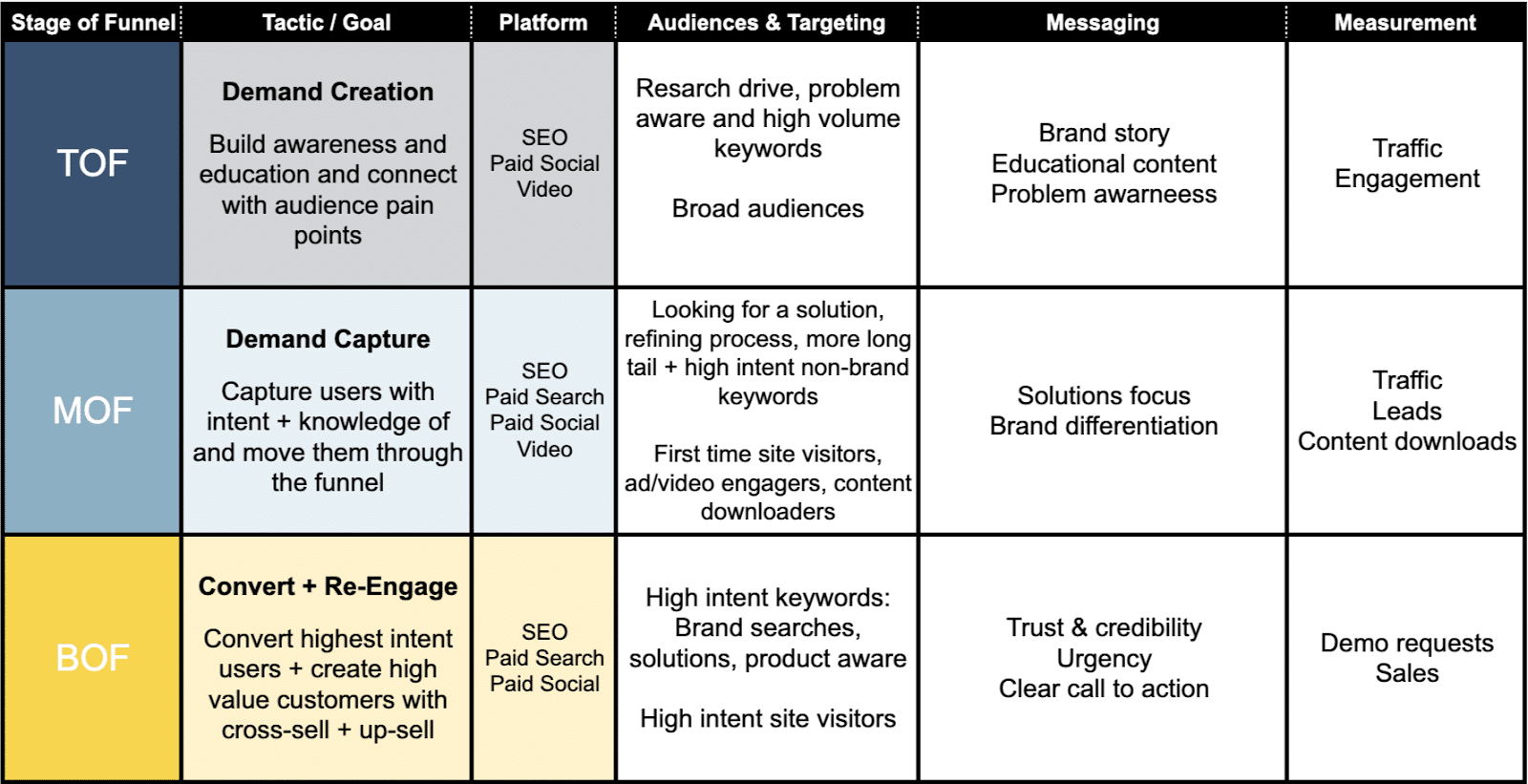
Here’s a chart we use at my agency to make sure we’re mapping out – and covering – the full purchase journey:
Without a unified approach agreed upon by all relevant teams, you won’t have visibility into your funnel coverage.
Whatever your preferred format, you must create a touchstone that your teams can share and monitor to reduce funnel gaps or redundancies.
Get the daily newsletter search marketers rely on.
3. Education and awareness of the changing SERPs
Let’s go into specifics. There are a lot of considerations in 2024:
On the paid side, we’re all intently watching the roll-out of ads in SGE because we can bet Google will figure out a way to monetize them. Since little is known about what this will look like, it’s important to:
- Stay in close touch with your SEO counterparts.
- Keep an eye on industry updates.
- Monitor click-through rates
Seeing how the ad algorithm and SGE algorithm collide and what campaign types will include it (are we all assuming it will be Performance Max?) and assessing impacts on ad inventory make SEO efforts and collaboration more critical.
As far as organic SGE, we could see an even bigger shift. No SEO can confidently say that they can optimize content for SGE because it’s even more of a black box than the traditional search algorithm.
As SGE rolls out, some brands will win and others will lose on the organic front. PPC teams need to be prepared to either pick up the slack or (in a best-case scenario) shift the budget to other initiatives where organic gains permit.
Continuing to optimize for the user and focusing on top-of-funnel content is a great place to start as we monitor SGE impacts.
4. Shared learnings off-Google
In 2024, paid and organic collaboration must expand to platforms beyond the search engines as search behavior becomes more fragmented.
Forums like Quora and Reddit are picking up steam (even in the SERPs) on the B2B side and organic social results from LinkedIn, X and beyond continue to be pulled into query results as well (and that’s not even mentioning TikTok, which a huge chunk of younger users now use as their primary search platform).
This opens collaboration opportunities beyond the search engines. Say your founder has a viral organic post on LinkedIn or your brand happens to be dominating a juicy topic on Quora.
Both present the paid team with testing options – maybe a thought leader ad on LinkedIn or a contextual campaign in Quora.
On the flip side, paid campaigns doing well targeting certain interests or placements on social platforms can inform SEO teams that they should lean in on “hidden gems” covering the same topics.
Future-proof your search marketing efforts
When change is fast and furious, it can be easy to put your head down and focus on what’s right in front of you (e.g., what you can control). But now’s the time to be a great teammate as well.
Whatever changes are ahead in 2024, your team will be stronger if the paid and organic sides of the house are on the same page about how to handle them.
Courtesy of Search Engine Land: News & Info About SEO, PPC, SEM, Search Engines & Search Marketing
Thursday, March 21st, 2024
Disney Advertising is teaming up with Google and The Trade Desk to expand its Disney Real-Time Ad Exchange (DRAX).
The partnerships mean that users of Google’s Display & Video 360 and The Trade Desk can directly access streaming inventory on both Hulu and Disney Plus through DRAX.
Why we care. A wider range of marketers, national, regional and local, will now have easier access to ad inventory across Hulu and Disney Plus.
Why now? As businesses move their advertising budgets away from traditional TV to digital video platforms, TV networks are feeling the impact. However, streaming services like Disney Plus and Hulu are gaining traction among advertisers because of their large and engaged viewership. These platforms also provide advanced targeting, interactive features, and real-time analytics, making them competitive choices for marketers aiming to reach their target audiences efficiently.
What Disney is saying. Jamie Power, senior VP, addressable sales at Disney Advertising, said in a statement:
- “Disney’s goal is to empower advertisers to transact with the freedom and flexibility that best suits their business needs.”
- “Owning our own technology stack allows us to build a direct path between our premium inventory and the leading media buying platforms in the industry, simplifying the way ads are bought and sold on Disney, while delivering greater effectiveness for our clients.”
What Google is saying. Stephen Yap, managing director Americas for Google Marketing Platform, said:
- “For over a decade, Google and Disney have collaborated on industry-leading ad innovations that drive results for customers.”
- “We are excited to expand on this relationship to bring Display & Video 360 demand to DRAX, providing our advertisers with a new way to directly purchase Disney’s high-quality CTV inventory and reach their audience with privacy-forward solutions.”
Get the daily newsletter search marketers rely on.
What is DRAX? Disney launched DRAX – which gets it names from a character the Guardians of the Galaxy movie franchise – in March 2021 as part of its advertising technology platform. DRAX, which is an automated ad platform, consolidates advertisers’ video demand to ensure that both direct-sold and programmatic deals compete fairly for Disney ad impressions.
Courtesy of Search Engine Land: News & Info About SEO, PPC, SEM, Search Engines & Search Marketing
Thursday, March 21st, 2024
Google Marketing Live registration is now open.
The conference is Google’s annual event for showcasing its latest ad products, formats, developments, and updates.
When is Google Marketing Live. Tuesday, May 21, starting at 12 p.m. ET / 9 a.m. PT, live from Mountain View, Calif.
How to register. You can register for Google Marketing Live 2024 here. Here’s what Google is teasing:
- “Get a front row seat to see Google’s newest Ads innovations and learn how you can put Google AI to work for your business. Watch the live keynote and access on-demand sessions to see how to drive next-level growth for your business.”
Why we care. Google Marketing Live is where Google typically announces a slew of new products and features. Google Marketing Live 2023 was heavy on AI announcements.
Get the daily newsletter search marketers rely on.
Courtesy of Search Engine Land: News & Info About SEO, PPC, SEM, Search Engines & Search Marketing
Wednesday, March 20th, 2024
Performance Max ads have been touted as an efficient way to manage Google Ads across multiple Google-owned channels, making campaign management simpler for PPC advertisers.
It combines all of Google Ads’ channel options together in one campaign and uses Google’s AI (Gemini) to optimize budgets and ad serving across all channels based on performance.
On the surface, I’ve seen great results from our clients’ Performance Max campaigns, but it’s certainly left me wondering which channels performed best.
Imagine the learnings you could glean from the rapid testing and data collection of AI applied to your Google Ads!
It could easily help you tweak and improve channel-specific campaigns and even utilize learnings from Google Ads across other ad platforms.
Exploring Performance Max data
Delving down into Performance Max data is easier said than done. Google is careful in providing only certain insights into the campaigns.
For example, within Google Ads (and when pulling the data from Google Ads via the API), advertisers can’t parse out performance data, such as conversions or cost per conversion, by channel. And why not?
I believe Google is using Performance Max for two main goals.
First, Google will likely realize that certain ad channels, such as Google Discover, act more as a branding interaction than a bottom-of-funnel (BOFU) interaction.
With marketers mostly being measured by performance, such as clicks and conversions, I suspect advertisers weren’t biting on these ad formats.
Performance Max allows Google a conduit to force advertisers to use channels they may not have originally chosen under the guise of overall optimized performance.
However, marketers benefit from AI-optimized ad-serving, but at a cost. We can’t remove the channels from Performance Max, which is affecting overall conversion performance.
So if Google Discover is negatively affecting performance, will Google stop showing your Performance Max ads there, or will they continue to show the ad on Google Discover to boost that ad channel’s usage at the expense of optimal click and conversion performance for your campaign?
Unfortunately, advertisers aren’t able to adjust Performance Max channels and have relatively no visibility into ad channel performance.
And therein lies the conundrum with Performance Max. Love it for the budget optimization or hate it for the lack of performance control.
If you, too, have a love/hate relationship with Performance Max, let me share some ways you can bend Performance Max to your marketing will through data from both Google Ads and GA4, even despite its data limitations.
As Menachem Ani shares in his 2022 article, focus your effort on guiding the AI machine.
Create broader campaigns and learn from them
When we first started testing Performance Max for a fine wine retailer we work with, at the advice of other Performance Max experts, we created very specific wine variety campaigns, such as champagne, merlot, white zinfandel, etc. However, we didn’t find this necessarily successful.
While some wine varieties performed well, less popular varieties struggled. Even after garnering high CTR, they often didn’t result in conversion and revenue.
We shifted strategies and decided to go a bit broader. With this strategy, we determined which varieties performed strongly through revenue data. Those that performed well earned their own breakout Performance Max campaign.
When testing Performance Max, consider starting with a broader category and then learning from your data to narrow it down.
You can glean this information from GA4 using an Explorations report (or pull the data via the GA4 API) and review item sales by campaign.
This will tell you the specific categories performing well through Performance Max and could likely support their specific Performance Max campaign.
Dig deeper: How to combine GA4 and Google Ads for powerful paid search results
Get the daily newsletter search marketers rely on.
Create multiple asset groups per campaign with a specific focus
Think of asset groups like you would ad groups in search campaigns. In search ad groups, it’s a best practice to group common keywords together in an ad group. Do the same with asset groups and the asset focus.
We recently ran two asset groups in a test in a Performance Max campaign for the same retailer. The asset groups had the same ad copy and extensions but different images and videos by group.
- Group A contained images and videos featuring beautiful scenery of vineyards, luscious glasses of wine pouring or a group of friends celebrating with wine.
- Group B featured images of specific wine bottles from our inventory, using a variety of brands based on our most popular wines in that category.
While Google doesn’t make it intuitive, you can compare the results of two asset groups. Asset groups in Performance Max campaigns are somewhat akin to ad groups in search campaigns, but there is limited reporting in Google Ads around asset groups.
To see how one asset group performs against another in a Performance Max campaign, navigate to the campaign in Google Ads, and instead of the default asset group Summary view, switch to the Table view:
The table view provides greater detail of performance by asset group, and you can customize the columns as well, allowing you to see conversion data by asset group:
Use different destination URLs for each asset group
However, seeing asset group performance in GA4 is a bit more difficult. Unlike ad groups, GA4 does not pass asset group information through to GA4. So, if you want to pull this data together in GA4, how can you do it?
The simplest way is to add a tracking parameter to the asset group destination URL. For example, you could create a separate destination URL for each asset group using a parameter, such as utm_creative_format, then capture that parameter in a custom dimension in GA4.
This would allow you to break down actual conversion and sales data by asset group in GA4 in addition to campaign.
Ad strength isn’t always indicative of possible success
In Performance Max asset groups, more asset items (such as images, videos, etc.) typically increase your ad strength. However, Google’s definition of ad strength isn’t always indicative of likely success.
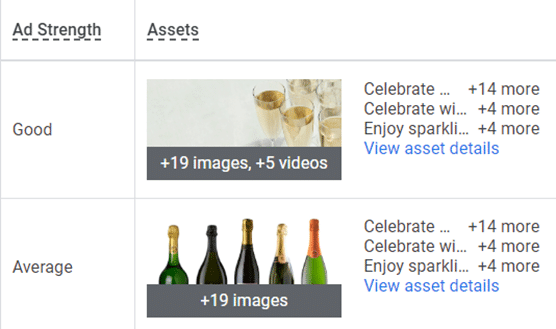
In the example below, both asset groups have identical assets except for the visual creatives. The only differences between the two groups are:
- The focus of the creative asset: The “Good” asset group focuses on scenes of the product, while the “Average” asset group focuses on actual product images.
- The types of creative assets: The “Good” asset group contains the maximum number of images and five videos, while the “Average” asset group contains the maximum number of images and no videos.
We tested this same asset group across all campaigns for over 30 days, using a scenic asset group versus a product image asset group.
In every case, the product image asset group featuring product bottles outperformed the scenic asset group every time, even though Google’s defined Ad Strength method implies that the scenic asset group will perform better.
The scenic asset group often garnered more clicks and a higher CTR, but it never generated revenue over that test period – only the product image asset group did.
While ad strength as a metric may appear to be helpful, use your actual conversion data from
Set your ROAS high, then go higher
If you set your ROAS goal at 200%, then you’ll get around 200%. But what if you set it higher?
One of Performance Max’s greatest strengths is its ability to maximize budget to achieve your desired ROAS. Push it to the maximum and use Performance Max for what it’s good at.
Check your outcomes in GA4 and Google Ads to see how the change impacts performance.
Beware of the cross-network default channel grouping
Performance Max campaigns appear as “cross-network” in GA4’s default channel groupings. Rolling all campaigns together under this aggregate grouping to evaluate performance can be tempting.
However, because Performance Max is AI-assisted, combining new campaigns with existing ones won’t provide the true clarity that individual campaign-level reporting will. Avoid the temptation to evaluate Performance Max on an aggregate level in GA4.
Courtesy of Search Engine Land: News & Info About SEO, PPC, SEM, Search Engines & Search Marketing