Archive for the ‘seo news’ Category
Monday, April 1st, 2024
Google is investigating an issue causing incomplete data in Ad Manager Reach reports.
Ad Manager Reach reports with dynamic date ranges like “Last week (Sun – Sat)” or “Last 93 days”, or fixed date ranges with start or end dates beyond March 20, 2024, will include incomplete reach reporting data for any Orders or Line items still actively delivering beyond March 20.
Why we care. Affected users are able to access Google Ad Manager but may not have access to the most recent data.
When will the problem be fixed? Google said it will provide an update at 5pm ET on April 1 with more information about this problem.
When did the issue start? Google confirmed that the incident began at 5.55pm ET on March 29.
What Google is saying. Google said in a statement:
- “The ‘Estimated Total Unique Visitors’ Reach report metric is unaffected by this issue and can be used as an interim workaround.”
- “This metric represents the total unique users, similar to ‘Total unique visitors’, but instead provides an estimate of unique visitors in order to report an estimated reach for as many rows as possible.”
Get the daily newsletter search marketers rely on.
Deep dive. Read Google’s announcement in full for more information.
Courtesy of Search Engine Land: News & Info About SEO, PPC, SEM, Search Engines & Search Marketing
Monday, April 1st, 2024
Perplexity, an AI-powered search engine, is planning to introduce native advertising in related questions, according to Adweek.
How it will work. Related questions, which include links to sources, account for 40% of Perplexity’s queries. So Perplexity plans to add relevant, related brand-sponsored questions along with organic questions.
Brand safety. It will be “a paramount priority,” Dmitry Shevelenko, Perplexity’s chief business officer, told Adweek.
When. Details are few. All we know is it is coming “in the upcoming quarters.”
Why we care. Perplexity, founded in August 2022, has a much smaller user base (a self-reported 15 million monthly active users) than the likes of Google, Microsoft Bing and AI rival ChatGPT. However, Google, OpenAI and other AI-powered search engines have yet to figure out how to reliably monetize AI search. So it will be interesting to see whether Google or other companies follow this path.
Perplexity vs. ads. On its About page, Perplexity says:
“Perplexity was founded on the belief that searching for information should be a straightforward, efficient experience, free from the influence of advertising-driven models.”
However, Shevelenko said:
- “Advertising was always part of how we’re going to build a great business.”
In a separate recent interview with Wired (subscription required), Perplexity founder and CEO Aravind Srinivas discussed ads, said he wasn’t against advertising. In fact, his vision for advertising on the platform is to help advertisers understand who is searching and then bid on the most “high-value traffic.”
- “Ads are not evil. When ads are done right it’s amazing, and generative AI is going to help us build even better targeting.”
This is a stark contrast from OpenAI CEO Sam Altman, who doesn’t love ads. He has even called internet advertising a “momentary industry.”
The report. Adweek’s Trishla Ostwal covered it in Gen-AI Search Engine Perplexity Has a Plan to Sell Ads.
Courtesy of Search Engine Land: News & Info About SEO, PPC, SEM, Search Engines & Search Marketing
Saturday, March 30th, 2024
Reddit Ads Manager has been updated to simplify the process of creating and tracking campaigns more efficiently.
The platform now offers six new automated features designed to provide advertisers with easy access to creative best practices.
Why we care. These updates offer advertisers simpler ways to build campaigns and receive creative support, which could be particularly beneficial for small and medium-sized businesses (SMBs) with limited resources.
Smart headlines. This new tool automatically generates a variety of ad copy headlines tailored to Reddit’s unique audience. To utilize it, advertisers only need to input their website URL.
Creative asset cropper. This new tool enables advertisers to crop images to fit Reddit’s ad format specifications, making the upload process simpler.
Lowest cost automated bidding strategy. This new tool is designed to help advertisers maximize campaign results within their budgets by automatically setting an ad cost amount. Initially used by advertisers focusing on Traffic and Simple Create, it’s now available for those with Conversions and Installs objectives.
Average daily budgets. This update automates advertisers’ daily budgets to align with their total spend for the week, reducing the need for manual adjustments to accommodate spending fluctuations.
Updated campaign management. Reddit has enhanced its duplication and bulk edit functionalities to now allow advertisers to duplicate existing campaigns, ad groups, or ads, and use them as a blueprint for new ones. Additionally, the bulk edit tool features a new user interface, facilitating faster edits and optimizations for campaigns.
Reporting improvements to Reddit Dashboard. Reddit has updated its Dashboard UI to enhance clarity for advertisers tracking their campaign performance in real time. The updates offer improved usability, new graphs displaying performance metrics, and additional report filtering options for customized tracking.
Get the daily newsletter search marketers rely on.
What Reddit is saying. Reddit’s EVP of Business Marketing and Growth, Jim Squires, said in a statement:
- “Every campaign on Reddit is unique, and we’re focused on serving our advertisers’ needs while providing best practices on creative, strategy, and campaign management,”
- “Through automation, our aim is to make it easy to create the best and most relevant ad experiences for advertisers and users alike. Smart Headlines, for example, is an intuitive tool that all Reddit advertisers can leverage to effectively connect with their audience.”
Courtesy of Search Engine Land: News & Info About SEO, PPC, SEM, Search Engines & Search Marketing
Saturday, March 30th, 2024
Facebook and Instagram advertisers filed a class-action lawsuit against Meta for $7 billion in San Francisco.
They claim that the social media giant exaggerated ad viewership figures by up to 400%, leading them to pay inflated premiums for ad placements on its platforms.
Potential Reach metric. The advertisers suing Meta allege that the Potential Reach metric used by the company to determine advertising costs relies on the total number of social media accounts rather than individual users. They argue that this approach is problematic because it could include bot and fake accounts, resulting in advertisers paying more money for their ads to be served to bots.
What Meta is saying. Meta denied the allegations, explaining that the price advertisers are charged is based on performance metrics – not the Potential Reach metric as claimed in the lawsuit. A Meta spokesperson told AdWeek:
- “These allegations are baseless, and we will defend ourselves vigorously.”
What the advertisers are saying. Geoffrey Graber, partner at Cohen Milstein and lead counsel representing the advertisers, said:
- “We look forward to continuing to litigate this case on behalf of Meta’s advertising customers and to presenting the evidence to a jury that Meta knew about its inflated Potential Reach and refused to fix the issue due to revenue concerns.”
Why we care. The lawsuit represents millions of advertisers who may have overpaid to serve their ads on Instagram and Facebook. Should this case proceed to trial, more affected advertisers could potentially come forward to claim compensation.
Legal details. Former Meta advertisers DZ Reserve and Cain Maxwell initiated the case in 2018. Following the filing of the complaint, DZ Reserve ceased operations with Meta and it is not know if Maxwell’s business is still operational.. Fast-forward to 2024 the 9th U.S. Circuit Court of Appeals in San Francisco ruled that the company could pursue legal action against Meta for monetary damages.
Next steps. The case will either go to trial or will be resolved through a settlement involving financial compensation for the plaintiffs.
Get the daily newsletter search marketers rely on.
Deep dive. Read the court documents in full for more information.
Courtesy of Search Engine Land: News & Info About SEO, PPC, SEM, Search Engines & Search Marketing
Friday, March 29th, 2024
Pinterest provided insights into how its algorithm works while warning of the risks of overreliance on user engagement. The platform emphasized that excessive reliance on engagement to rank content can result in a negative user experience, and proposed non-engagement signals as a solution.
To encourage other companies to follow suit and contribute to “building a more inspired Internet,” Pinterest published a new document titled ‘Field Guide to Non-Engagement Signals’.
Why we care. By having a better understanding of how Pinterest’s algorithm works, brands can identify what metrics they should prioritize in order to secure more visibility for their content.
What are non-engagement signals? Non-engagement signals are generated from two primary sources:
- In-app surveys: These give users have the opportunity to provide direct feedback about the platform. For instance, Pinterest may conduct surveys within the app to gather user insights.
- Independent assessments of content quality: This tends to be generated from manual labeling.
In addition to balancing engagement signals in content ranking, non-engagement signals enable Pinterest to align with its values. For example, Pinterest’s commitment to inclusivity is supported by non-engagement signals. When users specify preferences regarding body type, hair pattern, or skin tone in their feed, Pinterest can prioritize relevant content accordingly.
Field guide. Pinterest teamed up with UC Berkeley and the Integrity Institute to create the Field Guide to Non-Engagement Signals in a bid to help platforms create a better user experiences over time. Pinterest noted that the purpose of the guide is simply to help platforms make informed decisions when it comes to utilizing Non-Engagement Signals, as opposed to tell them what to do.
Key takeaways. The field guide, which is based on practical industry knowledge, offers several practical applications for product development, including:
- How to tune for emotional well-being.
- Using Generative AI to scale content quality signals.
- Improving user retention.
What Pinterest is saying. Leif Sigerson, Pinterest Sr. Data Scientist, and Wendy Matheny, Pinterest Sr. Lead Public Policy Manager, said in a blog post:
- “User engagement is a critical signal used by Pinterest and other online platforms to determine which content to show users. However, it is widely known that optimizing purely for user engagement can surface content that is low-quality (e.g., clickbait), or even harmful.”
- “Our CEO, Bill Ready, explained that if we’re not careful, content ranking can surface the ‘car crash we can’t look away from’, On the other hand, if you ask somebody after they saw the crash, ‘you want to see another one?’’ the vast majority of people will say ‘Goodness no’.”
- “Non-Engagement Signals are a critical component to ensure we don’t optimize for ‘the car crash we can’t look away from.’”
Get the daily newsletter search marketers rely on.
Deep dive. Read Pinterest’s blog in full or download a PDF copy of the field guide for more information.
Courtesy of Search Engine Land: News & Info About SEO, PPC, SEM, Search Engines & Search Marketing
Friday, March 29th, 2024
Google has not announced a date for when it will fully launch the Google Search Generative Experience (SGE). We know Google has begun testing SGE in the wild with a small subset of U.S. searchers, in fact, that seemed to have gone live today.
But Google has not yet announced when SGE and AI overviews will rollout to all searchers in the U.S. and other regions.
Google I/O on May 14. There are some rumors circulating that Google may launch SGE, at least in the U.S. and some other regions, on May 14, during the Google I/O keynote address while Google’s CEO Sundar Pichai is on stage.
I mean, it makes sense to launch SGE at I/O – it is Google’s largest and most notable event of the year.
But again, Google has not told me on or off the record that SGE will ever fully go live, let alone, that it would launch on a specific date. In fact, we had to squash some rumors about this before. Google did once have a deadline of December 2023, but Google removed that deadline and did not launch SGE.
How might SGE launch. If Google does launch SGE in the near future, I think it will be launched in a way that does not disrupt their search ads. I think that Google would launch AI overviews on search results that generally do not contain any ads.
In fact, Google has said the majority of queries people do each day do not show search ads. And generally, AI answers are better for longer tail queries that may not have ads anyway.
Google has to be concerned with how the SGE interface will impact clicks on search ads, its number one revenue-generating source. So if Google launched SGE but didn’t show them for search results with ads on them, that would solve that revenue problem.
Google also will likely try not to show AI overviews for queries that are political or generally sensitive in nature.
Right now, there are plenty of examples of where the AI answers in SGE just look really bad. It reminds me of when Google launched featured snippets, there were plenty of embarrassing examples to point out.
So if Google can figure out a way to limit AI overviews and not show them for those categories, Google can technically launch it.
Will users be able to opt out. Right now, SGE is a Labs experiment that you can toggle on and off to opt out. But now that SGE is being tested in the wild, those who are in that test group have no way to opt out.
I spotted complaints today, as Google just started rolling out the SGE live tests, where users want to opt out but cannot.
Why we care. Many in our industry are on edge about SGE launching. Those who buy ads in the Google search results are worried how it might impact clicks and conversions. Those who publish content are also worried how traffic from Google organic search might differ with the launch. And content producers are worried that Google will take their content, serve the answer to the searcher and not benefit with a single impression on their site.
Google has said that they continue to prioritize approaches that send valuable traffic to publishers. Google has also said they are showing more links to sites with SGE in Search than before, creating new opportunities for content to be discovered. But are searchers clicking on those links? We don’t know.
Stay tuned. We’ll let you know more about when SGE will launch, and where, and how, as soon as we know.
Courtesy of Search Engine Land: News & Info About SEO, PPC, SEM, Search Engines & Search Marketing
Friday, March 29th, 2024
Google has issued a correction from its previous statement in early February that Web Stories no longer showed in Google Image search results, that is not true. What is true is that Google stopped showing the Web Stories icon in the image search results.
Plus, Google Search Console had a reporting glitch with Web Stories in Google Image Search for the past two months.
Correction. Previously, Google wrote, “Web Stories don’t appear in Google Images anymore.”
Google posted a correction today saying, “Web Stories continue to appear in Google Images, just as other web content may appear, but Web Stories no longer appear with the Web Stories icon in Google Images.”
Search Console bug. Google Search Console had a bug during this same time period that did not show any clicks or impressions for Web Stories within Google Image Search. Google posted the bug details over here and wrote:
A logging error prevented Search Console from reporting on Web Stories in Google Images from August 28, 2023 until March 26, 2024. As a result, you may notice a decrease in clicks and impressions during this period for your Web Stories in the Search Console Performance report. This has been resolved and you may start to notice an increase in clicks and impressions, as the data returns to Search Console. This did not reflect a change in actual clicks or impressions, only an issue with data logging.
Why we care. For the past several weeks now we thought Google is no longer showing Web Stories within Google Image Search results. In fact, Search Console data did not report on impressions or clicks on Web Stories within Google Images. But this is not true, it was a miscommunication and now both have been corrected and clarified.
Courtesy of Search Engine Land: News & Info About SEO, PPC, SEM, Search Engines & Search Marketing
Friday, March 29th, 2024
Google is piloting new product discovery elements designed to give users a more personalized shopping experience, including:
- Style recommendations.
- Brand preferences.
- Generative AI for product search.
- Virtual try-on technology.
Why we care. These features offer businesses new opportunities to showcase their products and engage with high-value consumers who are likely to be more inclined to make purchases, thanks to a personalized shopping experience tailored to their specific preferences.
Style recommendations. Google is testing Style Recommendations, now accessible to signed-in U.S. shoppers via mobile browsers and the Google app, aiming to deliver more personalized results. For instance, when users search for specific apparel like shoes, they’ll come across the Style Recommendations section. Here, they can offer ratings with thumbs up or thumbs down, or simply swipe right or left to immediately access personalized results.
How it works. If shoppers aren’t satisfied with their personalized results or would prefer to continue browsing, Google offers the option to rate more items and immediately view another set of results. Additionally, the search engine will remember preferences for future searches. For example, when searching for men’s polo shirts again, you’ll receive personalized style recommendations based on your past preferences and interactions with products.
Managing style recommendations. If you’ve rated items incorrectly or would prefer to not see personalized shopping results, you can manage your preferences. To do this, just tap the three dots next to the “Get style recommendations” section and explore personalization options in the “About this result” panel.
Brand preferences. U.S. shoppers searching for apparel, shoes, or accessories on mobile browsers, desktop, or the Google app can now personalize their shopping experience by selecting preferred brands. Once chosen, options from these brands will appear instantly. To manage preferences, tap the three dots next to the “Popular from your favorite brands” section, and access personalization options in the “About this result” panel.
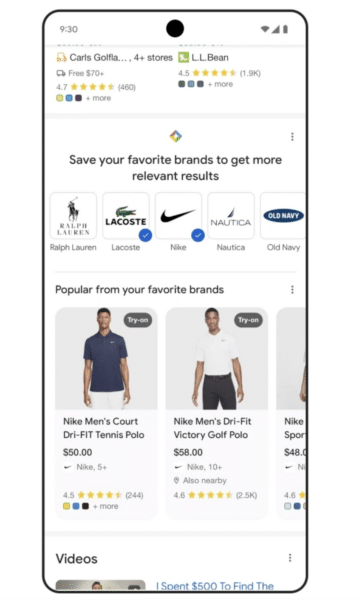
Image generation. Google is piloting an AI image generation tool for shopping, which is now available to all U.S. users who have opted into Search Generative Experience (SGE) within Search Labs. If you’re searching for a specific item, like a “colorful quilted spring jacket,” simply tap “Generate images” after your search to see photorealistic options matching your preferences. Once you find one you like, click on it to explore shoppable options conveniently.
Virtual try on. Additionally, Google is testing a virtual try-on tool in the U.S. on desktop, mobile and the Google app. When you see the “try-on” icon in shopping results, simply click on it, and you can see what the product looks like on a diverse set of real models ranging in size from XXS-4XL.
What Google is saying. Sean Scott, Google’s VP/GM Consumer Shopping, said:
- “People shop on Google more than a billion times a day. And thanks to the Shopping Graph, they see billions of products in their results that are constantly being refreshed. In fact, every hour, more than 2 billion listings are updated with the latest information, including pricing, in-stock availability and shipping details.”
- “So whether you’re looking for a specialty notepad from Japan, a monogrammed handbag from Paris or just a hammer from your local hardware store, the Shopping Graph can help you find it in just a few clicks. With that many options, we’re focused on making it easy to find exactly what you like.”
- “No two shoppers are alike, which is why we’re designing the shopping experience on Google so it’s tailored to you.”
Get the daily newsletter search marketers rely on.
Deep dive. Read Google’s announcement in full for more information.
Courtesy of Search Engine Land: News & Info About SEO, PPC, SEM, Search Engines & Search Marketing
Wednesday, March 27th, 2024
Google updated its definition of top ads in its Help Center to better reflect how ads can appear in Google Search
A spokesperson told Search Engine Land that this just a “definitional change” and that it would not affect how performance metrics are calculated.
What are top ads? Top ads are ads that appear above the organic result, and also below organic results for certain queries. As explaiend by Google:
- “When people search on Google, text ads can appear at different positions relative to organic search results. Top ads are adjacent to the top organic search results. Top ads are generally above the top organic results, although top ads may show below the top organic search results on certain queries. Placement of top ads is dynamic and may change based on the user’s search.”
Why now. Google changed its definition of top ads after testing ads between search results back in October. Patrick Stox, Ahrefs product advisor, technical SEO and brand ambassador, noticed sponsored posts were appearing where the third and fifth organic positions normally run and shared a screenshot on X:
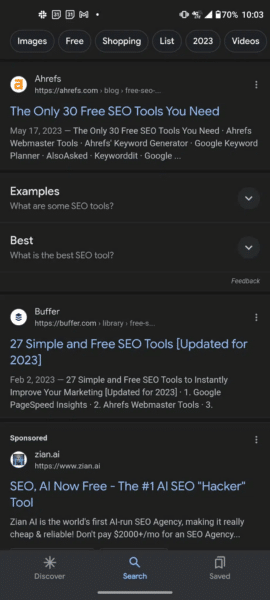
Why we care. This update could indicate that Google is progressing with its idea to insert ads between organic search results, as seen in trials last year. This change could potentially result in more clicks for advertisers in areas of Google Search that have traditionally been reserved for organic content.
Get the daily newsletter search marketers rely on.
Deep dive. Read Google’s top ads guide for more information.
Courtesy of Search Engine Land: News & Info About SEO, PPC, SEM, Search Engines & Search Marketing
Wednesday, March 27th, 2024
Amazon must now share details about the ads it serves in the European Union through a public library.
The retail giant is being forced to provide more transparency about its ad operations under the EU’s Digital Services Act (DSA) after losing an appeal in the Court of Justice of the EU (CJEU) for a temporary suspension.
Why we care. The creation of an Amazon ads library will offer marketers valuable insights into how the retail giant showcases and profits from campaigns. This will empower them to optimize their ads more effectively for better performance on the platform.
What is the Digital Markets Act (DMA)? The DMA is a piece of legislation introduced in 2022 designed to ensure that large online platforms, called “gatekeepers”, behave in a fair way online to create a fair and open environment for online businesses. Only six gatekeepers have obligations under the DMA:
- Alphabet (Google’s parent company).
- Apple.
- Meta.
- Amazon.
- Microsoft.
- ByteDance.
All six companies, none of which are based in the EU, were required to ensure they fully complied with DMA obligations and submit compliance reports by March 7.
DMA violation penalties. The consequences of non-compliance with the DMA includes:
- Fines: Up to 10% of the company’s total worldwide annual turnover, or up to 20% in the event of repeated infringements.
- Periodic penalty payments: Up to 5% of a company’s average daily turnover.
- Remedies: These can include behavioral and structural remedies, such as the divestiture of (parts of) a business.
Amazon contests DSA requirements. Amazon challenged the requirement to follow the ads transparency rule in the DSA in September last year. As a result, the EU General Court temporarily halted the ads library until the issue is resolved.
Decision reversal. This week, the CJEU overturned the decision to temporarily suspend Amazon’s requirement to comply with the ads transparency provision. The court ruled that Amazon must now adhere to publishing an ads library. While the court recognized Amazon’s concerns about compliance, they emphasized the importance of upholding the intentions of EU lawmakers in passing the law. Delaying compliance could undermine the objectives of the DSA, potentially for several years.
What the CJEU is saying. The CJEU said in a statement:
- “Suspension would lead to a delay, potentially for several years, in the full achievement of the objectives of the Regulation on a Single Market for Digital Services and therefore potentially allow an online environment threatening fundamental rights to persist or develop, whereas the EU legislature considered that very large platforms play an important role in that environment. “T
- “The interests defended by the EU legislature prevail, in the present case, over Amazon’s material interests, with the result that the balancing of interests weighs in favor of rejecting the request for suspension.”
What Amazon is saying. An Amazon spokesperson told Tech Crunch:
- “We are disappointed with this decision, and maintain that Amazon doesn’t fit the description of a ‘Very Large Online Platform’ (VLOP) under the DSA, and should not be designated as such.”
- “Customer safety is a top priority for us at Amazon, and we continue to work closely with the EC with regard to our obligations under the DSA.”
Get the daily newsletter search marketers rely on.
Deep dive. Read the CJEU’s statement on its decision in full for more information.
Courtesy of Search Engine Land: News & Info About SEO, PPC, SEM, Search Engines & Search Marketing