Archive for the ‘seo news’ Category
Monday, July 1st, 2024
Google Merchant Center will soon track conversion events beyond those attributed to clicks on Shopping free listings, including conversions from Search web results and other sources.
Why it matters. This change aims to provide merchants with more comprehensive performance data and optimize the Google shopping experience.
Key details:
- The update will roll out in the coming months.
- It expands conversion tracking to include all conversions from merchants’ websites.
- Google will use this data to optimize shopping search experiences and improve its products and services.
How it works. The expanded tracking will automatically apply to merchants using Google Merchant Center.
Opt-out options:
- Disable the conversion setting in Merchant Center
- Turn off the setting in the Google & YouTube channel app on Shopify
- Unlink Google Analytics and Merchant Center accounts
First seen. This update was first seen on Search Engine Land Contributor Menachem Ani’s X. He shared the email he got:

The big picture. This move reflects Google’s efforts to provide more comprehensive data to merchants while also improving its own shopping-related services.
What to watch. How this expanded data collection will impact merchants’ ability to optimize their listings and overall performance on Google’s platforms.
Courtesy of Search Engine Land: News & Info About SEO, PPC, SEM, Search Engines & Search Marketing
Monday, July 1st, 2024
Microsoft Advertising introduced Property Center, an evolution of Hotel Center, and made Lodging Campaigns globally available.
Why they matter. These new features aim to help property owners and managers attract more customers and increase bookings with simplified campaign management and expanded reach.
Key features:
- Property Center: A centralized hub for managing assets for Lodging Campaigns, including Hotel Price Ads and Property Promotion Ads.
- Lodging Campaigns: Now globally available, offering simplified campaign creation, enhanced reporting, and improved bidding and budgeting options.
How to get started:
- Review resources on Property Center in Microsoft’s help pages and API content.
- Sign in to your Microsoft Advertising account and access Property Center from the Tools tab.
- Contact Ad Support or your account team for assistance if needed.
The big picture. These updates are part of Microsoft Advertising’s ongoing efforts to expand its global presence and offer innovative solutions for the lodging industry, including the introduction of vacation rental offerings and Property Type Badge.
Courtesy of Search Engine Land: News & Info About SEO, PPC, SEM, Search Engines & Search Marketing
Monday, July 1st, 2024
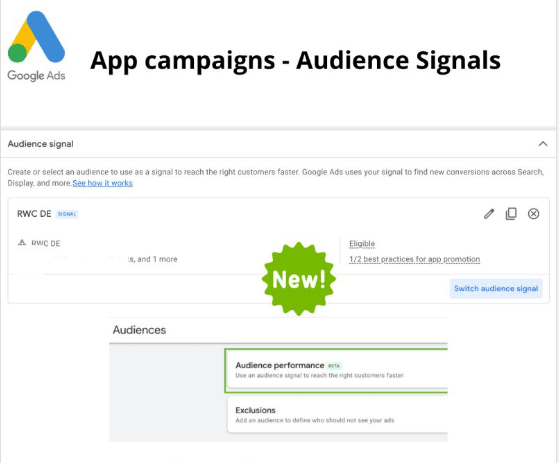
Google quietly expanded availability of Audience Signal Targeting for App campaigns, a feature previously only available for Performance Max campaigns.
While Google hasn’t made an official announcement, advertisers are reporting the ability to use Audience Signal Targeting in their App campaigns.
Why it matters. This update gives advertisers more control over their App campaign targeting, potentially improving campaign efficiency and performance.
Why we care. Audience Signal Targeting allows advertisers to reach more relevant users, potentially increasing app installs and engagement.
Key details.
- Before this update, App campaign targeting was fully automated.
- Advertisers could only exclude audiences, not target them directly.
- Now, advertisers can insert Audience Signals into their App campaigns.
First seen. This update was first spotted on Thomas Eccel’s LinkedIn:
Yes, but. Audience signal targeting can still be ignored by Google.

The big picture. This move aligns App campaigns more closely with Performance Max campaigns, suggesting Google is standardizing features across its automated campaign types.
Courtesy of Search Engine Land: News & Info About SEO, PPC, SEM, Search Engines & Search Marketing
Saturday, June 29th, 2024
Microsoft’s AI CEO Mustafa Suleyman believes most web content is “freeware’ that can be used for training AI models. The only exception: websites that explicitly opt out.
Freeware is any form of copyrighted software that can be freely downloaded, installed and used by end users.
The quote. Here’s what Suleyman told CNBC’s Andrew Ross Sorkin at the Aspen Ideas Festival:
- “…With respect to content that is already on the open web, the social contract of that content since the ’90s has been that it is fair use. Anyone can copy it, recreate with it, reproduce with it. That has been freeware, if you like. That’s been the understanding.
- “There’s a separate category where a website or a publisher or a news organization had explicitly said, ‘do not scrape or crawl me for any other reason than indexing me so that other people can find that content.’ That’s a gray area and I think that’s going to work its way through the courts.”
Fair use or theft? Fair uses allows for limited use of copyright material (e.g., criticism, teaching, research), but what AI models do goes beyond this. The companies behind the AI models clearly want to profit from this content.
Why we care. There is no such “social contract” that I’m aware of. Microsoft (and Google) simply believe that all online content should be available for AI training. Clearly, this benefits these large multinational corporations. The actual content producers? Not so much.
Zoom out. This controversial quote comes as Microsoft, OpenAI, Google and other companies face multiple legal challenges over copyright infringement. This is also why OpenAI is signing so many content licensing deals.
The video. CEO of Microsoft AI speaks about the future of artificial intelligence at Aspen Ideas Festival (CNBC)
Courtesy of Search Engine Land: News & Info About SEO, PPC, SEM, Search Engines & Search Marketing
Saturday, June 29th, 2024
Apple is set to extend its 30% fee on Facebook and Instagram ad purchases made through iOS devices to advertisers worldwide, starting July 1.
Why we care. This move could significantly impact digital advertising costs and strategies for businesses of all sizes, potentially altering marketing strategies and budget allocation toward mobile advertising.
The big picture. Initially implemented for U.S. advertisers in February, this expansion marks a major shift in how social media advertising is priced on mobile devices.
Details:
- The fee applies to ad purchases made via iOS apps but can be avoided by using desktop web browsers.
- Meta has updated its web platforms to offer the same ad-boosting functionality as mobile apps.
- EU regulators and a U.S. federal judge have criticized Apple’s fee structure.
What they’re saying. The fee is “anti-competitive” and gives Apple an unfair advantage, according to Meta’s Director of Privacy & Fairness Policy, Pedro Pavón.
The other side. Apple contends it’s entitled to charge for access to its platform’s audience.
Between the lines. This move is part of an ongoing battle between tech giants over app store policies and revenue sharing.
What’s next. Advertisers will need to adapt their ad purchasing strategies to avoid the fee, potentially shifting more activity to desktop platforms.
How to avoid the fee. Meta has provided guidance on purchasing ads without incurring Apple’s 30% charge.
The bottom line. This change could reshape mobile advertising practices and further intensify scrutiny of Apple’s App Store policies.
Courtesy of Search Engine Land: News & Info About SEO, PPC, SEM, Search Engines & Search Marketing
Friday, June 28th, 2024
Google Colab has been around since 2017 but has gained more popularity recently from SEO professionals sharing code samples.
SEOs love Colab because, unlike GitHub, you can actually run the code directly on the platform.
What is Google Colab?
Google Colab is a tool that allows users to quickly run Python directly on the platform with little to no setup. Google Colab is a hosted Jupyter Notebook that uses Google’s hosting services in the cloud.
In case you’re new to Python, a Jupyter Notebook is a free online tool you can use online to write code, solve math problems, make graphs and show your work. It’s like a digital notebook that helps you keep all of your project parts in one place and share them easily with others.
The best part about Google Colab? It’s free.
If you require more computing power, there is a tier pricing system. As of writing this, I pay $9.99 per month for the first paid tier. The next tier is $49.99 per month and then there’s a custom enterprise version.
Benefits of Google Colab
I’ve personally reaped the benefits of Google Colab for several years and am pleased to share what I’ve found to be its biggest benefits for SEOs.
Fast to start
If you’ve ever installed Python on your local machine, then you know firsthand how annoying it is to get Python set up. Also, if you’re trying a new bit of code, then you’re likely having to install new libraries to get your code to run.
The best part about Google Colab is that most common Python libraries are already installed on Google Colab. If something is missing, you can simply run:
!pip install new-library
The one nuance here is that you need the exclamation point before pip to install a new library.
Doesn’t use your computer’s bandwidth
I often use Python to compute large datasets, which can take quite a bit of time. I’ve run some bits of code that take hours to compute due to the size of the data.
In SEO, we often run crawls and other analyses in the background while we work. Have you ever run a Screaming Frog crawl that completely slows down your computer, making it nearly impossible to do other SEO tasks?
With Google Colab, you can seamlessly run compute-intensive code and work on other SEO tasks while the code runs.
Shareable
Google Colab is meant to be easily shared with collaborators or the world. As someone who believes in the power of open source, I believe that Google Colab is great for me to share code with the SEO community.
AI integration
Google has integrated Gemini directly into Google Colab. So, if you’re struggling to build a new feature in your code, you can leverage AI to help generate new code features.
I would urge caution when doing this, as you may find yourself debugging more than helping yourself.
Dig deeper: Can AI perform technical SEO analysis effectively?
Get the daily newsletter search marketers rely on.
How to use Google Colab
Let’s dive right into how to use Google Colab. I’ll run you through the eight most important features to get you right to coding for SEO.
How to run code
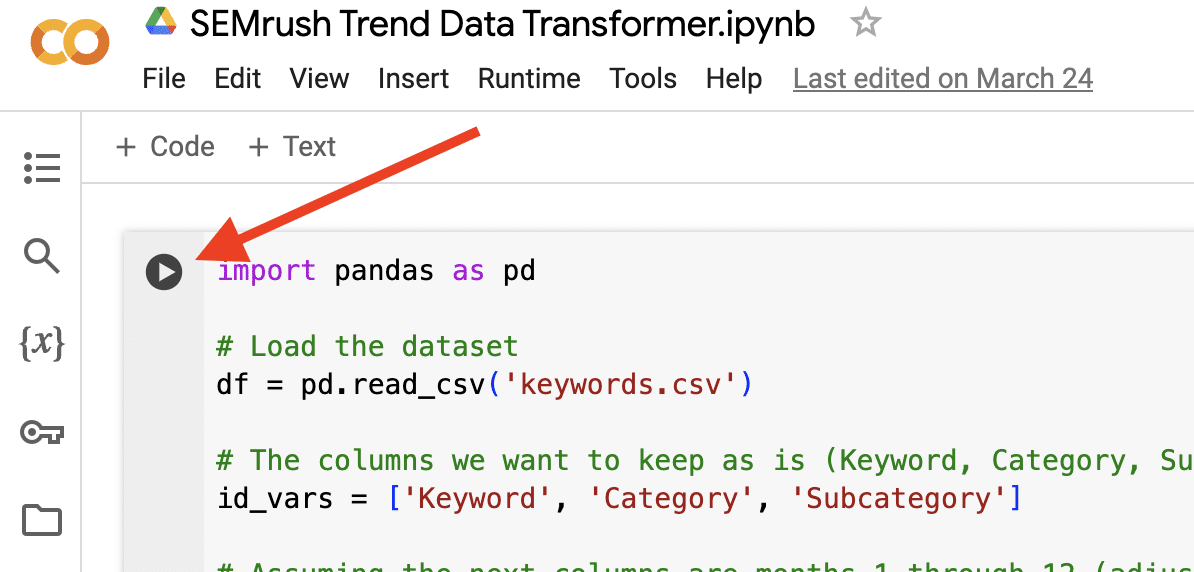
Probably the most simple step here is to know how to actually run the code.
Once you’re ready to run your code, click the play button.
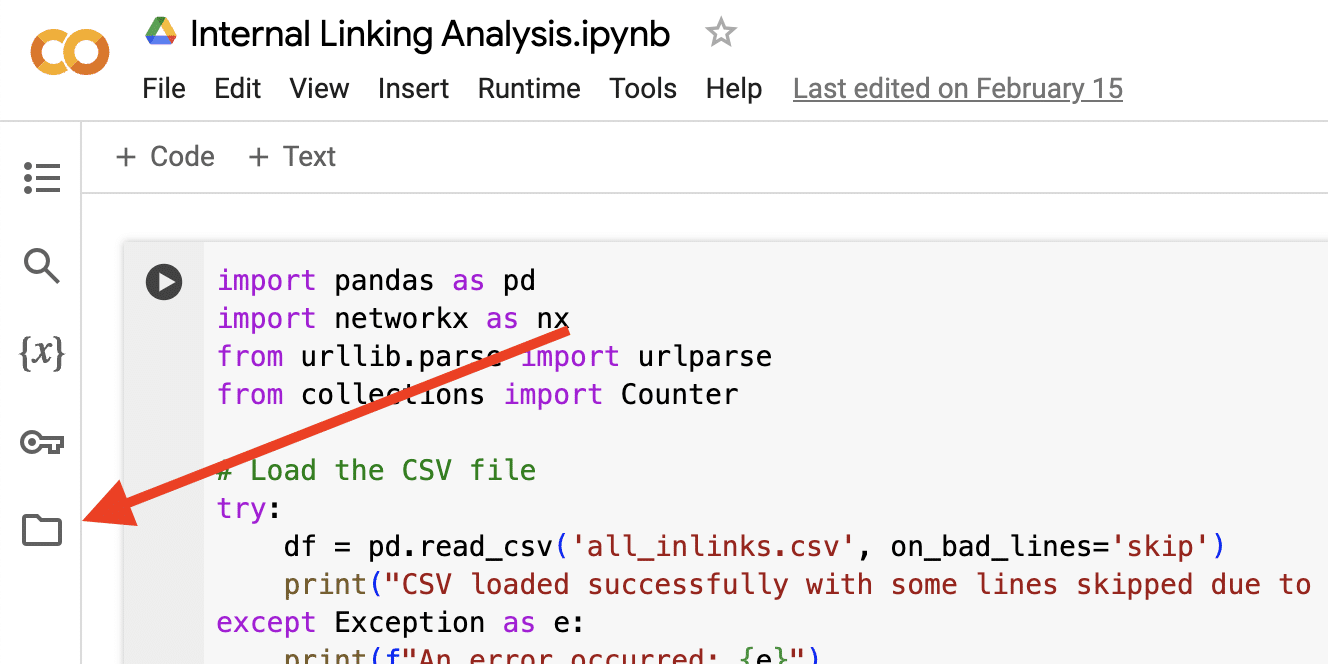
How to open the folder pane
To run code that relies on any source data or exports results into a file, you’ll need to be able to open the folder. Luckily, just like running code, this is just one button, specifically the one that looks like a folder.
How to connect to Google Drive
One of the great things about Google Colab is that it’s part of the Google suite of tools, allowing you to connect directly to files in Google Drive and even save your results to Google Drive.
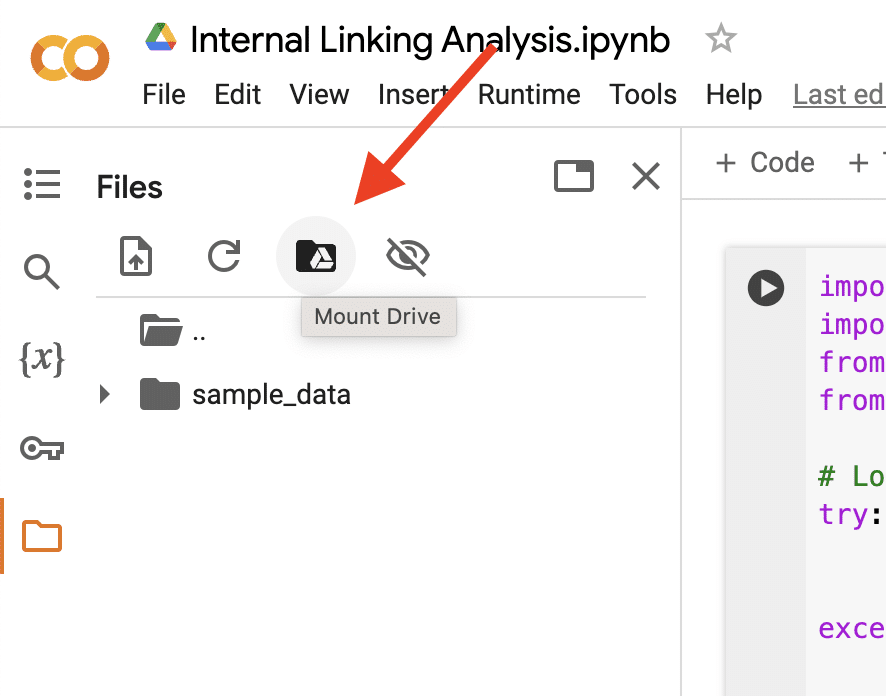
To connect to Google Drive, you first need to mount It by clicking the button shown in the screenshot below.
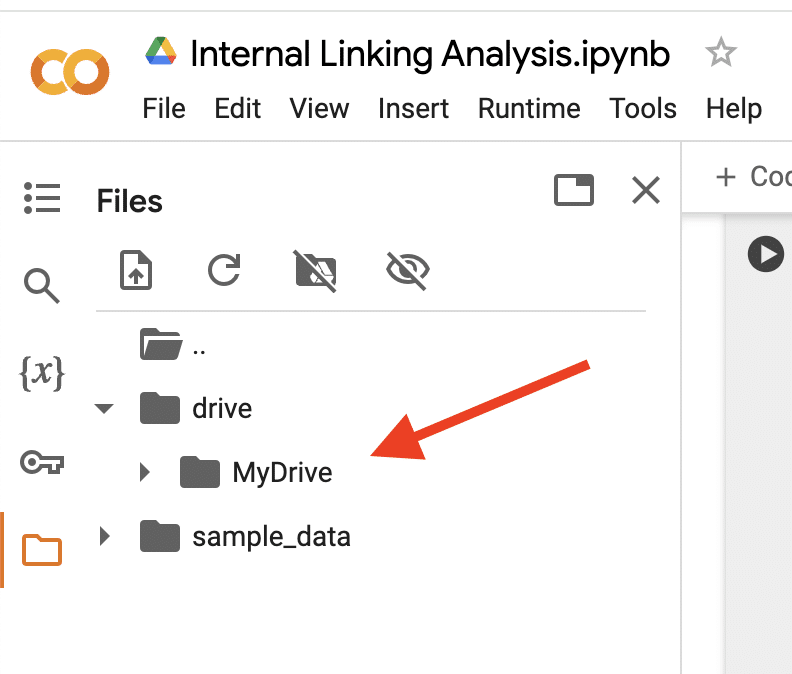
Once Colab finishes mounting Google Drive, your Google Drive folder will appear in the files pane.
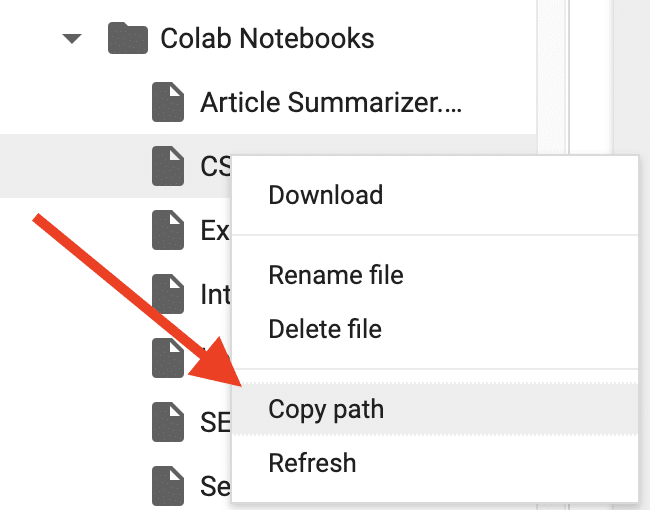
From here, you’re able to reference any of those files by right-clicking on the file, selecting a copy path and pasting it wherever you reference a file in your code.
How to upload files manually
Before uploading files, note that anything you upload will not be saved and will only be used as temporary files. Those files will disappear once you refresh the page or close it.
If you want the files to stay available, you’ll need to use Google Drive and connect to them that way (see previous steps).
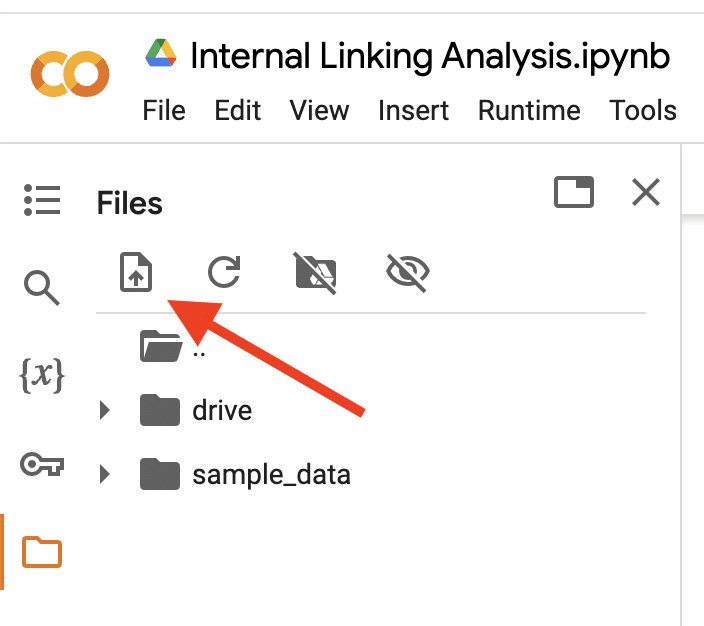
If you’re OK using files temporarily, then you have two options. You can drag and drop your files from your computer to the files pane or click the upload button.
How to create new files directly in Google Colab
Sometimes, I find it easier to create new files directly in Google Colab.
For example, if I have a bunch of keywords I want to analyze, it’s easier for me to copy them and paste them into a file in Colab rather than create a new file locally on my computer and upload it.
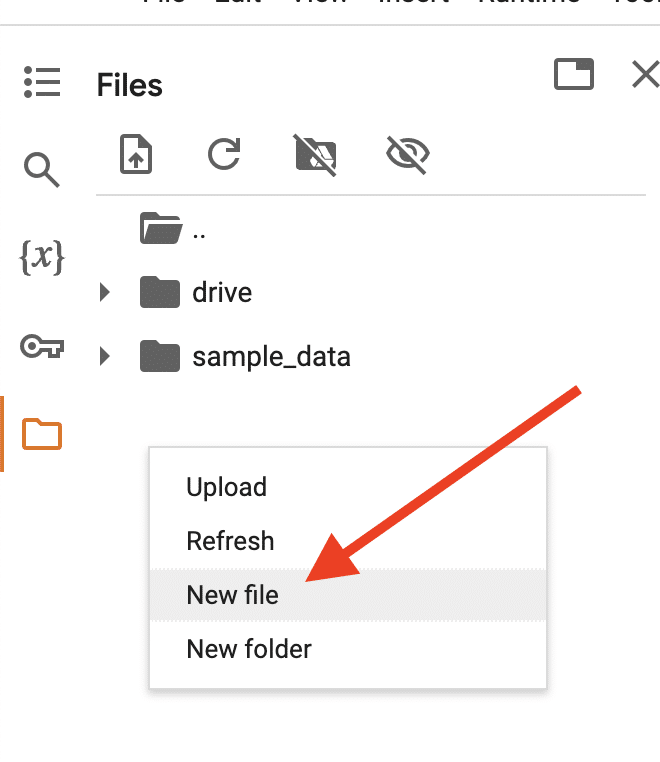
To do this, just right-click on a blank space in the files pane and click New File. From there, you can name it whatever you want, and paste your data and then save it with your hotkeys (Command + S or Control + S).
How to download results
Once you’ve run the code, you may have an exported file created in the process.
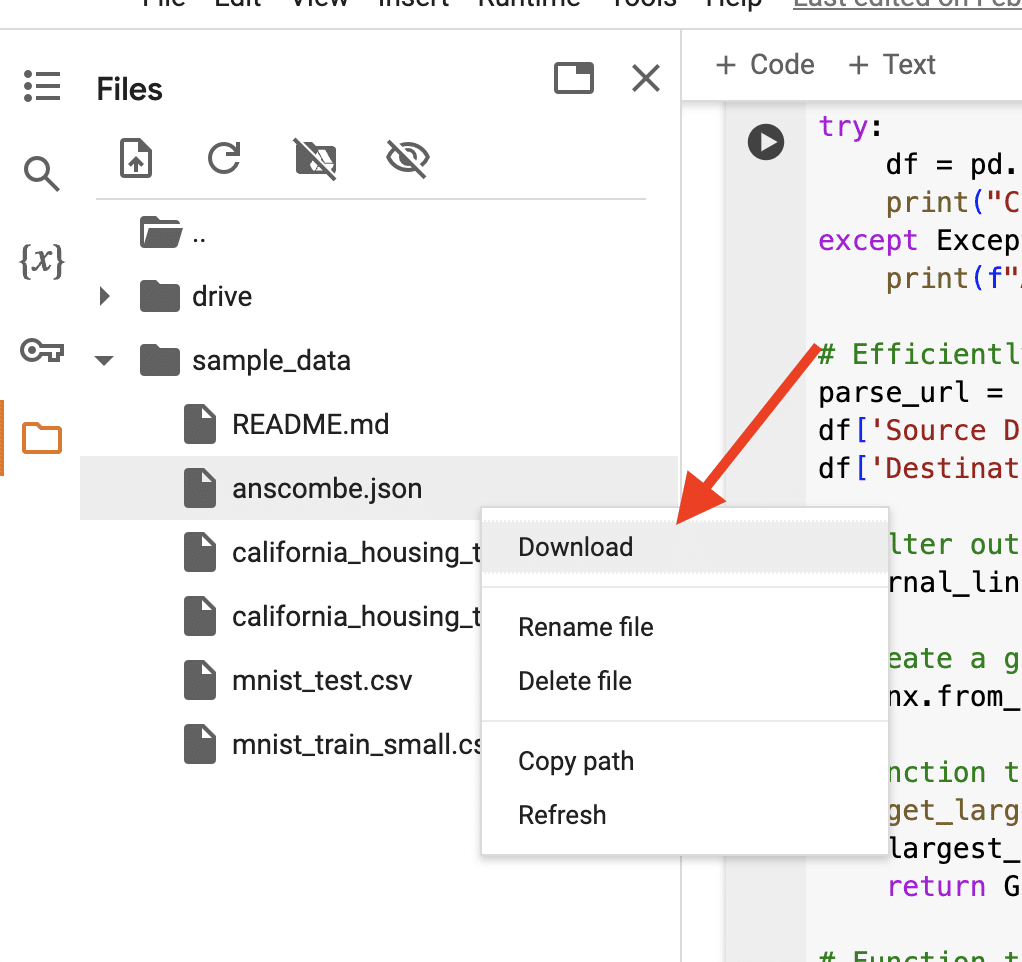
You can preview the file by double-clicking on it, but if you want to download it, all you need to do is right-click on it and select Download.
How to connect to a runtime
If you’re running code that may take a more heavy compute load, you may want to experiment with a faster runtime.
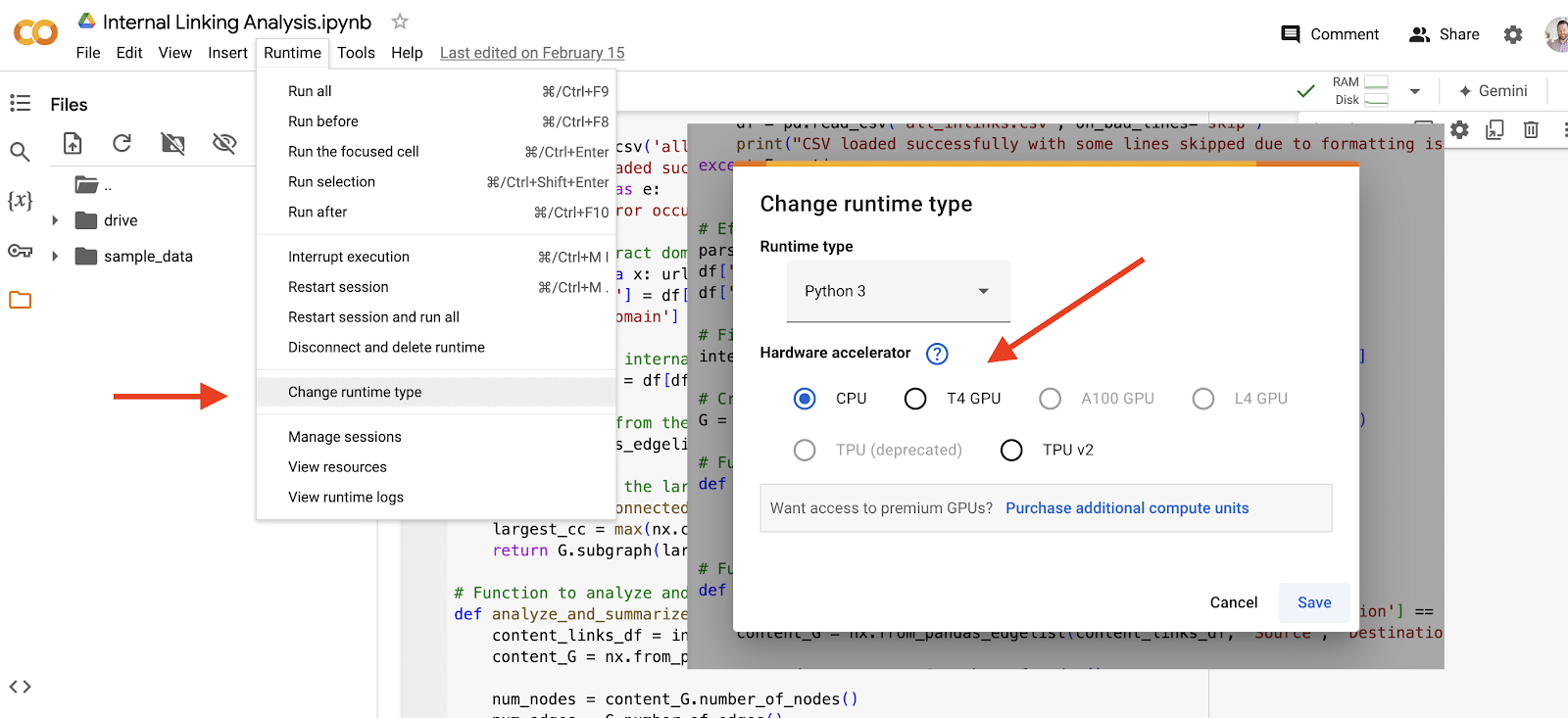
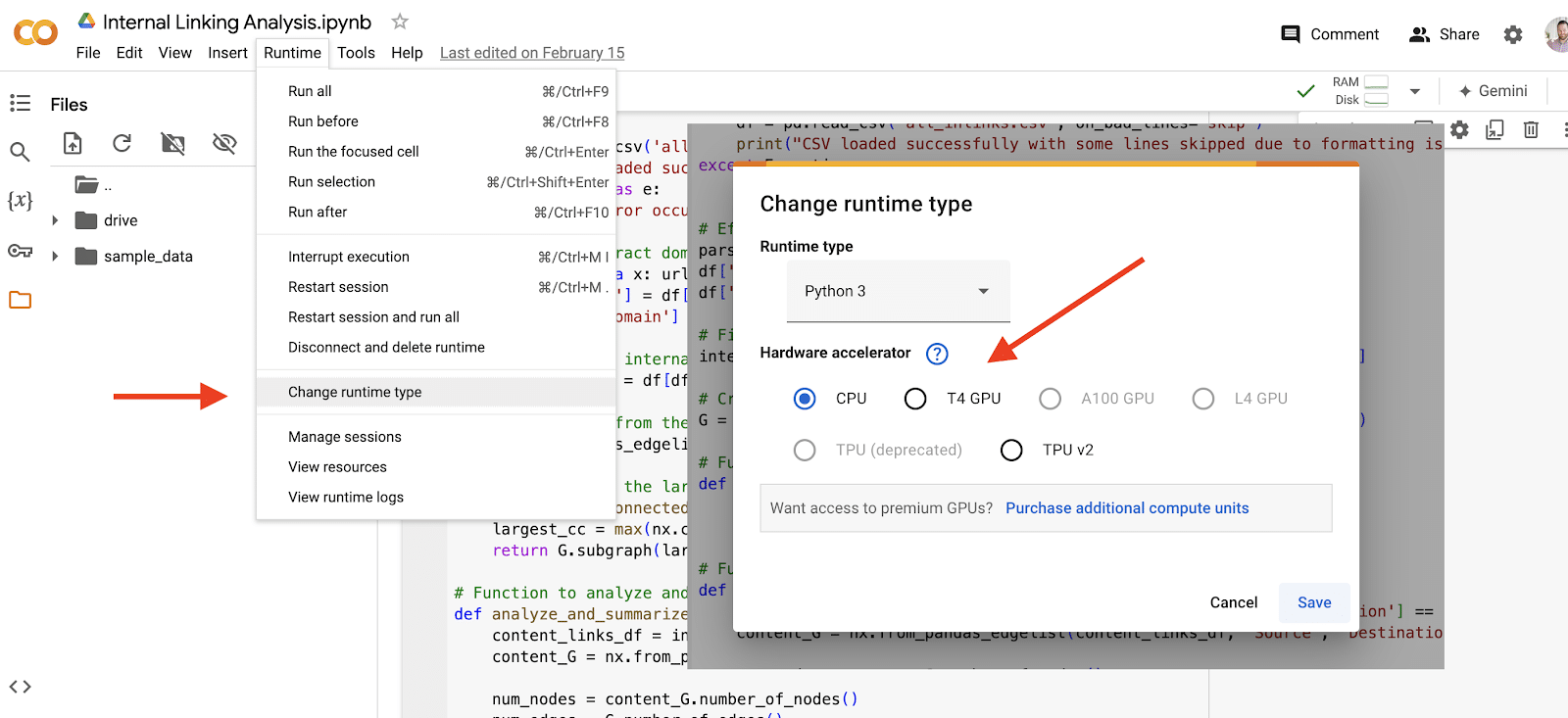
To do this, select Runtime in the top menu and then in the dropdown, select Change runtime type.
From there, you’ll see some options that you can change.
Please note that if you’re going to change the runtime, any files in the file pane will disappear.
How to use the AI integration
One of the latest features in Google Colab is the integration of Gemini. Google has made it easy to take advantage of this new feature by adding a Gemini button in the top right of the screen.
By clicking that, a sidebar will appear for you to ask it prompts.
Free code to get you started
Now that you’ve taken the crash course to getting started with Google Colab, it’s time to try some code!
In one of my previous articles, I’ve provided five Python scripts for SEO that you can try right now in Google Colab.
In that article, you will be able to see the context of the scripts, how to set them up and I provide the actual code for you to try.
It’s never been easier to get started in Python for SEO. Happy coding!
Courtesy of Search Engine Land: News & Info About SEO, PPC, SEM, Search Engines & Search Marketing
Friday, June 28th, 2024
Businesses can easily neglect the optimization of organic traffic. This happens because stakeholders often don’t understand how it works or its impact on company goals.
Continue reading and learn how to translate SEO concepts into business terms so you can onboard your business partners and secure their buy-in for organic projects.
Improving customer experience
Customer experience is one of those aspects of the business that almost all leaders agree is super important. And it can’t be different when 52% of customers say they will switch to a competitor after a single negative impression.
But which SEO factors have an impact on it?
1. Broken pages and redirects
Broken pages (like 404 or 500 errors) and implementing redirects are usually business priorities. This is because stakeholders are also online users who likely encounter these issues and understand the frustration they cause.
Cleaning up redirects, however, is another story. Users don’t see the change, but as SEOs, we know that excessive redirects can hurt a website’s performance.
Redirects consume search engines’ crawl budget, dilute page authority and negatively impact speed performance. But how do you explain this in business terms?
One of the easiest ways to explain this is with everyday examples, which people can easily relate to and probably have experienced.
In the 301 case, imagine you have a shopping list, but when you arrive at your local grocery store, you find the store has moved, adding 20 extra minutes to your shopping trip. Even though you’re “redirected” to the new location, you’re frustrated by the extra step.
The same happens with search engine bots when they encounter redirects. Too many redirects can frustrate them, leading to a potential negative impact on your site’s ranking. Similar to a negative customer review.
We all know the impact of negative reviews – the next potential customer will see them, and it may influence their decision to buy from you.
2. On-page SEO
The concept of optimizing individual webpages to rank higher and earn more relevant traffic is a key one in SEO. It is very similar to merchandising practices in the offline world, and its goal is to keep users and bots engaged with your content.
The higher the engagement, the lower the bounce rate, which can improve your rankings (or at least we have a strong reason to believe this after the recent Google documentation leak).
Keeping users engaged increases the time spent on the page and the visibility of important elements like CTAs.
This is similar to how supermarkets place essential items like bread at the back so customers can see other products as they navigate the store, enhancing product visibility.
Just as customers might end up with a basket of unplanned items in a supermarket, good on-page optimization can lead to increased leads and a healthier sales pipeline.
3. Page speed
Page speed is another important factor for SEO and overall user experience.
Slow-loading pages can lead to higher bounce rates, as users are likelier to abandon a site that takes too long to load. We all know how frustrating it is to see how the images load or to need to wait too long to be able to click or scroll.
It is the same as when you walk into a coffee shop for a quick morning coffee on a street full of coffee shops. If your order takes too long, you will probably go elsewhere the next time.
The same principle applies to your website. Just as efficient service in a coffee shop enhances customer experience, a fast-loading website ensures that visitors stay engaged and are more likely to return. And search engine bots are like picky customers who won’t tolerate slow service.
Optimizing your website for a good page speed can increase the loyalty from both humans and bots and can likely lead to higher rankings and sales.
Get the daily newsletter search marketers rely on.
Enhancing lead quality and conversion rates
Good customer experience is not the only factor in having a successful business.
You need to make sure that you attract the right customers – the ones with the highest chance to buy from you and that you give them enough reasons to do so.
On the online front, you have a couple of SEO allies to help you in this effort.
4. Meta titles and descriptions
By the clothes, they greet by the mind they send. This proverb is also true in the search engine world.
Making a strong first impression online is as vital as in any business setting and your meta title and description are the key players here. They are crucial for how bots and users perceive your webpages.
The title tag is the first thing users see and serves as your digital business card. It should be concise and clear and immediately convey your page’s value. The meta description is your elevator pitch. It offers a brief summary that should give users a reason to click on your result.
Just as a good introduction can lead to business engagements, well-crafted meta titles and descriptions enhance click-through rates and improve search engine visibility.
They also ensure that potential customers see the best of what you offer at first glance – the same as a very well-designed and decorated shop window.
Better meta tags can improve the conversion rate of leads entering the sales pipeline, as they set the right expectations. In some B2C businesses, where purchase decisions are quicker and emotionally driven, effective meta titles and descriptions can also increase the number of closed deals.
But good meta titles and descriptions can’t be created without preliminary research.
5. Topic research and content strategy
Understanding market trends and customer needs is crucial for any company and usually starts with deep-dive groundwork.
For example, when you plan to launch a new product or service, you have a preliminary discovery phase. Its goal is to clarify the details around your offer and launch something that has a good chance of being bought by your customers.
The same approach applies to your online presence, but instead of market research, you conduct topic and keyword research before creating your content strategy.
You can create relevant content that meets its needs by understanding what your audience searches for.
Effective topic and keyword research improves traffic quality, increases conversion rates and MQLs and nurtures leads through the sales funnel.
6. Structured data
Structured data is another powerful SEO tool that can enhance lead quality and conversion rates. These pieces of code are not directly visible to users, but they provide search engines with clear, specific information about your website’s content. They are like nutritional labels on food packaging.
Structured data enables search engines to display richer and more relevant search results, including enhanced snippets, product details, review stars and other elements that make your results more attractive to users. This leads to higher click-through rates and potentially higher conversation rates.
Building brand reputation
Improving lead quality and customer experience is crucial for businesses’ everyday survival. But to set the stage for long-term success, you need to invest also in building your brand reputation.
The reason is simple: the purchasing decisions of 63% of consumers are impacted by the company’s reputation, according to Qualtrics.
7. Internal and external links
Creating unique connections through internal and external links is essential for a website’s SEO. Internal links structure information and help users and search engines navigate through it.
The concept is similar to 360-degree reviews and how they help managers and company leadership decide which employees deserve promotion because you can’t promote everyone.
The same is true for Google and other search engines. Their mission is to organize the world’s information and display the best results on top. This won’t be very useful if you see 1 trillion results on page 1.
External links, on the other hand, signal the credibility of your website. They act like professional endorsements, similar to positive customer reviews or media mentions that validate your business’s stability.
External links build a positive image, making your site appear trustworthy, leading to growth opportunities, enhanced brand reputation, higher deal sizes and a stronger sales pipeline.
8. Anchor texts
Another element that has an impact on the website’s trustworthiness is the anchor texts. They are the clickable words in a hyperlink and serve as the invisible handshake between your content and the users. They are very similar to a good introduction at a networking event.
Just as a handshake can set the tone for a business relationship, well-chosen anchor texts guide users and search engine bots to understand the context of your linked content. They should be clear and descriptive so they can ensure a smooth transition to the linked page.
Targeted use of anchor texts can boost the relevance of your pages for concrete terms and serve as authority factors on a webpage level. They set the right expectations for the linked pages and naturally build trust with your users.
Simplifying SEO speak for business stakeholders
SEO is often seen as a mysterious process done by experts rambling about Google’s algorithms. Business stakeholders may view it as a black box where money is spent without clear results.
Explaining SEO concepts in business terms is crucial for website optimization success. This helps stakeholders see SEO’s impact on growth and success, leading to more support and resources for SEO efforts.
Courtesy of Search Engine Land: News & Info About SEO, PPC, SEM, Search Engines & Search Marketing
Friday, June 28th, 2024
PPC advertising can be challenging, especially when your product or service falls into a sensitive or difficult category.
Whether you’re promoting pharmaceuticals, financial services, adult content or other regulated industries, advertising – especially on Google Ads – requires a balance of creativity, compliance and ethical consideration.
Google Ads remains one of the most powerful platforms for reaching potential customers. However, with great power comes great responsibility.
Advertisers in sensitive categories face unique hurdles, including:
- Strict policy restrictions.
- Heightened scrutiny.
- The constant risk of ad disapprovals or account suspensions.
Seasoned marketers might be frustrated by frequent suspensions, but these policies are in place to maintain a safer advertising platform.
Recent Google Ads data shows the extent of this effort. In 2023, they blocked or removed 5.5 billion ads and suspended 12.7 million advertiser accounts, nearly doubling their enforcement actions from the previous year. However, many businesses suffer from incorrect suspensions and misclassified compliance cases due to automated reviews.
This article aims to guide you through the advertising of sensitive categories on Google Ads. We’ll explore strategies to effectively promote your products or services while adhering to Google’s policies and maintaining high ethical standards.
Understand Google Ads policies
Google’s comprehensive policies ensure a safe and positive experience for users, advertisers and publishers. Knowing these policies is the first step to successful advertising in challenging niches.
Google Ads policies on sensitive categories
Google Ads policies are designed to protect users from harmful, deceptive or inappropriate content.
For sensitive categories, these policies are often more stringent and specific. They cover various aspects of advertising, including ad content, targeting and landing pages.
Key policy areas for sensitive categories often include:
- Restricted content: Products or services that can be advertised but with limitations.
- Prohibited content: Products or services that cannot be advertised at all.
- Editorial and technical requirements: Specific guidelines for ad copy, imagery and website content.
Commonly restricted and prohibited content
While the full list is extensive, some common examples of restricted or prohibited content include:
- Pharmaceuticals and healthcare products.
- Financial services (e.g., loans, cryptocurrencies).
- Gambling and games of chance.
- Adult content and services.
- Weapons and explosives.
- Alcohol and tobacco products.
- Political content.
Each category has its own set of rules. For instance:
- Pharmaceutical advertisers must be certified by Google and can only promote in certain countries.
- Financial services advertisers often need specific licenses and must provide additional disclosures.
The list of restricted categories is not exhaustive, as many subcategories and industries have unexpected policies.
For example, in the IT service industry, working on IT hardware may be prohibited unless you are a certified partner, which can be problematic for many computer repair shops or IT freelancers who lack certification from major manufacturers.
Why you must stay updated with policy changes
To stay compliant and effective in sensitive advertising categories on Google Ads, it’s essential to proactively monitor and adapt to policy changes.
Regularly review Google’s advertising policies, subscribe to their official policy updates and engage with industry forums or groups to gain insights on policy interpretations.
If you have a Google Ads representative, maintain open communication with them to escalate issues quickly.
Remember, policy violations can lead to ad disapprovals, account suspensions or even permanent bans. Staying informed and compliant is not just about avoiding penalties – it’s about building a sustainable, long-term advertising strategy on the platform.
Conduct thorough research
Thorough research is a must before launching your Google Ads campaign in a sensitive category. This groundwork will help you navigate policy restrictions, understand your audience and develop effective strategies within the given constraints.
Identify the specific restrictions for your category
When diving into Google Ads for sensitive categories, it’s crucial to go beyond just skimming the general guidelines. Dig into the specific policies that apply to your industry.
You’ll want to look out for any special requirements, like certifications or pre-approvals, that Google might need before you can run your ads.
Don’t forget to check for any geographical restrictions on where you can advertise. This can be a big deal, depending on your product or service.
Next, try to get a feel for how Google interprets and enforces these policies in real-world situations.
Take a look at the enforcement examples they provide and spend some time browsing industry forums to see what experiences other advertisers have had.
If you’re lucky enough to have a Google Ads rep, pick their brain for insights. They can be a goldmine of information.
Finally, don’t overlook the legal side of things. Make sure you’re up to speed on the laws and regulations in the markets you’re targeting.
Your ads and landing pages need to meet Google’s policies and adhere to the law.
It might seem like a lot of work upfront, but trust me, it’s way better than dealing with account suspensions or legal headaches down the road.
Understand the target audience and their needs
When you’re navigating the tricky waters of advertising in sensitive categories, understanding your audience becomes absolutely crucial.
Here’s the thing: with limited reach due to stricter policies and restrictions, every single interaction with a potential customer carries much more weight.
You can’t afford to cast a wide net and hope for the best. You need to make every impression count.
That’s why it’s important to dive deep into your target audience’s psyche. Crafting detailed buyer personas isn’t just a nice-to-have; it’s essential.
You need to understand not just surface-level demographics but also your potential customers’ underlying motivations, concerns and online behaviors.
What specific pain points are they grappling with? How do they search for solutions?
These insights can help you create hyper-targeted ads that resonate on a personal level. Also, make sure to get the full picture of your target audience’s search behavior.
In sensitive categories, your audience might not be using the most obvious keywords but also a mix of alternatives, synonyms or abbreviations used in the industry.
Don’t underestimate the power of direct feedback, either. Surveys and interviews with your target audience can provide golden nuggets of information that might not be apparent from broader data analysis.
These firsthand insights can help you fine-tune your messaging to address specific concerns or highlight benefits that truly matter to your audience.
Lastly, mine your existing customer data relentlessly. Those customer service logs, reviews and FAQs are treasure troves of information. They reveal the real questions and concerns your audience has, allowing you to craft ads that speak directly to these issues.
Analyze competitors and their strategies within the constraints
Instead of fixating on copying what’s currently visible, focus on understanding the broader landscape.
Look at businesses offering similar products or services, but also consider alternative solutions that might be competing for your audience’s attention. This gives you a more comprehensive view of the market.
When analyzing competitor ads and landing pages, look for patterns in messaging and structure rather than specific tactics.
How are they communicating value while navigating policy restrictions? What themes seem to be consistent across multiple competitors?
This approach helps you understand the industry’s general direction without getting hung up on potentially non-compliant examples.
While it’s tempting to emulate competitors who seem to be pushing boundaries, always prioritize compliance.
If you notice competitors potentially breaking rules, use that as a reminder to double-check your own practices rather than as inspiration to follow suit.
Your goal should be to find ethical, compliant ways to stand out in a tightly regulated space.
Craft compliant ad content
Creating effective ad content for sensitive categories requires a delicate balance between compelling messaging and policy compliance.
Tips for writing ad copy that complies with Google Ads policies
When crafting ads for sensitive categories, navigating the fine line between effective marketing and policy compliance is crucial.
Familiarize yourself with prohibited terms in your industry and create a list of approved alternatives. Focus on highlighting factual, verifiable benefits without resorting to superlatives or unsupported claims.
Transparency is key. Be clear about your offering and include necessary disclaimers directly in your ad copy.
Maintain a professional tone throughout your messaging, avoiding sensationalism and using industry-appropriate terminology. This approach aligns with the seriousness of sensitive categories and helps build trust with your audience.
Make smart use of ad extensions to provide additional, compliant information. Sitelinks can offer more context, callouts can highlight key features or certifications and structured snippets can showcase your product categories or services.
Selecting appropriate visuals and media content
When creating visual content for sensitive category ads, aim to balance attractiveness with policy compliance.
Thoroughly review Google’s image policies for your specific niche, avoiding anything graphic or overly sensational. Always ensure you have proper consent to feature individuals in your visuals.
Focus on high-quality, relevant imagery that accurately represents your product or service. Consider using lifestyle images to provide context, but make sure they remain professional and appealing.
Don’t forget to incorporate necessary disclaimers or warnings directly into your visual content, ensuring they’re clearly legible.
When exploring different ad formats, such as responsive display ads or video content, proceed with caution. Every element must adhere to platform policies, from the opening frame to the closing shot.
Finally, leverage A/B testing to optimize your visual strategy. Create multiple versions of your ads with different images, then monitor their performance to identify what resonates best with your audience while maintaining strict compliance.
This data-driven approach allows you to refine your visual content strategy over time, maximizing impact within the bounds of platform regulations.
Examples of compliant ad content in sensitive categories:
- Pharmaceutical ad
- Instead of: “Miracle cure for all your ailments!”
- Try: “FDA-approved medication. May help manage [specific condition]. Consult your doctor.”
- Financial services ad
- Instead of: “Guaranteed approval for high-interest loans!”
- Try: “Personal loans available. Rates from X.XX% APR. Terms apply.”
- Adult content ad
- Instead of explicit imagery or text.
- Try: “Adult entertainment. Age-verified. Secure, discreet service.”
Get the daily newsletter search marketers rely on.
Design effective landing pages
Ensuring landing pages meet Google’s policy requirements
When it comes to landing pages for sensitive category ads, transparency and compliance are paramount.
Include comprehensive, accurate details about your product or service, with all the necessary disclaimers, terms and conditions.
Don’t shy away from clearly stating any limitations, risks or potential side effects associated with your offering. This upfront honesty builds trust with potential customers and helps you stay on the right side of advertising policies.
Make sure your business information is easily accessible. Display your company name, physical address and contact details prominently. Include clear links to your privacy policy and terms of service, typically in the footer.
For certain industries, consider adding a visible customer support phone number to further enhance credibility and meet specific policy requirements.
Pricing and billing information should be crystal clear. Display all costs upfront, including any recurring charges or additional fees. Explain your billing process in simple terms.
Avoid any hint of hidden charges or misleading pricing structures. These are quick ways to violate platform policies and consumer trust.
Lastly, pay close attention to industry-specific requirements. If you’re in financial services, include necessary licensing information and disclaimers.
For pharmaceuticals, ensure all claims are approved and include required warnings. Adult content requires robust age verification systems.
Dig deeper: PPC landing pages: How to craft a winning post-click experience
Provide high-quality, relevant content that aligns with the ad
When crafting landing pages for sensitive category ads, focus on creating a seamless, trustworthy experience.
Ensure your page content aligns perfectly with your ad claims, maintaining consistency in language and tone.
Provide comprehensive, valuable information about your offering, including FAQs and policy-compliant testimonials if possible.
Use clear, concise language throughout, avoiding jargon unless necessary. Organize content logically with headers and bullet points for easy digestion.
Incorporate trust signals like relevant certifications, security badges and reputable reviews to build credibility.
Leverage advanced targeting options
When advertising in sensitive categories, precise targeting becomes even more crucial. It helps ensure your ads reach the right audience while minimizing the risk of policy violations. Here’s how to leverage advanced targeting options effectively:
Utilize demographic and geographic targeting to reach the right audience
Set appropriate age restrictions based on your product and policy requirements to optimize targeting, ensuring adult content targets users 18 or older.
Use gender targeting for gender-specific products but avoid unfair discrimination. Employ geographic targeting to comply with regional regulations and exclude prohibited locations.
For financial or luxury products, target by income level to reach interested users while adhering to fair lending laws. Utilize parental status targeting for family-oriented products, ensuring content suitability and compliance.
Employ remarketing strategies to engage previous visitors
- Website visitor remarketing
- Create lists based on specific page visits to target users who’ve shown interest.
- Exclude converters to avoid unnecessary ad spend.
- Customer match
- Upload customer email lists to re-engage past customers.
- Ensure you have proper consent to use customer data for advertising.
- Similar audiences
- Use this feature to find new users similar to your existing customers.
- Be cautious with sensitive categories to avoid targeting inappropriate audiences.
- Dynamic remarketing
- Show ads featuring products or services users have viewed on your site.
- Ensure all product images and descriptions comply with policies.
- Remarketing lists for search ads (RLSA)
- Adjust bids for past visitors when they search for relevant keywords.
- Use this to bid more aggressively on high-intent searchers.
Dig deeper: How to combine Google Ads with other channels to retarget, nurture and convert
Use custom intent audiences to target users based on their search behavior
- In-market audiences
- Target users actively researching or considering products/services in your category.
- Be selective with in-market categories to ensure relevance and compliance.
- Custom intent audiences
- Create audiences based on keywords, URLs and apps your ideal customer might search for or use.
- Focus on intent signals that indicate genuine interest without crossing policy lines.
- Affinity audiences
- Target users based on their long-term interests and habits.
- Choose affinities that align with your offering while respecting privacy concerns.
- Life events targeting
- For relevant products/services, target users going through specific life changes.
- Ensure your messaging is sensitive and compliant when using this option.
Tips for compliant and effective targeting in sensitive categories
To optimize ad targeting, use layered targeting to combine multiple methods for specific audience segments, ensuring ads reach the most appropriate users.
Implement exclusions with negative keywords and audience lists to avoid inappropriate contexts, regularly updating them.
Use contextual targeting in display campaigns to ensure ads appear in relevant, brand-safe environments. Apply frequency capping to limit ad exposure and prevent fatigue.
Schedule ads based on the time and day when your audience is most receptive. Regularly review and optimize targeting performance, staying alert to any policy or regulatory changes that might impact your strategy.
Spammy advertising methods to steer clear of
Black hat marketers use deceptive tactics to bypass platform policies. These include cloaking, redirect chains, multiple accounts, coded language and URL shorteners. Some also use rapid ad rotations or slight variations to evade detection.
While these methods may temporarily work, they violate terms of service and can lead to permanent account suspensions, legal issues, and reputational damage. These practices are risky, unethical and strongly discouraged by advertising platforms and professionals.
Cloaking is a deceptive technique where different content is shown to search engines or ad reviewers compared to regular users. It detects when a page is accessed by a crawler or review system and shows compliant content, while regular users see potentially non-compliant content. This is often achieved through:
- IP detection: Identifying known IP ranges used by search engines or ad platforms.
- User-agent sniffing: Checking the browser or device information to spot crawlers.
- JavaScript-based cloaking: Using scripts to alter page content based on user behavior.
Advertisers using cloaking promote policy-violating products or boost rankings with hidden, keyword-stuffed content. This serious violation often leads to immediate account suspension or blacklisting. As detection methods improve, cloaking becomes increasingly risky and unsustainable.
Such techniques are especially dangerous for real, established companies:
Long-term consequences for legitimate businesses
While black hat marketers often operate with disposable websites and temporary accounts, real businesses have much more at stake:
- Brand reputation damage: Once exposed, black hat tactics can severely tarnish a company’s reputation. In today’s interconnected digital world, news of unethical practices spreads quickly and can be nearly impossible to overcome.
- Loss of customer trust: Consumers value authenticity and transparency. Discovering that a trusted brand engaged in deceptive practices can lead to a mass exodus of customers and long-lasting negative sentiment.
- Permanent platform bans: Major advertising platforms like Google Ads or social media sites may permanently ban offending businesses. This can be catastrophic for companies relying on these channels for customer acquisition.
- Legal ramifications: Depending on the nature of the deception, businesses might face legal consequences, including fines or lawsuits from misled customers or regulatory bodies.
- SEO penalties: Search engines can apply severe penalties or completely de-index sites caught using black hat SEO techniques, effectively erasing years of legitimate SEO efforts.
- Financial losses: Beyond immediate revenue drops, companies may face long-term financial repercussions from damaged reputation, legal fees and the cost of rebranding efforts.
- Industry blacklisting: In some sectors, being caught using black hat techniques can lead to industry-wide blacklisting or loss of crucial partnerships.
- Decrease in employee morale and retention: Ethical employees may leave when they discover their company engages in deceptive practices, leading to brain drain and internal turmoil.
Unscrupulous marketers may quickly abandon a project after being caught, but legitimate businesses have established customer bases and long-term goals.
The risks of unethical marketing far outweigh any potential short-term gains for companies focused on sustainable growth and customer trust.
Instead, ethical marketing practices ensure steady, reliable growth and protect valuable assets like reputation and customer loyalty.
If a client is considering unethical tactics, emphasize the long-term consequences. For a legitimate business, it’s never worth it to engage in unethical marketing.
Courtesy of Search Engine Land: News & Info About SEO, PPC, SEM, Search Engines & Search Marketing
Friday, June 28th, 2024
Google’s June 2024 spam update rollout is now complete. The spam update started June 20, 2024, about 7 days ago.
This update was a general and broad spam update, it was not a link spam update and did not automate the site reputation abuse policy, which is still only done via manual actions.
Google wrote this morning, “The rollout was complete as of June 27, 2024.”
Here’s our past coverage of confirmed Google spam updates:
Why we care. If you noticed your rankings changed during this time frame, it may be related to the June 2024 spam update. Maybe your rankings improved because your competitors were hurt by this update. Maybe your rankings declined because Google thinks you were going against its spam policies.
Spam updates. Here are the official Google spam updates documentation:
While Google’s automated systems to detect search spam are constantly operating, we occasionally make notable improvements to how they work. When we do, we refer to this as a spam update and share when they happen on our list of Google Search ranking updates.
For example, SpamBrain is our AI-based spam-prevention system. From time-to-time, we improve that system to make it better at spotting spam and to help ensure it catches new types of spam.
Sites that see a change after a spam update should review our spam policies to ensure they are complying with those. Sites that violate our policies may rank lower in results or not appear in results at all. Making changes may help a site improve if our automated systems learn over a period of months that the site complies with our spam policies.
In the case of a link spam update (an update that specifically deals with link spam), making changes might not generate an improvement. This is because when our systems remove the effects spammy links may have, any ranking benefit the links may have previously generated for your site is lost. Any potential ranking benefits generated by those links cannot be regained.
Courtesy of Search Engine Land: News & Info About SEO, PPC, SEM, Search Engines & Search Marketing
Thursday, June 27th, 2024
Google is testing moving the link cards from the bottom of the AI Overviews to the top, making those links much more visible and much more likely to be clicked on by a searcher. Currently, these link cards were below the AI Overview answer and are hard for searchers to see and click on.
What it looks like. Here is a screenshot of this new AI Overviews test in Google Search. It was spotted by Bartosz Góralewicz who posted this screenshot on X:
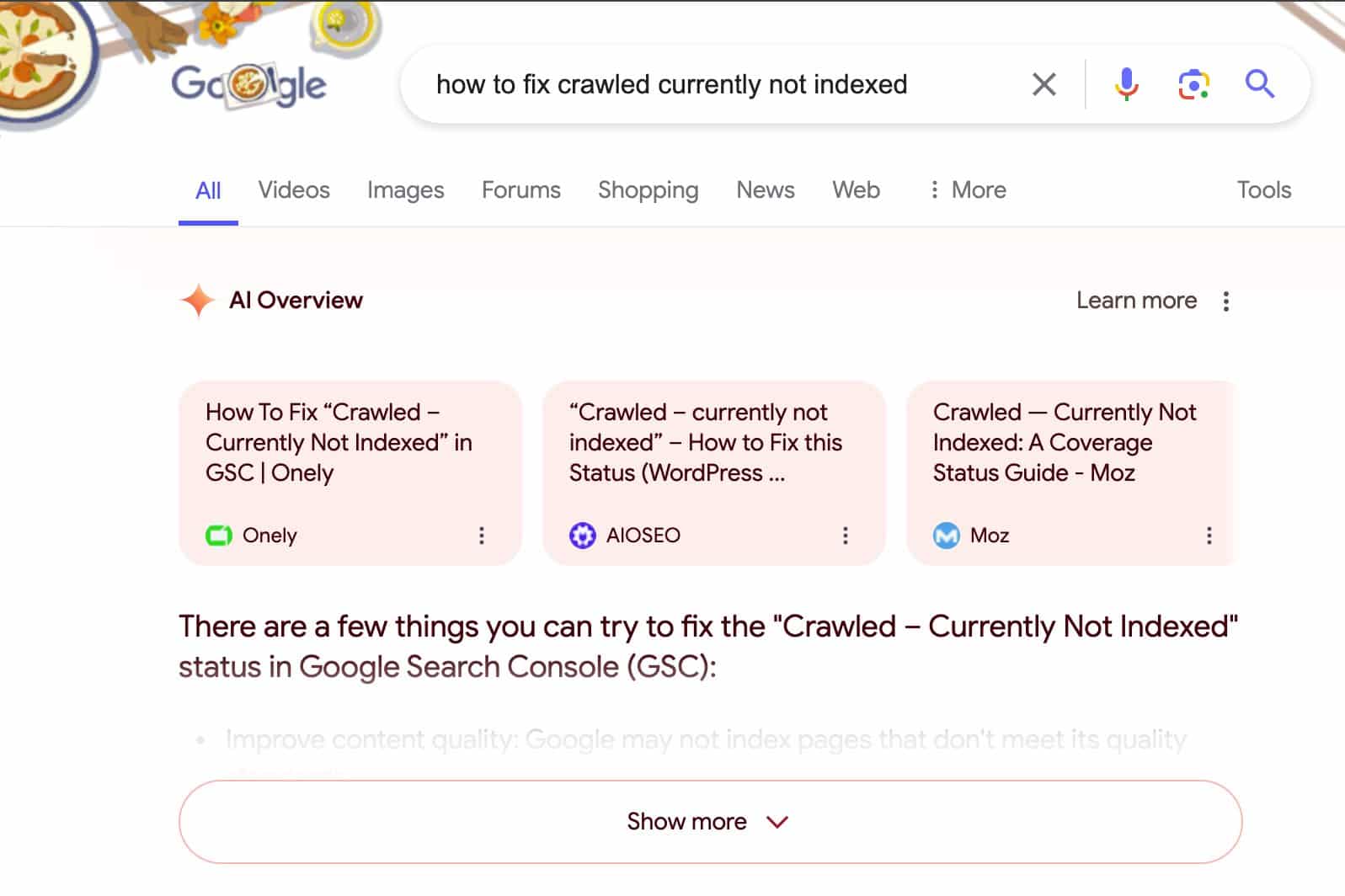
What a Normal AI Overview looks like. Here is a screenshot of the normal version of this AI Overview. By default, you see no link cards, you have to click “Show more” to see them:
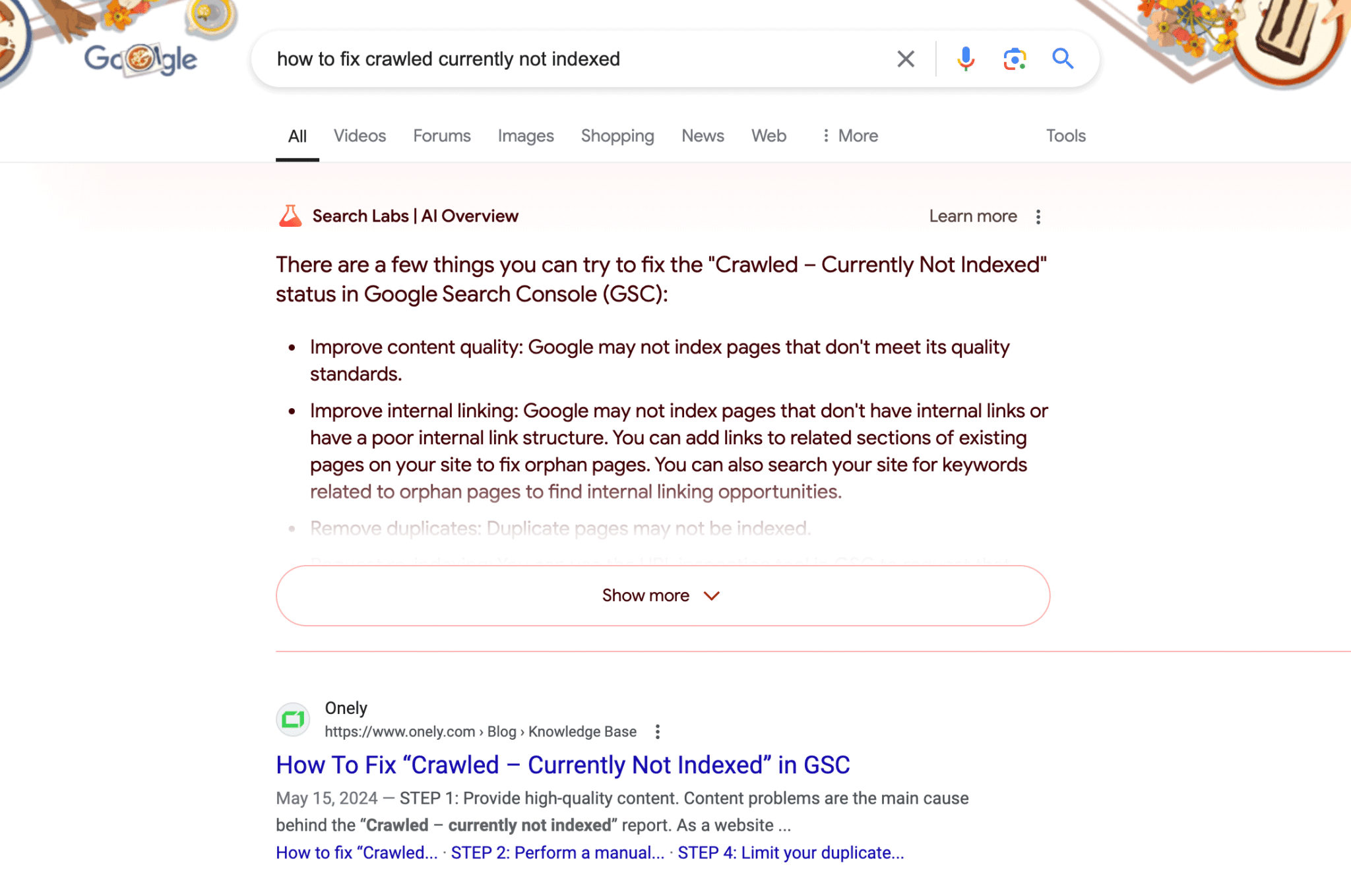
After you click on “Show more” it will then expand and show you the link cards below:
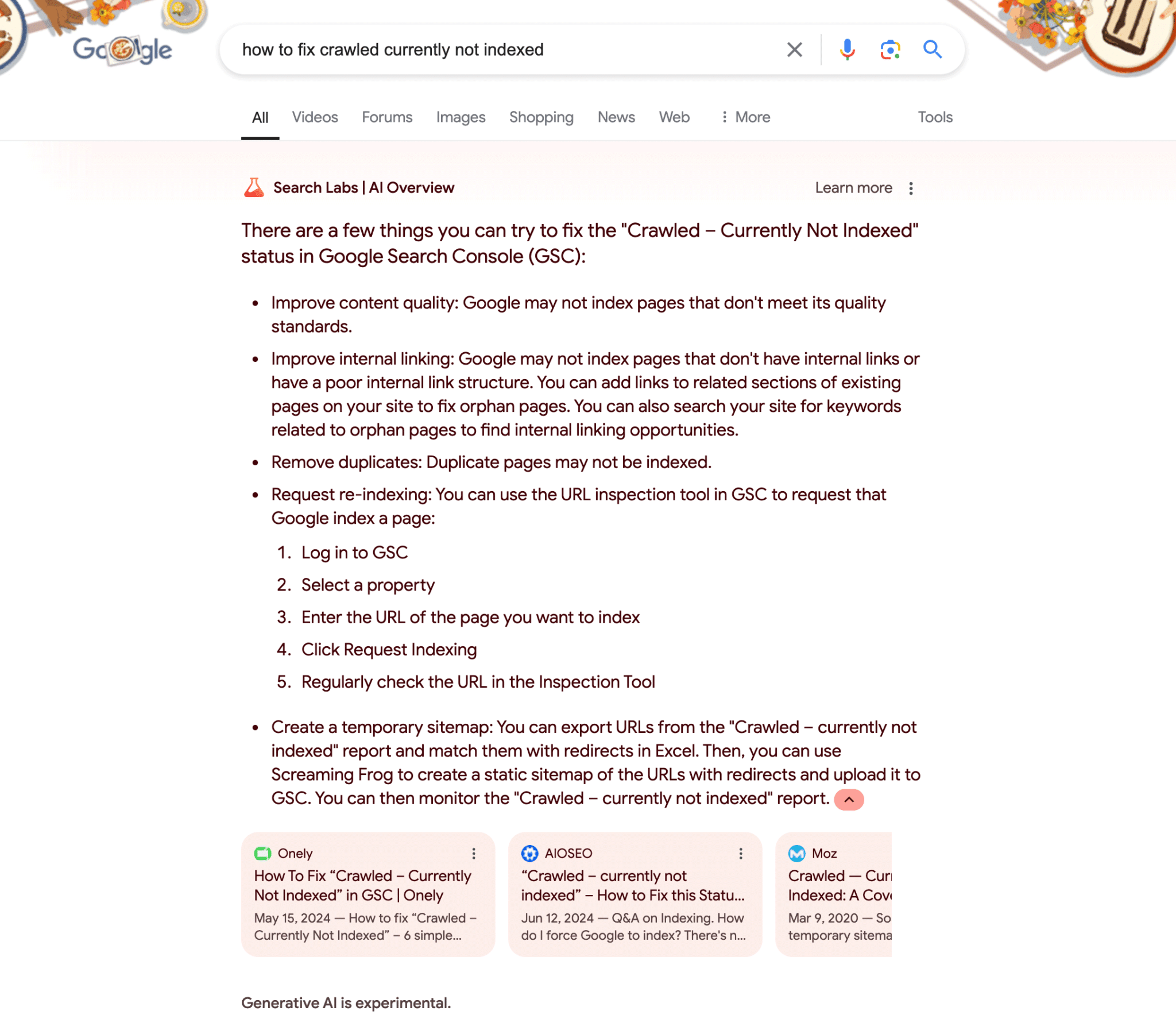
Why we care. If Google makes this change live for all AI Overviews, it might lead to publishers and content creators getting the visibility and clicks they deserve and want from these AI Overviews.
Google did confirm with Search Engine Land that this is just a test and they have nothing more to add.
Of course, Google doesn’t show us those impressions and clicks clearly in Google Search Console – yet.
Courtesy of Search Engine Land: News & Info About SEO, PPC, SEM, Search Engines & Search Marketing