Wednesday, October 25th, 2023
Snap, the parent company of Snapchat, reported its revenue rose 5% in the latest quarter after two straight quarters of declines on a rebound in the digital advertising market.
Advertising is the biggest source of Snap’s revenue – and the company cautioned the ad market remains volatile, pointing to the impact of war in the Middle East:
- “We have had a number of primarily brand-oriented campaigns pause spending in the early period, I will say that we have seen a lot of those campaigns resume spending and the impact to our daily run rate has reduced significantly as a result of that but we also have seen a very small amount of incremental campaign pauses trickle in more recently,” said Snap CFO Derek Andersen said in an analyst call yesterday.
Revenue for the third quarter was $1.19 billion, up from $1.13 billion a year ago. In the previous two quarters, Snap’s revenue had fallen between 4% and 7%.
The company remains unprofitable – its net loss of $368 million for the third quarter is wider than a loss of $360 million a year ago.
Ad platform improvements. In a letter to investors, Snap said the company has “focused on improving our advertising platform” to generate higher returns for advertisers.
- “We continue to make really significant investments in the ad ranking and optimization of creating a much broader range of signals into the ad platform and driving much larger models. And we’ve also instituted a much faster pace of experimentation. All of that’s leading to more precise conversion predictions, improved ROI for advertisers,” Andersen said.
Snap invested in improving ad ranking and optimization using ML models. This has led to a significant improvement in ROI for advertisers and an increase in lower-funnel revenue year-over-year and quarter-over-quarter. Also, its 7/0 Pixel Purchase optimization now lets advertisers bid for attributed seven-day clickthrough conversions.
Snapchat also reported working with advertisers to improve the effectiveness of their privacy-centric integrations with the ad platform. This resulted in significantly higher signal quality for those advertisers.
Last quarter, Snapchat introduced the Event Quality Score (EQS) system for advertisers to measure the quality and integrity of their data and identify opportunities to optimize their integrations with the ad platform.
Increase in paid subscribers. Daily active users for the third quarter were 406 million, up 12% from a year ago. Last month, Snap said it had reached five million users for its paid subscription services, up from 4 million in June.
Because Snap is primarily used as a messaging platform – and doesn’t run ads in those messages – it’s had a hard time monetizing its users.
To rectify that it has ads in features like Stories and Spotlight, scrollable feeds of photos and videos from creators. Last month, Snap partnered with Microsoft to include sponsored links in Snap’s AI chatbot My AI.
Snap reported more than 200 million people have used My AI, sending more than 20 billion messages. CEO Evan Spiegel said in yesterday’s analyst call that while My AI is just getting started, it will eventually be a revenue driver.
- “Our primary focus right now is just improving response quality. We’re seeing some of the work we’re doing to improve those responses lead to higher retention with the product overall. There’s certainly plenty of commercial intent. We are taking steps to integrate into our models to help folks see more relevant content and advertising,” Spiegel said.
The post Snap revenue up 5%, promises better ROI for advertisers appeared first on Search Engine Land.
Courtesy of Search Engine Land: News & Info About SEO, PPC, SEM, Search Engines & Search Marketing
Tuesday, October 24th, 2023
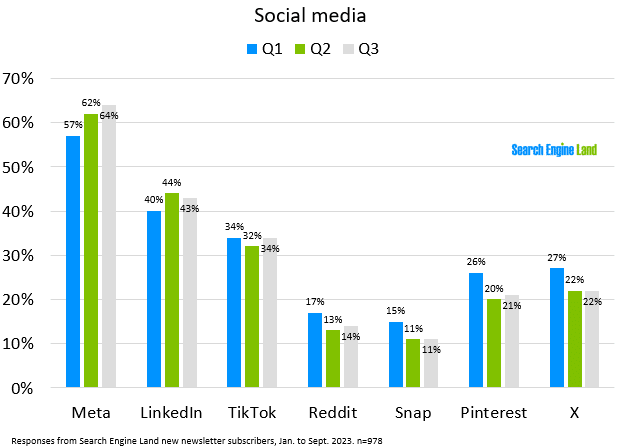
Marketers plan to invest in fewer advertising platforms over the next 12 months than at the beginning of the year, according to an ongoing survey of Search Engine Land readers.
Of the 16 ad platforms we asked about, fewer respondents said they expect to invest on 12 in the third quarter of this year compared to the first quarter of this year.
- Only Meta, Microsoft, and Microsoft’s LinkedIn will get more investment from advertisers, according to the survey. The number planning to invest with TikTok will be flat.
Search engines. More advertisers plan to invest dollars with Microsoft properties than at the beginning of the year. Investment with Google will be flat.
Fewer advertisers expect to invest with Apple in app store placements. Nine percentage points fewer respondents said they will invest with Apple in the third quarter compared to the first, the most significant change for any platform included in the survey.
- (Note: Google and Microsoft responses included their other advertising options, e.g. YouTube and Start.)
Social platforms. Meta was the platform experiencing the largest increase in expected investment of all of the platforms included in the survey. Seven percentage points more respondents said they expected to advertise on Meta in the third quarter than in the first.
Those predicting dollars earmarked for Pinterest and X declined 6 percentage points.
Retail platforms. Counter to the reports of explosive growth at shopping sites (a.k.a., retail media networks), fewer Search Engine Land readers said they’d be investing in those platforms (Amazon, Instacart, Walmart) in the third quarter compared to the first. We’re expecting that trend to reverse in the make-or-break ecommerce fourth quarter.
Fewer respondents will invest in all three of the audio/video platforms included in the survey (Spotify, Hulu, Netflix).
Why we care. It’s difficult to wrap your head around survey results that seem to contradict earnings reports and prevailing wisdom so profoundly. The reality is it likely says more about the mindset of the Search Engine Land audience than anything else.
Our conclusion is, that when faced with diminishing budgets and the difficult choices they create, the Search Engine Land audience chooses to invest in the platforms that have delivered results over the years, i.e. Google.
Investing in less proven platforms will have to wait for more prosperous times.
The post Survey: Marketers reducing ad platform investments appeared first on Search Engine Land.
Courtesy of Search Engine Land: News & Info About SEO, PPC, SEM, Search Engines & Search Marketing
Monday, October 23rd, 2023
It’s that time of year again – happy birthday, Google Ads!
Historically, we’ve celebrated the big day every five years by putting together a tribute to the world’s leading search engine, cloud computing, computer software, quantum computing, e-commerce, artificial intelligence, and consumer electronics giant that we know as Google. Take a look at their big 2-0.
But considering what a whirlwind year it’s been in search, we’re sure you’ll agree it’s time to pop the champagne, cut the cake, and settle in for a new, yearly, honoring.
Let’s get to it!
2023
New products at Google Marketing Live
Google announced a strong of new AI-powered ad products at this year’s Google Marketing Live (GML), including:
At Google Marketing Live 2023, the search engine talkeded a lot about AI, but the focus wasn’t on AI taking over. The tech giant emphasized that AI is meant to help advertisers with their tasks, not replace them entirely. These changes aim to save time and offer better control in managing automated campaigns.
Ads on SGE
Google rolled out search ads on the Search Generative Experience (SGE) when it launched in August 2023. All ads appeared in designated ad positions and carried a sponsored ad label.
The search engine wanted to closely assess ad performance and user experiences, so didn’t initially give advertisers the choice to opt out of displaying ads on this new platform.
While it was crucial to monitor ad performance on the new Google Search Generative Experience (SGE), during the experimental phase, tracking differences in ad performance between SGE and the old Google Search wasn’t immediately feasible. However, the search engine promised to continually evaluate, test, and adjust its approach to ensure that the ad experience benefited both searchers and advertisers.
Retirement of attribution models
Google retired four rules-based attribution models for all properties in Google Ads and Google Analytics in mid-October 2023:
- First-click.
- Linear.
- Time decay.
- Position-based.
The models listed above were removed from both the Analytics user interface and Admin API.
The retirement of these four attribution models was attributed to their dwindling popularity, as less than 3% of conversions in Google Ads were utilizing these models, as confirmed by a Google spokesperson.
Federal antitrust trial
Google sent shock waves through the PPC community at the federal antitrust trial as its leaders were interrogated over it advertising policies by the Department of Justice.
The search engine revealed that:
- It quietly increase ad prices by as much as 10% without telling advertisers.
- The highest bidders of ad auctions don’t necessarily win.
- It used RGSP – which has resulted in more ad revenue.
U.S. District Judge Amit Mehta isn’t expected to issue a ruling until early 2024.
If Google loses the case, it could mean it is no longer automatically installed as the default search engine on everyday products, which could threaten its position as the world’s search leader.
Demand Gen
Google replaced Discovery Ads with Demand Gen, and started rolling out the new product globally in October 2023. Described as the “next generation of Discovery campaigns,” it has new features, inventory, and insights, as well as an enhanced ad creation flow.
“Demand Gen campaigns combine image + video ads in one place and can be used to drive conversions, site visits and actions like sign-up and add-to-cart across YouTube, Discover and Gmail,” Google Ads Liaison Ginny Marvin explained in a thread on X.
Google has set a deadline for all existing Discovery campaigns to transition to Demand Gen by early 2024, marking a significant shift in their advertising strategy.
2021-2022
Keyword match types
Keyword match types seem to be the gift that keeps on giving, or in Google’s case, taking away. This time Google’s simplified phrase match worried advertisers with some acknowledging how similarly BMM and phrase match have behaved, and others denouncing the change as a move to strip away more data and controls from advertisers so that Google can extract as much profit from auctions as possible.
Farewell, broad-match modified keywords. Google expanded phrase-match to be included in broad match, to the chagrin of advertisers everywhere.
Audiences
Advertisers will be able to use connected TV campaigns to target viewers across YouTube and “most” other connected TV apps. The new development will bring affinity, in-market, and demographic audience segments to connected TVs.
Advertisers will be able to reuse audiences across campaigns. When you build an audience to use in a campaign, Google Ads will save it so you can use it again in a future campaign.
Google Ads is renaming some key terms in your audience report and throughout Google Ads. You may have seen this already in some accounts. Google revealed this via this help documentation in September 2021.
RSAs and the end of ETAs
Responsive Search Ads (RSAs) became the default ad type in 2021. RSAs allow advertisers to input multiple headlines and ad copy variations, and Google Ads uses machine learning to determine which variations to use based on what queries people are searching for.
An open beta allowed advertisers to see Display ads alongside search and YouTube for the first time in the Google Ads attribution report. Advertisers can see the ads in Top Paths, Model Comparison, Assisted Conversions and Path Metrics reports.
Automated vehicle ads were launched. The new format uses vehicle data feeds in Google Merchant Center to match users’ searches with ads.
Nine new policies were added to the three-strike system to target clickbait, misleading ad design, and more.
Automation
Bundled bid strategies have replaced standalone options. The Target CPA (tCPA) and Target ROAS (tROAS) Smart Bidding strategies will be bundled with the Maximize Conversions and Maximize Conversion Value bid strategies, respectively, Google announced Tuesday. Moving forward, Maximize Conversions will have an optional tCPA field, and Maximize Conversion Value will have an optional tROAS field.
Everyone’s favorite campaign type, Performance Max, became available to all advertisers. PMax includes Smart Shopping and Local campaigns, though Google eventually sunsetted Smart Shopping campaigns for good starting in January 2022.
Changes to automated extensions include extensions being shown together, an “Automatically Created Extensions” report, and the ability to add them at ad group, campaign, or account level.
Privacy Concerns Deepen
The depreciation of third-party cookies was supposed to happen in 2022 but was ultimately pushed to 2023. With that, an alternative targeting technology known as Federated Learning of Cohorts (FLoC) was opened for advertiser testing in Q2 2021, with adoption slated for Q4 2022.
The FLEDGE sandbox has been unveiled along with plans to roll out several Privacy Sandbox initiatives on Android, including the Topics API, the FLEDGE API for custom audiences and remarketing, and the Attribution Reporting API. It began testing in March 2022.
Honorable mentions
2015-2020
Audiences
Google’s 20th gave rise to an era of predictive marketing, using AI and machine learning to identify intent and predict customer needs, behavior and marketing outcomes.
YouTube gains access to Google data for audience targeting, effectively improving ad targeting and measurement across search and YouTube.
GA4 was also introduced, giving users expanded predictive insights, deeper integration with Google Ads, cross-device measurement capabilities and more granular data controls.
Keyword match-type decline
The way we manage search terms has changed. Close variants are no longer what they used to be and marketers are being forced to adapt to machine learning. “Google says its machine learning is now good enough to determine when a query has the same intent as a keyword with a high enough rate of success that advertisers will see an overall performance lift.” Awkward.
Google has loosened the reigns on close variant keywords. Broad match is super broad, exact match is more like phrase match, and phrase match is, well, gone?
Privacy concerns have forced Google to limit Search terms reporting. In a statement from Google, a spokesperson said, “In order to maintain our standards of privacy and strengthen our protections around user data, we have made changes to our Search Terms Report to only include terms that a significant number of users searched for. We’re continuing to invest in new and efficient ways to share insights that enable advertisers to make critical business decisions.”
Automation ramps up
RSAs and the start of the end for Expanded Text Ads began in 2020. The option for text ads was no longer the default option in the Ads dropdown. Advertisers are seeing only Responsive Search Ad (RSA) and Call ad.
Local Campaigns were introduced and aimed to drive in-store visits. Google automatically optimizes ad delivery across Search, YouTube, Maps and websites and apps in its ad networks.
Smart Campaigns debuted and were designed for small and local businesses that don’t have dedicated marketing staff and may not even have websites.
Smart Campaigns became the default campaign type for new advertisers in Google Ads. The campaigns are almost entirely automated and goals include phone calls, website visits and requests for directions.
Honorable mentions
Other new advancements in Search included:
2000 launch to 2015
While this is by no means a complete list, here are a few product development highlights from when Google launched the AdWords platform in 2000, all the way up to their 15th birthday.
2015
By 2015 Google maintained nearly 64 percent of search share on desktop and almost 90 percent of mobile in the US.
The Google shared library is sunsetted.
Google launches dynamic structured snippets for AdWords. The automated extensions display industry-specific, structured information about products and services on advertisers’ sites.
Google has opened up access to its home services ad program in AdWords Express. The home services ad program launched in beta in the San Francisco area to connect service providers with local residents searching for help.
Starting in October, Google changed the conversions columns to include only those conversions that are set for optimization: i.e., optimized conversion actions.
Google launched Smart Goals in early December. Smart Goals are designed for advertisers that don’t or can’t have conversion tracking on their sites. It aggregates conversion data from the thousands of sites that opt to share data with Google Analytics and, with machine learning, identifies visits deemed most likely to convert on the advertiser’s site.
2014
CNBC reports that Google is now banning porn businesses from utilizing their ad network.
To help retailers maintain consistent visibility in PLAs, Google has launched “automatic item updates” in AdWords.
Google announced it is extending its popular product listing ads (PLAs) to retail and e-commerce sites across the Google Search Network. The ads are served via a new Google product called AdSense for Shopping.
Automated Extensions report starts rolling out.
AdWords 11 is launched. Google released a fully-redesigned version of AdWords Editor that supports several of the bulk editing features that have recently been added to the web interface and introduces new functionality to the desktop tool.
2013
Google announced plans to add enhanced campaigns for AdWords to aid with campaign management catered to multiple-device users. The enhanced campaigns aimed to include advanced reports about users. This move was controversial among advertisers.
Ad group-level mobile bid adjustments started to roll out.
The AdWords Keyword Planner finally launches.
Google has announced the official beta for Image Extensions in AdWords.
Google announced the beta release of Review Extensions which allows advertisers to append a quote of endorsement from a reputable publication in their AdWords ads.
2012
Google Product Search is renamed to Google Shopping and only merchants that paid will be listed.
Google is testing the effect of adding “Trusted Stores” badges to qualifying advertisers’ search ads, as it considers deploying the badges more widely.
Google introduced the ability to target more than 30,000 ZIP codes in AdWords, giving advertisers the ability to find potential customers in a familiar, granular way. Another new feature, Location Insertion, is aimed at letting advertisers with multiple locations create one ad, and have information dynamically inserted depending on the user’s query or location.
Google released a new report — Auction Insights — that helps marketers understand how their ads stand, compared to others in the same auctions.
Testing begins for a new ad format on its Hotel Finder product that lets marketers bid to appear at the top of search results. Promoted Hotels ads are ranked based on a combination of bid and quality score, and are sold on a CPC basis.
The remarketing tag gets a makeover.
Google has begun notifying merchants that it won’t allow them to continue listing weapons-related items for sale in Google Shopping.
2011
Google is now letting AdWords advertisers automatically optimize what ads display most based on conversion rates.
Google will begin charging $1.00 for calls completed using the unique number it provisions, but solely when the call originates from someone using a computer who dials the number themselves from a phone. When the call is from a mobile device, or someone on a PC calls from the computer itself by clicking, the standard click charges apply. Previously, the calls dialed on a phone were free, as they didn’t involve a click, per se.
Google rolls out the ability to target ads to users by interest based on their previous browsing activity, or behavior, to all of its advertisers.
Cost per lead tests start. Google is testing search and display versions of a cost-per-lead ad format that would allow users to request an advertiser contact them.
Google is opening wider a beta test of Dynamic Search Ads. This ad type is designed for retailers or other advertisers with a large, often-changing inventory. Google automatically generates ad copy, based on the advertiser’s template.
Google officially announced it would begin serving AdWords at the bottom of search engine results pages on Google.com.
2010
Google has announced a new lab-type area called Google Ad Innovations, which is where it’ll “show you some of our latest ideas around advertising technologies and get your feedback.” Think of it as Google Labs for Ads.
Google has enabled access to the AdWords dashboard and other features for smartphone users. It’s configurable and provides on-the-go access to account data and stats. The new mobile interface is currently available for iPhone, Android and Palm/WebOS users.
Google starts testing a feature with a small number of advertisers in which a phone number can be included within the ad to help them more effectively engage with customers who prefer to connect over the phone.
A new keyword type, broad match modifier, begins testing.
Google Product Listing Ads are offered to all advertisers.
2009
Google’s newspaper ads initiative shuts down. Google said they are discontinuing this service because “the current Print Ads product is not the right solution.”
Google announced that they’re officially shutting down Google Audio Ads and Google Radio Automation.
The Google Base blog announced the launch of the new Google Merchant Center. The Merchant Center is replacing Google Base for those who submit products to Google.
Google Blog announced you can now buy YouTube Promoted Video ads directly in the Google AdWords console. Previously, all YouTube Promoted Video ads were managed on YouTube at ads.youtube.com.
Google has acquired AdMob (www.admob.com), a popular mobile display ad company, for $750 million. This acquisition gives Google access to AdMob’s more than 15,000 mobile Web sites and applications.
2008
Google pitched its media buying dashboard to very skeptical agencies.
Google also announced third-party tracking for the content network. Thanks, Google!
This same year, Google also began testing showing product ads in search results.
The Inside AdWords Google Blog announced that all US-based advertisers should now have the TV ads option in their account. In fact, you should see the option after logging in to your AdWords account at the bottom, where it says “Other Campaign Types.”
2007
Google started promoting audio ads. The landing page it takes you to tells you to call one of Google’s sales offices if you wanted to advertise on the radio.
Pay-per-action ads were launched this year, allowing advertisers to only pay when their preferred action was completed, such as a sale or click.
Google also began testing its Keyword Tool, showing the number of the previous month’s searches. The tool shows actual numbers in search volume for the previous month for keywords.
Also happening this year, Google acquired DoubleClick from The New York Times for $3.1 billion.
In July Google announced that those personalized ads you see are influenced by previous searches. In response, Google said “What you’re seeing is that we look at the user’s previous query and see how well it intersects with the current query. If it’s significant, we’ll use it to help targeting on the current query. We simply look at what’s in the referring URL (every time you load a web page, the HTTP header includes your previous URL as the “referrer”).”
Google reaches 1 million advertisers! “An analyst from UBS estimated Google has between 1.3 million and 1.5 million advertisers. According to the analyst, it shows there is still room for a lot more growth in terms of the advertiser base.”
2006
In 2006 Google decided to push forward with testing newspaper ads. If you’re curious, you can read the results here.
In the same year, they also began testing in-stream video ads with Beet.tv.
2000
Google launched its new self-service advertising program called AdWords. The program enabled “any advertiser to purchase individualized and affordable keyword advertising that appears instantly on the google.com search results page.”
The AdWords program replaced Google’s first ad program called Premium Sponsorships.
Check out this article we found from The Search Engine Report in 2000.
The post Google Ads turns 23: A look back at the biggest changes and advances in search appeared first on Search Engine Land.
Courtesy of Search Engine Land: News & Info About SEO, PPC, SEM, Search Engines & Search Marketing