Archive for the ‘seo news’ Category
Wednesday, November 1st, 2023
Ever wondered which search queries drive the most revenue for Google? It turns out that iPhone, insurance and cheap flight queries drove the most revenue for Google in the U.S., at least for one week in September 2018.
The list of search terms appeared on a heavily redacted slide that was included in a PDF released this week as a trial exhibit during the ongoing U.S. vs. Google antitrust trial.
Why we care. We know Google makes a lot of money (a modest $116.46 billion in 2018, when compared to the $224.47 billion Google made in 2022) and know which CPCs are most expensive. But we’ve never known which search terms were the most lucrative for Google because Google has never before revealed this information.
The 20 most profitable Google searches. The top search terms for the week of Sept. 22, 2018 in the U.S., ordered by revenue, were:
- iPhone 8
- iPhone 8 plus
- auto insurance
- car insurance
- cheap flights
- car insurance quote
- direct tv
- online colleges
- at&t
- hulu
- iPhone
- uber
- spectrum
- comcast
- xfinity
- insurance quotes
- free credit report
- cheap car insurance
- aarp
- lifelock
All other information was redacted on the slide – specifically:
- Revenue (how much Google made off each search term).
- Queries (number of).
- RPM (ad revenue per thousand impressions).
The slide. It appears in this PDF. Here is a screenshot:

The post 20 most profitable Google queries revealed during antitrust trial appeared first on Search Engine Land.
Courtesy of Search Engine Land: News & Info About SEO, PPC, SEM, Search Engines & Search Marketing
Wednesday, November 1st, 2023
Ever wondered which search queries drive the most revenue for Google? It turns out that iPhone, insurance and cheap flight queries drove the most revenue for Google in the U.S., at least for one week in September 2018.
The list of search terms appeared on a heavily redacted slide that was included in a PDF released this week as a trial exhibit during the ongoing U.S. vs. Google antitrust trial.
Why we care. We know Google makes a lot of money (a modest $116.46 billion in 2018, when compared to the $224.47 billion Google made in 2022) and know which CPCs are most expensive. But we’ve never known which search terms were the most lucrative for Google because Google has never before revealed this information.
The 20 most profitable Google searches. The top search terms for the week of Sept. 22, 2018 in the U.S., ordered by revenue, were:
- iPhone 8
- iPhone 8 plus
- auto insurance
- car insurance
- cheap flights
- car insurance quote
- direct tv
- online colleges
- at&t
- hulu
- iPhone
- uber
- spectrum
- comcast
- xfinity
- insurance quotes
- free credit report
- cheap car insurance
- aarp
- lifelock
All other information was redacted on the slide – specifically:
- Revenue (how much Google made off each search term).
- Queries (number of).
- RPM (ad revenue per thousand impressions).
The slide. It appears in this PDF. Here is a screenshot:
The post 20 most profitable Google queries revealed during antitrust trial appeared first on Search Engine Land.
Courtesy of Search Engine Land: News & Info About SEO, PPC, SEM, Search Engines & Search Marketing
Tuesday, October 31st, 2023
Google searches for AI content skyrocketed and have remained high throughout 2023 as businesses and creators tap into new opportunities to scale.
By March, 60% of writers already used AI in their work, a Hackernoon poll showed.
But while generative AI offers amazing content generation and optimization opportunities, balancing its capabilities and limitations is essential.
Marketers are getting AI content right, from summarizing lengthy texts to crafting compelling social media copy.
However, as we approach 2024, examining where generative AI content falls short is equally important as where it goes right.
Issues such as misguided SEO research, factual accuracy, plagiarism risks and the absence of human expertise and reasoning are all in play – and they present risks and challenges for brands.
Where marketers are getting AI content right
When used right, generative AI can streamline processes, improve efficiency and even boost the overall quality of content.
Let’s explore key areas where marketers successfully leverage AI for content creation.
Summarizing long passages of text
One of generative AI’s significant advantages is its ability to quickly and accurately summarize lengthy documents, reports or articles.
This enables us to extract and share critical information with our audience.
Generating landing page copy, titles and meta descriptions
Creating compelling landing page copy and meta descriptions is crucial for SEO and converting traffic to customers.
You can use AI to analyze your core content and generate attention-grabbing titles, meta descriptions and landing page copy.
Dig deeper: How to use AI and Chrome extensions for quick SEO wins
Creating social media copy for promotion
Promoting long-form content on social media platforms can be challenging, especially when you need to capture your audience’s attention quickly.
Use AI to craft engaging social media posts tailored to your target audience.
Extract key insights from long-form content and transform them into catchy captions and tweets to drive traffic to your in-depth articles or blog posts.
Dig deeper: 17 tips to improve your AI-assisted content creation process
Enhancing storytelling with use cases and examples
Storytelling is a powerful tool in marketing and AI can take it to the next level.
Use it to craft relatable, persuasive stories showcasing the benefits of your product or service. It aids research by anticipating objections and questions.
Producing copy and title variations for testing
AI can enhance A/B testing with diverse copy and headline variations.
Consider analyzing existing content and audience preferences to create alternatives for emails, websites and ads. This enables you to test and improve engagement and conversion rates quickly.
Get the daily newsletter search marketers rely on.
<input type=”hidden” name=”utmMedium” value=”“>
<input type=”hidden” name=”utmCampaign” value=”“>
<input type=”hidden” name=”utmSource” value=”“>
<input type=”hidden” name=”utmContent” value=”“>
<input type=”hidden” name=”pageLink” value=”“>
<input type=”hidden” name=”ipAddress” value=”“>
While AI can be a valuable tool, it’s being abused and misused – as some do with all new toys.
In the next section, we’ll explore some of the less effective and perhaps more dangerous ways people use AI for content creation.
Where AI content falls down
Using generative AI in these ways can result in poor-quality content, misinformation, misleading recommendations and other undesirable results.
The roots of any fall downs in generative AI are based on data. Whether it’s ChatGPT, Bing AI, Google Bard or third-party tools, the quality and connectivity of the data that powers these AI systems is crucial.
To achieve impressive results, prompt engineering and fine-tuning of data from large language models (LLM) have become increasingly prevalent. These techniques are vital for maximizing the potential of generative AI.
“Your site didn’t get penalised because you used AI for your content.
Your site got penalised because, the way you used AI, and the output of your AI tool was crap.”
- Pedro Dias/X
SEO and keyword research
Relying solely on AI for SEO research can result in:
- Misguided keyword choices.
- Incorrect optimization tactics.
- Missed opportunities to connect with your target audience effectively.
Human expertise is essential to interpret AI-generated insights and make informed decisions.
AI content generators typically lack access to live, real-time data.
Tools rely on historical data and patterns to suggest keywords and optimization strategies. They can’t adapt to real-time shifts in search trends or user behavior. This limitation is a real liability that can result in wasted spend and effort.
Too many tools can confuse, with over 70% of marketers recently feeling overwhelmed by AI changes.
Factual accuracy
AI-generated content cannot fact-check and verify information. Relying on it to do so can lead to misinformation, damaging your brand’s reputation and credibility. Human oversight is crucial to ensure the content aligns with accurate and up-to-date information.
AI-generated content often requires human editors to review, refine, fact-check and ensure it meets the desired quality standards.
While AI can assist in creating drafts, it may struggle with nuances, tone and context.
Human editors play a critical role in fine-tuning content, making it more coherent, engaging and aligned with the brand’s voice.
The risk of plagiarism
AI can inadvertently produce content that resembles existing materials already on the web. Without proper oversight, there is a risk of unintentional plagiarism.
To avoid this, content creators must conduct thorough checks to ensure their AI-generated content is original and unique.
Perspective and subject matter expertise
While AI can be valuable for generating shorter content, such as product descriptions or social media posts, it may struggle with the complexity and depth required for long-form content like in-depth articles or research papers.
Providing insightful analysis, coherent narratives and in-depth exploration of topics remains challenging for AI as it simply lacks the depth of knowledge and subject matter expertise that human writers and experts possess.
It cannot fully understand intricate or niche topics, leading to shallow and inaccurate content. It doesn’t possess humans’ creative and reasoning abilities, either.
It can generate content based on patterns and data but may struggle with producing truly innovative or emotionally resonant content.
Engaging storytelling, humor and emotional connections are often best crafted by human writers.
Dig deeper: AI can’t write this: 10 ways to AI-proof your content for years to come
Amplifying bias and stereotyping
AI algorithms learn from historical data, which can contain biases.
If not carefully monitored and trained, AI content generators can perpetuate biases, stereotypes or discriminatory language, harming your brand’s reputation.
Trying to cut costs with AI can backfire
For these reasons, looking to AI as a cost-cutting opportunity can be risky.
Leaning too heavily on technology can undermine quality, customer trust and employee morale, as AI lacks humans’ creativity, adaptability and nuanced decision-making.
It can lead to errors, impersonal interactions and a loss of competitive advantage in industries where human expertise and customer experience are paramount.
A balanced approach that combines AI’s efficiency with human oversight and creativity is key to sustainable cost management while maintaining quality and customer satisfaction.
Keep human content creators and editors in your content creation process.
These professionals can ensure that your content aligns with your brand’s unique voice and maintains a consistent tone throughout, retaining the desired brand identity and aligning messaging with your business goals.
Dig deeper: SEO scalability: We have a problem
Finding machine balance in 2024: Humans in the loop
A harmonious balance between humans and machines is key to a successful content strategy.
While AI technologies offer incredible efficiencies and opportunities, it’s crucial to understand where humans and machines can complement each other effectively.
Check out these intersections between humans and AI throughout the content creation process and how we can work better together.
1. Editorial process balance
In crafting compelling content, humans and machines can find their equilibrium at various points in the editorial process.
AI can be invaluable for initial research, data analysis and even generating first drafts.
However, the human must drive, especially during the later editing stages, where context, style and authenticity are refined.
2. Iteration and collaboration
Improvement is a continuous process. Collaboration between humans and AI is crucial for optimizing content output.
Humans can provide valuable feedback to AI systems, guiding them better to understand nuances, preferences and evolving trends.
In return, AI can assist humans by automating repetitive tasks and offering data-driven insights that inform content decisions.
3. Search experiences begin and end with humans
In SEO, it’s essential to remember that search engines ultimately serve humans. Content optimization must begin with an understanding of human intent and user behavior.
Once the content is optimized, humans will engage with it, so a human-centric approach ensures that the content:
- Meets their expectations.
- Answers their questions.
- Provides value.
4. Local and cultural relevance
Content must often cater to diverse audiences across regions and cultures.
AI translation tools can aid in content localization for businesses targeting global audiences.
However, human translators and cultural experts must ensure the content is accurately translated, culturally relevant and sensitive.
With their cultural awareness and contextual understanding, humans can tailor content to resonate with specific demographics and audiences in each location.
Dig deeper: The best AI tools for global SEO expansion
5. Creative ideation and strategy
AI is a great assist in generating content ideas based on data analysis, but from there, it’s human creativity that sparks innovative content concepts and strategic direction.
Humans bring the ability to think outside the box, connect disparate ideas and envision unique content angles that resonate with audiences.
6. Personalization and user segmentation
AI can analyze vast amounts of data to segment audiences effectively.
However, humans play a critical role in interpreting these segments and tailoring content to meet each audience group’s needs and preferences.
Human insights help create personalized content that resonates on a personal level.
7. Content distribution and optimization
While AI can automate content distribution across various channels and optimize posting schedules, humans provide strategic oversight to ensure content aligns with the broader marketing goals.
They can also respond to real-time engagement on social media or other platforms, adapting the content strategy as needed.
8. Content strategy growth and maturation
Developing a content strategy should be ongoing. Humans can:
- Evaluate the success of content initiatives.
- Understand audience feedback.
- Adjust the content strategy accordingly.
AI can assist by providing data-driven recommendations, but human strategists ensure the strategy aligns with overarching business objectives.
9. Content repurposing and diversification
Humans can provide the creative ideas and strategic direction needed when scaling content efforts or diversifying content formats.
From there, AI is a great assistant in generating additional content efficiently, whether as blog posts, videos, infographics, or podcasts.
10. Content accessibility and inclusivity
Ensuring that content is accessible to all audiences, including those with disabilities, is critical. Accessibility ensures that all individuals have equal access to digital content regardless of physical or cognitive abilities.
Many countries have enacted laws and regulations that mandate digital accessibility, with non-compliance putting you at risk of legal consequences, fines, or lawsuits. While AI can help identify accessibility issues, humans are essential for implementing solutions and ensuring content meets accessibility standards.
The future of content strategy lies in the synergy between AI, people and process.
While AI streamlines processes, analyzes data and generates content efficiently, the human touch infuses content with creativity, authenticity and emotional resonance.
In addition, it is essential that organizations find a balance between cost reduction and cost optimization. Reduction is often a short-term goal and limits content and creativity into silos.
Optimization allows humans and machines to work together toward a common goal and reduces costs without compromising efficiency and results.
Start with human intent, leverage AI for efficiency, and you’ll end up with human-centric optimization inside a content strategy that can thrive in 2024 and beyond.
The post AI-generated content in 2024: How to excel and where to exercise caution appeared first on Search Engine Land.
Courtesy of Search Engine Land: News & Info About SEO, PPC, SEM, Search Engines & Search Marketing
Monday, October 30th, 2023
In July, Google released a massive update to the Knowledge Graph. We named it the E-E-A-T Knowledge Graph update and gave it the codename “Killer Whale” because it made a splash in the SERPs twice:
- In real time between July 14 and 18.
- As part of the September helpful content update.
A Knowledge Graph (Vault) update rarely occurs simultaneously with a ranking update, core or otherwise. SERP volatility has seldom coincided with Knowledge Graph volatility. Kalicube Pro has been measuring volatility since 2015 with our Knowledge Graph Sensor.
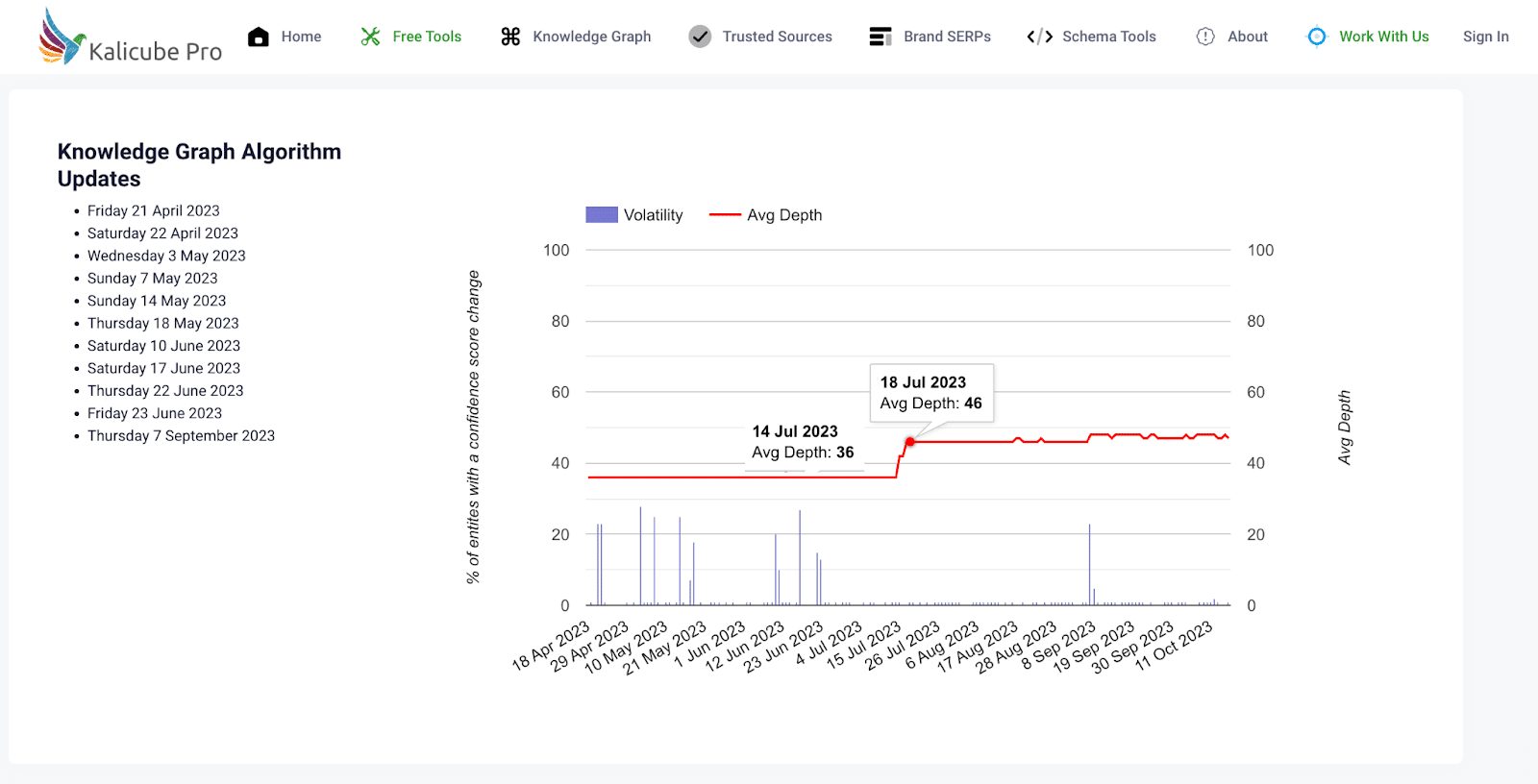
The graph below shows a significant uptick in the depth of the Knowledge Graph between July 14 and 18.
As you’ll see, Google’s SERPs were hugely volatile on those days, too – for the first time ever.
Checking the tools that provide historical data for SERP volatility, there is a huge peak between July 14 and 18. Accuranker and Advanced Web Ranking show that the volatility was significantly higher than during the subsequent core updates.
Algoroo indicates that July to August 2023 was the most intense and longest volatility since they started tracking in 2018.
So. Huge.
Some people reported changes to their Knowledge Panel in July. Still, Kalicube data shows changes to Knowledge Panels were not widespread in July (we analyzed over 100,000 rand SERPs containing Knowledge Panels).
Please exercise caution when making assumptions and performing manual checks. The degree I earned in economics and statistical analysis taught me that generalizing from a particular, or several particulars, is a huge mistake.
The changes to Knowledge Panels happened during the September core update, as we will see.
Get the daily newsletter search marketers rely on.
<input type=”hidden” name=”utmMedium” value=”“>
<input type=”hidden” name=”utmCampaign” value=”“>
<input type=”hidden” name=”utmSource” value=”“>
<input type=”hidden” name=”utmContent” value=”“>
<input type=”hidden” name=”pageLink” value=”“>
<input type=”hidden” name=”ipAddress” value=”“>
Knowledge Panels represent Google’s explicit understanding of named entities
Google cannot fully apply E-E-A-T signals to an article’s author (writer) if it doesn’t explicitly understand the writer’s identity.
The Knowledge Panel is the visual representation of Google’s explicit understanding of the writer. Without a stable, information-rich, and non-duplicated Knowledge Panel, your work building and demonstrating the writer’s E-E-A-T credentials is significantly under-leveraged.
The same approach applies to the company that owns and runs the website.
Sidenote: Google changed some significant terms in its Search Quality Rater Guidelines (SQRG) in December 2022, including changing “website” to “website owner.”
“The website owner is the person, company, or organization responsible for a website,” according to Google’s SQRG. This definition clearly indicates they are looking for the named entity responsible for the website and its content.
2023 core updates, E-E-A-T, Knowledge Panels and the Knowledge Vault update
The September 2023 helpful content update introduced the changes made in the Knowledge Vault on the SERPs in the form of Knowledge Panels.
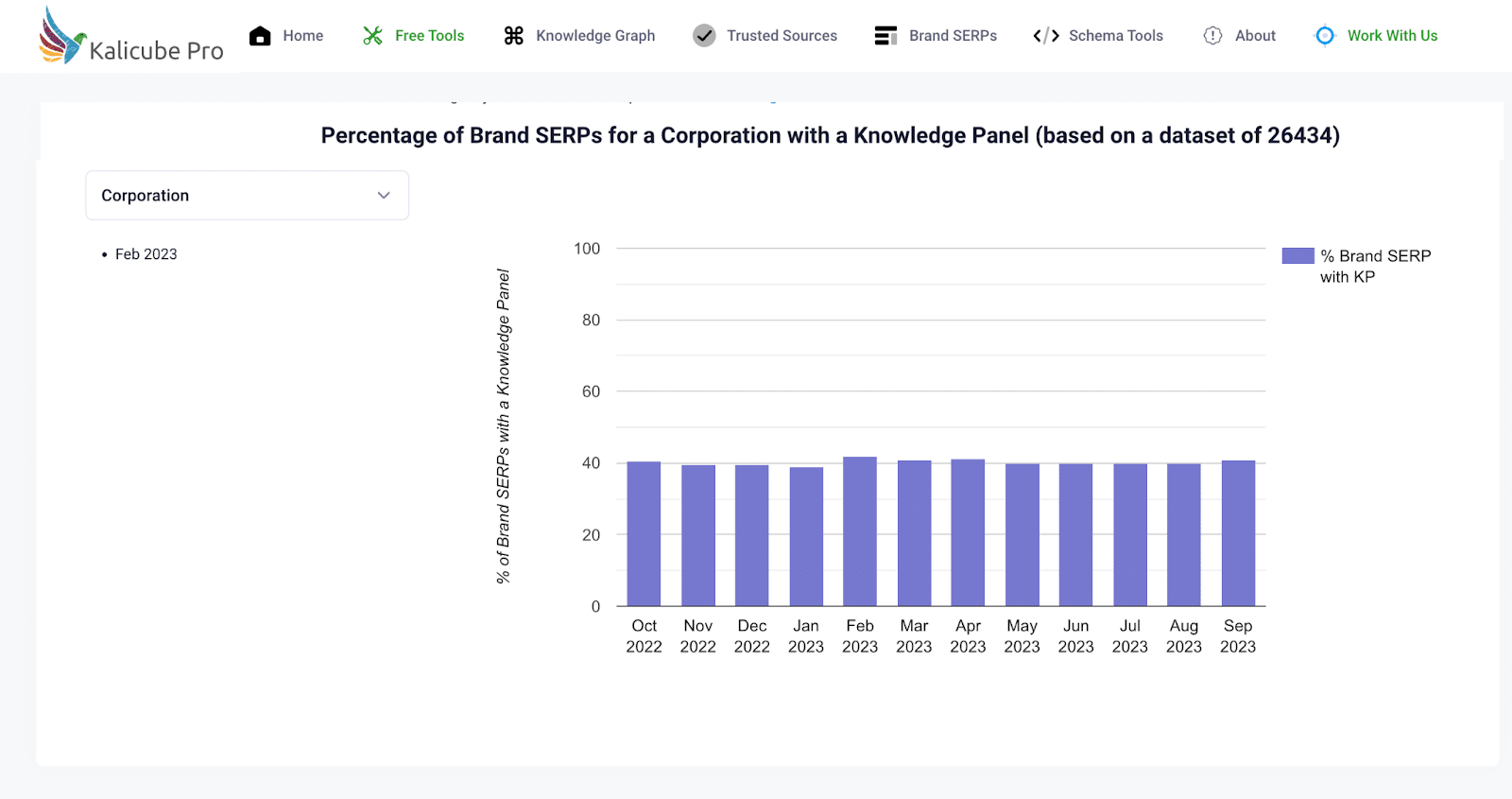
The percentage of Personal Brand SERPs with a Knowledge Panel increased from 38% to more than 50% (a rise of more than a third).
This is truly a Person update. For Corporations (and Organizations), the figure stayed steady at 40%.
We know that helpful content updates focus on improving Google’s ability to deliver the best solution from the most credible source (a.k.a., E-E-A-T).
Google’s July 2023 Knowledge Graph update added a layer to the September helpful content update. Google talks about “improved classification,” which is exactly what the Killer Whale update did to Person entities in the Knowledge Vault.
A quick aside: we now talk about N-E-E-A-T-T, adding “notability” and “transparency” to the mix. Without niche-level notability, you don’t stand out in your market. And without transparency, neither humans nor bots can understand who you are and why they should trust you.
Importantly, notability does not mean what Wikipedia says it means. Consider notability as having enough impact in a particular field for a specific audience to warrant recognition. Well-targeted digital PR and placement of your content on relevant platforms that are authoritative in your niche are two ways to approach niche notability.
Transparency simply means being open and honest. For example, having an easy-to-find and clear returns policy, privacy policy, cookie policy, About us page, etc.
Reliance on Wikipedia in Knowledge Panels dropped significantly
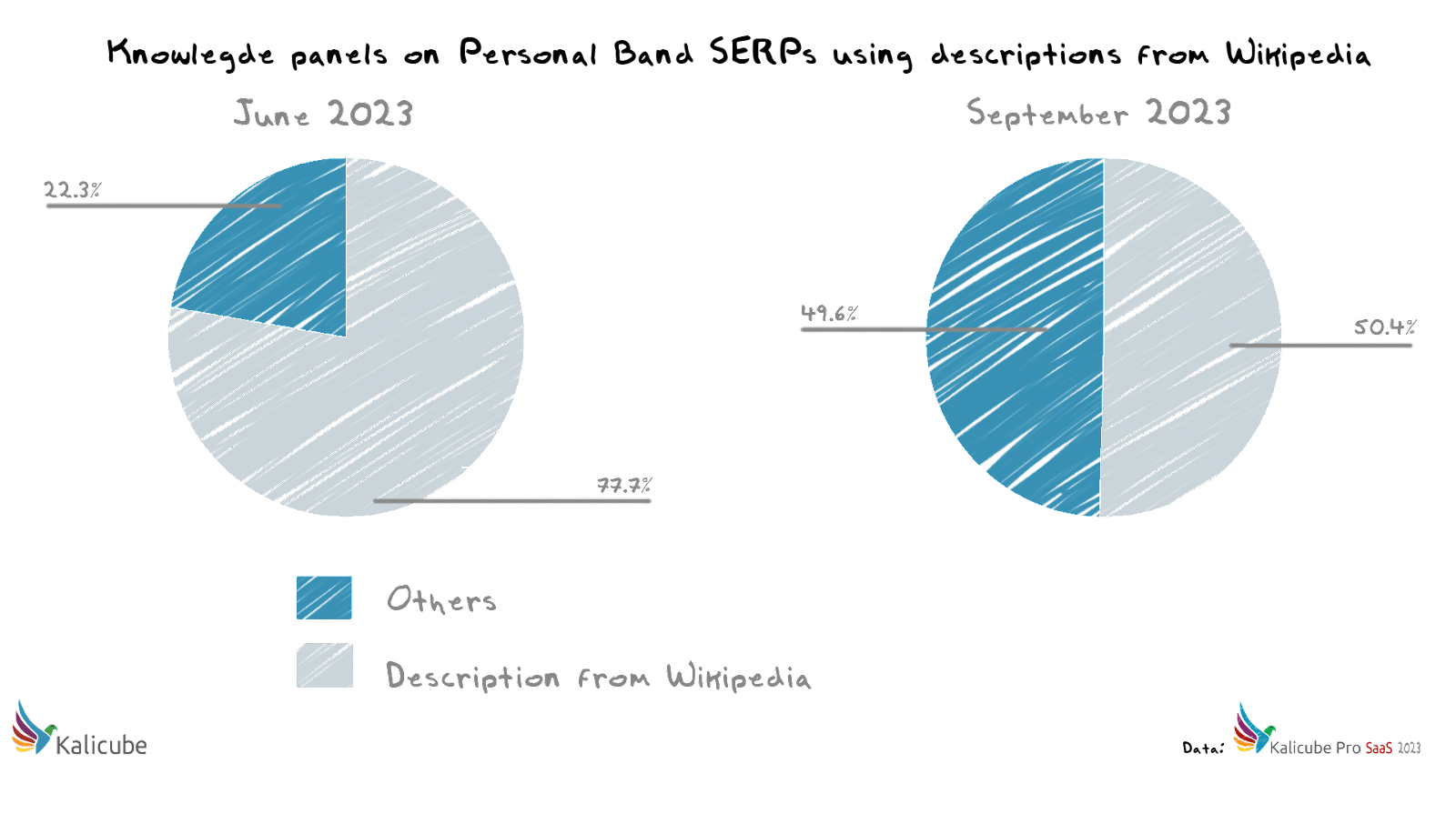
The percentage of Knowledge Panels on personal brand SERPs using descriptions from Wikipedia dropped from 77.7% in June 2023 to 50.4% in September.
For Corporations, the ratio remained steady: the percentages were 69.8% and 66.8% respectively.
Additionally, Google is expanding its horizons: the number of unique domains providing descriptions in Knowledge Panels or trusted sources has more than doubled.
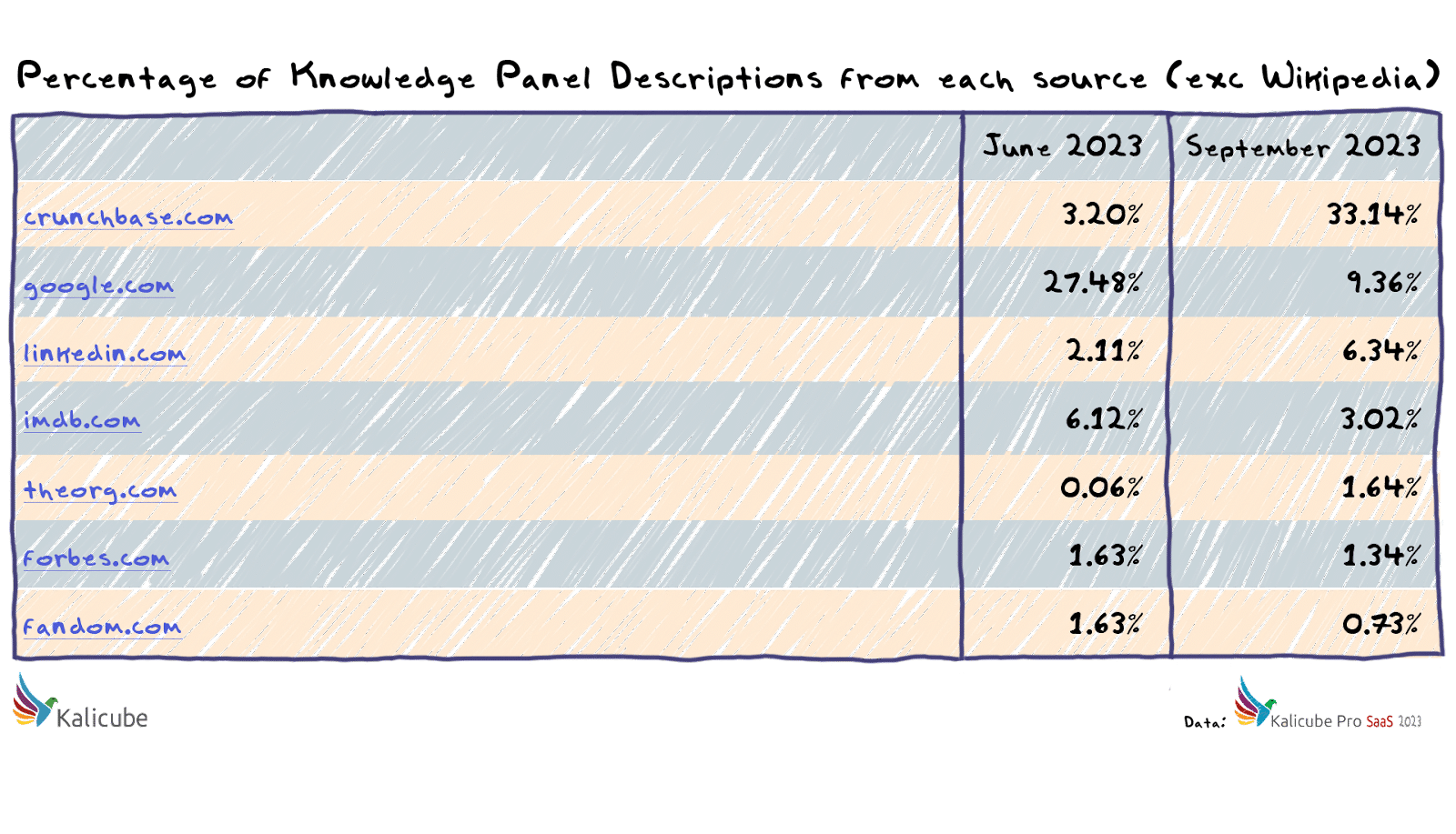
Importantly, the relative importance of each non-Wikipedia platform has changed significantly.
Crunchbase has become much more important, and Google Books and IMDB are no longer dominant, which makes sense given the Knowledge Vault update I have described.
But before you leap on Crunchbase, remember that Google will prioritize hyper-niche trusted sources for Knowledge Panels.
For example, Google has identified jasonbarnard.com as the trusted source for Boowa and Kwala. So, your strategy needs to be to go “hyper niche.”
The Kalicube Pro database contains over 63,000 unique trusted sources and the 400 trusted sources we provide free on the site.
Avoid handing control of your brand narrative to a third party, like Wikipedia. A source the entity owns and controls, like a website, is ideal.
For example, kalicube.com is the trusted source for Kalicube, and Kalicube controls the information about the business instead of a third-party source.
What you need to do right now
Knowledge Panels are already the next big thing. The July 2023 E-E-A-T Knowledge Graph update is based on expanding, classifying, and identifying E-E-A-T-applicable entities. It is limited to people.
The September 2023 helpful content update also prioritized Person entities and significantly reduced its dependency on Wikipedia for information it shows in Knowledge Panels for people.
For writer/author entities
If you are in any of these three situations:
- You missed the boat this time, and a Knowledge Panel still doesn’t trigger on your personal brand SERP.
- You see incorrect information in the Knowledge Panel for your Person entity.
- You lost a personal Knowledge Panel.
…then it’s time to work on the Knowledge Panels of your key Person entities to leverage as much E-E-A-T goodness as possible.
It’s time to build your personal brand and get your “Google stamp of approval” in the form of a Knowledge Panel.
Take action and actively educate Google about who you are and earn its trust. (Or get lost in the abyss of Internet darkness.
For website owner entities
The next Knowledge Vault update will likely be the expansion, classification, and identification of E-E-A-T-applicable entities for Corporations and Organizations.
For companies, businesses, corporations and people who double up as authors and website owners, it’s time to build a brand around your entities, build understanding for Google and get a Knowledge Panel.
Unless Google knows, likes and trusts you (through E-E-A-T), the next update spells disaster.
When will the next update be?
From our historical data, the pattern for Entity updates is clear for the last eight years: December, February (or March), and July have consistently been the critical months.
In each of the last five years, July has seen by far the most impactful updates.
Get ready. Our experience with thousands of Knowledge Panels is that you need to have all your corroboration straight six to eight weeks before the update. That update will be either February 2024 or July 2024.
The post September 2023 Google core update: A deep dive into personal knowledge panels and E-E-A-T enhancements appeared first on Search Engine Land.
Courtesy of Search Engine Land: News & Info About SEO, PPC, SEM, Search Engines & Search Marketing
Friday, October 27th, 2023
Best of the Bot showcases Search Engine Land Bot’s responses to prompts submitted by readers. The language model is based on content from Search Engine Land layered on top of ChatGPT. The editors of Search Engine Land selected this response for its usefulness and have supplemented it with additional relevant content.
I am the first generative AI chatbot for search marketers. I am trained with Search Engine Land content.
Here’s something somebody asked me! After that, how you can improve prompts to get even better answers from me.
Prompt:
Create a content marketing and SEO plan for a digital marketing agency.
Answer:
Creating a comprehensive content marketing and SEO plan for a digital marketing agency requires careful consideration of various factors. Here is a step-by-step guide to help you develop an effective plan:
- Define your target audience: Identify your agency’s target audience, including their demographics, interests, pain points, and preferred communication channels. This will help you tailor your content to resonate with your audience.
- Set clear goals: Determine the specific goals you want to achieve through your content marketing and SEO efforts. Examples may include increasing website traffic, generating leads, improving search engine rankings, or establishing thought leadership.
- Conduct keyword research: Perform thorough keyword research to identify relevant keywords and phrases that your target audience is searching for. Use tools like Google Keyword Planner, SEMrush, or Moz to find high-volume and low-competition keywords that align with your agency’s services.
- Develop a content strategy: Based on your target audience and keyword research, create a content strategy that outlines the types of content you will create (blogs, videos, infographics, etc.), topics to cover, and the frequency of publishing. Ensure your content is valuable, informative, and engaging to attract and retain your audience.
- Optimize on-page SEO: Implement on-page SEO best practices for each piece of content you create. This includes optimizing meta tags (title tags, meta descriptions), using relevant keywords naturally throughout the content, optimizing headings (H1, H2, etc.), and ensuring proper URL structure.
- Build high-quality backlinks: Develop a backlink strategy to improve your website’s authority and search engine rankings. Focus on acquiring high-quality backlinks from reputable websites in your industry through guest blogging, influencer outreach, content promotion, and creating link-worthy content.
- Leverage social media: Utilize social media platforms to promote your content and engage with your target audience. Share your blog posts, videos, and other content on platforms like Facebook, Twitter, LinkedIn, and Instagram. Encourage social sharing and interaction to increase visibility and reach.
- Monitor and analyze performance: Regularly track and analyze the performance of your content marketing and SEO efforts. Use tools like Google Analytics, SEMrush, or Moz to measure website traffic, keyword rankings, backlinks, and other relevant metrics. Adjust your strategy based on the insights gained from the data.
- Stay updated with industry trends: Continuously stay informed about the latest trends, algorithm updates, and best practices in content marketing and SEO. Follow reputable industry blogs, attend webinars, and participate in relevant forums to stay ahead of the curve and adapt your strategy accordingly. Remember, a successful content marketing and SEO plan requires consistency, patience, and ongoing optimization. Regularly review and refine your strategy to ensure it aligns with your agency’s goals and delivers the desired results.
Updated prompt with formatting
How this prompt could be improved
Create a content marketing and SEO plan for a digital marketing agency.
The key elements and enhancements to this prompt are as follows:
(Task)
Please create a detailed content marketing and SEO plan for a digital marketing agency trying to drive more sales.
(Context)
You are an experienced digital marketing and SEO professional. You are an expert in creating engaging, trustworthy, high-quality content that ranks well on Google and encourages potential customers to invest in the services of your digital marketing agency.
(Format)
Format the results in markdown.
(Tone)
You write in a professional, concise and easy to understand tone.
(Example)
You follow best practices to ensure your content serves user intent and meets editorial standards, including writing concise, click-worthy headlines, sourcing interviews where necessary to provide first-hand experiences, and speaking to authoritative figures to provide deeper insights. You also make sure your content educates those looking to invest in digital marketing and always links back to the services you offer. You use call-to-action words to motivate potential buyers and highlight unique selling points with enticing hooks.
New SearchBot answer
As an AI assistant, I can provide you with a detailed content marketing and SEO plan for a digital marketing agency trying to drive more sales. Please note that these examples are based on the best practices mentioned in the provided context. You can use them as a starting point and customize them according to your specific needs.
Content marketing and SEO plan for driving sales:
1. Define Target Audience and Buyer Personas
To effectively drive sales, it’s crucial to understand your target audience and create buyer personas. Conduct thorough research to identify the demographics, interests, pain points, and motivations of your potential customers. This information will help you tailor your content to their specific needs and preferences.
2. Keyword Research and Topic Selection
Perform comprehensive keyword research to identify relevant and high-volume search terms related to your digital marketing services. Use tools like Semrush or Google Keyword Planner to find keywords with a good balance of search volume and competition.
Based on the keyword research, develop a list of topics that align with your target audience’s interests and address their pain points. These topics should cover various aspects of digital marketing, such as SEO, social media marketing, content marketing, PPC advertising, etc.
3. Content Creation and Optimization
Create high-quality, informative, and engaging content that resonates with your target audience. Ensure that each piece of content is optimized for search engines and user experience. Here are some best practices to follow:
- Title Optimization: Craft compelling and keyword-rich titles that accurately reflect the content’s topic and entice users to click.
- Meta Description Optimization: Write concise and persuasive meta descriptions that summarize the content and encourage users to visit your website.
- Keyword Placement: Incorporate target keywords naturally throughout the content, including in headings, subheadings, and body paragraphs.
- Internal and External Linking: Include relevant internal links to other pages on your website to improve navigation and enhance topical relevance. Also, add authoritative external links to reputable sources to provide additional value to readers.
- Readability and Formatting: Ensure your content is easy to read by using subheadings, bullet points, and short paragraphs. Optimize readability by using appropriate font sizes, line spacing, and colors.
- Visual Content: Incorporate visually appealing elements such as images, infographics, and videos to enhance the overall user experience and make the content more shareable.
- Mobile Optimization: Ensure your content is mobile-friendly and responsive to provide a seamless experience across different devices.
4. Content Promotion and Distribution
Creating great content is only half the battle. To drive sales, you need to promote and distribute your content effectively. Here are some strategies to consider:
- Social Media Marketing: Share your content on relevant social media platforms, engage with your audience, and encourage them to share your content with their networks.
- Email Marketing: Build an email list and send regular newsletters featuring your latest content. Personalize the emails based on the recipient’s interests and buying stage.
- Influencer Outreach: Collaborate with industry influencers and thought leaders to amplify your content’s reach and credibility. Seek opportunities for guest blogging or interviews.
- Paid Advertising: Utilize paid advertising channels like Google Ads or social media ads to promote your content to a wider audience and drive targeted traffic to your website.
- Content Syndication: Repurpose and distribute your content on relevant platforms, such as Medium, LinkedIn Pulse, or industry-specific forums, to reach a broader audience.
- Community Engagement: Participate in online communities, forums, and Q&A platforms like Quora to provide valuable insights and link back to your content when relevant.
5. Performance Tracking and Optimization
Regularly monitor the performance of your content using analytics tools like Google Analytics and Google Search Console. Track key metrics such as traffic, engagement, conversions, and keyword rankings. Based on the data, make data-driven optimizations to improve the effectiveness of your content marketing efforts.
6. Continuous Improvement and Adaptation
Stay updated with the latest trends and changes in the digital marketing landscape. Continuously refine your content marketing and SEO strategies based on industry best practices, user feedback, and evolving search engine algorithms. Experiment with new content formats, distribution channels, and optimization techniques to stay ahead of the competition and drive more sales.
Remember, content marketing and SEO are long-term strategies that require consistent effort and adaptation. By following this comprehensive plan, you can effectively drive sales and establish your digital marketing agency as a trusted industry leader.
Try Search Engine Land Bot
The post Best of the Bot: Create an SEO plan for a digital marketing agency appeared first on Search Engine Land.
Courtesy of Search Engine Land: News & Info About SEO, PPC, SEM, Search Engines & Search Marketing
Thursday, October 26th, 2023
Ahrefs leadership is once again calling out Semrush for making “7 shameless edits” to an Ahrefs vs. Semrush comparison article written by Brian Dean before his site, Backlinko, was acquired by Semrush.
The saga continues. That would actually be seven additional edits. Because previously, in Ahrefs mentions vanishing from Semrush-owned Backlinko, Ahrefs called out Semrush for, among other edits, changing Dean’s recommendation from Ahrefs to Semrush in a sentence preceded by “if you had to make me pick ONE tool to use for SEO, I’d have to go with…”
The 7 ‘shameless edits’. So what’s changed now? In his own words, Ahrefs CMO Tim Soulo said these changes were made:
- Erased the fact that Brian used to be our customer for many years (since 2013)
- Changed Brian’s preference from Ahrefs to Semrush
- Tried to upend the narrative that backlink analysis is Ahrefs’ “bread and butter feature”
- Link Intersect is no longer “awesome:”
- No more praise for “Best by links” report
- Erased the statement about the accuracy of our traffic estimations
- Relegated our Site Audit tool from “web-based version of ScreamingFrog” to a “toned-down version of ScreamingFrog:”
The one edit Ahrefs wants. What Soulo and Dmytro Gerasymenko, founder and CEO, want is a disclosure that the article was edited by Semrush. The only mention of a connection between Backlinko and Semrush is in the footer of the page:
- © 2023 Backlinko is a Trademark of Semrush Inc
Deceptive endorsement? Ahrefs seemed to indicate they believe the article (which now has the title of Ahrefs vs Semrush: Which SEO Tool Should You Use in 2023?) could be violating Federal Trade Commision’s Endorsement Guides, which, in part say:
- “If there’s a connection between an endorser and the marketer that a significant minority of consumers wouldn’t expect and it would affect how they evaluate the endorsement, that connection should be disclosed clearly and conspicuously.”
You can dig deeper into the FTC rules here.
Semrush response. “Overreach” was the word used by Nick Eubanks, Semrush’s head of digital asset acquisition:
- “’Intentionally deceptive’ is overreaching here. ‘Doing business’ as in strategically owning media.. Semrush is far from the first company to do this,” Eubanks posted.
Little sympathy for Ahrefs. Reaction within the industry has been mixed. While both companies have their die-hard supporters/customers, various X posts accused Ahrefs of whining. Here are a couple of the negative reactions.
You're attempting to elicit empathy from a community that takes pride in faking EEAT, faking CTR data, PBNs, GSA, pushing 10,000 AI pages, rank and rent, negative link attacks, etc.
You'll get more empathy from a pile of rocks than you will from SEOs. 
— Nick Jordan (@nickfromseattle) October 23, 2023
You aren't going to win customers by whining about the competition. Ditch the credit system & yep, fix your infrastructure reliability. This is what is costing you customers not semrush's failure to disclose.
— Kris Roadruck (@KrisRoadruck) October 23, 2023
But Ahrefs also had supporters:
The pushback you’re getting here is wild. They’re doing something unethical that any editorial or journalistic org would recognize easily. It’s disappointing to see so many SEOs push for the industry to retain its low reputation.
— Nick Moore (@nickwritesit) October 25, 2023
Don't agree with most comments here. This is shady business. Good on @timsoulo getting out the truth
— Iron Brands  (@IronBrands16) October 24, 2023
Why we care. Nobody really “wins” here from a reputation perspective. Ahrefs is viewed negatively for complaining about a competitor. Semrush looks like it’s being deceptive (and perhaps a tad arrogant). But for Gerasymenko, this battle won’t be won in X posts. As Terry Van Horne put it on X, “report them to the FTC and move on”:
If SEMrush is contrary to FTC regulations (which I agree is the case) report them and move on. By pointing the finger and making this about reputation, credibility and ethics of the Industry you have done nothing to improve Industry perceptions! You've actually done the opposite!
— Terry Van Horne (@terryvanhorne) October 24, 2023
The post Ahrefs again calls out Semrush for ‘unethical practices’ appeared first on Search Engine Land.
Courtesy of Search Engine Land: News & Info About SEO, PPC, SEM, Search Engines & Search Marketing
Thursday, October 26th, 2023
Amazon generated $12.06 billion from its advertising services in the third quarter of 2023.
The figure marks a 26.3% increase from the same period in 2022 – a result significantly better than forecasts predicted by Wall Street.

Why we care. Amazon’s exceptional performance serves as a powerful signal that the digital advertising industry is experiencing a robust resurgence following on from the economic downturn. This promising trend should instill confidence among cautious marketers, ultimately rekindling their trust in the sector. As trust is rebuilt, experts anticipate a surge in ad spend during the all important holiday season in Q4.
Exceeding expectations. Financial analysts had predicted that ad revenue would generate $11.6 billion in Q3 – which would have marked a 21% year-on-year increase. However, Amazon’s ad sales surpassed this by $460 million. The segment includes:
- Sales of advertising services to sellers
- Vendors
- Publishers
- Authors
- Third parties through programs like sponsored ads, display ads and video advertising.
Ad partners. In the third quarter of this year, Amazon teamed up with a number of publishers and brands to serve ads on their apps and websites for products that are sold via Amazon in the US, including:
- BuzzFeed
- Hearst Newspapers
- Pinterest, Raptive
- Ziff Davis’ Lifehacker
- Mashable
The retail giant suggested these collaborations played an important role in its success in Q3.
Leveraging AI. Amazon also attributed its successful third quarter to rolling out new AI capabilities for brands and advertisers. In India, Amazon introduced a generative AI digital assistant to assist small businesses in setting up an online store, offering support with registration, listing, and advertising.
Other AI announcements included Amazon’s Supply Chain, a fully automated service for sellers to efficiently transport products from manufacturers to customers.
Get the daily newsletter search marketers rely on.
<input type=”hidden” name=”utmMedium” value=”“>
<input type=”hidden” name=”utmCampaign” value=”“>
<input type=”hidden” name=”utmSource” value=”“>
<input type=”hidden” name=”utmContent” value=”“>
<input type=”hidden” name=”pageLink” value=”“>
<input type=”hidden” name=”ipAddress” value=”“>
What has Amazon said? Andy Jassy, Amazon CEO, described Q3 as another “strong quarter”. He said:
- “We had a strong third quarter as our cost to serve and speed of delivery in our Stores business took another step forward, our AWS growth continued to stabilize, our Advertising revenue grew robustly, and overall operating income and free cash flow rose significantly.”
- “The benefits of moving from a single national fulfillment network in the U.S. to eight distinct regions are exceeding our optimistic expectations, and perhaps most importantly, putting us on pace to deliver the fastest delivery speeds for Prime customers in our 29-year history.”
- “The AWS team continues to innovate and deliver at a rapid clip, particularly in generative AI, where the combination of our custom AI chips, Amazon Bedrock being the easiest and most flexible way to build and deploy generative AI applications, and our coding companion (CodeWhisperer) allowing enterprises to have the equivalent of an experienced engineer who understands all of their proprietary code is driving momentum with customers, including:
- Adidas
- Booking.com
- GoDaddy
- LexisNexis, Merck
- Royal Philips
- United Airlines.”
Earnings report. You can read Amazon’s full third quarter 2023 results report for more information
The post Amazon’s ad services revenue rises 26%, bringing in more than $12 billion in Q3 appeared first on Search Engine Land.
Courtesy of Search Engine Land: News & Info About SEO, PPC, SEM, Search Engines & Search Marketing
Thursday, October 26th, 2023

When it comes to programmatic advertising, consent isn’t just a requirement; it’s the key to unprecedented revenue potential. Programmatic advertising thrives on precision and relevance, but how can you achieve these without compromising user trust or regulatory compliance?
Register and attend this digital advertising webinar to stay ahead, mastering consent-driven ad strategies so you can build trust and boost profits: “Why Consent and Compliance Matter With Programmatic Ads,” presented by OneTrust.
Click here to view more Search Engine Land webinars.
The post Build trust and boost profits with programmatic ads appeared first on Search Engine Land.
Courtesy of Search Engine Land: News & Info About SEO, PPC, SEM, Search Engines & Search Marketing
Thursday, October 26th, 2023

In today’s omnichannel world, customers engage with brands across many different touchpoints both online and offline. This makes mapping the customer journey more complex for marketers. Customers expect seamless experiences across channels and devices. If the journey is disjointed, they will quickly become frustrated and take their business elsewhere.
This is where customer journey orchestration (CJO) comes in. CJO platforms empower marketers to optimize the customer experience by:
- Identifying pain points in the journey where customers struggle
- Orchestrating personalized interactions to delight customers
- Responding quickly to changing customer needs and expectations
With CJO, marketing is no longer limited to siloed campaigns. You can take an outside-in approach starting from the customer perspective. This results in increased satisfaction, loyalty, and advocacy.
According to a recent Forrester study, 65% of marketers plan to increase spend on CJO platforms in the next year. But with many solutions now available, how do you choose the right one?
That’s where our MarTech guide comes in. This comprehensive report profiles leading platforms and provides actionable insights to guide your buying process including.
Visit Digital Marketing Depot to download Customer Journey Orchestration Platforms: A Marketer’s Guide and learn how to connect journeys, increase loyalty, and drive growth.
The post Why marketers should care about customer journey orchestration appeared first on Search Engine Land.
Courtesy of Search Engine Land: News & Info About SEO, PPC, SEM, Search Engines & Search Marketing
Wednesday, October 25th, 2023
Google is currently testing a new overview dashboard within the Google Ads console. This new dashboard looks similar to the existing one but it gives you the ability to customize what data you see in the dashboard and also let’s you scroll through more data in a carousel format.
More details. Anthony Higman spotted this change and posted some screenshots of this. He said on X “it lets select ALL the metrics and then click through on the right to see other things in the overview slide.” He added, “Also looks like they are working on you being able to segment by time right from the overview slide.” He said he loves site!
What it looks like. Here are some screenshots he posted:

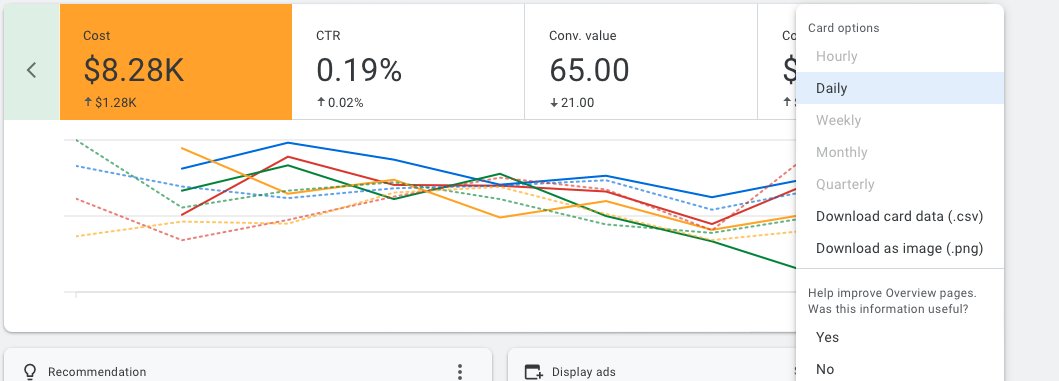
Confirmed. Ginny Marvin, Google’s Ads Liaison, confirmed this feature this morning saying on X, “We’re currently running an experiment with a limited number of advertisers to offer more flexibility from the overview page.”
Why we care. This new feature, if rolled out, can be a huge time saver for advertisers using Google Ads. While the standard data in this Google Ads dashboard is useful, each advertiser may want to see the data that is important to them, the way they want to see it. So this should be a welcomed addition to Google Ads, if it rolls out more widely.
The post Google Ads testing new overview dashboard for advertisers appeared first on Search Engine Land.
Courtesy of Search Engine Land: News & Info About SEO, PPC, SEM, Search Engines & Search Marketing


 Source: