Archive for the ‘seo news’ Category
Tuesday, November 21st, 2023
Google Ads has confirmed that it is going to update the Location asset requirements in December.
The update will clarify the types of location assets that are not permitted on Google Ads.
Locations that will not be allowed as Location assets include:
- Locations that are closed
- Locations that are not recognized by Google
- Locations that do not match the business running the ad.
- Assets with products or services that do not match the specified location.
Why we care. Using location assets in ads lets you display important business information, like the address and phone number, boosting conversion potential. Not following these requirements may mean leaving out crucial details, potentially harming your return on investment.
Get the daily newsletter search marketers rely on.
<input type=”hidden” name=”utmMedium” value=”“>
<input type=”hidden” name=”utmCampaign” value=”“>
<input type=”hidden” name=”utmSource” value=”“>
<input type=”hidden” name=”utmContent” value=”“>
<input type=”hidden” name=”pageLink” value=”“>
<input type=”hidden” name=”ipAddress” value=”“>
Deep dive. Read Google’s Location asset requirements article for more information.
The post Google Ads is updating Location asset requirements appeared first on Search Engine Land.
Courtesy of Search Engine Land: News & Info About SEO, PPC, SEM, Search Engines & Search Marketing
Tuesday, November 21st, 2023
Google is updating the language in some child and teen ads policies next month, including:
- Ads & made for kids content.
- Ad-serving protections for children.
- Ad-serving protection for teens.
The search engine explained that while there are no enforcement changes, it is tweaking policy language to provide more clarity and transparency for brands and advertisers.
Why we care. Enhancing clarity in advertising policies is crucial for brands to avoid inadvertent violations of rules and regulations. This is particularly important, as breaching these regulations can lead to substantial financial penalties. By clearly understanding and adhering to advertising guidelines, brands can protect themselves from potential legal and financial consequences.
Ads & made for kids content. Google is reorganizing and clarifying the language in the restricted categories and prohibited content section to align with its Ad-serving protections for children policy.
Ad-serving protections for children. Google is incorporating a new article into the Google Ads help center to make it easier to find and understand its existing protections for children when displaying ads.
Ad-serving protection for teens. Google is revising the language for clarity and for better consistency with its other policies.
Get the daily newsletter search marketers rely on.
<input type=”hidden” name=”utmMedium” value=”“>
<input type=”hidden” name=”utmCampaign” value=”“>
<input type=”hidden” name=”utmSource” value=”“>
<input type=”hidden” name=”utmContent” value=”“>
<input type=”hidden” name=”pageLink” value=”“>
<input type=”hidden” name=”ipAddress” value=”“>
Why now? Following an Adalytics study in August accusing Google of improperly tracking children for targeted advertising, the search engine is taking steps to offer more clarity on its child and teen ads policies. The research suggested that brands using the PMax product may have unintentionally violated the Children’s Online Privacy Protection Act (COPPA). Despite the allegations, Google denied any wrongdoing, attributing the concerns to “confusion about brand safety controls and reporting supported in PMax” – an issues it appears to now be addressing.
Deep dive. Read our report on concerns around PMax ads inadvertently violating the Children’s Online Privacy Protection Act for more information.
The post Google announces update to child and teen ad policy language appeared first on Search Engine Land.
Courtesy of Search Engine Land: News & Info About SEO, PPC, SEM, Search Engines & Search Marketing
Friday, November 17th, 2023
Meta has previewed two new generative AI tools for video asset creation and picture editing.
The projects will eventually be rolled out to Facebook and Instagram, enabling content creators to generate videos and edit in-stream images within seconds using text prompts.
Why we care. Instantly generating various video assets and image edits reduces the back-and-forth time between creative and media teams, freeing up resources for strategic tasks like audience analysis. Quick access to diverse creatives can also serve as inspiration for marketers.
Emu Video. Meta’s latest generative AI tool for video creation, named Emu Video, is built upon the technology from the company’s “Emu” AI research project. This tool enables creators to generate short video clips using text prompts. Emu Video can produce high-quality video content from simple text or still image inputs. The same model can also animate user-provided images based on a text prompt, surpassing previous work by a significant margin and setting a new state-of-the-art standard.
Emu Edit. Meta’s new picture editing tool, Emu Edit, enables flexible editing through detailed instructions, handling tasks such as local and global edits, background removal and addition, color and geometry transformations, detection, segmentation, and more. Emu Edit accurately follows instructions, ensuring that pixels unrelated to the specified tasks in the input image remain unchanged.
What Meta is saying. A spokesperson for Meta said in a statement:
- “Although this work is purely fundamental research right now, the potential use cases are clearly evident. Imagine generating your own animated stickers or clever GIFs on the fly to send in the group chat rather than having to search for the perfect media for your reply.”
- “While certainly no replacement for professional artists and animators, Emu Video, Emu Edit, and new technologies like them could help people express themselves in new ways — from an art director ideating on a new concept or a creator livening up their latest reel to a best friend sharing a unique birthday greeting. And we think that’s something worth celebrating.”
Get the daily newsletter search marketers rely on.
<input type=”hidden” name=”utmMedium” value=”“>
<input type=”hidden” name=”utmCampaign” value=”“>
<input type=”hidden” name=”utmSource” value=”“>
<input type=”hidden” name=”utmContent” value=”“>
<input type=”hidden” name=”pageLink” value=”“>
<input type=”hidden” name=”ipAddress” value=”“>
Deep dive. Read Meta’s Emu Video and Emu Edit announcement in full for more information.
The post Meta unveils new AI tools for video asset creation and picture editing appeared first on Search Engine Land.
Courtesy of Search Engine Land: News & Info About SEO, PPC, SEM, Search Engines & Search Marketing
Friday, November 17th, 2023
Sam Altman is no longer CEO of OpenAI. Mira Murati, OpenAI’s chief technology officer, has been named interim CEO, the company announced.
Why was Altman ousted? Altman was not consistently candid in his communications with the OpenAI’s board of directors, “hindering its ability to exercise its responsibilities. The board no longer has confidence in his ability to continue leading OpenAI,” according to OpenAI’s statement.
What’s next? OpenAI will begin its search for its next permanent CEO, the company said.
Why we care. Search marketers were shocked to learn of Altman being forced out of OpenAI, the company behind the extremely popular generative AI tool ChatGPT, which launched less than a year ago on Nov. 30, 2022. It has changed the way we work and the direction of search. This will be a story to watch over the next few weeks.
State of ChatGPT. It has 100 million active users – including about 90% of Fortune 500 companies. ChatGPT Plus sign-ups were paused Nov. 14 due to surge in demand, according to Altman. That followed a series of ChatGPT outages due to DDoS attacks.
Reaction. Here are some of the early reactions from the industry:
What OpenAI is saying. Here’s the full statement:
The board of directors of OpenAI, Inc, the 501(c)(3) that acts as the overall governing body for all OpenAI activities, today announced that Sam Altman will depart as CEO and leave the board of directors. Mira Murati, the company’s chief technology officer, will serve as interim CEO, effective immediately.
A member of OpenAI’s leadership team for five years, Mira has played a critical role in OpenAI’s evolution into a global AI leader. She brings a unique skill set, understanding of the company’s values, operations, and business, and already leads the company’s research, product, and safety functions. Given her long tenure and close engagement with all aspects of the company, including her experience in AI governance and policy, the board believes she is uniquely qualified for the role and anticipates a seamless transition while it conducts a formal search for a permanent CEO.
Mr. Altman’s departure follows a deliberative review process by the board, which concluded that he was not consistently candid in his communications with the board, hindering its ability to exercise its responsibilities. The board no longer has confidence in his ability to continue leading OpenAI.
In a statement, the board of directors said: “OpenAI was deliberately structured to advance our mission: to ensure that artificial general intelligence benefits all humanity. The board remains fully committed to serving this mission. We are grateful for Sam’s many contributions to the founding and growth of OpenAI. At the same time, we believe new leadership is necessary as we move forward. As the leader of the company’s research, product, and safety functions, Mira is exceptionally qualified to step into the role of interim CEO. We have the utmost confidence in her ability to lead OpenAI during this transition period.”
OpenAI’s board of directors consists of OpenAI chief scientist Ilya Sutskever, independent directors Quora CEO Adam D’Angelo, technology entrepreneur Tasha McCauley, and Georgetown Center for Security and Emerging Technology’s Helen Toner.
As a part of this transition, Greg Brockman will be stepping down as chairman of the board and will remain in his role at the company, reporting to the CEO.
OpenAI was founded as a non-profit in 2015 with the core mission of ensuring that artificial general intelligence benefits all of humanity. In 2019, OpenAI restructured to ensure that the company could raise capital in pursuit of this mission, while preserving the nonprofit’s mission, governance, and oversight. The majority of the board is independent, and the independent directors do not hold equity in OpenAI. While the company has experienced dramatic growth, it remains the fundamental governance responsibility of the board to advance OpenAI’s mission and preserve the principles of its Charter.
The post Shocker – Sam Altman out at OpenAI in huge CEO change appeared first on Search Engine Land.
Courtesy of Search Engine Land: News & Info About SEO, PPC, SEM, Search Engines & Search Marketing
Friday, November 17th, 2023
Apple is reportedly pulling all of its adverts from X after Elon Musk endorsed an antisemitic conspiracy theory.
The tech giant has allegedly also been concerned about its products being promoted alongside far-right content, according to Axios.
Why we care. As one of X’s longstanding major advertisers, Apple’s move to halt all ads is a powerful signal to other brands regarding the effectiveness of X as an advertising platform. Since Musk took over the social networking site last year, ad revenue has plummeted by 59%. Apple’s choice to withdraw its ads will undoubtedly be another huge blow for X’s ad revenue.
Far-right concerns. Apple, IBM, Amazon and Oracle were named as organizations whose ads appeared next to far-right posts on X, according to a report published by the left-leaning nonprofit Media Matters for America. IBM pulled all ads in response, with Apple becoming the latest major company to follow suit.
Antisemitic fears. More than 160 Jewish rabbis and activists have been calling on Apple, Google, Amazon and Disney to stop advertising on X after Musk endorsed an antisemitic post earlier this week. In response, X CEO Linda Yaccarino wrote in a post on the platform:
- “We have been extremely clear about our efforts to combat antisemitism and discrimination. There’s no place for it anywhere in the world — it’s ugly and wrong. Full stop.”
Get the daily newsletter search marketers rely on.
<input type=”hidden” name=”utmMedium” value=”“>
<input type=”hidden” name=”utmCampaign” value=”“>
<input type=”hidden” name=”utmSource” value=”“>
<input type=”hidden” name=”utmContent” value=”“>
<input type=”hidden” name=”pageLink” value=”“>
<input type=”hidden” name=”ipAddress” value=”“>
Deep dive. Read our report on X’s partnership with Google Ad Manager for more information on how the social platform is trying to salvage its advertising revenue.
The post Apple pulls all ads from X amid antisemitic and far-right content concerns appeared first on Search Engine Land.
Courtesy of Search Engine Land: News & Info About SEO, PPC, SEM, Search Engines & Search Marketing
Friday, November 17th, 2023
TikTok is rolling out a new measurement tool called Engaged View-through Attribution (EVTA) to provide creators with more insights into conversions.
When a viewer watches a video ad for over six seconds, it counts as an engaged view. EVTA tracks conversions that occur after a user watches an ad for at least six seconds but doesn’t click, and then converts within a seven-day attribution window.
This helps advertisers gauge the impact of these engaged views on conversions.
Why we care. Helping advertisers to make better sense of their data gives them the power to make data-led decisions for maximum campaign performance, leading to less inefficient spend and better returns on investment.
Key benefits. TikTok claims that the new measurement tool provides several key benefits, including:
- Better understanding of ad impact beyond clicks: Tracking conversions on TikTok goes beyond a simple click-and-convert scenario. By measuring conversions influenced by views lasting six seconds or more, you’ll get a more comprehensive understanding of TikTok’s impact on your business.
- Fuelling campaign performance with more signals: TikTok Ads Manager will receive more high-quality signals to optimize and enhance the performance of your campaigns over time by showing your ads to users who are more likely to take action.
- Balanced measurement across different channels: Aligning attribution methods with other platforms allows for a more accurate comparison of performance, ensuring fair measurement of results across different platforms.
Combined measurement approach. TikTok states that combining EVTA with its recently launched Self-Attributing Network (SAN) can provide you with a more complete picture of how users are converting on TikTok. With this enhanced attribution methodology in place, the total conversions reported on TikTok Ads Manager include the following:
- Click-through (CTA) and view-through (VTA) conversions driven by last click and view that are currently validated and reported by MMPs.
- Engaged view conversions as measured by our new EVTA touch-point. These conversions are currently reported as Click-through (CTA) conversions on MMP reporting.
- Additional click-through (CTA) conversions driven by clicks on TikTok ads that are not currently reported in MMP’s last-click attribution model.

What TikTok is saying. A spokesperson for TikTok said in a statement:
- “The mobile advertising landscape has evolved. Today’s users encounter a wide variety of ad types across multiple different platforms, each with its own format, flow and level of interactivity.”
- “Understanding the impact that different touchpoints and marketing channels have on driving user actions, such as app installs or purchases, remains a constant challenge for app advertisers.”
- “To see the true impact of your TikTok ads, we recommend you turn on VTA, EVTA and CTA with the maximum attribution window and ensure that the attribution windows on TikTok Ads Manager are the same as your MMP setting. Advertisers can customize CTA (1-day or 7-day), VTA (off or 1-day), EVTA (1-day or 7-day) directly on TikTok Ads Manager.”
Get the daily newsletter search marketers rely on.
<input type=”hidden” name=”utmMedium” value=”“>
<input type=”hidden” name=”utmCampaign” value=”“>
<input type=”hidden” name=”utmSource” value=”“>
<input type=”hidden” name=”utmContent” value=”“>
<input type=”hidden” name=”pageLink” value=”“>
<input type=”hidden” name=”ipAddress” value=”“>
Deep dive. Read TikTok’s mobile measurement framework announcement in full for more information.
The post TikTok launches new tool to provide more insight into how ads drive conversions appeared first on Search Engine Land.
Courtesy of Search Engine Land: News & Info About SEO, PPC, SEM, Search Engines & Search Marketing
Wednesday, November 15th, 2023
Google is rolling out a more personalized search experience that aims to show searchers more information about what they care about directly in the search results. This is being done with several new search features, including a new Follow button, search results tailored to you, perspectives results updates, creator snippets and more.
Follow button in Google Search
Google is rolling out a new “Follow” button in Google search that aims at keeping you up to date on topics that you want to keep coming back to search for. The follow button allows searchers to essentially subscribe to topics where Google can show searchers content on that topic, Brad Kelle, Senior Director of Engineering, at Google Search explained to us.
How to subscribe. When you do a search and see the “Follow” button, you can click on that button to subscribe. Google will then tell you are you’re following that topic and you can “look for updates in your home feed and when you revisit this search.”
Here is what the follow button looks like:

Google will also enable notifications, if you are using the Google App, to push you new content on that topic.
You can always unfollow and unsubscribe from topics.
Note, this feature does not work for “sensitive” topics and is first launching in the US English search results within the Google App and mobile search results in the coming weeks.
What changes. Google may add a section named “News for you” that shows you news topics and new content around the topic you followed. This includes an update to how the perspectives feature works in that section.
Here is what this looks like:

Google may also adapt the search snippets to show you specific content in the search results based on what you follow.
Google Discover may also send you notifications when new content around that topic may be useful to you.
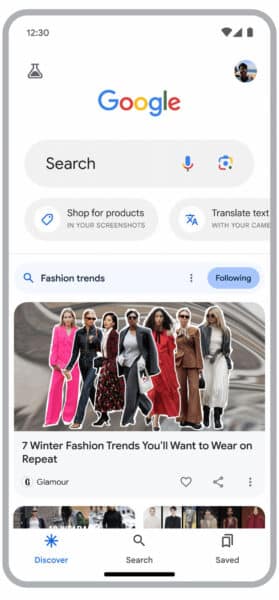
Also within Google Discover, you may see search buttons to click on for topics you subscribed to, so you can dig deeper into Google Search on that topic. We have seen Google test this with the “get the latest on” and other search buttons. Here is what it looks like:
Search results from your favorite sites
Google will also roll out a new ranking feature that looks at which sites you visit often and show those sites more often in the search results. This is similar to previous query, where Google may show you different search results based on your immediate previous query, but in this case, Google is looking at which sites you often visit over a longer period of time and showing you that site more often than other sites.
So if you visit this site frequently, Google may decide to rank content from this site over other sites writing about the same topic, specifically for you. While your friend may see different results ranked in a different order.
You do not need to “follow” a topic or query for this feature to work, this is an independent feature from that mentioned above.
Search history. Google said it would let me know how long you search history is retained for this level of personalization. There is no way to turn off this feature without turning off all personalization or signing out of Google Search when you conduct your search.
Here is the screen to unfollow topics:

What it looks like. Google may add a “you visit often” label to the search results that were personalized for you.
About this result. Google will also show you in the “about this result” feature if that result is ranked higher because you visit the site more often.
Later this year. Google said this is rolling out in Google Search later this year for English users within the US.
Others’ Perspectives in Google Search
Google is also updating the Perspectives feature to help you learn from others in the search results, the company said. When you tap on the perspectives filter within Google Search you can now see content from social media platforms, discussion forums, blog posts and other communities.
Coming to desktop. Perspectives launched on mobile and we saw Google testing perspectives on desktop. Google will now officially launch perspectives on desktop in the US in the coming weeks.
Creators details. Google will also be highlighting more information about the people who created that content, the content creators, directly in the search results. That includes showcasing their social media account, follower count and more.
What it looks like. We saw Google testing this a while ago and this will be rolling out officially today in the US and India, within the Google App and mobile search results:

The post Google launches new personal search experience with follow button and personalized ranking appeared first on Search Engine Land.
Courtesy of Search Engine Land: News & Info About SEO, PPC, SEM, Search Engines & Search Marketing
Wednesday, November 15th, 2023
Google has rolled out ranking improvements aimed at showcasing more content from social media, blog posts, forums and more that share personal insights and experiences. This is the hidden gems announcement Google made back in May, but this update is not part of the helpful content system. It is part of the Google core ranking system, Brad Kellett, Senior Director on Google Search product and engineering told us.
Hidden gems. Google said these “hidden gems” are when people share their first-hand knowledge and their own personal insights and experiences with others on the public web. Google wants to highlight such content in its search results and search interfaces.
Not a core or helpful content update. When Google initially announced the hidden gems ranking topic, it mentioned that it would be part of a future helpful content update. Instead, it ended up as part of Google’s core ranking system designed to promote more “authentic” content. This content can come from forum posts, social media posts, blog posts, or other web pages. As long as the content is authentic and shares personal insights and experiences, and if the content is found to be helpful, it might appear. It is not explicitly classifying something as a “gem,” but instead the idea is that this type of content can be perceived as especially helpful and in the past, might have been harder to appear in the results.
Google told us back then that the hidden gems feature was not live yet but it seems like it was. Google today told us it actually went live as part of the core ranking system a few months ago but Google told us it wasn’t live less than a month ago. Although, what Danny Sullivan wrote back then was “This work is still continuing and is not part of this particular update. We’ll share more about our work in this area in the future.” So while we all interpreted that it was not live yet, it didn’t necessarily mean that.
How does it work. I asked how does Google know if the person posting is really authentic. People make up personas, make up names, on the web, on social media, on forums and post anything. Google didn’t want to give me any of its secret sauce but implied it is less about the person posting and more about what content that person posts.
It sounds like if the content triggers some sort of authenticity signals, not that Google has an authenticity ranking signal, but if the signals Google uses for this ranking system show that the content is helpful, insightful and through personal experiences, then maybe Google will highlight that content more in search.
Why we care. Google began introducing this improvement to core ranking a few months ago and now has fully introduced it as part of its core ranking and you may start to see more search results from forum posts, social media posts, blog posts and more showing up in search.
This may impact where your sites or clients site rank for a given query, so keep an eye on the search results and see if your keywords and content is impacted by this new hidden gems Google ranking algorithm.
The post Google Search ranking improvement aims to surface hidden gems appeared first on Search Engine Land.
Courtesy of Search Engine Land: News & Info About SEO, PPC, SEM, Search Engines & Search Marketing
Wednesday, November 15th, 2023
Google launched a new search labs experiment named “Notes.” Notes gives searchers a way write their own notes on a specific search result listing and within Google Discover while also allowing others to read people’s notes on that search result listing.
“Our goal with this new Labs experiment is to provide access to helpful tips about an article or topic from both experts and everyday people. This not only helps you narrow in on the most relevant information, but also may help you see what worked for others who have been there before,” Brad Kelle, Senior Director of Engineering, Search at Google told us.
We knew Google was working on notes for search and here it is.
How it works. After you turn on the Search labs experiment you can view, create, and share notes on content in Google Search results and Google Discover. When go to the search results, you may see two icons below the search result snippet.
(1) Add Note: This button lets you add your own note to that search result listing.
(2) # notes: This shows you the number of notes on a specific search result listing and lets you view some of those notes on a separate page.
What it looks like. Here is what the snippet looks like, with those two icons:

When you click to view notes, you are taken to a page that shows you a list of the available notes ranked in order of some Google ranking algorithm, to show you the most useful notes first. Here is what that list view looks like:

You will see that notes can have visual backgrounds, with text and images. All notes also contain a link in the footer directly to the web page the notes are related to:

You can customize your Google note with elements like text, stickers and photos, and you can pick from different visual styles. Here is a GIF showing how to create a note using this feature:

Ranking. Google said it uses both algorithmic protections and human reviews to ensure the notes are useful and relevant, and not spammy and abusive. Plus searchers can report notes that may be problematic.
Google said each note is ranked for a given web page based on its relevance to the search query and the content on the page.
The notes are crawlable by Google for ranking purposes. but the ranking is just for the notes feature. Google does not have plans to use the notes for ranking purposes in the normal search results. This ranking feature is isolated to just ranking the notes on this notes page.
Notes have zero impact on rankings of that site, so adding more or less notes or types of notes will have no impact on how well or how high that search result listing ranks.
Site owners. Google said that notes were designed to work hand in hand with content on the web and as a result, Google is working on ways to give publishers insights into the notes left about their web pages and content. Google would not tell us if this will be a future feature in Search Console but said right now this is just a labs experiment and will announce more details in the future as this graduates labs.
Launches today. This is launching today as a Search Labs feature in the English in the U.S. and Hindi and English in India on the Google App and mobile search results.
The post Google Search tests Notes on search results appeared first on Search Engine Land.
Courtesy of Search Engine Land: News & Info About SEO, PPC, SEM, Search Engines & Search Marketing
Wednesday, November 15th, 2023
Why will people click on one ad – and not another?
Lots of factors go into the decision. But among the most essential is trust.
If your ads look slightly “off” or slightly suspicious, people are much less likely to click on them.
When you unintentionally set off internal alarm bells, people will scroll on by in the split second it takes for them to make the click/no click decision.
So, how can you ensure that your PPC text ads – and your business – look as legit as they actually are? Here are seven things you can follow to inspire greater confidence.
1. Display seller ratings
One of the most obvious things you can do to inspire trust in your text ads is to include seller ratings. These are the one- to five-star ratings that reside at the bottom of ads.
This company has a 5-star rating with 133 reviews. This is reassuring to anyone looking for an events company, especially those unfamiliar with the brand.
Seller ratings are an automated ad asset (formerly extension), so you can’t really control when they’ll show up. (But they won’t show up unless you set them up!) You need a minimum of 100 ratings in the past 12 months for them to get your seller ratings to show up.
Acquiring 100 ratings isn’t always easy, and you may need to work with an outside vendor to meet that threshold. But the trust and reassurance they convey can be well worth the effort.
Seller ratings are most common in consumer advertising, but we have some B2B clients that include seller ratings in their advertising – and benefit from them.
Dig deeper: 5 Google Ads examples with relevant and quality ad copy
2. Ensure messaging is consistent
Inconsistent messaging in your text ad is guaranteed to set off alarm bells.
Even little things, like a promise of “30% off” in the headline and “33% off” in an ad asset, are enough to deter people from clicking.
Here’s another example:
So how many people can this events company serve? Is it 25-2,500, 25-2,000, or 50-3,000? This inconsistency is a red flag that can deter prospective customers from clicking.
You can easily introduce inconsistencies in your messaging by accident, especially when multiple people and teams contribute. The best way to catch these errors is to use a messaging roadmap where you can view all of your messaging (including headlines, descriptions, and assets in one place.
3. Craft your own messaging
It’s also important that you craft your own messaging. Avoid relying on Google’s automation.
Google Ads has many automated messaging options (some turned on by default). We recommend turning them off and checking every quarter to ensure they haven’t been accidentally turned back on.
Why the resistance? Since Google introduced automated messaging, I’ve yet to see it perform better than human-crafted messaging. Instead, I’ve seen many cases where automated messaging misrepresents products, services, and brands – and even more cases where automated messaging is lackluster.
We shouldn’t be surprised. While Google’s automated messaging is created from the copy on your website, you can’t say where the copy will be picked up or how it will be used. And we don’t want to risk incorporating old blog post content into your messaging.
Still, I try to keep an open mind about automated messaging, but it isn’t easy. Recently, a new client came to us with some automated sitelinks and some hand-crafted sitelinks.
When we analyzed performance over the past year, the human-created sitelinks converted multiple times. The Google-generated sitelinks didn’t convert at all.
Dig deeper: How to dial in your ad messaging in an automated marketing world
4. Get verified
Both Google Ads and Microsoft Ads allow advertisers to be verified on their platforms. You have to go through an application process, which varies depending on the platform and the nature of your business.
Sometimes verification is required – and you’ll be notified – and sometimes it’s optional (at least for now).
We generally recommend getting verified, even if it’s not required. It adds another layer of authenticity, even if users have to drill down to find it.
You can see if an advertiser is verified by clicking the three vertical dots accompanying text search ads. When you do, you see something like this:
While verification isn’t immediately evident to users, that could change at any moment (think of X’s blue checkmark). It’s not a bad idea to get ahead of that change, should it happen.
Further, Google has stated that getting verified gives you access to advanced ad formats and features, which is another reason to do it.
Get the daily newsletter search marketers rely on.
<input type=”hidden” name=”utmMedium” value=”“>
<input type=”hidden” name=”utmCampaign” value=”“>
<input type=”hidden” name=”utmSource” value=”“>
<input type=”hidden” name=”utmContent” value=”“>
<input type=”hidden” name=”pageLink” value=”“>
<input type=”hidden” name=”ipAddress” value=”“>
5. Include your business name and logo
Including your business name and logo in your text ad is another way to build trust and is another perk of becoming a verified advertiser.
Here are two examples from Zoho and Monday.com:
Both the logos and company names are clearly communicated at the very top.
Providing this basic information up front inspires trust. It’s a way for these companies to politely introduce themselves (“Hello, my name is…”).
It also helps with brand awareness and recognition as prospective customers continue their research.
6. Provide more information, not less
We follow this general rule: Whenever and wherever Google allows us to provide messaging and assets, we do it.
Because the more we provide, the more we empower Google to use and display those assets.
It also allows us to take up more real estate on SERPs and tell prospective customers more about our clients. And the more they know about our clients, the more comfortable they are buying from them.
This text ad, for example, takes up a lot of space and provides a lot of great info:
The above ad inspires more trust than this sparse one (which showed up for the same search terms):
7. Use image assets
You may have noticed the image of the winter tire in the ad above. You may have also noted the image accompanying the Monday.com ad referenced earlier.
These images come from image assets and are another great way to inspire trust.
When you’re searching for new winter tires, it’s reassuring to be presented with a picture of a tire. You know that you’re in the right place, and confirm that the company advertised has the product or service that you’re looking for.
To learn more about image assets and how to set them up, you can check out this detailed video tutorial.
Make all of your digital advertising more trust-inspiring
Some of the abovementioned trust factors can also be applied to other advertising formats. So don’t stop at your text ads!
Whether it’s a text ad, Display ad, or YouTube advertising:
- Make sure your messaging is consistent.
- Deploy trust scores where you can.
- Provide prospective customers with the information and confidence they need to click.
The post 7 tips to create PPC text ads that are trustworthy and clickworthy appeared first on Search Engine Land.
Courtesy of Search Engine Land: News & Info About SEO, PPC, SEM, Search Engines & Search Marketing