Archive for the ‘seo news’ Category
Friday, November 24th, 2023
Google is deprecating the crawl rate limiter legacy tool within Google Search Console on January 8, 2024. Google said this feature is no longer useful because Google said it has improved its “crawling logic and other tools available to publishers.”
What is the crawl rate limiter. It is a tool within the legacy version of Google Search Console that lets you communicate to Google crawl your site less than it currently does. Google has historically recommended against limiting the crawl rate unless you are seeing server load problems that are definitely caused by Googlebot hitting your server too hard.
You can access the tool over here, until it is removed. Here is what it looks like:
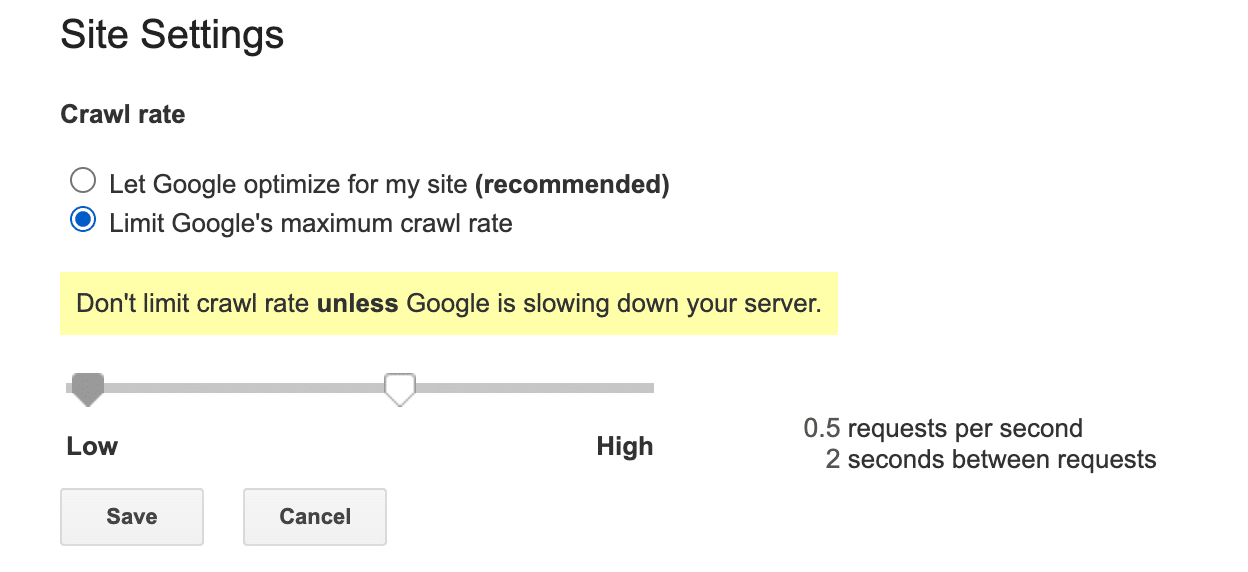
Why Google is removing it. Gary Illyes from Google said, “with the improvements we’ve made to our crawling logic and other tools available to publishers, its usefulness has dissipated.”
“Googlebot reacts to how the site–or more specifically the server handling the site– responds to Googlebot’s HTTP requests. For example, if the server persistently returns HTTP 500 status codes for a range of URLs, Googlebot will automatically, and almost immediately slow down crawling. Similarly, Googlebot slows down automatically if the response time for requests gets significantly longer. If you do experience unusually heavy crawling that your site can’t manage on its own, refer to this help article,” Gary Illyes added.
Illyes explained that the rate limiter tool within Google Search Console “had a much slower effect.” He said the tool often would “have taken over a day for the new limits to be applied on crawling.”
He added that the tool was “rarely” used by site owners and those who used it “in many cases set the crawling speed to the bare minimum.”
Crawl rate change. Google said with the deprecation of the crawl limiter tool, Google is setting the minimum crawling speed to a lower rate, comparable to the old crawl rate limits. So Google will “effectively continue honoring the settings that some site owners have set in the past if the Search interest is low, and our crawlers don’t waste the site’s bandwidth,” Illyes added.
What if you have issues. If you have issues with crawling, Google said you can read this help document and use the report form to let Google know.
Why we care. If you have been using this crawl rate tool, keep in mind it will be going away. So set a notification on your calendar to see what, if any, impact this has on your server when the feature is turned on.
The post Googlebot crawl rate tool in Search Console is going away appeared first on Search Engine Land.
Courtesy of Search Engine Land: News & Info About SEO, PPC, SEM, Search Engines & Search Marketing
Thursday, November 23rd, 2023
It’s been nearly a year since Google last updated its Search Quality Rater guidelines.
Unlike previous edits to the Search Quality Guidelines, which have introduced significant, new concepts (like the new E for Experience last year), the latest updates to the Search Quality Guidelines seem much more focused on user intent and needs met.
Google is:
- Refining what it means to provide high-quality search results.
- Helping quality raters understand why certain results are more helpful than others.
This level of nuance can help explain why we see certain volatility during core updates (as well as periods outside of announced algorithm updates).
If search quality raters have given Google ample evidence that its results are not meeting user expectations, this can lead to substantial intent shifts during core updates.
Looking at search results for the same query, before and after major Google updates, makes a lot more sense when you understand the granularity with which Google approaches understanding the intent behind a query, and what it means to have high-quality, helpful content.
Here are high-level insights into what has changed in the latest search quality rater guidelines update.
More guidance around rating page quality for forums & Q&A pages
Google added a new block of text to instruct raters on how to rate the quality of forum and Q&A pages, specifically in situations where the discussions are either brand new, or drifting into “combative,” “misleading” or “spammy content.”
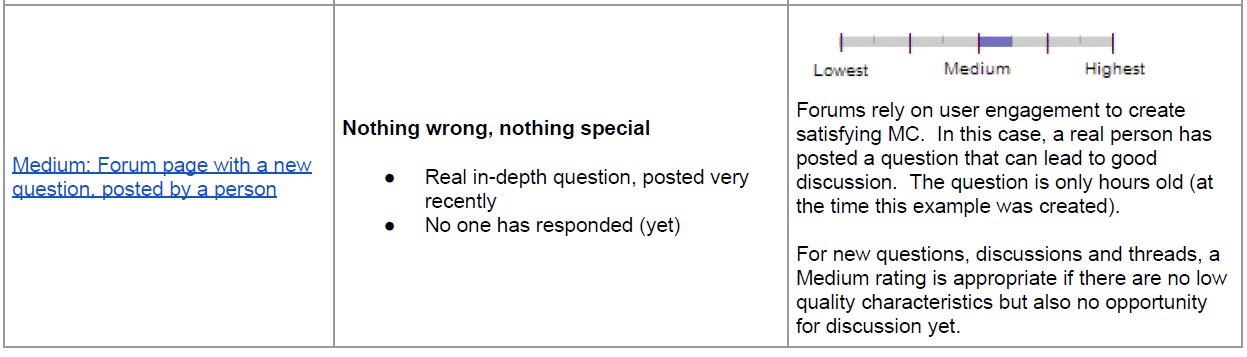
A forum page defaults to “medium” if it’s simply a new page that hasn’t had time to collect answers. But older posts without answers should be rated as low quality.
Google mentions “decorum” a few times in this section, indicating that combative discussions that show a lack of respect should be rated as low quality.
- This is a good reminder that the quality of comments on a given page can impact the overall quality of that page’s content, assuming Google can crawl and index the content in the comments. Often, comment sections are neglected or unmoderated, and if they become problematic, insulting or disrespectful, this can negatively impact an otherwise good-quality page.
 (Page 76)
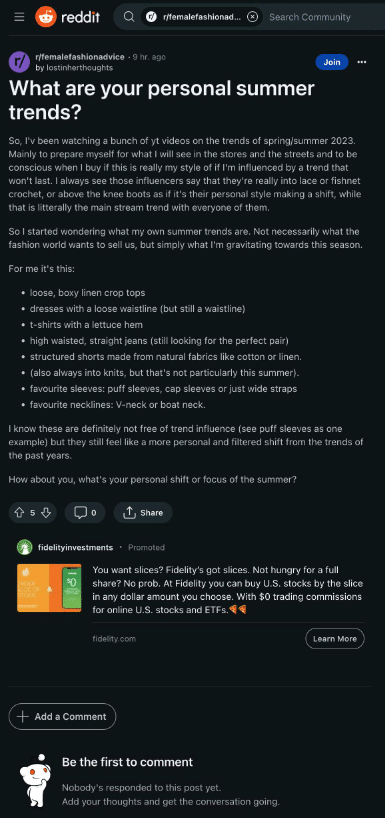
Additionally, the new version of the Search Quality Guidelines includes a visual example of what a “medium” quality forum page looks like on Reddit. The question is only 9 hours old and has no answers, so it defaults to a score of “medium.”
It’s worth noting that Google implies there are no other low-quality characteristics on this page that otherwise could lean the score towards “low quality” for new discussions.
 (Page 77)
Below is the example Reddit URL Google used in this case:
A quick addition about the importance of a location to a query
Google added a short snippet about the importance of user location to understanding a query. For searches looking for nearby places, location is important, whereas generic questions like “how does gravity work” have the same answer, regardless of the user’s location.
 (Page 84)
- Interestingly, Google felt this nuance was worth adding to the Rater Guidelines. While it seems self-explanatory, it’s true that the extent to which a search query has a built in “local intent” can have a major impact on the types of results that would best answer that query.
Expanding on “Minor Interpretations”
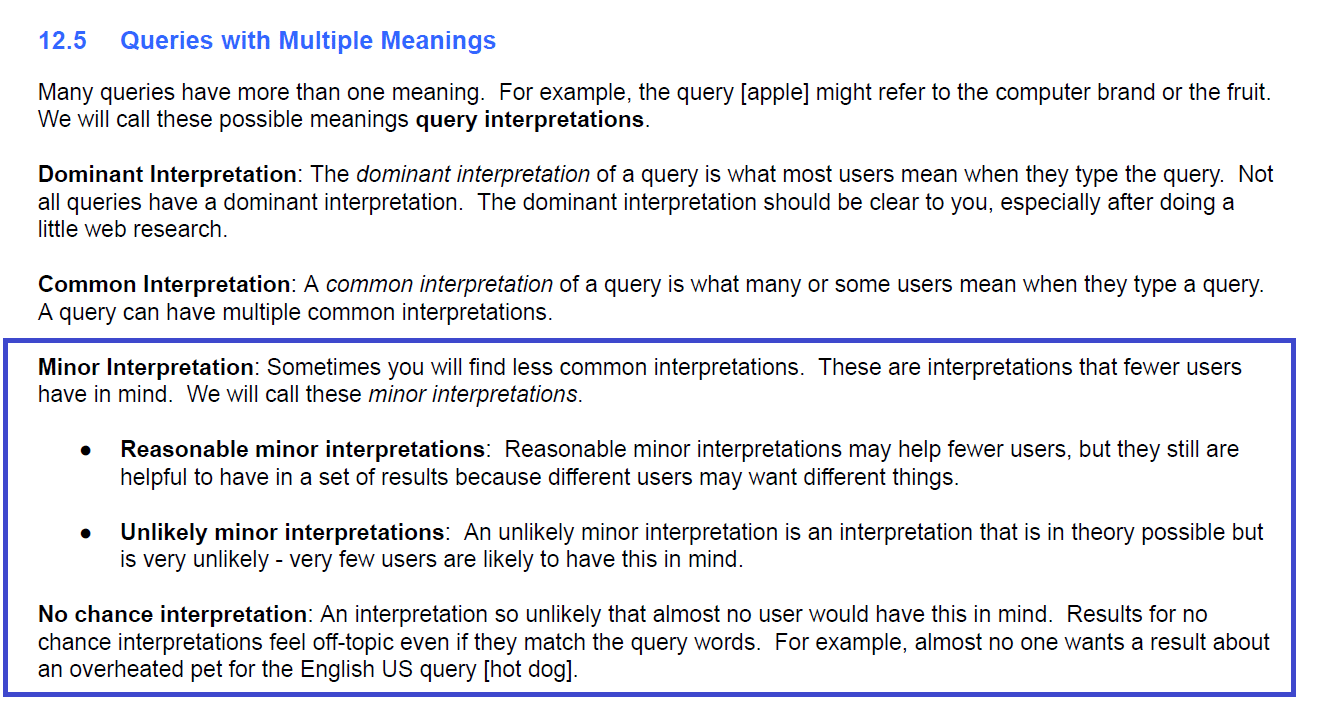
Google added a deeper explanation about its definitions for “Minor interpretations.”
Minor interpretations describe a situation when a query can have multiple meanings, and the minor interpretations are the least likely to be the commonly expected meanings of the query.
Within minor interpretations, Google introduced:
- “Reasonable minor interpretations,” which help “fewer users” but are still helpful for search results.
- “Unlikely minor interpretations,” which are theoretically possible but highly unlikely.
“No chance interpretations” are interpretations of a query that are incredibly unlikely for the user to be looking for. Google provides the example of an “overheated pet” when the searcher types “hot dog” (although I feel that this interpretation is more plausible than a “no chance” rating!).
 (Page 87)
Google also added some new visual examples of how to interpret these definitions. For example, an “unlikely minor interpretation” of the search query “Apple” would be the U.S. city, Apple, Oklahoma.
 (Page 88)
Further defining ‘Know Simple’ and ‘Do’ queries
Google added several new examples of what types of queries are not “Know Simple” queries.
“Know Simple” queries are defined as queries that seek a very specific answer, like a fact or a diagram, that can be answered in a small amount of space, like one or two sentences.
Google added three new examples of queries that are not Know Simple queries: when users want to browse or explore a topic, find inspiration related to a topic, or are seeking personal opinions and perspectives from real people.
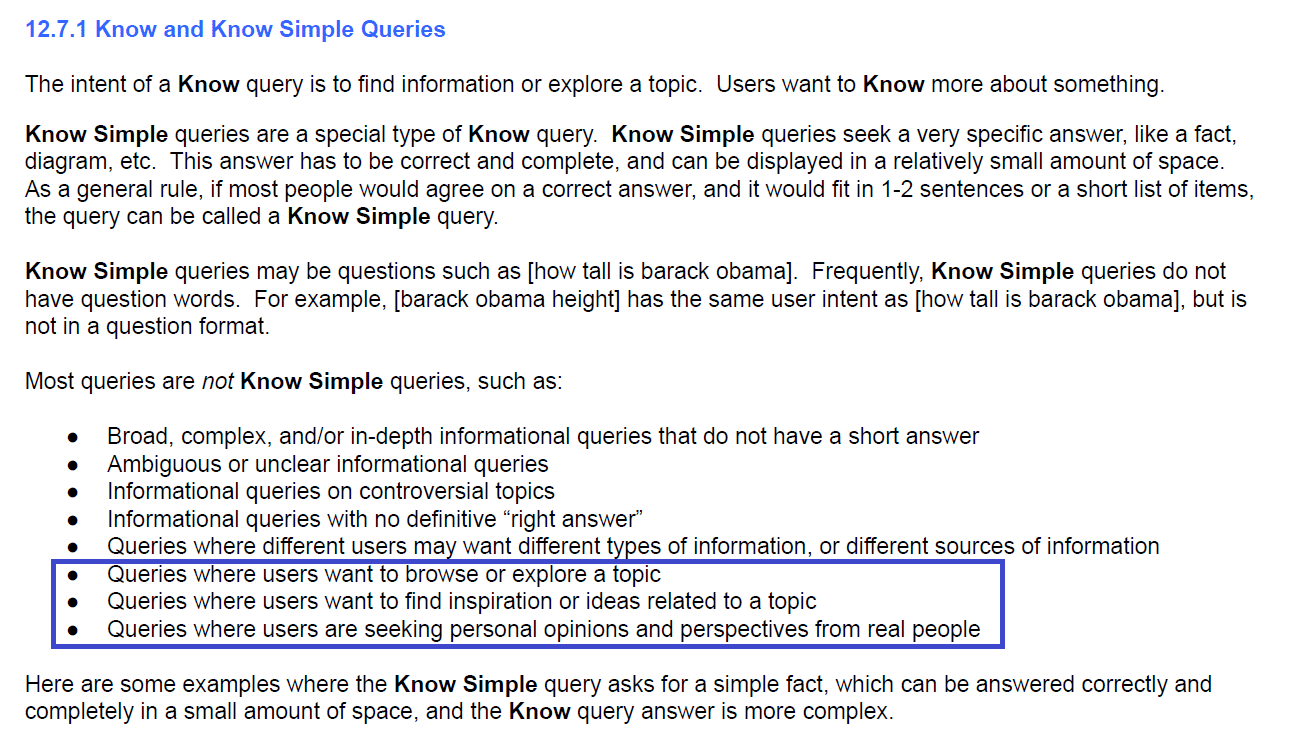 (Page 90)
What makes this addition interesting: The language used here is quite similar to the language Google uses when describing the value of SGE (Search Generative Experience). For example, the following language comes from the main SGE page:
- “Dive deeper on a topic in a conversational way.”
- “Access the high-quality results and perspectives that you expect from Google.”
- “I want to know what people think to help me make a decision”
Perhaps – and this is purely speculation – the feedback Google gets from quality raters about whether queries can be classified as “Know Simple” (or not) can help them understand when to trigger SGE.
Along the same lines, Google added two new examples of “Know Simple Queries” and “Know Queries” – the bottom two rows of the below table – to provide additional context about when a query is easily answered or when the answer is more open ended.
 (Page 91)
Google also added more examples of “Do” queries to the table below, starting with [shape of you video] and all queries below it. The three new examples represent queries that would be best answered with videos, images or how-to guides.
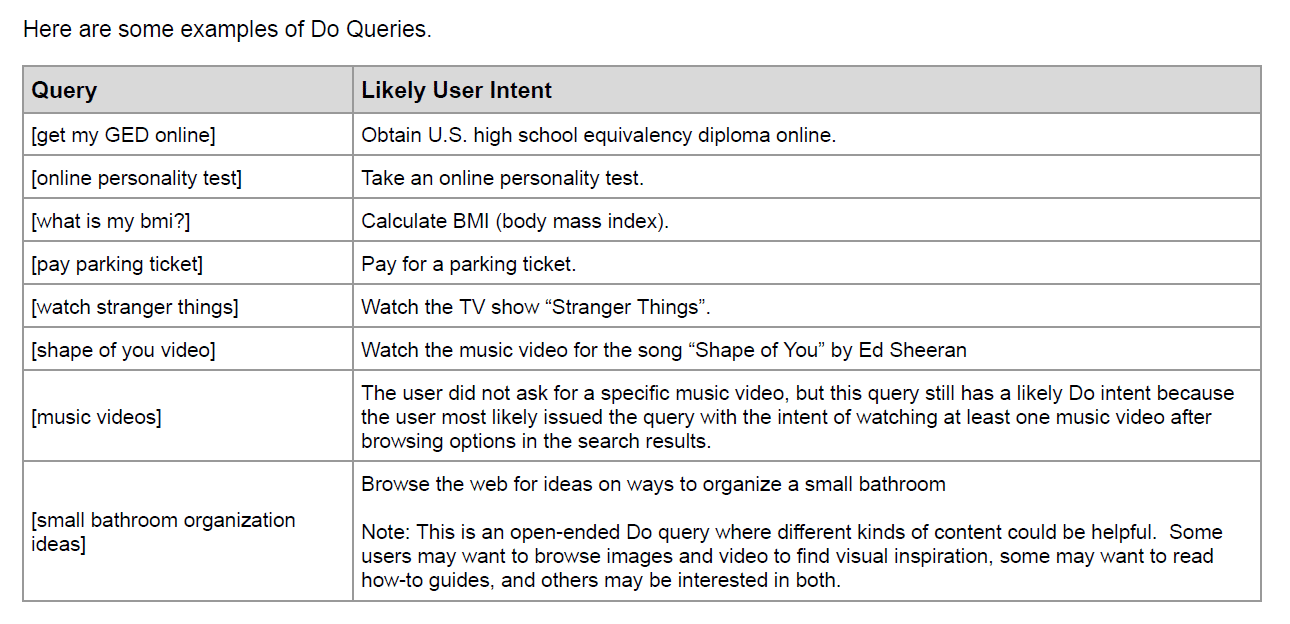 (Page 91)
Further refining user intent
Google introduced new language around user intent by classifying what is an unlikely user intent for a set of keywords.
In the table below, Google added a second column to explain unlikely intents for the keywords Harvard and Walmart. This limits the intent of these keywords to a more reasonable user intent, rather than a completely open-ended set of possible answers.
Users searching for “Harvard” could be looking for various details about the university, but are probably not looking for a specific course.
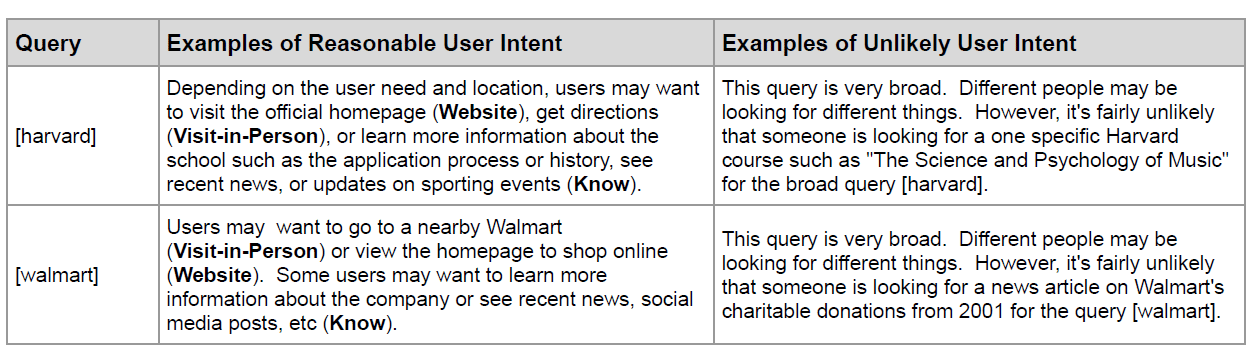 (Page 95)
Examples of Google’s SERP features that highly meet user needs
Google provides a table with various examples of search queries, the user’s location, and the user’s intent. It then shows the search result, and rates the extent to which the result met the expectations of the user (“Needs met”).
Google also offers an explanation about why these particular results are ranked as “highly meeting” the expectations of users.
In this new version of the QRG, Google added and adjusted some of the examples in the “Highly Meets (HM)” results, the highest possible rating of meeting user needs “for most queries.”
One example of a new example Google added to this list is one where the user is looking for “nearby coffee shops.” Google provides a screenshot of a Google Maps local pack with three coffee shops listed, and explains why this result highly, but not fully, meets the user’s expectation (it doesn’t list every possible coffee shop).
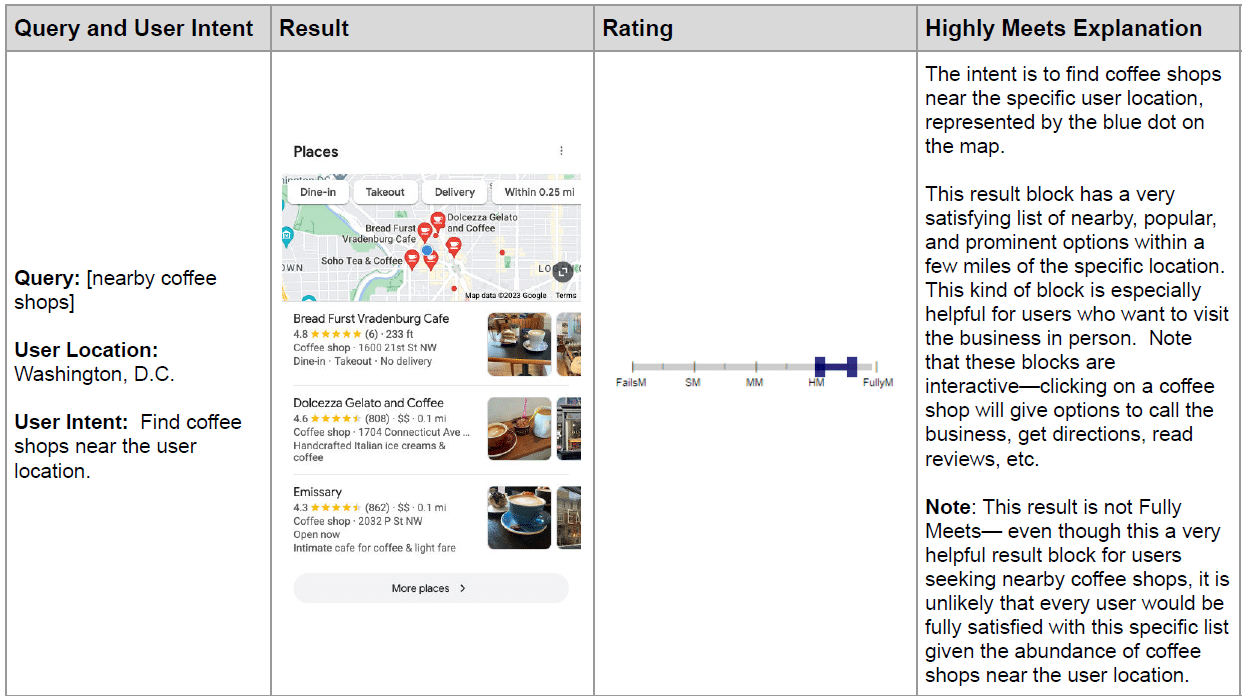 (Page 114)
Google even added a TikTok video as an example of a result that highly meets the needs of users looking an “around the world tutorial” for soccer.
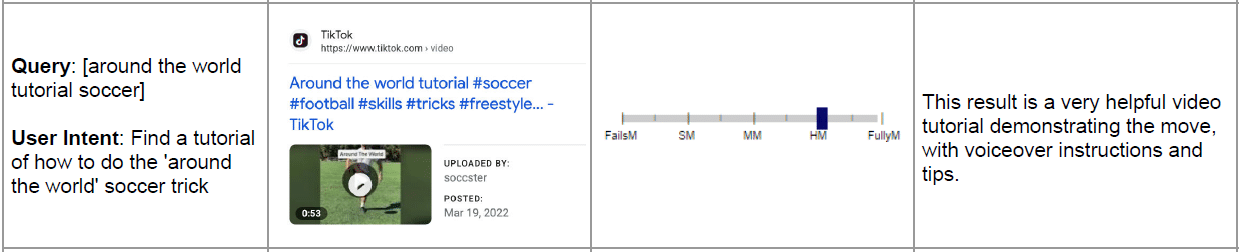
These are just some of the new examples, which seem to provide a more modern view of different results, both from external sites as well as Google’s own SERP features.
Dig deeper. An SEO guide to understanding E-E-A-T
The post Google’s 2023 Search quality rater guidelines update: Here’s what changed appeared first on Search Engine Land.
Courtesy of Search Engine Land: News & Info About SEO, PPC, SEM, Search Engines & Search Marketing
Thursday, November 23rd, 2023
Best of the Bot showcases Search Engine Land Bot’s responses to prompts submitted by readers. The language model is based on content from Search Engine Land layered on top of ChatGPT. The editors of Search Engine Land selected this response for its usefulness and have supplemented it with additional relevant content.
I am the first generative AI chatbot for search marketers. I am trained with Search Engine Land content.
Here’s something somebody asked me! After that, how you can improve prompts to get even better answers from me.
Prompt:
Create a Facebook post for crystal sale 30% off everything storewide black Friday sale at Dublin Rocks & Minerals.
Answer:
 Don’t miss out on the biggest crystal sale of the year! Dublin Rocks & Minerals is offering a spectacular Black Friday deal with 30% off everything storewide! Whether you’re a crystal enthusiast or looking for the perfect holiday gift, this is the perfect opportunity to add some sparkle to your collection. From amethyst to quartz, we have a wide selection of crystals to suit every taste and need. Join us on Black Friday and take advantage of this incredible offer. Our knowledgeable staff will be there to assist you in finding the perfect crystal for your needs. Don’t wait, this sale is only available for a limited time! Visit Dublin Rocks & Minerals at [store address] and get ready to indulge in the magic of crystals at unbeatable prices. See you there!
  #BlackFridaySale #CrystalSale #DublinRocksAndMinerals #30PercentOff #LimitedTimeOffer.
How this prompt could be improved
You are a veteran-owned retailer that sells unique high-quality minerals, crystals, and handcrafted jewellery sourced from around the world. Your products have all been carefully chosen for their beauty, energy, and transformative properties that your customers believe can bring happiness, beauty, and peace into their world. You have unwavering dedication to customer service. You are persuasive and trustworthy, which reassures consumers about making purchases from your brand, you have in-depth knowledge about your products and speak with confidence. Your target audience is spiritual people who prioritize their wellbeing and believe in the healing powers of crystals and minerals. Each social media post you share online aims to inform, inspire and sell products.
Please create a concise, impactful and engaging Facebook post for Dublin Rocks & Minerals to let their followers know that they have a one-off opportunity this Black Friday to buy your crystals with a 30% discount for a limited time only. The purpose of this post is boost sales and increase your social media followers.
Use emojis and other media where appropriate to drive consumers back to your product pages so that they can make a purchase.
The key elements and enhancements to this prompt are as follows:
(Task)
Please create a concise, impactful and engaging Facebook post for Dublin Rocks & Minerals to let their followers know that they have a one-off opportunity this Black Friday to buy your crystals with a 30% discount for a limited time only. The purpose of this post is boost sales and increase your social media followers.
(Context)
You are a veteran-owned retailer that sells unique high-quality minerals, crystals, and handcrafted jewellery sourced from around the world. Your products have all been carefully chosen for their beauty, energy, and transformative properties that your customers believe can bring happiness, beauty, and peace into their world. You have unwavering dedication to customer service.
(Tone)
You are persuasive and trustworthy, which reassures consumers about making purchases from your brand, you have in-depth knowledge about your products and speak with confidence.
(Example)
Your target audience is spiritual people who prioritize their wellbeing and believe in the healing powers of crystals and minerals. Each social media post you share online aims to inform, inspire and sell products. You use emojis and other media where appropriate to drive consumers back to your product pages so that they can make a purchase.
New SearchBot answer
As an AI assistant, I can provide you with a detailed content marketing and SEO plan for a digital marketing agency trying to drive more sales. Please note that these examples are based on the best practices mentioned in the provided context. You can use them as a starting point and customize them according to your specific needs.
 Exclusive Black Friday Offer: 30% Off on Transformative Crystals!
Calling all crystal enthusiasts and spiritual seekers! Dublin Rocks & Minerals is thrilled to announce our exclusive Black Friday sale!  For a limited time only, you can indulge in the magic of our high-quality crystals and handcrafted jewelry with an incredible 30% discount!

Immerse yourself in the captivating beauty and positive energy of our carefully curated collection sourced from around the world. Each crystal and gemstone has been chosen for its transformative properties, bringing happiness, beauty, and peace into your world. 

 Don’t miss out on this one-time opportunity to enhance your spiritual journey and surround yourself with the healing powers of nature. Whether you’re seeking balance, clarity, or protection, our crystals are here to guide you on your path to wellbeing.

Visit our website now to explore our wide range of crystals, minerals, and handcrafted jewelry. Click the link below to discover the perfect piece that resonates with your soul. 
 [Insert website link]
Let the transformative energy of crystals elevate your life. This Black Friday, embrace the power within and unlock a world of possibilities.
 Share this post with your friends and fellow crystal lovers to spread the joy of this incredible offer! Follow us for more updates, inspiration, and exclusive deals. Together, let’s create a community of enlightened souls.
#BlackFridaySale #TransformativeCrystals #SpiritualJourney #DublinRocksAndMinerals
Try Search Engine Land Bot
The post Best of the Bot: Create a Facebook post promoting Black Friday deals appeared first on Search Engine Land.
Courtesy of Search Engine Land: News & Info About SEO, PPC, SEM, Search Engines & Search Marketing
Thursday, November 23rd, 2023
Snapchat has started testing an ad-free paid subscription plan in Australia.
For $US10.50 a month, the new Snapchat+ tier enables consumers to use the platform without disruption from Story or Lens ads.
However, the app notes that users may still see sponsored places or My AI responses.
Why we care. Should ad-free subscriptions gain popularity, there is a potential for a notable impact on ad reach within Snapchat, subsequently affecting campaign performance and advertiser ROI. However, considering the substantial revenue generated by ads on Snapchat, it is improbable that the platform would willingly allow any negative impact on its advertising ecosystem.
Snapchat+ tiers.
Here is a breakdown of the various subscriptions currently offered in Australia. It’s important to note that as of now, ad-free plans have not been made widely available:
- Monthly plan: For $US3.91 a month, users can experience a version of Snapchat that serves all ad formats – this totals to $US46.97 a year.
- Annual plan: By signing up to a 12-month subscription, users pay $US2.73 a month for a version of Snapchat that serves all ad formats – this totals to $US32.67 a year.
- Ad-free monthly plan: For $US10.50 a month, users can experience a mostly ad-free version of Snapchat.
Snapchat+ subscriptions can be cancelled any time in the app store.
Australia market only. The ad-free Snapchat+ subscription plan is currently only being tested in Australia. It’s unclear if the new tier will be rolled out to consumers in the US given the platform’s reliance on ad revenue in America.
First look. The new Snapchat+ tier was first spotted by social media consultant, Jonah Manzano. He shared a screenshot of the new offering with his followers on Instagram:

When asked why he thought the plan was being tested in Australia before potentially being rolled out to additional markets, Manzano said:
- “The perception that Australia gets new features first may stem from social media companies choosing the country for initial testing due to its diverse user base and advanced technological infrastructure.”
- “It’s not solely based on laws or regulations but rather a strategic decision influenced by factors like user engagement and feedback.”
Get the daily newsletter search marketers rely on.
<input type=”hidden” name=”utmMedium” value=”“>
<input type=”hidden” name=”utmCampaign” value=”“>
<input type=”hidden” name=”utmSource” value=”“>
<input type=”hidden” name=”utmContent” value=”“>
<input type=”hidden” name=”pageLink” value=”“>
<input type=”hidden” name=”ipAddress” value=”“>
Deep dive. Visit the Snapchat Help Center for more information on the platform’s ad-free subscription plans.
The post Snapchat is testing an ad-free subscription appeared first on Search Engine Land.
Courtesy of Search Engine Land: News & Info About SEO, PPC, SEM, Search Engines & Search Marketing
Wednesday, November 22nd, 2023
In a world where even your toaster wants to discuss AI over breakfast, SEO professionals are currently mastering how to integrate it into their strategies – especially their content strategies.
For those who are still trying to grasp the concept of how AI and SEO can work synergistically for content, this article is for you. I’ll discuss:
How Google feels about AI
Search engines know the power of AI. Technology like ChatGPT (a Microsoft partner) is an asset to Bing and a threat to Google.
That is why Google has been testing Search Generative Experience (SGE).
At the same time, Google has been getting clearer with the SEO community on how it feels about AI content. Just see Google’s guidance about AI-generated content.
In that guide, Google says it will focus on “the quality of content, rather than how content is produced,” but that “using automation – including AI – to generate content with the primary purpose of manipulating ranking in search results is a violation of our spam policies.”
The bottom line is that using AI content is fine in your search engine strategies so long as it is original, helpful and demonstrates expertise, experience, authority and trust.
It is Google’s job to weed out the garbage. And, if AI creates a problem with the quality of its search results, Google will likely find a way to address it. But more on that next.
How Google’s generative AI might impact content and SEO as we know it
The organic search results as we know them today are a byproduct of the fact that Google cannot have 1 million experts on staff. They have to get the data from somewhere.
As I see it, Google will not be the single point of truth. It’s not in anybody’s interest to have Google be the expert – including Google.
So, websites and their content will always be there, and Google will always leverage others’ expertise.
So how will it work when Google starts to integrate more fully its AI functionality?
As it stands now, Google SGE will continue to pull information from expert sources across the web.
Google is testing its AI feature to display at the top of the search results, with the normal search engine result page underneath it, so people can still access the results that way.
As the AI generates answers, it cites the links of its sources so people can click through to the original sources.
Will this impact organic search traffic to your site? Definitely. For better or for worse? That remains to be seen.
Dig deeper: Preparing for Google SGE: Essential guide for marketers
Let’s now talk about the quality of the search results. If everyone starts using AI to generate answers – what happens to the integrity of the search results?
Using AI to create content outlines often brings up ideas for topics and research that the writers may not have considered. This gives them a new launching-off point.
So, in theory, if you are following a process that integrates AI-generated content in a way that doesn’t cut out the human writer and/or editor, the content can be of higher quality than before.
Now, if people are simply using AI tools to generate massive amounts of content without regard to quality, and those pages end up ranking, we could have a problem.
Many writers look to the top-ranking pages in the search results as part of their research process before writing the content.
You can task AI tools to pull answers from the search results, too.
So if 90% of all content in the search results is substandard AI-generated content, then it becomes a self-fulfilling prophecy that whatever AI says becomes the truth. (And we all know that AI is flawed.)
The silver lining in all this is that Google’s algorithms are pretty good at knowing today which websites out of millions deserve the top spots in its search results.
If you continue to differentiate through your content (being average won’t help you), you can continue to be viewed as an expert source that rises above the rest.
Ultimately, it’s the job of the search engine to ensure that AI garbage doesn’t dominate the search results.
And it’s the website publisher’s job to continue putting all their efforts into creating quality content.
How AI content is changing SEO skillsets
AI isn’t just for content creation.
AI-powered tools are helping SEOs do their jobs better in many of their day-to-day tasks, eliminating some of the more mundane and manual tasks they’ve been used to.
When it comes to content creation, the newest skillset for SEOs is understanding which AI tools are out there for content, and how to properly use them – whether you’re using the tools yourself or working alongside a content team.
A major portion of the time spent using these tools will be creating and perfecting the prompts for the AI tool.
The magic lies in the prework. Get this right, and you will spend less time editing the content.
I say “less” time because there will still be time spent editing (at least until the tools get even better).
Most SEOs don’t want to be AI content editors, but you are ultimately responsible for the work you turn into clients. So even if you work with content editors, you sign off on the content.
That means that another emerging skill set will be to view AI content with a critical eye before passing it to the client.
Because not every SEO will feel natural as a content editor, having a checklist for what quality content should be is helpful. (If ever in doubt, see what Google says about creating helpful, reliable content.)
You should also be able to bring a deep understanding of the brand(s) you serve so you can align the content with both search quality guidelines and client expectations.
Dig deeper: How to survive and thrive in a Google helpful content world
The challenges of AI content
AI-generated content does present challenges.
Redundancy, bad grammar, a lack of personal experience and an overall “generic” approach to the content can rear its ugly head.
And because AI programs lack a human touch, there isn’t anyone to verify facts, figures or statements.
It can be challenging to differentiate between content that adds genuine value versus long, but ineffectual articles (and AI certainly can ramble). Again, this takes a keen eye.
This is exactly the reason that AI content needs professional editors.
All AI-generated content should be considered a “rough draft.” The most effective approach to using AI tools today is combining them with human review.
Get the daily newsletter search marketers rely on.
<input type=”hidden” name=”utmMedium” value=”“>
<input type=”hidden” name=”utmCampaign” value=”“>
<input type=”hidden” name=”utmSource” value=”“>
<input type=”hidden” name=”utmContent” value=”“>
<input type=”hidden” name=”pageLink” value=”“>
<input type=”hidden” name=”ipAddress” value=”“>
Integrating AI content into your SEO strategy: Five steps
It’s no secret that SEOs and the companies they serve are finding success with artificial intelligence-powered articles.
Creating a system to leverage AI is key.
When done right, AI can help boost your online visibility faster because generating article outlines and first drafts via AI can save significant writing time.
After much experimentation, we have found a process that currently works for generating AI content for brands that aligns with SEO goals for search engines and search engine users.
Now, I’ll outline the steps we take to make AI content work, including:
- Persona identification
- Keyword selection
- The prewriting stage
- Content editing
- Content optimization
1. Persona identification
It may come as no surprise that you should still lean heavily on traditional marketing tactics before you create your content.
This means having an understanding of the persona that you are targeting with the content.
Some companies may already have their personas ready to go. In the absence of that, SEOs will need to do some of the legwork, which many already know how to do.
You could also use an AI tool to help you identify the persona(s). For example, you could feed an article to an AI tool and ask it to help you identify the target audience for that topic.
2. Keyword selection
Another traditional step in content creation for SEO that is not going away is identifying the search queries that the target audience is using.
You still need a target as to what you will write about and what other topics are related to that topic.
This helps with the next step, which is an outline.
For example, you could use an AI tool to take a particular keyword (a.k.a., a topic you want to write about) and generate things like:
The goal is to then take that list and organize it into a preliminary outline of topics that you want to write about.
The SEO and/or the writer will decide which out of all the keywords / topics generated are worthy of being included in the outline.
You should now have an outline to feed to the AI tool.
3. The prewriting stage
This is where the rubber meets the road. SEOs need a solid process for how they will prompt the AI tools to output the content.
This is typically where the most thought will go into the process in terms of how you want the AI-generated content to be.
Depending on the AI tool, the prompt may vary, but some ideas include:
- Indicate what type of persona the author of the content is.
- Confirm who the target audience is for the topic.
- Discuss the tone of voice you desire.
- Talk about how you would like the article formatted.
- List any other parameters that you would require to be quality content.
For some AI tools, you may want to ask, “Do you understand?” to get confirmation before moving on to the next step.
Then, the next step is to ask the tool to create an article using the outline you generated in the previous stage of the process and with the prompts that you clarify.
The whole process from start to finish, once you have the prompts down, should take only minutes, usually under 10 minutes.
You now have a rough draft that goes into editing.
Dig deeper: Perfecting prompts for SEO content development
4. Content editing
Here’s where you need a skilled editor. Ideally, the editor is not only a good editor but also is up to speed on the brand(s) that the content is being created for.
Bonus points here for editors who have subject matter expertise in the thing that is being written about.
And please note that not all writers are natural editors – writing and editing can require different skill sets.
All the basic facets of editing will need to be covered here, including:
- Fact-checking
- Tone of voice
- Grammar
- General flow
- Asking: Does this actually make sense?
- Sticking to any brand guidelines
Expect one to two rounds of editing on average before you get it to completion, depending on the technicality of the subject matter.
5. Content optimization
During the process of creating the outline and generating a first draft, you will have an article or page that is naturally optimized for the topics you want to talk about.
Where the human element comes in is to further optimize the webpage beyond just the topics and keywords.
This is where the SEO will perform all the best practices for optimization that need to happen for that webpage as they normally would.
Dig deeper: AI-generated content in 2024: How to excel and where to exercise caution
It’s time to adapt again
SEOs are no stranger to adapting to changes, and AI content presents a massive shift that we must all adapt to.
If done right, AI content presents opportunities to deliver the content that clients need while saving time. money and upholding quality.
The post AI content creation: A beginner’s guide appeared first on Search Engine Land.
Courtesy of Search Engine Land: News & Info About SEO, PPC, SEM, Search Engines & Search Marketing
Wednesday, November 22nd, 2023
Google Ads is investigating reports of an issue impacting AdMob.
The affected users have said that while they are able to access AdMob, they cannot retrieve their most recent data.
Some clicks that are recorded from Apple iOS 17 devices are not being counted in the reports, leading to inaccurate reporting as a consequence.
Why we care. Inaccurate data may result in an incorrect understanding of the performance of ad campaigns, making it challenging for advertisers to optimize their strategies effectively.
When will the problem be fixed? Google is continuing to investigate this issue with an update expected at 7pm UTC on 22 November 2023.
Google confirmed that it started investigating the issue at 11.14pm on 21 November 2023.
Get the daily newsletter search marketers rely on.
<input type=”hidden” name=”utmMedium” value=”“>
<input type=”hidden” name=”utmCampaign” value=”“>
<input type=”hidden” name=”utmSource” value=”“>
<input type=”hidden” name=”utmContent” value=”“>
<input type=”hidden” name=”pageLink” value=”“>
<input type=”hidden” name=”ipAddress” value=”“>
Deep dive. Read the service disruption announcement from Google in full for more information.
The post Google Ads investigating issue impacting AdMob appeared first on Search Engine Land.
Courtesy of Search Engine Land: News & Info About SEO, PPC, SEM, Search Engines & Search Marketing
Wednesday, November 22nd, 2023
YouTube has admitted to intentionally creating a suboptimal experience for users employing ad blockers.
Reports of a deliberate five-second delay in loading video pages on Mozilla’s Firefox have emerged on forums like Reddit and Hacker News.
Despite initial speculation about browser specificity, YouTube has clarified that users across all platforms may encounter loading delays. This deliberate delay is part of YouTube’s ongoing campaign to discourage the use of ad blockers.
Why we care. Encouraging users to disable ad blockers on YouTube can benefit advertisers by expanding reach. However, this broader reach might increase advertising costs and result in ads reaching less valuable customers, impacting the effectiveness of the marketing strategy. Achieving a balance between reach and targeting is crucial for optimizing return on investment.
Who is impacted? Not everyone is experiencing the reported five-second delay. Attempts by some individuals to recreate the issue on both Mac and Windows machines, while logged into YouTube or not, using ad-blockers or not, and in incognito mode or not, did not result in any observed delay. However, those that are impacted do have ad blockers installed.
What YouTube is saying. A YouTube spokesperson told Business Insider:
- “In the past week, users using ad blockers may have experienced suboptimal viewing, which included delays in loading, regardless of the browser they are using. Users who have uninstalled their ad blockers may still experience a temporary delay in loading, and should try refreshing their browser.”
- “Ads are a vital lifeline for our creators that helps them run and grow their businesses. That’s why the use of ad blockers violates YouTube’s Terms of Service.”
- “We’ve been urging users for some time to allow ads on YouTube or try YouTube Premium for an ad-free experience.”
Get the daily newsletter search marketers rely on.
<input type=”hidden” name=”utmMedium” value=”“>
<input type=”hidden” name=”utmCampaign” value=”“>
<input type=”hidden” name=”utmSource” value=”“>
<input type=”hidden” name=”utmContent” value=”“>
<input type=”hidden” name=”pageLink” value=”“>
<input type=”hidden” name=”ipAddress” value=”“>
Deep dive. Read our report on YouTube’s ad blocker crackdown for more information.
The post YouTube is deliberately ‘suboptimal’ for people using ad blockers appeared first on Search Engine Land.
Courtesy of Search Engine Land: News & Info About SEO, PPC, SEM, Search Engines & Search Marketing
Wednesday, November 22nd, 2023
Sam Altman is returning as CEO, OpenAI announced.
It is – perhaps (hopefully?) – the final chapter of a chaotic week that saw Altman ousted as CEO, two interim CEOs announced and nearly every OpenAI threaten to quit and go to Microsoft unless the entire board resigned.
The announcement. OpenAI announced the news via an X post on Tuesday night:
- “We have reached an agreement in principle for Sam Altman to return to OpenAI as CEO with a new initial board of Bret Taylor (Chair), Larry Summers, and Adam D’Angelo. We are collaborating to figure out the details. Thank you so much for your patience through this.”
Why we care. Now that the drama is over, let’s solve these ChatGPT service interruptions. Some of us are trying to work.
Status quo ante. Despite all the drama, OpenAI seemingly is now returning back to the way things were before all the drama that unfolded started Friday, with the shocking news that Altman had been ousted as CEO and all the chaos that followed.
They’re back. OpenAI’s (former – and once again(?) president) Greg Brockman shared this image via X:
Microsoft’s reaction. Altman posted that this move had the support of Microsoft Chairman and CEO Satya Nadella:
- “i love openai, and everything i’ve done over the past few days has been in service of keeping this team and its mission together. when i decided to join msft on sun evening, it was clear that was the best path for me and the team. with the new board and w satya’s support, i’m looking forward to returning to openai, and building on our strong partnership with msft.”
Nadella reposted Altman’s message and added:
- “We are encouraged by the changes to the OpenAI board. We believe this is a first essential step on a path to more stable, well-informed, and effective governance. Sam, Greg, and I have talked and agreed they have a key role to play along with the OAI leadership team in ensuring OAI continues to thrive and build on its mission. We look forward to building on our strong partnership and delivering the value of this next generation of AI to our customers and partners.”
Dig deeper. See Techmeme for all the coverage.
The post Sam Altman returns to OpenAI as CEO ‘in principle’ appeared first on Search Engine Land.
Courtesy of Search Engine Land: News & Info About SEO, PPC, SEM, Search Engines & Search Marketing
Tuesday, November 21st, 2023
Google has addressed the most commonly asked questions it receives about automatically-created assets (ACA) and provided some much-needed answers.
Why we care. As more generative AI tools become available to marketers, choosing the right one can be challenging. The confusion about these tools and their proper usage adds to the complexity. Understanding the capabilities of features like ACA can empower marketers to make informed decisions on whether to incorporate them for optimizing their campaign performance.
Google addresses ACA confusion
Ginny Marvin, Product Liaison at Google, used her X account to answer some of the most commonly asked questions her team receives about ACA:
What’s the point of ACA? “When you enable automatically-created assets at the campaign level, it will create headlines and descriptions for your RSAs. The main goals are to help you save time and provide incremental conversion opportunities with more relevant ads.”
How are ACA used? “RSAs can assemble ad combinations that are predicted to perform best using both the assets you’ve provided and automatically generated assets.”
Where does ACA pull content from? “Automatically created assets are generated from your own content, including your landing pages, existing ads and keywords. Tip: Be sure your website is up-to-date when using this feature!”
Where can I see automatically-created assets? “ACA will be labeled as ‘Automatically created’ in the ‘Asset source’ column in ad- and campaign-level asset reporting. You’ll also see when ACAs are included in Combination reports.”
Can I remove ACA? “Yes, you can review & remove assets you don’t want to serve any more. In addition, any automatically created assets with a ‘low’ performance rating get removed, well, automatically.”
Can I test ACA in Campaign Experiments? “Yep! Draft and Experiments are compatible with ACA. You will see automatically created assets on both the test and control arm, however the control side will serve 0 ACA impressions.”
Should I just rely on ACA? “ACA should augment, not replace, your existing assets. Keep the assets you’ve already created and continue to provide as many as you can (up to 15 headlines and 4 descriptions). Note that ACA don’t count toward these asset limits.”
Marketers give their verdict
Thomas Eccel, SMX Next speaker and Senior Performance Marketing Manager at Jung von Matt IMPACT, advised that while ACA can be a great source of inspiration, this feature needs to be closely monitored. He told Search Engine Land:
- “RSAs can work in my opinion to get inspiration of which Headlines and Description Google think could be potentially driving conversions for my account.”
- “I would not blindly active them on all accounts: do not activate them for accounts with high brand-control or for accounts where only some specific texts and wordings are allowed.”
- “If activated I would advise to closely monitor the asset creation and the sense of texts to not find surprises.”
Sarah Stemen, MBA, paid search expert and board member of the Paid Search Association, also shared her findings regarding ACA after experimenting with them in beta:
- Risk awareness: “I got client permission before we tested this (whenever you are testing something like this NEVER test this without making the risks very clear to ALL stakeholders, everyone MUST be on the same page).”
- Monitor daily: “These are indeed pulled from the website which means if you are running a sale on the website a headline will be pulled! If this is a short term sale you risk this headline or description running until the asset is removed by Google so YOU need to monitor this.””
- Headline issue: The platform will generate headlines longer than the rules (I see this as an advantage).”
- ACA can be boring: “I know, I know we complain that the automatically created anything is ‘bad’ but during the time we tested this in our account +95% of the assets were harmless. Mostly the assets were boring.”
- Human created assets win: “None of the automatically created assets performed better than the human created assets (note when I say perform I mean ‘had more impressions’ because RSA assets don’t perform the ad unit performs).”
- Watch for case inconsistencies: “All title case human written assets vs sentence style assets – but again you can remove.”
Get the daily newsletter search marketers rely on.
<input type=”hidden” name=”utmMedium” value=”“>
<input type=”hidden” name=”utmCampaign” value=”“>
<input type=”hidden” name=”utmSource” value=”“>
<input type=”hidden” name=”utmContent” value=”“>
<input type=”hidden” name=”pageLink” value=”“>
<input type=”hidden” name=”ipAddress” value=”“>
Language expansion. ACA for responsive search ads was rolled out in September for general availability in eight languages:
- Dutch
- English
- French
- German
- Italian
- Japanese
- Portuguese
- Spanish
Get the daily newsletter search marketers rely on.
Deep dive. Watch Google’s quick video tutorial on automatically created assets for more information or read Google’s responsive search ad guide for best practices on creating responsive search ads.
The post Google shares automatically-created assets FAQ and marketers give their verdict appeared first on Search Engine Land.
Courtesy of Search Engine Land: News & Info About SEO, PPC, SEM, Search Engines & Search Marketing
Tuesday, November 21st, 2023
Google Ads has stopped supporting Store Sales Direct (SSD) as a standalone product.
The update means that SSD conversion upload requests to the Google Ads API are also no longer supported.
Why we care. If you relied on SSD, Google said to review the Store Sales onboarding guide to understand your eligibility for ongoing store sales measurement. Work with your Google Ads account team to update the feature.
Improving shop sales reports. The update aims to simplify Google Ads’ Store Sales product, providing improved shop sales measurement and reporting data. It impacts businesses falling into:
- Automotive OEM (Original Equipment Manufacturer) or Automotive Regional Dealer – Beta.
- Restaurant.
- Retailer.
Error message. Users previously allowlisted for this feature will now receive a NOT_ON_ALLOWLIST_FOR_STORE_SALES_DIRECT error when attempting to upload SSD conversions. However, existing SSD conversions will continue to be available in reports.
Get the daily newsletter search marketers rely on.
<input type=”hidden” name=”utmMedium” value=”“>
<input type=”hidden” name=”utmCampaign” value=”“>
<input type=”hidden” name=”utmSource” value=”“>
<input type=”hidden” name=”utmContent” value=”“>
<input type=”hidden” name=”pageLink” value=”“>
<input type=”hidden” name=”ipAddress” value=”“>
The post Google Ads no longer supports Store Sales Direct appeared first on Search Engine Land.
Courtesy of Search Engine Land: News & Info About SEO, PPC, SEM, Search Engines & Search Marketing