Archive for the ‘seo news’ Category
Friday, December 15th, 2023
YouTube creators can now give away 10 free subscriptions each month as part of a new program aimed at facilitating audience growth.
Eligible creators with channel memberships can use this benefit at no extra cost to promote the perks of their memberships.
Why we care. This promotion is designed to give viewers a taste of the benefits offered by subscribing to your channel. Once they recognize the value, there’s potential for them to upgrade to full-paying members, contributing to increased revenue and brand awareness.
Getting started. To ensure your account is eligible for this off, make sire you:
- Have channel memberships enabled on your channel.
- Offer a membership tier below $5.
How it works. To give away these complimentary memberships to viewers during a live stream or Premiere, follow these simple steps:
- Click the “$” icon within the live chat.
- Select “Membership gifting”.
- Click “Gift 5 Now”.
You can give out gift memberships in batches of 5, twice a month. Share them in one stream or across several throughout the month. Unused gifts reset on the 1st of each month, so be sure to use them regularly.
Exclusions. Free of charge gift memberships are not currently available for Brand Accounts – however YouTube has confirmed it will be soon. You can check to see if you’re using a Brand account by:
- Signing into your Google account.
- Look in “Your Brand Accounts” to locate your linked Brand Accounts.
Ensure you’re using the correct account by clicking on your profile picture in the top right corner if you don’t see any listings.
What YouTube us saying. Currently, creators cannot individually select who benefits from free subscriptions, however, a YouTube spokesperson explained on X this may change:
- “We’ve seen a lot of this feedback [about this] and we’ve shared it with the team working on memberships gifting.”
- “These free of charge gift memberships are distributed to viewers based on how much they’ve watched and interacted with your channel for now, but we’ll keep you updated if that changes!”
Get the daily newsletter search marketers rely on.
Deep dive. Read Google’s ‘manage channel memberships‘ guide for more information on promotional gift memberships.
Courtesy of Search Engine Land: News & Info About SEO, PPC, SEM, Search Engines & Search Marketing
Thursday, December 14th, 2023
Google is reviewing complaints regarding an ad policy update that enforces tighter restrictions on consumer financial products and services.
Following the rollout, marketers have complained that the policy is so “overarching”, it is causing issues for advertisers outside the consumer finance sector.
Why we care. If your Google Ads campaigns are facing disapproval or limitations as a result of this update and you’re unsure why, it might not be due to a violation of Google’s policies. The issue could be attributed to Google’s own processes.
Personalized ads policy update. A few weeks ago, Google revealed plans to update its Personalized ads policy, introducing restrictions on personalized ads for consumer financial products and services. The expanded policy will change the name from “Credit in personalized ads” to “Consumer finance in personalized ads.” The updated policy states:
- “In the United States and Canada, the following sensitive interest categories cannot be targeted to audiences based on gender, age, parental status, marital status, or ZIP code.”
Issues for advertisers. PPC expert and Search Engine Land award-winner Greg Kohler shared a screenshot on X of his account after a handful of ads were disapproved or limited as a result of the update:

Greg said that his campaigns were experiencing these difficulties because of Google’s policy update, which he claims was “pushed through automated checks.”
He then revealed how one campaign triggered the policy violation simply for including the term “apartments” in the keyword group, writing on X:
- “These automated checks are always way too overarching when they’re first applied – I can’t even add this keyword in the interface since it’s rejected based on just including ‘apartments”‘.”

What Google is saying. Google Ads liaison officer Ginny Marvin personally acknowledged Greg’s complaint, expressing gratitude for bringing it to their attention. She then confirmed her intention to privately message him for additional details, indicating that the matter would be investigated.
Search Engine Land will provide you with updates on future developments from Google.
Get the daily newsletter search marketers rely on.
Deep dive. Read Search Engine Land’s report on Google’s personalized ads policy update for more information on how consumer finance ad targeting will be restricted moving forward.
Courtesy of Search Engine Land: News & Info About SEO, PPC, SEM, Search Engines & Search Marketing
Thursday, December 14th, 2023
This is a gentle reminder that Google is updating its ad-serving requirements in the European Economic Area (EEA) and the UK in the coming weeks.
Under the new rules, publishers and developers using Google AdSense, Ad Manager, or AdMob in these regions must use a certified Consent Management Platform (CMP) that has been certified by Google and has integrated with the IAB Europe’s Transparency and Consent Framework (TCF).
Enforcement will begin on January 16, 2023, and will affect a small percentage of EEA and UK traffic. It will then gradually expand to all EEA and UK traffic by the end of February 2024.
Why we care. If you are running campaigns in these regions and fail to adopt a Google certified CMP, only programmatic limited ads will be served, which could have a significant impact on your monetization.
What is a certified CMP? A Google-certified CMP is a platform approved by Google to assist businesses in managing user consent for online advertising and data collection, adhering to the IAB’s Transparency and Consent Framework (TCF) v2. Check if your CMP is certified by viewing Google’s full list of certified CMPs here.
What if my CMP is not certified by Google? If your current CMP isn’t listed among Google’s certified CMPs, it is recommended to reach out to your CMP directly to inquire about their certification status.
What is IAB Europe? The Interactive Advertising Bureau Europe, a coalition of 27 national IABs across Europe and over 500 companies, works to help the digital ecosystem understand consumer trends and platform habits by conducting research and providing legal support for the online advertising industry. The ultimate aim is to empower businesses to create messages that effectively and efficiently resonate with consumer preferences.
What is the TCF? TCF is a voluntary standard developed by IAB Europe that fosters collaboration between website publishers, app developers, and technology partners. It ensures a standardized user experience for privacy choices, allowing users to grant or withhold consent and exercise their ‘right to object’ to data processing, based on practical requirements from Data Protection Authorities and legal principles.
Get the daily newsletter search marketers rely on.
Deep dive. Read Google’s announcement in full for more information.
Courtesy of Search Engine Land: News & Info About SEO, PPC, SEM, Search Engines & Search Marketing
Thursday, December 14th, 2023
Ever wondered what would happen if you prevented Google from crawling your website for a few weeks? Technical SEO expert Kristina Azarenko has published the results of such an experiment.
Six surprising things that happened. What happened when Googlebot couldn’t crawl Azarenko’s site from Oct 5 to Nov. 7:
- Favicon was removed from Google Search results.
- Video search results took a big hit and still haven’t recovered post-experiment.
- Positions remained relatively stable, except were slightly more volatile in Canada.
- Traffic only saw only a slight decrease.
- An increase in reported indexed pages in Google Search Console. Why? Pages with noindex meta robots tags ended up being indexed because Google couldn’t crawl the site to see those tags.
- Multiple alerts in GSC (e.g., “Indexed, though blocked by robots.txt”, “Blocked by robots.txt”).
Why we care. Testing is a crucial element of SEO. All changes (intentional or unintentional) can impact your rankings and traffic and bottom line, so it’s good to understand how Google could possibly react. Also, most companies aren’t able to attempt this sort of an experiment, so this is good information to know.
The experiment. You can read all about it in Unexpected Results of My Google Crawling Experiment.
Another similar experiment. Patrick Stox of Ahrefs has also shared results of blocking two high-ranking pages with robots.txt for five months. The impact on ranking was minimal, but the pages lost all their featured snippets.
Courtesy of Search Engine Land: News & Info About SEO, PPC, SEM, Search Engines & Search Marketing
Thursday, December 14th, 2023
Google will begin testing a new feature that restricts third-party cookies by default in the coming weeks.
The Tracking Protection tool will be rolled out on January 4, 2024, to 1% of Chrome users globally.
Why we care. Be aware that if your website depends on third-party cookies, this rollout might pose challenges. Take this rollout as a heads-up to ensure your site is prepared well in advance before Google retires third-party cookies entirely in the latter half of 2024.
Why now? Google views this as a crucial step in its Privacy Sandbox initiative, aiming to phase out third-party cookies for everyone by the second half of 2024. However, the final decision depends on addressing any lingering competition concerns from the UK’s Competition and Markets Authority.
Am I affected? Google is selecting the 1% of Chrome users at random. If Tracking Protection is being rolled out to you, you will receive notifications upon opening Chrome on desktop or Android in January.
Potential issues. If a site relies on third-party cookies and the roll out of Tracking Protection causes issues (for example, you refresh a page multiple times), Chrome will prompt you to temporarily re-enable them by clicking the eye icon on the address bar’s right side.
What Google is saying. A Google spokesperson said in a statement:
- “Third-party cookies have been a fundamental part of the web for nearly three decades. While they can be used to track your website activities, sites have also used them to support a range of online experiences — like helping you log in or showing you relevant ads.”
- “As we introduce Tracking Protection, we’re starting with a small percentage of Chrome users so developers can test their readiness for a web without third-party cookies.”
What is Google’s Privacy Sandbox initiative? The Privacy Sandbox initiative develops tech that safeguards online privacy while providing companies and developers with tools to build successful digital businesses.
The Privacy Sandbox has two primary objectives:
- Phase out support for third-party cookies when new solutions are in place.
- Reduce cross-site and cross-app tracking while helping to keep online content and services free for all.
What are third-party cookies? A third-party cookie is a small piece of data placed on a user’s device (computer, cellphone, or tablet) by a website different from the one the user is currently visiting. Primarily utilized in online advertising, these cookies track a user’s browsing history and activities, enabling targeting for personalized ads for products and services.
Get the daily newsletter search marketers rely on.
Deep dive. Read ‘SEO and the future world without cookies‘ by Search Engine Land contributor Adam Audette for more information on what a cookieless world will look like for SEO and PPC marketers.
Courtesy of Search Engine Land: News & Info About SEO, PPC, SEM, Search Engines & Search Marketing
Wednesday, December 13th, 2023
Have you ever seen your traffic decline over time despite your top keywords ranking in Position 1? I have, and it’s the worst feeling.
It might feel like Google is punishing you for being successful, but that’s not the case.
Google doesn’t know you, but they do know users. And if your work is ranking in the top positions, but traffic continues to decline, it might not be your fault.
Here’s what you can do to revitalize your website’s traffic.
How to investigate traffic drops when rankings are solid
Your stakeholders are breathing down your neck and pressuring you for answers. Don’t panic, take a breath.
While you may not be able to magically bring users back to your site in an hour, you can at least do some quick research to figure out why.
An easy first step is to check search trends. This should be your very first step.
Check keyword trends from SEO tools
Most SEO research tools now have search volume interest over time. Here are some examples from Semrush.
Keyword: ‘best cars of 2022’
You would naturally expect a strong drop-off for most “2022” keywords once January 2023 arrives.
Let’s try something less stuck in the past and more evergreen.
Keyword: ‘movie theaters near me’
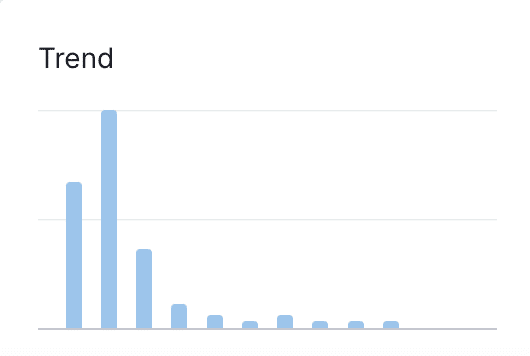
Now, this is an interesting topic. Here, we can see a spike around August and September, followed by a dropoff.
Barbie and Oppenheimer both came out in late July, maintaining popularity throughout those months.
Let’s say you’re the SEO for a major movie theater brand, and you say, “Hey John, this is normal seasonal behavior for movie theaters. My problem is that my boss complains that traffic has declined for years and we can’t figure out why.”
To zoom out even further, we need to use Google Trends.
Check Google Trends
This tool can sometimes lead us to helpful clues on cultural impact for search terms.
Now it’s important to quickly note the difference between search terms and topics in Google Trends. Here’s an oversimplified explanation:
- Search terms are simply keywords or search queries.
- Topics are entities that may encompass multiple search terms.
Now let’s type “movie theaters” and select Topic so that we get a better view of the landscape.
Before we move on, note that “Movie theater cleaning” as a topic follows closely after our main topic. That’s important for later. Don’t forget!
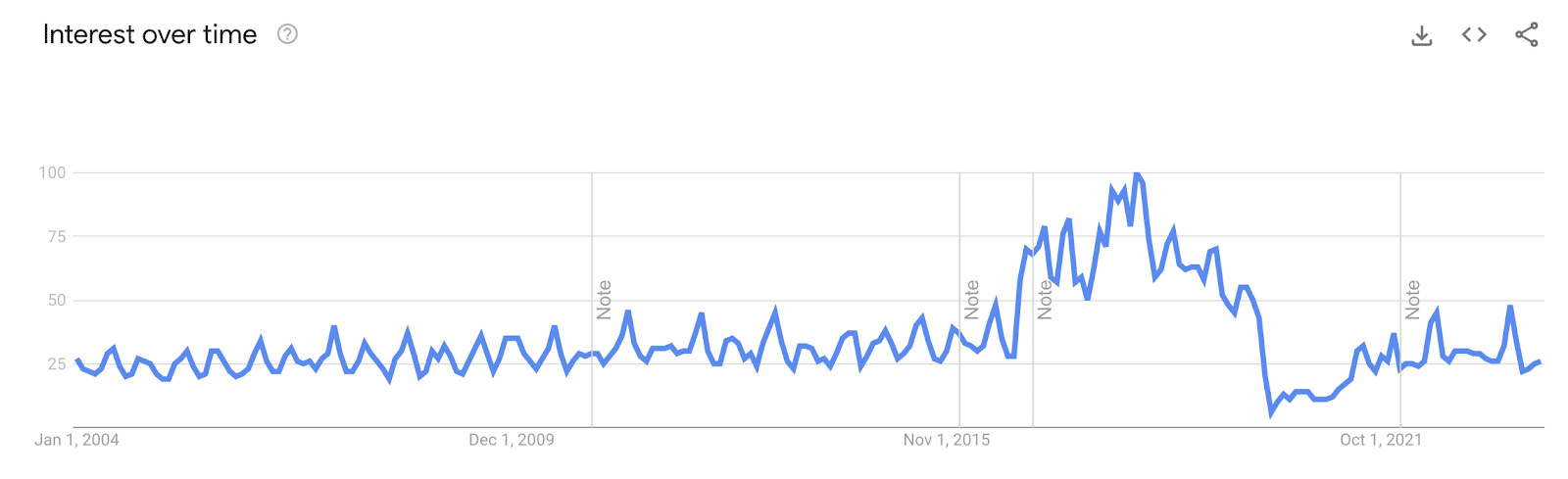
OK, let’s also change the date range to the longest option, 2004 – Present.
See that huge drop around Q2 of 2020? What happened then?
That’s when the world shut down for one of the most significant pandemics in history. That explains why traffic tanked then.
This also explains why movie theater cleaning was another hot topic in Google Trends.
But the pandemic is over. COVID is still around, but things are back open. Why hasn’t search interest returned?
Streaming services like HBO Max and Disney got innovative and started working directly with film production companies to allow streaming theatrical releases during this time. That trend has since slowed down but hasn’t brought demand back to peak levels.
But what about that huge peak before 2020? Marvel movies. That was a unique time for movie theaters where Marvel created a demand.
So what do we do about it? We can’t all be Marvel and bring people to our sites with Robert Downey Jr., but I’ll dive into some tactics later in this article.
Check new SERP features
Some keyword tracking tools have a cool metric that tracks how many pixels from the top your result is. Looking at the delta on that metric can be a clear indicator that some new SERP features may be hurting your organic CTR.
This can be frustrating, especially since Google constantly tests new ones, so you never know how long they’ll actually stick around.
Get the daily newsletter search marketers rely on.
What to do when search volume changes
SEO is only as good as your product and people’s interest in it.
So, if interest is dwindling, we need to get creative and try something else.
Get social
While working in the behavioral health space before and during COVID, I found something interesting: the increase in interest in virtual therapy and psychiatry.
My clients were fortunate enough to invest in it before the pandemic, but how did our audience know to search for it?
I did some research and found that during the early days of the pandemic, behavioral health professionals were going to Instagram and TikTok to share helpful information about how to handle depression during the lockdown. They also happened to be plugging their telehealth services.
That started a chain reaction of more and more professionals plugging telehealth as an option, spreading like wildfire.
Social media has a huge impact on search demand. Sometimes, it’s short-lived; other times, it can bring back demand.
So, if you’re a struggling movie theater chain, you can use social media to bring people back to the theaters. But you have to do it creatively. Give them a reason why they shouldn’t wait for streaming.
Go old school with above-the-line ads
If you have the budget, you can work with your marketing department to invest in traditional advertising, specifically above-the-line advertising. Think TV commercials, streaming ads, radio ads, and magazine ads.
Digital has changed the advertising landscape, but traditional advertising can still help influence certain demographics. The key is determining where your audience spends their time and seeing if advertising opportunities exist.
In B2B? Try below-the-line strategies
Above-the-line strategies may not work for you if you’re in B2B. In this case, you’ll need to pursue below-the-line strategies. Think trade shows, direct mailers, conferences, etc.
Sometimes, your audience may not know what to search for or know they need your services. You need to get in front of them and show them.
What to do when new SERP features appear
As previously mentioned, this can be one of the more complex signs of traffic drops.
Often, our stakeholders may not accept that something is out of your control and will ask you to make magic happen. So what can we do?
Discover how the SERP features work
If you’re determined to regain click share in the SERPs, you’ll want to rank for any of these new SERP features. So, figure out how they work!
SERP features typically rely on content structure or schema markup to find the right pages to show. Find out who’s ranking in those features and look for commonalities between them. See if it’s something you can quickly implement.
Be patient
I hate to say this, but sometimes, no action is the best action. SERP features come and go all the time.
You’ll need to go with your gut and decide if it’s worth the time and money to rank in these new features or if you think it’s just a test and will pass with time.
Is it permanent or cyclical?
We need to be the ones to determine if traffic declines are a permanent effect of our niche or if it may be a cyclical event.
In the case of movie theaters, it’s entirely possible that a new franchise or experience in the theater business could come about and bring audiences back to the big screen.
But if you’re in the CD sales business, I’m sorry you may need to find a new line of work. It’s unlikely that CDs will have the same revitalization as vinyl.
Use the tools at hand to analyze audience behavior and see if there’s something you can do outside of your SEO scope to bring back that search demand.
Courtesy of Search Engine Land: News & Info About SEO, PPC, SEM, Search Engines & Search Marketing
Wednesday, December 13th, 2023
SearchBot here! It’s been a few weeks since our launch and I’ve been watching with glee as more than 500 of you have registered to gain access to my personas, image generator and more.
I’m writing with a few updates and tips to consider as you continue tinkering with all I have to offer. If you haven’t registered yet, get a free account now!
Peer prompts
Here are some of my favorite prompts your fellow search marketers have used over the past few weeks… feel free to copy and paste these into the relevant persona or tweak them for your purposes:
- SEO persona: “You are an SEO expert and you need to explain to leadership why we saw a decrease in entries but an increase in overall SERP position month over month.”
- Content marketing persona: “What are some trending Florida travel search queries?”
- PPC persona: “What are the best ways to augment ad copy to different audiences within our funnel?”
The Search Engine Land team is also publishing a series of posts called “The Best of SearchBot” where they break down, improve and share additional user prompts.
Generative AI hot tip
After my initial response to your prompt, try following up with:
- “Is there anything else I should know, or questions you have for me?”
This is a great technique to validate your understanding of what I’m telling you, sniff out hallucinations, and make sure you haven’t forgotten anything.
December 2023 release notes
Because we all love prompts and prompt libraries, we’ve added 36 new ones for you to use. You can find them distributed across my personas in a handy table format.
We’ve got many updates planned for 2024, so stay tuned. We’re working on a PDF persona, new image capabilities and much more.
Share your feedback!
As always, I invite you to share your SearchBot feedback either by filling out our survey or replying to this email. Your feedback helps improve my features!
If you haven’t registered yet, get a free account now!
Courtesy of Search Engine Land: News & Info About SEO, PPC, SEM, Search Engines & Search Marketing
Wednesday, December 13th, 2023
SEOs know that the most valuable career skill is the ability to adapt to change, and there has been an incredible amount of it in the last 12 months. Industry headlines and random folks on X are happy to remind you that your SEO is “dead” in light of these developments, but the truth is that there has never been a more exciting and dynamic time to be in SEO.
As the new year dawns, the confluence of AI with existing frameworks will allow many to surge forward into new content streams and opportunities to connect with audiences via new channels. Across the industry, the rate and complexity of adopting AI tools will drive SEO growth and push advantage for audiences that have grown to expect innovation every day.
Sophisticated AI connectivity
AI has become a part of everyone’s workflow for SEO and marketing. Within the products we consume and how we create and manage content, AI has become an expectation rather than an exception in our lives.
Driven by a competitive landscape and customer expectations, in 2023, we saw AI emerge as an enhancement for 100s of SEO and martech products and tools. In a recent survey from Mailchimp, “88% of marketers believe their marketing organization must increase the use of automation and AI to meet customer expectations and stay competitive.”
In 2024, we should expect to see this trend continue but also to become more sophisticated. The first iterations of mainstream generative AI centered on discovering this new shiny object and what it could do. AI summaries and image generators have now become commonplace. However, after this initial fire sale, those who had solid marketing and SEO frameworks before generative AI hit the zeitgeist are now best place to use the tools today.
For example, Wix has applied AI widely across our systems for almost a decade, introducing our proprietary Artificial Design Intelligence in 2016. Three-time Google Cloud partner award winner, Wix CMS and business solutions include machine-learning powered AI like Google Translate, Vision AI and Google Ad management for years. So AI is, as they say, “not new.”
But with the mainstreaming of AI in marketing and SEO, Wix added AI capabilities to its SEO tools to increase access to SEO capabilities:
- Within the editor, the Create AI text tool allows users to generate keyword-focused copy intended for specific page types and intents. For category pages, about pages and other static pages for users.
- The AI Image generator is useful for helping users create illustrative images to accompany blogs and other content.
- The AI Meta Tag Generator works in tandem with the Semrush keyword research integration and helps to ensure that blogs and other pages have well-structured keyword-optimized meta tags.
- Wix Studio has a tool called Responsive AI, which evaluates the desktop UX of a web page and uses AI to adapt it to different screen sizes and breakpoints with the click of a button.
Each tool builds on existing frameworks and data back automation to get exceptional results; this is the sweet spot. SEOs and digital marketers will see automation, AI and data science enable them to bring new innovative value to clients and customers.
During 2024, expect to see those with solid data and firm marketing foundations surge forward with mature, well-integrated AI for more than just parlor tricks.
Headless for omnichannel
The era of AI will make headless CMSs even more appealing in 2024 as there are opportunities to surface content in new and exciting ways by engaging on-demand generative technologies. Unlike traditional CMS, headless doesn’t have an integrated frontend (head). This gives developers and SEOs the flexibility to use a range of tech to display content on different platforms, such as websites, mobile apps or IoT devices, via APIs. This flexibility is incredibly valuable in the multichannel marketing landscape of the TikTok generation. This means that headless offers incredible opportunities in omnichannel marketing consistency and quality.
The concept of the headless CMS hit critical mass in 2023, and over the last year, Wix Headless joined the trend. Empowering developers to use Wix frontend systems with any tech stack compatible with consuming data from a RESTful API, like React and server-side technologies, such as Node.js, has created more fluid opportunities for growth and experimentation. Integrations with Github and Netlify open more options for APIs, SDK and Next.js templates. These open systems create the infinite possibilities that make headless particularly appealing in the generative age.
Headless content systems connected to custom GPTs and other AI tools will almost certainly be integrated with existing headless solutions like chatbots to create seamless generative experiences.
Feed management as an SEO skill
Throughout 2023, SEOs have observed changes in crawl rates and percentage of pages indexed by Google bots.
Though indexing is never promised, this may occur because Google has begun to portion off how it crawls different elements of your website using APIs and differentiated feeds in conjunction with specified structured data.
Google’s guidance seems to be continually driving content producers to categorize and organize their content into dedicated Google channels like:
- Google Merchant Center
- Google Manufacturer Center
- Google News
- Google Business Profile
Feeds for each of these channels need to be optimized to perform optimally. Feeds left unmanaged trigger errors and distributed accurate information, wasting time for users and bots. Careful management requires putting rules in place to specify what goes into the feed and managing the tech configuration, like valid dynamic structured data, so that data flows freely.
While dedicated feeds and channels are not new, we are starting to see that indexing participation in these feeds does not seem optional. From Wix’s experience, we’ve seen clients struggle to get indexed in other ways and only be able to get products indexed via Google Merchant Center. Given how Google Search Console and Google’s SERP are organized and that the way they serve content is becoming continuously segmented by intent and customer journey, this seems to be a natural progression.
This article was written by Crystal Carter, Head of SEO Communications at Wix.
Courtesy of Search Engine Land: News & Info About SEO, PPC, SEM, Search Engines & Search Marketing
Wednesday, December 13th, 2023
Optimizing page speed for enterprise-level websites is challenging. Beyond suggesting improvements, your success as an enterprise SEO specialist depends on understanding the web team’s tech stack and their performance budget.
This article simplifies the process, offering insights to help you tailor recommendations and negotiate effectively for a stronger page speed strategy.
Page speed for enterprise sites: Key considerations
Developing page speed recommendations after a technical audit is fairly straightforward. But to get your recommendations implemented? That’s a different story.
Moving the needle for enterprise search requires knowing more about the web team’s work and collaborating with them.
In enterprise search, you often need to convince the web team and others who handle web and business operations technology.
To ensure your suggestions are taken seriously and put into action now and in the future, you need to:
- Understand the web team’s tech stack.
- Understand their performance budget.
These steps will save you time by avoiding proposals that won’t be implemented.
Dig deeper: 6 steps to a winning enterprise SEO strategy
Understanding an enterprise business’s tech stack
If you’re working with an enterprise web team, they likely have business-required items that add to the entirety of the website tech stack. This includes everything, from what the website is made with (like the CMS) to scripts that track analytics and marketing.
You can use BuiltWith to analyze a website’s tech stack. Just enter the website URL, and it will provide the site’s detailed technology profile so you know exactly what you’re working with.
In the example for NBA.com below, you’ll see several elements running on their site that take up bandwidth, including:
- Marketo: Enterprise email software.
- Eloqua: Enterprise marketing automation platform.
- Adobe Omniture: A website analytics tracking platform.
This will give you insight into what is already running on the site. That is just the beginning.
The hard part is formulating a business case around implementing your page speed recommendations. But before you do that, you should review your web team’s performance budget.
Dig deeper: What your enterprise SEO audit may be missing
Understanding your web team’s performance budget
Google defines a performance budget as:
“[A] set of limits imposed on metrics that affect site performance. This could be the total size of a page, the time it takes to load on a mobile network, or even the number of HTTP requests that are sent. Defining a budget helps get the web performance conversation started. It serves as a point of reference for making decisions about design, technology, and adding features.”
– Performance budgets 101, web.dev
If you’re lucky, the organization you’re working with will already have a performance budget in place for you to review before you run your page speed/technical audit.
If you find that the web team you’re working with doesn’t have a performance budget, I recommend checking out web.dev’s resources on the topic.
For the enterprise site I was working on, I suggested creating a performance budget to guide the web team on what aspects of page speed to focus on. Initially, they had none, causing uncertainty. After checking in later, I found out they had implemented one.
So, what does the performance budget do with page speed optimization?
It allows your web team to set up guardrails on things they will invest time and energy into from a resource/page speed and performance optimization standpoint.
This is very important information for you as you get into your audit and recommendations. Knowing your “guardrails” will help you navigate your conversation with your web team.
All of this will feed into things you will be looking into for your page speed optimization recommendations, which may include Core Web Vitals.
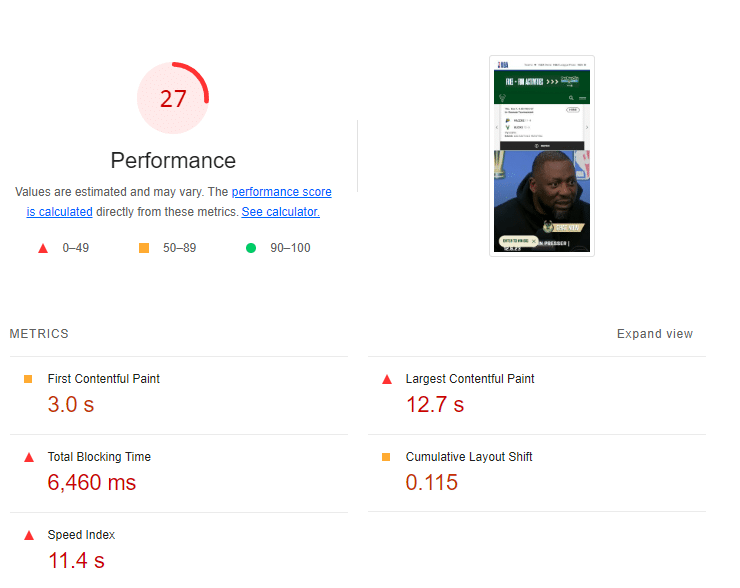
For example, suppose you are auditing a category page and notice poor performance scores after running a Lighthouse audit.
In that case, you may uncover issues related to the current server setup as it relates to First Contentful Paint (FCP) and Largest Contentful Paint (LCP).
With your knowledge of your web team’s performance budget, you will know what you can or can’t negotiate.
Working with enterprise web teams
Combining the knowledge of what your business’s website is currently running (tech stack) and what budget you have to work with (performance budget), you can now go about your page speed/technical audit more intelligently and thoroughly and be ready to negotiate your way to better site performance and SEO wins.
In my early agency days, I learned a valuable lesson: never accept “it can’t be done” from a web developer. Through negotiating on issues like URL fixes and redirects, I discovered that there’s almost always a solution in web development.
Recently, a product manager shared a similar experience with engineers. Despite initial resistance, showing evidence from a competitor or framing requests differently often led to finding solutions. Remember, it’s not just what you say but how you say it.
Dig deeper: Enterprise SEO: Why ‘best practices’ won’t cut it and what to do instead
Enterprise page speed optimization: Understanding tech stacks and performance budgets
Knowledge is key when aiming to optimize enterprise page speed.
Review the website’s tech stack to spot potential constraints on recommendations. Understand performance budgets to align with the web team’s priorities.
With these insights, you can propose viable optimizations aligned with the web team’s roadmap.
Convincing them to implement page speed recommendations can be tough. However, approaching them with knowledge of their tech stack limitations and performance priorities paves the way for collaboration and impact.
Courtesy of Search Engine Land: News & Info About SEO, PPC, SEM, Search Engines & Search Marketing
Tuesday, December 12th, 2023
Google Ads is testing a conversions account level diagnostic tab in alpha.
A spokesperson confirmed to Search Engine Land that the feature is set to launch next year with further details expected to be released soon.
Why we care. This new feature gives deeper insights into your current measurement setup, allowing you to assess what’s effective and what’s not, and make necessary changes to improve the performance of your ads.
How it works. The diagnostic tab delivers weekly updated data, offering enriched insights that enable you to:
- Monitor the current setup of your Google Ads account.
- Adopt privacy-preserving solutions (such as Sitewide tagging and Consent Mode).
- Fix issues with your measurement of campaigns.
First look. The feature was first spotted by SMX Next speaker and Google Ads expert Thomas Eccel, who shared his findings on X:
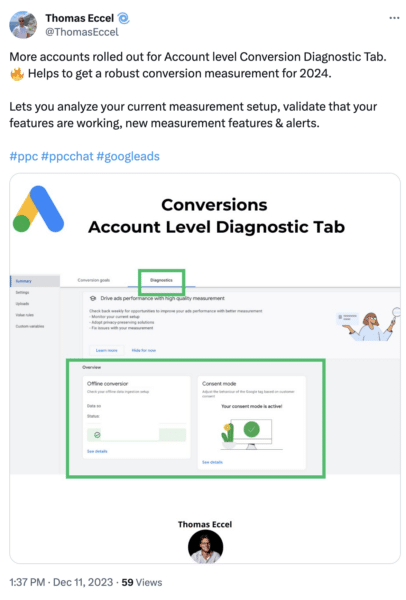
Thomas wrote:
- “More accounts rolled out for Account level Conversion Diagnostic Tab. Helps to get a robust conversion measurement for 2024.”
- “Lets you analyze your current measurement setup, validate that your features are working, new measurement features & alerts.”
What are conversions? In Google Ads, a conversion happens when a user takes a specific action after clicking or viewing an ad on the Display Network. This action could be making a purchase, installing a mobile app, or signing up for an email list. Conversion tracking gives important insights into what users do after interacting with an ad.
What is account level? In Google Ads, the account level is the core layer of PPC management, dealing with billing, user permissions, and fundamental settings across all campaigns. Account-level changes, like tracking templates, ad extensions, and negative keywords, automatically apply globally to relevant campaigns.
Get the daily newsletter search marketers rely on.
Deep dive. Read Search Engine Land’s Google Ads best practice guide for more information on how to achieve PPC excellence.
Courtesy of Search Engine Land: News & Info About SEO, PPC, SEM, Search Engines & Search Marketing