Archive for the ‘seo news’ Category
Wednesday, December 20th, 2023
Google is reportedly planning a major reshuffle of its 30,000-person ad sales unit.
Sean Downey, who is in charge of ad sales to big customers in the Americas, announced plans to restructure the ad sales teams during a department-wide meeting last week, according to The Information.
Downey did not comment on whether the reorganization would include layoffs during the meeting.
Why we care. This news could be perceived as another sign that Google Ads is leaning towards full automation, which may provide disadvantages for some advertisers, particularly those with smaller budgets as they lack the financial resources to monitor and experiment with AI asset and budget variations.
Revenue. In October, Google revealed a 11% year-on-year increase in overall revenue, reaching $76.7 billion in Q3. Notably, ad revenue surged from $54.5 billion to $59.65 billion, marking the highest total in that category in nine quarters. Given the profitable year the company has enjoyed, potential layoffs may come as a surprise.
So why now? The news comes as Google continues to invest in AI and machine learning to facilitate increased ad purchasing, diminishing human involvement. In line with this, Search Engine Land reported earlier today that Google aims to improve support in Google Ads by leveraging AI further.
What Google is saying. A Google spokesperson did not immediately respond to our request for a comment.
First Google mass layoffs. Earlier this year, in January, Google’s CEO Sundar Pichai announced the company would be letting go of 12,000 employees and contractors – approximately 5% of their total workforce – in the company’s first-ever round of mass layoffs. In an email to staff, he said:
- “I have some difficult news to share. We’ve decided to reduce our workforce by approximately 12,000 roles. We’ve already sent a separate email to employees in the US who are affected. In other countries, this process will take longer due to local laws and practices.”
It’s important to note that Google has not announced layoffs. Currently, the company has reportedly only confirmed a restructure of the ad sales unit.
Get the daily newsletter search marketers rely on.
Deep dive. Read our Automation Layering guide for more information on “how PPC pros retain control when automation takes over.”
Courtesy of Search Engine Land: News & Info About SEO, PPC, SEM, Search Engines & Search Marketing
Wednesday, December 20th, 2023
Campaign management software helps you automate the manual tasks of planning, launching and measuring the impact of your marketing campaigns.
Modern marketing campaigns often have many moving parts. Campaigns may involve multiple:
- Internal departments (e.g., creative, media, brand, legal).
- External partners (e.g., agencies, media, co-marketing).
Campaign management software helps keep stakeholders organized. Once the campaign is live, these tools help:
- Automate data collection on performance
- Generate insights.
Understanding the role of campaign management software
The biggest benefit of campaign management tools?
Organization.
All team members working on a marketing campaign must be organized before, during and after launch to be efficient and informed.
The right campaign management tools will improve collaboration and help teams move faster at each campaign stage, from preparing assets before launch to summarizing results after the campaign.
However, no true end-to-end, plug-and-play campaign management tool really exists.
But you can look for best-of-breed solutions that integrate well with existing tools and skill sets to build an ecosystem that meets your campaign management needs.
Key features and capabilities of marketing campaign management software
Marketing teams will benefit from campaign management solutions that help them across the campaign lifecycle of planning, tracking and analyzing.
The more tightly the tools are integrated, either out of the box or through the efforts of developers or marketing operations professionals, the better the experience will be for the marketers who use them.
Adopting several point solutions that cannot share information won’t create the efficiency you’re looking to gain from campaign management tools.
Campaign planning and scheduling
Aligning all the people and assets poses a significant challenge for teams, especially in distributed workforces.
Project management tools from several vendors can be used to track progress, assign work and send notifications. These tools offer automation, integrations and personalization capabilities that allow your team members to use them in a way that fits their work style.
The vendors with tools that will help your team with its campaign planning and scheduling include:
- Asana
- Monday.com
- SmartSheet
- ClickUp
- Trello
- Wrike
Audience segmentation and targeting tools
Using data and segmentation helps you avoid the inefficiency inherent in spray-and-pray marketing tactics. But you must have detailed audience and tool data to help segment that data into lists.
Many well-known cloud-based marketing tools can build lists based on certain criteria. Many also include the functionality to engage with the list members via email or create campaigns running on other channels (like paid ads) and connect to data sources to import data from those channels.
The vendors that make tools to help with audience segmentation and targeting include:
- HubSpot
- Salesforce
- Adobe
- ActiveCampaign
- Keap
- Klaviyo
Content creation and personalization
Many segmentation and targeting vendors also offer personalized marketing outreach. Customer data platform (CDP) vendors also help marketers craft personalized messages.
The combination of data and personalization functionality allows you to deliver the right message to the right person at the right time, which is a powerful combination for influencing prospects.
Multi-channel campaign execution
“Marketing cloud” vendors also offer visibility into your campaigns across channels, though it will likely require some work from the tool’s administrator or a marketing operations pro to get this working.
Leadership teams love high-level, holistic views, so the fewer data sources for your team to track down the better. You don’t want your team to spend valuable time collecting data from disparate sources to put in a slide deck for campaign updates and reviews.
Tracking and analytics
You might find that your existing campaign management software can’t work with all the data generated by their campaigns.
If that’s the case, you can pull together reporting tools from vendors like SAS, Tableau, SmartSheet and others to help manage your data and monitor campaign results.
Benefits of campaign management software
It’s difficult to coordinate, optimize and report on your campaigns without campaign management software.
While the exact tools and functionality you need will depend on many factors (i.e., your existing martech stack, your budget and your team), the right combination of tools will increase your efficiency and contribute to better outcomes.
Among the benefits of using campaign management software:
Improved efficiency and productivity
Some tools will help your team automate the often-mundane tasks that are simply part of marketing campaigns (e.g., deadlines, reporting). Other tools will help improve collaboration between the various roles that come together to create a marketing campaign.
Enhanced collaboration
Planning a marketing campaign often involves an assembly line that takes ideas from concept to reality and then introduces them to the market across various channels. That requires some job functions, and depending on your organization, possibly several departments.
Campaign management tools that establish deadlines and responsibilities keep the assembly line moving.
Data-driven decision making
Campaign management tools that collect and analyze data are important for quickly identifying how a campaign or portion of a campaign is performing. Having this data readily available allows for optimizations, such as diverting budget from an under-performing channel to an over-performing channel or making adjustments to creative units.
Software that helps analyze data also plays a key role in explaining the outcomes of a campaign to leadership teams that just want to know what they got for their investment in a campaign.
Considerations for choosing the right campaign management software
If you’re like most marketers, you’re trying to navigate lofty business goals, resource shortages and a variety of tools in a martech stack you inherited from someone else.
Licensing costs will play a critical role in investing in any technology. Here are four other criteria you can use to help make sound decisions around campaign management tools.
Scalability and flexibility
Tools that are too rigid and can’t grow with the organization make for poor investments.
Marketing is constantly changing, from the channels to the regulations that govern data collection and use, to new leadership with new ideas. You need to focus on tools designed to withstand these changes.
A constant cycle and ripping and replacing tools will hinder progress toward your goals.
User-friendliness and training
Many marketing teams are filled with people who can do a little bit of everything.
Deploying campaign management software with a steep learning curve delays progress but also creates bottlenecks when only certain people are capable of using it correctly.
Everyone needs training when a new tool is deployed, so make sure the vendor supports it. But the easier tools are to use the better.
Customer support and service
Even with training, your team is likely to hit some snags along the way. Good customer service from your campaign management software vendor can help your team keep moving, share best practices and introduce new features and functionality.
Look for the areas where your team has the most need. Start there.
If your campaign is getting stuck at the same point in the assembly line, then that’s your first area to address.
While software is certainly one way to solve a problem, don’t neglect other opportunities to increase efficiency.
If it’s a problem with people or processes, software alone is unlikely to fix it.
Courtesy of Search Engine Land: News & Info About SEO, PPC, SEM, Search Engines & Search Marketing
Wednesday, December 20th, 2023
Google has quietly started testing placing headlines within the ad copy description text in live ads.
Advertisers were not given prior notice about the ad copy variation experiment, and the uncertainty about the potential expansion of this test to more accounts has led to frustration within the community.
Why we care. Changing the rules without informing advertisers can make it harder for them to do their jobs and know what needs to be prioritized. The impact is even more significant for advertisers with smaller budgets, as assessing the changes, especially with responsive search ads, becomes challenging, adding to their workload.
What Google is saying. Google Ads liaison officer Ginny Marvin addressed concerns about ad variations following multiple reports on the topic during a PPC Chat Q&A. She said:
- “This is a small test and I don’t have anything further to share on this at this time.”
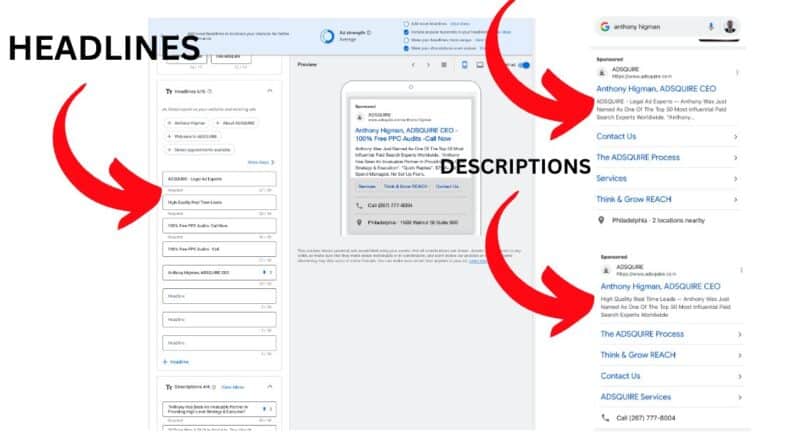
Just a small test? Despite Google’s comments, not everyone is convinced that the ad variation experiment is a “small test”. Google Ads expert Anthony Higman told Search Engine Land:
- “While I understand that Google rolls out tests to the SERPs and paid ads, this test seemed to be more far reaching in that everyone on my team and other people in the PPC community were seeing this in live ads. So this seems like it is one of the larger tests taking place. “
- “While I understand testing of paid ads, I think we are all just a little over the massive amount of tests and changes that have taken place this year and last.”
- “This test also seems different to me in that they are altering known elements of a search ad by making ad headlines show as descriptions or almost like “call out” assets in front of ad copy descriptions. This is troublesome because these changes alter the dynamics of ad copy that are well known by all Google advertisers.”
Calls for more transparency. Higman, who first flagged the ad variation test on X, went on to explain how a lack of transparency from Google can impact advertisers:
- “I think that since this test and other recent tests are changing ad copy dynamics that they need to be mentioned since it can alter planned out and tested ad copy in accounts.”
- “As others have mentioned, this also can change rules for certain more restrictive ad verticals like legal and medical where ad copy variations need to be approved before rolling out live.”
A move towards full automation? Commenting on the ad variation “small test”, as well as other experiments he’s witnessed within Google Ads recently, Higman claimed that Google appears to be heading towards full automation which could be problematic:
- “My point with all of these tests and also with the advancement of auto applied assets, recommendations, GBP connected ads, photos and also new asset format variations is that it seems as if everything is a new A/B test with every advertiser using Google ads.”
- “While this may be beneficial for advertisers with larger budgets, there is no statistical significance that can be gleaned on smaller spend accounts. Also we can no longer see what these changes are doing to our ad data because we don’t know what asset variations are doing to our CTR’s.”
- “So all of these new tests plus the dwindling ad data and lowered visibility of search query data is just further forcing us towards full automation which will not be a good fit for all advertisers using Google ads.”
Deep dive. Read our guide on How to write compelling ad copy in a Smart Bidding landscape for more information.
Courtesy of Search Engine Land: News & Info About SEO, PPC, SEM, Search Engines & Search Marketing
Wednesday, December 20th, 2023
Google Ads has confirmed that support is not being phased out.
With the introduction of a paid support service in August, concerns arose among advertisers about the potential withdrawal of the free feature. The perceived decline in customer experience further fuelled the belief that the free support might no longer be a priority.
However, Google Ads has now revealed that big changes are on the horizon with AI expected to play a major role moving forward.
Why we care. Advertisers, particularly those with smaller budgets, rely on support from their Google Ads rep to address campaign issues. Losing this service would make it more challenging to resolve problems affecting campaign performance and, consequently, ad revenue.
What Google is saying. During a live PPC Chat Q&A, Google Ads liaison officer Ginny Marvin addressed concerns about support being phased out. She said:
- “I’m very aware of questions and concerns about this topic.”
- “Support isn’t being phased out but changes are being made. There have long been challenges on this front, as everyone is likely aware. I’ve talked about this before, but Support was one of the areas I wanted to understand better when I joined.”
- “With the scope of inquiries, it’s not an easy solve. That said, I know there are real frustrations about the current state, including chat.”
- “I do think Support is an area where LLMs/Google AI will be able to make big strides in improving experiences. That’s not happening yet, but work is underway. Stay tuned.”
Support issues. SMX Next speaker and PPC expert Julie F Bacchini explained that advertisers suspected support was being phased out for several reasons, telling Search Engine Land:
- “A lot of people have made comments like this lately, so this seems like an important question to [address]. People think it is being phased out for a few reasons…”
- “It has gotten worse and harder to get answers lately.”
- “Everything takes longer to get resolved.”
- “The pilot program where you can pay for an actual call.”
AI replacing human support? Commenting on Marvin’s explanation as to what support will look like moving forward with AI playing a more significant role, Bacchini added:
- “I’m not surprised Google Ads is trying to bring AI into support. I think, like many companies, Google would love to find ways to have AI take over functions.”
- “For some low level tasks, it might be fine – but I can’t see AI every totally replacing human support.”
Paid support pilot. Marvin later confirmed that Google Ad’s paid support pilot is still ongoing, however there is no update on this front. In August, the platform’s enhanced customer service feature, which offers one-on-one support tailored to specific customer needs, was rolled out to small businesses as part of a new paid pilot for the first time. Historically, this level of one-on-one support has historically only been offered to Google Ads’ biggest clients.
Get the daily newsletter search marketers rely on.
Deep dive. Visit the Google Ads Help Center for more information on the support services it offers.
Courtesy of Search Engine Land: News & Info About SEO, PPC, SEM, Search Engines & Search Marketing
Tuesday, December 19th, 2023
SEO can be complicated – in many cases, overcomplicated. It’s easy to get lost in the SEO rabbit hole, spending significant time with minimal results.
This article will help you cut through the noise and focus on the four key pillars of SEO that will help you improve visibility in 2024 and beyond.
The four pillars of SEO
The four key areas of SEO that site owners need to consider are:
- Technical SEO: How well your content can be crawled and indexed.
- Content: Having the most relevant and best answers to a prospect’s question.
- On-site SEO: The optimization of your content and HTML.
- Off-site SEO: Building authority to boost trust and rankings.
By procedurally working through these four SEO pillars, you can improve your visibility, traffic and engagement from organic search.
1. Technical SEO
Technical SEO can seem a little daunting. But need it to make sure search engines can read your content and explore your site.
Much of this will be taken care of by the content management system you use, and Google’s Search Console can help you understand the technical makeup of your site.
The main areas to consider here are:
- Crawl: Can a search engine explore your site?
- Indexing: Is it clear which pages the search engine should index?
- Mobile: Does your site provide a solid mobile experience?
- Speed: Do your webpages load fast on mobile, desktop and beyond?
- Technology: Is your website search engine-friendly?
- Hierarchy: Is the content organized to help categorization?
If you are a small business using WordPress (or a similar CMS) for your website, technical SEO should be something you can check off your list pretty quickly. If you have a large, bespoke website with millions of pages, technical SEO becomes much more important (and troublesome).
In 2024 and beyond, much of what is “technical SEO” is actually part of your website and CMS. The key is to collaborate with a developer who grasps SEO principles and builds you a website that is SEO-friendly and properly configured. Doing this should get you most of the way toward effective SEO.
Note: If you are a small or micro business, don’t obsess over this too much or feel you have to perfect everything. We still see lots of sites that are essentially doing everything wrong and rank well, so just do your best!
2. On-site SEO
Once your technical SEO is in a good place, you need to optimize the content on your site.
Structural optimization
The first job here is to ensure your site is structured in a way that helps Google understand the relevance of every page. Think of your website as a filing cabinet. The website is the cabinet, the sections are drawers, and the pages are folders within those drawers.
You should be able to draw this structure on the back of a napkin and understand how everything relates.
- Home
- Services
- Locations
- Team
- Department
- Team Member A
- Team Member B
- Case Studies
- Case Study A
- Case Study B
- About Us
- Contact
You get the picture – and so, hopefully, does Google. By structuring your site like this, you provide context for a page before Google has even examined the page itself and set the scene for the page itself to be optimized.
Page-level optimization
With a sensible structure in place, you can now optimize the individual pages.
The main areas to focus on here are:
- Keyword research: Understand the language of your target audience.
- Descriptive URLs: Ensure each URL is simple and descriptive.
- Page titles: Use keywords naturally within the page title.
- Meta descriptions: Craft meta descriptions like they were ad copy to improve click-through rates.
- Content optimization: Sensibly use keywords and variations in your page copy.
- User experience (UX): Ensure your site is a joy to use and navigate.
- Strong calls to action: Make it easy for your users to know what to do next.
- Structured data markup: Help Google understand your content.
If you have taken the time to structure your site correctly, then the on-page optimization is fairly simple to layer over. If it helps, put your list of pages in a spreadsheet and detail the keyword you want to optimize each page for.
Plenty of tools will assess how well a page is optimized for a given term that can aid you in the nuts and bolts of the optimization.
Don’t think of this as a one-time job, either. Once the site is indexed, you can gather much more information from Google Search Console on what keywords each page ranks for and refine your optimization at a page-by-page level.
Get the daily newsletter search marketers rely on.
3. Content
Content is king. That’s the saying, right?
It’s true in a way. Your website is just a wrapper for your content.
Your content tells prospects what you do, where you do it, who you have done it for and why someone should use your business.
And if you’re smart, your content should also go beyond these obvious brochure-type elements and help your prospective customers achieve their goals.
For service businesses, we can loosely break your content down into four categories:
- Business Information. Who you are and why people should care.
- Service content. What you do and where you do it.
- Credibility content. Why a prospect should engage with your business.
- Marketing content. Content that helps position you as an expert and puts your business in front of prospects earlier in the buying cycle.
SEO is important for each type of content in different ways. SEO is often forgotten about when it comes to credibility content like case studies and reviews, but in an E-E-A-T world, this is a lost opportunity.
For example, I recently renovated a Victorian-era house in the UK. The house is 140 years old, falling apart, and known as The Money Pit!
Finding good people to help with this project was difficult, and it was those with good testimonials and case studies that we ended up:
- Finding via localized search results.
- Using due to the clear examples of relevant experience and expertise.
E-E-A-T may seem like another painful SEO acronym to work around, but in reality, E-E-A-T just represents what we, as consumers, want.
Adjusting your thinking to demonstrate your E-E-A-T in your content will only help you rank more highly, get more visitors and convert those clicks into customers!
Further still, ensure you optimize your marketing content, including case studies, portfolio entries and testimonials – not just the obvious service pages.
For larger businesses, a solid content marketing and SEO strategy is also the most scalable way to promote your business to a wide audience.
This generally has the best ROI, as there is no cost per click – so you are scaling your marketing without directly scaling your costs.
Layer in some remarketing and other ads that build on this first organic touch, and you can be onto a winning mix of tactics.
Ensure your SEO tactics align with your overall SEO strategy. We still see too many paint-by-numbers approaches to SEO, where local businesses are paying agencies or using generative AI tools to pump out blog posts that will never rank.
Create content that helps your customers either find you or choose you and focus on optimizing that.
Dig deeper: What is helpful content, according to Google
4. Off-site authority building
Eventually, all SEO rivers run to this one spot: authority building.
Building your authority, historically, was all about link building, a much abused and maligned SEO practice by 2024.
Authority is still crucial to developing strong organic rankings and is part of the E-E-A-T approach. However, this can be the hardest part of SEO to get right.
The best way I have ever seen to describe the right link-building mindset was penned by the late, great Eric Ward: “Connect what should be connected.”
This philosophy is beautiful in its simplicity and corrects the “more, more, more” mentality of historic link building. We only want links from relevant sources.
Often, this means that to scale our link building efforts beyond the obvious tactics, we need to create something that deserves links. You have links where it makes sense for you to have links. Simple.
Wikipedia has millions of links, yet I am pretty sure they have never done any link building. This is because they have reams of useful content that gets linked. These are real, natural links that enrich the linking page, provide further context and serve as the real connective tissue of this hyperlinked world we live in.
This kind of natural link should be the backbone of your link-building efforts. This may mean you have to revisit the content on your site and create something of value first, but if you can nail that, you are halfway home.
Any safe, scalable link building strategy should be built on this mindset.
Summary
SEO becomes more manageable when broken down into four core pillars.
- Technical SEO ensures search engines can properly crawl and index your site.
- Optimizing on-page elements provides helpful cues to search engines regarding relevance and hierarchy.
- Investing time and resources into useful content that answers your customers’ questions and establishes your expertise lays the groundwork for rankings.
- Taking a strategic yet authentic approach to external authority building cements your site’s place as a trusted resource on relevant topics.
Make sure to establish clear SEO goals and track your performance KPIs to continually improve on these four pillars.
Courtesy of Search Engine Land: News & Info About SEO, PPC, SEM, Search Engines & Search Marketing
Tuesday, December 19th, 2023
With a shared commitment to fostering a secure and trustworthy environment for publishers and advertisers, BidsCube and Pixalate have partnered to fortify the digital advertising industry and make it more transparent.
Pixalate’s fraud protection, privacy and compliance analytics solutions integrate into BidsCube’s programmatic ecosystem, providing clients with comprehensive tools powered by AI and machine learning. It will enhance the company’s quality approach, reinforcing its dedication to delivering safe and compliant programmatic advertising products.
“As the programmatic advertising continues to evolve, addressing ad fraud and ensuring transparency has become paramount for success,” said Dmytro Chebakov, CEO of BidsCube. “Our collaboration with Pixalate reflects our commitment to delivering trustworthy and secure programmatic advertising solutions.”
Why we care. The partnership of BidsCube and Pixalate is notable because it’s a substantial step towards creating a more secure ecosystem that benefits advertisers and publishers. The latest report by the Association of National Advertisers confirms concern about transparency issues in the programmatic market. The strategic partnership between BidsCube and Pixalate marks a significant milestone in the fight against ad fraud and championing transparency in programmatic advertising.
“Our partnership with BidsCube provides their customers with comprehensive fraud detection and prevention solutions,” said Jalal Nasir, CEO of Pixalate. “We are encouraged by their proactive approach in creating a programmatic advertising ecosystem built on transparency, efficiency and quality.”
How it works. For BidsCube customers, the new features will be now available within all platforms out of the box. Users can navigate the built-in Pixalate panel to customize all the necessary settings. For partners utilizing managed services, a traffic monitoring option with the Pixalate solutions will be available on demand. The company aims to provide every party involved with a more secure and reliable environment.
Why it is important for advertisers and publishers. This partnership will impact more than 250 of BidsCube’s global programmatic partners that use the company’s products, providing reliable publishers with more revenue and advertisers with high-quality advertising inventory.
Courtesy of Search Engine Land: News & Info About SEO, PPC, SEM, Search Engines & Search Marketing
Tuesday, December 19th, 2023
In the ever-evolving landscape of marketing, the use of customer data has become more critical than ever before. Customer data platforms (CDPs) have emerged as a game-changer, enabling businesses to harness the full potential of their customer data. With CDPs, organizations can unlock a wide array of use cases, each catering to specific business needs. This article covers a CDP use case, its benefits and how to implement them effectively for maximum impact.
Crawl, walk, run: The iterative approach for a CDP use case
Before delving into a specific CDP use case, it’s essential to emphasize the importance of the iterative approach. Often, organizations tend to get overwhelmed by the sheer possibilities of a CDP and aim for complex solutions right from the start. Instead, adopting a ‘crawl, walk, run’ approach can be highly beneficial.
To begin, start small – perhaps by addressing a straightforward use case and gradually build upon it. This way, you can understand how the CDP integrates into your existing systems and learn to harness its full potential progressively.
How can you use the ‘crawl, walk, run’ approach?
Cart abandonment is a common CDP use case. Here is an example using the iterative “Crawl, Walk, Run” approach.
- Crawl: Identify customers who abandon their carts and track this data. Measure the cart abandonment rate and its impact on revenue. Start sending basic email reminders to encourage customers to complete their purchases. To activate this data, connect your CDP to your email marketing tool, and the audience would-be cart abandoners.
- Walk: As you gain experience, it’s time to dive deeper into the data. Analyze the customer journey events leading to cart abandonment. Segment your audience based on attributes like cart value, product categories or purchase history. Create personalized email content for different segments. You can also incorporate SMS or app notifications to reach customers through multiple channels. Utilize connectors to automate these processes.
- Run: Now, take cart abandonment prevention to the next level. Implement dynamic on-site personalization for returning cart abandoners. Use returner data to identify and engage customers who have previously abandoned carts. Leverage retargeting campaigns across social media platforms to re-engage cart abandoners. Continuously measure and refine your strategies for optimal results using A/B testing and data analytics.
What is a use case in a CDP?
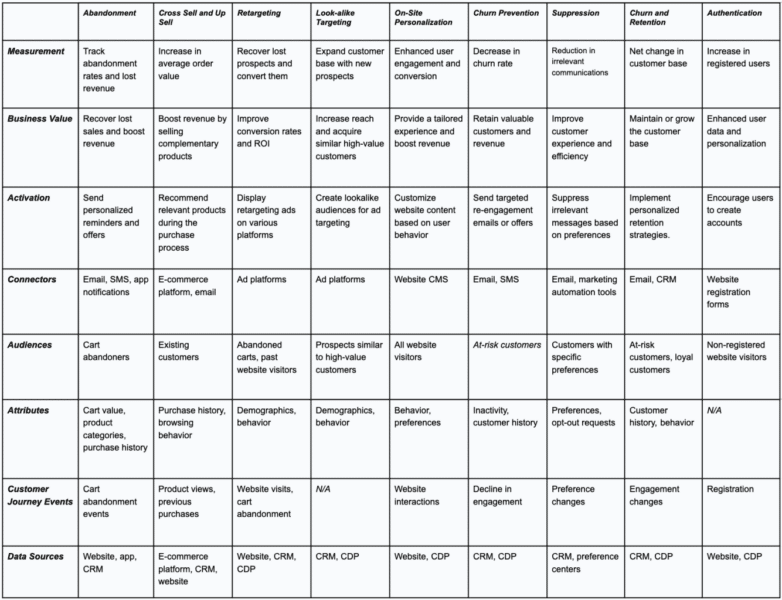
A use case in a CDP has eight main pillars. Here is how they can add value to your business.
1. Measurement
Defining measurable objectives and key performance indicators (KPIs) is crucial when developing a CDP use case. For instance, in a cart abandonment use case, the measurement could involve tracking the abandonment rate, the number of recovered carts and the increase in revenue.
2. Business value
To determine the business value, you need to identify the direct impact the use case will have on your organization. In the context of cart abandonment, the business value is evident in the form of increased revenue through recovered sales and improved customer retention.
3. Activation
Activation refers to the action you take based on the data and insights provided by the CDP. In a cart abandonment use case, activation involves sending personalized reminders or offers to customers who have abandoned their carts. Activation strategies should be well-defined and designed to achieve the objectives set in the measurement phase.
4. Connectors
Connectors are the bridges that link your CDP with other tools and platforms. In the case of cart abandonment, you would need connectors to integrate your CDP with your email marketing platform, SMS or app notification tools and potentially your ecommerce platform to track and recover abandoned carts effectively.
5. Audiences
Understanding your target audience is crucial. In the context of cart abandonment, the audience would be those customers who have abandoned their shopping carts. These audiences can be further segmented based on attributes and behaviors to tailor messages and offers effectively.
6. Attributes
Attributes are the characteristics or data points that define your audience segments. In the cart abandonment use case, attributes may include the value of the abandoned cart, product categories within the cart, purchase history, and more. These attributes help you personalize your messages and offers.
7. Customer journey events
Customer journey events are specific actions or interactions that customers take along their path to purchase. In cart abandonment, the key event is abandoning a cart. Understanding the customer journey events lets you pinpoint when and why potential customers drop off.
8. Data sources
Data sources are the places where the relevant data is collected. Data sources in the cart abandonment use case include your website, ecommerce platform, customer relationship management (CRM) system and CDP. Data from these sources is used to track customer behavior, gather cart abandonment data, and trigger activation processes. It is important to underscore the need for data quality and consistency from these sources to ensure accurate results.
By considering these elements, you create a comprehensive framework for building a CDP use case that is well-defined, measurable and aligned with your business objectives.
Here is how it all comes together in a framework.
Example use cases associated with definitions
To further examine the use cases, see the below graphic with example-specific definitions.
In conclusion, building a CDP use case involves careful planning. Focusing on measurable objectives, business impact, targeted activation strategies, data integration through connectors, well-defined audience segments, relevant attributes, customer journey events and the data sources that power the entire process is important. When executed effectively, CDP use cases can significantly improve your marketing efforts, customer engagement and overall business outcomes.
Incorporating these CDP use cases into your marketing strategy can substantially improve customer engagement, retention and revenue. Remember, it’s essential to start with simple implementations and gradually progress towards more complex strategies. This approach ensures a smoother transition into the world of CDPs, allowing your organization to fully leverage the power of customer data. So, take the first step and start reaping the benefits of CDPs today. For more resources, explore this blog post, 5 Clever CDP Use Cases You’ll Want To Implement.
Courtesy of Search Engine Land: News & Info About SEO, PPC, SEM, Search Engines & Search Marketing
Tuesday, December 19th, 2023
4.95 billion. That’s the number of social media users worldwide.
For the savvy marketer, that number represents a market they can tap into to drive business growth.
However, that number represents people who use social media in general. Each social media platform has its own monthly average users (MAU). For example, Facebook boasts a whopping 3 billion users.
With numerous social media platforms and new ones emerging constantly, marketers face the challenge of deciding where to concentrate their efforts.
If you’ve been wondering, I want to share the top five social media platforms you should focus on for business growth.
These platforms drive engagement for brands and have stood the test of time.
I will also show you ways businesses can harness the power of each platform to get the most mileage out of them.
1. Facebook: The powerhouse of social media marketing
Facebook is the platform that should take precedence when attempting to expand your brand’s social media presence. With a staggering 2.9 billion monthly active users worldwide, it’s an undeniable powerhouse in social networking.
Why does this matter?
It means vast brand awareness and customer service opportunities on this bustling social media platform are just a click away. No matter the target audience, Facebook offers a variety of features that can be tailored to suit one’s requirements.
The key to success on Facebook is creating an engaging business page and completing your profile. Once done, understand your target audience and how the Facebook algorithm works. This will help you create Facebook posts that resonate with your audience and get shown in more users’ news feeds.
You should also leverage other tools like Facebook stories for sharing short but captivating posts. Stories offer an immersive full-screen format where photos and videos play together sequentially with unique creative tools not available anywhere else on the site.
You can also use Facebook groups to build a community around your brand and its products/services.
Leveraging Facebook Ads for increased visibility
The key to completely harnessing the power of Facebook marketing is running Facebook Ads.
Facebook Ads enable you to reach your target audience with laser-focused precision – think demographics, interests, behavior patterns and more.
You can customize every aspect of these ads, from images and text to the timing of when they appear in user feeds. The best part? These personalized advertisements don’t feel intrusive but instead, add value to the overall browsing experience on the social platform.
2. Instagram: Harnessing visual storytelling
Businesses with visually appealing products or services can find a goldmine in Instagram, a platform teeming with 2 billion monthly active users.
Instagram thrives on visuals – from breathtaking travel photos to mouth-watering food snaps. It’s an exciting playground for businesses targeting niche communities and aiming to connect more personally with their target demographic.
The key lies in showcasing your consumer goods and weaving narratives around them through visual storytelling.
Utilizing user-generated content on Instagram
The real magic of Instagram comes alive when brands leverage user-generated content (UGC). This is authentic, relatable, and often more trusted by consumers than brand-produced ads. Encouraging customers to share images of themselves using your product can amplify engagement significantly.
This tactic enhances the authenticity of your Instagram content and helps foster strong relationships between you and your audience. By reposting customer content, you recognize them while showing potential buyers how existing customers enjoy your product.
You don’t need high-end equipment or a professional photographer to leverage Instagram’s visual appeal. A smartphone camera coupled with creative thinking does wonders here. The key is crafting stories your target audience resonates with. You can even show behind-the-scenes glimpses into production processes or highlight the people who make it happen.
In essence, effectively utilizing Instagram’s narrative power involves strategically using brand-created and user-generated visuals to create an immersive experience for followers. And this is what turns mere viewers into loyal customers.
Again, you also have to understand how the platform’s algorithm works and what Instagram users want if you’re to create more impactful Instagram content.
Dig deeper: Instagram Ad formats: Best practices for effective ad creative
3. YouTube and the influence of video content
You’ve likely heard that YouTube is a great place for product-based businesses. But why exactly?
One reason is its sheer reach. With its massive 2.6 billion user base, YouTube is one of the most popular social media sites on the planet.
This expansive user base isn’t just about numbers – it translates to an audience hungry for video content. People don’t visit YouTube merely to kill time. They’re actively searching for information, entertainment, or both. As such, creating engaging long and short-form videos on this platform can give your brand immense exposure.
A brilliant example would be beauty tutorials, which are incredibly popular on YouTube. They illustrate how well-crafted video content helps brands connect with their audience by providing value and building trust – key elements in any successful marketing strategy.
One of the beauties of YouTube is that you can grow your brand awareness without creating a single YouTube video. That’s because you can collaborate with creators and influencers to bring your brand in front of their audience.
But for lasting impact, creating your own channel is best. It allows you to create the types of content your target audience wants.
The impact of short-form videos on YouTube
In today’s fast-paced digital world, attention spans are shrinking rapidly. This has led to the rise of short-form videos as a powerful tool for capturing viewers’ interest quickly while still delivering meaningful messages effectively.
Besides being more digestible than long-format counterparts, these quick clips also tend to get shared far more frequently across various social media platforms. This is a bonus if you aim to grow your online presence beyond just YouTube.
Dig deeper: YouTube Shorts guide: How to get noticed
Get the daily newsletter search marketers rely on.
4. LinkedIn: The professional networking giant
If you’re in the B2B space and need to connect with other businesses, then LinkedIn is one of the social platforms tailored for you. It’s not just a place to flaunt your resume anymore. With 950 million members worldwide, LinkedIn has become an essential tool for B2B marketers.
Building business connections through LinkedIn
Relationships are vital in growing any business in today’s digital world.
And where better to start building these connections than on a platform designed specifically for professionals?
But it doesn’t stop at making connections. The real power lies in leveraging those relationships to create opportunities to expand your reach, generate leads and drive sales.
Personal profile vs. company page
Many marketers ask which is better to use – a personal profile or a company page (business profile).
The simple answer is both.
Your personal profile will help you network personally, even regarding growing your business. You can leverage your company profile to boost your brand awareness, educate your customers on your products/services, establish yourself as a thought leader, and more.
The key to successfully using LinkedIn as a marketing tool is posting regularly, engaging with other users, and even running LinkedIn ads.
Besides a personal profile and company page, LinkedIn also offers a powerful tool called Sales Navigator.
Sales Navigator is a suite of tools that gives you insights into your target audience, gives you extra marketing tools, and much more.
Dig deeper: Decoding the SEO success of LinkedIn collaborative articles
5. X: The pulse of real-time updates
Many people trust X (formerly Twitter) to stay up-to-date on the latest trends. With real-time updates and an active user base of over 556 million monthly users, it’s a platform where news breaks first. This is particularly useful for fast-paced industries (like financial services) where up-to-date news is crucial.
Despite having fewer users than other social networking sites, X users (and the platform) are quite influential.
One reason users love X is the brevity of the content. Being a micro-content site, users can quickly get the information they want without wading through unnecessary content. For longer content, you can create X threads.
X also has other features brands can leverage. Examples include live streaming, communities, hashtags, and much more.
While business posts don’t get much traction on the platform, it’s still a great place to post updates about your brand and products.
The up-and-comers
TikTok
With over 1.2 billion monthly active users globally, TikTok is one of the fastest-growing social networks on the planet. Founded in 2016, it’s also one of the newest major social media platforms.
While the platform thrives on a younger demographic, it’s now reaching more people of all ages.
One reason for the platform’s explosive growth is that it mainly features short-form video content, usually challenges that other users jump onto. This results in the virality of certain videos, hashtags, and topics.
Brands can also leverage this social platform by creating short-form video content that appeals to their target audience. And if funny ads are one of the ways you market your business, TikTok is a great place to share them.
Threads
Threads is one of the newest social media platforms, launched in 2023 by Meta, the parent company of Facebook, Instagram, and WhatsApp.
Launched as an X competitor in 2023, the platform has already garnered over 141 million users. While it may be too early to tell, research shows the platform’s momentum is slowing down.
Could this be a shiny syndrome that you shouldn’t waste time on?
While I may not like making predictions, I strongly believe it could be. For one, it’s a knockoff of X. Secondly, people have trust issues regarding Meta and how the brand handles users’ data. However, time alone will tell if Threads is a viable social media platform for business.
Know the top social media platforms you should focus on
Social media marketing is a critical component of digital marketing. You can use it to grow brand awareness, generate leads, and even drive sales (particularly on platforms with shoppable posts like Instagram).
The best part of social media is that you can create any type of content to reach a wider audience. From live video to short-form and long-form content to images, GIFs, and memes, social media allows you to publish content your target audience resonates with.
Plus, you don’t need massive budgets to run successful campaigns. You can often use an in-house social media management team to create and run your campaigns.
Courtesy of Search Engine Land: News & Info About SEO, PPC, SEM, Search Engines & Search Marketing
Saturday, December 16th, 2023
Google’s local search ranking algorithm has recently been updated to strengthen its “openness” signal for non-navigational queries. Danny Sullivan, Google’s Search Liaison, said, “we’ve long used “openness” as part of our local ranking systems, and it recently became a stronger signal for non-navigational queries.”
What changed. Earlier this month a report showed Google ranked open businesses more often in its local search rankings higher than businesses that are closed. “As of November 2023, Google appears to be looking at whether a business is currently open as a ranking factor for local pack rankings,” Joy Hawkins wrote in her report.
Google confirmed. A couple weeks later, Danny Sullivan from Google confirmed this saying, “we’ve long used “openness” as part of our local ranking systems, and it recently became a stronger signal for non-navigational queries.”
Navigational queries. Non-navigational queries are queries where you search for types of services versus specific brands. So a non-navigational query would be to search for a pharmacy, whereas a navigational query would be to search for CVS.
Don’t change your business hours. The report said, “If you are a business that’s open 24-hours a day, this would benefit you in the evenings when your competitors disappear but you still rank.”
But Sullivan said, “This might change in various ways, as we continue to evaluate the usefulness of it, however.” He added, “I wouldn’t recommend businesses do this, given the ranking signal may continue to be adjusted.”
Why we care. If you notice changes to your Google Business Profile listings, this may be why. It is also important to ensure your business hours reflect your true open hours because if you make up your business hours, you never know if you can be hit by some sort of penalty in the future.
In short, Google is now showing more businesses that are open at the current time of the search. Is that a good thing for searchers or bad is up to debate and probably very query dependent.
Courtesy of Search Engine Land: News & Info About SEO, PPC, SEM, Search Engines & Search Marketing
Friday, December 15th, 2023
Leading U.S. marketing company Cox Media Group (CMG) has reportedly admitted to monitoring conversations for the purpose of targeted advertising.
Working with renowned brands like CBS, Fox News and ESPN, CMG has allegedly been promoting its ability to eavesdrop on consumers through microphones in smartphones, TVs, and smart speakers.
The agency has coined this capability “Active Listening” and has been actively pitching this service it to advertisers, showcasing the feature on its website, reports 404.
Why we care. Amid the worldwide push for enhanced privacy, including measures like the phasing out of third-party cookies, these statements have caught the PPC community off guard. Many are now speculating about potential repercussions, signaling a warning to the broader industry.
SEO consultant Gelnn Gabe responded to the report on X, writing: “This will not end well.”
This will not end well -> Cox Media Group claims it can listen to conversations of consumers through microphones in smartphones, smart TVs, and other devices and use it to target ads
"Clients can “claim” a territory where they want to use CMG’s services, which are available… pic.twitter.com/sTcF2WhI39
— Glenn Gabe (@glenngabe) December 15, 2023
Google Ads expert, Steve Huskey, added: “Textbook definition of invasion of privacy.”
Textbook definition of invasion of privacy
— Steve Huskey (@TalkNerdie2Me) December 15, 2023
How it works. CMG allegedly claims that its Active Listening technology can spot potential customers in real-time through everyday conversations. It’s uncertain if this feature is on current devices, but CMG promotes it as a futuristic marketing tool that is “available today.”
Pitching the product. A CMG rep was reportedly spotted on LinkedIn promoting this service, encouraging interested parties to get in touch so that they could provide more information on prices.
What CMG is saying. The company did not respond to Search Engine Land’s request for comment. However, a promotional post on its website, which appears to have now been removed, reportedly read:
- “What would it mean for your business if you could target potential clients who are actively discussing their need for your services in their day-to-day conversations?”
- “No, it’s not a Black Mirror episode—it’s Voice Data, and CMG has the capabilities to use it to your business advantage.”
Get the daily newsletter search marketers rely on.
Deep dive. Read ‘A PPC guide to privacy-focused audience targeting‘ for more information on how to serve ads while adhering to user privacy best practices.
Courtesy of Search Engine Land: News & Info About SEO, PPC, SEM, Search Engines & Search Marketing