Archive for the ‘seo news’ Category
Friday, December 29th, 2023
Since Search Engine Land launched, we have given PPC experts a platform to share their in-depth knowledge and timely insights – with the goal of helping you solve problems, manage challenges and understand the constantly shifting landscape of paid search, paid social and display.
What follows are links to the 10 most-read, must-read Search Engine Land PPC columns of 2023 that were contributed by our fantastic group of Subject Matter Experts.
Learn how to avoid repeating some serious mistakes that advertisers have made with their Performance Max campaigns. (By Menachem Ani. Published Jan. 17.)
Getting Performance Max to work for lead generation programs without offline conversion data is very hard. Learn what you can do here. (By Menachem Ani. Published Feb. 14.)
Five tips for using Google Ads retargeting with email, organic traffic, cross-device tracking, direct mail, and social media. (By Adriana Stein. Published Dec. 1.)
Learn how to maintain or improve your performance in Google Ads and prepare for the removal of these high-quality audiences. (By Chelsea So. Published March 1.)
Google Ads is fundamentally changing the way recommendations work. Here’s why you should take extreme caution in applying any recommendation. (By Greg Finn. Published Jan. 5.)
Learn about the Hagakure method, a modern approach to Google Ads management that blends simplicity and automation for better results. (By Benjamin Wenner. Published Oct. 5.)
Use this script to provide GPT with facts about your account and get a performance summary that can be shared with clients and stakeholders. (By Frederick Vallaeys. Published June 5.)
Explore real-world examples of how to use the feature to speed up PPC data processing and visualization, insights generation, and more. (By Jason Tabeling. Published Aug. 31.)
This script can help you leverage GPT’s API to use the maximum number of RSA assets and, in turn, boost your paid search campaigns. (By Frederick Vallaeys. Published April 13.)
Learn how to use ChatGPT to level up your paid search efforts without sacrificing strategy, authenticity or creativity. (By Amy Hebdon. Published Feb. 1.)
Courtesy of Search Engine Land: News & Info About SEO, PPC, SEM, Search Engines & Search Marketing
Friday, December 29th, 2023
Since Search Engine Land launched, we have given SEO experts a platform to share their in-depth knowledge and timely insights – with the goal of helping you solve problems, manage challenges and understand the constantly shifting SEO landscape.
What follows are links to the 10 most-read, must-read Search Engine Land SEO columns of 2023 that were contributed by our fantastic group of Subject Matter Experts.
No surprise, Generative AI was the hottest topic in 2023 and dominates our list – 80% of the columns were either about ChatGPT, Bard or SGE.
Also, I need to give some huge recognition to Tom Demers, who authored 5 of the 10 most popular SEO columns of the year. Unbelievable!
Learn how Google Search Generative Experience could affect your website’s organic traffic in this in-depth analysis. (By Gilad David Maayan. Published Sept. 5.)
The ChatGPT API can help address some of the web interface’s shortcomings. Here’s how to maximize the API for specific SEO use cases. (By Tom Demers. Published March 17.)
Learn how ChatGPT and the ChatGPT API can help you create compelling, clickable title tags. (By Tom Demers. Published March 27.)
Yandex isn’t Google, but there is a lot SEOs can learn about how a modern search engine is built from reviewing this codebase. (By Michael King. Published Jan. 30.)
Dig deeper into E-E-A-T – specifically what it means, why it matters to SEO, and tips to use it to your advantage. (By Zoe Ashbridge. Published March 13.)
A seven-step, ChatGPT-assisted process to streamline your featured snippet optimization and boost traffic for your top-ranking keywords. (By Tony Hill. Published May 11.)
We tested the top detection tools for AI-generated content. Here’s what they are good and bad at, plus what to expect when using them. (By Tom Demers. Published April 25.)
Don’t miss out on Bard’s strategic advantage in SEO. Here are four ways to maximize Google’s AI chatbot for fine-tuning your SEO strategies. (By Lauren Busby. Published Oct. 23.)
Here’s what to remember when creating prompts, plus examples of SEO-focused ChatGPT prompts for daily work. (By Tom Demers. Published Feb. 24.)
Learn specific keyword research applications for ChatGPT, plus a framework for incorporating the tool into your SEO processes. (By Tom Demers. Published March 2.)
Courtesy of Search Engine Land: News & Info About SEO, PPC, SEM, Search Engines & Search Marketing
Thursday, December 28th, 2023
The PPC community had a rollercoaster year in 2023. Google stirred things up by shaking cushions and discreetly adjusting ad prices, and the entire industry faced a major shift with the sunset of Universal Analytics, forcing everyone to transition to Google Analytics 4. It’s fair to say that GA4 did not receive the warmest welcome.
As we approach the end of 2023, let’s reflect on some of the most headline-worthy, controversial, and impactful changes that significantly influenced the PPC world over the past 12 months.
Google antitrust trial
Google spent 10 weeks on trial for allegedly using underhand tactics to ensure it stays the world’s leading search engine. In September, the search engine was taken to court by the U.S. Justice Department (DOJ) and 35 states in a landmark case that could bring significant changes to Google and the future of the Internet. The DOJ is hoping that the case will force Google to divest parts of its online advertising business, which could have a major impact on advertisers.
One of the most significant revelations from the 10-week trial occurred when Jerry Dischler, the head of Google Ads, testified that the search engine secretly raises ad prices to achieve targets by as much as 10%, using techniques such as RGSP (Google’s Randomized Generalized Second-Price ad auctions).
This revelation not only angered advertisers but also directly contradicted Dischler’s statement during a keynote speech at SMX Advanced in 2015. In a clip brought to light by Search Engine Land, Dischler explicitly informs marketers:
Advertisers have since accused Google of downplaying its manipulation of ad prices, with some alleging that the company quietly increases ad prices by as much as 100%, a significant difference from the 10% figure mentioned by Dischler.
Other notable takeaway to come from the federal antitrust trial include:
Reacting to the revelations to come from the antitrust trial, some advertisers were so outraged that they claimed they no longer trust Google Ads and were considering leaving.
Judge Amit P. Mehta, who was presiding the federal antitrust trial, is expected to make a decision in the New Year.
Google Ads boss resigns
Google Ads chief Jerry Dischler resigned two weeks after the federal antitrust trial ended. Google told us the decision had nothing to do with his testimony, during which he claimed the search engine quietly raises ad prices for marketers by as much as 10%. Apparently, he just wanted “a new challenge” after working in advertising for 15 years.
Google would not confirm whether Dischler is moving to another department or leaving the company. However, it was confirmed that Vidhya Srinivasan, who previously led product and engineering for ads, will take over leadership of the Ads team reporting to Google Senior Vice President Prabhakar Raghavan. Shashi Thakur, a 17-year Google veteran, will take on Srinivasan’s previous role and report directly to her.
Google’s additional legal issues
Google was also sued by Gannett, the publisher of USA Today, for using “deceptive commercial practices” and breaching U.S. antitrust and consumer protection laws in June. A few weeks later, eight individuals accused Google of illegally using copyrighted content and stealing the personal information of millions of Americans to train its AI products in a proposed class action lawsuit in San Francisco.
Meanwhile, across the pond, Google is facing the possibility that it may be forced to sell part of its ad business after being charged with violating the European Union’s antitrust laws. Following a lengthy investigation, the European Commission suggested that “mandatory divestment” is the only way the search engine can resolve the issue.
In the UK, publishers sued Google for $4.2 billion in lost ad revenue. The claimants alleged that Google gave preferential treatment to its own ad tech products, which resulted in reduced display ad revenues for publishers.
In another blow for Google, an Adalytics study accused it of mis-selling video ads to marketers for the last three years. Advertisers working for small businesses, Fortune 500 companies and even the U.S. Federal Government have all been impacted, with the Google violating its own standards approximately 80% of the time, according to the research. Google denied the claims, describing them as “extremely inaccurate”.
A second Adalytics study accused Google of risking the brand safety of advertisers by placing search ads on compromising non-Google websites, including sites containing pirated content and hardcore pornographic sites. Google categorically denied the allegations.
Goodbye, Universal Analytics!
Universal Analytics was officially replaced by Google Analytics 4 in July, but the sunset of UA was more gradual than expected. In fact, it took two months for the tool to finally stop processing data.
Still, marketers were not happy. Despite repeated warnings from Google that the enforced migration was coming, only one in four marketers had fully adopted it in time, according to a Search Engine Land survey.
Marketers struggled to navigate the new interface, so much so that many were contemplating switching to GA4 alternatives.
GA4 updates
Given the forced migration from UA, Google spent 2023 focusing on improving its product and rolled out numerous updates to GA4, including:
Search ads and Search Generative Experience
Google confirmed in May that it was experimenting with directly integrating Search and Shopping ads within SGE. The search engine explained that search ads would be available on day one of its release and that advertisers wouldn’t be able to opt out of showing ads on the new search experience – at least not immediately.
Google CEO Sundar Pichai told Steven Levy in a Q&A published on Wired in September:
- “[SGE] will have a space for ads in a way that makes sense for users and particularly on commercial queries.”
In November, Google began testing a new SGE ad format and then rolled out new AI features within SGE to boost product visibility and conversions.
Demand Gen goes global
Google Ads introduced Demand Gen on a global scale in October, extending access to all advertisers. This feature, considered the “next generation of Discovery campaigns,” brings new elements such as enhanced ad creation flow, additional inventory, and insights.
Unlike Discovery campaigns, which were limited to images, carousels, or product data feeds for creatives, Demand Gen allows the use of videos. This includes regular YouTube videos and Shorts, providing advertisers with greater flexibility in crafting content that resonates with their target audience.
Merchant Center Next
Google officially unveiled a new, simplified version of Merchant Center, called Merchant Center Next (MCN), at Google Marketing Live 2023. MCN will officially replace Google Merchant Center in early 2024.
YouTube’s ad blocker battle
In May, YouTube began issuing warning notifications to users, informing them that ad blockers are not allowed on the platform. The social media platform told users to either turn ad blockers off or pay for YouTube Premium if they want access to its extensive video library.
A month later, YouTube stepped up its tactics to stop its users from installing ad blocked by disabling videos.
By August, the platform was testing a new anti-adblocker popup that featured a timer warning when the next ad will play. A countdown clock, which reportedly ran for 30 to 60 seconds, would appear in the top right corner of the message, showing non-paying viewers how long they have left to take action before another ad starts.
The following month, YouTube started sending users with ad blockers enabled more aggressive prompts, warning them to either “Allow YouTube ads” or subscribe to YouTube Premium. The platform then admitted to delivering a “suboptimal” experience to users with ad blockers enabled.
However, in November, it was reported that YouTube’s ad blocker crackdown could be illegal in the EU. The platform had been using JavaScript code to detect ad-blocking extensions without asking users for consent first, claims privacy expert, Alexander Hanff – who has filed an official complaint with the Irish Data Protection Commission (DPC). The alleged act would mean YouTube is violating EU privacy laws – however, Google is denying the charge.
Amazon breaks records, Prime video ads, ‘quiet’ deals with Apple
Amazon Prime Day 2023 set new records, emerging as the retailer’s most successful to date. The two-day extravaganza, held on July 11 and 12, witnessed a notable year-on-year spending increase of 6.1%, reaching $12.7 billion in the U.S., as reported by Adobe Analytics data. These impressive outcomes followed Amazon’s strategic layoffs in April within its advertising division.
In an effort to increase ad revenue, Amazon announced that Sponsored Product ads will now be served on more platforms, including Pinterest and Buzzfeed. The retailer is also exploring the possibility of launching ads on Prime Video.
However, when it comes to advertising on Amazon, the platform reportedly gives tech giant Apple an unfair advantage. In a secret deal, Apple allegedly asked Amazon to not serve competitor ads on its product pages. In response, the retail giant reportedly agreed to only serve ads and recommendations at the bottom of Apple product pages – a gesture it doesn’t provide to rival brands like Samsung and Microsoft.
In other Amazon news, it was reported that the retailer’s share of seller revenue is now 50%. Recent changes, including higher fulfillment fees and mandatory advertising expenses, have resulted in increased costs for sellers.
YouTube and TikTok expand their ad offerings
Both YouTube and TikTok introduced new features in 2023, and research from independent organizations underscored the platforms’ substantial value in effectively targeting specific demographics.
YouTube
- YouTube Shorts ads started being rolled out to more advertisers as the solution moved from beta to general availability in November. For the first time, Marketers reported the ability to choose Short ads as a video format, integrate them with in-stream ads and combine them with in-feed ads.
- YouTube also started rolling out a personalized ‘For You’ section on the home tab of creators’ channels in November.
- A survey found that Gen Z aren’t just tuning into YouTube for the videos – they’re also watching the ads. Six in 10 teens would watch a YouTube ad rather than skip it, while almost half can recall an ad they’ve seen on the platform.
- Creators earn the most from their brand partnerships on YouTube – more than Instagram and TikTok, according to a survey.
TikTok
- TikTok sellers were invited to be the first to sign up and try out TikTok Shop before its public release in April. TikTok Shop is now available in Malaysia, the Philippines, Singapore, Thailand, the United Kingdom, the United States, and Vietnam.
- TikTok launched ads within its search results in August challenging Google and Microsoft. TikTok’s search ads are not a standalone ads product. Rather, ads are an extension of a TikTok video ad buy.
- TikTok was reported to pilot an ad-free subscription service on its app in October. Code within the social platform suggests that subscribers may soon be able to access content with no interruptions from ads.
- In October, the platform began testing increasing its video upload limit to 15 minutes. Previously, creators could only share videos that were a maximum of 10 minutes.
The decline of X
Following Elon Musk’s takeover in 2022, Twitter’s ad revenue steeply declined. In June, it was reported that advertising revenue had fallen by 59% year-on-year, prompting Musk to bring in Linda Yaccarino as the new CEO. The following month, the platform changed its name to X and tried to lure back advertisers by slashing the price of video ads.
In August, major brands began pausing their ad spend on X after learning campaigns appeared under pro-Nazi content. A Search Engine Land survey then found that less than a quarter of advertisers were planning to advertise on X over the next 12 months.
X decided d to start outsourcing the sale of some of its ad space by joining forces with the Google Display Network in October. However, after Musk endorsed an antisemitic conspiracy theory in November, it was reported that major brands weren’t just pausing their ad spend, they were cutting ties with the platform. Experts have predicted that X will lose as much as $75 million in ad revenue by the end of the year.
Other Meta news
Meta experienced a significant year with the introduction of Threads, launched in July, with 100 million people subscribing in the first 102 hours.
While much attention was given to the company’s latest platform, notable developments also took place across Instagram, Facebook, and WhatsApp.
Microsoft ads boss steps down, predictive targeting and Target CPA and Maximize Conversions
After the departure of ads boss Rob Wilk in March, former VP, Global Partner & Retail Media Sales Kya Sainsbury-Carter took over. She keynoted Search Engine Land’s SMX Advanced in June. In a Q&A with Search Engine Land contributor Greg Finn, she discussed the future of Microsoft Advertising and emphasized the role of conversational AI.
Here’s a breakdown of other significant advertising developments from Microsoft in 2023:
Automation & Performance Max
The rapid pace of AI development led to a sense of overwhelm among 70% of marketers this year. Complicating the situation, both Google and Microsoft have been inserting ads into AI experiments without providing brands the option to opt-out. This has raised concerns among advertisers who worry about their products and services being promoted alongside inappropriate content.
Here’s an overview of some of the most significant AI advancements, news and developments in 2023:
Amazon
- Amazon rolled out enhanced AI capabilities to help advertisers create better product listings in September. The new technology simplifies how sellers create product descriptions, titles, and listing details by automatically generating content based on brief product descriptions.
- Amazon unveiled plans in October to roll out upgraded generative AI capabilities that offer a more conversational, detailed, and personalized user experience in the US from January.
- Select Amazon advertisers were able to start creating AI-generated images to use in ad campaigns in October. The tool offers advertisers the ability to add backgrounds or scenery to plain product images.
Google
- Google announced that PMax was rolling out generative AI to create text assets, images in May, to make setup much easier than in the past process.
- Google upgraded the capabilities of its Store Sales reporting and bidding to help marketers working on Performance Max campaigns to boost offline sales.
- The Google Ads help guide launched a new AI assistant in August. Still in open beta, the new feature has been designed to help users find answers and solve account issues relating to Google Ads – however, the search engine warned answers could be inaccurate.
- Google now requires political ads to disclose when AI-generated images, videos and audio have been used.
- Google was facing potential legal action from the owner of the Daily Mail in July over claims that the search engine allegedly has illegally taken hundreds of thousands of the newspaper’s articles to train its ChatGPT rival, Bard.
- Google rolled out significant updates to its Performance Max Best Practice Guide in August. The refreshed document now includes information on new strategies, advising retail marketers on how they can better optimize campaigns and improve conversions.
- Google responded to safety concerns regarding its Performance Max product in August. The search engine came under fire after its platform YouTube was accused of improperly tracking children for targeted advertising purposes in a study conducted by Adalytics. However, Google has denied the claims, suggesting there has been a misunderstanding.
- Google Bard was able to start answering questions about the content of YouTube videos in November. Following a significant update to the chatbot, Bard can now summarize video footage when users enter a YouTube URL.
- Google expanded its AR Beauty ads in October to let brands showcase lip and eye products, with plans to soon add foundation.
- Google released a range of new generative AI product imagery tools for advertisers in the U.S in November. Merchants can leverage these capabilities to create product imagery simply by using text prompts, completely free of charge in Product Studio.
- YouTube introduced Spotlight Moments in October – a new advertising package that will serve your brand’s videos next to “the most relevant and engaging content associated with the moment.”
Microsoft
- Microsoft’s Performance Max launched in open beta in July, with select marketers able to access its full inventory and serve ads across its network.
- The new Bing failed to take any market share from Google after six months. Although Microsoft disputes the data, research from web analytics service StatCounter showed Bing’s market share was actually lower in 2023 than it was in 2022 – before new Bing launched.
- Microsoft introduced AI-generated headlines and descriptions for ad campaigns in August. This service was launched alongside the company’s new auto-generated assets feature and IF functions for responsive search ads (RSAs).
- LinkedIn started rolling out a new tool that leverages AI to simplify ad creation in October. The new feature, called Accelerate, has been designed to help advertisers execute optimized campaigns in Campaign Manager in under five minutes.
- Microsoft was criticised after publishing an offensive AI-generated obituary for NBA star Brandon Hunter in September.
- The Guardian accused Microsoft of damaging its brand by adding an offensive AI-generated poll to
Meta
- Meta launched a range of AI-powered chatbots that could improve its targeted advertising capabilities. The chatbots reportedly have the ability to collect large amounts of data regarding users’ interests.
- Meta Ads Manager rolled out its first generative AI-powered features for advertisers in October. The new tools were designed to maximize productivity, personalization and performance.
Other platforms making headlines
Several other platforms made waves in 2023:
Instacart
Lyft
- Lyft started serving ads to customers on its app for the first time in August. Adverts appear while consumers wait for their taxi, when they are matched with a driver, and for the duration of the journey.
Pinterest
- Pinterest and Amazon teamed up for multi-year ads partnership in April. When Pinterest users encounter an Amazon ad on Pinterest, they are directed to Amazon’s website to complete their purchase. Amazon is the first-ever third-party advertising partner on Pinterest.
- Pinterest started testing an AI “body type” filter to make search more inclusive in November. The new consumer tool, which was rolled out on women’s fashion and wedding ideas, enables users to filter their product search results based on different body types.
Reddit
Shopify
Snapchat
Yelp
Key statistics
Throughout the year, researchers conducted studies to delve into the state of digital marketing in 2023 and published their findings. These insights provide an indication of the industry’s probable performance in the foreseeable future:
SMX Advanced and SMX Next
We can’t wrap up our 2023 year in review without talking about SMX. We had two epic virtual conferences this year with expert speakers discussing topics such as how to revolutionize your PPC game with Chat GPT to how to make Performance Max for Lead generation work. From SMX Advanced:
Well that’s a wrap on 2023! What a year it’s been.
Looking forward to 2024, I think automation and generative AI will play a more prominent role, and we’ll see big changes to the ad landscape as Google continues to roll out SGE. Additionally, expect significant developments from TikTok, Reddit and other advertising platforms.
Courtesy of Search Engine Land: News & Info About SEO, PPC, SEM, Search Engines & Search Marketing
Wednesday, December 27th, 2023
Google launched nine confirmed algorithmic updates in 2023, as well as a new AI search engine, the Search Generative Experience.
In 2022 and 2021, Google had 10 confirmed algorithmic updates. Unless Google rolls out a new update this week, Google would have rolled out one less update in 2023 than it did in 2022 and 2021.
Google confirmed algorithm update summary
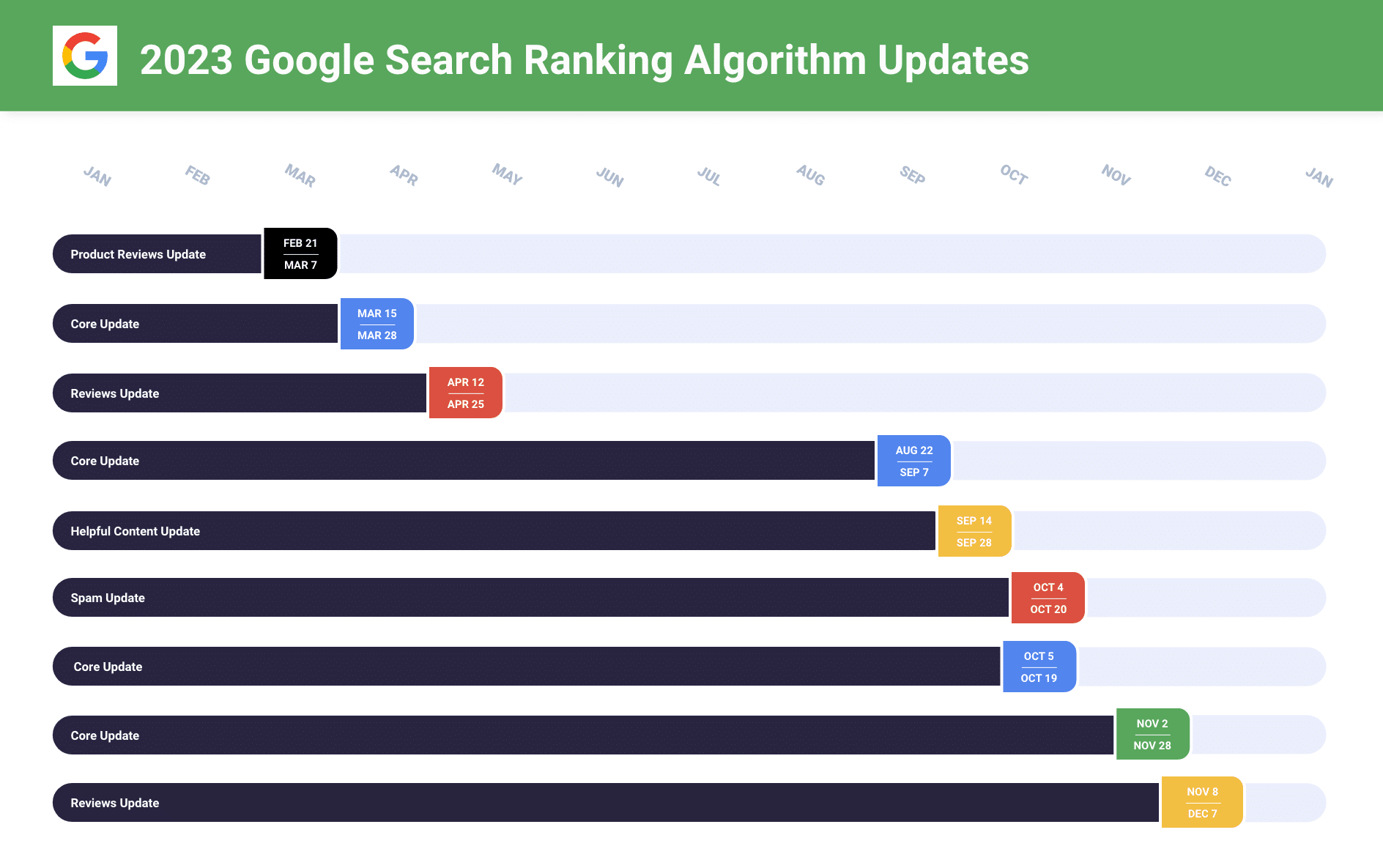
We whipped up this timeline documenting all the confirmed Google search algorithm updates in 2023, so you can visualize the updates over the year.
Four Google core updates in 2023
Google had a whopping four core updates in 2023, compared to only two in 2022. We had core updates in March, August, October and November.
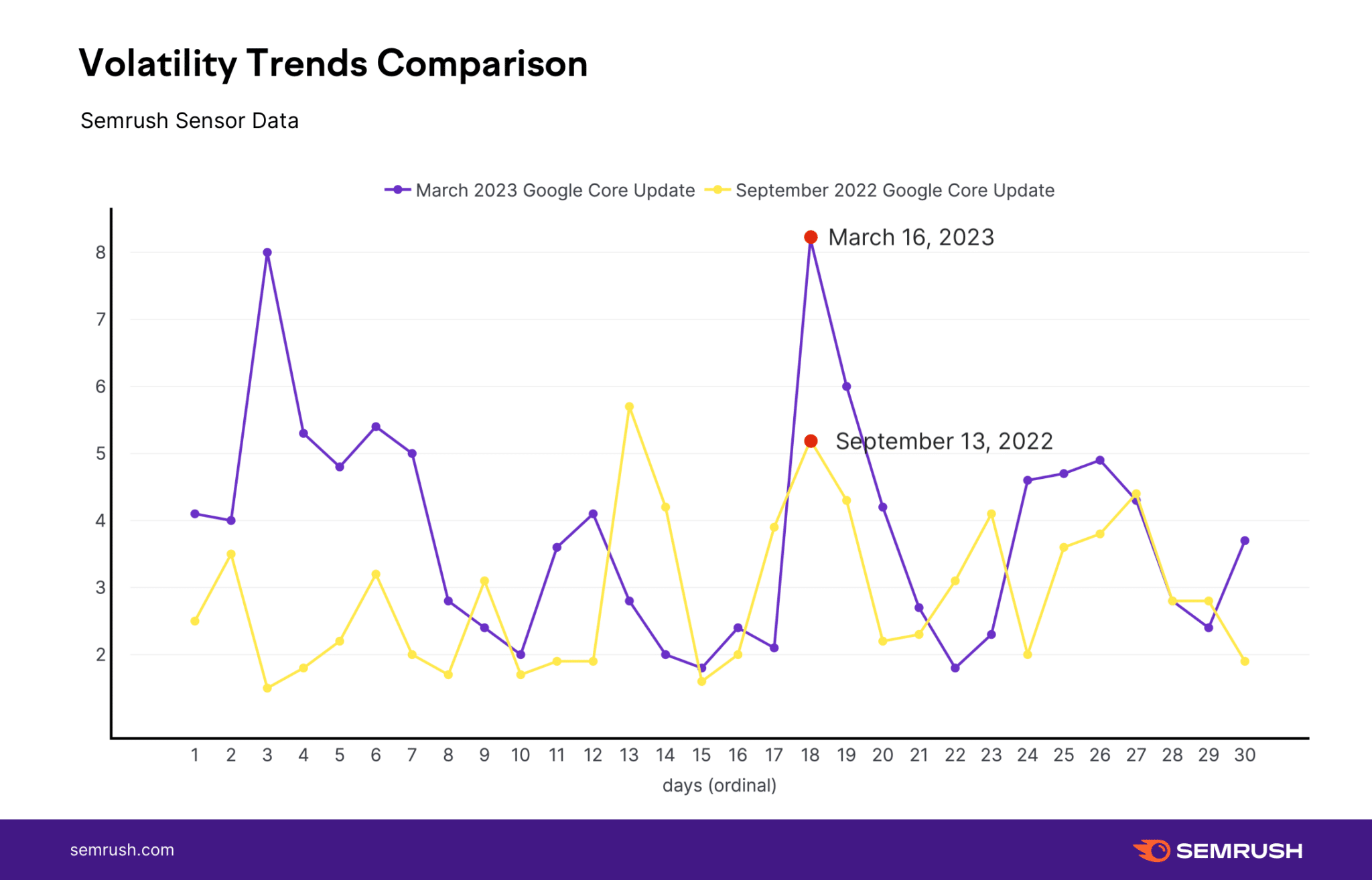
March 2023 core update. The Google March 2023 core update started rolling out March 15, took 13 days to complete, and finished on March 28. Overall, the volatility was about the same as previous core updates according to some data providers.
Here is one chart we shared back then comparing that volatility:
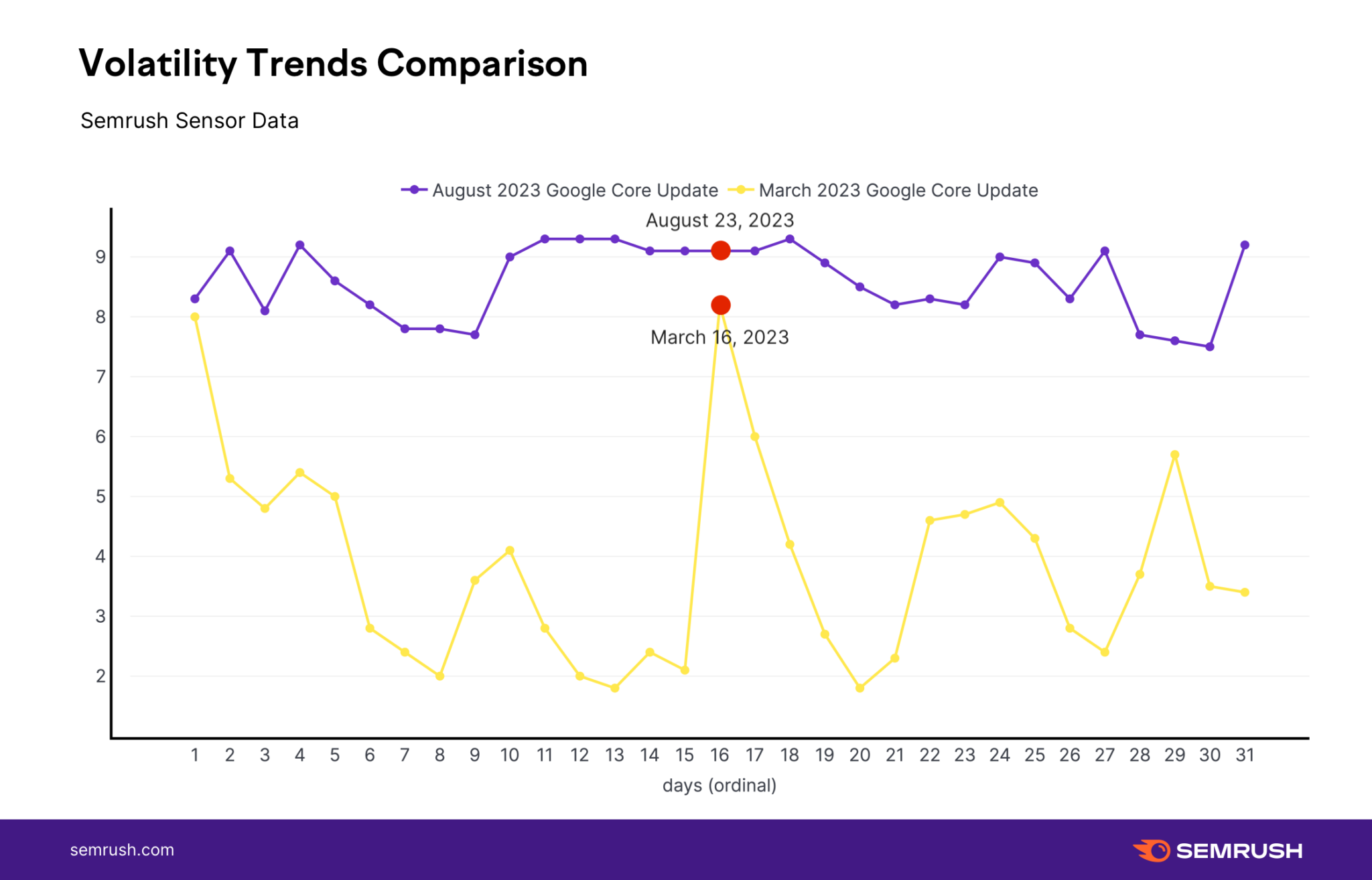
August 2023 core update. The Google August 2023 core update started rolling out August 22, took 16 days to complete, and finished on September 7. Overall, the volatility was generally less than previous updates, feeling more muted than what we expected according to data providers.
Here is one chart we shared back then comparing that volatility:
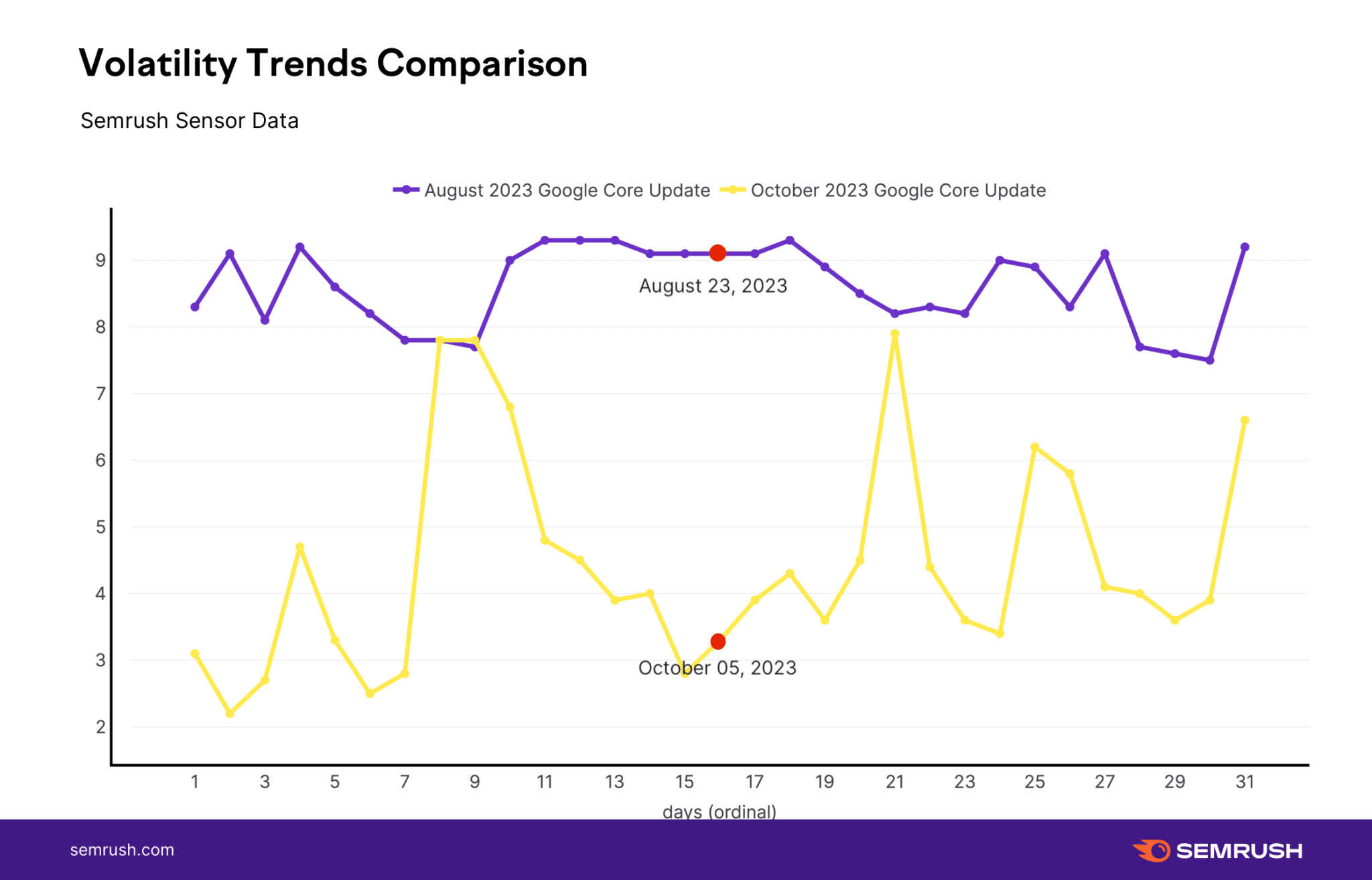
October 2023 core update. The Google October 2023 core update started rolling out Oct. 5, took 14 days to complete, and finished on Oct. 19. Overall, the volatility was hard to measure because it overlapped with the October spam update, but the volatility was felt in a big way, according to several data providers.
Here is one chart we shared back then comparing that volatility:
November 2023 core update. The Google November 2023 core update started rolling out on Nov. 2, took 26 days to complete, and finished on Nov. 19. Overall, the volatility was even greater than October spam update, according to data providers. But this update also overlapped with the November reviews update.
Here is one chart we shared back then comparing that volatility:

Product reviews update to reviews update
Google renamed the Product reviews update to the reviews update. That’s because Google is now looking at all types of review-related content, not just product review content.
We had three reviews updates this year. The November 2023 reviews update is the last update of its kind that will be confirmed going forward, Google said.
February 2023 product reviews update. The Google February 2023 product reviews update started Feb. 21, took 14 days to complete, and finished on March 7. Overall, the volatility showed that update was more significant that previous product reviews updates, according to some data providers. Also, this was the last product product reviews update before it was renamed the reviews update.
Here is one chart we shared back then comparing that volatility:

April 2023 reviews update. Now we move into the realm of reviews updates with the Google April 2023 reviews update, it started on April 12 and took 13 days to roll out, completing on April 25. again, this update went beyond product reviews and included services and businesses, destinations, media and other review content. Overall, the volatility was more widespread that previous updates, simply because it impacted more categories of review content.
Here is one chart we shared back then comparing that volatility:

November 2023 reviews update. Now we move into the realm of reviews updates with the Google November 2023 reviews update, it started on Nov. 8 and took 29 days to roll out, completing on Dec. 7. Again, this update went beyond product reviews and included services and businesses, destinations, media and other review content. I was unable to get data that compared the volatility of this update to previous ones because the November core update overlapped with this update and the data was too messy to separate.
Helpful content update that shook the industry
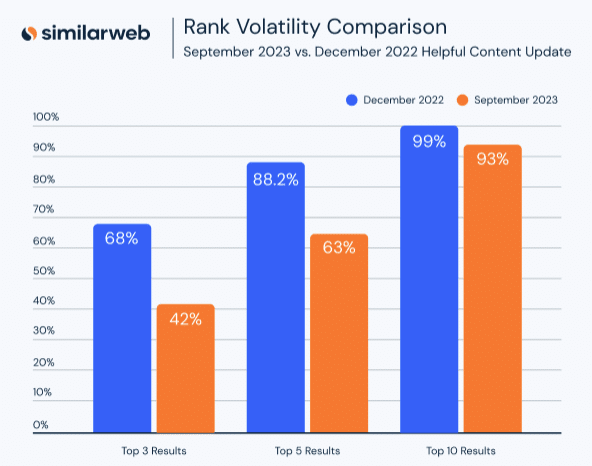
The Google September 2023 helpful content update started on Sept. 14 and took 14 days to roll out, ending on Sept. 28. While we only had one helpful content update in 2023, this update was big. In fact, SEOs are still talking about this update today and how much of an impact it had on their businesses and clients.
The volatility was very big, especially if you zoomed into the SEO chatter (what SEO forums were saying). It seemed like this was the helpful content update we expected Google to launch in 2022 but never did.
I believe this update was felt more within the SEO industry niche, maybe sites designed to rank well in search engines, more so than typical sites that take into account more than just search engines.
Here is one chart we shared back then comparing that volatility:
A spam update in the middle
And we had a spam update in the middle of all of these updates, the October 2023 spam update. That spam update started on Oct. 4 and lasted 15 days, ending Oct. 20. Yes, this update overlapped the October 2023 core update, making tracking the volatility of this specific update nearly impossible.
Google said the October 2023 spam update “aims to clean up several types of spam that our community members reported in Turkish, Vietnamese, Indonesian, Hindi, Chinese, and other languages.” Google added that update should “reduce the visible spam in search results, particularly when it comes to cloaking, hacked, auto-generated, and scraped spam.”
Other Google algorithm changes, updates, tweaks or topics
- In May, Google told us about a topic authority system it uses to better surface news content. It was not a new algorithm system, Google just had not discussed it before.
- Google released an update, outside of the helpful content update, to reward hidden gems. Maybe this was released to the more personalized Google search experience.
- In November, Google adjusted its local ranking algorithm to strengthen the “openness signal” for non-navigational queries.
- From Oct. 5 to Oct. 31, Google had a bug with its core update that impacted Discover related traffic.
- In September, Google updated its language matching system. Google told us: “Over the past few months, we’ve also released a series of updates to improve our language matching systems, including the latest update about two weeks ago. Collectively, these should better match results to the language someone searches in, while still allowing for the flexibility multilingual searchers need to access results in multiple languages.”
- Google dropped a bunch of its ranking systems help documentation but said while page experience is not a ranking system it is still a signal.
- Google also updated its search quality raters guidelines on Nov. 16 to focus more on user intent and do the search results meet the expectations of users.
- Google also relaunched its ranking updates page in March for better tracking purposes.
Courtesy of Search Engine Land: News & Info About SEO, PPC, SEM, Search Engines & Search Marketing
Wednesday, December 27th, 2023
The year 2023 was unlike any other I’ve seen in SEO and Search. I say this as someone who has been in this industry since 2007. Many others I spoke to expressed similar sentiments at various points throughout 2023.
By March, Search Engine Land had published multiple stories that, in any other year, all could have been the story of the year.
And the news and updates kept coming, day after day, week after week and month after month. Until at last, here we are, with no more year left to go! Although, with how this year has gone, I may be tempting fate – it’s entirely possible that a major Search story will break on Dec. 31.
Search Engine Land has covered all the biggest stories for 17 years, and we did it again in 2023.
Here’s our look back at the biggest SEO news and updates of 2023.
Google
Search Generative Experience
The all-new, AI-powered Google Search — officially: Google Search Generative Experience — was announced May 10 after months of speculation and rumors. It was powered by multiple large-language models (LLMs), including PaLM2 and MUM.
It came with a waitlist (a recurring theme in 2023). Google opened access May 25. Here’s our SGE hands-on and early reactions.
Dig deeper. Test driving Google’s Search Generative Experience
The AI-generated answers are presented in a variety of forms via a snapshot, with links, images, videos and the ability to ask follow-up questions. SGE has received countless feature updates and expanded to 120 more countries, all while its content formats continue to evolve.
Initially, SGE failed to cite sources in its answers (like Bard). Google began testing SGE links before officially adding links in August.
Leading up to this:
Dig deeper. Google patent describes how the Search Generative Experience works
Bard
Google tried to make it clear — Bard is not Search. This didn’t stop people from confusing Bard with some AI features it teased at the same time (which we later learned was SGE).
But the arrival of Bard — Google’s answer to ChatGPT — was huge news in the Search world. Bard is Google’s experimental conversational AI service, powered by LaMDA.
Bard was upgraded to Google’s Gemini model in December. Assistant with Bard, a “personal assistant powered by generative AI,” will soon be added to Google Assistant on iOS and Android.
- When Bard was introduced, there were no links or citations to the sources used to generate its AI answers, with some seeing this a declaration of war on publishers. Google’s initial explanation was that Bard was “intended to generate original content and not replicate existing content at length.” Citations were added later.
- Google seemed to rush the Bard announcement (widely considered to be so underwhelming that Google lost $100 million in market value the following day) to Feb. 6 so Google could upstage a Feb. 7 event at which Microsoft announced its new AI-powered version of Bing Search, powered with GPT-4.
- A month after announcing Bard, Google opened a waitlist. SEOs who got early access shared early Bard issues, which included hallucinations and getting bad SEO advice that went against Google’s guidelines (e.g., Bard thought buying links is a good idea). Overall, SEOs weren’t impressed with Bard — Google Bard was called disappointing compared to ChatGPT and Bing Chat.
Dig deeper: ChatGPT vs. Google Bard vs. Bing Chat: Which generative AI solution is best?
AI content
The arrival of generative AI led to brands, including BankRate, CNET and others, experiment with publishing AI-generated content, as we saw in January. This emergence of generative AI-written content reminded us of the old content farms wiped out by Google’s Panda updates.
Google seemed to change its stance on AI content this year, less than a year after warning against AI written content.
Content that is helpful and created for people first (vs. solely for earning search rankings) was now OK, according to Google’s Danny Sullivan. Google reiterated its stance a month later, with Sullivan saying Google’s focus is “on the quality of content, rather than how content is produced.”
Meanwhile, content creators quickly became concerned about AI answers stealing traffic and revenue:
We also saw bad examples of AI content this year:
Ranking revelations
SEO wasn’t front and center at the U.S. vs. Google antitrust trial, but we learned a lot about how Google actually ranks pages.
- How Google Search and ranking works, according to Google’s Pandu Nayak: This is an absolute must-read. Learn how indexing, algorithms, deep learning systems, human raters, click and query data and more shape Google’s Search results, based on Nayak’s testimony.
- 7 must-see Google Search ranking documents in antitrust trial exhibits: We learn a lot from internal presentations and documents, including Google’s pillars of ranking, what user interaction signals Google looks at (clicks, reads, scrolls, hovers); how Google learns from users and uses that data to improve Search; 18 aspects of search quality and much more.
- Former Googler: Google ‘using clicks in rankings’: Eric Lehman, a former 17-year employee of Google, said during his testimony: “Pretty much everyone knows we’re using clicks in rankings.” When this was published, we didn’t yet have the full context (provided in the two stories above) around just how much click data was using due to less-than-stellar reporting from people who just don’t understand much about how search works.
Also this year (separate from the antitrust trial), Google’s Gary Illyes told us that links are no longer a “top 3” Google search ranking factor, which is in line with what Google said a year ago and told us would happen nearly a decade ago.
Links clearly still play a role in SEO. However, for Google, links are less important for ranking webpages than in years past.
Hidden gems, personal search and Notes
Google announced a trio of updates in November:
Algorithm updates
Although it felt like an incredibly volatile year, and we were warned to “buckle up” for more, Google only released nine algorithm updates this year – less than the 10 it has released the previous two years. You can read the annual recap of 2023 Google algorithm updates by Barry Schwartz.
Reminder: Our history of Google algorithm updates page features all the latest news and guidance around the latest algorithm updates.
Link best practices
Google shared new link best practices in their SEO and search developer documentation.
This help document evolved from covering the basics of crawlable links to covering anchor text placements, how to write good anchor text, internal links and external links.
Content pruning
CNET got “exposed” for deleting thousands of pages (a.k.a., content pruning), which is a fairly common advanced SEO practice. CNET wrongly believed that content deprecation “sends a signal to Google that says CNET is fresh, relevant and worthy of being placed higher than our competitors in search results.”
However, Google’s Sullivan wanted to make Google’s stance on this tactic clear:
- “Are you deleting content from your site because you somehow believe Google doesn’t like ‘old’ content? That’s not a thing! Our guidance doesn’t encourage this. Older content can still be helpful, too.”
Read all about it in Google warns against content pruning as CNET deletes thousands of pages as well as my follow-up guide, Improving or removing content for SEO: How to do it the right way.
In memoriam: Google Analytics UA
We knew the end of Universal Analytics (UA) was inevitable. Google published blog posts, sent us emails, posted reminders on social platforms and showed us an intrusive interstitial every time we logged in. Google even threatened to set up Google Analytics 4 for us if we didn’t.
While it seemed everybody was talking about AI, GA4’s switch-or-else date — July 1 — eventually came. Despite all the advanced notice, marketers still felt unprepared. Our coverage:
We thought UA would stop processing data. It didn’t. UA properties kept processing data. Ten days later. A month later. Two months later.
Search Engine Land’s UA property finally stopped processing data on Sept. 8 — 68 days past the date on which we were expecting, and told repeatedly, it would stop. I wonder if there are still any UA properties collecting data as we close out 2023?
10 more Google Search updates and changes
Dig deeper. Inside Google’s massive 2023 E-E-A-T Knowledge Graph update
Microsoft
New Bing / Bing Chat / Bing Copilot
In January, we learned Microsoft was planning on adding ChatGPT features to Bing. By February, we learned it would be powered by GPT-4, (OpenAI released this model in March) and the new interface was spotted in the wild.
Microsoft revealed the new Bing at an event in February. Here’s our hands-on review from February.
New Bing earned praise from SEOs (e.g., New Bing is mind-blowingly fast and better than I expected) despite seeming to have multiple personalities (or “confused”) early on and received multiple quality improvements since.
It also came with a waitlist and would only be open to Edge users on desktop initially. Over a million people signed up for the AI-powered Bing over the next 48 hours.
Dig deeper. Microsoft explains how Bing AI Chat uses ChatGPT and Search with Prometheus
Microsoft’s AI-powered search earned much media attention and created the perception that the company might finally gain ground on its longtime rival, Google. But hype, as it often does, turns out not to be reality.
It looked like Bing made some small gains in search market share by March. We later learned that the new Bing attracted many new Edge users, who then chose Google for Search instead of Bing.
It became clear by May that Microsoft Bing had failed to gain market share. Even clearer after six months of the new Bing — Microsoft disputed the numbers but failed to provide any figures.
By the time Microsoft CEO Satya Nadella spoke at the U.S. vs. Google antitrust trial, he sounded like a defeated man, saying at one point:
- “Yeah, I mean, look, that’s called exuberance of someone who has like 3% share, that maybe I’ll have 3.5% share.”
In November, Microsoft announced a rebranding of Bing Chat to Copilot. When that change will actually become visible remains to be seen, as Bing still refers to its chat experience from Search as “Bing Chat” or “Chat.”
Dig deeper:
Yandex
A former Yandex employee allegedly leaked source code, part of which contained 1,922 search ranking factors. This was huge news when it broke, but has almost been forgotten now.
It turned out that 1,922 figure was low — there were actually 17,854 Yandex ranking factors. See Michael King’s excellent analysis: Yandex scrapes Google and other SEO learnings from the source code leak.
Also, Russia’s largest search engine is now reportedly for sale.
Yahoo
Yahoo started dropping hints in January about its return to competing in the search space. In addition to hiring, a tweet promised Yahoo was going to make search “cool again.”
Now we know Yahoo’s new Search experience will start rolling out in the first few weeks of 2024, Brian Provost, SVP & GM, Yahoo, told me at SMX Next in November.
Neeva
The ad-free search engine, founded in 2019, shut down.
Search Engine Land
SearchBot
We turned Search Engine Land into a chatbot this year. Yes, we trained ChatGPT on our content so you can explore, experiment and learn more about search marketing.
Later in the year, SearchBot got a huge upgrade, including new personas and image generation.
Sign up here for free access.
SMX Advanced and Next
We ran two digital events this year – SMX Advanced in June and SMX Next in November. Both shows were packed full of actionable SEO tips and insights.
Below are links to our coverage of some SEO session from Advanced:
You can expect to read lots of coverage of SEO sessions from SMX Next over the coming weeks on Search Engine Land.
Plus, congratulations to all the 2023 Search Engine Land Award winners.
Salary & Career Survey
Here’s what you told us:
20 years of Barry Schwartz
Search Engine Land’s own Barry Schwartz has now been covering all things search for 20 years — 17 of those here at Search Engine Land. JR Oaks did a fascinating breakdown of 20 years of search based on Search Engine Roundtable analytics data.
SEO in 2033
What’s next for SEO? More AI. We are only at the dawn of our generative AI journey and AI-driven Search as we enter 2024.
Pichai said this year Google Search will evolve substantively in next 10 years. And 2024 will be one year closer to the type of search that is more “personalized” (hello, Bard Assistant) and “ambiently available to users in radically different ways.” And he promises Google will get SGE right.
DeepMind co-founder Mustafa Suleyman echoed this, saying Google will look much different in 2033 – where conversation is the interface, not a Search box.
If you’ve never seen the 2013 movie “Her,” watch it. Or if you have seen it, watch it again. That could be the general direction Google is heading. The future of AI Search could be:
- Virtually assisted.
- Conversational.
- Predictive.
- Adaptive — to evolve and understand you.
We aren’t there yet. Learn all you can about how modern search engines work, generative AI, LLMs, retrieval augmented generation and generative engine optimization (GEO) in 2024.
Courtesy of Search Engine Land: News & Info About SEO, PPC, SEM, Search Engines & Search Marketing
Friday, December 22nd, 2023
In 2023, we witnessed the rise of AI-powered search and significant evolution of the SERPs with the arrival of Google’s Search Generative Experience, as well as Bing Copilot (formerly Bing Chat).
Google’s new AI model, Gemini, is its largest and most advanced, capable of understanding text, code, audio, images and video. We expect to see its full potential unleashed on Google Search in 2024.
Meanwhile, Google continues to stress the importance of quality and experience while using AI models as a key component of ranking and re-ranking. Google released several algorithm updates this year around the quality of content and page experience.
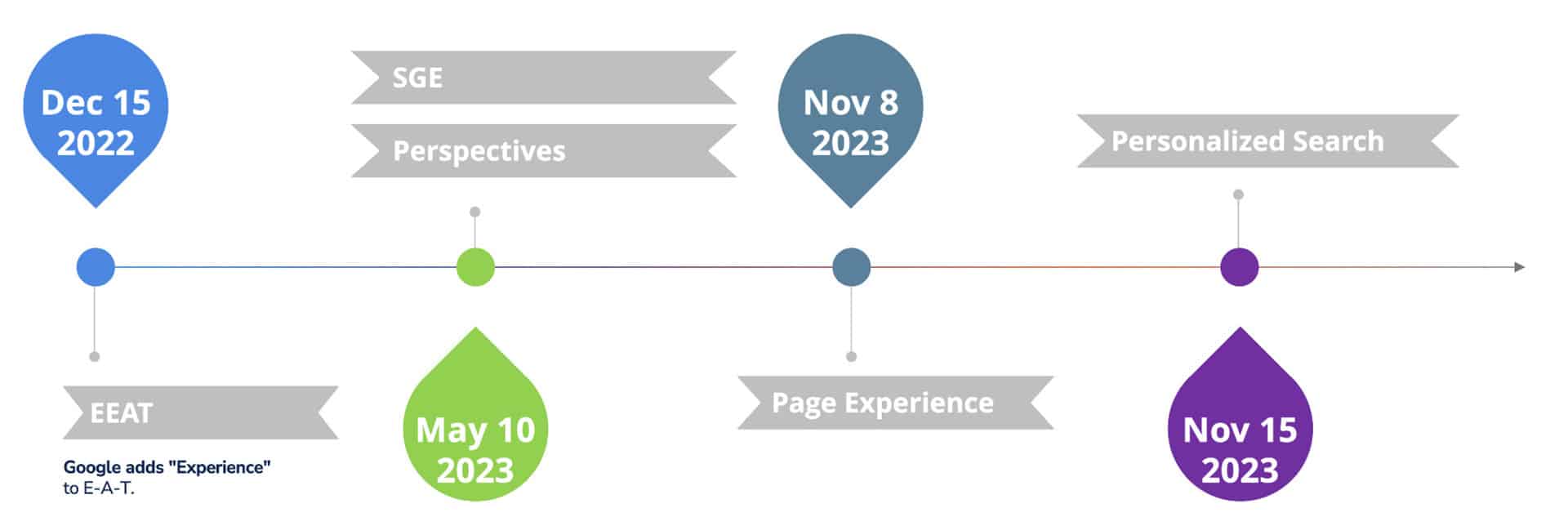
Using AI is acceptable to Google for generating content as long as it is highly relevant and offers value. Still, don’t expect thin, AI-generated content with little or no value to easily earn long-term SERP visibility.
A topical, entity-first strategy is now a competitive advantage. Strengthening the technical foundation of your platform to improve discovery and experience is critical.
Bottom line: futureproofing digital presence for AI search should be a major priority for all brands in 2024.
Read on to discover seven key trends that should influence your roadmap in 2024, as well as three must-haves for success.
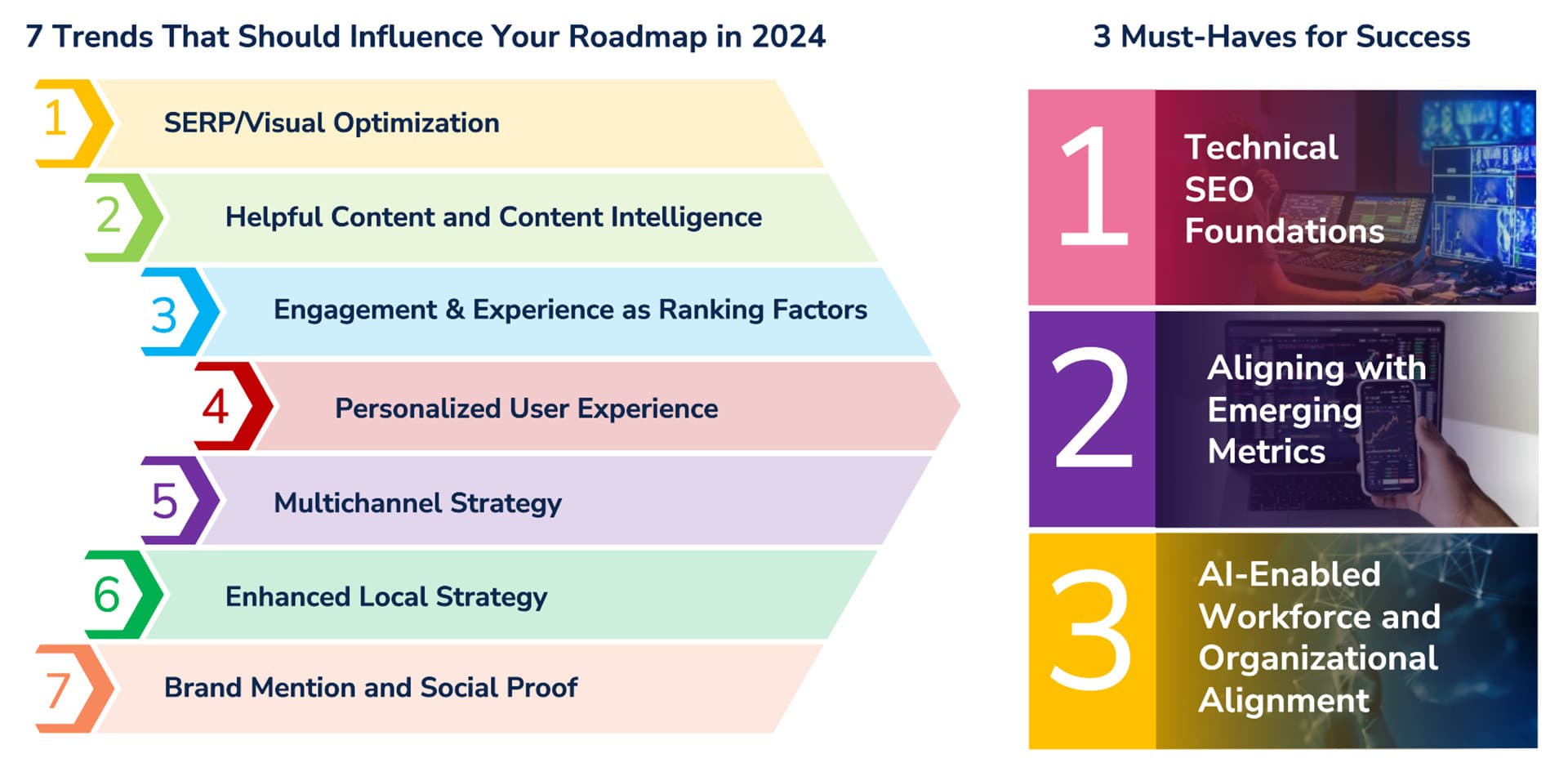
7 trends that will influence your strategic roadmap in 2024
These are the top seven trends we will notice in 2024.
1. SERP and visual optimization
In Google SGE and the SERPs, rich results will continue to evolve. Ongoing SERP optimization will be critical as we expect zero-click results to grow due to SGE.
Want to get into the AI-generated answer (or snapshot)? Keep publishing fast-loading pages filled with relevant, helpful, valuable and unique content. Some specific areas to prioritize:
- Experiential/informational videos.
- Web stories.
- Podcasts.
- Webinars.
- Visual optimization.
- FAQ/PAA.
2. Helpful content and content intelligence
A rock-solid content strategy will be essential in 2024:
- Find and fill relevant content gaps.
- Review content performance.
- Create personalized content based on user intent and touchpoints.
- Create and optimize various types of helpful content (e.g., topical and informational, localized, visual).
You want to demonstrate high levels of E-E-A-T and publish content written or reviewed by subject matter experts or demonstrate hands-on experience.
Every search happens because someone wants or needs something. Your content should help searchers achieve goals or complete tasks. How a user interacts with your content is just as important as the content itself.
To meaningfully do this, your strategy should include creating buyer personas. Create content based on the buyer’s journey at every touch point. Survey your customers and ensure content and UX align with the strategy.

Content intelligence – knowing what type of content will perform, based on data – should become your foundation of content creation.
Several generative AI tools and plugins can quickly create content, sure, but it’s typically unclear:
- What content types will perform well.
- How to humanize content.
- How to forecast the effectiveness of a content strategy.
Establishing a data-driven approach to measure the effectiveness of content will become crucial for content creators.
3. Engagement and experience
User interactions and engagement are important factors that shape Google’s search results.
Google wants to reward expert-level content that is compelling and meets the needs of searchers.
Your goal in 2024 should be to improve the quality and experience for searchers by improving the quality of your content and experience of your digital assets.
4. Personalized experience
Google CEO Sundar Pichai said search will evolve substantively in the next 10 years. Search will be more personalized to impact users more profoundly and meaningfully.
That may be why, on Nov. 15, Google introduced a personalized search experience, including a new Follow button, to show searchers more information about what they care about directly in their search results.
You also should give your customers personalized experiences based on who they are, what they are looking for and where they are coming from.
This means a tighter integration with your CDP (customer data platform) and CRM (customer relationship management) systems to ensure a personalized experience.
Clean data, audience segmentatio, and data-driven campaigns to personalize experience are critical strategies to win in 2024.
5. Multichannel approach
Take advantage of all opportunities on what will become increasingly competitive SERP real estate with limited inventory for organic listings. That means optimizing the customer journey across various channels and content types:
- Videos.
- Images.
- FAQs.
- PAAs.
- News.
- Webinars.
Be everywhere. Be consistent.
6. Local Strategy needs to be more personalized, localized, and experiential.
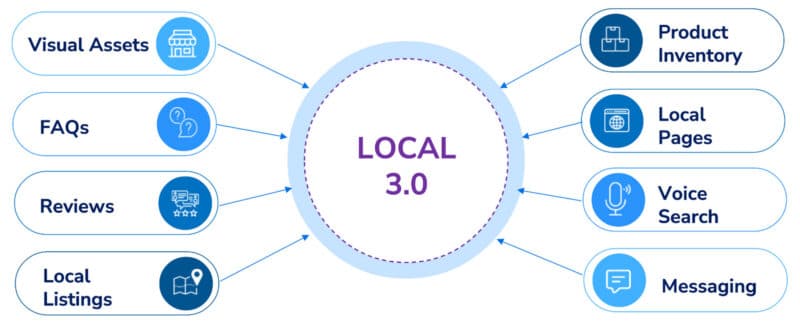
If your brand has a local presence, add localized experiences to build expertise, engagement and traffic. For destination-based content, think:
- Local posts.
- Quality images.
- Videos.
- Web stories.
Listings management alone will not be enough. You must optimize the entire local consumer journey – from your landing page to audience interactions across all channels.
7. Brand mentions and social proof
We know LLMs are trained on a variety of sources to compile results.
Understand what specific questions/topics your customers are seeking answers for, where they will get this information, and ensure we create targeted strategies.
Find ways to get/earn brand mentions and citations from well-respected sources and relevant influencers (ideally with a substantial social following).
3 priorities for staying ahead in changing times
With all the changes taking place, staying ahead of the curve and the changing times is imperative. “Keep up, or you will be left behind.”
Here are three main priorities to help you stay ahead.
1. Technical Infrastructure which Enables Integrated, Robust Experience
Having a solid technical foundation is a must-have for 2024. A solid technical foundation ensures robust experience.
This includes the ability to centralize all your data to build meaningful dashboards and customer journey insights, component-based architecture that enables one-click personalized and omnichannel experiences, security infrastructure, fast server response (CDN), and integrations.
Dig deeper. Future Proofing Digital Experiences in AI First Semantic Search.
2. Embracing New Metrics
As AI serves answers in the search results, traffic is likely to decline. As more content is served within search results from Google properties, organic listings will continue to get more fragmented and will be pushed lower down on the page.
Traditional metrics like rankings will mean even less than they do today.
New metrics are emerging. Brands must consider adopting these new measures of success, such as:
- Rich snippet visibility.
- Pixel height and width.
- Impressions.
- Clicks.
- On-site engagement.
- Conversions.
3. AI-Enabled Worker and Organization Alignment
By learning how to apply AI in your daily life, you can become more efficient and better in creating content outlines, image creation, custom images, summaries, designs, and so many other places where AI should be used.
- “A common fear has been around since the advent of AI – with many people asking ‘Will AI take my job?’ Not to worry! With the current technology, there is no actual intelligence in the AI, and it’s not coming for your job. However, there is a key need to adapt because AI can be used to do your job better,” according to Eric Enge.
Are you ready for 2024?
Smart organizations in 2024 will:
- Integrate channels to enable intelligent decisions.
- Connect customer journeys across touchpoints when creating an omnichannel strategy.
- Measure the right metrics, including zero-click and AI results.
- Prioritize training across the organization.
Some individual and organizational transformations will be needed. For example:
- Content writers should evolve into content strategists.
- Developers should create exceptional experiences.
- Analytics teams should become business analysts.
Get familiar with AI. Learn to use large language models for forecasting, content generation and analyzing user behavior.
There are many ways to use AI to simultaneously improve your day-to-day efficiency and the quality of your work.
AI-enabled workers and organizations will have the advantage. They will be more valuable than those that haven’t learned and leveraged AI tools.
Use the trends and strategies from this article to help decide what to prioritize and why and how to align organizations cross-functionally.
Courtesy of Search Engine Land: News & Info About SEO, PPC, SEM, Search Engines & Search Marketing
Thursday, December 21st, 2023
Google posted an indexing issue with Google Search, saying it is investigating reports of indexing delays for content. Google said this issue is “affecting a small number of sites” and they are “working on identifying the root cause.”
What Google wrote. Google posted, “Google is investigating reports about delayed indexing in Google Search that’s affecting a small number of sites. We’re working on identifying the root cause. Next update will be within 12 hours.”
Google also posted these responses on X:
Started early this morning. The reports of these indexing issues started to come in around 1:30 am ET on Thursday, December 21. I initially posted about it on the Search Engine Roundtable, several hours prior to Google confirming the issue. You can see that some of the complaints came in as early as 1:30 am ET and continued to come in throughout even as I write this story.
Who is impacted. Initial thoughts were that only sites in India and specific regions were impacted but that is not exactly correct. Others thought it had to do with sites that publish both normal HTML pages, as well as offer an AMP alternative solution.
The sites I write at, here and the Search Engine Roundtable do not appear to be impacted. The Wall Street Journal, NY Times, Washington Post and other large publications also do not seem to be impacted.
Google said it is only “affecting a small number of sites.” Google will update us when it figures out the “root cause” of the issue. But I do not expect Google to share which sites were impacted and which were not.
What now. If you are impacted, there is not much you can do right now but wait it out. Google is investigating the issue on their end and will hopefully resolve the issue sooner than later. Google did say it will provide an update within the next 12 hours, but hopefully we will see an update sooner.
Why we care. If you are noticing issues with indexing of your content and thus traffic issues to your site from Google Search, then this may be why. Again, this specific issue is new, as of this morning. If you have been having indexing and ranking issues over the past several days or months, that is likely more of an issue with one of the Google Search algorithm updates and Google thinking your site is not worth ranking and indexing at this point.
Courtesy of Search Engine Land: News & Info About SEO, PPC, SEM, Search Engines & Search Marketing
Thursday, December 21st, 2023
The prevalence of mass-produced, AI-generated content is making it harder for Google to detect spam.
AI-generated content has also made judging what is quality content difficult for Google.
However, indications are that Google is improving its ability to identify low-quality AI content algorithmically.
Spammy AI content all over the web
You don’t need to be in SEO to know generative AI content has been finding its way into Google search results over the last 12 months.
During that time, Google’s attitude toward AI-created content evolved. The official position moved from “it’s spam and breaks our guidelines” to “our focus is on the quality of content, rather than how content is produced.”
I’m certain Google’s focus-on-quality statement made it into many internal SEO decks pitching an AI-generated content strategy. Undoubtedly, Google’s stance provided just enough breathing room to squeak out management approval at many organizations.
The result: Lots of AI-created, low-quality content flooding the web. And some of it initially made it into the company’s search results.
Invisible junk
The “visible web” is the sliver of the web that search engines choose to index and show in search results.
We know from How Google Search and ranking works, according to Google’s Pandu Nayak, based on Google antitrust trial testimony, that Google “only” maintains an index of ~400 billion documents. Google finds trillions of documents during crawling.
That means Google indexes only 4% of the documents it encounters when crawling the web (400 billion/10 trillion).
Google claims to protect searchers from spam in 99% of query clicks. If that’s even remotely accurate, it’s already eliminating most of the content not worth seeing.
Content is king – and the algorithm is the Emperor’s new clothes
Google claims it’s good at determining the quality of content. But many SEOs and experienced website managers disagree. Most have examples demonstrating inferior content outranking superior content.
Any reputable company investing in content is likely to rank in the top few percent of “good” content on the web. Its competitors are likely to be there, too. Google has already eliminated a ton of lesser candidates for inclusion.
From Google’s point of view, it’s done a fantastic job. 96% of documents didn’t make the index. Some issues are obvious to humans but difficult for a machine to spot.
I’ve seen examples that lead to the conclusion Google is proficient at understanding which pages are “good” and are “bad” from a technical perspective, but relatively ineffective at decerning good content from great content.
Google admitted as much in DOJ anti-trust exhibits. In a 2016 presentation says: “We do not understand documents. We fake it.”
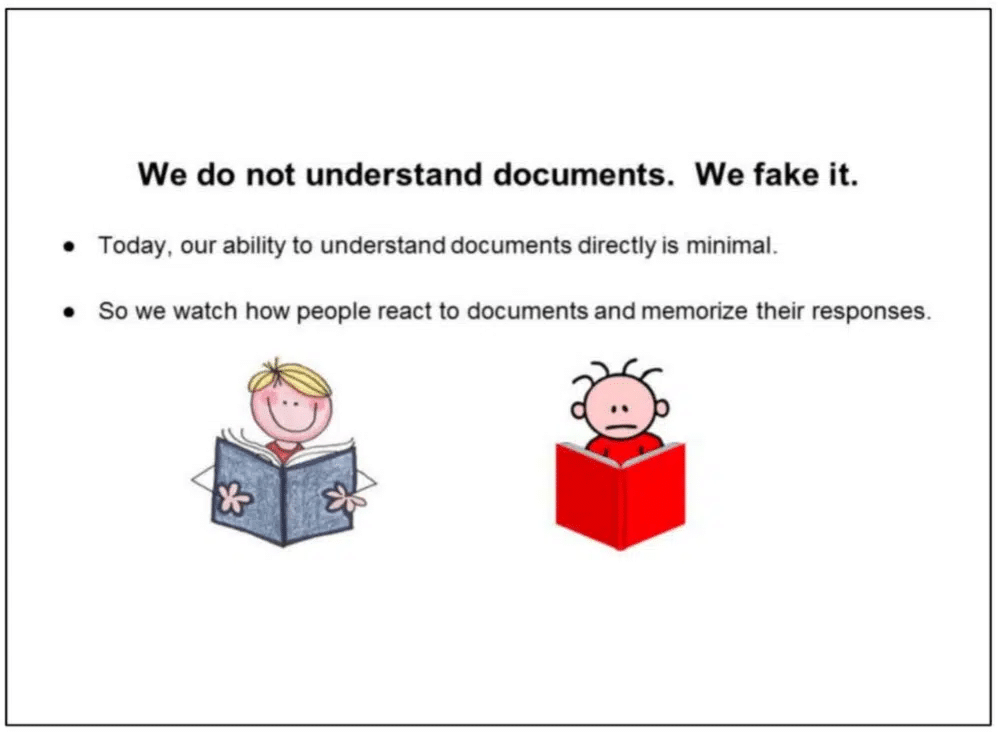 A slide from a Search all-hands presentation prepared by Eric Lehman
Google relies on user interactions on SERPs to judge content quality
Google has relied on user interactions with SERPs to understand how “good” the contents of a document is. Google explains later the presentation: “Each searcher benefits from the responses of past users… and contributes responses that benefit future users.”
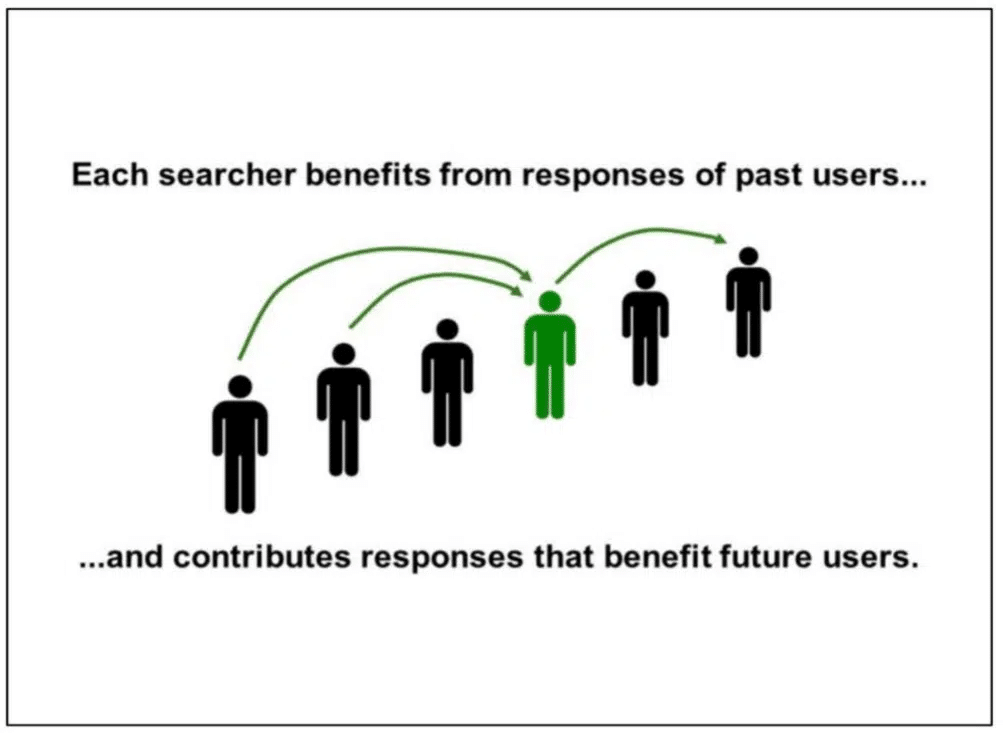 A slide from a Search All Hands presentation prepared by Lehman
The interaction data Google uses to judge quality has always been a hotly debated topic. I believe Google uses interactions almost entirely from their SERPs, not from websites, to make decisions about content quality. Doing so rules out site-measured metrics like bounce rate.
If you’ve been listening closely to the people who know, Google has been fairly transparent that it uses click data to rank content.
Google engineer Paul Haahr presented “How Google Works: A Google Ranking Engineer’s Story,” at SMX West in 2016. Haahr spoke about Google’s SERPs and how the search engine “looks for changes in click patterns.” He added that this user data is “harder to understand than you might expect.”
Haahr’s comment is further reinforced in the “Ranking for Research” presentation slide, which is part of the DOJ exhibits:
 A slide from “Ranking for Research” DOJ exhibit
Google’s ability to interpret user data and turn it into something actionable relies on understanding the cause-and-effect relationship between changing variables and their associated outcomes.
The SERPs are the only place Google can use to understand which variables are present. Interactions on websites introduce a vast number of variables beyond Google’s view.
Even if Google could identify and quantify interactions with websites (which would arguably be more difficult than assessing the quality of content), there would be a knock-on effect with the exponential growth of different sets of variables, each requiring minimum traffic thresholds to be met before meaningful conclusions could be made.
Google acknowledges in its documents that “growing UX complexity makes feedback progressively hard to convert into accurate value judgments” when referring to the SERPs.
Get the daily newsletter search marketers rely on.
Brands and the cesspool
Google says the “dialogue” between SERPs and users is the “source of magic” in how it manages to “fake” the understanding of documents.
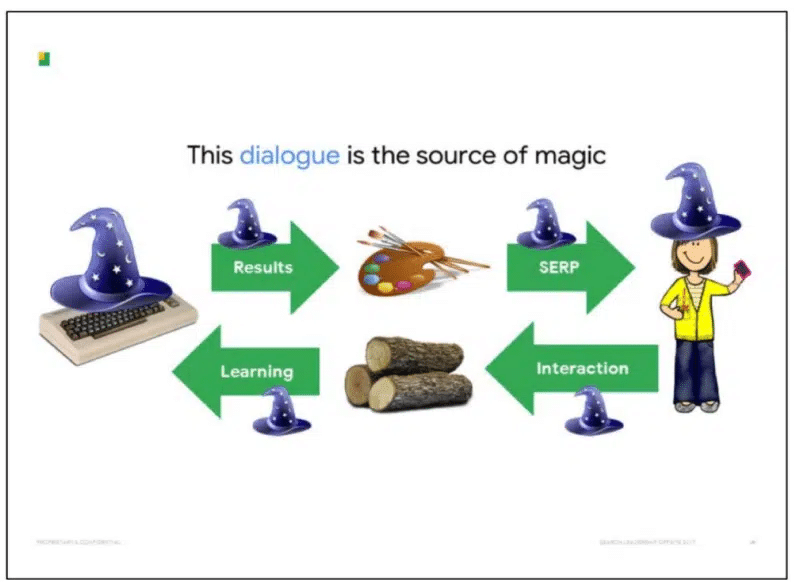 A slide from “Logging & Ranking” DOJ exhibit
Outside of what we’ve seen in the DOJ exhibits, clues to how Google uses user interaction in rankings are included in its patents.
One that is particularly interesting to me is the “Site quality score,” which (to grossly oversimplify) looks at relationships such as:
- When searchers include brand/navigational terms in their query or when websites include them in their anchors. For instance, a search query or link anchor for “seo news searchengineland” rather than “seo news.”
- When users appear to be selecting a specific result within the SERP.
These signals may indicate a site is an exceptionally relevant response to the query. This method of judging quality aligns with Google’s Eric Schmidt saying, “brands are the solution.”
This makes sense in light of studies that show users have a strong bias toward brands.
For instance, when asked to perform a research task such as shopping for a party dress or searching for a cruise holiday, 82% of participants selected a brand they were already familiar with, regardless of where it ranked on the SERP, according to a Red C survey.
Brands and the recall they cause are expensive to create. It makes sense that Google would rely on them in ranking search results.
What does Google consider AI spam?
Google published guidance on AI-created content this year, which refers to its Spam Policies the define define content that is “intended to manipulate search results.”
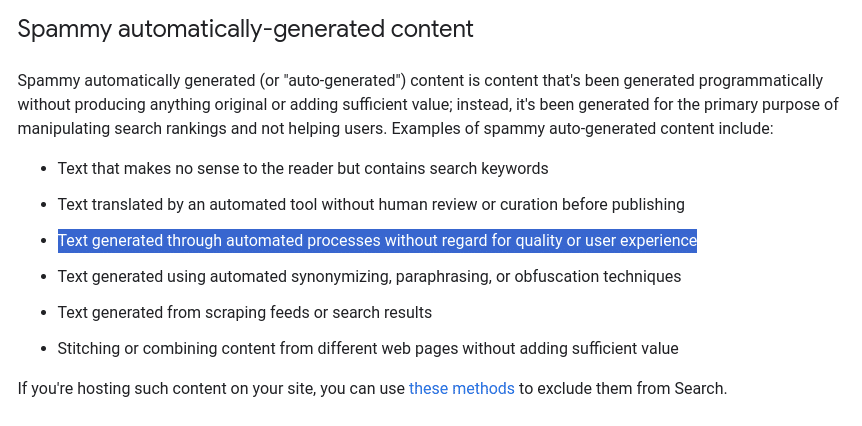 Google spam policies
Spam is “Text generated through automated processes without regard for quality or user experience,” according to Google’s definition. I interpret this as anyone using AI systems to produce content without a human QA process.
Arguably, there could be cases where a generative-AI system is trained on proprietary or private data. It could be configured to have more deterministic output to reduce hallucinations and errors. You could argue this is QA before the fact. It’s likely to be a rarely-used tactic.
Everything else I’ll call “spam.”
Generating this kind of spam used to be reserved for those with the technical ability to scrape data, build databases for madLibbing or use PHP to generate text with Markov chains.
ChatGPT has made spam accessible to the masses with a few prompts and an easy API and OpenAI’s ill-enforced Publication Policy, which states:
“The role of AI in formulating the content is clearly disclosed in a way that no reader could possibly miss, and that a typical reader would find sufficiently easy to understand.”
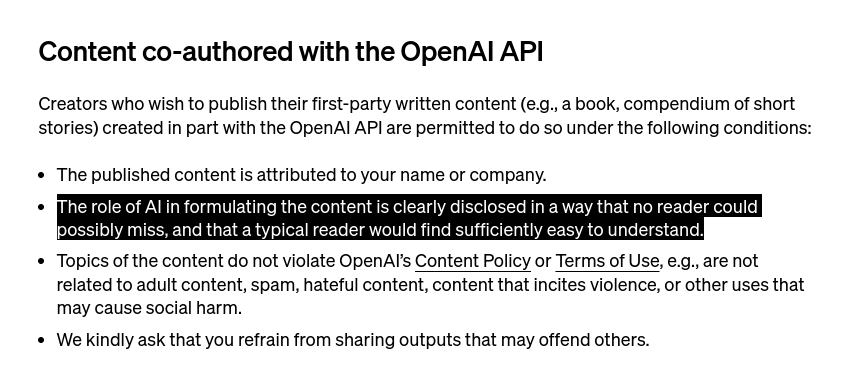 OpenAI’s Publication Policy
The volume of AI-generated content being published on the web is enormous. A Google Search for “regenerate response -chatgpt -results” displays tens of thousands of pages with AI content generated “manually” (i.e., without using an API).
In many cases QA has been so poor “authors” left in the “regenerate response” from the older versions of ChatGPT during their copy and paste.
Patterns of AI content spam
When GPT-3 hit, I wanted to see how Google would react to unedited AI-generated content, so I set up my first test website.
This is what I did:
- Bought a brand new domain and set up a basic WordPress install.
- Scraped the top 10,000 games that were selling on Steam.
- Fed these games into the AlsoAsked API to get the questions being asked by them.
- Used GPT-3 to generate answers to these questions.
- Generate FAQPage schema for each question and answer.
- Scraped the URL for a YouTube video about the game to embed on the page.
- Use the WordPress API to create a page for each game.
There were no ads or other monetization features on the site.
The whole process took a few hours, and I had a new 10,000-page website with some Q&A content about popular video games.
Both Bing and Google ate up the content and, over a period of three months, indexed most pages. At its peak, Google delivered over 100 clicks per day, and Bing even more.
 Google Search Console Performance data from this site presented by Lily Ray at PubCon
Results of the test:
- After about 4 months, Google decided not to rank some content, resulting in a 25% hit in traffic.
- A month later, Google stopped sending traffic.
- Bing kept sending traffic for the entire period.
The most interesting thing? Google did not appear to have taken manual action. There was no message in Google Search Console, and the two-step reduction in traffic made me skeptical that there had been any manual intervention.
I’ve seen this pattern repeatedly with pure AI content:
- Google indexes the site.
- Traffic is delivered quickly with steady gains week on week.
- Traffic then peaks, which is followed by a rapid decline.
Another example is the case of Casual.ai. In this “SEO heist,” a competitor’s sitemap was scraped and 1,800+ articles were generated with AI. Traffic followed the same pattern, climbing several months before stalling, then a dip of around 25% followed by a crash that eliminated nearly all traffic.
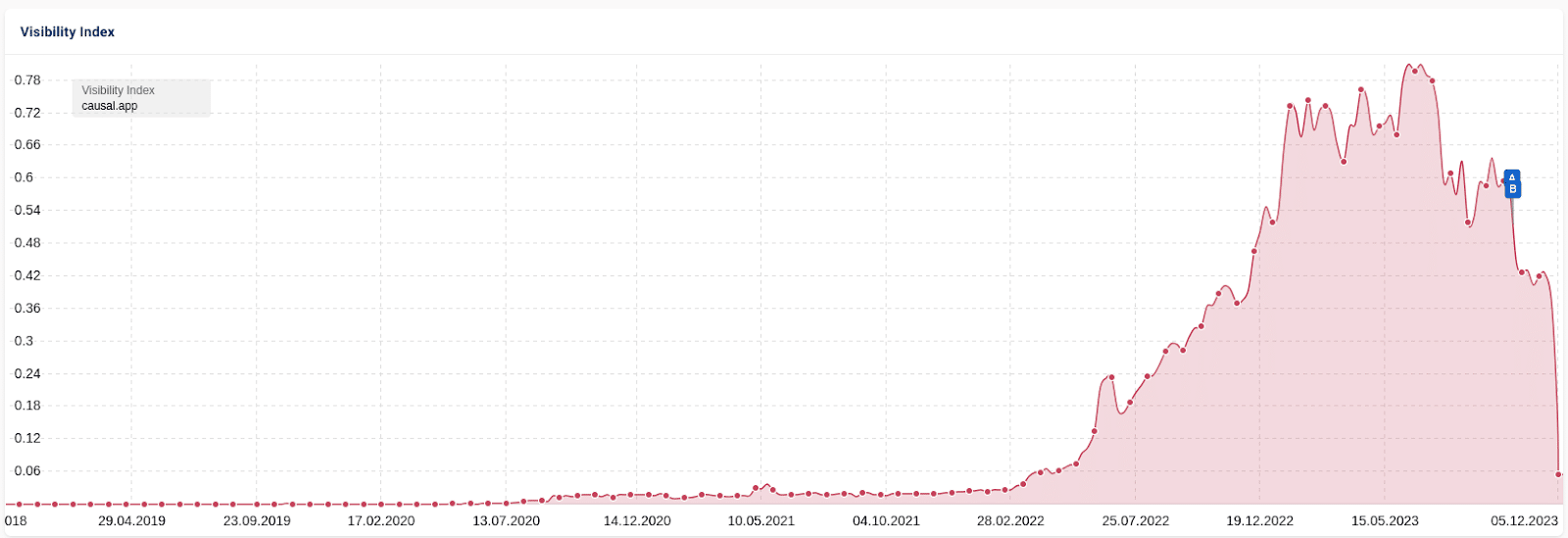 SISTRIX visibility data for Causal.app
There is some discussion in the SEO community about whether this drop was a manual intervention because of all the press coverage it got. I believe the algorithm was at work.
A similar and perhaps more interesting case study involved LinkedIn’s “collaborative” AI articles. These AI-generated articles created by LinkedIn invited users to “collaborate” with fact-checking, corrections and additions. It rewarded “top contributors” with a LinkedIn badge for their efforts.
As with the other cases, traffic rose and then dropped. However, LinkedIn maintained some traffic.
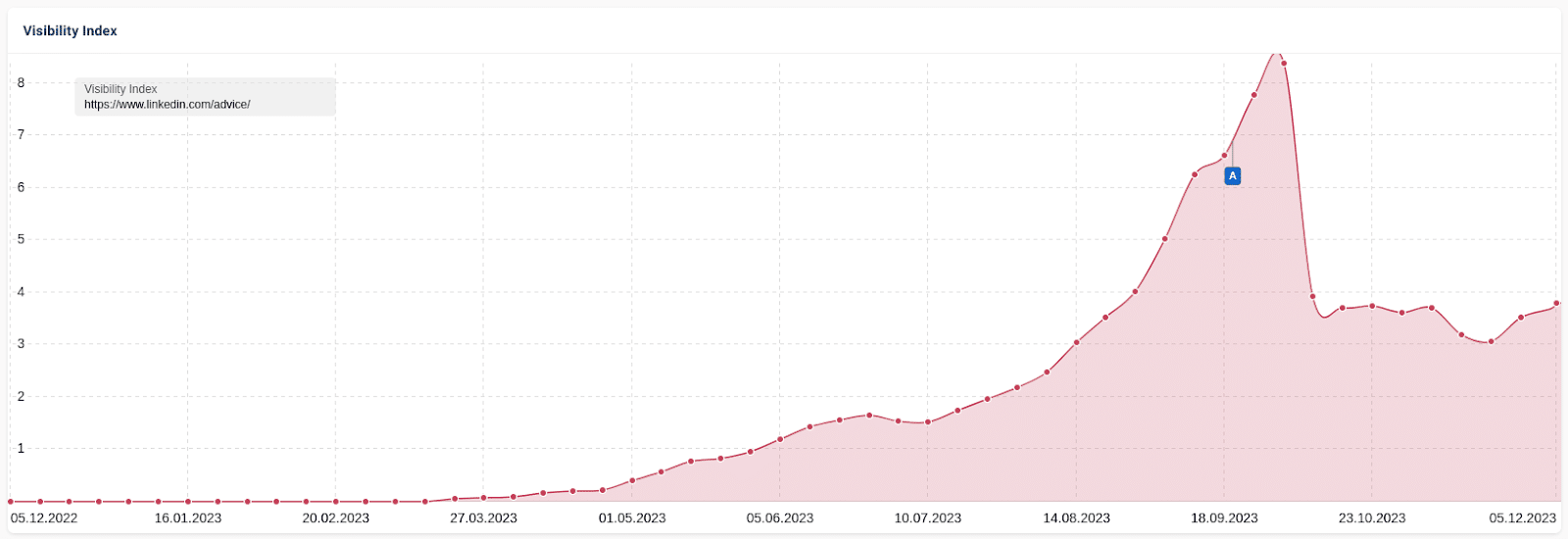 SISTRIX visibility for LinkedIn /advice/ pages
This data indicates that traffic fluctuations result from an algorithm rather than a manual action.
Once edited by a human, some LinkedIn collaborative articles apparently met the definition of useful content. Others were not, in Google’s estimation.
Maybe Google’s got it right in this instance.
If it’s spam, why does it rank at all?
From everything I have seen, ranking is a multi-stage process for Google. Time, expense, and limits on data access prevent the implementation of more complex systems.
While the assessment of documents never stops, I believe there is a lag before Google’s systems detect low-quality content. That’s why you see the pattern repeat: content passes an initial “sniff test,” only to be identified later.
Let’s take a look at some of the evidence for this claim. Earlier in this article, we skimmed over Google’s “Site Quality” patent and how they leverage user interaction data to generate this score for ranking.
When a site is brand new, users haven’t interacted with the content on the SERP. Google can’t access the quality of the content.
Well, another patent for Predicting Site Quality covers this situation.
Again, to grossly oversimplify, a quality score for new sites is predicted by first obtaining a relative frequency measure for each of a variety of phrases found on the new site.
These measures are then mapped using a previously generated phrase model built from quality scores established from previously scored sites.
 Predicting Site Quality patent
If Google were still using this (which I believe they are, at least a small way), it would mean that many new websites are ranked on a “first guess” basis with a quality metric included in the algorithm. Later, the ranking is refined based on user interaction data.
I have observed, and many colleagues agree, that Google sometimes elevates sites in ranking for what appears to be a “test period.”
Our theory at the time was there was a measurement going on to see if user interaction matched Google’s predictions. If not, traffic fell as quickly as it rose. If it performed well, it continued to enjoy a healthy position on the SERP.
Many of Google’s patents have references to “implicit user feedback,” including this very candid statement:
“A ranking sub-system can include a rank modifier engine that uses implicit user feedback to cause re-ranking of search results in order to improve the final ranking presented to a user.”
AJ Kohn wrote about this kind of data in detail back in 2015.
It is worth noting that this is an old patent and one of many. Since this patent was published, Google has developed many new solutions, such as:
- RankBrain, which has specifically been cited to handle “new” queries for Google.
- SpamBrain, one of Google’s main tools for combatting webspam.
Google: Mind the gap
I don’t think anyone outside of those with first-hand engineering knowledge at Google knows exactly how much user/SERP interaction data would be applied to individual sites rather than the overall SERP.
Still, we know that modern systems such as RankBrain are at least partly trained on user click data.
One thing also piqued my interest in AJ Kohn’s analysis of the DOJ testimony on these new systems. He writes:
“There are a number of references to moving a set of documents from the ‘green ring to the ‘blue ring.’ These all refer to a document that I have not yet been able to locate. However, based on the testimony it seems to visualize the way Google culls results from a large set to a smaller set where they can then apply further ranking factors.”
This supports my sniff-test theory. If a website passes, it gets moved to a different “ring” for more computationally or time-intensive processing to improve accuracy.
I believe this to be the current situation:
- Google’s current ranking systems can’t keep pace with AI-generated content creation and publication.
- As gen-AI systems produce grammatically correct and mostly “sensible” content, they pass Google’s “sniff tests” and will rank until further analysis is complete.
Herein lies the problem: the speed at which this content is being created with generative AI means there is an unending queue of sites waiting for Google’s initial evaluation.
An HCU hop to UGC to beat the GPT?
I believe Google knows this is one major challenge they face. If I can indulge in some wild speculation, it’s possible that recent Google updates, such as the helpful content update (HCU), have been applied to compensate for this weakness.
It’s no secret the HCU and “hidden gems” systems benefited user-generated content (UGC) sites such as Reddit.
Reddit was already one of the most visited websites. Recent Google changes yielded more than double its search visibility, at the expense of other websites.
My conspiracy theory is that UGC sites, with a few notable exceptions, are some of the least likely places to find mass-produced AI, as much content is moderated.
While they may not be “perfect” search results, the overall satisfaction of trawling through some raw UGC may be higher than Google consistently ranking whatever ChatGPT last vomited onto the web.
The focus on UGC may be a temporary fix to boost quality; Google can’t tackle AI spam fast enough.
What does Google’s long-term plan look like for AI spam?
Much of the testimony about Google in the DOJ trial came from Eric Lehman, a former 17-year employee who worked there as a software engineer on search quality and ranking.
One recurring theme was Lehman’s claims that Google’s machine learning systems, BERT and MUM, are becoming more important than user data. They are so powerful that it is likely Google will rely more on them than user data in the future.
With slices of user interaction data, search engines have an excellent proxy for which they can make decisions. The limitation is collecting enough data fast enough to keep up with changes, which is why some systems employ other methods.
Suppose Google can build their models using breakthroughs such as BERT to massively improve the accuracy of their first content parsing. In that case, they may be able to close the gap and drastically reduce the time it takes to identify and de-rank spam.
This problem exists and is exploitable. The pressure on Google to address its shortcomings increases as more people search for low-effort, high-results opportunities.
Ironically, when a system becomes effective in combatting a specific type of spam at scale, the system can make itself almost redundant as the opportunity and motivation to take part is diminished.
Fingers crossed.
Courtesy of Search Engine Land: News & Info About SEO, PPC, SEM, Search Engines & Search Marketing
Thursday, December 21st, 2023
One of the joys of living in a place where the winters tend to be long and dark is the time it allows for reading. Make a fire in the fireplace, pour yourself a drink and open a good book.
I often do the bulk of my reading for the year between October and March because then it’s outside time (which isn’t to say you can’t read outside).
We live in a time when we’re surrounded by marketing. Everything and everyone seems to be vying for our attention.
If you work in marketing, the idea of reading a book about something you do all day and that surrounds you every waking moment might sound unappealing. Yet, there are still new things to be said and new things to learn about marketing.
As you head into 2024, here are six books to put on your reading list.
The first thing you’ll likely notice is they aren’t all actually about marketing. But marketing is an essential part of every business and every leader must be a marketer to be successful.
1. Impossible to Ignore: Creating Memorable Content to Influence Decisions
The central focus of Dr. Carmen Simon’s book is the creation of memorable presentations, which is an area where many people have just enough knowledge of PowerPoint and Google Slides to be dangerous.
The problem with many of the day-to-day presentations we see in sales and business, in general, is they try to function as both a presentation and a leave-behind. That leaves them packed with information and light on strong visuals and stories, and those are the exact elements that stick in our memories and promote recall.
As evidence that the techniques in the book work, I like to refer to how Simon uses them in the book itself.
Years after first reading “Impossible to Ignore,” I remember her anecdote about standing in line at a store when she was a child in Soviet-era Romania. Food was in short supply, so the workers had to limit the number of people in line. They decided to send home everyone behind the girl who stood out in a bright red coat, which was a young Simon. The combination of strong visuals and a powerful story burned that in my mind.
2. Running with Purpose: How Brooks Outpaced Goliath Competitors to Lead the Pack
Why would a memoir by the CEO of an athletic shoe company make the list? Because marketing, at its essence, is about identifying and creating markets for whatever you’re selling.
When Jim Weber took over as CEO of Brooks, the company was trying to be everything to everyone who wore sneakers. That’s a lot of people in a market with many big brand names.
Weber and team decided to drop a large portion of the market by leaving the “athleisure” business, which consists of the low(ish)-cost sneakers people wear around the house or when they’re doing chores. They decided instead to focus on serious runners.
This one also has a great marketing play involving luxurious portable toilets Brooks brought to major races. To gain entry, runners had to be wearing Brooks footwear.
There’s a lesson on market disruption, too. Remember the craze over five-finger running shoes? Yeah, that was fun.
3. Unreasonable Hospitality: The Remarkable Power of Giving People More Than They Expect
Will Guidara has a unique resumé. Among his roles: restaurant owner, creative agency leader, conference host and the author of four cookbooks.
His specialty is hospitality. One of his guiding beliefs is that hospitality need not be limited to what we think of as the hospitality industry (i.e., restaurants, spas, hotels). Instead, businesses across industries can create experiences that delight customers and drive more business.
As Guidara rose to prominence in the restaurant business in New York City, his business became legendary for providing experiences like sledding in Central Park for a family that had never before experienced snow.
The moments of brilliance and generosity in the book could serve as a lesson for corporations across the business spectrum. Americans have relatively dim views of large corporations and financial institutions in general. They feel much better about small businesses, which are more nimble and structured in a way that makes personal touches possible.
Many marketers will tell you their brand is more than a logo or color palette, it evokes emotions and, most importantly, trust. In “Unreasonable Hospitality,” you get a view of what this truly looks like in practice.
4. The Power of Moments: Why Certain Experiences Have Extraordinary Impact
We can’t remember every detail of every experience. If you’ve ever watched a courtroom drama, you’ve seen this play out.
“So what you’re saying is, you’re not sure if the suspect had a beard or not when you saw him on that misty, moonless night?”
We remember the peaks of our experiences most of all. Sometimes, we remember the valleys of our experiences. Everything else gets labeled as “just not important enough to remember” by our memory.
In “The Power of Moments,” Chip Heath and Dan Heath help readers understand how our minds process and classify experiences. Once you understand how this all works subconsciously, it’s much easier to be deliberate in creating moments that matter for our audiences.
As a blueprint, the book looks at events that weren’t necessarily designed to be memorable, such as a “Signing Day” ceremony for graduating high school seniors where they announced which college they were attending. It then deconstructs the events to see what exactly made them memorable.
5. Humanizing B2B: The new truth in marketing that will transform your brand and your sales
Download a whitepaper. Get calls from sales reps. Receive email after email.
For years, the B2B marketing playbook was pretty boring – even a bit annoying. It’s improved to some extent but still has a long way to go. You probably know the feeling if you have friends who work in B2C marketing.
“Oh, you’re doing a Super Bowl ad? That must be exhausting for you…”
What if it didn’t have to be this way? (Spoiler alert: it doesn’t.)
Instead of being the boring part of marketing, Paul Cash and James Trezona say, B2B should appeal to the emotions of people trying to transform organizations and create change.
They draw heavily on research from The B2B Institute at LinkedIn to make the case that B2B buyers rely on emotions just as much as their B2C counterparts.
That makes a great deal of sense, when you think about it. Because they aren’t actually counterparts. They are the same people, and they don’t take off their B2B hat and put on a B2C hat when they finish their workday.
6. Obviously Awesome: How to Nail Product Positioning So Customers Get It, Buy It, Love It
Part of what I enjoy about April Dunford’s story is that, like me, she never set out to be a marketer. As someone without a formal marketing education, she asked a lot of questions. The answers left her unsatisfied.
“Trust me, it works.”
“Because we’ve always done it that way.”
The result is “Obviously Awesome,” a book that re-thinks product marketing from an outsider’s perspective.
The most difficult part for people trying to turn their product into a story that resonates with customers is where to start. Do you craft a story that starts with your features? Or do you focus first on the customers’ needs? What about differentiation?
You’ll have to read the book to find out.
Courtesy of Search Engine Land: News & Info About SEO, PPC, SEM, Search Engines & Search Marketing
Thursday, December 21st, 2023

Data storytelling helps marketers present complex information in a relatable and compelling format – which plays a heavy hand in engaging consumers, influencing decisions and creating brand loyalty.
Join experts from Marigold for a 20-minute data storytelling masterclass and learn how to increase your conversions using data storytelling.
Register and attend “Data Storytelling Masterclass,” presented by Marigold.
Click here to view more Search Engine Land webinars.
Courtesy of Search Engine Land: News & Info About SEO, PPC, SEM, Search Engines & Search Marketing


 Say no to cookies – biscuits only