Archive for the ‘seo news’ Category
Tuesday, January 9th, 2024
Artificial intelligence (AI) is revolutionizing the digital landscape – leaving no room for outdated SEO tactics. As search engines increasingly leverage AI to anticipate user intent, we must completely rethink our strategies and balance human creativity and AI efficiency to stay ahead.
Let’s explore the innovations, opportunities and pitfalls to master as AI propels search into a new era.
Search evolution: Prioritizing intent over keywords
The era of keyword stuffing is over, replaced by a focus on user intent.
Search engines have evolved to understand the context behind queries. This shift demands a change in SEO strategies – prioritizing creativity and relevance over mere keyword density.
Today’s SEO is about aligning with user goals and pain points, not just keyword counts. Including elements like location-based services and personalized recommendations turns searches into dynamic interactions between users and your content.
Embracing semantic search
Incorporating semantic search requires a mix of data analytics and empathetic writing. This approach focuses on delivering relevant and valuable insights, aligning with E-E-A-T guidelines for expertise and trustworthiness.
In this new landscape, keyword research remains valuable but as part of a wider strategy. It’s about creating meaningful interactions and standing out in a digital world filled with information overload.
Consider Google’s BERT algorithm. It uses natural language processing to understand the real intent behind a search. This is a leap from simple keyword matching to predictive, context-aware results.
This essentially means AI doesn’t just improve search – it anticipates our needs, often before we articulate them.
AI does more than just understand user intent. It also brings personalization to search engines.
By analyzing past user data like location and search history, AI can predict the future preferences of search engine users.
AI’s transformative role in SEO
AI is a pivotal force in digital marketing, making it important for content creators to understand the technology.
It involves machine learning algorithms that analyze data to predict relevant content for search queries.
With search engines like Google and Bing employing AI to enhance result accuracy, marketers must understand AI’s impact to remain competitive.
Leveraging AI for advanced content strategies
AI tools offer more than just enhancements to current strategies.
They enable optimization through trend identification and advanced analytics. These tools provide insights into strategy performance, like click-through rates and page engagement.
AI also suggests improvements based on user behavior, revolutionizing content optimization by revealing new opportunities and offering data-driven recommendations for continuous enhancement.
The balance between man and machine: The future trend?
Despite AI’s advancements, the need for human narrative crafting remains.
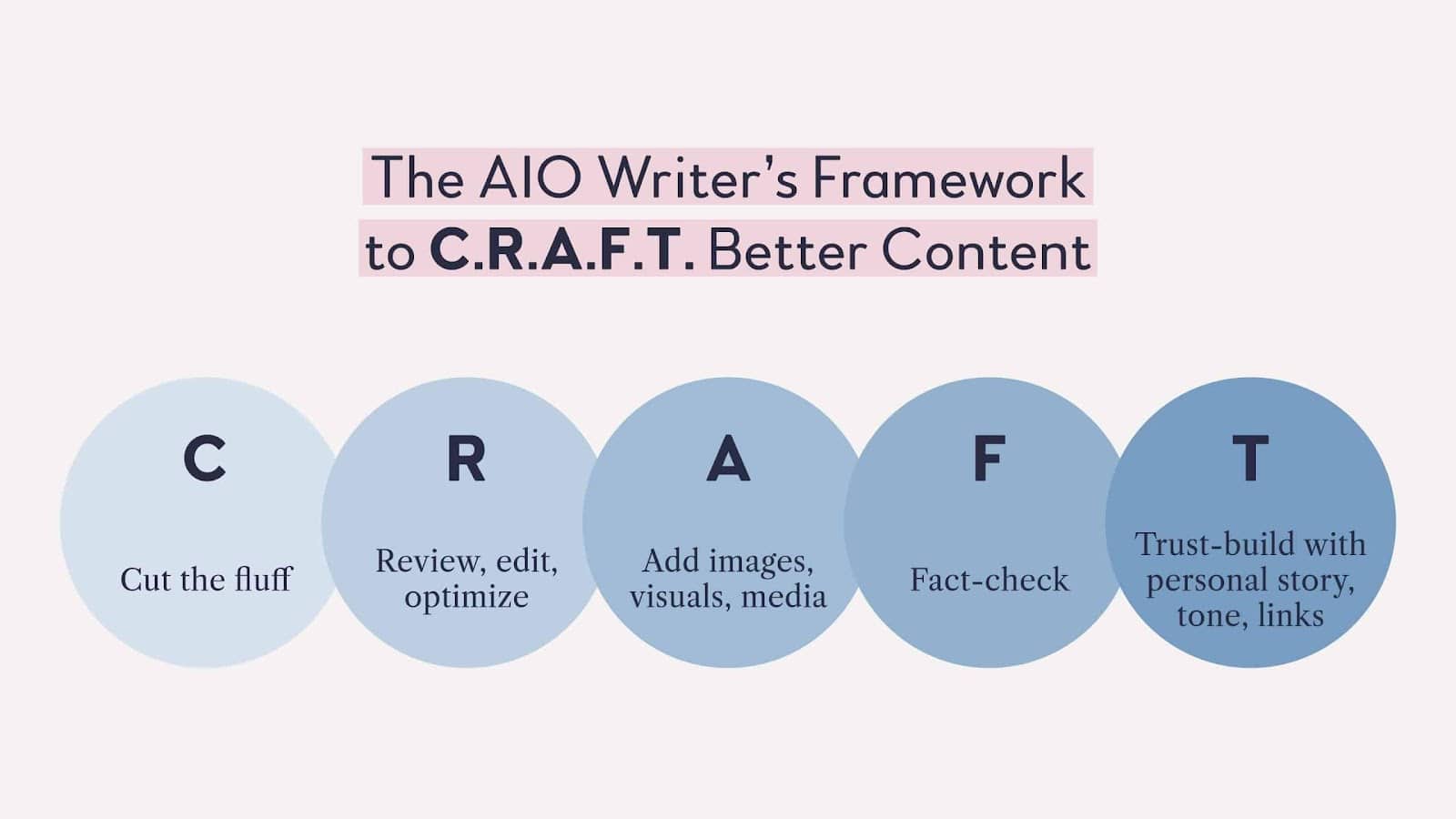
This balance is where concepts like AIO and my C.R.A.F.T framework become crucial, merging machine learning with human intuition to produce compelling, search engine-friendly content.
Artificial intelligence optimization (AIO) in content creation
AI’s role in content creation marks a new era. Enter AIO writers.
It starts with AI drafting content, embedding keywords, and aligning with search engine results pages. But AI alone is not enough. A human writer trained in AIO takes over next. They take AI drafts and make them better.
These optimized pieces attract readers and meet the criteria of modern search algorithms. They keep the language and brand voice unique.
The interesting thing about this model isn’t just about quantity. I am talking about accuracy and trustworthiness, which are essential for any high E-E-A-T content strategy.
Marketers who embrace AIO in their strategy are leading the way – not keeping up.
Synergy of AI and human expertise in SEO
AI boosts efficiency, but the nuanced touch of human writing brings depth and appeal to the content. This collaborative process involves using AI for initial drafts and human skills for final refinements.
Today, creating SEO-friendly content requires a careful approach. AI lays a solid groundwork, but human skill is what makes content stand out.
What C.R.A.F.T. is all about
I developed the C.R.A.F.T. framework to steer content creators in a rapidly changing digital environment, especially when working with AI-generated content.
AI writing isn’t ready to publish as is. It lacks your personal experiences, client insights, and unique tone.
That’s where C.R.A.F.T. comes in. It empowers writers to infuse AI content with these essential human elements and ensures your content reflects you and your audience.
Here’s what it looks like.
Cut the fluff
C.R.A.F.T. centers on concise, impactful writing. Eliminating excess words is essential in today’s information-saturated world.
This approach aligns with Google Search Essentials (formerly Webmaster Guidelines), which prioritizes valuable content for users.
Review, edit, optimize
Transform good writing into great communication. Refine syntax and strategically integrate keywords, balancing SEO with reader appeal.
Add images, visuals, media
You need visuals. They enrich your text and help explain complex ideas. Alt tags and clear visuals also contribute to SEO by enhancing user experience and search indexing.
Fact-check your content
Fact-checking establishes authority and combats misinformation. Truth is our responsibility as creators, reflecting Google’s E-E-A-T principles.
Trust-build
This involves adding personal stories and authoritative links to build trust with your readers.
Get the daily newsletter search marketers rely on.
Generative AI’s role in search results
Generative AI is redefining content ranking based on quality. This advancement challenges traditional SEO tactics, as algorithms can now create and assess content unprecedentedly.
Elevating quality standards across the board
In this competitive arena, high-quality standards become paramount.
Google’s evolving algorithm updates now prioritize relevant, original and useful content – mirroring the objectives of generative AI.
This shift calls for stringent fact-checking and authenticity in content creation.
Enhancing user experience through AI
Generative AI impacts more than just search rankings. It influences creative storytelling, tone differentiation, and user engagement metrics.
The narrative around facts enhances user experience, as authoritative links within content add credibility.
However, despite AI’s advanced capabilities, the essential human element in content creation cannot be overlooked.
The blend of technology and the innate human touch in crafting compelling narratives is irreplaceable.
Adapting to AI-driven search engine marketing
The future of search engine marketing is rapidly evolving with AI advancements. Marketers must stay informed and prepare for this change. Here are key strategies:
- Stay updated on AI trends: Keep abreast of the latest AI developments. Subscribe to trade publications and engage in professional discussions about AI trends and technologies.
- Understand AI challenges: Recognize AI’s opportunities and pitfalls. Generative AI, while promising, raises concerns like misinformation. Up to 80% of marketers will need teams dedicated to countering AI-generated misinformation by 2027, Gartner predicts.
- Consider copyright concerns: Copyright issues are paramount with generative AI. After the 2023 ruling by the U.S. Copyright Office, navigating copyright becomes more complex, especially with AI-generated content. The ruling reminds us to make sure we humanly edit AI-generated output to maintain the human stamp and ownership of our content.
- Be aware of regulatory changes: Monitor the evolving regulatory landscape for AI technologies. Anticipate and prepare for inevitable regulatory actions affecting AI use.
Marketers need to stay informed, understand challenges, navigate copyright issues, and maintain regulatory awareness to thrive in the AI-driven future of search engine marketing.
Integrating human expertise with AI in search technology
Merging human expertise with AI is becoming crucial in optimizing for search.
This combination is not just helpful – it’s essential to master modern search algorithms.
AI brings immense processing power but lacks human-like, nuanced understanding. Marketers need to use their insights to refine AI results. This leads to a more focused approach that matches user intent, boosting efficiency.
This fusion also helps predict consumer behavior shifts that data alone might miss. Combining metrics with human empathy ensures digital strategies connect personally with users.
Creativity and predictive analytics: A powerful duo
Creativity is a core human factor and the key to standing out in a crowded market.
When blended with AI’s predictive analytics, creativity becomes both original and data-driven, maximizing impact.
We see this partnership in action when analyzing metrics like click-through rates. Human creativity is the factor to lean into to build interest and curiosity, while AI can optimize reach based on these insights.
Making better decisions with AI and human insight
AI is great at quickly spotting patterns helping in SEO decision-making.
But without human strategic oversight, AI alone might miss opportunities that need human cultural understanding or trend identification.
Professionals must use AI tools to enhance, not replace, their decision-making. This approach allows for quick yet well-thought-out strategic choices.
Shaping the future of search with AI
AI is reshaping search. It’s changing how we create content, adapt to algorithms, and stay ahead in marketing. The future of search isn’t just about keywords – it’s about understanding and utilizing AI.
Remember the milestones that got us here. Keep my C.R.A.F.T framework handy as you refine your SEO approach: Cut through the noise, enhance with custom visuals, and build trust with authentic stories.
Understand how to function in the role of AIO – AIOs are not just helpers; they’re co-creators. Generative AI is not a threat but an ally for those who learn to collaborate effectively.
The takeaway? How AI will affect the future of search hinges on our ability to blend human ingenuity with machine efficiency. Master this, and the way forward is bright.
Get the daily newsletter search marketers rely on.
Courtesy of Search Engine Land: News & Info About SEO, PPC, SEM, Search Engines & Search Marketing
Tuesday, January 9th, 2024
TikTok has launched two new ad performance measurement tools:
- Cross-Channel Partners – which analyzes how ads perform across different online platforms and touchpoints before a purchase is made to understand their overall impact.
- Lift Partners – this assesses the effectiveness of ads on brand metrics, sales, physical store visits, and viewership for shows or media.
Given that conventional last-click attribution models fail to capture four out of five purchases attributed to TikTok, these new features are designed to offer marketers improved insights into the effectiveness of their campaigns on the social platform.
Why we care. A clearer understanding of the customer journey reveals the returns from your advertising investments, empowering you to make informed decisions about your ad spend moving forward.
Cross-Channel Partners. This feature analyzes the impact of TikTok ads across various marketing touchpoints before a purchase is made. It focuses on two key areas:
- Multi-touch attribution: This involves measuring the effectiveness of TikTok advertising across digital touchpoints. It provides marketers with a deeper understanding of the customer’s path to purchase, helping them identify the most effective channels to achieve their goals.
- Post-purchase survey (PPS): This survey-based tool integrated with e-commerce stores, helping advertisers understand how customers discover their product/brand and gathers attitudinal metrics (how customers feel about your product). By using the voice of the customer as a source of truth, PPS helps advertisers to gain a more complete view of attribution, contributing to a deeper understanding of advertising impact.

Lift Partners. Lift partners gauge the impact of TikTok advertising, focusing on four main areas:
- Brand lift: This uses an engaging, in-feed polling experience to measure the impact of ads on brand lift metrics like Ad Recall, Awareness, Attitude, and Favorability.
- Sales lift: Determines how effective advertising is in driving both online and offline sales, especially beneficial for Consumer Packaged Goods marketers.
- Store visit lift: Measures the additional visits to physical stores generated by TikTok ad campaigns.
- Tune-in lift: Assesses the impact of advertising on increasing viewership for shows, movies, or other media content.
Brand lift, a focus area under the Measurement category, is not a new addition to the program in this launch; it has been a part of the program previously.
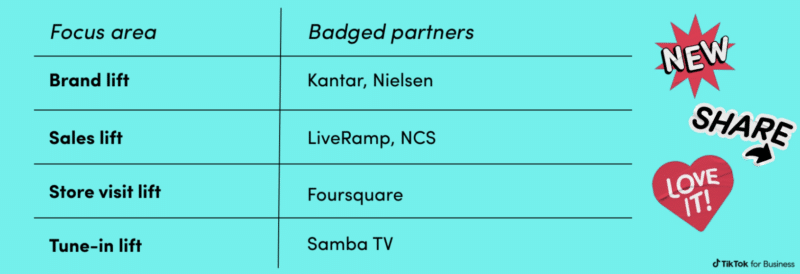
Eligibility. To work with a measurement partner for Cross-Channel and Lift solutions, or to be considered for the TikTok Marketing Partners Program, visit the TikTok Marketing Partners website.
What TikTok is saying. Melissa Yang, Global Head of Marketing Partnerships and Industry Education, TikTok, said in a statement:
- “Partnering with our Cross-Channel and Lift measurement experts provides better visibility into consumer behavior beyond last click.”
- “Working with our partners reveals the true impact of TikTok marketing campaigns, while also providing strategic insight that can be leveraged to drive meaningful growth for businesses.”
Get the daily newsletter search marketers rely on.
Deep dive. Read TikTok’s announcement in full for more information.
Courtesy of Search Engine Land: News & Info About SEO, PPC, SEM, Search Engines & Search Marketing
Thursday, January 4th, 2024
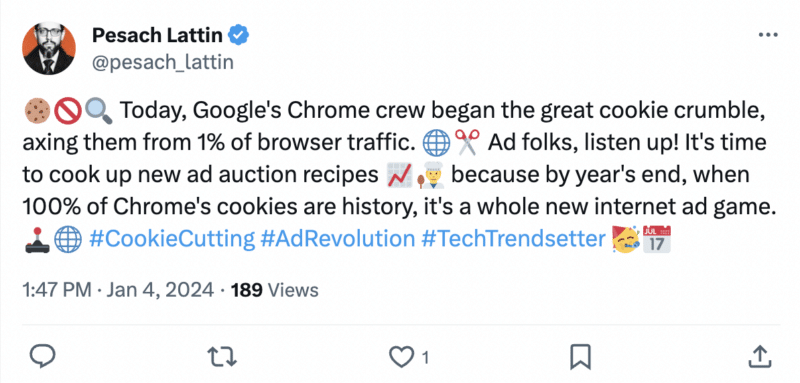
Google has officially started to phase out third-party cookies.
A new feature called Tracking Protection, which restricts third-party cookies by default, began rolling out to 1% of Chrome users globally on January 4, 2024.
If you have been affected, you will will receive a notification when you open Chrome on either desktop or Android devices.
Why we care. If your marketing heavily depends on targeted advertising with third-party cookies, it’s time to reconsider your tactics. Begin preparing your websites now before Google completely retires third-party cookies in the latter half of 2024.
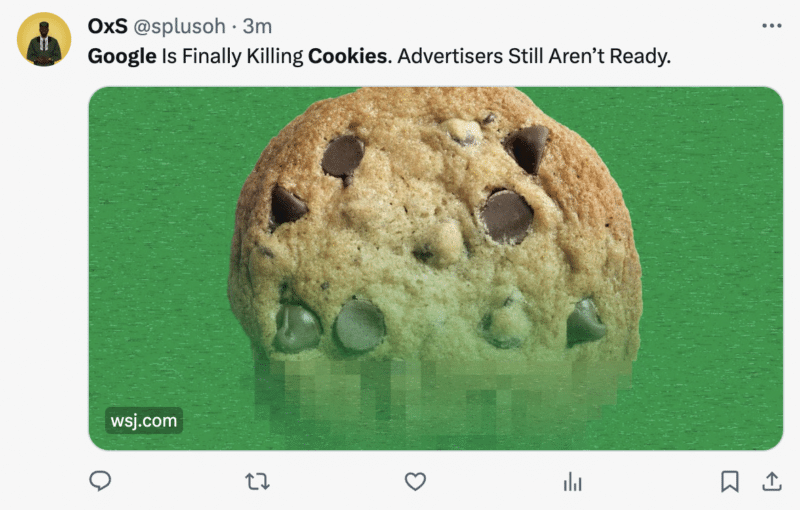
Impact: The affect of the Tracking Protection tool rollout is yet to be determined, however, discussions among digital marketers on X indicate that advertisers are still not ready for the removal of third-party cookies:


Problems to watch out for. If your site relies on third-party cookies and the roll out of Tracking Protection causes issues (for example, you refresh a page multiple times), Chrome will prompt you to temporarily re-enable them by clicking the eye icon on the address bar’s right side.
What are third-party cookies? A third-party cookie is a small piece of data placed on a user’s device (computer, cellphone, or tablet) by a website different from the one the user is currently visiting. It tracks the user’s browsing history, enabling personalized ads based on their activities.
Why now? Google considers phasing out third-party cookies by the second half of 2024 as a crucial move in its Privacy Sandbox initiative. The final decision depends on resolving competition concerns from the UK’s Competition and Markets Authority.
Get the daily newsletter search marketers rely on.
Deep dive. Read ‘SEO and the future world without cookies‘ by Search Engine Land contributor Adam Audette for more information on what a cookieless world will look like for SEO and PPC marketers.
Courtesy of Search Engine Land: News & Info About SEO, PPC, SEM, Search Engines & Search Marketing
Thursday, January 4th, 2024
Group M is planning to simplify the buying and placement of ads on streaming services for advertisers.
Through the GroupM Ad Innovation Accelerator program, GroupM is joining forces with BrightLine, Disney, KERV, NBCUniversal, Roku, Telly, and YouTube to develop a new ad format for streaming services. This format aims to cater to viewers who prefer to avoid commercials.
The collaborative effort aims to transform the conventional 30-second ad spot by incorporating advanced digital technologies. This innovation aims to strengthen connections between brands and viewers, delivering measurable outcomes for advertisers partnering with GroupM.
Why we care. This program addresses changing viewer preferences and offers a potential solution for more effective streaming service advertising. It also presents a promising opportunity for advertisers to connect with younger audiences, who are increasingly shifting from traditional TV to streaming services.
What is GroupM? GroupM, the media-buying division of European advertising conglomerate WPP, is one of the largest investors of advertising dollars in the U.S.
What Group M is saying. Mike Fisher, Executive Director, Investment Innovation, GroupM U.S., said in a statement:
- “Brands advertising in ad-supported streaming environments have an incredible opportunity to engage with attentive consumers, but the rapidly evolving media landscape makes it difficult for advertisers to efficiently and resourcefully launch interactive advertising campaigns.”
- “Our clients need a simple way to activate interoperable and attributable campaigns across the ad-supported streaming ecosystem. With key stakeholders at the same table, we will shape impactful outcomes that allow advertisers to execute creative, engaging and effective campaigns.”
Get the daily newsletter search marketers rely on.
Deep dive. Read Group M’s announcement in full for more information.
Courtesy of Search Engine Land: News & Info About SEO, PPC, SEM, Search Engines & Search Marketing
Thursday, January 4th, 2024
The Google Ads gambling and games policy United States country-specifics has been updated.
From January 4, the platform will accept and run ads for sports betting from state-approved entities in Delaware.
Why we care. Eligible advertisers who want to run sports betting ads in Delaware will need to apply for accreditation.
Certification. To obtain certification, follow these steps if you meet Google’s policy and country-specific requirements:
- Privately-licensed operators: If you are based in one of the countries where Google permits online gambling content, fill out the online gambling application form in the Google Ads Help Center. Providing all the requested information will help prevent delays.
- State-run entities: If you operate in one of the countries where Google allows only state-run entities, use this form. When completing the form:
- In ‘Summary of the issue’: Note that you’re requesting certification to advertise as a state-run gambling entity, and provide your website URL.
- In ‘Campaign name and Ad group name’: Enter N/A if you haven’t set up a campaign or ad group.
- Social casino game operators: Use this form to submit your website URL or app, Google Ads customer ID, and the country group you are targeting.
You must submit a separate application form for each country you want to target.
Get the daily newsletter search marketers rely on.
Deep dive. Read Google’s announcement in full for more information.
Courtesy of Search Engine Land: News & Info About SEO, PPC, SEM, Search Engines & Search Marketing
Thursday, January 4th, 2024
Advertising on Meta presents unique opportunities that Google Ads doesn’t offer.
Whether your goal is lead generation or ecommerce, Menachem Ani, PPC expert and founder of JXT Group, shared valuable insights at SMX Next on how to optimize campaigns for Facebook and Instagram.
Read on to learn Ani’s seven-step frameworks for building winning lead generation and ecommerce strategies in Meta’s automated landscape.
Meta Ads > Google Ads?
When advertising on platforms like Google, you’re restricted to reaching people searching for your product or service.
However, when placing ads on social platforms like Facebook and Instagram, the possibilities are more diverse, according to Ani. He explained:
- “There are similarities between Google and Meta ads in the sense that they are both pushing towards automation with fewer levels and less controls. But that’s where the similarities end.”
- “With Google Ads, you’re capturing existing demand, somebody searching for the product or service – but it’s finite. There’s only a certain amount of search happening for a specific keyword. Whereas with paid social, you can, you can educate consumers a little higher up in the funnel, create demand and then capture it later on.”
Should you spend more on Google or Meta?
A multi-channel approach is usually best but the answer depends on the nature of your business, according to Ani. He said:
- “If your brand sells products, then Meta will likely work for you. If you’re selling more commoditized products like electronic appliances, then it’s best to lead with Google.”
- “However, we’ve found that it’s usually best to run campaigns across all channels because it gives you multiple sources of revenue – and diversification is always a good thing.”
Lead generation on Facebook and Instagram
Although Meta ads are probably best known for driving results in ecommerce, Facebook and Instagram ads can also be used to effectively generate leads. The key is to focus on quality over quantity (i.e., leads that will actually convert into sales). Ani explained:
- “The last thing you want is to generate leads that you can’t sell to. Ultimately a lead is only worth something if it if it can turn into revenue.”
- “To do this, you need a well thought out strategy to ensure that your message reaches the right consumer.”
The challenge with Meta lead generation
Although lead generation campaigns on Facebook and Instagram can drive great results, you’re also likely to receive a lot of spam leads, according to Ani.
The system tends to optimize for form submissions rather than real-time revenue like in ecommerce, which can result in more leads of lower quality. The challenge is finding a balance to get better quality leads, even if it means fewer form submissions:
- “Remember that leads are not sales – you can’t deposit leads in your bank account. It’s super important to figure out how to get good quality leads.”
7-step lead generation framework
Ani shared a seven-step strategy to address issues like spam and enhance lead generation results through Facebook and Instagram ads.
1. Leads > traffic
The campaign goal you choose is crucial. The Meta algorithm is powerful but specific.
If you run a traffic-focused campaign, you’ll get traffic – but that doesn’t necessarily translate into leads. To sell and get inbound inquiries, you need leads, Ani explained:
- “For this, I recommend always using a conversion-focused campaign specifically focused to driving leads based off of your pixel tracking.”
2. Test dynamic and standard creative
When setting up your campaign on Facebook, you can choose to create individual ads or use dynamic creative, which is like responsive search ads on Google – and it’s important to explore both options.
Although testing various targeting and ad creatives is usually advised, dynamic creative works well for smaller lead generation campaigns. Ani explained:
- “With dynamic creative, you provide a list of ad copy and creative elements (like images and videos), and the system personalizes the ad for each user.”
- “This is particularly useful for small budgets on lead generation campaigns where you may lack sufficient data to optimize specific ads as it allows the system to algorithmically target users.”
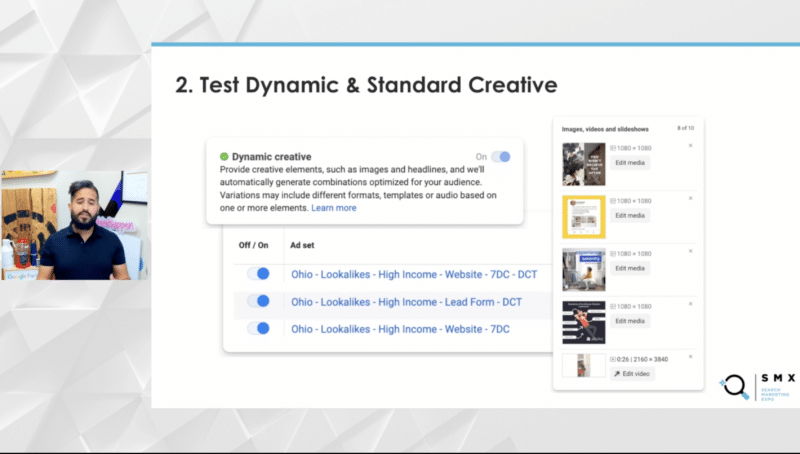
3. Use customer lookalikes and interests
Ani explained that while the pixel is powerful for targeting based on website activity, when it comes to lead generation, especially on newer or smaller accounts, custom audiences can be effective.
Instead of broad targeting, he recommends creating lookalike audiences from your customer list or qualified leads.
- “Telling the system that people who are interested in x or belong to specific demographics are likely the potential consumer for you can be helpful.”
- “It’s also a good idea to allow the system to use Advantage+ targeting (which is where it expands outside of your audiences) as an additional 20% or so to find users who may not be in the specific audiences you set up.”
- “Unlike ecommerce, where the system can see the revenue coming in in real-time, sometimes you need a bit more of a signal and this helps with lead quality because your ads are being shown to more interested users.”
4. Use Facebook and Instagram
Advertisers often try to manually control where their ads appear, but the algorithm is powerful. It’s best to let the system show ads wherever on Facebook, Instagram, and Messenger, according to Ani.
The algorithm efficiently regulates ad placements based on where conversions are happening. So Ani recommends allowing the algorithm to do the heavy lifting.
Limiting exposure with manual adjustments can increase costs and you may miss out on untapped potential, Ani said:
- “What we’ve learned is that this holds true across most ad platforms today. … When you limit your exposure with manual adjustments, you end up increasing your costs and you lose out on untapped potential.”
5. Think beyond video creatives
Once you’ve identified your audience, the next step is crafting your message.
While ecommerce often emphasizes video creative, for lead generation, image ads surprisingly work well, according to Ani. Video ads are effective too, but creating good videos, especially for lead gen, can be challenging.
Plain images or overlaying text onto an image, like banner ads, are effective. Because your audiences are broad, the messaging in your image ad or the accompanying copy serves as a form of targeting.
6. Create dedicated landing pages
When a user clicks your ad, the destination matters, especially in lead generation. So consider options like sending them to your homepage, a dedicated landing page, or using embedded Facebook or Instagram forms. Ani recommended creating embedded forms:
- “You’re likely going to get less leads if you use an embedded form, but the leads you do get will be better quality because the ones that were going to be spam are less likely to fill out that form due to the extra effort needed.”
- “Remember, embedded forms on Facebook and Instagram are pre-populated with the user’s Instagram or Facebook account information. So it’ll have their name, email and so on. And that makes the form a lot easier to fill out.”
- “I would also recommend adding an additional question to sort of forcefully add friction to the process so that fewer people accidentally fill out the form and you’ll end up with slightly better quality leads – remembering that leads are not sales.”
7. Conversions are not sales
Tracking the source of each lead is crucial. You can add UTM parameters to your ads to see, in real time, which campaign, ad set, and ad creative a specific lead came from.
Over time, by analyzing this data in your CRM, you can establish patterns.
For example, a breakdown of 30 leads from a specific campaign, including their current status, can reveal insights. Isolating and analyzing such data helps identify what’s working well, whether it’s a specific creative resonating with consumers or certain audiences performing better.
This information is valuable for optimizing your future lead generation efforts, Ani explained.

Ecommerce ads for Facebook and Instagram
Ecommerce differs in that the system automatically tracks revenue in real time, according to Ani. This simplifies the process, as a lead often translates directly to a sale.
However, industries with high fraud rates may pose challenges. Tracking revenue in real time lets you assign a dollar value to each order, making it easier to align with profit-centric optimization.
Many direct-to-consumer (DTC) operators use Meta ads and email in their marketing mix. Yet, ecommerce doesn’t have to be purely transactional, Ani said:
- “You can lean into other campaigns on the Google side, like Performance Max, Demand Gen, YouTube, and so on, to capture additional demand that way too.”
7-point ecommerce framework
Here is Ani’s seven-step guide to drive ecommerce results using Facebook and Instagram ads.
1. Test Advantage+ carefully
Unlike lead generation campaigns, where the primary option is conversion-focused, ecommerce allows for a different campaign type called Advantage Plus Shopping. This automated and algorithmic approach, with fewer controls, is akin to Google’s Performance Max.
Advantage Plus Shopping is broad and less structured than a standard conversion purchase-optimized campaign.
- “What we’ve found is that you want to try using both [Advantage Plus Shopping and conversion campaign types] and see how it goes.”
- “For some of our clients, Advantage Plus typically performs better, but for others, we have found that standard purchase conversions work better – but for others, we find a mixture of running them both side-by-side for different products or promotions is best.”
2. Go broad on targeting
For broad targeting in ecommerce campaigns, it’s often effective to let the system go “crazy”, according to Ani. Allow it to target whoever it deems most likely to purchase, excluding recent purchasers, such as those in the last 30 days.
Additional audience limitations can artificially increase CPMs, so it’s generally better to go broad and let the powerful Meta algorithm determine the most promising targets based on real-time revenue data. Trusting the algorithm’s capabilities and leaning into its power tends to yield positive results.
3. Purchase > Add to cart > Clicks
In ecommerce, when running conversion campaigns, it’s crucial to be specific in your objectives.
While the powerful system will deliver what you ask for, specifying actions like “add to carts” or “clicks” might not lead to actual sales. Ani explained:
- “If you tell it you want clicks, you’re going to get clicks, but they typically don’t convert into sales.”
- “So if you’re going to run a purchase conversions campaign, make sure you’re focusing on purchases very specifically because you want purchases – you need revenue. Make sure to focus on that.”
4. Trust in seven-day click
In ecommerce, attribution is different from lead generation. While one day is often sufficient for leads, ecommerce purchases may require more time.
Leaning into a seven-day click attribution is generally recommended. This longer period accommodates the full purchase journey, acknowledging that a user who clicks on an ad may not be ready to buy on the same day.
Avoid one-day view attributions, which can inflate attribution figures due to the widespread exposure of ads on Facebook and Instagram. Ani added:
- “Typically, we recommend using seven-day click attribution unless you’re selling an impulse purchase. In those cases, a one-day click should be enough.”
5. Get creative with creatives
When it comes to creative in online marketing, testing is key, according to Ani. You can experiment with various formats like image ads, video ads, and carousel ads.
Within each type, there are diverse approaches.
- For image ads, you can try product shots, lifestyle images, comparison visuals, or showcase media mentions and customer reviews.
- Videos offer versatility, ranging from high-production to user-generated content, testimonials and different lengths.
- Carousels allow for dynamic catalog ads, providing a range of options.
There’s no one-size-fits-all solution, so it’s essential to test different creative elements to discover what resonates best with your brand. What works for one brand may not necessarily work for another.

6. Match creative cycling to spend
When it comes to testing new creative assets, the focus should be on the traffic flow through a specific ad rather than a specific time or budget. Ideally, you want a significant amount of traffic in the hundreds or even a couple of thousand clicks, to establish statistical significance.
This ensures that the data collected is reliable and can be trusted for making informed decisions. With only a few clicks or orders, it’s challenging to gauge whether the creative will work at a larger scale. Emphasizing the amount of traffic passing through an ad allows for a more robust evaluation of its effectiveness.
7. Keep naming consistent
Maintaining consistent ad naming conventions is crucial for effectively tracking the performance of your creative assets.
By properly naming your ads (including details like asset type, destination, call-to-action, and more), you can easily filter and report on their effectiveness. This approach allows you to compare the performance of different ad types, such as image ads versus video ads or influencer campaigns versus others.
Consistent ad naming ensures that you can quickly and accurately analyze your data to make informed decisions about your advertising strategy.
Get the daily newsletter search marketers rely on.
Key takeaways
Whether running a lead generation or ecommerce campaign on Facebook and Instagram, there are key strategies to consider. For lead gen, focus on:
- Limiting spam.
- Precise targeting.
- Emphasizing the offer.
- Messaging.
Meanwhile, in ecommerce, allow the system to handle more targeting, placing greater emphasis on creative component testing.
Both Facebook and Instagram are valuable additions to your marketing efforts. However, it’s essential to integrate them holistically into your overall strategy.
As ad platforms become more sophisticated and algorithmic, understanding when to let the system handle tasks and when to intervene is crucial.
Courtesy of Search Engine Land: News & Info About SEO, PPC, SEM, Search Engines & Search Marketing
Wednesday, January 3rd, 2024
Google Analytics 4 (GA4) offers enhanced Google Ads integrations and features that surpass those available in its predecessor, Universal Analytics.
To make the most of these new and updated capabilities, Google Ads expert Charles Farina discussed the latest improvements in conversion tracking, audience analysis, and reporting at SMX Advanced.
Read on to discover how integrating GA4 and Google Ads could boost your paid search results.
Conversion tracking updates
To measure your campaign’s success accurately in GA4, you need to configure your conversions. However, there are some key changes you need to be aware of before diving into this process.
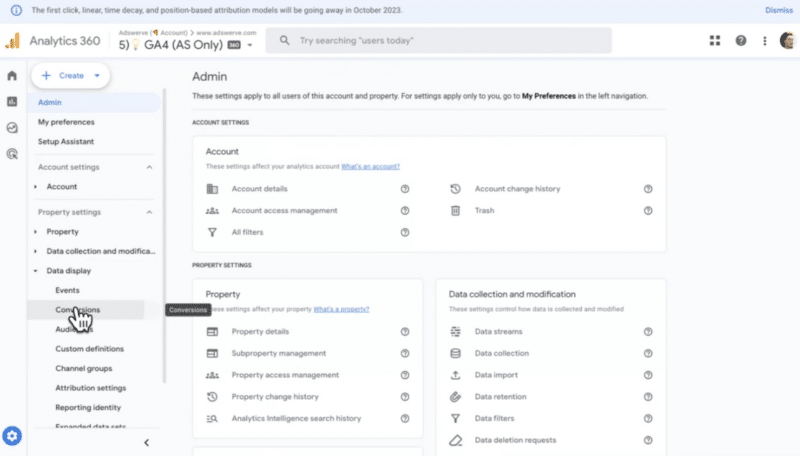
New administration section
For starters, there is a brand new administration section in GA4, which was rolled out toward the end of 2023. Farina said:
- “If you haven’t spent time in this section, you definitely need to because this is where we set up conversion tracking for GA4.”
- “Conversion tracking is now on one page, so it’s more simple than the old version. It’s also way more powerful than what we had before.”
- “So you can come in here and track events and simply turn on or off conversions whenever you want.”
More goals
Historically, only 20 goals were available in the free version of Google Analytics – and you weren’t allowed to reuse them. This could be problematic because if marketers were using GA for a long period of time, they would often run out of goals, Farina explained.
However, this feature has been “completely rebuilt” for GA4. He commented:
- “First of all, we now have up to 30 conversions (goals) in the free version of GA4. More importantly though, you can now archive or enable or disable conversions at any time.”
- “I’ve actually made some horrible mistakes by archiving all of my conversions. However, now, when you archive a conversion, it doesn’t delete all the data – it actually keeps it which frees up a new conversion slot that we can use.”
- “But why is this important? Well, a lot of paid media campaigns aren’t always necessarily permanent or always on. For example, we could have things that are seasonal in nature like a back to school or Black Friday campaign. Because we can now reuse goals, we actually have the ability to do kind of seasonal or micro conversions.”
- “By simply setting up these seasonal conversions, they’re automatically available for measurement, both within GA4 and within Google Ads.”

Audience updates
Google has also improved audiences in GA4, which Farina sees as a crucial feature for both paid ads and other aspects. However, many advertisers haven’t been using or activating them in Google Ads. Farina hopes that the changes in GA4 will encourage more utilization of audiences.
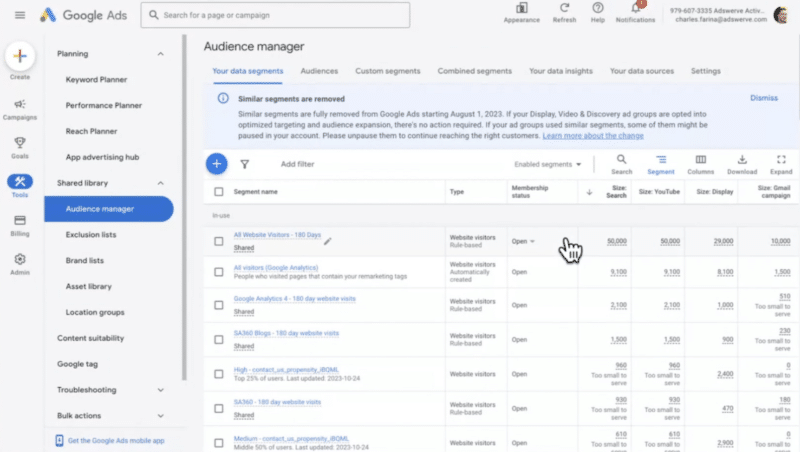
GA4 audiences automatically available in Google Ads
- “One of the reasons people weren’t using audiences properly before was because it wasn’t exactly intuitive. When you created an audience in GA4, you’d have to also manually publish it to Google Ads. Now though, it’s automatically available in Google Ads without you having to really do anything.”
- “All you have to do is go into the admin you link Google Ads to in the product section, and with three clicks, you have Google Ads linked – all of your conversions and audiences will automatically be shared.”
- “If I then go back to Google Ads, and we go into our tools and then to the shared library, the audience manager is inside here, and this is where we can see all of our GA4 audiences. And all of these will be curated for us automatically without having to publish one individually, which is a big change.”
Types of audiences
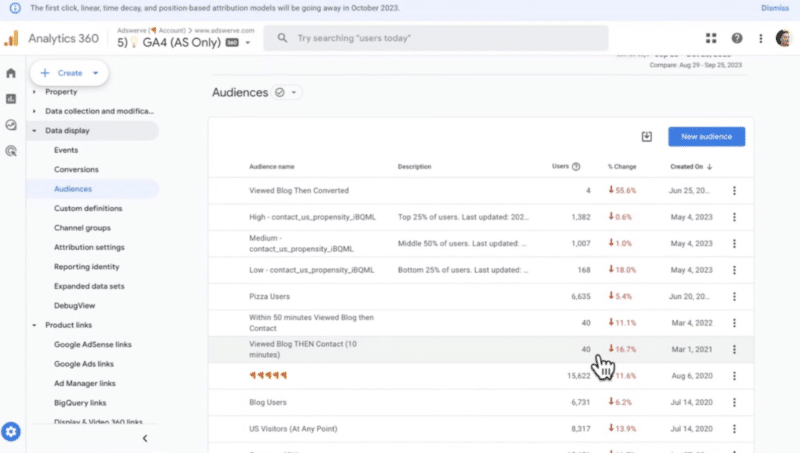
- “There has also been significant changes to the types of audiences you can create and the types of remarketing campaigns you can drive.”
- “The audience builder is one of the most powerful features in GA4 because we can create audiences of any condition we collect on the platform. We have access to every dimension, every metric, every event that our user does – and we call these ‘rich conditions.’”
- “For example, we can look at users who visit a certain page like blog posts, and then we could say show me those users who looked at blog posts and then did something else to build sequences. And not only can we build sequences, but we can also restrict our audiences by time.”
- “Remember, the audiences we create will also automatically be available in Google Ads for us to utilize if we so choose.”
Explorations paid-for features now free
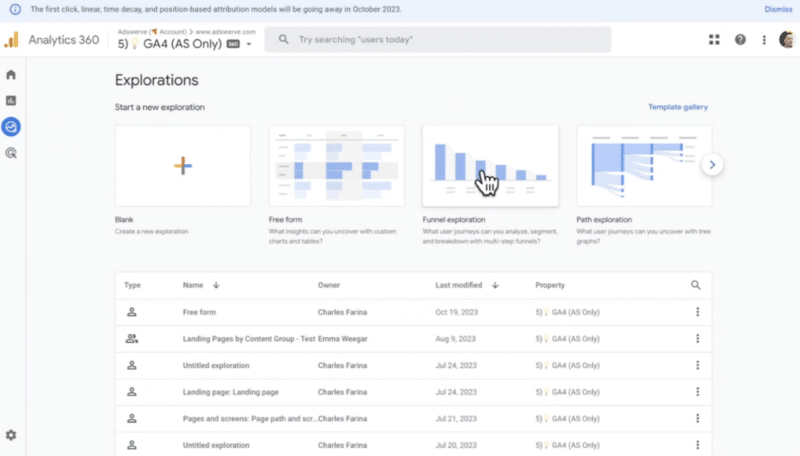
Another major change rolled out by Google is that a bunch of features that previously only existed in the paid-for version of Google Analytics are now available to everyone in the free version of GA4 – for example, “funnel explorations” (see image below).
- “The funnel explorations feature is a really powerful feature because you can build funnels for anything. With one click, you can customize your funnels regardless of your business and your use cases.”
- “The part for Google Ads that is super important is that these are also available for you to leverage as remarketing audiences. Everyone should have some sort of basic funnel created for their business.”
- “The power of combining Google Analytics and Google Ads together, you don’t have to create a bunch of remarketing tags, publish and then wait a week to build audiences. Now, anyone can go in and immediately build these audiences on the fly. So this is a huge change.”
- “This is the bread and butter of how to use our audiences and our conversions more effectively between Ads and Analytics.”
Attribution
Accurately measuring attribution is critical for marketing campaigns. This is one of the most misunderstood areas within GA4, Farina said.
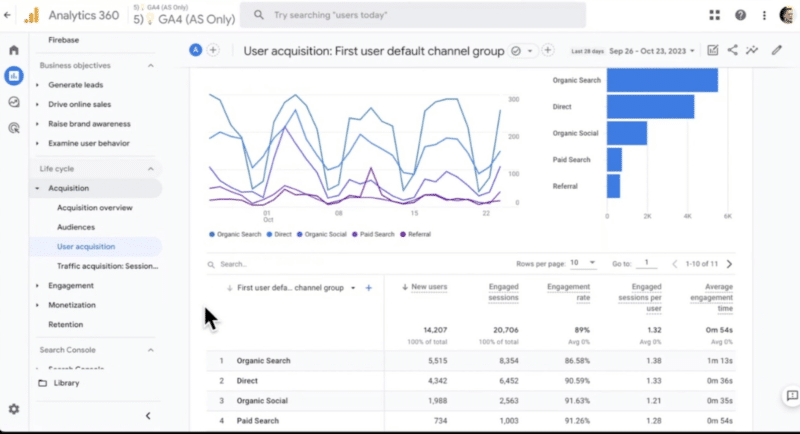
User acquisition report
- “The dimension of this report tells us that this is the first user traffic source – so the first type of attribution we have is the first touch. The way this works is any new user who visits our site, whatever the original traffic source is, gets all the credit in this dimension as it’s the first touch.”
- “But if we’re trying to measure the effectiveness of our paid search campaigns, this first user channel report or user acquisition report doesn’t give us the complete story. That’s because it only tells us how much paid search traffic we acquired where paid search was the first touch point.”
Real time report
- “Real time is also one of the most misunderstood areas – I’ve seen a lot of people go to the real time report and they look at this traffic source section and, for example, think they have eight users from Google. But if the current session is from paid Facebook, but the first user source was Google, it’s not going to show that paid Facebook activity even though that’s the current traffic source.
- “So real time in GA4 doesn’t report the real time traffic source of right now. It reports the first traffic source that user ever had.”
- “So just be careful if you’re trying to do any sort of real time traffic analysis that you don’t misuse this kind of out of the box traffic widget that Google shows here.”

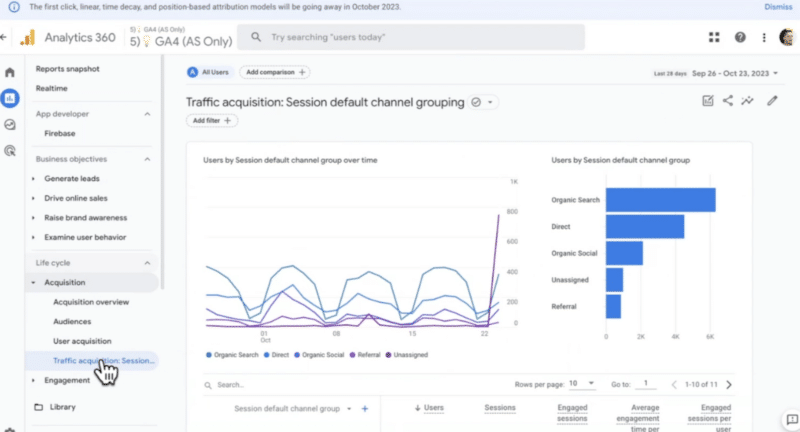
Traffic source report
- “The traffic source report in GA4 helps us to understand how our paid search campaigns are performing. Within this report, you’ll find the session default channel group.”
- “You’ve probably heard that GA4 has this new event driven data model; everything’s an event, it’s more flexible and they’ve updated the way attribution works, whereas in the old version, every new traffic source would actually create a new session. So each session in the old Google Analytics could only have a single traffic source.”
- “I’ve heard some people say that GA4 now allows multiple traffic sources per session. That’s true. But with a very important asterisk because it’s only true in certain places within GA4 and it’s not necessarily true in this report, which is why this is really so misunderstood.”
- “So if you compare your data in the new versus the old version of Google Analytics, this is one of the reasons that like the session or the traffic source reports don’t match because sessions with multiple interactions are not represented with each other.”
Data driven attribution model
There are two places where data driven models live in GA:
- In the advertising section: If you go into the performance or the model comparison reports, this will be the new data driven attribution reports.
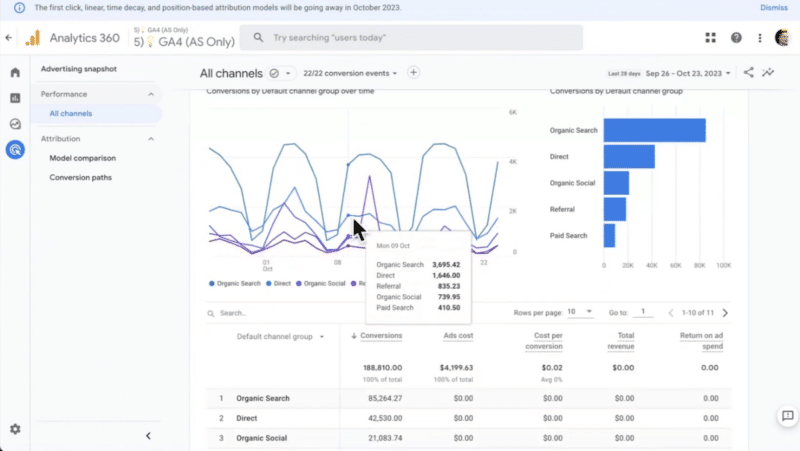
- In the reporting section inside the engagement and in the conversions reports.
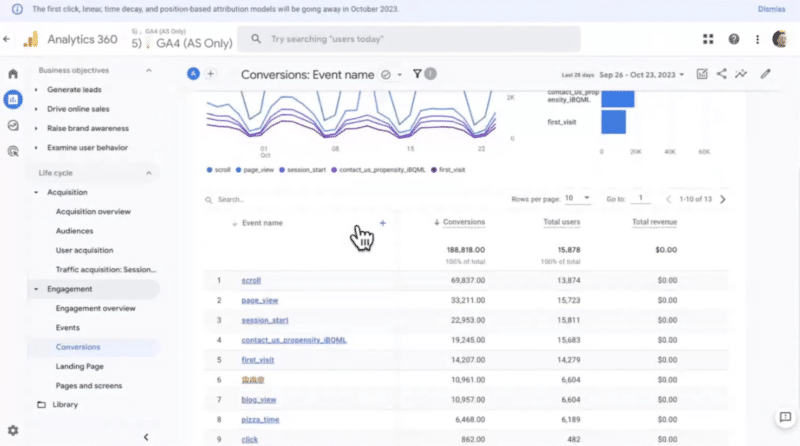
- “If you wanted to know how paid search was leading to outcomes, [data driven attribution reports] are the best place to do that. However, this doesn’t account for sessions or paid search interactions that don’t result in a conversion.”
- “For example, if someone clicks on a paid ad, visits your site and just has an interaction, going back to this report, just note you will be missing some of those paid search interactions in here. So some of that is being under reported.”
Quick tips
Farina concluded the session by sharing three quick tips on how you can get even more out of Google Analytics.
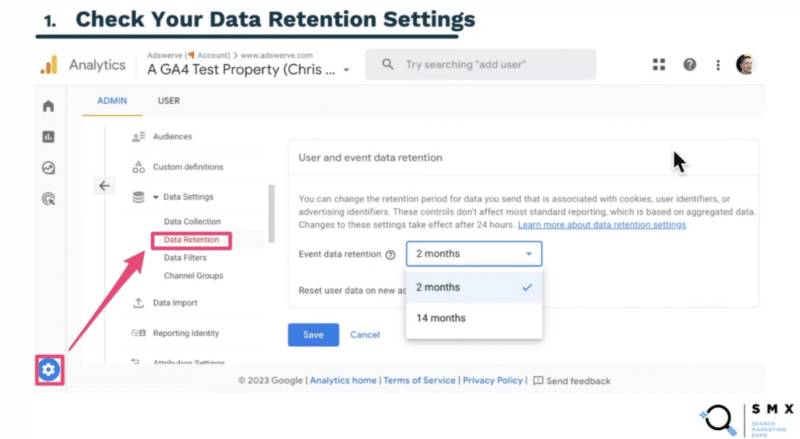
1. Check your data retention settings
Data retention settings inside GA4 is one of the most problematic areas new users run into. Farina explained:
- “When you set up a new GA4 property by default, it only gives you the last two months of data because that’s the default setting.”
- “Go look at that setting and change it to the 14 months because you’ll probably be very disappointed if you’re trying to do year-on-year comparison or do a more granular ad hoc analysis.”
- “So check your data retention settings and make sure you don’t run into that issue.”
2. Be aware of your reporting identity
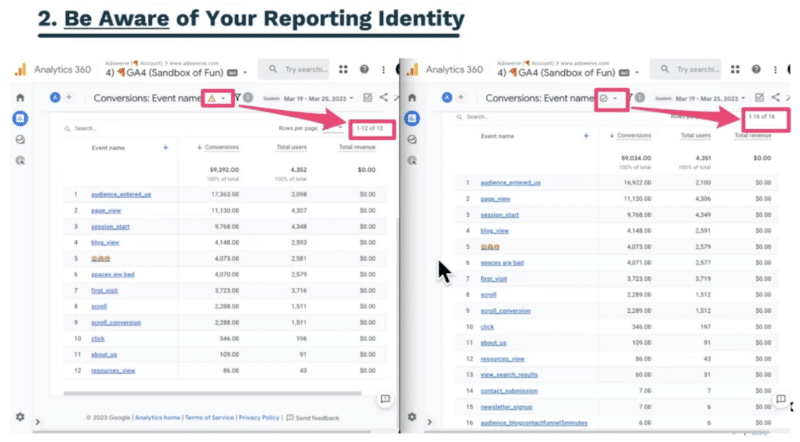
One of the biggest challenges that’s still occurring right now is with thresholding, according to Farina. This is because, by default, when you link and create a new GA4 property, it enables Google signals and uses it as a reporting identity in GA4, which can cause issues. He explained:
- “If you’re doing your analysis and you ever see this orange triangle (see image below), you’ll want to immediately change your reporting identity.”
- “There’s two ways to do this; you can either change the reporting identity to device ID only or there’s a brand new feature GA4 just rolled out where you can actually disable ‘using Google signals’ at all – which is actually my recommendation.”
- “I don’t think ‘using Google signals’ helps better connect your data together, and it is definitely not worth the trade-off of this orange triangle because that means we lose data.”
3. Learn the different attribution scopes
One of the most misunderstood areas of GA4 is how attribution works, according to Farina, but mastering this topic can set you up for success. He concluded:
- “The best way to do attribution right now is probably with the ‘attribution dimension’ (see image below) – this is super important.”
- “The ‘source/medium’ dimension actually gives credit in a session to multiple traffic sources and across sessions.
- “The other two traffic source dimensions – ‘first user source/medium’ and ‘session source/medium’ – I think are problematic, especially the session source, because it doesn’t account for multiple traffic sources within a session.”
- “And with that, I think you have everything you need to use Google Ads and Google Analytics far more effectively.”

Courtesy of Search Engine Land: News & Info About SEO, PPC, SEM, Search Engines & Search Marketing
Wednesday, January 3rd, 2024
Regular audits of Google Ads and Microsoft Advertising campaigns are crucial for PPC marketers.
Failing to do so can result in significant costs for clients, and what’s more, it’s often an entirely avoidable expense.
To avoid common pitfalls and optimize spending in PPC campaigns, Melissa Mackey, paid search director at Compound Growth Marketing, provided a comprehensive walkthrough of the most costly mistakes she comes across during auditing and her top tips for avoiding these errors at SMX Next.
Below is a summary of the insights and advice she shared.
Always check your campaign goal settings
Mackey shared a cautionary tale about inheriting accounts with ample clicks but minimal conversions:
- “This happened to me – I was thinking we would have to rebuild the whole campaign. Something must be wrong with it, right? But as I dug deeper, I realized something important was missing.”
- “What’s cool about Google Ads is they have goal settings at account level and campaign specific goals. This is a fantastic setting, but you need to make sure you’re careful about how you use it.”
- “In this case, the client wanted track custom goals of demo requests and lead forms. However, they had campaign specific goals selected instead – these were goals that couldn’t even be completed on the landing pages for the campaigns that were running on, which is why it showed zero.”
- “Once we switched the campaign specific goal to the correct goal, we started seeing conversions. This could have been disastrous if we decided to blow up these campaigns without digging into it. So always check your campaign goal settings and make sure that you’re actually measuring what you want to measure.”

Default settings you should never use
Mackey suggested steering clear of certain default settings that come pre-configured in your Google Ads campaigns, despite the convenience of having them in place. For example:
1. Broad Match without smart bidding or audiences
- “Google will tell you that broad match can:
- Get you a 35% improvement in your target Cost Per Action (CPA).
- Find keywords that you never would have thought of to bid on.
- Deliver an overall better performance that’s more efficient.”
- “This is true – but only if you do it correctly. Broad match needs smart bidding and audience signals to be sure to get you the right customers. Using broad match with those two things works well, but using it without does not.”
- “Make sure you’re always layering on audiences and smart bidding with your broad match campaigns.”
2. Broad Match campaign setting
- “There is a broad match campaign setting that you need to really be careful about:”

- “If you turn this setting on (see picture above), it’ll say use broad match keywords for your entire campaign. That means you can only use broad match. Now, you may think that’s fine because that’s what I wanted to do anyway.”
- “The problem is you will not be able to add other match types further down the road because you’ve locked yourself into just broad match.”
- “I can think of few to no such situations where you would want to do this. You would always want to choose the ‘Use keyword, match types’ setting to give you flexibility.”
3. All the networks
- “When you create a new campaign, Search Partners and Display Network are both on by default. For our B2B clients, we usually turn off Search Partners because we don’t tend to get good results and there’s not enough control. Your mileage may vary, so test it, look at it, but be careful with it.
- “Display network – you should never run this alongside Search. Even though Google tells you, we have smart campaigns that can run in both Search and Display, what we have seen is that display will eat up all your budget. It’s also very challenging to optimize it properly and it is a best practice still to run separate Search and Display campaigns.”
- “So make sure that you opt out of display.”
4. Location targeting method
- “The default location targeting method is people who show interest in your targeted locations. This setting almost always leads to traffic from unwanted locations.”
- “I saw recently on LinkedIn, one of my paid search peers said that she saved a client $1,000 a month immediately just by turning off the setting.”
- “You may think you’re just reaching people in the United States, but your ads can actually serve to people anywhere if they’ve shown interest in the United States.”
- “Go to your location report in Google Ads and see where your ads actually served, you’ll see that they might have run in Turkey, Pakistan, India and a lot of other places you didn’t want them to run.”
- “The setting that you should use instead is ‘people in or regularly in your target locations’. This will help cut down on those unwanted locations and make sure that your ads just serve in the places that you want them to serve.”
5. Exclude locations that charge tax
- “You should always exclude the locations that charge tax or fees. There are seven locations that currently that have regulatory operating costs (or DST fees) and they charge tax for any ads that serve there.”
- “If you have location targeting set to ‘people in or who show interest in’, you will probably get traffic from these locations. And in addition to paying for that traffic, you also pay taxes on it. So this is something you don’t want to do.”
- “If you are not intending to target any of these seven countries, be sure to just exclude them as a matter of course, that way you won’t get charged.”

6. Conversion counting conundrum
- “Another area that trips people up is in the actual conversions that they’re counting.”
- “One of the first things that I audit when I look at a new account is what are we tracking as conversions? What’s primary, what’s secondary and what are the sources of those conversions? Because I think a lot of times we set up a conversion action and then maybe we decide we want to track something different. So we add the new conversion and forget to get rid of the old one – and that can really get you into trouble.”
- “Over-reporting results to your client can create a lot of problems. So make sure that you’re actually counting the correct actions and you’re only counting them once. That’s a really important point.”
Hidden settings
Mackey went on to address the many hidden settings in both Google Ads and Microsoft Ads – and how to deal with them.
Automated extensions
- “Automated extensions are turned on by default and they’re often completely irrelevant to what it is that you’re advertising.
- “Automated extensions can work well for ecommerce if you’ve got lots of products, but it would really be challenging to set up bespoke extensions for all of your campaigns.”
- “For B2B campaigns, we almost always turn these off. So, how do you do that? It’s not easy:
- “You have to click these three dots above the “more” button on the righthand side of the screen.”
- “Then you click account level automated assets.”
- “Click a more button again, then you click advanced settings and finally you get to the screen where you can actually turn these off.”
- “This is completely buried. If you didn’t know where it was, you would never find it. So it’s really important to understand where this is and then go in and turn off any of these extensions that you don’t want.”
- “We turn off all of the dynamic extensions for our B2B advertisers, such as: Call out, structured snippets, images, and site links. Some are okay to leave on such as ‘automated apps’ and ‘automated locations’ if that makes sense for your business. But definitely at least give this some thought.”

Expanded audiences
- “With expanded audiences, Google can expand and show your ads to other audiences that are similar to that audience.”
- “If you want to cast a wide net, this is fine. But if you have a very specific remarketing program set up, you definitely don’t want the ads showing in expanded audiences because it really undoes your whole strategy.”
- “Make sure that you opt out of expanded audiences if you don’t want to use them when you set up your campaign initially. It’s not easy to find as it’s buried. To do this, go to:
- Group settings.
- Select the option to edit ad group targeting.
- Go into every single ad group where you’re doing targeted audience segments and turn this setting off.
- Make sure you go through in the online UI and turn off optimized targeting for every single campaign that you don’t want it to run.”
- “Make sure that you do this if you don’t want to serve in expanded audiences.”

Microsoft Ad group settings
Microsoft Ads has a lot of ad group settings that are different from Google and this can be used to your advantage, according to Mackey. For example:
- You can schedule ad groups.
- You can use campaign settings.
- You can apply independent website exclusions.
- You can make independent bid adjustments and ad distribution (this is also where you opt out of the Microsoft Advertising network).
- You can make independent location bid adjustments and age settings.
Avoiding pitfalls
Next, Mackey talked about common mistakes she finds in audits and shared advice on avoiding them.
CPCs still matter
- “We’ve all gotten used to smart bidding where we don’t have to worry about setting bids every day and checking them and changing them. And that’s a good thing because the machines are much better and more efficient at this than humans are.”
- “However, cost per click is still how we’re charged, ultimately. And it can get very wildly out of control with smart bidding. So, it’s very important, especially if you’re using maximized clicks or a portfolio bid strategy in Google Ads, to go in and set a maximum CPC bid limit even if it’s a very high limit.”
Keeping tabs on CPCs
- “To keep tabs on your CPCS use a script. Nils Rooijmans has a wonderful website where he has a lot of free scripts and one that we install on all of our accounts is his high CPC bid script.”
- “This script allows you to say my CPC threshold is X amount and any time a bid goes above that I want to be notified. This doesn’t change anything in your account. It just emails you when your bids goes over your limit and then you can decide if you need to make any changes or adjustments.”
- “You can change the CPC threshold at any time. And this script is run hourly.”
- “You can also use this script to keep tabs on account changes. So if you’ve ever had a client who likes to go into your account and make changes without telling you or if someone from Google Ads has gone in and maybe auto applied recommendations on your behalf, you’re going to want to know about that.”
- “This is another script that just sends you an email if anyone who’s not on your list of recognized users has made changes in your account.”
Keep rules in check
- “We think we can schedule rules in advance and then we don’t have to worry about it again. However, be careful when you’re setting a rule.”
- “If you are using a Manager Account (MCC), the default is for rules to run at the MCC level. Now, this is OK, if you are just specifying campaigns that you want the rule to apply to, then it will only run on those campaigns, whether you’ve set the rule at the MCC or client account level.”
- “However, if you have a rule that just says ‘increase bids by 50%’ or ‘decrease budgets by 25%’ and you’ve set that at the MCC level, you’re going to have a lot of very unhappy clients.”
- “So make sure if you are setting up rules at the client account level and not at the MCC level – you really will save yourself a lot of headache there.’
Auditing your account
Mackey wrapped up her SMX Next session by emphasizing the importance of auditing your account. She concluded:
- “Whether it’s a new account or one you have been running for years, it’s a good idea to go through and audit it, check your settings and make sure that everything is the way that you want it to be.”
- “I recommend auditing all your accounts on a quarterly basis just to make sure that things haven’t gone out of whack. It’s very easy to copy campaigns, copy ad groups, forget to change the settings and have problems that you may not have noticed.”
- “So check all of your campaigns and make sure that everything is the way that you want it to be. You’ll get better account health in 2024 if you do this.”
Courtesy of Search Engine Land: News & Info About SEO, PPC, SEM, Search Engines & Search Marketing
Wednesday, January 3rd, 2024
LinkedIn ad prices have soared due to a surge in demand reportedly driven by the advertiser boycott of X.
Why we care. If you’re thinking about moving your ad spend away from platforms like X in 2024, LinkedIn could be a solid alternative to consider. Marketers are seeing good returns, but keep in mind it comes with a higher cost, so be sure to check your budget before making the switch.
Ad prices soar. In the past year, the cost of ads on the Microsoft-owned platform has surged by as much as 30% in some cases, reports the Financial Times. Leesha Anderson, the vice-president of digital marketing and social media at Outcast ad agency, told the paper:
- “This is LinkedIn season. Most have switched over to LinkedIn over the past year . . . A few weeks ago most of our clients were off X. Now they are all off X.”
One media buyer revealed that the cost per 1,000 impressions of an ad was now as much as $300 for premium LinkedIn campaigns. In contrast, running a comparable campaign on Meta’s platforms costs between $10 and $15.
How ad prices are calculated. LinkedIn ad prices are determined by an auction system based on market demand. The greater the demand, the higher the ad price.
ROI. Despite the steep rise in LinkedIn ad prices, marketers are claiming to see substantial returns on their investments. Advertisers are reporting as much as 20% ROI, indicating that for every $100 spent, they are generating profits of $120.
LinkedIn ad revenue. The platform’s annual ad revenue soared by 10.1% year-on-year in 2023 to almost $4 billion, according to Insider Intelligence. The research group now forecasts that growth will soar by an additional 14.1% in 2024.
What Microsoft is saying. Penry Price, LinkedIn’s vice-president of marketing solutions, said that “more brands” are investing their ad spend in LinkedIn because of the platform’s unique targeting capabilities. The platform claims to have twice the buying power of the average web audience, with four out of five members driving business decisions.
Search Engine Land has reached out to Microsoft for additional comment.
Get the daily newsletter search marketers rely on.
Deep dive. Read LinkedIn Ads in 2023 for more information on how the platform has strengthened its position with B2B advertisers.
Courtesy of Search Engine Land: News & Info About SEO, PPC, SEM, Search Engines & Search Marketing
Wednesday, January 3rd, 2024

As search marketers brace themselves for SEO’s next chapter, it’s easy to get caught off guard by disruptions from generative AI advancements like Google’s SGE.
Get ready to step into the future of SEO by joining experts from Conductor as they dive into the ever-evolving landscape of SEO in the age of AI.
Learn more by registering and attending “The State of SEO for 2024: Are you AI-Ready?” presented by Conductor.
Click here to view more Search Engine Land webinars.
Courtesy of Search Engine Land: News & Info About SEO, PPC, SEM, Search Engines & Search Marketing