Archive for the ‘seo news’ Category
Thursday, January 11th, 2024

Customer expectations are higher than ever. They expect companies to know who they are and what they need. That’s why marketers should have a data strategy that will give them a complete view of their customers – without this view, it will be much harder to personalize your marketing programs.
Join experts from Google and Salesforce for tips on how to make the most of your data with GA4.
Register and attend “Power Up Your Marketing Programs with Google Analytics 4 and Salesforce Marketing Cloud,” presented by Salesforce.
Click here to view more Search Engine Land webinars.
Courtesy of Search Engine Land: News & Info About SEO, PPC, SEM, Search Engines & Search Marketing
Thursday, January 11th, 2024
OpenAI’s APIs, especially the large language model (LLM) GPT-4 and its chatbot ChatGPT, have gained significant popularity in the past year.
Despite the availability of marketing APIs from long-established providers like Google Cloud, Microsoft Azure, and AWS for over a decade, many search marketers prefer generative AI models for their SEO-related tasks.
This article compares the performance of GPT-4 and Google Cloud’s machine learning APIs on common SEO tasks where automation can be implemented, including semantic analysis, classification, translation, and image understanding.
While there are undoubtedly many other applications of these technologies for SEO and digital marketing, my aim with this analysis is to:
- Inspire you to think creatively about available machine learning APIs and how you use them daily.
- Help you understand the different areas where ML-based automation can help boost efficiency and improve outcomes for digital marketers.
- Illustrate the importance of choosing your automation allies carefully depending on the task instead of relying on one solution (like ChatGPT) for all your automation tasks.
Methodology
To test the models’ performance, I’ve put them against one another on the same data (i.e., same text, video/audio, or image, depending on the task).
I’ve repeated the process on three different data points for each task to allow me to draw better conclusions for the “Comparative Analysis” below.
Summary
Here’s a table quickly summarizing the performance analysis:
Legend:
 – Can do it, with limitations
 – Can’t do it
 – Excels at this task
Let’s dive into each category below.
Understanding text
Named entity recognition (NER) is an area in computer science and natural language processing (NLP) that focuses on detecting and categorizing specific entities within a text, like people’s names, organizations and places.
The main objective of entity analysis is to efficiently extract these details from unstructured text data (or otherwise – from free-form text).
You can also analyze unstructured text through syntax analysis. This area deals with understanding and analyzing the structure of sentences in a language, assisting machines to extract meaning from text.
The key aspects of syntax analysis include:
Parsing sentence structure
- Syntax analysis involves breaking down a sentence into constituent elements like nouns, verbs, adjectives, etc., and understanding how these elements form grammatically correct sentences.
Dependency parsing
- Understanding how different words in a sentence depend on each other – identifying main verbs, subjects, objects, etc.
Parts of speech tagging
- This involves identifying parts of speech for each word in a sentence, such as whether a word is a noun, verb, adjective, etc. This is crucial for understanding the role each word plays in a sentence.
Phrase chunking
- This step groups words into phrases that naturally belong together, which is helpful for further syntactic and semantic analysis.
Syntax trees
- Many syntax analysis tools create a tree diagram (syntax tree) to represent the hierarchical structure of a sentence, showing the relationships between different parts of the sentence.
So, what type of projects can these two approaches be used in SEO for?
Entity recognition in SEO
In SEO, you can use entity recognition in the following projects:
SERP analysis
- In this case, you can use your keyword universe as a starting point and collect SERP data in bulk via a tool like dataforSEO.
- Using a Sheets template like this one, you can extract entities of titles, URLs, or meta descriptions of top-ranking pages and use the insights from the analysis to inform your topical maps and content direction.
Keyword research
- Begin with your keyword data and validate which keywords include entities.
- Develop content maps based on closely linked entities and create lists of both positive and negative secondary entities for your content writers.
- Additionally, assess which keywords feature entities in the knowledge graph.
Internal linking audits
- Start with your internal linking anchor text data. Validate which anchors include entities and further analyze anchor text for entities, particularly those in the knowledge graph.
- Utilizing your website content (scraped via crawling) in combination with internal links, identify pages mentioning entities and link them together.
Competitor content analysis
- Extract entities from your competitors’ website content, including text, titles, and meta descriptions. If an entity appears prominently, include it in your content map.
- Analyze how many articles with prominent entities feature them in titles/meta descriptions and what the relationship between this practice and traffic.
Social comments analysis
- Scrape customer-generated comments from platforms like YouTube, TikTok, X and Facebook. Analyze these entities and map the findings against your site content for enhanced insights.
- As an additional step, check the entity sentiment associated to uncover insights into how users feel toward important entities, especially if those relate to the brand or its products or services (e.g., the price).
Syntax analysis in SEO
In SEO, text analysis methods can be used if you want to:
Analyze content at scale
- Employ text analysis methods in SEO to comprehensively analyze and understand content from SERPs or competitor websites.
Identify n-grams
- Discover n-grams within titles, meta descriptions, content, and anchor text to gain insights into content composition and relevance.
Determine successful title structures
- Identify effective title structures for your target keywords by analyzing patterns and structures in existing content.
Enhance entity analysis
- Detect the most common words associated with target entities and attributes to enhance content relevance and SEO performance.
Facilitate structured data automation
- Recognize repeated use of specific terms and term combinations to trigger automated structured data JSON completion.
- For instance, if a page frequently mentions “FAQ” or “Frequently asked questions,” initiate FAQPage structured data extraction.
- Similarly, if a page mentions “recipe” more than three times, trigger the completion of Recipe schema, and so on.
Comparative analysis of GPT-4 vs. Google Cloud Natural Language API on entity extraction and text analysis
Grouping text
In the following section, I will review two machine learning approaches for grouping text – clustering and classification. Both are extremely important for SEO analysis and executing different tasks at scale.
- Clustering is an unsupervised machine learning approach that involves partitioning an unlabeled dataset (splitting into groups of similar data objects).
- Classification is a supervised machine learning approach that involves sorting data objects into pre-defined categories using the provided labels.
It’s best to illustrate the difference between the two with a simple example from the SEO industry. Imagine working with a list of pages (a website’s URLs) that you want to label with appropriate category tags based on the pages’ content. In this case:
- If you have a list of categories (e.g., that your client is sure that the content will align with in one way or another), you can implement a classification machine learning algorithm to parse the content and label it accordingly, based on the provided category list
- Suppose you don’t have a list of categories (e.g., nobody on the team knows what the content is about). In that case, you can implement a clustering machine learning algorithm to parse the content, understand its key terms and provide the most appropriate topic label for it, organizing each content piece into topics and giving an approximation of how closely to this topic each piece is aligned.
Here are some examples of how these approaches can be applied in SEO and why they are important.
Classification in SEO
Review the following scenarios and how classification can help improve your SEO strategy completion or speed up some processes.
You have a large website that you want to quickly understand the content of
- Utilize classification to quickly determine the range of topics covered by a site’s content.
You are conducting a content gap analysis or competitor research and trying to categorize multiple competitors’ content
- Use classification to verify if the competitor sites’ content aligns with the desired business direction.
Clustering in SEO
Consider these practical applications of clustering in SEO and how it can enhance your strategy and efficiency:
You are trying to group together keywords in a big Keyword Universe
- Clustering here enables categorizing and understanding various topics within your keyword set.
You are trying to understand a website’s content without having any idea what the content is about
- Topic clusters work on the semantic or keyword extraction method, so some models can help identify prominent topics and cluster content together based on sub-topic similarity.
Comparative analysis of GPT-4 vs. Google Cloud Natural Language API on clustering and classification
The table below shows the benefits and limitations of using either of the models analyzed.
Image SEO
There are a few tasks in the image category where machine learning algorithms can assist you, like captioning images and image generation.
Currently, image generation can be done only by OpenAI’s DALL-E model; Google Cloud does not yet have a comparable alternative.
Image captioning, needless to say, is highly important for SEO for many reasons, including:
- Site accessibility.
- Improved image search rankings and site visibility.
- Better content comprehension of your site by crawlers.
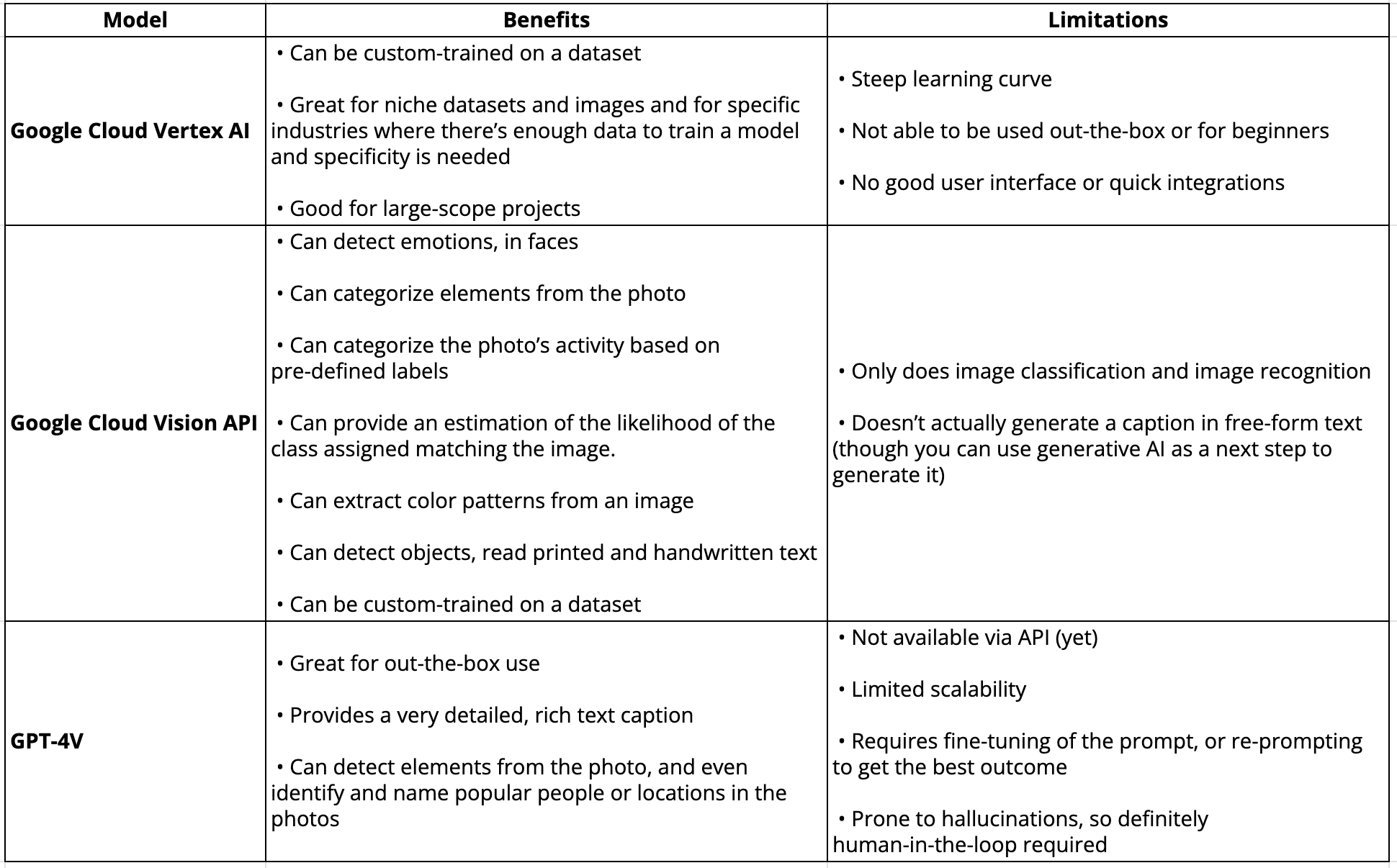
Comparative analysis of GPT-4V vs. Google Cloud Vision AI on captioning images
The table below compares the captioning capabilities of Google Cloud’s Vision AI and Vertex AI versus the recent introduction of GPT-4 with vision (or GPT-4V) vision capabilities, accessed via ChatGPT.
The only notable difference that can sway you to use one versus the other would be that you can easily integrate Google Cloud’s Vertex AI algorithm into a project and run it to caption hundreds, if not thousands, of images.
This can be extremely useful for image captioning for enterprise-level or large websites failing at this accessibility requirement. Despite the many conversions that this capability will soon be introduced with the GPT-4 API endpoint, this has not (yet) come to fruition, though it might soon.
Get the daily newsletter search marketers rely on.
Content transformation
Content transformation refers to transforming the content to a different format, style, or length. It is important for SEO because of two factors: omnipresence and accessibility.
Omnipresence encapsulates the need for your brand or content to exist in different forms and platforms. This requirement is influenced by:
- Customers’ desires to be able to consume the content in different formats.
- The ever-changing preferences Google provides in the SERP for different content types.
It’s important to know that Google won’t automatically treat it as duplicate content if you have the same content in both written (like a blog) and video formats (such as a long YouTube video or in shorter clips on Shorts/TikTok).
In short, the same content in different formats is not considered duplicate, as it benefits both the user (able to consume the content in whatever format they choose) and search engines (able to serve the content in different formats and satisfy the user’s search intent regardless of their preference).
Accessibility means offering diverse ways for people to consume your content, helping you reach a broader and more inclusive audience.
Think of different platforms (YouTube, TikTok, Spotify, Instagram, Pinterest, Medium) and content formats (text, image, video, audio).
Transforming your textual content into audio format, for instance, makes it accessible to people with visual impairments or those who prefer listening over reading.
Text-to-text transformation in SEO
You can use text-to-text content transformation to improve your organic reach in the following scenarios:
You have a high-performing blog or resource section but no presence on platforms like LinkedIn, X or Facebook Groups
- In this case, you can benefit from growing an audience and brand reach and potentially improve lead gen.
- To do this, transform the content into the format required to gain maximum visibility (which is different for each site) and start regularly publishing insightful and helpful posts.
Your email newsletters have substantial content but limited engagement
- Repurpose this content into bite-sized, visually appealing posts for social media or as blog posts.
- Use interactive elements to attract more readers and encourage shares, increasing visibility and subscriber numbers.
Your in-depth research or whitepapers are underutilized
- Break down these extensive texts into a series of smaller, digestible articles or blog posts, each focusing on a specific aspect or finding.
You have comprehensive guides or reports in PDF format that are only accessible through gated content
- You can extract key insights, summaries, or actionable tips from these documents and repurpose them into blog posts, LinkedIn articles, or X threads.
- Offer a teaser of the value in the full PDF and drive traffic back to your gated content.
Text-to-audio transformation in SEO
You can use text-to-audio content transformation to improve your organic reach in cases where:
You have a high-performing blog or resource section but no presence on YouTube
- In this case, you can easily transform the content to audio format,
- Take it a step further and incorporate the audio with visual elements, creating videos for social media like YouTube, or Shorts and TikTok (for short-form content).
You have data to support the hypothesis that your audience prefers audio content over reading
- For instance, people often listen to audio content while driving, exercising, working, or performing other tasks.
- You can increase engagement by converting your blog posts, articles, or newsletters into podcast episodes or audiobooks compared to having only one static format.
Video or audio transcription in SEO
Here is how you can use audio-to-text or video-to-text content transformation to improve your organic reach:
You have a library of high-performing videos on YouTube but no blog
- In this case you can scale the launch of your blog quickly via audio transcription.
You have a series of successful webinars or online workshops
- Transcribe these sessions and convert them into a multi-part blog series or an ebook.
- This approach gives your content a longer shelf life and reaches an audience that prefers reading over watching videos or attending live events.
You have a running podcast or interview series
- Transcribe these and publish them as text on landing pages on your site, with the appropriate structured data and links to the audio or video resource.
- Incorporate key insights or additional contributions.
Comparative analysis of GPT-4 vs. Google Cloud on content transformation
The table below compares three of Google Cloud’s models (depending on the task) versus GPT-4’s model. (You will notice that the latter does not have text-to-audio or video transcription out-of-the-box. However, this can be incorporated with custom agents.)
Content localization
Remember that regardless of the development of machine learning models, translation does not replace localization, at least not yet.
This means that when it comes to SEO or user-facing content, you should use a content localization specialist as your last edit, ideally, also someone who can align the last draft of content with SEO research for that target market.
That said, automated translation can make a difference for medium and large websites or those working on a bit more constrained budget, as it is much quicker, cheaper, and scalable to implement than traditional translation.
Content translation in SEO
When would you require content translation to improve your organic search performance? Consider the following as some potential examples:
You are expanding your business research into international markets
- In this case, translating existing content before handing it off to a localization expert can significantly reduce costs.
You are trying to attract searches from other locales
- Translating content into the local language can significantly improve visibility in local search results, as search engines prioritize content that matches the user’s language and location.
You are building a content and keyword strategy for a website in another language
- While not common, this scenario happens in big organizations or agencies, where you’d rely on a translation tool to better understand competitor content, SERP analysis, or keywords from the language you don’t speak.
Comparative analysis of GPT-4 vs. Google Cloud Translation AI for content translation
The following table summarizes the insights from the analysis conducted by Dmitrii Lukianov.

Key takeaway
Don’t just use a blanket model for all your tasks. You might be missing out on useful tools from Google Cloud because you’re focusing a lot on GPT-4.
I’ve pointed out the various tasks where you can use these APIs and how they can help your strategy, make tasks faster, and improve your organic visibility. Using APIs for specific tasks can also:
- Speed up the process of turning data into insights.
- Improve the quality of your work when dealing with enterprise-level websites.
- Help you evolve in your career and skills as an SEO consultant.
As noted, each model will have benefits and limitations for specific tasks, so it’s important to research what each model you use has been trained for and its ideal use before you start.
Courtesy of Search Engine Land: News & Info About SEO, PPC, SEM, Search Engines & Search Marketing
Thursday, January 11th, 2024
TikTok claims that non-skippable video ads may hinder engagement in a new report.
Consumers are more likely to watch and engage with brand-sponsored videos when they have control over their experience, according to the study.
Why we care. Engaging ads are essential for brand awareness, visibility, and conversions. If non-skippable ads are reducing engagement, it may be more effective to experiment with skippable ads to enhance viewer experience and improve campaign performance.
The stats. The TikTok study, which was conducted in conjunction with MAGNA Media Trials, a global media investment and intelligence company, found that:
- 73% of viewers agree that having the ability to skip videos makes them more engaged in the experience.
- 56% of viewers are more likely to actively watch videos sponsored by a brand when they have the option to skip.
Ad duration. TikTok added that while consumers tend to watch skippable ads for shorter durations, the distinction between the duration of skippable and non-skippable ads doesn’t markedly impact viewership. A separate study conducted by the platform in collaboration with MediaScience revealed that 50% of the impact from a TikTok ad occurs within the initial two seconds. This research also found that the first six seconds of an:
- Captures 90% cumulative impact on Ad Recall.
- Captures 80% cumulative impact on brand awareness.
Ad placement. Ads have a greater impact and are viewed longer when they are placed next to popular, relevant content, regardless of the platform, according to the MAGNA study. For instance, when placed alongside trending content, the same ad becomes more relevant to viewers, enhancing its effectiveness, increasing purchase intent by 9%.
What TikTok is saying. A TikTok spokesperson said in a statement:
- “On TikTok, every view is intentional because users can skip any video they choose, including ads. Forced view also isn’t needed to create meaningful impact.”
- “TikTok’s skippable formats perform on par with video-on-demand forced view formats across key metrics like brand favorability and purchase intent.”
Get the daily newsletter search marketers rely on.
Deep dive. Read the report in full for more information.
Courtesy of Search Engine Land: News & Info About SEO, PPC, SEM, Search Engines & Search Marketing
Thursday, January 11th, 2024
Google is changing the Google Assistant, removing and changing dozens of features that some of you may have become accustomed to. Google said these changes are aimed to “focus on quality and reliability,” adding it will “ultimately make it easier to use Assistant across devices,” the company wrote.
With these changes, Google also has laid off hundreds of employees who worked on Google Assistant. It makes you wonder if AI will be the future and overtake Google Assistant. Although we know Bard is coming to the Google Assistant.
The changes. Here is a list of changes coming to the Google Assistant starting on January 26:
- Playing and controlling audiobooks on Google Play Books with your voice. You can still cast audiobooks from your mobile device.
- Setting or using media alarms, music alarms, or radio alarms on Google Assistant enabled devices. You can create a custom Routine that has similar behavior or use a standard alarm.
- Accessing or managing your cookbook, transfering recipes from device to device, playing an instructional recipe video, or showing step-by-step recipes. You can use Google Assistant to search for recipes across the web and YouTube.
- Managing a stopwatch on Smart Displays and Speakers. You can still set timers and alarms.
- Using your voice to call a device or broadcast a message to your Google Family Group. You can still broadcast to devices in your home.
- Using your voice to send an email, video or audio message. You can still make calls and send text messages.
- Rescheduling an event in Google Calendar with your voice. You can still schedule a new event.
- Using App Launcher in Google Assistant driving mode on Google Maps to read and send messages, make calls, and control media. You can still use voice control on Google Maps the same way.
- Asking to schedule or hear previously scheduled Family Bell announcements. You can create a custom Routine that has similar behavior.
- Asking to meditate with Calm. You can still ask for meditation options with media providers such as YouTube.
- Voice control for activities will no longer be available on Fitbit Sense and Versa 3 devices. You’ll need to use the buttons on your device to start, stop, pause, and resume activities. You can still voice control activities on Pixel Watches.
- Viewing your sleep summaries will only be available on Google Smart Displays. You can still ask for sleep details by voice on third-party smart clocks.
- Calls made from speakers and Smart Displays will not show up with a caller ID unless you’re using Duo.
- Viewing the ambient “Commute to Work” time estimates on Smart Displays. You can still ask for commute times and get directions by voice.
- Checking personal travel itineraries by voice. You can still ask for flight status.
- Asking for information about your contacts. You can still make calls to your contacts.
- Asking to take certain actions by voice, such as send a payment, make a reservation, or post to social media. You can still ask Assistant to open your installed apps.
There are also changes coming to the Google App, they include:
- Microphone icon will trigger Google Search results instead of the Assistant
- Saying “Hey Google” or long pressing the home or power button on Android phones or opening the Google Assistant app on iOS will still work
- The microphone button in the Pixel Search bar will activate Google voice search, not the Assistant
Layoffs. With these changes, Google has laid off hundreds of employees working on Google Assistant. Google said it is restricting the company from integrating new AI technologies. The layoffs impact Google employees working in core engineering, devices, and services, those working on Pixel, Fitbit, Nest, and, of course, the Google Assistant.
Why we care. It does seem like this might be a win for core search, but we all know that more AI technologies and features loom in the future. How will those new technologies impact Google Search? Will it be new Google Search Generative Experience or something else.
Hang tight, 2024 will be an interesting year in Search.
Courtesy of Search Engine Land: News & Info About SEO, PPC, SEM, Search Engines & Search Marketing
Wednesday, January 10th, 2024
We want to hear about your search marketing career. Please take the Salary and Career Survey from MarTech, Search Engine Land’s sibling site.
This year’s survey should take you only about three minutes to complete. The survey results will be released in the first quarter.
TAKE THE SURVEY
If you thought ushering the 2020s in with a global pandemic would be the unlikeliest thing to happen for a while, you weren’t alone. We’re just early into 2024, but we know unexpected and unexplainable things are ahead for companies, marketing teams, agencies and you.
While the pandemic devastated industries like travel, tourism and hospitality, it created a boom for segments like B2B technology, home goods retailers and home improvement businesses. But with every rise comes a fall, and areas like tech felt the pain in 2023. We didn’t even mention inflation, interest rates and global political instability.
Layoffs in the technology sector alone totaled nearly 250,000 jobs according to Layoffs.fyi. Job losses also piled up in sectors like financial services and brick-and-mortar retail.
It’s often the case that marketing is among the first areas of an organization to be impacted by job cuts, and that remains true.
But job losses aren’t the only thing impacting marketers and their broader organizations.
- The AI explosion. Is it a tool? Is it a job killer? Is it a skill that marketers need to master? It might be all of the above. It can help teams scale and move faster, and it helps automate manual tasks. But many of the tasks were previously done by people.
- Scrutiny of martech stacks and other investments. When budgets are getting slashed, tech investments get a long, hard look. Contracts up for renewals and new deployments need to show rapid ROI or they don’t stand a chance.
- Changing the channels. X, once one of the most impactful social media channels, lost a significant number of advertisers since Elon Musk took over. In early 2024, Google and Yahoo will implement new rules for email senders.
TAKE THE SURVEY
Courtesy of Search Engine Land: News & Info About SEO, PPC, SEM, Search Engines & Search Marketing
Wednesday, January 10th, 2024
As we kick off 2024, it’s time to rethink our SEO strategy. Rather than a complete overhaul, evaluating what’s working and what needs refinement will help you realign priorities.
This article outlines key strategic aspects you must review, from high-level business considerations to the specific data, tools, content and technical elements that drive results.
Whether you’re aiming for minor tweaks or bigger changes, this checklist will help set your SEO program up for success in the next 12 months.
Gain clarity on business priorities for 2024 and beyond
Before assessing your SEO strategy, you must understand where the business intends to go in 2024 and beyond. Gain insight into potential strategic moves, new products, markets, audiences and pivots.
The business strategy needs to be built into the foundations of your plan, so the more you can understand this and ensure your goals are aligned, the better.
Economic or industry trends: Do you have the right awareness?
Macro trends may have been tackled in the wider business strategy. Still, it is good to do your research.
- What is happening in the industry, thinking bigger than SEO?
- Have any big competitors made big moves in 2023?
- Are there annual reports you can download and read? What is the industry press saying?
It’s that time of year when all the predictions content comes out, be sure to have your eyes on this. Think of how this information might affect the business’ trajectory in 2024, particularly search.
Audience insights: Has anything changed about how customers search or buy your product or service?
How well do you know your audience? And how well is this knowledge informing your search strategy?
Audience understanding should be foundational to your strategy. When did you last map the customer journey?
For example, seeing the intersections where search and social work together can be really insightful as to what content the user is actually looking for.
Are your audience still turning to a search engine at the milestones you have in your journey, or are they searching on social? Do they want written content or are they hoping to see audio or video?
Also, are you still considering the right audience, or is there a new audience you could tap into? With the knowledge of the business strategy and new product launches that might be coming, does this change anything?
Competitors: Are you still monitoring the right competitors?
Map out your competitors and be sure you haven’t missed any new players in the market. You might have Goliaths out there that aren’t your search day-to-day competitors.
When did you last deeply dive into some of your key search competitors? Resetting your strategy is always a good time to do this.
Look at where they are focusing, if they are doing something you haven’t considered and where you see the risks.
Analyzing strengths, weaknesses, opportunities and threats
With all the research you have done considering the bigger picture, note down what you think your strengths, weaknesses, opportunities and threats (SWOT) are from an SEO perspective.
This might be something that you use just for yourself, but it can also be helpful to include in your strategy documentation if you need to share this with a manager, the board or your client. It shows you have really understood where you are currently and what is likely to happen over the coming 12 months.
So with the business strategy fully considered, you can now dive into your SEO strategy, starting with a performance review and a check-in on your processes, tools and people.
Dig deeper: SEO SWOT analysis: How to optimize where it counts
Best and worst performance from last year
I always find doing a review of last year’s performance helpful. You may want to include slightly different insights depending on your strategic focus.
Look at top-performing and worst-performing content from a search perspective, overlaying information such as the format of the content. Compare this to content from all channels, you can start to understand what content is most popular with your users and in what format.
Consider this content with your goal and ecommerce data. You’ll have your own business-agreed attribution model, but I always find it helpful to see where SEO has assisted in converting someone.
If you have a well-defined customer journey, you will undoubtedly understand what role SEO is aiming to play in converting customers, as you’ll know where your focus has been.
Looking to see how successful across the year this has been is a great exercise. This highlights gaps where either the results haven’t been achieved, or maybe the rankings are there, but it’s not driving the expected action.
Work with your CX and data teams to understand some of these trends. Looking at rankings, for example, might be too narrow a focus. It doesn’t tell you enough to understand whether SEO is actually performing the role of converting customers.
So, think widely when it comes to reviewing 2023 data. It’s also a great opportunity to think if there is anything you wish you had tracked so you can set this in motion for your 2024 strategy.
Get the daily newsletter search marketers rely on.
Tools: When did you last review what you are using?
Carefully evaluating your tools is crucial, as overlooking a key asset could give your competitors an advantage.
We all build habits, and it’s no different with our tools. We go in and use the same reports that we always use. But is there more to the tools you have that you aren’t benefitting from? Do you need some more training from the provider?
Or, are there new tools that might add to your capability, speed up processes or improve the way you tackle your SEO strategy?
Depending on when your annual budget renews, it is worth taking some time to look at what is on the market and the best use of your tool budget.
AI: Have you embraced it?
2023 was the year where AI was the topic of nearly every article, podcast and event. Have you tested where AI might fit in for you and your business? If not, I would recommend carving out some time in 2024 for this.
I believe AI is a valuable ally for strategy, serving as a data slicer, researcher, or ideation machine. While it’s not a finisher for tasks like content publication or final decision-making, it significantly enhances processes and accelerates delivery.
Reporting: Are your reports conveying what they need to?
SEO reporting serves two purposes:
- Providing detailed insights for day-to-day decision-making with close colleagues.
- Fulfilling reporting requirements for managers, boards, or clients.
At the start of a new year, it’s beneficial to seek feedback from recipients to enhance transparency and clarity in your reports.
Team and partners: Are you set up for success in 2024?
With the many skills required to deliver an SEO strategy, you will have colleagues, freelancers or an agency supporting you. I hope they are also doing some of what we’re covering in this checklist. For most agency relationships, a version of this should be happening every quarter.
As you build your 2024 strategy, consider if you have the right players in the right positions and ensure they know what their part is.
Keywords: Are they still relevant? What are you missing?
Understanding your audience’s search behavior is crucial for a successful SEO strategy. It’s not just about optimizing what you think makes sense; you need to ensure it aligns with user intent.
Without this knowledge, you risk failing by either having the wrong content for user intent despite a good position or having both position and content but failing to guide the user to a conversion.
Understanding what your audience is searching for, what they are hoping to find and what they are trying to do all need to be known factors to accompany your keyword research.
Content: Are your plans prioritized accordingly?
Ensuring you have a content plan prioritized by likely impact will set you up for better success. Work closely with your CX and data teams to understand how you can convert more users through content.
You also need to ask yourself:
- Is the format right?
- How does my audience wish to digest this content?
- Am I serving them in the right way to help aid a conversion?
Having a roadmap that clearly outlines the next quarter and an overall plan for the entire year is beneficial. This is particularly useful for aligning teams and facilitating collaboration.
Technical SEO: How healthy is the website? What plans are there for 2024?
Technical SEO is integral to an SEO strategy and often influenced by other departments, necessitating broader business discussions. Access to the website’s technical roadmap and involvement in its planning can significantly enhance your strategy’s chances of success.
Engineering teams easily forget SEO. Ensure it is not an afterthought by embedding yourself into their planning. This makes working as an SEO less stressful. Nothing is worse than that last-minute curve ball of “We’re launching X tomorrow’!”
A strategy refresh is a great time to consider the SEO technical health in general, looking at what stands out as opportunities to tackle this year.
Benchmark this against some of the core competitors so you have a baseline. You can also use it to push the case forward for technical work that may require the development team.
Dig deeper: What to look for in a technical SEO audit
Digital PR: Why will your target publications want to talk about your business in 2024?
Having reviewed your 2023 performance, you’ll have a clear idea of what worked, what didn’t or where missed opportunities may have been.
In planning for this year, you want to be sure you don’t fall into any of the issues that held the strategy back previously.
Aligning the digital PR plan with your content strategy is crucial, especially when relying on others for content creation. Ask yourself why your target publications would care and identify hooks to stand out in 2024.
Journalists are increasingly time-poor, facing pressure to produce quality content at scale. Creating the content their audience seeks and cultivating the right relationships can lead to success.
Dig deeper: How SEO and digital PR can drive maximum brand visibility
Collaboration: What is everyone else doing?
Remember, SEO is most successful when integrated into the wider strategy. While some businesses naturally incorporate this, many still operate in siloed teams with insufficient communication.
Champion the breakdown of silos, share your strategy reset process, and encourage other teams to undergo similar exercises.
Mimic customer behavior, aligning your priorities and work with the customer’s journey. Magic happens when you embrace a customer-first mentality.
Refining your 2024 SEO game plan
Approach 2024 with confidence by ensuring your SEO foundations are strong. Carefully evaluating what has worked, where there are gaps, changes in the market, and alignment with business goals will set you up for success.
Leverage the checklist outlined here as a framework, adapting areas to suit your business priorities. With clarity on the strategy and transparency through reporting, you can continually optimize throughout the year, working collaboratively across teams.
Courtesy of Search Engine Land: News & Info About SEO, PPC, SEM, Search Engines & Search Marketing
Wednesday, January 10th, 2024
Are you ready to turn your low-spending but profitable lead gen search campaigns into sources of significant growth? You might be ready to scale your Google Ads account.
Every new Google Ads account starts from a humble position, but there comes a time when it makes sense to tune up campaigns and generate even more leads.
If you want to ramp things up, this guide will show you:
- What to expect when scaling a Google Ads lead gen account.
- What’s involved and what you have control over.
- How to actually ramp up PPC results.
How to know when you’re ready
When you are ready to scale, there are two ways to approach it:
- Getting more from a single ad platform.
- Expanding to new platforms.
This article will focus on the first, particularly on Google Ads for lead generation.
Scaling a nascent Google Ads account doesn’t simply mean increasing your budget and hoping for a proportional increase in leads. You may encounter new settings and moving pieces, ask clients for added support, and give back as much insight as you take.
Some signs that you might be ready to truly scale include:
- Overly profitable campaigns are a sign that you may not be investing enough.
- Low impression share or click share indicates untapped search volume.
- A high-converting primary offer with other offers you aren’t advertising.
The 9 levers you can pull to scale lead gen PPC
Throwing money at a challenge might work elsewhere, but scaling a Google Ads account takes a bit more care.
Simply dialing up your spend won’t be enough, so consider these nine tactics that can influence growth to varying degrees (both together and on their own).
1. Target new locations
Once you’ve maxed out impression share, one way to expand the scale of your Search program is by looking for additional geographies to target. If yours is a Local campaign, can you expand the location targeting?
When targeting one specific county or mile radius, I’ve sometimes gotten results by targeting different versions of the same area (e.g., county, ZIP codes, radius around a certain location).
They’re all really targeting the same place, but somehow it builds your audience because it captures a bit more people.
That’s my experience – your mileage may vary.
Side note: It may be a good idea to use “Presence” and not “Presence or interest” in the advanced location settings.
Dig deeper: Improve your Google Ads performance: 3 simple setting changes
2. Add new keywords
If you began your Search campaign by targeting a small group of keywords, there’s a good chance you can scale up simply by targeting new queries.
- Are there keywords related to the industry or problem you’re addressing that you have not targeted?
- Are there new things people are searching for?
- Do you have location-based keywords that you can go after, even if it’s just adding location terms to the end of an existing keyword?
These are all ways to open your ads up to people who need what you have but might not have been the recipients of your previous ads.
Outside of keywords, your match type can also open up new opportunities. If you haven’t yet added Broad Match to your campaigns, you can start testing it to open your ads up to a much wider range of traffic.
You can also test new keywords with a Dynamic Search Ads campaign.
3. Optimize your spend
Simply spending more is often a great way to take your early-stage Search campaigns to the next level. This is easier when you aren’t capturing a large percentage of available impressions because the budget increase will find more relevant people to show your ads to. So, you can likely double a $100 budget and get twice as many leads.
However, as you increase your budget, finding new conversions will become more difficult because fewer people are searching for relevant terms. So when you spend thousands and have a healthy impression share, you’ll get fewer conversions as you raise your spend.
Another area to monitor is whether placements are eating up your spend by bringing in junk leads or irrelevant clicks. Opting out of things like Search Partners and the Display network can open up opportunities to spend that money where it’s more likely to return a profit.
Similarly, trying a new campaign with a new goal (such as generating fresh demand) might be a way to find opportunities you didn’t know existed.
4. Build dedicated landing pages
We typically start our campaigns by driving traffic to the homepage of a website. It’s ready, so we see how it goes. If it doesn’t perform as well as we’d like, we build a dedicated landing page.
The objective of a dedicated landing page is to be:
- Relevant.
- Uncluttered.
- Quick to load.
- Clear in copy and call to action.
In general, people typically focus on lowering bounce rate. With lead gen landing pages, you almost want a high bounce rate because the inverse of that is increasing your conversion rate.
When you create a binary choice for anyone who lands on the page – convert or leave – you’ll get a higher conversion rate.
Do that by being as clear as possible:
- What action should the visitor take?
- Why should they take it?
- Why should they trust you?
- What will happen after they take it?
It can lead to a higher bounce rate, but that’s not necessarily bad. If you get your conversion rate from 5% to 10% and your cost per click goes up by 30%, you still have a cheaper cost per lead than you did before.
It’s a frequently overlooked component of Google Ads – or any digital marketing campaign in general.
Get the daily newsletter search marketers rely on.
5. Test landing page variations
Landing page optimization is a significant lever that many Google Ads managers don’t touch, and it can often be because they don’t know where to begin.
Here are some of my landing page best practices:
- Experiment with removing the header/navigation of the website, with a logo going to the homepage but no other links on the page.
- The page should load quickly and be responsive to the device it’s accessed on. Too many landing pages aren’t mobile-friendly when they should be.
- For copy, We’ll pick clear over clever every day of the week. A clear headline should state in very plain language what you do and match both your ad copy and keywords.
- Your form should be prominent, easy to fill, not too complicated, and have only as many fields as necessary.
- For call-based conversions, a click-to-call button with a clear CTA is a must. Don’t forget to track this.
- Make sure you display credibility above the fold. Customer reviews, links to review sites, and media or industry accreditations let others vouch for you and build trust with visitors.
- Include content below the fold so that as people scroll, they can learn more about the business, what you do, your solution and its benefits. Intersperse that with CTAs between sections.
6. Test form variations
If your lead collection method is form-based, the structure and content of your forms become critical to how well they convert.
A basic form contains three to four fields, such as:
- Full name (or split into first and last names).
- Email.
- Phone number.
You may also want to include qualifiers. For B2B brands, here are examples of information we like to ask for:
- Company name: Anybody who doesn’t have a company will leave your page and disqualify themselves naturally.
- Location: For businesses with limited service areas, we include a geography drop-down or zip code field (for U.S. campaigns).
- Start date: If what you’re selling has a longer or limited timeline, you can ask people to specify when they want the job done.
You can also ask for information that helps qualify leads based on whether they meet certain criteria, such as their budget or industry. You can even write underneath the CTA button that you only take on customers who meet certain conditions.
The idea is to make sure that only right-fit prospects fill out your forms, reducing your junk leads and improving your qualification rate. This gives you a better idea of your addressable market instead of seeing inflated lead volume, making for better forecasts.
Another trick that often helps get the conversion is to place an icon of a lock and say that their data is 100% secure and won’t be shared. This handles another concern or objection up front and builds confidence.
7. Qualify your leads
We like to connect lead gen accounts with their CRM data whenever possible so we can focus on generating leads that drive business outcomes.
Let’s say you have a client that sells a specific item built to measure. Your form will ask for the usual contact information and qualifiers, but you can also let them input those dimensions or measurements.
What you want to look for is which leads come in with measurements and which leads don’t have them, and generally, the former will be of much higher quality. If someone takes the time to perform an action outside the form to fill it out, it indicates they really want what you’re selling.
Those leads can be marked appropriately and sent back to Google through offline conversion imports, allowing the system to pursue more users like them. Not only that, but your sales team will know which leads to go after first, making this a holistic improvement to your ability to close more deals faster.
8. Set up Enhanced Conversions
You should set up Enhanced Conversions if you can. Their primary use is to let Google track users even when ecosystems like Apple’s and other devices make that harder. As we move towards a cookie-less future, this allows Google to track what its pixels cannot.
This requires you to provide Google with personal data, such as emails and phone numbers, so their system can match it up with an account they know clicked on the ad. Doing this captures an additional 10% of user information, making it an extra signal that’s good to have.
But it will probably be considerably more important in the future, so get a headstart if you can!
9. Layer in Performance Max
After expanding each of the other strategies, and it seems that you’re tapped out and really can’t get anything else out of them, I would then consider layering in Performance Max if (and only if) you have some kind of offline conversion tracking. Otherwise, you’re going to get a ton of spam.
There are two ways of adding Performance Max to lead gen campaigns:
- Continue with Target CPA and send your qualified leads back to Google from your CRM data using offline conversion imports. That can sometimes be a stronger signal than a lead that becomes a sale. If you collect 100 leads from Google and 30 of them are later marked as qualified in your CRM, use that as a conversion action and set the campaign to specifically target those types of conversions.
- Bid to a Target ROAS if you’re able to send your revenue data back into Google Ads.
Without the ability to implement offline conversions, I recommend avoiding Performance Max for lead gen because you will spend time and money with little return to show for it.
Scaling lead gen on Google Ads
PPC fell into a years-long trap where the industry believed it could operate independently of other marketing and business functions. And for a long time, that was because Google made it possible to do so.
But all things are cyclical, and PPC is once again taking its rightful place in a broader marketing strategy.
As you grow your spend and results on Google Ads, remember that many other moving pieces influence the customer experience. Before and after the click, you have design, web development, discoverability, UX, and sales follow-up elements.
Scaling accounts doesn’t happen overnight, and it certainly doesn’t happen effortlessly. But there is a tremendous reward for those who can see the big picture and show persistence.
Courtesy of Search Engine Land: News & Info About SEO, PPC, SEM, Search Engines & Search Marketing
Wednesday, January 10th, 2024
TikTok marketers can no longer search for specific hashtags within the platform’s Creative Center tools.
Why we care. These restrictions will make it harder for you to explore and gauge the popularity of trends on the platform, which is essential for effective campaign planning.
What’s changed? Links for hashtags related to the Israel-Hamas war and U.S. politics no longer work within Creative Center. TikTok has also removed the search button in Creative Center.
According to TikTok, the tool has shifted its focus towards providing data on the top 100 hashtags within diverse industries, such as pets and travel, instead.
Why now? TikTok has restricted its hashtag search feature due to concerns that the data was being used to uncover potential platform censorship. This decision comes after researchers and lawmakers scrutinized content related to geopolitics and the Israel-Hamas war using the tool’s results.
What is TikTok Creative Center? The Creative Center is a tool designed to assist advertisers in monitoring trend popularity on the site. Accessible to everyone, it provides data on the number of videos associated with a specific hashtag and details about the audience that viewed those videos.
What TikTok is saying. TikTok spokesperson Alex Haurek tolf the New York Times (which is paywalled):
- “Unfortunately, some individuals and organizations have misused the Center’s search function to draw inaccurate conclusions, so we are changing some of the features to ensure it is used for its intended purpose.”
Get the daily newsletter search marketers rely on.
Deep dive. Read our guide on how the TikTok algorithm works for more information on how to create successful campaigns.
Courtesy of Search Engine Land: News & Info About SEO, PPC, SEM, Search Engines & Search Marketing
Tuesday, January 9th, 2024
Instacart is set to start serving ads on Caper Carts in Good Food Holdings banner stores.
Customers using the AI-powered smart carts will soon be greeted by ads on the trolley’s home screen, featuring launch partners such as Del Monte Foods, Dreyer’s Grand Ice Cream, and General Mills
Why we care. Instacart’s latest advertising solution presents a strategic avenue to engage with high-value customers at a pivotal moment in the shopping journey, increasing the likelihood of sales and return on investment.
New features. Customers using Casper Carts will soon experience two new features:
- Ads for new products and brands: This means you’ll find special offers and seasonal promotions right when you start shopping on the Caper Cart home screen. For example, you might see a fun banner showing limited-edition Chocolate Strawberry Cheerios from General Mills for Valentine’s Day.
- Personalized product recommendations: These ads will show up based on what the customer is doing while shopping, like what’s in their cart or how they’re browsing (see image below). For instance, if a customer adds ice cream cones, they might get a suggestion for a matching item, such as Dreyer’s ice cream.

Store locations. During the initial phase of the pilot scheme, ads will exclusively appear on carts at Good Food Holdings’ Bristol Farms stores in Southern California. However, Instacart has assured the inclusion of additional retailers in the upcoming months. The ambitious plan aims to deploy thousands of Caper Carts by the end of 2024.
Incentive for participating retailers. Instacart aims to incentivize stores to display ads on Caper Carts by offering a revenue-sharing model and the chance for enhanced in-store customer engagement.
What Instacart is saying. Neil Stern, Chief Executive Officer of Good Food Holdings, said in a statement:
- “Since deploying Caper Carts last year, we’ve been incredibly excited to provide our customers with a greater personalized experience while driving value as they shop.”
- “With the introduction of ads on Caper Carts, we’ll soon be able to unlock a new, incremental revenue stream while offering customers valuable suggestions and promotions from our brand partners.”
Get the daily newsletter search marketers rely on.
Deep dive. Read Instacart’s announcement in full for more information.
Courtesy of Search Engine Land: News & Info About SEO, PPC, SEM, Search Engines & Search Marketing
Tuesday, January 9th, 2024
Google is giving websites the opportunity to request additional time to transition away from third-party cookie dependencies.
To address possible compatibility concerns, the search engine has introduced a third-party cookie deprecation trial. While Chrome plans to eliminate third-party cookies by Q3 2024, this program lets embedded sites and services temporarily enable them until December 27, 2024.
However, developers are expected to make the necessary changes by the trial end date.
Why we care. For marketers heavily dependent on targeted advertising through third-party cookies, delaying Chrome’s phase-out until the end of the year could come as a huge relief. But it’s still crucial to update your marketing strategy to be cookieless before the December deadline, as there won’t be any additional help afterward.
How it works. Eligible websites can enable third party cookie deprecation trials by using JavaScript to provide unique access tokens in Chrome. To request a third-party token during registration, activate the “Third-party matching” option on the origin trial’s registration page. The third-party token should be provided through JavaScript by creating an origin trial <meta> tag, not in HTML code or an HTTP header.
Trial participants are advised to deploy deprecation trial tokens before the grace period ends on April 1, 2024.
Eligibility. The program is specifically designed for embeds and services that use third-party cookies and meet Google’s strict eligibility criteria”
- Advertising-related services won’t get approval.
- If your domain is known for advertising, even subdomains, it’s likely to be rejected.
- To be considered, you need to show direct impact on end-users; problems just affecting later data analysis won’t qualify. Submit bug reports to Google with detailed steps to reproduce the issue.
- Google will only consider requests with confirmed breakage, and there’s an appeals process for clarification.
- Even if your site has both ad and non-ad content, if it’s associated with advertising domains, it’s likely to be denied.
Review process. After you submit your application for the third-party cookie deprecation trial, Google will review your request. Response times will vary, however, if you have not received a response with one to two weeks, Google advises contacting them at 3pcd-deprecationtrial@google.com.
What Google is saying. A Google spokesperson said in a statement:
- “At the moment we are only focusing on third-party embeds and services.”
- “We recommend first-party sites continue making changes to their sites directly to fix the breakage and encourage their embedded third parties to sign up for this deprecation trial.”
Get the daily newsletter search marketers rely on.
Deep dive. Read Google’s guidance in full for more information.
Courtesy of Search Engine Land: News & Info About SEO, PPC, SEM, Search Engines & Search Marketing