Archive for the ‘seo news’ Category
Wednesday, February 21st, 2024

In an industry that’s constantly evolving…
- Machine learning in Google Ads – friend or foe?
- How can you leverage generative AI right now to power success?
- Email deliverability is on the verge of a shake-up… are you prepared?
- Google’s definition of quality content keeps changing – how can you stay ahead?
… it’s never been more critical to learn trusted, actionable tactics to drive more awareness, traffic, conversions, and sales.
Don’t miss your chance to participate in tactic-rich, expert-led training on your search marketing specialty: Register now for your choice of live, two-day SMX Master Class for just $299 each – happening online next Wednesday and Thursday, February 28-29!
(Need to get your boss on board? We can help.)
Choose one or more of these expert-led classes:

Attending a Master Class is a rewarding step toward a more successful campaign, company, and career. Check out past attendees’ favorite reasons to attend:
- Learn actionable tactics and next steps to improve campaign performance and achieve measurable results, no matter your KPIs.
- Train with experienced instructors from all walks of the search marketing spectrum and validate your instincts and initiatives.
- Get trusted answers to your specific questions during live Q&A, happening throughout your Master Class.
- Soak up the knowledge you need to know in two days rather than wasting valuable time with multi-week training programs.
- Train at your own pace – and watch and rewatch for deeper learning – with the convenience of on-demand access, available until June 28, 2024 (120 days).
- Digital access means you can attend from anywhere in the world – and anywhere in your home or office: couch, cubicle, kitchen table – wherever.
- Unlock hours of premium search marketing content for just $299 per class – less than the cost of a plane ticket to an in-person event.
- Earn a personalized certificate of completion and a digital badge to showcase your expertise and involvement in the search marketing community.
- Enjoy a rewarding team-building experience when you attend as a group – and save up to 20% depending on party size.
- Cross-train on multiple critical search marketing disciplines and save 15%* when purchasing more than one Master Class.
For nearly 20 years, more than 150,000 search marketers from some of the world’s most prestigious brands have attended SMX to learn the latest in SEO and PPC, sharpen their professional skills, and take their careers to new heights.
Now, it’s your turn. Secure your spot now!
Please note: Discounts cannot be combined.
Courtesy of Search Engine Land: News & Info About SEO, PPC, SEM, Search Engines & Search Marketing
Wednesday, February 21st, 2024
Instagram started testing two new features for brands and content creators:
- Backdrop: An AI background editing tool for Stories.
- Get Orders: In-steam ordering for feed posts and Stories.
Backdrop explained. This new feature can automatically identify a main focus or let you choose one manually. It then removes the background, and you can use the Backdrop feature to pick a new background from a carousel of options or create one by inputting a prompt, such as “National Park” ad demonstrated in the screenshot below:

When you share the Story, the prompt becomes a sticker that others can then use.
Getting started. Associate Director of Influencer Innovation at Mavrck, Lindsey Gamble, shared a screenshot on Threads to show where the new Backdrop feature is located within Instagram. Under the sticker menu, it appears in between “Add Yours” and “Add Yours Templates”:

In-stream ordering. The ‘Get Orders’ sticker, which was first flagged on Threads by Co-Founder of Satiné Ahmed Ghanem, enables content creators and brands to create a product, link it to their story, and receive orders directly. This presents a potential avenue to drive orders through Instagram content without the necessity of setting up an Instagram Shop.
Ghanem shared a screenshot of the Get Orders sticker below:

Why we care. With the Backdrop feature, marketers can try out different backgrounds until they find the perfect one for their ads. Meanwhile, the ‘Get Orders’ feature is a simple and free way to increase sales.
Deep dive. Read our guide for building effective Instagram ad creatives for more information.
Courtesy of Search Engine Land: News & Info About SEO, PPC, SEM, Search Engines & Search Marketing
Wednesday, February 21st, 2024
Google Ads is targeting businesses within their Gmail accounts, offering them free consultations.
Notably, the promotion is delivered through pop-up notifications rather than emails, making the message look less like an ad, possibly increasing the chances of conversions.
Why we care. Prompting businesses to engage directly with Google Ads, especially when they already have an advertising agency, may lead to confusion for the business and undermine the agency’s ability to perform effectively.
Pop-up notifications. The pop-up message reads:
- “Get a free 1-on-1 consultation with a Google Ads expert: You don’t have to start on your own. Let our experts help you set your strategy, budget and keywords.”
Businesses can choose to respond by clicking either ‘No thanks’ or ‘Schedule’ to arrange a free consultation meeting.
First spotted. The Google Ads pop-up notifications within Gmail were first flagged by Anthony Higman, CEO of online advertising agency Adsquire, on X. He wrote:
- “Wow, just wow. A client just sent me This screenshot of a pop up in his Gmail account about setting up a consultation for Google Ads. IN HIS GMAIL ACCOUNT!!!! So that just happened.”
HIgman then shared a screen of the notification:

Reaction. Melissa Mackey, paid search director at Compound Growth Marketing, also reported seeing the pop-up notification being served to her clients. She wrote on X:
- “We were on a zoom with a client last week and he was googling something and there were his Google Ads account stats at the top of the SERP… this client is knowledgeable about search so in this case it’s ok, but I don’t like this popping up for any random client – just brings more questions/confusion.”
Deep dive. Read our report on why advertisers think Google Ads support is at an all-time low for more information.
Courtesy of Search Engine Land: News & Info About SEO, PPC, SEM, Search Engines & Search Marketing
Tuesday, February 20th, 2024
The SERPs of 2024 are certainly not what they were a few years ago, and they’re due to change even more in the coming months as Google aggressively rolls out SGE.
Defining an SEO strategy to capture SERP real estate is increasingly complex due to recent additions like SGE, rich snippets, and other features.
Surprisingly, video search optimization, a method to dominate real estate, remains underutilized.
Let’s look at a quick how-to fitness-related search to see video’s SERP dominance in action:
Reason enough to keep reading, right? Well, there are two main approaches for hosting your video – YouTube and self-hosting – and each requires a different set of optimization techniques.
This article compares YouTube to self-hosted video, highlights key optimization factors for each, and discusses strategies to extend your video content‘s reach beyond views.
YouTube video optimization
I’ll start with this option because it’s the one I recommend my clients use for one simple reason: you get the benefits of organic search on both Google and YouTube.
Another pro of YouTube hosting is that it’s easy to upload videos on the platform – much easier, anyway, than embedding them into your owned media, which you have to do with self-hosted videos.
YouTube also bears the brunt of storing the content, while self-hosted videos can take a toll on site speed and processing power.
YouTube optimization relies on a few major factors:
- Keyword research that lets you feed Google the right signals to show up for related queries.
- Video page optimization, including headlines (the most important factor and one that should include your top keyword), descriptions, tags, and thumbnails.
- Video structure that enables watch time signals; and
- Watch time optimization means that videos with longer watch times may rank more highly – so the content should be compelling.
One of the things I like to remind my clients to do for YouTube optimization is to build a good YouTube channel subscriber list, so when you launch a video, you can get subscriber engagement early on.
Dig deeper: How to audit your YouTube channel for brand success
Self-hosted video optimization
The big benefit of self-hosting your videos is that you have full control of the branding and cookies, which YouTube hosting compromises somewhat.
That can carry different levels of importance depending on brand priorities, but YouTube’s audience is generally a more powerful consideration.
Self-hosted video optimization relies on some traditional SEO practices, like structured data and sitemaps and making the video crawlable and eligible to rank in video search features on the SERP (as explained in these Google guidelines).
Veteran SEOs should have a few issues translating their skills from other content forms to video SEO.
Get the daily newsletter search marketers rely on.
How to leverage video to its fullest
Use it to spin out content
You’ll notice I haven’t claimed anywhere that creating videos is easy (although AI is certainly producing options to make it easier). Anytime you invest in video (especially longer-form video), make sure you’re using it to produce a full range of content.
A couple of use cases I love to recommend include:
- Picking any of a number of free software services to provide a translation for your video (if you’re going with YouTube video, YouTube will automatically create a transcript). Feed the transcript into ChatGPT and ask for some kind of blog content (as always, with ChatGPT, you’ll have to refine your queries to get what you want, then ruthlessly edit the results).
- Using highlight clips from your video in discrete social media posts and tag any guests to extend reach. If you have enough quotes to highlight from those, pull them out into a “10 top moments from {video} blog, which you should then add to your next newsletter.
In those and similar cases, make sure you’re embedding the video where it makes sense so you can capture more video views.
You can do this with either YouTube or self-hosted videos. This creates a virtuous cycle of content (e.g., video content translated into a blog with the embedded video).
Use the video in your email campaigns
Adding video to your emails does more than just make the content engaging; it makes users more likely to check out the content in the first place. Simply adding “VIDEO” to your email subject lines increases open rate by almost 20%, according to Covideo.
Monetize the video
If it’s hard to track view-through performance and impact in paid media, you can correctly guess that it’s even harder for organic video.
But you can use links (ideally shortened links with UTMs from a tool like Bitly), either in:
- The YouTube description.
- Content close to a self-hosted video.
This helps people find landing pages or product pages that are a natural extension of the user journey. (For instance, a running shoe store might create a video showing “best shoes to correct pronation” and add the link to the top-selling model in the video.)
If your priority is to drive leads or revenue with your video, you can always sacrifice organic performance by gating it. Or you could try adding it in full to your YouTube channel, writing a blog post and including a snippet, then asking the user for an email for the full video link (and hoping the user will do that instead of searching YouTube – hey, it can work).
Ultimately, video’s primary function will be to increase brand awareness, measured by an increase in brand search. While the above tactics can help video push people toward purchase, good video campaigns usually lead to more brand searches first, then conversions.
Check things like video views, YouTube search trends (you can see a mapping of video watch time per keyword), and related upticks in brand search trends and corresponding conversions, and you’ll have at least some directional data on revenue impact.
Maximizing video’s impact for better search visibility
Ultimately, I view video optimization as a smart strategy for hedging against any negative effects from the fast-evolving SERP.
Start with great content that will keep users’ eyes on the screen, pull some levers to help your content show up when they need to see it, and you can afford to be a little less worried about the impact of SGE’s evolution.
Courtesy of Search Engine Land: News & Info About SEO, PPC, SEM, Search Engines & Search Marketing
Tuesday, February 20th, 2024
Google has announced that the new Interaction to Next Paint (INP) metric will become one of the three Core Web Vitals metrics on March 12, 2024. It’s replacing the older First Input Delay metric.
This marks the biggest change to the web vitals since Google first introduced them as a ranking factor in 2021.
What is Interaction to Next Paint?
The three Core Web Vitals metrics each measure a different aspect of the experience users have on your website. INP assesses how quickly your website responds to user interactions.
For example, if a visitor clicks on a button on your website and it takes a second for the updated page content to render, that represents a poor user experience.
Interaction to Next Paint measures how much time elapses between the user interaction and the next time the browser can update the content on the screen. The more CPU processing is required to handle the interaction and display the new content, the worse the INP score will be.
Does Interaction to Next impact Google rankings?
Google has confirmed that the Core Web Vitals are a ranking factor. That means if your site does worse on the INP score, it may rank lower than competitors that do well on all three web vitals metrics.
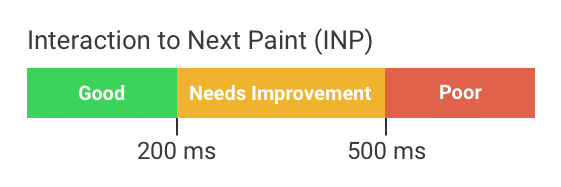
To get a good score, the INP should be below 200 milliseconds. A delay of over 500 milliseconds is considered poor. Your SEO is gradually impacted as INP worsens between the Good and Poor thresholds.
How does Google know how fast your website responds to user interactions? This data is collected from real Chrome users as part of the Chrome User Experience Report (CrUX).
How to test Interaction to Next Paint on your website
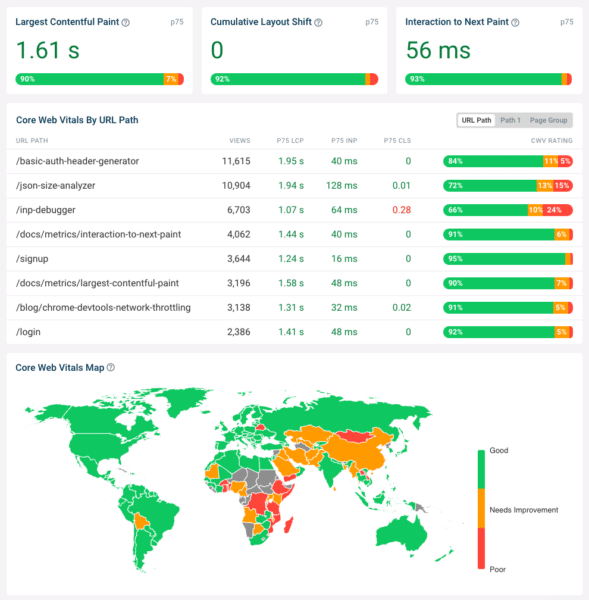
Want to find out how well your website does on the INP metric and other Core Web Vitals? Running a free Core Web Vitals test on your website is one quick way to check. Just enter a page URL and wait for the test result.
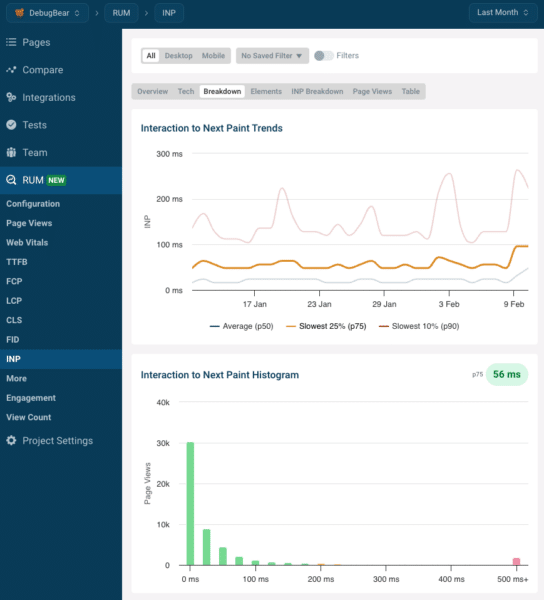
The real user Interaction to Next Paint data can be found in the Web Vitals tab. The 25-week trend lets you know whether the page is getting better or worse over time.
The data that’s shown here comes from the Google CrUX report.
To get a broader view of different page groups on your website, you can also check the Core Web Vitals tab in Google Search Console. Here you’ll see how many pages are affected by INP issues or otherwise don’t pass the Core Web Vitals assessment.
Unfortunately, the data Google provides isn’t very nuanced, and due to the page grouping mechanism, you may not be able to tell which specific pages are impacted by slow Interaction to next Paint.
Google CrUX data is also aggregated over 28 days. That means you’ll have to wait several weeks to see the impact of any optimizations.
To get more in-depth insight, a dedicated real-user Core Web Vitals monitoring tool like DebugBear can help. This way, you get detailed Core Web Vitals data across your whole website, updating as soon as a change is rolled out.
How do you speed up interactions and improve INP?
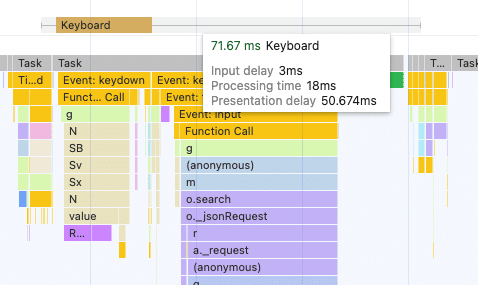
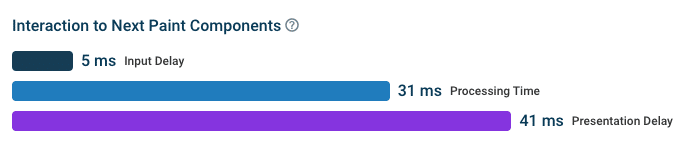
To improve INP scores on your website, you need to know what CPU processing is involved in a user interaction. INP can be divided into three components:
- Input delay: background tasks that prevent the browser from handling an interaction until after the tasks are complete
- Processing time: running code that handles the user interaction and schedules updates to the user interface
- Presentation delay: after UI updates are scheduled, the browser has to update the page layout and present the new content
The performance tab in Chrome DevTools shows how long interactions on the page took and what was responsible for the CPU processing.
The data in the DevTools performance tab can be hard to read, so you’ll usually want a developer involved. But it provides an explanation for every millisecond that the browser spends while handling the event.
For example, you may find that:
- Third-party code is running in the background and slowing down interactions.
- The JavaScript code your website runs in response to an interaction must be optimized.
- You can schedule CPU tasks more efficiently to reduce the time that interactions are blocked.
Real user monitoring with DebugBear will show you which INP component contributes the most to poor responsiveness on your website.
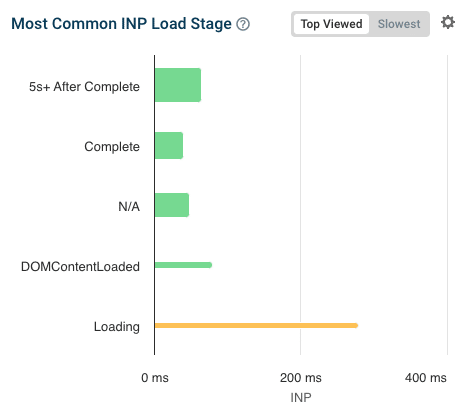
You’ll also often find that interactions take longer during the initial loading process of the website. That’s because when a page first starts loading, many small tasks are run in the background to set up the page, for example, loading ads or initializing a form or chat widget.
DebugBear shows a breakdown of how fast interactions are at different stages and how frequently interactions occur in these time periods (indicated by the height of the bar).
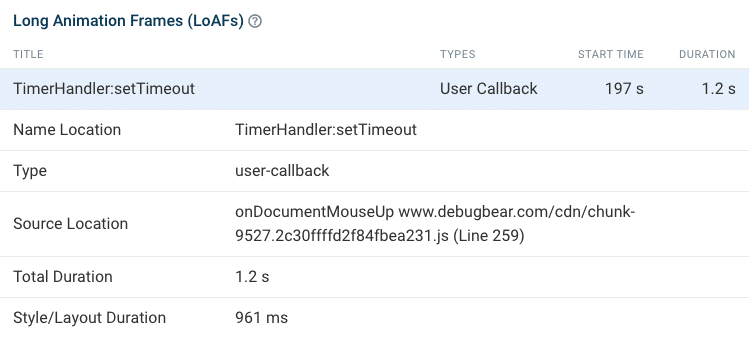
If your website supports the Long Animation Frames API, you’ll also be able to see specific scripts and JavaScript functions that are causing slow interactions for your visitors.
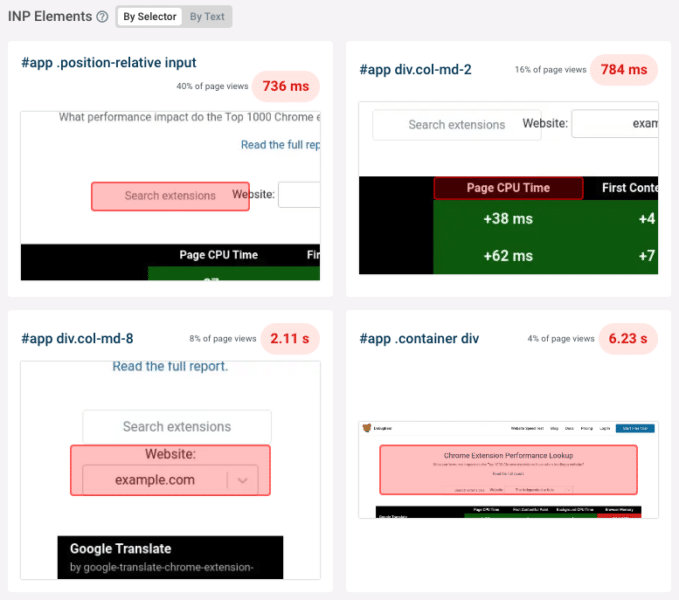
How do I know which page interactions are impacted by slow INP?
If you want to optimize your code and test interactions on your website, you need to know what elements users most often interact with on your website and which interactions often cause slow INP.
This isn’t data you can get from Google CrUX reports, but a dedicated Core Web Vitals monitoring tool like DebugBear will collect this information for you.
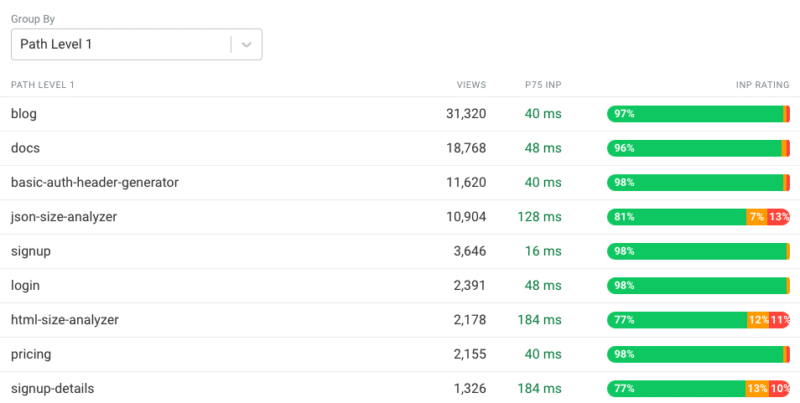
You can filter the data by page, device type, and many other factors to better understand how visitors experience your website. DebugBear reporting can give you targeted advice on how to improve Interaction to Next Paint.
How to monitor Interaction to Next Paint and other Core Web Vitals
A real user monitoring (RUM) solution can help you get ready for the new Interaction to Next Paint metric and help you stay on top of your Core Web Vitals over time.
Try DebugBear with a free 14-day trial. Continuously measure your web vitals and see what pages would benefit the most from optimizations.
Simply install the DebugBear analytics snippet to gain insight into your visitor experiences. Avoid the 28-day delay that comes with Google’s web vitals data and get detailed reports you can use to deliver a better website experience and rank higher in Google.
Courtesy of Search Engine Land: News & Info About SEO, PPC, SEM, Search Engines & Search Marketing
Tuesday, February 20th, 2024
Google added new structured data to support product variants on e-commerce stores, this includes new technical documentation on how to implement the new structured data and Search Console and rich result testing tools for validation of the new markup. This is called product variant structured data.
Also, Google clarified when to use FreeReturn versus ReturnShippingFees as value for returnFees for product returns in the product structured data documentation.
Product variant details. Google explained that e-commerce sites “for variant products are more complex than single-product sites, and, consequently, the associated structured data is more complex as well. One added complexity is that variants must be grouped together under one “parent” product.” Google’s solution to allow such grouping of variants is by adding new support for the Schema.org ProductGroup type and three new properties:
hasVariant (to nest Product variants under their parent ProductGroup),variesBy (to list the variant-identifying properties), andproductGroupID (the ID, also known as “parent sku” of the ProductGroup).
Also added a new isVariantOf property to the product structured data documentation and clarified that Google support product variants with distinct URLs.
Validation support. In addition to the new documentation, Google updated Search Console to support validation and error handling for this new structured data. Google said, “New validations for variants have been added to the Product snippets and Merchant listings reports in Search Console and Rich Results Test.”
Here is what that report looks like:

Return clarifications. As a side note, Google Clarified when to use FreeReturn versus ReturnShippingFees as value for returnFees for product returns in the product structured data documentation.
Why we care. If you run an e-commerce site and you have products that have product variants, such as by sizes, colors, materials, or patterns or different memory sizes, screen sizes, and processors, etc – then you will want to check out this new product variant structured data support.
Utilize the documentation and the testing tools and track any success in search with these implementations.
Courtesy of Search Engine Land: News & Info About SEO, PPC, SEM, Search Engines & Search Marketing
Tuesday, February 20th, 2024
Google Analytics 4 is allegedly missing data from User Acquisition and Traffic Acquisition reports due to a bug.
Users report that data prior to September 6 is no longer available, despite it having been in place for at least two years prior, as demonstrated in the screenshot below:
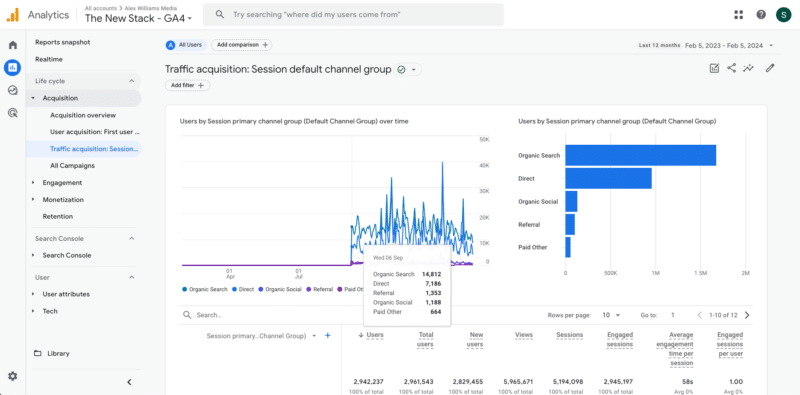
The screenshot was shared in the Google Analytics Help Center.
In response, 15 others confirmed they were experiencing the same issue:
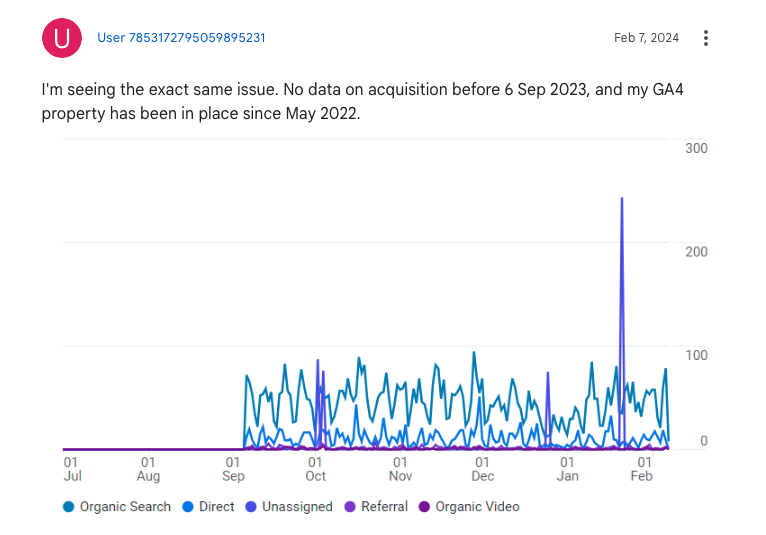
Why we care. If you are experiencing this problem, rest assured that the bug has been submitted to Google in Issue Tracker. Additionally, your data is not lost – you can still generate reports on traffic in Exploration reports or Standard reports using a different dimension such as source/medium.
What Google is saying. Google did not immediately respond to Search Engine Land’s request for comment.
Get the daily newsletter search marketers rely on.
Deep dive. Read the full thread on the Google Analytics Help Center for more information.
Courtesy of Search Engine Land: News & Info About SEO, PPC, SEM, Search Engines & Search Marketing
Friday, February 16th, 2024
Goggle Ads is updating the unacceptable business pactices portion of its Misrepresentation policy.
From March, this section will include:
- “Enticing users to part with money or information by impersonating or falsely implying affiliation with or endorsement by a public figure, brand, or organization.”
Enforcement. Google will begin enforcing this policy in March for advertisers outside of France. For advertisers in France, Google will begin enforcing this policy in April.
Violation penalty. If Google finds your in violation of this policy, it will will suspend your Google Ads accounts without prior warning. Additionally, you will not be allowed to advertise with Google again.
Why we care. If any of your ads violate this policy, it is crucial to take corrective action immediately before Google begins enforcing these new rules. Failure to do so may result in the suspension of your account, and a permanent ban on advertising with Google.
What Google is saying. Google said in a statement:
- “We take violations of this policy very seriously and consider them egregious.”
- “Please review this policy to determine whether or not any of your ads fall in scope of the policy, and if so, remove those ads before the relevant enforcement date.”
Get the daily newsletter search marketers rely on.
Deep dive. Read Google’s announcement in full for more information.
Courtesy of Search Engine Land: News & Info About SEO, PPC, SEM, Search Engines & Search Marketing
Friday, February 16th, 2024
Snapchat is teaming up with Foshpa to offer its advertisers enhanced campaign insights.
The partnership will enable users to measure the impact and effectiveness of ads on the platform more efficiently with a particular focus on cross-marketing return on ad spend (ROAS).
It will also allow advertisers to directly compare their Snapchat results to other channels like Search, providing a more accurate understanding of overall campaign performance.
Why we care. Advertisers can utilize these enhanced insights to optimze campaigns more effectively for stronger attribution capabilities, pinpoint growth opportunities, and maximize ROAS.
What is Foshpa? Fospha is an analytics platform that tracks all clicks and impressions, presenting this data in a dashboard to assist users in identifying actions that enhance cost per acquisition and ROAS.
Getting started. If you’re interested in accessing these enhanced insights, contact your Fospha or Snapchat account manager for more details.
What Snapchat is saying. Snapchat said in a statement:
- “With this partnership, Fospha and Snap will help marketers increase their confidence in spending on Snapchat and enable them to capitalize on strong campaign performance at higher spend levels.”
Get the daily newsletter search marketers rely on.
Deep dive. Read Snap’s announcement in full for more information.
Courtesy of Search Engine Land: News & Info About SEO, PPC, SEM, Search Engines & Search Marketing
Friday, February 16th, 2024
Amazon’s reign as the king of ecommerce won’t end any time soon.
There were over 15 billion worldwide visits to Amazon.com in 2023.
The continued flood of purchase-ready visitors makes Amazon lucrative for sellers who can stand out and generate sales from the platform.
This year, Amazon’s core belief behind its algorithm remains straightforward. They want customers to continue buying. They are just as interested in making sales, if not more so, than the sellers themselves.
Here are six marketing strategies to help you grow your sales on Amazon in 2024.
1. Cover the basics
Tips and tricks still don’t replace solid marketing fundamentals. In general, you should think about strategy, not simply tactics.
- How are you positioning your brand/product?
- Are your prices competitive?
- Is your product differentiated?
- Do the photos and copy represent that?
You can’t start optimizing your marketing until you have covered the basics.
2. Continuously analyze your keywords and focus on relevancy
Amazon’s algorithm may be focused on customers buying products, which is similar to saying Google’s algorithm is focused on providing the best answers. While it may be true, many variables and nuances go into rankings.
- On-page elements.
- Customer reviews and ratings.
- Pricing.
- Inventory/availability.
- Images and multimedia.
Targeting the right keywords has always been critical. However, this has increased with Amazon’s focus on using AI and machine learning for product recommendations, search relevancy, and customer behavior analysis.
If you haven’t done keyword research on your product detail pages recently, it’s time to do so. Shopping trends evolve, and fresher data is available. Regularly researching keywords is crucial. Ensure they’re integrated into key areas like the title, description, and bullet points.
This doesn’t mean stuffing keywords in your copy. You still have to write for shoppers in a way that drives conversions. In 2024, this has become even easier with generative AI. Amazon even has its own AI tool to help with product listings.
Remember, shoppers are the ones reading and making decisions to purchase. No matter how the copy is created, it must help convince them your product is the right choice.
3. Go all in on Amazon Advertising
Amazon’s ad revenue was more than $49.9 billion in 2023. It’s hard to imagine it was only $10 billion in 2018.
Ad campaigns continue to be a must for success on Amazon.
Sales on Amazon are rewarded, meaning you can use advertising to get those sales, unlike Google Ads. This means by increasing your ad spend, you can stimulate sales velocity and improve your rankings.
Amazon continues to invest in its advertising offerings, which include expanded targeting options with:
- Sponsored display audiences.
- Sponsored display product targeting.
- Ssponsored brands video targeting.
They are also offering new ad formats, including:
- Sponsored display video ads.
- Sponsored brands video-only creatives.
- Amazon DSP marketplace targeting.
Amazon has even introduced a new AI-powered image generation tool to help you produce improved creative.
With new features and capabilities comes the ability to gain more granular insights into campaign performance allowing for better resource allocation of your advertising spend.
To differentiate your campaigns, you should explore and invest in emerging ad types, such as interactive and augmented reality ads.
Stay informed about updates to Amazon’s advertising platform to optimize your advertising cost of sales (ACoS) and leverage these insights for better ad performance.
Dig deeper: 5 reasons Amazon Ads is better than Google Ads for ecommerce
Get the daily newsletter search marketers rely on.
4. Utilize off-Amazon traffic strategies
Amazon’s brilliance has always been how they gain traffic from other websites. That’s why they are and have been one of the largest customers of Google Ads.
Taking an omnichannel approach by utilizing social media, influencer marketing, and content marketing will build brand awareness and direct users to your Amazon listings.
Implementing target campaigns, offering exclusive promotions, and sharing engaging content related to your products helps diversify your traffic sources.
You can also take advantage of Amazon’s Brand Referral Bonus program that incentivizes sellers to drive external traffic by offering them a percentage of sales as a bonus.
By strategically directing traffic from other sources, sellers can enhance their product’s discoverability and competitiveness on Amazon, standing out in a crowded marketplace.
Dig deeper: 3 tips for using promotions and discounts in paid search
5. Incorporate coupons and promotions with Amazon Ads
Everyone loves a discount and a good deal. You can play off both psychological triggers by running a coupon for sponsored product ads.
Running a coupon with advertising on Amazon is a powerful tactic to enhance product visibility, attract more clicks, and significantly boost conversion rates.
Coupons serve as a direct incentive for potential buyers, offering them a tangible saving on their purchase, which can effectively differentiate your product from competitors.
When these discounts are highlighted in sponsored product ads, they grab attention within search results, making your listing more appealing.
This strategy leverages the psychological appeal of getting a deal, encouraging shoppers to make a purchase decision more quickly.
Additionally, advertising your product ensures that it appears in front of a targeted audience actively searching for items in your category, increasing the likelihood of clicks and conversions.
Using coupons and advertising boosts immediate sales and enhances your product’s Amazon ranking by increasing sales velocity. Implementing this approach entails pricing and profit margin analysis to ensure sustainable discount and advertising costs.
Despite this, the potential visibility, sales, and customer acquisition benefits make running coupons with advertising a worthwhile investment for Amazon sellers aiming to expand.
6. Invest in high-quality product videos
Videos have become an indispensable element of effective Amazon listings, providing a dynamic way to showcase your products and differentiate your brand.
In 2024, leveraging high-quality, informative videos that address customer pain points, demonstrate product use, and highlight unique features is key.
Consider incorporating user-generated content, testimonials, and behind-the-scenes footage to build trust and authenticity. Amazon’s platform now offers enhanced video capabilities, making integrating this content into your product listings easier.
Optimizing for better visibility and sales on Amazon
Amazon continues to be the de facto product search engine. Their improvements in technology and advertising for brands continue to pave the way for online sellers while setting expectations for consumers.
Even though it may feel like it, it isn’t you vs. Amazon. It is you vs. the other products someone would buy instead of yours on Amazon. Remember, Amazon wants happy customers and more sales – just like you.
By focusing on these tactics, you can improve your visibility, conversion rates, and, ultimately, your sales on Amazon.
Courtesy of Search Engine Land: News & Info About SEO, PPC, SEM, Search Engines & Search Marketing