Archive for the ‘seo news’ Category
Thursday, April 18th, 2024
Brave Search introduced a new AI answer engine called Answer with AI. It will produce AI-generated answers “synthesized” from multiple sources for any query.
What is Answer with AI. Answer with AI, as the name suggests, uses AI to generate answers to queries directly in the search results. This new Brave Search feature appears above the organic search results.
The format varies slightly, depending on the query type. At the bottom, Brave includes a section called Context, underneath which Brave links to the sources it used to generate its answer. Based on a small number of searches I conducted, Brave tends to pull most of its answers from the top-ranking pages.
It follows on from Brave’s AI Summarizer feature, introduced last year.
How Answer with AI works. When a user enters a query, Brave is using large language models (LLMs), primarily Mixtral 8×7B and Mistral 7B, data from its search results and RAG (retrieval augmented generation) to generate answers nearly instantly.
When will users see Answer with AI. For informational, question-like queries, Answer with AI will be the default experience. For other query types (navigational, commercial, transactional), Answer with AI will be optional – you will click on an Answer with AI button.
What it looks like. Here’s an example search for [what is after gen z]:

And here’s what it looks like for a vanity search:

But it’s not perfect. It thought I was the same person/entity as the former Major League Baseball player who shares my name.

Brave Search size. Brave Search has an index of 20 billion webpages, has more than 1 billion location-based schemas and serves:
- 27 million queries per day.
- 10 billion queries per year.
Answer with AI availability. It is available on all platforms (desktop and mobile) for all searches in English, French, German, Italian and Spanish. Searching in any other languages may return answers in English language.
What Brave is saying about AI answers. The big concern among SEOs and content creators is how AI answers in the search results could potentially impact the amount of traffic search engines send to websites. Brave addressed this concern, telling Search Engine Land:
- “Brave, as both a browser and search engine, is aware of these challenges. Consequently, we will be monitoring and quantifying the impact of AI-generated content on site visits, and eventually will address the disruptions that could be caused by the drop in traffic.”
Courtesy of Search Engine Land: News & Info About SEO, PPC, SEM, Search Engines & Search Marketing
Thursday, April 18th, 2024
Paid search advertising revenues reached a new high in 2023 – though annual growth continues to slow, according to a new report.
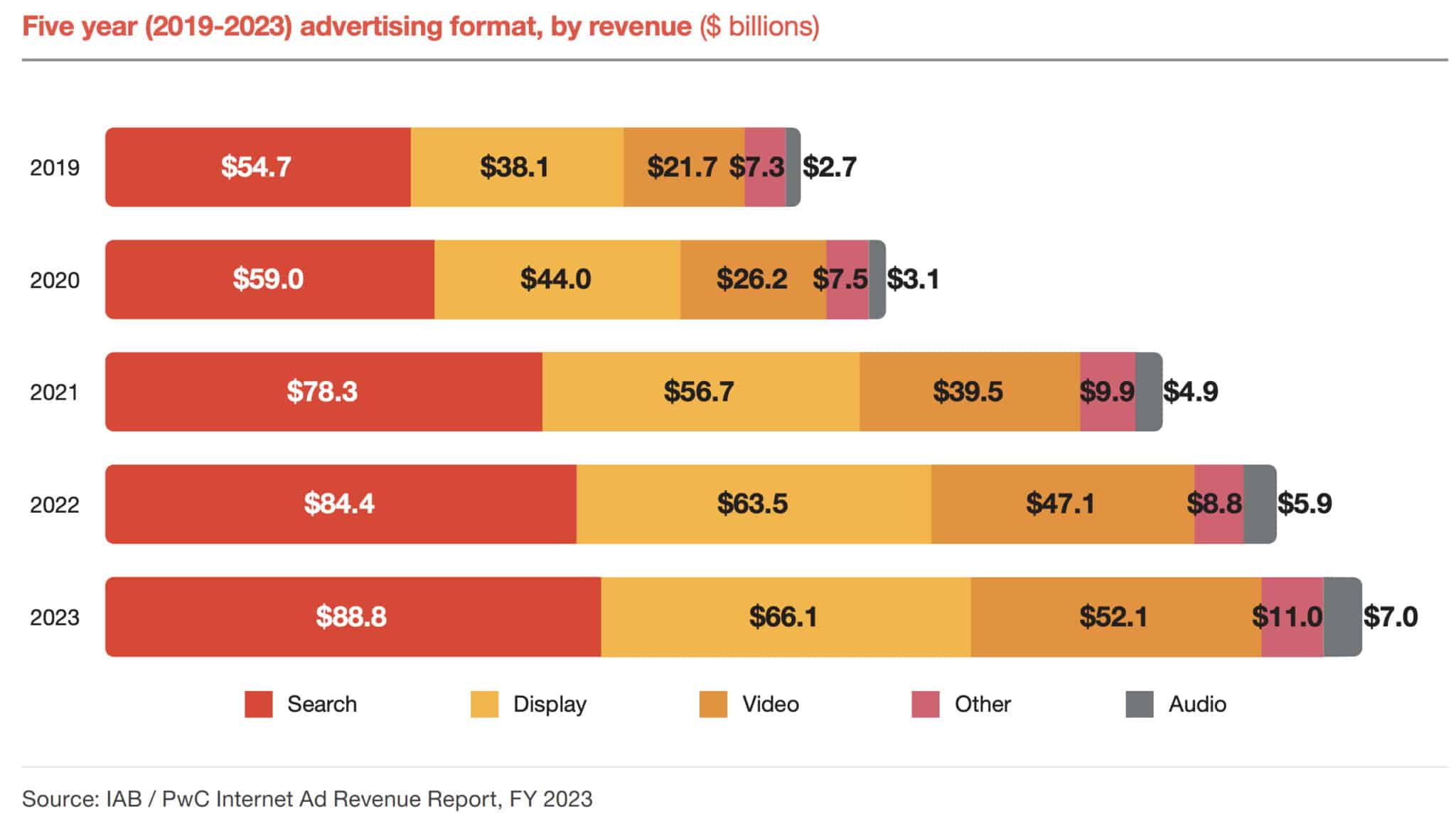
In total, search accounted for $88.8 billion of a record $225 billion in U.S. digital advertising revenues, according to the IAB Internet Advertising Revenue Report: Full Year 2023, conducted by PwC. That figure represents a $4.4 billion increase over 2022.
Why we care. Paid search becomes more expensive and challenging every year, with less transparency. But advertisers continue to embrace paid search for one simple reason: it drives results for brands and businesses.
Paid search is still king. Search continues to own the largest market share of advertising – 39.5%, but that is down from 40.2% in 2022, 41.4% in 2021 and 42.2% in 2020.
- But YoY growth for search advertising is slower than the digital industry as a whole and the majority of other ad formats, according to the report.
The state of digital advertising. Resilient. Advertising continued to grow in a time of high inflation, rising interest rates and job cuts, according to the report. Of note from the IAB report:
- Q4 had the highest growth rate – 12.3% – with revenues growing to $64.5 billion. In 2022 the growth rate for the quarter was 4.4%.
- Social media ad revenue rose 8.7% YoY to reach $64.9 billion in 2023, with much of that growth coming in the second half of the year.
- Video advertising accounted for $52.1 billion, or 23.2% of all advertising revenue, in 2023.
- Display advertising revenues remained high in 2023 – $66.1 billion – though YoY growth was 4%, down from 12% growth in 2022.
- Retail media networks saw a 16.3% increase in revenue YoY, reaching $43.7 billion.
2024 outlook. It’s “promising,” according to the IAB. Advertisers must, as always, adapt to changing consumer behaviors, consumption channels, privacy regulations and the ongoing generative AI revolution.
The report. You can read the report here (registration required).
Courtesy of Search Engine Land: News & Info About SEO, PPC, SEM, Search Engines & Search Marketing
Thursday, April 18th, 2024
The rise of AI content creation has been a game-changer – for better or worse.
On the one hand, you have benefits like:
- Improved efficiency.
- Powerful content ideation.
- Rapid research.
These efficiencies have allowed SEO programs to move faster and produced cost savings, added value and, in some cases, more revenue.
On the other hand, you have issues like:
- Generic content.
- Poorly written text.
- Ineffective content.
These drawbacks can lead to a bad user experience, lost rankings or deindexing from the search results.
As more and more people eagerly adopt AI content tools, it seems two schools of thought are emerging around how to use AI:
- AI enthusiasts believe that with the right tools, AI can crank out content ready to publish faster than you can say, “Google spam update.”
- Traditionalists argue that AI is a tool, and without the insight of a human writer, the content lacks the depth and expertise needed to succeed.
I fall into the second camp. However, AI tools are rapidly evolving, and some tout you don’t even need to edit the content to be ready to publish and rank.
They are more likely to mean “publish and not get caught” because if ranking were that easy, everyone would be No. 1. The risk is on you.
Next, let’s explore these two schools of thought around AI content creation.
The AI-only approach
While it’s true that AI tools are getting more sophisticated by the minute, that doesn’t mean we should act too soon.
Brands that acted hastily have experienced consequences – from embarrassing content that led to PR snafus (like MSN, Sports Illustrated and others) to being removed from the Google index in Google’s March 2024 updates.
While we don’t know which AI tools those sites relied on, we know it went badly for them.
Here’s a fun test: Go to ChatGPT and start the stopwatch timer on your phone. Copy and paste the following prompt:
- “Write an article that discusses “how to repair a broken light switch,” list several types of light switches, add some statistics about the usefulness of multi-way and dimmer light switches and add a one-question FAQ section.”
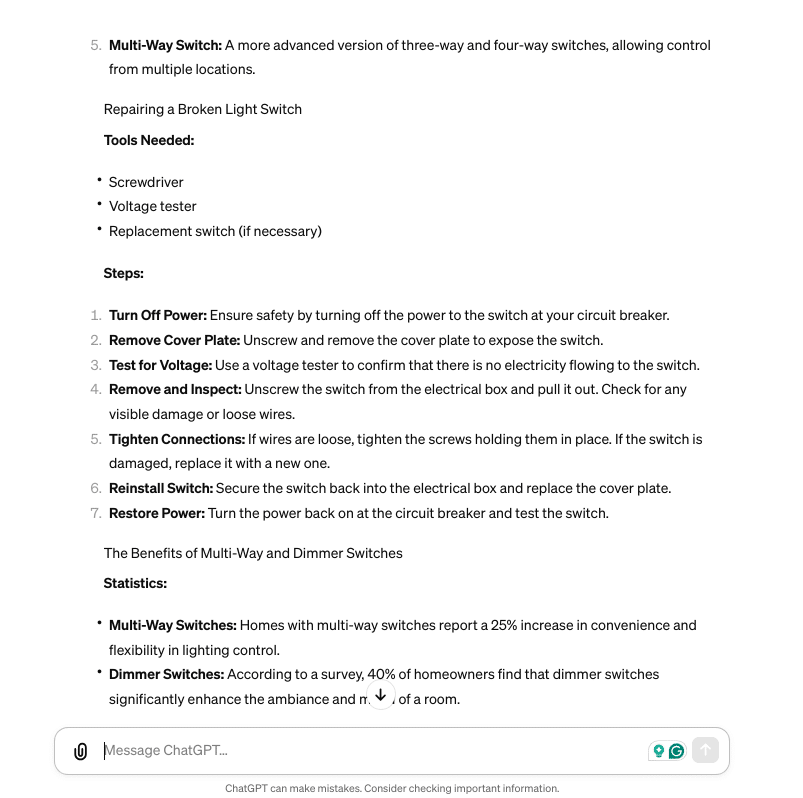 A portion of a ChatGPT-generated article on how to repair a broken light switch.
Took about a minute or less? Those who think they can earn top rankings out of millions of results with this approach to creating content with little to no human intervention will fail.
There are more sophisticated AI content tools out there. And many of them are intriguing. I question how many are just better at wording and are targets for a future Google trap.
We must be cautious about using these tools, regardless of how good they appear or their promises – until we figure out the best way to engage with them and prove they can withstand Google’s algorithms.
It’s no secret that Google’s March 2024 updates targeted websites abusing AI content.
My thoughts:
- AI tools can help create content but avoid violating Google’s spam policies. The content must include unique elements such as expert perspectives or personal experiences.
- When using AI tools, avoid merely stitching together information from search results without adding extra value.
- It’s acceptable to use AI tools to perform research, create unique outlines, provide content summaries and even give chunks of text to be edited (so long as you can fact-check its validity), but avoid plagiarism and generic content.
You’re playing with fire if you’re going “all in” on an AI content tool without a good process.
Dig deeper: AI for SEO content creation: 5 real-world examples
The collaborative approach
If you want content that can survive Google algorithms and offers something valuable to your readership, and you also want the efficiencies that AI can offer, you need:
- Professional writers and editors.
- The right AI tools.
- A good process.
It sounds simple – because it is!
Don’t completely remove writers and editors from your marketing projects. Instead, hire writers and editors who know how to use the right AI tools the right way (read: with discernment).
For example, AI tools helped with the following in the article you are reading right now:
- Brainstorming article titles (which ultimately weren’t used but helpful in getting the ideas flowing).
- A content outline (about 50% of the suggestions were considered and the rest was scrapped).
- Summarizing some of my previously published content into a list of ideas to edit or expand on.
So repeat this mantra: “Only the quality content survives,” and then follow these rules as you add AI tools to your content creation process:
- Produce user-centric, unique and valuable content that builds trust, authority and credibility in your niche.
- Focus on creating helpful, people-first content that addresses the needs of your audience.
- Ensure your content adds something unique to the conversation, avoiding a “copy/paste/reword” approach.
What does the collaborative process look like? I’ve written about this in my AI content creation beginner’s guide, and here are some tips:
Prework
Develop a solid process for prompting AI tools to generate content, including defining the persona, target audience, tone of voice and format of the content.
Content creation
In the content creation phase, use the AI tool to generate ideas, create outlines, do research, provide summaries, create intros and/or conclusions to be edited and, in some cases, create a first draft.
When I say first draft, I mean it’s a start. Without a doubt: Do not publish any AI content verbatim unless you want to risk a hit from Google’s spam policies.
Put in the work to make it unique to your brand, your perspective and differentiate it from what’s out there in some way.
Editing
Many times, the writing and editing processes happen at the same time. Regardless of when you do it, make sure that when you are creating the content, you do the following:
- If large parts of AI content are baked into the final piece, the editor must use an AI detector and/or plagiarism tool to ensure everything looks good. And then have them look again. When you use AI enough, you will recognize the phrases and wording common to an AI writer.
- Fact-check by making sure the statements, the data and anything else AI generates is factual and what the brand would get behind.
- Review the content for tone of voice synergy, grammar and adherence to brand guidelines.
All these things take time. So, you and your team must know if AI saves you time and money in the long run. If not, then maybe there’s a different way you should be using it.
The balancing act between automation and collaboration
Things will change – Google’s algorithms will change and strategies will change. So, the advice I’m sharing now is what I believe to be true for the foreseeable future.
However, a solid content strategy puts quality first, which will never change.
While AI tools offer efficiency in content creation, they are tools, not solutions. The key is integrating AI tools into the writer’s process, not replacing the writer.
Continue to provide value to your audience and adhere to Google’s guidelines to ensure your content stands the test of time.
Dig deeper: 7 reasons why your AI content sucks (and how to fix it)
Courtesy of Search Engine Land: News & Info About SEO, PPC, SEM, Search Engines & Search Marketing
Wednesday, April 17th, 2024
Google Search Console has released a security update around user permissions and controls management where you can better manage the ownership tokens. Ownership tokens are used for when people verify your site in Search Console, Merchant Center and other Google products and sometimes people who had access in the past to your profiles no longer should.
This update show make it easier to manage such access and remove those tokens and permissions when they are no longer needed.
What Google said. Google wrote:
We’re rolling out further improvements to Search Console’s user and permission management, incorporating capabilities related to unused ownership tokens management. Tokens are the codes used for website ownership verification in Search Console, Merchant Center, and other Google products. We have seen cases where these were accidentally left behind after owners have moved on. In February 2023, we rolled out improvements to the user and permissions management report. The latest changes will improve the accuracy and reflect the actual state of unused ownership tokens.
What it looks like. Int he user and permissions interface, under the “unused ownership tokens” you will see a screen like this where you can click “remove” to remove access to those ownership tokens:
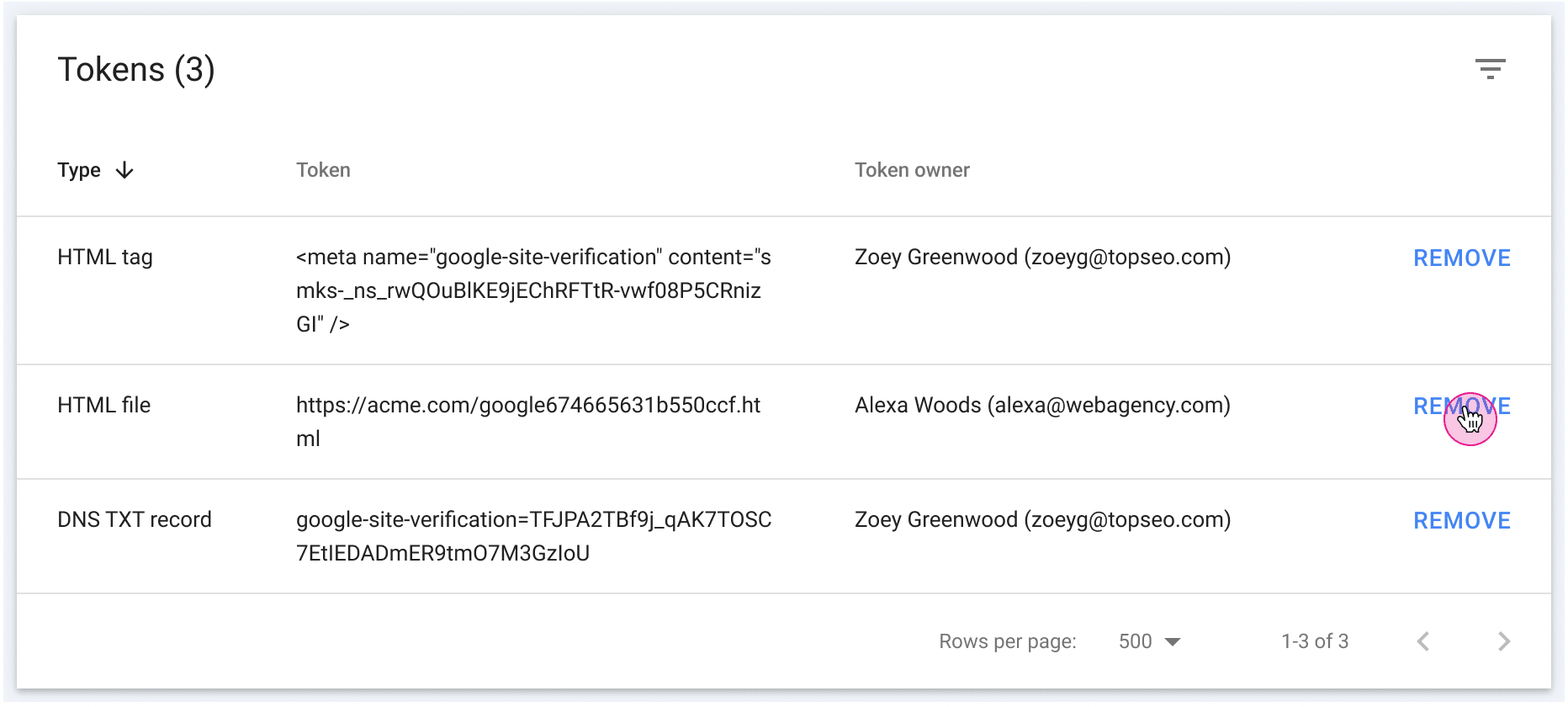
How it works. Here are the steps to take to manage these ownership tokens:
- Visit the Users and permissions interface
- Click “Unused ownership tokens”
- Choose the tokens you’d like to remove and click “Remove” (see screenshot below)
- Click “Verify removal” to get update for the unused ownership token
Why we care. It is always a good idea to ensure the right people have access to your data and Search Console properties and more importantly that the wrong people do not have access to it. As Nir Kalush from Google wrote, “The update rolled out today lets you verify the removal of the unused verification token so that removed owners cannot regain access to the property.”
So check your tokens and remove those who should not have access.
Courtesy of Search Engine Land: News & Info About SEO, PPC, SEM, Search Engines & Search Marketing
Wednesday, April 17th, 2024
The recent shift from “conversions” to “key events” in (GA4) represents a significant change that digital marketers, especially SEO professionals, need to understand and act on.
This article explores the implications of this change and insights on how to leverage it to elevate your marketing reporting.
Understanding key events in GA4
On March 21, I got an email from a former student who said he’d logged into Google Analytics 4 (GA4) that morning and saw, “Analytics conversions have been renamed key events.”
Google explained:
“To distinguish conversions in Google Analytics from those in Google Ads, Analytics conversions are now called key events. You don’t need to take any action on your existing setup. Key events are created and reported like previous conversions in Google Analytics.”
When he clicked the arrow for more information, he learned:
“Key events in Google Analytics measure the interactions most important to your business. For example, you could mark an important event like a purchase or newsletter subscription as a key event. This will appear as a key event metric in Analytics reports.”
And when he clicked on the next arrow, he saw a summary of the updates:
- “An event measures a specific behavioral interaction on your website or app.
- “A key event is an event that you mark as important to your business. Key events appear in Analytics reports but aren’t directly eligible for reporting or bidding in Google Ads.”
Since he’d taken my online course on GA4, my former student asked me, “How will the change to key events impact my metrics and reporting? And is there anything I need to be doing?”
I started thinking about all the other subtle name changes that Google engineers had made to Universal Analytics (UA), which had signaled significant paradigm shifts in GA4:
- UA used data based on sessions; GA4 uses data based on events.
- UA measured bounce rate; GA4 measures engagement rate.
- UA used cookies; GA4 uses modeling to estimate key events.
- UA let you set up to 20 goals; GA4 lets you mark up to 30 key events.
- UA provided data; GA4 automatically provides anomaly detection.
- UA reported what users did; GA4 generates predictive insights.
- UA used last-click attribution; GA4 uses data-driven attribution.
That’s when I realized that the shift from conversions to key events in GA4 is a game changer.
This is especially true for SEO specialists and managers who currently use website traffic from organic search to measure their results. But it is also the case for other marketing professionals, who could use website traffic from referral, organic social or other default channels to measure their contribution to the success of their company or clients.
What this change means for SEOs
So, let’s start with the impact that measuring key events can have on the career path of SEOs. Many SEOs use Search Console to measure organic search traffic. And who can blame them?
Organic search is responsible for 53% of all website traffic, while paid search is responsible for 15%, per a BrightEdge study. (This study included thousands of domains and tens of billions of sessions, though it excluded direct traffic.)
Unfortunately, providing “53% of all website traffic” doesn’t appear to be highly valued by the executives in the C-suite at more organizations that you can shake a stick at. If it were, then you’d see a lot more VPs of SEO, wouldn’t you?
So, what is highly valued by the C-suite? Well, it differs by organization. But most executives are focused on business objectives like “raise brand awareness,” “generate leads” or “drive online sales.”
That’s why Google added the Business Objectives collection to GA4 in June 2023. However, the latest shift from conversions to key events gives SEOs a new opportunity to measure what matters.
Aligning with business objectives
Before this latest shift, it was possible to measure “micro conversions.”
But the term “micro conversions” tended to remind their executives that these small steps fell short of “macro conversions,” which are the important interactions that directly impact the success of their business.
However, “key events” sound much more valuable than “micro conversions.” If you disagree, then ask yourself this question: Would you rather tell your executives that you will be providing “sushi” or “cold, dead, raw fish” at their next meeting?
Words matter.
So, if your chief marketing officer is focused on raising brand awareness at your B2C company, then you should start reporting how many organic search users go on to:
- Scroll to 90% of a blog post or article.
- Play at least 50% of a product video.
- Complete a tutorial.
If your chief revenue officer is focused on generating leads at your B2B company, then you should kick off a new set of reports on the number of organic search users who go on to:
- Download a white paper.
- Subscribe to a newsletter.
- Complete a registration form.
And if your chief executive officer is focused on driving online sales at your ecommerce, then you should begin reporting the percentage of organic search users who go on to:
- Begin the checkout process.
- Add merchandise to the shopping cart.
- Make a purchase.
This is particularly true if you can assign a default monetary value to a key event in GA4.
Assigning monetary value to key events
Now, purchase events already have value and currency parameters. But you can add the same parameters to any other key event. Just calculate the economic value of a key event based on how often the people who take this important action go on to become customers later.
For example, if 10% of the people who sign up for a newsletter go on to become customers and your average transaction is $500, then you can associate $50 (10% of $500) as the monetary value of this key event.
If you want to see this for yourself, then go to the Google Analytics demo account. Just click on the Google Analytics 4 property: Google Merchandise Store (web data) and then ask yourself this question: Would you rather tell your executives that organic search provided “27,657 users,” “42,596 key events” or “$61,370 in revenue” over the last 90 days?
I know the revenue number above looks like “small change,” but the most popular item purchased from the Google Merchandise Store in the last 90 days was a “Google Cloud Sticker,” which cost $1.25. So, you may provide your company or clients with significantly more economic value.
Get the daily newsletter search marketers rely on.
Adopting key events beyond SEO
SEOs aren’t the only ones who can adopt key events and revenue as key performance indicators (KPIs).
For example, if you scroll down the Google Merchandise Store data in GA4, then you’ll see the “referral” channel, which is an innovative way to measure digital PR, delivered 5,987 users, 12,260 key events and $10,210 in revenue over the last 90 days.
The “organic social” channel, which offers a new way to measure social media marketing, delivered 1,920 users, 4,952 key events and $5,797 in total revenue over the same period.
This brings us to direct traffic, also known as “dark traffic.”
Back in 2014, an “experiment” by Groupon found that up to 60% of “direct” traffic was actually organic search traffic.
In 2023, a large portion of traffic marked as “direct” in Google Analytics was likely sent by “dark social” networks like TikTok, Slack, Discord, Mastodon and WhatsApp, according to research by SparkToro. (Disclosure: I was one of about 100 experiment participants recruited to conduct this experiment.)
So, would it be a “career-damaging move” to ask an executive to discuss the probable sources of direct traffic?
Well, you know the “highest paid person’s opinion” in your office better than I do. But I’d bet dollars to donuts that he or she would welcome such a discussion – especially if it takes place before his or her next meeting with other members of the C-suite.
And while you will want to use your own data from GA4, here’s what the Google Analytics demo account will show you:
- The “direct” channel provided 75,788 users, 91,304 key events and $189,918 in revenue over the last 90 days.
- That makes it almost 2.5 times more valuable than the organic search, referral and organic social channels put together.
However, only a very small percentage of these users went to the home page of the Google Merchandise Store.
The overwhelming majority went to a wide variety of landing pages, including ones for stationery, new products, sale (clearance) items, men’s and unisex apparel and drinkware and bags (lifestyle) merchandise.
So, where did all these people discover the relatively long URLs for the plethora of landing pages?
Here’s my scientific, wild-ass guess: It was a two-step process.
- Step 1: A small group of opinion leaders discovered a page about a specific product using organic search, news articles or social media posts.
- Step 2: This small group copied and pasted links to these pages – along with their opinion of the product – in thousands of emails, text messages or Zoom chats to a larger group of their friends, family and colleagues.
And voila! You get a ton of so-called direct traffic to a wide variety of landing pages on the Google Merchandise Store’s website that’s hard to track directly.
Now, I didn’t make up this two-step flow model of communication. According to an article written by Monica Postelnicu and fact-checked by the editors of Encyclopedia Britannica:
“The two-step flow model was formulated in 1948 by Paul Lazarsfeld, Bernard Berelson and Hazel Gaudet in the book The People’s Choice, after research into voters’ decision-making processes during the 1940 U.S. presidential election.”
I think it offers a tested and validated model of what is probably happening today.
Test and prepare for imminent changes in search marketing
Even if you haven’t tested or validated it yet, it’s a fairly smart move to ask an executive to discuss the probable sources of direct traffic – especially if you also recommend conducting some tests using Google’s campaign URL builder tool, which enables you to easily add campaign parameters to URLs so you can measure your custom campaigns in GA4.
You should have this conversation and conduct these tests sooner, rather than later. Why?
Because a seismic change is coming in 2024 and those who can measure the quality as well as the quantity of organic search, referral and organic social traffic will be in a stronger position to survive – and thrive.
In an article entitled, “Google SGE a top threat to brand and product terms, study finds,” Danny Goodwin wrote:
“You should expect to see ‘some erosion of current traffic levels’ from brand-related terms as a result of Google’s Search Generative Experience, according to a new Authoritas analysis.”
So, how much erosion are we talking about?
Well, Authoritas found Google SGE displayed for 91.4% of all search queries. Another study by BrightEdge found 84% of search queries will include Generative AI when SGE is fully deployed by Google.
So, imagine that you’re living on the brink of the verge of the edge of the San Andreas Fault. You’d probably take some prudent precautions to prepare for the upcoming “searchquake.” And you’d almost certainly want to do more than hang your pictures with two nails instead of one.
The sooner you start measuring key events, the better. As Sun-Tzu observed, “In the midst of chaos, there is also opportunity.”
Courtesy of Search Engine Land: News & Info About SEO, PPC, SEM, Search Engines & Search Marketing
Wednesday, April 17th, 2024
Technology news rag The Verge has published a 700-word article half-filled with content generated by Google Gemini and a heavy dose of sarcasm that has been outranking more in-depth, well-researched and arguably more helpful content written by humans at publications for the competitive query [best printer 2024].
Sound familiar? It should. We wrote about this exact same thing just over a year ago in How The Verge gamed Google with its ‘best printer 2023’ article.
Why we care. Google has been telling us to write for people, not Google, a lot lately. This article will likely infuriate many brands who invest time and resources into researching products, with the hopes of ranking at the top of Google’s Search results. Others will point to this as proof that experience, expertise, authoritativeness and trustworthiness don’t matter.
Yet, the article ultimately does answer the question (“the best printer is still whatever random Brother laser printer that’s on sale”) – perhaps in the most ludicrous way possible.
The article. The title of The Verge’s April 2 article gives you a taste of what to expect: Best printer 2024, best printer for home use, office use, printing labels, printer for school, homework printer you are a printer we are all printers. SEO best practices? Not here.
Google Gemini. Last year, The Verge used ChatGPT to to generate half of its content. This year, that honor went to Google Gemini:
“Here’s what Google Gemini had to say when I asked it about Brother laser printers, which is not worth reading but which is by definition an incredible example of experience, expertise, authority, and trustworthiness because Google is synthesizing the entire web for this information, right? Isn’t that the whole idea of these LLMs, or are we just kind of fooling ourselves”
How it ranks on Google. I’m currently seeing the article in Position 2 (Chrome, incognito) on a search for [best printer 2024]. I’m seeing it in Position 1 (under SGE) when I’m logged in. Other have reported seeing it lower (Position 4 or lower).

Time will tell whether the ecosystem of content farms will do fake updates, as the Verge article put it, to push this article lower.
Google response. Google’s John Mueller was asked how articles like this rank so well on Google.
This is probably an accurate statement. We know from the antitrust trial documents and the testimony of Pandu Nayak that user interactions (e.g., clicks) play a huge role in what ranks and what doesn’t. And The Verge may be a tech rag, but it is an authoritative one.
Little changed in a year. The Verge’s Editor-in-Chief Nilay Patel told Search Engine Land a year ago:
- “The web is about to be overrun with AI-generated content explicitly designed to game the algorithms. Me doing this is the least of Google’s problems. At least I’m being honest,” Patel said.
It would have been more surprising to Patel if this article wasn’t ranking. That was the point – and the problem – Patel was pointing out then, and it remains true in 2024.
- “The architecture of the web is built to Google specifications,” Patel said. “Here’s the skeleton of every webpage and you put a bunch of stuff in there to prove you’re smart.”
Courtesy of Search Engine Land: News & Info About SEO, PPC, SEM, Search Engines & Search Marketing
Wednesday, April 17th, 2024

Some of the world’s most iconic search marketers — including Glenn Gabe, Brad Geddes, Lily Ray, Amy Hebdon, Jessica Bowman, and Bruce Clay — are now confirmed to speak at Search Engine Land’s SMX Advanced, online June 11-12… and you can learn from them, along with the thousands of marketers who have already signed up, for free.
The agenda is coming together beautifully, with tactical AI, SEO, and PPC sessions exploring everything from what you need to know about Google’s Search Generative Experience to a spirited debate about AI and automation in paid search.
Each day kicks off with an exclusive keynote, followed by tactic-rich sessions from search marketing experts…

The entire SMX Advanced program – including keynotes, sessions, Q&As, live demos, and interactive Coffee Talk meetups – will be available live and on-demand starting June 11 so you can train at your own pace.
It’s all free. No plane ticket. No expense report. No kidding.
I hope you’ll join me – and the nearly 200,000 search marketers who have relied on SMX since 2006 – for this once-a-year training experience.
Grab your free SMX Advanced pass now!
Courtesy of Search Engine Land: News & Info About SEO, PPC, SEM, Search Engines & Search Marketing
Tuesday, April 16th, 2024
Want to rank highly in 2024 and beyond? Then, you must create what Google calls “helpful, reliable, people-first content.”
In this article, I will outline a process that shows you exactly how to do that and provide a simple template you can fill out to take your content to the next level.
Spambusters
At the time of writing, Google is doing some major spring cleaning to tackle some of the spammy, low-quality content littering the search results.
Unsurprisingly, much content is developed from an SEO perspective. Google’s latest update is designed to help push down some of this SEO-first content and surface people-first content.
Our goal here should be to create well-optimized, people-first content. Any savvy marketer knows you build trust with your prospects by being helpful and sharing.
A people-first content process
Google has a help page that provides several questions you can use to review your existing content to ensure it is helpful, reliable and people-first. Unfortunately (and ironically), this page is not helpful when creating new content.
In addition, I have created a simple process we use at my agency for planning, writing and reviewing new content that is people-first and ticks all of Google’s qualitative boxes.
To simplify following the steps, here’s a simple template you can fill out as you work through the article. Grab a copy of this first.
People-first content: A writing process
What follows is a six-step process for creating SEO-friendly content that is people first.
As a side note, while Google is at war with low-quality generic content, don’t feel like you can’t use AI tools to help. Just ensure you use these generative AI tools as an SEO assistant rather than create the whole article for you.
Step 1: Goals
What is your goal for this content? How does this fit into your overall SEO strategy and SEO planning?
Creating a well-considered goal is essential. The goal is what you are aiming at. If you are off the mark here, you will miss the target despite your efforts.
To strengthen goals, follow a simple process called “The Five Whys.” State your initial goal, then ask “why” up to five times until you have strengthened and clearly articulated your goals.
Example
- Initial goal: Write a blog post about our eco-friendly kitchen products.
- Why? To improve our website’s ranking on Google.
- First analysis: I want to improve our website’s ranking on Google.
- Why? Because a higher ranking will lead to more organic traffic to our site.
- Second analysis: I want more organic traffic.
- Why? Because increased traffic can lead to more customer engagement and brand recognition.
- Third analysis: I want increased customer engagement and brand recognition.
- Why? This engagement will likely lead to higher sales and customer loyalty.
- Fourth analysis: I want higher sales and customer loyalty.
- Why? With increased sales and a loyal customer base, we can further our mission to promote sustainable living and make a larger positive environmental impact.
- Revised goal: Our objective is to create an informative blog post about eco-friendly kitchen products that educate users about kitchen sustainability. This will help us drive organic traffic to the site, increasing engagement and leads.
Action item
Outline your goals and refine them using The Five Whys technique. Incorporate SMART SEO goals to refine and articulate the objectives.
Step 2: Reframing for your audience
You know what you want, but Google does not care about your goals, only the satisfaction of its users. You must align your objectives with helping users while connecting them to your business and marketing mission.
To do this, you can employ “reframing.” Based on Ann Handley’s book “Everybody Writes,” it’s a tool for shifting perspectives and better serving our audience in marketing.
First, you should be clear on who your audience is. Google spells this out:
“Do you have an existing or intended audience for your business or site that would find the content useful if they came directly to you?”
Take your initial goal and look at this from your audience’s perspective. Ask, “So what?” and answer with “Because…” Do this exercise up to five times.
Example
Your goal: Our objective is to create an informative blog post about eco-friendly kitchen products to help generate leads for our sustainable kitchen products.
- So what? We all need to learn how to be sustainable in all areas of our lives to help prevent global warming and ensure the planet’s safety for future generations.
- So what? Learning about sustainability in the kitchen can help you reduce your environmental footprint, lead to healthier living and save money – good for you and good for your children.
Final goal: The article will provide a detailed look at how choosing eco-friendly kitchen products leads to a healthier lifestyle, cost savings and benefits for the planet. It encourages readers to make sustainable choices in their daily lives and shows them how to do that with our products.
Action item
Define your audience, query your goal, reframe it from the customer’s perspective and explain how it helps them. Fill it out in the supplied template. Ensure you can succinctly answer how this helps the reader.
Get the daily newsletter search marketers rely on.
Step 3: Demonstrate experience and expertise
The content you create should establish the author’s experience and expertise in a verifiable way. Google spells this out for us with the E-E-A-T and, more specifically, the requirement for “helpful, reliable, people-first content.”
What makes something reliable? Experience, expertise and credibility are good starting points.
Below are key points to remember based on Google’s documentation:
Experience
Your content should demonstrate first-hand experience and expertise. You should show a depth of knowledge by using a product or service or visiting a place. From a business perspective, you should clearly illustrate that you have experience.
Expertise
The content should demonstrate expertise or link to a page that does. For instance, if your business has accreditations, ensure they are visible on the site. If the author has specific expertise, ensure this is detailed on an author page.
Get your facts straight
Using data to illustrate your expertise is helpful, but ensure that any facts you use are 100% correct, referenced and do not contain unsubstantiated claims.
‘About us’ and author pages
Your site should feature “About us” and author pages that expand upon the credibility of the business and the individual authors. Link to these from your content. Google mentions these pages specifically, so give it what it wants.
Action item
In the people-first content template, fill out the four expertise boxes covering experience, expertise, fact-checking and about us and author pages.
Step 4: Aim high
You should aim to create unique content that is different or better than elsewhere. Your overall SEO strategy is important here, as you want a reason to stand out from the crowd, and that should flow through your content marketing.
Google provides us with 12 points to review content quality. However, we can summarize these into six points that you can use to guide your content creation.
Data and examples
Identify data and examples that support your article. Include these, and be sure to cite them correctly. Remember, people love stats and having something makes your content linkable (which is still crucially important).
Add something to the discussion
Look for areas where you can add something new to the discussion, such as new research, reporting or analysis. This does not have to be complicated. Run a short survey, but add something new to the discussion to add value to your article. In a nutshell, don’t just say the same thing as everyone else!
Use clear titles
Create clear, descriptive, accurate and non-sensational titles summarizing the content. You can still optimize but do so sensibly. Always prioritize people over SEO.
State your sources and add commentary
When referencing other sources, add value. Avoid just rewriting or restating; try to add a unique spin to what is already there. Use your experience and expertise to do so. You are an expert on this topic; your opinion and experience here matter.
Focus on quality and make it easy to share
Ensure the content is well produced. Use AI tools here to help if you wish. Don’t take every recommendation. Keep your voice in the piece. Aim for something of the same quality you expect in a newspaper or other printed media.
Action item
Fill out page four of the template. Don’t worry about finding something for each of these but try to ensure you bring something new.
Dig deeper: Mastering content quality: The ultimate guide
Step 5: Write
In some respects, this is the easy bit. Once you have completed the research steps above, you will know the angle from which you are coming. I recommend copying your overall goal at the top of your document so you can use that as your North Star!
The steps you take now will vary depending on your own writing style, but the key here is that planning sets up success.
My approach is something like this:
- Decide on the format (blog post, list, stats, etc.).
- Outline bullet points of the sections.
- Work on a very rough first draft (just write – don’t stop to edit).
- Walk away for a few hours, at least.
- Write the second draft.
- Walk away and sleep on it.
- Review using Google’s question list.
- Write the third draft.
- Editor review.
- Tweak and publish.
I often think the most important aspect here is to sleep on it. If you can and if, like me, you are fitting in writing around running your business, then it can make sense to do the big steps over different days.
- Day 1: Plan and bullet points
- Day 2: Rough first draft
- Day 3: Second draft
- Day 4: Third draft, edits and publish
A key element for me is the sleeping on it factor. When you are writing like this, you are often trying to solve a problem and your planning and first drafts get you so far.
But then, when you sleep on it, your subconscious starts to work through all those little bits that are not quite there yet.
Then, when you work on your second and third drafts, you will strengthen the article so much more (and it is much easier).
Dig deeper: 25 tips to optimize your content for people and search engines
Step 6: Review
At this stage, if you want to be absolutely certain you have nailed this, you can revisit Google’s Helpful Content help page to self-assess your content.
Having conducted the planning process, this should be orders of magnitude easier. Starting your content creation with planning and ending with a qualitative review will strengthen your approach and improve your results.
Page experience and SEO
One last point of importance: the content should be housed on a site that provides a solid page experience.
- Your web design and SEO should be dialed in.
- You should have green lights on your Core Web Vitals.
- Your site should run over HTTPS.
- You should not show too many ads (if any, should you be a business selling services).
These are the basics, but Google does have a help page if you wish to dive in further.
Crafting people-first content: A blueprint for SEO success
While there is a lot of change and doomsaying at the moment, content marketing with SEO is still a viable tactic for authentic experts who can help the target audience.
Google has articulated what they are looking for. By carefully reviewing the help pages on E-E-A-T and creating helpful content, we can build a process that ensures we are aiming at exactly what Google is aiming at (that is, real SEO that stands the test of time).
This dogged focus on the end user is truly what marketing is all about and why Google is such a big company. Getting into this mindset and making it the heart of your SEO philosophy will only improve your results.
Be sure to determine some simple SEO KPIs to measure your success and keep focused on creating content that helps you while helping your audience.
Courtesy of Search Engine Land: News & Info About SEO, PPC, SEM, Search Engines & Search Marketing
Tuesday, April 16th, 2024
Brand mentions are crucial in shaping brand presence and perception across the search universe. This article explores the growing relationship between brand mentions and their significance in developing share of search and boosting brand search.
We will also:
- Dive into the nuances of brand mentions.
- Examine how brand mentions impact search marketing, both on traditional and social search platforms.
- Discuss strategies for integrating brand mentions into a cohesive search marketing approach.
Understanding brand mentions
From publications to social channels, right through to search platforms, conversations about brands are happening across an increasing number of touchpoints.
Broadly speaking, brand mentions are any reference to a brand within digital content, encompassing a wide array of online interactions.
These mentions can be categorized into:
- Direct mentions.
- Indirect mentions.
Direct mentions
- These are clear references where the brand name is explicitly mentioned.
- Direct mentions are straightforward to track and measure, providing clear insights into brand visibility and audience engagement.
- Social Sentiment tools, such as Brand24 or Brandwatch, can be leveraged to monitor them.
Indirect mentions
- These may involve product names, services or content closely associated with the brand without explicitly naming it.
- These mentions require more sophisticated tracking methods but offer valuable insights into the broader brand landscape and still impact share-of-search.
Understanding the types of mentions is imperative to understanding their impact on brand search and share of search.
Developments in search volumes, as well as trends around brand terms and products, are signals we can turn to when reporting on the impact of direct/indirect mentions across channels.
Where brand mentions occur
Brand mentions can occur across numerous channels, each holding a unique audience and interaction style.
Social media
- Instagram, X, TikTok, Pinterest and Facebook are hotbeds for brand mentions, with users frequently discussing brands in posts, comments and stories.
- Brands that can manufacture these mentions through strategic activations around UGC campaigns, influencer marketing and owned content can effectively develop their share of search.
Blogs, news and articles
- Written content on blogs and news sites often includes brand mentions, either as the primary focus or within broader topics.
- Digital PR remains a fantastic way to achieve coverage within these online publications.
- Previously, the elusive “follow” link was the goal. Moving forward, brand mentions will become the desired goal.
Forums and discussion boards
- As Reddit and Quora gain prominence in search engine results, brands can leverage them for in-depth discussions on specific topics.
- Brand mentions on these platforms offer valuable insights, enhancing perception and awareness.
Online reviews and feedback platforms
- Sites like Yelp, Google Reviews and TripAdvisor feature direct customer feedback, making them invaluable for assessing brand sentiment.
- Such reviews can then be leveraged within our website content to showcase “trustworthiness.”
Understanding brand mentions across various touchpoints is crucial. It’s the initial step in using them within a comprehensive search strategy.
Monitoring and engaging with these mentions offer valuable insights into public perception and user needs.
Dig deeper: Why brand mentions are the future of backlinks
Get the daily newsletter search marketers rely on.
Brand mentions for SEO
The influence of brand mentions extends beyond name-dropping. They offer a crucial way for brands to shape their presence in SERP results across the search universe on both traditional and social search platforms.
Let’s look at the impact of brand mentions on search marketing.
Traditional search
For traditional search, the benefits of attaining and leveraging brand mentions are significant, albeit indirect.
I remember Carrie Rose from Rise at Seven discussing how brands can use mentions to expand their presence on SERPs in a 2023 conference talk. This remains relevant today.
Brands can leverage brand mentions across the channels we have discussed to begin dominating SERPs, ensuring their brand owns SERP real estate.
By associating brand names with relevant search terms and striving to generate mentions alongside these terms, it’s possible to:
- Increase visibility on social search platforms.
- Get featured in press articles often appearing at the top of search results.
- Gain exposure on forums that are becoming more prominent in search results.
This method ensures that brands are front and center for vital terms in the non-brand space – a huge SEO win.
Social search / search universe
When we shift our focus to the emerging search universe and social search platforms, brand mentions begin to take on a different form.
Brand mentions on social search platforms aim to boost brand awareness and fame, ultimately driving conversions, often through traditional SEO platforms.
Traditional search relies on us searching to show us relevant content. On social platforms, these handcuffs are removed.
Social algorithms look to provide relevant content to users upon their feed, typically related to previously engaged content.
In this case, social platforms could deliver the content featuring our brand mentions without a search, making social platforms an enticing prospect for brands.
Each platform has individual nuances that need to be considered. Ultimately, social search allows brands to blur the lines between demand generation content and demand capitalization content, something traditional search simply cannot replicate.
In the process, we can facilitate brand search and improve share of search – a win-win!
Dig deeper: Search, social and retail: The future of digital brand experiences
Brand mentions on traditional and social search platforms
Let’s explore some of the benefits of traditional and social search brand mentions.
Expanding reach
- Every mention serves as a digital beacon, a brand bat signal if you like, potentially reaching new audiences across these diverse platforms.
- These audiences may not have encountered the brand otherwise, broadening its reach beyond its existing community.
Building trust and authority
- In the eyes of consumers, frequent mentions by reputable sources can elevate a brand’s status, lending it credibility and authority. This perceived authority makes the brand more visible and attractive to potential customers.
- In traditional SEO, this arises from coverage in press and publications. For social search, it is more likely to arise from user-generated content (UGC) or a community’s favorite content creators.
Driving engagement and conversations
- Brand mentions can spark discussions and engagement, increasing visibility in public forums, social media or comment sections.
- They keep the brand at the forefront of relevant discussions, enhancing its presence online. This can be manufactured to move people to a landing page as part of this discussion or conversation.
How to integrate brand mentions into a strategy
Brand mentions will likely occur naturally, but relying on this is insufficient. Instead, you can manufacture your search strategies with “achieving brand mentions” as a key consideration. This involves consistent monitoring and analysis of your brand mentions.
Adopt processes and tools to monitor such mentions across platforms so you can assess their impact on visibility, brand search trends and share of search. This should be the foundational piece of your puzzle.
From here, actively engage with your brand mentions, especially on social search platforms. Respond to reviews, participate in conversations and contribute to discussions, as these will amplify the impacts and effects of your activations.
Crafting a content strategy to boost brand search and enhance share of search is crucial, especially if you’re seeing a shift toward social search destinations among your audiences.
To drive better brand mentions and long-term value, consider:
- Using outreach and digital PR.
- Creating shareable content.
- Activating creator-led content.
- Leveraging UGC.
- Participating in emerging trends.
This strategic approach to leveraging brand mentions enhances organic visibility, enabling you to secure a prominent place in the search universe.
Driving brand mentions across the search universe
By strategically fostering brand mentions, you can command a considerable share of search, marking your territory in the evolving search universe.
Integrating brand mentions into a cohesive search marketing strategy requires a proactive and creative approach – monitoring, engaging with and cultivating organic mentions are foundational steps.
To truly capitalize on brand mentions, you must also craft resonant content, collaborate with influential voices and participate in digital trends that elevate your presence beyond traditional search.
By embracing a search-everywhere approach, you can harness the full spectrum of opportunities brand mentions offer.
Courtesy of Search Engine Land: News & Info About SEO, PPC, SEM, Search Engines & Search Marketing
Friday, April 12th, 2024
JPMorgan Chase launched Chase Media Solutions, a new digital media business. It’s the first bank-led media platform, allowing advertisers to send relevant promotions to some 80 million financial customers.
Chase acquired transaction-based digital advertising platform Figg in 2022 — a key component in Chase’s two-sided commerce platform. Chase Media Solutions was announced April 3.
Why we care. Over the last several years, many retailers have grown new revenue streams by setting up retail media networks (RMNs) for advertisers. RMNs are attractive to advertisers because they can send targeted ads based on the retailers’ deep knowledge of their customers, especially loyalty customers.
Data. Chase’s advantage is transactional first-party data, which allows brands and agencies to target based on purchase history. RMNs have that data too, but only within their specific stores and owned channels. Chase customers have purchase histories across retailers and other businesses they buy from.
Non-retail media platform. “Our deep understanding of consumer spending across categories has driven us to reimagine what retail media networks can offer,” said Rich Muhlstock, President of Chase Media Solutions, in a release.
- “Like retailers, we have first-party data and a dedicated audience. But what sets us apart is the unrivaled scale and insights from our customers – having long-served as a trusted guide for their financial decisions. Chase reaches across brands, merchants and shopping verticals, providing a comprehensive view of purchase behavior; this strengthens the degree of personalization, helping brands deliver offers that stoke consumer interests,” Muhlstock said.
Dig deeper: 2024 Predictions: Retail media networks
Early adopters. Pilot partners include Air Canada, Solo Stove, Blue Bottle and Whataburger, all of which ran 30-day campaigns through Chase Media Solutions.
- “The Chase team succeeded in creating a thoughtful, targeted offer that exceeded our expectations,” said Scott O’Leary, vice president of loyalty and product for Air Canada, in a release. “Two distinct offer constructs drove incremental revenue and awareness for Air Canada amongst Chase’s cardmember base. These tests clearly demonstrated the potential of the Chase Media Solutions channel, and we look forward to working together more in the future.”
Courtesy of Search Engine Land: News & Info About SEO, PPC, SEM, Search Engines & Search Marketing