Archive for the ‘seo news’ Category
Friday, May 10th, 2024
Experimentation is an underutilized tool in content strategy for SEO.
Traditionally, we create content based on research and theory, wait months to see how it ranks, then iterate if needed – an ongoing cycle.
However, the rise of social search platforms presents an opportunity to accelerate this process.
Social search allows users to discover content through social interactions rather than just keyword searches.
By leveraging real-time data, trends and user-generated content on these platforms, SEOs can test and refine content much faster than waiting for traditional ranking signals.
Embracing a “search everywhere” approach powered by social data can help find optimized content solutions sooner.
This article explores how integrating social search insights can enable more efficient content testing, optimization and on-site enhancements.
Understanding social search
Social search continues to be a key driving force behind the evolution of search marketing.
Within a search everywhere strategy, social platforms offer a unique avenue for users to discover content through social interactions rather than traditional keyword-based searches.
Unlike conventional search engines, which primarily rely on algorithms to rank and display results, social search platforms leverage content creators, user-generated content (UGC), brand communities and engagement metrics to surface relevant information, providing a more personalized approach to search that resonates with younger audiences.
The significance of social search lies in its ability to reflect real-time user behaviors, trends, interests and preferences. By tapping into the collective wisdom of online communities, these platforms provide invaluable insights into trending topics, user sentiments and emerging discussions.
When we partner this with our traditional search efforts, understanding and harnessing the power of social search can unlock new opportunities for content discovery, audience engagement and more efficient content optimization.
Social-led search content testing
Where algorithms continuously evolve and user preferences shift, iterative content testing emerges as a crucial strategy for achieving sustained success.
Content testing lets search marketers try various strategies, formats and messages to find what connects best with their audience. While not a new concept, social search accelerates the process of gaining insights compared to traditional methods.
By systematically testing and refining content elements such as headlines, keywords and calls to action, strategists can optimize their content for maximum impact, driving higher visibility, engagement and conversions – both on social search platforms and traditional search, essentially unifying the search universe.
Social search platforms are excellent for quick content testing due to their real-time nature, large user base, and varied engagement metrics. Unlike traditional methods, which can take weeks or months, social search gives instant feedback.
The interactive nature of social search platforms lets you engage directly with your audience to understand their preferences and concerns. Social interactions like comments and shares help gauge content effectiveness early on before Google ranks it on a SERP.
Below are practical ways to deploy iterative social search content testing:
Polls and surveys
- Social search platforms have tools for polls and surveys, helping you gather data on audience preferences and behaviors.
- Asking specific questions about content topics or formats lets you understand audience sentiment and adjust your strategy.
- This technique is essential in establishing FAQ-type queries that can surround my content on a particular topic.
Question-based posts
- Crafting question-based posts encourages audience engagement and fosters meaningful discussions around specific topics or pain points.
- Gathering feedback from the community helps you find valuable insights and improve content.
- These insights should then be mapped to keywords/clusters to assist in understanding what content solutions need to be included as H2s/H3s within content.
Analyzing engagement metrics
- Looking at likes, shares and comments gives you a better understanding of how your content is doing and what people think about it.
- Tracking these metrics allows you to spot trends and improvement areas, quickly refine strategies, learn from failures and find success faster.
- If a post doesn’t do well on social search, it’s a sign we may need to adjust it for traditional search, too.
Dig deeper: How to turn polls and surveys into great content
Get the daily newsletter search marketers rely on.
Integrating social search insights into on-site optimization
In search marketing, engaging users and being relevant are crucial. Include social search insights in on-site optimization, especially if your brand targets younger audiences who use social search in their search process. Social search platforms provide lots of up-to-date data, including UGC, which gives valuable insights into what audiences like and do.
Let’s discuss the areas directly affected by this approach to testing and improving content.
Content development and keyword targeting
- Social search and forum platforms are rich sources of user-generated content that can guide content creation and keyword strategies.
- By tracking trends and popular topics, you can find relevant keywords and themes more effectively than through traditional keyword research.
- Analyzing social engagement helps refine content creation by showing what resonates with the audience. If something doesn’t work, it can be adjusted and tested again easily.
User experience enhancements
- Insights from social search can help improve user experience on websites, like navigation and design.
- By knowing how users interact with content on social platforms, you can adjust on-site elements to match their preferences.
- For instance, if social search suggests people like visuals or shorter content, you can update how and where you present content on the website.
Dig deeper: The SEO-UX paradox: Achieving visibility without sacrificing user delight
Link building and internal linking strategies
- Social search platforms can affect how you build links and connect content internally by helping you find authoritative sources, influencers and relevant content online.
- By engaging with these connections, you can get valuable backlinks and boost the visibility of your content.
- Also, using social search insights in your internal linking strategy improves how easily users find content on your site.
- For instance, if users often go to page X after reading content piece A on social search, we can link to page X within content piece A on our site.
Practical techniques for a more seamless social search integration
Using social listening tools helps track brand mentions, trends, and audience sentiment on social platforms. This information guides on-site optimization and content creation.
Sharing on-site content on social media and vice versa boosts visibility and promotes a holistic search marketing approach. Creating shareable content for social platforms and engaging with communities drives traffic to our site, building authority and trust.
Analyzing on-site and social engagement metrics shows how content is performing and guides optimization efforts for ongoing success in a search-focused strategy.
How we can maximize the search optimization process
Search marketing is an ongoing process of improvement, adapting to changes in search engines, user behavior and market trends. We must continually refine our strategies to stay ahead and make the most impact.
This means regularly adjusting keyword targeting, content, technical setup, and links. By tracking metrics, analyzing data and adjusting tactics, we can improve website visibility, traffic and conversions.
The feedback loop
Silos must go. This collaborative process between search and social marketers could assist brands in aligning teams.
Continuous optimization relies on a feedback loop between social search insights and on-site efforts. This involves collaboration between social and search teams.
Social platforms provide valuable data for on-site strategies. SEOs can learn about user preferences by listening to feedback, monitoring trends, and analyzing metrics.
This helps inform content, keywords, user experience and links on-site. Integrating social insights into optimization keeps websites relevant and competitive in social-first search marketing.
Dig deeper: Search universe analysis: A deep dive
Accelerating SEO success with social search insights
In today’s democratized search landscape, integrating social search insights is vital for maximizing on-site optimization and SEO success.
Embracing social search unlocks new avenues for content discovery, engagement and conversions.
As we enter the “search everywhere” era, harnessing the power of social data will separate optimization leaders from laggards. Those who effectively leverage these insights will accelerate SEO wins and shape the future of search marketing success.
Courtesy of Search Engine Land: News & Info About SEO, PPC, SEM, Search Engines & Search Marketing
Thursday, May 9th, 2024
Some Meta advertisers received an alert yesterday when they opened their accounts. A source from Meta confirmed this alert was sent in error.
What was announced? The message said setting new detailed targeting exclusions would no longer be possible when creating campaigns after June 28.
- Existing exclusions would remain unless ad set targeting is modified.
- Exclusions based on brand suitability and employment will still be allowed at the account level across all campaigns.
However, this alert was an error, Meta confirmed to Search Engine Land.
Why we care. Getting alerts about functionalities that advertisers rely on can be destabilizing. If false alerts like these keep showing – how should advertisers trust the alerts we see?
Concerns from advertisers. Dario Zannoni, who got this alert, shared the information with his followers:
- “By using targeting exclusions in combination with the other targeting options, it was possible to not only exclude interests for brand protection but also to create well-curated Audiences that are aligned with the specific product or service.”
Get the daily newsletter search marketers rely on.
Search Engine Land contributor Navah Hopkins was also not happy to hear that is was coming:
- “I’m pretty devastated by the news that Meta is removing audience exclusions for all campaigns in June 28, 2024.
- One of the reasons audience exclusions were really impactful is they enabled us to be very specific about who we were going after. Beyond the flexibility of “or” and “and” audience statements, they ensured we could really fine-tune our messaging.”
Courtesy of Search Engine Land: News & Info About SEO, PPC, SEM, Search Engines & Search Marketing
Thursday, May 9th, 2024
The new buzzword in SEO is information gain. And like all new buzzwords, SEOs are throwing it around like we’ve just discovered fire.
But there’s a massive problem.
Information gain means different things to different people.
In this article, you’ll learn about information gain and how to use it to your advantage.
The 3 schools of information gain: Humans, machines and search engines
Information gain can be used in three topics:
- Machine learning.
- Google Patent.
- Information foraging theory.
Information gain is used to train decision trees in machine learning. And unless you are a computer programmer, we can largely leave that can of worms unopened (for now).
When SEOs talk about information gain, they mainly refer to the Google patent.
Google was granted a patent in 2022 regarding an information gain score that applied to documents.
This patent showed that Google had developed a way to measure the “sameness” of content and either promote or demote it accordingly.
This is a great way for Google to deal with content that is essentially unoriginal or simply copied from another source and reworded.
But what about information gain in relation to the information foraging theory?
Information foraging theory was documented in the book of the same name, written by Peter Pirolli.
It applies the models of how animals search for food (optimal foraging theory) to how humans search for information (which we’ll talk about later).
As you can see, we have three different meanings for the same term.
With regards to SEO, the Google patent is mainly easy to understand – just make your content unique.
However, information foraging is more complex, so we need to examine it more thoroughly.
Why information foraging matters for SEO
Recently, Google started discussing information foraging theory in their decoding decisions report (the messy middle).
Indeed, information foraging theory seems to be the direction Google is heading, and to quote their report directly:
“An explosion in product choice and information has made it harder to feel confident about making the right decision.”
Or, to put it another way, there’s just too much information out there.
If we have too much information, the time to make a purchase decision is increased, and this isn’t good for anyone.
You can see why Google SGE might help things if you think about this.
By providing a generative AI response to a search query, a search user immediately grasps the subject without needing to click a website.
This initial information should help a user to make their next search decision.
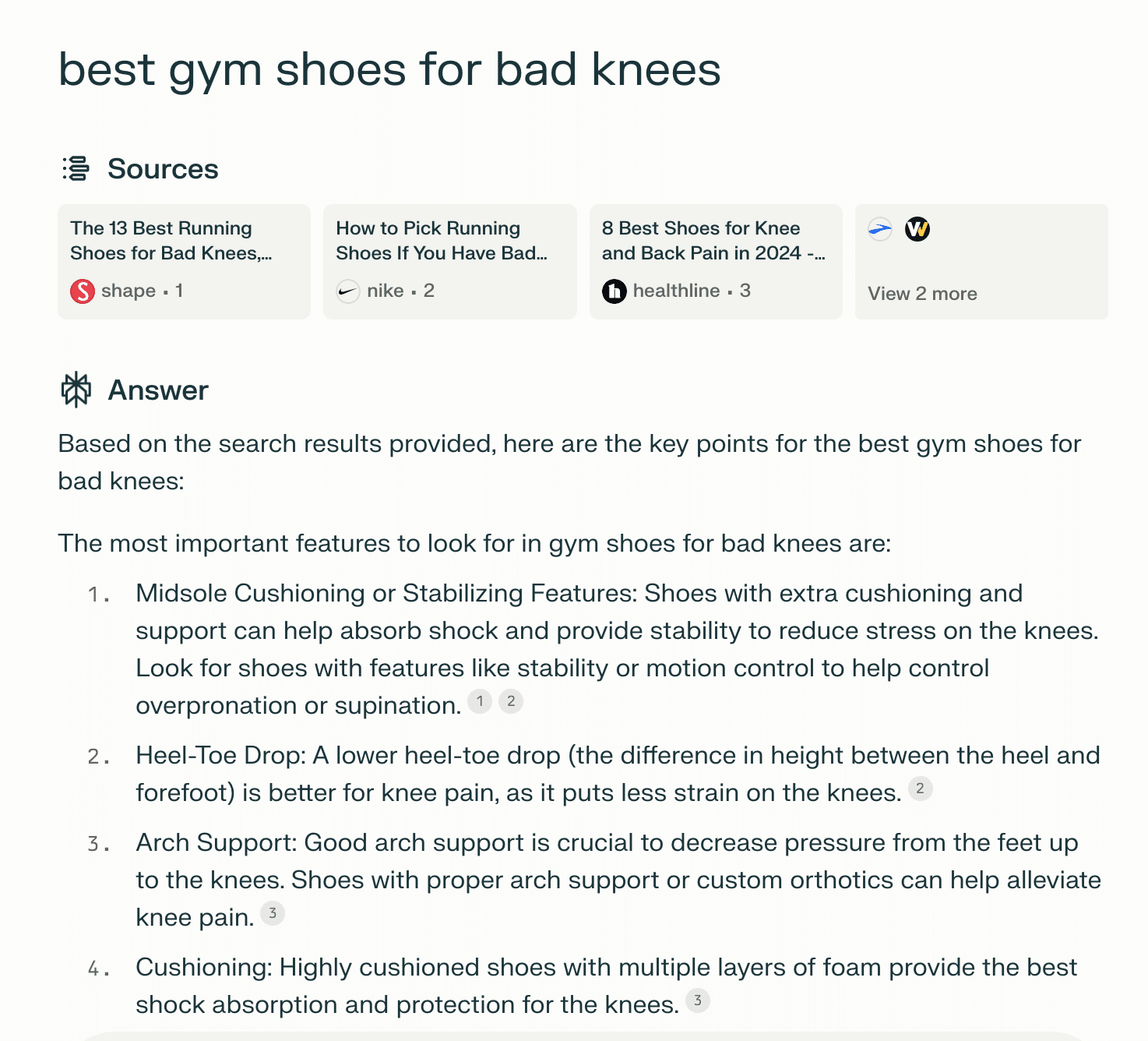
Take this result from a search in Perplexity.
Within seconds, my knowledge of the best gym shoes for bad knees has increased, and there are many links and suggestions.
My next click will be to look at the suggested shoes, not to read another five blog articles.
If SGE works similarly, you can see how it will radically change commerce.
We’re no longer optimizing for Google. We’re optimizing for AI.
Dig deeper: LLM optimization: Can you influence generative AI outputs?
Get the daily newsletter search marketers rely on.
From SEO to information gain optimization
Google has been involved in AI for a long time, and AI is part of many of its systems.
They used BERT to improve their understanding of language, and I’m sure many more systems are in use.
The point is that Google is trying to understand content to serve search engine users better. Therefore, Google itself is reading your content.
Sure, not like a human does, but they are reading it.
So, it makes sense to apply a similar approach to increase Google’s information gain from content, just like humans.
In essence, we become information optimizers.
Our job as SEOs is to continually increase the rate of information gain.
The rate of gain, explained
Information gain rate, when it comes to information foraging theory, is described as:
- Rate of gain = Information value / Cost associated with obtaining that information
You see, while search engines carry a cost for indexing and retrieving documents, so do humans.
When we use our brains, we consume calories, and the body is highly efficient at not wasting them.
We use heuristics (mental shortcuts) to filter the world and make decisions.
Information foraging theory suggests that we seek to do the same. We attempt to gain as much information as possible from a source in as little time as possible.
To do this, we go through a five-stage process.
Goal
- What information do we need?
Patch
- We decide on what source of information would best deliver our goal. This could mean that we go to Tripadvisor, TikTok, YouTube or any website/ search engine that comes to mind.
Forage
- Here, we search for the information we need on the platform of choice. For this example, we’ll stick with Google. You type into the search engine keywords to try and find the information you need.
Scent
- When we head to search engines, we’re looking for the scent of good information sources; signals such as reviews, higher rankings and page titles that encourage clicks.
- We click on sites, scan information and decide whether to invest time reading the resource.
Diet
- We consume information from multiple sources before making decisions. This is what Google refers to as the messy middle of search.
- For brands/ sites, being part of your consumers’ information diet increases the propensity that they will come to depend on you for information and trust you.
As we know, that trust leads to purchases or increased clicks (which can lead to advertising/ affiliate revenue). So this means that SEO should include optimizing around information scent.
But if you’ve read the above, you can see that Google search works similarly, just a machine version.
Information optimization: The new science
If we’re going to optimize around information gain, we need to understand that it requires a greater understanding of two factors:
- Machine learning.
- Human learning.
We already know that Google wants original, experience-based information from the best sources.
They also want to reduce the cost of extracting that information.
Yes, Google wants an easy life. So, how do we do this on a practical level?
Simply put, we make extracting information easier for both machines and humans (at the same time), and here’s how.
The optimal website maximizes the value gained per interaction
Contrary to what many think, fast websites might matter, but if the information gain rate from a website is low or has a high perceived cost, then the person will leave.
Here’s an example.
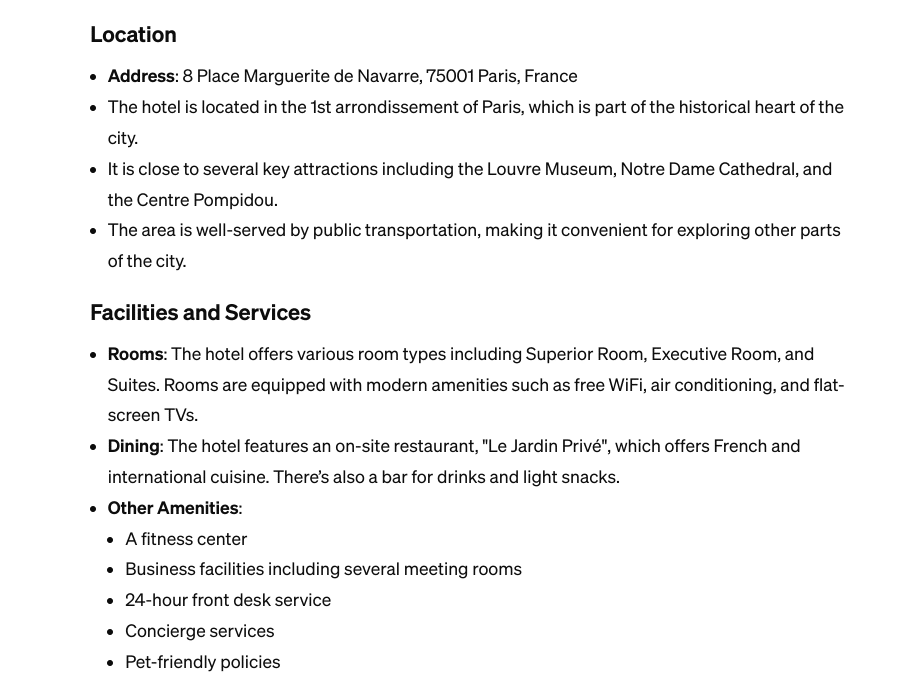
I’ve asked ChatGPT for some information about a hotel in Paris. It gives me the information the best way it can.
It gives a lot of information I can easily extract at a low cognitive cost. But how should a website deal with this?
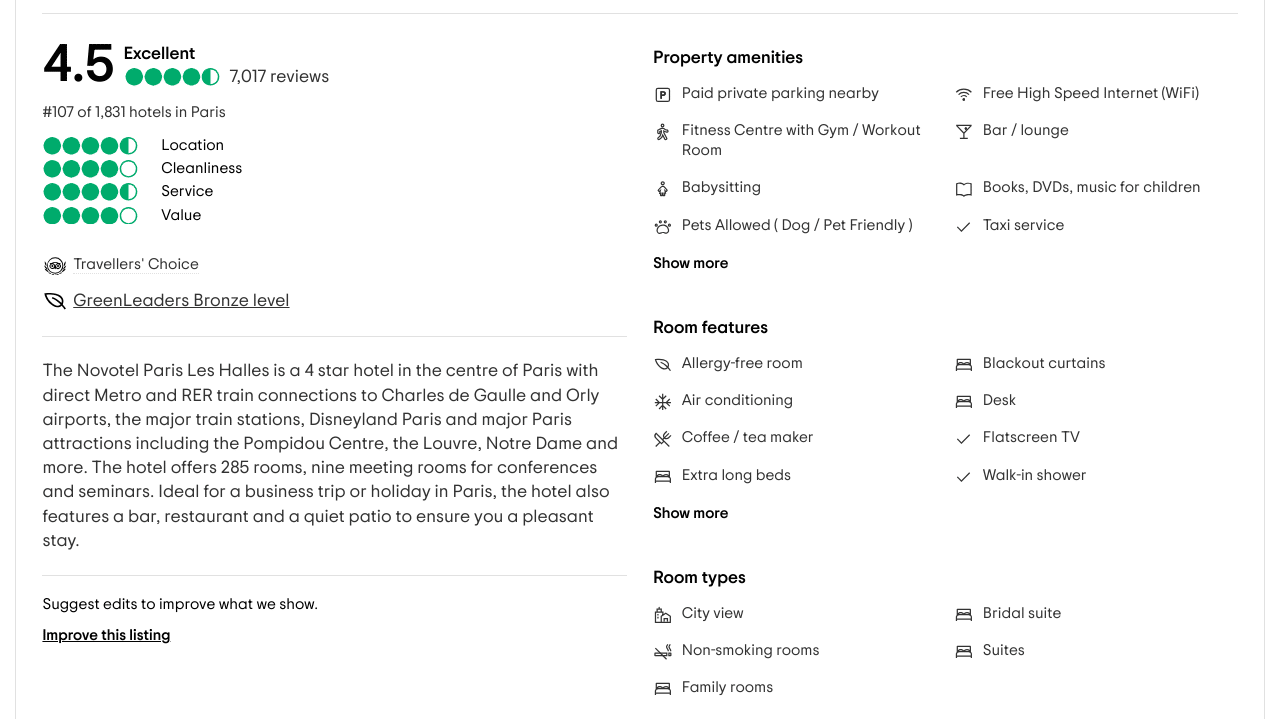
Tripadvisor has a whole page dedicated to the hotel. Look at how they’ve optimized one section for information gain rate.
The content – which uses symbols, scorecards and lists room types – is designed for humans (and machines) to gain the most information in the least time/cost.
And it’s this that we have to get our heads around to help search users.
But we need to destroy some myths around content.
Good content is context-based
I read a lot of good content, but most of it’s in my inbox in the form of blogs people have written that are not designed to gain traction from search.
Good content for SEO is wildly different.
When we search online, we have an emotional need state that requires solving.
Kantar and Google did some research a while ago.
In this study, the above need states were used by searchers, who came to search engines looking for them to be resolved.
Some words that stand out across from each need state are:
- Quick.
- Laser focused.
- Specific phrases.
- To the point.
- Simplicity.
- Uncomplicated.
- Trust.
- Ratings.
- Reviews.
- Competence.
- Location.
It’s these attributes in information that search users look for in content online.
Strikingly, we can see how Tripadvisor’s content displays these attributes, and we can also see how applying them to content would increase the information gain rate for humans and machines.
But how can we start to take the approach of information optimization to content?
Well, here’s a four-part process to get you started.
Part 1: Content structure
Look at how your page should be structured for search to increase the information gain rate.
A good example is the Tui website:
They’ve used faceted search “buttons” to help users find what they are looking for.
Consider how best to design your page for humans and search engines to increase the information gain.
UX matters, as does the information on the page.
Part 2: Information architecture
Consider how you want your information to be structured for maximum information gain.
You might consider giving information early and quickly, for example:
“When is the best time to travel to Jamaica?”
“March is the best time to travel to Jamaica.”
Look at your content and aim to add some, if not all, of the following attributes.
- Quick adventure.
- Laser focused.
- Specific phrases.
- To the point.
- Simplicity.
- Uncomplicated.
- Trust.
- Ratings.
- Reviews.
- Competence.
Part 3: Content design
The last impact is the design of the content.
Consider how best to add value, such as using unique images to your posts to help explain information or data.
Backlinko uses images like the above to convey data in an interesting format.
This leads us to the final part.
Part 4: Content difference
If you do all of the above, you should have content that is very different from what already exists.
But if you don’t, ensure that you do.
There are 1,000 different ways to say the same thing, but it requires creativity and consideration about how best to display your unique angles and viewpoints around this.
But here’s a little challenge.
Head to a site like Backlinko or HubSpot and look at their content.
Find an article and apply the above four-part system, and think about how you would improve it based on your unique views or experience.
This could serve as a suitable workshop for agencies and in-house staff to consider the information gain and how best to apply it.
Because in the era of generative content, information gain is king.
Courtesy of Search Engine Land: News & Info About SEO, PPC, SEM, Search Engines & Search Marketing
Thursday, May 9th, 2024
The number of Google Search queries without SGE increased last month from 25% to 65%. This is a surprisingly big drop, especially considering rumors that SGE could launch ahead of, or during, Google I/O next week.
Search results without SGE increase. Why did this happen, starting in mid-April? The reduction of SGE can be traced to Google’s Opt-in results type (when users must request an AI-generated answer).
This screenshot shows the data from enterprise SEO platform BrightEdge and the company’s BrightEdge Generative Parser:
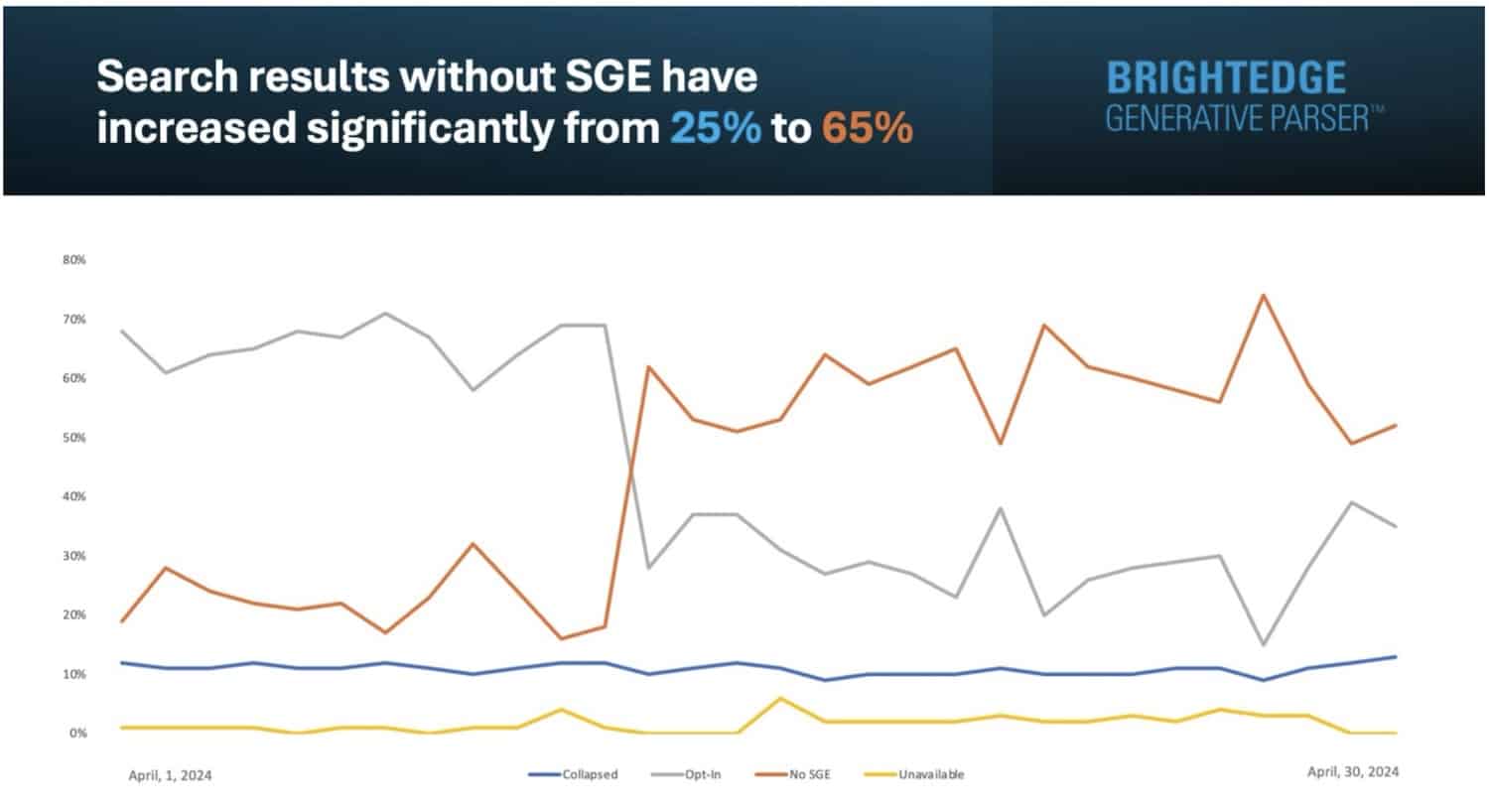
Why we care. Many SEOs have been worried about the day Google SGE moves from being an opt-in experiment to the default experience because of the potentially devastating impact it could have on how much organic traffic Google sends to websites. But it seems like Google has been cautiously and patiently testing a variety of factors over the past year, all with the goal of improving it for a wider launch.
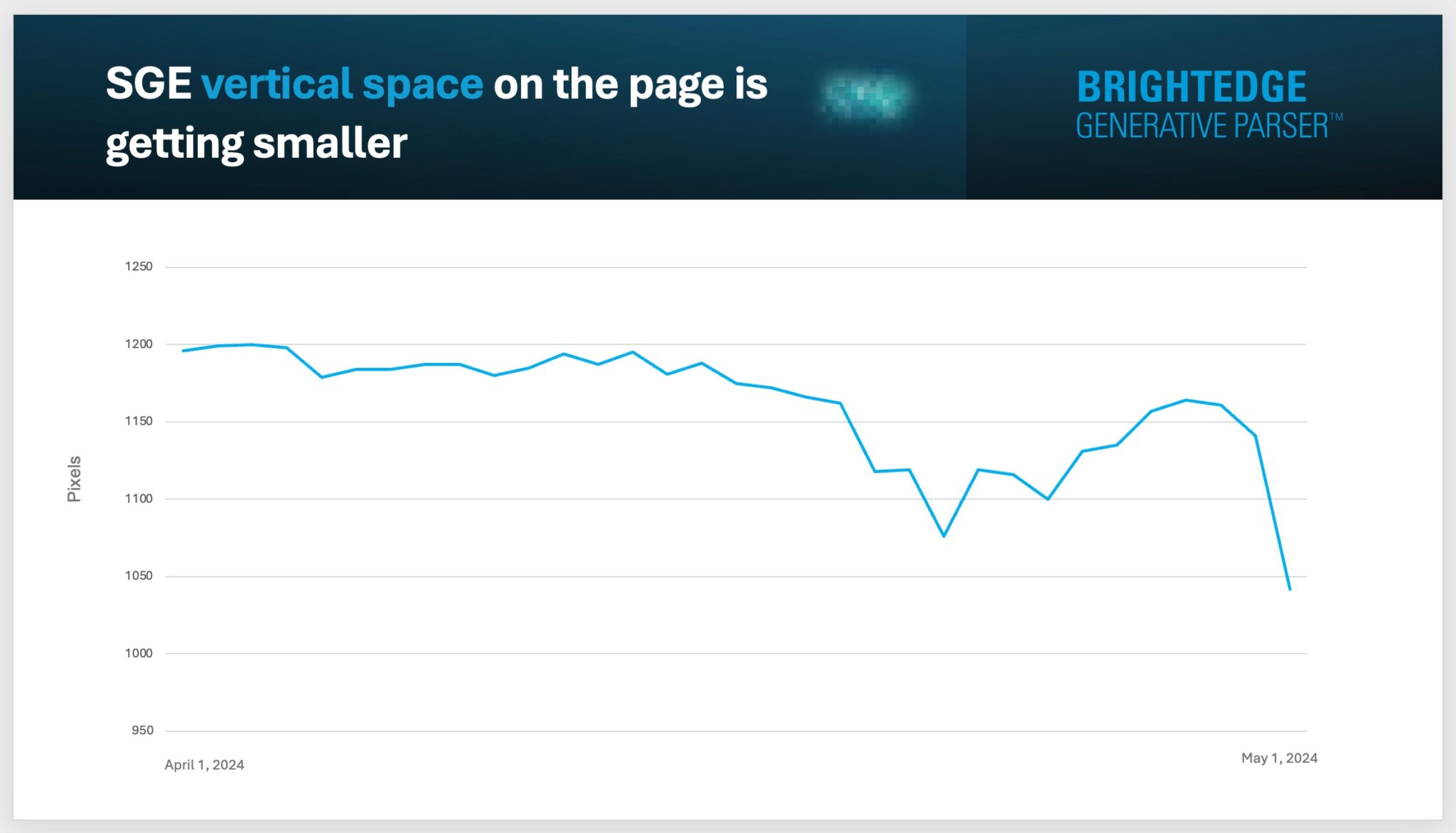
SGE vertical space shrinking. In addition to SGE showing on less queries, the amount of space SGE occupies has been getting smaller over the past month. Here’s a screenshot showing SGE dropping from around 1200 pixels to under 1050 pixels:
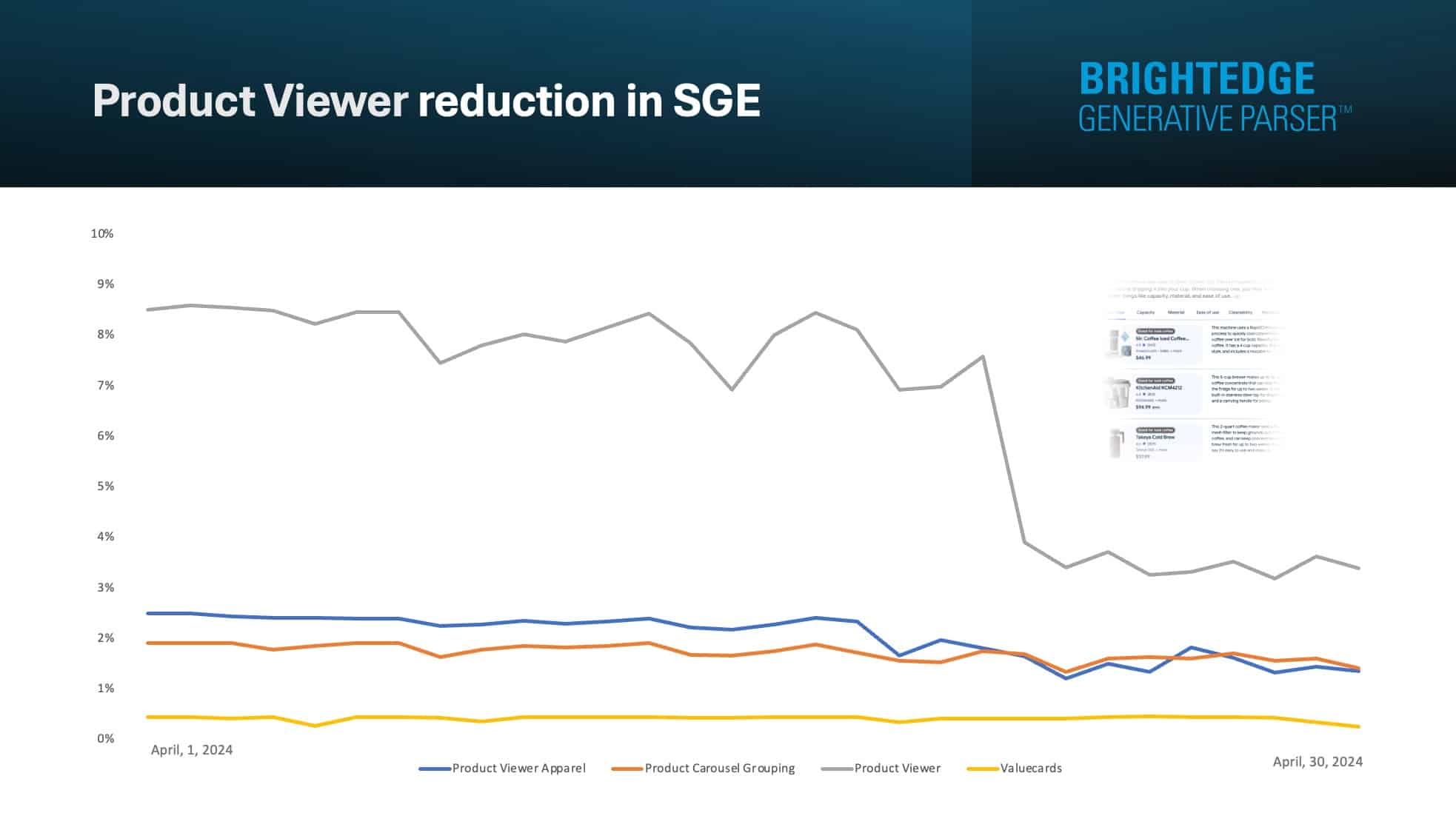
Product viewers decrease. There was a significant drop of this SGE format at the end of April:
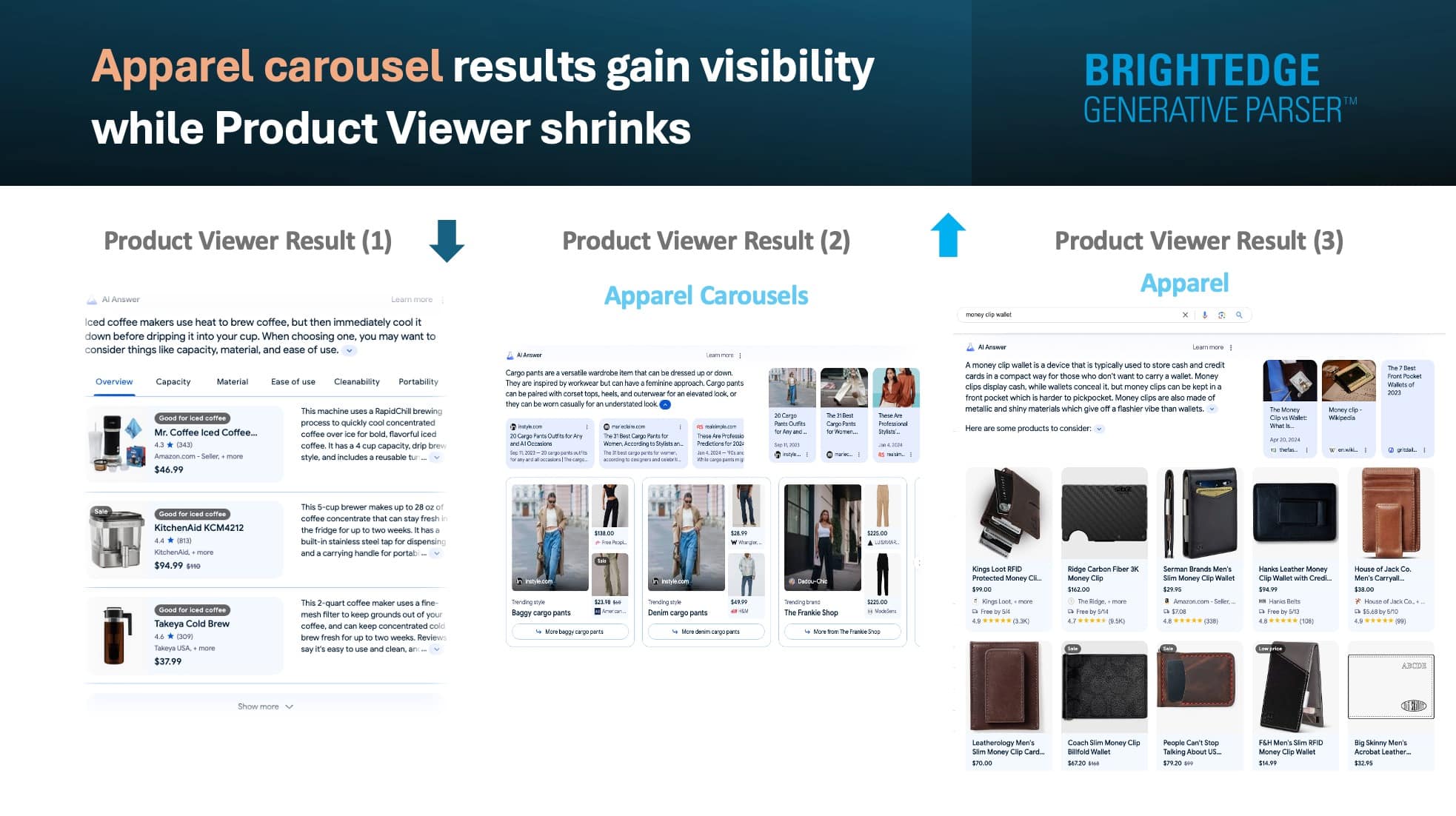
Apparel carousel results increase. This format type gained visibility in SGE for queries specific to apparel.
More warnings. A new, universally-applied warning appeared in April: Generative AI is experimental. This warning now appears across industries and query types.
AIO. SEO for Classic Search will remain important for the foreseeable future, but it’s become clear that AIO (Artificial Intelligence Optimization) may become equally or more important in coming years for AI Search, according to BrightEdge founder and executive chair Jim Yu:
- “Google search has undergone massive changes in the past few months to test and perfect SGE, with the goal of providing the best possible search experience. For marketers, it is essential to stay in lockstep with these changes to adapt to the new ways of optimizing for generative AI search.”
The report. BrightEdge continues to do live SGE update monitoring as part of its resource, The Ultimate Guide to Google SGE.
Courtesy of Search Engine Land: News & Info About SEO, PPC, SEM, Search Engines & Search Marketing
Thursday, May 9th, 2024
As Google Search continues to incorporate AI-generated answers into Search, links will live on, Alphabet/Google CEO Sundar Pichai told Bloomberg in a new interview. Here’s what you need to know from Pichai’s interview.
Future of links. Unlike in previous statements, where Pichai indicated that the Search experience would evolve substantively in the next 10 years, in the Bloomberg interview he seemed to indicate that links to websites will continue to be an important part of Google Search results:
- “I think part of what makes Google Search differentiator is while there are times we give answers, it’ll always link to a wide variety of sources. We’ve had answers in Search now for many, many years. We are just now using generative AI to do that.”
- “I think [links will] always be an important part of Search.”
- “There will be times when they want quick answers. My son is celiac, so we did a quick question to see whether something is gluten-free. We just want to know. But often it leads to more things, and then you want to explore more. I think understanding that, meeting all that needs, is part of what makes Search unique.”
Google Search getting worse. Pichai was also asked about search getting worse and “more SEO spam.” Pichai didn’t directly answer it (a typical Pichai non-answer answer), but my interpretation is Pichai acknowledged the issue without confirming it. Here’s what Pichai said, you can decide what it means:
- “Anytime there’s a transition, you get an explosion of new content, and AI is going to do that. So for us, we view this as the challenge, and I actually think there’ll be people who will struggle to do that, right? So doing that well is what will define a high-quality product, and I think it’s gonna be the heart of what makes Search successful.”
He was later asked how concerned he was about AI-generated content ruining Search. His response:
- “The challenge for everyone, and the opportunity, is how do you have a notion of what’s objective and real in a world where there’s gonna be a lot of synthetic content? I think it’s part of what will define Search in the next decade ahead, right?”
- “People often come to Google right away to see whether something they saw somewhere else actually happened. It’s a common pattern we see. We are making progress, but it’s gonna be an ongoing journey, right?”
Google’s business model. Google made more than $192 billion just from search ads in 2023. Pichai was also asked whether a chatbot giving AI-generated answers, rather than links, is “an assault on Google’s business model.”
- “So we’ve always found people want choices, including in commercial areas, and that’s a fundamental need. And I think we’ve always been able to balance it. As we are rolling out AI Overviews in Search, we’ve been experimenting with ads, and the data we see shows that those fundamental principles will hold true during this phase as well.”
Other quotes of note. Pichai was asked about the perception that Google is behind other companies (e.g., OpenAI, Microsoft) in AI, (even though Google became an AI-first company in 2016):
- “I take a long-term perspective and say, when the internet just first came about, Google didn’t even exist then, right? So we weren’t the first company to do search, we weren’t the first company to do email, we weren’t the first company to build a browser. So I view this AI as, you know, we are in the earliest possible stages.”
Meanwhile, in what I consider a fairly shocking moment, Pichai – the leader of a company that while not perfect is doing and has done many amazing things – couldn’t articulate a coherent reason when asked a simple question: why anyone we trust Google:
- “Well, I share the notion that no one, you shouldn’t blind lead, you know? That’s why it’s important to have systems in place. Regulation has a part to play, you know, test balance innovation. But as these AI systems get more capable, it shouldn’t just be based on a system of trust people or trust companies.”
What’s the biggest threat to Google’s future, according to Pichai:
Pichai was also asked whether we’ll look back on this “LLM era” and laugh because it will someday look basic and rudimentary:
- “I hope we do … my kids aren’t impressed by touchscreens or the fact that they have this extraordinary amount of computing in their hands. So similarly … there’s no reason we wouldn’t scale up our computing a hundred thousand times in a few years. … I hope some of this looks like a toy in the future. I hope it is that way, otherwise, we didn’t do our job well.”
Why we care. Just the other day, former Google CEO Eric Schmidt said “Google is not about blue links. It’s about organizing the world’s information,” which seemed to echo Pichai’s recent statement about Google evolving toward Search Generative Experience, where links to websites will eventually become less central to Search. AI answers are the present and future of Search – they’re not going away, especially if ChatGPT delivers on its rumored search product.
The interview. Google CEO Sundar Pichai and the Future of AI | The Circuit
Courtesy of Search Engine Land: News & Info About SEO, PPC, SEM, Search Engines & Search Marketing
Wednesday, May 8th, 2024
All signs point to ChatGPT launching a search feature soon. When? That remains the big question.
Rumor has it. OpenAI is developing a ChatGPT feature that searches the web and cites sources in its results, Bloomberg reported (subscription required):
- “The feature would allow users to ask ChatGPT a question and receive answers that use details from the web with citations to sources such as Wikipedia entries and blog posts … One version of the product also uses images alongside written responses to questions, when they’re relevant. If a user asked ChatGPT how to change a doorknob, for instance, the results might include a diagram to illustrate the task…”
And. “OpenAI has been aggressively trying to poach Google employees for a team that is working hard to ship the product soon,” according to the Verge.
Why we care. Search has quickly evolving in a new direction since the emergence of generative AI – with OpenAI seemingly perceived to be ahead of Google in many ways (not yet including Search), even though ChatGPT’s user base is still much smaller than Google. However, there is clearly growing frustration with all aspects of Google – from the quality of Search results to its abundance of advertising. Not to mention Google’s alleged monopolistic practices that have hurt advertisers, users and competitors.
X things we know about ChatGPT search. ChatGPT doesn’t want to copy Google’s model or layout (he hates ads). OpenAI CEO Sam Altman said as much earlier this year:
- “I don’t think the world needs another copy of Google,” Altman said.
ChatGPT’s version of Search wouldn’t be traditional, or classic, general web search. Altman’s vision is integrating ChatGPT with Search:
- “…We are interested in how to do that well. That would be an example of a cool thing. I don’t think anyone has cracked the code on yet. I would love to go do that. I think that would be cool,” Altman said.
Dig deeper. Is ChatGPT the Google Search killer we’ve been expecting?
Other ChatGPT search developments. We first heard rumors about OpenAI’s search product in February. Other stories Search Engine Land has covered:
More evidence. search.chatgpt.com appeared in the log files for some servers, as reported In Report: OpenAI To Launch Search Engine on Search Engine Roundtable by Barry Schwartz. There were rumors that ChatGPT’s search product would launch as early as tomorrow (May 9), but that seems unlikely at this point.
Courtesy of Search Engine Land: News & Info About SEO, PPC, SEM, Search Engines & Search Marketing
Wednesday, May 8th, 2024
Reddit is exploring monetizing its search results pages, teasing a significant untapped opportunity for the popular online forum.
Logical next step. With over 1 billion monthly searches on the platform, Reddit sees advertising against user searches as a logical next step to improve monetization after enhancing the core search experience.
Why we care. Reddit venturing into search ads could present a lucrative opportunity to target users with high intent. Advertisers will get the diversity in available platforms they crave as signs of decreasing Google trust levels prevail.
What they’re saying. Steve Huffman, CEO of Reddit, said on the company’s latest earnings call:
- “There are no ads today on search result pages. But that’s a very high-performing product elsewhere on the internet. And I think there’s no reason to believe that it wouldn’t be for Reddit because the intention is so explicit when users are searching.”
State of play. Reddit is first focused on upgrading its search functionality with improved back-end performance, autocomplete, and a revamped user interface slated for this year.
- The company believes nailing the search user experience is crucial before exploring monetization options like search ads.
- As it improves discovery and leverages explicit search intent signals, the platform sees advertising as a natural complement.
Get the daily newsletter search marketers rely on.
What’s next? While no firm timeline was provided, Reddit appears committed to extracting more value from its massive search volume by opening up ad inventory once its revamped search product takes shape.
Courtesy of Search Engine Land: News & Info About SEO, PPC, SEM, Search Engines & Search Marketing
Wednesday, May 8th, 2024
TikTok is positioning itself as a prime destination for search discovery, touting its community-driven approach as a key differentiator from traditional search engines.
New insights. TikTok released new insights emphasizing the platform’s role in driving discovery across the marketing funnel:
- 61% of TikTok users discover new brands/products on the app, 1.5x more than other platforms.
- 1 in 2 users go to TikTok to research products or brands.
- 91% of those inspired by the TikTok search followed through with an action.
- TikTok users are 1.5x more likely to discover and immediately purchase something.
Why we care: As TikTok evolves into a lifestyle platform blending entertainment, community and commerce, its ability to facilitate discovery throughout the consumer journey makes it an increasingly effective touchpoint for digital marketing strategies that would leave a massive gap if TikTok were banned.
Between the lines. TikTok is spotlighting three core “discovery modes” that power its search ecosystem:
- Swipe to Discover (the For You feed)
- Tap to Discover (likes, follows, video details)
- Search to Discover (text-based queries)
TikTok claims its visual, community-driven approach delivers more entertaining (41%), authentic (28%) and concise (25%) search results than traditional engines.
Get the daily newsletter search marketers rely on.
Why now. TikTok is not happy with the US government. TikTok and parent company ByteDance have filed a lawsuit challenging a new U.S. law that would ban the popular video-sharing app unless sold to an approved American buyer, arguing the law unfairly singles out TikTok and is an unconstitutional attack on free speech.
The lawsuit asserts that the law vaguely portrays TikTok’s Chinese ownership as a national security threat without evidence and that requiring a complete sale and separation from ByteDance is technologically impossible.
TikTok claims the law leaves no choice but a U.S. shutdown by January 2024 since it can’t operate independently from the global platform.
The big picture. As the fight to keep its current structure ensues, TikTok is vying for a central role in product discovery by showcasing how its community-powered recommendations can effectively inspire audiences and drive conversions across the entire funnel.
Courtesy of Search Engine Land: News & Info About SEO, PPC, SEM, Search Engines & Search Marketing
Wednesday, May 8th, 2024

March 2024 disrupted the SEO industry. Websites were deindexed, and manual penalties were delivered—all to produce more helpful, more trustworthy search results. How did your website fare?
Join us for an insightful webinar as we delve into the seismic shifts brought about by Google’s March 2024 updates and explore strategies to not just survive but thrive in this dynamic digital landscape. In this session, we’ll dissect the implications of the latest algorithm changes on content creation, link building, and SEO practices.
Register now for Surviving and Thriving in the New Google: Navigating March 2024 Updates for Content Creation, Link Building, and SEO Success to secure your spot and unlock the secrets to thriving in the new Google era.
Courtesy of Search Engine Land: News & Info About SEO, PPC, SEM, Search Engines & Search Marketing
Tuesday, May 7th, 2024
Have you ever clicked on a brand’s ad and ended up on a website you weren’t expecting? That’s ad hijacking. And it hurts advertisers and users.
Keep reading to learn how ad hijacking works, the risks it poses and how to protect your brand.
What is ad hijacking?
Ad hijacking is when an affiliate mimics a brand’s ads to steal clicks and revenue on their trademarked keywords. Affiliates do this to trick you into clicking on their ad instead of a real one from the brand.
How does ad hijacking work?
Imagine you search for [your favorite clothing brand]. Normally, the first ad you see should be the brand’s official one, taking you straight to its website. Here’s how ad hijacking disrupts that:
- The rightful owner: The first ad above belongs to the brand. It leads directly to its own website via the correct tracking link..
- The obvious culprit: The second ad is from an affiliate. It redirects you to the brand’s website, but adds the affiliate’s tracking link in the process. This lets them steal a commission for any sale you might make, even though you intended to visit the brand directly.
- The masked marauder: The third ad shows a more sophisticated hijacker using a series of redirects to hide their involvement. They might even send you through several websites before finally landing you at the brand’s site. This makes it difficult to identify them and hurts the brand’s affiliate program because it’s hard to track where the stolen commission came from.
What does ad hijacking look like?
In this example, a brand violation instance has been captured using Adthena’s Ad Hijacking Detection for a hotel brand (the brand name has been changed for anonymity). A search for “brandhotels.com” has returned the ad shown, which features the brand name in the display URL and site links.
However, the ad has not been placed by the hotel brand. It was placed by an affiliate bidding on “brandhotels.com.”
Why is ad hijacking harmful to your brand?
Ad hijacking can harm both advertisers and users. Here’s a breakdown of the main challenges it can cause:
For advertisers:
- Lost sales and revenue: Imagine paying for clicks that don’t reach your website! Hijacked ads steal clicks meant for your official ads, diverting potential customers and reducing sales.
- Increased costs: Advertisers compete with hijackers bidding on their brand terms (i.e., your brand name). This drives up the CPC, meaning you pay more for each person who sees your genuine ad.
- Channel conflict and data skewing: If you and a hijacker use affiliate programs, things get messy. Metrics like impression share and revenue attribution become inaccurate, making it difficult to track campaign performance effectively.
- Brand reputation damage: If users click on a hijacked ad and end up on a low-quality website or experience something negative, it reflects poorly on your brand. They might associate the bad experience with your company.
For users:
- Deception: The whole point of ad hijacking is to trick users. They click on an ad believing it leads to a brand’s website, only to find themselves somewhere else. This can feel misleading and like a waste of time.
- Exposure to malware: In some cases, hijacked ads might lead to malicious websites containing malware. This software can steal personal information or harm your device.
- Wasted time: Users expecting to visit a brand’s website after clicking on an ad will be disappointed if they land on an irrelevant page. They’ll waste valuable time navigating away from the wrong website.
Spot and stop ad hijacking attempts
Catching ad hijacking can be tricky, but there are tools to help.
Adthena’s Ad Hijacking Detection catches instances of ad hijacking instances from 50+ affiliate networks and sub-networks, by:
- Constantly monitoring your brand: Ad Hijacking Detection continuously scans search results for ads containing your brand terms, trademarks and even variations of them. It acts like a tireless lookout for imposters!
- Identifying suspicious activity: Sophisticated algorithms analyze ad copy, landing pages and affiliate links. If anything doesn’t seem genuine, it will be flagged for further investigation.
- Alerts and reports: Get notified right away if potential hijacking attempts are detected. These reports will include details like the infringing ad copy, landing page URLs, and even the suspected affiliates involved.
- Gathering evidence for takedown: Having all the evidence in one place makes it easier to report the infringing ad to Google. You’ll have the affiliate ID and other details needed for a swift takedown.

See Ad Hijacking Detection in action in a self-guided platform tour. Get started.
How to spot ad hijacking in your campaigns
Being proactive is key to fighting ad hijacking. Here are some red flags to watch out for in your branded ad campaigns:
- Performance slump: A sudden drop in clicks and conversions for your branded ads could be a sign that hijacked ads are stealing your clicks.
- Suspicious spikes in affiliates: A surge in referral traffic or conversions from an unknown affiliate is a cause for concern.
- Copycat conversions: If an affiliate’s conversion rates suspiciously mirror your branded ad campaigns, it might be because they’re benefiting from hijacked clicks.
- URL mismatches: Always check the landing page URLs linked to your affiliates. If they don’t match your brand’s domain or contain strange redirects, it could be a hijacking attempt.
These warning signs can help you catch ad hijacking early and take action to protect your brand.
Prevent ad hijacking before it strikes
Why wait for trouble? By being vigilant and monitoring your campaigns closely, you can take steps to identify and address ad hijacking attempts by affiliates.
1. Secure your brand identity:
- Trademark protection: Register your trademarks and brand terms. This strengthens your legal stance if you need to confront hijackers.
- Brand watch: Use brand monitoring tools to track online mentions, including search results. This helps you spot potential hijacking attempts early on.
2. Manage your affiliate program:
- Clear affiliate agreements: Outline acceptable practices in your affiliate agreements. Ban affiliates from bidding on your brand terms or using misleading ad copy.
- Performance monitoring: Regularly monitor your affiliate program performance. Look for unusual spikes in traffic or conversions from specific affiliates.
3. Paid search defense:
- Negative keywords: Use negative keywords to prevent your ads from showing for searches that include hijacked terms or variations of your brand name.
- Trademark bidding: Consider trademark bidding on your branded keywords. This ensures your ads appear prominently in search results, pushing hijacked ads down the page.
4. Advanced protection solutions:
- Brand Protection: Explore advanced brand protection tools like Adthena’s Ad Hijacking Detection, a part of the Brand Protection solution. These tools actively scan for hijacking attempts and provide detailed reports to help you take action.

Learn more about PPC brand protection and how to do it in the complete guide to PPC brand protection.
5. Take action:
- Report infringing ads: Report any instances of ad hijacking to the relevant search engine platform.
- Terminate rogue affiliates: If you identify affiliates engaging in ad hijacking, terminate their agreements immediately.
Fight back against ad hijacking
Ad hijacking can be sneaky, stealing clicks and damaging your brand reputation. By understanding how it works, you can take proactive measures to:
- Protect your brand: Register trademarks and use brand monitoring tools to stay vigilant against hijacking attempts.
- Secure your affiliate program: Define acceptable practices in affiliate agreements. Block affiliates from bidding on your brand terms or using misleading ad copy.
- Put paid search protection in place: Use negative keywords to prevent hijacked terms from triggering your ads. Consider trademark bidding to ensure your ads appear prominently.
- Consider advanced protection: Explore tools like Adthena’s Ad Hijacking Detection for advanced monitoring and defense.
- Take down hijackers: Report infringing ads to search engines and terminate relationships with rogue affiliates.
By staying informed and implementing these strategies, you can reclaim control of your online presence and ensure a positive experience for your customers.
Do you know if your branded keywords are being hijacked by your affiliates? Take a self-guided platform tour of Adthena’s Ad hijacking detection or Book a demo to get started.
Courtesy of Search Engine Land: News & Info About SEO, PPC, SEM, Search Engines & Search Marketing