Archive for the ‘seo news’ Category
Tuesday, May 21st, 2024
OpenAI didn’t launch its much-rumored ChatGPT Search product last week. Or did it?
Has OpenAI quietly launched an early version of ChatGPT Search, as part of the GPT-4o rollout?
ChatGPT (the free 4o version) now tells you the sites it is searching to provide its AI-generated answers and crawls and summarizes webpages. And the websites it lists aren’t hallucinations.
Searched sites. When you ask a question that requires current information, ChatGPT will tell you it is “Searching the web.” Once this part completes after a few seconds, ChatGPT tells you it “Searched X sites” and lists them.
Here’s a screenshot:
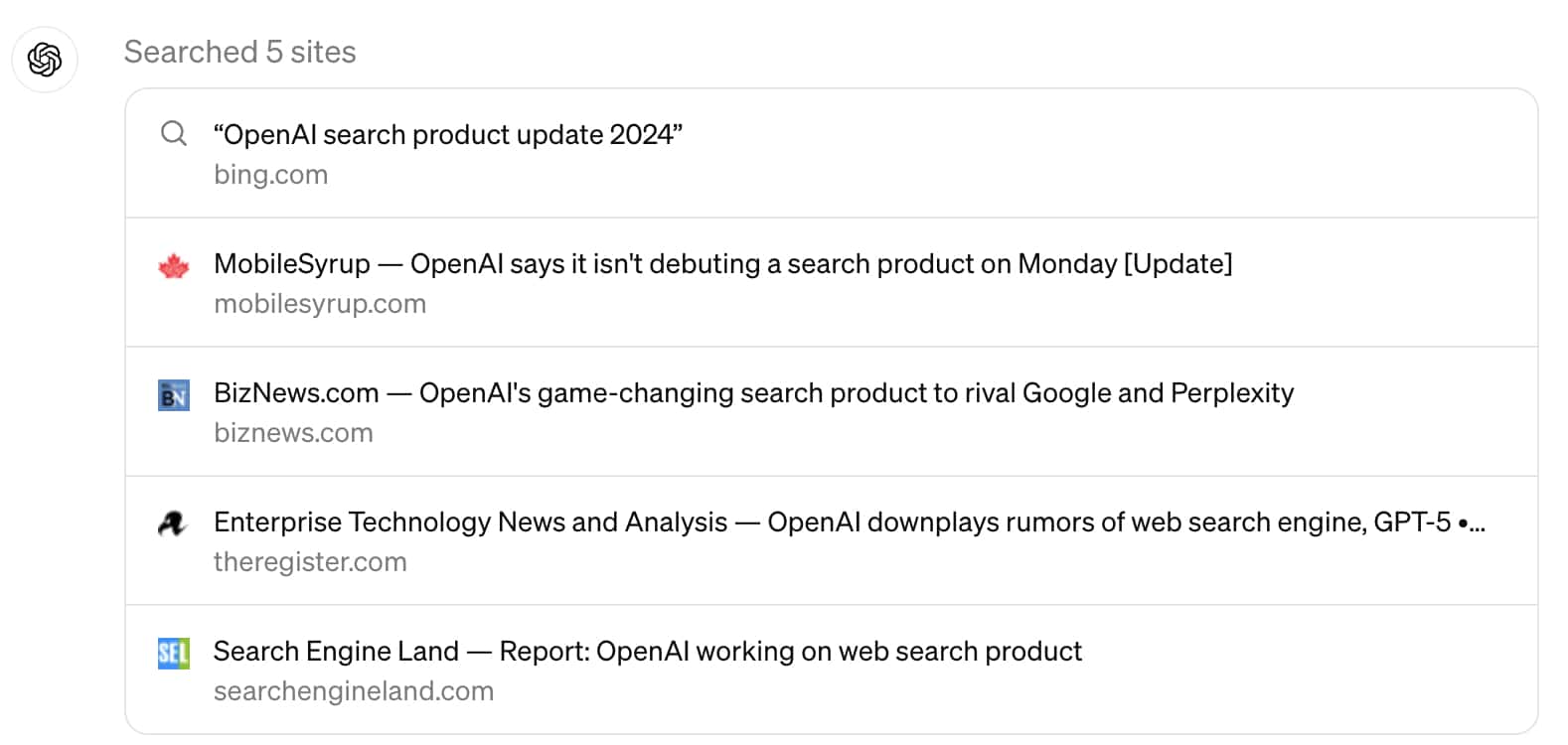
OpenAI and Microsoft are partners. So based on this screenshot, OpenAI is likely using retrieval augmented generation (RAG) to rewrite the query and search on bing.com to find websites.
But remember – OpenAI also launched a web crawler, GPTBot, in August.
- Side note: If you blocked ChatGPT and other AI companies over content theft concerns, you may want to reconsider that.
Dig deeper. Should you block ChatGPT’s web browser plugin from accessing your website?
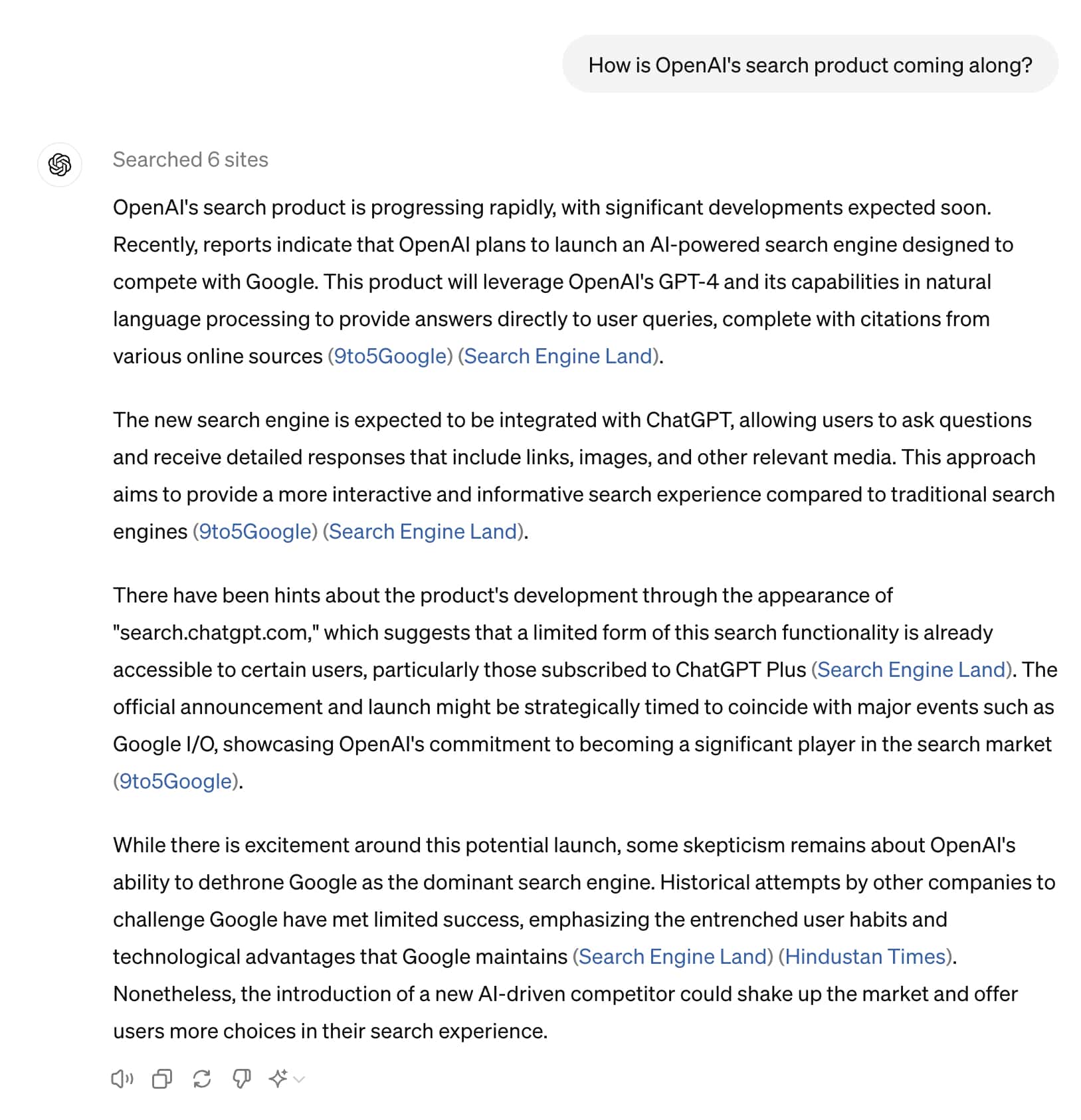
Answers and sources. ChatGPT’s answer experience is much better – especially the prominent linking to sources – than what Google is now doing with its recently launched AI Overviews. In this screenshot, ChatGPT cites 9to5Google and Search Engine Land multiple times:
Browser. I asked ChatGPT whether it can search the web. I have no way to verify whether this is fact or hallucination, but here’s how ChatGPT responded:
- “Yes, I can search the web using a tool called the
browser. This allows me to find current information, recent events, or detailed answers that aren’t in my training data. If you need me to look up something specific, just let me know what you’re looking for!”

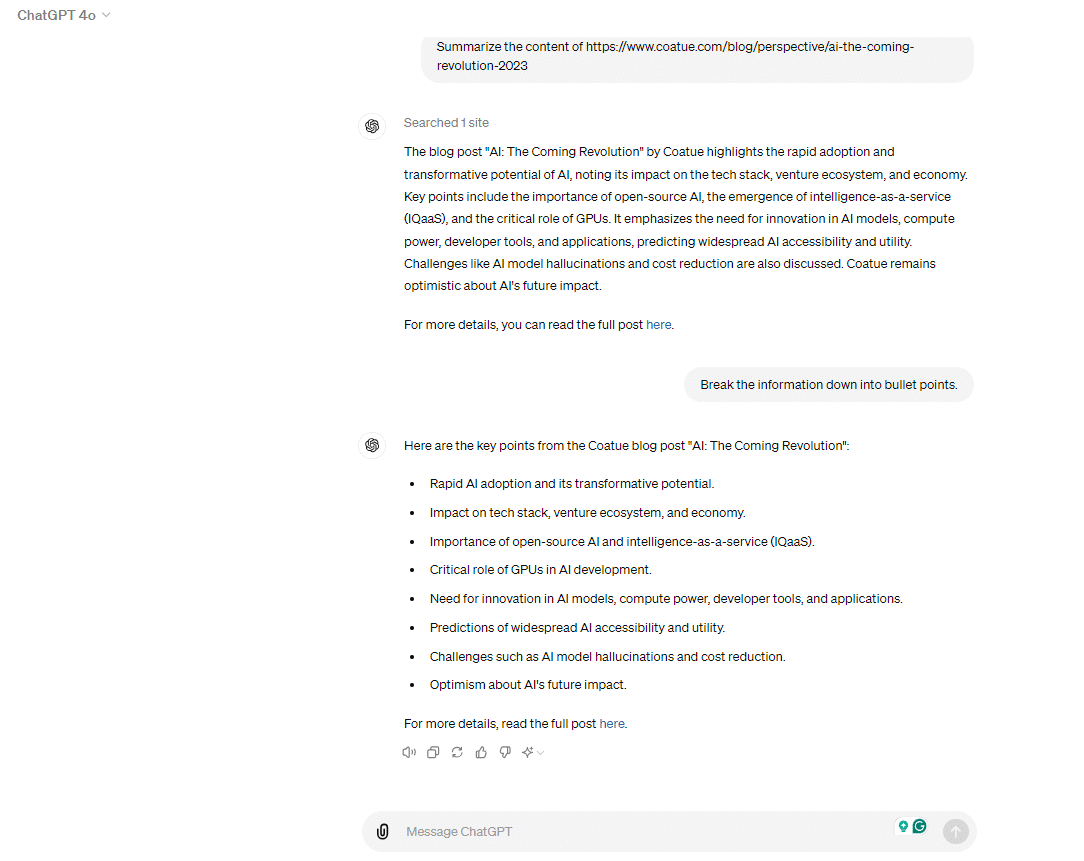
Summarizing content. ChatGPT is crawling links and summarizing the information from them. This was shared on X by Dave Davies, a Search Engine Land contributor and speaker at SMX Advanced:
ChatGPT Search. As a reminder, don’t expect ChatGPT Search to look like Google Search. OpenAI CEO Sam Altman has said Google is boring and the world doesn’t need another Google.
Dig deeper. Is ChatGPT the Google Search killer we’ve been expecting?
Why we care. OpenAI right now is in the underdog position Google once occupied and seems to be slowly and smartly developing a unique take on Search combined with large language models (LLMs). With negative sentiment around Google, OpenAI has a legitimate shot at making a run at Google – not by trying to emulate Google, but by changing the paradigm.
Courtesy of Search Engine Land: News & Info About SEO, PPC, SEM, Search Engines & Search Marketing
Friday, May 17th, 2024
TikTok is testing a new 60-minute video upload limit, which could unlock new content possibilities for brands, marketers and content creators.
Why we care. TikTok is already a powerful discovery engine, but the ability to upload 60-minute videos opens up TikTok’s potential as a platform to host long-form branded video content – rather than breaking up videos into multiple parts.
Why TikTok is testing this. TikTok wants to give creators more flexibility and the ability to experiment with new types of long-form content (e.g., cooking demos, beauty tutorials, educational lessons, comedic sketches) that don’t fit well into shorter videos.
Not widely available. This new 60-minute video upload option is being tested with a limited number of users in select markets. It is not available to all users yet and TikTok has no “immediate plans” for a wider rollout, TechCrunch reported.
Longer videos, more ads? This development could also lead the way to TikTok offering more advertising, in the form of pre- and mid-roll ads.
Keeps getting longer. In January, TikTok started testing 30-minute video uploads. That followed increases to 15 minutes in 2023 and 10 minutes in 2022.
- At launch, TikTok videos were limited to 15 seconds. TikTok later increased the maximum video length time to 60 seconds, then tripled that to 3 minutes in July 2021.
Courtesy of Search Engine Land: News & Info About SEO, PPC, SEM, Search Engines & Search Marketing
Friday, May 17th, 2024
The Department of Justice’s laid out a damning case against Google in the antitrust lawsuit closing argument.
Search Engine Land Managing Editor Danny Goodwin highlighted some of the damaging evidence – including how Google has been increasing costs for advertisers – in How Google harms search advertisers in 20 slides
In light of the revelations, I contacted search marketers to get their thoughts on Google Ads to evaluate the current confidence level. Spoiler alert: it’s not good.
Clearly, trust is a major issue – and in the court of public opinion among advertisers, Google has already been found guilty.
Here’s what advertisers told Search Engine Land:
Manipulation and deceptive practices
Sarah Stemen (Paid Search Specialist and Founder):
- “Their willingness to rewrite help desk documents, frankly, feels shocking after such revelations.”
- “It seems like Google is trying to hide the mechanics of a potential first-price auction rather than ensuring a truly fair second-price system.”
Boris Beceric (Google Ads consultant and coach):
- “The only one ‘benefitting’ from randomization is Google.”
- “Google is a monopoly that’s raising prizes without telling advertisers about it.”
Dids Reeve (Freelance Paid Media Specialist):
- “The document reads like randomization is code for ‘we can deviate from the usual auction algorithm to make ourselves some more money’. And that if advertisers perceive Google to be ‘randomizing’, then it would be bad enough that they want to cover up the fact.”
Chris Ridley (Paid Media Manager, Evoluted):
- “The latest news of Google randomizing the top two ad positions in the hope advertisers will raise their bids, is a sign that Google is willing to rewrite the rulebook for advertising on their platform.”
Robert Brady (Founder and PPC Expert):
- “Exact match bears the name ‘exact,’ but the behavior of the match type is far from exact. They keep the name because it gives advertisers a false sense of precision.”
- “Randomization in this context is used the same way. The layperson would infer that it meant the behavior was truly random (not influenced by predictable factors), so Google deflects scrutiny when a full analysis shows that their ‘randomization’ showed a clear preference in Google’s favor.”
Amy Hebdon (Google Ads Conversion expert):
- “With RGSP, Google has gaslit advertisers with disingenuous explanations of the changes, trying to convince us that this lack of transparency is for our benefit.”
Google’s prioritization of profit over fairness
Jyll Saskin Gales (Google Ads Coach):
- “However, reading the internal Google commentary on the practice, it’s clear that the motivations for randomization were not noble.”
Charley Brennand (PPC Consultant & Founder):
- “Google will never put advertisers’ needs before their need to grow profit.”
Hebdon added:
- “Using ad rank and a second-price auction, Google already had a system prioritizing quality and user experience while setting a fair price for advertisers. Where’s the flaw in that model, besides the fact that Google wasn’t extracting the maximum revenue possible?”
Julie Friedman Bacchini (Founder of NeptuneMoon):
- “My main takeaway from this is that these exhibits show that Google Ads is absolutely doing what is best for Google Ads first and foremost.”
Nick Handley (Head of Paid Media Performance at Impression):
- “Google has a monopoly on the Search space and until another player challenges Google, I feel we’re going to continue to see this type of revenue-increasing tactic to continue with Google putting stakeholders above clients.”
Trust in Google is quickly collapsing
Kirk Williams (Founder of Zato):
- “But I can say that these [evidence brought up against Google] continually demonstrate the problem Google has right now: trust.”
- “Google has an optics problem right now, and these documents help erode, rather than increase, trust.”
Stemen added:
- “It challenges the very foundation of trust and transparency that’s essential for a healthy digital advertising ecosystem.”
- “It raises the question – what else haven’t they been transparent about?”
Reeve added:
- “It makes me feel like the PPC community and their clients are being manipulated, too.”
Ridley added:
- “We, as advertisers, should not take anything we know about how ad auctions work at face value, even if it’s within the Google Ads Help Center.”
Brennand added:
- “Now with the published data from the court case, we can see that we’ve been manipulated and actually, not even our Google counterparts are privy to what Google is up to.”
Handley added:
- “Given the recent DOJ vs Google trial, it’s becoming increasingly harder to trust Google and the recommendations they provide.”
Impact on advertisers and clients
Gales added:
- “The people who should be most angered by this are Google’s top customers, the Amazons and Temus and Expedias of the world, who spend millions a year on Google Ads just to be punished for their investment by being ‘randomly’ pushed down.”
Brennand added:
- “If this has only just been surfaced now, it begs the question of how many other harmful changes have happened under the radar that we didn’t know about.”
Handley added:
- “This poses an interesting question, how are we meant to trust recommendations from our reps? If they are in the dark as much as us, surely some of their insight is harmful to us advertisers.”
Perceived (un)fairness of ad auctions
Williams added:
- “When users believe an auction to be more about competition and less about manipulation by the auctioneer and then learn it to be otherwise, that causes a lack of trust.”
Gales added:
- “I support the principle of Randomization, as it seems to support the same principle as Quality Score: those with the deepest pockets shall not hoard all the clicks, and the most important thing is to give the user what they want – the best results.”
Ridley added:
- “For years, Google has been telling advertisers through their Google Ads Help Articles that Ad Rank determines ‘whether your ads are eligible to show and, if eligible, where on the page your ads are shown (if at all) relative to other advertisers’ ads’.”
- They even go as far as providing six factors that contribute to calculating your Ad Rank and have published and regularly updated several Google-hosted articles that double-down on the concept that “Your ad’s position on the page is determined by your Ad Rank”
Other reactions of shock and disappointment
Stemen added:
- “However, encountering statements like ‘this gives us the freedom to config pricing’ in official court documents is a real blow.”
Reeve added:
- “It’s quite shocking to see in black and white the cynical way individuals at Google have discussed how they manipulate and warp the definitions and configuration of Google Ads metrics.”
Bacchini added:
- “Advertisers and PPC pros have long suspected some of this stuff, but seeing it in these docs is still stunning.”
Why we care: The breakdown in the relationship between Google and advertisers may start with trust – but it goes beyond that. It becomes harder or impossible to trust advice from ad reps, having seen that Google is prioritizing revenue over fairness via manipulative practices. It means advertisers have an even harder job of ensuring they are not just throwing advertising budget down the drain but actually gaining incremental conversions with their ad spend.
Dig deeper. Has Google Ads lost all credibility? Why one advertiser says it’s time to leave
Courtesy of Search Engine Land: News & Info About SEO, PPC, SEM, Search Engines & Search Marketing
Friday, May 17th, 2024
Another Google Analytics 4 migration project deadline is fast approaching, and this deadline is hard set. On July 1, Google will delete all historical data from Universal Analytics properties. This deadline also affects Analytics 360 customers.
With little more than a month until the deadline, if you have not done so by now, your organization needs to prioritize archiving your historical data. There are three main phases I recommend for approaching this project.
Phase 1: Make a plan
Before archiving data, it’s important to decide:
What specific data is important to you?
- Prioritize downloading data that you regularly refer to, such as conversion and sales data.
- Make a full list of the data you need to archive.
How many years of data do you want to keep?
- Many of us have been using Google Analytics since the mid-2000s – does your organization need to archive data from nearly 20 years ago?
- Decide how far back you want to archive data from. I recommend, at minimum, to consider archiving back to 2018 or so to ensure you have pre-pandemic data since the pandemic really presented data anomalies for many companies.
At what cadence do you review data?
- Consider how often you typically report on your data. Is it weekly? Monthly?
- Depending on the archiving method you choose in Phase 2, you may need to organize the data into specific time increments.
Get the daily newsletter search marketers rely on.
Phase 2: Choose an archiving method
There are four main options available for archiving your Universal Analytics data. Each has its own pros and cons, so choose a method based on your team’s resources and skills.
Option 1: Manual file downloads
- Pros: Easy for almost all users to do, free
- Cons: Time-consuming, cumbersome, difficult to access data for reporting later, limited to 5000 rows
While this is the easiest process to understand, it is also time consuming.
Following your plan for years, cadence and data points, you’ll need to go into each report in the Google Universal Analytics interface, set the date, dimension and metric settings as needed.
Also, remember to change the number of rows from the default of 10 to the maximum of 5,000 rows to ensure you capture as much data as possible.
Click the export button and export data to a Google Sheet, Excel or CSV. Repeat this process until you have downloaded all of the data identified in your archive plan.
Option 2: Download data to Google Sheets using the Google Analytics add-on (best option for tech novices)
- Pros: Fairly simple to implement for most users with spreadsheet experience, free, fast to download.
- Cons: Restrictive to a set timeframe (e.g., monthly), each sheet has total data limitations, often encounters sampling issues.
This option is fairly simple for most users to perform. Create a new Google Sheet and add the Google Analytics spreadsheetadd-on.
The add-on essentially uses the Google Analytics API to download data to Google Sheets but doesn’t require API programming knowledge to operate. Google has compiled a basic overview of this approach in this help document.
The first time you use the add-on, you’ll build a report using the add-on’s interface. But after the first report has been run, you can also simply update the Report Configuration tab and create additional reports directly in columns of that sheet.
You can also conveniently use formulas in the Report Configuration sheet. Use the Dimensions and Metrics Explorer to find the proper API code to enter into each field.
One drawback of the Google Sheets method is that you may encounter sampling if you pull too much data at once (e.g., your entire 20-year dataset for sessions) or your report is too detailed (too many dimensions pulled together for a high level of granularity).
When you run a report, you’ll see the sampling level on the report’s data tab in cell B6. If your report contains sampled data, you may want to consider reducing the amount of data in this particular pull, for example, you might split the pull into two time frames.
However, if you just can’t avoid sampling, check the data sample percentage on the report. Then, on the Report Configuration tab, unhide rows 14-17 and the sampling size on row 15 to this level so that your data remains consistent.
Tip: The add-on defaults to 1,000 lines of data in a report. Simply delete the 1,000 under the line labeled “Limit” (typically row 11).
Another drawback of the Google Sheets option is that each file is limited to 10,000,000 cells. Typically, each sheet starts out with 26 columns (A to Z) and 1,000 default rows (or 26,000 cells).
If your downloaded data exceeds the 10,000,000 cell limitation (which can very likely happen), then you may need to have multiple Google Sheets to download all of the data.
Option 3: Download data using the Google Analytics API
- Pros: Pulls data quickly once set up
- Cons: Requires web development knowledge and resources, doesn’t solve the data sampling issue, API quota limitations
If you have web development resources that can work on the archiving project, they can pull the data detailed in your plan using the Google Analytics API directly.
This works similarly to the aforementioned Google Sheets add-on option, but it’s a more manual process in programming the API calls.
To learn about how to use the API for this project, visit Google’s archiving information page and review the second bullet, which details several resources and considerations for using the API for this data export project.
Option 4: Download data to BigQuery (best option overall)
- Pros: Simple to access data later for reporting, increased data insights, most flexible for data
- Cons: Complicated for novices to set up initially, can involve fees for BiqQuery, may require technical resources to set up, need to involve an additional tool
The main benefit of archiving your Universal Analytics data to BigQuery is that BigQuery is a data warehouse that allows you to ask questions of the data set through SQL queries to get your data very quickly. This is especially useful in accessing this data for reporting later.
Analytics 360 users
If you are an Analytics 360 user, Google provides a native export to BigQuery. I recommend this method. See instructions from Google.
Everyone else
If you’re not an Analytics 360 user, then you’ll need to approach the BigQuery backup differently because Google does not provide innate BigQuery backup options in Universal Analytics for non-360 users.
Here are the steps you’ll want to follow:
- Step 1: Create a Google API Console project and enable BigQuery.
- Log in to the Google APIs Console.
- Create a Google APIs Console project.
- Navigate to the APIs table.
- Activate BigQuery.
- Step 2: Prepare your project for BigQuery export.
- Ensure Billing is enabled for your project. You may not need to pay anything, but it will vary depending on the usage and data you have.
- If prompted, create a billing account.
- Accept the free trial if it’s available.
- Validate Billing enablement. Open your project at https://console.cloud.google.com/bigquery, and try to create a data set in the project. Click the blue arrow next to the project name, then click Create data set. If you can create the data set, billing is setup correctly. If there are any errors, make sure billing is enabled.
- Add the service account to your project. Add analytics-processing-dev@system.gserviceaccount.com as a member of the project, and ensure that permission at the project level is set to Editor (as opposed to BigQuery Data Editor). The Editor role is required in order to export data from Analytics to BigQuery.
- If you are in the EU, please also review additional requirements.
- Step 3: Set up a free trial of Supermetrics. Similar to the Google Sheets add-on in option 2 above, Supermetrics is a tool that helps non-technical users interface with and use APIs. They offer a free 14-day trial, which is likely all you’ll need for this project since you’re only downloading the Universal Analytics data once (not regularly).
- Connect the BigQuery data source in the Supermetrics dashboard.
- Step 4: In BigQuery, establish the connection to Supermetrics.
- Navigate to BigQuery, then to Data transfers.
- Click + Create transfer.
- Select your Google Analytics by Supermetrics as your source and click Enroll.
- Fill in the transfer details. See detailed instructions on how to set up a transfer.
- Under Third-party connection, click Connect source.
- Accept the agreement.
- Click Authorize with your Google data source.
- Click Sign in with Google.
- Sign in with the Google Account you use with this data source. This doesn’t have to be the same as the Google Account you use with Supermetrics.
- Click Allow.
- Select the accounts you’d like to include in your reporting and define the transfer settings.
- Click Submit.
- Click Save.
Because you only need to transfer the Universal Analytics data one time, you can also change the schedule on the transfer to On demand and then run the transfer now.
Phase 3: Ensure you’ve captured it all
Before you consider the project complete, be sure to double-check your archived data to ensure you’ve captured everything you planned to archive.
On July 1, you will no longer be able to access Universal Analytics data, either by API or through the interface.
Courtesy of Search Engine Land: News & Info About SEO, PPC, SEM, Search Engines & Search Marketing
Friday, May 17th, 2024
As the traditional search box becomes obsolete and the vast majority of searches shift to the extreme long tail, SEO will invariably evolve in the future.
It’s actually not such a bold prediction if you have been in the search space for a while. Data has shown time and time again that searchers don’t want to “search” but “find.” AI will finally make that happen, which is why every major tech company is shifting its focus to it.
Those of us who have been around for a while remember the PC war, the OS war, the first browser war, the smartphone war, the second browser war, the search engine war and the smart speaker war.
The AI wars will make them all pale in comparison because AI is the future to which all of those technologies pointed.
Who will win the AI wars?
At this point, it’s anybody’s guess. We know the ones who captured the early buzz, such as OpenAI’s ChatGPT, Google’s Gemini, X’s Grok and Anthropic’s Claude.
But don’t count out Apple and Amazon, which late in 2023, realized how annoyingly unintelligent Siri and Alexa were and what a goldmine they’d have if they could make them smarter. They announced their own LLMs, Ferret (now MM1) and Project Olympus.
Don’t count out the countless other AI companies. Will one of them ultimately build a better model than the big companies and either compete with them or be acquired by them? Or will the AI landscape eventually fragment so people learn to go to different LLMs depending on the subject they’re looking for?
While we don’t know exactly who the winners will be just yet, anyone who’s been in search marketing for a while knows exactly what the winning AI will eventually look like.
Follow the yellow brick road
In L. Frank Baum’s “The Wizard of Oz,” Dorothy finds herself lost and encounters three other lost souls: the Scarecrow, the Tin Woodsman and the Cowardly Lion.
Each of them is missing something.
- A brain
- A heart
- Courage
- Home
All these also happen to be what AI is missing now.
‘If I only had a brain’: Knowledge
“Some people without brains do an awful lot of talking, don’t you think?”
– L. Frank Baumm, “The Wizard of Oz”
While chatbots seem impressive today, if you ask them anything more than a surface level of questions, you’ll quickly find where they lack.
Here’s an example. As a parent, I love the idea of buying toys made in America. It supports local manufacturing jobs, local communities and I find the quality and safety to be better than toys made overseas.
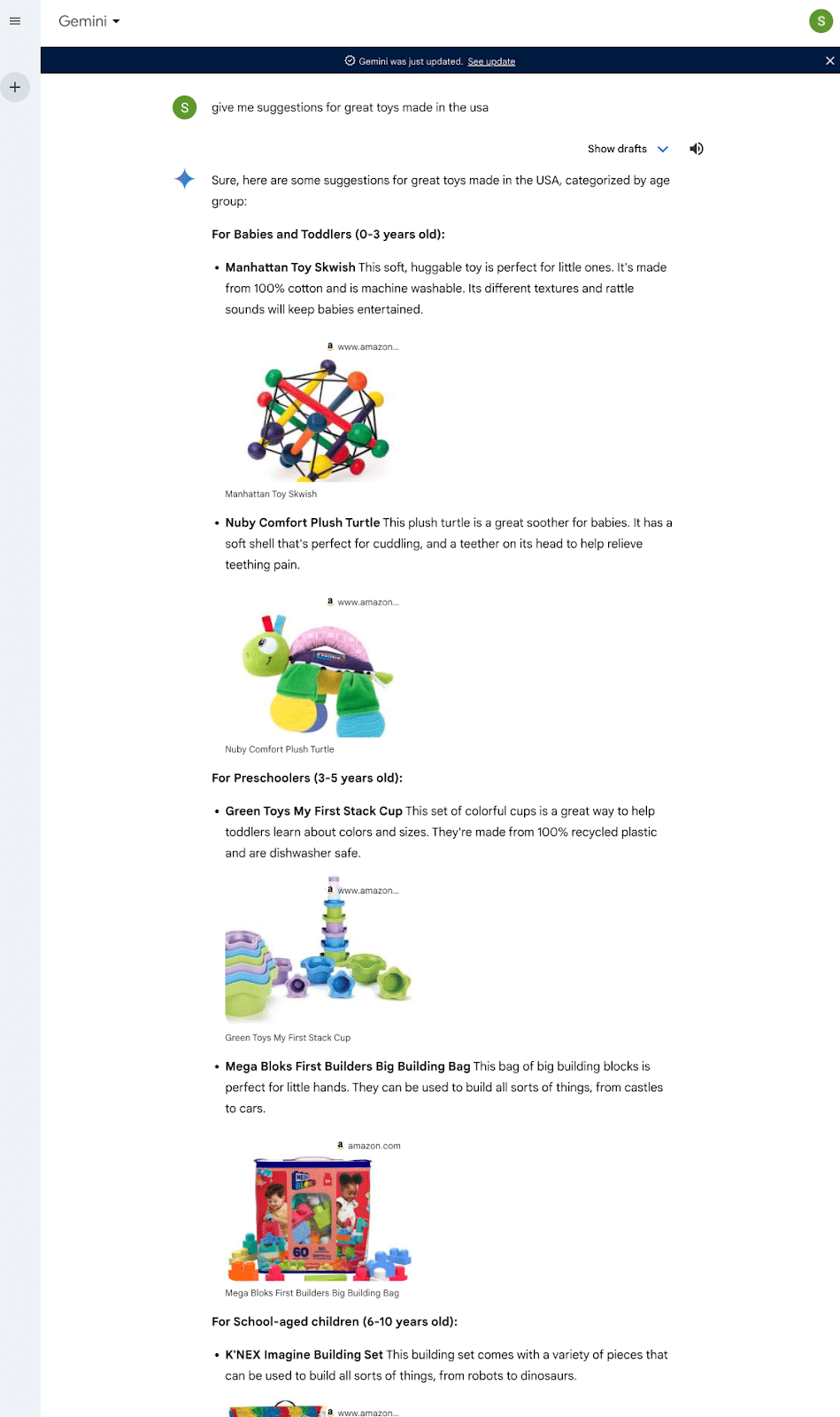
I asked Google Gemini for suggestions for toys made in the U.S. Here’s what it told me.
Here’s the strange thing.
The Manhattan Toy Skwish is made in Thailand, the Nuby Comfort Plush Turtle in China and Mega Bloks, which used to be made in Canada, are now made in Mexico and China. K’NEX labels read “made in China of USA parts.”
In other words, out of six toys that Google Gemini recommends that are made in the USA, only one is. It’s the Green Toys My First Stack Cup.
OK, Google.
In fairness to Google, none of the other AI chatbots got it right. The problem is the age-old problem of “garbage in, garbage out.”
Google Gemini is tapping Amazon as one of its “authorities” on the subject. But when you go to Amazon’s own toys made in USA search results page (which happens to have ranked in the top 10 of Google’s organic results since the May 2020 core update), you’ll see that out of 75 product listings, nearly half of them are not made in the USA.
“Experience is the only thing that brings knowledge, and the longer you are on earth the more experience you are sure to get.”
– L. Frank Baumm, “The Wizard of Oz”
While Google may have gotten away with ranking sites in organic search based more on their perceived authority than objective truth, users of their AI won’t be as forgiving.
There’s a reason Google has been stressing E-E-A-T for years, and it hasn’t just been out of the goodness of their hearts. They need E-E-A-T to survive.
For a query like this, a retailer like FatBrain, which has been accurately cataloging and displaying the country of origin for all its products, will have an outsized advantage over less precise user experiences like Amazon’s.
AI models that can pull from the most accurate information will have an outsized advantage over their competition, and brands that can produce this information will, too.
‘If I only had a heart’: Empathy
“I had brains and a heart also; so, having tried them both, I should much rather have a heart.”
– L. Frank Baumm, “The Wizard of Oz”
Let’s say you had a question and you know two people who knew the answer. One is brilliant but tends to be pedantic, smug and self-absorbed. This person might give you the right answer but definitely isn’t the most pleasant person to talk to.
The other person may not know quite as much as the first, but takes a genuine interest in what you’re saying, is open-minded, patient and respectful, asks meaningful follow-up questions and doesn’t just deliver you a right answer but does it in a way that you understand and appreciate.
Which of the two would you go to for the answer? Which of the two would you want around you 24/7?
Everyone knows that SEO requires E-E-A-T. But in the coming world of AI, there’s going to be another “E,” which may be the most important factor of all: empathy.
The winner of the AI war will be a great communicator. While you can see the early attempts of AI companies to give their chatbots a “personality,” all the funniest jokes and most clever side comments will be nothing but annoying if the chatbot can’t – or won’t – understand your question.
Get the daily newsletter search marketers rely on.
‘If I only had the nerve’: Courage
“True courage is in facing danger when you are afraid.”
– L. Frank Baumm, “The Wizard of Oz”
In 1998, when Yahoo was at its pinnacle of power, Rick Skrenta and Bob Truel created GnuHoo in response, which later became DMOZ. Yahoo was dominant at the time, and many of us feared that the free and open nature of the Internet would be threatened by any one corporation controlling it.
In 2002, Dave Hyatt, Joe Hewitt, and Blake Ross started what would become Firefox in response to the increasing pressure of Netscape’s commercial requirements. It later became a bulwark against Microsoft when Internet Explorer won the first browser war.
Ironically, Google eventually controlled and shaped the web by dominating both. Today, Alphabet, Apple, Amazon, Meta and Microsoft (through OpenAI) seem to be looking to control and shape AI.
Those of us in the search space have witnessed how Google has evolved. While updates like Medic in 2018 did a lot of good in suppressing potentially dangerous YMYL sites, there are lingering questions of whether Google has too much power to elevate established (“authoritative”) voices and drown out legitimate voices in the minority.
Google’s recent missteps with Gemini further illustrated the potential of what might happen if Google’s internal biases have too much influence on the training and testing of its AI.
When the United States was established, its founders rooted it in classical liberal principles. All humans are created equal. All humans are born with certain rights, including the freedom to speak, assemble and worship as they please. Those on earth who wielded the greatest power were not to infringe on these rights.
With direct control over the information that 99,000 people a second ask around the world, Google arguably has more power than any government on earth today. The power that whoever wins the AI War will have will be much greater.
Will the winners of the AI war set their principles on classic liberty (i.e., “I may not approve of what you say but I will defend the right to say it”)? Or, to maintain “order,” will they do what so many totalitarian regimes have done in world history by suppressing voices that don’t agree with them, especially those who challenge their power?
Just as it took courage for America’s founders to do what they did – and 250 years later, we are still enjoying the blessings of liberty that they put in place – it will take courage for the winner of the AI war to do the same – or for another DMOZ or Firefox to arise to challenge them.
Home
“No matter how dreary and gray our homes are, we people of flesh and blood would rather live there than in any other country, be it ever so beautiful. There is no place like home.”
– L. Frank Baumm, “The Wizard of Oz”
I’ll end with the same bold prediction I started the last article with.
Traditional search is going the way of TV, newspaper and radio advertising. At one time, those were the dominant advertising media. They’re still relevant today, but they have a small fraction of the influence they once had.
What will the “new search” look like? It’ll be people asking their robot for an opinion and the robot giving them the best possible answer. No clicks, no SERPs, no ads.
Oh, AI companies will try to inject ads into their answer, but you’ll drop that AI faster than you drop your friend, who takes every conversation to try to sell you into their latest MLM venture.
How do you compete in this new world? How do you survive and thrive as a brand in a world where all searches are zero click, all SERPs are a single result and people won’t be able to skip or block your ads because there won’t be ads to skip or block?
The ultimate solution is to go back to 1993, the year before Yahoo was founded.
Build your brand.
Search engines like Google were always just supposed to be a way to get customers into your door. From there, it was really up to you to win them over to your brand and earn their loyalty so the next time they search, they’ll bypass Google and go directly to you.
In online marketing terms, if you look at your website traffic and see that your direct traffic is growing, you’re in good shape. But if your direct traffic has been shrinking while your traffic from other channels is growing, you’re in trouble.
In 1993, businesses grew by building great products, taking care of their customers and relying mostly on word-of-mouth to promote their brands.
In 2024, the most successful businesses still do it this way.
When I asked ChatGPT, Grok and Gemini where the best place to buy books is, they all mentioned Amazon. Why? Because they’d look foolish if they said anything else.
Amazon didn’t pay the AI models to mention them, and the latter didn’t arbitrarily decide to promote Amazon. These AI models looked around them and saw that more people buy books from Amazon than anywhere else and that people generally have good things to say about their experience.
There is one thing that will always be more powerful than AI, and that’s free and independent human thought.
If you want to be known as the best widget company, your job is not to convince AI or even Google that you’re the best. Your job is to convince your customers. Like any other expert, AI’s opinion will be questioned if it capriciously contradicts public opinion.
In fairness to Google, every bit of SEO advice they’ve ever given was always about building your brand, from title tag optimization to Core Web Vitals to building links to E-E-A-T. These are all things you should have always been doing as a brand, not for Google’s sake but for your customers.
Assuming that the winner of the AI wars has a good brain, a good heart and courage, we’ll be back home to a place where building your brand is back to being the most important ranking factor – which it always was.
Dig deeper: Modern SEO: Packaging your brand and marketing for Google
Courtesy of Search Engine Land: News & Info About SEO, PPC, SEM, Search Engines & Search Marketing
Thursday, May 16th, 2024
I don’t know for a fact that people are searching less on Google. I just know it’s true.
During Google I/O, Alphabet/Google CEO Sundar Pichai told us AI Overviews have resulted in an “increase in Search usage.” Pichai said the same thing during Alphabet’s Q1 2024 earnings call.
But if that’s the case – doesn’t that mean AI Overviews, or the artist formerly known as Search Generative Experience (SGE), isn’t solving a problem it was supposedly invented to fix?
Namely, giving users the answer or information they want, faster?
Yes, in the same week that OpenAI basically created Samantha, the AI virtual assistant from the movie “Her,” Google’s tagline became “Let Google do the Googling for you.”
Well, if Google is now doing the Googling for you, Search volume will likely go up when Google can’t find what Google is Googling for on Google!
No blue links
Google’s Search in the Gemini era video was telling.
Watch this:
What did you notice was missing?
The subheading already gave it away, but there are no blue links in sight.
Former Google CEO said Google is not about blue links. Clearly, he wasn’t wrong.
In Google’s Gemini era, apparently, links will now live in a Web filter.
If you’re lucky, Web will be the fourth option you can choose (after All, Images, Video and News) – or you may have to hunt for the Web filter under the More options.
We knew this was coming. For two decades, Google has talked about Search being like the computer from “Star Trek”:
- “When search grows up, it will look like Star Trek: you talk into the air (“Computer! What’s the situation down on the planet?”) and the computer processes your question, figures out its context, figures out what response you’re looking for, searches a giant database in who-knows-how-many languages, translates/analyses/summarises all the results, and presents them back to you in a pleasant voice. I think this technology is about, oh, 300 years off.”
That quote, from former Google Chief Technology Officer Craig Silverstein, is from 2003.
It didn’t take 300 years. It took just 20.
The future is here.
Search was already fragmenting
We don’t know exact data on overall Google Search usage in 2024 and how it compares to previous years. Google doesn’t reveal that.
But reporting an increase in Search usage is like reporting on Domain Authority. It’s a meaningless vanity metric.
Google claims user satisfaction has also gone up during the same time. But I can’t remember an extended period of sustained negativity around the quality of Google’s Search results as I’ve seen over the past two years – both inside and outside of the search marketing industry.
Google’s own data has shown that younger Internet users going to TikTok and Instagram instead of Google. While Google is a monopoly general search engine, people are searching on other platforms – Amazon, TikTok, YouTube, Facebook, Reddit and more.
Meanwhile, we’ve been hearing rumors about ChatGPT search – and I fully expect OpenAI to launch a search product in the near future.
Dig deeper. The modern search landscape: How and where to reach your target audience
AI Overviews apocalypse
The inevitable SGE doomsday we’ve been warning you about since last May has finally arrived.
Publishers who weren’t already freaking out about losing traffic from Google’s helpful content or core updates – or Gartner’s prediction that traffic from search engines fall 25% by 2026 – are definitely starting to freak out now as AI Overviews start rolling out.
Here are just a few headlines we’ve seen following the launch of AI overviews:
This quote from Owen Meredith, CEO of the News Media Association, is a variation on one that we’ve heard in recent months from content creators who have recently been frustrated by Google algorithm updates:
- “Google’s stated mission is to ‘organise the world’s information and make it universally accessible’ by sending visitors to websites. Introducing [generative AI] into search and AI Overviews that directly synthesise and present information to the user risks discouraging users from clicking through to the original links, in turn threatening the business model of those who invest in journalism and quality information.”
Relying entirely or mostly on one platform like Google to send you traffic via clicks on links isn’t a business model. It’s gambling. Because anytime Google changes something, you risk losing everything.
Ten blue links were a transitory way to provide answers. Now we have AI Overviews.
Tying a bow on it
So we don’t know for a fact that people are searching less on Google. We just know it’s true.
People are unhappy with Search. Google remains a monopoly but people are searching elsewhere.
AI Overviews are designed to reduce the number of Searches – but again, the whole message from Google is “Let Google do the Googling for you.” That itself indicates users should have to do less searches.
Although Google has definitely seen an uptick in the number of Searches for how to turn off AI results.
Oops.
Google seems to be increasingly detaching itself from reality.
In this brave new Google world, advertisers should expect costs to increase (hello, tuning and squashing), websites should expect less organic traffic, while Google sends Searchers down rabbit holes of follow-up queries to inflate Search usage stats nobody cares about – or uses agents to complete tasks like purchases (where I’m sure Google will tack on some hidden Ticketmaster-type fees that turn what should be a $50 purchase into $120).
Courtesy of Search Engine Land: News & Info About SEO, PPC, SEM, Search Engines & Search Marketing
Thursday, May 16th, 2024
With rising data restrictions, Snapchat says “Execution, Experimentation and Evaluation” are the key pillars marketers need to focus on to ensure strategic measurement evolves with the times.
Why we care. While Google keeps delaying deprecating third-party cookies, it will happen. So it’s important for advertisers to maintain accurate campaign insights and revenue accountability to conduct effective marketing measurement with tighter data privacy laws.
How it works. The framework aims to create a cycle of constant testing, learning and iteration.
- Execution refers to the core campaign components that power marketing efforts day-to-day.
- Experimentation involves methods like A/B testing to course correct along the way.
- Evaluation uses techniques like media mix modeling to quantify real performance impact.

What they’re saying. “Advertisers who adopt this robust measurement approach see better advertising outcomes,” per Snapchat.
Between the lines. The real emphasis is on evaluating actual results over chasing vanity metrics.
- Snap says brands often prioritize “easy accessible correlation metrics over causal experimentation KPIs.”
- But if experimentation isn’t tied to evaluating bottom-line impact, “media optimization may be driving negative progress.”
Zoom out. Snapchat’s push is part of a broader industry reckoning as user privacy changes upend traditional digital measurement.
The bottom line. As ad measurement evolves, Snapchat is encouraging a more holistic, cyclical approach centered on continuous optimization and tying performance to real business outcomes.
Courtesy of Search Engine Land: News & Info About SEO, PPC, SEM, Search Engines & Search Marketing
Thursday, May 16th, 2024
B2B advertising, with its long sales cycles and relatively thin data density, has never been easy. And the tracking upheaval from cookies disappearing is about to make it harder.
That means that some of the pervasive flaws I’ve seen in inheriting B2B lead gen accounts over the years are about to produce even shakier results.
Even without talking about cookies and alternative measurement set-ups, there’s a better path forward for lead gen in 2024. This article will examine:
- What brands still get wrong about their lead gen fundamentals.
- How to align the offer and the funnel stage.
- How to align the channel mix and the funnel stage.
- How to qualify users with content.
What brands are getting wrong about lead gen
The single biggest mistake I see brands making with lead gen is misjudging (or ignoring) the intent of the lead.
A common example here is asking a cold prospect to request a demo, which is a leap of faith that will very rarely be rewarded with positive ROI or pestering prospects that download content to engage with sales.
The second big mistake is that brands will stop measuring beyond the lead, which leads to misappropriating budget and clear blind spots in performance.
Movement between funnel stages, lead quality and lead progression to MQLs > SQLs > opportunities > closed deals are all vital for lead gen marketers to understand. This lets you assess your campaigns’ performance and optimization priorities – and spend your budget where it will have the biggest impact on the bottom line.
Dig deeper: Top 5 paid search B2B lead gen strategies for 2024
How to align your offer with the user’s funnel stage
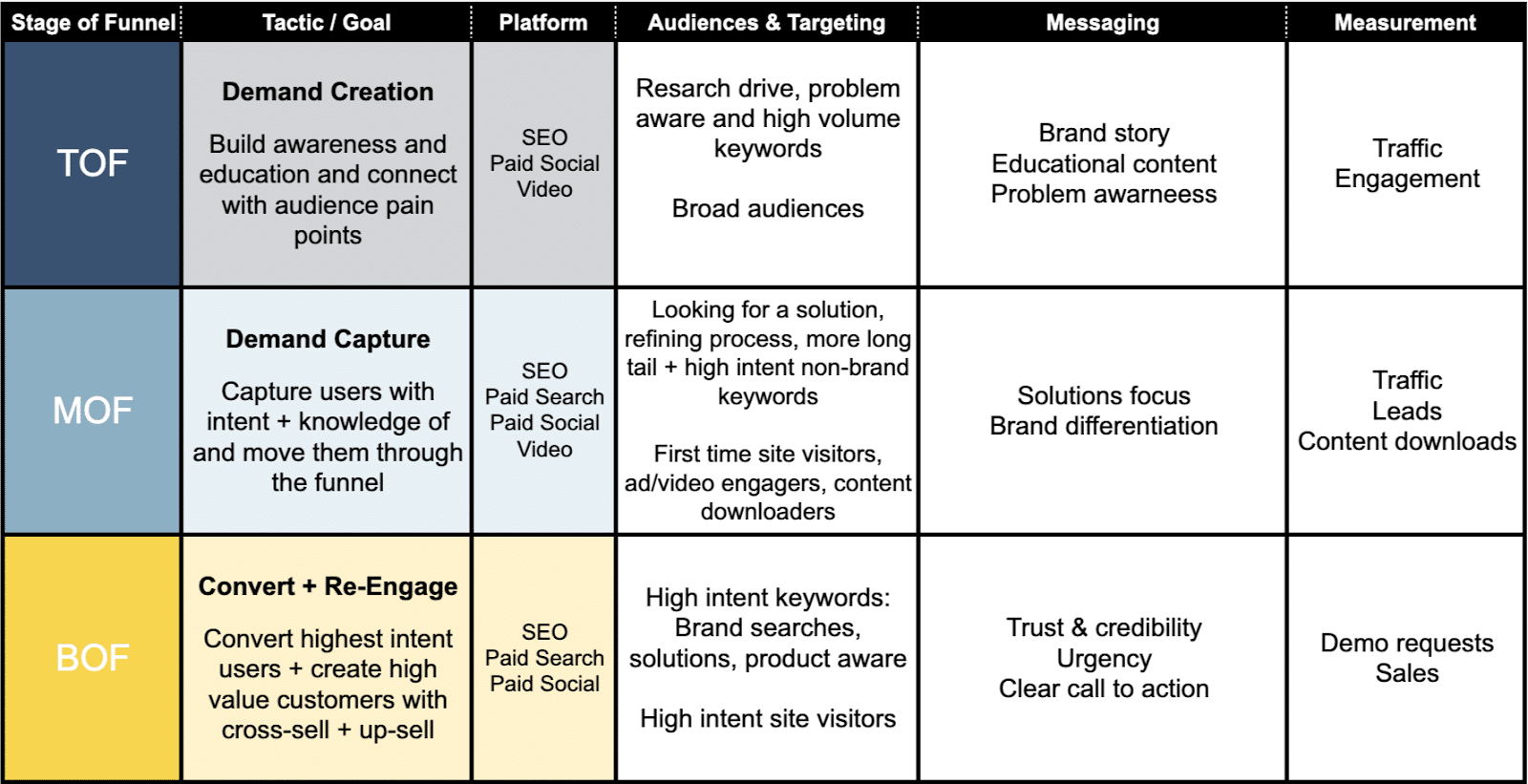
I use this chart all the time with my clients (and sometimes in my articles for Search Engine Land):
The top of the funnel is about educating and relating to the user:
- What they need to learn.
- What challenges they need to solve.
- What they need to know about their problem.
At this point, it’s about relating to their pain points and starting to build trust more than what they need to solve than they do about who’s solving it for them.
The middle of the funnel starts tying solutions to problems and introduces your brand as the option:
- Why your solution works.
- How it’s different from your competitors.
- The results you’ve driven for brands with similar challenges.
This stage assumes the user has their head around their challenge and is now actively researching solutions to help.
The bottom of the funnel brings in more emotion and third-party proof. This stage assumes the users have a shortlist of solutions in mind and are looking for reassurance, from case studies and testimonials, that yours is the one for them. This is also when you can start leaning on urgency, with limited sales windows or expiring promotions.
The most important thing to remember from all of this is that thoughtful nurturing is key to good lead gen. If you’re using bottom-funnel tactics for people who haven’t heard of you yet, you’re only wasting time and possibly turning users off from your brand.
Get the daily newsletter search marketers rely on.
How to align the channel mix and the funnel stage
Top-of-funnel channels
Starting with awareness/top-of-funnel targeting should mean starting on LinkedIn (and, for some brands with access to the right audiences, possibly on Facebook).
My first option is always to start with LinkedIn prospecting because:
- Costs are cheaper for top-of-funnel engagement than they are for lead generation or conversion.
- LinkedIn’s company-based targeting means you can go fairly broad and still stay within your ICP.
LinkedIn is a great place for educating users and positioning your brand as a thought leader; people go to LinkedIn to consume content, perhaps in the form of thought leader ads, and are open to high-quality, informative engagements.
I approach Facebook prospecting with caution, but it can be worth testing depending on the audience.
Middle-of-funnel and retargeting channels
Once someone has engaged with your brand and content, you should have started to narrow your audience.
Whether you’re retargeting content engagers or focused on accounts that have engaged with sales in some way or piped-in audiences from tools like Clearbit or 6Sense, I recommend choosing the following combinations of ad types and channels:
- LinkedIn sponsored content and conversation ads.
- Facebook and Instagram in-feed ads or video ads, with messaging that aligns with your audience and funnel stage.
Given my thoughts on Facebook prospecting, you might be surprised at my preference here. But you’ve already defined the audience.
Facebook/Instagram can help expand your audience matching scope beyond LinkedIn (where we’ve seen plenty of audience match degradation), and retargeting costs tend to be lower.
Bottom-of-funnel channels
Focusing on users who have engaged with high-intent content or visited your site multiple times is a crucial audience for this stage.
Ensuring coverage for paid search and high-intent SEO queries are the bread and butter for capturing intent at this stage, but paid social is a great way to generate that last step of intent by using social proof like case studies, testimonials, etc. – and sealing the deal with demo offers.
These will be your highest engagement costs of the campaign, and they should be, since leads at this stage are (assuming you’ve qualified them along the way) extremely valuable.
Dig deeper: How to implement a full-funnel PPC marketing strategy
How to qualify users with content
This happens throughout the funnel, and lots of this work is done with the type of content you’re offering.
For instance, your content should help the platforms’ bidding and targeting algorithms identify the audience’s pain points, solutions, etc. (Facebook’s algorithm can do this, but it doesn’t have the all-important layer of company targeting that LinkedIn does.)
There can also be ways to increase engagement within your ICP by speaking directly to them in your copy. Identifying opportunities to call out your audience in messaging is a great tactic.
For example, if you’re targeting CFOs, try “CFOs’ Favorite Answer to {Challenge} in 2024” or something similar that lets them know your content is for them.
The bonus here is that the more tightly you align your messaging with your ICP, the more you can delineate who falls outside your ICP and shouldn’t bother engaging with your ad.
Dig deeper: Paid search for lead gen: Tips for new accounts with limited budgets
Aligning tactics to intent: A better B2B lead gen approach
Above all, remember to consider the user’s mentality when developing your lead gen campaigns.
Don’t:
- Ask for too much too early.
- Get silly with retargeting frequency.
- Bother spending for bottom-funnel engagement without so much as a how-do-you-do.
Cookies or not, adhering to those principles will help you eliminate a lot of waste from your lead gen campaigns and keep your brand from developing a pushy reputation.
Courtesy of Search Engine Land: News & Info About SEO, PPC, SEM, Search Engines & Search Marketing
Thursday, May 16th, 2024
Netflix’s ad-supported tier is rapidly gaining traction, reaching 40 million monthly users globally, the streamer announced at its 2024 Upfront presentation.
The paid ad offering, initially seen as a risky move, has quickly become a hit for Netflix as it seeks new revenue streams amid intensifying streaming competition.
Why we care. Netflix’s platform offers advertisers a large and expanding pool of potential customers. If you’re looking for new advertising opportunities, you may want to explore streaming audiences.
Driving the news. Just six months after hitting 5 million ad-supported subscribers post-launch in late 2022, that number has now swelled to 40 million.
- In regions where the ad tier is available, over 40% of new Netflix sign-ups are opting for the cheaper ad-supported plan.
- The service now has 270 million total subscribers across all its pricing tiers.
Between the lines. Netflix is doubling down on the ad business by bringing its ad tech in-house.
- It’s launching its own advertising platform to “power the ads plan with the same level of excellence” as its streaming tech, per Netflix’s president of advertising Amy Reinhard.
- While initially partnering solely with Microsoft, Netflix is now also tapping Google, The Trade Desk and Magnite for its ad sales and tech.
What they’re saying. “Our ad membership has been an overwhelming success,” Netflix co-CEO Ted Sarandos said during the presentation. “We’re just getting started on that journey.”
The bottom line. Netflix’s ability to rapidly scale its ad business demonstrates the power of its brand and content – signaling a secure new revenue pipeline as it branches further into advertising.
Courtesy of Search Engine Land: News & Info About SEO, PPC, SEM, Search Engines & Search Marketing
Wednesday, May 15th, 2024
While the concept of entities for SEO has been around since 2012, it hasn’t been a widely adopted in PPC. Entities are essentially unique people, places, things or concepts that provide context and relationships for keywords.
As AI becomes more prevalent in digital marketing, incorporating an entity-based approach into your PPC campaigns is a way to get ahead of the competition. This article dives into how leveraging entities can significantly contribute to PPC success.
1. Entities for PPC keyword expansion
If you’re struggling to expand your keyword list, taking an entity-based approach could expand your horizons.
Entities are important because of their relationships with other entities. Thinking about these relationships can help you uncover ideas and insights that resonate with different groups of people based on their intent. In short, consider the context and assumptions behind searches and use that to brainstorm new keywords.
Here are some questions to consider when brainstorming entity-based keywords:
Activities: What are people doing in relation to my product/service?
- Entity identification: What specific activities or interests are associated with my business and product/service?
- Entity relevance: How does my product/service relate to these activities as entities?
- Entity pain points: What challenges do people performing these activities typically encounter?
- Entity solutions: How does my product/service address and solve these pain points?
Location: Where are people who may need my product/service?
- Entity scope: What geographical locations are relevant to my business as entities?
- Entity presence: Where are the majority of my customers located and how does that relate to location-based entities?
- Entity associations: What local landmarks, neighborhoods or events can I associate with my business to enhance local entity relevance?
- Entity impact: How do geographical entities influence consumer behavior and preferences in my target locations?
Season or event: When would people need my product/service?
- Entity timing: What seasonal trends or events are relevant to my business?
- Entity impact: How do seasonal or event-based entities influence my potential consumer behavior and preferences?
- Entity integration: How can I integrate seasonal or event-based entities into my copy and imagery to enhance relevance?
- Entity promotions: What special promotions or offers can I create to capitalize on seasonal or event-based entities and drive engagement?
By incorporating these entity-based principles into your PPC keyword expansion strategy, you’re building a more comprehensive advertising approach that closely ties into your site’s relevance and authority.
Get the daily newsletter search marketers rely on.
2. Entities for improved PPC quality scores
In PPC, it’s relatively easy to determine if your website accurately presents the entities and relationships you want it to; simply check out your quality scores.
If your website follows an entity approach and the accompanying PPC campaigns are aligned with that approach, you will see high quality scores, which mean lower costs-per-click and higher click-through rates.
Quality Score is calculated by Google based on three factors that are heavily influenced by entity recognition:
- Expected click-through rate (CTR): Entities influence the click-through rate of your ads by ensuring that your campaigns align with the interests, intents and preferences of your audience. When your ads resonate with users based on their search queries and interests, they are more likely to click through to your website, resulting in a higher expected CTR.
- Ad relevance: Entities ensure your ads are relevant to users’ intent, not just matching keywords. By optimizing your ad copy to relevant entities, you increase your chance of delivering ads that match what users intend to find, which boosts ad relevance.
- Landing page experience: The entities on your landing pages directly impact the landing page experience. When your landing pages provide relevant content that aligns with the entities highlighted in your ads, users are more likely to have their expectations met by your website and a positive experience with it.
Essentially, the more cohesive the journey from search term to delivered ad to landing page is, the more positive the user experience will likely be.
Quality score is the search engine’s attempt to evaluate whether you’re delivering content that users want to see. Giving them something that perfectly matches their intent with the final result is a quality search experience. And it’s much easier to account for intent with entities than keywords alone.
3. Entities for strategic PPC audience targeting
Traditional audience segmentation lets you identify key demographics to target, such as age, device and location. But when you combine those insights with the contextual relevance of entity-based targeting, you hone in on who your audience is and who your audience could be.
For example, you may be working on the PPC campaigns for a local restaurant. Sure, they may only want to target the local geographic area, but don’t stop there.
Using entity-based PPC strategies, you would have a campaign targeting the local geographic area and targeting users’ interests, behaviors and relationships with entities across the broader geographic region. This could be a campaign targeting all audiences interested in a local food festival or a campaign targeting users searching for a tourist activity nearby.
AI-powered targeting options, such as behavior and audience-based targeting, have been used in ad platforms for some time. Custom combination segments can make them even more effective.
Admittedly, they are a respectable attempt by search engines to find relevant consumer segments that are connected but that may not be directly related to your product or service. If you’re not taking advantage of these audience options, you’re wasting potential.
The real beauty of entity-based targeting is in the numbers and information it provides, even if it “fails.” Remember that you always learn something from a well-designed experiment.
By analyzing the data on different audience segments, you can refine your targeting strategy to identify the high-performing segments that deliver the best ROI. You may also discover new consumer groups and behavioral insights that can guide your broader marketing strategy.
In our earlier restaurant example, they may find that adding a new dish to their menu directly referencing nearby tourist attractions increases the number of out-of-town visitors. I can guarantee they will not discover this by limiting their reach to only a local campaign sourced from Google’s Keyword Planner.
Optimizing your campaigns with an entity-based approach
I like to think of entities as AI’s attempt to codify the human penchant for assumptions, undertones and subtleties in our communication.
If you’re looking to get ahead of your competition, tailoring your PPC efforts to account for entities is a great approach because so few companies are investing time in it right now.
Whether you’re a global brand or a local restaurant, incorporating entity-based strategies into your PPC playbook will help future-proof your marketing efforts and drive performance.
Courtesy of Search Engine Land: News & Info About SEO, PPC, SEM, Search Engines & Search Marketing