Archive for the ‘seo news’ Category
Thursday, June 13th, 2024
Reddit is partnering with ad measurement firm Integral Ad Science (IAS) to provide advertisers with third-party validation for campaign delivery across its platform.
Why it matters. The integration of IAS’s Total Media Quality suite gives Reddit advertisers globally an added layer of trusted, independent measurement around brand safety, viewability and invalid traffic.
Why we care. Brand safety and transparency have always been concerns for advertisers. Integrating trusted third-party verification directly into Reddit’s ad platform could provide vital campaign insights to justify ad spend and growth on the platform.
The details. Through the new offering, Reddit advertisers can:
- Leverage GARM-aligned brand suitability and quality metrics from a trusted third party.
- Gain video-level insights using IAS’s AI-powered multimedia analysis.
- Layer IAS’s measurement with Reddit’s existing moderation capabilities for enhanced brand protection at scale.
- Access unified campaign reporting and insights within IAS Signal.
Get the daily newsletter search marketers rely on.
What they’re saying. “Third-party validation…equips Reddit advertisers with the tools they need to grow on our platform confidently,” said Reddit’s Jim Squires.
From IAS’s Lisa Utzschneider. “Our partnership will give Reddit customers…reliable and accurate data, so they can focus on driving business growth.”
Between the lines. Transparency has become table stakes for ad platforms courting big brands’ budgets. Reddit’s IAS integration aims to provide that assurance.
The big picture. Social platforms are working to combine their rich first-party data with trusted third-party verification to drive advertiser confidence and spending.
What’s next. The IAS integration will roll out to Reddit’s global advertiser base later this year.
Courtesy of Search Engine Land: News & Info About SEO, PPC, SEM, Search Engines & Search Marketing
Wednesday, June 12th, 2024
Performance Max is a versatile campaign, but understanding the nuances and adapting it to the account you’re working on can be the difference between investing budget and burning it.
One significant reason is that the quality and intent of traffic from Performance Max can vary considerably based on how you configure it. This will depend on your choices around retargeting, new customer bidding and segmentation with other campaigns like Search or Shopping.
In this guide, I’ll walk you through the different approaches to Performance Max:
- Three ways you can set it up.
- How to use it for different types of ecommerce brands.
- How to use it with lead generation businesses with differing budgets.
- Why it’s the only way to access local ads.
3 different ways to set up Performance Max
Performance Max can be a different beast depending on how you set it up and how much data you feed it, but there are three general approaches:
- The full-funnel version (or Performance Max as intended by Google) covers all inventory types and uses the full range of creative assets, audience signals and data feeds. This can be used for ecommerce, private label brands, retailers, lead generation and multitudes of products and services.
- The “Smart Shopping” style only uses the product feed by disabling or turning off all creative assets. When creating a new asset group, all fields must be empty: headlines, descriptions, images, videos, logo, business name, etc. The CTA must be set to automatic. You’ll also want to turn off URL expansion to prevent the system from choosing an alternate page to send traffic. Also, consider excluding your brand name to force the algorithm to focus on searches from net new users who don’t already have you in mind.
- The “social style” campaign emphasizes creative assets with strong audience signals, first-party data and customer lists. Accounts with large budgets can use this to grow reach and awareness.
Now let’s look at the nuances of the different types of ad accounts that might use one or more of these Performance Max setups.
Performance Max for ecommerce
Performance Max and ecommerce seem to be made for each other; it’s certainly the best use case we have today for Google’s machine-driven campaign.
However, many ecommerce advertisers continue to make fundamental errors that impede success such as:
- Treating audiences and audience signals like they work the same way.
- Forgetting to optimize or keep their product feed up to standard.
- Structuring their campaigns poorly, such as too many or too few asset groups.
- Ignoring the potential to run Shopping campaigns alongside Performance Max.
- Accepting auto-apply recommendations from Google without knowing what they do.
- Not optimizing assets and asset groups to each win the right traffic.
- Using the wrong bid strategy at the wrong time.
Fortunately, these are all fixable. If you struggle with any of these, learn how to solve seven mistakes that tank retail Performance Max campaigns.
DTC ecommerce
For direct-to-consumer ecommerce brands, Meta is still the holy grail of advertising channels. It’s tough to argue with that position, given how many brands have scaled on the back of growth programs centered around Facebook and Instagram ad campaigns.
But no channel is immune to challenges like volatility, saturation and reliability. This is why I recommend that ecommerce advertisers test out Google Ads, even if they want to remain Meta-first.
When it comes to Performance Max, these brands have a couple of traits that are relevant:
- They generally have relatively fewer SKUs, often in the single digits or a few dozen.
- Products are closely related (i.e., brands won’t sell a popcorn maker or makeup).
- All these products are clustered under a single brand.
- Very often, these are invented/formulated products rather than branded commodities.
These all impact decisions around how many campaigns you need, how to structure each one and what work you need to do on your feed, creatives and landing pages.
With all of those in place, you’ll want to make sure your product feed is in order, that you use captivating product imagery and that you build a post-click experience that excites people enough to convert.
Retail ecommerce
One key distinction between DTC and retail ecommerce is that the latter generally advertise a larger number of SKUs across multiple brands. Within this segment, I see two clear distinctions:
- There is the mass retailer with hundreds or thousands of commoditized products from dozens or hundreds of brands. This advertiser is almost always going to want to do either Smart Shopping-style Performance Max or Shopping, very rarely opting for creative or audience signals.
- Then you have what’s called private label brands. These advertisers sell their own line of products like fashion apparel, generally with fewer SKUs than mass retail. Private labels also sell products that typically do well with ads on Meta and YouTube, so Performance Max can lean into that.
For both, Performance Max can send very different types of traffic to their website or landing page. Much of the quality will be determined by how the campaign is structured, including bid strategies and whether the account uses brand exclusions to ensure incrementality.
Teaser of an analysis for bid strategies in Performance Max ecommerce campaigns. Click like and I'll either tag you or DM you when the research drops next week.
95% of PMax advertisers are using max conv. val
Any guesses how many are setting an efficiency target?#ppcchat pic.twitter.com/sH6vI4HpKc
— Mike Ryan (@mikeryanretail) June 23, 2023
I spoke to one advertiser who shared an audit of his Google Ads account, saying that he paused Google Ads and overall revenue was not impacted at all.
I can see why in that audit.
The campaign simply brought back people who were already going to purchase from him (i.e., a lot of branded and retargeting traffic). But you can set up Performance Max to focus on net new customers and new business.
Get the daily newsletter search marketers rely on.
Performance Max for lead generation
What exactly makes Performance Max such a hassle for lead-generation accounts? Aside from the variety of inventory these campaigns can serve, the biggest challenge is the actual nature of lead generation.
In ecommerce, a purchase actually is the conversion.
The creation of a lead, however, is just the start. Just because you get a conversion from a form doesn’t mean you’ve made the sale or that they’re even qualified to sell to.
This is why offline conversions are critical: You can train Performance Max on which “conversions” became sales or at least got close to contributing revenue. Without that, you’re letting Google optimize future leads based on that limited window of data.
Low-budget lead generation
Running ads for a service or lead-based business is difficult enough. When that account is new or limited by budget, competing against high-spending accounts with plenty of historical data makes it even tougher to crack the code.
If your business or client is new to Google Ads or has a modest budget, that’s when they need more support and calculated decision-making.
With just a few hundred or thousand dollars in budget, the pressure is on for everything to be dialed in and working well. The truth is that in this scenario, Performance Max is probably not your best friend.
We've had some success on lead gen with PMax, and verified the quality with lead tracking. Many times the traffic is garbage, but we've had a few clients that get a good number of leads from PMax that are quality.
— Mark Subel (@marksubel) May 30, 2024
Because Performance Max is driven by machine learning, a new account with no historical data – or one that doesn’t spend enough to gather enough of it – is better off running a traditional Search campaign.
Additional reading:
High-budget lead generation
If you’ve got the budget to tolerate some of Performance Max’s issues and lower-quality placements, there are also ways of making it work for lead generation.
The most important prerequisites for this are:
- Implementing some type of spam protection, like a reCAPTCHA for form submissions or a qualifying script for call conversions. Performance Max has a very real issue with spam traffic, so you’ll want measures in place to minimize this.
- Setting up offline conversion tracking by connecting your CRM or other customer database to Google Ads, either natively (for Salesforce or HubSpot) or through Zapier. This feeds the post-conversion sales data back to Google, using the hashed Google Click ID (GCLID) to tell the system which leads were most valuable.
Check out this detailed guide on how to set up these protective measures for lead-generation Performance Max.
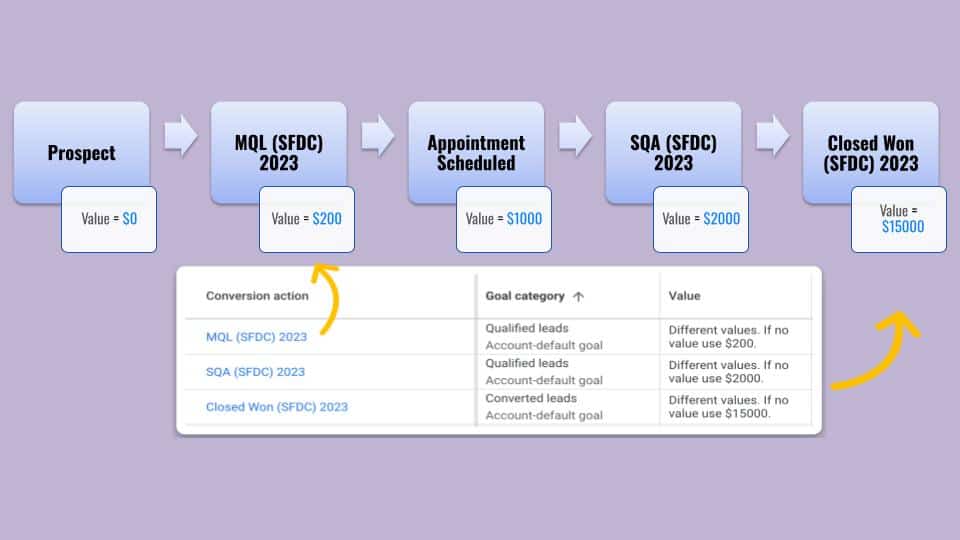
You might also want to consider implementing a value-based bidding strategy, where you assign pipeline stages different values based on what each CRM deal stage is worth to your business.
Google is then able to find more leads in the future who share the data points that it determines your revenue-generating conversions have in common (this is also done using the GCLID as an identifier).
Here’s an example of how that looks for a Salesforce-connected account progressing from prospect to closed-won. You can see that an appointment being scheduled makes a lead five times more valuable than the previous stage, while a closed-won deal is 15 times more valuable.
This approach to lead valuation tells Google to find more people who are likely to progress further down this path, improving your overall conversion rate and limiting how many low-quality leads clog the pipeline.
Performance Max for local businesses
In 2022, Performance Max absorbed local campaigns.
For businesses that make sales from physical locations but advertise on Google, Performance Max is the primary way to access these features that include paid placements on Google Maps, Display, Search, YouTube and other inventory.
5⃣ Can I run Performance Max for a local business?
Yes. Local campaigns were rolled into PMax, so if you want to advertise on Maps, you’ll have to use it.
Turn off Location Expansion in campaign settings. I recommend setting target areas to within a 30- or 45-minute drive.
— Menachem Ani – Google Ads  (@MenachemAni) February 20, 2023
We’ll consider this somewhere between lead generation and ecommerce for the purposes of this exercise since conversions can span anything from actual orders to local actions like calls or requests for direction, where the actual transaction takes place offline.
Needless to say, offline conversions are critical if your business doesn’t or can’t sell online, such as a hairstylist or a shop with a limited delivery range. If this proves too difficult an obstacle, you will need to switch to something less dependent on offline data, such as Search or Display.
Bottom line: Test it before you write it off
As we go deeper and deeper into what was once a future vision of automated advertising, Performance Max occupies a unique place: it is at once a powerful tool and one that can drive accounts into the ground if poorly used.
Whether you’re a DTC ecommerce giant with deep pockets, a small business trying to get leads on the internet – or an agency or marketer working with those kinds of brands – it’s important that you understand its capabilities and limitations.
As always, test everything. If you don’t like what you see in Performance Max, you can always double down on another campaign, go back to what works or find something new to experiment with!
Courtesy of Search Engine Land: News & Info About SEO, PPC, SEM, Search Engines & Search Marketing
Wednesday, June 12th, 2024
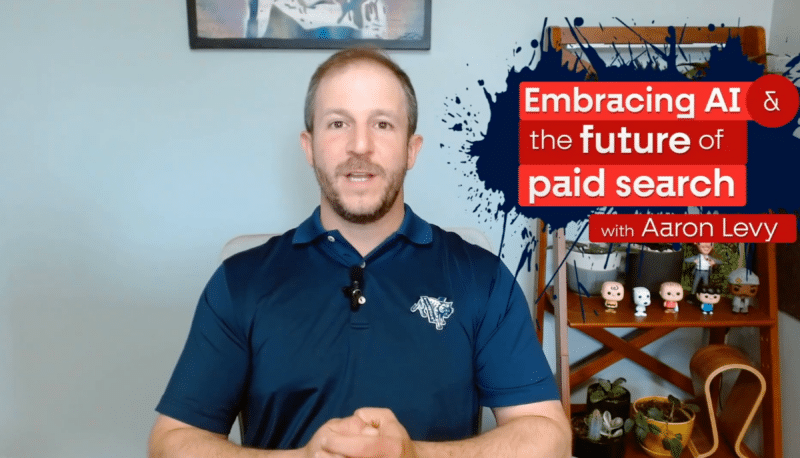
SMX Advanced Day 2 kicked off with Aaron Levy reminding us about the complex nature of search marketing and the need to focus on customers in our strategy.
Here are some highlights of his keynote talk, which included a look back at what the search marketing industry has been through, how the new wave of AI change is nothing new and his bet on the fact that search isn’t going away anytime soon.
1. Search will not die but it will evolve from its current state so long as marketers stop clinging to outdated views of paid search as a perfect direct response channel.
“Search survived some serious hits, in the case of the show, Nuclear Fallout, it carries the weight of what it used to be and what it’s known for. It’s adapted into a really hostile environment and is sometimes not so savory to survive. I think too many search marketers are just holding on too closely to what we think paid search used to be – that is a perfect direct response channel, which I’ll argue it never really was.
It certainly isn’t now – it’s a factor in a customer journey.”
2. Generative AI and assistants are transforming search into more of an ‘answer engine’ that tries to understand and address queries before they are asked.
“Sundar Pichai from Google’s Q4 earnings call earlier this year said that generative AI will allow Google Assistant to act more like an agent over time, and that it could eventually go beyond answers and follow through for users and even more. And then at I/O in mid May, Google announced a number of new features that even further reflected their intention, which is to become an answer engine rather than a search engine.”
3. Modern search marketers need a broad and deep understanding of all available marketing tools/channels beyond just search ads.
“[Search Marketers] needs a broad and deep understanding of all the tools in their toolbox. These features can be and often are extremely profitable, but developing a core understanding of exactly how they work and help you understand when and where you want to deploy them.
Should you be exploring in your branded search campaigns?
Probably not.
Should you be exploiting retargeting even though it’s not particularly incremental?
I don’t think so, but that’s up to you to determine. And developing an understanding of how the machine makes decisions is crucial to making that decision for yourself.”
4. Performance marketing metrics alone are inadequate – there needs to be a mindset shift towards branding and incrementality.
“We have to evolve away from a performance only view, or what I like to call the searchy view. There’s always been this weird battle between performance and brand marketers.
And it’s time for that fight to end. Performance and branding are not separate. They are done at the same time. They are one and the same. We use different metrics, we use different measurements and we might have different goals and certainly the tactics are different, but they happen at the same time.
We very likely contributed to a conversion, but did we cause it? Not sure. We’re part of a more complicated journey and so one of the most complicated things that we have to do as modern search marketers is to provide engines the right guidance, the right reward mechanism, the right incentives and the right assets to do their job properly incentives or goals or conversions or whatever you want to call them are probably best thought of as compasses for automation.”
5. Customer-centricity is crucial – leverage audiences, alternative KPIs, and creative assets to move customers through the full funnel journey.
“For the past couple of years, I’ve comfortably been saying that keywords are optional in PPC and audiences are not. I stand by that. Think about the good old-fashioned marketing funnel. Yes, the customer journey is complex, but a funnel is the easiest way to understand it.
We don’t need every date with a customer to point directly towards marriage. You have to leverage alternative KPIs to help move people through the funnel rather than just swinging for the fences on the first pitch.
Especially when the industry is so much more crowded now, there’s so much more competition within search. We have to get a little bit more creative.”
6. Search is no longer just about keywords and language – it’s about understanding customer behaviors, problems, and emotions to provide relevant answers/solutions.
“Aim for the heart and the head will follow. What it’s going to mean is that we have to go beyond a simple question and answer. The question that people are asking is never as simple as what they’re actually saying, and the answer we provide needs to speak toward their emotions, their problems, whether they know they exist or not, we have to tell them – ‘Hey, I’m going to make your life better’
We’ve never really done that in search because we made the relationship so transactional.”
7. Search is part of a larger, complex customer journey that spans multiple touchpoints before and after the search.
“People are weird and people are inconsistent. Search isn’t always the most influential part of the journey. It’s almost always part of it, but it’s rarely what actually caused the conversion.”
8. New AI-powered search experiences may reduce site traffic, necessitating new affiliate/commission ad models.
“I think the interesting thing will be that we expect SGE experiences to generate way less site traffic.
I anticipate there’s going to be some sort of an affiliate negotiable commission model coming soon. We’ll see, but in my opinion, I think local services ads and some of the other products that Google and Microsoft have that are commission based, I think those are going to become more of the norm, which is going to make evaluating the value of a conversion even more important.”
9. Search marketing’s evolution requires adaptability – understand how new AI tools work and how to strategically deploy them to solve customer problems.
“We have to remember that these new tools coming our way are just that. Tools.
We have to understand how they work, what they do, and how best to deploy them. There’s an old quote that says ‘if the only tool you have is a hammer, every problem looks like a nail.’ We have complex problems, we have complex tools to solve them.”
10. While search advertising faces changes, search itself is not going away as long as people have questions that need answering.
“Search as a medium is not going anywhere. As long as internet users have a question that needs answering, search will be there.
We simply have to understand that we are structuring our efforts around people, not just language. We are looking at problems. We are looking at their behaviors. We’re looking at their hopes and their dreams. We are saying that we are the answer.”
How to watch the keynote
Register for SMX Advanced to see Levy’s full keynote – as well as dozens of other sessions from yesterday and today.
Courtesy of Search Engine Land: News & Info About SEO, PPC, SEM, Search Engines & Search Marketing
Wednesday, June 12th, 2024
A short while after Google announced it would pause low-activity keywords, the Optmyzr team ran a study and got reactions from paid search experts to figure out how marketers may be affected, what shifts (if any) it would cause in advertiser management styles and what risks come with this update.
The big picture. Google’s plans to automatically pause long-idle ad keywords have sparked debate among marketers – some see it as overreach, while others say it’s overdue account maintenance.
What’s happening? Google will start automatically pausing search ad keywords and ad groups that have gone 13+ months without any impressions or activity. The change, initially met with mixed reactions, aims to streamline the management of stale entities.

The concerns. Some advertisers believe leaving dormant keywords maintains account history and relevance signals. Others fear prematurely pausing viable terms that see sporadic bursts of traffic.
The data. The Optmyzr study of over 9,400 Google Ads accounts found:
- 84% of accounts had 50%+ keywords with zero impressions in 13+ months.
- Pausing those terms likely won’t hurt performance for most.
- Only 145 large accounts (1.5%) risk potential performance loss.

Why we care. While most small account advertisers may welcome the account clean-up, larger brands with established keyword-level control may face challenges adapting to increasingly automated, opaque Google Ads management
The upside. Most accounts stand to gain streamlined structures and simpler budgeting after the pauses, aligning with Google’s push for automation over manual management.
What they’re saying. “Google continues to blur the lines between platform and ad partner” by making organizational calls like this, marketing consultant Kirk Williams, owner of ZATO, told Optmyzr.
Bottom line. While valid fears exist around losing viable keywords, most advertisers likely have little to lose – and may see gains – once long-dormant terms get automatically parked.
Courtesy of Search Engine Land: News & Info About SEO, PPC, SEM, Search Engines & Search Marketing
Wednesday, June 12th, 2024
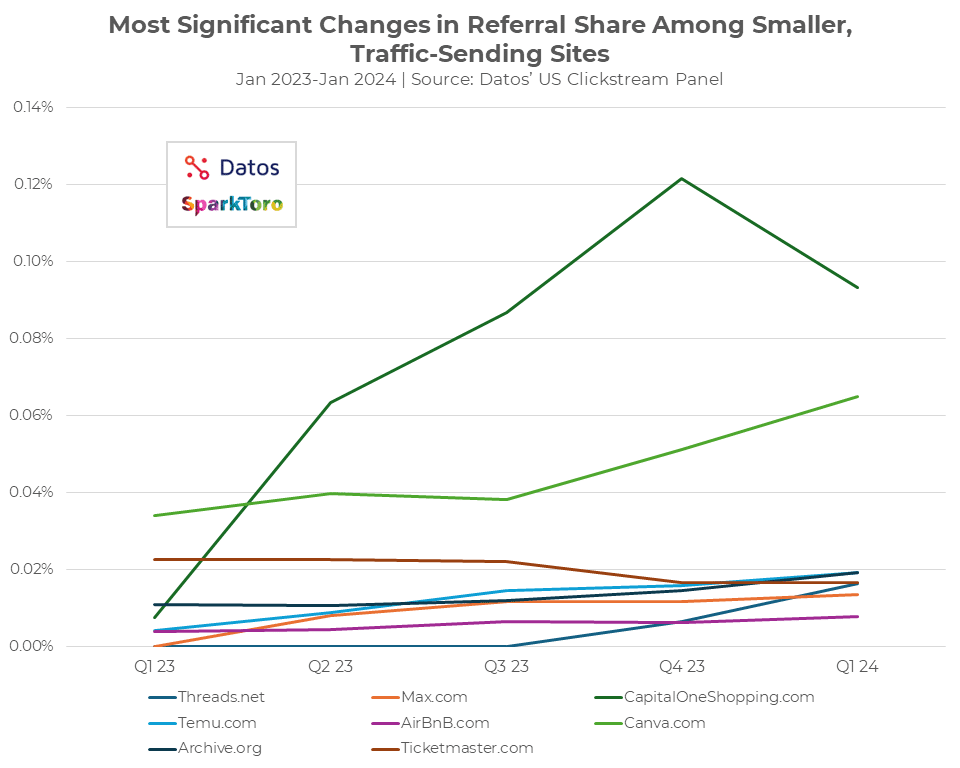
In March 2024, SparkToro and Datos published a study revealing insights about “where users spent time vs. where traffic referrals originate.” It has been seen by over 250,000 people since being released.
SparkToro Founder Rand Fishkin later wrote a clarifying article concluding that you should never focus on SEO, stating:
“The only reasonable move is to invest in the sources of influence to which your audience pays attention: social accounts they follow, YouTube channels they watch, podcasts they listen to, websites they visit, events they attend, etc. Anything else is missing out on opportunity.”
At a glance, I thought the data was insightful. But as I dug deeper, I found that the insights seemed misleading.
Fishkin holds enormous sway over some marketers. If you’re one of the thousands who read this study and analysis, I urge you to read this article before leaving SEO out of your marketing mix and overly focusing on social channels and Threads.
Study overview
Based on the data’s story, you might conclude the following:
- Search engines drive the most traffic, but you can’t generate any business results, so focus on marketing on sites with the most traffic and audience.
- Social is the largest count of visits, so focus the budget there.
- Threads is the fastest-growing visited site, so pay attention to it.
The first sentence in the report stated:
“‘Most of our site’s traffic comes from Google, so most of our digital marketing efforts and spending should be on Google, too.’ – An absolutely terrible way to invest in marketing.”
This sets the tone for how a reader should interpret the report’s data.
The “Site Categories That Sent Referrals vs. Received Visits” chart is a great summary of the data. It shows that visitors visit sites to learn or engage on that platform, while search engines drive more traffic than the other sites combined. Social is the top-visited site category.
The study further demonstrates that Threads’ traffic is growing faster than other top-visited sites
Now, the comment from Fishkin above becomes important:
“The only reasonable move is to invest in the sources of influence to which your audience pays attention: social accounts they follow, YouTube channels they watch, podcasts they listen to, websites they visit, events they attend, etc. Anything else is missing out on opportunity.”
So we’re being encouraged to invest in Threads and social over SEO. But does it work?
SparkToro follows this mix – and appears to be failing
If excluding SEO and focusing only on social media worked, why is SparkToro losing traction and growth?
SparkToro is Fishkin’s tool for audience research. It grew almost entirely because of Fishkin’s following and push on social media. This following created a short-lived interest that started to decline heavily in 2024.
The tool only ranks in the top 3 for brand keywords like “SparkToro” or “audience research tool,” which have low interest and an average monthly search of 170.
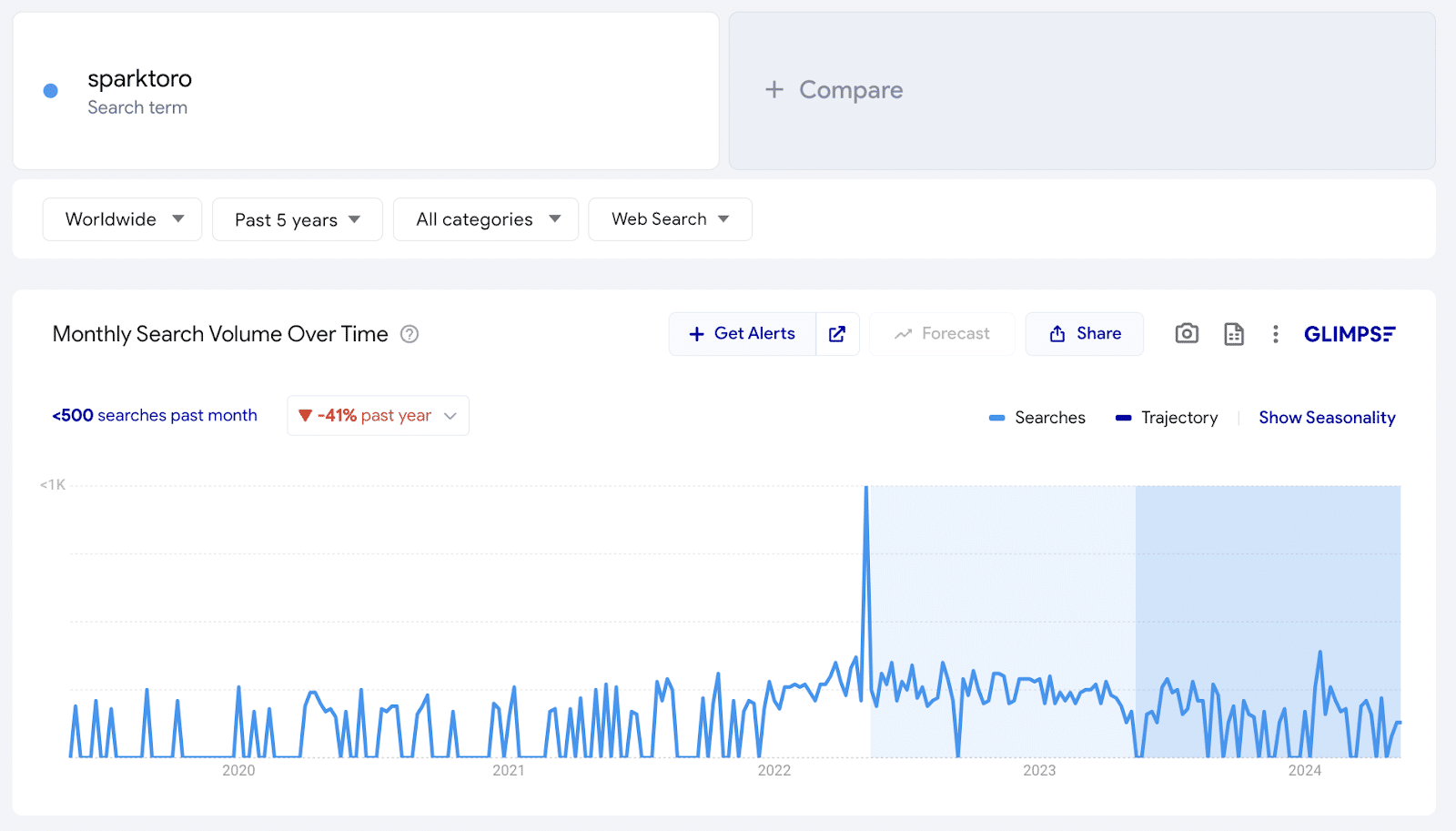
Google Trends shows a 41% decrease in brand search volume for “SparkToro” in 2024 from 2023. Looking at the SparkToro pricing page on archive.org, the lowest-paid package’s pricing in April 2022 was $150/month and is $50/month as of 2024.
A decrease in price and brand search shows a declining user base and a need to attract or retain users. Overall, the tool gained interest but then started to decline.
If focusing on social works, shouldn’t SparkToro be doing better?
SparkToro seems to be underperforming right now. However, the team may be playing a long game and focusing on designing an entirely new category for “audience research tools.”
Search volume for the keyword “audience research tool” started to grow after SparkToro launched in 2018 and increased by 33% in the past year. These are the telltale signs of an emerging category.
“Audience research tools” is a keyword someone would use to find a tool for “audience research.” This keyword has high buyer intent for software that provides insights into where a brand’s audience lives online.
SparkToro is actually doing SEO but trying to create demand for the keywords it already ranks for. It ranks in Position 1 for the keyword “audience research tools,” according to Semrush.
Users from non-brand searches are looking for something specifically to solve a problem and understand how products or services relate to the solution they need. This is a buying intent.
But if you are not creating a new market category, why not rank for high-search keywords in your existing category with buyer intent?
Get the daily newsletter search marketers rely on.
Can search work in new market categories?
SEO can drive growth by ranking for adjacent market segment keywords in new market categories but solving similar problems for that audience.
Adjacent markets are ones where your product, service or idea solves a similar problem or opportunities with a different audience.
For example, SparkToro allows you to build a list of contacts on press sites with overlapping audiences. The site could then create an integrated PR and SEO campaign to help corporate PR or communication professionals find audiences related to their target publications.
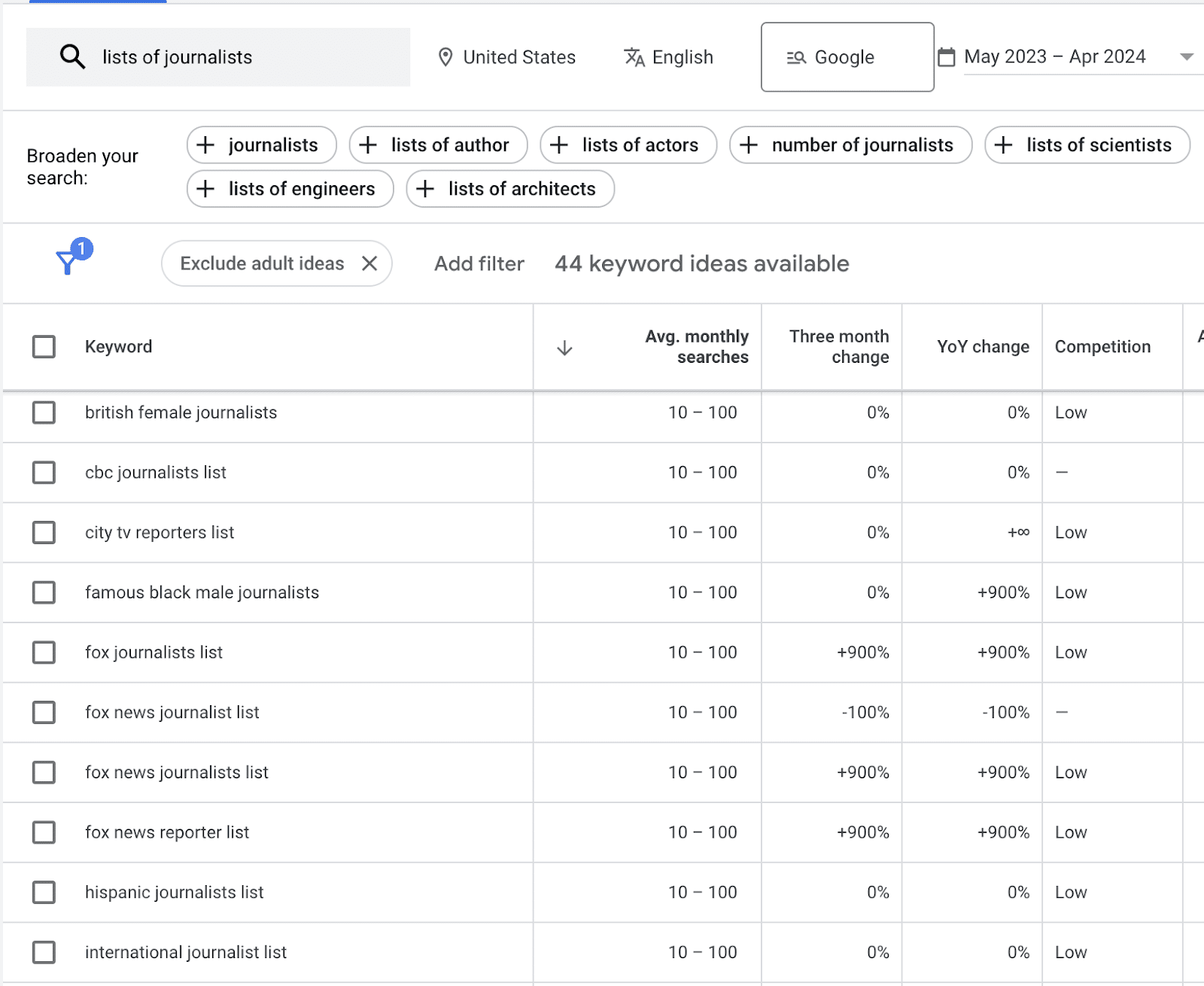
In this scenario, they could create a campaign around “journalists seed list audiences” where they build a landing page with a list of contacts at CBC or Fox.
The purpose of this page would be to help comms professionals looking for contacts at one publication convert and build a list of all publications and platforms where the same audience visits.
Although these individual keywords have low search volume (e.g., “CBC journalists lists has 10-100 avg. monthly searches), creating these across hundreds of publications and then doing a PR topic tour to explain how comms professionals can improve campaign performance by these targeted publications.
The campaign could look something like this:
- Funnel: Drive demands around finding the audience for Fox or CBC, then sign up for a new tool or feature specific to finding audiences for these major publications or journalists.
- On-page: Create landing pages around each media outlet or an “audience profile kit” of sorts. This landing page could highlight all the places the audience visits for those publications, contacts, audience demographics, etc.
- Search engines: Ranks the audience scorecard for “CBC journalists list” or other publication names.
- PR topic tour: Have an expert appear on podcasts or webinars to talk about how to find the audiences for these publications and create a study showing the audience’s path.
Searching for an audience by specific groups of journalists would make targeting more precise, as people often read only certain sections, like business or lifestyle. This data could be useful on the landing page.
These pages’ content could also be a new feature or widget for the site, showing that keyword data can be used to understand the audience’s needs and test new features.
You could argue that this type of SEO may not be needed for a product-led growth strategy. However, product-led growth focuses on technical users finding specific applications and sharing how they solved a problem with the tool.
People with similar issues will then see how they solved the problem and do the same. This type of SEO strategy gives technical users (e.g., media list builders) in a corporate communications role a way to use a seed list to find other relevant audiences.
This type of campaign provides unique value in a product-led growth strategy (i.e., a technical audience uses and loves the product, so they share it with other technical users). The page could provide an asset that technical users, PR or media relations people, in this case, could easily share when someone needs a list of sites and contacts for an audience.
SEO does have applications in new markets and with product-led growth, but the amount of traffic in these markets may not be as robust as in emerging or established markets.
What about search marketing in emerging or mature markets?
As a market matures, buyers use search engines to learn more about the products, services or ideas in that category.
I like to use the innovation adoption curve to understand and plan keyword targets and media communication strategy since as technology or innovation adoption grows, so does search volume.
- Innovators: Technical enthusiasts who are looking to solve new problems.
- Early adopters: Visionaries who see a big opportunity when solving problems.
- Early majority: Pragmatic users who want to solve problems but need proof it works.
- Late majority: Skeptical about technology or changes.
- Laggards: Do things in the market standard.
Ebikes, for example, are an emerging market in the U.S., with some states and cities having a much higher adoption rate than the national rate. As more people use and talk about using ebikes, the demand and Google searches for the product grow.
A recent case study I wrote for Search Engine Land about the ebikes category illustrates this.
The keyword “ebike” has between 100,000 to 1 million average monthly searches with a +900% increase YoY (Google keywords planner).
Keywords planner aggregates multiple keywords into this search volume beyond “ebike” so Google Trends can provide another perspective on growth. But Google Trends show a growing interest in the category with over 17% increase in search in 2024 from 2023.
For this rapidly growing term, the brand has spots in the shopping feature, paid ads and standard Google blue listings.
The standard organic rankings could get a 35% click-through rate (CTR) alone, but taking up three key positions could drive up CTR due to brand presence on the page.
The CTR could also be improved since the brand’s ebike has strong brand recognition through its PR efforts.
Let’s use some rough numbers to estimate the traffic for this keyword that a person would use when looking to buy an ebike.
This doesn’t include the return visits with latent conversions (e.g., non-last click conversions) for those shopping around during the first click.
Why would an ebike brand not want to have the same dominance for this keyword as Lectric?
An insightful conclusion
Target each stage of your audience’s journey with the right messaging based on the medium they are using and how they use it, using an integrated PR and SEO strategy.
This graph above tells an important story about designing your marketing strategy, and this data point is an important part of that story:
- “70% of online shoppers who are also active weekly on social media report using Google Search to inform or evaluate purchases that caught their attention on social media.”
Thus, the audience may start their journey on social media sites, but they will also use search engines as they progress to make buying decisions.
This means that a budget should be invested in each stage of the audience’s online journey, including using PR and SEO techniques.
Courtesy of Search Engine Land: News & Info About SEO, PPC, SEM, Search Engines & Search Marketing
Tuesday, June 11th, 2024
Knowledge bases are powerful self-service features that improve customer satisfaction, enhance user experience and reduce customer support costs. The knowledge base can also be an SEO goldmine if given proper attention.
Follow this guide to make your knowledge base a hit with both users and search engines.
What is a knowledge base?
A knowledge base is a comprehensive collection of organized, searchable, easily accessible information about a company and its products and/or services. The primary purpose of a knowledge base is to anticipate and answer user questions.
Some companies use the terms “knowledge base” and “help center” interchangeably. Others consider the help center a repository of information from various sources, including knowledge base articles, contact information and live support options.
Dig deeper: Why your website needs a resource center and how to create it
What types of content should you include in a knowledge base?
Meeting diverse user needs requires comprehensive documentation in a variety of formats. The finer details of your knowledge base content will depend on your product and audience, but common knowledge base content types include:
- A getting started guide: Guide new users through basic setup, navigation and admin features.
- FAQs: Provide answers to the most common user questions.
- Product documentation: Include specifications, features, use cases, version history and release notes.
- A glossary: Define brand- or product-specific terminology and industry jargon.
- How-to guides: Use a variety of formats, including text, images and video tutorials.
- Best practices and pro tips: Suggest ways to enhance, optimize or simplify usage.
- Troubleshooting guides: Offer step-by-step solutions to common user roadblocks.
- Community forums: Highlight helpful user-generated content and give users a space to help each other.
How to leverage site search data to choose knowledge base article topics
Your Google Analytics Site Search report will give you insight into what users are looking for on your site.
- Do their queries lead them to timely, relevant content?
- Do you notice any common themes among the queries?
- Are users looking for information but coming up empty-handed?
Your internal site search data is immensely beneficial for identifying potential knowledge base articles and aligning your SEO and content strategy with your audience’s language.
To identify what users are searching for on your site, create a Free Form Exploration report.
Add Page path + query string as your dimension variable and select it as the row of your report. For your metrics, which will also be the values in your report, add Views, Exits and Bounce rate.
To limit your data to only contain site search queries, create a Page path + query string filter using your search term query parameter.
To check your parameter, perform a search on your site. Your parameter will be the text between the question mark and the equal sign in your search term’s URL.
For example, the parameter in the Google merch store is “keyword.” To ensure your results only contain site search data, include the surrounding question mark and equal sign in your filter.
Now, turn your report into a heatmap by changing its cell type. Look for search terms with a high number of views, but also a high bounce rate and exit count.
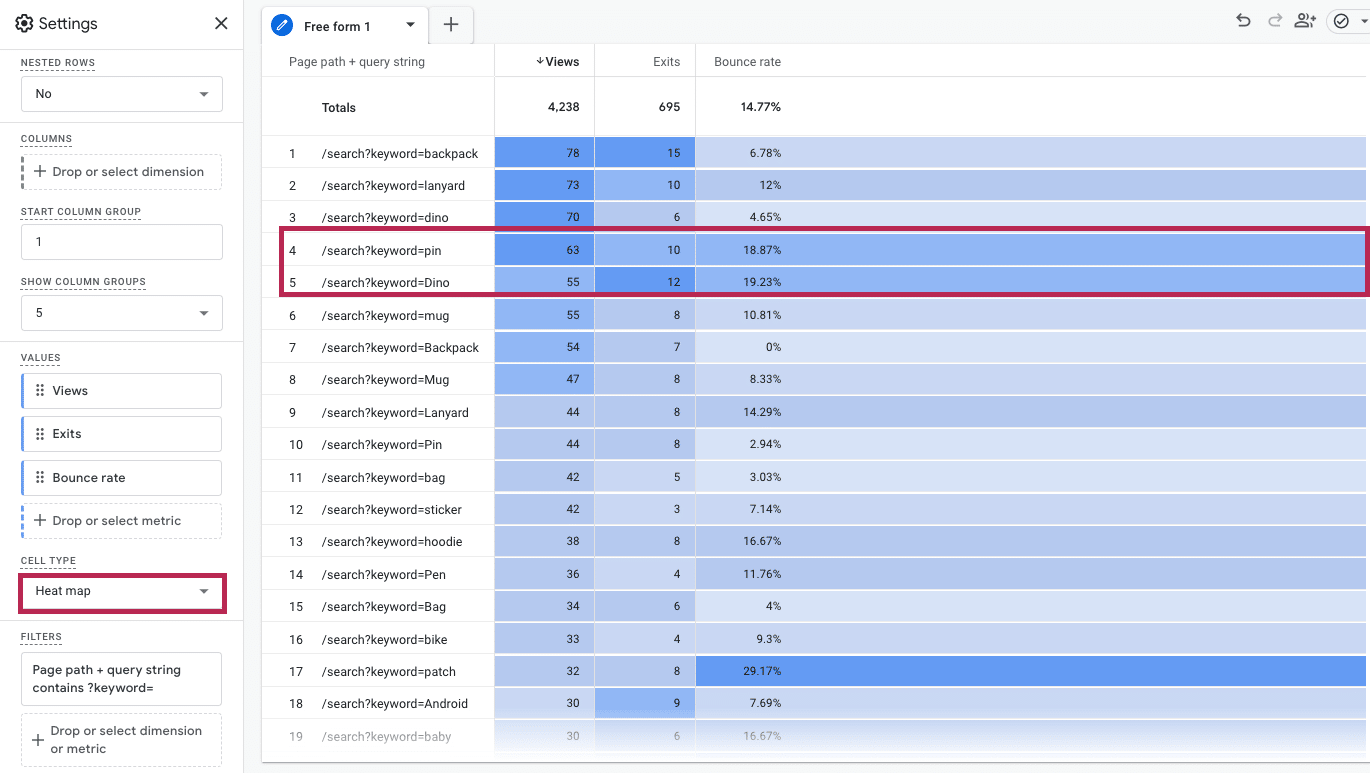
Try searching for these terms on your site and see what comes up. If it isn’t what you expected, consider building them into your knowledge base.
Other places to look for knowledge base content inspiration
If you don’t have any site search data yet or have already optimized your knowledge base based on the data in your exploration report, here are a few additional places to look for knowledge base article ideas.
Find troubleshooting needs on social media and review forums
Customers frequently flock to online communities and review outlets to express their confusion or frustration.
Social listening can help you identify your audience’s troubleshooting needs.
Even if a dissatisfied customer doesn’t directly engage with your company’s social media accounts, they may still air their dissatisfaction on a third-party review site or submit their question to an online community like Reddit.
Gain tutorial ideas from influencers and industry experts
No matter what your industry is, chances are you can learn something new about it from a TikTok or YouTube video.
Following influencers or experts in your industry can give you some great ideas for your own content.
While their tutorials may not be specific to your product, you might be able to apply some of the concepts they discuss to your own how-to guides.
Look to your competitors for inspiration
When was the last time you performed a content gap analysis?
Your knowledge base can help you fill content gaps you might not be able to fill with your blog alone and can also enhance the value of your existing blog posts by offering actionable next steps.
The best keywords for knowledge base articles are “how to” questions with informational intent.
Ask for (and respond to) user feedback
Direct user feedback can uncover some surprising insights you might not find in your analytics data.
Review feedback form submissions, look for common themes in customer support tickets and ask your customer-facing teams (sales, customer support, customer success, etc.) if they find themselves answering any questions over and over again.
Responding to user feedback with knowledge base articles will make your customers feel heard, enhance your onboarding process and improve your brand’s relatability.
Get the daily newsletter search marketers rely on.
How to create an SEO-friendly knowledge base
A knowledge base with logical and intuitive information architecture (IA) simplifies a user’s quest for answers while also jumpstarting the next stage in their self-education.
From a technical SEO perspective, a clear IA helps search engine crawlers find, index and contextualize your content. A few best practices for knowledge base IA:
Make your knowledge base easy for search engines to crawl
- Establish a clear knowledge base taxonomy with categories, subcategories and tags.
- Help crawlers (and users) navigate and contextualize your content with breadcrumbs that follow the structure of your URL path.
- Create a web of interconnected content and prevent orphan pages by adding a “related articles” section at the end of each article.
- Preserve crawl budget and avoid keyword cannibalization by consolidating similar content and canonicalizing duplicate content.
Bonus tip: If you have a large knowledge base or want to build in scalability, consider using a subdomain like help.yourwebsite.com.
Make your knowledge base easy for search engines to understand
- Build a knowledge graph to optimize for entity-based search. (See: “Entity-oriented search: The evolution of information retrieval, explained” for detailed instructions.)
- Implement structured data markup to give search engine crawlers explicit details about how to classify your knowledge base content.
- Maintain recency by updating your knowledge base to reflect new products and features.
- Maintain relevancy by updating your knowledge base to include version updates and changes to processes.
How to create a user-friendly knowledge base
Because users visit your knowledge base looking for specific, actionable information, your knowledge base content should get to the point quickly and simply.
Save the conversational introduction and flowery language for your blog. Reduce time to value by providing answers upfront. To build a knowledge base your users will love:
Make your knowledge base easy for users to find
- Make your help center accessible from your website’s navigation menu and customer support page, link to it on your social media accounts and online communities and integrate it with your onboarding process.
- Optimize your knowledge base articles for site search by incorporating user query keywords.
- Prominently display your most popular knowledge base articles under your search bar.
- Implement a chatbot to suggest knowledge base articles based on user queries.
Make your knowledge base articles easy for users to read
- Standardize and templatize your different article types, creating a predictable and chronological structure of headings and subheadings. For a troubleshooting article, for example, you might follow the following format: X problem, X solution, step-by-step instructions to get from problem to solution, related articles.
- Include anchor links in a table of contents to help users quickly navigate long articles.
- Follow web accessibility best practices, including ensuring proper contrast ratios, including alt text on all non-text media and using descriptive text for links.
- Offer multilingual support if you serve users in multiple countries (but don’t forget to follow hreflang best practices!).
Knowledge base examples to inspire you
Ready to take your knowledge base from ideation to creation? Check out these best-in-class examples for some additional guidance.
Information architecture: Shopify
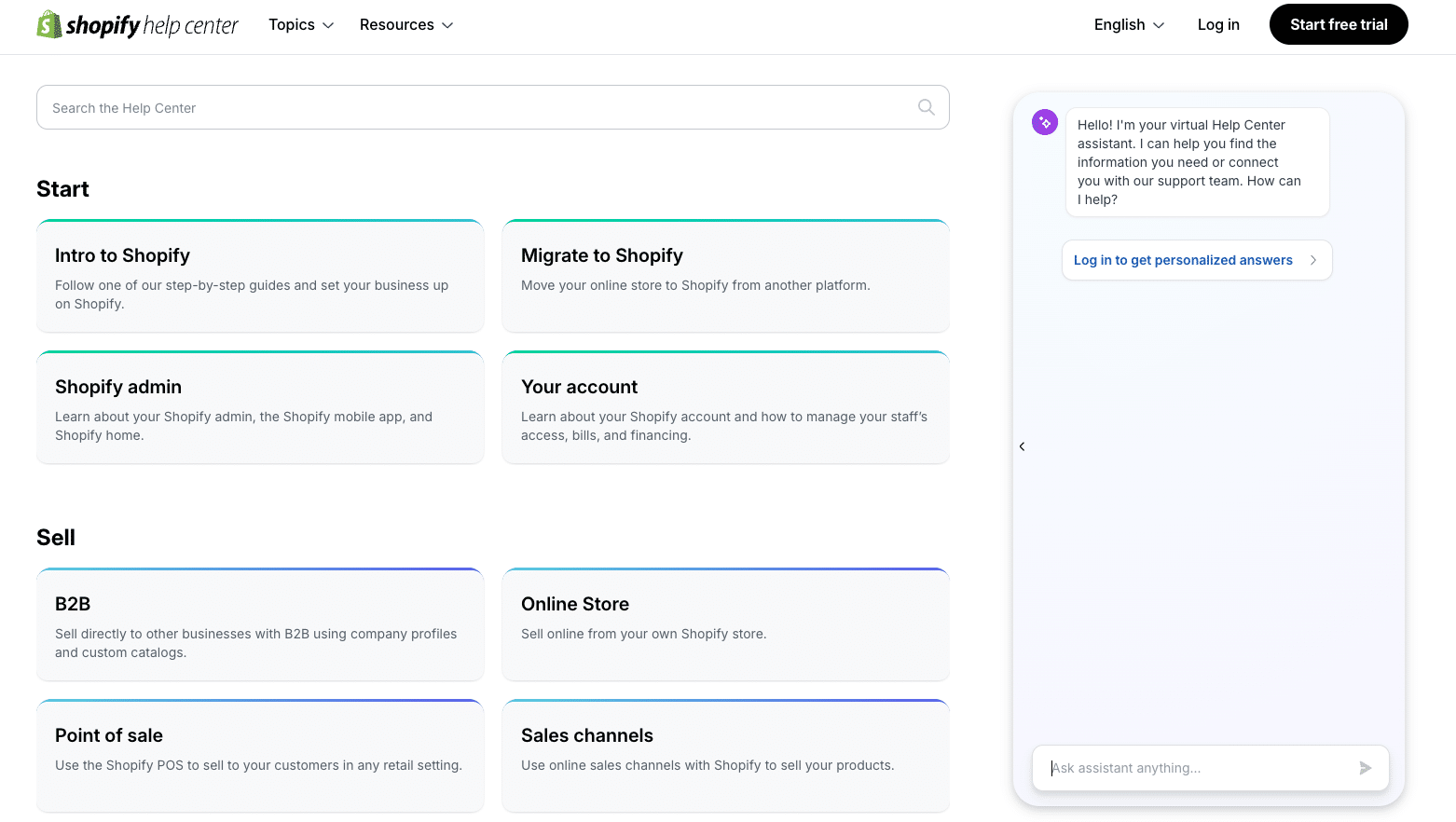
The Shopify help center offers a delightful experience for both users and search engine crawlers. Their categories and subcategories are easy to understand and organized logically within a minimalist interface.
They also prominently display a chatbot to help users find what they need or connect them with a member of customer support.
The articles in each section of Shopify’s knowledge base act as categories with high-level information. Each article includes a dropdown menu with a table of contents guiding users to subcategories with more specific information.
For example, the Migrate to Shopify article’s dropdown menu allows users to choose platform-specific migration instructions.
As users continue navigating the help center, Shopify leaves breadcrumbs so they can return to previous pages if desired.
They also include previews – in the form of a table of contents – of the step-by-step instructions their articles will cover.
The virtual assistant remains on screen the entire time in case additional help is required.
Site search optimization: Dropbox
Dropbox clearly designed its knowledge base around what users search for in their help center. Their FAQs come up the moment users click on their help center’s search bar.
As a user begins to type, Dropbox auto-suggests potential queries. Their suggestions don’t just show up in alphabetical order based on what you type in the search box, either. They’ve clearly put thought into displaying queries based on internal search data.
The ‘getting started’ guide: Trello
Your “getting started” guide should provide new users with basic setup instructions without overwhelming them. This resource from Trello, for example, covers all the essentials for using their project management platform, including:
- A brief welcome message.
- Basic product features (and how to locate them).
- Account settings (and how to modify them).
- Onboarding instructions.
- Top tips and tricks.
Take note of the navigation menu on the left side. When the user views different chapters within the guide, the navigation menu expands to include anchor links matching the headings of the questions answered within the chapter. The articles are also enhanced with screenshots and related article suggestions.
Trello highlights “pro tips” in purple boxes to encourage users to try additional workflow optimizations once they’ve mastered the basics.
The FAQs: Airbnb
Your answers to the most common user questions should be displayed in a prominent place within your help center. Making these knowledge base articles easy to find creates a better user experience by shortening the user journey within your knowledge base.
Airbnb’s FAQ integration is a standout example of how FAQs can be used to establish brand loyalty by making users feel heard.
Airbnb segments their help center resources by their different audiences: guests, hosts, experience hosts and travel admin. With the click of a tab, the featured guides and top articles change to match the intended audience.
For guests, the Airbnb journey starts with finding the perfect lodging and how to check the reservation status.
For hosts, getting paid is most important, so it makes sense for cancellation policies to be a host FAQ.
The multimedia how-tos: Canva
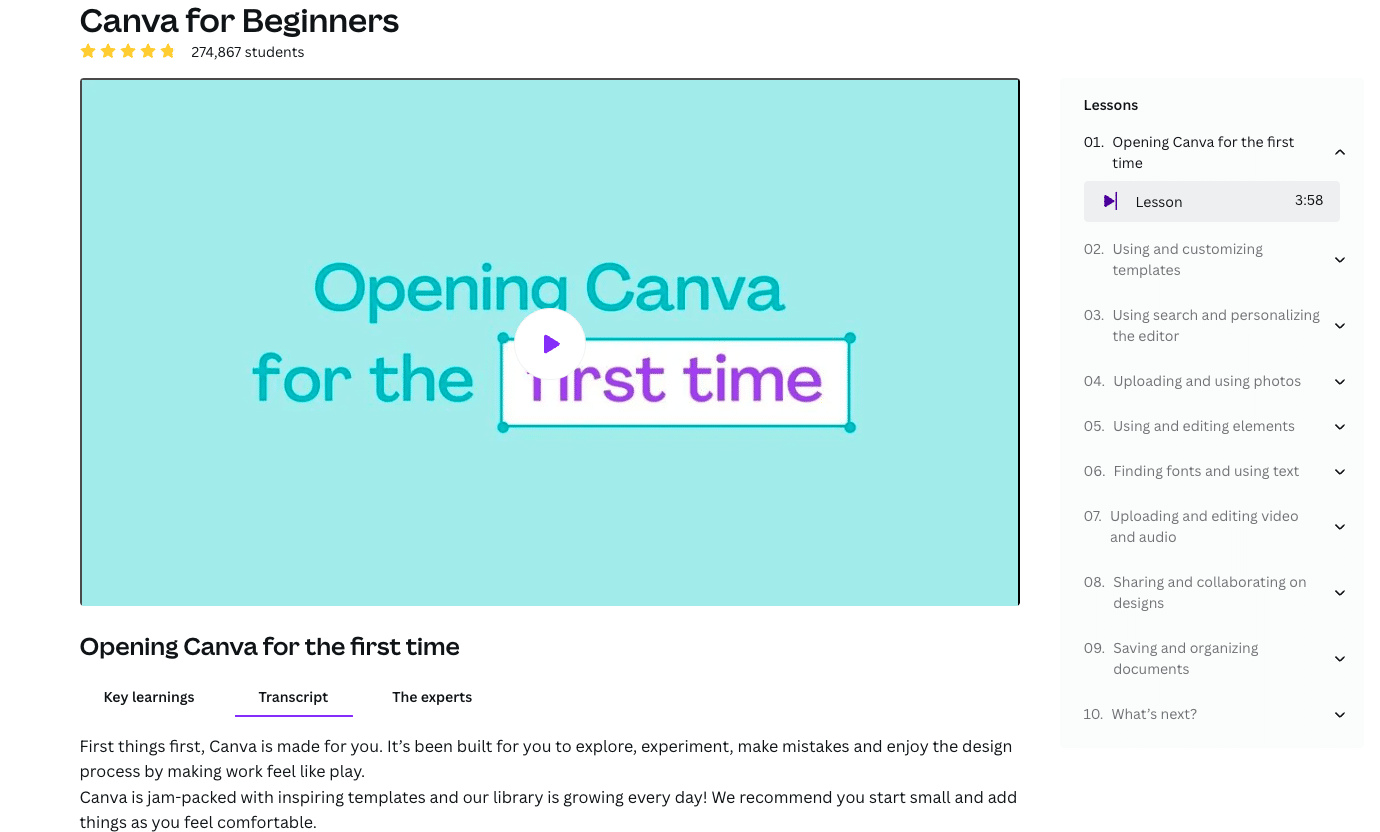
Given its purpose as a visual design tool, it’s no surprise Canva offers an extensive array of multimedia how-to guides, product documentation and tutorials to help both new and experienced users master their tools.
Canva’s design school contains thousands of courses and tutorials. Videos include text transcripts and give users the ability to skip ahead to a specific step in the instructions, making them both accessibility-friendly and easy to navigate.
Building an SEO-friendly, user-friendly knowledge base requires careful thought and planning. Skillful implementation, however, can improve user satisfaction and boost your brand’s search engine visibility.
Courtesy of Search Engine Land: News & Info About SEO, PPC, SEM, Search Engines & Search Marketing
Tuesday, June 11th, 2024
SMX Advanced opened with a bang today as Search Engine Land’s Barry Schwartz interviewed Elizabeth Tucker, director, product management, Google Search.
Here are some highlights of the wide-ranging keynote interview, which included discussion on creating helpful content, the biggest Google core update ever, why Search results may be volatile and more.
1. What to think about when creating content: helpfulness + satisfaction + experience
What should SEOs and content creators think about when building content to serve the user and rank well in Search?
Google’s North Star is getting people to satisfying and helpful results, Tucker said. She paraphrased a well-known quote from NHL legend Wayne Gretzky, which is that as SEOs and content creators you need to skate to where the puck is going to be, not where it has been:
- “Think about what we are trying to do … and where we are going and aim for that. … Think about content that’s helpful, satisfying and has good experiences.”
2. Why you should focus on the big picture
Some SEOs have misconceptions about how ranking works and can get too caught up in technical details, Tucker said.
There is no one-size-fits-all solution to making great content because great content comes in “many flavors, shapes and sizes” Tucker said.
Her advice? “Focus on the big picture”:
- “We are trying to satisfy people with all of these different informational needs with all sorts of different great types of content and great websites. I do worry that when people kinda get down in the weeds on specific technical details or signals we may or may not have, it might take away from that big picture question of ‘is this helpful satisfying content [and] are people gonna have a great experience?’”
3. Why the March 2024 Core update rollout took 45 days
In short, it was a lot of work. Google carefully changed “a lot of different core systems.”
There was “some re-architecture work” to help Google do a better job of showing helpful content. This included improving its core systems by bringing in new signals, Tucker said:
- “We actually had a mini war room going on. We were doing live monitoring of capacity and latency in our data centers because it is unusual for us to roll out so many different changes at once. We did so successfully.
- “However, there were a few times when we noticed hiccups [e.g., an unexpected capacity issue]. We paused, we slowed down and we made sure things rolled out smoothly. So yes, it took 45 days.
- “We really do have to be careful when we’re rolling out changes to these large-scale systems that have to operate around the world for billions of queries a day in all languages. There’s a lot of hard engineering we need to do to make sure that Search works successfully.”
Dig deeper. Google releasing massive search quality enhancements in March 2024 core update and multiple spam updates
4. Google’s March 2024 core update was its largest core update to date
The March 2024 core update was “unprecedented,” according to Tucker. She agreed this was the largest core update in Google’s history.
When she was discussing the update with executives, Tucker was told “not to break Google”:
- “So we did a couple different updates to different core systems simultaneously. I don’t think we’ve ever quite done that before. … We took our time and we did it right.”
- “We did not break Search. That was one of our big goals.”
5. Why it took Google a week to tell us the March core update was over
Google’s March 2024 core update rollout completed April 19. So why didn’t Google tell us that until April 26?
Because it was “a pretty complex operation” and Google wanted to be absolutely certain everything had rolled out, Tucker said:
- “We wanted to make sure all the changes were entirely rolled out. … Hundreds of people were involved. So just answering the question of are we done yet? involved so many different pings and discussions. I think there was a little bit of uncertainty at one point whether we were finished.”
6. What led to the 45% reduction in unhelpful content
In March, Google said its search quality enhancements would reduce unhelpful content by 40%. Why did that number change to 45% when Google announced the rollout had been completed? Tucker explained:
- “Before we roll something out live to 100% of Google traffic, we are testing in a testing environment. Sometimes there can be a little bit of difference in performance that we see in a testing environment versus a full rollout.
- “The numbers that I trust are the numbers after we’ve rolled out to 100% of Google traffic. And then we’ve done multiple point-in-time measurements [on real live traffic] and gotten consistent numbers. … And that’s where the 45% came from. Those real measurements after rollout.”
7. How Google defines low quality
Many SEOs and content creators have been frustrated by Google’s unclear definition of “low-quality content.”
Tucker told us that Google didn’t have a formal definition of “quality” when she started working there.
Some lively and sometimes contentious discussions led to Google creating a “unifying notion of what quality means.”
This is captured in the page quality rating guidelines within the Search Quality Rater Guidelines document, Tucker said:
- “…we rigorously define high-quality, low quality, we give examples. And this document is truly the foundation of how third-party evaluators then go and evaluate our results for quality.
- “And I think what makes quality so incredibly difficult is there isn’t a one-size-fits-all easy way to think about it. It’s actually a fairly nuanced thing.
- “Because what you want in a high-quality result for a search like [symptoms of a heart attack], you want really accurate, comprehensive information. Might be really different than what you might think of a search for [cute kittens]. You want really adorable kittens.
- “So we’ve laid it all out in our search quality rater guidelines. We take into account the quality of the main content. Things like accuracy for informational content. Talent and skill. We look at things like page experience – can people find the main content easily?
- “We have E-E-A-T (experience, expertise, authoritativeness, trustworthiness). We have a lot of things we think about and they play different roles depending on the different types of content.
- “So take a look, it’s all there.”
8. What causes radical fluctuations in Google Search rankings
Google doesn’t release any “baby” core updates – “I think I would know” if Google did, Tucker said.
So what causes volatility in Google Search results in times when Google hasn’t announced any updates? Tucker said a bunch of different things are likely going on:
- The things people search for change radically day by day. (“A Taylor Swift concert happens and like boom, we’re just seeing radically different traffic.”)
- Content on the web constantly updates.
- Google’s core systems are constantly refreshing on different cadences.
- Several smaller search improvements may have launched.
Tucker added:
- “When we monitor and look at the kinds of results we’re showing on Search, what people are engaging with and so on, we do see some radical fluctuations even if we don’t change a thing.”
9. How many systems are involved in Google’s core updates?
Tucker said she couldn’t give us “a good number” for how many systems are part of Google’s core updates. “I don’t know. Sorry, there’s just no good way for me to count.”
Why is this? Tucker explained:
- “I think if you were to get five search quality engineers into a room and ask them how many systems we have, you’d get at least 10 answers. … I might give you like three different answers myself.
- “I think we sometimes get into these pointless arguments about what is a signal, what is a system, what are subsystems vs. main systems, which ones are core systems, which are supporting systems.”
10. Google won’t discuss any signals mentioned in the leak
As for the huge Google Content API documentation leak, Tucker declined to discuss any specific signals, adding:
- “There are bad actors. You know when we release a lot of information about how specific signals work, it becomes a vector for abuse. That’s frustrating for me, too.
- “I’m a total search quality nerd. I would love to be able to share more but we have to be incredibly careful.”
11. Statements made by Google spokespeople were ‘accurate’
Since the leak, some in the SEO community have been angry at Google spokespeople like Danny Sullivan and John Mueller – essentially accusing them of lying to us all for years.
Although Tucker isn’t aware of every statement made by every Google spokesperson, she told us that the statements she’s aware of “are accurate.” Also, Google’s search systems are constantly changing.
- “Things do change over time. We are constantly changing our signals and our systems and how they work because Search is really dynamic.
- “So we’re constantly making changes and so a statement 10 years ago may not still be true today. However, I will say I don’t know of any inaccurate statements that a Google spokesperson has ever made.”
12. Google wants feedback from SEOs, content creators and publishers
Tucker’s message was simple: “We’re listening, we care, keep the feedback coming.” She added:
- “We’re working hard to make sure that Search lives up to the expectations, not only of people who come to Search but also the creators, the publishers who are putting great content out there. So we’ll keep working on it. Keep talking to us, we’re listening.”
13. SEOs play a vital role in Google Search
SEOs play two wonderful roles, according to Tucker:
- Making great websites: SEOs help create great content and page experiences for people – that Google Search can also understand so it can “surface the best of the web.”
- Providing feedback: Tucker said SEOs are a group that holds Google to its own “high standards. So a huge shout out and thank you to everyone in the SEO community.”
How to watch the keynote
Register for SMX Advanced to see Tucker’s full interview – as well as dozens of other sessions today and tomorrow.
Courtesy of Search Engine Land: News & Info About SEO, PPC, SEM, Search Engines & Search Marketing
Tuesday, June 11th, 2024
There are so many metrics you can track when running a Google Ads campaign. Yes, having more data at your disposal helps you make more informed decisions, but to someone new to paid search, all the data can be overwhelming. Where do you start? Are some metrics more critical to success?
This article covers a few metrics to track to help you make more informed decisions about your marketing strategy.
I’m intentionally ignoring the most popular metrics (e.g., clicks, costs, conversions), because while they’re important, they don’t tell the entire story of how the account performs and why.
Instead, I want to focus on a few metrics that can help offer a deeper understanding of your account’s performance and paths to improvement when used in conjunction with your core KPIs. These metrics will provide additional value and insight but may not be as helpful in a vacuum.
1. Conversion rate (CVR)
Conversion rate is a pretty easy metric to understand; it’s the percentage of users who click on an ad and end up converting afterward.
While this is useful in and of itself, it’s especially useful when used in conjunction with click-through rate (CTR). These two metrics can help highlight which part of your customer journey needs improvement.
CTR is a metric that indicates the quality of the traffic you’re generating. If your CTR is high, then your target users likely resonate with your product and messaging. If it’s low, then you may be targeting the wrong audience or need to tweak your messaging more.
Let’s bring this to life with an example: Say you have a PPC campaign, and the conversion rate is much lower than the rest of the account.
Many things can cause low CVR, but it’ll likely fall into one of two categories: your Google Ads strategy or landing page/website. Looking at just CVR, it’s hard to know what area needs improving, but what happens if you also look at CTR?
If you have a low conversion rate but a high click-through rate, it could mean that your audience is resonating with your ad, but there’s a disconnect once they click the ad and go to the landing page.
In this case, I would focus on improving the customer experience on the website site. If they have a low CVR and a low CTR, then the issue may be with your targeting and some work on your keywords and ad copy may be in order.
Dig deeper: PPC landing pages: How to craft a winning post-click experience
2. Impression share
So, maybe you’ve been running your Google Ads campaigns for a while, and things are going well, and you’re looking at increasing the budget.
Where do you start? What campaigns have room to grow more and which ones don’t? This is where impression share is incredibly helpful.
Impression share measures the percentage of impressions your ad received compared to the total number of impressions available. Two main factors influence impression share: budget and ad rank. Knowing which one limits your campaign is very important.
Luckily, you can see which of the two limits you with the following metrics: Search IS Lost (Budget) and Search IS Lost (Rank).
These two metrics will show you how many impressions share you’ve missed out and why.
- Impression share lost due to budget is easy to fix; you simply raise the budget. No bid increases are necessary, so you’ll likely maintain your current cost per conversion if you raise your budget this way.
- Impression share lost due to rank means that in order to gain that impression share, you’ll either need to bid more or improve your quality score.
Back to our original scenario: Using these three impression share metrics is a great way to show where you can easily raise your budget without affecting performance.
If campaigns show a lot of impression share lost due to budget, there’s a big opportunity to expand that campaign’s budget without sacrificing your cost per conversion.
If most of the impression share lost is due to rank, you’ll need to consider where it’s worth it to be more aggressive in your bidding or if you want to raise the budget at all.
Dig deeper: How to glean insights from impression share to boost PPC performance
Get the daily newsletter search marketers rely on.
3. Lifetime value
OK, I cheated a little bit. Lifetime value is not a metric you can find in Google Ads, but it is well worth figuring out, especially if you run a business with repeat customers.
Lifetime value is exactly what it says: it’s the total value of a customer over the course of their relationship with your business. This means different things for different industries.
- If your company sells socks, this includes repeat purchasers.
- If you sell a subscription, it calculates how long the average user is subscribed before canceling.
- If you’re selling higher-priced services (like a marketing agency), it considers average contract size and average length.
Calculating this for your brand is an incredibly valuable exercise that can heavily dictate what success in PPC looks like. Let’s illustrate this using that sock example I mentioned:
A company that sells socks sets up a Google Ads account and sells socks for $10/pair. It knows that to be profitable, it needs at least a 3:1 return on its ad spend. They optimize the account to try and get a 3:1 return on every single purchase.
Eventually, they decide to calculate the lifetime value of a customer and realize that the average customer ends up purchasing ten additional times! Now that they have a customer LTV, they feel comfortable with a lower initial return because they know each purchase leads to more purchases down the road.
The account strategy was completely changed with the addition of one metric. Without LTV, the account manager couldn’t accept a lower return because it didn’t have enough data to rationalize it.
But once you add lifetime value to the equation, you have the data to back up more aggressive strategies that while less profitable initially, will help lead to more long-term growth.
Dig deeper: How to increase LTV with PPC
Optimize your Google Ads campaigns by tracking these metrics
Every metric in Google Ads is useful in some way or another. It’s very easy to see the value of some (more conversions = good!), but some require a bit more context.
The more metrics you can use to make informed decisions, the easier it’ll be to assess problems and better set yourself up for success.
Dig deeper: Setting PPC goals: How to tailor KPIs and metrics for each funnel stage
Courtesy of Search Engine Land: News & Info About SEO, PPC, SEM, Search Engines & Search Marketing
Tuesday, June 11th, 2024
A year ago, Google added support for return policy structured data support for merchant listing and now Google is expanding that support to the organization level. “Today we’re adding support for return policies at the organization level as well, which means you’ll be able to specify a general return policy for your business instead of having to define one for each individual product you sell,” Google wrote.
You no longer need to have to specify a separate return policy for each individual product you sell. You can now have one return policy that goes across your whole organization.
More details. Google explained that by adding an organization-level return policy, it can help reduce the size of your Product structured data markup and make it easier to manage your return policy markup in one place. Plus, it will help you show your return policy in the snippets across many search appearances.
Google said it is “especially important” to add a return policy to your organization structured data “if you don’t have a Merchant Center account and want the ability to provide a return policy for your business.” “Merchant Center already lets you provide a return policy for your business, so if you have a Merchant Center account we recommend defining your return policy there instead,” Google added.
Google said if your site is an online or local business, it is recommended to use one of the OnlineStore, or LocalBusiness subtypes of Organization.
What it looks like. Here is a mockup from Google on how the return policy looks in the Google Search results:
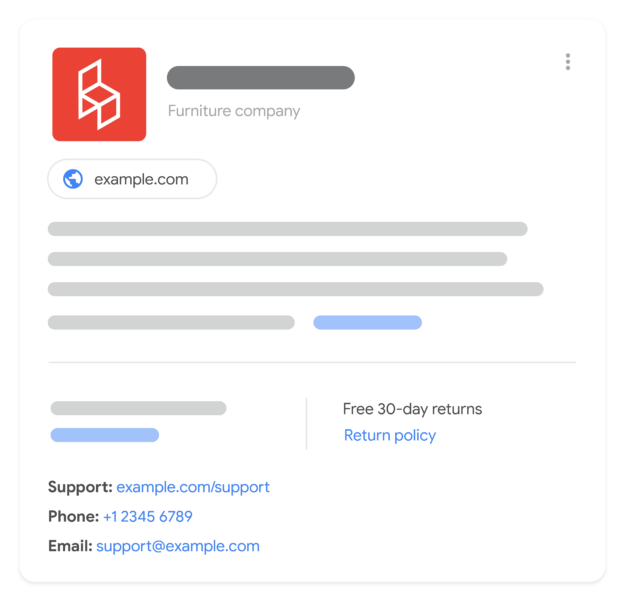
Testing this. Google said you can test return policies defined under your organization structured data using the Rich Results Test by submitting the URL of a page or a code snippet. Using the rich results test tool will allow you to confirm whether or not your markup is valid.
Here is what the tool looks like:

Why we care. If you want an easier way to implement this return policy markup across all your products on your site, now you can do it at the organization level.
This may save you time and effort, while also giving more data for Google to show in the search results about your search listings.
Courtesy of Search Engine Land: News & Info About SEO, PPC, SEM, Search Engines & Search Marketing
Monday, June 10th, 2024
Since the August 2022 helpful content update, Google has been emphasizing “helpfulness” for ranking content on SERPs. Now, Google has incorporated helpfulness signals into the March 2024 core update. It’s now a huge part of search.
So, what exactly is helpful content?
Are you meeting Google’s “helpful” content requirements?
This article is a one-stop solution guide to help you clarify this question and create content that meets Google’s standards for usefulness, value and, most of all, helpfulness.
If your content hasn’t been ranking, you’ll want to read every word.
Helpful vs. unhelpful content
We can analyze helpfulness on two levels: page-level and website-level. I will focus on page-level since we mostly care about the content here but with some website-level hints.
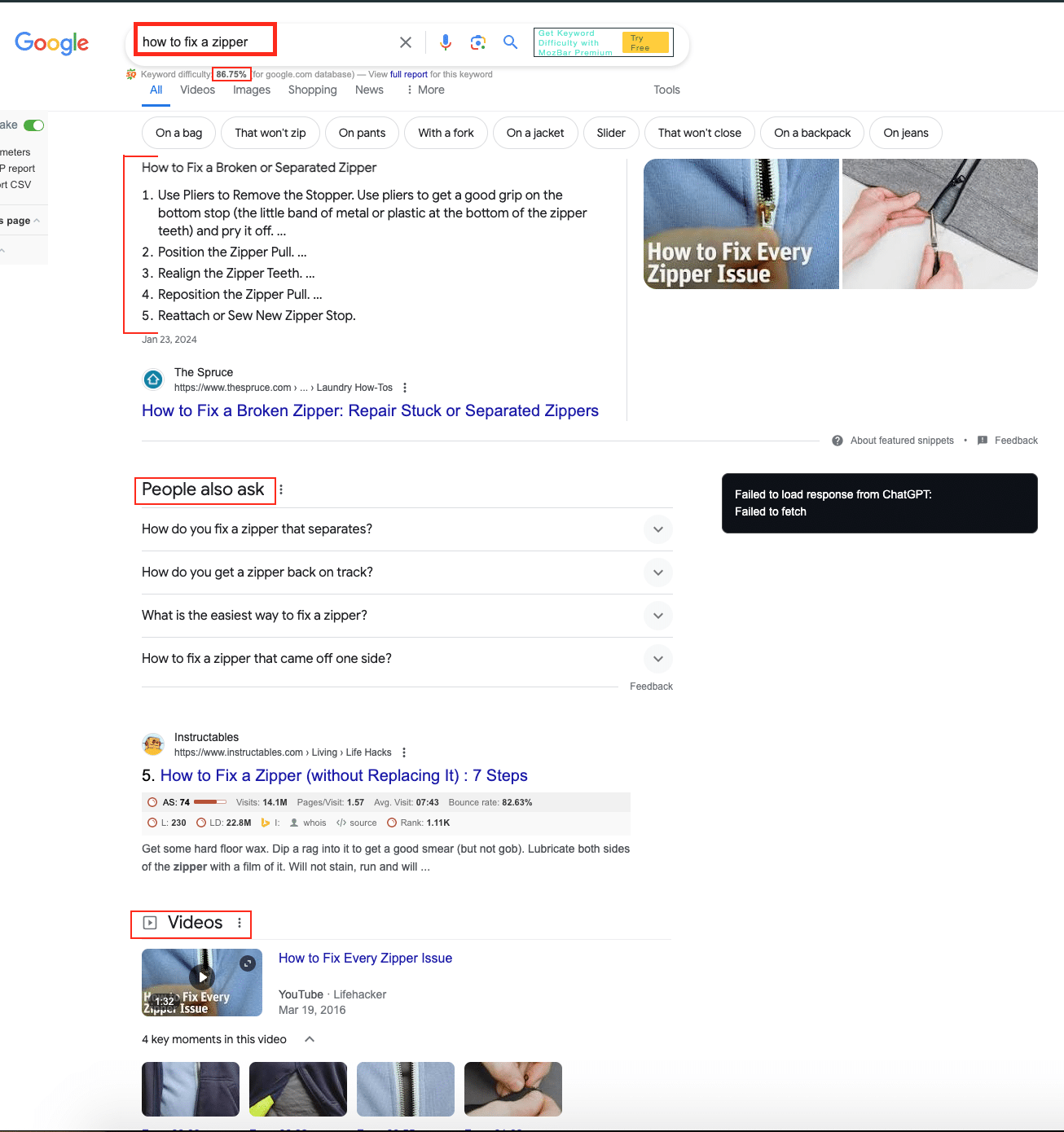
Let’s search for the keyword “how to fix a zipper”:
Looking at the keyword difficulty under the search box, we already know that this keyword is hard to rank for. (I’m using SEOquake Chrome extension here to get more data, which makes things easier while searching, but you can use any other tool).
High keyword difficulty (KD) means many people are searching for this query, and authoritative websites are competing to rank for it. Just look at the domains ranking at the top! (This is mostly a website-level factor; the better your website performs in general, the more chance you have for ranking.)
Note: Personally, I’m not a fan of third-party metrics. They cannot determine whether a domain is good or bad because they have their own algorithms that are different from Google’s, which could be easily manipulated. However, they can be useful when you’re dealing with a lot of data.
Back to the SERPs, the second step is to determine the intent of our keyword.
This one is easy; you can already tell it is an informational keyword. But for more complex keywords, you can look at the top title ranking, their context and other clues that Google is giving you.
In this case, the keyword has a featured snippet. There are several types of featured snippets, and this one is a step-by-step snippet.
Since the user is searching for “how to fix a zipper,” the snippet shows a series of steps on how to do it.
The next SERP feature is “People also ask,” which is a great place to get an idea about the topic you want to write about.
Another SERP feature for this query is videos. Remember how I said we should talk about steps “showing” readers how to fix their zipper? That’s exactly what this video does.
From simply analyzing the SERP features for a given keyword, Google is already giving you clues on how to create helpful content.
Put yourself in your reader’s shoes. If you have a broken zipper, following a step-by-step guide as well as watching an actual video of how to do it solves your problem instantly.
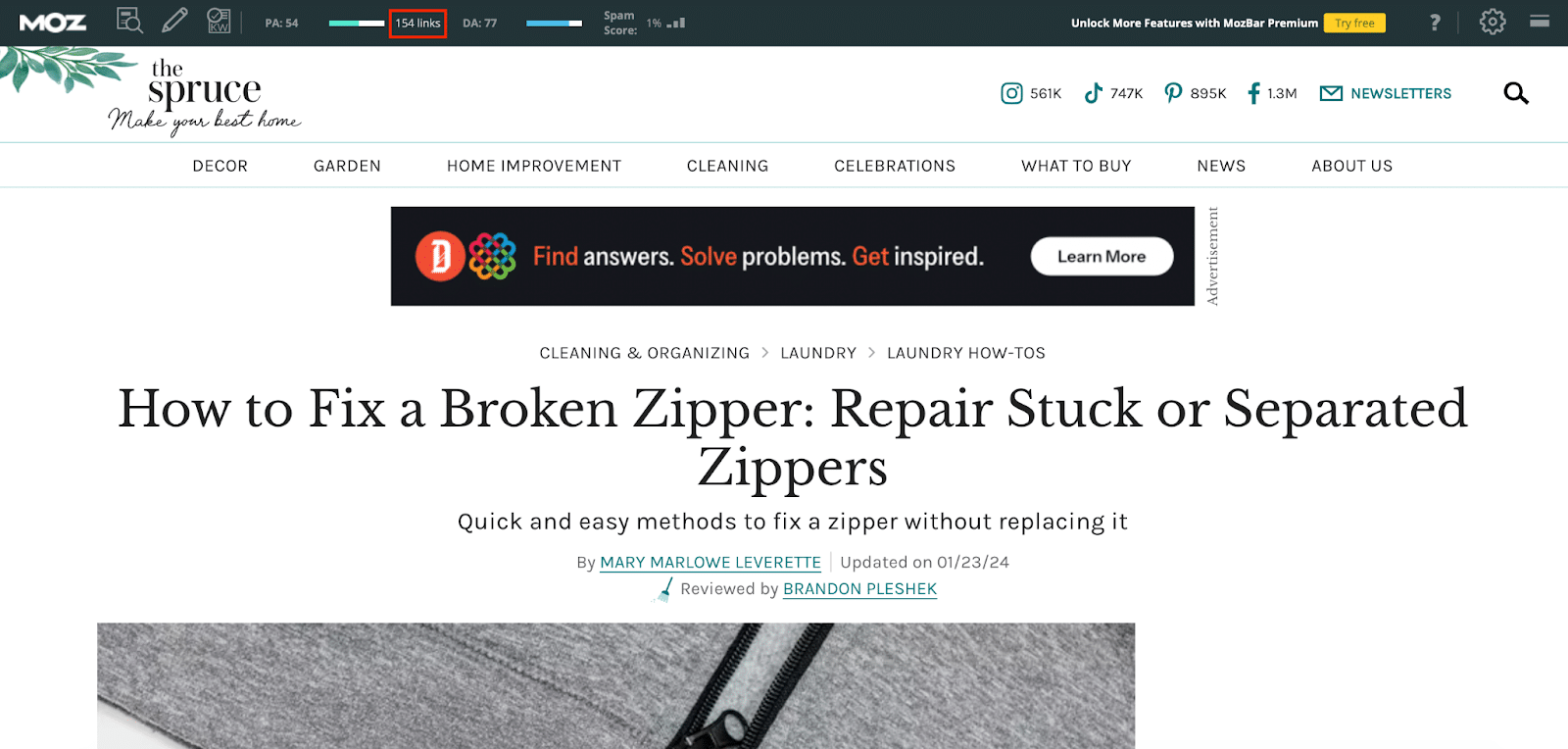
Now, let’s look at the first result in the SERP. If Google has decided to rank it number one, this is what the search engine considers helpful content:
As SEOs, we all know that links matter. Looking at the Moz extension, I know this page has 154 backlinks pointing at it. This may not be 100% about how you wrote the content, but it is definitely a signal Google cares about.
I can hear Google saying, “A piece of content that has 154 other articles citing it as their source? This one probably has something interesting in it!”
What other factors make this article stand out?
- The title is straight to the point. I already know what broken zippers I’ll be able to fix by reading this article. It is targeting two of the most common issues when it comes to broken zippers – stuck and separated zippers – which I know based on the “People also ask” result.
- The article has an author byline. The name also has a link that points to the author’s detailed bio.
- The intro answers the search query right away. It also mentions what tools and materials you need and how long it will take, plus some highlighted tips.
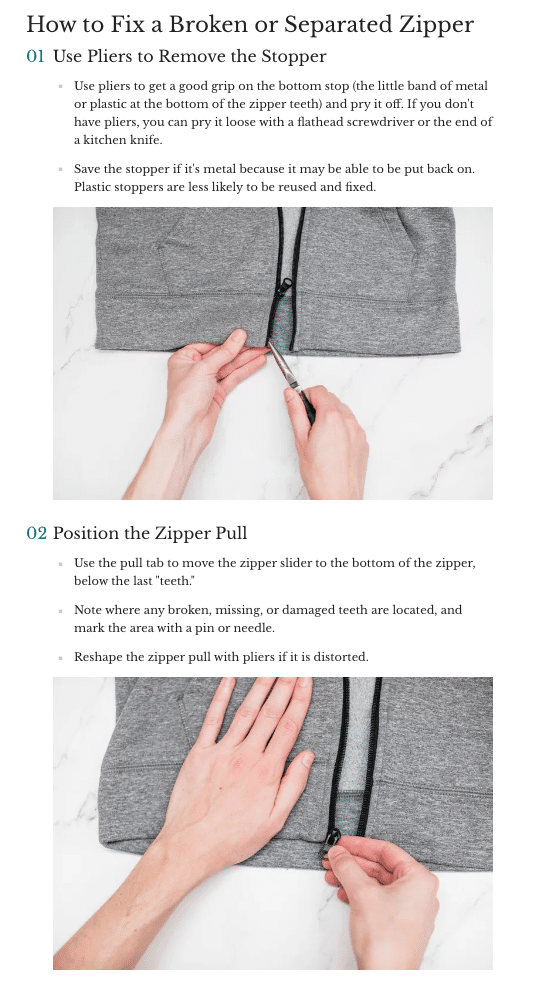
- The article breaks down each of the steps in detail. And it comes with screenshots to demonstrate how to do it.
- There are also colored tip boxes. These visuals help break up the text and provide additional information, recommendations or shortcuts.
Now let me show you what the opposite looks like – an article currently ranked 76th for the same keyword.
How did it end up in Google hell?
First of all, it has a terrible meta description. As you can see above, it doesn’t tell you anything about the page. The meta description is the second element I pay attention to before deciding whether I want to click on it. (The first one is obviously the title).
This particular meta description is already decreasing CTR!
Let’s get into it:
The article has 27 links. Not bad, right? But why isn’t it ranking?
The intro is not very appealing and the first image you see is blurry. Just compare it with the image from the top ranking article.
Scrolling through the body of the article, I see that the step-by-step guide uses the same image, and that’s it.
Let’s put ourselves in our reader’s shoes. We want to fix a broken zipper. Despite the very poor meta description, we decided to click on this link, and this is all we got.
Neither the introduction nor the image is helpful, so you simply go back to the SERP and find a new resource, which will increase the bounce rate and churn of this domain.
Let’s look at what’s inside.
This article has more ads than actual content. There’s a whole sidebar of ads on the right column, a huge ad banner at the bottom, ads popping up every time you scroll and more ads in between the text!
The third step in the guide mentions a dense zigzag stitch. What does that even mean?
This is where an internal link would have been helpful. The author could have created a separate article on how to sew a zigzag stitch and linked it to this article to help users who may not be familiar with this sewing method.
What other factors made this article unhelpful?
If you check the first image, it is in the “sewing category,” but it doesn’t help me with any sewing.
Secondly, it contains affiliate links, which is not a bad thing by itself, but it seems like this content was written solely for commercial purposes.
Check out both links and see for yourself – it’s not that hard to distinguish helpful content from unhelpful content.
What is helpful content?
According to Google, helpful content:
- Demonstrates experience, expertise, authoritativeness and trustworthiness (E-E-A-T).
- Is created for a specific audience.
- Feels authentic and human-centered.
- Meets the needs or wants of the searcher.
Helpful content is information that satisfies a user’s curiosity and provides them with something valuable. Here are some key aspects of helpful content:
- User-focused: It’s written with a specific audience in mind, considering their needs and interests.
- Expertise: It comes from a credible source with knowledge and experience on the topic.
- Value: It fulfills the user’s intent, whether it’s informing them, answering a question, solving a problem or even entertaining them.
- Unique perspective: It offers fresh insights or a new take on existing information
Take a closer look at your content. Is it genuinely helpful for your audience, answering their questions or solving their problems?
If your content doesn’t provide unique insights or information, it’s time to either improve it or remove it altogether.
Is your content not ranking? Focus on creating people-first content that demonstrates real expertise and provides an exceptional user experience.
Dig deeper: Mastering content quality: The ultimate guide
Get the daily newsletter search marketers rely on.
5 reasons why your content isn’t working
Here are five reasons why your content might not be ranking as well as you’d like, along with some hard-won wisdom on how to fix it.
1. Your content doesn’t offer anything new
Your page may be of good quality but if it doesn’t offer anything new, it may have a tough time cracking the top spots.
When Google already has numerous pages on the same topic with similar (and better) content, there’s little reason for it to rank yours.
If your content is mostly scraped from other sources or simply rehashes information that can be found elsewhere, don’t expect it to perform well in search.
This is especially true in the age of AI-generated content. While AI can be a helpful tool, relying too heavily on machine-generated content without adding E-E-A-T is a recipe for ranking disaster.
Rather than rehashing the same old information, focus on crafting unique content that provides a new angle or perspective. Infuse your writing with your own expertise and real-life experiences to make it truly one-of-a-kind.
Adding something unique and substantive to your blog post can give Google a reason to include it among the top results for the topic.
2. Your intro is too long and fluffy
With the launch of AI Overviews, Google seems to favor results from Reddit and Quora, which often provide straight-to-the-point answers.
If you’re trying to rank for “embroidery tips,” don’t start with a two-paragraph history and definition of embroidery. This is a common issue with content that’s generated by chatbots like Gemini, ChatGPT and Claude.
People want answers fast, so keep your introduction brief and to the point. If your AI writer takes too long to answer the query, cut the fluff during the editing stage.
3. Your content doesn’t match user intent
Search intent is another significant ranking factor as Google prioritizes delivering results that best match the user’s query.
You could write the most epic, in-depth piece of content ever, but if it doesn’t align with what searchers are actually looking for, it might still fail to rank.
That’s because Google is getting pretty good at understanding search intent and delivering results that match.
If someone searches for “how to tie a tie,” they want a quick step-by-step guide, not a 5,000-word essay on the history of neckwear.
Let’s say you’re trying to rank for “how to fix a leaky faucet,” but your page only covers plumbing tools or types of faucets. Google will immediately recognize that this page does not have the answers that users seek.
Similarly, if a searcher is looking for “cheap DIY plumbing tools,” Google will favor pages selling these tools over a page about plumbing techniques. That’s because the term “cheap DIY plumbing tools” indicates commercial intent, with users ready to make a purchase. Google will rank ecommerce pages for this keyword, not informational ones about faucet leaks.
Also, consider your page’s overall structure. Mixing too many search intents on a single page can confuse Google.
For example, an educational page on home renovation techniques followed by a list of your service offerings might make it unclear whose needs the page is trying to serve.
4. Google prefers a different content format for the query
Even if your content is useful, informative and unique, your long-form blog post might struggle to climb the SERPs if Google thinks there’s a better type of content to meet users’ needs.
For some queries, Google strongly prefers videos, product listings, map packs, or direct answers pulled from a trusted source (also called snippets).
For instance, your home renovation site aims to rank a page on how to fix a leaking faucet. You search some relevant keywords you believe your page should rank for:
- “DIY faucet repair”
- “Fix leaky faucet”
- “Repair dripping faucet”
- “Stop faucet leak”
- “Leaking faucet solutions”
You notice that Google is displaying many videos in the SERPs for these terms.
If Google thinks searchers want a specific format, that’s what it will prioritize in the results. No matter how amazing your blog post on “how to fix a leaky faucet” is, your written content may never rank above these videos.
A quick fix would be to include a video in your written content to help you compete with top-ranking pages.
Scope out the top search results for your target keyword. If Google seems to prefer a particular format, it’s time to change your strategy.
5. Your competitor’s content is better
Sometimes, your page isn’t ranking well simply because it doesn’t measure up to your competitors. If their content is more in-depth, engaging or of better quality than yours, that could be the culprit behind your lower rankings.
Fortunately, this is one of the easier issues to fix. Carefully review the top-ranking content for your target keywords. How does it compare to yours in terms of depth, helpfulness, expertise and user experience?
To create content that stands out, find unique angles and insights that your competitors have missed. Put in the extra effort to create content that’s not just good but exceptional.
How to create content that Google wants to rank
Now that you know the top reasons why your content is tanking in the SERPs, it’s time to start creating content that Google will actually want to rank.
When creating content, put yourself in your reader’s shoes and ask yourself these questions:
- Would I click on this headline?
- Does this solve a problem or answer my question?
- Is this relevant to my interests?
- Would I read past the first paragraph?
- Is the information useful?
- Is it enjoyable to read?
- Is it visually appealing?
- Is it easy to skim?
- Would I scroll to the end despite my busy schedule?
- Would I lose interest and bounce to another page?
Keep editing and revising your content until you can answer “yes” to all these questions.
When you write with your audience in mind, you will not only be able to serve their needs and capture their interests, but Google will also take notice.
Dig deeper: 25 tips to optimize your content for people and search engines
5 tips for writing helpful content
Helpful content goes beyond sharing useful tips and covering a topic in-depth. Thousands of blog articles do that. What will make your content stand out?
Here are five tips to help you create helpful content that readers – and Google – will love.
Create topic clusters
The key to establishing topical authority is to create related content and link them together – also called topic clusters. Let’s say you’re trying to rank for “how to fix a leaky faucet.” Maybe your readers might want to know about the different types of faucets or the history of faucets. Create a dedicated article for those subtopics and link them to your pillar content.
Whenever you come up with a topic idea you think your readers will be interested in, link it to the related article. This will give you a strong structure for Google to crawl and discover your content better.
At the same time, you’re providing a better user experience as your readers can choose to read more about that subject by clicking on the link instead of scrolling down a very long article with unnecessary data. Plus, you are improving your other content by giving it an internal link.
Don’t be redundant
Each header should provide value to readers. But you don’t have to keep repeating your main points in every section. You want the reader experience to be enjoyable, not lull them to sleep.
Get to the point
If your topic is how to fix a leaky faucet, don’t take too long to tell (or show) your readers how to do it. Offer value above the fold – not in the middle of your post.
Backup your claims
Let’s say you’re trying to convince your readers that stainless steel faucets are better than chrome or brass. Why would they believe you? Always back up your claim with facts, testimonials and external links from a credible source.
Go beyond the basics
So you have your standard blog post with 2,000 words and a couple of images. It looks exactly the same as thousands of blog posts on that topic. What can make it stand out?
Embed a relevant tweet or a YouTube video, add a quote card from an expert or include a customer testimonial. There are many ways to personalize your content by going beyond the basic text + image formula.
Helpful content checklist
Here’s a cheat sheet to help you create content that ranks well.
Title tag
- Is the title tag between 55-60 characters?
- Does the title tag reflect what the article is about?
- Is the title click-worthy?
- Is the main keyword mentioned in the title tag?
Meta description
- Is the meta description between 150-160 characters?
- Does the meta description summarize what the page is about?
- Is the main keyword mentioned in the meta description?
Headline (H1)
- Does the headline offer value to a target audience?
- Is the main keyword mentioned in the headline?
Content
- Does the article have a clear targeted topic or keyword?
- Is there an author byline with a link to the author’s page?
- Is there a table of contents?
- Does the introduction contain a hook and address the search query right away?
- Does the content have a unique take on the topic that makes it stronger than the competition?
- Does the content include statistics, examples, facts or case studies to support claims?
- Is the content written just for Google or is it written for people?
- Is the content too thin to be helpful?
- Is the content written by AI or humans?
- Is the content plagiarized or detectable?
Multimedia
- Does the article contain visuals?
- Are the images and infographics high quality?
- Do the images have alt tags?
- Are the images and videos properly optimized for mobile?
Readability
- Does the blog post have a clear structure with an intro, body and conclusion?
- Are subtopics divided into sections with relevant headers?
- Are there bullet points or numbered lists for easy scanning?
- Are sentences and paragraphs short and easy to read?
- Is the article free of typos and grammatical errors?
Helpful content = helping people
Creating helpful content that Google wants to rank simply comes down to one thing: putting people first. Focus on crafting content that genuinely helps your audience, showcasing your expertise and building trust along the way.
While SEO tactics like keyword and technical optimization are still important, they should enhance your already valuable content rather than be the sole focus.
Prioritize helpfulness and authenticity, and you’ll be rewarded with a loyal following and improved search rankings.
Dig deeper: Writing people-first content: A process and template
Courtesy of Search Engine Land: News & Info About SEO, PPC, SEM, Search Engines & Search Marketing