Archive for the ‘seo news’ Category
Thursday, June 27th, 2024
On June 12 and 13, 2024, Emarsys went live with the Omnichannel and AI Masterclass, a digital event featuring fireside chats and expert-led sessions from digital leaders who are blazing a trail in the world of omnichannel marketing. If you missed it you can access it all on-demand for free now.
But for an even more immediate marketing inspiration, here’s a recap of three of our favorite sessions!
How Molton Brown drives engagement by embracing sustainability
A company’s values around sustainability are powerful influencers of customer behavior and loyalty. Put simply, many consumers want to know they’re doing business with a company that cares about the planet. Since 2019, sustainability has been one of Molton Brown’s top priorities.
In this session, Molton Brown’s Senior Business Transformation Manager (Cosmetics), Naresh Krishnamurthy, was joined by Sunny Sangra, Director of Sales Enablement and Partnerships at Sinch. Among other unique insights, they talked about how Molton Brown embraces ESG both in terms of the technology choices the company makes, and how the brand creates content and deploys campaigns that increase average order value by 22%, purchase frequency by 38% and customer value by 68%, all the while focusing on sustainability.
“Customers are not only just buying the products. They also want to know how sustainable it is.”
– Naresh Krishnamurthy, Senior Business Transformation Manager (Cosmetics), Molton Brown
How Huel is driving profitable, scalable growth through customer advocacy marketing with Mention Me
Huel’s Global Head of CRM, Tash Reynolds, and Mention Me’s Director of Strategic Partnerships, Kat Wray, hosted this session and shared insights on how they managed to get 22% of their customer base sharing and recommending the brand to their friends and contacts, activating their fans to drive retention, loyalty and profitable growth.
The session provided a wealth of ideas. Here are some stand-outs:
“Paid channels aren’t going anywhere, but if you think advocacy first, you’ll have superior economics as a brand and be able to drive truly profitable, sustainable growth.”
– Kat Wray, Director of Strategic Partnerships, Mention Me
“Your customers do a lot more than buy from your brand. Who are your advocates? Who is spreading the word and driving organic growth? If you can get your customers to do this on your behalf, it’s the most valuable form of marketing.”
– Kat Wray, Director of Strategic Partnerships, Mention Me
How Replacements, Ltd. plates up traditional and digital marketing to serve a broad demographic
Replacements, Ltd.’s Ecommerce Marketing Manager, Amy Childress, was joined by Kara Lewis, Attentive’s Lead Client Strategy Manager, to discuss how Replacements Ltd. leverages customer data and the right mix of channels to bridge the gap between traditional and transformative marketing.
The whole session is worth a watch for the many insights this brand has on its unique demographic. Here’s one key quote:
“I would say the first thing is to understand your customers’ interactions with SMS and to really start A/B testing early. Test SMS vs. MMS, send times and days. Some people may not interact at 10:30 in the morning and 7:00 p.m. is better.”
– Amy Childress, Ecommerce Marketing Manager, Replacements, Ltd.
These are just a handful of the sessions from the Emarsys AI & Omnichannel Masterclass that are now available on-demand. Register now to get access.
Courtesy of Search Engine Land: News & Info About SEO, PPC, SEM, Search Engines & Search Marketing
Thursday, June 27th, 2024
Google Chrome for Android has added new local places features to Chrome Actions, that will allow Chrome users to quickly call, get directions and read reviews from a local business directly from the Chrome search bar.
What Google said. Google announced it added “new Chrome Actions to help you save time when you’re trying to engage with places like a local business. For example, when you search for a restaurant, you’ll see shortcut buttons in the search results to quickly do things like call, get directions and read reviews.”
Android first. This is first launching on Android today and will be coming to Chrome for iOS later this fall.
What it looks like. Here is a screenshot showing those Chrome Action shortcut buttons. You can see it shows a mobile phone screen doing a search for “verdant valley,” with options underneath the Chrome address bar to “call,” get “directions” and read “reviews.”

Why we care. This may lead to more visibility for local businesses within the Google Chrome Android and, in the future, iOS platforms. Searchers would be able to click to call the business, get driving directions or read reviews a bit faster than when performing a full search in Google.
Courtesy of Search Engine Land: News & Info About SEO, PPC, SEM, Search Engines & Search Marketing
Thursday, June 27th, 2024
Google today announced updates to Google Analytics 4 (GA4). The coming months will see improved cross-channel reporting and budgeting, AI-generated insights and some integration with Chrome Privacy Sandbox.
What’s new. These are the five new features Google announced:
- Third-party ad data: Users will be able to import advertising data from Pinterest, Reddit and Snap directly into GA4. The non-Google campaign data will be included in the cross-channel performance report and mapped to Analytics traffic source dimensions with metrics like “ads cost,” “ads clicks” and “ads impressions.”
- Cross-channel budgeting: Google will also release a cross-channel budgeting feature in beta. The company says it will include a projections report to track media pacing and projected performance against a target objective, like revenue, across channels.
- Campaign Manager 360: GA4 will start importing aggregated impressions from linked Campaign Manager 360 accounts into the advertising workspace.
- An AI to call its own: GA4 will also get an artificial intelligence engine built to find patterns in “countless combinations of dimensions and metrics” and report them in plain language.
- Cookieless measurement: Later this year GA4 will start supporting some Chrome Privacy Sandbox APIs “to ensure you can continue to reach your audiences and measure effectively even without third-party cookies.”
Why we care. The ability to add data from Pinterest, Reddit and Snap is a big step forward. Likewise, being able to budget across channels will also be helpful.
But. There’s still no action on the one thing everyone has complained about since GA4 launched in October 2020: the UI.
What Google is saying. Steve Ganem, director of product management for Google Analytics, wrote in a blog post:
- “Measurement is essential for marketers to understand the impact of their efforts and make more informed decisions. Today, we’re highlighting new features and key investment areas to help you make better business decisions.”
Reminder. Google turns off Universal Analytics July 1. That’s when you will lose access to your UA data and the interface and Google said it will begin permanently deleting all UA data.
Courtesy of Search Engine Land: News & Info About SEO, PPC, SEM, Search Engines & Search Marketing
Wednesday, June 26th, 2024
Google has introduced a new tROAS (target Return on Ad Spend) Insight Box for Performance Max and Standard Shopping campaigns, offering advertisers enhanced visibility into campaign performance.
Why it matters. This update provides ecommerce advertisers with a clearer understanding of their ROAS performance relative to their targets, potentially enabling more informed optimization decisions.
How it works.
- Displays whether Actual ROAS falls within the expected range.
- Shows weekly ROAS averages, including projected conversions.
- Calculates typical variation based on historical campaign data.
Key features.
- Visual graph of ROAS performance over time.
- Indication of whether the campaign is on track to meet goals.
- Inclusion of projected conversions in the analysis
Why we care. This update essentially empowers advertisers to make more data-driven decisions about their tROAS strategies, potentially leading to improved campaign performance and more efficient use of ad spend.
First spotted. This update was first seen on Thomas Eccel’s X post:
The big picture. This tool acknowledges that while individual conversion values may fluctuate above or below the target, Google Ads aims to maintain overall conversion value per cost equal to the set target ROAS.
What to watch. How this new insight box influences advertisers’ strategy for setting and adjusting tROAS in their shopping campaigns.
Courtesy of Search Engine Land: News & Info About SEO, PPC, SEM, Search Engines & Search Marketing
Wednesday, June 26th, 2024
Google is updating its consent management requirements for AdSense for Search, AdSense for Domains, and Programmable Search Engine in Switzerland.
Key points:
- Effective July 31.
- Applies to ads served to users in Switzerland, in addition to the EEA and UK.
- Aims to comply with the EU User Consent Policy.
New requirements. Publishers must either:
- Use a certified Consent Management Platform (CMP) that integrates with the Transparency and Consent Framework (TCF), or
- Implement the ‘ivt’ parameter in ad requests for invalid traffic-only cookies and local storage
Why it matters. Failure to comply will result in search ads not being served to Swiss traffic.
Why we care. This update essentially requires advertisers to be more proactive in their approach to user privacy and consent, which can have far-reaching implications for their digital advertising strategies in European markets.
The big picture. This move aligns Switzerland with existing EEA and UK consent management practices for online advertising.
What’s next. Publishers should review their consent management tools and consider legal advice to ensure compliance.
Between the lines. Google is shifting more responsibility to publishers for consent management, reflecting the evolving regulatory landscape in Europe.
Courtesy of Search Engine Land: News & Info About SEO, PPC, SEM, Search Engines & Search Marketing
Wednesday, June 26th, 2024
The perfect click refers to a click from a SERP that takes the user directly to the single best webpage or resource that directly solves their problem.
The ultimate aim of assistive search features like Google’s AI Overviews and Bing’s Copilot is to bring the user down the funnel and get them to the Perfect Click without leaving the search interface (for now, that is a SERP).
Off-SERP assistive engines such as ChatGPT and Perplexity operate from a similar perspective. However, for this article, I will focus on Google’s AI Overviews and Bing Copilot, which are simply assistive engines integrated into the SERPs.
The perfect click is official
Fabrice Canel, Principal Program Manager at Microsoft Bing, has confirmed that they use this concept and term internally and that they are guiding the user on SERP to the ideal bottom-of-the-funnel action – conversion.
Google hasn’t communicated about this but certainly has the same concept, perhaps by a different name.
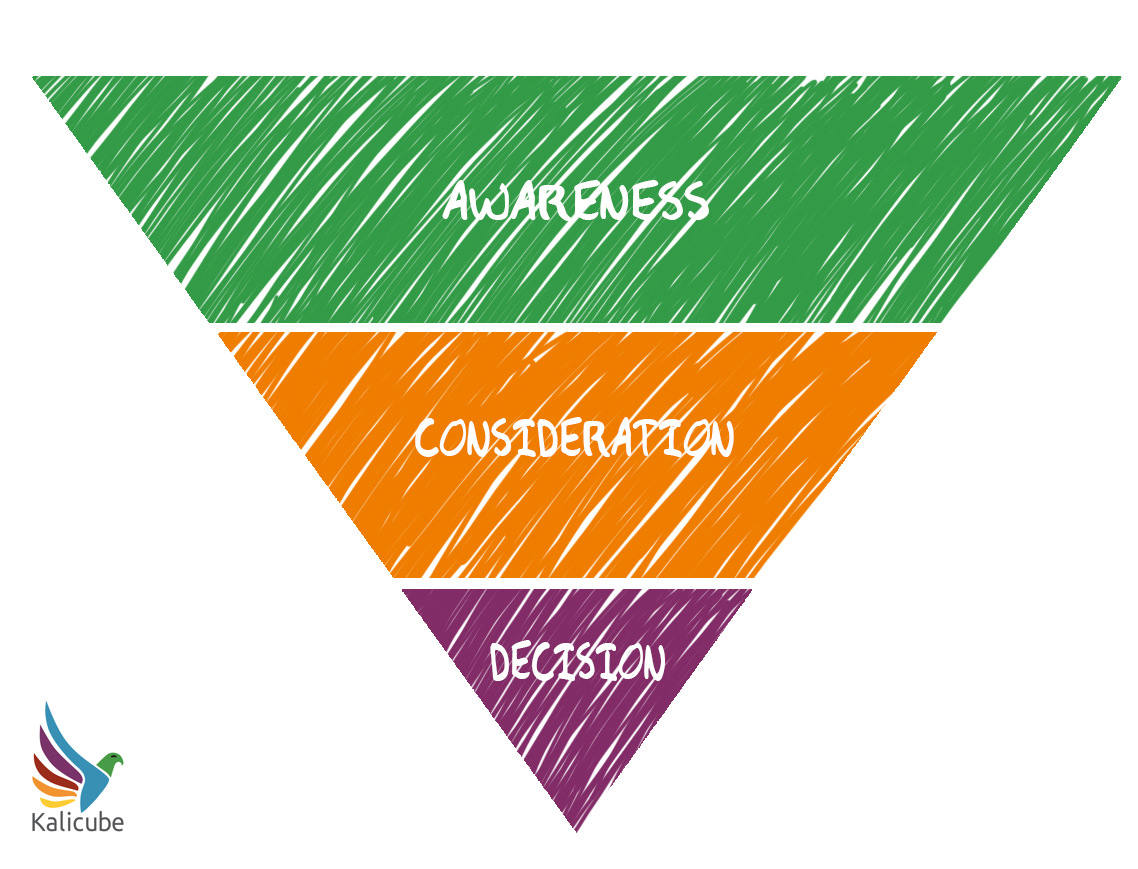
A typical three-step marketing acquisition funnel
Marketers often represent acquisition as a funnel with three stages:
- Awareness: Where the target audience becomes aware of a problem they need to solve and research to find the solution to that problem.
- Consideration: Where the user researches which providers (company or person) offer a viable solution, and narrows down their choices to a select few.
- Decision: Where the user makes their final choice about the most suitable solution for their problem and the best provider of that solution.
Google’s AI Overviews mimics the acquisition funnel
The aim of Google’s AI Overviews and Bing’s Copilot is to guide the user through the funnel from awareness to the final decision.
The assistive engine does this through a conversation between the human user and the machine. The user asks questions, and the assistive engine answers the question by:
- Providing answers in the form of summaries from information found around the web.
- Making research suggestions based on behavioral data, query pools and information from the web.
- Making recommendations about solution providers based on algorithmic evaluations of E-E-A-T (N-E-E-A-T) credibility.
How to build a successful strategy for Google’s AI Overviews
This strategy is universal. Bing Copilot, ChatGPT, Perplexity and Google Gemini all function the same way, and this approach satisfies the fundamental pillars and ticks all the right boxes.
The secret to optimizing for assistive search engines and assistive SERP features is to understand:
- How the algorithms find, digest and communicate your content to users in the SERP (traditional SEO).
- How your content fits into the funnel (marketing).
- That the “who” behind the content is key (entity optimization).
Only the last point requires skills and strategies that are new. Luckily, it is very simple since it focuses on how well the algorithms understand the website owner (generally a corporation, but sometimes a person) and the content creator (generally a person, but sometimes a corporation).
Focus on the nature of the conversation between the human and the machine
The human has a single goal: to find the best solution to their problem. The machine is designed to fulfill a single function: guide the human to the best solution to their problem. This is the perfect match.
The human starts this journey with sketchy knowledge of the problem, a very limited understanding of the possible solutions and little or no idea about credible solution providers.
The human is confident that the machine understands the problem, has an encyclopedic knowledge of the possible solutions and can reliably evaluate the credibility of the solution providers.
The machine/algorithm is in control.
The machine is single-minded about the funnel
The algorithms want to guide the human user down the funnel:
- Provide helpful research information and advice in a way that reduces the time and effort a person needs to invest in research.
- Identify the providers who can best solve the problem for the human user.
- Help the human user identify the solution provider they are comfortable with.
You need to become the focus of the conversation between machine and human
As an SEO, you must influence the algorithms to act in your favor and guide their users to you rather than your competitors.
Let’s look at the marketing funnel again, adding what you want the machine to do for you on the left-hand side.
Awareness
- If the human user is unaware of you, you want the assistive engine to introduce you to the conversation.
- If the user is aware of you, then you want to ensure it doesn’t lead the user away from you.
- The human user is mostly in control at this stage.
Consideration
- You are in the conversation, and you want the assistive engine to systematically place you first in every list of options and constantly re-introduce you to the conversation.
- The human user still feels in control but is unlikely to insist on you as a candidate for consideration if the assistive engine doesn’t naturally keep you in the conversation.
Decision
- The choice is being narrowed down to one. The perfect click.
- The assistive engine (or assistive search feature) is now in control.
- You need to ensure that it prioritizes you and doesn’t guide the human user toward your competitor as a better solution provider.
Get the daily newsletter search marketers rely on.
Steps you can take to become the focus of the conversation between machine and human
To create a situation where the assistive engine algorithms make you the focus of its conversation with human users:
- First, you must communicate understanding about who you are, what you offer and who you serve.
- Second, establish your credibility.
- Third, ensure that you provide deliverable content that will ensure the assistive engine reliably includes you in the conversation more often than not.
Your aim is to become the ideal candidate for the perfect click
Assistive engines like ChatGPT and assistive search features like Google’s AI Overviews aim to get the user to the perfect click within their own walled garden. Your aim is that the Perfect Click they choose to present to the user is you.
There is only one single perfect click. the perfect click is the click that converts. you cannot allow the perfect click to go to your competitor.
To get the perfect click, focus on three pillars in this order of importance:
- Understanding (you need to educate it about yourself).
- Credibility (you need to convince it you are the most legitimate solution provider).
- Deliverability (you need to provide the educational content that will encourage it to cite you as it guides people to the perfect click).
The key to optimizing for Google’s AI Overviews: Build the traditional marketing funnel
If you look at the illustration of the funnel above, it seems that we are building the funnel upside down. That is a question of perspective. A perspective that many people have
Google can only start to consider your credibility as a solution if it understands who you are, what you offer and who you serve.
Once it understands who you are and believes that you are a credible solution provider, it will be enthusiastic about introducing you to the conversation it is having with its human user.
Your content will only be a candidate for visibility on assistive features of search engines, answer engines and assistive engines if the algorithms understand you, your offer and your credibility.
These engines are designed to guide the human user down the funnel to the best (most credible or recommendable) solution to their problem.
They need to:
- Understand who you are (solution provider).
- Be convinced of your credibility and trustworthiness to deliver that solution.
- Have access to your branded content so it can deliver a convincing argument for you.
The last point is hugely important since it demonstrates that the assistive engines and their algorithms are delivering your sales pitch for you.
The perfect click as the future of SEO
How can you ensure that the assistive engines and assistive search features reliably and regularly bring the right people to the perfect click?
Tell search engines clearly who you are, what you do, and why you’re trustworthy. Then, provide detailed information so they can consistently recommend you to users and guide potential customers through your sales process, leading them to click directly on your most conversion-ready page.
Courtesy of Search Engine Land: News & Info About SEO, PPC, SEM, Search Engines & Search Marketing
Wednesday, June 26th, 2024
A new Google Ads tool – Cross-Media Reach Measurement – lets advertisers measure deduplicated, on-target reach and frequency across video campaigns.
Why it matters. This tool helps advertisers understand the efficiency of their YouTube video campaigns compared to TV, providing a comprehensive view of brand campaign performance.
Why we care. This tool essentially empowers advertisers to make more data-driven decisions, potentially leading to more effective branding campaigns and better use of advertising budgets across different media channels and over a long-term period.
How it works.
- Aggregates and deduplicates reach and frequency across multiple campaigns
- Shows total on-target reach for specific demographics
- Measures unique reach across different devices, formats, sites, apps and networks
Key features.
- Digital Video Only report: Available globally, measures reach and frequency for Google Ads video campaigns
- Digital Video + Traditional TV report: Available in select countries, combines Google Ads metrics with third-party TV data

How to use it.
- Access through the Measurement menu in Google Ads.
- Select country and video campaigns (preferably with Target CPM bidding).
- Generate reports for various age and gender groups over periods up to 92 days.
The big picture. This tool aims to help advertisers optimize their advertising investments by providing insights into campaign planning and performance across digital and traditional media.
What’s next. Advertisers can now use this tool to make more informed decisions about their video advertising strategies on YouTube and TV.
Courtesy of Search Engine Land: News & Info About SEO, PPC, SEM, Search Engines & Search Marketing
Monday, June 24th, 2024
Google is launching enhanced shopping features to help consumers navigate the upcoming summer sales season, responding to increased interest in online deals.
What’s new:
- Updated deals destination:
- – Shows freshest deals from across retailers in a carousel
- – Organizes promotions by product categories
- – Available on mobile and desktop in the U.S.

- Membership price display:
- – Shows regular prices alongside discounted costs for loyalty program members
- – Currently available for retailers like BestBuy, Petco, and Minted

Why we care. Retail advertisers might need to shift more focus towards promoting deals and special offers to appear in these new features.
Why it matters. With 44% of shoppers saying deal days prompt them to shop more than usual (according to Google/Ipsos Deal Days Survey), these tools aim to help consumers find the best discounts across retailers.
The big picture. These features leverage Google’s Shopping Graph, which contains 45 billion product listings, to provide a centralized shopping experience.
By the numbers.
- Online searches for “deals” spike in mid-July, surpassing interest in “vacation”
- 25% of people who regret purchases during big sales say it’s due to finding lower prices later
Between the lines. Google is positioning itself as a one-stop shop for deal-hunting, potentially increasing its importance in the e-commerce ecosystem.
Courtesy of Search Engine Land: News & Info About SEO, PPC, SEM, Search Engines & Search Marketing
Monday, June 24th, 2024
Google Ads is updating its EU user consent policy, affecting advertisers using Customer Match lists for ad personalization in the European Economic Area (EEA).
The big picture. This change aligns with increasing privacy regulations in Europe and Google’s efforts to ensure compliance.
Why it matters. Advertisers must now explicitly pass granted consent signals to Google to continue using Customer Match for personalized advertising in the EEA.
Why we care. This update puts more responsibility on advertisers to collect and transmit user consent, potentially impacting campaign reach and effectiveness.
How it works. Advertisers have four options to pass consent signals:
- Google Ads API
- Partner and Audience Partner API
- Manual input in Audience Manager (Google Ads UI)
- Conversion-based Customer lists (requires Consent Mode enabled)
First seen. This update was first seen on Thomas Eccel’s X post:
What’s next. Advertisers targeting EEA users need to implement one of these consent signal methods to maintain their Customer Match capabilities.
Bottom line. Failing to adapt to these new consent requirements could result in limited ad personalization options for EEA audiences.
Courtesy of Search Engine Land: News & Info About SEO, PPC, SEM, Search Engines & Search Marketing
Monday, June 24th, 2024
Google is rolling out automated Local Services Ads lead credits in July, streamlining the process for advertisers to receive credit for poor-quality leads.
Why it matters. This change aims to save time for advertisers and ensure more equitable distribution of ad credits, particularly benefiting those with limited resources. This will potentially affect advertisers’ budgets, lead quality and overall experience with the platform.
How it works:
- Google’s machine learning models will automatically review all leads.
- Invalid leads will be credited without manual disputes.
- Credits typically are applied within 30 days.
The big picture. Since launching in 2017, Local Services Ads have evolved, but the manual dispute system has become challenging to scale and vulnerable to gaming.
- This automation addresses disparities in lead disputing practices among advertisers and aims to improve overall lead quality.
Key changes.
- No more manual lead disputes are required.
- “Job type not serviced” and “geo not serviced” leads will no longer be credited.
- Overall, more leads are expected to be credited on average.
Exceptions. The system won’t apply to healthcare verticals or advertisers in EMEA.
What’s next. Advertisers are encouraged to provide feedback on every lead through the Lead Feedback survey to help improve future lead quality.
Between the lines. This shift reflects Google’s growing capability to use AI for quality control in its advertising products.
Courtesy of Search Engine Land: News & Info About SEO, PPC, SEM, Search Engines & Search Marketing